
Articles | Volume 22, issue 4
https://doi.org/10.5194/os-22-2357-2026
© Author(s) 2026. This work is distributed under
the Creative Commons Attribution 4.0 License.
the Creative Commons Attribution 4.0 License.
https://doi.org/10.5194/os-22-2357-2026
© Author(s) 2026. This work is distributed under
the Creative Commons Attribution 4.0 License.
the Creative Commons Attribution 4.0 License.
Research article
| 
05 Aug 2026
Research article |
| 05 Aug 2026
| 05 Aug 2026
Sea surface salinity downscaling using deep generative diffusion models
Enzo Forestier
CORRESPONDING AUTHOR

Laboratoire d’Océanographie et du Climat: Expérimentations et Approches Numériques (LOCEAN), UMR 7159, Sorbonne Université/CNRS/IRD/ Muséum national d’Histoire naturelle (MNHN), 4 place Jussieu, 75005 Paris, France
Luther Ollier
Laboratoire d’Océanologie et de Géosciences (LOG), UMR 8187, Université du Littoral Côte d'Opale (ULCO)/Université de Lille/CNRS, Wimereux, France
Roy El Hourany
Laboratoire d’Océanologie et de Géosciences (LOG), UMR 8187, Université du Littoral Côte d'Opale (ULCO)/Université de Lille/CNRS, Wimereux, France
Jacqueline Boutin
Laboratoire d’Océanographie et du Climat: Expérimentations et Approches Numériques (LOCEAN), UMR 7159, Sorbonne Université/CNRS/IRD/ Muséum national d’Histoire naturelle (MNHN), 4 place Jussieu, 75005 Paris, France
Carlos Mejia
Laboratoire d’Océanographie et du Climat: Expérimentations et Approches Numériques (LOCEAN), UMR 7159, Sorbonne Université/CNRS/IRD/ Muséum national d’Histoire naturelle (MNHN), 4 place Jussieu, 75005 Paris, France
Sylvie Thiria
Laboratoire d’Océanographie et du Climat: Expérimentations et Approches Numériques (LOCEAN), UMR 7159, Sorbonne Université/CNRS/IRD/ Muséum national d’Histoire naturelle (MNHN), 4 place Jussieu, 75005 Paris, France
Related authors
No articles found.
Ana Claudia Parracho, Patricia Zunino, Michela Sammartino, Jacqueline Boutin, Eric Greiner, Bruno Buongiorno Nardelli, and Nicolas Kolodziejczyk
State Planet, 7-osr10, 12, https://doi.org/10.5194/sp-7-osr10-12-2026, https://doi.org/10.5194/sp-7-osr10-12-2026, 2026
Short summary
Short summary
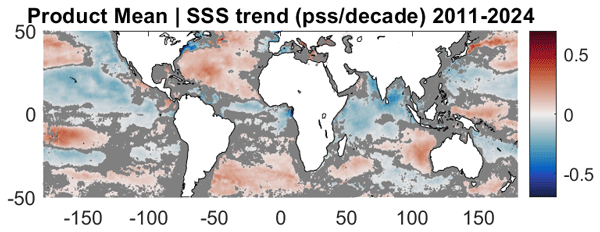
We compared six global sea surface salinity datasets and found consistent trends between them. Many regions follow the known pattern of fresh areas getting fresher and salty areas saltier, with a growing contrast between the North Atlantic and North Pacific. However, comparison with longer-term data shows that short-term trends are strongly shaped by natural climate variability, especially in the Pacific.
Marta Stentella, Ghislain Picard, Petra Heil, Jacqueline Boutin, Emmanuel Dinnat, and Stuart Corney
The Cryosphere, 20, 4465–4489, https://doi.org/10.5194/tc-20-4465-2026, https://doi.org/10.5194/tc-20-4465-2026, 2026
Short summary
Short summary
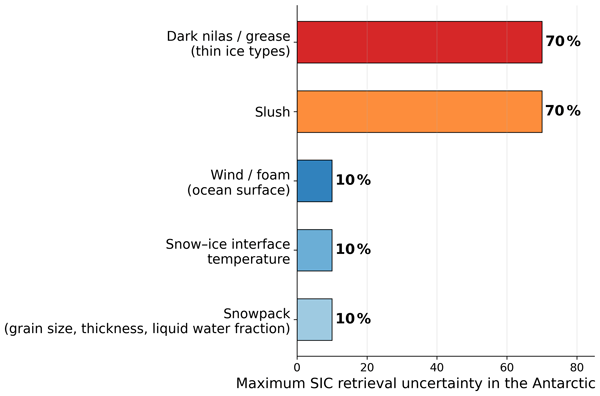
Passive microwave radiometers are the primary tool for monitoring Antarctic sea ice, but their reliability decreases in the marginal ice zone between the pack ice and the open ocean. We simulate satellite observations to assess the impact of varying physical parameters on sea ice concentration retrievals. The largest errors are due to flooded/wet snow, thin ice, and roughened ocean surfaces. These findings can improve our interpretation of satellite observations and forecast sea ice changes.
Angelina Cassianides, Marina Levy, Clément Haëck, Ines Mangolte, Roy El Hourany, Michela Sammartino, and Bruno Buongiorno Nardelli
EGUsphere, https://doi.org/10.5194/egusphere-2026-3531, https://doi.org/10.5194/egusphere-2026-3531, 2026
Short summary
Short summary
Oceanic fronts are common features considered as biodiversity hotspots. Using satellite data, we quantified how fronts affect phytoplankton growth, the base of the marine food web, and its community in the Mediteranean Sea. We show that phytoplankton are systematically enhanced, especially in nutrient-poor area, while the community structure shifts to favor larger organisms like diatoms. However, these ecological impacts depend on both the method and the nature of the dataset used.
Léa Olivier, Jacqueline Boutin, Gilles Reverdin, Christopher Hunt, Thomas Linkowski, Alison Chase, Nils Haentjens, Pedro C. Junger, Stéphane Pesant, and Douglas Vandemark
Earth Syst. Sci. Data, 17, 3583–3598, https://doi.org/10.5194/essd-17-3583-2025, https://doi.org/10.5194/essd-17-3583-2025, 2025
Short summary
Short summary
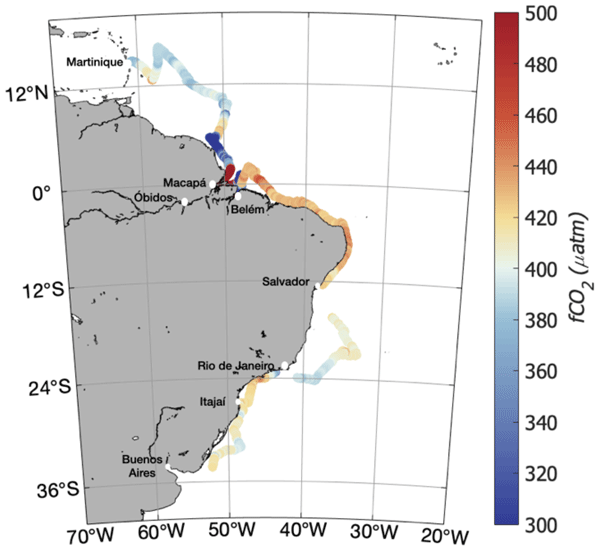
The air–sea CO2 flux in coastal waters plays a key role in the global carbon budget but remains poorly understood. In 2021, the Tara schooner collected 14 000 km of CO2 fugacity (fCO2) data along the South American coast. This dataset improves our understanding of fCO2 in the under-sampled Brazilian coastal region and provides a unique insight into the complex biogeochemistry of the Amazon River–ocean continuum.
Kirtana Naëck, Jacqueline Boutin, Sebastiaan Swart, Marcel du Plessis, Liliane Merlivat, Laurence Beaumont, Antonio Lourenco, Francesco d'Ovidio, Louise Rousselet, Brian Ward, and Jean-Baptiste Sallée
Biogeosciences, 22, 1947–1968, https://doi.org/10.5194/bg-22-1947-2025, https://doi.org/10.5194/bg-22-1947-2025, 2025
Short summary
Short summary
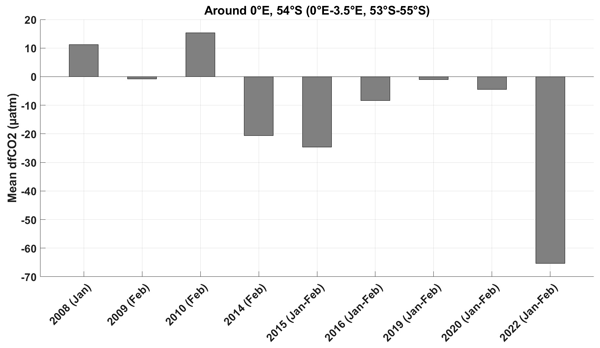
In summer 2022, a CARbon Interface OCean Atmosphere (CARIOCA) drifting buoy observed an anomalously strong ocean carbon sink in the subpolar Southern Ocean associated with large plumes of chlorophyll a. Lagrangian backward trajectories indicate that these waters originated from the sea ice edge in spring 2021. Our study highlights the northward migration of the CO2 sink associated with early sea ice retreat.
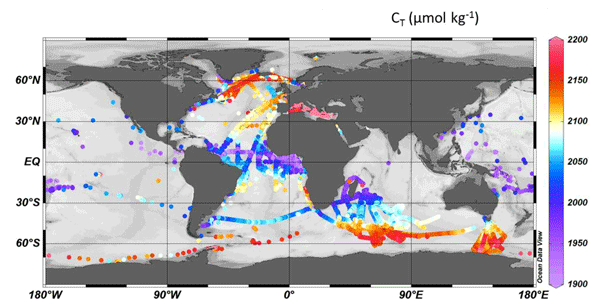
Nicolas Metzl, Jonathan Fin, Claire Lo Monaco, Claude Mignon, Samir Alliouane, Bruno Bombled, Jacqueline Boutin, Yann Bozec, Steeve Comeau, Pascal Conan, Laurent Coppola, Pascale Cuet, Eva Ferreira, Jean-Pierre Gattuso, Frédéric Gazeau, Catherine Goyet, Emilie Grossteffan, Bruno Lansard, Dominique Lefèvre, Nathalie Lefèvre, Coraline Leseurre, Sébastien Petton, Mireille Pujo-Pay, Christophe Rabouille, Gilles Reverdin, Céline Ridame, Peggy Rimmelin-Maury, Jean-François Ternon, Franck Touratier, Aline Tribollet, Thibaut Wagener, and Cathy Wimart-Rousseau
Earth Syst. Sci. Data, 17, 1075–1100, https://doi.org/10.5194/essd-17-1075-2025, https://doi.org/10.5194/essd-17-1075-2025, 2025
Short summary
Short summary
This work presents a new synthesis of 67 000 total alkalinity and total dissolved inorganic carbon observations obtained between 1993 and 2023 in the global ocean, coastal zones, and the Mediterranean Sea. We describe the data assemblage and associated quality control and discuss some potential uses of this dataset. The dataset is provided in a single format and includes the quality flag for each sample.
Stéphane Doléac, Marina Lévy, Roy El Hourany, and Laurent Bopp
Biogeosciences, 22, 841–862, https://doi.org/10.5194/bg-22-841-2025, https://doi.org/10.5194/bg-22-841-2025, 2025
Short summary
Short summary
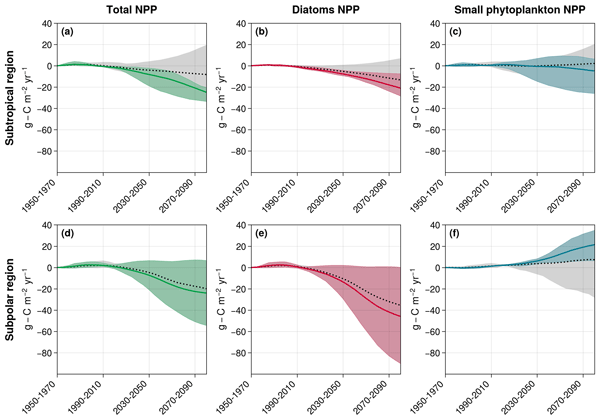
The marine biogeochemistry components of Coupled Model Intercomparison Project phase 6 (CMIP6) models vary widely in their process representations. Using an innovative bioregionalization of the North Atlantic, we reveal that this model diversity largely drives the divergence in net primary production projections under a high-emission scenario. The identification of the most mechanistically realistic models allows for a substantial reduction in projection uncertainty.
Georges Baaklini, Julien Brajard, Leila Issa, Gina Fifani, Laurent Mortier, and Roy El Hourany
Ocean Sci., 20, 1707–1720, https://doi.org/10.5194/os-20-1707-2024, https://doi.org/10.5194/os-20-1707-2024, 2024
Short summary
Short summary
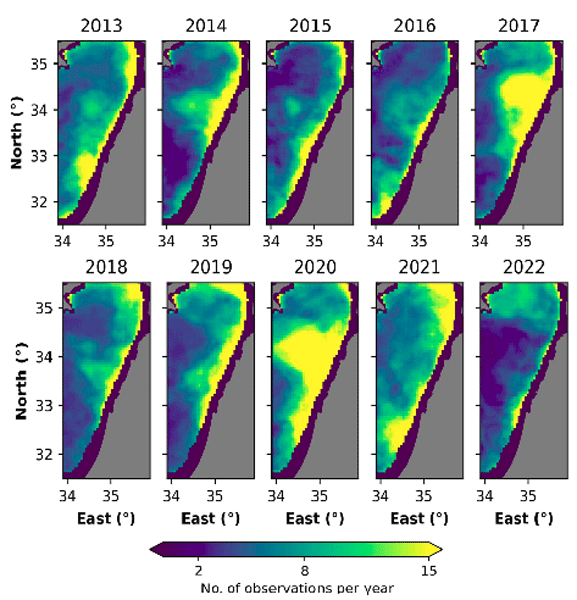
Understanding the flow of the Levantine Sea surface current is not straightforward. We propose a study based on learning techniques to follow interactions between water near the shore and further out at sea. Our results show changes in the coastal currents past 33.8° E, with frequent instances of water breaking away along the Lebanese coast. These events happen quickly and sometimes lead to long-lasting eddies. This study underscores the need for direct observations to improve our knowledge.
Clovis Thouvenin-Masson, Jacqueline Boutin, Vincent Échevin, Alban Lazar, and Jean-Luc Vergely
Ocean Sci., 20, 1547–1566, https://doi.org/10.5194/os-20-1547-2024, https://doi.org/10.5194/os-20-1547-2024, 2024
Short summary
Short summary
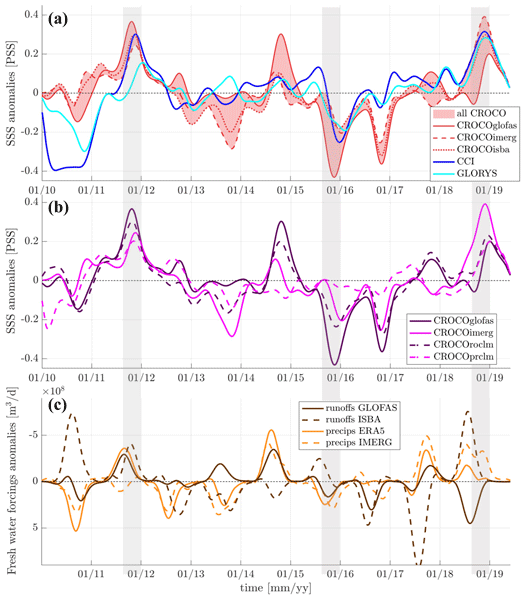
We focus on understanding the impact of river runoff and precipitation on sea surface salinity (SSS) in the eastern North Tropical Atlantic (e-NTA) region off northwestern Africa. By analyzing regional simulations and observational data, we find that river flows significantly influence SSS variability, particularly after the rainy season. Our findings underscore that a main source of uncertainty representing SSS variability in this region is from river runoff estimates.
Roy El Hourany, Juan Pierella Karlusich, Lucie Zinger, Hubert Loisel, Marina Levy, and Chris Bowler
Ocean Sci., 20, 217–239, https://doi.org/10.5194/os-20-217-2024, https://doi.org/10.5194/os-20-217-2024, 2024
Short summary
Short summary
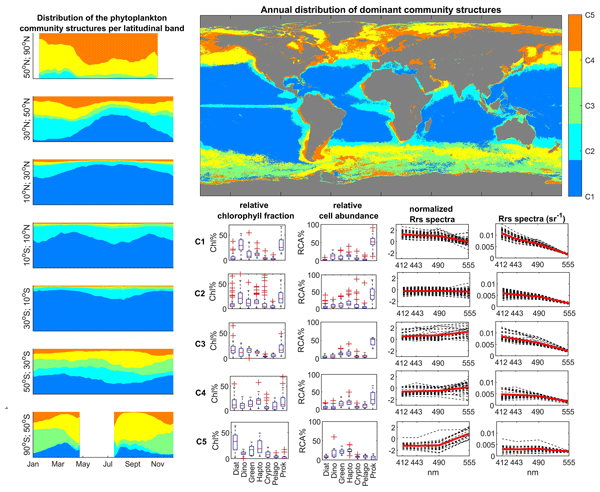
Satellite observations offer valuable information on phytoplankton abundance and community structure. Here, we employ satellite observations to infer seven phytoplankton groups at a global scale based on a new molecular method from Tara Oceans. The link has been established using machine learning approaches. The output of this work provides excellent tools to collect essential biodiversity variables and a foundation to monitor the evolution of marine biodiversity.
Nicolas Metzl, Jonathan Fin, Claire Lo Monaco, Claude Mignon, Samir Alliouane, David Antoine, Guillaume Bourdin, Jacqueline Boutin, Yann Bozec, Pascal Conan, Laurent Coppola, Frédéric Diaz, Eric Douville, Xavier Durrieu de Madron, Jean-Pierre Gattuso, Frédéric Gazeau, Melek Golbol, Bruno Lansard, Dominique Lefèvre, Nathalie Lefèvre, Fabien Lombard, Férial Louanchi, Liliane Merlivat, Léa Olivier, Anne Petrenko, Sébastien Petton, Mireille Pujo-Pay, Christophe Rabouille, Gilles Reverdin, Céline Ridame, Aline Tribollet, Vincenzo Vellucci, Thibaut Wagener, and Cathy Wimart-Rousseau
Earth Syst. Sci. Data, 16, 89–120, https://doi.org/10.5194/essd-16-89-2024, https://doi.org/10.5194/essd-16-89-2024, 2024
Short summary
Short summary
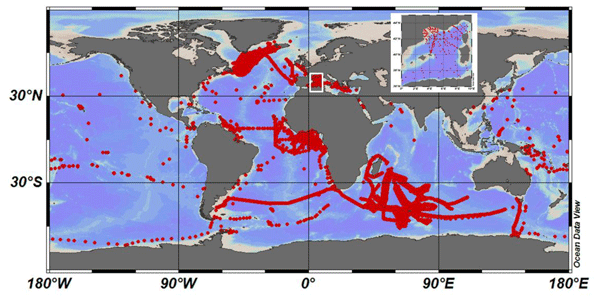
This work presents a synthesis of 44 000 total alkalinity and dissolved inorganic carbon observations obtained between 1993 and 2022 in the Global Ocean and the Mediterranean Sea at the surface and in the water column. Seawater samples were measured using the same method and calibrated with international Certified Reference Material. We describe the data assemblage, quality control and some potential uses of this dataset.
Georges Baaklini, Roy El Hourany, Milad Fakhri, Julien Brajard, Leila Issa, Gina Fifani, and Laurent Mortier
Ocean Sci., 18, 1491–1505, https://doi.org/10.5194/os-18-1491-2022, https://doi.org/10.5194/os-18-1491-2022, 2022
Short summary
Short summary
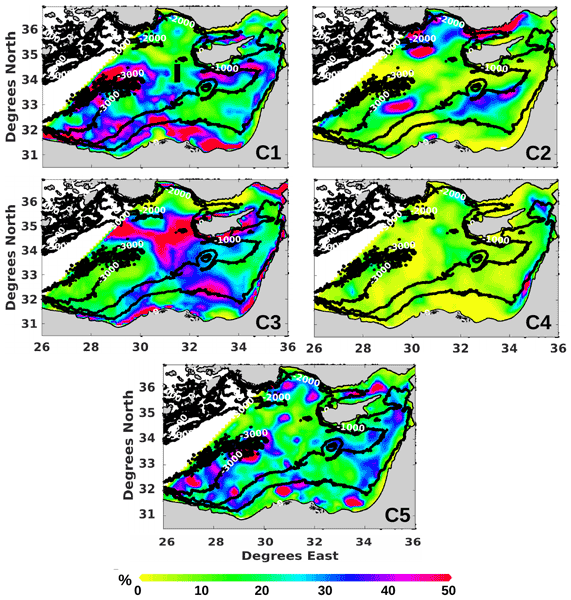
We use machine learning to analyze the long-term variation of the surface currents in the Levantine Sea, located in the eastern Mediterranean Sea. We decompose the circulation into groups based on their physical characteristics and analyze their spatial and temporal variability. We show that most structures of the Levantine Sea are becoming more energetic over time, despite those of the western area remaining the most dominant due to their complex bathymetry and strong currents.

Liliane Merlivat, Michael Hemming, Jacqueline Boutin, David Antoine, Vincenzo Vellucci, Melek Golbol, Gareth A. Lee, and Laurence Beaumont
Biogeosciences, 19, 3911–3920, https://doi.org/10.5194/bg-19-3911-2022, https://doi.org/10.5194/bg-19-3911-2022, 2022
Short summary
Short summary
We use in situ high-temporal-resolution measurements of dissolved inorganic carbon and atmospheric parameters at the air–sea interface to analyse phytoplankton bloom initiation identified as the net rate of biological carbon uptake in the Mediterranean Sea. The shift from wind-driven to buoyancy-driven mixing creates conditions for blooms to begin. Active mixing at the air–sea interface leads to the onset of the surface phytoplankton bloom due to the relaxation of wind speed following storms.
Michael P. Hemming, Jan Kaiser, Jacqueline Boutin, Liliane Merlivat, Karen J. Heywood, Dorothee C. E. Bakker, Gareth A. Lee, Marcos Cobas García, David Antoine, and Kiminori Shitashima
Ocean Sci., 18, 1245–1262, https://doi.org/10.5194/os-18-1245-2022, https://doi.org/10.5194/os-18-1245-2022, 2022
Short summary
Short summary
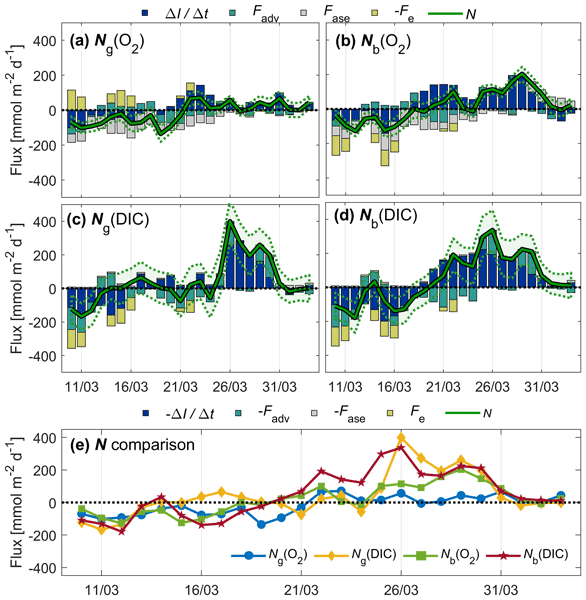
An underwater glider mission was carried out in spring 2016 near a mooring in the northwestern Mediterranean Sea. The glider deployment served as a test of a prototype ion-sensitive field-effect transistor pH sensor. Mean net community production rates were estimated from glider and buoy measurements of dissolved oxygen and inorganic carbon concentrations before and during the spring bloom. Incorporating advection is important for accurate mass budgets. Unexpected metabolic quotients were found.
Léa Olivier, Jacqueline Boutin, Gilles Reverdin, Nathalie Lefèvre, Peter Landschützer, Sabrina Speich, Johannes Karstensen, Matthieu Labaste, Christophe Noisel, Markus Ritschel, Tobias Steinhoff, and Rik Wanninkhof
Biogeosciences, 19, 2969–2988, https://doi.org/10.5194/bg-19-2969-2022, https://doi.org/10.5194/bg-19-2969-2022, 2022
Short summary
Short summary
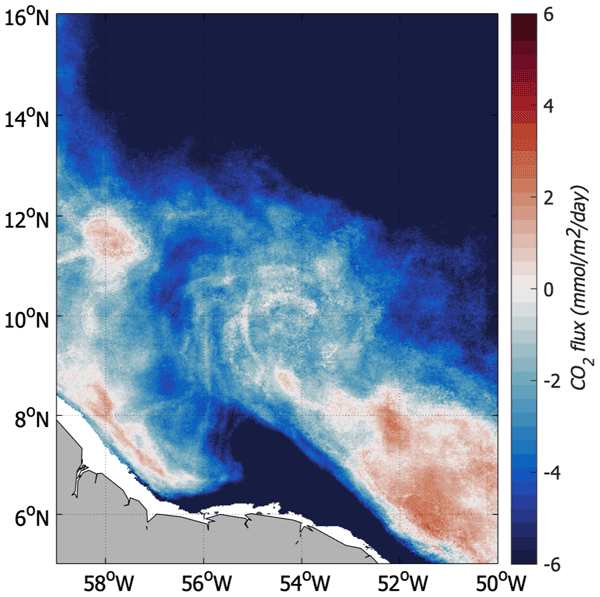
We investigate the impact of the interactions between eddies and the Amazon River plume on the CO2 air–sea fluxes to better characterize the ocean carbon sink in winter 2020. The region is a strong CO2 sink, previously underestimated by a factor of 10 due to a lack of data and understanding of the processes responsible for the variability in ocean carbon parameters. The CO2 absorption is mainly driven by freshwater from the Amazon entrained by eddies and by the winter seasonal cooling.
Cited articles
Archer, M., Wang, J., Klein, P., Dibarboure, G., and Fu, L.-L.: Wide-swath satellite altimetry unveils global submesoscale ocean dynamics, Nature, 640, 691–696, 2025. a
Boutin, J., Martin, N., Reverdin, G., Morisset, S., Yin, X., Centurioni, L., and Reul, N.: Sea surface salinity under rain cells: SMOS satellite and in situ drifters observations, J. Geophys. Res.-Oceans, 119, 5533–5545, https://doi.org/10.1002/2014JC010070, 2014. a, b
Boutin, J., Reul, N., Koehler, J., Martin, A., Catany, R., Guimbard, S., Rouffi, F., Vergely, J.-L., Arias, M., Chakroun, M., Corato, G., Gabia, G., Hasson, A., Josey, S. A., Supply, A., Thouvenin-Masson, C., Turiel, A., Vialard, J., and Waldteufel, P.: Satellite-Based Sea Surface Salinity Designed for Ocean and Climate Studies, J. Geophys. Res.-Oceans, 126, e2021JC017676, https://doi.org/10.1029/2021JC017676, 2021. a, b, c, d
Chassignet, E. P. and Xu, X.: Impact of Horizontal Resolution (
Chin, T. M., Vazquez-Cuervo, J., and Armstrong, E. M.: A multi-scale high-resolution analysis of global sea surface temperature, Remote Sens. Environ., https://doi.org/10.1016/j.rse.2017.07.029, 2017. a
Chung, H., Kim, J., Mccann, M. T., Klasky, M. L., and Ye, J. C.: Diffusion Posterior Sampling for General Noisy Inverse Problems, arXiv [preprint], https://doi.org/10.48550/arXiv.2209.14687, 2024. a, b
Donlon, C. J., Martin, M., Stark, J., Roberts-Jones, J., Fiedler, E., and Wimmer, W.: The Operational Sea Surface Temperature and Sea Ice Analysis (OSTIA) system, Remote Sens. Environ., 116, 140–158, https://doi.org/10.1016/j.rse.2010.10.017, 2012. a
Embury, O., Merchant, C. J., Good, S. A., Rayner, N. A., Høyer, J. L., Atkinson, C., Block, T., Alerskans, E., Pearson, K. J., Worsfold, M., McCarroll, N., and Donlon, C.: Satellite-based time-series of sea-surface temperature since 1980 for climate applications, Sci. Data, 11, 326, https://doi.org/10.1038/s41597-024-03147-w, 2024. a
E.U. Copernicus Marine Service Information: Global Ocean Physics Reanalysis, Marine Data Store [data set], https://doi.org/10.48670/moi-00021, 2023. a
Fablet, R., Chapron, B., Drumetz, L., Pannekoucke, O., Raynaud, R., and Ménard, R.: Joint interpolation and representation learning for irregularly sampled satellite-derived geophysical fields, Front. Appl. Math. Stat., 7, 655224, https://doi.org/10.3389/fams.2021.655224, 2021. a
Finn, T. S., Durand, C., Farchi, A., Bocquet, M., Rampal, P., and Carrassi, A.: Generative diffusion for regional surrogate models from sea-ice simulations, J. Adv. Model. Earth Sy., 16, e2024MS004395, https://doi.org/10.1029/2024MS004395, 2024. a
Joyce, T. M., Kwon, Y.-O., Seo, H., and Ummenhofer, C. C.: Meridional Gulf Stream Shifts Can Influence Wintertime Variability in the North Atlantic Storm Track and Greenland Blocking, Geophys. Res. Lett., 46, 1702–1708, https://doi.org/10.1029/2018GL081087, 2019a. a, b
Joyce, T. M., Kwon, Y.-O., Seo, H., and Ummenhofer, C. C.: Meridional Gulf Stream Shifts Can Influence Wintertime Variability in the North Atlantic Storm Track and Greenland Blocking, Geophys. Res. Lett., 46, 1702–1708, https://doi.org/10.1029/2018GL081087, 2019b. a, b
Kerr, Y. H., Waldteufel, P., Wigneron, J.-P., Delwart, S., Cabot, F., Boutin, J., Escorihuela, M.-J., Font, J., Reul, N., Gruhier, C., Juglea, S. E., Drinkwater, M. R., Hahne, A., Martín-Neira, M., and Mecklenburg, S.: The SMOS mission: New tool for monitoring key elements of the global water cycle, P. IEEE, 98, 666–687, https://doi.org/10.1109/JPROC.2010.2043032, 2010. a
Lagerloef, G., Colomb, F. R., Le Vine, D., Wentz, F., Yueh, S., Ruf, C., Lilly, J., Gunn, J., Chao, Y., deCharon, A., Feldman, G., and Swift, C.: The Aquarius/SAC-D mission: Designed to meet the salinity remote-sensing challenge, Oceanography, 21, 68–81, https://doi.org/10.5670/oceanog.2008.68, 2008. a
Le Traon, P. Y., Reppucci, A., Alvarez Fanjul, E., Aouf, L., Behrens, A., Belmonte, M., Bentamy, A., Bertino, L., Brando, V. E., Kreiner, M. B., Benkiran, M., Carval, T., Ciliberti, S. A., Claustre, H., Clementi, E., Coppini, G., Cossarini, G., De Alfonso Alonso-Muñoyerro, M., Delamarche, A., Dibarboure, G., Dinessen, F., Drevillon, M., Drillet, Y., Faugere, Y., Fernández, V., Fleming, A., Garcia-Hermosa, M. I., Sotillo, M. G., Garric, G., Gasparin, F., Giordan, C., Gehlen, M., Gregoire, M. L., Guinehut, S., Hamon, M., Harris, C., Hernandez, F., Hinkler, J. B., Hoyer, J., Karvonen, J., Kay, S., King, R., Lavergne, T., Lemieux-Dudon, B., Lima, L., Mao, C., Martin, M. J., Masina, S., Melet, A., Buongiorno Nardelli, B., Nolan, G., Pascual, A., Pistoia, J., Palazov, A., Piolle, J. F., Pujol, M. I., Pequignet, A. C., Peneva, E., Pérez Gómez, B., Petit de la Villeon, L., Pinardi, N., Pisano, A., Pouliquen, S., Reid, R., Remy, E., Santoleri, R., Siddorn, J., She, J., Staneva, J., Stoffelen, A., Tonani, M., Vandenbulcke, L., von Schuckmann, K., Volpe, G., Wettre, C., and Zacharioudaki, A.: From Observation to Information and Users: The Copernicus Marine Service Perspective, Front. Mar. Sci., 6, 2019, https://doi.org/10.3389/fmars.2019.00234, 2019. a
Ledig, C., Theis, L., Huszár, F., Caballero, J., Cunningham, A., Acosta, A., Aitken, A., Tejani, A., Totz, J., Wang, Z., and Shi, W.: Photo-Realistic Single Image Super-Resolution Using a Generative Adversarial Network, in: Proceedings of the IEEE Conference on Computer Vision and Pattern Recognition (CVPR), 105–114, https://doi.org/10.1109/CVPR.2017.19, 2017. a, b
Lellouche, J.-M., Greiner, E., Bourdallé-Badie, R., Garric, G., Melet, A., Drévillon, M., Bricaud, C., Hamon, M., Le Galloudec, O., Regnier, C., Candela, T., Testut, C.-E., Gasparin, F., Ruggiero, G., Benkiran, M., Drillet, Y., and Le Traon, P.-Y.: The Copernicus Global
Mardani, M., Brenowitz, N., Cohen, Y., Pathak, J., Chen, C.-Y., Liu, C.-C., Vahdat, A., Nabian, M. A., Ge, T., Subramaniam, A., Kashinath, K., Kautz, J., and Pritchard, M.: Generative residual diffusion modeling for km-scale atmospheric downscaling, arXiv [preprint], https://doi.org/10.48550/arXiv.2309.15214, 2023. a
Morrow, R., Fu, L.-L., Ardhuin, F., Benkiran, M., Chapron, B., Cosme, E., d’Ovidio, F., Farrar, J. T., Gille, S. T., Lapeyre, G., Le Traon, P.-Y., Pascual, A., Ponte, A., Qiu, B., Rascle, N., Ubelmann, C., Wang, J., and Zaron, E. D.: Global Observations of Fine-Scale Ocean Surface Topography With the Surface Water and Ocean Topography (SWOT) Mission, Front. Mar. Sci., 6, 2019, https://doi.org/10.3389/fmars.2019.00232, 2019. a
Nichol, A. Q. and Dhariwal, P.: Improved Denoising Diffusion Probabilistic Models, arXiv [preprint], https://doi.org/10.48550/arXiv.2102.09672, 2021. a, b
Olmedo, E., Martínez, J., Umbert, M., Hoareau, N., Portabella, M., Ballabrera-Poy, J., and Turiel, A.: Improving time and space resolution of SMOS salinity maps using multifractal fusion, Remote Sens. Environ., 180, 246–263, https://doi.org/10.1016/j.rse.2016.02.038, 2016. a
Piepmeier, J. R., Focardi, P., Horgan, K. A., Knuble, J., Ehsan, N., Lucey, J., Brambora, C., Brown, P. R., Hoffman, P. J., French, R. T., Mikhaylov, R. L., Kwack, E.-Y., Slimko, E. M., Dawson, D. E., Hudson, D., Peng, J., Mohammed, P. N., De Amici, G., Freedman, A. P., Medeiros, J., Sacks, F., Estep, R., Spencer, M. W., Chen, C. W., Wheeler, K. B., Edelstein, W. N., O'Neill, P. E., and Njoku, E. G.: SMAP L-band microwave radiometer: Instrument design and first year on orbit, IEEE T. Geosci. Remote S., 55, 1954–1966, https://doi.org/10.1109/TGRS.2016.2631978, 2017. a
Reul, N., Grodsky, S. A., Arias, M., Boutin, J., Catany, R., Chapron, B., D’Amico, F., Dinnat, E. P., Donlon, C., Fore, A., Fournier, S., Guimbard, S., Hasson, A., Kolodziejczyk, N., Lagerloef, G., Lee, T., Le Vine, D. M., Lindstrom, E., Maes, C., Mecklenburg, S., Meissner, T., Olmedo, E., Sabia, R., Tenerelli, J., Thouvenin-Masson, C., Turiel, A., Vergely, J.-L., Vinogradova, N., Wentz, F., and Yueh, S.: Sea surface salinity estimates from spaceborne L-band radiometers: An overview of the first decade of observation (2010–2019), Remote Sens. Environ., 242, 111769, https://doi.org/10.1016/j.rse.2020.111769, 2020. a, b, c, d
Reverdin, G., Supply, A., Boutin, J., and Yin, X.: Missing Argo float profiles in highly stratified waters of the Amazon River plume, J. Atmos. Ocean. Tech., 41, 221–233, https://doi.org/10.1175/JTECH-D-23-0072.1, 2024. a, b, c
Rombach, R., Blattmann, A., Lorenz, D., Esser, P., and Ommer, B.: High-resolution image synthesis with latent diffusion models, in: Proceedings of the IEEE/CVF Conference on Computer Vision and Pattern Recognition (CVPR), 10684–10695, https://doi.org/10.1109/CVPR52688.2022.01042, 2022. a, b
Ronneberger, O., Fischer, P., and Brox, T.: U-Net: Convolutional Networks for Biomedical Image Segmentation, in: Medical Image Computing and Computer-Assisted Intervention – MICCAI 2015, edited by Navab, N., Hornegger, J., Wells, W. M., and Frangi, A., vol. 9351 of Lecture Notes in Computer Science, Springer, 234–241, https://doi.org/10.1007/978-3-319-24574-4_28, 2015. a
Thiria, S., Sorror, C., Archambault, T., Charantonis, A., Béréziat, D., Mejia, C., Molines, J.-M., and Crépon, M.: Downscaling of ocean fields by fusion of heterogeneous observations using deep learning algorithms, Ocean Model., 182, 102174, https://doi.org/10.1016/j.ocemod.2023.102174, 2023. a, b
Tomasi, E., Franch, G., and Cristoforetti, M.: Can AI be enabled to perform dynamical downscaling? A latent diffusion model to mimic kilometer-scale COSMO5.0_CLM9 simulations, Geosci. Model Dev., 18, 2051–2078, https://doi.org/10.5194/gmd-18-2051-2025, 2025. a
Vinogradova, N., Lee, T., Boutin, J., Drushka, K., Fournier, S., Sabia, R., Stammer, D., Bayler, E., Reul, N., Gordon, A., Melnichenko, O., Li, L., Hackert, E., Martin, M., Kolodziejczyk, N., Hasson, A., Brown, S., Misra, S., and Lindstrom, E.: Satellite salinity observing system: Recent discoveries and the way forward, Front. Mar. Sci., 6, 243, https://doi.org/10.3389/fmars.2019.00243, 2019. a, b
Wang, Z., Bovik, A. C., Sheikh, H. R., and Simoncelli, E. P.: Image Quality Assessment: From Error Visibility to Structural Similarity, IEEE T. Image Process., 13, 600–612, https://doi.org/10.1109/TIP.2003.819861, 2004. a, b, c
Watt, R. A. and Mansfield, L. A.: Generative diffusion-based downscaling for climate, arXiv [preprint], https://doi.org/10.48550/arXiv.2404.17752, 2024. a
Wu, R., Jia, L., Li, C., Liu, Y., Han, B., and Chen, D.: Impact of Horizontal Resolution (Submesoscale Permitting vs. Mesoscale Resolving) on Ocean Dynamic Features in the South China Sea, Earth Space Sci., 9, e2022EA002448, https://doi.org/10.1029/2022EA002448, 2022. a
Zhai, X., Johnson, H. L., and Marshall, D. P.: On the Seasonal Variability of Eddy Kinetic Energy in the Gulf Stream Region, Geophys. Res. Lett., 35, L24609, https://doi.org/10.1029/2008GL036412, 2008. a, b
Short summary
This study evaluates deep generative diffusion models for downscaling sea surface salinity in the Gulf Stream. Using a reanalysis dataset as a controlled framework, it assesses the added value of high-resolution sea surface temperature and sea surface height as auxiliary constraints. The results show that diffusion-based reconstructions preserve plausible fine-scale variability, highlighting the method’s potential for future applications to satellite products.
This study evaluates deep generative diffusion models for downscaling sea surface salinity in...


