
Articles | Volume 22, issue 3
https://doi.org/10.5194/os-22-1937-2026
© Author(s) 2026. This work is distributed under
the Creative Commons Attribution 4.0 License.
the Creative Commons Attribution 4.0 License.
https://doi.org/10.5194/os-22-1937-2026
© Author(s) 2026. This work is distributed under
the Creative Commons Attribution 4.0 License.
the Creative Commons Attribution 4.0 License.
Research article
| 
23 Jun 2026
Research article |
| 23 Jun 2026
| 23 Jun 2026
Investigating the predictability of marine heatwaves at subseasonal to seasonal timescales in New Caledonia, South Pacific
Inès Mangolte
CORRESPONDING AUTHOR

ENTROPIE (Institute of Research for Development (IRD) / University of New Caledonia / University of Reunion / IFREMER), Promenade Roger-Laroque, 98848 Noumea Cedex, New Caledonia, France
EMR9001 SantEco (CNRS / Institute of Research for Development (IRD) / University of New Caledonia / University of Reunion), Promenade Roger-Laroque, 98848 Noumea Cedex, New Caledonia, France
Sophie Cravatte
Institute of Research for Development (IRD) campus, Promenade Roger-Laroque, 98848 Noumea Cedex, New Caledonia, France
LEGOS (Université de Toulouse/CNES/CNRS/IRD), Toulouse, France
Alexandre Ganachaud
Institute of Research for Development (IRD) campus, Promenade Roger-Laroque, 98848 Noumea Cedex, New Caledonia, France
LEGOS (Université de Toulouse/CNES/CNRS/IRD), Toulouse, France
MARBEC (Université Montpellier/CNRS/Ifremer/IRD), Sète, France
Christophe Menkes
ENTROPIE (Institute of Research for Development (IRD) / University of New Caledonia / University of Reunion / IFREMER), Promenade Roger-Laroque, 98848 Noumea Cedex, New Caledonia, France
EMR9001 SantEco (CNRS / Institute of Research for Development (IRD) / University of New Caledonia / University of Reunion), Promenade Roger-Laroque, 98848 Noumea Cedex, New Caledonia, France
Related authors
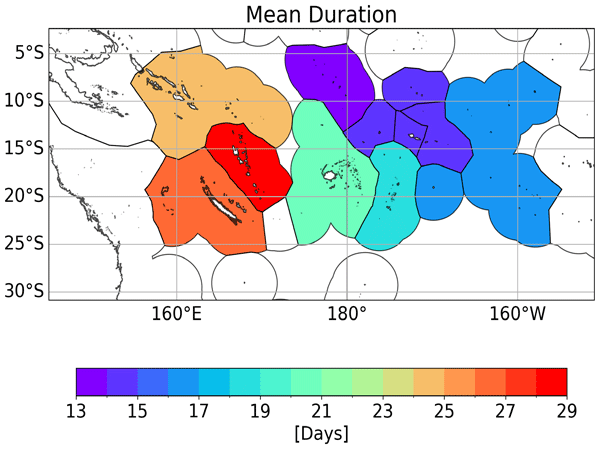
Shilpa Lal, Sophie Cravatte, Christophe Menkes, Jed Macdonald, Romain Le Gendre, Ines Mangolte, Cyril Dutheil, Neil J. Holbrook, and Simon Nicol
Ocean Sci., 22, 1023–1049, https://doi.org/10.5194/os-22-1023-2026, https://doi.org/10.5194/os-22-1023-2026, 2026
Short summary
Short summary
This paper characterizes historical (1981–2023) marine heatwaves in the tropical southwestern Pacific, where they pose a challenge for marine resource dependent Islands. Heatwaves are distinguished as a function of their spatial extent, signature at the coast, and seasonality, to allow a better understanding of their impacts on ecosystems. Marine heatwaves are getting longer and more frequent, with greater spatial extents. Our results aim to inform the Pacific Islands on their vulnerability.
Lionel Gourdeau, Nadia Ayoub, Arne Bendinger, Sophie Cravatte, Rosemary Morrow, Mei-Ling Dabat, Fabien Léger, and Oscar Vergara
EGUsphere, https://doi.org/10.5194/egusphere-2026-5846, https://doi.org/10.5194/egusphere-2026-5846, 2026
This preprint is open for discussion and under review for Earth Observation (EO).
Short summary
Short summary
For decades, conventional altimeters have observed sea surface height features of hundreds of km. The recent SWOT satellite provides unprecedented observations of fine-scale ocean features down to 15 km. This study shows in a test region that with specific processing of their high-resolution data, conventional altimeters can also capture features down to 20 km, and offer a rich long-term dataset to improve our knowledge of ocean fine-scale processes alongside and beyond the SWOT mission.
Salomé Domergue, Martine Rodier, Cécile Dupouy, Maxime Duphil, David Varillon, Amandine Delepierre, Anne Desnues, Sylvie Fiat, and Christophe Menkes
Earth Syst. Sci. Data Discuss., https://doi.org/10.5194/essd-2026-653, https://doi.org/10.5194/essd-2026-653, 2026
Preprint under review for ESSD
Short summary
Short summary
For over 12 years, MOISE station has monitored coastal waters in the Southwest lagoon of New Caledonia, measuring physical and biogeochemical parameters through water column profiles, surface and bottom sampling, and current measurements. Results reveal clear seasonal and interannual variability, and strong short-term changes driven by tropical cyclones and rainfall. This long-term dataset provides a baseline to study lagoon ecosystem dynamics under climate change.
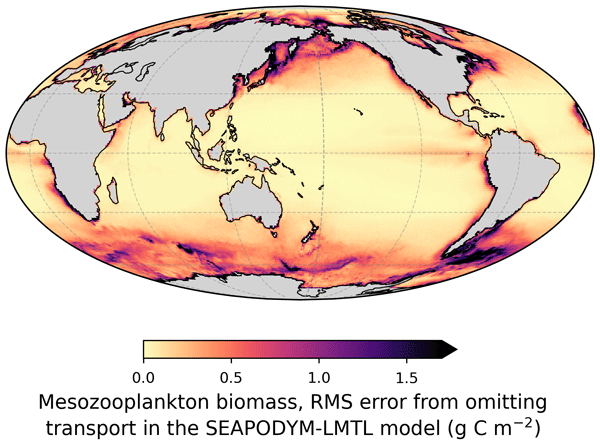
Jules Victor Lehodey, Alexandre Mignot, Alexandre Ganachaud, Sarah Albernhe, and Simon Nicol
Geosci. Model Dev., 19, 8349–8366, https://doi.org/10.5194/gmd-19-8349-2026, https://doi.org/10.5194/gmd-19-8349-2026, 2026
Short summary
Short summary
Marine zooplankton transfer energy from microscopic algae to fish and larger predators. Understanding their distribution helps predict how oceans respond to climate change. We developed SeapoPym, a freely available model that simulates zooplankton using ocean temperature and plant productivity. This tool lets scientists test biological hypotheses and estimate parameters from observations.
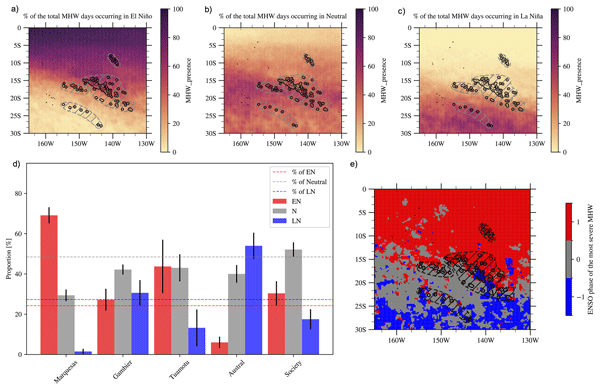
Bastien Pagli, Takeshi Izumo, Alexandre Barboni, Carla Chevillard, Cyril Dutheil, Raphaël Legrand, Christophe Menkes, Claire Rocuet, and Sophie Cravatte
Ocean Sci., 22, 1329–1352, https://doi.org/10.5194/os-22-1329-2026, https://doi.org/10.5194/os-22-1329-2026, 2026
Short summary
Short summary
Marine heatwaves—periods of unusually warm ocean temperatures—are becoming more frequent and intense with climate change. These events can harm marine ecosystems, especially in vulnerable regions like French Polynesia. Here, we used satellite sea surface temperature data and ocean reanalysis to characterize past events. We investigated their characteristics, variability linked to El Niño Southern Oscillation, and the physical mechanisms driving their onset and decay across the region.
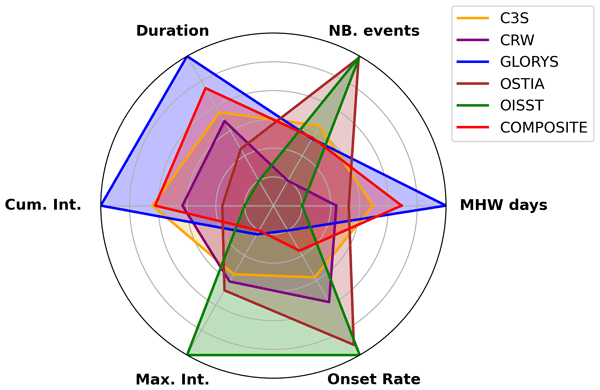
Carla Chevillard, Romain Le Gendre, Christophe Menkes, Takeshi Izumo, Bastien Pagli, Simon Van Wynsberge, and Sophie Cravatte
Ocean Sci., 22, 1213–1236, https://doi.org/10.5194/os-22-1213-2026, https://doi.org/10.5194/os-22-1213-2026, 2026
Short summary
Short summary
To detect past marine heatwaves events and analyse their characteristics, scientists use one of the available sea surface temperature products, relying on different data ingested and procedures. Here, we compare marine heatwaves statistics computed using six products in the tropical Pacific over 1993–2021. We highlight significant differences and provide uncertainties. Our results advocate for the use of multiple products in marine heatwaves studies to increase the robustness of the conclusions.
Shilpa Lal, Sophie Cravatte, Christophe Menkes, Jed Macdonald, Romain Le Gendre, Ines Mangolte, Cyril Dutheil, Neil J. Holbrook, and Simon Nicol
Ocean Sci., 22, 1023–1049, https://doi.org/10.5194/os-22-1023-2026, https://doi.org/10.5194/os-22-1023-2026, 2026
Short summary
Short summary
This paper characterizes historical (1981–2023) marine heatwaves in the tropical southwestern Pacific, where they pose a challenge for marine resource dependent Islands. Heatwaves are distinguished as a function of their spatial extent, signature at the coast, and seasonality, to allow a better understanding of their impacts on ecosystems. Marine heatwaves are getting longer and more frequent, with greater spatial extents. Our results aim to inform the Pacific Islands on their vulnerability.
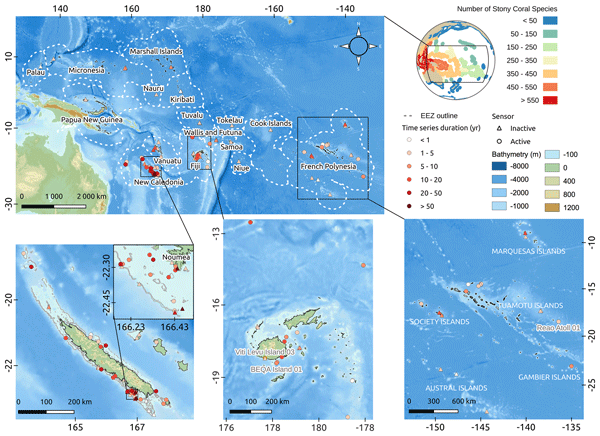
Romain Le Gendre, David Varillon, Sylvie Fiat, Régis Hocdé, Antoine de Ramon N'Yeurt, Serge Andréfouët, Jérôme Aucan, Sophie Cravatte, Maxime Duphil, Alexandre Ganachaud, Baptiste Gaudron, Elodie Kestenare, Vetea Liao, Bernard Pelletier, Alexandre Peltier, Anne-Lou Schaefer, Thomas Trophime, Simon Van Wynsberge, Yves Dandonneau, Michel Allenbach, and Christophe Menkes
Earth Syst. Sci. Data, 17, 5277–5301, https://doi.org/10.5194/essd-17-5277-2025, https://doi.org/10.5194/essd-17-5277-2025, 2025
Short summary
Short summary
Due to ocean warming, coral reef ecosystems are strongly impacted by dystrophic events and corals experiencing increasing frequencies of bleaching events. In situ observation remains the best alternative for accurate characterization of trends and extremes in these shallow environments. This paper presents the coastal temperature dataset of the ReefTEMPS monitoring network, which spreads over multiple Pacific Island countries and territories (PICTs) in the western and central South Pacific.
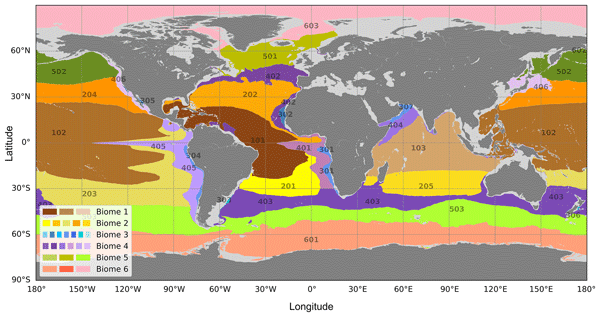
Sarah Albernhe, Thomas Gorgues, Olivier Titaud, Patrick Lehodey, Christophe Menkes, and Anna Conchon
State Planet, 6-osr9, 4, https://doi.org/10.5194/sp-6-osr9-4-2025, https://doi.org/10.5194/sp-6-osr9-4-2025, 2025
Short summary
Short summary
Micronekton are marine organisms gathering a wide diversity of taxa (crustaceans, fish, cephalopods) 2 to 20 cm in size. They are responsible for an important carbon export to the deep ocean and are the main prey for marine predators. We define provinces of homogeneous environmental parameters, representing areas of common micronekton biomass and vertical structure. We observe the evolution of the provinces in time from 1998 to 2023 to account for the seasonal to interannual variability.
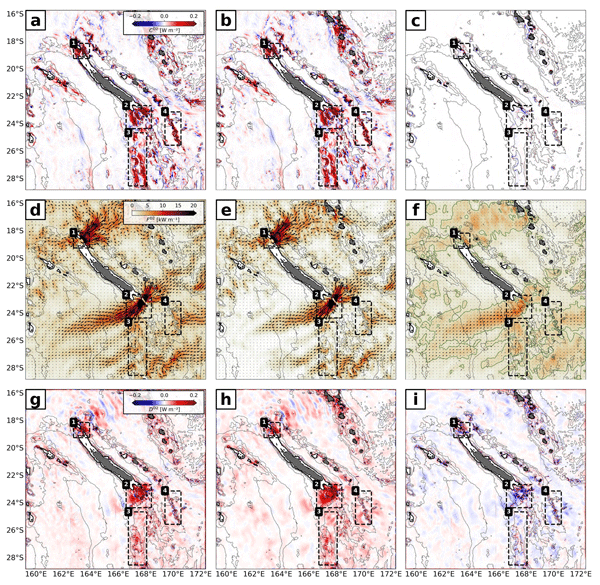
Arne Bendinger, Sophie Cravatte, Lionel Gourdeau, Clément Vic, and Florent Lyard
Ocean Sci., 21, 1943–1966, https://doi.org/10.5194/os-21-1943-2025, https://doi.org/10.5194/os-21-1943-2025, 2025
Short summary
Short summary
Temporal variability of the semidiurnal internal tide around New Caledonia is investigated using regional modeling. An important contribution to temporal variability not linked to the spring–neap tide cycle is due to the presence of mesoscale eddies both at the generation sites and in the propagation direction. The incoherent tide has a widespread signature in sea surface height (SSH), challenging the SSH observability of mesoscale to submesoscale dynamics.
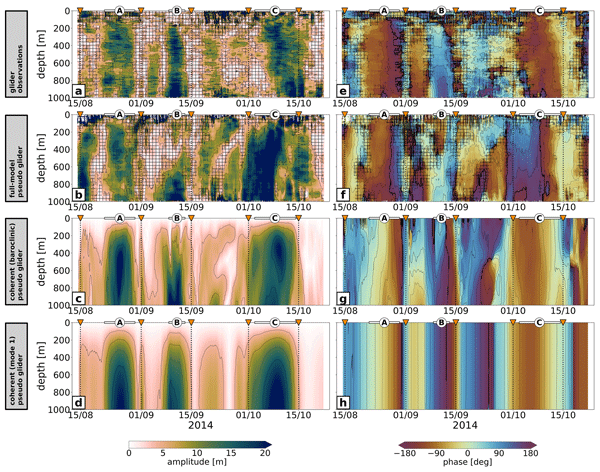
Arne Bendinger, Sophie Cravatte, Lionel Gourdeau, Luc Rainville, Clément Vic, Guillaume Sérazin, Fabien Durand, Frédéric Marin, and Jean-Luc Fuda
Ocean Sci., 20, 945–964, https://doi.org/10.5194/os-20-945-2024, https://doi.org/10.5194/os-20-945-2024, 2024
Short summary
Short summary
A unique dataset of glider observations reveals tidal beams south of New Caledonia – an internal-tide-generation hot spot in the southwestern tropical Pacific. Observations are in good agreement with numerical modeling output, highlighting the glider's capability to infer internal tides while assessing the model's realism of internal-tide dynamics. Discrepancies are in large part linked to eddy–internal-tide interactions. A methodology is proposed to deduce the internal-tide surface signature.
Arne Bendinger, Sophie Cravatte, Lionel Gourdeau, Laurent Brodeau, Aurélie Albert, Michel Tchilibou, Florent Lyard, and Clément Vic
Ocean Sci., 19, 1315–1338, https://doi.org/10.5194/os-19-1315-2023, https://doi.org/10.5194/os-19-1315-2023, 2023
Short summary
Short summary
New Caledonia is a hot spot of internal-tide generation due to complex bathymetry. Regional modeling quantifies the coherent internal tide and shows that most energy is converted in shallow waters and on very steep slopes. The region is a challenge for observability of balanced dynamics due to strong internal-tide sea surface height (SSH) signatures at similar wavelengths. Correcting the SSH for the coherent internal tide may increase the observability of balanced motion to < 100 km.
Cited articles
Arafeh-Dalmau, N., Schoeman, D. S., Montaño-Moctezuma, G., Micheli, F., Rogers-Bennett, L., Olguin-Jacobson, C., and Possingham, H. P.: Marine heat waves threaten kelp forests, Science, 367, 635–635, 2020. a
Atkinson, J., King, N. G., Wilmes, S. B., and Moore, P. J.: Summer and Winter Marine Heatwaves Favor an Invasive Over Native Seaweeds, J. Phycol., 56, 1591–1600, https://doi.org/10.1111/jpy.13051, 2020. a
Bambridge, T., D'Arcy, P., and Mawyer, A.: Oceanian Sovereignty: Rethinking conservation in a sea of islands, Pacific Conserv. Biol., 27, 345–353, https://doi.org/10.1071/PC20026, 2021. a
Batté, L., Dorel, L., Ardilouze, C., and Guérémy, J.-F.: Documentation of the METEO-FRANCE seasonal forecasting system 8, Météo-France, https://confluence.ecmwf.int/display/CKB/Description+of+System8-v20210101+C3S+contribution (last access: June 2026), 2021. a
Ben Bouallègue, Z. and Richardson, D. S.: On the ROC Area of Ensemble Forecasts for Rare Events, Weather Forecast., 37, 787–796, https://doi.org/10.1175/waf-d-21-0195.1, 2022. a, b, c
Bian, C., Jing, Z., Wang, H., and Wu, L.: Scale-Dependent Drivers of Marine Heatwaves Globally, Geophys. Res. Lett., 51, 1–10, https://doi.org/10.1029/2023GL107306, 2024. a, b
Brady, R. and Spring, A.: climpred: Verification of weather and climate forecasts [code], J. Open Source Softw., 6, 2781, https://doi.org/10.21105/joss.02781, 2021. a
Capotondi, A., Rodrigues, R. R., Sen Gupta, A., Benthuysen, J. A., Deser, C., Frölicher, T. L., Lovenduski, N. S., Amaya, D. J., Le Grix, N., Xu, T., Hermes, J., Holbrook, N. J., Martinez-Villalobos, C., Masina, S., Roxy, M. K., Schaeffer, A., Schlegel, R. W., Smith, K. E., and Wang, C.: A global overview of marine heatwaves in a changing climate, Commun. Earth Environ., 5, https://doi.org/10.1038/s43247-024-01806-9, 2024. a, b, c
Cheung, W. W., Frölicher, T. L., Lam, V. W., Oyinlola, M. A., Reygondeau, G., Rashid Sumaila, U., Tai, T. C., Teh, L. C., and Wabnitz, C. C.: Marine high temperature extremes amplify the impacts of climate change on fish and fisheries, Sci. Adv., 7, 1–15, https://doi.org/10.1126/sciadv.abh0895, 2021. a
Copernicus Climate Change Service, Climate Data Store: Seasonal forecast monthly statistics on single levels, Copernicus Climate Change Service (C3S) Climate Data Store (CDS) [data set], https://doi.org/10.24381/cds.68dd14c3, 2018.
Çorbacıoğlu, Ş. K. and Aksel, G.: Receiver operating characteristic curve analysis in diagnostic accuracy studies: A guide to interpreting the area under the curve value, Turk. J. Emerg. Med., 23, 195–198, 2023. a
Cravatte, S., Serazin, G., Penduff, T., and Menkes, C.: Imprint of chaotic ocean variability on transports in the southwestern Pacific at interannual timescales, Ocean Sci., 17, 487–507, https://doi.org/10.5194/os-17-487-2021, 2021. a, b
De Boisséson, E. and Balmaseda, M. A.: Predictability of marine heatwaves: assessment based on the ECMWF seasonal forecast system, Ocean Sci., 20, 265–278, https://doi.org/10.5194/os-20-265-2024, 2024. a, b, c, d
Dutheil, C., Lal, S., Lengaigne, M., Cravatte, S., Menkès, C., Receveur, A., Börgel, F., Gröger, M., Houlbreque, F., Le Gendre, R., Mangolte, I., Peltier, A., and Meier, H. E.: The massive 2016 marine heatwave in the Southwest Pacific: An “El Niño–Madden-Julian Oscillation” compound event, Sci. Adv., 10, 1–11, https://doi.org/10.1126/sciadv.adp2948, 2024. a, b
Ehsan, M. A., L'Heureux, M. L., Tippett, M. K., Robertson, A. W., and Turmelle, J.: Real-time ENSO forecast skill evaluated over the last two decades, with focus on the onset of ENSO events, npj Clim. Atmos. Sci., 7, 1–12, https://doi.org/10.1038/s41612-024-00845-5, 2024. a
Ferro, C. A. and Stephenson, D. B.: Extremal dependence indices: Improved Verification measures for deterministic forecasts of rare binary events, Weather Forecast., 26, 699–713, https://doi.org/10.1175/WAF-D-10-05030.1, 2011. a
Fisher, M. C., Moore, S. K., Jardine, S. L., Watson, J. R., and Samhouri, J. F.: Climate shock effects and mediation in fisheries, PNAS, 118, 1–8, https://doi.org/10.1073/pnas.2014379117, 2021. a
Fragkopoulou, E., Sen Gupta, A., Costello, M. J., Wernberg, T., Araújo, M. B., Serrão, E. A., De Clerck, O., and Assis, J.: Marine biodiversity exposed to prolonged and intense subsurface heatwaves, Nat. Clim. Chang., 13, 1114–1121, https://doi.org/10.1038/s41558-023-01790-6, 2023. a
Frölicher, T. L. and Laufkötter, C.: Emerging risks from marine heat waves, Nat. Commun., 9, 2015–2018, https://doi.org/10.1038/s41467-018-03163-6, 2018. a
Gregory, C. H., Holbrook, N. J., Marshall, A. G., and Spillman, C. M.: Sub-seasonal to seasonal drivers of regional marine heatwaves around Australia, Clim. Dyn., 62, 6599–6623, https://doi.org/10.1007/s00382-024-07226-x, 2024. a
Gruber, N., Boyd, P. W., Frölicher, T. L., and Vogt, M.: Biogeochemical extremes and compound events in the ocean, Nature, 600, 395–407, https://doi.org/10.1038/s41586-021-03981-7, 2021. a
Hartog, J. R., Spillman, C. M., Smith, G., and Hobday, A. J.: Forecasts of marine heatwaves for marine industries: Reducing risk, building resilience and enhancing management responses, Deep. Res. II: Top. Stud. Oceanogr., 209, 105276, https://doi.org/10.1016/j.dsr2.2023.105276, 2023. a, b
Hobday, A. J., Alexander, L. V., Perkins, S. E., Smale, D. A., Straub, S. C., Oliver, E. C., Benthuysen, J. A., Burrows, M. T., Donat, M. G., Feng, M., Holbrook, N. J., Moore, P. J., Scannell, H. A., Sen Gupta, A., and Wernberg, T.: A hierarchical approach to defining marine heatwaves, Prog. Oceanogr., 141, 227–238, https://doi.org/10.1016/j.pocean.2015.12.014, 2016. a, b
Hobday, A. J., Spillman, C. M., Eveson, J. P., Hartog, J. R., Zhang, X., and Brodie, S.: A framework for combining seasonal forecasts and climate projections to aid risk management for fisheries and aquaculture, Front. Mar. Sci., 5, 1–9, https://doi.org/10.3389/fmars.2018.00137, 2018. a, b, c, d
Hobday, A. J., Burrows, M. T., Filbee-Dexter, K., Holbrook, N. J., Sen Gupta, A., Smale, D. A., Smith, K. E., Thomsen, M. S., and Wernberg, T.: With the arrival of El Niño, prepare for stronger marine heatwaves, Nature, 621, 38–41, https://doi.org/10.1038/d41586-023-02730-2, 2023. a
Hobday, A. J., Spillman, C. M., Allnutt, J., Coleman, M. A., Bailleul, F., Blamey, L. K., Brodie, S., Chandrapavan, A., Hartog, J. R., Maynard, D., Mundy, C., Plagányi, É. E., Seaborn, F., Smith, G. A., and Stuart-Smith, J.: Forecasting a Summer of Extremes Building Stakeholder Response Capacity To Marine Heatwaves, Oceanography, 37, 42–51, https://doi.org/10.5670/oceanog.2024.508, 2024. a
Holbrook, N. J., Scannell, H. A., Sen Gupta, A., Benthuysen, J. A., Feng, M., Oliver, E. C., Alexander, L. V., Burrows, M. T., Donat, M. G., Hobday, A. J., Moore, P. J., Perkins-Kirkpatrick, S. E., Smale, D. A., Straub, S. C., and Wernberg, T.: A global assessment of marine heatwaves and their drivers, Nat. Commun., 10, https://doi.org/10.1038/s41467-019-10206-z, 2019. a
Holbrook, N. J., Sen Gupta, A., Oliver, E. C., Hobday, A. J., Benthuysen, J. A., Scannell, H. A., Smale, D. A., and Wernberg, T.: Keeping pace with marine heatwaves, Nat. Rev. Earth Environ., 1, 482–493, https://doi.org/10.1038/s43017-020-0068-4, 2020. a, b
Holbrook, N. J., Hernaman, V., Koshiba, S., Lako, J., Kajtar, J. B., Amosa, P., and Singh, A.: Impacts of marine heatwaves on tropical western and central Pacific Island nations and their communities, Glob. Planet. Change, 208, 103680, https://doi.org/10.1016/j.gloplacha.2021.103680, 2022. a
Hoyer, S. and Hamman, J.: xarray: N-D labeled Arrays and Datasets in Python [data set], J. Open Res. Softw., 5, 10, https://doi.org/10.5334/jors.148, 2017. a
Hu, J., Xu, J., Luo, J. J., Xue, J., Nie, Y., and Zhi, D.: Sub-Seasonal Forecast of Global Marine Heatwaves Based on NUIST CFS1.1, Adv. Atmos. Sci., 42, 1285–1300, https://doi.org/10.1007/s00376-024-4280-x, 2025. a, b
Jacox, M. G., Alexander, M. A., Bograd, S. J., and Scott, J. D.: Thermal displacement by marine heatwaves, Nature, 584, 82–86, https://doi.org/10.1038/s41586-020-2534-z, 2020. a
Jacox, M. G., Alexander, M. A., Amaya, D., Becker, E., Bograd, S. J., Brodie, S., Hazen, E. L., Pozo Buil, M., and Tommasi, D.: Global seasonal forecasts of marine heatwaves, Nature, 604, 486–490, https://doi.org/10.1038/s41586-022-04573-9, 2022. a, b, c, d
Johnson, S. J., Stockdale, T. N., Ferranti, L., Balmaseda, M. A., Molteni, F., Magnusson, L., Tietsche, S., Decremer, D., Weisheimer, A., Balsamo, G., Keeley, S. P. E., Mogensen, K., Zuo, H., and Monge-Sanz, B. M.: SEAS5: the new ECMWF seasonal forecast system, Geosci. Model Dev., 12, 1087–1117, https://doi.org/10.5194/gmd-12-1087-2019, 2019. a
Keppler, L., Cravatte, S., Chaigneau, A., Pegliasco, C., Gourdeau, L., and Singh, A.: Observed Characteristics and Vertical Structure of Mesoscale Eddies in the Southwest Tropical Pacific, J. Geophys. Res. Ocean., 123, 2731–2756, https://doi.org/10.1002/2017JC013712, 2018. a
Koul, V., Brune, S., Akimova, A., Düsterhus, A., Pieper, P., Hövel, L., Parekh, A., Schrum, C., and Baehr, J.: Seasonal Prediction of Arabian Sea Marine Heatwaves, Geophys. Res. Lett., 50, 1–10, https://doi.org/10.1029/2023GL103975, 2023. a, b, c
Le-Grix, N., Cheung, W. L., Reygondeau, G., Zscheischler, J., and Frölicher, T. L.: Extreme and compound ocean events are key drivers of projected low pelagic fish biomass, Glob. Chang. Biol., 29, 6478–6492, https://doi.org/10.1111/gcb.16968, 2023. a
Lellouche, J.-M., Greiner, E., Badie, R. B., Garric, G., Melet, A., Drévillon, M., Bricaud, C., Hamon, M., Galloudec, O. L., Regnier, C., Candela, T., Testut, C.-E., Gasparin, F., Ruggiero, G., Benkiran, M., Drillet, Y., and Le Traon, P.-Y.: The Copernicus Global
Lim, Y., Son, S. W., and Kim, D.: MJO prediction skill of the subseasonal-to-seasonal prediction models, J. Clim., 31, 4075–4094, https://doi.org/10.1175/JCLI-D-17-0545.1, 2018. a
Liu, G., Mark Eakin, C., Chen, M., Kumar, A., De La Cour, J. L., Heron, S. F., Geiger, E. F., Skirving, W. J., Tirak, K. V., and Strong, A. E.: Predicting heat stress to inform reef management: NOAA Coral Reef Watch's 4-month Coral Bleaching Outlook, Front. Mar. Sci., 5, 1–23, https://doi.org/10.3389/fmars.2018.00057, 2018. a, b, c
Mangolte, I.: Code and Data for Mangolte et al. (2026) Investigating the predictability of Marine Heatwaves at subseasonal to seasonal timescales in New Caledonia, South Pacific, Zenodo, https://doi.org/10.5281/zenodo.20712236, 2026. a
Malan, N., Gupta, A. S., Schaeffer, A., Zhang, S., Doblin, M. A., Pilo, G. S., Kiss, A. E., Everett, J. D., Behrens, E., Capotondi, A., Cravatte, S., Hobday, A. J., Holbrook, N. J., and Kajtar, J. B., and Spillman, C. M.: Lifting the lid on Marine Heatwaves, Prog. Oceanogr., 239, 103539, 2025. a
Maynard, J. A., Johnson, J. E., Marshall, P. A., Eakin, C. M., Goby, G., Schuttenberg, H., and Spillman, C. M.: A Strategic Framework for Responding to Coral Bleaching Events in a Changing Climate, Environ. Manage., 44, 1–11, https://doi.org/10.1007/s00267-009-9295-7, 2009. a
McAdam, R., Masina, S., and Gualdi, S.: Seasonal forecasting of subsurface marine heatwaves, Commun. Earth Environ., 4, 1–11, https://doi.org/10.1038/s43247-023-00892-5, 2023. a, b, c, d
Mogen, S. C., Lovenduski, N. S., Yeager, S., Keppler, L., Sharp, J., Bograd, S. J., Quiros, N. C., Di Lorenzo, E., Hazen, E. L., Jacox, M. G., and Buil, M. P.: Skillful Multi-Month Predictions of Ecosystem Stressors in the Surface and Subsurface Ocean, Earth's Future, 11, 1–15, https://doi.org/10.1029/2023EF003605, 2023. a
Mogollón, R., Quispe, J., Colas, F., and Tam, J.: Role of atmospheric and oceanographic frequency variability on surface Marine Heatwaves in the Northern Humboldt Current System, Ocean Model., 194, 102494, 2025. a
Noh, K. M., Lim, H.-G., and Kug, J.-S.: Global chlorophyll responses to marine heatwaves in satellite ocean color, Environ. Res. Lett., 17, 064034, 2022. a
Oliver, E. C., Donat, M. G., Burrows, M. T., Moore, P. J., Smale, D. A., Alexander, L. V., Benthuysen, J. A., Feng, M., Sen Gupta, A., Hobday, A. J., Holbrook, N. J., Perkins-Kirkpatrick, S. E., Scannell, H. A., Straub, S. C., and Wernberg, T.: Longer and more frequent marine heatwaves over the past century, Nat. Commun., 9, 1–12, https://doi.org/10.1038/s41467-018-03732-9, 2018. a
Oliver, E. C., Burrows, M. T., Donat, M. G., Sen Gupta, A., Alexander, L. V., Perkins-Kirkpatrick, S. E., Benthuysen, J. A., Hobday, A. J., Holbrook, N. J., Moore, P. J., Thomsen, M. S., Wernberg, T., and Smale, D. A.: Projected Marine Heatwaves in the 21st Century and the Potential for Ecological Impact, Front. Mar. Sci., 6, 1–12, https://doi.org/10.3389/fmars.2019.00734, 2019. a
Oliver, E. C., Benthuysen, J. A., Darmaraki, S., Donat, M. G., Hobday, A. J., Holbrook, N. J., Schlegel, R. W., and Sen Gupta, A.: Marine Heatwaves, Ann. Rev. Mar. Sci., 13, 313–342, https://doi.org/10.1146/annurev-marine-032720-095144, 2021. a
Payri, C. E., Benzoni, F., André, L. V., and Houlbrèque, F.: Le blanchissement corallien de–2016, in: Nouvelle-Calédonie, 2018, 161–166, IRD Éditions, ISBN 9782709926331, https://doi.org/10.4000/books.irdeditions.28127, 2019. a
Pietri, A., Colas, F., Mogollon, R., Tam, J., and Gutierrez, D.: Marine heatwaves in the Humboldt current system: from 5-day localized warming to year-long El Niños, Sci. Rep., 11, 21172, https://doi.org/10.1038/s41598-021-00340-4, 2021. a
Pilo, G. S., Holbrook, N. J., Kiss, A. E., and Hogg, A. M. C.: Sensitivity of Marine Heatwave Metrics to Ocean Model Resolution, Geophys. Res. Lett., 46, 14604–14612, https://doi.org/10.1029/2019GL084928, 2019. a
Saito, T. and Rehmsmeier, M.: The precision-recall plot is more informative than the ROC plot when evaluating binary classifiers on imbalanced datasets, PLoS ONE, 10, 1–21, https://doi.org/10.1371/journal.pone.0118432, 2015. a
Schober, P. and Schwarte, L. A.: Correlation coefficients: Appropriate use and interpretation, Anesth. Analg., 126, 1763–1768, https://doi.org/10.1213/ANE.0000000000002864, 2018. a
Sen Gupta, A., Thomsen, M., Benthuysen, J. A., Hobday, A. J., Oliver, E., Alexander, L. V., Burrows, M. T., Donat, M. G., Feng, M., Holbrook, N. J., Perkins-Kirkpatrick, S., Moore, P. J., Rodrigues, R. R., Scannell, H. A., Taschetto, A. S., Ummenhofer, C. C., Wernberg, T., and Smale, D. A.: Drivers and impacts of the most extreme marine heatwaves events, Sci. Rep., 10, 1–15, https://doi.org/10.1038/s41598-020-75445-3, 2020. a, b
Siedlecki, S. A., Alin, S. R., Norton, E. L., Bond, N. A., Hermann, A. J., Feely, R. A., and Newton, J. A.: Can Seasonal Forecasts of Ocean Conditions Aid Fishery Managers? Experiences From 10 Years of J-Scope, Oceanography, 36, 158–167, https://doi.org/10.5670/oceanog.2023.219, 2023. a
Smale, D. A., Wernberg, T., Oliver, E. C., Thomsen, M., Harvey, B. P., Straub, S. C., Burrows, M. T., Alexander, L. V., Benthuysen, J. A., Donat, M. G., Feng, M., Hobday, A. J., Holbrook, N. J., Perkins-Kirkpatrick, S. E., Scannell, H. A., Sen Gupta, A., Payne, B. L., and Moore, P. J.: Marine heatwaves threaten global biodiversity and the provision of ecosystem services, Nat. Clim. Chang., 9, 306–312, https://doi.org/10.1038/s41558-019-0412-1, 2019. a
Smith, G. A. and Spillman, C. M.: Global ocean surface and subsurface temperature forecast skill over subseasonal to seasonal timescales, J. South. Hemisph. Earth Syst. Sci., 74, 1–17, https://doi.org/10.1071/ES23020, 2024. a, b, c, d
Smith, K. E., Burrows, M. T., Hobday, A. J., Gupta, A. S., Moore, P. J., Thomsen, M., Wernberg, T., and Smale, D. A.: Socioeconomic impacts of marine heatwaves: Global issues and opportunities, Science, 374, https://doi.org/10.1126/science.abj3593, 2021. a
Smith, K. E., Burrows, M. T., Hobday, A. J., King, N. G., Moore, P. J., Sen Gupta, A., Thomsen, M. S., Wernberg, T., and Smale, D. A.: Biological Impacts of Marine Heatwaves, Ann. Rev. Mar. Sci., 15, 119–145, https://doi.org/10.1146/annurev-marine-032122-121437, 2023. a
Smith, K. E., Sen Gupta, A., Amaya, D., Benthuysen, J. A., Burrows, M. T., Capotondi, A., Filbee-Dexter, K., Frölicher, T. L., Hobday, A. J., Holbrook, N. J., Malan, N., Moore, P. J., Oliver, E. C., Richaud, B., Salcedo-Castro, J., Smale, D. A., Thomsen, M., and Wernberg, T.: Baseline matters: Challenges and implications of different marine heatwave baselines, Prog. Oceanogr., 231, https://doi.org/10.1016/j.pocean.2024.103404, 2025a. a
Smith, K. E., Sen Gupta, A., Burrows, M. T., Filbee-Dexter, K., Hobday, A. J., Holbrook, N. J., Malan, N., Moore, P. J., Oliver, E. C., Thomsen, M. S., Wernberg, T., Zhao, Z., and Smale, D. A.: Ocean extremes as a stress test for marine ecosystems and society, Nat. Clim. Chang., 15, 231–235, https://doi.org/10.1038/s41558-025-02269-2, 2025b. a, b
Spillman, C. M. and Smith, G. A.: A New Operational Seasonal Thermal Stress Prediction Tool for Coral Reefs Around Australia, Front. Mar. Sci., 8, 1–14, https://doi.org/10.3389/fmars.2021.687833, 2021. a, b
Spillman, C. M., Smith, G. A., Hobday, A. J., and Hartog, J. R.: Onset and Decline Rates of Marine Heatwaves: Global Trends, Seasonal Forecasts and Marine Management, Front. Clim., 3, 1–13, https://doi.org/10.3389/fclim.2021.801217, 2021. a
Spillman, C. M., Hobday, A. J., Behrens, E., Feng, M., Capotondi, A., Cravatte, S., Holbrook, N. J., and Gupta, A. S.: What makes a marine heatwave forecast useable, useful and used?, Prog. Oceanogr., 234, 103464, https://doi.org/10.1016/j.pocean.2025.103464, 2025. a, b, c
Starko, S., Epstein, G., Chalifour, L., Bruce, K., Buzzoni, D., Csordas, M., Dimoff, S., Hansen, R., Maucieri, D. G., Mchenry, J., Tietjen, K. L., Timmer, B., and Baum, J. K.: Ecological responses to extreme climatic events: A systematic review of the 2014–2016 Northeast Pacific marine heatwave, in: Oceanogr. Mar. Biol. An Annu. Rev., 63, pp. 42–96, CRC Press, Boca Raton, FL, ISBN 9781003589600, https://doi.org/10.1201/9781003589600-2, 2025. a
Sun, C., Hobday, A. J., Condie, S. A., Baird, M. E., Eveson, J. P., Hartog, J. R., Richardson, A. J., Steven, A. D., Wild-Allen, K., Babcock, R. C., Yang, D., Yu, R., and Mongin, M.: Ecological Forecasting and Operational Information Systems Support Sustainable Ocean Management, Forecasting, 4, 1051–1079, https://doi.org/10.3390/forecast4040057, 2022. a
Tommasi, D., Stock, C. A., Hobday, A. J., Methot, R., Kaplan, I. C., Eveson, J. P., Holsman, K., Miller, T. J., Gaichas, S., Gehlen, M., Pershing, A., Vecchi, G. A., Msadek, R., Delworth, T., Eakin, C. M., Haltuch, M. A., Séférian, R., Spillman, C. M., Hartog, J. R., Siedlecki, S., Samhouri, J. F., Muhling, B., Asch, R. G., Pinsky, M. L., Saba, V. S., Kapnick, S. B., Gaitan, C. F., Rykaczewski, R. R., Alexander, M. A., Xue, Y., Pegion, K. V., Lynch, P., Payne, M. R., Kristiansen, T., Lehodey, P., and Werner, F. E.: Managing living marine resources in a dynamic environment: The role of seasonal to decadal climate forecasts, Prog. Oceanogr., 152, 15–49, https://doi.org/10.1016/j.pocean.2016.12.011, 2017. a
Vogt, L., Burger, F. A., Griffies, S. M., and Frölicher, T. L.: Local Drivers of Marine Heatwaves: A Global Analysis With an Earth System Model, Front. Clim., 4, 1–18, https://doi.org/10.3389/fclim.2022.847995, 2022. a
Wang, Y., Holbrook, N. J., and Kajtar, J. B.: Predictability of Marine Heatwaves off Western Australia Using a Linear Inverse Model, J. Clim., 36, 6177–6193, https://doi.org/10.1175/JCLI-D-22-0692.1, 2023. a
Welch, H., Savoca, M. S., Brodie, S., Jacox, M. G., Muhling, B. A., Clay, T. A., Cimino, M. A., Benson, S. R., Block, B. A., Conners, M. G., Costa, D. P., Jordan, F. D., Leising, A. W., Mikles, C. S., Palacios, D. M., Shaffer, S. A., Thorne, L. H., Watson, J. T., Holser, R. R., Dewitt, L., Bograd, S. J., and Hazen, E. L.: Impacts of marine heatwaves on top predator distributions are variable but predictable, Nat. Commun., 14, 5188, 2023. a
Wernberg, T., Thomsen, M. S., Burrows, M. T., Filbee-Dexter, K., Hobday, A. J., Holbrook, N. J., Montie, S., Moore, P. J., Oliver, E. C., Sen Gupta, A., Smale, D. A., and Smith, K.: Marine heatwaves as hot spots of climate change and impacts on biodiversity and ecosystem services, Nat. Rev. Biodivers., 1, 461–479, 2025. a, b
Witman, J. D., Pershing, A. J., and Bruno, J. F.: Smooth and Spiky: The Importance of Variability in Marine Climate Change Ecology, Annu. Rev. Ecol. Evol. Syst., 54, 129–149, https://doi.org/10.1146/annurev-ecolsys-022323-082123, 2023. a
Zhang, Y., Du, Y., Feng, M., and Hobday, A. J.: Vertical structures of marine heatwaves, Nat. Commun., 14, https://doi.org/10.1038/s41467-023-42219-0, 2023. a, b
Short summary
Marine heatwaves pose a serious threat to marine ecosystems that will become increasingly important with climate change. Here we show in the Southwest Pacific that dynamical forecasting systems are able to forecast long, large-scale marine heatwaves occurring in austral winter, but have less skill in predicting smaller, shorter events, and summer events. We discuss the implications for operational forecasts dedicated to help marine managers to prepare and mitigate some of their impacts.
Marine heatwaves pose a serious threat to marine ecosystems that will become increasingly...


