
Articles | Volume 22, issue 4
https://doi.org/10.5194/os-22-2425-2026
© Author(s) 2026. This work is distributed under
the Creative Commons Attribution 4.0 License.
the Creative Commons Attribution 4.0 License.
https://doi.org/10.5194/os-22-2425-2026
© Author(s) 2026. This work is distributed under
the Creative Commons Attribution 4.0 License.
the Creative Commons Attribution 4.0 License.
Research article
| 
13 Aug 2026
Research article |
| 13 Aug 2026
| 13 Aug 2026
Thermohaline gradients and frontal regimes in the northwestern Tropical Atlantic
Dante C. Napolitano
CORRESPONDING AUTHOR

Univ. Brest, CNRS, Ifremer, IRD, Laboratoire d’Océanographie Physique et Spatiale (LOPS), IUEM, 29280, Plouzané, France
Jonathan Gula
Univ. Brest, CNRS, Ifremer, IRD, Laboratoire d’Océanographie Physique et Spatiale (LOPS), IUEM, 29280, Plouzané, France
Institut Universitaire de France (IUF), Paris, France
Solange Coadou-Chaventon
LMD/IPSL, ENS, PSL University, École Polytechnique, Institut Polytechnique de Paris, Sorbonne Université, CNRS, Paris, France
Department of Marine Sciences, University of Gothenburg, Gothenburg, Sweden
Sabrina Speich
LMD/IPSL, ENS, PSL University, École Polytechnique, Institut Polytechnique de Paris, Sorbonne Université, CNRS, Paris, France
Cesar B. Rocha
Instituto Oceanográfico, Universidade de São Paulo, São Paulo, Brazil
James C. McWilliams
Department of Atmospheric and Ocean Sciences, University of California Los Angeles, Los Angeles, California, USA
Dongxiao Zhang
CICOES/University of Washington and NOAA Pacific Marine Environmental Laboratory, Seattle, Washington, USA
Xavier Carton
Univ. Brest, CNRS, Ifremer, IRD, Laboratoire d’Océanographie Physique et Spatiale (LOPS), IUEM, 29280, Plouzané, France
Related authors
No articles found.
Charly de Marez, Anissa Bouras, and Xavier Carton
EGUsphere, https://doi.org/10.5194/egusphere-2026-5662, https://doi.org/10.5194/egusphere-2026-5662, 2026
This preprint is open for discussion and under review for Ocean Science (OS).
Short summary
Short summary
We show that static stability constrains the structure and distribution of oceanic eddies. Eddy polarity, intensity, vertical extent, and background stratification determine whether balanced eddies remain stable, with implications for their propagation and eddy-induced vertical mixing.
Delphine Hypolite, Daniel Dauhajre, Minna Ho, Leonel Romero, and James McWilliams
EGUsphere, https://doi.org/10.5194/egusphere-2026-2942, https://doi.org/10.5194/egusphere-2026-2942, 2026
This preprint is open for discussion and under review for Geoscientific Model Development (GMD).
Short summary
Short summary
As ocean waves break on the beach, they push water along the shore and drag against the seafloor, sculpting the currents that flow past our shores. We built a computer model that captures these wave-driven effects together with the broader ocean circulation, at a resolution fine enough to see how the surf zone connects to the open sea. On the California coast, the model shows how breaking waves and seafloor friction together drive a vertical overturning loop and fast currents along the shore.
Yonglin Huang, Annalisa Bracco, Kurt Polzin, and Jonathan Gula
EGUsphere, https://doi.org/10.5194/egusphere-2026-2869, https://doi.org/10.5194/egusphere-2026-2869, 2026
Short summary
Short summary
We compared four high-resolution simulations with observations from the Brazil Basin to test how models represent deep-ocean mixing above rough seafloor. By tracking virtual particles, we found that the simulations reproduce strong mixing near the bottom, and higher resolution produces enhanced mixing in the ocean interior. Our results indicate that smoothed seafloor details weaken wave breaking and leave too much energy in eddies, making them more intense than they likely are in the real ocean.
Audrey Minière, Karina von Schuckmann, and Sabrina Speich
Earth Syst. Sci. Data Discuss., https://doi.org/10.5194/essd-2026-106, https://doi.org/10.5194/essd-2026-106, 2026
Preprint under review for ESSD
Short summary
Short summary
This study assesses the sensitivity of global ocean heat content estimates to key methodological choices. Global trends are robust across methodological configurations. Most of the spread comes from the choice of temperature dataset, while other methodological impacts remain small. Our results show that both research and operational indicators consistently track global ocean warming, supporting their reliability and traceability for climate monitoring and Earth energy budget assessments.
Pablo Fernández, Sabrina Speich, Guillaume Lapeyre, Claudia Pasquero, Carlos Conejero, Lionel Renault, and Fabien Desbiolles
Ocean Sci., 22, 699–725, https://doi.org/10.5194/os-22-699-2026, https://doi.org/10.5194/os-22-699-2026, 2026
Short summary
Short summary
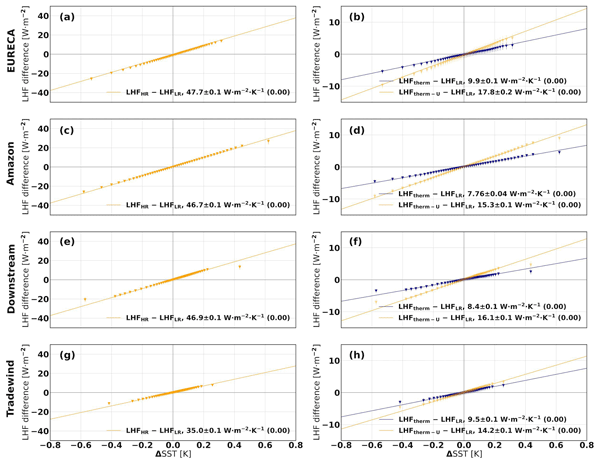
We use a high-resolution ocean-atmosphere coupled simulation to assess the effects of fine-scale sea surface temperature, surface currents, and ocean vertical stratification on the spatial variability of latent heat flux in the Northwest Tropical Atlantic. The results show significant impacts from these three variables in latent heat flux. They stress the need to account for fine-scale ocean processes in the coarser global coupled models even in relatively quiescent regions like the tropics.
Iury Simoes-Sousa, Cesar Rocha, Amit Tandon, and Andre Schmidt
Earth Syst. Sci. Data, 18, 1089–1101, https://doi.org/10.5194/essd-18-1089-2026, https://doi.org/10.5194/essd-18-1089-2026, 2026
Short summary
Short summary
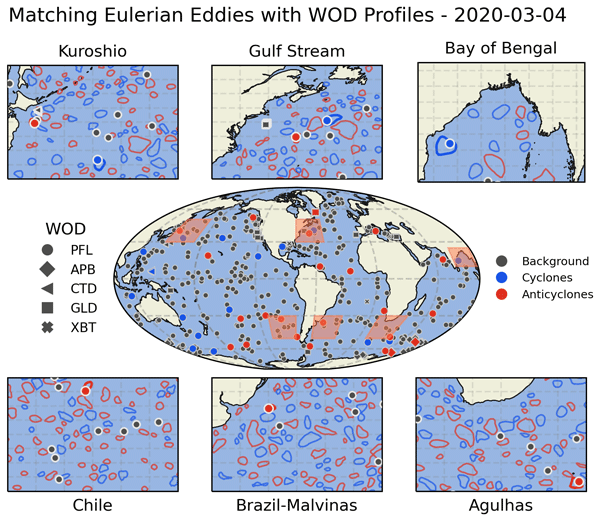
This research combines ocean profile data with satellite-tracked ocean vortex data to explore the vertical structure of ocean vortices globally. It integrates over 4 million vertical profiles with 35 million vortex observations. The dataset, processed using advanced computing, is openly accessible and offers a foundation for studying the role of ocean vortices on weather, climate, and ecosystems.
Yan Barabinot, Sabrina Speich, and Xavier Carton
Ocean Sci., 21, 2527–2553, https://doi.org/10.5194/os-21-2527-2025, https://doi.org/10.5194/os-21-2527-2025, 2025
Short summary
Short summary
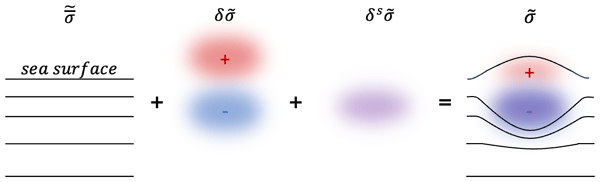
Mesoscale eddies, characterized by rotating currents, are ubiquitous in the ocean. However, their three-dimensional structure remains poorly observed and analyzed, with transport estimates often relying on approximations. To better quantify their shape, we propose a new theoretical framework based on geophysical fluid dynamics and apply it to field observations.
Yan Barabinot, Sabrina Speich, Xavier Carton, Pierre L'Hégaret, Corentin Subirade, Rémi Laxenaire, and Johannes Karstensen
Ocean Sci., 21, 1849–1872, https://doi.org/10.5194/os-21-1849-2025, https://doi.org/10.5194/os-21-1849-2025, 2025
Short summary
Short summary
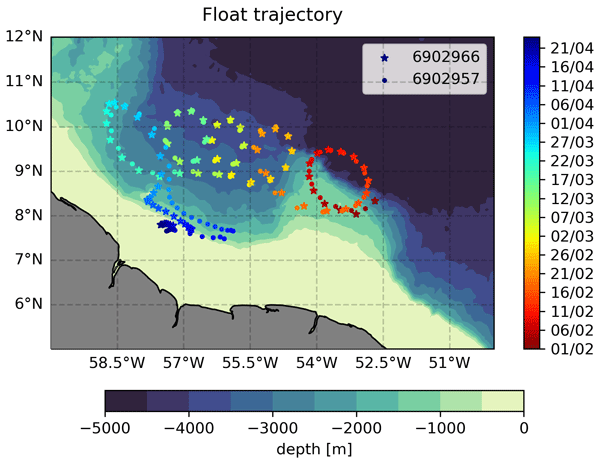
Mesoscale eddies are rotating oceanic currents key to ocean variability. Off Brazil’s northeast coast, the North Brazil Current generates on average 4.5 eddies per year, which drift towards the West Indies, transporting waters from the Southern Hemisphere. Using data collected at sea by the EUREC4A-OA cruise, this study reveals that deep eddies transport 5 times more water than surface ones, reshaping our understanding of the regional water transport.
Théo Picard, Chelsey A. Baker, Jonathan Gula, Ronan Fablet, Laurent Mémery, and Richard Lampitt
Biogeosciences, 22, 4309–4331, https://doi.org/10.5194/bg-22-4309-2025, https://doi.org/10.5194/bg-22-4309-2025, 2025
Short summary
Short summary
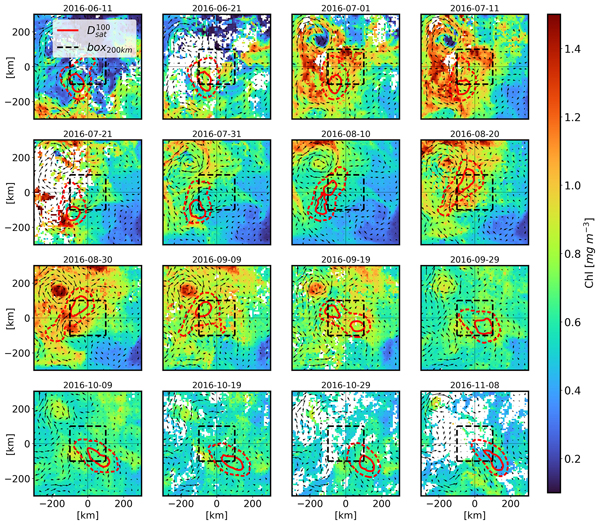
Ocean sediment traps measure the sequestrated sinking organic carbon. While sinking, the particles are affected by local currents, which presents a challenge with regard to linking the deep flux with the surface. We present a machine learning tool that predicts the source location of the sinking particles based on satellite data. The predictions demonstrate a stronger correlation between surface and deep carbon fluxes, allowing a more comprehensive understanding of the deep carbon sequestration drivers.
Yawouvi Dodji Soviadan, Miriam Beck, Joelle Habib, Alberto Baudena, Laetitia Drago, Alexandre Accardo, Remi Laxenaire, Sabrina Speich, Peter Brandt, Rainer Kiko, and Stemmann Lars
Biogeosciences, 22, 3485–3501, https://doi.org/10.5194/bg-22-3485-2025, https://doi.org/10.5194/bg-22-3485-2025, 2025
Short summary
Short summary
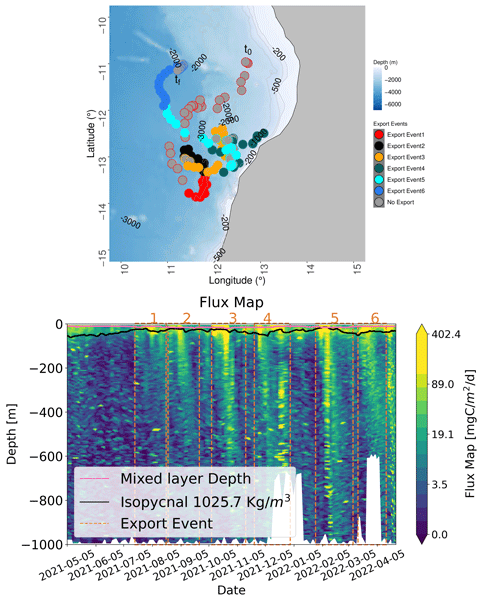
Key parameters representing the gravity flux in global models are sinking speed and vertical attenuation of exported material. We calculate, for the first time, these parameters in situ in the ocean for six intermittent blooms followed by export events using high-resolution (3 d) time series of 0–1000 m depth profiles from imaging sensors mounted on an Argo float. We show that sinking speed depends not only on size but also on the morphology of the particles, with density being an important property.
Alexandre Accardo, Rémi Laxenaire, Alberto Baudena, Sabrina Speich, Rainer Kiko, and Lars Stemmann
Biogeosciences, 22, 1183–1201, https://doi.org/10.5194/bg-22-1183-2025, https://doi.org/10.5194/bg-22-1183-2025, 2025
Short summary
Short summary
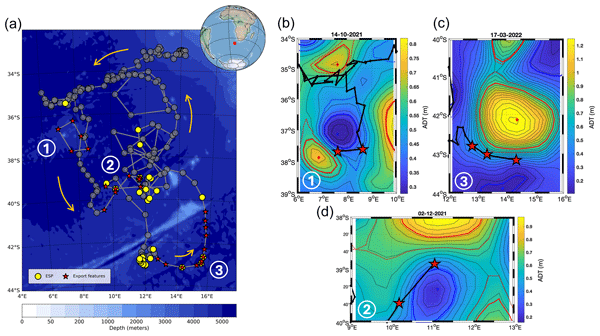
The open ocean helps mitigate climate change by storing CO2 via the biological carbon pump (BCP), which involves processes like organic carbon production at the surface and transferring it to the deep ocean via various pathways. By deploying an autonomous platform, we found significant marine snow accumulation from the surface to the mesopelagic zone in frontal regions between eddies. We suggest that the coupling of hydrodynamics at eddy edges and biological activity may enhance this process.
Yan Barabinot, Sabrina Speich, and Xavier Carton
Ocean Sci., 21, 151–179, https://doi.org/10.5194/os-21-151-2025, https://doi.org/10.5194/os-21-151-2025, 2025
Short summary
Short summary
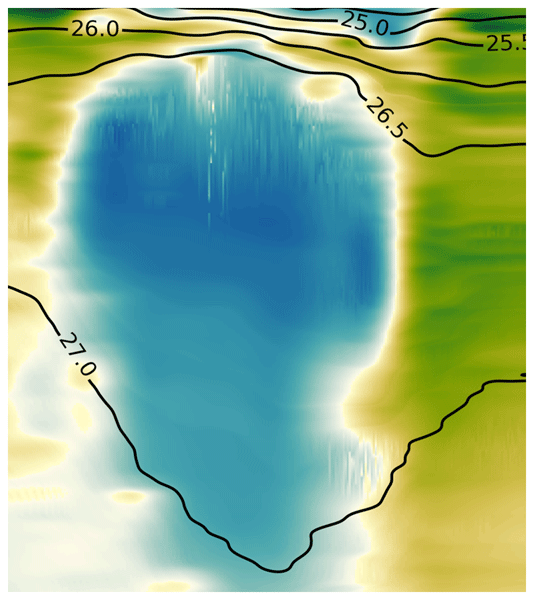
Mesoscale eddies are ubiquitous rotating currents in the ocean. Some eddies, called "materially coherent", are able to transport a different water mass from the surrounding water. By analyzing 3D eddy structures sampled during oceanographic cruises, we found that eddies can be nonmaterially coherent, accounting only for their surface properties, but materially coherent considering their properties at depth. Future studies cannot rely solely on satellite data to evaluate heat and salt transport.
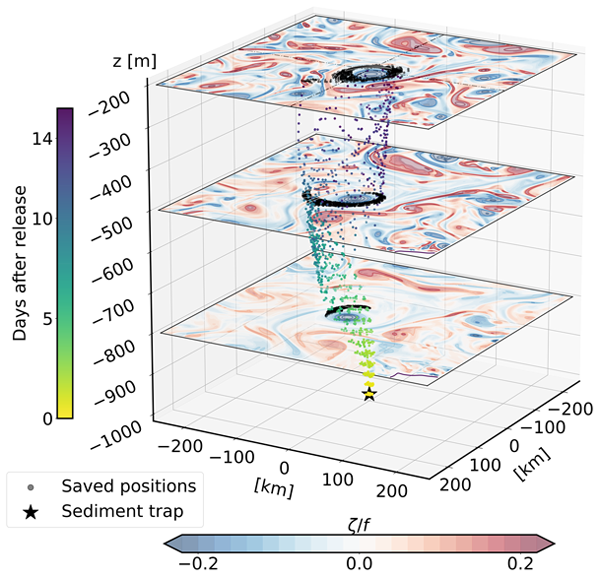
Théo Picard, Jonathan Gula, Ronan Fablet, Jeremy Collin, and Laurent Mémery
Ocean Sci., 20, 1149–1165, https://doi.org/10.5194/os-20-1149-2024, https://doi.org/10.5194/os-20-1149-2024, 2024
Short summary
Short summary
The biological carbon pump plays a key role in the climate system. Plankton absorb and transform CO2 into organic carbon, forming particles that sink to the ocean floor. Sediment traps catch these particles and measure the carbon stored in the abyss. However, the particles' surface origin is unknown as ocean currents alter their paths. Here, we train an AI model to predict the origin of these particles. This new tool enables a better link between deep-ocean observations and satellite images.
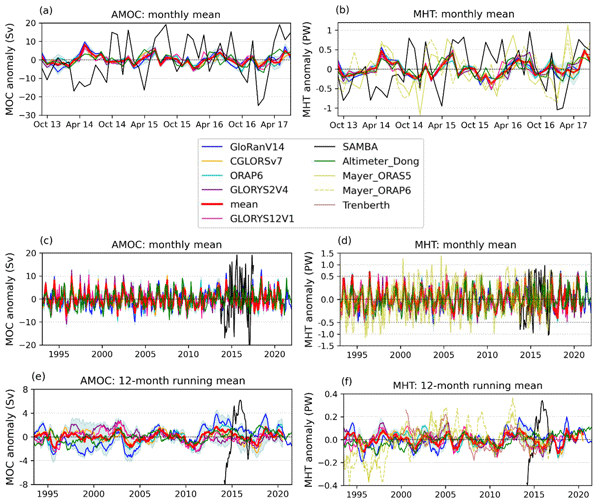
Jonathan Andrew Baker, Richard Renshaw, Laura Claire Jackson, Clotilde Dubois, Doroteaciro Iovino, Hao Zuo, Renellys C. Perez, Shenfu Dong, Marion Kersalé, Michael Mayer, Johannes Mayer, Sabrina Speich, and Tarron Lamont
State Planet, 1-osr7, 4, https://doi.org/10.5194/sp-1-osr7-4-2023, https://doi.org/10.5194/sp-1-osr7-4-2023, 2023
Short summary
Short summary
We use ocean reanalyses, in which ocean models are combined with observations, to infer past changes in ocean circulation and heat transport in the South Atlantic. Comparing these estimates with other observation-based estimates, we find differences in their trends, variability, and mean heat transport but closer agreement in their mean overturning strength. Ocean reanalyses can help us understand the cause of these differences, which could improve estimates of ocean transports in this region.
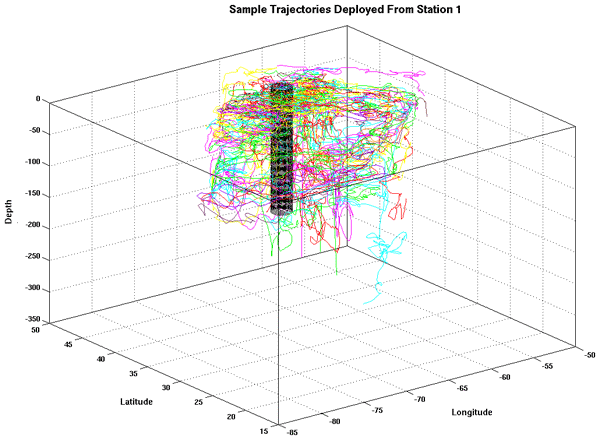
Saeed Hariri, Sabrina Speich, Bruno Blanke, and Marina Lévy
Ocean Sci., 19, 1183–1201, https://doi.org/10.5194/os-19-1183-2023, https://doi.org/10.5194/os-19-1183-2023, 2023
Short summary
Short summary
This work presents a series of studies conducted by the authors on the application of the Lagrangian approach for the connectivity analysis between different ocean locations in an idealized open-ocean model. We assess how the connectivity properties of typical oceanic flows are affected by the fine-scale circulation and discuss the challenges facing ocean connectivity estimates related to the spatial resolution. Our results are important to improve the understanding of marine ecosystems.
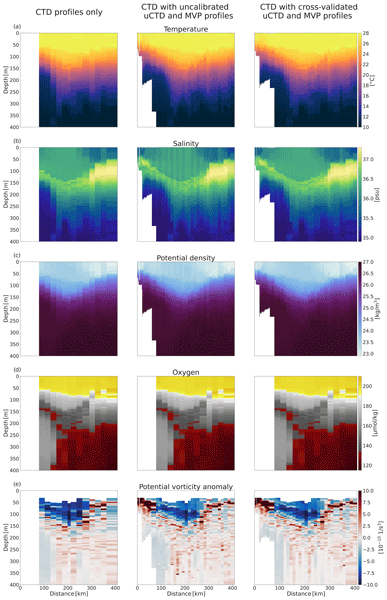
Pierre L'Hégaret, Florian Schütte, Sabrina Speich, Gilles Reverdin, Dariusz B. Baranowski, Rena Czeschel, Tim Fischer, Gregory R. Foltz, Karen J. Heywood, Gerd Krahmann, Rémi Laxenaire, Caroline Le Bihan, Philippe Le Bot, Stéphane Leizour, Callum Rollo, Michael Schlundt, Elizabeth Siddle, Corentin Subirade, Dongxiao Zhang, and Johannes Karstensen
Earth Syst. Sci. Data, 15, 1801–1830, https://doi.org/10.5194/essd-15-1801-2023, https://doi.org/10.5194/essd-15-1801-2023, 2023
Short summary
Short summary
In early 2020, the EUREC4A-OA/ATOMIC experiment took place in the northwestern Tropical Atlantic Ocean, a dynamical region where different water masses interact. Four oceanographic vessels and a fleet of autonomous devices were deployed to study the processes at play and sample the upper ocean, each with its own observing capability. The article first describes the data calibration and validation and second their cross-validation, using a hierarchy of instruments and estimating the uncertainty.

Alexandre Barboni, Solange Coadou-Chaventon, Alexandre Stegner, Briac Le Vu, and Franck Dumas
Ocean Sci., 19, 229–250, https://doi.org/10.5194/os-19-229-2023, https://doi.org/10.5194/os-19-229-2023, 2023
Short summary
Short summary
Mesoscale eddies are ubiquitous turbulent structures in the ocean, influencing the upper mixed layer. The mixed layer is the ocean surface layer mixed through air–sea exchanges. Using Argo profiling floats inside large Mediterranean anticyclones, we investigate the induced winter mixed-layer depth anomalies. Mixed-layer depth was observed to be greatly influenced by the eddy preexisting subsurface structure to which it possibly connects and can also create double-core anticyclones.
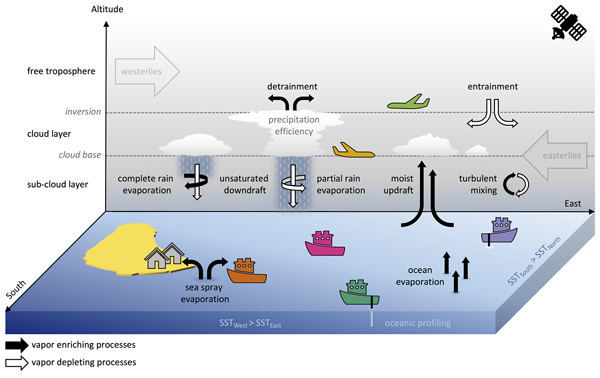
Adriana Bailey, Franziska Aemisegger, Leonie Villiger, Sebastian A. Los, Gilles Reverdin, Estefanía Quiñones Meléndez, Claudia Acquistapace, Dariusz B. Baranowski, Tobias Böck, Sandrine Bony, Tobias Bordsdorff, Derek Coffman, Simon P. de Szoeke, Christopher J. Diekmann, Marina Dütsch, Benjamin Ertl, Joseph Galewsky, Dean Henze, Przemyslaw Makuch, David Noone, Patricia K. Quinn, Michael Rösch, Andreas Schneider, Matthias Schneider, Sabrina Speich, Bjorn Stevens, and Elizabeth J. Thompson
Earth Syst. Sci. Data, 15, 465–495, https://doi.org/10.5194/essd-15-465-2023, https://doi.org/10.5194/essd-15-465-2023, 2023
Short summary
Short summary
One of the novel ways EUREC4A set out to investigate trade wind clouds and their coupling to the large-scale circulation was through an extensive network of isotopic measurements in water vapor, precipitation, and seawater. Samples were taken from the island of Barbados, from aboard two aircraft, and from aboard four ships. This paper describes the full collection of EUREC4A isotopic in situ data and guides readers to complementary remotely sensed water vapor isotope ratios.
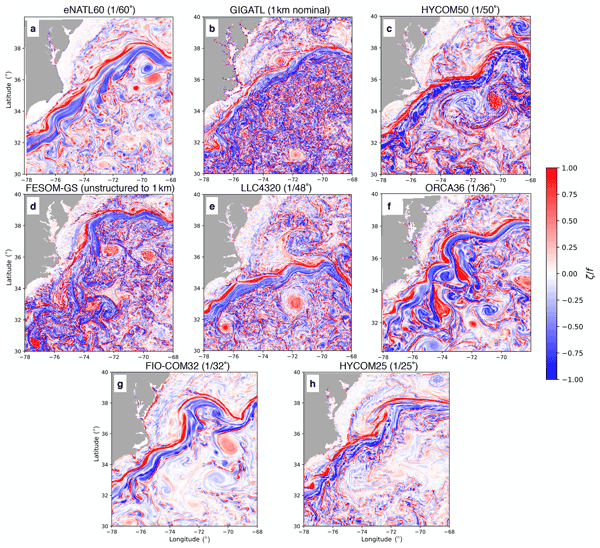
Takaya Uchida, Julien Le Sommer, Charles Stern, Ryan P. Abernathey, Chris Holdgraf, Aurélie Albert, Laurent Brodeau, Eric P. Chassignet, Xiaobiao Xu, Jonathan Gula, Guillaume Roullet, Nikolay Koldunov, Sergey Danilov, Qiang Wang, Dimitris Menemenlis, Clément Bricaud, Brian K. Arbic, Jay F. Shriver, Fangli Qiao, Bin Xiao, Arne Biastoch, René Schubert, Baylor Fox-Kemper, William K. Dewar, and Alan Wallcraft
Geosci. Model Dev., 15, 5829–5856, https://doi.org/10.5194/gmd-15-5829-2022, https://doi.org/10.5194/gmd-15-5829-2022, 2022
Short summary
Short summary
Ocean and climate scientists have used numerical simulations as a tool to examine the ocean and climate system since the 1970s. Since then, owing to the continuous increase in computational power and advances in numerical methods, we have been able to simulate increasing complex phenomena. However, the fidelity of the simulations in representing the phenomena remains a core issue in the ocean science community. Here we propose a cloud-based framework to inter-compare and assess such simulations.
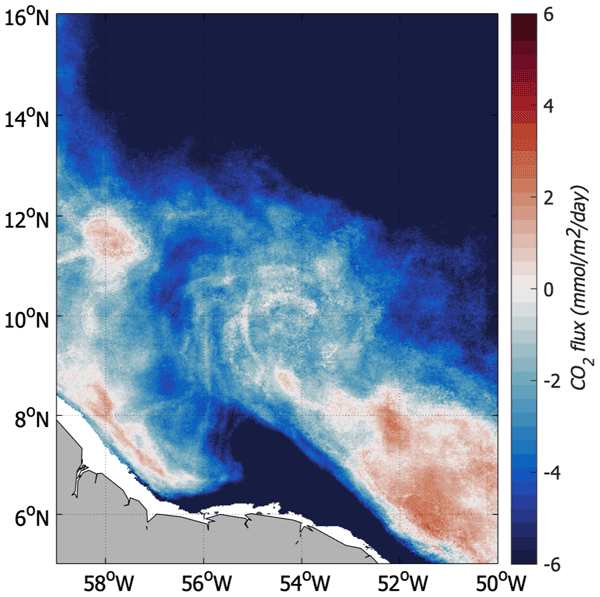
Léa Olivier, Jacqueline Boutin, Gilles Reverdin, Nathalie Lefèvre, Peter Landschützer, Sabrina Speich, Johannes Karstensen, Matthieu Labaste, Christophe Noisel, Markus Ritschel, Tobias Steinhoff, and Rik Wanninkhof
Biogeosciences, 19, 2969–2988, https://doi.org/10.5194/bg-19-2969-2022, https://doi.org/10.5194/bg-19-2969-2022, 2022
Short summary
Short summary
We investigate the impact of the interactions between eddies and the Amazon River plume on the CO2 air–sea fluxes to better characterize the ocean carbon sink in winter 2020. The region is a strong CO2 sink, previously underestimated by a factor of 10 due to a lack of data and understanding of the processes responsible for the variability in ocean carbon parameters. The CO2 absorption is mainly driven by freshwater from the Amazon entrained by eddies and by the winter seasonal cooling.
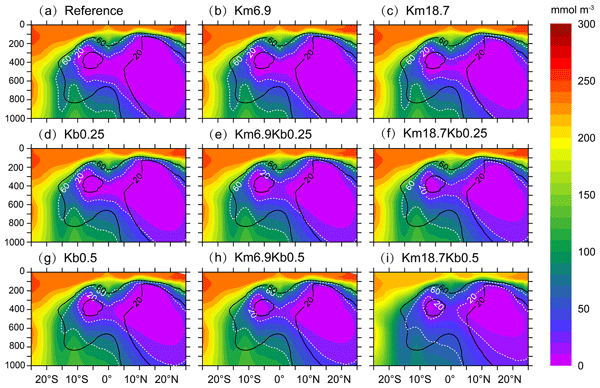
Kai Wang, Xiujun Wang, Raghu Murtugudde, Dongxiao Zhang, and Rong-Hua Zhang
Geosci. Model Dev., 15, 1017–1035, https://doi.org/10.5194/gmd-15-1017-2022, https://doi.org/10.5194/gmd-15-1017-2022, 2022
Short summary
Short summary
We use observational data of dissolved oxygen (DO) and organic nitrogen to calibrate a basin-scale model (OGCM-DEMC V1.4) and then evaluate model capacity for simulating mid-depth DO in the tropical Pacific. Sensitivity studies show that enhanced vertical mixing combined with reduced biological consumption performs well in reproducing asymmetric oxygen minimum zones (OMZs). We find that DO is more sensitive to biological processes in the upper OMZs but to physical processes in the lower OMZs.
Cited articles
Assene, F., Koch-Larrouy, A., Dadou, I., Tchilibou, M., Morvan, G., Chanut, J., Costa da Silva, A., Vantrepotte, V., Allain, D., and Tran, T.-K.: Internal tides off the Amazon shelf – Part 1: The importance of the structuring of ocean temperature during two contrasted seasons, Ocean Sci., 20, 43–67, https://doi.org/10.5194/os-20-43-2024, 2024. a
Balanda, K. P. and MacGillivray, H.: Kurtosis: a critical review, Am. Stat., 42, 111–119, https://doi.org/10.1080/00031305.1988.10475539, 1988. a
Balwada, D., Xiao, Q., Smith, S., Abernathey, R., and Gray, A. R.: Vertical fluxes conditioned on vorticity and strain reveal submesoscale ventilation, J. Phys. Oceanogr., 51, 2883–2901, https://doi.org/10.1175/JPO-D-21-0016.1, 2021. a
Balwada, D., Xie, J.-H., Marino, R., and Feraco, F.: Direct observational evidence of an oceanic dual kinetic energy cascade and its seasonality, Science Advances, 8, eabq2566, https://doi.org/10.1126/sciadv.abq2566, 2022. a
Barkan, R., McWilliams, J. C., Shchepetkin, A. F., Molemaker, M. J., Renault, L., Bracco, A., and Choi, J.: Submesoscale dynamics in the northern Gulf of Mexico, Part I: Regional and seasonal characterization and the role of river outflow, J. Phys. Oceanogr., 47, 2325–2346, https://doi.org/10.1175/JPO-D-17-0035.1, 2017a. a, b, c
Barkan, R., McWilliams, J. C., Molemaker, M. J., Choi, J., Srinivasan, K., Shchepetkin, A. F., and Bracco, A.: Submesoscale dynamics in the northern Gulf of Mexico, Part II: Temperature–salinity relations and cross-shelf transport processes, J. Phys. Oceanogr., 47, 2347–2360, https://doi.org/10.1175/JPO-D-17-0040.1, 2017b. a, b, c
Becker, J., Sandwell, D., Smith, W., Braud, J., Binder, B., Depner, J., Fabre, D., Factor, J., Ingalls, S., Kim, S., Ladner, R., Marks, K., Nelson, S., Pharaoh, A., Trimmer, R., Von Rosenberg, J., Wallace, G., and Weatherall, P.: Global bathymetry and elevation data at 30 arc seconds resolution: SRTM30 PLUS, Mar. Geod., 32, 355–371, https://doi.org/10.1080/01490410903297766, 2009. a
Bhuyan, P., Rocha, C. B., Romero, L., and Farrar, J. T.: Acoustic Doppler Current Profiler Measurements from Saildrones, with Applications to Submesoscale Studies, J. Atmos. Ocean. Tech., e240114, https://doi.org/10.1175/JTECH-D-24-0114.1, 2026. a, b, c
Boutin, J., Vergely, J.-L., Olivier, L., Reverdin, G., Perrot, X., and Thouvenin-Masson, C.: SMOS SMAP High Resolution SSS maps in regions of high variability, generated by CATDS CEC, SEANOE [data set], https://doi.org/10.17882/90082, 2022. a, b, c
Callies, J., Ferrari, R., Klymak, J. M., and Gula, J.: Seasonality in submesoscale turbulence, Nat. Commun., 6, 6862, https://doi.org/10.1038/ncomms7862, 2015. a, b, c
Candela, J., Beardsley, R. C., and Limeburner, R.: Separation of tidal and subtidal currents in ship-mounted acoustic Doppler current profiler observations, J. Geophys. Res.-Oceans, 97, 769–788, https://doi.org/10.1029/91JC02569, 1992. a, b
Capó, E., McWilliams, J. C., Mason, E., and Orfila, A.: Intermittent frontogenesis in the Alboran Sea, J. Phys. Oceanogr., 51, 1417–1439, https://doi.org/10.1175/JPO-D-20-0277.1, 2021. a
Carton, J. A. and Giese, B. S.: A reanalysis of ocean climate using Simple Ocean Data Assimilation (SODA), Month. Weather Rev., 136, 2999–3017, https://doi.org/10.1175/2007MWR1978.1, 2008. a
CMEMS: Global Ocean Gridded L4 Sea Surface Heights And Derived Variables Reprocessed, Copernicus [data set], https://doi.org/10.48670/moi-00145, 2024. a
Coadou-Chaventon, S., Speich, S., Zhang, D., Rocha, C. B., and Swart, S.: Oceanic fronts driven by the Amazon freshwater plume and their thermohaline compensation at the submesoscale, J. Geophys. Res.-Oceans, 129, e2024JC021326, https://doi.org/10.1029/2024JC021326, 2024. a, b, c, d, e, f, g, h, i, j, k, l, m
Coles, V. J., Brooks, M. T., Hopkins, J., Stukel, M. R., Yager, P. L., and Hood, R. R.: The pathways and properties of the Amazon River Plume in the tropical North Atlantic Ocean, J. Geophys. Res.-Oceans, 118, 6894–6913, https://doi.org/10.1002/2013JC008981, 2013. a, b, c, d
Dai, A. and Trenberth, K. E.: Estimates of freshwater discharge from continents: latitudinal and seasonal variations, J. Hydrometeorol., 3, 660–687, https://doi.org/10.1175/1525-7541(2002)003<0660:EOFDFC>2.0.CO;2, 2002. a, b, c
de Boyer Montégut, C., Mignot, J., Lazar, A., and Cravatte, S.: Control of salinity on the mixed layer depth in the world ocean: 1. General description, J. Geophys. Res.-Oceans, 112, https://doi.org/10.1029/2006JC003953, 2007. a
Dong, J., Fox-Kemper, B., Zhang, H., and Dong, C.: The seasonality of submesoscale energy production, content, and cascade, Geophys. Res. Lett., 47, e2020GL087388, https://doi.org/10.1029/2020GL087388, 2020. a
Drushka, K., Asher, W. E., Sprintall, J., Gille, S. T., and Hoang, C.: Global patterns of submesoscale surface salinity variability, J. Phys. Oceanogr., 49, 1669–1685, https://doi.org/10.1175/JPO-D-19-0018.1, 2019. a
Farrar, J. T., D’Asaro, E., Rodríguez, E., Shcherbina, A., Lenain, L., Omand, M., Wineteer, A., Bhuyan, P., Bingham, F., Villas Boas, A. B., Czech, E., D’Addezio, J., Freilich, M., Grare, L., Hypolite, D., Jacobs, G., Klein, P., Lang, S., Leyba, I. M., Li, Z., Mahadevan, A., McWilliams, J., Menemenlis, D., Middleton, L., Molemaker, J., O’Neill, L., Perkovic-Martin, D., Pizzo, N., Rainville, L., Rocha, C., Samelson, R. M., Simoes-Sousa, I., Statom, N., Thompson, A., Thompson, D., Torres, H., Uchoa, I., Wenegrat, J., and Westbrook, E. S-mode: The Sub-Mesoscale Ocean Dynamics Experiment, B. Am. Meteorol. Soc., 106, E657–E677, https://doi.org/10.1175/BAMS-D-23-0178.1, 2025. a
Ferrari, R. and Rudnick, D. L.: Thermohaline variability in the upper ocean, J. Geophys. Res.-Oceans, 105, 16857–16883, https://doi.org/10.1029/2000JC900057, 2000. a, b, c
Ffield, A.: North Brazil current rings viewed by TRMM Microwave Imager SST and the influence of the Amazon Plume, Deep-Sea Res. Pt. I, 52, 137–160, https://doi.org/10.1016/j.dsr.2004.05.013, 2005. a, b, c
Flagg, C. N., Gordon, R. L., and McDowell, S.: Hydrographic and current observations on the continental slope and shelf of the western equatorial Atlantic, J. Phys. Oceanogr., 16, 1412–1429, https://doi.org/10.1175/1520-0485(1986)016<1412:HACOOT>2.0.CO;2, 1986. a
Foltz, G. R., Schmid, C., and Lumpkin, R.: Transport of surface freshwater from the equatorial to the subtropical North Atlantic Ocean, J. Phys. Oceanogr., 45, 1086–1102, https://doi.org/10.1175/JPO-D-14-0189.1, 2015. a, b, c, d
Fournier, S., Vandemark, D., Gaultier, L., Lee, T., Jonsson, B., and Gierach, M. M.: Interannual variation in offshore advection of Amazon-Orinoco plume waters: Observations, forcing mechanisms, and impacts, J. Geophys. Res.-Oceans, 122, 8966–8982, https://doi.org/10.1002/2017JC013103, 2017. a
Fratantoni, D. M. and Glickson, D. A.: North Brazil Current Ring Generation and Evolution Observed with SeaWiFS, J. Phys. Oceanogr., 2, 1058–1074, https://doi.org/10.1175/1520-0485(2002)032<1058:NBCRGA>2.0.CO;2, 2002. a, b
Freilich, M. A., Flierl, G., and Mahadevan, A.: Diversity of growth rates maximizes phytoplankton productivity in an eddying ocean, Geophys. Res. Lett., 49, e2021GL096180, https://doi.org/10.1029/2021GL096180, 2022. a
Freilich, M. A., Lenain, L., and Gille, S. T.: Characterizing the Role of Non-Linear Interactions in the Transition to Submesoscale Dynamics at a Dense Filament, Geophys. Res. Lett., 50, https://doi.org/10.1029/2023GL103745, 2023. a
Fu, L.-L., Pavelsky, T., Cretaux, J.-F., Morrow, R., Farrar, J. T., Vaze, P., Sengenes, P., Vinogradova-Shiffer, N., Sylvestre-Baron, A., Picot, N., Dibarboure, G.: The surface water and ocean topography mission: A breakthrough in radar remote sensing of the ocean and land surface water, Geophys. Res. Lett., 51, e2023GL107652, https://doi.org/10.1029/2023GL107652, 2024. a
Giachini-Tosetto, E., Bertrand, A., Neumann-Leitão, S., and Nogueira Júnior, M.: The Amazon River plume, a barrier to animal dispersal in the Western Tropical Atlantic, Scientific Reports, 12, 537, https://doi.org/10.1038/s41598-021-04165-z, 2022. a, b
Gouveia, N. d. A., Gherardi, D. F. M., Wagner, F. H., Paes, E., Coles, V., and Aragão, L.: The salinity structure of the Amazon River plume drives spatiotemporal variation of oceanic primary productivity, J. Geophys. Res.-Biogeo., 124, 147–165, https://doi.org/10.1029/2018JG004665, 2019. a, b
Gula, J., Molemaker, M. J., and McWilliams, J. C.: Submesoscale cold filaments in the Gulf Stream, J. Phys. Oceanogr., 44, 2617–2643, https://doi.org/10.1175/JPO-D-14-0029.1, 2014. a, b, c
Gula, J., Theetten, S., Cambon, G., and Roullet, G.: Description of the GIGATL simulations, Zenodo [code], https://doi.org/10.5281/zenodo.4948523, 2021. a, b, c
Gula, J., Taylor, J., Shcherbina, A., and Mahadevan, A.: Submesoscale processes and mixing, in: Ocean mixing, Elsevier, 181–214, https://doi.org/10.1016/B978-0-12-821512-8.00015-3, 2022. a
Hellweger, F. L. and Gordon, A. L.: Tracing Amazon river water into the Caribbean Sea, J. Mar. Res., 60, 537–549, https://doi.org/10.1357/002224002762324202, 2002. a
Hoskins, B. J. and Bretherton, F. P.: Atmospheric frontogenesis models: Mathematical formulation and solution, J. Atmos. Sci., 29, 11–37, https://doi.org/10.1175/1520-0469(1972)029<0011:AFMMFA>2.0.CO;2, 1972. a
Jahfer, S., Vinayachandran, P., and Nanjundiah, R. S.: Long-term impact of Amazon river runoff on northern hemispheric climate, Sci. Rep.-UK, 7, 10989, https://doi.org/10.1038/s41598-017-10750-y, 2017. a
Johns, W. E., Lee, T. N., Schott, F. A., Zantopp, R. J., and Evans, R. H.: The North Brazil Current retroflection: Seasonal structure and eddy variability, J. Geophys. Res.-Oceans, 95, 22103–22120, https://doi.org/10.1029/JC095iC12p22103, 1990. a
Johns, W. E., Lee, T., Beardsley, R., Candela, J., Limeburner, R., and Castro, B.: Annual cycle and variability of the North Brazil Current, J. Phys. Oceanogr., 28, 103–128, https://doi.org/10.1175/1520-0485(1998)028<0103:ACAVOT>2.0.CO;2, 1998. a, b
Johnson, L., Lee, C. M., and D'Asaro, E. A.: Global estimates of lateral springtime restratification, J. Phys. Oceanogr., 46, 1555–1573, https://doi.org/10.1175/JPO-D-15-0163.1, 2016. a
Klein, P., Hua, B. L., Lapeyre, G., Capet, X., Le Gentil, S., and Sasaki, H.: Upper ocean turbulence from high-resolution 3D simulations, J. Phys. Oceanogr., 38, 1748–1763, https://doi.org/10.1175/2007JPO3773.1, 2008. a
Kolodziejczyk, N., Prigent-Mazella, A., and Gaillard, F.: ISAS temperature, salinity, dissolved oxygen gridded fields, SEANOE [data set], https://doi.org/10.17882/52367, 2023. a, b, c
Lapeyre, G. and Klein, P.: Impact of the small-scale elongated filaments on the oceanic vertical pump, J. Mar. Res., 64, 835–851, https://doi.org/10.1357/002224006779698369, 2006. a
Lévy, M., Franks, P. J., and Smith, K. S.: The role of submesoscale currents in structuring marine ecosystems, Nat. Commun., 9, 4758, https://doi.org/10.1038/s41467-018-07059-3, 2018. a, b
L'Hégaret, P., Schütte, F., Speich, S., Reverdin, G., Baranowski, D. B., Czeschel, R., Fischer, T., Foltz, G. R., Heywood, K. J., Krahmann, G., Laxenaire, R., Le Bihan, C., Le Bot, P., Leizour, S., Rollo, C., Schlundt, M., Siddle, E., Subirade, C., Zhang, D., and Karstensen, J.: Ocean cross-validated observations from R/Vs L'Atalante, Maria S. Merian, and Meteor and related platforms as part of the EUREC 4 A-OA/ATOMIC campaign, Earth Syst. Sci. Data, 15, 1801–1830, https://doi.org/10.5194/essd-15-1801-2023, 2023. a, b
Liu, G., Bracco, A., and Sitar, A.: Submesoscale mixing across the mixed layer in the Gulf of Mexico, Frontiers in Marine Science, 8, 615066, https://doi.org/10.3389/fmars.2021.615066, 2021. a
Liu, Q., Napolitano, D. C., Gula, J., Wang, M., Liu, Y., Gao, L., and Li, X.: Detection of surface submesoscale fronts in the Atlantic Ocean, Ocean Model., 203, 102787, https://doi.org/10.1016/j.ocemod.2026.102787, 2026. a, b
Masson, S. and Delecluse, P.: Influence of the Amazon river runoff on the tropical Atlantic, Phys. Chem. Earth Pt. B, 26, 137–142, https://doi.org/10.1016/S1464-1909(00)00230-6, 2001. a
McWilliams, J. C.: Oceanic frontogenesis, Annu. Rev. Mar. Sci., 13, 227–253, https://doi.org/10.1146/annurev-marine-032320-120725, 2021. a
Meissner, T., Wentz, F., Manaster, A., Lindsley, R., Brewer, M., and Densberger, M.: Remote sensing systems SMAP ocean surface salinities [Level 3 running 8-day], version 5.0 validated release, NASA [data set], https://doi.org/10.5067/SMP50-3SPCS, 2022. a, b
Molemaker, M. J., McWilliams, J. C., and Dewar, W. K.: Submesoscale instability and generation of mesoscale anticyclones near a separation of the California Undercurrent, J. Phys. Oceanogr., 45, 613–629, https://doi.org/10.1175/JPO-D-13-0225.1, 2015. a
Molleri, G. S., Novo, E. M. d. M., and Kampel, M.: Space-time variability of the Amazon River plume based on satellite ocean color, Cont. Shelf. Res., 30, 342–352, https://doi.org/10.1016/j.csr.2009.11.015, 2010. a
Morozov, E. G., Frey, D. I., Salyuk, P. A., and Budyansky, M. V.: Amazon River Plume in the Western Tropical North Atlantic, Journal of Marine Science and Engineering, 12, https://doi.org/10.3390/jmse12060851, 2024. a
Muller-Karger, F. E., McClain, C. R., and Richardson, P. L.: The dispersal of the Amazon's water, Nature, 333, 56–59, https://doi.org/10.1038/333056a0, 1988. a, b, c
Napolitano, D. C., Carton, X., and Gula, J.: Vertical interaction between NBC rings and its implications for South Atlantic Water export, J. Geophys. Res.-Oceans, 129, e2023JC020741, https://doi.org/10.1029/2023JC020741, 2024. a
Naveira-Garabato, A. C., Yu, X., Callies, J., Barkan, R., Polzin, K. L., Frajka-Williams, E. E., Buckingham, C. E., and Griffies, S. M.: Kinetic energy transfers between mesoscale and submesoscale motions in the open ocean's upper layers, J. Phys. Oceanogr., 52, 75–97, https://doi.org//10.1175/JPO-D-21-0099.1, 2022. a
Olivier, L., Boutin, J., Reverdin, G., Lefèvre, N., Landschützer, P., Speich, S., Karstensen, J., Labaste, M., Noisel, C., Ritschel, M., Steinhoff, T., and Wanninkhof, R.: Wintertime process study of the North Brazil Current rings reveals the region as a larger sink for CO2 than expected, Biogeosciences, 19, 2969–2988, https://doi.org/10.5194/bg-19-2969-2022, 2022. a, b, c
Olivier, L., Reverdin, G., Boutin, J., Laxenaire, R., Iudicone, D., Pesant, S., Calil, P. H. R., Horstmann, J., Couet, D., Erta, J. M., Huber, P., Sarmento, H., Freire, A., Koch-Larrouy, A., Vergely, J. L., Rousselot, P., and Speich, S.: Late summer northwestward Amazon plume pathway under the action of the North Brazil Current rings, Remote Sens. Environ., 307, 114165, https://doi.org/10.1016/j.rse.2024.114165, 2024. a
Patterson, R. G., Cronin, M. F., Swart, S., Beja, J., Edholm, J. M., McKenna, J., Palter, J. B., Parker, A., Addey, C. I., Boone, W., Bhuyan, P., Buck, J. J. H., Burger, E. F., Burris, J., Camus, L., de Young, B., du Plessis, M., Flanigan, M., Foltz, G. R., Gille, S. T., Grare, L., Hansen, J. E., Hole, L. R., Honda, M. C., Hormann, V., Kohlman, C., Kosaka, N., Kuhn, C., Lenain, L., Looney, L., Marouchos, A., McGeorge, E. K., McMahon, C. R., Mitarai, S., Mordy, C., Nagano, A., Nicholson, S.-A., Nickford, S., O’Brien, K. M., Peddie, D., Ponsoni, L., Ramasco, V., Rozenauers, N., Siddle, E., Stienbarger, C., Sutton, A. J., Tada, N., Thomson, J., Ueki, I., Yu, L., Zhang, C., and Zhang, D.: Uncrewed surface vehicles in the Global Ocean Observing System: a new frontier for observing and monitoring at the air-sea interface, Frontiers in Marine Science, 12, 1523585, https://doi.org/10.3389/fmars.2025.1523585, 2025. a
Perry, G., Duffy, P., and Miller, N.: An extended data set of river discharges for validation of general circulation models, J. Geophys. Res.-Atmos., 101, 21339–21349, https://doi.org/10.1029/96JD00932, 1996. a
Pham, H. T., Verma, V., Sarkar, S., Shcherbina, A. Y., and D’Asaro, E. A.: Rapid downwelling of tracer particles across the boundary layer and into the pycnocline at submesoscale ocean fronts, Geophys. Res. Lett., 51, e2024GL109674, https://doi.org/10.1029/2024GL109674, 2024. a
Remote Sensing Systems: RSS SMAP Level 3 Sea Surface Salinity Standard Mapped Image 8-Day Running Mean V5.0 Validated Dataset, NASA Physical Oceanography Distributed Active Archive Center [data set], https://doi.org/10.5067/SMP50-3SPCS, 2022. a
Reverdin, G., Olivier, L., Foltz, G., Speich, S., Karstensen, J., Horstmann, J., Zhang, D., Laxenaire, R., Carton, X., Branger, H., Carrasco, R., and Boutin, J.: Formation and evolution of a freshwater plume in the northwestern tropical Atlantic in February 2020, J. Geophys. Res.-Oceans, 126, e2020JC016981, https://doi.org/10.1029/2020JC016981, 2021. a, b, c, d, e, f
Richardson, P., Hufford, G., Limeburner, R., and Brown, W.: North Brazil current retroflection eddies, J. Geophys. Res.-Oceans, 99, 5081–5093, https://doi.org/10.1029/93JC03486, 1994. a
Rocha, C. B., Gille, S. T., Chereskin, T. K., and Menemenlis, D.: Seasonality of submesoscale dynamics in the Kuroshio Extension, Geophys. Res. Lett., 43, 11–304, https://doi.org/10.1002/2016GL071349, 2016. a, b
Romanova, V., Köhl, A., and Stammer, D.: Seasonal cycle of near-surface freshwater budget in the western tropical Atlantic, J. Geophys. Res.-Oceans, 116, https://doi.org/10.1029/2010JC006650, 2011. a
Rudnick, D. L. and Martin, J. P.: On the horizontal density ratio in the upper ocean, Dynam. Atmos. Oceans, 36, 3–21, https://doi.org/10.1016/S0377-0265(02)00022-2, 2002. a, b, c
Saha, S., Moorthi, S., Pan, H.-L., Wu, X., Wang, J., Nadiga, S., Tripp, P., Kistler, R., Woollen, J., Behringer, D., Liu, H., Stokes, D., Grumbine, R., Gayno, G., Wang, J., Hou, Y.-T., ya Chuang, H., Juang, H.-M. H., Sela, J., Iredell, M., Treadon, R., Kleist, D., Delst, P. V., Keyser, D., Derber, J., Ek, M., Meng, J., Wei, H., Yang, R., Lord, S., van den Dool, H., Kumar, A., Wang, W., Long, C., Chelliah, M., Xue, Y., Huang, B., Schemm, J.-K., Ebisuzaki, W., Lin, R., Xie, P., Chen, M., Zhou, S., Higgins, W., Zou, C.-Z., Liu, Q., Chen, Y., Han, Y., Cucurull, L., Reynolds, R. W., Rutledge, G., and Goldberg, M.: The NCEP climate forecast system reanalysis, B. Am. Meteorol. Soc., 91, 1015–1058, https://doi.org/10.1175/2010BAMS3001.1, 2010. a
Schubert, R., Gula, J., Greatbatch, R. J., Baschek, B., and Biastoch, A.: The Submesoscale Kinetic Energy Cascade: Mesoscale Absorption of Submesoscale Mixed Layer Eddies and Frontal Downscale Fluxes, J. Phys. Oceanogr., 50, 2573–2589, https://doi.org/10.1175/JPO-D-19-0311.1, 2020. a
Shchepetkin, A. F. and McWilliams, J. C.: The regional oceanic modeling system (ROMS): a split-explicit, free-surface, topography-following-coordinate oceanic model, Ocean Model., 9, 347–404, https://doi.org/10.1016/j.ocemod.2004.08.002, 2005. a
Shcherbina, A. Y., D'Asaro, E. A., Lee, C. M., Klymak, J. M., Molemaker, M. J., and McWilliams, J. C.: Statistics of vertical vorticity, divergence, and strain in a developed submesoscale turbulence field, Geophys. Res. Lett., 40, 4706–4711, https://doi.org/10.1002/grl.50919, 2013. a, b
Speich, S. and Embarked Science Team: EUREC4A-OA. Cruise Report, 19 January–19 February 2020, Vessel: L’ATALANTE, https://doi.org/10.13155/80129, 2021. a, b
Srinivasan, K., McWilliams, J. C., Renault, L., Hristova, H. G., Molemaker, J., and Kessler, W. S.: Topographic and mixed layer submesoscale currents in the near-surface southwestern tropical Pacific, J. Phys. Oceanogr., 47, 1221–1242, https://doi.org/10.1175/JPO-D-16-0216.1, 2017. a, b
Srinivasan, K., Barkan, R., and McWilliams, J. C.: A forward energy flux at submesoscales driven by frontogenesis, J. Phys. Oceanogr., 53, 287–305, https://doi.org/10.1175/JPO-D-22-0001.1, 2023. a, b, c
Stevens, B., Bony, S., Farrell, D., Ament, F., Blyth, A., Fairall, C., Karstensen, J., Quinn, P. K., Speich, S., Acquistapace, C., Aemisegger, F., Albright, A. L., Bellenger, H., Bodenschatz, E., Caesar, K.-A., Chewitt-Lucas, R., de Boer, G., Delanoë, J., Denby, L., Ewald, F., Fildier, B., Forde, M., George, G., Gross, S., Hagen, M., Hausold, A., Heywood, K. J., Hirsch, L., Jacob, M., Jansen, F., Kinne, S., Klocke, D., Kölling, T., Konow, H., Lothon, M., Mohr, W., Naumann, A. K., Nuijens, L., Olivier, L., Pincus, R., Pöhlker, M., Reverdin, G., Roberts, G., Schnitt, S., Schulz, H., Siebesma, A. P., Stephan, C. C., Sullivan, P., Touzé-Peiffer, L., Vial, J., Vogel, R., Zuidema, P., Alexander, N., Alves, L., Arixi, S., Asmath, H., Bagheri, G., Baier, K., Bailey, A., Baranowski, D., Baron, A., Barrau, S., Barrett, P. A., Batier, F., Behrendt, A., Bendinger, A., Beucher, F., Bigorre, S., Blades, E., Blossey, P., Bock, O., Böing, S., Bosser, P., Bourras, D., Bouruet-Aubertot, P., Bower, K., Branellec, P., Branger, H., Brennek, M., Brewer, A., Brilouet, P.-E., Brügmann, B., Buehler, S. A., Burke, E., Burton, R., Calmer, R., Canonici, J.-C., Carton, X., Cato Jr., G., Charles, J. A., Chazette, P., Chen, Y., Chilinski, M. T., Choularton, T., Chuang, P., Clarke, S., Coe, H., Cornet, C., Coutris, P., Couvreux, F., Crewell, S., Cronin, T., Cui, Z., Cuypers, Y., Daley, A., Damerell, G. M., Dauhut, T., Deneke, H., Desbios, J.-P., Dörner, S., Donner, S., Douet, V., Drushka, K., Dütsch, M., Ehrlich, A., Emanuel, K., Emmanouilidis, A., Etienne, J.-C., Etienne-Leblanc, S., Faure, G., Feingold, G., Ferrero, L., Fix, A., Flamant, C., Flatau, P. J., Foltz, G. R., Forster, L., Furtuna, I., Gadian, A., Galewsky, J., Gallagher, M., Gallimore, P., Gaston, C., Gentemann, C., Geyskens, N., Giez, A., Gollop, J., Gouirand, I., Gourbeyre, C., de Graaf, D., de Groot, G. E., Grosz, R., Güttler, J., Gutleben, M., Hall, K., Harris, G., Helfer, K. C., Henze, D., Herbert, C., Holanda, B., Ibanez-Landeta, A., Intrieri, J., Iyer, S., Julien, F., Kalesse, H., Kazil, J., Kellman, A., Kidane, A. T., Kirchner, U., Klingebiel, M., Körner, M., Kremper, L. A., Kretzschmar, J., Krüger, O., Kumala, W., Kurz, A., L'Hégaret, P., Labaste, M., Lachlan-Cope, T., Laing, A., Landschützer, P., Lang, T., Lange, D., Lange, I., Laplace, C., Lavik, G., Laxenaire, R., Le Bihan, C., Leandro, M., Lefevre, N., Lena, M., Lenschow, D., Li, Q., Lloyd, G., Los, S., Losi, N., Lovell, O., Luneau, C., Makuch, P., Malinowski, S., Manta, G., Marinou, E., Marsden, N., Masson, S., Maury, N., Mayer, B., Mayers-Als, M., Mazel, C., McGeary, W., McWilliams, J. C., Mech, M., Mehlmann, M., Meroni, A. N., Mieslinger, T., Minikin, A., Minnett, P., Möller, G., Morfa Avalos, Y., Muller, C., Musat, I., Napoli, A., Neuberger, A., Noisel, C., Noone, D., Nordsiek, F., Nowak, J. L., Oswald, L., Parker, D. J., Peck, C., Person, R., Philippi, M., Plueddemann, A., Pöhlker, C., Pörtge, V., Pöschl, U., Pologne, L., Posyniak, M., Prange, M., Quiñones Meléndez, E., Radtke, J., Ramage, K., Reimann, J., Renault, L., Reus, K., Reyes, A., Ribbe, J., Ringel, M., Ritschel, M., Rocha, C. B., Rochetin, N., Röttenbacher, J., Rollo, C., Royer, H., Sadoulet, P., Saffin, L., Sandiford, S., Sandu, I., Schäfer, M., Schemann, V., Schirmacher, I., Schlenczek, O., Schmidt, J., Schröder, M., Schwarzenboeck, A., Sealy, A., Senff, C. J., Serikov, I., Shohan, S., Siddle, E., Smirnov, A., Späth, F., Spooner, B., Stolla, M. K., Szkółka, W., de Szoeke, S. P., Tarot, S., Tetoni, E., Thompson, E., Thomson, J., Tomassini, L., Totems, J., Ubele, A. A., Villiger, L., von Arx, J., Wagner, T., Walther, A., Webber, B., Wendisch, M., Whitehall, S., Wiltshire, A., Wing, A. A., Wirth, M., Wiskandt, J., Wolf, K., Worbes, L., Wright, E., Wulfmeyer, V., Young, S., Zhang, C., Zhang, D., Ziemen, F., Zinner, T., and Zöger, M.: EUREC4A, Earth Syst. Sci. Data, 13, 4067–4119, https://doi.org/10.5194/essd-13-4067-2021, 2021. a, b, c
Stommel, H.: A conjectural regulating mechanism for determining the thermohaline structure of the oceanic mixed layer, J. Phys. Oceanogr., 23, 142–148, https://doi.org/10.1175/1520-0485(1993)023<0142:ACRMFD>2.0.CO;2, 1993. a
Strobach, E., Klein, P., Molod, A., Fahad, A. A., Trayanov, A., Menemenlis, D., and Torres, H.: Local air-sea interactions at ocean mesoscale and submesoscale in a western boundary current, Geophys. Res. Lett., 49, e2021GL097003, https://doi.org/10.1029/2021GL097003, 2022. a
Subirade, C., L'Hégaret, P., Speich, S., Laxenaire, R., Karstensen, J., and Carton, X.: Combining an Eddy Detection Algorithm with In-Situ Measurements to Study North Brazil Current Rings, Remote Sens.-Basel, 15, 1897, https://doi.org/10.3390/rs15071897, 2023. a, b
Tchilibou, M., Koch-Larrouy, A., Barbot, S., Lyard, F., Morel, Y., Jouanno, J., and Morrow, R.: Internal tides off the Amazon shelf during two contrasted seasons: interactions with background circulation and SSH imprints, Ocean Sci., 18, 1591–1618, https://doi.org/10.5194/os-18-1591-2022, 2022. a
Tchilibou, M., Carrere, L., Lyard, F., Ubelmann, C., Dibarboure, G., Zaron, E. D., and Arbic, B. K.: Internal tides off the Amazon shelf in the western tropical Atlantic: analysis of SWOT Cal/Val mission data, Ocean Sci., 21, 325–342, https://doi.org/10.5194/os-21-325-2025, 2025. a
Umlauf, L. and Burchard, H.: A generic length-scale equation for geophysical turbulence models, J. Mar. Res., 61, 235–265, https://doi.org/10.1357/002224003322005087, 2003. a
Waite, A. M., Stemmann, L., Guidi, L., Calil, P. H., Hogg, A. M. C., Feng, M., Thompson, P. A., Picheral, M., and Gorsky, G.: The wineglass effect shapes particle export to the deep ocean in mesoscale eddies, Geophys. Res. Lett., 43, 9791–9800, https://doi.org/10.1002/2015GL066463, 2016. a
Wang, T., Barkan, R., McWilliams, J. C., and Molemaker, M. J.: Structure of submesoscale fronts of the Mississippi River plume, J. Phys. Oceanogr., 51, 1113–1131, https://doi.org/10.1175/JPO-D-20-0191.1, 2021. a, b
Weber, S. C., Carpenter, E. J., Coles, V. J., Yager, P. L., Goes, J., and Montoya, J. P.: Amazon River influence on nitrogen fixation and export production in the western tropical North Atlantic, Limnol. Oceanogr., 62, 618–631, https://doi.org/10.1002/lno.10448, 2017. a
Whalen, C. B. and Drushka, K.: Global distribution and governing dynamics of submesoscale density fronts, J. Phys. Oceanogr., 55, 1831–1845, https://doi.org/10.1175/JPO-D-24-0119.1, 2025. a, b
Yu, L.: Meso–Submesoscale T–S Compensation and Density Variability in the North Atlantic from Saildrone, J. Phys. Oceanogr., 56, 115–134, https://doi.org/10.1175/JPO-D-25-0037.1, 2026. a
Zhang, D., Cronin, M. F., Meinig, C., Farrar, J. T., Jenkins, R., Peacock, D., Keene, J., Sutton, A., and Yang, Q.: Comparing Air-Sea Flux Measurements from a New Unmanned Surface Vehicle and Proven Platforms During the SPURS-2 Field Campaign, Oceanography, 32, 122–133, https://doi.org/10.5670/oceanog.2019.220, 2019. a, b
Zhang, D., Chiodi, A., Zhang, C., Foltz, G., Cronin, M., Mordy, C., Cross, J., Cokelet, E., Zhang, J., Meinig, C., Lawrence-Slavas, N., Stabeno, P., and Jenkins, R.: Observing Extreme Ocean and Weather Events Using Innovative Saildrone Uncrewed Surface Vehicles, Oceanography, 36, 70–77, https://doi.org/10.5670/oceanog.2023.214, 2023a. a
Zhang, Z., Liu, Y., Qiu, B., Luo, Y., Cai, W., Yuan, Q., Liu, Y., Zhang, H., Liu, H., Miao, M., Zhang, J., Zhao, W., and Tian, J.: Submesoscale inverse energy cascade enhances Southern Ocean eddy heat transport, Nat. Commun., 14, 1335, https://doi.org/10.1038/s41467-023-36991-2, 2023b. a
Zhu, R., Yang, H., Li, M., Chen, Z., Ma, X., Cai, J., and Wu, L.: Observations reveal vertical transport induced by submesoscale front, Sci. Rep.-UK, 14, 4407, https://doi.org/10.1038/s41598-024-54940-x, 2024. a
Short summary
The Amazon River plume interaction with the North Brazil Current creates sharp temperature-salinity differences called fronts that are important for modulating air-sea interactions and biogeochemical cycles. This study uses data from robotic sailboats and a numerical model to provide a comprehensive picture of these fronts associated with the local dynamics. We characterize three distinct frontal regimes and the temperature-salinity relations linked to the Amazon discharge and current strength.
The Amazon River plume interaction with the North Brazil Current creates sharp...


