
Articles | Volume 22, issue 3
https://doi.org/10.5194/os-22-1875-2026
© Author(s) 2026. This work is distributed under
the Creative Commons Attribution 4.0 License.
the Creative Commons Attribution 4.0 License.
Special issue:
https://doi.org/10.5194/os-22-1875-2026
© Author(s) 2026. This work is distributed under
the Creative Commons Attribution 4.0 License.
the Creative Commons Attribution 4.0 License.
Review article
| Highlight paper
| 
22 Jun 2026
Review article | Highlight paper |
| 22 Jun 2026
| 22 Jun 2026
Estuarine mixing

Department of Physical Oceanography, Leibniz Institute for Baltic Sea Research Warnemünde, Rostock, Germany
Knut Klingbeil
Department of Physical Oceanography, Leibniz Institute for Baltic Sea Research Warnemünde, Rostock, Germany
Xiangyu Li
Department of Physical Oceanography, Leibniz Institute for Baltic Sea Research Warnemünde, Rostock, Germany
Lloyd Reese
Department of Physical Oceanography, Leibniz Institute for Baltic Sea Research Warnemünde, Rostock, Germany
W. Rockwell Geyer
Department of Applied Physics and Engineering, Woods Hole Oceanographic Institution, Woods Hole, MA, USA
Related authors
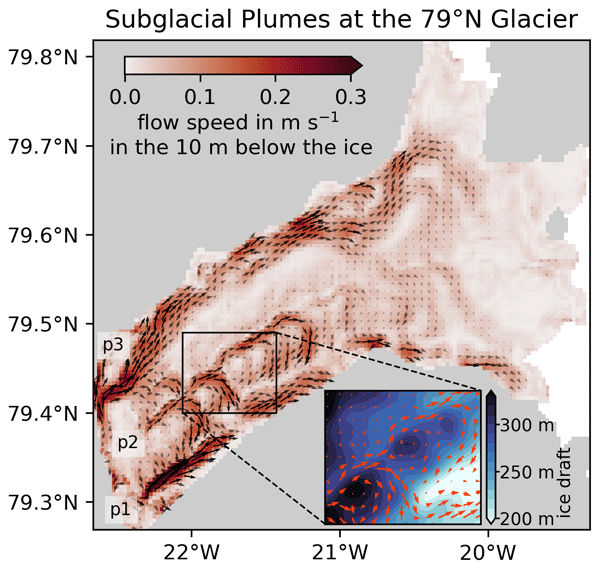
Markus Reinert, Claudia Wekerle, Knut Klingbeil, Marvin Lorenz, and Hans Burchard
The Cryosphere, 20, 4563–4584, https://doi.org/10.5194/tc-20-4563-2026, https://doi.org/10.5194/tc-20-4563-2026, 2026
Short summary
Short summary
The Greenland Ice Sheet is an important contributor to global sea level rise. In northern Greenland, floating glacier tongues are primarily melted by ocean currents. These processes are difficult to observe, so we developed a realistic numerical model to study ocean-driven melting at Greenland's largest floating ice tongue, the 79° North Glacier. Our simulation reveals the details of the oceanic currents bringing warm water toward the ice base, melting and shaping the glacier tongue from below.
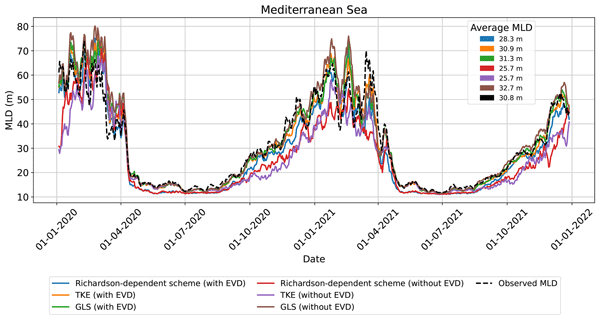
Lucia Gualtieri, Hans Burchard, Federica Borile, Aimie Moulin, Pietro Miraglio, Francesco Maicu, Emanuela Clementi, and Paolo Oddo
Geosci. Model Dev., 19, 7041–7068, https://doi.org/10.5194/gmd-19-7041-2026, https://doi.org/10.5194/gmd-19-7041-2026, 2026
Short summary
Short summary
This study addresses a gap in understanding how turbulent mixing closure schemes and convective adjustments interplay in the Mediterranean Sea. Coupled ocean-wave simulations were performed with different mixing parameterizations and model results were compared against Argo float observations across different space and time scales. Results show that the Generalised Length Scale closure scheme best reproduces observed mixed layer properties and variability, without needing convective adjustment.
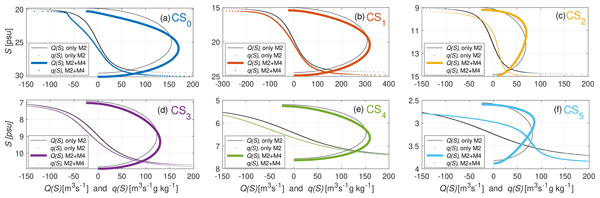
Manuel Díez-Minguito and Hans Burchard
Ocean Sci., 22, 1861–1874, https://doi.org/10.5194/os-22-1861-2026, https://doi.org/10.5194/os-22-1861-2026, 2026
Short summary
Short summary
Combining field observations with an analytical tidal scenario, we estimated in the Guadalquivir estuary its Total Exchange Flow (TEF), which has implications for water quality and residence times. The influence of tidal asymmetry on TEF is also explored. Results reveal a spatial variability in TEF and that salinity–current covariance exerts greater control on TEF than tidal asymmetry. The approach is suitable for regional studies evaluating sensitivity to changes in runoff, salinity and tides.
Evridiki Chrysagi, Lars Umlauf, Ulf Gräwe, Hans Burchard, and Alberto C. Naveira Garabato
EGUsphere, https://doi.org/10.5194/egusphere-2026-2878, https://doi.org/10.5194/egusphere-2026-2878, 2026
Short summary
Short summary
High-resolution numerical simulations of the Baltic Sea reveal that fine-scale motions known as submesoscales are widespread in the deeper layers of the basin, especially near its boundaries. These features are linked to strong mixing and, in this wind-driven system, are found to intensify during storms, with wind reversals shifting the location of mixing hotspots. Our results suggest that storm-modulated submesoscales may be important in other wind-driven coastal seas and lakes.
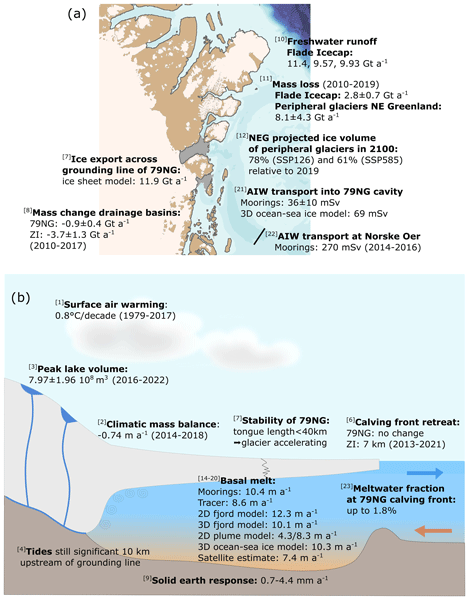
Torsten Kanzow, Angelika Humbert, Thomas Mölg, Mirko Scheinert, Matthias Braun, Hans Burchard, Francesca Doglioni, Philipp Hochreuther, Martin Horwath, Oliver Huhn, Maria Kappelsberger, Jürgen Kusche, Erik Loebel, Katrina Lutz, Ben Marzeion, Rebecca McPherson, Mahdi Mohammadi-Aragh, Marco Möller, Carolyne Pickler, Markus Reinert, Monika Rhein, Martin Rückamp, Janin Schaffer, Muhammad Shafeeque, Sophie Stolzenberger, Ralph Timmermann, Jenny Turton, Claudia Wekerle, and Ole Zeising
The Cryosphere, 19, 1789–1824, https://doi.org/10.5194/tc-19-1789-2025, https://doi.org/10.5194/tc-19-1789-2025, 2025
Short summary
Short summary
The Greenland Ice Sheet represents the second-largest contributor to global sea-level rise. We quantify atmosphere, ice and ocean processes related to the mass balance of glaciers in northeast Greenland, focusing on Greenland’s largest floating ice tongue, the 79° N Glacier. We find that together, the different in situ and remote sensing observations and model simulations reveal a consistent picture of a coupled atmosphere–ice sheet–ocean system that has entered a phase of major change.
Pia Kolb, Anna Zorndt, Hans Burchard, Ulf Gräwe, and Frank Kösters
Ocean Sci., 18, 1725–1739, https://doi.org/10.5194/os-18-1725-2022, https://doi.org/10.5194/os-18-1725-2022, 2022
Short summary
Short summary
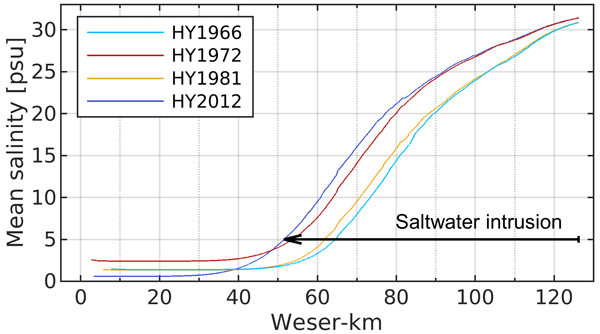
River engineering measures greatly changed tidal dynamics in the Weser estuary. We studied the effect on saltwater intrusion with numerical models. Our analysis shows that a deepening of the navigation channel causes saltwater to intrude further into the Weser estuary. This effect is mostly masked by the natural variability of river discharge. In our study, it proved essential to recalibrate individual hindcast models due to differences in sediments, bed forms, and underlying bathymetric data.
Vera Fofonova, Tuomas Kärnä, Knut Klingbeil, Alexey Androsov, Ivan Kuznetsov, Dmitry Sidorenko, Sergey Danilov, Hans Burchard, and Karen Helen Wiltshire
Geosci. Model Dev., 14, 6945–6975, https://doi.org/10.5194/gmd-14-6945-2021, https://doi.org/10.5194/gmd-14-6945-2021, 2021
Short summary
Short summary
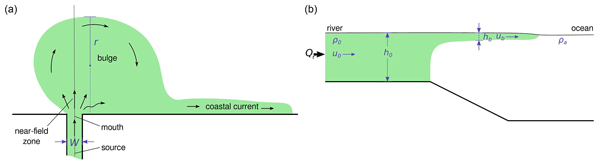
We present a test case of river plume spreading to evaluate coastal ocean models. Our test case reveals the level of numerical mixing (due to parameterizations used and numerical treatment of processes in the model) and the ability of models to reproduce complex dynamics. The major result of our comparative study is that accuracy in reproducing the analytical solution depends less on the type of applied model architecture or numerical grid than it does on the type of advection scheme.
Markus Reinert, Claudia Wekerle, Knut Klingbeil, Marvin Lorenz, and Hans Burchard
The Cryosphere, 20, 4563–4584, https://doi.org/10.5194/tc-20-4563-2026, https://doi.org/10.5194/tc-20-4563-2026, 2026
Short summary
Short summary
The Greenland Ice Sheet is an important contributor to global sea level rise. In northern Greenland, floating glacier tongues are primarily melted by ocean currents. These processes are difficult to observe, so we developed a realistic numerical model to study ocean-driven melting at Greenland's largest floating ice tongue, the 79° North Glacier. Our simulation reveals the details of the oceanic currents bringing warm water toward the ice base, melting and shaping the glacier tongue from below.
Lucia Gualtieri, Hans Burchard, Federica Borile, Aimie Moulin, Pietro Miraglio, Francesco Maicu, Emanuela Clementi, and Paolo Oddo
Geosci. Model Dev., 19, 7041–7068, https://doi.org/10.5194/gmd-19-7041-2026, https://doi.org/10.5194/gmd-19-7041-2026, 2026
Short summary
Short summary
This study addresses a gap in understanding how turbulent mixing closure schemes and convective adjustments interplay in the Mediterranean Sea. Coupled ocean-wave simulations were performed with different mixing parameterizations and model results were compared against Argo float observations across different space and time scales. Results show that the Generalised Length Scale closure scheme best reproduces observed mixed layer properties and variability, without needing convective adjustment.
Manuel Díez-Minguito and Hans Burchard
Ocean Sci., 22, 1861–1874, https://doi.org/10.5194/os-22-1861-2026, https://doi.org/10.5194/os-22-1861-2026, 2026
Short summary
Short summary
Combining field observations with an analytical tidal scenario, we estimated in the Guadalquivir estuary its Total Exchange Flow (TEF), which has implications for water quality and residence times. The influence of tidal asymmetry on TEF is also explored. Results reveal a spatial variability in TEF and that salinity–current covariance exerts greater control on TEF than tidal asymmetry. The approach is suitable for regional studies evaluating sensitivity to changes in runoff, salinity and tides.
Evridiki Chrysagi, Lars Umlauf, Ulf Gräwe, Hans Burchard, and Alberto C. Naveira Garabato
EGUsphere, https://doi.org/10.5194/egusphere-2026-2878, https://doi.org/10.5194/egusphere-2026-2878, 2026
Short summary
Short summary
High-resolution numerical simulations of the Baltic Sea reveal that fine-scale motions known as submesoscales are widespread in the deeper layers of the basin, especially near its boundaries. These features are linked to strong mixing and, in this wind-driven system, are found to intensify during storms, with wind reversals shifting the location of mixing hotspots. Our results suggest that storm-modulated submesoscales may be important in other wind-driven coastal seas and lakes.
Torsten Kanzow, Angelika Humbert, Thomas Mölg, Mirko Scheinert, Matthias Braun, Hans Burchard, Francesca Doglioni, Philipp Hochreuther, Martin Horwath, Oliver Huhn, Maria Kappelsberger, Jürgen Kusche, Erik Loebel, Katrina Lutz, Ben Marzeion, Rebecca McPherson, Mahdi Mohammadi-Aragh, Marco Möller, Carolyne Pickler, Markus Reinert, Monika Rhein, Martin Rückamp, Janin Schaffer, Muhammad Shafeeque, Sophie Stolzenberger, Ralph Timmermann, Jenny Turton, Claudia Wekerle, and Ole Zeising
The Cryosphere, 19, 1789–1824, https://doi.org/10.5194/tc-19-1789-2025, https://doi.org/10.5194/tc-19-1789-2025, 2025
Short summary
Short summary
The Greenland Ice Sheet represents the second-largest contributor to global sea-level rise. We quantify atmosphere, ice and ocean processes related to the mass balance of glaciers in northeast Greenland, focusing on Greenland’s largest floating ice tongue, the 79° N Glacier. We find that together, the different in situ and remote sensing observations and model simulations reveal a consistent picture of a coupled atmosphere–ice sheet–ocean system that has entered a phase of major change.
Tridib Banerjee, Patrick Scholz, Sergey Danilov, Knut Klingbeil, and Dmitry Sidorenko
Geosci. Model Dev., 17, 7051–7065, https://doi.org/10.5194/gmd-17-7051-2024, https://doi.org/10.5194/gmd-17-7051-2024, 2024
Short summary
Short summary
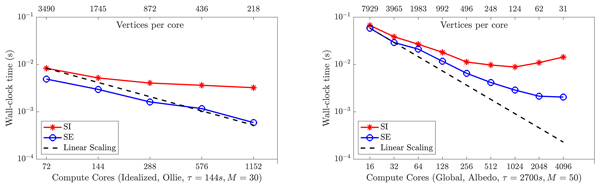
In this paper we propose a new alternative to one of the functionalities of the sea ice model FESOM2. The alternative we propose allows the model to capture and simulate fast changes in quantities like sea surface elevation more accurately. We also demonstrate that the new alternative is faster and more adept at taking advantages of highly parallelized computing infrastructure. We therefore show that this new alternative is a great addition to the sea ice model FESOM2.
Pia Kolb, Anna Zorndt, Hans Burchard, Ulf Gräwe, and Frank Kösters
Ocean Sci., 18, 1725–1739, https://doi.org/10.5194/os-18-1725-2022, https://doi.org/10.5194/os-18-1725-2022, 2022
Short summary
Short summary
River engineering measures greatly changed tidal dynamics in the Weser estuary. We studied the effect on saltwater intrusion with numerical models. Our analysis shows that a deepening of the navigation channel causes saltwater to intrude further into the Weser estuary. This effect is mostly masked by the natural variability of river discharge. In our study, it proved essential to recalibrate individual hindcast models due to differences in sediments, bed forms, and underlying bathymetric data.
Malcolm E. Scully, W. Rockwell Geyer, David Borkman, Tracy L. Pugh, Amy Costa, and Owen C. Nichols
Biogeosciences, 19, 3523–3536, https://doi.org/10.5194/bg-19-3523-2022, https://doi.org/10.5194/bg-19-3523-2022, 2022
Short summary
Short summary
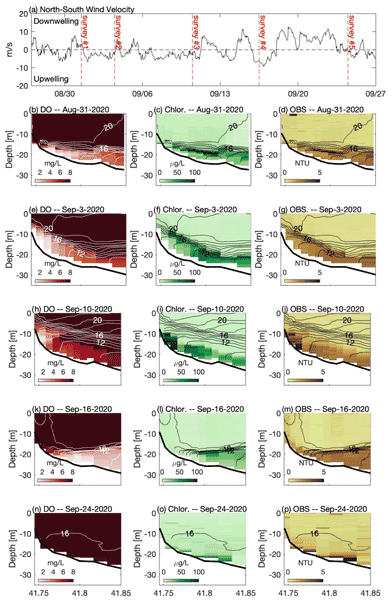
For two consecutive summers, the bottom waters in southern Cape Cod Bay became severely depleted of dissolved oxygen. Low oxygen levels in bottom waters have never been reported in this area before, and this unprecedented occurrence is likely the result of a new algae species that recently began blooming during the late-summer months. We present data suggesting that blooms of this new species are the result of regional climate change including warmer waters and changes in summer winds.
Vera Fofonova, Tuomas Kärnä, Knut Klingbeil, Alexey Androsov, Ivan Kuznetsov, Dmitry Sidorenko, Sergey Danilov, Hans Burchard, and Karen Helen Wiltshire
Geosci. Model Dev., 14, 6945–6975, https://doi.org/10.5194/gmd-14-6945-2021, https://doi.org/10.5194/gmd-14-6945-2021, 2021
Short summary
Short summary
We present a test case of river plume spreading to evaluate coastal ocean models. Our test case reveals the level of numerical mixing (due to parameterizations used and numerical treatment of processes in the model) and the ability of models to reproduce complex dynamics. The major result of our comparative study is that accuracy in reproducing the analytical solution depends less on the type of applied model architecture or numerical grid than it does on the type of advection scheme.
Cited articles
Armi, L. and Farmer, D. M.: Maximal two-layer exchange through a contraction with barotropic net flow, J. Fluid Mech., 164, 27–51, https://doi.org/10.1017/S0022112086002458, 1986. a
Banerjee, T., Klingbeil, K., and Danilov, S.: Discrete variance decay analysis of spurious mixing, Ocean Model., 192, 102460, https://doi.org/10.1016/j.ocemod.2024.102460, 2024. a, b
Becherer, J., Burchard, H., Flöser, G., Mohrholz, V., and Umlauf, L.: Evidence of tidal straining in well-mixed channel flow from micro-structure observations, Geophys. Res. Lett., 38, L17611, https://doi.org/10.1029/2011GL049005, 2011. a
Bo, T., Ralston, D. K., Garcia, A. M. P., and Geyer, W. R.: Tidal intrusion fronts, surface convergence, and mixing in an estuary with complex topography, J. Phys. Oceanogr., 54, 653–677, https://doi.org/10.1175/JPO-D-23-0131.1, 2024. a
Boehlich, M. J. and Strotmann, T.: The Elbe estuary, Die Küste, 74, 288–306, https://doi.org/10.18171/1.087106, 2008. a
Börgel, F., Karsten, S., Rummel, K., and Gräwe, U.: From weather data to river runoff: using spatiotemporal convolutional networks for discharge forecasting, Geosci. Model Dev., 18, 2005–2019, https://doi.org/10.5194/gmd-18-2005-2025, 2025. a
Boyle, E., Collier, R., Dengler, A., Edmond, J., Ng, A., and Stallard, R.: On the chemical mass-balance in estuaries, Geochim. Cosmochim. Ac., 38, 1719–1728, https://doi.org/10.1016/0016-7037(74)90188-4, 1974. a
Burchard, H. and Bolding, K.: Comparative analysis of four second-moment turbulence closure models for the oceanic mixed layer, J. Phys. Oceanogr., 31, 1943–1968, https://doi.org/10.1175/1520-0485(2001)031<1943:caofsm>2.0.co;2, 2001. a, b, c, d
Burchard, H. and Bolding, K.: GETM – A General Estuarine Transport Model, Tech. Rep. EUR 20253 EN, European Commission, https://publications.jrc.ec.europa.eu/repository/handle/JRC23237 (last access: 16 June 2026), 2002. a
Burchard, H. and Hetland, R. D.: Quantifying the contributions of tidal straining and gravitational circulation to residual circulation in periodically stratified tidal estuaries, J. Phys. Oceanogr., 40, 1243–1262, https://doi.org/10.1175/2010JPO4270.1, 2010. a
Burchard, H., Bolding, K., and Villarreal, M. R.: GOTM – a general ocean turbulence model. Theory, applications and test cases, Tech. Rep. EUR 18745 EN, European Commission, https://op.europa.eu/en/publication-detail/-/publication/5b512e12-367d-11ea-ba6e-01aa75ed71a1 (last access: 16 June 2026), 1999. a
Burchard, H., Bolding, K., and Villarreal, M. R.: Three-dimensional modelling of estuarine turbidity maxima in a tidal estuary, Ocean Dyn., 54, 250–265, https://doi.org/10.1007/s10236-003-0073-4, 2004. a
Burchard, H., Hetland, R. D., Schulz, E., and Schuttelaars, H. M.: Drivers of residual estuarine circulation in tidally energetic estuaries: Straight and irrotational channels with parabolic cross section, J. Phys. Oceanogr., 41, 548–570, https://doi.org/10.1175/2010JPO4453.1, 2011. a, b
Burchard, H., Schulz, E., and Schuttelaars, H. M.: Impact of estuarine convergence on residual circulation in tidally energetic estuaries and inlets, Geophys. Res. Lett., 41, 913–919, https://doi.org/10.1002/2013GL058494, 2014. a
Burchard, H., Bolding, K., Feistel, R., Gräwe, U., Klingbeil, K., MacCready, P., Mohrholz, V., Umlauf, L., and van der Lee, E. M.: The Knudsen theorem and the Total Exchange Flow analysis framework applied to the Baltic Sea, Progr. Oceanogr., 165, 268–286, https://doi.org/10.1016/j.pocean.2018.04.004, 2018a. a, b, c, d, e, f, g
Burchard, H., Schuttelaars, H. M., and Ralston, D. K.: Sediment trapping in estuaries, Annu. Rev. Mar. Sci., 10, 10371–10395, https://doi.org/10.1146/annurev-marine-010816-060535, 2018b. a
Burchard, H., Gräwe, U., Klingbeil, K., Koganti, N., Lange, X., and Lorenz, M.: Effective diahaline diffusivities in estuaries, J. Adv. Model. Earth Sy., 13, https://doi.org/10.1029/2020MS002307, 2021. a, b
Cessi, P.: The global overturning circulation, Annu. Rev. Mar. Sci., 11, 249–270, https://doi.org/10.1146/annurev-marine-010318-095241, 2019. a
Chang, Y., Li, X., Wang, Y. P., Klingbeil, K., Li, W., Zhang, F., and Burchard, H.: Salinity mixing in a tidal multi-branched estuary with huge and variable runoff, J. Hydrol., 634, 131094, https://doi.org/10.1016/j.jhydrol.2024.131094, 2024. a, b, c
Chen, S.-N. and Sanford, L. P.: Axial wind effects on stratification and longitudinal salt transport in an idealized, partially mixed estuary, J. Phys. Oceanogr., 39, 1905–1920, https://doi.org/10.1175/2009JPO4016.1, 2009. a
Cheng, Y., Canuto, V. M., and Howard, A. M.: An improved model for the turbulent PBL, J. Atmos. Sci., 59, 1550–1565, https://doi.org/10.1175/1520-0469(2002)059<1550:aimftt>2.0.co;2, 2002. a
Chrysagi, E., Umlauf, L., Holtermann, P., Klingbeil, K., and Burchard, H.: High-resolution simulations of submesoscale processes in the Baltic Sea: The role of storm events, J. Geophys. Res.-Oceans, 126, e2020JC016411, https://doi.org/10.1029/2020JC016411, 2021. a
Collignon, A. G. and Stacey, M. T.: Turbulence dynamics at the shoal–channel interface in a partially stratified estuary, J. Phys. Oceanogr., 43, 970–989, https://doi.org/10.1175/JPO-D-12-0115.1, 2013. a
Conroy, T., Sutherland, D. A., and Ralston, D. K.: Estuarine exchange flow variability in a seasonal, segmented estuary, J. Phys. Oceanogr., 50, 595–613, https://doi.org/10.1175/JPO-D-19-0108.1, 2020. a
Dijkstra, Y. M., Schuttelaars, H. M., and Burchard, H.: Generation of exchange flows in estuaries by tidal and gravitational eddy viscosity-shear covariance (ESCO), J. Geophys. Res.-Oceans, 122, 4217–4237, https://doi.org/10.1002/2016JC012379, 2017. a
Döös, K., Meier, H. M., and Döscher, R.: The Baltic haline conveyor belt or the overturning circulation and mixing in the Baltic, AMBIO, 33, 261–266, https://doi.org/10.1579/0044-7447-33.4.261, 2004. a, b
Drake, H. F., Shanice, B., Dussin, R., Griffies, S. M., Krasting, J. P., MacGilchrist, G. A., Stanley, G. J., Tesdal, J.-E., and Zika, J. D.: Water mass transformation budgets in finite-volume generalized vertical coordinate ocean models, J. Adv. Model. Earth Sy., 17, e2024MS004383, https://doi.org/10.1029/2024MS004383, 2025. a
Etemad-Shahidi, A. and Imberger, J.: Anatomy of turbulence in a narrow and strongly stratified estuary, J. Geophys. Res.-Oceans, 107, 7–1, https://doi.org/10.1029/2001JC000977, 2002. a
E.U. Copernicus Marine Service: Atlantic – European North West Shelf – Ocean Physics Analysis and Forecast, Marine Data Store (MDS) [data set], https://doi.org/10.48670/moi-00054, 2024. a
Ferrari, R., Mashayek, A., McDougall, T. J., Nikurashin, M., and Campin, J.-M.: Turning ocean mixing upside down, J. Phys. Oceanogr., 46, 2239–2261, https://doi.org/10.1175/JPO-D-15-0244.1, 2016. a
Fischer, H. B.: Mixing and dispersion in estuaries, Annu. Rev. Fluid Mech., 8, 107–133, https://doi.org/10.1146/annurev.fl.08.010176.000543, 1976. a
Galperin, B., Kantha, L., Rosati, A., and Hassid, S.: A quasi-equilibrium turbulent energy model for geophysical flows, J. Atmos. Sci., 45, 55–62, https://doi.org/10.1175/1520-0469(1988)045<0055:aqetem>2.0.co;2, 1988. a
Gargett, A. E.: Observing turbulence with a modified acoustic Doppler current profiler, J. Atmos. Ocean. Tech., 11, 1592–1610, https://doi.org/10.1175/1520-0426(1994)011<1592:otwama>2.0.co;2, 1994. a
Garrett, C.: Marginal mixing theories, Atmosphere-Ocean, 29, 313–339, https://doi.org/10.1080/07055900.1991.9649407, 1991. a
Garvine, R. W.: Penetration of buoyant coastal discharge onto the continental shelf: A numerical model experiment, J. Phys. Oceanogr., 29, 1892–1909, https://doi.org/10.1175/1520-0485(1999)029<1892:pobcdo>2.0.co;2, 1999. a, b
Geyer, W. R.: The importance of suppression of turbulence by stratification on the estuarine turbidity maximum, Estuaries, 16, 113–125, https://doi.org/10.2307/1352769, 1993. a
Geyer, W. R.: Influence of wind on dynamics and flushing of shallow estuaries, Estuar. Coast. Shelf S., 44, 713–722, https://doi.org/10.1006/ecss.1996.0140, 1997. a
Geyer, W. R. and MacCready, P.: The estuarine circulation, Annu. Rev. Fluid Mech., 46, 175–197, https://doi.org/10.1146/annurev-fluid-010313-141302, 2014. a, b
Geyer, W. R. and Ralston, D. K.: Estuarine frontogenesis, J. Phys. Oceanogr., 45, 546–561, https://doi.org/10.1175/JPO-D-14-0082.1, 2015. a, b, c
Geyer, W. R., Ralston, D. K., and Holleman, R. C.: Hydraulics and mixing in a laterally divergent channel of a highly stratified estuary, J. Geophys. Res.-Oceans, 122, 4743–4760, https://doi.org/10.1002/2016JC012455, 2017. a, b
Geyer, W. R., Ralston, D. K., and Chen, J.-L.: Mechanisms of exchange flow in an estuary with a narrow, deep channel and wide, shallow shoals, J. Geophys. Res., 125, e2020JC016092, https://doi.org/10.1029/2020JC016092, 2020. a
Gibbs, J. W.: On the equilibrium of heterogeneous substances, Am. J. Sci., 3, 441–458, https://doi.org/10.11588/heidok.00013220, 1878. a
Gibson, A. H., Hogg, A. M., Kiss, A. E., Shakespeare, C. J., and Adcroft, A. J.: Attribution of horizontal and vertical contributions to spurious mixing in an Arbitrary Lagrangian–Eulerian ocean model, Ocean Model., 119, 45–56, https://doi.org/10.1016/j.ocemod.2017.09.008, 2017. a
Giddings, S. N., Fong, D. A., and Monismith, S. G.: Role of straining and advection in the intratidal evolution of stratification, vertical mixing, and longitudinal dispersion of a shallow, macrotidal, salt wedge estuary, J. Geophys. Res.-Oceans, 116, https://doi.org/10.1029/2010JC006482, 2011. a, b
Gräwe, U., Holtermann, P., Klingbeil, K., and Burchard, H.: Advantages of vertically adaptive coordinates in numerical models of stratified shelf seas, Ocean Model., 92, 56–68, https://doi.org/10.1016/j.ocemod.2015.05.008, 2015. a
Gräwe, U., Flöser, G., Gerkema, T., Duran-Matute, M., Badewien, T. H., Schulz, E., and Burchard, H.: A numerical model for the entire Wadden Sea: Skill assessment and analysis of hydrodynamics, J. Geophys. Res., 121, 5231–5251, https://doi.org/10.1002/2016JC011655, 2016. a, b, c
Griffies, S. M.: Fundamentals of Ocean-Climate Models, Princeton University Press, Princeton, USA, ISBN 9780691118925, 2004. a
Griffies, S. M., Pacanowski, R. C., and Hallberg, R. W.: Spurious diapycnal mixing associated with advection in a z-coordinate ocean model, Mon. Weather Rev., 128, 538–564, https://doi.org/10.1175/1520-0493(2000)128<0538:sdmawa>2.0.co;2, 2000. a
Groeskamp, S., Griffies, S. M., Iudicone, D., Marsh, R., Nurser, A. G., and Zika, J. D.: The water mass transformation framework for ocean physics and biogeochemistry, Annu. Rev. Mar. Sci., 11, 271–305, https://doi.org/10.1146/annurev-marine-010318-095421, 2019. a, b
Harcourt, R. R.: An improved second-moment closure model of Langmuir turbulence, J. Phys. Oceanogr., 45, 84–103, https://doi.org/10.1175/JPO-D-14-0046.1, 2015. a
Hetland, R.: Relating river plume structure to vertical mixing, J. Phys. Oceanogr., 35, 1667–1688, https://doi.org/10.1175/JPO2774.1, 2005. a, b
Hieronymus, M., Nilsson, J., and Nycander, J.: Water mass transformation in salinity–temperature space, J. Phys. Oceanogr., 44, 2547–2568, https://doi.org/10.1175/JPO-D-13-0257.1, 2014. a, b
Hofmeister, R., Beckers, J.-M., and Burchard, H.: Realistic modelling of the exceptional inflows into the central Baltic Sea in 2003 using terrain-following coordinates, Ocean Model., 39, 233–247, https://doi.org/10.1016/j.ocemod.2011.04.007, 2011. a, b
Holmes, R. M., Zika, J. D., Griffies, S. M., Hogg, A. M., Kiss, A. E., and England, M. H.: The geography of numerical mixing in a suite of global ocean models, J. Adv. Model. Earth Sy., 13, https://doi.org/10.1029/2020MS002333, 2021. a
Horner-Devine, A. R., Hetland, R. D., and MacDonald, D. G.: Mixing and transport in coastal river plumes, Annu. Rev. Fluid Mech., 47, 569–594, https://doi.org/10.1146/annurev-fluid-010313-141408, 2015. a
Huang, J., Chamecki, M., Li, Q., and Chen, B.: The role of longitudinal alignment between surface and bottom forcing on the full-column turbulence mixing in the coastal ocean, Ocean Model., 102637, https://doi.org/10.1016/j.ocemod.2025.102637, 2025. a
Huguenard, K., Valle-Levinson, A., Li, M., Chant, R., and Souza, A.: Linkage between lateral circulation and near-surface vertical mixing in a coastal plain estuary, J. Geophys. Res.-Oceans, 120, 4048–4067, https://doi.org/10.1002/2014JC010679, 2015. a
Huguenard, K., Bears, K., and Lieberthal, B.: Intermittency in Estuarine Turbulence: A framework toward limiting bias in microstructure measurements, J. Atmos. Ocean. Tech., 36, 1917–1932, https://doi.org/10.1175/JTECH-D-18-0220.1, 2019. a
Huzzey, L. M. and Brubaker, J. M.: The formation of longitudinal fronts in a coastal plain estuary, J. Geophys. Res.-Oceans, 93, 1329–1334, https://doi.org/10.1029/JC093iC02p01329, 1988. a
Ianniello, J. P.: Tidally induced residual currents in estuaries of variable breadth and depth, J. Phys. Oceanogr., 9, 962–974, https://doi.org/10.1175/1520-0485(1979)009<0962:TIRCIE>2.0.CO;2, 1979. a
Inall, M. and Gillibrand, P.: The physics of mid-latitude fjords: a review, in: Fjord Systems and Archives, edited by Howe, J. A., Austin, W. E. N., Forwick, M., and Paetzel, M., vol. 344 of Geological Society, London, Special Publications, The Geological Society of London London, 17–33, https://doi.org/10.1144/SP344.3, 2010. a
Jay, D. A. and Musiak, J. D.: Particle trapping in estuarine tidal flows, J. Geophys. Res., 99, 20445–20461, https://doi.org/10.1029/94JC00971, 1994. a
Ji, Z.-G., Hu, G., Shen, J., and Wan, Y.: Three-dimensional modeling of hydrodynamic processes in the St. Lucie Estuary, Estuar. Coast. Shelf S., 73, 188–200, https://doi.org/10.1016/j.ecss.2006.12.016, 2007. a
Kim, J., Park, K., Yang, D. R., and Hong, S.: A comprehensive review of energy consumption of seawater reverse osmosis desalination plants, Appl. Energ., 254, 113652, https://doi.org/10.1016/j.apenergy.2019.113652, 2019. a
Klingbeil, K.: Source code for the coastal ocean model GETM (tef branch), Zenodo [software], https://doi.org/10.5281/zenodo.7741730, 2022. a
Klingbeil, K. and Burchard, H.: Implementation of a direct nonhydrostatic pressure gradient discretisation into a layered ocean model, Ocean Model., 65, 64–77, https://doi.org/10.1016/j.ocemod.2013.02.002, 2013. a
Klingbeil, K. and Henell, E.: A rigorous derivation of the water mass transformation framework, the relation between mixing and diasurface exchange flow, and links to recent theories in estuarine research, J. Phys. Oceanogr., 53, 2953–2968, https://doi.org/10.1175/JPO-D-23-0130.1, 2023. a, b, c
Klingbeil, K. and Lorenz, M.: On the instantaneous salt mixing due to freshwater boundary fluxes, J. Phys. Oceanogr., 55, 809–813, https://doi.org/10.1175/JPO-D-24-0168.1, 2025. a
Klingbeil, K., Mohammadi-Aragh, M., Gräwe, U., and Burchard, H.: Quantification of spurious dissipation and mixing - Discrete variance decay in a Finite-Volume framework, Ocean Model., 81, 49–64, https://doi.org/10.1016/j.ocemod.2014.06.001, 2014. a, b, c
Klingbeil, K., Lemarié, F., Debreu, L., and Burchard, H.: The numerics of hydrostatic structured-grid coastal ocean models: State of the art and future perspectives, Ocean Model., 125, 80–105, https://doi.org/10.1016/j.ocemod.2018.01.007, 2018. a
Klingbeil, K., Becherer, J., Schulz, E., de Swart, H. E., Schuttelaars, H. M., Valle-Levinson, A., and Burchard, H.: Thickness-Weighted Averaging in tidal estuaries and the vertical distribution of the Eulerian residual transport, J. Phys. Oceanogr., 49, 1809–1826, https://doi.org/10.1175/JPO-D-18-0083.1, 2019. a
Kuhlbrodt, T., Griesel, A., Montoya, M., Levermann, A., Hofmann, M., and Rahmstorf, S.: On the driving processes of the Atlantic meridional overturning circulation, Rev. Geophys., 45, https://doi.org/10.1029/2004RG000166, 2007. a
Lange, X. and Burchard, H.: The relative importance of wind straining and gravitational forcing in driving exchange flows in tidally energetic estuaries, J. Phys. Oceanogr., 49, 723–736, https://doi.org/10.1175/JPO-D-18-0014.1, 2019. a
Lange, X., Klingbeil, K., and Burchard, H.: Inversions of estuarine circulation are frequent in a weakly tidal estuary with variable wind forcing and seaward salinity fluctuations, J. Geophys. Res.-Oceans, 125, e2019JC015789, https://doi.org/10.1029/2019JC015789, 2020. a, b
Legay, A., Deremble, B., and Burchard, H.: Derivation and implementation of a non-local term to improve the oceanic convection representation within the k–ɛ parameterization, J. Adv. Model. Earth Sy., 17, e2024MS004243, https://doi.org/10.1029/2024MS004243, 2025. a, b
Lemagie, E., Giddings, S. N., MacCready, P., Seaton, C., and Wu, X.: Measuring estuarine total exchange flow from discrete observations, J. Geophys. Res.-Oceans, 127, e2022JC018960, https://doi.org/10.1029/2022JC018960, 2022. a, b, c
Lerczak, J. and Geyer, W.: Modeling the lateral circulation in straight, stratified estuaries, J. Phy. Oceanogr., 34, 1410–1428, https://doi.org/10.1175/1520-0485(2004)034<1410:MTLCIS>2.0.CO;2, 2004. a, b
Li, X. and Reese, L.: Dataset from Burchard et al. (2026): “Estuarine mixing”, Zenodo [data set], https://doi.org/10.5281/zenodo.20305994, 2026. a
Li, M., Trowbridge, J., and Geyer, W. R.: Asymmetric tidal mixing due to the horizontal density gradient, J. Phys. Oceanogr., 38, 418–434, https://doi.org/10.1175/2007JPO3372.1, 2008. a
Li, M., Radhakrishnan, S., Piomelli, U., and Geyer, W. R.: Large-eddy simulation of the tidal-cycle variations of an estuarine boundary layer, J. Geophys. Res.-Oceans, 115, https://doi.org/10.1029/2009JC005702, 2010. a
Li, Q., Bruggeman, J., Burchard, H., Klingbeil, K., Umlauf, L., and Bolding, K.: Integrating CVMix into GOTM (v6.0): a consistent framework for testing, comparing, and applying ocean mixing schemes, Geosci. Model Dev., 14, 4261–4282, https://doi.org/10.5194/gmd-14-4261-2021, 2021. a
Li, X., Chrysagi, E., Klingbeil, K., and Burchard, H.: Impact of islands on tidally dominated river plumes: A high-resolution modeling study, J. Geophys. Res.-Oceans, 129, e2023JC020272, https://doi.org/10.1029/2023JC020272, 2024. a, b, c
Loder, T. C. and Reichard, R. P.: The dynamics of conservative mixing in estuaries, Estuaries, 4, 64–69, https://doi.org/10.2307/1351543, 1981. a
Lorenz, M., Klingbeil, K., MacCready, P., and Burchard, H.: Numerical issues of the Total Exchange Flow (TEF) analysis framework for quantifying estuarine circulation, Ocean Sci., 15, 601–614, https://doi.org/10.5194/os-15-601-2019, 2019. a, b
Lorenz, M., Klingbeil, K., and Burchard, H.: Numerical study of the exchange flow of the Persian Gulf using an extended total exchange flow analysis framework, J. Geophys. Res.-Oceans, 125, e2019JC015527, https://doi.org/10.1029/2019JC015527, 2020. a, b
Lorenz, M., Klingbeil, K., and Burchard, H.: Impact of evaporation and precipitation on estuarine mixing, J. Phys. Oceanogr., 51, 1319–1333, https://doi.org/10.1175/JPO-D-20-0158.1, 2021. a, b, c, d
Lu, Y. and Lueck, R. G.: Using a broadband ADCP in a tidal channel. Part II: Turbulence, J. Atmos. Ocean. Tech., 16, 1568–1579, https://doi.org/10.1175/1520-0426(1999)016<1568:UABAIA>2.0.CO;2, 1999. a
Lui, H.-K. and Chen, C.-T. A.: Shifts in limiting nutrients in an estuary caused by mixing and biological activity, Limnol. Oceanogr., 56, 989–998, https://doi.org/10.4319/lo.2011.56.3.0989, 2011. a
MacCready, P.: Toward a unified theory of tidally-averaged estuarine salinity structure, Estuaries, 27, 561–570, https://doi.org/10.1007/BF02907644, 2004. a
MacCready, P. and Banas, N.: Residual Circulation, Mixing, and Dispersion, in: Treatise on Estuarine and Coastal Science (Second Edition), edited by Baird, D. and Elliott, M., Academic Press, Oxford, 2nd Edn., 92–108, https://doi.org/10.1016/B978-0-323-90798-9.20006-1, 2011. a, b
MacCready, P. and Geyer, W. R.: Estuarine salt flux through an isohaline surface, J. Geophys. Res., 106, 11629–11637, https://doi.org/10.1029/2001JC900006, 2001. a
MacCready, P. and Geyer, W. R.: Advances in estuarine physics, Annu. Rev. Mar. Sci., 2, 35–58, https://doi.org/10.1146/annurev-marine-120308-081015, 2010. a, b, c, d
MacCready, P. and Geyer, W. R.: Estuarine exchange flow in the Salish Sea, J. Geophys. Res., 129, e2023JC020369, https://doi.org/10.1029/2023JC020369, 2024. a, b, c
MacCready, P., Hetland, R. D., and Geyer, W. R.: Long-term isohaline salt balance in an estuary, Cont. Shelf Res., 22, 1591–1601, https://doi.org/10.1016/S0278-4343(02)00023-7, 2002. a
McPherson, R., Stevens, C., and O'Callaghan, J.: Turbulent scales observed in a river plume entering a fjord, J. Geophys. Res.-Oceans, 124, 9190–9208, https://doi.org/10.1029/2019JC015448, 2019. a
McWilliams, J. C.: Submesoscale currents in the ocean, Proc. R. Soc. Lond., A Math., 472, https://doi.org/10.1098/rspa.2016.0117, 2016. a
Mellor, G. L. and Yamada, T.: A hierarchy of turbulence closure models for planetary boundary layers, J. Atmos. Sci., 31, 1791–1806, https://doi.org/10.1175/1520-0469(1974)031<1791:AHOTCM>2.0.CO;2, 1974. a, b, c, d
Monismith, S. G., Burau, J. R., and Stacey, M.: Stratification dynamics and gravitational circulation in Northern San Francisco Bay, in: San Francisco Bay: the ecosystem, edited by Hollibaugh, J. T., American Association for the Advancement of Science, Pacific Division, San Francisco, 123–153, ISBN 9780934394116, 1996. a
Muche, Y., Klingbeil, K., Lorenz, M., Yankovsky, A. E., and Burchard, H.: Numerical investigation of the influence of wind and tides on salt mixing and cross-shore transport in river plumes, J. Geophys. Res.-Oceans, 131, e2025JC023583, https://doi.org/10.1029/2025JC023583, 2026. a
Munk, W. H.: Abyssal recipes, in: Deep sea research and oceanographic abstracts, Elsevier, vol. 13, 707–730, https://doi.org/10.1016/0011-7471(66)90602-4, 1966. a
Munk, W. H. and Wunsch, C.: Abyssal recipes II: Energetics of tidal and wind mixing, Deep-Sea Res. Pt. I, 45, 1977–2010, https://doi.org/10.1016/S0967-0637(98)00070-3, 1998. a
Nash, J. D. and Moum, J. N.: Microstructure estimates of turbulent salinity flux and the dissipation spectrum of salinity, J. Phys. Oceanogr., 32, 2312–2333, https://doi.org/10.1175/1520-0485(2002)032<2312:MEOTSF>2.0.CO;2, 2002. a, b
Nikurashin, M. and Ferrari, R.: Global energy conversion rate from geostrophic flows into internal lee waves in the deep ocean, Geophys. Res. Lett., 38, https://doi.org/10.1029/2011GL046576, 2011. a
Norwegian Meteorological Institute: MET Nordic operational archive, https://github.com/metno/NWPdocs/wiki/MET-Nordic-dataset (last access: 18 December 2024), 2024. a
Notz, D. and Worster, M. G.: Desalination processes of sea ice revisited, J. Geophys. Res.-Oceans, 114, https://doi.org/10.1029/2008JC004885, 2009. a
Nunes, R. and Simpson, J.: Axial convergence in a well-mixed estuary, Estuarine, Coast. Shelf Sci., 20, 637–649, https://doi.org/10.1016/0272-7714(85)90112-X, 1985. a
Osborn, T. R.: Estimates of the local rate of vertical diffusion from dissipation measurements, J. Phys. Oceanogr., 10, 83–89, https://doi.org/10.1175/1520-0485(1980)010<0083:EOTLRO>2.0.CO;2, 1980. a, b, c
Osborn, T. R. and Cox, C. S.: Oceanic fine structure, Geophys. Fluid Dyn., 3, 321–345, https://doi.org/10.1080/03091927208236085, 1972. a
Pemberton, P., Nilsson, J., Hieronymus, M., and Meier, H. M.: Arctic Ocean water mass transformation in S–T coordinates, J. Phys. Oceanogr., 45, 1025–1050, https://doi.org/10.1175/JPO-D-14-0197.1, 2015. a
Peters, H.: Observations of stratified turbulent mixing in an estuary: Neap-to-spring variations during high river flow, Estuar. Coast. Shelf S., 45, 69–88, https://doi.org/10.1006/ecss.1996.0180, 1997. a
Peters, H. and Bokhorst, R.: Microstructure observations of turbulent mixing in a partially mixed estuary. Part I: Dissipation rate, J. Phys. Oceanogr., 30, 1232–1244, https://doi.org/10.1175/1520-0485(2000)030<1232:MOOTMI>2.0.CO;2, 2000. a
Peters, H. and Bokhorst, R.: Microstructure observations of turbulent mixing in a partially mixed estuary. Part II: Salt flux and stress, J. Phys. Oceanogr., 31, 1105–1119, https://doi.org/10.1175/1520-0485(2001)031<1105:MOOTMI>2.0.CO;2, 2001. a, b, c
Pietrzak, J. D.: The use of TVD limiters for forward-in-time upstream-biased advection schemes in ocean modeling, Mon. Weather Rev., 126, 812–830, https://doi.org/10.1175/1520-0493(1998)126<0812:TUOTLF>2.0.CO;2, 1998. a
Pritchard, D. W.: Observations of circulation in coastal plain estuaries, Estuaries, AAAS Publ., 83, 37–44, 1967. a
Purkiani, K., Becherer, J., Flöser, G., Gräwe, U., Mohrholz, V., Schuttelaars, H. M., and Burchard, H.: Numerical analysis of stratification and destratification processes in a tidally energetic inlet with an ebb tidal delta, J. Geophys. Res.-Oceans, 120, 225–243, https://doi.org/10.1002/2014JC010325, 2015. a
Qu, L., Hetland, R. D., and Schlichting, D.: Mixing pathways in simple box models, J. Phys. Oceanogr., 52, 2761–2772, https://doi.org/10.1175/JPO-D-22-0074.1, 2022. a
Ralston, D. K., Cowles, G. W., Geyer, W. R., and Holleman, R. C.: Turbulent and numerical mixing in a salt wedge estuary: Dependence on grid resolution, bottom roughness, and turbulence closure, J. Geophys. Res., 122, 692–712, https://doi.org/10.1002/2016JC011738, 2017. a, b, c
Ramadhan, A., Wagner, G., Hill, C., Campin, J.-M., Churavy, V., Besard, T., Souza, A., Edelman, A., Ferrari, R., and Marshall, J.: Oceananigans. jl: Fast and friendly geophysical fluid dynamics on GPUs, J. Open Source Software, 5, https://doi.org/10.21105/joss.02018, 2020. a
Rayson, M. D., Gross, E. S., Hetland, R. D., and Fringer, O. B.: Using an isohaline flux analysis to predict the salt content in an unsteady estuary, J. Phys. Oceanogr., 47, 2811–2828, https://doi.org/10.1175/JPO-D-16-0134.1, 2017. a
Reese, L., Gräwe, U., Klingbeil, K., Li, X., Lorenz, M., and Burchard, H.: Local mixing determines spatial structure of diahaline exchange flow in a mesotidal estuary: A study of extreme runoff conditions, J. Phys. Oceanogr., 54, 3–27, https://doi.org/10.1175/JPO-D-23-0052.1, 2024. a, b, c, d, e, f, g, h, i, j, k, l, m, n, o
Rippeth, T. P., Fisher, N., and Simpson, J. H.: The cycle of turbulent dissipation in the presence of tidal straining, J. Phys. Oceanogr., 31, 2458–2471, https://doi.org/10.1175/1520-0485(2001)031<2458:TCOTDI>2.0.CO;2, 2001. a
Rodi, W.: Examples of calculation methods for flow and mixing in stratified fluids, J. Geophys. Res., 92, 5305–5328, https://doi.org/10.1029/JC092iC05p05305, 1987. a, b
Ross, L., Huguenard, K., and Sottolichio, A.: Intratidal and fortnightly variability of vertical mixing in a macrotidal estuary: The Gironde, J. Geophys. Res.-Oceans, 124, 2641–2659, https://doi.org/10.1029/2018JC014456, 2019. a
Rummel, K., Strauß, T., Lauer, F., and Gräwe, U.: Real-time prediction of salt intrusion in tidal estuaries using long short-term memory networks, J. Geophys. Res.-Mach., 2, e2025JH000768, https://doi.org/10.1029/2025JH000768, 2025. a, b
Schlichting, D., Qu, L., Kobashi, D., and Hetland, R.: Quantification of physical and numerical mixing in a coastal ocean model using salinity variance budgets, J. Adv. Model. Earth Sy., 15, e2022MS003380, https://doi.org/10.1029/2022MS003380, 2023. a, b
Schumann, U. and Gerz, T.: Turbulent mixing in stably stratified shear flows, J. Appl. Meteorol., 34, 33–48, 1995. a
Scully, M. E. and Friedrichs, C. T.: Sediment pumping by tidal asymmetry in a partially mixed estuary, J. Geophys. Res.-Oceans, 112, https://doi.org/10.1029/2006JC003784, 2007. a
Scully, M. E., Friedrichs, C. T., and Brubaker, J.: Control of estuarine stratification and mixing by wind-induced straining of the estuarine density field, Estuaries, 28, 321–326, https://doi.org/10.1007/BF02693915, 2005. a, b
Scully, M. E., Michel, A. P., Nicholson, D. P., and Traylor, S.: Spatial and temporal variations in atmospheric gas flux from the Hudson River: the estuarine gas exchange maximum, Limnol. Oceanogr., 67, 1590–1603, https://doi.org/10.1002/lno.12154, 2022. a
Shchepetkin, A. F. and McWilliams, J. C.: The regional oceanic modelling system (ROMS): a split-explicit, free-surface, topography-following-coordinate oceanic model, Ocean Model., 9, 347–404, https://doi.org/10.1016/j.ocemod.2004.08.002, 2005. a
Skyllingstad, E. D. and Wijesekera, H. W.: Large-eddy simulation of flow over two-dimensional obstacles: high drag states and mixing, J. Phys. Oceanogr., 34, 94–112, https://doi.org/10.1175/1520-0485(2004)034<0094:LSOFOT>2.0.CO;2, 2004. a
Smagorinsky, J.: General circulation experiments with the primitive equations: I. The basic experiment, Mon. Weather Rev., 91, 99–164, https://doi.org/10.1175/1520-0493(1963)091<0099:GCEWTP>2.3.CO;2, 1963.
Smolarkiewicz, P. K.: Multidimensional positive definite advection transport algorithm: an overview, Int. J. Num. Meth. Fluids, 50, 1123–1144, https://doi.org/10.1002/fld.1071, 2006. a
Stacey, M. T., Fram, J. P., and Chow, F. K.: Role of tidally periodic density stratification in the creation of estuarine subtidal circulation, J. Geophys. Res., 113, C08016, https://doi.org/10.1029/2007JC004581, 2008. a
Stacey, M. W., Monismith, S. G., and Burau, J. R.: Measurements of Reynolds stress profiles in unstratified tidal flow, J. Geophys. Res., 104, 10933–10949, https://doi.org/10.1029/1998JC900095, 1999. a
Strotmann, T.: Deutsches Gewässerkundliches Jahrbuch. Elbegebiet, Teil III. Untere Elbe ab der Havelmündung 2014, ISSN 0949-3654, 2017. a
Thorpe, S. A.: Turbulence and mixing in a Scottish loch, Phil. Trans. R. Soc. Lond. A 286, 125–181, https://doi.org/10.1098/rsta.1977.0112, 1977. a
Trowbridge, J., Geyer, W., Bowen, M., and Williams III, A.: Near-bottom turbulence measurements in a partially mixed estuary: Turbulent energy balance, velocity structure, and along-channel momentum balance, J. Phys. Oceanogr., 29, 3056–3072, https://doi.org/10.1175/1520-0485(1999)029<3056:NBTMIA>2.0.CO;2, 1999. a
Umlauf, L.: A note on the description of mixing in stratified layers without shear in large-scale ocean models, J. Phys. Oceanogr., 39, 3032–3039, https://doi.org/10.1175/2009JPO4006.1, 2009. a
Umlauf, L. and Burchard, H.: A generic length-scale equation for geophysical turbulence models, J. Mar. Res., 61, 235–265, 2003. a
Verspecht, F. I., Burchard, H., Rippeth, T. P., Howarth, M. J., and Simpson, J. H.: Processes impacting on stratification in a region of freshwater influence: Application to Liverpool Bay, J. Geophys. Res.-Oceans, 114, 11022, https://doi.org/10.1029/2009JC005475, 2009. a
Walin, G.: On the relation between sea-surface heat flow and thermal circulation in the ocean, Tellus, 34, 187–195, https://doi.org/10.1111/j.2153-3490.1982.tb01806.x, 1982. a
Wang, T. and Geyer, W. R.: The balance of salinity variance in a partially stratified estuary: Implications for exchange flow, mixing, and stratification, J. Phys. Oceanogr., 48, 2887–2899, https://doi.org/10.1175/JPO-D-18-0032.1, 2018. a, b
Wang, X., Kukulka, T., and Plueddemann, A. J.: Wind fetch and direction effects on Langmuir turbulence in a coastal ocean, J. Geophys. Res.-Oceans, 127, e2021JC018222, https://doi.org/10.1029/2021JC018222, 2022. a
Warner, J. C., Geyer, W. R., and Lerczak, J. A.: Numerical modeling of an estuary: A comprehensive skill assessment, J. Geophys. Res.-Oceans, 110, https://doi.org/10.1029/2004JC002691, 2005a. a, b
Warner, J. C., Sherwood, C. R., Arango, H. G., and Signell, R. P.: Performance of four turbulence closure models implemented using a generic length scale method, Ocean Model., 8, 81–113, https://doi.org/10.1016/j.ocemod.2003.12.003, 2005b. a
Wasserstraßen- und Schifffahrtsamt Magdeburg: Abflussstation Neu Darchau, https://www.kuestendaten.de/DE/Services/Messreihen_Dateien_Download/Download_Zeitreihen_node.html (last access: 18 December 2024), 2024. a
Xiong, J., Shen, J., and Qin, Q.: Exchange flow and material transport along the salinity gradient of a long estuary, J. Geophys. Res.-Oceans, 126, e2021JC017185, https://doi.org/10.1029/2021JC017185, 2021. a
Yan, C., McWilliams, J. C., and Chamecki, M.: Overlapping boundary layers in coastal oceans, J. Phys. Oceanogr., 52, 627–646, https://doi.org/10.1175/JPO-D-21-0067.1, 2022. a
Yin, D., Ralston, D. K., Warner, J. C., Ganju, N. K., and Harris, C. K.: Wind pumping dominates landward salt transport in a weakly tidal estuary, J. Geophys. Res.-Oceans, 130, e2025JC022683, https://doi.org/10.1029/2025JC022683, 2025. a
Yu, L.: On sea surface salinity skin effect induced by evaporation and implications for remote sensing of ocean salinity, J. Phys. Oceanogr., 40, 85–102, https://doi.org/10.1175/2009JPO4168.1, 2010. a
Zalesak, S. T.: Fully multidimensional flux-corrected transport algorithms for fluids, J. Comput. Phys., 31, 335–362, https://doi.org/10.1016/0021-9991(79)90051-2, 1979. a
Zhang, Y. J., Ye, F., Stanev, E. V., and Grashorn, S.: Seamless cross-scale modeling with SCHISM, Ocean Model., 102, 64–81, https://doi.org/10.1016/j.ocemod.2016.05.002, 2016. a
Editorial statement
This 'review and perspectives' paper, recently accepted in the Jubilee Special Issue of Ocean Science, provides an authoritative overview of the role of mixing in estuarine circulation. It gives valuable guidance to good and up-to-date practice in estuarine modelling. It will be a valuable resource for anyone wanting to know the state of the art in understanding physical processes in estuaries.
This 'review and perspectives' paper, recently accepted in the Jubilee Special Issue of Ocean...
Short summary
This review presents major aspects of estuarine mixing. Due to the large amounts of brackish water in estuaries produced by mixing of fresh river discharge and salty ocean water, mixing is one major characteristic of what is an estuary. Mixing is quantified locally as well as on estuary-wide scales. Diagnostics of integrated mixing are given for estuarine volumes bounded by transects as well as surfaces of constant salinity moving with the flow. Examples for real-world estuaries are given.
This review presents major aspects of estuarine mixing. Due to the large amounts of brackish...


Special issue