
Articles | Volume 22, issue 2
https://doi.org/10.5194/os-22-871-2026
© Author(s) 2026. This work is distributed under
the Creative Commons Attribution 4.0 License.
the Creative Commons Attribution 4.0 License.
https://doi.org/10.5194/os-22-871-2026
© Author(s) 2026. This work is distributed under
the Creative Commons Attribution 4.0 License.
the Creative Commons Attribution 4.0 License.
Research article
| 
19 Mar 2026
Research article |
| 19 Mar 2026
| 19 Mar 2026
Tidal signatures on surface chlorophyll a concentration in the Brazilian Equatorial Margin
Carina Regina de Macedo
CORRESPONDING AUTHOR

Earth Observation and Geoinformatics Division, General Coordination of Earth Sciences, National Institute for Space Research (INPE), São José dos Campos, Brazil
Univ. Littoral Côte d'Opale, CNRS, Univ. Lille, IRD, UMR 8187 – LOG – Laboratoire d'Océanologie et de Géosciences, 62930 Wimereux, France
LEGOS CNRS/IRD/CNES, Université de Toulouse, Toulouse, France
Ariane Koch-Larrouy
LEGOS CNRS/IRD/CNES, Université de Toulouse, Toulouse, France
CECI CNRS/Cerfacs/IRD, Université de Toulouse, Toulouse, France
José Carlos Bastos da Silva
Department of Geosciences, Environment and Spatial Planning, Faculdade de Ciências da Universidade do Porto, Rua do Campo Alegre 687, 4169-007 Porto, Portugal
Instituto de Ciências da Terra, Polo Porto, Universidade do Porto, Rua do Campo Alegre 687, 4169-007 Porto, Portugal
Jorge Manuel Magalhães
Department of Geosciences, Environment and Spatial Planning, Faculdade de Ciências da Universidade do Porto, Rua do Campo Alegre 687, 4169-007 Porto, Portugal
CIIMAR, Universidade do Porto, Rua dos Bragas 289, 4050-123 Porto, Portugal
Fernand Assene
Department of Maritime Navigation and Information Systems, National Advanced School of Maritime and Ocean Science and Technology (NASMOST), University of Ebolowa, P.O. Box: 292 Kribi, Ebolowa, Cameroon
Manh Duy Tran
Univ. Littoral Côte d'Opale, CNRS, Univ. Lille, IRD, UMR 8187 – LOG – Laboratoire d'Océanologie et de Géosciences, 62930 Wimereux, France
Isabelle Dadou
LEGOS CNRS/IRD/CNES, Université de Toulouse, Toulouse, France
Amine M'Hamdi
LEGOS CNRS/IRD/CNES, Université de Toulouse, Toulouse, France
CECI CNRS/Cerfacs/IRD, Université de Toulouse, Toulouse, France
Departamento de Oceanografia da Universidade Federal de Pernambuco – DOCEAN/UFPE, Recife, Brazil
Trung Kien Tran
Univ. Littoral Côte d'Opale, CNRS, Univ. Lille, IRD, UMR 8187 – LOG – Laboratoire d'Océanologie et de Géosciences, 62930 Wimereux, France
Vincent Vantrepotte
Univ. Littoral Côte d'Opale, CNRS, Univ. Lille, IRD, UMR 8187 – LOG – Laboratoire d'Océanologie et de Géosciences, 62930 Wimereux, France
Related authors
Amine M'hamdi, Ariane Koch-Larrouy, Isabelle Dadou, Carina Regina de Macedo, Fernand Assene, Vincent Vantrepotte, Guillaume Morvan, and Alex Costa da Silva
EGUsphere, https://doi.org/10.5194/egusphere-2026-2729, https://doi.org/10.5194/egusphere-2026-2729, 2026
Short summary
Short summary
We show that tides play a major role in structuring nutrient supply and phytoplankton variability across the Amazon shelf–offshore continuum, from the 15-day spring–neap cycle to seasonal timescales. By enhancing nitrate uplift, especially along the shelf break and internal-tide pathway, tides stimulate offshore chlorophyll growth, modulate the nitracline and deep chlorophyll maximum, and explain a large fraction of the seasonal nutrient signal.
Chloé Goret, Ariane Koch-Larrouy, Fabius Kouogang, Carina Regina de Macedo, Amine M'Hamdi, Jorge M. Magalhães, José Carlos Bastos da Silva, Michel Tchilibou, Camila Artana, Isabelle Dadou, Antoine Delepoulle, Simon Barbot, Maxime Ballarotta, Loren Carrère, and Alex Costa da Silva
Ocean Sci., 22, 679–698, https://doi.org/10.5194/os-22-679-2026, https://doi.org/10.5194/os-22-679-2026, 2026
Short summary
Short summary
Using high-resolution satellite measurements, we observed how eddies off the Amazon shelf modify internal solitary waves. The results show that these waves can be deflected from their path, even split into two branches, and change their geometry when interacting with different types of eddies. This work provides new insight into the ocean’s complex dynamic interactions and could help guide future predictions of ocean behavior and its effects on coastal and marine ecosystems.
Amine M'hamdi, Ariane Koch-Larrouy, Alex Costa da Silva, Isabelle Dadou, Carina Regina de Macedo, Anthony Bosse, Vincent Vantrepotte, Habib Micaël Aguedjou, Trung-Kien Tran, Pierre Testor, Laurent Mortier, Arnaud Bertrand, Pedro Augusto Mendes de Castro Melo, James Lee, Marcelo Rollnic, and Moacyr Araujo
Ocean Sci., 21, 2873–2894, https://doi.org/10.5194/os-21-2873-2025, https://doi.org/10.5194/os-21-2873-2025, 2025
Short summary
Short summary
In the ocean off the Amazon shelf, internal waves caused by tides move water layers up and down and mix them. Using an underwater glider and satellites, we found internal tides redistribute chlorophyll from the deep chlorophyll maximum upward to the surface and downward to depth. Turbulent chlorophyll fluxes supply about 38 % of surface chlorophyll, and total chlorophyll increases by 14–29 % during strong tides, potentially affecting the marine food web.
Carina Regina de Macedo, Ariane Koch-Larrouy, José Carlos Bastos da Silva, Jorge Manuel Magalhães, Carlos Alessandre Domingos Lentini, Trung Kien Tran, Marcelo Caetano Barreto Rosa, and Vincent Vantrepotte
Ocean Sci., 19, 1357–1374, https://doi.org/10.5194/os-19-1357-2023, https://doi.org/10.5194/os-19-1357-2023, 2023
Short summary
Short summary
We focus on the internal solitary waves (ISWs) off the Amazon shelf, their velocity, and their variability in seasonal and tidal cycles. The analysis is based on a large remote-sensing data set. The region is newly described as a hot spot for ISWs with mode-2 internal tide wavelength. The wave activity is higher during spring tides. The mode-1 waves located in the region influenced by the North Equatorial Counter Current showed a velocity/wavelength 14.3 % higher during the boreal summer/fall.
Amine M'hamdi, Ariane Koch-Larrouy, Anthony Bosse, Isabelle Dadou, Vincent Vantrepotte, and Alex Costa da Silva
EGUsphere, https://doi.org/10.5194/egusphere-2026-4862, https://doi.org/10.5194/egusphere-2026-4862, 2026
Short summary
Short summary
Internal tides are underwater waves that can transport nutrients from deep waters toward the sunlit ocean. Using glider observations off the Amazon shelf, we compared vertical advection and turbulent mixing. Vertical advection supplied more nitrate and silicate on average, while turbulence became important during energetic events. Together, these processes change nutrient supply and balance, potentially influencing phytoplankton communities in the tropical Atlantic.
Hubert Loisel, Daniel Schaffer Ferreira Jorge, Marine Bretagnon, Philippe Bryère, Quentin Q. Jutard, Antoine Mangin, Lucile Duforêt-Gaurier, Xavier Mériaux, Alain Fumenia, Manh Duy Tran, and Vincent Vantrepotte
State Planet Discuss., https://doi.org/10.5194/sp-2026-22, https://doi.org/10.5194/sp-2026-22, 2026
Preprint under review for SP
Short summary
Short summary
Small oceanic particles of organic matter play a key role in storing carbon and supporting marine life. We developed a new way to measure these particles from satellite observations and used it to study changes across the world's oceans over the past 28 years. The results show that these particles have increased in some regions and decreased in others, and that their changes do not always follow those of microscopic algae. This work improves long-term monitoring of the ocean and climate change.
Philippe Gamet, Bimal K. Bhattacharya, Jean-Louis Roujean, Gilles Boulet, Corinne Salcedo, Albert Olioso, Kanishka Mallick, Marie Weiss, Emmanuelle Sarrazin, Emmanuelle Autret, Laure Roupioz, José Antonio Sobrino, Olivier Merlin, Ghislain Picard, Thomas H. G. Vidal, Mark Irvine, Rahul Nigam, Mehul Pandya, Simon Gascoin, Sébastien Marcq, Manoj K. Mishra, Emilie Delogu, Vincent Rivalland, Jordi Etchanchu, Jean-Louis Raynaud, Meenakshi Sarkar, Rishi K. Gangwar, Sushil K. Singh, Renaud Binet, Sara Arioli, Hervé Yésou, Isabelle Dadou, Alexei Kouraev, Julien Michel, Benoit Coudert, Samuel Mwangi, Nesrine Farhani, Ayan Das, Stéphane Saux-Picart, Thierry Tormos, Jean-François Piollé, Charles Verpoorter, Auline Rodler, Jonathan Leon Tavares, Jennifer Adams, Anand S. Sahadevan, Besavaraju Santhi Sree, Manikumar Vedantam, Dheeraj Adlakha, Laurence Buffet, Kathrin Naegeli, Itziar Barat, Jerome Demarty, Olivier Hagolle, and Philippe Maisongrande
EGUsphere, https://doi.org/10.5194/egusphere-2026-4492, https://doi.org/10.5194/egusphere-2026-4492, 2026
Short summary
Short summary
This paper highlights how the upcoming TRISHNA satellite mission (launching 2027) will transform Earth observation by providing high-resolution (60 m) thermal infrared imagery with sub-weekly revisits. It details the mission's design and its synergies with other future missions to significantly improve the monitoring of global surface temperature and its dynamics, water stress, and ecosystem energy processes.
Perrine Bauchot, Ariane Koch-Larrouy, Michel Tchilibou, Loren Carrère, Fabrice Hernandez, Guillaume Morvan, and Jérôme Chanut
Ocean Sci., 22, 2011–2025, https://doi.org/10.5194/os-22-2011-2026, https://doi.org/10.5194/os-22-2011-2026, 2026
Short summary
Short summary
The Vitória–Trindade Ridge off the Brazilian coast is a hotspot for internal tides, which drive energy and nutrients exchanges in the ocean. Using satellite data and a high-resolution ocean model, we study what influences these small waves in this region. We show that internal tides are generated more strongly in summer and lose energy faster in winter. Ocean eddies may also affect their fate. These results are essential for understanding oceanic energy pathways and refine model predictions.
Amine M'hamdi, Ariane Koch-Larrouy, Isabelle Dadou, Carina Regina de Macedo, Fernand Assene, Vincent Vantrepotte, Guillaume Morvan, and Alex Costa da Silva
EGUsphere, https://doi.org/10.5194/egusphere-2026-2729, https://doi.org/10.5194/egusphere-2026-2729, 2026
Short summary
Short summary
We show that tides play a major role in structuring nutrient supply and phytoplankton variability across the Amazon shelf–offshore continuum, from the 15-day spring–neap cycle to seasonal timescales. By enhancing nitrate uplift, especially along the shelf break and internal-tide pathway, tides stimulate offshore chlorophyll growth, modulate the nitracline and deep chlorophyll maximum, and explain a large fraction of the seasonal nutrient signal.
Fabius Kouogang, Ariane Koch-Larrouy, Xavier Carton, Fernand Assene, Guillaume Morvan, and Moacyr Araujo
Ocean Sci., 22, 1545–1568, https://doi.org/10.5194/os-22-1545-2026, https://doi.org/10.5194/os-22-1545-2026, 2026
Short summary
Short summary
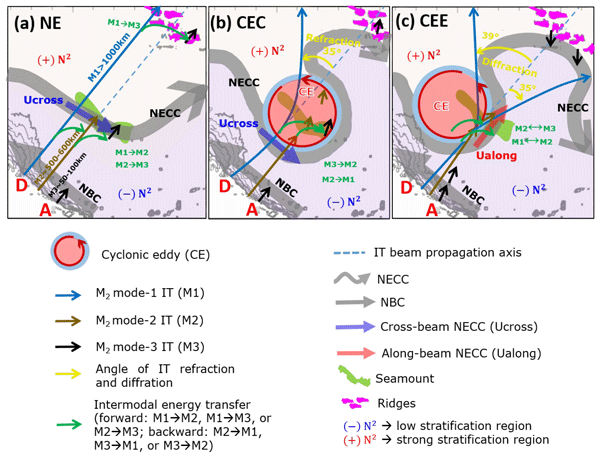
Our research investigates how large waves travel deep within the ocean. Using a detailed computer model, we show that when these deep waves meet giant ocean circulation, their path is dramatically changed. They can be bent off course, split apart, or stopped completely. An underwater mountain works with this circulation to transfer the wave energy between different ocean layers. Understanding this process is vital because it controls ocean mixing.
Landry Junior Mbang Essome, Gaël Alory, Casimir Yelognissé Da-Allada, Isabelle Dadou, Roy Dorgeless Ngakala, and Guillaume Morvan
Ocean Sci., 22, 1279–1309, https://doi.org/10.5194/os-22-1279-2026, https://doi.org/10.5194/os-22-1279-2026, 2026
Short summary
Short summary
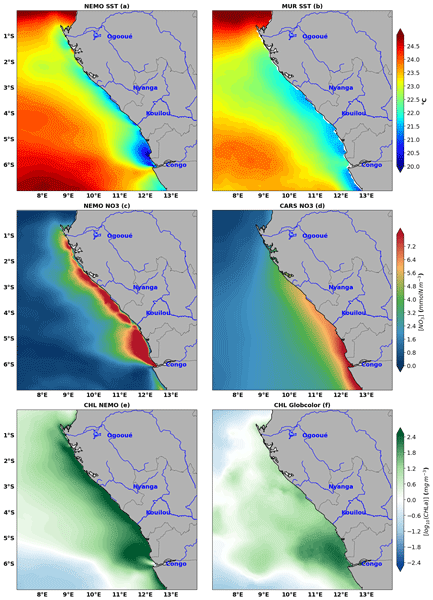
We used a high-resolution model to study how ocean currents and waves, especially coastal trapped waves, control nitrate variability in the Gabon-Congo upwelling system. This nutrient availability drives seasonal marine productivity, with the Congo River also adding significant nitrate. Our research clarifies the complex interplay of physical and biological factors, offering crucial insights for managing regional fisheries and assessing climate change impacts on this vital ecosystem.
Chloé Goret, Ariane Koch-Larrouy, Fabius Kouogang, Carina Regina de Macedo, Amine M'Hamdi, Jorge M. Magalhães, José Carlos Bastos da Silva, Michel Tchilibou, Camila Artana, Isabelle Dadou, Antoine Delepoulle, Simon Barbot, Maxime Ballarotta, Loren Carrère, and Alex Costa da Silva
Ocean Sci., 22, 679–698, https://doi.org/10.5194/os-22-679-2026, https://doi.org/10.5194/os-22-679-2026, 2026
Short summary
Short summary
Using high-resolution satellite measurements, we observed how eddies off the Amazon shelf modify internal solitary waves. The results show that these waves can be deflected from their path, even split into two branches, and change their geometry when interacting with different types of eddies. This work provides new insight into the ocean’s complex dynamic interactions and could help guide future predictions of ocean behavior and its effects on coastal and marine ecosystems.
Fernand Assene, Ariane Koch-Larrouy, Carina Regina de Macedo, Isabelle Dadou, Michel Tchilibou, Guillaume Morvan, Damien Allain, Simon Barbot, Alex Costa da Silva, Jérôme Chanut, Vincent Vantrepotte, Florent Lyard, Edward Zaron, and Trung-Kien Tran
EGUsphere, https://doi.org/10.5194/egusphere-2026-557, https://doi.org/10.5194/egusphere-2026-557, 2026
Short summary
Short summary
We examine temperature (T) variability at two semidiurnal and one fortnightly frequencies in North Brazil using satellite-observed and modeled temperatures. Semidiurnal T variability is weak offshore but peaks over the shelf due to barotropic mixing. Below 100 m, internal tide (IT)-driven mixing causes strong T variability (0.6–2 °C). T fortnightly maximums (~0.15 °C) appear along IT pathways, showing their key role.
Amine M'hamdi, Ariane Koch-Larrouy, Alex Costa da Silva, Isabelle Dadou, Carina Regina de Macedo, Anthony Bosse, Vincent Vantrepotte, Habib Micaël Aguedjou, Trung-Kien Tran, Pierre Testor, Laurent Mortier, Arnaud Bertrand, Pedro Augusto Mendes de Castro Melo, James Lee, Marcelo Rollnic, and Moacyr Araujo
Ocean Sci., 21, 2873–2894, https://doi.org/10.5194/os-21-2873-2025, https://doi.org/10.5194/os-21-2873-2025, 2025
Short summary
Short summary
In the ocean off the Amazon shelf, internal waves caused by tides move water layers up and down and mix them. Using an underwater glider and satellites, we found internal tides redistribute chlorophyll from the deep chlorophyll maximum upward to the surface and downward to depth. Turbulent chlorophyll fluxes supply about 38 % of surface chlorophyll, and total chlorophyll increases by 14–29 % during strong tides, potentially affecting the marine food web.
Fabius Kouogang, Ariane Koch-Larrouy, Jorge Magalhaes, Alex Costa da Silva, Daphne Kerhervé, Arnaud Bertrand, Evan Cervelli, Fernand Assene, Jean-François Ternon, Pierre Rousselot, James Lee, Marcelo Rollnic, and Moacyr Araujo
Ocean Sci., 21, 1589–1608, https://doi.org/10.5194/os-21-1589-2025, https://doi.org/10.5194/os-21-1589-2025, 2025
Short summary
Short summary
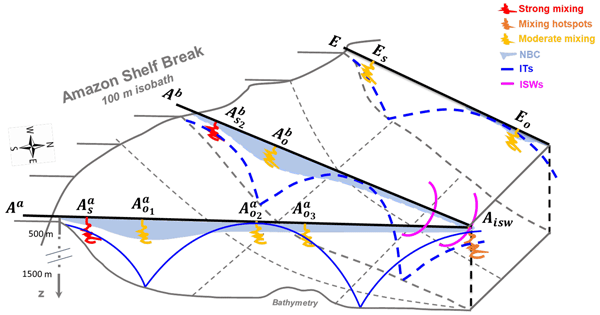
New research reveals that ocean mixing off the Amazon coast peaks not only near wave origins but also 230 km offshore, where different wave paths may intersect. This overlap likely forms strong solitary waves that intensify turbulence. Based on the AMAZOMIX-2021 cruise, which collected direct turbulence measurements alongside hydrographic data, the study quantifies dissipation and the relative contributions of tidal shear and large-scale shear. This mixing helps redistribute heat and nutrients, playing a key role in climate regulation and marine ecosystems.
Michel Tchilibou, Simon Barbot, Loren Carrere, Ariane Koch-Larrouy, Gérald Dibarboure, and Clément Ubelmann
Ocean Sci., 21, 1469–1486, https://doi.org/10.5194/os-21-1469-2025, https://doi.org/10.5194/os-21-1469-2025, 2025
Short summary
Short summary
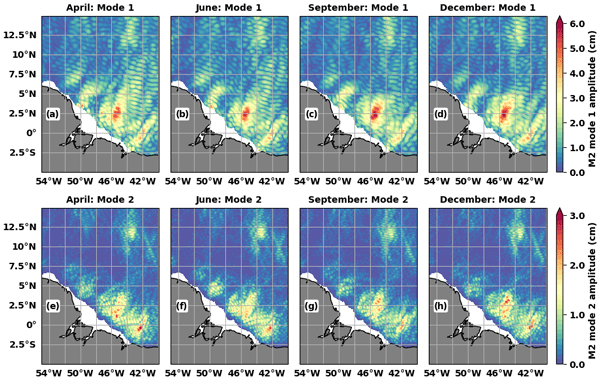
MIOST24 (Multivariate Inversion of Ocean Surface Topography 2024) annual and monthly internal tide (IT) atlases, based on 25 years of altimetry data and an updated wavelength database, are presented for the Indo-Philippine archipelago and the Amazon shelf. The atlases show monthly IT variability and a better correction of IT in altimetry data than with MIOST22 (MIOST 2022) and HRET (High-Resolution Empirical Tide). The results support the development of a global MIOST24.
Erick Vinicius Correia da Cunha, Pedro Augusto Mendes de Castro Melo, Gabriel Bittencourt Farias, and Vincent Vantrepotte
Int. Arch. Photogramm. Remote Sens. Spatial Inf. Sci., XLVIII-3-2024, 89–95, https://doi.org/10.5194/isprs-archives-XLVIII-3-2024-89-2024, https://doi.org/10.5194/isprs-archives-XLVIII-3-2024-89-2024, 2024
Fernand Assene, Ariane Koch-Larrouy, Isabelle Dadou, Michel Tchilibou, Guillaume Morvan, Jérôme Chanut, Alex Costa da Silva, Vincent Vantrepotte, Damien Allain, and Trung-Kien Tran
Ocean Sci., 20, 43–67, https://doi.org/10.5194/os-20-43-2024, https://doi.org/10.5194/os-20-43-2024, 2024
Short summary
Short summary
Twin simulations, with and without tides, are used to assess the impact of internal tides (ITs) on ocean temperature off the Amazon mouth at a seasonal scale. We found that in the surface layers, ITs and barotropic tides cause a cooling effect on sea surface temperature, subsequently leading to an increase in the net heat flux between the atmosphere and ocean. Vertical mixing is identified as the primary driver, followed by vertical and horizontal advection.
Carina Regina de Macedo, Ariane Koch-Larrouy, José Carlos Bastos da Silva, Jorge Manuel Magalhães, Carlos Alessandre Domingos Lentini, Trung Kien Tran, Marcelo Caetano Barreto Rosa, and Vincent Vantrepotte
Ocean Sci., 19, 1357–1374, https://doi.org/10.5194/os-19-1357-2023, https://doi.org/10.5194/os-19-1357-2023, 2023
Short summary
Short summary
We focus on the internal solitary waves (ISWs) off the Amazon shelf, their velocity, and their variability in seasonal and tidal cycles. The analysis is based on a large remote-sensing data set. The region is newly described as a hot spot for ISWs with mode-2 internal tide wavelength. The wave activity is higher during spring tides. The mode-1 waves located in the region influenced by the North Equatorial Counter Current showed a velocity/wavelength 14.3 % higher during the boreal summer/fall.

Edward D. Zaron, Tonia A. Capuano, and Ariane Koch-Larrouy
Ocean Sci., 19, 43–55, https://doi.org/10.5194/os-19-43-2023, https://doi.org/10.5194/os-19-43-2023, 2023
Short summary
Short summary
Phytoplankton in the upper ocean are food for fish and are thus economically important to humans; furthermore, phytoplankton consume nutrients and generate oxygen by photosynthesis, just like plants on land. Vertical mixing in the ocean is responsible for transporting nutrients into the sunlit zone of the surface ocean. We used remotely sensed data to quantify the influence of tidal mixing on phytoplankton through an analysis of ocean color, which we interpret as chlorophyll concentration.
Michel Tchilibou, Ariane Koch-Larrouy, Simon Barbot, Florent Lyard, Yves Morel, Julien Jouanno, and Rosemary Morrow
Ocean Sci., 18, 1591–1618, https://doi.org/10.5194/os-18-1591-2022, https://doi.org/10.5194/os-18-1591-2022, 2022
Short summary
Short summary
This high-resolution model-based study investigates the variability in the generation, propagation, and sea height signature (SSH) of the internal tide off the Amazon shelf during two contrasted seasons. ITs propagate further north during the season characterized by weak currents and mesoscale eddies and a shallow and strong pycnocline. IT imprints on SSH dominate those of the geostrophic motion for horizontal scales below 200 km; moreover, the SSH is mainly incoherent below 70 km.
Cited articles
Aguedjou, H., Dadou, I., Chaigneau, A., Morel, Y., and Alory, G.: Eddies in the Tropical Atlantic Ocean and their seasonal variability, Geophys. Res. Lett., 46, 12156–12164, 2019. a
Althaus, A. M., Kunze, E., and Sanford, T. B.: Internal tide radiation from Mendocino Escarpment, J. Phys. Oceanogr., 33, 1510–1527, 2003. a
Assene, F., Koch-Larrouy, A., Dadou, I., Tchilibou, M., Morvan, G., Chanut, J., Costa da Silva, A., Vantrepotte, V., Allain, D., and Tran, T.-K.: Internal tides off the Amazon shelf – Part 1: The importance of the structuring of ocean temperature during two contrasted seasons, Ocean Sci., 20, 43–67, https://doi.org/10.5194/os-20-43-2024, 2024. a, b, c, d, e, f, g, h, i, j
Barbot, S., Lyard, F., Tchilibou, M., and Carrere, L.: Background stratification impacts on internal tide generation and abyssal propagation in the western equatorial Atlantic and the Bay of Biscay, Ocean Sci., 17, 1563–1583, https://doi.org/10.5194/os-17-1563-2021, 2021. a
Bertrand, A., De Saint Leger, E., and Koch-Larrouy, A.: AMAZOMIX 2021, French Oceanographic Cruises [data set], https://doi.org/10.17600/18001364, 2021. a
Blauw, A. N., Beninca, E., Laane, R. W., Greenwood, N., and Huisman, J.: Dancing with the tides: fluctuations of coastal phytoplankton orchestrated by different oscillatory modes of the tidal cycle, PLoS One, 7, e49319, https://doi.org/10.1371/journal.pone.0049319, 2012. a
Byun, D.-S., Wang, X. H., Zavatarelli, M., and Cho, Y.-K.: Effects of resuspended sediments and vertical mixing on phytoplankton spring bloom dynamics in a tidal estuarine embayment, J. Mar. Syst., 67, 102–118, 2007. a
Capuano, T., Koch-Larrouy, A., Nugroho, D., Zaron, E., Dadou, I., Tran, K., Vantrepotte, V., and Allain, D.: Impact of internal tides on distributions and variability of chlorophyll-a and nutrients in the Indonesian Seas, J. Geophys. Res.-Oceans, 130, e2022JC019128, https://doi.org/10.1029/2022JC019128, 2025. a, b
Cazelles, B., Chavez, M., Berteaux, D., Ménard, F., Vik, J. O., Jenouvrier, S., and Stenseth, N. C.: Wavelet analysis of ecological time series, Oecologia, 156, 287–304, https://doi.org/10.1007/s00442-008-0993-2, 2008. a
Copernicus Marine Service: Global Ocean Colour (Copernicus-GlobColour), Bio-Geo-Chemical, L4 (monthly and interpolated) from Satellite Observations (1997–ongoing), Copernicus Marine Service [data set], https://doi.org/10.48670/moi-00281, 2023a. a
Copernicus Marine Service: Global Ocean Gridded L 4 Sea Surface Heights And Derived Variables Reprocessed 1993 Ongoing, Copernicus Marine Service [data set], https://doi.org/10.48670/moi-00148, 2023b. a
de Macedo, C. R., Koch-Larrouy, A., da Silva, J. C. B., Magalhães, J. M., Lentini, C. A. D., Tran, T. K., Rosa, M. C. B., and Vantrepotte, V.: Spatial and temporal variability in mode-1 and mode-2 internal solitary waves from MODIS-Terra sun glint off the Amazon shelf, Ocean Sci., 19, 1357–1374, https://doi.org/10.5194/os-19-1357-2023, 2023. a, b, c, d, e, f, g, h, i
Donlon, C. J., Martin, M., Stark, J., Roberts-Jones, J., Fiedler, E., and Wimmer, W.: The operational sea surface temperature and sea ice analysis (OSTIA) system, Remote Sens. Environ., 116, 140–158, 2012. a
Dunphy, M. and Lamb, K.: Focusing and vertical mode scattering of the first‐mode internal tide by mesoscale eddy interaction, J. Phys. Oceanogr., 119, 523–536, https://doi.org/10.1002/2013JC009293, 2014. a
Gohin, F., Druon, J., and Lampert, L.: A five channel chlorophyll concentration algorithm applied to SeaWiFS data processed by SeaDAS in coastal waters, Int. J. Remote Sens., 23, 1639–1661, 2002. a
González-Haro, C., Ponte, A., and Autret, E.: Quantifying tidal fluctuations in remote sensing infrared sst observations, Remote Sens., 11, 2313, https://doi.org/10.3390/rs11192313, 2019. a
Good, S., Fiedler, E., Mao, C., Martin, M. J., Maycock, A., Reid, R., Roberts-Jones, J., Searle, T., Waters, J., While, J., and Worsfold, M.: The current configuration of the OSTIA system for operational production of foundation sea surface temperature and ice concentration analyses, Remote Sens., 12, 720, https://doi.org/10.3390/rs12040720, 2020. a
Hu, C., Lee, Z., and Franz, B.: Chlorophyll algorithms for oligotrophic oceans: A novel approach based on three-band reflectance difference, J. Geophys. Res.-Oceans, 117, 1–25, https://doi.org//10.1029/2011JC007395, 2012. a
Hu, C., Feng, L., Lee, Z., Franz, B. A., Bailey, S. W., Werdell, P. J., and Proctor, C. W.: Improving satellite global chlorophyll a data products through algorithm refinement and data recovery, J. Geophys. Res.-Oceans, 124, 1524–1543, 2019. a
Kay, S. M.: Modern Spectral Estimation: Theory and Application, Prentice-Hall, Englewood Cliffs, NJ, ISBN 10:013598582X, https://doi.org/10.3389/fmars.2023.1309011, 1988. a
Kerry, C. G., Powell, B. S., and Carter, G. S.: The impact of subtidal circulation on internal tide generation and propagation in the Philippine Sea, J. Phys. Oceanogr., 44, 1386–1405, https://doi.org/10.1175/JPO-D-13-0142.1, 2014. a
Koch-Larrouy, A., Madec, G., Bouruet-Aubertot, P., Gerkema, T., Bessières, L., and Molcard, R.: On the transformation of Pacific Water into Indonesian Throughflow Water by internal tidal mixing, Geophys. Res. Lett., 34, 1–6, https://doi.org/10.1029/2006GL028405, 2007. a
Kouogang, F., Koch-Larrouy, A., Magalhaes, J., Costa da Silva, A., Kerhervé, D., Bertrand, A., Cervelli, E., Assene, F., Ternon, J.-F., Rousselot, P., Lee, J., Rollnic, M., and Araujo, M.: Turbulent dissipation along contrasting internal tide paths off the Amazon shelf from AMAZOMIX, Ocean Sci., 21, 1589–1608, https://doi.org/10.5194/os-21-1589-2025, 2025. a
Lahaye, N., Gula, J., and Roullet, G.: Internal tide cycle and topographic scattering over the North Mid-Atlantic Ridge, J. Geophys. Res.-Oceans, 125, e2020JC016376, https://doi.org/10.1029/2020JC016376, 2020. a
Lande, R. and Yentsch, C. S.: Internal waves, primary production and the compensation depth of marine phytoplankton, J. Plankt. Res., 10, 565–571, 1988. a
Lau, K.-M. and Weng, H.: Climate signal detection using wavelet transform: How to make a time series sing, B. Am. Meteorol. Soc., 76, 2391–2402, 1995. a
Li, W. and Xie, X.: Reflection and scattering of low-mode internal tides on the continental slope of the South China Sea, J. Phys. Oceanogr., 53, 2687–2699, 2023. a
Madec, G., Bell, M., Benshila, R., Blaker, A., Boudrallé-Badie, R., Bricaud, C., Bruciaferri, D., Carneiro, D., Castrillo, M., Calvert, D., Chanut, J., Clementi, E., Coward, A., de Lavergne, C., Dobricic, S., Epicoco, I., Éthé, C., Fiedler, E., Ford, D., Furner, R., Ganderton, J., Graham, T., Harle, J., Hutchinson, K., Iovino, D., King, R., Lea, D., Levy, C., Lovato, T., Maisonnave, E., Mak, J., Sanchez, J. M. C., Martin, M., Martin, N., Martins, D., Masson, S., Mathiot, P., Mele, F., Mocavero, S., Moulin, A., Müller, S., Nurser, G., Oddo, P., Paronuzzi, S., Paul, J., Peltier, M., Person, R., Rousset, C., Rynders, S., Samson, G., Schroeder, D., Storkey, D., Storto, A., Téchené, S., Vancoppenolle, M., and Wilson, C.: NEMO Ocean Engine Reference Manual (v5.0), Zenodo [data set], https://doi.org/10.5281/zenodo.14515373, 2024. a
Magalhaes, J. M., da Silva, J. C. B., Buijsman, M. C., and Garcia, C. A. E.: Effect of the North Equatorial Counter Current on the generation and propagation of internal solitary waves off the Amazon shelf (SAR observations), Ocean Sci., 12, 243–255, https://doi.org/10.5194/os-12-243-2016, 2016. a, b
M'hamdi, A., Koch-Larrouy, A., Costa da Silva, A., Dadou, I., de Macedo, C. R., Bosse, A., Vantrepotte, V., Aguedjou, H. M., Tran, T.-K., Testor, P., Mortier, L., Bertrand, A., Mendes de Castro Melo, P. A., Lee, J., Rollnic, M., and Araujo, M.: Impact of internal tides on chlorophyll a distribution and primary production off the Amazon shelf from glider measurements and satellite observations, Ocean Sci., 21, 2873–2894, https://doi.org/10.5194/os-21-2873-2025, 2025. a, b, c, d, e, f
MODIS Science Team: MODIS/Terra Calibrated Radiances 5-Min L1B Swath 250 m NASA LANCE MODIS at the MODAPS [data set], https://doi.org/10.5067/MODIS/MOD02QKM.NRT.061, 2017. a
Nittrouer, C. A., DeMaster, D. J., Kuehl, S. A., Figueiredo Jr, A. G., Sternberg, R. W., Faria, L. E. C., Silveira, O. M., Allison, M. A., Kineke, G. C., Ogston, A. S., Souza Filho, P. W. M., Asp, N. E., Nowacki, D. J., and Fricke, A. T.: Amazon sediment transport and accumulation along the continuum of mixed fluvial and marine processes, Annu. Rev. Mar. Sci., 13, 501–536, 2021. a
O'Reilly, J. E. and Werdell, P. J.: Chlorophyll algorithms for ocean color sensors-OC4, OC5 & OC6, Remote Sens. Environ., 229, 32–47, 2019. a
Rabiner, L. R. and Gold, B.: Theory and Application of Digital Signal Processing, Prentice-Hall, Englewood Cliffs, NJ, ISBN 10:0139141014, 1975. a
Richardson, P., Hufford, G., Limeburner, R., and Brown, W.: North Brazil current retroflection eddies, J. Geophys. Res.-Oceans, 99, 5081–5093, 1994. a
Richardson, P. L. and Walsh, D.: Mapping climatological seasonal variations of surface currents in the tropical Atlantic using ship drifts, J. Geophys. Res.-Oceans, 91, 10537–10550, 1986. a
Ruault, V., Jouanno, J., Durand, F., Chanut, J., and Benshila, R.: Role of the tide on the structure of the Amazon plume: A numerical modeling approach, J. Geophys. Res.-Oceans, 125, e2019JC015495, https://doi.org/10.1029/2019JC015495, 2020. a
Savva, M. A. C. and Vanneste, J.: Scattering of internal tides by barotropic quasigeostrophic flows, J. Fluid Mech., 856, 504–530, https://doi.org/:0.1017/jfm.2018.694, 2018. a
Sharples, J., Tweddle, J. F., Mattias Green, J., Palmer, M. R., Kim, Y.-N., Hickman, A. E., Holligan, P. M., Moore, C. M., Rippeth, T. P., Simpson, J. H., and Krivtsov, V.: Spring-neap modulation of internal tide mixing and vertical nitrate fluxes at a shelf edge in summer, Limnol. Oceanogr., 52, 1735–1747, 2007. a, b
Shi, W., Wang, M., and Jiang, L.: Spring-neap tidal effects on satellite ocean color observations in the Bohai Sea, Yellow Sea, and East China Sea, J. Geophys. Res.-Oceans, 116, 1–13, https://doi.org/10.1029/2011JC007234, 2011. a
Silva, A., Araujo, M., Medeiros, C., Silva, M., and Bourles, B.: Seasonal changes in the mixed and barrier layers in the western equatorial Atlantic, Brazil. J. Oceanogr., 53, 83–98, 2005. a
Solano, M. S., Buijsman, M. C., Shriver, J. F., Magalhaes, J., da Silva, J., Jackson, C., Arbic, B. K., and Barkan, R.: Nonlinear internal tides in a realistically forced global ocean simulation, J. Geophys. Res.-Oceans, 128, e2023JC019913, https://doi.org/10.1029/2023JC019913, 2023. a
Stark, J. D., Donlon, C. J., Martin, M. J., and McCulloch, M. E.: OSTIA: An operational, high resolution, real time, global sea surface temperature analysis system, in: OCEANS 2007 – Europe, Aberdeen, UK, 1–4, https://doi.org/10.1109/OCEANSE.2007.4302251, 2007. a
Steinmetz, F., Deschamps, P.-Y., and Ramon, D.: Atmospheric correction in presence of sun glint: application to MERIS, Opt. Express, 19, 9783–9800, 2011. a
Tchilibou, M., Koch-Larrouy, A., Barbot, S., Lyard, F., Morel, Y., Jouanno, J., and Morrow, R.: Internal tides off the Amazon shelf during two contrasted seasons: interactions with background circulation and SSH imprints, Ocean Sci., 18, 1591–1618, https://doi.org/10.5194/os-18-1591-2022, 2022. a, b, c, d
Tran, M. D., Vantrepotte, V., Loisel, H., Oliveira, E. N., Tran, K. T., Jorge, D., Mériaux, X., and Paranhos, R.: Band ratios combination for estimating chlorophyll-a from sentinel-2 and sentinel-3 in coastal waters, Remote Sens., 15, 1653, https://doi.org/10.3390/rs15061653, 2023. a, b
Valente, A. S. and da Silva, J. C.: On the observability of the fortnightly cycle of the Tagus estuary turbid plume using MODIS ocean colour images, J. Mar. Syst., 75, 131–137, 2009. a
Wang, Z.-h., Liang, Y., and Kang, W.: Utilization of dissolved organic phosphorus by different groups of phytoplankton taxa, Harmful Algae, 12, 113–118, 2011. a
Welch, P. D.: The Use of Fast Fourier Transform for the Estimation of Power Spectra: A Method Based on Time Averaging Over Short, Modified Periodograms, IEEE T. Audio Electroacoust., AU-15, 70–73, https://doi.org/10.1109/TAU.1967.1161901, 1967. a
Xing, Q., Yu, H., Yu, H., Wang, H., Ito, S.-I., and Yuan, C.: Evaluating the spring-neap tidal effects on chlorophyll-a variations based on the geostationary satellite, Front. Mar. Sci., 8, 758538, https://doi.org/10.3389/fmars.2021.758538, 2021. a, b
Zaron, E. D., Capuano, T. A., and Koch-Larrouy, A.: Fortnightly variability of Chl a in the Indonesian seas, Ocean Sci., 19, 43–55, https://doi.org/10.5194/os-19-43-2023, 2023. a, b
Short summary
We investigated how ocean tides influence marine phytoplankton along the North Brazilian coast. Using satellite data from 2005 to 2021, we found that tides can either enhance or reduce phytoplankton growth on the continental shelf. Offshore, internal tides stimulate primary production along their pathways. These results improve our understanding of how tidal processes shape marine life in tropical coastal regions.
We investigated how ocean tides influence marine phytoplankton along the North Brazilian coast....


