
Articles | Volume 22, issue 2
https://doi.org/10.5194/os-22-761-2026
© Author(s) 2026. This work is distributed under
the Creative Commons Attribution 4.0 License.
the Creative Commons Attribution 4.0 License.
https://doi.org/10.5194/os-22-761-2026
© Author(s) 2026. This work is distributed under
the Creative Commons Attribution 4.0 License.
the Creative Commons Attribution 4.0 License.
Research article
| 
04 Mar 2026
Research article |
| 04 Mar 2026
| 04 Mar 2026
Response of a semi-enclosed sea to perturbed freshwater and open ocean salinity forcing

Department of Research and Development, Swedish Meteorological and Hydrological Institute, 601 76 Norrköping, Sweden
Magnus Hieronymus
Department of Research and Development, Swedish Meteorological and Hydrological Institute, 601 76 Norrköping, Sweden
Per Pemberton
Department of Research and Development, Swedish Meteorological and Hydrological Institute, 601 76 Norrköping, Sweden
Department of Research and Development, Swedish Meteorological and Hydrological Institute, 601 76 Norrköping, Sweden
Sam T. Fredriksson
Department of Research and Development, Swedish Meteorological and Hydrological Institute, 601 76 Norrköping, Sweden
Related authors
Matteo Masini, Agnes Karlsson, Lars Arneborg, Bengt Karlson, and Inga Monika Koszalka
EGUsphere, https://doi.org/10.5194/egusphere-2026-1344, https://doi.org/10.5194/egusphere-2026-1344, 2026
Short summary
Short summary
On the 8th of August, Storm Hans swept through the Baltic Sea disturbing the operation of desalination plants producing drinking water from sea water. In this paper, we build upon reports from the desalination plants to analyze the operational ocean model outputs and observations to identify the coastal processes behind the reported hazards. The results show a potential for future development of forecast framework.
Göran Björk, Göran Broström, Lars Arneborg, Anis Elyouncha, Daniel Bergman-Sjöstrand, and Per Pemberton
EGUsphere, https://doi.org/10.5194/egusphere-2026-785, https://doi.org/10.5194/egusphere-2026-785, 2026
Short summary
Short summary
During the 2023/2024 ice season, a high-resolution dataset of ice thickness was collected in the Bothnian Bay. The analysis of data revealed a significant frequency of thick deformed ice such that about 60 % was thicker than 1 m. Among the 5500 individually identified ice keels, 20 % had a keel depth larger than 5 m and 2 % a depth larger than 10 m. This type of high-resolution ice data can be of vital importance for design of offshore structures and evaluation of computer ice models.
Itzel Ruvalcaba Baroni, Elin Almroth-Rosell, Lars Axell, Sam T. Fredriksson, Jenny Hieronymus, Magnus Hieronymus, Sandra-Esther Brunnabend, Matthias Gröger, Ivan Kuznetsov, Filippa Fransner, Robinson Hordoir, Saeed Falahat, and Lars Arneborg
Biogeosciences, 21, 2087–2132, https://doi.org/10.5194/bg-21-2087-2024, https://doi.org/10.5194/bg-21-2087-2024, 2024
Short summary
Short summary
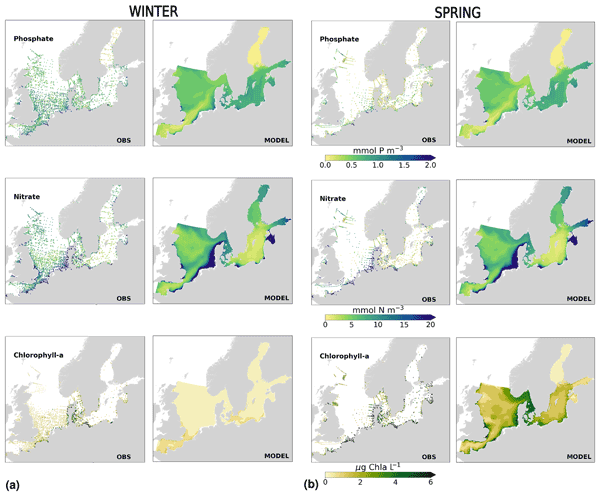
The health of the Baltic and North seas is threatened due to high anthropogenic pressure; thus, different methods to assess the status of these regions are urgently needed. Here, we validated a novel model simulating the ocean dynamics and biogeochemistry of the Baltic and North seas that can be used to create future climate and nutrient scenarios, contribute to European initiatives on de-eutrophication, and provide water quality advice and support on nutrient load reductions for both seas.
Julia Muchowski, Martin Jakobsson, Lars Umlauf, Lars Arneborg, Bo Gustafsson, Peter Holtermann, Christoph Humborg, and Christian Stranne
Ocean Sci., 19, 1809–1825, https://doi.org/10.5194/os-19-1809-2023, https://doi.org/10.5194/os-19-1809-2023, 2023
Short summary
Short summary
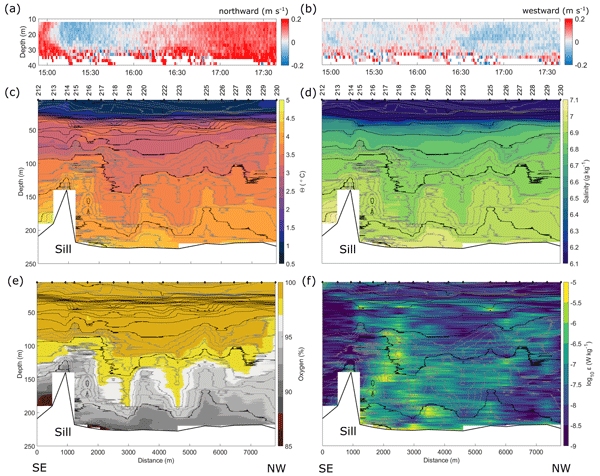
We show observational data of highly increased mixing and vertical salt flux rates in a sparsely sampled region of the northern Baltic Sea. Co-located acoustic observations complement our in situ measurements and visualize turbulent mixing with high spatial resolution. The observed mixing is generally not resolved in numerical models of the area but likely impacts the exchange of water between the adjacent basins as well as nutrient and oxygen conditions in the Bothnian Sea.
Per Pemberton, Iréne Wåhlström, and Sam T. Fredriksson
Ocean Sci., 22, 2375–2404, https://doi.org/10.5194/os-22-2375-2026, https://doi.org/10.5194/os-22-2375-2026, 2026
Short summary
Short summary
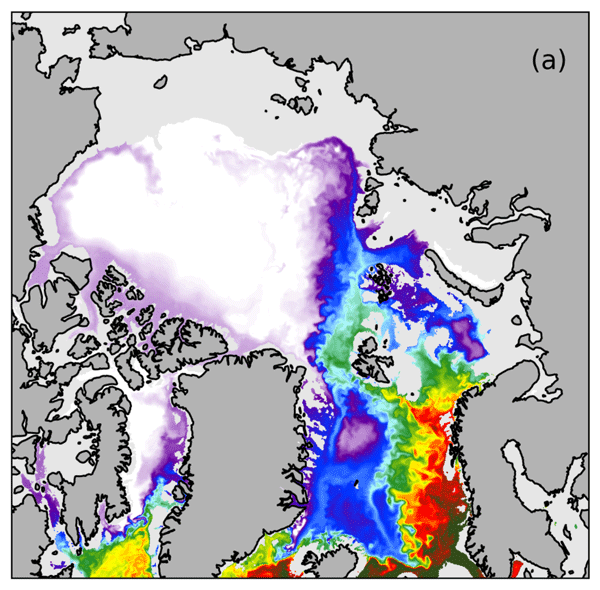
Mesoscale ocean eddies (10–100 km) are crucial for transporting heat and salt in global circulation. While traditionally parameterized in ocean models, advances in computational power allow them to be partly resolved, questioning whether parameterizations should be used in this regime. We examine implications for Atlantic water circulation and heat transport to the Arctic, highlighting challenges in using – or omitting – mesoscale eddy parameterizations.
Ye Liu and Weiwei Fu
EGUsphere, https://doi.org/10.5194/egusphere-2026-3657, https://doi.org/10.5194/egusphere-2026-3657, 2026
Short summary
Short summary
We evaluate a framework for the Baltic Sea that jointly assimilates sea surface temperature and chlorophyll from satellite and in situ observations into a model. Satellite chlorophyll improves surface phytoplankton, but profile data is needed to represent subsurface features. The improved representation of phytoplankton alters how light is absorbed in the water, modifying temperature structure and leading to improved oxygen distributions in well-oxygenated waters.
Florian Börgel, Itzel Ruvalcaba Baroni, Leonie Barghorn, Leonard Borchert, Bronwyn Cahill, Cyril Dutheil, Leonie Esters, Małgorzata Falarz, Helena L. Filipsson, Matthias Gröger, Jari Hänninen, Magnus Hieronymus, Erko Jakobson, Mehdi Pasha Karami, Karol Kuliński, Taavi Liblik, H. E. Markus Meier, Gabriele Messori, Lev Naumov, Thomas Neumann, Piia Post, Gregor Rehder, Anna Rutgersson, and Georg Sebastian Voelker
Earth Syst. Dynam., 17, 415–450, https://doi.org/10.5194/esd-17-415-2026, https://doi.org/10.5194/esd-17-415-2026, 2026
Short summary
Short summary
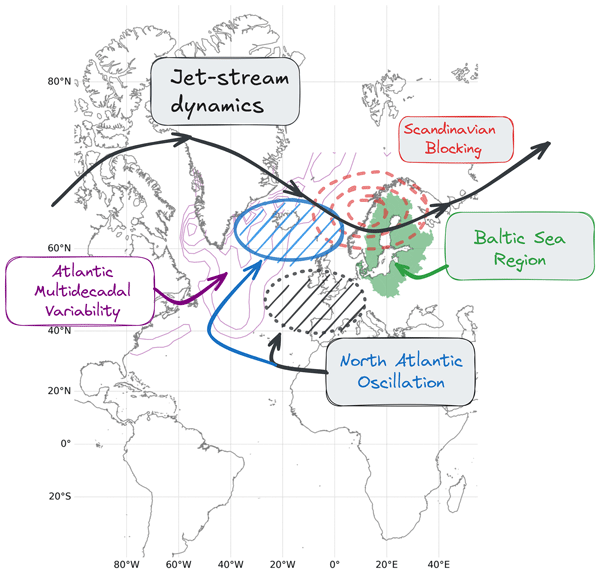
This review explains how weather patterns, guided by the polar jet stream, influence the Baltic Sea’s climate and ecosystem. It covers the North Atlantic Oscillation, blocking events and other processes and discusses how they affect temperature, rainfall, and storms from days to decades. These shifts then impact oxygen levels, productivity, and acidification in the Baltic Sea. Physical links are fairly well known, but biogeochemical pathways remain uncertain.
Robinson Hordoir, Jarle Berntsen, Magnus Hieronymus, Per Pemberton, and Hjálmar Hátún
Geosci. Model Dev., 19, 2677–2690, https://doi.org/10.5194/gmd-19-2677-2026, https://doi.org/10.5194/gmd-19-2677-2026, 2026
Short summary
Short summary
Dense water created in high latitude regions flows at the bottom of the ocean, from one basin to the next, and contributes to the global ocean circulation. The flow between shallow and deeper basins occurs at straits such as the Faeroe Bank Channel as underwater streams of dense water. Their representation in ocean models is problematic. In the present article, we use a mathematical formulation of dense water plumes to show that the representation of these dense overflows can be improved.
Matteo Masini, Agnes Karlsson, Lars Arneborg, Bengt Karlson, and Inga Monika Koszalka
EGUsphere, https://doi.org/10.5194/egusphere-2026-1344, https://doi.org/10.5194/egusphere-2026-1344, 2026
Short summary
Short summary
On the 8th of August, Storm Hans swept through the Baltic Sea disturbing the operation of desalination plants producing drinking water from sea water. In this paper, we build upon reports from the desalination plants to analyze the operational ocean model outputs and observations to identify the coastal processes behind the reported hazards. The results show a potential for future development of forecast framework.
Göran Björk, Göran Broström, Lars Arneborg, Anis Elyouncha, Daniel Bergman-Sjöstrand, and Per Pemberton
EGUsphere, https://doi.org/10.5194/egusphere-2026-785, https://doi.org/10.5194/egusphere-2026-785, 2026
Short summary
Short summary
During the 2023/2024 ice season, a high-resolution dataset of ice thickness was collected in the Bothnian Bay. The analysis of data revealed a significant frequency of thick deformed ice such that about 60 % was thicker than 1 m. Among the 5500 individually identified ice keels, 20 % had a keel depth larger than 5 m and 2 % a depth larger than 10 m. This type of high-resolution ice data can be of vital importance for design of offshore structures and evaluation of computer ice models.
Seuri Basilio Kuosmanen and Magnus Hieronymus
EGUsphere, https://doi.org/10.5194/egusphere-2025-1257, https://doi.org/10.5194/egusphere-2025-1257, 2025
Short summary
Short summary
We studied the annual maximum sea levels for the coastal regions in the Baltic Sea and parts of the North Sea. The study aimed to reduce the quantified uncertainty and produce estimates at locations with no tide gauges data. Comparing four statistical models and a baseline model, we concluded that the spatial hierarchical models, which leverages spatial dependency, reduced the uncertainty for higher/lower probability events compared to the other models for locations with or without observations.
Ye Liu, Lars Axell, and Jun She
EGUsphere, https://doi.org/10.5194/egusphere-2024-3283, https://doi.org/10.5194/egusphere-2024-3283, 2024
Preprint archived
Short summary
Short summary
The temperature and salinity trends at various depths in the Baltic basins from 1990 to 2020 were analyzed from a reasonable reanalysis data set. Overall, the Baltic Sea showed a clear warming trend in recent decades, the northern Baltic Sea has a slight desalination trend, and the southern Baltic Sea has a salinity increase trend. The temperature and salinity trends in the southern Baltic Sea are greater than those in the northern Baltic Sea.
Jenny Hieronymus, Magnus Hieronymus, Matthias Gröger, Jörg Schwinger, Raffaele Bernadello, Etienne Tourigny, Valentina Sicardi, Itzel Ruvalcaba Baroni, and Klaus Wyser
Biogeosciences, 21, 2189–2206, https://doi.org/10.5194/bg-21-2189-2024, https://doi.org/10.5194/bg-21-2189-2024, 2024
Short summary
Short summary
The timing of the net primary production annual maxima in the North Atlantic in the period 1750–2100 is investigated using two Earth system models and the high-emissions scenario SSP5-8.5. It is found that, for most of the region, the annual maxima occur progressively earlier, with the most change occurring after the year 2000. Shifts in the seasonality of the primary production may impact the entire ecosystem, which highlights the need for long-term monitoring campaigns in this area.
Itzel Ruvalcaba Baroni, Elin Almroth-Rosell, Lars Axell, Sam T. Fredriksson, Jenny Hieronymus, Magnus Hieronymus, Sandra-Esther Brunnabend, Matthias Gröger, Ivan Kuznetsov, Filippa Fransner, Robinson Hordoir, Saeed Falahat, and Lars Arneborg
Biogeosciences, 21, 2087–2132, https://doi.org/10.5194/bg-21-2087-2024, https://doi.org/10.5194/bg-21-2087-2024, 2024
Short summary
Short summary
The health of the Baltic and North seas is threatened due to high anthropogenic pressure; thus, different methods to assess the status of these regions are urgently needed. Here, we validated a novel model simulating the ocean dynamics and biogeochemistry of the Baltic and North seas that can be used to create future climate and nutrient scenarios, contribute to European initiatives on de-eutrophication, and provide water quality advice and support on nutrient load reductions for both seas.
Julia Muchowski, Martin Jakobsson, Lars Umlauf, Lars Arneborg, Bo Gustafsson, Peter Holtermann, Christoph Humborg, and Christian Stranne
Ocean Sci., 19, 1809–1825, https://doi.org/10.5194/os-19-1809-2023, https://doi.org/10.5194/os-19-1809-2023, 2023
Short summary
Short summary
We show observational data of highly increased mixing and vertical salt flux rates in a sparsely sampled region of the northern Baltic Sea. Co-located acoustic observations complement our in situ measurements and visualize turbulent mixing with high spatial resolution. The observed mixing is generally not resolved in numerical models of the area but likely impacts the exchange of water between the adjacent basins as well as nutrient and oxygen conditions in the Bothnian Sea.
Magnus Hieronymus
Geosci. Model Dev., 16, 2343–2354, https://doi.org/10.5194/gmd-16-2343-2023, https://doi.org/10.5194/gmd-16-2343-2023, 2023
Short summary
Short summary
A statistical model called the sea level simulator is presented and made freely available. The sea level simulator integrates mean sea level rise and sea level extremes into a joint probabilistic framework that is useful for flood risk estimation. These flood risk estimates are contingent on probabilities given to different emission scenarios and the length of the planning period. The model is also useful for uncertainty quantification and in decision and adaptation problems.
Matthias Gröger, Manja Placke, H. E. Markus Meier, Florian Börgel, Sandra-Esther Brunnabend, Cyril Dutheil, Ulf Gräwe, Magnus Hieronymus, Thomas Neumann, Hagen Radtke, Semjon Schimanke, Jian Su, and Germo Väli
Geosci. Model Dev., 15, 8613–8638, https://doi.org/10.5194/gmd-15-8613-2022, https://doi.org/10.5194/gmd-15-8613-2022, 2022
Short summary
Short summary
Comparisons of oceanographic climate data from different models often suffer from different model setups, forcing fields, and output of variables. This paper provides a protocol to harmonize these elements to set up multidecadal simulations for the Baltic Sea, a marginal sea in Europe. First results are shown from six different model simulations from four different model platforms. Topical studies for upwelling, marine heat waves, and stratification are also assessed.
Cited articles
Arneborg, L.: Comment on “Influence of sea level rise on the dynamics of salt inflows in the Baltic Sea” by R. Hordoir, L. Axell, U. Löptien, H. Dietze, and I. Kuznetsov, Journal of Geophysical Research: Oceans, 121, 2035–2040, https://doi.org/10.1002/2015JC011451, 2016.
Arneborg, L., Hieronymus, M., Pemberton, P., Liu, Y., and Fredriksson, S.: Dataset for Response of a semi-enclosed sea to perturbed freshwater and open ocean salinity forcing, Zenodo [data set], https://doi.org/10.5281/zenodo.18199627, 2026.
Balmaseda, M. A., Mogensen, K., and Weaver, A. T.: Evaluation of the ECMWF ocean reanalysis system ORAS4, Q. J. Roy. Meteor. Soc., 139, 1132–1161, https://doi.org/10.1002/qj.2063, 2013.
Bruciaferri, D., Shapiro, G. I., and Wobus, F.: A Multi-Envelope Vertical Coordinate System for Numerical Ocean Modelling, Ocean Dynamics, 68, 1239–1258, https://doi.org/10.1007/s10236-018-1189-x, 2018.
Burchard, H., Bolding, K., Feistel, R., Gräwe, U., Klingbeil, K., MacCready, P., Mohrholz, V., Umlauf, L., and van der Lee, E. M.: The Knudsen theorem and the Total Exchange Flow analysis framework applied to the Baltic Sea, Progress in Oceanography, 165, 268–286, https://doi.org/10.1016/j.pocean.2018.04.004, 2018.
Cokelet, E. D. and Stewart, R. J.: The exchange of water in fjords: The efflux/reflux theory of advective reaches separated by mixing zones, Journal of Geophysical Research: Oceans, 90, 7287–7306, 1985.
Dahlgren, P., Landelius, T., Kållberg, P., and Gollvik, S.: A high-resolution regional reanalysis for Europe. Part 1: Three-dimensional reanalysis with the regional HIgh-Resolution Limited-Area Model (HIRLAM), Q. J. Roy. Meteor. Soc., 142, 2119–2131, https://doi.org/10.1002/qj.2807, 2016.
Donnelly, C., Andersson, J., and Arheimer, B.: Using flow signatures and catchment similarities to evaluate a multi-basin model (E-HYPE) across Europe, Hydrolog. Sci. J., 61, 255–273, https://doi.org/10.1080/02626667.2015.1027710, 2016.
Gröger, M., Placke, M., Meier, H. E. M., Börgel, F., Brunnabend, S.-E., Dutheil, C., Gräwe, U., Hieronymus, M., Neumann, T., Radtke, H., Schimanke, S., Su, J., and Väli, G.: The Baltic Sea Model Intercomparison Project (BMIP) – a platform for model development, evaluation, and uncertainty assessment, Geosci. Model Dev., 15, 8613–8638, https://doi.org/10.5194/gmd-15-8613-2022, 2022.
Haid, V., Stanev, E. V., Pein, J., Staneva, J., and Chen, W.: Secondary circulation in shallow ocean straits: observations and numerical modeling of the Danish Straits, Ocean Modelling, 148, 101585, https://doi.org/10.1016/j.ocemod.2020.101585, 2020.
Hordoir, R., Axell, L., Löptien, U., Dietze, H., and Kuznetsov, I.: Influence of sea level rise on the dynamics of salt inflows in the Baltic Sea, Journal of Geophysical Research: Oceans, 120, 6653–6668, https://doi.org/10.1002/2014JC010642, 2015.
Hordoir, R., Axell, L., Höglund, A., Dieterich, C., Fransner, F., Gröger, M., Liu, Y., Pemberton, P., Schimanke, S., Andersson, H., Ljungemyr, P., Nygren, P., Falahat, S., Nord, A., Jönsson, A., Lake, I., Döös, K., Hieronymus, M., Dietze, H., Löptien, U., Kuznetsov, I., Westerlund, A., Tuomi, L., and Haapala, J.: Nemo-Nordic 1.0: a NEMO-based ocean model for the Baltic and North seas – research and operational applications, Geosci. Model Dev., 12, 363–386, https://doi.org/10.5194/gmd-12-363-2019, 2019.
Janssen, F., Schrum, C., and Backhaus, J. O.: A Climatological Data Set of Temperature and Salinity for the Baltic Sea and the North Sea, Deutsche Hydrographische Zeitschrift, 51, 5–245, https://doi.org/10.1007/BF02933676, 1999.
Knudsen, M.: Ein hydrographischer Lehrsatz, Hydrogr. Mar. Meteorol., 28, 316–320, 1900.
Lehmann, A., Myrberg, K., Post, P., Chubarenko, I., Dailidiene, I., Hinrichsen, H.-H., Hüssy, K., Liblik, T., Meier, H. E. M., Lips, U., and Bukanova, T.: Salinity dynamics of the Baltic Sea, Earth Syst. Dynam., 13, 373–392, https://doi.org/10.5194/esd-13-373-2022, 2022.
MacCready, P.: Calculating estuarine exchange flow using isohaline coordinates, J. Phys. Oceanogr., 41, 1116–1124, https://doi.org/10.1175/2011JPO4517.1, 2011.
Meier, H. M. and Kauker, F.: Sensitivity of the Baltic Sea salinity to the freshwater supply, Climate Research, 24, 231–242, https://doi.org/10.3354/cr024231, 2003.
Meier, H. E. M., Höglund, A., Eilola, K., and Almroth-Rosell, E.: Impact of accelerated future global mean sea level rise on hypoxia in the Baltic Sea, Climate Dynamics, 49, 163–172, https://doi.org/10.1007/s00382-016-3333-y, 2017.
Meier, H. E. M., Eilola, K., Almroth-Rosell, E., Schimanke, S., Kniebusch, M., Höglund, A., Pemberton, P., Liu. Y., Väli, G., and Saraiva, S.: Disentangling the impact of nutrient load and climate changes on Baltic Sea hypoxia and eutrophication since 1850, Climate Dynamics, 53, 1145–1166. https://doi.org/10.1007/s00382-018-4296-y, 2019.
Meier, H. E. M., Barghorn, L., Börgel, F., Gröger, M., Naumov, L., and Radtke, H.: Multidecadal climate variability dominated past trends in the water balance of the Baltic Sea watershed, npj Climate and Atmospheric Science, 6, 58, https://doi.org/10.1038/s41612-023-00380-9, 2023.
Meier, M. H. E., Dieterich, C., and Gröger, M.: Natural variability is a large source of uncertainty in future projections of hypoxia in the Baltic Sea, Communications Earth & Environment, 2, 50, https://doi.org/10.1038/s43247-021-00115-9, 2021.
Mohrholz, V.: Major Baltic inflow statistics–revised, Frontiers in Marine Science, 5, 384, https://doi.org/10.3389/fmars.2018.00384, 2018.
Molodtsov, S., Marinov, I., Weijer, W., DeSantis, D., Jonko, A., Veneziani, M., and Lu, J.: North Atlantic temperature and salinity changes are driven by external forcing, underestimated by CMIP6 models, npj Climate and Atmospheric Science, 8, 332, https://doi.org/10.1038/s41612-025-01210-w, 2025.
Pemberton, P., Löptien, U., Hordoir, R., Höglund, A., Schimanke, S., Axell, L., and Haapala, J.: Sea-ice evaluation of NEMO-Nordic 1.0: a NEMO–LIM3.6-based ocean–sea-ice model setup for the North Sea and Baltic Sea, Geosci. Model Dev., 10, 3105–3123, https://doi.org/10.5194/gmd-10-3105-2017, 2017.
Pemberton, P., Mulder, E., and Bruciaferri, D.: Implementation and Evaluation of Multi-Envelope s-Coordinates in a NEMO4.2 Configuration of the North Sea–Baltic Sea System, Geosci. Model Dev., in preparation, 2026.
Quante, M. and Colijn, F.: North Sea region climate change assessment, Springer Nature, 528 pp., https://doi.org/10.1007/978-3-319-39745-0, 2016.
Radtke, H., Brunnabend, S.-E., Gräwe, U., and Meier, H. E. M.: Investigating interdecadal salinity changes in the Baltic Sea in a 1850–2008 hindcast simulation, Clim. Past, 16, 1617–1642, https://doi.org/10.5194/cp-16-1617-2020, 2020.
Rodhe, J. and Winsor, P.: On the influence of the freshwater supply on the Baltic Sea mean salinity, Tellus A: Dynamic Meteorology and Oceanography, 55, 455–456, https://doi.org/10.3402/tellusa.v54i2.12134, 2003.
Saraiva, S., Meier, H. M., Andersson, H., Höglund, A., Dieterich, C., Gröger, M., Hordoir, R., and Eilola, K.: Uncertainties in projections of the Baltic Sea ecosystem driven by an ensemble of global climate models, Frontiers in Earth Science, 6, 244, https://doi.org/10.3389/feart.2018.00244, 2019.
Schimanke, S. and Meier, H. M.: Decadal-to-centennial variability of salinity in the Baltic Sea, Journal of Climate, 29, 7173–7188, https://doi.org/10.1175/JCLI-D-15-0443.1, 2016.
She, J., Berg, P., and Berg, J.: Bathymetry impacts on water exchange modelling through the Danish Straits, J. Marine Syst., 65, 450–459, https://doi.org/10.1016/j.jmarsys.2006.01.017, 2007.
Stigebrandt, A.: A model for the exchange of water and salt between the Baltic and the Skagerrak, Journal of Physical Oceanography, 13, 411–427, 1983.
Stigebrandt, A. and Gustafsson, B. G.: Response of the Baltic Sea to climate change – theory and observations, Journal of Sea Research, 49, 243–256, https://doi.org/10.1016/S1385-1101(03)00021-2, 2003.
Wåhlström, I., Hammar, L., Hume, D., Pålsson, J., Almroth-Rosell, E., Dieterich, C., Arneborg, L., Gröger, M., Mattsson, M., Snowball, L. Z., Kågesten, G., Törnqvist, O., Breviere, E., Brunnabend, S.-E., and Jonsson, P. R.: Projected climate change impact on a coastal sea – As significant as all current pressures combined, Global Change Biology, 28, 5310–5319, https://doi.org/10.1111/gcb.16312, 2022.
Walin, G.: A theoretical framework for the description of estuaries, Tellus, 29, 128–136, https://doi.org/10.3402/tellusa.v29i2.11337, 1977.
Short summary
Climate change influences estuaries and their ecosystems not only by rising temperatures but also by salinity changes. This modeling study highlights the magnitude and causes of the Baltic Sea salinity sensitivity to fresh water forcing and changed ocean salinity. The large sensitivity to increased fresh water forcing is shown to be caused by dilution of fresh water within the estuary, recirculation of much of the outflow water back into the estuary, as well as decreasing inflows of ocean water.
Climate change influences estuaries and their ecosystems not only by rising temperatures but...


