Articles | Volume 22, issue 5
https://doi.org/10.5194/os-22-3207-2026
© Author(s) 2026. This work is distributed under
the Creative Commons Attribution 4.0 License.
https://doi.org/10.5194/os-22-3207-2026
© Author(s) 2026. This work is distributed under
the Creative Commons Attribution 4.0 License.
Efficient ensemble estimation using an MCMC sampler: a reconstruction of the Mediterranean low-frequency variability combining observed and simulated sea level

Jean-Michel Brankart
CORRESPONDING AUTHOR
Univ. Grenoble Alpes, CNRS, IRD, Grenoble INP, IGE, Grenoble, France
Damien Héron
Univ. Grenoble Alpes, CNRS, IRD, Grenoble INP, IGE, Grenoble, France
Lisa Weiss
Univ. Grenoble Alpes, CNRS, IRD, Grenoble INP, IGE, Grenoble, France
IRD, LEGOS, Toulouse, France
Thierry Penduff
Univ. Grenoble Alpes, CNRS, IRD, Grenoble INP, IGE, Grenoble, France
Pierre Brasseur
Univ. Grenoble Alpes, CNRS, IRD, Grenoble INP, IGE, Grenoble, France
Related authors
Loïc Macé, Luc Vandenbulcke, Jean-Michel Brankart, Jean-François Grailet, Pierre Brasseur, and Marilaure Grégoire
Geosci. Model Dev., 19, 9077–9102, https://doi.org/10.5194/gmd-19-9077-2026, https://doi.org/10.5194/gmd-19-9077-2026, 2026
Short summary
Short summary
We present a three-stream radiative transfer model within the NEMO (Nucleus for European Modelling of the Ocean) framework and a use case for the Black Sea. The model is able to simulate in-water irradiance and sea surface reflectance in a wide spectral range. When coupled with an ecosystem model, the simulated irradiances are used to compute water temperature and primary production. A stochastic version of this model is also proposed to inform on uncertainties in the optical properties of seawater.
Yutong Zhang, Pierre Brasseur, Melika Baklouti, and Jean-Michel Brankart
EGUsphere, https://doi.org/10.5194/egusphere-2026-5134, https://doi.org/10.5194/egusphere-2026-5134, 2026
This preprint is open for discussion and under review for Ocean Science (OS).
Short summary
Short summary
This study examines how parameter-induced uncertainty affects marine biogeochemical model outputs and whether simplified model versions preserve these uncertainty distributions. Parameter-induced uncertainty is concentrated during the spring bloom and near the nutricline and deep chlorophyll maximum. Simplification affects oxygen, plankton, and carbon export differently, while using annual or depth-integrated ecosystem indicators may mask changes occurring at specific times or depths.
Lohenn Fiol, Stephanie Leroux, Pierre Rampal, and Jean-Michel Brankart
The Cryosphere, 20, 4655–4680, https://doi.org/10.5194/tc-20-4655-2026, https://doi.org/10.5194/tc-20-4655-2026, 2026
Short summary
Short summary
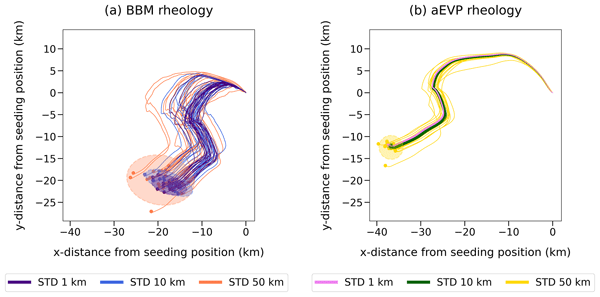
We examine how uncertainty in the initial position of sea ice features (leads, ridges), affects daily-to-weekly winter sea-ice forecasts. Using ensemble simulations with a sea ice–ocean model, we compare two formulations of sea ice mechanics. We show that pack-ice dynamics are highly sensitive to this choice: one formulation strongly amplifies small initial errors, while the other damps them. Our results highlight the need for ensemble forecasts to capture uncertainty and risks in the Arctic.
Damien Héron, Thierry Penduff, Jean-Michel Brankart, Pierre Brasseur, Samuel Somot, Robin Waldman, and Romain Pennel
Ocean Sci., 22, 531–547, https://doi.org/10.5194/os-22-531-2026, https://doi.org/10.5194/os-22-531-2026, 2026
Short summary
Short summary
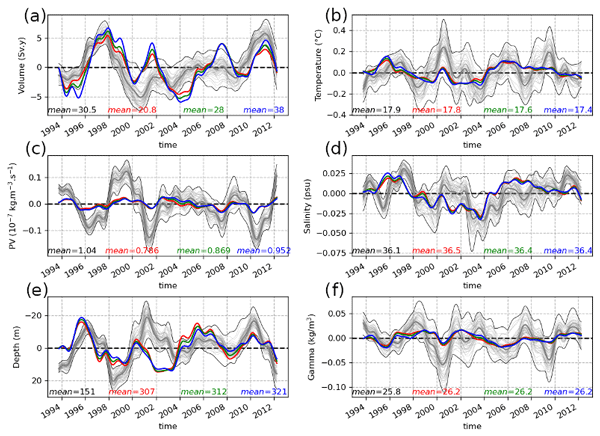
Our study used realistic ocean simulations to determine how much of the Mediterranean’s circulation is due to natural randomness rather than atmospheric forcing. We found that spontaneous ocean variability is strong in several regions and can persist for years or even decades. This randomness influences how well models and observations can capture the Mediterranean’s response to climate change.
Loïc Macé, Luc Vandenbulcke, Jean-Michel Brankart, Pierre Brasseur, and Marilaure Grégoire
Biogeosciences, 22, 3747–3768, https://doi.org/10.5194/bg-22-3747-2025, https://doi.org/10.5194/bg-22-3747-2025, 2025
Short summary
Short summary
The representation of light propagation in seawater is critical for modelling marine biogeochemistry. We analyse results from a radiative transfer model that accounts for the absorption and scattering of light in the ocean with their respective uncertainties. We compare these results with in situ and remote-sensed data. Our analysis highlights the benefits of accounting for model uncertainties while using advanced representations of light in modelling frameworks.
Mikhail Popov, Jean-Michel Brankart, Arthur Capet, Emmanuel Cosme, and Pierre Brasseur
Ocean Sci., 20, 155–180, https://doi.org/10.5194/os-20-155-2024, https://doi.org/10.5194/os-20-155-2024, 2024
Short summary
Short summary
This study contributes to the development of methods to estimate targeted ocean ecosystem indicators, including their uncertainty, in the framework of the Copernicus Marine Service. A simplified approach is introduced to perform a 4D ensemble analysis and forecast, directly targeting selected biogeochemical variables and indicators (phenology, trophic efficiency, downward flux of organic matter). Care is taken to present the methods and discuss the reliability of the solution proposed.
Stephanie Leroux, Jean-Michel Brankart, Aurélie Albert, Laurent Brodeau, Jean-Marc Molines, Quentin Jamet, Julien Le Sommer, Thierry Penduff, and Pierre Brasseur
Ocean Sci., 18, 1619–1644, https://doi.org/10.5194/os-18-1619-2022, https://doi.org/10.5194/os-18-1619-2022, 2022
Short summary
Short summary
The goal of the study is to evaluate the predictability of the ocean circulation
at a kilometric scale, in order to anticipate the requirements of the future operational forecasting systems. For that purpose, ensemble experiments have been performed with a regional model for the Western Mediterranean (at 1/60° horizontal resolution). From these ensemble experiments, we show that it is possible to compute targeted predictability scores, which depend on initial and model uncertainties.
Loïc Macé, Luc Vandenbulcke, Jean-Michel Brankart, Jean-François Grailet, Pierre Brasseur, and Marilaure Grégoire
Geosci. Model Dev., 19, 9077–9102, https://doi.org/10.5194/gmd-19-9077-2026, https://doi.org/10.5194/gmd-19-9077-2026, 2026
Short summary
Short summary
We present a three-stream radiative transfer model within the NEMO (Nucleus for European Modelling of the Ocean) framework and a use case for the Black Sea. The model is able to simulate in-water irradiance and sea surface reflectance in a wide spectral range. When coupled with an ecosystem model, the simulated irradiances are used to compute water temperature and primary production. A stochastic version of this model is also proposed to inform on uncertainties in the optical properties of seawater.
Yutong Zhang, Pierre Brasseur, Melika Baklouti, and Jean-Michel Brankart
EGUsphere, https://doi.org/10.5194/egusphere-2026-5134, https://doi.org/10.5194/egusphere-2026-5134, 2026
This preprint is open for discussion and under review for Ocean Science (OS).
Short summary
Short summary
This study examines how parameter-induced uncertainty affects marine biogeochemical model outputs and whether simplified model versions preserve these uncertainty distributions. Parameter-induced uncertainty is concentrated during the spring bloom and near the nutricline and deep chlorophyll maximum. Simplification affects oxygen, plankton, and carbon export differently, while using annual or depth-integrated ecosystem indicators may mask changes occurring at specific times or depths.
Lohenn Fiol, Stephanie Leroux, Pierre Rampal, and Jean-Michel Brankart
The Cryosphere, 20, 4655–4680, https://doi.org/10.5194/tc-20-4655-2026, https://doi.org/10.5194/tc-20-4655-2026, 2026
Short summary
Short summary
We examine how uncertainty in the initial position of sea ice features (leads, ridges), affects daily-to-weekly winter sea-ice forecasts. Using ensemble simulations with a sea ice–ocean model, we compare two formulations of sea ice mechanics. We show that pack-ice dynamics are highly sensitive to this choice: one formulation strongly amplifies small initial errors, while the other damps them. Our results highlight the need for ensemble forecasts to capture uncertainty and risks in the Arctic.
Alejandro Blazquez, Benoit Meyssignac, Robin Fraudeau, Michael Ablain, Jonathan Bamber, Antonio Bonaduce, Marie Bouih, Anny Cazenave, Thorben Döhne, Ines Dussaillant, Ramiro Ferrari, Martin Horwath, Nicolas Kolodziejczyk, Hugo Lecomte, Stephanie Leroux, William Llovel, Daniele Melini, Erwan Oulhen, Thierry Penduff, Roshin P. Raj, Giorgio Spada, Marius Schlaak, Papasarafianou Stamatia, Andrea Storto, Chunxue Yang, and Sarah Connors
Earth Syst. Sci. Data Discuss., https://doi.org/10.5194/essd-2026-627, https://doi.org/10.5194/essd-2026-627, 2026
Preprint under review for ESSD
Short summary
Short summary
Closing the sea‑level budget on annual and longer time scales is a cornerstone of physical oceanography because sea‑level rise is one of the best indicators of climate change, and a closed budget shows we have identified and quantified all major drivers. We examined it from 1993 to 2022, finding an accelerated rise that matched ice melt and warm water until 2015. Afterwards an unexplained gap appears. Better deep‑ocean observations and refined gravity processing are needed to close the budget.
Damien Héron, Thierry Penduff, Jean-Michel Brankart, Pierre Brasseur, Samuel Somot, Robin Waldman, and Romain Pennel
Ocean Sci., 22, 531–547, https://doi.org/10.5194/os-22-531-2026, https://doi.org/10.5194/os-22-531-2026, 2026
Short summary
Short summary
Our study used realistic ocean simulations to determine how much of the Mediterranean’s circulation is due to natural randomness rather than atmospheric forcing. We found that spontaneous ocean variability is strong in several regions and can persist for years or even decades. This randomness influences how well models and observations can capture the Mediterranean’s response to climate change.
Lisa Weiss, Marine Herrmann, Patrick Marsaleix, Matthieu Bompoil, and Christophe Maes
Geosci. Model Dev., 19, 827–865, https://doi.org/10.5194/gmd-19-827-2026, https://doi.org/10.5194/gmd-19-827-2026, 2026
Short summary
Short summary
We developed a high-resolution ocean model to study marine debris dispersion across the Indian Ocean, from coastal scales to the open sea. Results show that model resolution and wave forcing, through both the Stokes-Coriolis force and Stokes drift, play a key role in shaping ocean circulation, seasonal energy budgets, and floating debris trajectories. High-resolution currents and wave forcing, especially during monsoons, increase the anisotropic spread and travel distances of drifting material.
Claudio M. Pierard, Siren Rühs, Laura Gómez-Navarro, Michael Charles Denes, Florian Meirer, Thierry Penduff, and Erik van Sebille
Nonlin. Processes Geophys., 32, 411–438, https://doi.org/10.5194/npg-32-411-2025, https://doi.org/10.5194/npg-32-411-2025, 2025
Short summary
Short summary
Particle-tracking simulations compute how ocean currents transport material. However, initializing these simulations is often ad hoc. Here, we explore how two different strategies (releasing particles over space or over time) compare. Specifically, we compare the variability in particle trajectories to the variability of particles computed in a 50-member ensemble simulation. We find that releasing the particles over 20 weeks gives variability that is most like that in the ensemble.
Loïc Macé, Luc Vandenbulcke, Jean-Michel Brankart, Pierre Brasseur, and Marilaure Grégoire
Biogeosciences, 22, 3747–3768, https://doi.org/10.5194/bg-22-3747-2025, https://doi.org/10.5194/bg-22-3747-2025, 2025
Short summary
Short summary
The representation of light propagation in seawater is critical for modelling marine biogeochemistry. We analyse results from a radiative transfer model that accounts for the absorption and scattering of light in the ocean with their respective uncertainties. We compare these results with in situ and remote-sensed data. Our analysis highlights the benefits of accounting for model uncertainties while using advanced representations of light in modelling frameworks.
Lara Börger, Michael Schindelegger, Mengnan Zhao, Rui M. Ponte, Anno Löcher, Bernd Uebbing, Jean-Marc Molines, and Thierry Penduff
Earth Syst. Dynam., 16, 75–90, https://doi.org/10.5194/esd-16-75-2025, https://doi.org/10.5194/esd-16-75-2025, 2025
Short summary
Short summary
Flows in the ocean are driven either by atmospheric forces or by small-scale internal disturbances that are inherently chaotic. We use computer simulation results to show that these chaotic oceanic disturbances can attain spatial scales large enough to alter the motion of Earth's pole of rotation. Given their size and unpredictable nature, the chaotic signals are a source of uncertainty when interpreting observed year-to-year polar motion changes in terms of other processes in the Earth system.
Olivier Narinc, Thierry Penduff, Guillaume Maze, Stéphanie Leroux, and Jean-Marc Molines
Ocean Sci., 20, 1351–1365, https://doi.org/10.5194/os-20-1351-2024, https://doi.org/10.5194/os-20-1351-2024, 2024
Short summary
Short summary
This study examines how the ocean's chaotic variability and atmospheric fluctuations affect yearly changes in North Atlantic Subtropical Mode Water (STMW) properties, using an ensemble of realistic ocean simulations. Results show that while yearly changes in STMW properties are mostly paced by the atmosphere, a notable part of these changes are random in phase. This study also illustrates the value of ensemble simulations over single runs in understanding oceanic fluctuations and their causes.
Mikhail Popov, Jean-Michel Brankart, Arthur Capet, Emmanuel Cosme, and Pierre Brasseur
Ocean Sci., 20, 155–180, https://doi.org/10.5194/os-20-155-2024, https://doi.org/10.5194/os-20-155-2024, 2024
Short summary
Short summary
This study contributes to the development of methods to estimate targeted ocean ecosystem indicators, including their uncertainty, in the framework of the Copernicus Marine Service. A simplified approach is introduced to perform a 4D ensemble analysis and forecast, directly targeting selected biogeochemical variables and indicators (phenology, trophic efficiency, downward flux of organic matter). Care is taken to present the methods and discuss the reliability of the solution proposed.
Stephanie Leroux, Jean-Michel Brankart, Aurélie Albert, Laurent Brodeau, Jean-Marc Molines, Quentin Jamet, Julien Le Sommer, Thierry Penduff, and Pierre Brasseur
Ocean Sci., 18, 1619–1644, https://doi.org/10.5194/os-18-1619-2022, https://doi.org/10.5194/os-18-1619-2022, 2022
Short summary
Short summary
The goal of the study is to evaluate the predictability of the ocean circulation
at a kilometric scale, in order to anticipate the requirements of the future operational forecasting systems. For that purpose, ensemble experiments have been performed with a regional model for the Western Mediterranean (at 1/60° horizontal resolution). From these ensemble experiments, we show that it is possible to compute targeted predictability scores, which depend on initial and model uncertainties.
Cited articles
Anderson, J.: A method for producing and evaluating probabilistic forecasts from ensemble model integrations, J. Climate, 9, 1518–1530, https://doi.org/10.1175/1520-0442(1996)009<1518:AMFPAE>2.0.CO;2, 1996. a
Balmaseda, M. A., Trenberth, K. E., and Källén, E.: Distinctive climate signals in reanalysis of global ocean heat content, Geophys. Res. Lett., 40, 1754–1759, https://doi.org/10.1002/grl.50382, 2013. a
Beuvier, J., Béranger, K., Lebeaupin Brossier, C., Somot, S., Sevault, F., Drillet, Y., Bourdallé-Badie, R., Ferry, N., and Lyard, F.: Spreading of the Western Mediterranean Deep Water after winter 2005: Time scales and deep cyclone transport, J. Geophys. Res.-Oceans, 117, 2011JC007679, https://doi.org/10.1029/2011JC007679, 2012. a
Bishop, C. H. and Hodyss, D.: Ensemble covariances adaptively localized with ECO-RAP. Part 2: a strategy for the atmosphere, Tellus A, 61, 97–111, https://doi.org/10.1111/j.1600-0870.2008.00372.x, 2009. a, b
Bishop, C. H., Whitaker, J. S., and Lei, L.: Gain Form of the Ensemble Transform Kalman Filter and Its Relevance to Satellite Data Assimilation with Model Space Ensemble Covariance Localization, Mon. Wheather Rev., 145, 4575–4592, https://doi.org/10.1175/MWR-D-17-0102.1, 2017. a
Brankart, J.-M.: brankart/ensdam: ensdam (Version v1.1), Zenodo [computer software], https://doi.org/10.5281/zenodo.23314072, 2026a. a
Brankart, J.-M.: brankart/sesam: sesam (Version v1.1), Zenodo [computer software], https://doi.org/10.5281/zenodo.23314005, 2026b. a
Brankart, J.-M.: brankart/ensemble-altimetry-lf: ensemble-altimetry-lf (Version v1.1), Zenodo [computer software], https://doi.org/10.5281/zenodo.23314298, 2026c. a
Brankart, J.-M., Cosme, E., Testut, C.-E., Brasseur, P., and Verron, J.: Efficient adaptive error parameterizations for square root or ensemble Kalman filters: application to the control of ocean mesoscale signals, Mon. Weather Rev., 138, 932–950, https://doi.org/10.1175/2009MWR3085.1, 2010. a
Brankart, J.-M., Candille, G., Garnier, F., Calone, C., Melet, A., Bouttier, P.-A., Brasseur, P., and Verron, J.: A generic approach to explicit simulation of uncertainty in the NEMO ocean model, Geosci. Model Dev., 8, 1285–1297, https://doi.org/10.5194/gmd-8-1285-2015, 2015. a
Brankart, J.-M., Héron, D., Weiss, L., Penduff, T., and Brasseur, P.: Low-frequency variability of the Mediterranean dynamic height: an ensemble estimation combining model and observations, SEANOE [data set], https://doi.org/10.17882/113890, 2026. a
Dee, D.: On-line estimation of error covariance parameters for atmospheric data assimilation, Mon. Weather Rev., 123, 1128–1145, https://doi.org/10.1175/1520-0493(1995)123<1128:OLEOEC>2.0.CO;2, 1995 a
Durán Moro, M., Brankart, J.-M., Brasseur, P. and Verron, J.: Exploring image data assimilation in the prospect of high-resolution satellite oceanic observations, Ocean Dynam., 87, 875–895, https://doi.org/10.1007/s10236-017-1062-3, 2017. a
Evensen, G.: The Ensemble Kalman Filter: theoretical formulation and practical implementation, Ocean Dynam., 53, 343–367, https://doi.org/10.1007/s10236-003-0036-9, 2003. a
Gaultier, L., Djath, B., Verron, J., Brankart, J.-M., Brasseur, P. and Melet, A.: Inversion of submesoscale patterns from a high-resolution Solomon Sea model: feasibility assessment, J. Geophys. Res., 119, 4520–4541, https://doi.org/10.1002/2013JC009660, 2014. a
Hoang, S., Baraille, R., Talagrand, O., Carton, X., and De Mey, P.: Adaptive filtering: Application to satellite data assimilation in oceanography, Dynam. Atmos. Oceans, 27, 257–281, https://doi.org/10.1016/s0377-0265(97)00014-6, 1998. a
Houtekamer, P. L. and Mitchell, H. L.: Data assimilation using an Ensemble Kalman Filter technique, Mon. Weather Rev., 126, 796–811, https://doi.org/10.1175/1520-0493(1998)126<0796:DAUAEK>2.0.CO;2, 1998. a, b, c
Li, H., Kalnay, E., and Miyoshi, T.: Simultaneous estimation of covariance inflation and observation errors within an ensemble Kalman filter, Q. J. Roy. Meteorol. Soc., 135, 523–533, https://doi.org/10.1002/qj.371, 2009. a
Ludwig, W., Dumont, E., Meybeck, M., and Heussner, S.: River discharges of water and nutrients to the Mediterranean and Black Sea: Major drivers for ecosystem changes during past and future decades?, Prog. Oceanogr., 80, 199–217, https://doi.org/10.1016/j.pocean.2009.02.001, 2009. a
Mitchell, H. L. and Houtekamer, P. L.: An adaptive ensemble Kalman filter, Mon. Weather Rev., 128, 416–433, https://doi.org/10.1175/1520-0493(2000)128<0416:AAEKF>2.0.CO;2, 2000. a
Nabat, P., Somot, S., Cassou, C., Mallet, M., Michou, M., Bouniol, D., Decharme, B., Drugé, T., Roehrig, R., and Saint-Martin, D.: Modulation of radiative aerosols effects by atmospheric circulation over the Euro-Mediterranean region, Atmos. Chem. Phys., 20, 8315–8349, https://doi.org/10.5194/acp-20-8315-2020, 2020. a
Polkova, I., Brune, S., Kadow, C., Romanova, V., Gollan, G., Baehr, J., Glowienka-Hense, R., Greatbatch, R. J., Hense, A., Illing, S., Köhl, A., Kröger, J., Müller, W. A., Pankatz, K., and Stammer, D.: Initialization and ensemble generation for decadal climate predictions: A comparison of different methods, J. Adv. Model. Earth Syst., 11, 149–172, https://doi.org/10.1029/2018MS001439, 2019. a
Popov, M., Brankart, J.-M., Capet, A., Cosme, E., and Brasseur, P.: Ensemble analysis and forecast of ecosystem indicators in the North Atlantic using ocean colour observations and prior statistics from a stochastic NEMO/PISCES simulator, Ocean Sci., 20, 155–180, https://doi.org/10.5194/os-20-155-2024, 2024. a, b
Talagrand, O.: A posteriori verification of analysis and assimilation algorithms, in: Workshop on diagnosis of data assimilation systems, 2–4 November 1998, ECMWF, Reading, UK, https://www.ecmwf.int/sites/default/files/elibrary/1999/12547-posteriori-evaluation-and-verification-analysis-and-assimilation-algorithms.pdf (last access: 12 October 2026), 1999. a
Volpi, D., Meccia, V. L., Guemas, V., Ortega, P., Bilbao, R., Doblas-Reyes, F. J., Amaral, A., Echevarria, P., Mahmood, R., and Corti, S.: A Novel Initialization Technique for Decadal Climate Predictions, Front. Clim., 3, 681127, https://doi.org/10.3389/fclim.2021.681127, 2021. a
Editorial statement
Climate projections should be able to reproduce long-term and low-frequency variability of the system. A method is proposed to estimate the low-frequency component of the ocean variability from observations using statistics from a prior long-term simulation. The paper presents a significant step forward in combining numerical ensembles together with satellite data to provide relevant reconstructions of a given ocean variable (in this case the low frequency variability of the sea surface height, SSH) in a way that reduces systematic errors of the prior pdf. It is likely that the application will lead to future improvement in the context of data assimilation. The paper includes significant theoretical advances but at the same time provides a concrete application for SSH estimation from observation and model results.
Climate projections should be able to reproduce long-term and low-frequency variability of the...
Short summary
In this paper, an ensemble method is proposed to estimate directly the low-frequency component of the ocean variability from native observations using statistics from a prior long-term ensemble simulation. The approach is illustrated by the reconstruction of the low-frequency variability of the Mediterranean sea level from along-track altimetric observations over 26 years. The resulting ensemble estimate is assessed against independent observations, showing good reliability.
In this paper, an ensemble method is proposed to estimate directly the low-frequency component...