
Articles | Volume 22, issue 5
https://doi.org/10.5194/os-22-2835-2026
© Author(s) 2026. This work is distributed under
the Creative Commons Attribution 4.0 License.
the Creative Commons Attribution 4.0 License.
https://doi.org/10.5194/os-22-2835-2026
© Author(s) 2026. This work is distributed under
the Creative Commons Attribution 4.0 License.
the Creative Commons Attribution 4.0 License.
Research article
| 
16 Sep 2026
Research article |
| 16 Sep 2026
| 16 Sep 2026
Seasonal and interannual drivers of Sargassum inundations in the Northern Gulf of Guinea
Clovis Thouvenin-Masson
CORRESPONDING AUTHOR

IRD, LEGOS, Toulouse, France
Julien Jouanno
IRD, LEGOS, Toulouse, France
Related authors
No articles found.
Gaël Many, Julien Jouanno, Marc Lucas, Audrey Hasson, Jean-Michel Lellouche, and Yann Drillet
State Planet Discuss., https://doi.org/10.5194/sp-2026-30, https://doi.org/10.5194/sp-2026-30, 2026
Preprint under review for SP
Short summary
Short summary
Large Sargassum blooms have become a recurring feature of the Tropical Atlantic, affecting coastal areas and ecosystems. We studied satellite observations from 2002 to 2025 to understand how bloom size and severity vary through time and across regions. We developed two simple indicators to compare years and areas. The results reveal strong regional differences and show that 2025 was an exceptional basin-wide bloom, highlighting the value of consistent monitoring for tracking future events.
Marc Kakante Mendy, Florent Gasparin, Manon Gévaudan, Moussa Diakhaté, Issa Sakho, and Julien Jouanno
Ocean Sci., 22, 1745–1762, https://doi.org/10.5194/os-22-1745-2026, https://doi.org/10.5194/os-22-1745-2026, 2026
Short summary
Short summary
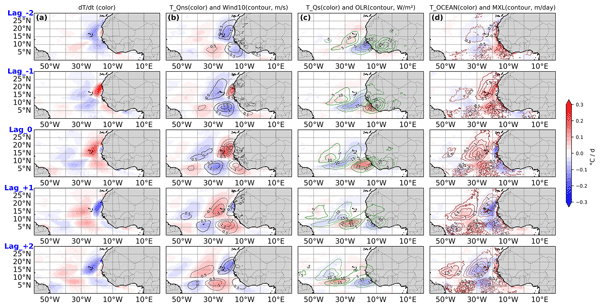
The North Tropical Atlantic plays an important role in shaping climate in the region. In our study we examined how African Easterly Waves influence the ocean surface. Using numerical modelling and buoy records, we found that these waves can warm or cool the sea by more than half a degree. The faster waves have the strongest impact. Because sea temperature affects rainfall and storms, understanding these waves can help improve weather and climate forecasts.
Gabriela Martinez Balbontin, Julien Jouanno, Rachid Benshila, Julien Lamouroux, Coralie Perruche, and Stefano Ciavatta
Biogeosciences, 23, 2601–2620, https://doi.org/10.5194/bg-23-2601-2026, https://doi.org/10.5194/bg-23-2601-2026, 2026
Short summary
Short summary
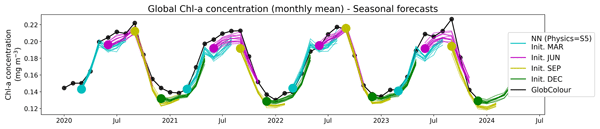
This study uses machine learning to predict global sea surface chlorophyll a, which is important for monitoring marine ecosystems and the carbon cycle. Using forecasts of sea surface temperature, salinity, height, and mixed layer depth, we generate global predictions up to six months ahead in just minutes. Our approach matches state-of-the-art numerical methods while being faster and more resource-efficient.
Marco Larrañaga, Julien Jouanno, Eric P. Chassignet, Giovanni Durante, Ilkyeong Ma, Julio Sheinbaum, and Lionel Renault
Ocean Sci., 22, 821–841, https://doi.org/10.5194/os-22-821-2026, https://doi.org/10.5194/os-22-821-2026, 2026
Short summary
Short summary
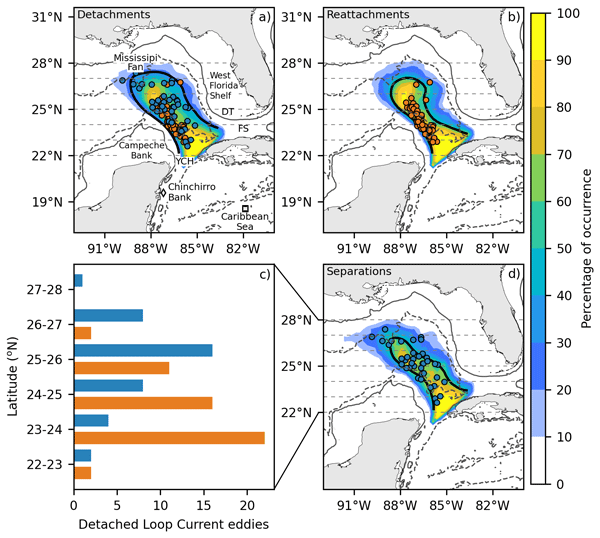
We analyze 29 years of satellite altimetry to investigate the detachment of Loop Current Eddies in the Gulf of Mexico. Over half of the Loop Current eddies reattach within a month, while 42 % separate and drift westward. Detachment requires the Loop Current to reach the Mississippi Fan and is strongly influenced by cyclonic eddies, whose configuration determines whether an eddy separates or reattaches to the Loop Current.
Rosmery Sosa-Gutierrez, Julien Jouanno, and Leo Berline
Ocean Sci., 21, 1505–1514, https://doi.org/10.5194/os-21-1505-2025, https://doi.org/10.5194/os-21-1505-2025, 2025
Short summary
Short summary
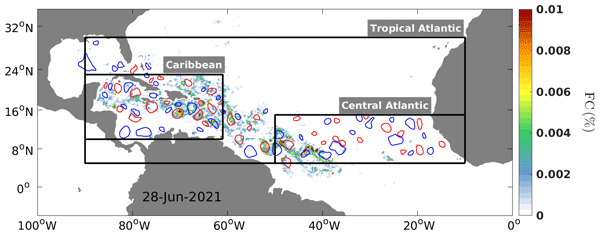
Since 2010, pelagic Sargassum spp. blooms have increased in several tropical Atlantic regions, causing socioeconomic and ecosystem impacts. Offshore structuration of Sargassum by mesoscale dynamics may influence transport and growth. Sargassum stays afloat, constantly interacting with currents, waves, winds, and mesoscale eddies. We find that anticyclones and cyclones effectively trap Sargassum throughout its propagation, with a greater tendency for cyclones to accumulate Sargassum.
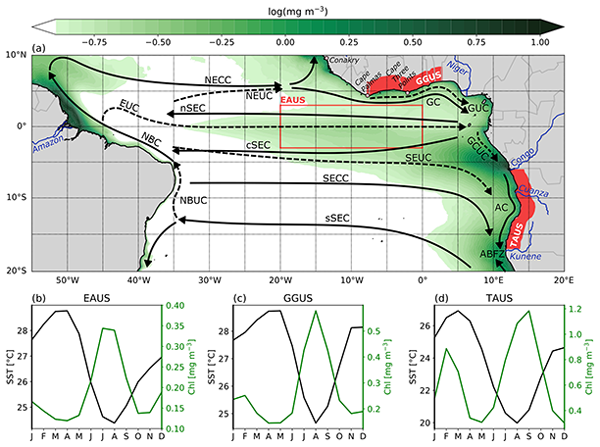
Peter Brandt, Gaël Alory, Founi Mesmin Awo, Marcus Dengler, Sandrine Djakouré, Rodrigue Anicet Imbol Koungue, Julien Jouanno, Mareike Körner, Marisa Roch, and Mathieu Rouault
Ocean Sci., 19, 581–601, https://doi.org/10.5194/os-19-581-2023, https://doi.org/10.5194/os-19-581-2023, 2023
Short summary
Short summary
Tropical upwelling systems are among the most productive ecosystems globally. The tropical Atlantic upwelling undergoes a strong seasonal cycle that is forced by the wind. Local wind-driven upwelling and remote effects, particularly via the propagation of equatorial and coastal trapped waves, lead to an upward and downward movement of the nitracline. Turbulent mixing results in upward supply of nutrients. Here, we review the different physical processes responsible for biological productivity.
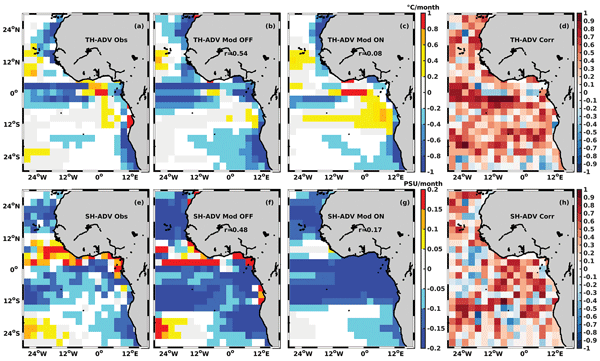
Roy Dorgeless Ngakala, Gaël Alory, Casimir Yélognissè Da-Allada, Olivia Estelle Kom, Julien Jouanno, Willi Rath, and Ezinvi Baloïtcha
Ocean Sci., 19, 535–558, https://doi.org/10.5194/os-19-535-2023, https://doi.org/10.5194/os-19-535-2023, 2023
Short summary
Short summary
Surface heat flux is the main driver of the heat budget in the Senegal, Angola, and Benguela regions but not in the equatorial region. In the Senegal and Benguela regions, freshwater flux governs the salt budget, while in equatorial and Angola regions, oceanic processes are the main drivers. Results from numerical simulation show the important role of mesoscale advection for temperature and salinity variations in the mixed layer. Nonlinear processes unresolved by observations play a key role.
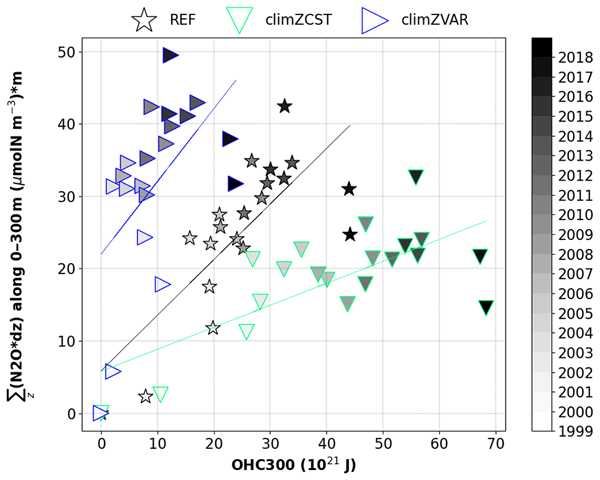
Sarah Berthet, Julien Jouanno, Roland Séférian, Marion Gehlen, and William Llovel
Earth Syst. Dynam., 14, 399–412, https://doi.org/10.5194/esd-14-399-2023, https://doi.org/10.5194/esd-14-399-2023, 2023
Short summary
Short summary
Phytoplankton absorbs the solar radiation entering the ocean surface and contributes to keeping the associated energy in surface waters. This natural effect is either not represented in the ocean component of climate models or its representation is simplified. An incomplete representation of this biophysical interaction affects the way climate models simulate ocean warming, which leads to uncertainties in projections of oceanic emissions of an important greenhouse gas (nitrous oxide).
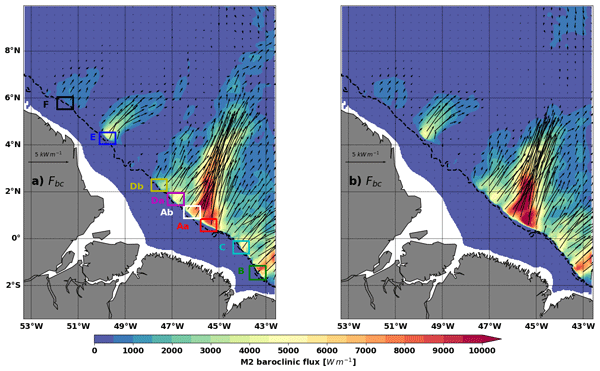
Michel Tchilibou, Ariane Koch-Larrouy, Simon Barbot, Florent Lyard, Yves Morel, Julien Jouanno, and Rosemary Morrow
Ocean Sci., 18, 1591–1618, https://doi.org/10.5194/os-18-1591-2022, https://doi.org/10.5194/os-18-1591-2022, 2022
Short summary
Short summary
This high-resolution model-based study investigates the variability in the generation, propagation, and sea height signature (SSH) of the internal tide off the Amazon shelf during two contrasted seasons. ITs propagate further north during the season characterized by weak currents and mesoscale eddies and a shallow and strong pycnocline. IT imprints on SSH dominate those of the geostrophic motion for horizontal scales below 200 km; moreover, the SSH is mainly incoherent below 70 km.
Cited articles
Ackah-Baidoo, A.: Fishing in troubled waters: oil production, seaweed and community-level grievances in the Western Region of Ghana, Community Dev. J., 48, 406–420, https://doi.org/10.1093/cdj/bst022, 2013.
Addico, G. N. D. and deGraft-Johnson, K. A. A.: Preliminary investigation into the chemical composition of the invasive brown seaweed Sargassum along the west coast of Ghana, Afr. J. Biotechnol., 15, 2184–2191, https://doi.org/10.5897/AJB2015.15177, 2016.
Adet, L., Nsofor, G. N., Ogunjobi, K. O., and Camara, B.: Knowledge of Climate Change and the Perception of Nigeria's Coastal Communities on the Occurrence of Sargassum natans and Sargassum fluitans, Open Access Libr. J., 4, 1–18, https://doi.org/10.4236/oalib.1104198, 2017.
Aka, K. S., Sankare, Y., Komoe, K., and N'Cho, A. J.: Influence des algues sargasses (sargassum fluitans, sargassum natans, sargassum natans) sur les activités socio–économiques le long du littoral ivoirien (Côte d'Ivoire – Afrique de l'ouest), Revue canadienne de géographie tropicale/Canadian journal of tropical geography, 5, 10–15, 2018.
Akrong, M. O., Anning, A. K., Addico, G. N. D., deGraft-Johnson, K. A. A., Adu-Gyamfi, A., Ale, M., and Meyer, A. S.: Spatio-temporal variations in seaweed diversity and abundance of selected coastal areas in Ghana, Regional Studies in Marine Science, 44, 101719, https://doi.org/10.1016/j.rsma.2021.101719, 2021.
Amorim, J. P. M. D., Carmo, A. M. C. D., and Martinelli Filho, J. E.: Sargassum transport to the Amazon Coast: Explaining the stranding through meteorological and oceanographic conditions, Harmful Algae, 149, 102955, https://doi.org/10.1016/j.hal.2025.102955, 2025.
Areola, F., Osanyinlusi, O., and Soyinka, O.: The Benefits And Challenges Of Sargassum Seaweed To The Local Fishing Communities In Nigeria, Journal of Research and Review in Science, 11, 1–11, https://www.jrrslasu.com/article-details.php?id=115 (last access: 10 September 2026), 2025.
Atiglo, D., Jayson-Quashigah, P.-N., Sowah, W., Tompkins, E. L., and Addo, K. A.: Misperception of drivers of risk alters willingness to adapt in the case of sargassum influxes in West Africa, Global Environ. Chang., 84, 102779, https://doi.org/10.1016/j.gloenvcha.2023.102779, 2024.
Azcorra-May, K. J., Olguin-Maciel, E., Domínguez-Maldonado, J., Toledano-Thompson, T., Leal-Bautista, R. M., Alzate-Gaviria, L., and Tapia-Tussell, R.: Sargassum biorefineries: potential opportunities towards shifting from wastes to products, Biomass Conv. Bioref., 14, 1837–1845, https://doi.org/10.1007/s13399-022-02407-2, 2022.
Berline, L. and Descloitres, J.: Cartes de répartition des couvertures de Sargasses dérivées de MODIS sur l'Atlantique, ODATIS [data set], https://doi.org/10.12770/8FE1CDCB-F4EA-4C81-8543-50F0B39B4ECA, 2021.
Berline, L., Ody, A., Jouanno, J., Chevalier, C., André, J.-M., Thibaut, T., and Ménard, F.: Hindcasting the 2017 dispersal of Sargassum algae in the Tropical North Atlantic, Mar. Pollut. Bull., 158, https://doi.org/10.1016/j.marpolbul.2020.111431, 2020.
Bernard, D., Biabiany, E., Cécé, R., Chery, R., and Sekkat, N.: Clustering analysis of the Sargassum transport process: application to beaching prediction in the Lesser Antilles, Ocean Sci., 18, 915–935, https://doi.org/10.5194/os-18-915-2022, 2022.
Beron-Vera, F. J., Olascoaga, M. J., Putman, N. F., Triñanes, J., Goni, G. J., and Lumpkin, R.: Dynamical geography and transition paths of Sargassum in the tropical Atlantic, AIP Adv., 12, 105107, https://doi.org/10.1063/5.0117623, 2022.
Beron-Vera, F. J., Olascoaga, M. J., Miron, P., and Bonner, G.: Tracing the origin of tropical North Atlantic Sargassum blooms to West Africa, PNAS Nexus, 5, pgag085, https://doi.org/10.1093/pnasnexus/pgag085, 2026.
Berthet, S., Séférian, R., Bricaud, C., Chevallier, M., Voldoire, A., and Ethé, C.: Evaluation of an Online Grid‐Coarsening Algorithm in a Global Eddy‐Admitting Ocean Biogeochemical Model, J. Adv. Model. Earth Syst., 11, 1759–1783, https://doi.org/10.1029/2019MS001644, 2019.
Binet, D.: Climate and pelagic fisheries in the Canary and Guinea currents 1964–1993: the role of trade winds and the southern oscillation, Oceanol. Acta, 20, 177–190, 1997.
Brooks, M. T., Coles, V. J., Hood, R. R., and Gower, J. F. R.: Factors controlling the seasonal distribution of pelagic Sargassum, Mar. Ecol. Prog. Ser., 599, 1–18, https://doi.org/10.3354/meps12646, 2018.
Byrne, M. P., Pendergrass, A. G., Rapp, A. D., and Wodzicki, K. R.: Response of the Intertropical Convergence Zone to Climate Change: Location, Width, and Strength, Curr. Clim. Change Rep., 4, 355–370, https://doi.org/10.1007/s40641-018-0110-5, 2018.
Calvin, K., Dasgupta, D., Krinner, G., Mukherji, A., Thorne, P. W., Trisos, C., Romero, J., Aldunce, P., Barrett, K., Blanco, G., Cheung, W. W. L., Connors, S., Denton, F., Diongue-Niang, A., Dodman, D., Garschagen, M., Geden, O., Hayward, B., Jones, C., Jotzo, F., Krug, T., Lasco, R., Lee, Y.-Y., Masson-Delmotte, V., Meinshausen, M., Mintenbeck, K., Mokssit, A., Otto, F. E. L., Pathak, M., Pirani, A., Poloczanska, E., Pörtner, H.-O., Revi, A., Roberts, D. C., Roy, J., Ruane, A. C., Skea, J., Shukla, P. R., Slade, R., Slangen, A., Sokona, Y., Sörensson, A. A., Tignor, M., Van Vuuren, D., Wei, Y.-M., Winkler, H., Zhai, P., Zommers, Z., Hourcade, J.-C., Johnson, F. X., Pachauri, S., Simpson, N. P., Singh, C., Thomas, A., Totin, E., Arias, P., Bustamante, M., Elgizouli, I., Flato, G., Howden, M., Méndez-Vallejo, C., Pereira, J. J., Pichs-Madruga, R., Rose, S. K., Saheb, Y., Sánchez Rodríguez, R., Ürge-Vorsatz, D., Xiao, C., Yassaa, N., Alegría, A., Armour, K., Bednar-Friedl, B., Blok, K., Cissé, G., Dentener, F., Eriksen, S., Fischer, E., Garner, G., Guivarch, C., Haasnoot, M., Hansen, G., Hauser, M., Hawkins, E., Hermans, T., Kopp, R., Leprince-Ringuet, N., Lewis, J., Ley, D., Ludden, C., Niamir, L., Nicholls, Z., Some, S., Szopa, S., Trewin, B., Van Der Wijst, K.-I., Winter, G., Witting, M., Birt, A., Ha, M., Romero, J., Kim, J., Haites, E. F., Jung, Y., Stavins, R., Birt, A., Ha, M., Orendain, D. J. A., Ignon, L., Park, S., Park, Y., Reisinger, A., Cammaramo, D., Fischlin, A., Fuglestvedt, J. S., Hansen, G., Ludden, C., Masson-Delmotte, V., Matthews, J. B. R., Mintenbeck, K., Pirani, A., Poloczanska, E., Leprince-Ringuet, N., and Péan, C.: IPCC, 2023: Climate Change 2023: Synthesis Report, Contribution of Working Groups I, II and III to the Sixth Assessment Report of the Intergovernmental Panel on Climate Change, edited by: Core Writing Team, Lee, H. and Romero, J., IPCC, Geneva, Switzerland, Intergovernmental Panel on Climate Change (IPCC), https://doi.org/10.59327/IPCC/AR6-9789291691647, 2023.
Carpenter, E. J. and Cox, J. L.: Production of pelagic Sargassum and a blue-green epiphyte in the western Sargasso Sea, Limnol. Oceanogr., 19, 429–436, https://doi.org/10.4319/lo.1974.19.3.0429, 1974.
CERMES: Sargassum Reference Repository, https://www.zotero.org/groups/2921152/sargassum_reference_repository/item-list (last access: 4 August 2026), 2026.
Chávez, V., Uribe-Martínez, A., Cuevas, E., Rodríguez-Martínez, R. E., van Tussenbroek, B. I., Francisco, V., Estévez, M., Celis, L. B., Monroy-Velázquez, L. V., Leal-Bautista, R., Álvarez-Filip, L., García-Sánchez, M., Masia, L., and Silva, R.: Massive Influx of Pelagic Sargassum spp. on the Coasts of the Mexican Caribbean 2014–2020: Challenges and Opportunities, Water, 12, 2908, https://doi.org/10.3390/w12102908, 2020.
Chiang, J. C. H. and Vimont, D. J.: Analogous Pacific and Atlantic Meridional Modes of Tropical Atmosphere–Ocean Variability, J. Climate, 17, 4143–4158, https://doi.org/10.1175/JCLI4953.1, 2004.
Delandmeter, P. and Van Sebille, E.: The Parcels v2.0 Lagrangian framework: new field interpolation schemes, Geosci. Model Dev., 12, 3571–3584, https://doi.org/10.5194/gmd-12-3571-2019, 2019.
Descloitres, J., Minghelli, A., Steinmetz, F., Chevalier, C., Chami, M., and Berline, L.: Revisited Estimation of Moderate Resolution Sargassum Fractional Coverage Using Decametric Satellite Data (S2-MSI), Remote Sens., 13, 5106, https://doi.org/10.3390/rs13245106, 2021.
DGEC and MCVDD: État de l'environnement marin du Bénin, DGEC, Cotonou, Bénin, https://mamiwataproject.org/wp-content/uploads/2020/09/SoME-report-Benin.pdf (last access: 10 September 2026), 2020.
Dirisu, A.-R., Uyi, H. S., and Uyi, M.: First report on the occurrence of Sargassum Weed Fish Histrio histrio (Lophiliformes: Antennariidae) in Nigeria deep water, Gulf of Guinea, J. Threat. Taxa, 13, 18899–18902, https://doi.org/10.11609/jott.4413.13.7.18899-18902, 2021.
Djakouré, S., Penven, P., Bourlès, B., Koné, V., and Veitch, J.: Respective Roles of the Guinea Current and Local Winds on the Coastal Upwelling in the Northern Gulf of Guinea, J. Phys. Oceanogr., 47, 1367–1387, https://doi.org/10.1175/JPO-D-16-0126.1, 2017.
Djakouré, S., Konaté, Y., Koné, V., Bosson, K., Koné, M., and Kouadio, K. Y.: Relationship between the Guinea Current and the Coastal Upwelling in Northern of Gulf of Guinea, Open Journal of Marine Science, 14, 63–77, https://doi.org/10.4236/ojms.2024.144004, 2024.
Donohoe, A., Marshall, J., Ferreira, D., and Mcgee, D.: The Relationship between ITCZ Location and Cross-Equatorial Atmospheric Heat Transport: From the Seasonal Cycle to the Last Glacial Maximum, J. Climate, 26, 3597–3618, https://doi.org/10.1175/JCLI-D-12-00467.1, 2013.
Environment Protection Agency: Sierra Leone State of the Marine Environment report 2015, Freetown, Sierra Leone, https://epa.gov.sl/wp-content/uploads/2021/12/State-of-Marine-Environment-Report.pdf (last access: 10 September 2026), 2015.
E.U. Copernicus Marine Service Information (CMEMS): Global Ocean Biogeochemistry Analysis and Forecast, Mercator Ocean International, https://doi.org/10.48670/moi-00015, 2025.
Fidai, Y. A., Donnelly, J., Tompkins, E. L., and Tonon, T.: A systematic review of floating and beach landing records of Sargassum beyond the Sargasso Sea, Environ. Res. Commun., 2, 122001, https://doi.org/10.1088/2515-7620/abd109, 2020.
Fidai, Y. A., Botelho Machado, C., Dominguez Almela, V., Oxenford, H. A., Jayson-Quashigah, P.-N., Tonon, T., and Dash, J.: Innovative spectral characterisation of beached pelagic sargassum towards remote estimation of biochemical and phenotypic properties, Sci. Total Environ., 914, 169789, https://doi.org/10.1016/j.scitotenv.2023.169789, 2024.
Fidai, Y. A., Dash, J., Tompkins, E., Atiglo, D. Y., Jayson-Quashigah, P.-N., Sowah, W. N. A., and Addo, K. A.: Sargassum Biomass Movement and Proliferation in the Eastern Tropical Atlantic, Phycology, 5, 17, https://doi.org/10.3390/phycology5020017, 2025.
Franks, J. S., Johnson, D. R., Ko, D.-S., Sanchez-Rubio, G., Hendon, J. R., and Lay, M.: Unprecedented influx of pelagic Sargassum along Caribbean Island coastlines during summer 2011, Proceedings of the 64th Gulf and Caribbean Fisheries Institute, 6–8, http://hdl.handle.net/1834/36124 (last access: 10 September 2026), 2012.
Franks, J. S., Johnson, D. R., and Ko, D. S.: Pelagic Sargassum in the tropical North Atlantic, Gulf and Caribbean Research, 27, https://doi.org/10.18785/gcr.2701.08, 2016.
Gobert, T., Connan, S., Johnson, D. R., and Waeles, M.: The Guiana current: a fast-lane to the Caribbean for holopelagic Sargassum contaminated in arsenic and cadmium, Harmful Algae, 150, 102981, https://doi.org/10.1016/j.hal.2025.102981, 2025.
Gower, J., Young, E., and King, S.: Satellite images suggest a new Sargassum source region in 2011, Remote Sens. Lett., 4, 764–773, https://doi.org/10.1080/2150704X.2013.796433, 2013.
Grodsky, S. A. and Carton, J. A.: The Intertropical Convergence Zone in the South Atlantic and the Equatorial Cold Tongue, J. Climate, 16, 723–733, https://doi.org/10.1175/1520-0442(2003)016<0723:TICZIT>2.0.CO;2, 2003.
Hanisak, M. D. and Samuel, M. A.: Growth rates in culture of several species of Sargassum from Florida, USA, Hydrobiologia, 151–152, 399–404, https://doi.org/10.1007/BF00046159, 1987.
Hardman-Mountford, N. J. and McGlade, J. M.: 5 Variability of physical environmental processes in the gulf of guinea and implications for fisheries recruitment, an investigation using remotely sensed SST, in: Large Marine Ecosystems, vol. 11, Elsevier, 49–66, https://doi.org/10.1016/S1570-0461(02)80027-1, 2002.
Hersbach, H., Bell, B., Berrisford, P., Hirahara, S., Horányi, A., Muñoz‐Sabater, J., Nicolas, J., Peubey, C., Radu, R., Schepers, D., Simmons, A., Soci, C., Abdalla, S., Abellan, X., Balsamo, G., Bechtold, P., Biavati, G., Bidlot, J., Bonavita, M., De Chiara, G., Dahlgren, P., Dee, D., Diamantakis, M., Dragani, R., Flemming, J., Forbes, R., Fuentes, M., Geer, A., Haimberger, L., Healy, S., Hogan, R. J., Hólm, E., Janisková, M., Keeley, S., Laloyaux, P., Lopez, P., Lupu, C., Radnoti, G., De Rosnay, P., Rozum, I., Vamborg, F., Villaume, S., and Thépaut, J.: The ERA5 global reanalysis, Q. J. Roy. Meteor. Soc., 146, 1999–2049, https://doi.org/10.1002/qj.3803, 2020.
Hormann, V., Lumpkin, R., and Foltz, G. R.: Interannual North Equatorial Countercurrent variability and its relation to tropical Atlantic climate modes, J. Geophys. Res., 117, https://doi.org/10.1029/2011JC007697, 2012.
Hwang, Y.-T. and Frierson, D. M. W.: Link between the double-Intertropical Convergence Zone problem and cloud biases over the Southern Ocean, Proc. Natl. Acad. Sci. USA., 110, 4935–4940, https://doi.org/10.1073/pnas.1213302110, 2013.
Issifou, L., Atanle, K., Radji, R., Lawson, H. L., Adjonou, K., Edorh, M. T., Kokutse, A. D., Mensah, A. A., and Kokou, K.: Checklist of tropical algae of Togo in the Guinean Gulf of West-Africa, Sci. Res.-Essays, 9, 932–958, https://doi.org/10.5897/SRE2014.6113, 2014.
Johns, E. M., Lumpkin, R., Putman, N. F., Smith, R. H., Muller-Karger, F. E., Rueda-Roa, T. D., Hu, C., Wang, M., Brooks, M. T., Gramer, L. J., and Werner, F. E.: The establishment of a pelagic Sargassum population in the tropical Atlantic: Biological consequences of a basin-scale long distance dispersal event, Prog. Oceanogr., 182, 102269, https://doi.org/10.1016/j.pocean.2020.102269, 2020.
Jouanno, J. and Benshila, R.: Sargassum distribution model based on the NEMO ocean modelling platform (0.0), Zenodo [code], https://doi.org/10.5281/ZENODO.4275901, 2020.
Jouanno, J., Benshila, R., Berline, L., Soulié, A., Radenac, M.-H., Morvan, G., Diaz, F., Sheinbaum, J., Chevalier, C., Thibaut, T., Changeux, T., Menard, F., Berthet, S., Aumont, O., Ethé, C., Nabat, P., and Mallet, M.: A NEMO-based model of Sargassum distribution in the tropical Atlantic: description of the model and sensitivity analysis (NEMO-Sarg1.0), Geosci. Model Dev., 14, 4069–4086, https://doi.org/10.5194/gmd-14-4069-2021, 2021.
Jouanno, J., Morvan, G., Berline, L., Benshila, R., Aumont, O., Sheinbaum, J., and Ménard, F.: Skillful Seasonal Forecast of Sargassum Proliferation in the Tropical Atlantic, Geophys. Res. Lett., 50, https://doi.org/10.1029/2023GL105545, 2023.
Jouanno, J., Berthet, S., Muller-Karger, F., Aumont, O., and Sheinbaum, J.: An extreme North Atlantic Oscillation event drove the pelagic Sargassum tipping point, Commun. Earth Environ., 6, 1–11, https://doi.org/10.1038/s43247-025-02074-x, 2025a.
Jouanno, J., Almar, R., Muller-Karger, F., Morvan, G., Van Tussenbroek, B., Benshila, R., Marchesiello, P., and Addo, K. A.: Socio-ecological vulnerability assessment to Sargassum arrivals, Sci. Rep., 15, 9998, https://doi.org/10.1038/s41598-025-94475-3, 2025b.
Komoe, K., Sankare, Y., Fofie, N. B. Y., Bamba, A., and Sahr, A. G.-S.: Taxonomic study of two species of Saragassum: Sargassum fluitans (Borgesen) Borgesen and Sargassum natans (Linnaneus) Gaillon (brown algae) collected in Côte d'Ivoire coasts, West Africa, Nature and Science, 14, 50–56, 2016.
Laval, M., Aimene, Y., Descloitres, J., Courtrai, L., Duarte-Neto, P., Salazar-Garibay, A., Costa Da Silva, A., Zongo, P., Dorville, R., and Chevalier, C.: The Influence of Wind on the Spatial Distribution of Pelagic Sargassum Aggregations in the Tropical Atlantic, Water, 17, 776, https://doi.org/10.3390/w17060776, 2025.
Lellouche, J.-M., Eric, G., Romain, B.-B., Gilles, G., Angélique, M., Marie, D., Clément, B., Mathieu, H., Olivier, L. G., Charly, R., Tony, C., Charles-Emmanuel, T., Florent, G., Giovanni, R., Mounir, B., Yann, D., and Pierre-Yves, L. T.: The Copernicus Global 1/12° Oceanic and Sea Ice GLORYS12 Reanalysis, Front. Earth Sci., 9, 698876, https://doi.org/10.3389/feart.2021.698876, 2021.
León-Pérez, M. C., McLaughlin, R., Chaparro, R., Krimsky, L., Klein, Z., Myers, A., and Ankersen, T. T.: Massive Influxes of Pelagic Sargassum in the Wider Caribbean Region, National Sea Grant Law Center and Puerto Rico Sea Grant, https://issuu.com/seagrantpr/docs/sargassum_english_1_ (last access: 10 September 2026), 2021.
López Miranda, J. L., Celis, L. B., Estévez, M., Chávez, V., van Tussenbroek, B. I., Uribe-Martínez, A., Cuevas, E., Rosillo Pantoja, I., Masia, L., Cauich-Kantun, C., and Silva, R.: Commercial Potential of Pelagic Sargassum spp. in Mexico, Front. Mar. Sci., 8, 768470, https://doi.org/10.3389/fmars.2021.768470, 2021.
Madec, G. and the NEMO System Team: NEMO Ocean Engine Reference Manual, Zenodo, https://doi.org/10.5281/zenodo.8167700, 2023.
Maneein, S., Milledge, J. J., Harvey, P. J., and Nielsen, B. V.: Methane production from Sargassum muticum: effects of seasonality and of freshwater washes, Energy and Built Environment, 2, 235–242, https://doi.org/10.1016/j.enbenv.2020.06.011, 2021.
Marchal, E. and Picaut, J.: Répartition et abondance évaluées par échointégration des poissons du plateau ivoiro-ghanéen en relation avec les upwellings locaux, J. Rech. Océanogr., 2, 39–57, https://www.documentation.ird.fr/hor/fdi:09120 (last access: 10 September 2026), 1977.
Marsh, R., Addo, K. A., Jayson-Quashigah, P.-N., Oxenford, H. A., Maxam, A., Anderson, R., Skliris, N., Dash, J., and Tompkins, E. L.: Seasonal Predictions of Holopelagic Sargassum Across the Tropical Atlantic Accounting for Uncertainty in Drivers and Processes: The Sartrac Ensemble Forecast System, Front. Mar. Sci., 8, 722524, https://doi.org/10.3389/fmars.2021.722524, 2021.
Martín-Rey, M., Vallès-Casanova, I., and Pelegrí, J. L.: Upper-Ocean Circulation and Tropical Atlantic Interannual Modes, J. Climate, 36, 2625–2643, https://doi.org/10.1175/JCLI-D-22-0184.1, 2023.
Mercator Ocean International: Global Ocean Physics Reanalysis, Copernicus Marine Service [data set], https://doi.org/10.48670/moi-00021, 2023.
Milledge, J. J. and Harvey, P. J.: Golden tides: problem or golden opportunity? The valorisation of Sargassum from beach inundations, J. Mar. Sci. Eng., 4, https://doi.org/10.3390/jmse4030060, 2016.
MINEDD: Résumé à l'attention des décideurs du premier Rapport sur l'état de l'environnement marin et côtier de la Côte d’Ivoire (REEM-CI), 20 pp., https://mamiwataproject.org/2021/06/08/cote-divoire-some-report/ (last access: 10 September 2026), 2021.
Niermann, U.: Distribution of Sargassum natans and some of its epibionts in the Sargasso Sea, Helgolander Meeresunters., 40, 343–353, 1986.
Nobre, P. and Shukla, J.: Variations of Sea Surface Temperature, Wind Stress, and Rainfall over the Tropical Atlantic and South America, J. Climate, 9, 2464–2479, https://doi.org/10.1175/1520-0442(1996)009<2464:VOSSTW>2.0.CO;2, 1996.
Ody, A., Thibaut, T., Berline, L., Changeux, T., André, J.-M., Chevalier, C., Blanfuné, A., Blanchot, J., Ruitton, S., Stiger-Pouvreau, V., Connan, S., Grelet, J., Aurelle, D., Guéné, M., Bataille, H., Bachelier, C., Guillemain, D., Schmidt, N., Fauvelle, V., Guasco, S., and Ménard, F.: From in situ to satellite observations of pelagic Sargassum distribution and aggregation in the Tropical North Atlantic Ocean, PLoS ONE, 14, https://doi.org/10.1371/journal.pone.0222584, 2019.
Olascoaga, M. J., Beron-Vera, F. J., Beyea, R. T., Bonner, G., Castellucci, M., Goni, G. J., Guigand, C., and Putman, N. F.: Physics-informed laboratory estimation of Sargassum windage, Phys. Fluids, 35, 111702, https://doi.org/10.1063/5.0175179, 2023.
Oyesiku, O. O. and Egunyomi, A.: Identification and chemical studies of pelagic masses of Sargassum natans (Linnaeus) Gaillon and S. fluitans (Borgessen) Borgesen (brown algae), found offshore in Ondo State, Nigeria, Afr. J. Biotechnol., 13, 1188–1193, https://doi.org/10.5897/AJB2013.12335, 2014.
Podlejski, W., Descloitres, J., Chevalier, C., Minghelli, A., Lett, C., and Berline, L.: Filtering out false Sargassum detections using context features, Front. Mar. Sci., 9, 960939, https://doi.org/10.3389/fmars.2022.960939, 2022.
Putman, N. F., Goni, G. J., Gramer, L. J., Hu, C., Johns, E. M., Triñanes, J., and Wang, M.: Simulating transport pathways of pelagic Sargassum from the Equatorial Atlantic into the Caribbean Sea, Prog. Oceanogr., 165, 205–214, https://doi.org/10.1016/j.pocean.2018.06.009, 2018.
Putman, N. F., Lumpkin, R., Olascoaga, M. J., Triñanes, J., and Goni, G. J.: Improving transport predictions of pelagic Sargassum, J. Exp. Mar. Biol. Ecol., 529, 151398, https://doi.org/10.1016/j.jembe.2020.151398, 2020.
Resiere, D., Valentino, R., Nevière, R., Banydeen, R., Gueye, P., Florentin, J., Cabié, A., Lebrun, T., Mégarbane, B., Guerrier, G., and Mehdaoui, H.: Sargassum seaweed on Caribbean islands: an international public health concern, The Lancet, 392, 2691, https://doi.org/10.1016/S0140-6736(18)32777-6, 2018.
Robledo, D., Vázquez-Delfín, E., Freile-Pelegrín, Y., Vásquez-Elizondo, R. M., Qui-Minet, Z. N., and Salazar-Garibay, A.: Challenges and Opportunities in Relation to Sargassum Events Along the Caribbean Sea, Front. Mar. Sci., 8, 699664, https://doi.org/10.3389/fmars.2021.699664, 2021.
Rodríguez-Martínez, R. E., Medina-Valmaseda, A. E., Blanchon, P., Monroy-Velázquez, L. V., Almazán-Becerril, A., Delgado-Pech, B., Vásquez-Yeomans, L., Francisco, V., and García-Rivas, M. C.: Faunal mortality associated with massive beaching and decomposition of pelagic Sargassum, Mar. Pollut. Bull., 146, 201–205, https://doi.org/10.1016/j.marpolbul.2019.06.015, 2019.
Saba, A. O., Fakoya, K. A., Adet, L., Sule, H. A., Ojewole, A. E., and Osho-Abdulgafar, N. F.: Sargassum influxes in West Africa: Impacts, challenges, and prospects for sustainable management, Harmful Algae, 150, 102982, https://doi.org/10.1016/j.hal.2025.102982, 2025.
Sissini, M. N., Barros Barreto, M. B. B., Széchy, M. T. M., Lucena, M. B., Oliveira, M. C., Gower, J., Liu, G., Oliviera Bastos, E., Milstein, D., Gusmāo, F., Martinelli-Filho, J. E., Alves-Lima, C., Colepicolo, P., Ameka, G., deGraft-Johnson, K. A. A., Gouvêa, L. P., Torrano-Silva, B., Jeremias Mello, T., Costa Lotufo, L. V., and Horta, P. A.: The floating Sargassum (Phaeophyceae) of the South Atlantic Ocean – likely scenarios, Phycologia, 56, 321–328, https://doi.org/10.2216/16-92.1, 2017.
Skliris, N., Marsh, R., Appeaning Addo, K., and Oxenford, H.: Physical drivers of pelagic sargassum bloom interannual variability in the Central West Atlantic over 2010–2020, Ocean Dynam., 72, 383–404, https://doi.org/10.1007/s10236-022-01511-1, 2022.
Solarin, B. B., Bolaji, D. A., Fakayode, O. S., and Akinnigbagbe, R. O.: Impacts of an invasive seaweed Sargassum hystrix var. fluitans (Børgesen 1914) on the fisheries and other economic implications for the Nigerian coastal waters, IOSR Journal of Agriculture and Veterinary Science, 7, 1–6, https://doi.org/10.9790/2380-07710106, 2014.
Sowah, W. N. A., Jayson-Quashigah, P.-N., Atiglo, D. Y., and Addo, K. A.: Socio-economic Impact of Sargassum Influx Events on Artisanal Fishing in Ghana, Research Square [preprint], https://doi.org/10.21203/rs.3.rs-1861970/v1, 2022.
Thompson, T. M., Young, B. R., and Baroutian, S.: Pelagic Sargassum for energy and fertiliser production in the Caribbean: A case study on Barbados, Renew. Sust. Energ. Rev., 118, 109564, https://doi.org/10.1016/j.rser.2019.109564, 2020.
van Tussenbroek, B. I., Hernández-Arana, H. A., Rodríguez-Martínez, R. E., Espinoza-Avalos, J., Canizales-Flores, H. M., González-Godoy, C. E., Barba-Santos, M. G., Vega-Zepeda, A., and Collado-Vides, L.: Severe impacts of brown tides caused by Sargassum spp. on near-shore Caribbean seagrass communities, Mar. Pollut. Bull., 122, 272–281, https://doi.org/10.1016/j.marpolbul.2017.06.057, 2017.
Wang, M. and Hu, C.: Mapping and quantifying Sargassum distribution and coverage in the Central West Atlantic using MODIS observations, Remote Sens. Environ., 183, 350–367, https://doi.org/10.1016/j.rse.2016.04.019, 2016.
Wang, M., Hu, C., Barnes, B. B., Mitchum, G., Lapointe, B., and Montoya, J. P.: The great Atlantic Sargassum belt, Science, 365, 83–87, https://doi.org/10.1126/science.aaw7912, 2019.
Witherington, B., Hirama, S., and Hardy, R.: Young sea turtles of the pelagic Sargassum-dominated drift community: habitat use, population density, and threats, Mar. Ecol. Prog. Ser., 463, 1–22, https://doi.org/10.3354/meps09970, 2012.
Short summary
We studied why floating Sargassum seaweed repeatedly reaches the northern Gulf of Guinea, where it affects coastal activities such as fishing. By combining satellite observations with computer simulations, we found two main arrival seasons, in spring and autumn. Most events are driven by seaweed transported from the eastern tropical Atlantic, while winds push it toward the coast and beaching limits how long it persists. Year-to-year changes are linked to shifts in Atlantic climate.
We studied why floating Sargassum seaweed repeatedly reaches the northern Gulf of Guinea, where...


