
Articles | Volume 22, issue 4
https://doi.org/10.5194/os-22-2559-2026
© Author(s) 2026. This work is distributed under
the Creative Commons Attribution 4.0 License.
the Creative Commons Attribution 4.0 License.
https://doi.org/10.5194/os-22-2559-2026
© Author(s) 2026. This work is distributed under
the Creative Commons Attribution 4.0 License.
the Creative Commons Attribution 4.0 License.
Research article
| 
25 Aug 2026
Research article |
| 25 Aug 2026
| 25 Aug 2026
An automated method for polynya detection using a geomorphon algorithm
Scottish Oceans Institute, University of St Andrews, St Andrews, KY16 8LB, United Kingdom
Lars Boehme
Scottish Oceans Institute, University of St Andrews, St Andrews, KY16 8LB, United Kingdom
Related authors
No articles found.
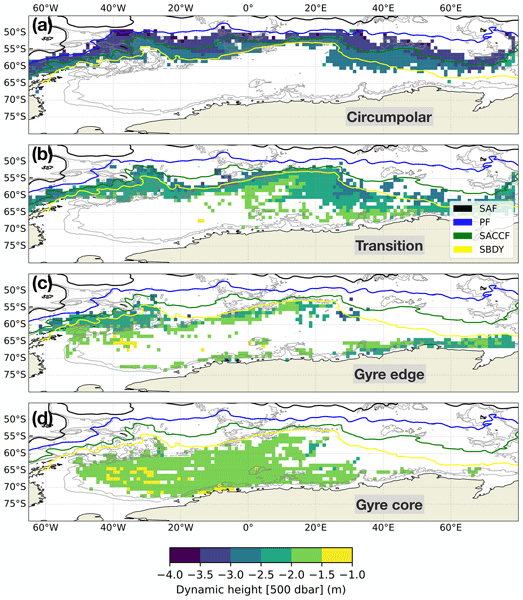
Dani C. Jones, Maike Sonnewald, Shenjie Zhou, Ute Hausmann, Andrew J. S. Meijers, Isabella Rosso, Lars Boehme, Michael P. Meredith, and Alberto C. Naveira Garabato
Ocean Sci., 19, 857–885, https://doi.org/10.5194/os-19-857-2023, https://doi.org/10.5194/os-19-857-2023, 2023
Short summary
Short summary
Machine learning is transforming oceanography. For example, unsupervised classification approaches help researchers identify underappreciated structures in ocean data, helping to generate new hypotheses. In this work, we use a type of unsupervised classification to identify structures in the temperature and salinity structure of the Weddell Gyre, which is an important region for global ocean circulation and for climate. We use our method to generate new ideas about mixing in the Weddell Gyre.
Cited articles
Alam, A. and Curry, J.: Lead-induced atmospheric circulations, J. Geophys. Res.-Oceans, 100, 4643–4651, https://doi.org/10.1029/94JC02562, 1995.
Albaji, A. O., Rashid, R. B. A., and Hamid, S. Z. A.: Investigation on Machine Learning Approaches for Environmental Noise Classifications, Ele. Com. Eng., 3615137, 1–26, https://doi.org/10.1155/2023/3615137, 2023.
Alem, A. and Kumar, S.: Deep Learning Models Performance Evaluations for Remote Sensed Image Classification, IEEE Access, 10, 111784–111793, https://doi.org/10.1109/ACCESS.2022.3215264, 2022.
Andersen, S., Tonboe, R., Kaleschke, L., Heygster, G., and Pedersen, L. T.: Intercomparison of passive microwave sea ice concentration retrievals over the high-concentration Arctic sea ice, J. Geophys. Res.-Oceans, 112, 1–18, https://doi.org/10.1029/2006JC003543, 2007.
Antonello, A., Franceschi, S., Floreancig, V., Comiti, F., and Tonon, G.: Application of a Pattern Recognition Algorithm for Single Tree Detection from Lidar Data, Int. Arch. Photogramm., XLII-4/W2, 27–33, https://doi.org/10.5194/isprs-archives-XLII-4-W2-27-2017, 2017.
Arrigo, K. R. and van Dijken, G. L.: Phytoplankton dynamics within 37 Antarctic coastal polynya systems, J. Geophys. Res.-Oceans, 108, 1–18, https://doi.org/10.1029/2002JC001739, 2003.
Arrigo, K. R., van Dijken, G. L., and Bushinsky, S.: Primary production in the Southern Ocean, 1997–2006, J. Geophys. Res.-Oceans, 113, 1–27, https://doi.org/10.1029/2007JC004551, 2008.
Arrigo, K., Lowry, K., and van Dijken, G.: Annual changes in sea ice and phytoplankton in polynyas of the Amundsen Sea, Antarctica, Deep-Sea Res. Pt. II, 71–76, 5–15, https://doi.org/10.1016/j.dsr2.2012.03.006, 2012.
Barber, D. G. and Massom, R. A.: The Role of Sea Ice in Arctic and Antarctic Polynyas, in: Polynyas – Windows to the World, edited by: Smith, W. O. and Barber, D. G., Elsevier Oceanography Series, 1–54, https://doi.org/10.1016/S0422-9894(06)74001-6, 2007.
Behera, B., Kumaravelan, G., and Kumar, P. B.: Performance Evaluation of Deep Learning Algorithms in Biomedical Document Classification, 11th Int. Conf. Adv. Comput. (ICoAC), Chennai, India, 220–224, https://doi.org/10.1109/ICoAC48765.2019.246843, 2019.
Bennett, M., Renfrew, I., Stevens, D., and Moore, G.: The Northeast Water Polynya, Greenland: Climatology, Atmospheric Forcing and Ocean Response, J. Geophys. Res.-Oceans, 129, 1–24, https://doi.org/10.1029/2023JC020513, 2024.
Bitz, C. M., Holland, M. M., Hunke, E. C., and Moritz, R. E.: Maintenance of the Sea-Ice Edge, J. Climate, 18, 2903–2921, https://doi.org/10.1175/JCLI3428.1, 2005.
Boothroyd, A., Adams, V., Alexander, K., and Hill, N.: Priority areas for marine protection in the Amundsen and Bellingshausen Seas, Antarctica, Mar. Policy, 167, 1–11, https://doi.org/10.1016/j.marpol.2024.106232, 2024.
Bromwich, D. H. and Kurtz, D. D.: Katabatic wind forcing of the Terra Nova Bay polynya, J. Geophys. Res., 89, 3561–3572, https://doi.org/10.1029/JC089iC03p03561, 1984.
Budikova, D.: Role of Arctic sea ice in global atmospheric circulation: A review, Global Planet. Change, 68, 149–163, https://doi.org/10.1016/j.gloplacha.2009.04.001, 2009.
Burada, G., McDonald, A., Renwick, J., and Jolly, B.: Delineating Polynya Area Using Active and Passive Microwave Sensors for the Western Ross Sea Sector of Antarctica, Remote Sens., 15, 1–23, https://doi.org/10.3390/rs15102545, 2023.
Campbell, E. C., Wilson, E. A., Kent Moore, G. W., Rider, S. C., Brayton, C. E., Mazloff, M. R., and Talley, L. D.: Antarctic offshore polynyas linked to Southern Hemisphere climate anomalies, Nature, 570, 319–325, https://doi.org/10.1038/s41586-019-1294-0, 2019.
Carsey, F. D.: Microwave Observation of the Weddell Sea Polynya, Mon. Weather Rev., 108, 2032–2044, https://doi.org/10.1175/1520-0493(1980)108<2032:MOOTWP>2.0.CO;2, 1980.
Cheon, W. G. and Gordon, A.: Open-ocean polynyas and deep convection in the Southern Ocean, Sci. Rep., 9, https://doi.org/10.1038/s41598-019-43466-2, 2019.
Chorowicz, J., Parrot, J.-F., Taud, H., Hakdaoui, M., Rudant, J. P., and Rois, T.: Automated pattern-recognition of geomorphic features from DEMs and satellite images, Z. Geomorphol. Suppl., 101, 69–84, 1995.
Comiso, J. and Gordon, A.: Interannual Variability in Summer Sea Ice Minimum, Coastal Polynyas and Bottom Water Formation in the Weddell Sea, in: Antarctic Sea Ice: Physical Processes, Interactions and Variability, 74, 293–315, https://doi.org/10.1029/AR074p0293, 1998.
Comiso, J. C., Cavalieri, D. J., and Markus, T.: Sea ice concentration, ice temperature, and snow depth using AMSR-E data, IEEE T. Geosci. Remote, 41, 243–252, https://doi.org/10.1109/TGRS.2002.808317, 2003.
Cook, J. and Ramadas, V.: When to consult precision-recall curves, Stata J., 20, 131–148, https://doi.org/10.1177/1536867X20909693, 2020.
Dennett, M., Mathot, S., Caron, D., Smith Jr, W., and Lonsdale, D.: Abundance and distribution of phototrophic and heterotrophic nano- and microplankton in the southern Ross Sea, Deep-Sea Res. Pt. II, 48, 4019–4037, https://doi.org/10.1016/S0967-0645(01)00079-0, 2001.
Duffy, G. A., Montiel, F., Purich, A., and Fraser, C. I.: Emerging long-term trends and interdecadal cycles in Antarctic polynyas, Proc. Natl. Acad. Sci. USA, 121, https://doi.org/10.1073/pnas.2321595121, 2024.
Flynn, T., Rozanov, A., Ellis, F., de Clercq, W., and Clarke, C.: Farm-scale soil patterns derived from automated terrain classification, Catena, 185, 1–11, https://doi.org/10.1016/j.catena.2019.104311, 2020.
Francis, D., Eayrs, C., Cuesta, J., and Holland, D.: Polar cyclones at the origin of the reoccurrence of the Maud Rise polynya in austral winter 2017, J. Geophys. Res.-Atmos., 124, 5251–5267, https://doi.org/10.1029/2019JD030618, 2019.
Fu, H., Zhao, J., and Frey, K. E.: Investigation of polynya dynamics in the northern Bering Sea using greyscale morphology image-processing techniques, Int. J. Remote Sens., 33, 2214–2232, https://doi.org/10.1080/01431161.2011.608088, 2012.
Gallée, H.: Air-sea interactions over Terra Nova Bay during winter: Simulation with a coupled atmosphere-polynya model, J. Geophys. Res.-Atmos., 102, 13835–13849, https://doi.org/10.1029/96JD03098, 1997.
Gilchrist, G. and Robertson, G.: Observations of Marine Birds and Mammals Wintering at Polynyas and Ice Edges in the Belcher Islands, Nunavut, Canada, Arctic, 53, 61–68, https://doi.org/10.14430/arctic835, 2000.
Gordon, A. L. and Comiso, J. C.: Polynyas in the Southern Ocean, Sci. Am., 258, 90–97, https://doi.org/10.1038/scientificamerican0688-90, 1988.
Gutjahr, O., Heinemann, G., Preußer, A., Willmes, S., and Drüe, C.: Quantification of ice production in Laptev Sea polynyas and its sensitivity to thin-ice parameterizations in a regional climate model, The Cryosphere, 10, 2999–3019, https://doi.org/10.5194/tc-10-2999-2016, 2016.
Hall, D., Key, J., Casey, K., Riggs, G., and Cavalieri, D.: Sea Ice Surface Temperature Product From MODIS, IEEE T. Geosci. Remote, 42, 1076–1087, https://doi.org/10.1109/TGRS.2004.825587, 2004.
Heorton, H. D. B. S., Radia, N., and Feltham, D. L.: A model of sea ice formation in leads and polynyas, J. Phys. Oceanogr., 47, 1701–1718, https://doi.org/10.1175/JPO-D-16-0224.1, 2017.
Heuzé, C. and Wong, C. H. M.: Automatic detection of Arctic polynyas using hybrid supervised-unsupervised deep learning, The Cryosphere, 19, 6043–6058, https://doi.org/10.5194/tc-19-6043-2025, 2025.
Heuzé, C., Zhou, L., Mohrmann, M., and Lemos, A.: Spaceborne infrared imagery for early detection of Weddell Polynya opening, The Cryosphere, 15, 3401–3421, https://doi.org/10.5194/tc-15-3401-2021, 2021.
Holz, R., Ackerman, S., Nagle, F., Frey, R., Dutcher, S., Kuehn, R., Vaughan, M., and Baum, B.: Global Moderate Resolution Imaging Spectroradiometer (MODIS) cloud detection and height evaluation using CALIOP, J. Geophys. Res.-Atmos., 113, 1–17, https://doi.org/10.1029/2008JD009837, 2008.
Hoppema, M. and Anderson, L.: Biogeochemistry of polynyas and their role in sequestration of anthropogenic constituents, in: Polynyas – Windows to the World, edited by: Smith, W. O. and Barber, D. G., Elsevier Oceanography Series, https://doi.org/10.1016/S0422-9894(06)74006-5, 2007.
Houghton, J., Filho, L. M., Callander, B., Harris, N., Kattenberg, A., and Maskell, K.: Climate Change 1995: The Science of Climate Change: contribution of working group I to the second assessment report of the Intergovernmental Panel on Climate Change, 2, Cambridge University Press, https://www.ipcc.ch/site/assets/uploads/2018/02/ipcc_sar_wg_I_full_report.pdf (last access: 10 March 2026), 1996.
Iwamoto, K., Ohshima, K. I., and Tamura, T.: Improved mapping of sea ice production in the Arctic Ocean using AMSR-E thin ice thickness algorithm, J. Geophys. Res.-Oceans, 119, 3574–3594, https://doi.org/10.1002/2013JC009749, 2014.
Jasiewicz, J. and Stepinski, T. F.: Geomorphons – a pattern recognition approach to classification and mapping of landforms, Geomorphology, 182, 147–156, https://doi.org/10.1016/j.geomorph.2012.11.005, 2013.
Jena, B. and Pillai, A. N.: Satellite observations of unprecedented phytoplankton blooms in the Maud Rise polynya, Southern Ocean, The Cryosphere, 14, 1385–1398, https://doi.org/10.5194/tc-14-1385-2020, 2020.
Jena, B., Ravichandran, M., and Turner, J.: Recent reoccurrence of large open-ocean polynya on the Maud Rise Seamount, Geophys. Res. Lett., 46, 4320–4329, https://doi.org/10.1029/2018GL081482, 2019.
Jiang, L., Ma, Y., Chen, F., Liu, J., Yao, W., Qiu, Y., and Zhang, S.: Trends in the stability of Antarctic coastal polynyas and the role of topographic forcing factors, Remote Sens., 12, 1–21, https://doi.org/10.3390/rs12061043, 2020.
Kern, S.: Wintertime Antarctic coastal polynya area: 1992–2008, Geophys. Res. Lett., 36, https://doi.org/10.1029/2009GL038062, 2009.
Kern, S., Spreen, G., Kaleschke, L., De La Rosa, S., and Heygster, G.: Polynya Signature Simulation Method polynya area in comparison to AMSR-E 89 GHz sea-ice concentrations in the Ross Sea and off the Adélie Coast, Antarctica, for 2002–05: first results, Ann. Glaciol., 46, 410–418, https://doi.org/10.3189/172756407782871585, 2007.
Kern, S., Lavergne, T., Pedersen, L. T., Tonboe, R. T., Bell, L., Meyer, M., and Zeigermann, L.: Satellite passive microwave sea-ice concentration data set intercomparison using Landsat data, The Cryosphere, 16, 349–378, https://doi.org/10.5194/tc-16-349-2022, 2022.
Kim, Y., Min, S., Gillett, N., Notz, D., and Malinina, E.: Observationally-constrained projections of an ice-free Arctic even under a low emission scenario, Nat. Commun., 14, 3139, https://doi.org/10.1038/s41467-023-38511-8, 2023.
Kimura, N. and Wakatsuchi, M.: Increase and decrease of sea ice area in the Sea of Okhotsk: Ice production in coastal polynyas and dynamic thickening in convergence zones, J. Geophys. Res.-Oceans, 109, https://doi.org/10.1029/2003JC001901, 2004.
Kwok, R., Comiso, J. C., Martin, S., and Drucker, R.: Ross Sea polynyas: Response of ice concentration retrievals to large areas of thin ice, J. Geophys. Res.-Oceans, 112, 1–13, https://doi.org/10.1029/2006JC003967, 2007.
Labrousse, S., Williams, G., Tamura, T., Bestley, S., Sallée, J., Fraser, A., Sumner, M., Roquet, F., Heerah, K., Picard, B., Guinet, C., Harcourt, R., McMahon, C., Hindell, M., and Charrassin, J.: Coastal polynyas: Winter oases for subadult southern elephant seals in East Antarctica, Sci. Rep., 8, 3183, https://doi.org/10.1038/s41598-018-21388-9, 2018.
Landrum, L. L. and Holland, M. M.: Influences of changing sea ice and snow thicknesses on simulated Arctic winter heat fluxes, The Cryosphere, 16, 1483–1495, https://doi.org/10.5194/tc-16-1483-2022, 2022.
Landrum, L. L., DuVivier, A. K., Holland, M. M., Krumhardt, K., and Sylvester, Z.: Challenges in identifying Antarctic coastal polynyas in satellite observations and climate model output to support ecological climate change research, The Cryosphere, 20, 1815–1840, https://doi.org/10.5194/tc-20-1815-2026, 2026.
Lin, Y., Nakayama, Y., Liang, K., Huang, Y., Chen, D., and Yang, Q.: A dataset of the daily edge of each polynya in the Antarctic, Sci. Data, 11, 1015, https://doi.org/10.1038/s41597-024-03848-2, 2024.
Louanchi, F., Hoppema, M., Bakker, D. C. E., Poisson, A., Stoll, M. H. C., De Baar, H. J. W., Schauer, B., Ruiz-Pino, D. P., and Wolf-Gladrow, D.: Modelled and observed sea surface fCO2 in the Southern Ocean: a comparative study, Tellus B, 51, 541–559, https://doi.org/10.1034/j.1600-0889.1999.00029.x, 1999.
Macdonald, G. J., Ackley, S. F., Mestas-Nuñez, A. M., and Blanco-Cabanillas, A.: Evolution of the dynamics, area, and ice production of the Amundsen Sea Polynya, Antarctica, 2016–2021, The Cryosphere, 17, 457–476, https://doi.org/10.5194/tc-17-457-2023, 2023.
Markus, T. and Burns, B. A.: A method to estimate subpixel-scale coastal polynyas with satellite passive microwave data, J. Geophys. Res., 100, 4473–4487, https://doi.org/10.1029/94JC02278, 1995.
Martinson, D. G.: Open Ocean Convection in the Southern Ocean, in: Elsevier Oceanography Series, 57, 37–52, https://doi.org/10.1016/S0422-9894(08)70059-X, 1991.
Massom, R. A., Harris, P. T., Michael, K. J., and Potter, M. J.: The distribution and formative processes of latent-heat polynyas in East Antarctica, Ann. Glaciol., 27, 420–426, https://doi.org/10.3189/1998AoG27-1-420-426, 1998.
Mchedlishvili, A., Spreen, G., Melsheimer, C., and Huntemann, M.: Weddell Sea polynya analysis using SMOS–SMAP apparent sea ice thickness retrieval, The Cryosphere, 16, 471–487, https://doi.org/10.5194/tc-16-471-2022, 2022.
Melling, H., Gratton, Y., and Ingram, G.: Ocean circulation within the North Water Polynya of Baffin Bay, Atmos.-Ocean, 39, 301–325, https://doi.org/10.1080/07055900.2001.9649683, 2001.
Melsheimer, C.: ASI Version 5 Sea Ice Concentration User Guide, Version V0.9.4, Institute of Environmental Physics, University of Bremen, Bremen, Germany, August 2024, https://seaice.uni-bremen.de/fileadmin/user_upload/ASIuserguide.pdf (last access: 27 June 2026), 2024.
Melsheimer, C. and Spreen, G.: AMSR2 ASI sea ice concentration data, Antarctic, version 5.4 (NetCDF) (July 2012–December 2019), PANGAEA [data set], https://doi.org/10.1594/PANGAEA.898400, 2019.
miahurst.: miahurst/geomorphon_method_polynyas: Geomorphon Pattern Recognition Algorithm for Detecting Polynyas (Version ver_1), Zenodo [computer software], https://doi.org/10.5281/zenodo.22029238, 2026.
Mohrmann, M., Heuzé, C., and Swart, S.: Southern Ocean polynyas in CMIP6 models, The Cryosphere, 15, 4281–4313, https://doi.org/10.5194/tc-15-4281-2021, 2021.
Monroe, E., Taylor, P., and Boisvert, L.: Arctic Cloud Response to a Perturbation in Sea Ice Concentration: The North Water Polynya, J. Geophys. Res.-Atmos., 126, https://doi.org/10.1029/2020JD034409, 2021.
Morales Maqueda, M. A., Willmott, A. J., and Biggs, N. R. T.: Polynya dynamics: a review of observations and modeling, Rev. Geophys., 42, https://doi.org/10.1029/2002RG000116, 2004.
Nakata, K., Ohshima, K., Nihashi, S., Kimura, N., and Tamura, T.: Variability and ice production budget in the Ross Ice Shelf Polynya based on a simplified polynya model and satellite observations, J. Geophys. Res.-Oceans, 120, 6234–6252, https://doi.org/10.1002/2015JC010894, 2015.
Neteler, M. and Mitasova, H.: Open Source GIS: A GRASS GIS Approach (3rd edn.), Springer, New York, https://doi.org/10.1007/978-0-387-68574-8, 2007.
Nihashi, S. and Ohshima, K. I.: Circumpolar mapping of Antarctic coastal polynyas and landfast sea ice: relationship and variability, J. Climate, 28, 3650–3670, https://doi.org/10.1175/JCLI-D-14-00369.1, 2015.
Nomura, D., Abe, H., Hirawake, T., Ooki, A., Yamashita, Y., Murayama, A., Ono, K., and Nishioka, J.: Formation of dense shelf water associated with sea ice freezing in the Gulf of Anadyr estimated with oxygen isotopic ratios, Prog. Oceanogr., 196, 102595, https://doi.org/10.1016/j.pocean.2021.102595, 2021.
Ohshima, K., Nihashi, S., and Iwamoto, K.: Global view of sea-ice production in polynyas and its linkage to dense/bottom water formation, Geosci. Lett., 3, 13, https://doi.org/10.1186/s40562-016-0045-4, 2016.
Paul, S., Willmes, S., and Heinemann, G.: Long-term coastal-polynya dynamics in the southern Weddell Sea from MODIS thermal-infrared imagery, The Cryosphere, 9, 2027–2041, https://doi.org/10.5194/tc-9-2027-2015, 2015.
Preußer, A., Heinemann, G., Willmes, S., and Paul, S.: Multi-decadal variability of polynya characteristics and ice production in the North Water Polynya by means of passive microwave and thermal infrared satellite imagery, Remote Sens., 7, 15844–15867, https://doi.org/10.3390/rs71215807, 2015.
Spreen, G., Kaleschke, L., and Heygster, G.: Sea ice remote sensing using AMSR-E 89 GHz channels, J. Geophys. Res.-Oceans, 113, C2, https://doi.org/10.1029/2005JC003384, 2008.
Stepinski, T. F. and Jasiewicz, J.: Geomorphons – a new approach to classification of landforms, in: Proc. Geomorphometry 2011, 109–112, https://gisandscience.wordpress.com/2011/12/12/geomorphons-a-new-approach-to-classification-of-landforms/ (last access: 10 March 2026), 2011.
Tamura, T. and Ohshima, K. I.: Mapping of sea ice production in the Arctic coastal polynyas, J. Geophys. Res.-Oceans, 116, https://doi.org/10.1029/2010JC006586, 2011.
Wakatsuchi, M. and Ono, N.: Measurements of salinity and volume of brine excluded from growing sea ice, J. Geophys. Res.-Oceans, 88, 2943–2951, https://doi.org/10.1029/JC088iC05p02943, 1983.
Walsh, J. E. and Johnson, C. M.: Interannual atmospheric variability and associated fluctuations in Arctic sea ice extent, J. Geophys. Res.-Oceans, 84, 6915–6928, https://doi.org/10.1029/JC084iC11p06915, 1979.
Wei, Z., Zhang, Z., Vihma, T., Wang, X., and Chen, Y.: An overview of Antarctic polynyas: sea ice production, forcing mechanisms, temporal variability and water mass formation, Adv. Polar Sci., 32, 295–311, https://doi.org/10.13679/j.advps.2021.0026, 2021.
Worby, A. P. and Comiso, J. C.: Studies of the Antarctic sea ice edge and ice extent from satellite and ship observations, Remote Sens. Environ., 92, 98–111, https://doi.org/10.1016/j.rse.2004.05.007, 2004.
WMO (World Meteorological Organization): WMO Sea-Ice Nomenclature, Vol. I: Terminology and Codes, Vol. II: Illustrated Glossary, and Vol. III: International System of Sea-Ice Symbols, WMO-No. 259, Geneva, Switzerland, https://library.wmo.int/viewer/41953/download?file=259-2015_multilingual.pdf&type=pdf&navigator=1 (last access: 5 August 2026), 2015.
Wyles, H. M. E., Boehme, L., Russell, D. J. F., and Carter, M. I. D.: A novel approach to using seabed geomorphology as a predictor of habitat use in highly mobile marine predators: Implications for ecology and conservation, Front. Mar. Sci., 9, 1–16, https://doi.org/10.3389/fmars.2022.818635, 2022.
Yager, P. L., Sherrell, R. M., Stammerjohn, S. E., Ducklow, H. W., Schofield, O. M. E., Ingall, E. D., Wilson, S. E., Lowry, K. E., Williams, C. M., Riemann, L., Bertilsson, S., Alderkamp, A.-C., Dinasquet, J., Logares, R., Richert, I., Sipler, R. E., Melara, A. J., Mu, L., Newstead, R. G., Post, A. F., Swalethorp, R., and van Dijken, G. L.: A carbon budget for the Amundsen Sea Polynya, Antarctica: Estimating net community production and export in a highly productive polar ecosystem, Elementa Sci. Anthr., 4, 1–36, https://doi.org/10.12952/journal.elementa.000140, 2016.
Yokoyama, R., Shirasawa, M., and Pike, R. J.: Visualizing topography by openness: A new application of image processing to digital elevation models, Photogramm. Eng. Remote Sens., 68, 257–265, 2002.
Zheng, W., Zhaoru, Z., Vihma, T., Xiaoqiao, W., and Yuanjie, C.: An overview of Antarctic polynyas: Sea ice production, forcing mechanisms, temporal variability and water mass formation, Adv. Polar Sci., 32, 295–311, https://doi.org/10.13679/j.advps.2021.0026, 2021.
Zhou, L., Heuzé, C., and Mohrmann, M.: Sea ice production in the 2016 and 2017 Maud Rise polynyas, J. Geophys. Res.-Oceans, 128, 1–20, https://doi.org/10.1029/2022JC019148, 2023.
Short summary
Polynyas are areas of open water in sea ice that are important for ocean life and climate. We developed a new method to automatically find polynyas using morphological patterns in Antarctic sea ice data. The method reliably detected both large and small polynyas, produced results consistent with existing approaches, and remained accurate despite data uncertainty. This approach offers a promising way to build consistent long-term records and improve future studies of changing polar environments.
Polynyas are areas of open water in sea ice that are important for ocean life and climate. We...


