
Articles | Volume 22, issue 3
https://doi.org/10.5194/os-22-1515-2026
© Author(s) 2026. This work is distributed under
the Creative Commons Attribution 4.0 License.
the Creative Commons Attribution 4.0 License.
https://doi.org/10.5194/os-22-1515-2026
© Author(s) 2026. This work is distributed under
the Creative Commons Attribution 4.0 License.
the Creative Commons Attribution 4.0 License.
Research article
| Highlight paper
| 
13 May 2026
Research article | Highlight paper |
| 13 May 2026
| 13 May 2026
High-latitude eddy statistics from SWOT compared with in situ observations
Charly de Marez
CORRESPONDING AUTHOR

Laboratoire d'Océanographie Physique et Spatiale, Univ. Brest, CNRS, Ifremer, IRD, IUEM, Plouzané, France
Arne Bendinger
Laboratoire d'Océanographie Physique et Spatiale, Univ. Brest, CNRS, Ifremer, IRD, IUEM, Plouzané, France
Ahmad Fehmi Dilmahamod
GEOMAR Helmholtz Centre for Ocean Research, Kiel, Germany
Related authors
Charly de Marez, Anissa Bouras, and Xavier Carton
EGUsphere, https://doi.org/10.5194/egusphere-2026-5662, https://doi.org/10.5194/egusphere-2026-5662, 2026
This preprint is open for discussion and under review for Ocean Science (OS).
Short summary
Short summary
We show that static stability constrains the structure and distribution of oceanic eddies. Eddy polarity, intensity, vertical extent, and background stratification determine whether balanced eddies remain stable, with implications for their propagation and eddy-induced vertical mixing.
Angel Ruiz-Angulo, Esther Portela, Charly de Marez, Andreas Macrander, Sólveig Rósa Ólafsdóttir, Thomas Meunier, Steingrímur Jónsson, and M. Dolores Pérez-Hernández
Ocean Sci., 22, 1727–1743, https://doi.org/10.5194/os-22-1727-2026, https://doi.org/10.5194/os-22-1727-2026, 2026
Short summary
Short summary
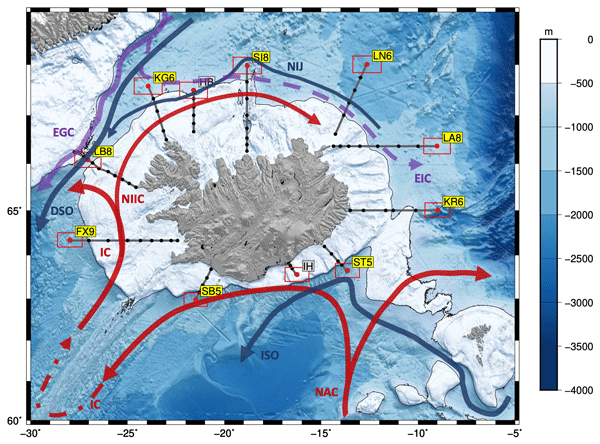
Analysis of 1990–2019 hydrographic around Iceland identifies three dynamical regions: an α-ocean south with warm Atlantic Water and deep mixed layers, a β-ocean northwest with salinity-dominated stratification and shallow mixed layers, and a northeastern transition zone with seasonal shifts. Waters warmed, especially in the northeast, showing Atlantification. Density decreases occur in the south, while other regions show density-compensated variability, with no clear trend in mixed layer depth.
Charly de Marez
Ocean Sci., 21, 1933–1942, https://doi.org/10.5194/os-21-1933-2025, https://doi.org/10.5194/os-21-1933-2025, 2025
Short summary
Short summary
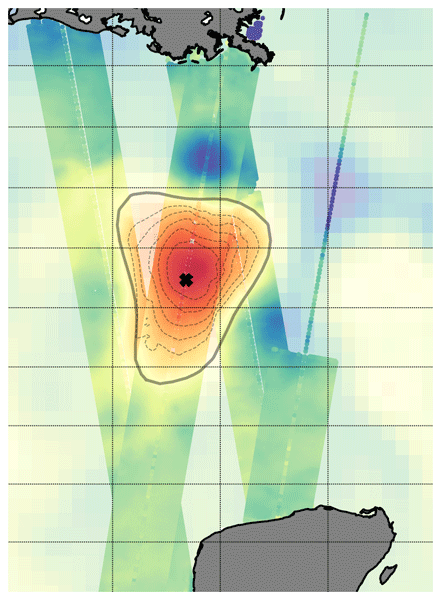
Oceanic eddies are giant swirling currents that help transport heat, nutrients, and pollutants across the ocean. However, their life cycle has never been observed in detail. Using new satellite data, we tracked an intense eddy in the Gulf of Mexico, describing its life cycle from birth during a 6-month period. Our observations reveal small-scale turbulence surrounding it and interactions with other structures that shape its evolution, validating decades of numerical studies.
Gwendal Marechal and Charly de Marez
Ocean Sci., 18, 1275–1292, https://doi.org/10.5194/os-18-1275-2022, https://doi.org/10.5194/os-18-1275-2022, 2022
Short summary
Short summary
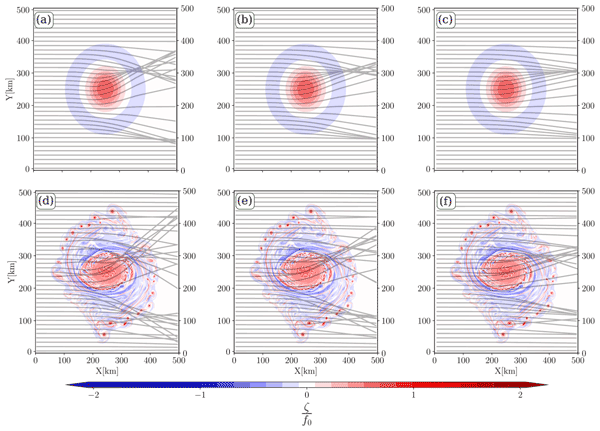
The surface ocean is turbulent from several hundred to a few kilometres. The more the current field is turbulent, the more traveling waves over the underlying current that are scattered. In this paper we focus on an isolated eddy where spontaneous instabilities have occurred, resulting in the emergence of smaller structures. Thanks to the wave scattering we have been able to retrieve the underlying surface current gradients normally not retrievable with traditional current measurements.
Lionel Gourdeau, Nadia Ayoub, Arne Bendinger, Sophie Cravatte, Rosemary Morrow, Mei-Ling Dabat, Fabien Léger, and Oscar Vergara
EGUsphere, https://doi.org/10.5194/egusphere-2026-5846, https://doi.org/10.5194/egusphere-2026-5846, 2026
This preprint is open for discussion and under review for Earth Observation (EO).
Short summary
Short summary
For decades, conventional altimeters have observed sea surface height features of hundreds of km. The recent SWOT satellite provides unprecedented observations of fine-scale ocean features down to 15 km. This study shows in a test region that with specific processing of their high-resolution data, conventional altimeters can also capture features down to 20 km, and offer a rich long-term dataset to improve our knowledge of ocean fine-scale processes alongside and beyond the SWOT mission.
Charly de Marez, Anissa Bouras, and Xavier Carton
EGUsphere, https://doi.org/10.5194/egusphere-2026-5662, https://doi.org/10.5194/egusphere-2026-5662, 2026
This preprint is open for discussion and under review for Ocean Science (OS).
Short summary
Short summary
We show that static stability constrains the structure and distribution of oceanic eddies. Eddy polarity, intensity, vertical extent, and background stratification determine whether balanced eddies remain stable, with implications for their propagation and eddy-induced vertical mixing.
Angel Ruiz-Angulo, Esther Portela, Charly de Marez, Andreas Macrander, Sólveig Rósa Ólafsdóttir, Thomas Meunier, Steingrímur Jónsson, and M. Dolores Pérez-Hernández
Ocean Sci., 22, 1727–1743, https://doi.org/10.5194/os-22-1727-2026, https://doi.org/10.5194/os-22-1727-2026, 2026
Short summary
Short summary
Analysis of 1990–2019 hydrographic around Iceland identifies three dynamical regions: an α-ocean south with warm Atlantic Water and deep mixed layers, a β-ocean northwest with salinity-dominated stratification and shallow mixed layers, and a northeastern transition zone with seasonal shifts. Waters warmed, especially in the northeast, showing Atlantification. Density decreases occur in the south, while other regions show density-compensated variability, with no clear trend in mixed layer depth.
Alan D. Fox, Neil J. Fraser, Kristin Burmeister, Sam C. Jones, Stuart A. Cunningham, Lewis A. Drysdale, Ahmad Fehmi Dilmahamod, and Johannes Karstensen
Ocean Sci., 22, 1439–1456, https://doi.org/10.5194/os-22-1439-2026, https://doi.org/10.5194/os-22-1439-2026, 2026
Short summary
Short summary
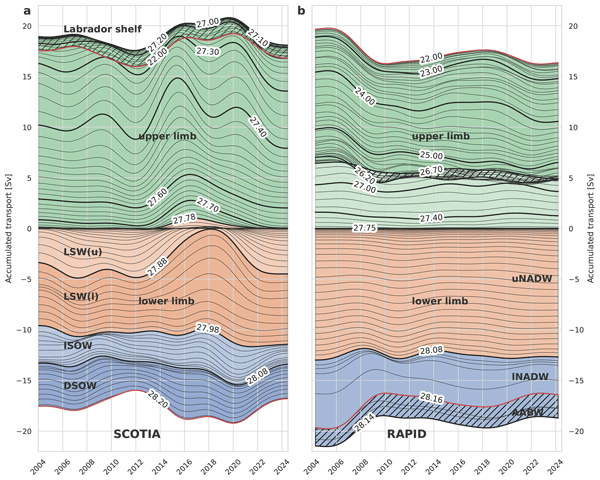
The Atlantic ocean circulation that helps regulate climate is expected to weaken this century. Long-term measurements in the subtropics now show signs of weakening, but northern data are shorter and more variable. By combining several observing systems, we reconstructed northern circulation since 2004 and found strong ups and downs, but no clear long-term weakening so far.
Florian Schütte, Johannes Hahn, Ivy Frenger, Arne Bendinger, Ahmad Fehmi Dilmahamod, Marco Schulz, and Peter Brandt
Ocean Sci., 22, 119–143, https://doi.org/10.5194/os-22-119-2026, https://doi.org/10.5194/os-22-119-2026, 2026
Short summary
Short summary
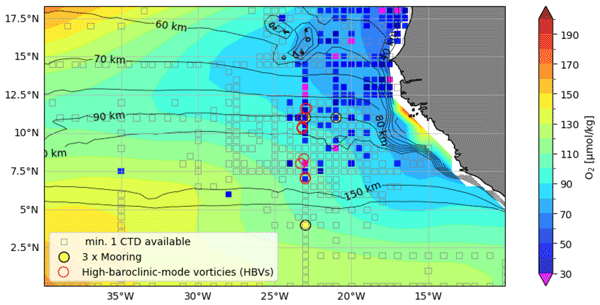
We found extreme drops in oxygen levels in the tropical Atlantic linked to surprisingly long-lived, small subsurface eddies. These eddies are hidden beneath the surface (undetectable by satellites) and are unusually stable, even in the highly dynamic ocean near the equator. Using long-term measurements and computer models, we show that these features can strongly influence oxygen supply and potentially impact marine ecosystems.
Maher Bouzaiene, Antonio Guarnieri, Damiano Delrosso, Ahmad F. Dilmahamod, Simona Simoncelli, and Claudia Fratianni
Ocean Sci., 21, 2643–2662, https://doi.org/10.5194/os-21-2643-2025, https://doi.org/10.5194/os-21-2643-2025, 2025
Short summary
Short summary
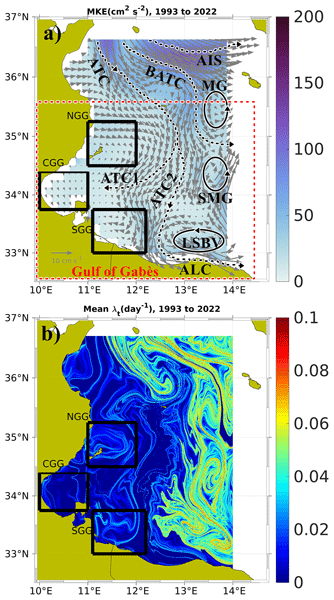
We analyze the geostrophic circulation and tidal effects in the Gulf of Gabès from 30 years of altimetry data (1993–2022) and the outputs of a high-resolution ocean model for the year 2022.
Arne Bendinger, Sophie Cravatte, Lionel Gourdeau, Clément Vic, and Florent Lyard
Ocean Sci., 21, 1943–1966, https://doi.org/10.5194/os-21-1943-2025, https://doi.org/10.5194/os-21-1943-2025, 2025
Short summary
Short summary
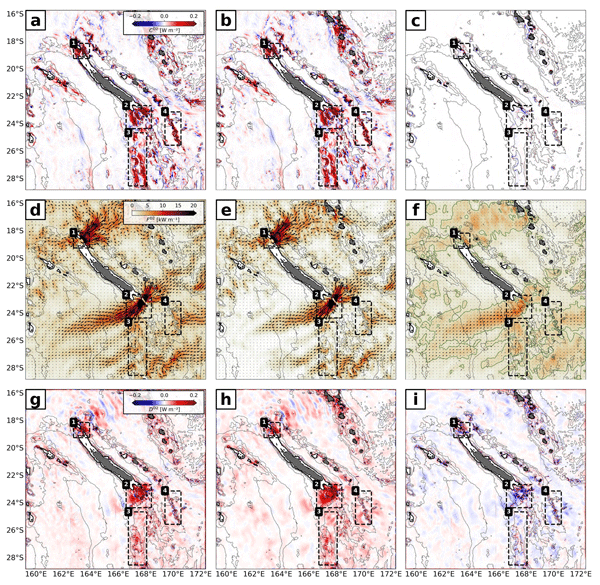
Temporal variability of the semidiurnal internal tide around New Caledonia is investigated using regional modeling. An important contribution to temporal variability not linked to the spring–neap tide cycle is due to the presence of mesoscale eddies both at the generation sites and in the propagation direction. The incoherent tide has a widespread signature in sea surface height (SSH), challenging the SSH observability of mesoscale to submesoscale dynamics.
Charly de Marez
Ocean Sci., 21, 1933–1942, https://doi.org/10.5194/os-21-1933-2025, https://doi.org/10.5194/os-21-1933-2025, 2025
Short summary
Short summary
Oceanic eddies are giant swirling currents that help transport heat, nutrients, and pollutants across the ocean. However, their life cycle has never been observed in detail. Using new satellite data, we tracked an intense eddy in the Gulf of Mexico, describing its life cycle from birth during a 6-month period. Our observations reveal small-scale turbulence surrounding it and interactions with other structures that shape its evolution, validating decades of numerical studies.
Arne Bendinger, Sophie Cravatte, Lionel Gourdeau, Luc Rainville, Clément Vic, Guillaume Sérazin, Fabien Durand, Frédéric Marin, and Jean-Luc Fuda
Ocean Sci., 20, 945–964, https://doi.org/10.5194/os-20-945-2024, https://doi.org/10.5194/os-20-945-2024, 2024
Short summary
Short summary
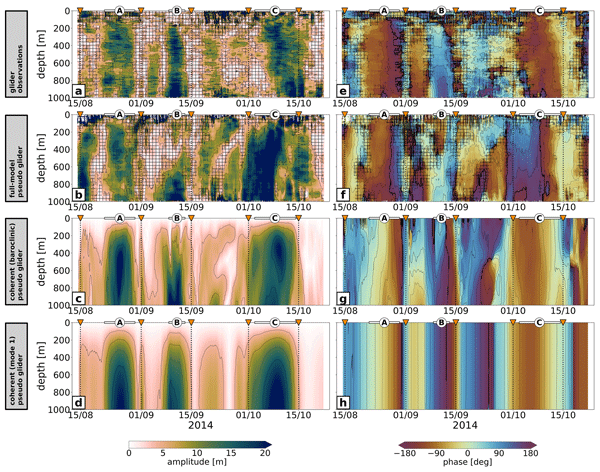
A unique dataset of glider observations reveals tidal beams south of New Caledonia – an internal-tide-generation hot spot in the southwestern tropical Pacific. Observations are in good agreement with numerical modeling output, highlighting the glider's capability to infer internal tides while assessing the model's realism of internal-tide dynamics. Discrepancies are in large part linked to eddy–internal-tide interactions. A methodology is proposed to deduce the internal-tide surface signature.
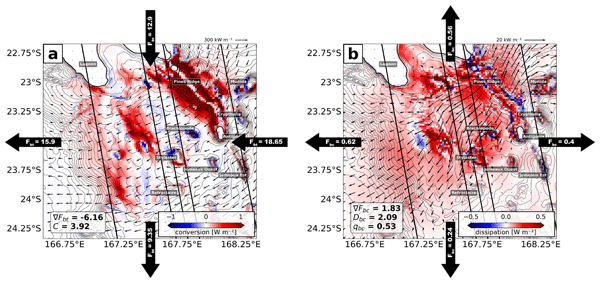
Arne Bendinger, Sophie Cravatte, Lionel Gourdeau, Laurent Brodeau, Aurélie Albert, Michel Tchilibou, Florent Lyard, and Clément Vic
Ocean Sci., 19, 1315–1338, https://doi.org/10.5194/os-19-1315-2023, https://doi.org/10.5194/os-19-1315-2023, 2023
Short summary
Short summary
New Caledonia is a hot spot of internal-tide generation due to complex bathymetry. Regional modeling quantifies the coherent internal tide and shows that most energy is converted in shallow waters and on very steep slopes. The region is a challenge for observability of balanced dynamics due to strong internal-tide sea surface height (SSH) signatures at similar wavelengths. Correcting the SSH for the coherent internal tide may increase the observability of balanced motion to < 100 km.
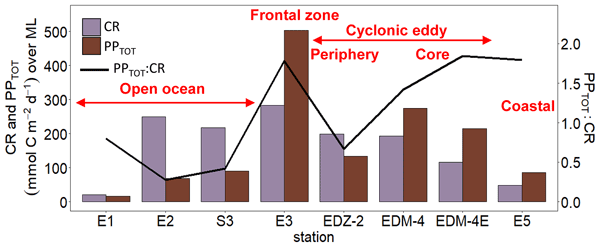
Quentin Devresse, Kevin W. Becker, Arne Bendinger, Johannes Hahn, and Anja Engel
Biogeosciences, 19, 5199–5219, https://doi.org/10.5194/bg-19-5199-2022, https://doi.org/10.5194/bg-19-5199-2022, 2022
Short summary
Short summary
Eddies are ubiquitous in the ocean and alter physical, chemical, and biological processes. However, how they affect organic carbon production and consumption is largely unknown. Here we show how an eddy triggers a cascade effect on biomass production and metabolic activities of phyto- and bacterioplankton. Our results may contribute to the improvement of biogeochemical models used to estimate carbon fluxes in the ocean.
Gwendal Marechal and Charly de Marez
Ocean Sci., 18, 1275–1292, https://doi.org/10.5194/os-18-1275-2022, https://doi.org/10.5194/os-18-1275-2022, 2022
Short summary
Short summary
The surface ocean is turbulent from several hundred to a few kilometres. The more the current field is turbulent, the more traveling waves over the underlying current that are scattered. In this paper we focus on an isolated eddy where spontaneous instabilities have occurred, resulting in the emergence of smaller structures. Thanks to the wave scattering we have been able to retrieve the underlying surface current gradients normally not retrievable with traditional current measurements.
Cited articles
Amores, A., Jordà, G., Arsouze, T., and Le Sommer, J.: Up to what extent can we characterize ocean eddies using present-day gridded altimetric products?, J. Geophys. Res.-Oceans, 123, 7220–7236, https://doi.org/10.1029/2018JC014140, 2018. a, b, c
Arai, M. and Yamagata, T.: Asymmetric evolution of eddies in rotating shallow water, Chaos, 4, 163–175, https://doi.org/10.1063/1.166001, 1994. a
Archer, M., Wang, J., Klein, P., Dibarboure, G., and Fu, L.-L.: Wide-swath satellite altimetry unveils global submesoscale ocean dynamics, Nature, 640, 691–696, https://doi.org/10.1038/s41586-025-08722-8, 2025. a
AVISO/DUACS: SWOT Level-3 SSH Basic (v3.0) [Data set], AVISO/DUACS [data set], https://doi.org/10.24400/527896/A01-2023.017, 2023a. a
AVISO/DUACS: SWOT Level-3 SSH Unsmoothed (v2.0.1) [Data set], AVISO/DUACS [data set], https://doi.org/10.24400/527896/A01-2024.003, 2023b. a
Ballarotta, M., Ubelmann, C., Pujol, M.-I., Taburet, G., Fournier, F., Legeais, J.-F., Faugère, Y., Delepoulle, A., Chelton, D., Dibarboure, G., and Picot, N.: On the resolutions of ocean altimetry maps, Ocean Sci., 15, 1091–1109, https://doi.org/10.5194/os-15-1091-2019, 2019. a
Beaird, N., Rhines, P., and Eriksen, C.: Observations of seasonal subduction at the Iceland-Faroe Front, J. Geophys. Res.-Oceans, 121, 4026–4040, https://doi.org/10.1002/2015JC011501, 2016. a
Callies, J. and Wu, W.: Some Expectations for Submesoscale Sea Surface Height Variance Spectra, J. Phys. Oceanogr., 49, 2271–2289, https://doi.org/10.1175/JPO-D-18-0272.1, 2019. a
Carli, E., Tranchant, Y., Siegelman, L., Le Guillou, F., Morrow, R. A., Ballarotta, M., and Vergara, O.: Small-scale eddy diagnostics around the Southern Ocean Polar Front with SWOT, Authorea Preprints, https://doi.org/10.22541/essoar.173655546.61867308/v1, 2025. a
Chanut, J., Barnier, B., Large, W., Debreu, L., Penduff, T., Molines, J. M., and Mathiot, P.: Mesoscale eddies in the Labrador Sea and their contribution to convection and restratification, J. Phys. Oceanogr., 38, 1617–1643, https://doi.org/10.1175/2008JPO3485.1, 2008. a
Chelton, D. B.: A postlaunch update on the effects of instrumental measurement errors on SWOT estimates of sea surface height, velocity, and vorticity, J. Atmos. Ocean. Tech., 41, 865–888, https://doi.org/10.1175/JTECH-D-24-0035.1, 2024. a
Chelton, D. B., Schlax, M. G., Samelson, R. M., and de Szoeke, R. A.: Global observations of large oceanic eddies, Geophys. Res. Lett., 34, https://doi.org/10.1029/2007GL030812, 2007. a
Chelton, D. B., Gaube, P., Schlax, M. G., Early, J. J., and Samelson, R. M.: The Influence of Nonlinear Mesoscale Eddies on Near-Surface Oceanic Chlorophyll, Science, 334, 328–332, https://doi.org/10.1126/science.1208897, 2011. a
CMEMS: OSI SAF, E.U. Copernicus Marine Service Information (CMEMS), Marine Data Store (MDS), https://doi.org/10.48670/moi-00134, 2026. a
Damerell, G. M., Bosse, A., and Fer, I.: Merging of a mesoscale eddy into the Lofoten Vortex in the Norwegian Sea captured by an ocean glider and SWOT observations, Ocean Sci., 21, 2763–2785, https://doi.org/10.5194/os-21-2763-2025, 2025. a
de Jong, M., Bower, A., and Furey, H.: Two years of observations of warm-core anticyclones in the Labrador Sea and their seasonal cycle in heat and salt stratification, J. Phys. Oceanogr., 44, 427–444, https://doi.org/10.1175/JPO-D-13-070.1, 2014. a, b, c
de Marez, C., Ruiz-Angulo, A., and Gula, J.: Mesoscale induced vertical fluxes over the Iceland-Faroe ridge, Geophys. Res. Lett., 52, e2025GL115520, https://doi.org/10.1029/2025gl115520, 2025a. a
de Marez, C., Vives, C. R., Portela, E., and Ruiz-Angulo, A.: Mesoscale ocean processes: The critical role of stratification in the Icelandic region, J. Geophys. Res.-Oceans, 130, e2025JC022664, https://doi.org/10.1029/2025JC022664, 2025b. a, b, c
Demol, M., Ponte, A., Garreau, P., Bellacicco, M., Berta, M., Centurioni, L., Doglioli, A., Joel, A., Mourre, B., and Pascual, A.: Large Drifter Experiment in the Western Mediterranean Sea reveals Dynamical vs Noise contributions in SWOT-KaRIn Sea Level, Geophys. Res. Lett., submitted, 2026. a
Dibarboure, G., Anadon, C., Briol, F., Cadier, E., Chevrier, R., Delepoulle, A., Faugère, Y., Laloue, A., Morrow, R., Picot, N., Prandi, P., Pujol, M.-I., Raynal, M., Tréboutte, A., and Ubelmann, C.: Blending 2D topography images from the Surface Water and Ocean Topography (SWOT) mission into the altimeter constellation with the Level-3 multi-mission Data Unification and Altimeter Combination System (DUACS), Ocean Sci., 21, 283–323, https://doi.org/10.5194/os-21-283-2025, 2025. a, b
Dong, C., McWilliams, J. C., Liu, Y., and Chen, D.: Global heat and salt transports by eddy movement, Nat. Commun., 5, https://doi.org/10.1038/ncomms4294, 2014. a
Du, T. and Jing, Z.: Fine-Scale Eddies Detected by SWOT in the Kuroshio Extension, Remote Sens., 16, 3488, https://doi.org/10.3390/rs16183488, 2024. a
Du Plessis, M., Swart, S., Ansorge, I. J., Mahadevan, A., and Thompson, A. F.: Southern ocean seasonal restratification delayed by submesoscale wind–front interactions, J. Phys. Oceanogr., 49, 1035–1053, https://doi.org/10.1175/JPO-D-18-0136.1, 2019. a
Fu, C., Müller, V., and Myers, P. G.: Large Mesoscale Eddy Properties and Dynamics in the Labrador Sea from Satellite Altimetry, Atmos.-Ocean, 63, 334–352, https://doi.org/10.1080/07055900.2025.2538892, 2025. a, b
Fu, C., Han, X., Wang, Q., Pennelly, C., and Myers, P. G.: Wide-swath satellite altimetry reveals hotspots of small mesoscale eddies in the western Arctic Ocean, Commun. Earth Environ., 7, 344, https://doi.org/10.1038/s43247-026-03498-9, 2026. a
Gómez-Navarro, L., Ballarotta, M., Cortés-Morales, D., Pujol, M.-I., Fortunato, L., Mourre, B., and Pascual, A.: New insights on mesoscale activity in the western Mediterranean Sea, State Planet Discuss. [preprint], https://doi.org/10.5194/sp-2025-17, in review, 2025. a
Gula, J., Theetten, S., Cambon, G., and Roullet, G.: Description of the GIGATL simulations, Zenodo [data set], https://doi.org/10.5281/zenodo.4948523, 2021. a
Han, X., Wang, Q., Stewart, A. L., Wang, Z., Yang, Q., Ni, Q., Liu, C., and Chen, D.: High coastal eddy activity around Antarctica revealed by SWOT, Natil. Sci. Rev., nwag181, https://doi.org/10.1093/nsr/nwag181, 2026. a
Ioannou, A., Stegner, A., Tuel, A., LeVu, B., Dumas, F., and Speich, S.: Cyclostrophic corrections of AVISO/DUACS surface velocities and its application to mesoscale eddies in the Mediterranean Sea, J. Geophys. Res.-Oceans, 124, 8913–8932, https://doi.org/10.1029/2019JC015031, 2019. a
Jensen, S., Andersen, O., Ludwigsen, C., Gonçalves-Araujo, R., and de Steur, L.: Surface water and ocean topography (SWOT) observations unveil small mesoscale variability on the East Greenland shelf, Geophys. Res. Lett., 52, e2025GL118573, https://doi.org/10.1029/2025GL118573, 2025. a
Karstensen, J. and Czeschel, R.: ADCP current measurements (38 and 75 kHz) during Maria S. Merian cruise MSM74, PANGAEA [data set], https://doi.org/10.1594/PANGAEA.929000, 2021. a
Karstensen, J. and Schlundt, M.: Master track of MARIA S. MERIAN cruise MSM129/1 in 1 sec resolution (zipped, 41 MB), PANGAEA [data set], https://doi.org/10.1594/PANGAEA.972525, 2024. a
Karstensen, J., Czeschel, R., and Krahmann, G.: ADCP current measurements during Maria S. Merian cruise MSM54, PANGAEA [data set], https://doi.org/10.1594/PANGAEA.911727, 2020. a
Koszalka, I., Bracco, A., McWilliams, J. C., and Provenzale, A.: Dynamics of wind-forced coherent anticyclones in the open ocean, J. Geophys. Res.-Oceans, 114, https://doi.org/10.1029/2009JC005388, 2009. a
Le Traon, P. Y., Nadal, F., and Ducet, N.: An Improved Mapping Method of Multisatellite Altimeter Data, J. Atmos. Ocean. Tech., 15, 522–534, https://doi.org/10.1175/1520-0426(1998)015<0522:AIMMOM>2.0.CO;2, 1998. a
Le Vu, B., Stegner, A., and Arsouze, T.: Angular momentum eddy detection and tracking algorithm (AMEDA) and its application to coastal eddy formation, J. Atmos. Ocean. Tech., 35, 739–762, https://doi.org/10.1175/JTECH-D-17-0010.1, 2018. a
Lilly, J. M. and Rhines, P. B.: Coherent eddies in the Labrador Sea observed from a mooring, J. Phys. Oceanogr., 32, 585–598, https://doi.org/10.1175/1520-0485(2002)032<0585:CEITLS>2.0.CO;2, 2002. a
Manucharyan, G. E. and Thompson, A. F.: Submesoscale sea ice-ocean interactions in marginal ice zones, J. Geophys. Res.-Oceans, 122, 9455–9475, https://doi.org/10.1002/2017JC012895, 2017. a
Manucharyan, G. E. and Thompson, A. F.: Heavy footprints of upper-ocean eddies on weakened Arctic sea ice in marginal ice zones, Nat. Commun., 13, 2147, https://doi.org/10.1038/s41467-022-29663-0, 2022. a
Manucharyan, G. E., Lopez-Acosta, R., and Wilhelmus, M. M.: Spinning ice floes reveal intensification of mesoscale eddies in the western Arctic Ocean, Sci. Rep., 12, 7070, https://doi.org/10.1038/s41598-022-10712-z, 2022. a
Mason, E., Pascual, A., and McWilliams, J. C.: A new sea surface height–based code for oceanic mesoscale eddy tracking, J. Atmos. Ocean. Tech., 31, 1181–1188, https://doi.org/10.1175/JTECH-D-14-00019.1, 2014. a
Morrow, R., Fu, L.-L., Ardhuin, F., Benkiran, M., Chapron, B., Cosme, E., d'Ovidio, F., Farrar, J. T., Gille, S. T., Lapeyre, G., Le Traon, P.-Y., Pascual, A., Ponte, A., Qiu, B., Rascle, N., Ubelmann, C., Wang, J., and Zaron, E. D.: Global observations of fine-scale ocean surface topography with the Surface Water and Ocean Topography (SWOT) mission, Front. Mar. Sci., 6, 232, https://doi.org/10.3389/fmars.2019.00232, 2019. a
NOAA National Centers for Environmental Information: ETOPO 2022 15 Arc-Second Global Relief Model, NOAA National Centers for Environmental Information, https://doi.org/10.25921/fd45-gt74, 2022. a
Pacini, A. and Pickart, R. S.: Meanders of the west Greenland current near cape farewell, Deep-Sea Research Pt. I,, 179, 103664, https://doi.org/10.1016/j.dsr.2021.103664, 2022. a, b
Polvani, L. M., McWilliams, J. C., Spall, M. A., and Ford, R.: The coherent structures of shallow-water turbulence: Deformation-radius effects, cyclone/anticyclone asymmetry and gravity-wave generation, Chaos, 4, 177–186, https://doi.org/10.1063/1.166002, 1994. a
Pujol, M.-I., Faugère, Y., Taburet, G., Dupuy, S., Pelloquin, C., Ablain, M., and Picot, N.: DUACS DT2014: the new multi-mission altimeter data set reprocessed over 20 years, Ocean Sci., 12, 1067–1090, https://doi.org/10.5194/os-12-1067-2016, 2016. a
Rieck, J. K., Böning, C. W., and Getzlaff, K.: The nature of eddy kinetic energy in the Labrador Sea: Different types of mesoscale eddies, their temporal variability, and impact on deep convection, J. Phys. Oceanogr., 49, 2075–2094, https://doi.org/10.1175/JPO-D-18-0243.1, 2019. a, b, c
Roullet, G. and Klein, P.: Cyclone-anticyclone asymmetry in geophysical turbulence, Phys. Rev. Lett., 104, 218501, https://doi.org/10.1103/PhysRevLett.104.218501, 2010. a
Shchepetkin, A. F. and McWilliams, J. C.: The regional oceanic modeling system (ROMS): a split-explicit, free-surface, topography-following-coordinate oceanic model, Ocean Model., 9, 347–404, https://doi.org/10.1016/j.ocemod.2004.08.002, 2005. a
Si, Y., Stewart, A. L., and Eisenman, I.: Heat transport across the Antarctic Slope Front controlled by cross-slope salinity gradients, Sci. Adv., 9, eadd7049, https://doi.org/10.1126/sciadv.add7049, 2023. a
Thompson, A. F., Heywood, K. J., Schmidtko, S., and Stewart, A. L.: Eddy transport as a key component of the Antarctic overturning circulation, Nat. Geosci., 7, 879–884, https://doi.org/10.1038/ngeo2289, 2014. a
Thomsen, S., Eden, C., and Czeschel, L.: Stability analysis of the Labrador Current, J. Phys. Oceanogr., 44, 445–463, https://doi.org/10.1175/JPO-D-13-0121.1, 2014. a
Tréboutte, A., Carli, E., Ballarotta, M., Carpentier, B., Faugère, Y., and Dibarboure, G.: KaRIn noise reduction using a convolutional neural network for the SWOT ocean products, Remote Sens., 15, 2183, https://doi.org/10.3390/rs15082183, 2023. a
Verger-Miralles, E., Mourre, B., Gómez-Navarro, L., Barceló-Llull, B., Casas, B., Cutolo, E., Díaz-Barroso, L., d'Ovidio, F., Tarry, D. R., Zarokanellos, N. D., and Pascual, A.: SWOT enhances small-scale eddy detection in the Mediterranean Sea, Geophys. Res. Lett., 52, e2025GL116480, https://doi.org/10.1029/2025GL116480, 2025. a
Zhang, L., Liu, C., Sun, W., Wang, Z., Liang, X., Li, X., and Cheng, C.: Modeling Mesoscale Eddies Generated Over the Continental Slope, East Antarctica, Front. Earth Sci., 10, 970, https://doi.org/10.3389/feart.2022.916398, 2022. a
Zhang, L., Hwang, C., Liu, H.-Y., Chang, E. T., and Yu, D.: Automated Eddy Identification and Tracking in the Northwest Pacific Based on Conventional Altimeter and SWOT Data, Remote Sens., 17, 1665, https://doi.org/10.3390/rs17101665, 2025a. a, b
Zhang, X., Liu, L., Fei, J., Li, Z., Wei, Z., Zhang, Z., Jiang, X., Dong, Z., and Xu, F.: Advances in surface water and ocean topography for fine-scale eddy identification from altimeter sea surface height merging maps in the South China Sea, Ocean Sci., 21, 1033–1045, https://doi.org/10.5194/os-21-1033-2025, 2025b. a
Zhang, Z., Wang, W., and Qiu, B.: Oceanic mass transport by mesoscale eddies, Science, 345, 322–324, https://doi.org/10.1126/science.1252418, 2014. a
Zhang, Z., Miao, M., Qiu, B., Tian, J., Jing, Z., Chen, G., Chen, Z., and Zhao, W.: Submesoscale eddies detected by SWOT and moored observations in the Northwestern Pacific, Geophys. Res. Lett., 51, e2024GL110000, https://doi.org/10.1029/2024GL110000, 2024. a
Zhu, J., Fan, C., Jia, Y., Meng, J., Wan, Y., Yan, Q., and Yang, J.: A method for identifying and analysing submesoscale eddies in SWOT data, Remote Sens. Lett., 17, 65–76, https://doi.org/10.1080/2150704X.2025.2596023, 2026. a
Editorial statement
The Surface Water and Ocean Topography (SWOT) wideswath altimeter is providing unprecedented observations of the ocean surface, enabling characterisation of mesoscale eddies at high latitudes with a resolution fine enough to capture the relevant spatial scales. Eddies are smaller in high latitudes due to the change in the Coriolis parameter. The eddies in these latitudes are, however, important influencing deep-water formation, carbon uptake, and sea-ice melt. The paper shows that the new SWOT satellite enables robust, quantitative eddy detection in polar and subpolar oceans, opening the door to global eddy climatologies in areas previously inaccessible.
The Surface Water and Ocean Topography (SWOT) wideswath altimeter is providing unprecedented...
Short summary
We use new observations from the Surface Water and Ocean Topography Mission (SWOT) satellite to reveal the structure of ocean eddies in the Labrador Sea at unprecedented resolution. By comparison with ship-based measurements, we show that SWOT reliably detects these features even at high latitudes, where conventional altimetry is limited. Our results provide the first detailed view of mesoscale eddies in the Labrador Sea and highlight SWOT's potential in polar regions.
We use new observations from the Surface Water and Ocean Topography...


