
Articles | Volume 22, issue 3
https://doi.org/10.5194/os-22-1439-2026
© Author(s) 2026. This work is distributed under
the Creative Commons Attribution 4.0 License.
the Creative Commons Attribution 4.0 License.
https://doi.org/10.5194/os-22-1439-2026
© Author(s) 2026. This work is distributed under
the Creative Commons Attribution 4.0 License.
the Creative Commons Attribution 4.0 License.
Research article
| Highlight paper
| 
08 May 2026
Research article | Highlight paper |
| 08 May 2026
| 08 May 2026
The Scotland–Canada overturning array (SCOTIA): twenty years of meridional overturning in the subpolar North Atlantic
Alan D. Fox
Scottish Association for Marine Science, Oban, UK

Scottish Association for Marine Science, Oban, UK
Kristin Burmeister
Scottish Association for Marine Science, Oban, UK
Sam C. Jones
Scottish Association for Marine Science, Oban, UK
Stuart A. Cunningham
Scottish Association for Marine Science, Oban, UK
Lewis A. Drysdale
Scottish Association for Marine Science, Oban, UK
Ahmad Fehmi Dilmahamod
GEOMAR Helmholtz Centre for Ocean Research Kiel, Kiel, Germany
Johannes Karstensen
GEOMAR Helmholtz Centre for Ocean Research Kiel, Kiel, Germany
Related authors
Kristin Burmeister, Sam C. Jones, Neil J. Fraser, Alan D. Fox, Stuart A. Cunningham, Lewis A. Drysdale, Mark E. Inall, Tiago S. Dotto, and N. Penny Holliday
Ocean Sci., 22, 167–185, https://doi.org/10.5194/os-22-167-2026, https://doi.org/10.5194/os-22-167-2026, 2026
Short summary
Short summary
The Rockall Trough carries two ocean currents vital for Europe’s climate. Using underwater sensors and robotic gliders we develop a new method to create the first decade-long record of these flows. We find that the North Atlantic Current drives most changes linked to wider ocean shifts while the slope current responds mainly to local winds. This work improves ocean monitoring and advances our understanding of climate-related changes.
Alan D. Fox, Neil J. Fraser, and Stuart A. Cunningham
Ocean Sci., 21, 1735–1760, https://doi.org/10.5194/os-21-1735-2025, https://doi.org/10.5194/os-21-1735-2025, 2025
Short summary
Short summary
Understanding the seasonality of the overturning circulation is important for mitigating the impacts of Atlantic meridional overturning circulation (AMOC) changes on European weather and climate. We examine the seasonal cycle in various common measures of overturning and find each to be dominated by different processes, not necessarily reflective of the processes driving overturning. We advocate for the use of a density flux measure as a valuable addition to understanding AMOC.
Sam C. Jones, Neil J. Fraser, Stuart A. Cunningham, Alan D. Fox, and Mark E. Inall
Ocean Sci., 19, 169–192, https://doi.org/10.5194/os-19-169-2023, https://doi.org/10.5194/os-19-169-2023, 2023
Short summary
Short summary
Warm water is transported from the tropical Atlantic towards western Europe and the Arctic. It loses heat to the atmosphere on the way, which strongly influences the climate. We construct a dataset encircling the North Atlantic basin north of 47° N. We calculate how and where heat enters and leaves the basin and how much cooling must happen in the interior. We find that cooling in the north-eastern Atlantic is a crucial step in controlling the conversion of water to higher densities.
Alan D. Fox, Patricia Handmann, Christina Schmidt, Neil Fraser, Siren Rühs, Alejandra Sanchez-Franks, Torge Martin, Marilena Oltmanns, Clare Johnson, Willi Rath, N. Penny Holliday, Arne Biastoch, Stuart A. Cunningham, and Igor Yashayaev
Ocean Sci., 18, 1507–1533, https://doi.org/10.5194/os-18-1507-2022, https://doi.org/10.5194/os-18-1507-2022, 2022
Short summary
Short summary
Observations of the eastern subpolar North Atlantic in the 2010s show exceptional freshening and cooling of the upper ocean, peaking in 2016 with the lowest salinities recorded for 120 years. Using results from a high-resolution ocean model, supported by observations, we propose that the leading cause is reduced surface cooling over the preceding decade in the Labrador Sea, leading to increased outflow of less dense water and so to freshening and cooling of the eastern subpolar North Atlantic.
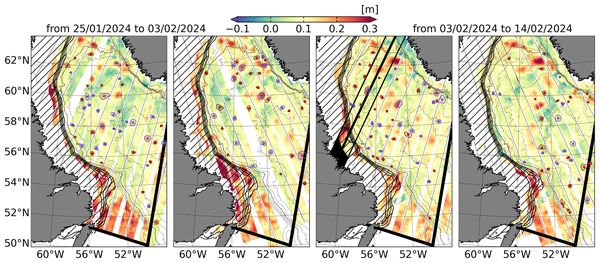
Charly de Marez, Arne Bendinger, and Ahmad Fehmi Dilmahamod
Ocean Sci., 22, 1515–1528, https://doi.org/10.5194/os-22-1515-2026, https://doi.org/10.5194/os-22-1515-2026, 2026
Short summary
Short summary
We use new observations from the Surface Water and Ocean Topography Mission (SWOT) satellite to reveal the structure of ocean eddies in the Labrador Sea at unprecedented resolution. By comparison with ship-based measurements, we show that SWOT reliably detects these features even at high latitudes, where conventional altimetry is limited. Our results provide the first detailed view of mesoscale eddies in the Labrador Sea and highlight SWOT's potential in polar regions.
Kristin Burmeister, Sam C. Jones, Neil J. Fraser, Alan D. Fox, Stuart A. Cunningham, Lewis A. Drysdale, Mark E. Inall, Tiago S. Dotto, and N. Penny Holliday
Ocean Sci., 22, 167–185, https://doi.org/10.5194/os-22-167-2026, https://doi.org/10.5194/os-22-167-2026, 2026
Short summary
Short summary
The Rockall Trough carries two ocean currents vital for Europe’s climate. Using underwater sensors and robotic gliders we develop a new method to create the first decade-long record of these flows. We find that the North Atlantic Current drives most changes linked to wider ocean shifts while the slope current responds mainly to local winds. This work improves ocean monitoring and advances our understanding of climate-related changes.
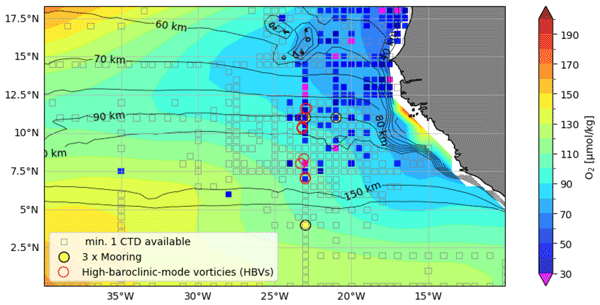
Florian Schütte, Johannes Hahn, Ivy Frenger, Arne Bendinger, Ahmad Fehmi Dilmahamod, Marco Schulz, and Peter Brandt
Ocean Sci., 22, 119–143, https://doi.org/10.5194/os-22-119-2026, https://doi.org/10.5194/os-22-119-2026, 2026
Short summary
Short summary
We found extreme drops in oxygen levels in the tropical Atlantic linked to surprisingly long-lived, small subsurface eddies. These eddies are hidden beneath the surface (undetectable by satellites) and are unusually stable, even in the highly dynamic ocean near the equator. Using long-term measurements and computer models, we show that these features can strongly influence oxygen supply and potentially impact marine ecosystems.
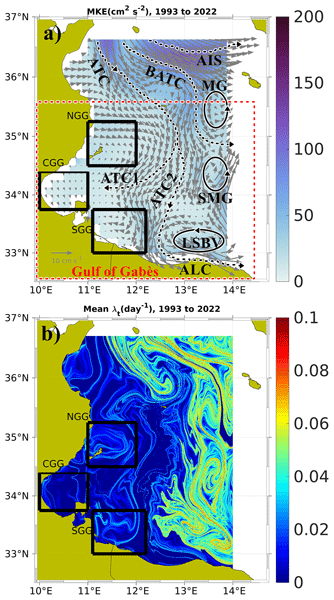
Maher Bouzaiene, Antonio Guarnieri, Damiano Delrosso, Ahmad F. Dilmahamod, Simona Simoncelli, and Claudia Fratianni
Ocean Sci., 21, 2643–2662, https://doi.org/10.5194/os-21-2643-2025, https://doi.org/10.5194/os-21-2643-2025, 2025
Short summary
Short summary
We analyze the geostrophic circulation and tidal effects in the Gulf of Gabès from 30 years of altimetry data (1993–2022) and the outputs of a high-resolution ocean model for the year 2022.

Donald A. Slater, Eleanor Johnstone, Martim Mas e Braga, Neil J. Fraser, Tom Cowton, and Mark Inall
Geosci. Model Dev., 18, 7475–7500, https://doi.org/10.5194/gmd-18-7475-2025, https://doi.org/10.5194/gmd-18-7475-2025, 2025
Short summary
Short summary
Glacial fjords connect ice sheets to the ocean, controlling heat delivery to glaciers, which impacts ice sheet melt, and freshwater discharge to the ocean, affecting ocean circulation. However, their dynamics are not captured in large-scale climate models. We designed a simplified, computationally efficient model – FjordRPM – that accurately captures key fjord processes. It has direct applications for improving projections of ice melt, ocean circulation, and sea level rise.
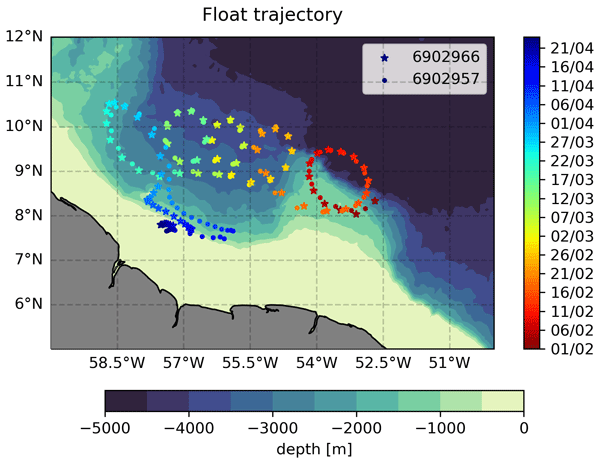
Yan Barabinot, Sabrina Speich, Xavier Carton, Pierre L'Hégaret, Corentin Subirade, Rémi Laxenaire, and Johannes Karstensen
Ocean Sci., 21, 1849–1872, https://doi.org/10.5194/os-21-1849-2025, https://doi.org/10.5194/os-21-1849-2025, 2025
Short summary
Short summary
Mesoscale eddies are rotating oceanic currents key to ocean variability. Off Brazil’s northeast coast, the North Brazil Current generates on average 4.5 eddies per year, which drift towards the West Indies, transporting waters from the Southern Hemisphere. Using data collected at sea by the EUREC4A-OA cruise, this study reveals that deep eddies transport 5 times more water than surface ones, reshaping our understanding of the regional water transport.
Alan D. Fox, Neil J. Fraser, and Stuart A. Cunningham
Ocean Sci., 21, 1735–1760, https://doi.org/10.5194/os-21-1735-2025, https://doi.org/10.5194/os-21-1735-2025, 2025
Short summary
Short summary
Understanding the seasonality of the overturning circulation is important for mitigating the impacts of Atlantic meridional overturning circulation (AMOC) changes on European weather and climate. We examine the seasonal cycle in various common measures of overturning and find each to be dominated by different processes, not necessarily reflective of the processes driving overturning. We advocate for the use of a density flux measure as a valuable addition to understanding AMOC.
Taavi Liblik, Daniel Rak, Enriko Siht, Germo Väli, Johannes Karstensen, Laura Tuomi, Louise C. Biddle, Madis-Jaak Lilover, Māris Skudra, Michael Naumann, Urmas Lips, and Volker Mohrholz
EGUsphere, https://doi.org/10.5194/egusphere-2024-2272, https://doi.org/10.5194/egusphere-2024-2272, 2024
Preprint archived
Short summary
Short summary
Eight current meters were deployed to the seafloor across the Baltic to enhance knowledge about circulation and currents. The experiment was complemented by autonomous vehicles. Stable circulation patterns were observed at the sea when weather was steady. Strong and quite persistent currents were observed at the key passage for the deep-water renewal of the Northern Baltic Sea. Deep water renewal mostly occurs during spring and summer periods in the northern Baltic Sea.
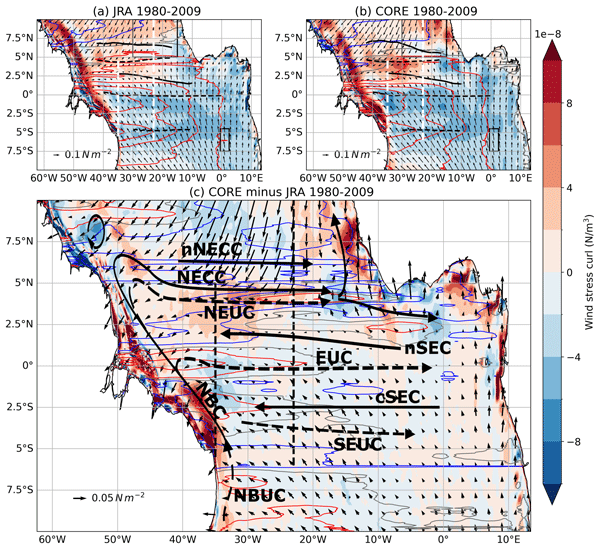
Kristin Burmeister, Franziska U. Schwarzkopf, Willi Rath, Arne Biastoch, Peter Brandt, Joke F. Lübbecke, and Mark Inall
Ocean Sci., 20, 307–339, https://doi.org/10.5194/os-20-307-2024, https://doi.org/10.5194/os-20-307-2024, 2024
Short summary
Short summary
We apply two different forcing products to a high-resolution ocean model to investigate their impact on the simulated upper-current field in the tropical Atlantic. Where possible, we compare the simulated results to long-term observations. We find large discrepancies between the two simulations regarding the wind and current fields. We propose that long-term observations, once they have reached a critical length, need to be used to test the quality of wind-driven simulations.
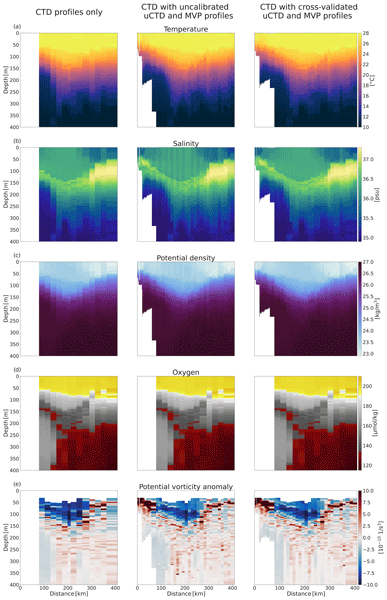
Pierre L'Hégaret, Florian Schütte, Sabrina Speich, Gilles Reverdin, Dariusz B. Baranowski, Rena Czeschel, Tim Fischer, Gregory R. Foltz, Karen J. Heywood, Gerd Krahmann, Rémi Laxenaire, Caroline Le Bihan, Philippe Le Bot, Stéphane Leizour, Callum Rollo, Michael Schlundt, Elizabeth Siddle, Corentin Subirade, Dongxiao Zhang, and Johannes Karstensen
Earth Syst. Sci. Data, 15, 1801–1830, https://doi.org/10.5194/essd-15-1801-2023, https://doi.org/10.5194/essd-15-1801-2023, 2023
Short summary
Short summary
In early 2020, the EUREC4A-OA/ATOMIC experiment took place in the northwestern Tropical Atlantic Ocean, a dynamical region where different water masses interact. Four oceanographic vessels and a fleet of autonomous devices were deployed to study the processes at play and sample the upper ocean, each with its own observing capability. The article first describes the data calibration and validation and second their cross-validation, using a hierarchy of instruments and estimating the uncertainty.
Sam C. Jones, Neil J. Fraser, Stuart A. Cunningham, Alan D. Fox, and Mark E. Inall
Ocean Sci., 19, 169–192, https://doi.org/10.5194/os-19-169-2023, https://doi.org/10.5194/os-19-169-2023, 2023
Short summary
Short summary
Warm water is transported from the tropical Atlantic towards western Europe and the Arctic. It loses heat to the atmosphere on the way, which strongly influences the climate. We construct a dataset encircling the North Atlantic basin north of 47° N. We calculate how and where heat enters and leaves the basin and how much cooling must happen in the interior. We find that cooling in the north-eastern Atlantic is a crucial step in controlling the conversion of water to higher densities.
Alan D. Fox, Patricia Handmann, Christina Schmidt, Neil Fraser, Siren Rühs, Alejandra Sanchez-Franks, Torge Martin, Marilena Oltmanns, Clare Johnson, Willi Rath, N. Penny Holliday, Arne Biastoch, Stuart A. Cunningham, and Igor Yashayaev
Ocean Sci., 18, 1507–1533, https://doi.org/10.5194/os-18-1507-2022, https://doi.org/10.5194/os-18-1507-2022, 2022
Short summary
Short summary
Observations of the eastern subpolar North Atlantic in the 2010s show exceptional freshening and cooling of the upper ocean, peaking in 2016 with the lowest salinities recorded for 120 years. Using results from a high-resolution ocean model, supported by observations, we propose that the leading cause is reduced surface cooling over the preceding decade in the Labrador Sea, leading to increased outflow of less dense water and so to freshening and cooling of the eastern subpolar North Atlantic.
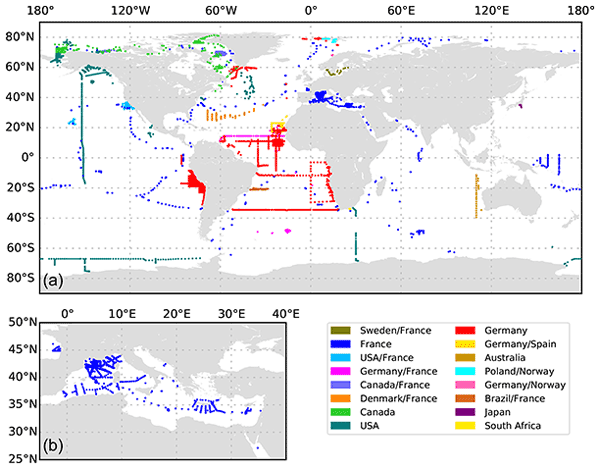
Rainer Kiko, Marc Picheral, David Antoine, Marcel Babin, Léo Berline, Tristan Biard, Emmanuel Boss, Peter Brandt, Francois Carlotti, Svenja Christiansen, Laurent Coppola, Leandro de la Cruz, Emilie Diamond-Riquier, Xavier Durrieu de Madron, Amanda Elineau, Gabriel Gorsky, Lionel Guidi, Helena Hauss, Jean-Olivier Irisson, Lee Karp-Boss, Johannes Karstensen, Dong-gyun Kim, Rachel M. Lekanoff, Fabien Lombard, Rubens M. Lopes, Claudie Marec, Andrew M. P. McDonnell, Daniela Niemeyer, Margaux Noyon, Stephanie H. O'Daly, Mark D. Ohman, Jessica L. Pretty, Andreas Rogge, Sarah Searson, Masashi Shibata, Yuji Tanaka, Toste Tanhua, Jan Taucher, Emilia Trudnowska, Jessica S. Turner, Anya Waite, and Lars Stemmann
Earth Syst. Sci. Data, 14, 4315–4337, https://doi.org/10.5194/essd-14-4315-2022, https://doi.org/10.5194/essd-14-4315-2022, 2022
Short summary
Short summary
The term
marine particlescomprises detrital aggregates; fecal pellets; bacterioplankton, phytoplankton and zooplankton; and even fish. Here, we present a global dataset that contains 8805 vertical particle size distribution profiles obtained with Underwater Vision Profiler 5 (UVP5) camera systems. These data are valuable to the scientific community, as they can be used to constrain important biogeochemical processes in the ocean, such as the flux of carbon to the deep sea.
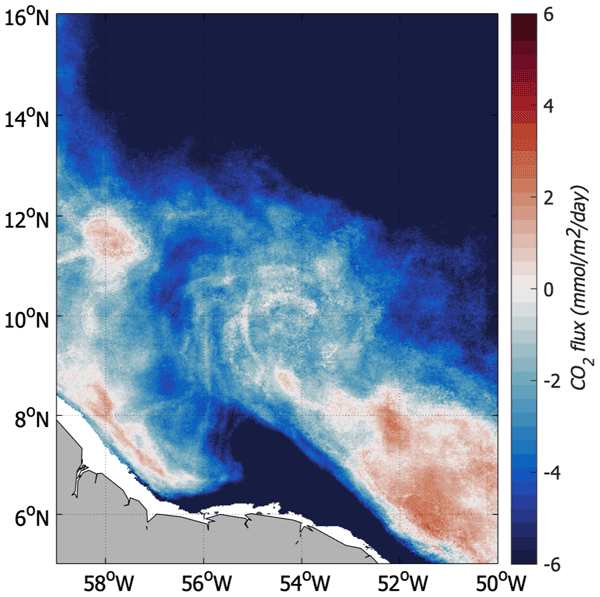
Léa Olivier, Jacqueline Boutin, Gilles Reverdin, Nathalie Lefèvre, Peter Landschützer, Sabrina Speich, Johannes Karstensen, Matthieu Labaste, Christophe Noisel, Markus Ritschel, Tobias Steinhoff, and Rik Wanninkhof
Biogeosciences, 19, 2969–2988, https://doi.org/10.5194/bg-19-2969-2022, https://doi.org/10.5194/bg-19-2969-2022, 2022
Short summary
Short summary
We investigate the impact of the interactions between eddies and the Amazon River plume on the CO2 air–sea fluxes to better characterize the ocean carbon sink in winter 2020. The region is a strong CO2 sink, previously underestimated by a factor of 10 due to a lack of data and understanding of the processes responsible for the variability in ocean carbon parameters. The CO2 absorption is mainly driven by freshwater from the Amazon entrained by eddies and by the winter seasonal cooling.
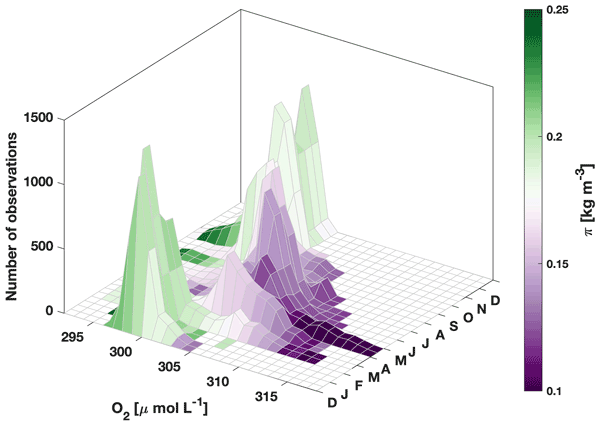
Jannes Koelling, Dariia Atamanchuk, Johannes Karstensen, Patricia Handmann, and Douglas W. R. Wallace
Biogeosciences, 19, 437–454, https://doi.org/10.5194/bg-19-437-2022, https://doi.org/10.5194/bg-19-437-2022, 2022
Short summary
Short summary
In this study, we investigate oxygen variability in the deep western boundary current in the Labrador Sea from multiyear moored records. We estimate that about half of the oxygen taken up in the interior Labrador Sea by air–sea gas exchange during deep water formation is exported southward the same year. Our results underline the complexity of the oxygen uptake and export in the Labrador Sea and highlight the important role this region plays in supplying oxygen to the deep ocean.
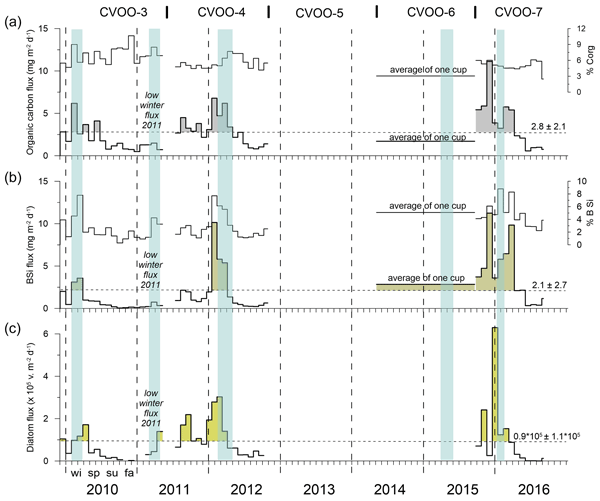
Gerhard Fischer, Oscar E. Romero, Johannes Karstensen, Karl-Heinz Baumann, Nasrollah Moradi, Morten Iversen, Götz Ruhland, Marco Klann, and Arne Körtzinger
Biogeosciences, 18, 6479–6500, https://doi.org/10.5194/bg-18-6479-2021, https://doi.org/10.5194/bg-18-6479-2021, 2021
Short summary
Short summary
Low-oxygen eddies in the eastern subtropical North Atlantic can form an oasis for phytoplankton growth. Here we report on particle flux dynamics at the oligotrophic Cape Verde Ocean Observatory. We observed consistent flux patterns during the passages of low-oxygen eddies. We found distinct flux peaks in late winter, clearly exceeding background fluxes. Our findings suggest that the low-oxygen eddies sequester higher organic carbon than expected for oligotrophic settings.
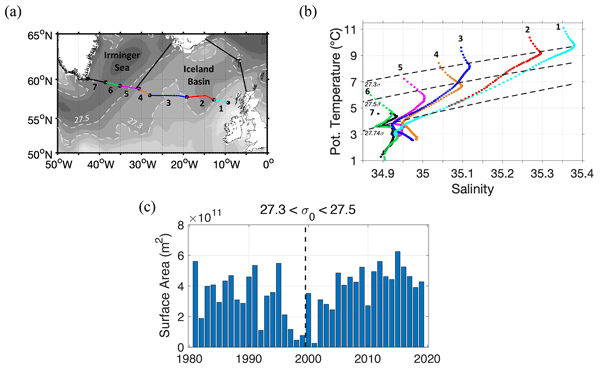
Tillys Petit, M. Susan Lozier, Simon A. Josey, and Stuart A. Cunningham
Ocean Sci., 17, 1353–1365, https://doi.org/10.5194/os-17-1353-2021, https://doi.org/10.5194/os-17-1353-2021, 2021
Short summary
Short summary
Recent work has highlighted the dominant role of the Irminger and Iceland basins in the production of North Atlantic Deep Water. From our analysis, we find that air–sea fluxes and the ocean surface density field are both key determinants of the buoyancy-driven transformation in the Iceland Basin. However, the spatial distribution of the subpolar mode water (SPMW) transformation is most sensitive to surface density changes as opposed to the direct influence of the air–sea fluxes.
Cited articles
Berglund, S., Döös, K., Groeskamp, S., and McDougall, T. J.: The downward spiralling nature of the North Atlantic Subtropical Gyre, Nat. Commun., 13, 2000, https://doi.org/10.1038/s41467-022-29607-8, 2022. a
Biastoch, A., Schwarzkopf, F. U., Getzlaff, K., Rühs, S., Martin, T., Scheinert, M., Schulzki, T., Handmann, P., Hummels, R., and Böning, C. W.: Regional imprints of changes in the Atlantic Meridional Overturning Circulation in the eddy-rich ocean model VIKING20X, Ocean Sci., 17, 1177–1211, https://doi.org/10.5194/os-17-1177-2021, 2021. a
Caesar, L., McCarthy, G. D., Thornalley, D. J., Cahill, N., and Rahmstorf, S.: Current Atlantic Meridional Overturning Circulation weakest in last millennium, Nat. Geosci., 14, https://doi.org/10.1038/s41561-021-00699-z, 2021. a, b, c
Copernicus Marine Service: Global Ocean Gridded L4 Sea Surface Heights and Derived Variables Reprocessed 1993–Ongoing, Copernicus Marine Service [data set], https://doi.org/10.48670/moi-00148 2025. a, b
Curry, R. G.: HYDROBASE : a database of hydrographic stations and tools for climatological analysis, Tech. rep., Woods Hole Oceanographic Institution [data set], https://doi.org/10.1575/1912/472, 1996. a
EU Copernicus Marine Service Information: Global Ocean Physics Reanalysis, EU Copernicus Marine Service Information [data set], https://doi.org/10.48670/moi-00021, 2023. a
Foukal, N. P. and Pickart, R. S.: Moored observations of the West Greenland coastal current along the Southwest Greenland Shelf, J. Phys. Oceanogr., 53, 2619–2632, https://doi.org/10.1175/JPO-D-23-0104.1, 2023. a, b
Fox, A. D., Handmann, P., Schmidt, C., Fraser, N., Rühs, S., Sanchez-Franks, A., Martin, T., Oltmanns, M., Johnson, C., Rath, W., Holliday, N. P., Biastoch, A., Cunningham, S. A., and Yashayaev, I.: Exceptional freshening and cooling in the eastern subpolar North Atlantic caused by reduced Labrador Sea surface heat loss, Ocean Sci., 18, 1507–1533, https://doi.org/10.5194/os-18-1507-2022, 2022. a
Fraser, N. J., Cunningham, S. A., Drysdale, L. A., Inall, M. E., Johnson, C., Jones, S. C., Burmeister, K., Fox, A. D., Dumont, E., Porter, M., and Holliday, N. P.: North Atlantic current and European slope current circulation in the Rockall Trough observed using moorings and gliders, J. Geophys. Res.-Oceans, 127, e2022JC019291, https://doi.org/10.1029/2022JC019291, 2022. a
Fu, Y., Li, F., Karstensen, J., and Wang, C.: A stable Atlantic Meridional Overturning Circulation in a changing North Atlantic Ocean since the 1990s, Science Advances, 6, eabc7836, https://doi.org/10.1126/sciadv.abc7836, 2020. a
Fu, Y., Lozier, M. S., Biló, T. C., Bower, A. S., Cunningham, S. A., Cyr, F., de Jong, M. F., deYoung, B., Drysdale, L., Fraser, N., Fried, N., Furey, H. H., Han, G., Handmann, P., Holliday, N. P., Holte, J., Inall, M. E., Johns, W. E., Jones, S., Karstensen, J., Li, F., Pacini, A., Pickart, R. S., Rayner, D., Straneo, F., and Yashayaev, I.: Seasonality of the Meridional Overturning Circulation in the subpolar North Atlantic, Communications Earth and Environment, 4, 1–13, https://doi.org/10.1038/s43247-023-00848-9, 2023a. a, b, c, d
Fu, Y., Lozier, M. S., Biló, T. C., Bower, A. S., Cunningham, S. A., Cyr, F., de Jong, M. F., deYoung, B., Drysdale, L., Fraser, N., Fried, N., Furey, H. H., Han, G., Handmann, P., Holliday, N. P., Holte, J., Inall, M. E., Johns, W. E., Jones, S., Karstensen, J., Li, F., Pacini, A., Pickart, R. S., Rayner, D., Straneo, F., and Yashayaev, I.: Meridional Overturning Circulation Observed by the Overturning in the Subpolar North Atlantic Program (OSNAP) Array from August 2014 to June 2020, GT Library [data set], https://doi.org/10.35090/gatech/70342, 2023b. a
Fu, Y., Lozier, M. S., Bower, A., Burmeister, K., Carrilho Biló, T., Cyr, F., Cunningham, S. A., deYoung, B., Dilmahamod, A. F., de Jong, M. F., Fried, N., Holliday, N. P., Fraser, N. J., Johns, W. E., Li, F., Karstensen, J., Pickart, R. S., Straneo, F., and Yashayaev, I.: Characterizing the interannual variability of North Atlantic subpolar overturning, Geophys. Res. Lett., 52, e2025GL114672, https://doi.org/10.1029/2025GL114672, 2025. a, b
Getzlaff, K. and Schwarzkopf, F. U.: VIKING20X-JRA-short: daily to multi-decadal ocean dynamics under JRA55-do atmospheric forcing, World Data Center for Climate (WDCC) at DKRZ [data set], https://doi.org/10.26050/WDCC/VIKING20XJRAshort, 2024. a, b
Hersbach, H., Bell, B., Berrisford, P., Hirahara, S., Horányi, A., Muñoz-Sabater, J., Nicolas, J., Peubey, C., Radu, R., Schepers, D., Simmons, A., Soci, C., Abdalla, S., Abellan, X., Balsamo, G., Bechtold, P., Biavati, G., Bidlot, J., Bonavita, M., De Chiara, G., Dahlgren, P., Dee, D., Diamantakis, M., Dragani, R., Flemming, J., Forbes, R., Fuentes, M., Geer, A., Haimberger, L., Healy, S., Hogan, R. J., Hólm, E., Janisková, M., Keeley, S., Laloyaux, P., Lopez, P., Lupu, C., Radnoti, G., de Rosnay, P., Rozum, I., Vamborg, F., Villaume, S., and Thépaut, J.-N.: The ERA5 global reanalysis, Q. J. Roy. Meteor. Soc., 146, 1999–2049, https://doi.org/10.1002/qj.3803, 2020. a
Hersbach, H., Bell, B., Berrisford, P., Biavati, G., Horányi, A., Muñoz-Sabater, J., Nicolas, J., Peubey, C., Radu, R., Rozum, I., Schepers, D., Simmons, A., Soci, C., Dee, D., and Thépaut, J.-N.: ERA5 monthly averaged data on single levels from 1940 to present, Copernicus Climate Change Service (C3S) Climate Data Store (CDS) [data set], https://doi.org/10.24381/cds.f17050d7, 2023. a, b
Jackett, D. R. and McDougall, T. J.: A neutral density variable for the world's oceans, J. Phys. Oceanogr., 27, 237–263, https://doi.org/10.1175/1520-0485(1997)027<0237:ANDVFT>2.0.CO;2, 1997. a, b
Johns, W. E., Kanzow, T., and Zantopp, R.: Estimating ocean transports with dynamic height moorings: an application in the Atlantic Deep Western Boundary Current at 26°N, Deep-Sea Res. Pt. I, 52, 1542–1567, https://doi.org/10.1016/j.dsr.2005.02.002, 2005. a, b
Jones, S. C., Fraser, N. J., Cunningham, S. A., Fox, A. D., and Inall, M. E.: Observation-based estimates of volume, heat, and freshwater exchanges between the subpolar North Atlantic interior, its boundary currents, and the atmosphere, Ocean Sci., 19, 169–192, https://doi.org/10.5194/os-19-169-2023, 2023. a
Jones, S. C., Fox, A., Burmeister, K., and Fraser, N.: Code/data used in the production of Fox et al. 2026. “The Scotland-Canada overturning array (SCOTIA): twenty years of meridional overturning in the subpolar North Atlantic”. In Ocean Science, Zenodo [code and data set], https://doi.org/10.5281/zenodo.19682610, 2026. a
Kanzow, T., Cunningham, S. A., Johns, W. E., Hirschi, J. J.-M., Marotzke, J., Baringer, M. O., Meinen, C. S., Chidichimo, M. P., Atkinson, C., Beal, L. M., Bryden, H. L., and Collins, J.: Seasonal variability of the Atlantic Meridional Overturning Circulation at 26.5°N, J. Climate, 23, 5678–5698, https://doi.org/10.1175/2010JCLI3389.1, 2010. a
Koman, G., Bower, A. S., Holliday, N. P., Furey, H. H., Fu, Y., and Biló, T. C.: Observed decrease in Deep Western Boundary Current transport in subpolar North Atlantic, Nat. Geosci., 17, 1148–1153, https://doi.org/10.1038/s41561-024-01555-6, 2024. a, b
Le Bras, I. A.-A., Straneo, F., Holte, J., and Holliday, N. P.: Seasonality of freshwater in the East Greenland current system from 2014 to 2016, J. Geophys. Res.-Oceans, 123, 8828–8848, https://doi.org/10.1029/2018JC014511, 2018. a
Lellouche, J.-M., Greiner, E., Bourdallé-Badie, R., Garric, G., Melet, A., Drévillon, M., Bricaud, C., Hamon, M., Le Galloudec, O., Regnier, C., Candela, T., Testut, C.-E., Gasparin, F., Ruggiero, G., Benkiran, M., Drillet, Y., and Le Traon, P.-Y.: The Copernicus global
Li, F., Lozier, M. S., Bacon, S., Bower, A. S., Cunningham, S. A., de Jong, M. F., deYoung, B., Fraser, N., Fried, N., Han, G., Holliday, N. P., Holte, J., Houpert, L., Inall, M. E., Johns, W. E., Jones, S., Johnson, C., Karstensen, J., Bras, I. A. L., Lherminier, P., Lin, X., Mercier, H., Oltmanns, M., Pacini, A., Petit, T., Pickart, R. S., Rayner, D., Straneo, F., Thierry, V., Visbeck, M., Yashayaev, I., and Zhou, C.: Subpolar North Atlantic western boundary density anomalies and the Meridional Overturning Circulation, Nat. Commun., 12, https://doi.org/10.1038/s41467-021-23350-2, 2021. a, b
Liu, M. and Tanhua, T.: Water masses in the Atlantic Ocean: characteristics and distributions, Ocean Sci., 17, 463–486, https://doi.org/10.5194/os-17-463-2021, 2021. a, b
Lobelle, D., Beaulieu, C., Livina, V., Sévellec, F., and Frajka-Williams, E.: Detectability of an AMOC decline in current and projected climate changes, Geophys. Res. Lett., 47, e2020GL089974, https://doi.org/10.1029/2020GL089974, 2020. a
Lozier, M. S., Li, F., Bacon, S., Bahr, F., Bower, A. S., Cunningham, S. A., de Jong, M. F., de Steur, L., DeYoung, B., Fischer, J., Gary, S. F., Greenan, B. J. W., Holliday, N. P., Houk, A., Houpert, L., Inall, M. E., Johns, W. E., Johnson, H. L., Johnson, C., Karstensen, J., Koman, G., Le Bras, I. A., Lin, X., Mackay, N., Marshall, D. P., Mercier, H., Oltmanns, M., Pickart, R. S., Ramsey, A. L., Rayner, D., Straneo, F., Thierry, V., Torres, D. J., Williams, R. G., Wilson, C., Yang, J., Yashayaev, I., and Zhao, J.: A sea change in our view of overturning in the subpolar North Atlantic, Science, 363, 516+, https://doi.org/10.1126/science.aau6592, 2019. a, b, c, d
Lozier, M. S., Bower, A. S., Furey, H. H., Drouin, K. L., Xu, X., and Zou, S.: Overflow water pathways in the North Atlantic, Prog. Oceanogr., 208, 102874, https://doi.org/10.1016/j.pocean.2022.102874, 2022. a, b
McCarthy, G. D. and Caesar, L.: Can we trust projections of AMOC weakening based on climate models that cannot reproduce the past?, Philos. T. Roy. Soc. A, 381, 20220193, https://doi.org/10.1098/rsta.2022.0193, 2023. a
McCarthy, G. D., Smeed, D. A., Johns, W. E., Frajka-Williams, E., Moat, B. I., Rayner, D., Baringer, M. O., Meinen, C. S., Collins, J., and Bryden, H. L.: Measuring the Atlantic Meridional Overturning Circulation at 26°N, Prog. Oceanogr., 130, 91–111, https://doi.org/10.1016/j.pocean.2014.10.006, 2015. a, b
McCarthy, G. D., Hug, G., Smeed, D., Morris, K. J., and Moat, B.: Signal and noise in the Atlantic Meridional Overturning Circulation at 26°N, Geophys. Res. Lett., 52, e2025GL115055, https://doi.org/10.1029/2025GL115055, 2025. a, b
Moat, B. I., Smeed, D., Rayner, D., Johns, W. E., Smith, R. H., Volkov, D. L., Elipot, S., Petit, T., Kajtar, J. B., Baringer, M. O., and Collins, J.: Atlantic meridional overturning circulation observed by the RAPID-MOCHA-WBTS array at 26N from 2004 to 2024 (v2024.1), nERC EDS British Oceanographic Data Centre NOC [data set], https://doi.org/10.5285/3f24651e-2d44-dee3-e063-7086abc0395e, 2025. a
Nurser, A. J., Marsh, R., and Williams, R. G.: Diagnosing water mass formation from air-sea fluxes and surface mixing, J. Phys. Oceanogr., 29, 1468–1487, https://doi.org/10.1175/1520-0485(1999)029<1468:DWMFFA>2.0.CO;2, 1999. a
Pacini, A., Pickart, R. S., Bahr, F., Torres, D. J., Ramsey, A. L., Holte, J., Karstensen, J., Oltmanns, M., Straneo, F., Bras, I. A. L., Moore, G. W. K., and de Jong, M. F.: Mean conditions and seasonality of the West Greenland Boundary Current System near Cape Farewell, J. Phys. Oceanogr., 50, 2849–2871, https://doi.org/10.1175/JPO-D-20-0086.1, 2020. a, b
Petit, T., Robson, J., Ferreira, D., Yeager, S., and Evans, D. G.: Coherence of the AMOC over the subpolar North Atlantic on interannual to multiannual time scales, Geophys. Res. Lett., 52, e2025GL115171, https://doi.org/10.1029/2025GL115171, 2025. a, b
Smeed, D. A., McCarthy, G. D., Cunningham, S. A., Frajka-Williams, E., Rayner, D., Johns, W. E., Meinen, C. S., Baringer, M. O., Moat, B. I., Duchez, A., and Bryden, H. L.: Observed decline of the Atlantic meridional overturning circulation 2004–2012, Ocean Sci., 10, 29–38, https://doi.org/10.5194/os-10-29-2014, 2014. a, b, c
Smeed, D. A., Josey, S. A., Beaulieu, C., Johns, W. E., Moat, B. I., Frajka-Williams, E., Rayner, D., Meinen, C. S., Baringer, M. O., Bryden, H. L., and McCarthy, G. D.: The North Atlantic ocean is in a state of reduced overturning, Geophys. Res. Lett., 45, 1527–1533, https://doi.org/10.1002/2017GL076350, 2018. a, b
Smeed, D. A., Johns, W. E., Smith, R. H., Petit, T., McDonagh, E. L., Rayner, D., Volkov, D. L., Elipot, S., Kajtar, J. B., King, B. A., Firing, Y. L., and Moat, B. I.: Overturning circulation of the North Atlantic subtropical gyre computed in density coordinates at 26°N, Geophys. Res. Lett., 53, e2025GL118277, https://doi.org/10.1029/2025GL118277, 2026. a, b
Speer, K. and Tziperman, E.: Rates of water mass formation in the North Atlantic ocean, J. Phys. Oceanogr., 22, 93–104, https://doi.org/10.1175/1520-0485(1992)022<0093:rowmfi>2.0.co;2, 1992. a
Stommel, H.: Thermohaline convection with two stable regimes of flow, Tellus, 13, 224–230, https://doi.org/10.3402/tellusa.v13i2.9491, 1961. a
Sun, Y., Pickart, R. S., Lin, P., Pacini, A., Macrander, A., Larsen, K.-M. H., Hátún, H., Frajka-Williams, E., Lan, J., and Dilmahamod, A. F.: Reduced transport of overflow water in the West Greenland Boundary Current System: the role of upstream entrainment, J. Phys. Oceanogr., 55, 2119–2139, https://doi.org/10.1175/JPO-D-25-0024.1, 2025. a, b
Tooth, O. J., Johnson, H. L., Wilson, C., and Evans, D. G.: Seasonal overturning variability in the eastern North Atlantic subpolar gyre: a Lagrangian perspective, Ocean Sci., 19, 769–791, https://doi.org/10.5194/os-19-769-2023, 2023. a
Tooth, O. J., Foukal, N. P., Johns, W. E., Johnson, H. L., and Wilson, C.: Lagrangian decomposition of the Atlantic ocean heat transport at 26.5°N, Geophys. Res. Lett., 51, e2023GL107399, https://doi.org/10.1029/2023GL107399, 2024. a
Tziperman, E.: On the role of interior mixing and air-sea fluxes in determining the stratification and circulation of the oceans, J. Phys. Oceanogr., 16, 680–693, https://doi.org/10.1175/1520-0485(1986)016<0680:OTROIM>2.0.CO;2, 1986. a
van Westen, R. M. and Baatsen, M. L. J.: European temperature extremes under different AMOC scenarios in the community Earth system model, Geophys. Res. Lett., 52, https://doi.org/10.1029/2025GL114611, 2025. a
Weijer, W., Cheng, W., Garuba, O. A., Hu, A., and Nadiga, B. T.: CMIP6 models predict significant 21st century decline of the Atlantic Meridional Overturning Circulation, Geophys. Res. Lett., 47, https://doi.org/10.1029/2019gl086075, 2020. a, b, c
Yeager, S., Castruccio, F., Chang, P., Danabasoglu, G., Maroon, E., Small, J., Wang, H., Wu, L., and Zhang, S.: An outsized role for the Labrador Sea in the multidecadal variability of the Atlantic overturning circulation, Science Advances, 7, eabh3592, https://doi.org/10.1126/sciadv.abh3592, 2021. a
Zantopp, R., Fischer, J., Visbeck, M., and Karstensen, J.: From interannual to decadal: 17 years of boundary current transports at the exit of the Labrador Sea, J. Geophys. Res.-Oceans, 122, 1724–1748, https://doi.org/10.1002/2016JC012271, 2017. a
Editorial statement
There is growing evidence that the Atlantic meridional overturning circulation (AMOC) is on course to reach a tipping point, a prospect that is increasingly shaping scientific, policy, and media discourse. Here, the authors double the length of the observed AMOC record in the North Atlantic subpolar gyre to cover 2004-2024. They find that the subpolar AMOC exhibited no weakening trend in that time. The methodology could provide a blueprint for a lightweight, reliable and sustainable subpolar AMOC observing system for the coming decades.
There is growing evidence that the Atlantic meridional overturning circulation (AMOC) is on...
Short summary
The Atlantic ocean circulation that helps regulate climate is expected to weaken this century. Long-term measurements in the subtropics now show signs of weakening, but northern data are shorter and more variable. By combining several observing systems, we reconstructed northern circulation since 2004 and found strong ups and downs, but no clear long-term weakening so far.
The Atlantic ocean circulation that helps regulate climate is expected to weaken this century....


