Articles | Volume 22, issue 1
https://doi.org/10.5194/os-22-727-2026
© Author(s) 2026. This work is distributed under
the Creative Commons Attribution 4.0 License.
https://doi.org/10.5194/os-22-727-2026
© Author(s) 2026. This work is distributed under
the Creative Commons Attribution 4.0 License.
Horizontal transport on the continental shelf driven by periodic rotary wind stress
Nathan Paldor
CORRESPONDING AUTHOR
Fredy and Nadine Herrmann Institute of Earth Sciences, Hebrew University of Jerusalem, 91904 Jerusalem, Israel
Lazar Friedland
Racah Institute of Physics, Hebrew University of Jerusalem, 91904 Jerusalem, Israel
Related authors
Itamar Yacoby, Hezi Gildor, and Nathan Paldor
Ocean Sci., 21, 2805–2828, https://doi.org/10.5194/os-21-2805-2025, https://doi.org/10.5194/os-21-2805-2025, 2025
Short summary
Short summary
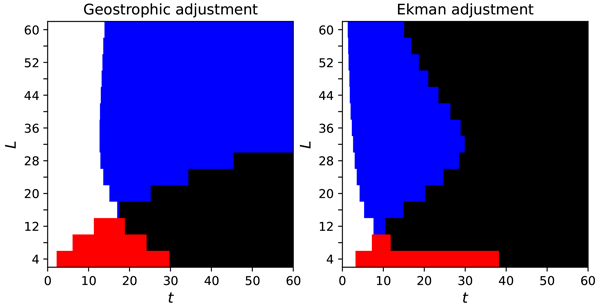
The paper examines the applicability of known linear wave theories to numerical simulations of two, zonally invariant, fundamental problems of Physical Oceanography: Geostrophic adjustment and Ekman Adjustment. By simulating the problems with a modified version of the Massachusetts Institute of Technology General Circulation Model (MITgcm) we show that neither of the known wave theories can explain the results of the simulations in large and small meridional domains and for long and short times.
Nathan Paldor and Yair De-Leon
Ocean Sci., 21, 1461–1468, https://doi.org/10.5194/os-21-1461-2025, https://doi.org/10.5194/os-21-1461-2025, 2025
Short summary
Short summary
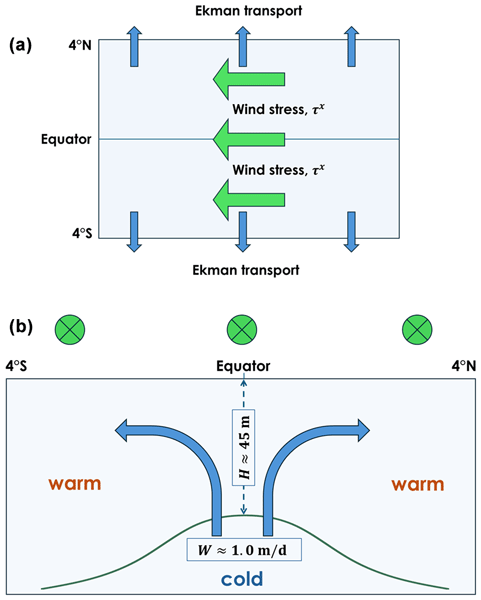
The study combines archived surface drifter trajectories along the Equator with a novel extension of Ekman's wind-driven theory to the equatorial β-plane in order to estimate the depth of the equatorial Ekman layer and the speed of upwelling into it. The analysis provides a direct estimate of the depth of the equatorial Ekman layer based on observed drifter trajectories and does not involve the 3D continuity equation, which is only used for estimating the upwelling speed.
Itamar Yacoby, Nathan Paldor, and Hezi Gildor
Ocean Sci., 19, 1163–1181, https://doi.org/10.5194/os-19-1163-2023, https://doi.org/10.5194/os-19-1163-2023, 2023
Short summary
Short summary
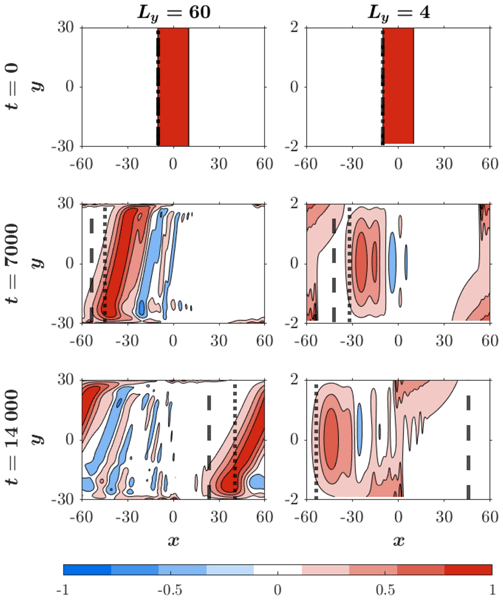
The transition from an arbitrary initial sea surface height to a geostrophic balance in which the velocity is steady was solved last century for constant Coriolis frequency, f(y), where y is the latitude. This study extends the theory to the realistic case in which f(y) is linear with y. We find that the variation in f(y) translates the steady geostrophic state westward as low-frequency Rossby waves that are harmonic in narrow domains and trapped near the equatorward boundary in wide ones.
Itamar Yacoby, Hezi Gildor, and Nathan Paldor
Ocean Sci., 21, 2805–2828, https://doi.org/10.5194/os-21-2805-2025, https://doi.org/10.5194/os-21-2805-2025, 2025
Short summary
Short summary
The paper examines the applicability of known linear wave theories to numerical simulations of two, zonally invariant, fundamental problems of Physical Oceanography: Geostrophic adjustment and Ekman Adjustment. By simulating the problems with a modified version of the Massachusetts Institute of Technology General Circulation Model (MITgcm) we show that neither of the known wave theories can explain the results of the simulations in large and small meridional domains and for long and short times.
Nathan Paldor and Yair De-Leon
Ocean Sci., 21, 1461–1468, https://doi.org/10.5194/os-21-1461-2025, https://doi.org/10.5194/os-21-1461-2025, 2025
Short summary
Short summary
The study combines archived surface drifter trajectories along the Equator with a novel extension of Ekman's wind-driven theory to the equatorial β-plane in order to estimate the depth of the equatorial Ekman layer and the speed of upwelling into it. The analysis provides a direct estimate of the depth of the equatorial Ekman layer based on observed drifter trajectories and does not involve the 3D continuity equation, which is only used for estimating the upwelling speed.
Itamar Yacoby, Nathan Paldor, and Hezi Gildor
Ocean Sci., 19, 1163–1181, https://doi.org/10.5194/os-19-1163-2023, https://doi.org/10.5194/os-19-1163-2023, 2023
Short summary
Short summary
The transition from an arbitrary initial sea surface height to a geostrophic balance in which the velocity is steady was solved last century for constant Coriolis frequency, f(y), where y is the latitude. This study extends the theory to the realistic case in which f(y) is linear with y. We find that the variation in f(y) translates the steady geostrophic state westward as low-frequency Rossby waves that are harmonic in narrow domains and trapped near the equatorward boundary in wide ones.
Nathan Paldor and Lazar Friedland
Ocean Sci., 19, 93–100, https://doi.org/10.5194/os-19-93-2023, https://doi.org/10.5194/os-19-93-2023, 2023
Short summary
Short summary
Mean surface transport forced by wind blowing over an ocean can assume many directions relative to the wind direction and does not have to be perpendicular to the direction of the wind. This is in contrast to a simpler 120-year-old theory that completely ignored Earth's sphericity and predicted that the mean ocean current should always be perpendicular to the direction of the overlying wind. In the new theory the direction of the mean current is determined by the values of several parameters.
Cited articles
Allen, J. and Smith, R.: On the dynamics of wind-driven shelf currents, Philos. T. Roy. Soc. Lond. A, 302, 617–634, 1981. a
Almeida, L., Mazloff, M. R., and Mata, M. M.: The Impact of Southern Ocean Ekman Pumping, Heat and Freshwater Flux Variability on Intermediate and Mode Water Export in CMIP Models: Present and Future Scenarios, J. Geophys. Res.-Oceans, 126, e2021JC017173, https://doi.org/10.1029/2021JC017173, 2021. a
Bennett, A.: Lagrangian fluid dynamics, Cambridge University Press, https://doi.org/10.1017/CBO9780511734939, 2006. a, b
Craig, P. D.: Constant-eddy-viscosity models of vertical structure forced by periodic winds, Cont. Shelf Res., 9, 343–358, 1989. a
Ekman, V. W.: On the influence of the earth's rotation on ocean-currents, Ark. Mat. Astr. Fys., 2, 1–52, 1905. a
Gonella, J.: A rotary-component method for analysing meteorological and oceanographic vector time series, Deep-Sea Res. Oceanogr. Abstr., 19, 833–846, 1972. a
Lentz, S. J. and Fewings, M. R.: The wind-and wave-driven inner-shelf circulation, Annu. Rev. Mar. Sci., 4, 317–343, 2012. a
Liu, X. and Zhou, H.: Seasonal Variations of the North Equatorial Current Across the Pacific Ocean, J.Geophys. Res.-Oceans, 125, e2019JC015895, https://doi.org/10.1029/2019JC015895, 2020. a
Loder, J. W.: Topographic rectification of tidal currents on the sides of Georges Bank, J. Phys. Oceanogr., 10, 1399–1416, 1980. a
Paldor, N.: Inertial particle dynamics on the rotating Earth, in: Chap. 5, Cambridge University Press, 119–135, https://doi.org/10.1017/CBO9780511535901.006, 2007. a
Paldor, N.: A Lagrangian theory of equatorial upwelling, Phys. Fluids, 36, 046605, https://doi.org/10.1063/5.0202412, 2024. a, b, c
Paldor, N.: Time-dependent transport on the continental shelf driven by steady winds, Phys. Fluids, 37, https://doi.org/10.1111/j.1600-0870.2006.00170.x, 2025. a, b, c, d
Paldor, N. and Friedland, L.: Extension of Ekman (1905) wind-driven transport theory to the β plane, Ocean Sci., 19, 93–100, https://doi.org/10.5194/os-19-93-2023, 2023a. a, b, c
Paldor, N. and Friedland, L.: Wind-driven transport on the rotating spherical Earth, Phys. Fluids, 35, 056604, https://doi.org/10.1063/5.0151488, 2023b. a
Paldor, N. and Killworth, P. D.: Inertial trajectories on a rotating earth, J. Atmos. Sci., 45, 4013–4019, 1988. a
Pedlosky, J.: Geophysical fluid dynamics, Springer Science & Business Media, ISBN 978-0387963877, 2013. a
Rom-Kedar, V., Dvorkin, Y., and Paldor, N.: Chaotic Hamiltonian dynamics of particle's horizontal motion in the atmosphere, Physica D, 106, 389–431, https://doi.org/10.1016/S0167-2789(97)00015-8, 1997. a
Vallis, G. K.: Atmospheric and oceanic fluid dynamics, Cambridge University Press, https://doi.org/10.1017/9781107588417, 2017. a, b, c, d
Vinayachandran, P. N. M., Masumoto, Y., Roberts, M. J., Huggett, J. A., Halo, I., Chatterjee, A., Amol, P., Gupta, G. V. M., Singh, A., Mukherjee, A., Prakash, S., Beckley, L. E., Raes, E. J., and Hood, R.: Reviews and syntheses: Physical and biogeochemical processes associated with upwelling in the Indian Ocean, Biogeosciences, 18, 5967–6029, https://doi.org/10.5194/bg-18-5967-2021, 2021. a
Weller, R. A.: Observations of the velocity response to wind forcing in the upper ocean, J. Geophys. Res.-Oceans, 86, 1969–1977, https://doi.org/10.1029/JC086iC03p01969, 1981. a
Short summary
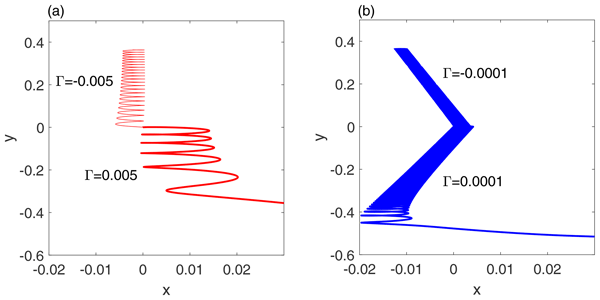
The work develops a Lagrangian theory of the transport on the continental shelf forced by periodically rotating wind driven. A strong resonance occurs when the wind stress rotates counterclockwise at the local Coriolis frequency, manifested in a fast longshore drift. For clockwise sub-inertial wind rotation the drift is directed with the coast to its right while in all other frequencies the drift is directed with the coast to its left.
The work develops a Lagrangian theory of the transport on the continental shelf forced by...