
Articles | Volume 22, issue 1
https://doi.org/10.5194/os-22-281-2026
© Author(s) 2026. This work is distributed under
the Creative Commons Attribution 4.0 License.
the Creative Commons Attribution 4.0 License.
https://doi.org/10.5194/os-22-281-2026
© Author(s) 2026. This work is distributed under
the Creative Commons Attribution 4.0 License.
the Creative Commons Attribution 4.0 License.
Research article
| 
23 Jan 2026
Research article |
| 23 Jan 2026
| 23 Jan 2026
Impact of assimilated observations on the Corsica Channel transport in a 4D-Var system for the northwestern Mediterranean Sea

CNR-ISMAR, 19032 Lerici (Sp), Italy
Andrew Michael Moore
Department of Ocean Sciences, University of California, 95062 Santa Cruz, CA, USA
Roberta Sciascia
CNR-ISMAR, 19032 Lerici (Sp), Italy
Carlo Brandini
CNR-ISMAR, 50019 Sesto Fiorentino (Fi), Italy
Katrin Schroeder
CNR-ISMAR, 30122 Venezia (Ve), Italy
Mireno Borghini
CNR-ISMAR, 19032 Lerici (Sp), Italy
Marcello Gatimu Magaldi
CNR-ISMAR, 19032 Lerici (Sp), Italy
Related authors
Michele Bendoni, Francesca Caparrini, Andrea Cucco, Stefano Taddei, Iulia Anton, Roberta Paranunzio, Rossella Mocali, Massimo Perna, Michele Sacco, Giovanni Vitale, Manuela Corongiu, Alberto Ortolani, Salem Gharbia, and Carlo Brandini
Nat. Hazards Earth Syst. Sci., 26, 709–731, https://doi.org/10.5194/nhess-26-709-2026, https://doi.org/10.5194/nhess-26-709-2026, 2026
Short summary
Short summary
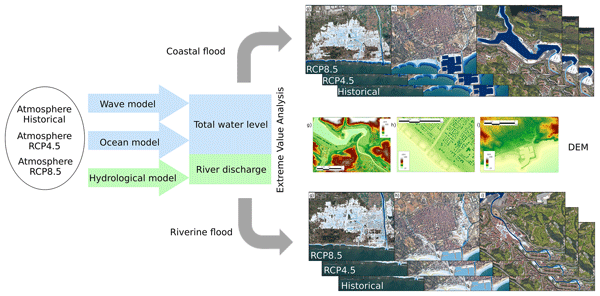
We studied how future climate scenarios may affect flooding in three European coastal cities. Using atmospheric data and an integrated modeling framework, we simulated extreme storm surges, waves, and river discharges at high urban resolution (up to 2 m). Flood trends are driven by local geomorphic features, sea-level rise, and storm intensity changes, providing insights for adaptation strategies.
Emma Reyes, Eva Aguiar, Michele Bendoni, Maristella Berta, Carlo Brandini, Alejandro Cáceres-Euse, Fulvio Capodici, Vanessa Cardin, Daniela Cianelli, Giuseppe Ciraolo, Lorenzo Corgnati, Vlado Dadić, Bartolomeo Doronzo, Aldo Drago, Dylan Dumas, Pierpaolo Falco, Maria Fattorini, Maria J. Fernandes, Adam Gauci, Roberto Gómez, Annalisa Griffa, Charles-Antoine Guérin, Ismael Hernández-Carrasco, Jaime Hernández-Lasheras, Matjaž Ličer, Pablo Lorente, Marcello G. Magaldi, Carlo Mantovani, Hrvoje Mihanović, Anne Molcard, Baptiste Mourre, Adèle Révelard, Catalina Reyes-Suárez, Simona Saviano, Roberta Sciascia, Stefano Taddei, Joaquín Tintoré, Yaron Toledo, Marco Uttieri, Ivica Vilibić, Enrico Zambianchi, and Alejandro Orfila
Ocean Sci., 18, 797–837, https://doi.org/10.5194/os-18-797-2022, https://doi.org/10.5194/os-18-797-2022, 2022
Short summary
Short summary
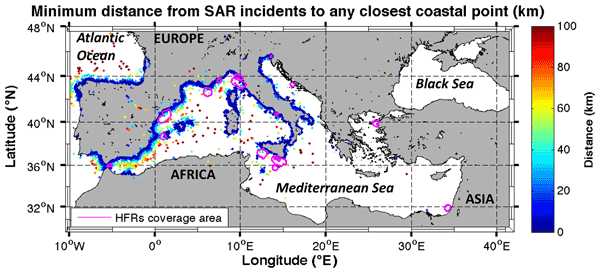
This work reviews the existing advanced and emerging scientific and societal applications using HFR data, developed to address the major challenges identified in Mediterranean coastal waters organized around three main topics: maritime safety, extreme hazards and environmental transport processes. It also includes a discussion and preliminary assessment of the capabilities of existing HFR applications, finally providing a set of recommendations towards setting out future prospects.
Pablo Lorente, Eva Aguiar, Michele Bendoni, Maristella Berta, Carlo Brandini, Alejandro Cáceres-Euse, Fulvio Capodici, Daniela Cianelli, Giuseppe Ciraolo, Lorenzo Corgnati, Vlado Dadić, Bartolomeo Doronzo, Aldo Drago, Dylan Dumas, Pierpaolo Falco, Maria Fattorini, Adam Gauci, Roberto Gómez, Annalisa Griffa, Charles-Antoine Guérin, Ismael Hernández-Carrasco, Jaime Hernández-Lasheras, Matjaž Ličer, Marcello G. Magaldi, Carlo Mantovani, Hrvoje Mihanović, Anne Molcard, Baptiste Mourre, Alejandro Orfila, Adèle Révelard, Emma Reyes, Jorge Sánchez, Simona Saviano, Roberta Sciascia, Stefano Taddei, Joaquín Tintoré, Yaron Toledo, Laura Ursella, Marco Uttieri, Ivica Vilibić, Enrico Zambianchi, and Vanessa Cardin
Ocean Sci., 18, 761–795, https://doi.org/10.5194/os-18-761-2022, https://doi.org/10.5194/os-18-761-2022, 2022
Short summary
Short summary
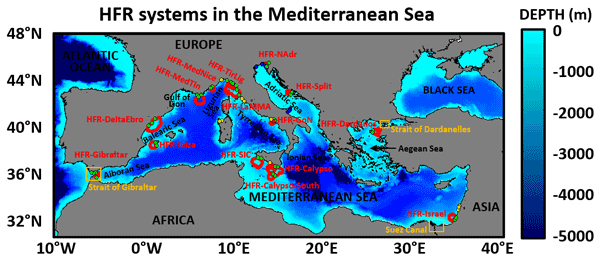
High-frequency radar (HFR) is a land-based remote sensing technology that can provide maps of the surface circulation over broad coastal areas, along with wave and wind information. The main goal of this work is to showcase the current status of the Mediterranean HFR network as well as present and future applications of this sensor for societal benefit such as search and rescue operations, safe vessel navigation, tracking of marine pollutants, and the monitoring of extreme events.
Bartolomeo Doronzo, Stefano Taddei, and Carlo Brandini
EGUsphere, https://doi.org/10.5194/egusphere-2026-3013, https://doi.org/10.5194/egusphere-2026-3013, 2026
Short summary
Short summary
This study presents a new way to map ocean surface currents measured by coastal radar systems. Instead of using fixed grids, the method adapts the spatial resolution to where observations are more reliable. This leads to a more consistent and continuous representation of the flow, especially in complex coastal areas. The approach improves how observational information is used and is particularly useful for applications involving ocean transport and coastal dynamics.
Manuel Vargas-Yáñez, Orens Pasqueron de Fommervault, Emanuela Clementi, Christian Ferrarin, Svitlana Liubertseva, Diego Álvarez-Berastegui, Baptiste Mourre, Salvatore Aronica, Rosa Balbin, Joaquín Ballabrera-Poy, Sana Ben Ismail, Nathaniel Benssousan, Ismail Bessa, Alicia Blanco, Anthony Bosse, Evi Bourma, François Bourrin, Carlo Brandini, Fulvio Capodici, Clara Casals-Baixas, Branko Cermelj, Giuseppe Ciraolo, Pascal Conan, Laurent Coppola, Lorenzo Corgnati, Joaquín del Río, Emilie Diamond Riquier, Lara Diaz-Barroso, Bartolomeo Doronzo, Xavier Durrieu de Madron, Milad Fakhri, Costantine Frangoulis, Claudia Fratianni, Emilio García-Ladona, Jesus García-Lafuente, M. Carmen García-Martínez, Joaquín Garrabou, Josep Gasol, Adam Gauci, Frédéric Gazeau, Gerard Gregory, Abed El Raman Hassoun, Jordi Isern-Fontanet, Dominique Lefevre, Nadia Lo Bue, Guiomar López, Pablo Lorente, Deny Malengros, Ramon Massana, Sinan Mavruk, Stefano Miserocchi, Behzad Mostajir, Laure Mousseau, Francina Moya, Antonio Novellino, Arianna Orasi, Emanuele Organelli, Vicent Ouisse, Tal Ozer, Begoña Pérez-Gómez, Susana Pérez-Rubio, Leonidas Perivoliotis, Georges Petihakis, Anne Petrenko, Sebastien Pinel, Xavier Pitarch, Angela Pomaro, Lucía Quirós-Collazos, Emma Reyes, Simone Sammartino, Anna Sánchez-Vidal, Katrin Schroeder, Stefano Taddei, Elena Tel, Pierre Testor, Marco Torri, Daniela Turk, Laura Ursella, Dimitris Velaoras, Francesca Vidussi, Ivica Vilivić, Enrico Zambiachi, D. Nikolaos Zarokanellos, George Zodiatis, and Vanessa Cardin
EGUsphere, https://doi.org/10.5194/egusphere-2026-2632, https://doi.org/10.5194/egusphere-2026-2632, 2026
Short summary
Short summary
This work compiles current marine observation capabilities in the Mediterranean Sea, making this information accessible to scientists, organizations, stakeholders, and environmental policymakers. It supports initiatives such as Copernicus Marine Service, EMODNet, the European Ocean Pact, and EU directives. It is intended as a living resource to be updated, identifying strengths and gaps in Mediterranean observation systems.
Florian Volmer Martin Kokoszka, Mireno Borghini, Katrin Schroeder, Jacopo Chiggiato, Joaquín Tintoré, Nikolaos Dimitrios Zarokanellos, Albert Miralles, Patricia Rivera Rodríguez, Manuel Rubio, Miguel Charcos, Benjamín Casas, and Anneke ten Doeschate
Earth Syst. Sci. Data, 18, 2203–2226, https://doi.org/10.5194/essd-18-2203-2026, https://doi.org/10.5194/essd-18-2203-2026, 2026
Short summary
Short summary
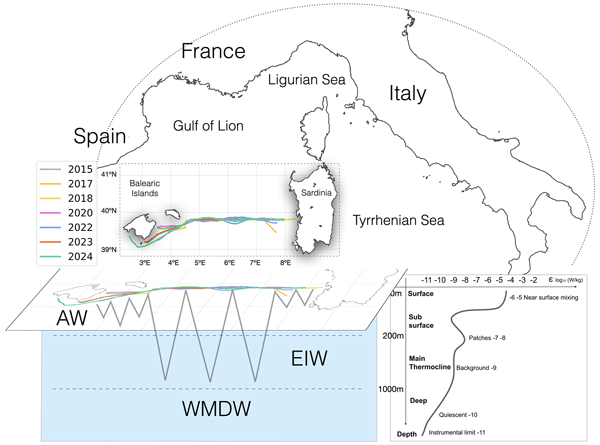
We present a unique dataset of underwater measurements collected by an autonomous glider in the western Mediterranean Sea. It reveals how ocean layers mix over seasons and years. Using sensors to detect small scale water movements, we estimated how mechanical energy and heat are transferred in the ocean. These data help scientists better understand ocean circulation and climate effects. All files and methods are openly shared to support future research.
Michele Bendoni, Francesca Caparrini, Andrea Cucco, Stefano Taddei, Iulia Anton, Roberta Paranunzio, Rossella Mocali, Massimo Perna, Michele Sacco, Giovanni Vitale, Manuela Corongiu, Alberto Ortolani, Salem Gharbia, and Carlo Brandini
Nat. Hazards Earth Syst. Sci., 26, 709–731, https://doi.org/10.5194/nhess-26-709-2026, https://doi.org/10.5194/nhess-26-709-2026, 2026
Short summary
Short summary
We studied how future climate scenarios may affect flooding in three European coastal cities. Using atmospheric data and an integrated modeling framework, we simulated extreme storm surges, waves, and river discharges at high urban resolution (up to 2 m). Flood trends are driven by local geomorphic features, sea-level rise, and storm intensity changes, providing insights for adaptation strategies.

Gianpiero Cossarini, Andrew Moore, Stefano Ciavatta, and Katja Fennel
State Planet, 5-opsr, 12, https://doi.org/10.5194/sp-5-opsr-12-2025, https://doi.org/10.5194/sp-5-opsr-12-2025, 2025
Short summary
Short summary
Marine biogeochemistry refers to the cycling of chemical elements resulting from physical transport, chemical reaction, uptake, and processing by living organisms. Biogeochemical models can have a wide range of complexity, from a single nutrient to fully explicit representations of multiple nutrients, trophic levels, and functional groups. Uncertainty sources are the lack of knowledge about the parameterizations, the initial and boundary conditions, and the lack of observations.
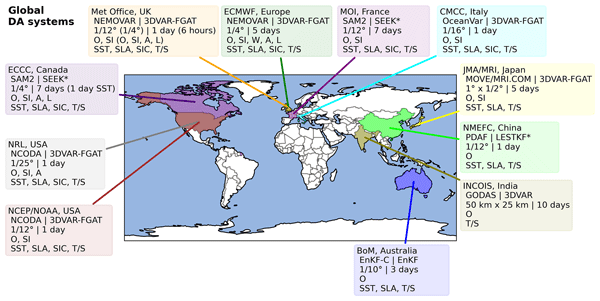
Matthew J. Martin, Ibrahim Hoteit, Laurent Bertino, and Andrew M. Moore
State Planet, 5-opsr, 9, https://doi.org/10.5194/sp-5-opsr-9-2025, https://doi.org/10.5194/sp-5-opsr-9-2025, 2025
Short summary
Short summary
Observations of the ocean from satellites and platforms in the ocean are combined with information from computer models to produce predictions of how the ocean temperature, salinity, and currents will evolve over the coming days and weeks and to describe how the ocean has evolved in the past. This paper summarises the methods used to produce these ocean forecasts at various centres around the world and outlines the practical considerations for implementing such forecasting systems.
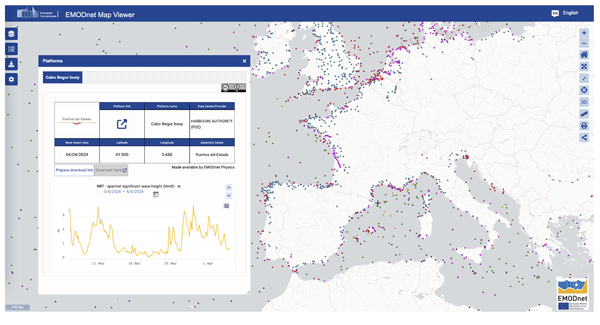
Antonio Novellino, Pierre-Yves Le Traon, and Andy Moore
State Planet, 5-opsr, 8, https://doi.org/10.5194/sp-5-opsr-8-2025, https://doi.org/10.5194/sp-5-opsr-8-2025, 2025
Short summary
Short summary
This paper discusses the vital role of observations in ocean predictions and forecasting, highlighting the need for effective access, management, and integration of data to improve models and decision-making. The paper also explores opportunities for standardizing protocols and the potential of citizen-based, cost-effective data collection methods.
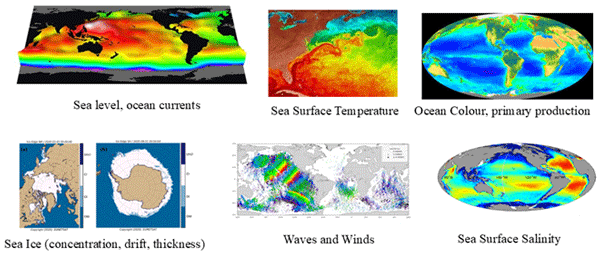
Pierre-Yves Le Traon, Antonio Novellino, and Andrew M. Moore
State Planet, 5-opsr, 7, https://doi.org/10.5194/sp-5-opsr-7-2025, https://doi.org/10.5194/sp-5-opsr-7-2025, 2025
Short summary
Short summary
Ocean prediction relies on the integration between models and satellite and in situ observations through data assimilation techniques. The authors discuss the role of observations in operational ocean forecasting systems, describing the state of the art of satellite and in situ observing networks and defining the paths for addressing multi-scale monitoring and forecasting.
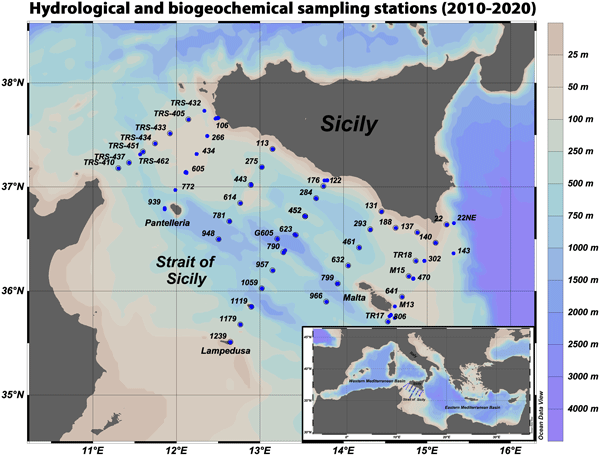
Francesco Placenti, Marco Torri, Katrin Schroeder, Mireno Borghini, Gabriella Cerrati, Angela Cuttitta, Vincenzo Tancredi, Carmelo Buscaino, and Bernardo Patti
Earth Syst. Sci. Data, 16, 743–752, https://doi.org/10.5194/essd-16-743-2024, https://doi.org/10.5194/essd-16-743-2024, 2024
Short summary
Short summary
Oceanographic surveys were conducted in the Strait of Sicily between 2010 and 2021. This paper provides a description of the time series of nutrients and hydrological data collected in this zone. The dataset fills an important gap in field observations of a crucial area where exchanges with the Mediterranean sub-basin take place, providing support for studies aimed at describing ongoing processes and at realizing reliable projections of the effects of these processes in the near future.
Pierre-Marie Poulain, Luca Centurioni, Carlo Brandini, Stefano Taddei, Maristella Berta, and Milena Menna
Ocean Sci., 19, 1617–1631, https://doi.org/10.5194/os-19-1617-2023, https://doi.org/10.5194/os-19-1617-2023, 2023
Short summary
Short summary
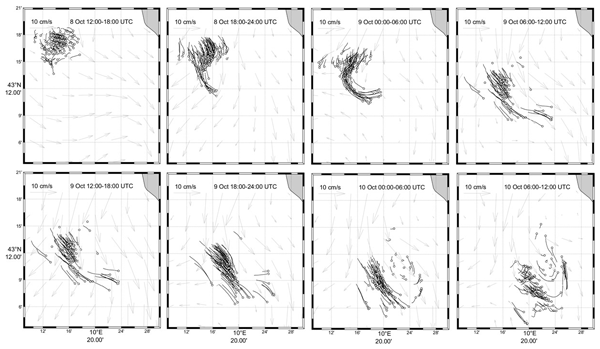
Drifters and a profiling float were deployed in the coastal waters of the southeastern Ligurian Sea to characterize the near-surface circulation at a scale of ~10 km. The drifters were trapped in an offshore-flowing filament and a cyclonic eddy that developed at the southwestern extremity of the filament. Drifter velocities are used to estimate differential kinematic properties and relative dispersion statistics of the surface currents.
Stefania A. Ciliberti, Enrique Alvarez Fanjul, Jay Pearlman, Kirsten Wilmer-Becker, Pierre Bahurel, Fabrice Ardhuin, Alain Arnaud, Mike Bell, Segolene Berthou, Laurent Bertino, Arthur Capet, Eric Chassignet, Stefano Ciavatta, Mauro Cirano, Emanuela Clementi, Gianpiero Cossarini, Gianpaolo Coro, Stuart Corney, Fraser Davidson, Marie Drevillon, Yann Drillet, Renaud Dussurget, Ghada El Serafy, Katja Fennel, Marcos Garcia Sotillo, Patrick Heimbach, Fabrice Hernandez, Patrick Hogan, Ibrahim Hoteit, Sudheer Joseph, Simon Josey, Pierre-Yves Le Traon, Simone Libralato, Marco Mancini, Pascal Matte, Angelique Melet, Yasumasa Miyazawa, Andrew M. Moore, Antonio Novellino, Andrew Porter, Heather Regan, Laia Romero, Andreas Schiller, John Siddorn, Joanna Staneva, Cecile Thomas-Courcoux, Marina Tonani, Jose Maria Garcia-Valdecasas, Jennifer Veitch, Karina von Schuckmann, Liying Wan, John Wilkin, and Romane Zufic
State Planet, 1-osr7, 2, https://doi.org/10.5194/sp-1-osr7-2-2023, https://doi.org/10.5194/sp-1-osr7-2-2023, 2023
Alberto Ribotti, Roberto Sorgente, Federica Pessini, Andrea Cucco, Giovanni Quattrocchi, and Mireno Borghini
Earth Syst. Sci. Data, 14, 4187–4199, https://doi.org/10.5194/essd-14-4187-2022, https://doi.org/10.5194/essd-14-4187-2022, 2022
Short summary
Short summary
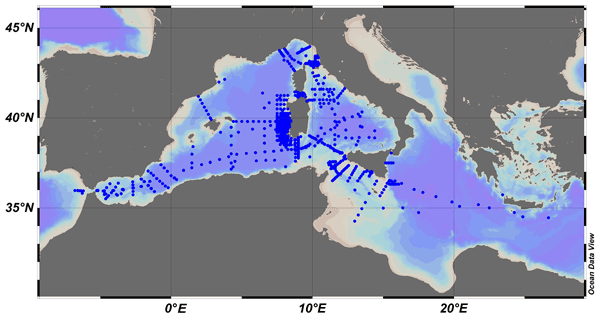
Over 1468 hydrological vertical profiles were acquired in 21 years in the Mediterranean Sea. This allowed us to follow the diffusion of the Western Mediterranean Transient along all western seas or make some important repetitions across straits, channels, or at defined locations. These data are now available in four open-access online datasets, including profiles of water temperature, conductivity, dissolved oxygen, chlorophyll α fluorescence, and, after 2004, turbidity and pH.
Emma Reyes, Eva Aguiar, Michele Bendoni, Maristella Berta, Carlo Brandini, Alejandro Cáceres-Euse, Fulvio Capodici, Vanessa Cardin, Daniela Cianelli, Giuseppe Ciraolo, Lorenzo Corgnati, Vlado Dadić, Bartolomeo Doronzo, Aldo Drago, Dylan Dumas, Pierpaolo Falco, Maria Fattorini, Maria J. Fernandes, Adam Gauci, Roberto Gómez, Annalisa Griffa, Charles-Antoine Guérin, Ismael Hernández-Carrasco, Jaime Hernández-Lasheras, Matjaž Ličer, Pablo Lorente, Marcello G. Magaldi, Carlo Mantovani, Hrvoje Mihanović, Anne Molcard, Baptiste Mourre, Adèle Révelard, Catalina Reyes-Suárez, Simona Saviano, Roberta Sciascia, Stefano Taddei, Joaquín Tintoré, Yaron Toledo, Marco Uttieri, Ivica Vilibić, Enrico Zambianchi, and Alejandro Orfila
Ocean Sci., 18, 797–837, https://doi.org/10.5194/os-18-797-2022, https://doi.org/10.5194/os-18-797-2022, 2022
Short summary
Short summary
This work reviews the existing advanced and emerging scientific and societal applications using HFR data, developed to address the major challenges identified in Mediterranean coastal waters organized around three main topics: maritime safety, extreme hazards and environmental transport processes. It also includes a discussion and preliminary assessment of the capabilities of existing HFR applications, finally providing a set of recommendations towards setting out future prospects.
Pablo Lorente, Eva Aguiar, Michele Bendoni, Maristella Berta, Carlo Brandini, Alejandro Cáceres-Euse, Fulvio Capodici, Daniela Cianelli, Giuseppe Ciraolo, Lorenzo Corgnati, Vlado Dadić, Bartolomeo Doronzo, Aldo Drago, Dylan Dumas, Pierpaolo Falco, Maria Fattorini, Adam Gauci, Roberto Gómez, Annalisa Griffa, Charles-Antoine Guérin, Ismael Hernández-Carrasco, Jaime Hernández-Lasheras, Matjaž Ličer, Marcello G. Magaldi, Carlo Mantovani, Hrvoje Mihanović, Anne Molcard, Baptiste Mourre, Alejandro Orfila, Adèle Révelard, Emma Reyes, Jorge Sánchez, Simona Saviano, Roberta Sciascia, Stefano Taddei, Joaquín Tintoré, Yaron Toledo, Laura Ursella, Marco Uttieri, Ivica Vilibić, Enrico Zambianchi, and Vanessa Cardin
Ocean Sci., 18, 761–795, https://doi.org/10.5194/os-18-761-2022, https://doi.org/10.5194/os-18-761-2022, 2022
Short summary
Short summary
High-frequency radar (HFR) is a land-based remote sensing technology that can provide maps of the surface circulation over broad coastal areas, along with wave and wind information. The main goal of this work is to showcase the current status of the Mediterranean HFR network as well as present and future applications of this sensor for societal benefit such as search and rescue operations, safe vessel navigation, tracking of marine pollutants, and the monitoring of extreme events.
Cited articles
Aliani, S. and Meloni, R.: Dispersal strategies of benthic species and water current variability in the Corsica Channel (Western Mediterranean), Scientia Marina, 63, 137–145, https://doi.org/10.3989/scimar.1999.63n2137, 1999. a
Aracri, S., Borghini, M., Canesso, D., Chiggiato, J., Durante, S., Schroeder, K., Sparnocchia, S., Vetrano, A., Honda, T., Kitawaza, Y., Kawahara, H., and Nakamura, T.: Trials of an autonomous profiling buoy system, Journal of Operational Oceanography, 9, s176–s184, https://doi.org/10.1080/1755876X.2015.1115631, 2016. a
Arango, H. G., Levin, J. C., Curchitser, E. N., Zhang, B., Moore, A. M., Han, W., Gordon, A. L., Lee, C. M., and Girton, J. B.: Development of a hindcast/forecast model for the Philippine Archipelago, Oceanography, 24, 58–69, 2011. a
Artale, V. and Gasparini, G.: Simultaneous temperature and velocity measurements of the internal wave field in the Corsican Channel (Eastern Ligurian Sea), J. Geophys. Res.-Oceans, 95, 1635–1645, https://doi.org/10.5670/oceanog.2011.04, 1990. a
Artale, V., Astraldi, M., Buffoni, G., and Gasparini, G. P.: Seasonal variability of gyre-scale circulation in the northern Tyrrhenian Sea, J. Geophys. Res.-Oceans, 99, 14127–14137, https://doi.org/10.1029/94JC00284, 1994. a
Astraldi, M. and Gasparini, G. P.: The Seasonal Characteristics of the Circulation in the Tyrrhenian Sea, Chap. 7, American Geophysical Union (AGU), https://doi.org/10.1029/CE046p0115, 115–134, 1994. a, b
Astraldi, M., Gasparini, G., Manzella, G., and Hopkins, T.: Temporal variability of currents in the eastern Ligurian Sea, J. Geophys. Res.-Oceans, 95, 1515–1522, https://doi.org/10.1029/JC095iC02p01515, 1990. a, b, c
Astraldi, M., Gasparini, G. P., and Sparnocchia, S.: The Seasonal and Interannual Variability in the Ligurian-Provençal basin, Chap. 6, American Geophysical Union (AGU), https://doi.org/10.1029/CE046p0093, 93–113, 1994. a, b
Astraldi, M., Bianchi, C. N., Gasparini, G. P., and Morri, C.: Climatic fluctuations, current variability and marine species distribution: a case study in the Ligurian Sea (North-West Mediterranean), Oceanol. Acta, 18, 139–149, 1995. a
Aydogdu, A., Escudier, R., Hernandez-Lasheras, J., Amadio, C., Pistoia, J., Zarokanellos, N. D., Cossarini, G., Remy, E., and Mourre, B.: Glider observations in the Western Mediterranean Sea: their assimilation and impact assessment using four analysis and forecasting systems, Frontiers in Marine Science, 12, 1456463, https://doi.org/10.3389/fmars.2025.1456463, 2025. a
Bajo, M., Ferrarin, C., Umgiesser, G., Bonometto, A., and Coraci, E.: Modelling the barotropic sea level in the Mediterranean Sea using data assimilation, Ocean Sci., 19, 559–579, https://doi.org/10.5194/os-19-559-2023, 2023. a
Barral, Q.-b., Zakardjian, B., Dumas, F., Garreau, P., and Beuvier, J.: Assessment of the water mass dynamics over the Algero-Provencal Basin (Western Mediterranean Sea) in the MEDRYS1V2 reanalysis, J. Geophys. Res.-Oceans, 129, e2023JC020260, https://doi.org/10.1029/2023JC020260, 2024. a, b, c, d
Bendoni, M., Moore, A. M., Molcard, A., Magaldi, M. G., Fattorini, M., and Brandini, C.: 4D-Var data assimilation and observation impact on surface transport of HF-Radar derived surface currents in the North-Western Mediterranean Sea, Ocean Model., 184, 102236, https://doi.org/10.1016/j.ocemod.2023.102236, 2023. a, b, c, d, e, f
Béranger, K., Mortier, L., and Crépon, M.: Seasonal variability of water transport through the Straits of Gibraltar, Sicily and Corsica, derived from a high-resolution model of the Mediterranean circulation, Prog. Oceanogr., 66, 341–364, https://doi.org/10.1016/j.pocean.2004.07.013, 2005. a, b
Bethoux, J.: Mean water fluxes across sections in the Mediterranean-Sea, evaluated on the basis of water and salt budgets and of observed salinities, Oceanol. Acta, 3, 79–88, 1980. a
Bosse, A., Testor, P., Coppola, L., Bretel, P., Dausse, D., Durrieu de Madron, X., Houpert, L., Labaste, M., Legoff, H., Mortier, L., and D'ortenzio, F.: LION observatory data, SEANOE [data set], https://doi.org/10.17882/44411, 2025. a
Cabanes, C., Grouazel, A., von Schuckmann, K., Hamon, M., Turpin, V., Coatanoan, C., Paris, F., Guinehut, S., Boone, C., Ferry, N., de Boyer Montégut, C., Carval, T., Reverdin, G., Pouliquen, S., and Le Traon, P.-Y.: The CORA dataset: validation and diagnostics of in-situ ocean temperature and salinity measurements, Ocean Sci., 9, 1–18, https://doi.org/10.5194/os-9-1-2013, 2013. a
Chapman, D. C.: Numerical treatment of cross-shelf open boundaries in a barotropic coastal ocean model, J. Phys. Oceanogr., 15, 1060–1075, https://doi.org/10.1175/1520-0485(1985)015<1060:NTOCSO>2.0.CO;2, 1985. a
Ciuffardi, T., Napolitano, E., Iacono, R., Reseghetti, F., Raiteri, G., and Bordone, A.: Analysis of surface circulation structures along a frequently repeated XBT transect crossing the Ligurian and Tyrrhenian Seas, Ocean Dynam., 66, 767–783, https://doi.org/10.1007/s10236-016-0954-y, 2016. a, b, c
Coppola, L., Diamond, R. E., Carval, T., Irisson, J.-O., and Desnos, C.: Dyfamed observatory data, SEANOE [data set], https://doi.org/10.17882/43749, 2025. a
Courtier, P., Thépaut, J.-N., and Hollingsworth, A.: A strategy for operational implementation of 4D-Var, using an incremental approach, Q. J. Roy. Meteor. Soc., 120, 1367–1387, https://doi.org/10.1002/qj.49712051912, 1994. a
Cushman-Roisin, B. and Beckers, J.-M.: Introduction to Geophysical Fluid Dynamics: Physical and Numerical Aspects, Vol. 101, Academic Press, ISBN: 978-0-12-088759-0, 2011. a
de La Vara, A., del Sastre, P. G., Arsouze, T., Gallardo, C., and Gaertner, M. Á.: Role of atmospheric resolution in the long-term seasonal variability of the Tyrrhenian Sea circulation from a set of ocean hindcast simulations (1997–2008), Ocean Model., 134, 51–67, https://doi.org/10.1016/j.ocemod.2019.01.004, 2019. a, b
Dobricic, S., Pinardi, N., Adani, M., Bonazzi, A., Fratianni, C., and Tonani, M.: Mediterranean forecasting system: an improved assimilation scheme for sea-level anomaly and its validation, Q. J. Roy. Meteor. Soc., 131, 3627–3642, https://doi.org/10.1256/qj.05.100, 2005. a
Embury, O., Merchant, C. J., Good, S. A., Rayner, N. A., Høyer, J. L., Atkinson, C., Block, T., Alerskans, E., Pearson, K. J., Worsfold, M., McCarroll, N., and Donlon, C.: Satellite-based time-series of sea-surface temperature since 1980 for climate applications, Scientific Data, 11, 326, https://doi.org/10.1038/s41597-024-03147-w, 2024. a
Escudier, R., Clementi, E., Cipollone, A., Pistoia, J., Drudi, M., Grandi, A., Lyubartsev, V., Lecci, R., Aydogdu, A., Delrosso, D., Omar, M., Masina, S., Coppini, G., and Pinardi, N.: A high resolution reanalysis for the Mediterranean Sea, Front. Earth Sci., 9, 702285, https://doi.org/10.3389/feart.2021.702285, 2021. a, b, c, d
Estournel, C., Estaque, T., Ulses, C., Barral, Q.-B., and Marsaleix, P.: Extreme sensitivity of the northeastern Gulf of Lion (western Mediterranean) to subsurface heatwaves: physical processes and insights into effects on gorgonian populations in the summer of 2022, Ocean Sci., 21, 1487–1503, https://doi.org/10.5194/os-21-1487-2025, 2025. a
Fairall, C. W., Bradley, E. F., Rogers, D. P., Edson, J. B., and Young, G. S.: Bulk parameterization of air-sea fluxes for tropical ocean-global atmosphere coupled-ocean atmosphere response experiment, J. Geophys. Res.-Oceans, 101, 3747–3764, https://doi.org/10.1029/95JC03205, 1996. a
Fang, Y.-C., Weingartner, T. J., Potter, R. A., Winsor, P. R., and Statscewich, H.: Quality assessment of HF radar–derived surface currents using optimal interpolation, J. Atmos. Ocean. Tech., 32, 282–296, https://doi.org/10.1175/JTECH-D-14-00109.1, 2015. a
Flather, R.: A tidal model of the north-west European continental shelf, Memoires de la Societe Royale de Sciences de Liege, 6, 141–164, 1976. a
Fossi, M. C., Romeo, T., Panti, M., Marsili, L., Campani, T., Canese, S., Galgani, F., Druon, J., Airoldi, S., Taddei, S., Fattorini, M., Brandini, C., and Lapucci, C.: Plastic debris occurrence, convergence areas and fin whales feeding ground in the Mediterranean Marine Protected Area Pelagos Sanctuary: a modeling approach, Frontiers in Marine Science, 4, 167, https://doi.org/10.3389/fmars.2017.00167, 2017. a
Francour, P., Harmelin, J.-G., Pollard, D., and Sartoretto, S.: A review of marine protected areas in the northwestern Mediterranean region: siting, usage, zonation and management, Aquatic Conservation: Marine and Freshwater Ecosystems, 11, 155–188, https://doi.org/10.1002/aqc.442, 2001. a
Fraysse, M., Pairaud, I., Ross, O. N., Faure, V. M., and Pinazo, C.: Intrusion of Rhone River diluted water into the Bay of Marseille: generation processes and impacts on ecosystem functioning, J. Geophys. Res.-Oceans, 119, 6535–6556, https://doi.org/10.1002/2014JC010022, 2014. a
Fujii, Y., Yoshida, T., Sugimoto, H., Ishikawa, I., and Urakawa, S.: Evaluation of a global ocean reanalysis generated by a global ocean data assimilation system based on a four-dimensional variational (4DVAR) method, Frontiers in Climate, 4, 1019673, https://doi.org/10.3389/fclim.2022.1019673, 2023. a
Gürol, S., Weaver, A. T., Moore, A. M., Piacentini, A., Arango, H. G., and Gratton, S.: B-preconditioned minimization algorithms for variational data assimilation with the dual formulation, Q. J. Roy. Meteor. Soc., 140, 539–556, https://doi.org/10.1002/qj.2150, 2014. a
Hernandez-Lasheras, J. and Mourre, B.: Dense CTD survey versus glider fleet sampling: comparing data assimilation performance in a regional ocean model west of Sardinia, Ocean Sci., 14, 1069–1084, https://doi.org/10.5194/os-14-1069-2018, 2018. a
Hernandez-Lasheras, J., Mourre, B., Orfila, A., Santana, A., Reyes, E., and Tintoré, J.: Evaluating high-frequency radar data assimilation impact in coastal ocean operational modelling, Ocean Sci., 17, 1157–1175, https://doi.org/10.5194/os-17-1157-2021, 2021. a, b
Hersbach, H., Bell, B., Berrisford, P., Biavati, G., Horányi, A., Muñoz Sabater, J., Nicolas, J., Peubey, C., Radu, R., Rozum, I., Schepers, D., Simmons, A., Soci, C., Dee, D., and Thépaut, J.-N.: ERA5 hourly data on single levels from 1940 to present, Copernicus Climate Change Service (C3S) Climate Data Store (CDS) [data set], https://doi.org/10.24381/cds.adbb2d47, 2023. a
Houpert, L., Durrieu de Madron, X., Testor, P., Bosse, A., d'Ortenzio, F., Bouin, M.-N., Dausse, D., Le Goff, H., Kunesch, S., and Labaste, M.: Observations of open-ocean deep convection in the northwestern Mediterranean Sea: Seasonal and interannual variability of mixing and deep water masses for the 2007–2013 period, J. Geophys. Res.-Oceans, 121, 8139–8171, https://doi.org/10.1002/2016JC011857, 2016. a
Iacono, R. and Napolitano, E.: Aspects of the summer circulation in the eastern Ligurian Sea, Deep-Sea Res. Pt. I, 166, 103407, https://doi.org/10.1016/j.dsr.2020.103407, 2020. a, b, c
Iermano, I., Moore, A., and Zambianchi, E.: Impacts of a 4-dimensional variational data assimilation in a coastal ocean model of southern Tyrrhenian Sea, J. Marine Syst., 154, 157–171, https://doi.org/10.1016/j.jmarsys.2015.09.006, 2016. a, b
Janeković, I., Powell, B., Matthews, D., McManus, M., and Sevadjian, J.: 4D-Var data assimilation in a nested, coastal ocean model: a Hawaiian case study, J. Geophys. Res.-Oceans, 118, 5022–5035, https://doi.org/10.1002/jgrc.20389, 2013. a
Janeković, I., Mihanović, H., Vilibić, I., Grčić, B., Ivatek-Šahdan, S., Tudor, M., and Djakovac, T.: Using multi-platform 4D-Var data assimilation to improve modeling of Adriatic Sea dynamics, Ocean Model., 146, 101538, https://doi.org/10.1016/j.ocemod.2019.101538, 2020. a
Janeković, I., Rayson, M., Jones, N., Watson, P., and Pattiaratchi, C.: 4D-Var data assimilation using satellite sea surface temperature to improve the tidally-driven interior ocean dynamics estimates in the Indo-Australian Basin, Ocean Model., 171, 101969, https://doi.org/10.1016/j.ocemod.2022.101969, 2022. a
Jean-Michel, L., Eric, G., Romain, B.-B., Gilles, G., Angélique, M., Marie, D., Clément, B., Mathieu, H., Olivier, L. G., Charly, R., Tony, C., Charles-Emmanuel, T., Florent, G., Giovanni, R., Mounir, B., Yann, D., and Pierre-Yves, L. T.: The Copernicus global
Kerry, C., Roughan, M., and Powell, B.: Predicting the submesoscale circulation inshore of the East Australian Current, J. Marine Syst., 204, 103286, https://doi.org/10.1016/j.jmarsys.2019.103286, 2020. a
Langland, R. H. and Baker, N. L.: Estimation of observation impact using the NRL atmospheric variational data assimilation adjoint system, Tellus A, 56, 189–201, https://doi.org/10.3402/tellusa.v56i3.14413, 2004. a
Lefevre, D., Tamburini, C., Bhairy, N., Chirurgien, L., Gojak, C., Bernardet, K., Hafidi, Z., and Mahiouz, K.: EMSO-Ligure Ouest observatory data (mooring ALBATROSS), SEANOE [data set], https://doi.org/10.17882/47129, 2016. a
Levin, J., Arango, H. G., Laughlin, B., Hunter, E., Wilkin, J., and Moore, A. M.: Observation impacts on the Mid-Atlantic Bight front and cross-shelf transport in 4D-Var ocean state estimates: Part I – Multiplatform analysis, Ocean Model., 156, 101721, https://doi.org/10.1016/j.ocemod.2020.101721, 2020. a
Marchesiello, P., McWilliams, J. C., and Shchepetkin, A.: Open boundary conditions for long-term integration of regional oceanic models, Ocean Model., 3, 1–20, https://doi.org/10.1016/S1463-5003(00)00013-5, 2001. a
Marmain, J., Molcard, A., Forget, P., Barth, A., and Ourmières, Y.: Assimilation of HF radar surface currents to optimize forcing in the northwestern Mediterranean Sea, Nonlin. Processes Geophys., 21, 659–675, https://doi.org/10.5194/npg-21-659-2014, 2014. a
McAdam, R., Bonino, G., Clementi, E., and Masina, S.: Forecasting the Mediterranean Sea marine heatwave of summer 2022, State of the Planet, 4-osr8, 13, https://doi.org/10.5194/sp-4-osr8-13-2024, 2024. a
McIntosh, P. and Bennett, A.: Open ocean modeling as an inverse problem: M2 tides in Bass Strait, J. Phys. Oceanogr., 14, 601–614, https://doi.org/10.1175/1520-0485(1984)014<0601:OOMAAI>2.0.CO;2, 1984. a, b
Millot, C.: Circulation in the western Mediterranean Sea, J. Marine Syst., 20, 423–442, https://doi.org/10.1016/S0924-7963(98)00078-5, 1999. a
Moore, A. M., Arango, H. G., Di Lorenzo, E., Miller, A. J., and Cornuelle, B. D.: An adjoint sensitivity analysis of the Southern California current circulation and ecosystem, J. Phys. Oceanogr., 39, 702–720, https://doi.org/10.1175/2008JPO3740.1, 2009. a
Moore, A. M., Arango, H. G., Broquet, G., Edwards, C., Veneziani, M., Powell, B., Foley, D., Doyle, J. D., Costa, D., and Robinson, P.: The Regional Ocean Modeling System (ROMS) 4-dimensional variational data assimilation systems: Part II – Performance and application to the California Current System, Prog. Oceanogr., 91, 50–73, https://doi.org/10.1016/j.pocean.2011.05.003, 2011a. a
Moore, A. M., Arango, H. G., Broquet, G., Edwards, C., Veneziani, M., Powell, B., Foley, D., Doyle, J. D., Costa, D., and Robinson, P.: The Regional Ocean Modeling System (ROMS) 4-dimensional variational data assimilation systems: Part III – Observation impact and observation sensitivity in the California Current System, Prog. Oceanogr., 91, 74–94, https://doi.org/10.1016/j.pocean.2011.05.005, 2011b. a, b, c
Moore, A. M., Arango, H. G., Broquet, G., Powell, B. S., Weaver, A. T., and Zavala-Garay, J.: The Regional Ocean Modeling System (ROMS) 4-dimensional variational data assimilation systems: Part I – System overview and formulation, Prog. Oceanogr., 91, 34–49, https://doi.org/10.1016/j.pocean.2011.05.004, 2011c. a, b, c, d
Moore, A. M., Edwards, C. A., Fiechter, J., Drake, P., Neveu, E., Arango, H. G., Gürol, S., and Weaver, A. T.: A 4D-Var analysis system for the California current: a prototype for an operational regional ocean data assimilation system, in: Data Assimilation for Atmospheric, Oceanic and Hydrologic Applications (Vol. II), Springer, https://doi.org/10.1007/978-3-642-35088-7_14, 345–366, 2013. a, b
Moore, A. M., Jacox, M. G., Crawford, W. J., Laughlin, B., Edwards, C. A., and Fiechter, J.: The impact of the ocean observing system on estimates of the California current circulation spanning three decades, Prog. Oceanogr., 156, 41–60, https://doi.org/10.1016/j.pocean.2017.05.009, 2017. a
Moore, A. M., Arango, H. G., and Edwards, C. A.: Reduced-rank array modes of the California current observing system, J. Geophys. Res.-Oceans, 123, 452–465, https://doi.org/10.1002/2017JC013172, 2018. a, b
Moore, A. M., Levin, J., Arango, H. G., and Wilkin, J.: Assessing the performance of an ocean observing, analysis and forecast system for the Mid-Atlantic Bight using array modes, Ocean Model., 164, 101821, https://doi.org/10.1016/j.ocemod.2021.101821, 2021. a, b
Napolitano, E., Iacono, R., Ciuffardi, T., Reseghetti, F., Poulain, P.-M., and Notarstefano, G.: The Tyrrhenian Intermediate Water (TIW): characterization and formation mechanisms, Prog. Oceanogr., 170, 53–68, https://doi.org/10.1016/j.pocean.2018.10.017, 2019. a
Notarbartolo di Sciara, G., Agardy, T., Hyrenbach, D., Scovazzi, T., and Van Klaveren, P.: The Pelagos Sanctuary for Mediterranean marine mammals, Aquat. Conserv., 18, 367–391, https://doi.org/10.1002/aqc.855, 2008. a
Odic, R., Bensoussan, N., Pinazo, C., Taupier-Letage, I., and Rossi, V.: Sporadic wind-driven upwelling/downwelling and associated cooling/warming along Northwestern Mediterranean coastlines, Cont. Shelf Res., 250, 104843, https://doi.org/10.1016/j.csr.2022.104843, 2022. a, b
Panteleev, G., Yaremchuk, M., Francis, O., Stabeno, P. J., Weingartner, T., and Zhang, J.: An inverse modeling study of circulation in the Eastern Bering Sea during 2007–2010, J. Geophys. Res.-Oceans, 121, 3970–3989, https://doi.org/10.1002/2015JC011287, 2016. a
Pisano, A., Buongiorno Nardelli, B., Tronconi, C., and Santoleri, R.: The new Mediterranean optimally interpolated pathfinder AVHRR SST dataset (1982–2012), Remote Sens. Environ., 176, 107–116, https://doi.org/10.1016/j.rse.2016.01.019, 2016. a
Poulain, P.-M., Mauri, E., Gerin, R., Chiggiato, J., Schroeder, K., Griffa, A., Borghini, M., Zambianchi, E., Falco, P., Testor, P., Mortier, L., and Raimbault, P.: On the dynamics in the southeastern Ligurian Sea in summer 2010, Cont. Shelf Res., 196, 104083, https://doi.org/10.1016/j.csr.2020.104083, 2020. a
Schroeder, K., Josey, S. A., Herrmann, M., Grignon, L., Gasparini, G. P., and Bryden, H. L.: Abrupt warming and salting of the Western Mediterranean Deep Water after 2005: atmospheric forcings and lateral advection, J. Geophys. Res.-Oceans, 115, C08029, https://doi.org/10.1029/2009JC005749, 2010. a
Schroeder, K., Ben Ismail, S., Bensi, M., Bosse, A., Chiggiato, J., Civitarese, G., Falcieri, F. M., Fusco, G., Gačić, M., Gertman, I., Kubin, E., Malanotte-Rizzoli, P., Martellucci, R., Menna, M., Ozer, T., Taupier-Letage, I., Vargas Yáñez, M., Velaroas, D., and Vilibić, I.: A consensus-based, revised and comprehensive catalogue for Mediterranean water masses acronyms, Mediterranean Marine Science, 25, 783–791, https://doi.org/10.12681/mms.38736, 2024. a
Sciascia, R., Magaldi, M. G., and Vetrano, A.: Current reversal and associated variability within the Corsica Channel: the 2004 case study, Deep-Sea Res. Pt. I, 144, 39–51, https://doi.org/10.1016/j.dsr.2018.12.004, 2019. a, b, c, d
Shchepetkin, A. F. and McWilliams, J. C.: A method for computing horizontal pressure-gradient force in an oceanic model with a nonaligned vertical coordinate, J. Geophys. Res.-Oceans, 108, https://doi.org/10.1029/2001JC001047, 2003. a
Shchepetkin, A. F. and McWilliams, J. C.: The regional oceanic modeling system (ROMS): a split-explicit, free-surface, topography-following-coordinate oceanic model, Ocean Model., 9, 347–404, https://doi.org/10.1016/j.ocemod.2004.08.002, 2005. a
Sperrevik, A. K., Christensen, K. H., and Röhrs, J.: Constraining energetic slope currents through assimilation of high-frequency radar observations, Ocean Sci., 11, 237–249, https://doi.org/10.5194/os-11-237-2015, 2015. a
Szekely, T., Gourrion, J., Pouliquen, S., Reverdin, G., and Merceur, F.: CORA, coriolis ocean dataset for reanalysis, SEANOE [data set], https://doi.org/10.17882/46219, 2025. a, b
Teruzzi, A., Bolzon, G., Salon, S., Lazzari, P., Solidoro, C., and Cossarini, G.: Assimilation of coastal and open sea biogeochemical data to improve phytoplankton simulation in the Mediterranean Sea, Ocean Model., 132, 46–60, https://doi.org/10.1016/j.ocemod.2018.09.007, 2018. a
Vandenbulcke, L., Beckers, J.-M., and Barth, A.: Correction of inertial oscillations by assimilation of HF radar data in a model of the Ligurian Sea, Ocean Dynam., 67, 117–135, https://doi.org/10.1007/s10236-016-1012-5, 2017. a, b
Veneziani, M., Edwards, C., and Moore, A.: A central California coastal ocean modeling study: 2. Adjoint sensitivities to local and remote forcing mechanisms, J. Geophys. Res.-Oceans, 114, https://doi.org/10.1029/2008JC004775, 2009. a
Vignudelli, S., Gasparini, G., Astraldi, M., and Schiano, M.: A possible influence of the North Atlantic oscillation on the circulation of the Western Mediterranean Sea, Geophys. Res. Lett., 26, 623–626, https://doi.org/10.1029/1999GL900038, 1999. a
Warner, J. C., Sherwood, C. R., Arango, H. G., and Signell, R. P.: Performance of four turbulence closure models implemented using a generic length scale method, Ocean Model., 8, 81–113, https://doi.org/10.1016/j.ocemod.2003.12.003, 2005. a
Weaver, A. and Courtier, P.: Correlation modelling on the sphere using a generalized diffusion equation, Q. J. Roy. Meteor. Soc., 127, 1815–1846, https://doi.org/10.1002/qj.49712757518, 2001. a
Zavala-Garay, J., Wilkin, J., and Arango, H.: Predictability of mesoscale variability in the East Australian current given strong-constraint data assimilation, J. Phys. Oceanogr., 42, 1402–1420, https://doi.org/10.1175/JPO-D-11-0168.1, 2012. a
Zavala-Garay, J., Wilkin, J., and Levin, J.: Data assimilation in coastal oceanography: IS4DVAR in the Regional Ocean Modelling System (ROMS), in: Advanced Data Assimilation for Geosciences: Lecture Notes of the Les Houches School of Physics: Special Issue, June 2012, Oxford University Press, https://doi.org/10.1093/acprof:oso/9780198723844.003.0024, 2014. a
Zhang, W. G., Wilkin, J. L., and Arango, H. G.: Towards an integrated observation and modeling system in the New York Bight using variational methods. Part I: 4DVAR data assimilation, Ocean Model., 35, 119–133, https://doi.org/10.1016/j.ocemod.2010.08.003, 2010. a
Zuo, H., Balmaseda, M. A., Mogensen, K., and Tietsche, S.: OCEAN5: The ECMWF Ocean Reanalysis System and its Real-Time analysis component, ECMWF, https://doi.org/10.21957/la2v0442, 2018. a
Short summary
We use data assimilation (DA) to optimally merge information from observations of ocean variables and a numerical model of the north-western Mediterranean Sea. Data come from satellites, coastal high-frequency radars and fixed & movable devices. DA decreases model errors associated to all observed variables. The volume transport across the Corsica Channel, which connects the Tyrrhenian and Ligurian waters, is differently modified based on the typology and location of the assimilated observation.
We use data assimilation (DA) to optimally merge information from observations of ocean...


