Articles | Volume 22, issue 1
https://doi.org/10.5194/os-22-241-2026
Research article
 | 
21 Jan 2026
Research article |  | 21 Jan 2026

A robust minimization-based framework for cyclogeostrophic ocean surface current retrieval

Vadim Bertrand, Julien Le Sommer, Victor Vianna Zaia De Almeida, Adeline Samson, and Emmanuel Cosme

Related authors

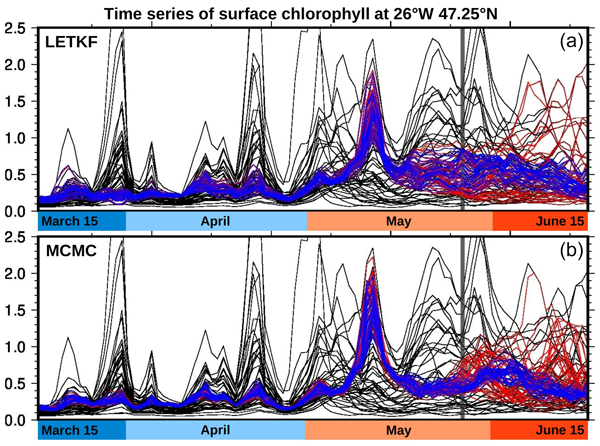
Ensemble analysis and forecast of ecosystem indicators in the North Atlantic using ocean colour observations and prior statistics from a stochastic NEMO–PISCES simulator
Mikhail Popov, Jean-Michel Brankart, Arthur Capet, Emmanuel Cosme, and Pierre Brasseur
Ocean Sci., 20, 155–180, https://doi.org/10.5194/os-20-155-2024,https://doi.org/10.5194/os-20-155-2024, 2024
Short summary
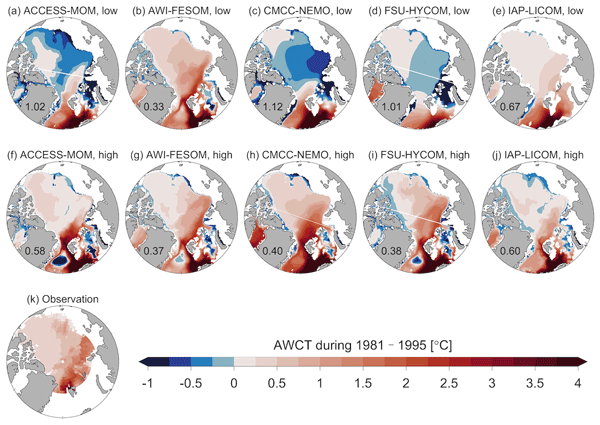
Impact of increased resolution on Arctic Ocean simulations in Ocean Model Intercomparison Project phase 2 (OMIP-2)
Qiang Wang, Qi Shu, Alexandra Bozec, Eric P. Chassignet, Pier Giuseppe Fogli, Baylor Fox-Kemper, Andy McC. Hogg, Doroteaciro Iovino, Andrew E. Kiss, Nikolay Koldunov, Julien Le Sommer, Yiwen Li, Pengfei Lin, Hailong Liu, Igor Polyakov, Patrick Scholz, Dmitry Sidorenko, Shizhu Wang, and Xiaobiao Xu
Geosci. Model Dev., 17, 347–379, https://doi.org/10.5194/gmd-17-347-2024,https://doi.org/10.5194/gmd-17-347-2024, 2024
Short summary
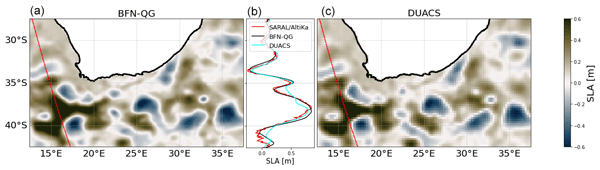
Regional mapping of energetic short mesoscale ocean dynamics from altimetry: performances from real observations
Florian Le Guillou, Lucile Gaultier, Maxime Ballarotta, Sammy Metref, Clément Ubelmann, Emmanuel Cosme, and Marie-Helène Rio
Ocean Sci., 19, 1517–1527, https://doi.org/10.5194/os-19-1517-2023,https://doi.org/10.5194/os-19-1517-2023, 2023
Short summary
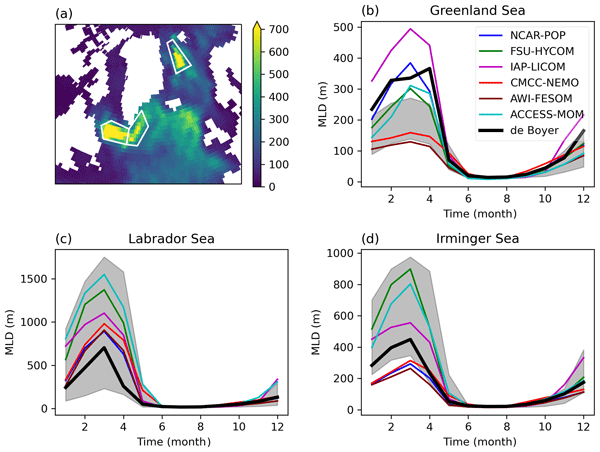
The mixed-layer depth in the Ocean Model Intercomparison Project (OMIP): impact of resolving mesoscale eddies
Anne Marie Treguier, Clement de Boyer Montégut, Alexandra Bozec, Eric P. Chassignet, Baylor Fox-Kemper, Andy McC. Hogg, Doroteaciro Iovino, Andrew E. Kiss, Julien Le Sommer, Yiwen Li, Pengfei Lin, Camille Lique, Hailong Liu, Guillaume Serazin, Dmitry Sidorenko, Qiang Wang, Xiaobio Xu, and Steve Yeager
Geosci. Model Dev., 16, 3849–3872, https://doi.org/10.5194/gmd-16-3849-2023,https://doi.org/10.5194/gmd-16-3849-2023, 2023
Short summary
Snow data assimilation for seasonal streamflow supply prediction in mountainous basins
Sammy Metref, Emmanuel Cosme, Matthieu Le Lay, and Joël Gailhard
Hydrol. Earth Syst. Sci., 27, 2283–2299, https://doi.org/10.5194/hess-27-2283-2023,https://doi.org/10.5194/hess-27-2283-2023, 2023
Short summary

Cited articles

Archambault, T., Filoche, A., Charantonis, A. A., and Béréziat, D.: Multimodal Unsupervised Spatio-Temporal Interpolation of Satellite Ocean Altimetry Maps, https://hal.sorbonne-universite.fr/hal-03934647 (last access: 26 August 2025), 2023. a
Archer, M., Wang, J., Klein, P., Dibarboure, G., and Fu, L.-L.: Wide-swath satellite altimetry unveils global submesoscale ocean dynamics, Nature, 640, 691–696, https://doi.org/10.1038/s41586-025-08722-8, 2025. a, b
Arnason, G., Haltiner, G. J., and Frawley, M. J.: Higher-order geostrophic wind approximations, Mon. Weather Rev., 90, 175–195, 1962. a, b, c, d, e
Ballarotta, M., Ubelmann, C., Pujol, M.-I., Taburet, G., Fournier, F., Legeais, J.-F., Faugère, Y., Delepoulle, A., Chelton, D., Dibarboure, G., and Picot, N.: On the resolutions of ocean altimetry maps, Ocean Sci., 15, 1091–1109, https://doi.org/10.5194/os-15-1091-2019, 2019. a
Ballarotta, M., Ubelmann, C., Veillard, P., Prandi, P., Etienne, H., Mulet, S., Faugère, Y., Dibarboure, G., Morrow, R., and Picot, N.: Improved global sea surface height and current maps from remote sensing and in situ observations, Earth Syst. Sci. Data, 15, 295–315, https://doi.org/10.5194/essd-15-295-2023, 2023. a
Download
Short summary
Understanding ocean surface currents is essential for navigation and environmental monitoring. Traditionally, currents are estimated from satellite sea surface height using a simplified balance. We developed a new method that goes beyond this approximation, providing more accurate currents estimates. Using a model simulation, satellite observations, and drifters data, we show that these corrections become increasingly important at finer spatial scales, especially in energetic regions.
Share