Articles | Volume 22, issue 3
https://doi.org/10.5194/os-22-1861-2026
© Author(s) 2026. This work is distributed under
the Creative Commons Attribution 4.0 License.
https://doi.org/10.5194/os-22-1861-2026
© Author(s) 2026. This work is distributed under
the Creative Commons Attribution 4.0 License.
Along-channel variability of Total Exchange Flow in a narrow, well-mixed estuary: influence of the M4 tide

Andalusian Institute for Earth System Research (IISTA), University of Granada, Avda. del Mediterráneo s/n, Edificio CEAMA, Granada 18006, Spain
Hans Burchard
Leibniz Institute for Baltic Sea Research Warnemünde, Physical Oceanography, 18119 Rostock, Seestr. 15, Germany
Related authors
No articles found.
Markus Reinert, Claudia Wekerle, Knut Klingbeil, Marvin Lorenz, and Hans Burchard
EGUsphere, https://doi.org/10.5194/egusphere-2025-6459, https://doi.org/10.5194/egusphere-2025-6459, 2026
Short summary
Short summary
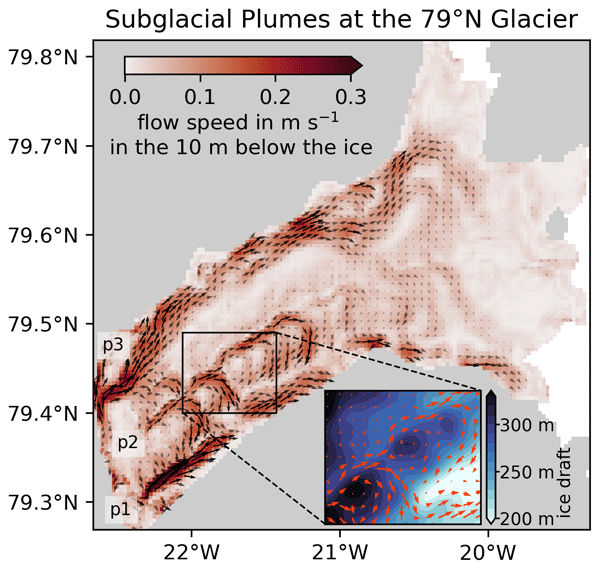
The Greenland Ice Sheet is an important contributor to global sea level rise. In northern Greenland, floating glacier tongues are primarily melted by ocean currents. These processes are difficult to observe, so we developed a realistic numerical model to study ocean-driven melting at Greenland's largest floating ice tongue, the 79° North Glacier. Our simulation reveals the details of the oceanic currents bringing warm water toward the ice base, melting and shaping the glacier tongue from below.
Lucia Gualtieri, Paolo Oddo, Hans Burchard, Federica Borile, Aimie Moulin, Pietro Miraglio, Francesco Maicu, and Emanuela Clementi
EGUsphere, https://doi.org/10.5194/egusphere-2025-5327, https://doi.org/10.5194/egusphere-2025-5327, 2025
Short summary
Short summary
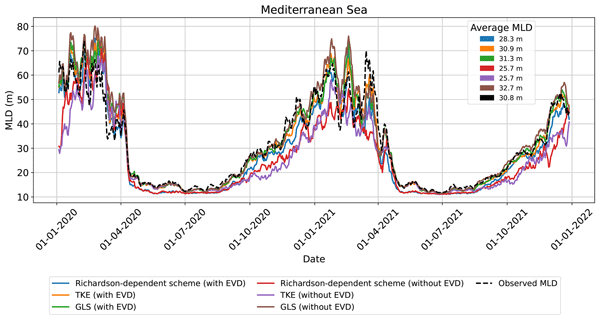
This study addresses a gap in understanding how turbulent mixing closure schemes and convective adjustments interplay in the Mediterranean Sea. Coupled ocean-wave simulations were performed with different mixing parameterizations and model results were compared against Argo float observations across different space and time scales. Results show that the Generalised Length Scale closure scheme best reproduces observed mixed layer properties and variability, without needing convective adjustment.
Hans Burchard, Knut Klingbeil, Xiangyu Li, Lloyd Reese, and W. Rockwell Geyer
EGUsphere, https://doi.org/10.5194/egusphere-2025-6062, https://doi.org/10.5194/egusphere-2025-6062, 2025
Short summary
Short summary
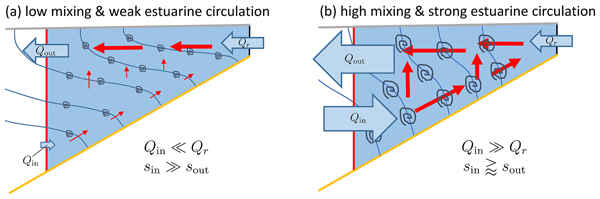
This review presents major aspects of estuarine mixing. Due to the large amounts of brackish water in estuaries produced by mixing of fresh river discharge and salty ocean water, mixing is one major characteristic of what is an estuary. Mixing is quantified locally as well as on estuary-wide scales. Diagnostics of integrated mixing are given for estuarine volumes bounded by transects as well as surfaces of constant salinity moving with the flow. Examples for real-world estuaries are given.
Torsten Kanzow, Angelika Humbert, Thomas Mölg, Mirko Scheinert, Matthias Braun, Hans Burchard, Francesca Doglioni, Philipp Hochreuther, Martin Horwath, Oliver Huhn, Maria Kappelsberger, Jürgen Kusche, Erik Loebel, Katrina Lutz, Ben Marzeion, Rebecca McPherson, Mahdi Mohammadi-Aragh, Marco Möller, Carolyne Pickler, Markus Reinert, Monika Rhein, Martin Rückamp, Janin Schaffer, Muhammad Shafeeque, Sophie Stolzenberger, Ralph Timmermann, Jenny Turton, Claudia Wekerle, and Ole Zeising
The Cryosphere, 19, 1789–1824, https://doi.org/10.5194/tc-19-1789-2025, https://doi.org/10.5194/tc-19-1789-2025, 2025
Short summary
Short summary
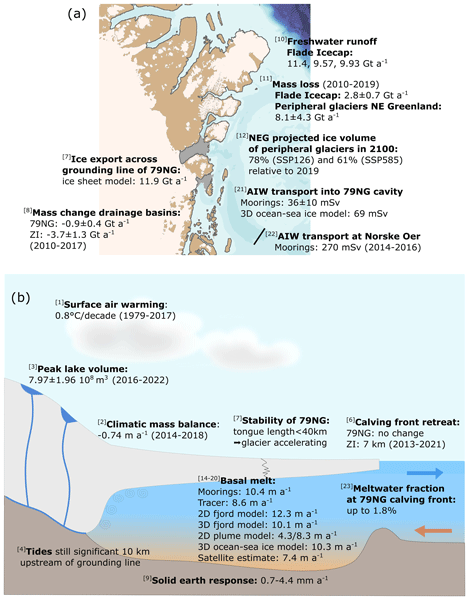
The Greenland Ice Sheet represents the second-largest contributor to global sea-level rise. We quantify atmosphere, ice and ocean processes related to the mass balance of glaciers in northeast Greenland, focusing on Greenland’s largest floating ice tongue, the 79° N Glacier. We find that together, the different in situ and remote sensing observations and model simulations reveal a consistent picture of a coupled atmosphere–ice sheet–ocean system that has entered a phase of major change.
Pia Kolb, Anna Zorndt, Hans Burchard, Ulf Gräwe, and Frank Kösters
Ocean Sci., 18, 1725–1739, https://doi.org/10.5194/os-18-1725-2022, https://doi.org/10.5194/os-18-1725-2022, 2022
Short summary
Short summary
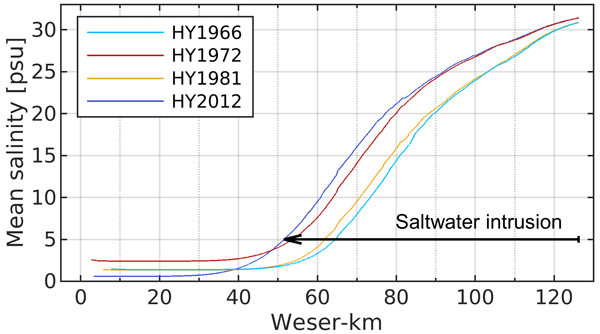
River engineering measures greatly changed tidal dynamics in the Weser estuary. We studied the effect on saltwater intrusion with numerical models. Our analysis shows that a deepening of the navigation channel causes saltwater to intrude further into the Weser estuary. This effect is mostly masked by the natural variability of river discharge. In our study, it proved essential to recalibrate individual hindcast models due to differences in sediments, bed forms, and underlying bathymetric data.
Vera Fofonova, Tuomas Kärnä, Knut Klingbeil, Alexey Androsov, Ivan Kuznetsov, Dmitry Sidorenko, Sergey Danilov, Hans Burchard, and Karen Helen Wiltshire
Geosci. Model Dev., 14, 6945–6975, https://doi.org/10.5194/gmd-14-6945-2021, https://doi.org/10.5194/gmd-14-6945-2021, 2021
Short summary
Short summary
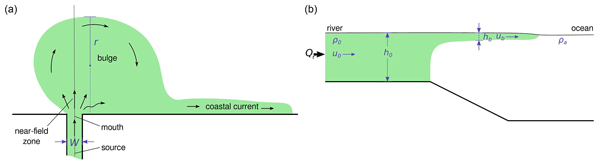
We present a test case of river plume spreading to evaluate coastal ocean models. Our test case reveals the level of numerical mixing (due to parameterizations used and numerical treatment of processes in the model) and the ability of models to reproduce complex dynamics. The major result of our comparative study is that accuracy in reproducing the analytical solution depends less on the type of applied model architecture or numerical grid than it does on the type of advection scheme.
Qing Li, Jorn Bruggeman, Hans Burchard, Knut Klingbeil, Lars Umlauf, and Karsten Bolding
Geosci. Model Dev., 14, 4261–4282, https://doi.org/10.5194/gmd-14-4261-2021, https://doi.org/10.5194/gmd-14-4261-2021, 2021
Short summary
Short summary
Different ocean vertical mixing schemes are usually developed in different modeling framework, making the comparison across such schemes difficult. Here, we develop a consistent framework for testing, comparing, and applying different ocean mixing schemes by integrating CVMix into GOTM, which also extends the capability of GOTM towards including the effects of ocean surface waves. A suite of test cases and toolsets for developing and evaluating ocean mixing schemes is also described.
Cited articles
Biemond, B., de Swart, H. E., and Dijkstra, H. A.: Quantification of salt transports due to exchange flow and tidal flow in estuaries, J. Geophys. Res.-Oceans, 129, e2024JC021294, https://doi.org/10.1029/2024JC021294, 2024. a, b
Blanton, J. O., Lin, G., and Elston, S. A.: Tidal current asymmetry in shallow estuaries and tidal creeks, Cont. Shelf Res., 22, 1731–1743, 2002. a
Burchard, H., Hetland, R. D., Schulz, E., and Schuttelaars, H. M.: Drivers of residual estuarine circulation in tidally energetic estuaries: Straight and irrotational channels with parabolic cross section, J. Phys. Oceanogr., 41, 548–570, 2011. a
Burchard, H., Schuttelaars, H. M., and Ralston, D. K.: Sediment trapping in estuaries, Annu. Rev. Mar. Sci., 10, 371–395, 2018b. a
Burchard, H., Klingbeil, K., Lange, X., Li, X., Lorenz, M., MacCready, P., and Reese, L.: The relation between exchange flow and diahaline mixing in estuaries, J. Phys. Oceanogr., 55, 243–256, https://doi.org/doi.org/10.1175/JPO-D-24-0105.1, 2025a. a
Burchard, H., Klingbeil, K., Li, X., Reese, L., and Geyer, W. R.: Estuarine mixing, EGUsphere [preprint], https://doi.org/10.5194/egusphere-2025-6062, 2025b. a, b
Caballero, I., Morris, E. P., Ruiz, J., and Navarro, G.: Assessment of suspended solids in the Guadalquivir estuary using new DEIMOS-1 medium spatial resolution imagery, Remote Sens. Environ., 146, 148–158, 2014. a
Castillo, J. M., Sirviente, S., Bruno, M., Cabrera-Castro, R., Sánchez-Rodríguez, J., Granado, C., Gallego-Tévar, B., Miró, J. M., and Díez-Minguito, M.: Mining discharges and environmental assessment and management in estuaries: insights from the Guadalquivir Estuary, Spain, Integr. Environ. Asses., https://doi.org/10.1093/inteam/vjaf191, 2025. a
Cobos, M., Baquerizo, A., Díez-Minguito, M., and Losada, M.: A subtidal box model based on the longitudinal anomaly of potential energy for narrow estuaries. An application to the Guadalquivir River Estuary (SW Spain), J. Geophys. Res.-Oceans, 125, e2019JC015242, 2020. a
Cokelet, E. and Stewart, R.: The exchange of water in fjords: The efflux/reflux theory of advective reaches separated by mixing zones, J. Geophys. Res.-Oceans, 90, 7287–7306, 1985. a
de Swart, H. E. and Zimmerman, J. T. F.: Morphodynamics of tidal inlet systems, Annu. Rev. Fluid Mech., 41, 203–229, 2009. a
Díez-Minguito, M. and de Swart, H. E.: Relationships Between Chlorophyll-a and Suspended Sediment Concentration in a High-Nutrient Load Estuary: An Observational and Idealized Modeling Approach, J. Geophys. Res.-Oceans, 125, e2019JC015188, https://doi.org/10.1029/2019JC015188, 2020. a, b
Díez-Minguito, M., Baquerizo, A., Ortega-Sánchez, M., Navarro, G., and Losada, M. A.: Tide transformation in the Guadalquivir estuary (SW Spain) and process-based zonation, J. Geophys. Res.-Oceans, 117, https://doi.org/10.1029/2011JC007344, 2012. a, b, c
Friedrichs, C. T. and Aubrey, D. G.: Non-linear tidal distortion in shallow well-mixed estuaries: a synthesis, Estuar. Coast. Shelf S., 27, 521–545, 1988. a
Friedrichs, C. T. and Aubrey, D. G.: Tidal propagation in strongly convergent channels, J. Geophys. Res.-Oceans, 99, 3321–3336, 1994. a
Geyer, W. R. and MacCready, P.: The estuarine circulation, Annu. Rev. Fluid Mech., 46, 175–197, https://doi.org/10.1146/annurev-fluid-010313-141302, 2014. a, b
Hoitink, A., Hoekstra, P., and Van Maren, D.: Flow asymmetry associated with astronomical tides: Implications for the residual transport of sediment, J. Geophys. Res.-Oceans, 108, https://doi.org/10.1029/2002JC001539, 2003. a
Lewis, R. and Lewis, J.: The principal factors contributing to the flux of salt in a narrow, partially stratified estuary, Estuar. Coast. Shelf S., 16, 599–626, 1983. a
Lorenz, M., Klingbeil, K., MacCready, P., and Burchard, H.: Numerical issues of the Total Exchange Flow (TEF) analysis framework for quantifying estuarine circulation, Ocean Sci., 15, 601–614, https://doi.org/10.5194/os-15-601-2019, 2019. a, b, c, d
Losada, M. A., Díez-Minguito, M., and Reyes-Merlo, M. Á.: Tidal-fluvial interaction in the Guadalquivir River Estuary: Spatial and frequency-dependent response of currents and water levels, J. Geophys. Res.-Oceans, 122, 847–865, 2017. a
Muñoz-Lopez, P., Nadal, I., García-Lafuente, J., Sammartino, S., and Bejarano, A.: Numerical modeling of tidal propagation and frequency responses in the Guadalquivir estuary (SW, Iberian Peninsula), Cont. Shelf Res., 279, 105275, https://doi.org/10.1016/j.csr.2024.105275, 2024. a
Navarro, G., Ruiz, J., Cobos, M., Baquerizo, A., Díez-Minguito, M., Ortega-Sanchez, M., and Losada, M. Á.: Atmospheric, hydrodynamic and water quality observations from environmental-quality stations, water level sensors, acoustic Doppler velocimeters, and meteorological stations located at the Guadalquivir river estuary (2008–2010), Zenodo [data set], https://doi.org/10.5281/zenodo.3459610, 2019. a
Parker, B. B.: The relative importance of the various nonlinear mechanisms in a wide range of tidal interactions, in: Tidal hydrodynamics, Wiley, New York, 237–268, ISBN 0471514985, 1991. a
Pawlowicz, R., Beardsley, B., and Lentz, S.: Classical tidal harmonic analysis including error estimates in MATLAB using T_TIDE, Comput. Geosci., 28, 929–937, 2002. a
Pein, J., Valle-Levinson, A., and Stanev, E.: Secondary circulation asymmetry in a meandering, partially stratified estuary, J. Geophys. Res.-Oceans, 123, 1670–1683, 2018. a
Reese, L., Gräwe, U., Klingbeil, K., Li, X., Lorenz, M., and Burchard, H.: Local mixing determines spatial structure of diahaline exchange flow in a mesotidal estuary: A study of extreme runoff conditions, J. Phys. Oceanogr., 54, 3–27, 2024. a
Reyes-Merlo, M. Á., Díez-Minguito, M., Ortega-Sánchez, M., Baquerizo, A., and Losada, M. Á.: On the relative influence of climate forcing agents on the saline intrusion in a well-mixed estuary: Medium-term Monte Carlo predictions, J Coastal Res., 65, 1200–1205, https://doi.org/10.2112/SI65-203.1, 2013. a, b, c
Rummel, K., Gräwe, U., Klingbeil, K., Kolb, P., Li, X., Reese, L., and Burchard, H.: Spatially resolved salt intrusion mechanisms in a tidal Estuary and the impact of channel deepening, J. Geophys. Res.-Oceans, 130, e2024JC022073, https://doi.org/10.1029/2024JC022073, 2025. a
Sirviente, S., Sánchez-Rodríguez, J., Gomiz-Pascual, J. J., Bolado-Penagos, M., Sierra, A., Ortega, T., Álvarez, O., Forja, J., and Bruno, M.: A numerical simulation study of the hydrodynamic effects caused by morphological changes in the Guadalquivir River Estuary, Sci. Total Environ., 902, 166084, https://doi.org/10.1016/j.scitotenv.2023.166084, 2023. a
Smith, R.: Longitudinal dispersion of a buoyant contaminant in a shallow channel, J. Fluid Mech., 78, 677–688, 1976. a
Speer, P. and Aubrey, D.: A study of non-linear tidal propagation in shallow inlet/estuarine systems Part II: Theory, Estuar. Coast. Shelf S., 21, 207–224, 1985. a
Sutherland, D. A., MacCready, P., Banas, N. S., and Smedstad, L. F.: A model study of the Salish Sea estuarine circulation, J. Phys. Oceanogr., 41, 1125–1143, 2011. a
Short summary
Combining field observations with an analytical tidal scenario, we estimated in the Guadalquivir estuary its Total Exchange Flow (TEF), which has implications for water quality and residence times. The influence of tidal asymmetry on TEF is also explored. Results reveal a spatial variability in TEF and that salinity–current covariance exerts greater control on TEF than tidal asymmetry. The approach is suitable for regional studies evaluating sensitivity to changes in runoff, salinity and tides.
Combining field observations with an analytical tidal scenario, we estimated in the Guadalquivir...