Articles | Volume 22, issue 3
https://doi.org/10.5194/os-22-1819-2026
Research article
 | 
12 Jun 2026
Research article |  | 12 Jun 2026

Greenland tip jet and deep convection in the Irminger Sea: disentangling the roles of heat loss and wind stress

Aleksandr M. Fedorov, M. Femke De Jong, Claudia E. Wieners, Elodie Duyck, and Henk A. Dijkstra

Related authors

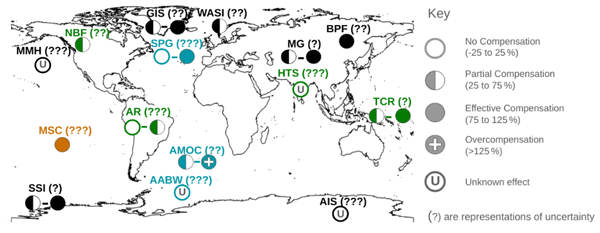
Extracting coherent spatio-temporal modes of simulated multi-centennial AMOC variability under constraints that reflect sparsity of proxy data
Toon Bense, Henk A. Dijkstra, and Pepijn Bakker
EGUsphere, https://doi.org/10.5194/egusphere-2026-2794,https://doi.org/10.5194/egusphere-2026-2794, 2026
This preprint is open for discussion and under review for Climate of the Past (CP).
Short summary
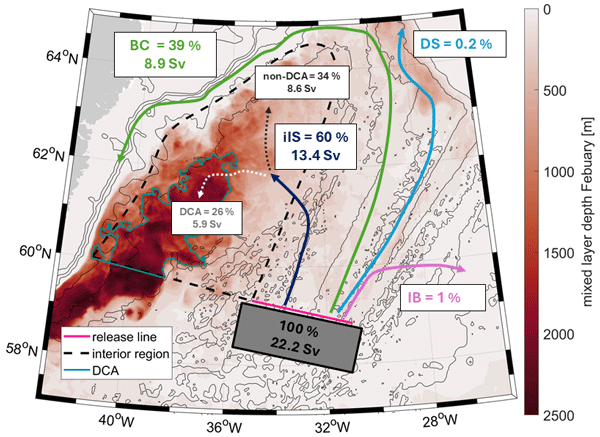
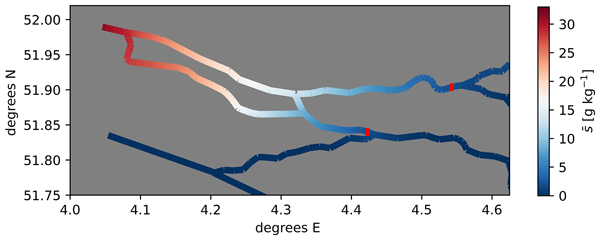
On the fate of the Irminger Current water and its impact on the convection region in the Irminger Sea – a Lagrangian model study
Nora Fried, Renske Gelderloos, Oliver J. Tooth, Caroline A. Katsman, and M. Femke de Jong
Ocean Sci., 22, 1763–1780, https://doi.org/10.5194/os-22-1763-2026,https://doi.org/10.5194/os-22-1763-2026, 2026
Short summary
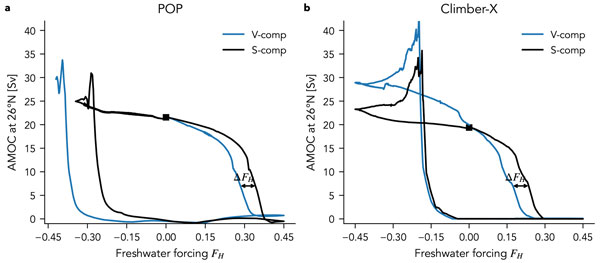
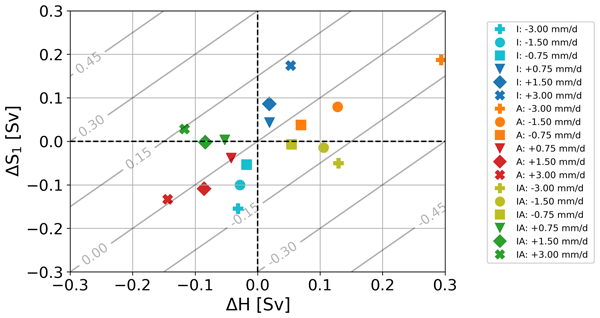
Critical freshwater forcing for AMOC tipping in climate models – compensation matters
Oliver Mehling, Elian Vanderborght, and Henk A. Dijkstra
Earth Syst. Dynam., 17, 563–579, https://doi.org/10.5194/esd-17-563-2026,https://doi.org/10.5194/esd-17-563-2026, 2026
Short summary
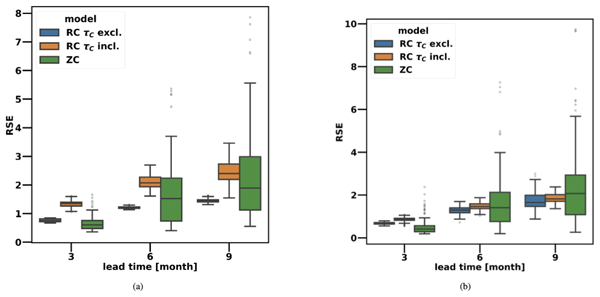
Predicting the distance of the AMOC to its tipping point using CNNs
Francesco Guardamagna, Sacha Sinet, and Henk A. Dijkstra
EGUsphere, https://doi.org/10.5194/egusphere-2026-1872,https://doi.org/10.5194/egusphere-2026-1872, 2026
This preprint is open for discussion and under review for Nonlinear Processes in Geophysics (NPG).
Short summary
Effect of a Bering Strait Closure on AMOC Resilience in a Climate Box Model
Jelle Soons, Elian Vanderborght, and Henk A. Dijkstra
EGUsphere, https://doi.org/10.5194/egusphere-2025-6565,https://doi.org/10.5194/egusphere-2025-6565, 2026
This preprint is open for discussion and under review for Earth System Dynamics (ESD).
Short summary

Cited articles

Bakalian, F., Hameed, S., and Pickart, R.: Influence of the Icelandic Low latitude on the frequency of Greenland tip jet events: Implications for Irminger Sea convection, J. Geophys. Res., 112, C04020, https://doi.org/10.1029/2006JC003807, 2007. 
Biló, T. C., Straneo, F., Holte, J., and Le Bras, I. A.-A.: Arrival of New Great Salinity Anomaly Weakens Convection in the Irminger Sea, Geophys. Res. Lett., 49, e2022GL098857, https://doi.org/10.1029/2022GL098857, 2022. 
Coquereau, A., Foukal, N. P., and Våge, K.: Extreme wind events responsible for an outsized role in shelf-basin exchange around the southern tip of Greenland, Sci. Adv., 10, https://doi.org/10.1126/sciadv.adp9266, 2024. 
de Jong, M. F. and de Steur, L.: Strong winter cooling over the Irminger Sea in winter 2014–2015, exceptional deep convection, and the emergence of anomalously low SST, Geophys. Res. Lett., 43, 7106–7113, https://doi.org/10.1002/2016GL069596, 2016. 
de Jong, M. F., Oltmanns, M., Karstensen, J., and de Steur, L.: Deep Convection in the Irminger Sea Observed with a Dense Mooring Array, Oceanography, 31, 50–59, https://doi.org/10.5670/oceanog.2018.109, 2018. 
Download
Short summary
Deep ocean mixing in the North Atlantic helps power major currents, but it is weakening as the surface warms. We used a high-resolution ocean model and separate experiments that added either extra heat loss, extra wind, or both during Greenland storm events. Extra heat loss caused most of the deep mixing, but strong winds also helped by mixing salty water upward and removing the fresh surface layer early in winter. This wind effect may modulate the future decline of deep mixing.
Share