Articles | Volume 22, issue 3
https://doi.org/10.5194/os-22-1781-2026
© Author(s) 2026. This work is distributed under
the Creative Commons Attribution 4.0 License.

https://doi.org/10.5194/os-22-1781-2026
© Author(s) 2026. This work is distributed under
the Creative Commons Attribution 4.0 License.
Sea ice melt drives vertical pCO2 variability modulating air–sea gas exchange
Henry C. Henson

CORRESPONDING AUTHOR
Department of Ecoscience, Aarhus University, Aarhus, 8000, Denmark
Arctic Research Center, Aarhus University, Aarhus, 8000, Denmark
Dorte H. Søgaard
Arctic Research Center, Aarhus University, Aarhus, 8000, Denmark
Greenland Climate Research Cluster, Greenland Institute of Natural Resources, Nuuk, 3900, Greenland, Denmark
Department of Biology, Center for Ice-free Arctic Research, Aarhus University, Aarhus, 8000, Denmark
Bjarne Jensen
Department of Environmental science, Aarhus University, Roskilde, 4000, Denmark
Kunuk Lennert
UiT, The Arctic University of Norway, Tromsø, 9037, Norway
Tim Papakyriakou
Centre for Earth Observation Science, University of Manitoba, Winnipeg, MB, R3T 2N2, Canada
Mikael K. Sejr
Department of Ecoscience, Aarhus University, Aarhus, 8000, Denmark
Arctic Research Center, Aarhus University, Aarhus, 8000, Denmark
Jakob Sievers
Department of Environmental science, Aarhus University, Roskilde, 4000, Denmark
Søren Rysgaard
Arctic Research Center, Aarhus University, Aarhus, 8000, Denmark
Department of Biology, Center for Ice-free Arctic Research, Aarhus University, Aarhus, 8000, Denmark
Lise Lotte Sørensen
Arctic Research Center, Aarhus University, Aarhus, 8000, Denmark
Department of Environmental science, Aarhus University, Roskilde, 4000, Denmark
Related authors
No articles found.
Jonathan Fipper, Jakob Abermann, Ingo Sasgen, Henrik Skov, Lise Lotte Sørensen, and Wolfgang Schöner
The Cryosphere, 20, 683–698, https://doi.org/10.5194/tc-20-683-2026, https://doi.org/10.5194/tc-20-683-2026, 2026
Short summary
Short summary
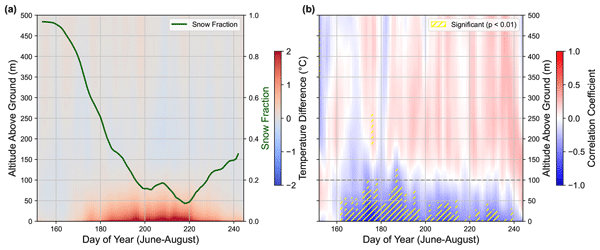
We use measurements conducted with uncrewed aerial vehicles (UAVs) and reanalysis data to study the drivers of vertical air temperature structures and their link to the surface mass balance of Flade Isblink, a large ice cap in Northeast Greenland. Surface properties control temperature structures up to 100 m above ground, while large-scale circulation dominates above. Mass loss has increased since 2015, with record loss in 2023 associated with frequent synoptic conditions favouring melt.
Anna-Maria Virkkala, Isabel Wargowsky, Judith Vogt, McKenzie A. Kuhn, Simran Madaan, Richard O'Keefe, Tiffany Windholz, Kyle A. Arndt, Brendan M. Rogers, Jennifer D. Watts, Kelcy Kent, Mathias Göckede, David Olefeldt, Gerard Rocher-Ros, Edward A. G. Schuur, David Bastviken, Kristoffer Aalstad, Kelly Aho, Joonatan Ala-Könni, Haley Alcock, Inge Althuizen, Christopher D. Arp, Jun Asanuma, Katrin Attermeyer, Mika Aurela, Sivakiruthika Balathandayuthabani, Alan Barr, Maialen Barret, Ochirbat Batkhishig, Christina Biasi, Mats P. Björkman, Andrew Black, Elena Blanc-Betes, Pascal Bodmer, Julia Boike, Abdullah Bolek, Frédéric Bouchard, Ingeborg Bussmann, Lea Cabrol, Eleonora Canfora, Sean Carey, Karel Castro-Morales, Namyi Chae, Andres Christen, Torben R. Christensen, Casper T. Christiansen, Housen Chu, Graham Clark, Francois Clayer, Patrick Crill, Christopher Cunada, Scott J. Davidson, Joshua F. Dean, Sigrid Dengel, Matteo Detto, Catherine Dieleman, Florent Domine, Egor Dyukarev, Colin Edgar, Bo Elberling, Craig A. Emmerton, Eugenie Euskirchen, Grant Falvo, Thomas Friborg, Michelle Garneau, Mariasilvia Giamberini, Mikhail V. Glagolev, Miquel A. Gonzalez-Meler, Gustaf Granath, Jón Guðmundsson, Konsta Happonen, Yoshinobu Harazono, Lorna Harris, Josh Hashemi, Nicholas Hasson, Janna Heerah, Liam Heffernan, Manuel Helbig, Warren Helgason, Michal Heliasz, Greg Henry, Geert Hensgens, Tetsuya Hiyama, Macall Hock, David Holl, Beth Holmes, Jutta Holst, Thomas Holst, Gabriel Hould-Gosselin, Elyn Humphreys, Jacqueline Hung, Jussi Huotari, Hiroki Ikawa, Danil V. Ilyasov, Mamoru Ishikawa, Go Iwahana, Hiroki Iwata, Marcin Antoni Jackowicz-Korczynski, Joachim Jansen, Järvi Järveoja, Vincent E. J. Jassey, Rasmus Jensen, Katharina Jentzsch, Robert G. Jespersen, Carl-Fredrik Johannesson, Chersity P. Jones, Anders Jonsson, Ji Young Jung, Sari Juutinen, Evan Kane, Jan Karlsson, Sergey Karsanaev, Kuno Kasak, Julia Kelly, Kasha Kempton, Marcus Klaus, George W. Kling, Natacha Kljun, Jacqueline Knutson, Hideki Kobayashi, John Kochendorfer, Kukka-Maaria Kohonen, Pasi Kolari, Mika Korkiakoski, Aino Korrensalo, Pirkko Kortelainen, Egle Koster, Kajar Koster, Ayumi Kotani, Praveena Krishnan, Juliya Kurbatova, Lars Kutzbach, Min Jung Kwon, Ethan D. Kyzivat, Jessica Lagroix, Theodore Langhorst, Elena Lapshina, Tuula Larmola, Klaus S. Larsen, Isabelle Laurion, Justin Ledman, Hanna Lee, A. Joshua Leffler, Lance Lesack, Anders Lindroth, David Lipson, Annalea Lohila, Efrén López-Blanco, Vincent L. St. Louis, Erik Lundin, Misha Luoto, Takashi Machimura, Marta Magnani, Avni Malhotra, Marja Maljanen, Ivan Mammarella, Elisa Männistö, Luca Belelli Marchesini, Phil Marsh, Pertti J. Martkainen, Maija E. Marushchak, Mikhail Mastepanov, Alex Mavrovic, Trofim Maximov, Christina Minions, Marco Montemayor, Tomoaki Morishita, Patrick Murphy, Daniel F. Nadeau, Erin Nicholls, Mats B. Nilsson, Anastasia Niyazova, Jenni Nordén, Koffi Dodji Noumonvi, Hannu Nykanen, Walter Oechel, Anne Ojala, Tomohiro Okadera, Sujan Pal, Alexey V. Panov, Tim Papakyriakou, Dario Papale, Sang-Jong Park, Frans-Jan W. Parmentier, Gilberto Pastorello, Mike Peacock, Matthias Peichl, Roman Petrov, Kyra St. Pierre, Norbert Pirk, Jessica Plein, Vilmantas Preskienis, Anatoly Prokushkin, Jukka Pumpanen, Hilary A. Rains, Niklas Rakos, Aleski Räsänen, Helena Rautakoski, Riika Rinnan, Janne Rinne, Adrian Rocha, Nigel Roulet, Alexandre Roy, Anna Rutgersson, Aleksandr F. Sabrekov, Torsten Sachs, Erik Sahlée, Alejandro Salazar, Henrique Oliveira Sawakuchi, Christopher Schulze, Roger Seco, Armando Sepulveda-Jauregui, Svetlana Serikova, Abbey Serrone, Hanna M. Silvennoinen, Sofie Sjogersten, June Skeeter, Jo Snöälv, Sebastian Sobek, Oliver Sonnentag, Emily H. Stanley, Maria Strack, Lena Strom, Patrick Sullivan, Ryan Sullivan, Anna Sytiuk, Torbern Tagesson, Pierre Taillardat, Julie Talbot, Suzanne E. Tank, Mario Tenuta, Irina Terenteva, Frederic Thalasso, Antoine Thiboult, Halldor Thorgeirsson, Fenix Garcia Tigreros, Margaret Torn, Amy Townsend-Small, Claire Treat, Alain Tremblay, Carlo Trotta, Eeva-Stiina Tuittila, Merritt Turetsky, Masahito Ueyama, Muhammad Umair, Aki Vähä, Lona van Delden, Maarten van Hardenbroek, Andrej Varlagin, Ruth K. Varner, Elena Veretennikova, Timo Vesala, Tarmo Virtanen, Carolina Voigt, Jorien E. Vonk, Robert Wagner, Katey Walter Anthony, Qinxue Wang, Masataka Watanabe, Hailey Webb, Jeffrey M. Welker, Andreas Westergaard-Nielsen, Sebastian Westermann, Jeffrey R. White, Christian Wille, Scott N. Williamson, Scott Zolkos, Donatella Zona, and Susan M. Natali
Earth Syst. Sci. Data Discuss., https://doi.org/10.5194/essd-2025-585, https://doi.org/10.5194/essd-2025-585, 2025
Revised manuscript under review for ESSD
Short summary
Short summary
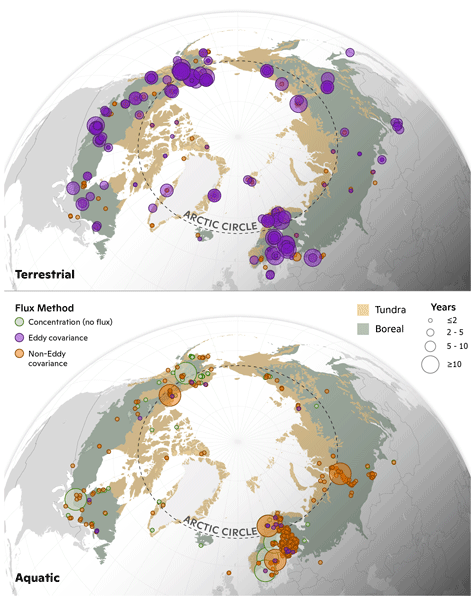
This dataset includes monthly measurements of carbon dioxide and methane exchange between land, water, and the atmosphere from over 1,000 sites in Arctic and boreal regions. It combines measurements from a variety of ecosystems, including wetlands, forests, tundra, lakes, and rivers, gathered by over 260 researchers from 1984–2024. This dataset can be used to improve and reduce uncertainty in carbon budgets in order to strengthen our understanding of climate feedbacks in a warming world.
Fleur Rooijakkers, Ebbe Poulsen, Eugenio Ruiz-Castillo, and Søren Rysgaard
The Cryosphere, 19, 2881–2894, https://doi.org/10.5194/tc-19-2881-2025, https://doi.org/10.5194/tc-19-2881-2025, 2025
Short summary
Short summary
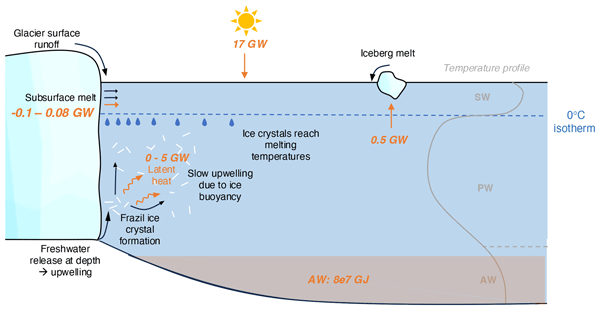
Glacier melting contributes to global sea level rise, largely due to interactions between the ocean and glacier fronts. Understanding these interactions is crucial. This study explores these processes in a fjord in understudied East Greenland, using a drone to collect data near the glacier. Based on our measurements, we hypothesise that glacier meltwater refreezes in cold Polar Water, forming ice crystals that float to the surface and melt when exposed to warmer ocean temperatures.
Jakob Boyd Pernov, Jens Liengaard Hjorth, Lise Lotte Sørensen, and Henrik Skov
Atmos. Chem. Phys., 24, 13603–13631, https://doi.org/10.5194/acp-24-13603-2024, https://doi.org/10.5194/acp-24-13603-2024, 2024
Short summary
Short summary
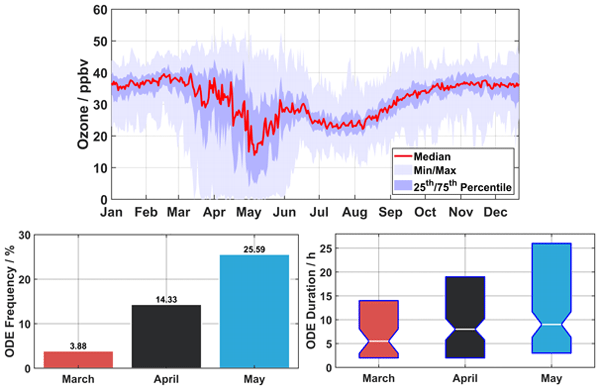
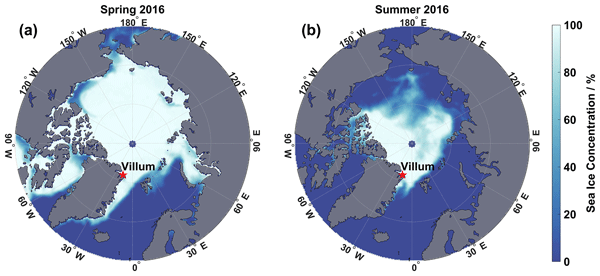
Arctic ozone depletion events (ODEs) occur every spring and have vast implications for the oxidizing capacity, radiative balance, and mercury oxidation. In this study, we analyze ozone, ODEs, and their connection to meteorological and air mass history variables through statistical analyses, back trajectories, and machine learning (ML) at Villum Research Station. ODEs are favorable under sunny, calm conditions with air masses arriving from northerly wind directions with sea ice contact.
Esdoorn Willcox, Marcos Lemes, Thomas Juul-Pedersen, Mikael Kristian Sejr, Johnna Marchiano Holding, and Søren Rysgaard
Biogeosciences, 21, 4037–4050, https://doi.org/10.5194/bg-21-4037-2024, https://doi.org/10.5194/bg-21-4037-2024, 2024
Short summary
Short summary
In this work, we measured the chemistry of seawater from samples obtained from different depths and locations off the east coast of the Northeast Greenland National Park to determine what is influencing concentrations of dissolved CO2. Historically, the region has always been thought to take up CO2 from the atmosphere, but we show that it is possible for the region to become a source in late summer. We discuss the variables that may be related to such changes.
Ulrike Egerer, Holger Siebert, Olaf Hellmuth, and Lise Lotte Sørensen
Atmos. Chem. Phys., 23, 15365–15373, https://doi.org/10.5194/acp-23-15365-2023, https://doi.org/10.5194/acp-23-15365-2023, 2023
Short summary
Short summary
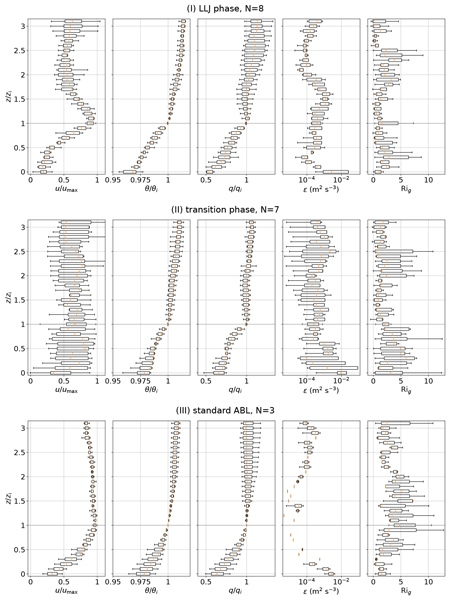
Low-level jets (LLJs) are strong winds near the surface and occur frequently in the Arctic in stable conditions. Using tethered-balloon profile measurements in Greenland, we analyze a multi-hour period with an LLJ that later weakens and finally collapses. Increased shear-induced turbulence at the LLJ bounds mostly does not reach the ground until the LLJ collapses. Our findings support the hypothesis that a passive tracer can be advected with an LLJ and mixed down when the LLJ collapses.
Andreas Massling, Robert Lange, Jakob Boyd Pernov, Ulrich Gosewinkel, Lise-Lotte Sørensen, and Henrik Skov
Atmos. Chem. Phys., 23, 4931–4953, https://doi.org/10.5194/acp-23-4931-2023, https://doi.org/10.5194/acp-23-4931-2023, 2023
Short summary
Short summary
The effect of anthropogenic activities on cloud formation introduces the highest uncertainties with respect to climate change. Data on Arctic aerosols and their corresponding cloud-forming properties are very scarce and most important as the Arctic is warming about 2 times as fast as the rest of the globe. Our studies investigate aerosols in the remote Arctic and suggest relatively high cloud-forming potential, although differences are observed between the Arctic spring and summer.
Eva Friis Møller, Asbjørn Christensen, Janus Larsen, Kenneth D. Mankoff, Mads Hvid Ribergaard, Mikael Sejr, Philip Wallhead, and Marie Maar
Ocean Sci., 19, 403–420, https://doi.org/10.5194/os-19-403-2023, https://doi.org/10.5194/os-19-403-2023, 2023
Short summary
Short summary
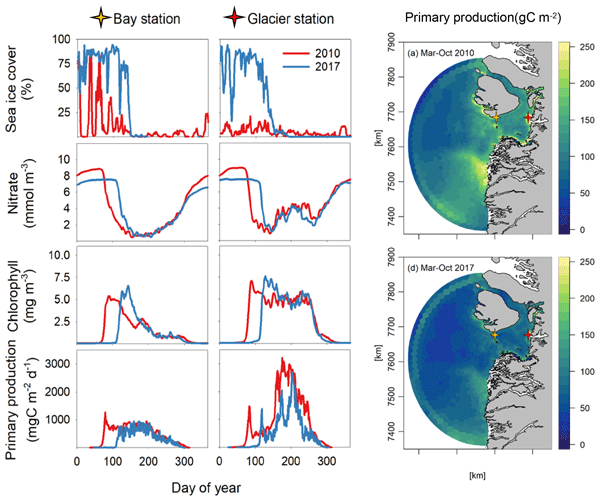
Melt from the Greenland ice sheet and sea ice both influence light and nutrient availability in the Arctic coastal ocean. We use a 3D coupled hydrodynamic–biogeochemical model to evaluate the relative importance of these processes for timing, distribution, and magnitude of phytoplankton production in Disko Bay, west Greenland. Our study indicates that decreasing sea ice and more freshwater discharge can work synergistically and increase primary productivity of the coastal ocean around Greenland.
Jakob Boyd Pernov, Bjarne Jensen, Andreas Massling, Daniel Charles Thomas, and Henrik Skov
Atmos. Chem. Phys., 21, 13287–13309, https://doi.org/10.5194/acp-21-13287-2021, https://doi.org/10.5194/acp-21-13287-2021, 2021
Short summary
Short summary
Atmospheric mercury species (GEM, GOM, PHg) are important constituents in the High Arctic due to their detrimental effects on human and ecosystem health. However, understanding their behavior in the High Arctic summer remains lacking. This research investigates the dynamics of mercury oxidation in the High Arctic summer. The cold, dry, sunlit free troposphere was associated with events of high GOM in the High Arctic summer, while individual events yielded unique origins.
Cited articles
Ahmed, M. M. M., Else, B. G. T., Capelle, D., Miller, L. A., and Papakyriakou, T.: Underestimation of surface pCO2 and air-sea CO2 fluxes due to freshwater stratification in an Arctic shelf sea, Hudson Bay, Elementa: Science of the Anthropocene, 8, 084, https://doi.org/10.1525/elementa.084, 2020.
Arrigo, K. R. and van Dijken, G. L.: Continued increases in Arctic Ocean primary production, Prog. Oceanogr., 136, 60–70, https://doi.org/10.1016/j.pocean.2015.05.002, 2015.
Bates, N. R. and Mathis, J. T.: The Arctic Ocean marine carbon cycle: evaluation of air-sea CO2 exchanges, ocean acidification impacts and potential feedbacks, Biogeosciences, 6, 2433–2459, https://doi.org/10.5194/bg-6-2433-2009, 2009.
Burgers, T. M., Miller, L. A., Thomas, H., Else, B. G. T., Gosselin, M., and Papakyriakou, T.: Surface Water CO2 Variations and Sea-Air CO2 Fluxes During Summer in the Eastern Canadian Arctic, J. Geophys. Res.-Oceans, 122, 9663–9678, https://doi.org/10.1002/2017jc013250, 2017.
Butterworth, B. J., Else, B. G. T., Brown, K. A., Mundy, C. J., Williams, W. J., Rotermund, L. M., and de Boer, G.: Annual carbon dioxide flux over seasonal sea ice in the Canadian Arctic, The Cryosphere, 19, 5317–5335, https://doi.org/10.5194/tc-19-5317-2025, 2025.
Dai, M., Su, J., Zhao, Y., Hofmann, E. E., Cao, Z., Cai, W.-J., Gan, J., Lacroix, F., Laruelle, G. G., Meng, F., Müller, J. D., Regnier, P. A. G., Wang, G., and Wang, Z.: Carbon Fluxes in the Coastal Ocean: Synthesis, Boundary Processes, and Future Trends, Annu. Rev. Earth Pl. Sc., 50, 593–626, https://doi.org/10.1146/annurev-earth-032320-090746, 2022.
de Caritat, P., Hall, G., Gìslason, S., Belsey, W., Braun, M., Goloubeva, N. I., Olsen, H. K., Scheie, J. O., and Vaive, J. E.: Chemical composition of arctic snow: concentration levels and regional distribution of major elements, Sci. Total Environ., 336, 183–199, https://doi.org/10.1016/j.scitotenv.2004.05.031, 2005.
Dong, Y., Yang, M., Bakker, D. C. E., Liss, P. S., Kitidis, V., Brown, I., Chierici, M., Fransson, A., and Bell, T. G.: Near-Surface Stratification Due to Ice Melt Biases Arctic Air-Sea CO2 Flux Estimates, Geophys. Res. Lett., 48, https://doi.org/10.1029/2021GL095266, 2021.
Garbe, C. S., Rutgersson, A., Boutin, J., de Leeuw, G., Delille, B., Fairall, C. W., Gruber, N., Hare, J., Ho, D. T., Johnson, M. T., Nightingale, P. D., Pettersson, H., Piskozub, J., Sahlée, E., Tsai, W., Ward, B., Woolf, D. K., and Zappa, C. J.: Transfer Across the Air-Sea Interface, in: Ocean-Atmosphere Interactions of Gases and Particles, edited by: Liss, P. S. and Johnson, M. T., Springer, Berlin, Heidelberg, 55–112, https://doi.org/10.1007/978-3-642-25643-1_2, 2014.
Gattuso, J.-P., Orr, J., Epitalon, J.-M., Baldry, K., Hoshijima, U., and Abulos: jpgattuso/seacarb-git: Numerous updates since first release, Version v3.2.16, Zenodo [code], https://doi.org/10.5281/zenodo.4600014, 2021.
Geilfus, N.-X., Carnat, G., Papakyriakou, T., Tison, J.-L., Else, B., Thomas, H., Shadwick, E., and Delille, B.: Dynamics of pCO2 and related air-ice CO2 fluxes in the Arctic coastal zone (Amundsen Gulf, Beaufort Sea), J. Geophys. Res., 117, https://doi.org/10.1029/2011JC007118, 2012.
Geilfus, N.-X., Galley, R. J., Crabeck, O., Papakyriakou, T., Landy, J., Tison, J.-L., and Rysgaard, S.: Inorganic carbon dynamics of melt-pond-covered first-year sea ice in the Canadian Arctic, Biogeosciences, 12, 2047–2061, https://doi.org/10.5194/bg-12-2047-2015, 2015.
Granskog, M. A., Kuzyk, Z. Z. A., Azetsu-Scott, K., and Macdonald, R. W.: Distributions of runoff, sea-ice melt and brine using δ18O and salinity data – A new view on freshwater cycling in Hudson Bay, J. Marine Syst., 88, 362–374, https://doi.org/10.1016/j.jmarsys.2011.03.011, 2011.
Greenland Ecosystem Monitoring: MarineBasis Zackenberg - Water column - Water pCO2, Version 1.0, Greenland Ecosystem Monitoring [data set], https://doi.org/10.17897/A8J4-AF12, 2020.
Hansen, J. W., Thamdrup, B., and Jørgensen, B. B.: Anoxic incubation of sediment in gas-tight plastic bags: a method for biogeochemical process studies, Mar. Ecol. Prog. Ser., 208, 273–282, 2000.
Haraldsson, C., Anderson, L. G., Hassellöv, M., Hulth, S., and Olsson, K.: Rapid, high-precision potentiometric titration of alkalinity in ocean and sediment pore waters, Deep-Sea Res. Pt. I, 44, 2031–2044, https://doi.org/10.1016/S0967-0637(97)00088-5, 1997.
Henson, H. C., Holding, J. M., Meire, L., Rysgaard, S., Stedmon, C. A., Stuart-Lee, A., Bendtsen, J., and Sejr, M.: Coastal freshening drives acidification state in Greenland fjords, Sci. Total Environ., 855, 158962, https://doi.org/10.1016/j.scitotenv.2022.158962, 2023.
Henson, H. C., Sejr, M., Meire, L., Sørensen, L. L., Winding, M. H. S., and Holding, J. M.: Resolving Heterogeneity in CO2 Uptake Potential in the Greenland Coastal Ocean, J. Geophys. Res.-Biogeo., 129, e2024JG008246, https://doi.org/10.1029/2024JG008246, 2024.
Henson, H. C., Puts, I. C., Sejr, M. K., Sørensen, L. L., and Holding, J. M.: Glacial meltwater increases coastal carbon dioxide uptake and sensitivity to biogeochemical change, Commun. Earth Environ., 6, 687, https://doi.org/10.1038/s43247-025-02685-4, 2025a.
Henson, H. C., Schrøder, D. S., Jensen, B., Lennert, K., Papakyriakou, T., Sejr, M. K., Sievers, J., and Sørensen, L. L.: High-resolution vertical pCO2 profiles from two Greenlandic fjords during sea-ice breakup, Version v1, Zenodo [data set], https://doi.org/10.5281/zenodo.17471918, 2025b.
Jørgensen, H. E., Sørensen, L. L., and Larsen, S. E.: A Simple Model of Chemistry Effects on the Air-Sea CO2 Exchange Coefficient, J. Geophys. Res.-Oceans, 125, e2018JC014808, https://doi.org/10.1029/2018JC014808, 2020.
Laruelle, G. G., Lauerwald, R., Pfeil, B., and Regnier, P.: Regionalized global budget of the CO2 exchange at the air-water interface in continental shelf seas, Global Biogeochem. Cy., 28, 1199–1214, https://doi.org/10.1002/2014GB004832, 2014.
Liss, P. S. and Slater, P. G.: Flux of Gases across the Air-Sea Interface, Nature, 247, 181–184, https://doi.org/10.1038/247181a0, 1974.
Lueker, T. J., Dickson, A. G., and Keeling, C. D.: Ocean pCO2 calculated from dissolved inorganic carbon, alkalinity, and equations for K1 and K2: validation based on laboratory measurements of CO2 in gas and seawater at equilibrium, Mar. Chem., 70, 105–119, https://doi.org/10.1016/s0304-4203(00)00022-0, 2000.
Meire, L., Søgaard, D. H., Mortensen, J., Meysman, F. J. R., Soetaert, K., Arendt, K. E., Juul-Pedersen, T., Blicher, M. E., and Rysgaard, S.: Glacial meltwater and primary production are drivers of strong CO2 uptake in fjord and coastal waters adjacent to the Greenland Ice Sheet, Biogeosciences, 12, 2347–2363, https://doi.org/10.5194/bg-12-2347-2015, 2015.
Meire, L., Mortensen, J., Meire, P., Juul-Pedersen, T., Sejr, M. K., Rysgaard, S., Nygaard, R., Huybrechts, P., and Meysman, F. J. R.: Marine-terminating glaciers sustain high productivity in Greenland fjords, Glob. Change Biol., 23, 5344–5357, https://doi.org/10.1111/gcb.13801, 2017.
Miller, L. A., Papakyriakou, T. N., Collins, R. E., Deming, J. W., Ehn, J. K., Macdonald, R. W., Mucci, A., Owens, O., Raudsepp, M., and Sutherland, N.: Carbon dynamics in sea ice: A winter flux time series, J. Geophys. Res., 116, C02028, https://doi.org/10.1029/2009JC006058, 2011.
Miller, L. A., Burgers, T. M., Burt, W. J., Granskog, M. A., and Papakyriakou, T. N.: Air-Sea CO2 Flux Estimates in Stratified Arctic Coastal Waters: How Wrong Can We Be?, Geophys. Res. Lett., 46, 235–243, https://doi.org/10.1029/2018gl080099, 2019.
Nomura, D., Yoshikawa-Inoue, H., Toyota, T., and Shirasawa, K.: Effects of snow, snowmelting and refreezing processes on air–sea-ice CO2 flux, J. Glaciol., 56, 262–270, https://doi.org/10.3189/002214310791968548, 2010.
Perovich, D., Meier, W., Tschudi, M., Hendricks, S., Petty, A. A., Divine, D., Farrell, S., Gerland, S., Haas, C., Kaleschke, L., Pavlova, O., Ricker, R., Tian-Kunze, X., Webster, M., and Wood, K.: Arctic Report Card 2020: Sea Ice, NOAA, https://doi.org/10.25923/n170-9h57, 2020.
Raimondi, L., Matthews, J. B. R., Atamanchuk, D., Azetsu-Scott, K., and Wallace, D. W. R.: The internal consistency of the marine carbon dioxide system for high latitude shipboard and in situ monitoring, Mar. Chem., 213, 49–70, https://doi.org/10.1016/j.marchem.2019.03.001, 2019.
Roobaert, A., Laruelle, G. G., Landschützer, P., Gruber, N., Chou, L., and Regnier, P.: The Spatiotemporal Dynamics of the Sources and Sinks of CO2 in the Global Coastal Ocean, Global Biogeochem. Cy., 33, 1693–1714, https://doi.org/10.1029/2019GB006239, 2019.
Rysgaard, S., Vang, T., Stjernholm, M., Rasmussen, B., Windelin, A., and Kiilsholm, S.: Physical Conditions, Carbon Transport, and Climate Change Impacts in a Northeast Greenland Fjord, Arct. Antarct. Alp. Res., 35, 301–312, https://doi.org/10.1657/1523-0430(2003)035[0301:PCCTAC]2.0.CO;2, 2003.
Rysgaard, S., Søgaard, D. H., Cooper, M., Pućko, M., Lennert, K., Papakyriakou, T. N., Wang, F., Geilfus, N. X., Glud, R. N., Ehn, J., McGinnis, D. F., Attard, K., Sievers, J., Deming, J. W., and Barber, D.: Ikaite crystal distribution in winter sea ice and implications for CO2 system dynamics, The Cryosphere, 7, 707–718, https://doi.org/10.5194/tc-7-707-2013, 2013.
Sejr, Krause-Jensen, D., Rysgaard, S., Sørensen, L. L., Christensen, P. B., and Glud, R. N.: Air–sea flux of CO2 in arctic coastal waters influenced by glacial melt water and sea ice, Tellus B, 63, 815–822, https://doi.org/10.1111/j.1600-0889.2011.00540.x, 2011.
Sejr, M. K., Stedmon, C. A., Bendtsen, J., Abermann, J., Juul-Pedersen, T., Mortensen, J., and Rysgaard, S.: Evidence of local and regional freshening of Northeast Greenland coastal waters, Sci. Rep.-UK, 7, 13183, https://doi.org/10.1038/s41598-017-10610-9, 2017.
Semiletov, I., Makshtas, A., Akasofu, S., and L Andreas, E.: Atmospheric CO2 balance: The role of Arctic sea ice, Geophys. Res. Lett., 31, 2003GL017996, https://doi.org/10.1029/2003GL017996, 2004.
Sievers, J., Papakyriakou, T., Larsen, S. E., Jammet, M. M., Rysgaard, S., Sejr, M. K., and Sørensen, L. L.: Estimating surface fluxes using eddy covariance and numerical ogive optimization, Atmos. Chem. Phys., 15, 2081–2103, https://doi.org/10.5194/acp-15-2081-2015, 2015.
Smedman, A., Högström, U., Sahlée, E., and Cecilia, J.: Critical re-evaluation of the bulk transfer coefficient for sensible heat over the ocean during unstable and neutral conditions, Q. J. Roy. Meteor. Soc., 133, 227–250, https://doi.org/10.1002/qj.6, 2007.
Søgaard, D. H., Thomas, D. N., Rysgaard, S., Glud, R. N., Norman, L., Kaartokallio, H., Juul-Pedersen, T., and Geilfus, N.-X.: The relative contributions of biological and abiotic processes to carbon dynamics in subarctic sea ice, Polar Biol., 36, 1761–1777, https://doi.org/10.1007/s00300-013-1396-3, 2013.
Søgaard, D. H., Sorrell, B. K., Sejr, M. K., Andersen, P., Rysgaard, S., Hansen, P. J., Skyttä, A., Lemcke, S., and Lund-Hansen, L. C.: An under-ice bloom of mixotrophic haptophytes in low nutrient and freshwater-influenced Arctic waters, Sci. Rep.-UK, 11, 2915, https://doi.org/10.1038/s41598-021-82413-y, 2021.
Sulpis, O., Lauvset, S. K., and Hagens, M.: Current estimates of and appear inconsistent with measured CO2 system parameters in cold oceanic regions, Ocean Sci., 16, 847–862, https://doi.org/10.5194/os-16-847-2020, 2020.
Verdugo, J., Ruiz-Castillo, E., Rysgaard, S., Boone, W., Papakyriakou, T., Geilfus, N.-X., and Sørensen, L. L.: Snow and Sea Ice Melt Enhance Under-Ice pCO2 Undersaturation in Arctic Waters, Journal of Marine Science and Engineering, 13, 2257, https://doi.org/10.3390/jmse13122257, 2025.
Wanninkhof, R., Asher, W., Ho, D., Sweeney, C., and McGillis, W.: Advances in Quantifying Air-Sea Gas Exchange and Environmental Forcing, Annu. Rev. Mar. Sci., 1, 213–44, https://doi.org/10.1146/annurev.marine.010908.163742, 2009.
Watts, J., Bell, T. G., Anderson, K., Butterworth, B. J., Miller, S., Else, B., and Shutler, J.: Impact of sea ice on air-sea CO2 exchange – A critical review of polar eddy covariance studies, Prog. Oceanogr., 201, 102741, https://doi.org/10.1016/j.pocean.2022.102741, 2022.
Woolf, D. K., Land, P. E., Shutler, J. D., Goddijn-Murphy, L. M., and Donlon, C. J.: On the calculation of air-sea fluxes of CO2 in the presence of temperature and salinity gradients, J. Geophys. Res.-Oceans, 121, 1229–1248, https://doi.org/10.1002/2015JC011427, 2016.
Short summary
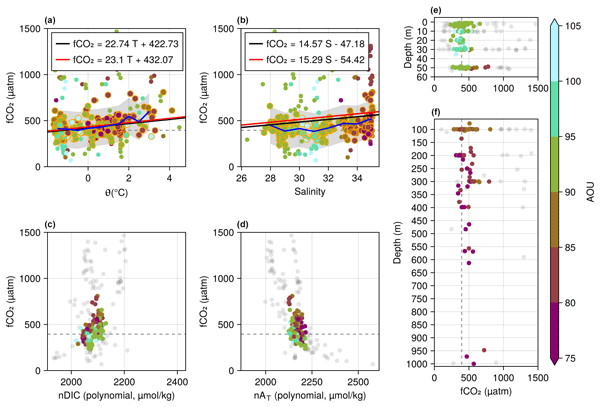
Sea ice melt adds less-saline water to the surface ocean. This creates vertical gradients in salinity, temperature, and partial pressures of carbon dioxide (pCO2). The concentration difference of pCO2 across the air-ocean boundary is used to estimate gas transfer. Thus, the depth that we measure will impact our estimates. Similar patterns were observed in multiple Arctic fjords years apart, suggesting these vertical gradients may be common during the spring melt season.
Sea ice melt adds less-saline water to the surface ocean. This creates vertical gradients in...