
Articles | Volume 22, issue 2
https://doi.org/10.5194/os-22-1329-2026
© Author(s) 2026. This work is distributed under
the Creative Commons Attribution 4.0 License.
the Creative Commons Attribution 4.0 License.
Special issue:
https://doi.org/10.5194/os-22-1329-2026
© Author(s) 2026. This work is distributed under
the Creative Commons Attribution 4.0 License.
the Creative Commons Attribution 4.0 License.
Research article
| 
27 Apr 2026
Research article |
| 27 Apr 2026
| 27 Apr 2026
Marine heatwaves across the central South Pacific: characteristics, mechanisms, and modulation by El Niño Southern Oscillation

UMR 241 SECOPOL, (IRD, ILM, Ifremer, UPF), Tahiti, French Polynesia
ENTROPIE (IRD, Ifremer, Université de la Réunion, Université de la Nouvelle-Calédonie), Nouméa, New Caledonia
Takeshi Izumo
UMR 241 SECOPOL, (IRD, ILM, Ifremer, UPF), Tahiti, French Polynesia
Alexandre Barboni
Laboratoire d'Etudes en Géophysique et Océanographie Spatiales (LEGOS), Toulouse, France
Carla Chevillard
IFREMER, Tahiti, French Polynesia
Cyril Dutheil
MARBEC, University of Montpellier, CNRS, Ifremer, IRD, Sète, France
Raphaël Legrand
DIRPF, Météo France, Tahiti, French Polynesia
Christophe Menkes
ENTROPIE (IRD, Ifremer, Université de la Réunion, Université de la Nouvelle-Calédonie), Nouméa, New Caledonia
Claire Rocuet
UMR 241 SECOPOL, (IRD, ILM, Ifremer, UPF), Tahiti, French Polynesia
Sophie Cravatte
Université de Toulouse, LEGOS (IRD, CNES, CNRS, UT3), Toulouse, France
Related authors
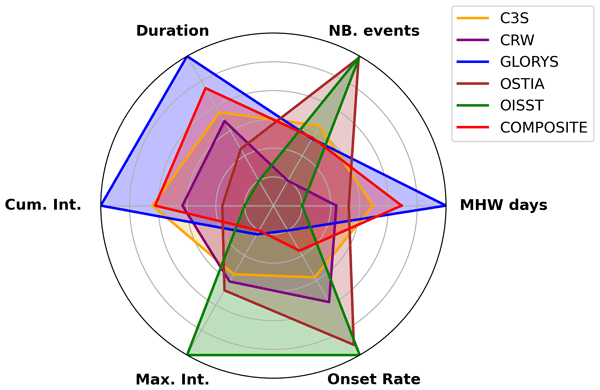
Carla Chevillard, Romain Le Gendre, Christophe Menkes, Takeshi Izumo, Bastien Pagli, Simon Van Wynsberge, and Sophie Cravatte
Ocean Sci., 22, 1213–1236, https://doi.org/10.5194/os-22-1213-2026, https://doi.org/10.5194/os-22-1213-2026, 2026
Short summary
Short summary
To detect past marine heatwaves events and analyse their characteristics, scientists use one of the available sea surface temperature products, relying on different data ingested and procedures. Here, we compare marine heatwaves statistics computed using six products in the tropical Pacific over 1993–2021. We highlight significant differences and provide uncertainties. Our results advocate for the use of multiple products in marine heatwaves studies to increase the robustness of the conclusions.
Lionel Gourdeau, Nadia Ayoub, Arne Bendinger, Sophie Cravatte, Rosemary Morrow, Mei-Ling Dabat, Fabien Léger, and Oscar Vergara
EGUsphere, https://doi.org/10.5194/egusphere-2026-5846, https://doi.org/10.5194/egusphere-2026-5846, 2026
This preprint is open for discussion and under review for Earth Observation (EO).
Short summary
Short summary
For decades, conventional altimeters have observed sea surface height features of hundreds of km. The recent SWOT satellite provides unprecedented observations of fine-scale ocean features down to 15 km. This study shows in a test region that with specific processing of their high-resolution data, conventional altimeters can also capture features down to 20 km, and offer a rich long-term dataset to improve our knowledge of ocean fine-scale processes alongside and beyond the SWOT mission.
Salomé Domergue, Martine Rodier, Cécile Dupouy, Maxime Duphil, David Varillon, Amandine Delepierre, Anne Desnues, Sylvie Fiat, and Christophe Menkes
Earth Syst. Sci. Data Discuss., https://doi.org/10.5194/essd-2026-653, https://doi.org/10.5194/essd-2026-653, 2026
Preprint under review for ESSD
Short summary
Short summary
For over 12 years, MOISE station has monitored coastal waters in the Southwest lagoon of New Caledonia, measuring physical and biogeochemical parameters through water column profiles, surface and bottom sampling, and current measurements. Results reveal clear seasonal and interannual variability, and strong short-term changes driven by tropical cyclones and rainfall. This long-term dataset provides a baseline to study lagoon ecosystem dynamics under climate change.
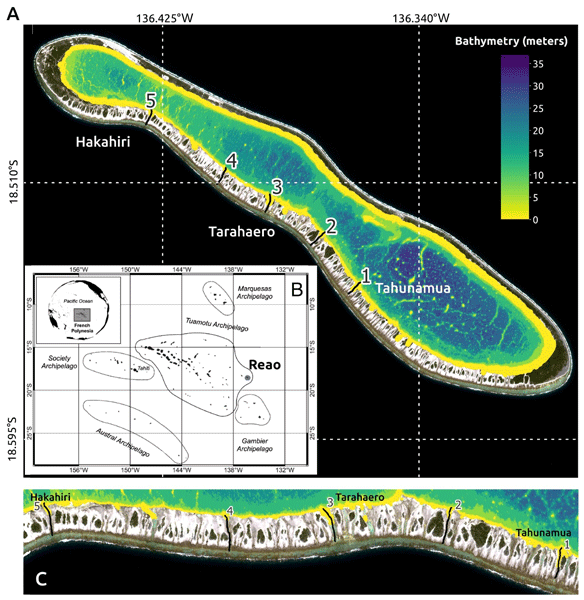
Esther Ladet, Carla Chevillard, Romain Le Gendre, Thomas Trophime, Sébastien Petton, and Simon Van Wynsberge
Earth Syst. Sci. Data, 18, 5283–5302, https://doi.org/10.5194/essd-18-5283-2026, https://doi.org/10.5194/essd-18-5283-2026, 2026
Short summary
Short summary
This dataset on Reao atoll provides an unprecedented record of thermal dynamics and lagoon circulation in a semi-closed atoll of French Polynesia, including full coverage of the extreme 2024 marine heatwave that caused mass bleaching. Collected over six monitoring periods between 2016 and 2025, it offers a critical basis for analysing thermal exposure of giant clams, identifying potential refugia, and supporting modelling of atoll responses to climate change.
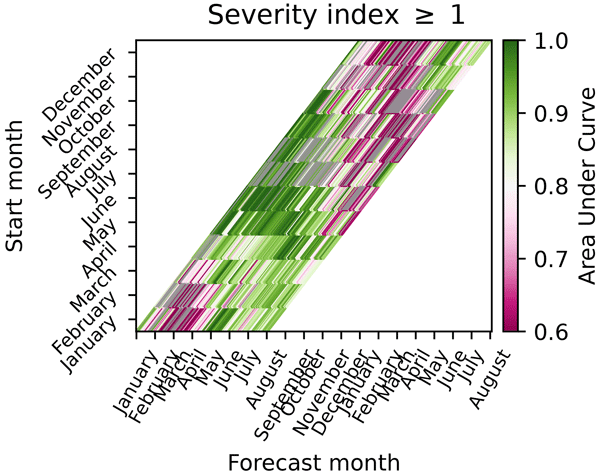
Inès Mangolte, Sophie Cravatte, Alexandre Ganachaud, and Christophe Menkes
Ocean Sci., 22, 1937–1964, https://doi.org/10.5194/os-22-1937-2026, https://doi.org/10.5194/os-22-1937-2026, 2026
Short summary
Short summary
Marine heatwaves pose a serious threat to marine ecosystems that will become increasingly important with climate change. Here we show in the Southwest Pacific that dynamical forecasting systems are able to forecast long, large-scale marine heatwaves occurring in austral winter, but have less skill in predicting smaller, shorter events, and summer events. We discuss the implications for operational forecasts dedicated to help marine managers to prepare and mitigate some of their impacts.
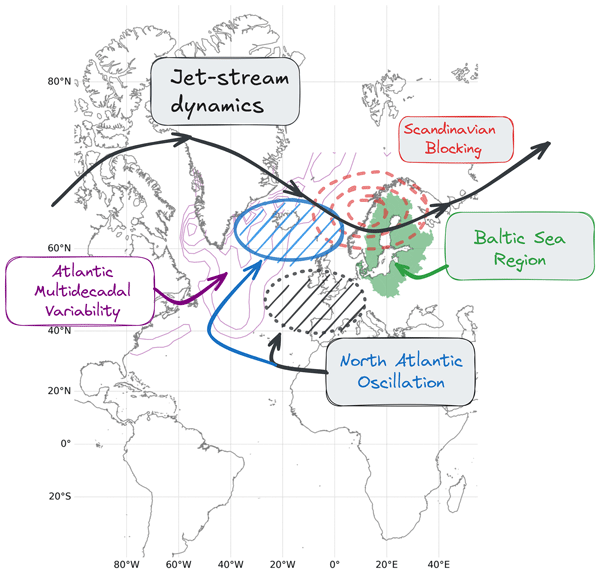
Florian Börgel, Itzel Ruvalcaba Baroni, Leonie Barghorn, Leonard Borchert, Bronwyn Cahill, Cyril Dutheil, Leonie Esters, Małgorzata Falarz, Helena L. Filipsson, Matthias Gröger, Jari Hänninen, Magnus Hieronymus, Erko Jakobson, Mehdi Pasha Karami, Karol Kuliński, Taavi Liblik, H. E. Markus Meier, Gabriele Messori, Lev Naumov, Thomas Neumann, Piia Post, Gregor Rehder, Anna Rutgersson, and Georg Sebastian Voelker
Earth Syst. Dynam., 17, 415–450, https://doi.org/10.5194/esd-17-415-2026, https://doi.org/10.5194/esd-17-415-2026, 2026
Short summary
Short summary
This review explains how weather patterns, guided by the polar jet stream, influence the Baltic Sea’s climate and ecosystem. It covers the North Atlantic Oscillation, blocking events and other processes and discusses how they affect temperature, rainfall, and storms from days to decades. These shifts then impact oxygen levels, productivity, and acidification in the Baltic Sea. Physical links are fairly well known, but biogeochemical pathways remain uncertain.
Carla Chevillard, Romain Le Gendre, Christophe Menkes, Takeshi Izumo, Bastien Pagli, Simon Van Wynsberge, and Sophie Cravatte
Ocean Sci., 22, 1213–1236, https://doi.org/10.5194/os-22-1213-2026, https://doi.org/10.5194/os-22-1213-2026, 2026
Short summary
Short summary
To detect past marine heatwaves events and analyse their characteristics, scientists use one of the available sea surface temperature products, relying on different data ingested and procedures. Here, we compare marine heatwaves statistics computed using six products in the tropical Pacific over 1993–2021. We highlight significant differences and provide uncertainties. Our results advocate for the use of multiple products in marine heatwaves studies to increase the robustness of the conclusions.
Shilpa Lal, Sophie Cravatte, Christophe Menkes, Jed Macdonald, Romain Le Gendre, Ines Mangolte, Cyril Dutheil, Neil J. Holbrook, and Simon Nicol
Ocean Sci., 22, 1023–1049, https://doi.org/10.5194/os-22-1023-2026, https://doi.org/10.5194/os-22-1023-2026, 2026
Short summary
Short summary
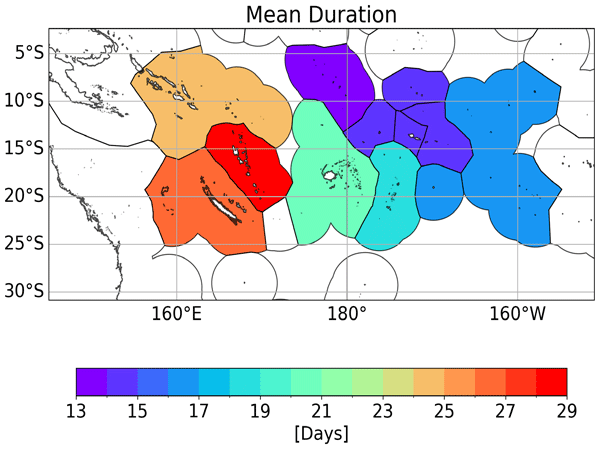
This paper characterizes historical (1981–2023) marine heatwaves in the tropical southwestern Pacific, where they pose a challenge for marine resource dependent Islands. Heatwaves are distinguished as a function of their spatial extent, signature at the coast, and seasonality, to allow a better understanding of their impacts on ecosystems. Marine heatwaves are getting longer and more frequent, with greater spatial extents. Our results aim to inform the Pacific Islands on their vulnerability.
Romain Le Gendre, David Varillon, Sylvie Fiat, Régis Hocdé, Antoine de Ramon N'Yeurt, Serge Andréfouët, Jérôme Aucan, Sophie Cravatte, Maxime Duphil, Alexandre Ganachaud, Baptiste Gaudron, Elodie Kestenare, Vetea Liao, Bernard Pelletier, Alexandre Peltier, Anne-Lou Schaefer, Thomas Trophime, Simon Van Wynsberge, Yves Dandonneau, Michel Allenbach, and Christophe Menkes
Earth Syst. Sci. Data, 17, 5277–5301, https://doi.org/10.5194/essd-17-5277-2025, https://doi.org/10.5194/essd-17-5277-2025, 2025
Short summary
Short summary
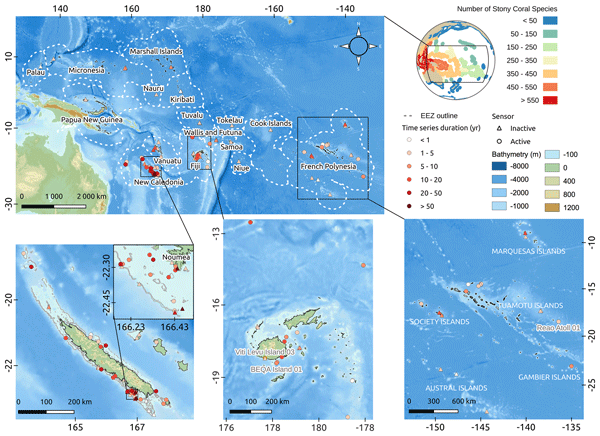
Due to ocean warming, coral reef ecosystems are strongly impacted by dystrophic events and corals experiencing increasing frequencies of bleaching events. In situ observation remains the best alternative for accurate characterization of trends and extremes in these shallow environments. This paper presents the coastal temperature dataset of the ReefTEMPS monitoring network, which spreads over multiple Pacific Island countries and territories (PICTs) in the western and central South Pacific.
Sarah Albernhe, Thomas Gorgues, Olivier Titaud, Patrick Lehodey, Christophe Menkes, and Anna Conchon
State Planet, 6-osr9, 4, https://doi.org/10.5194/sp-6-osr9-4-2025, https://doi.org/10.5194/sp-6-osr9-4-2025, 2025
Short summary
Short summary
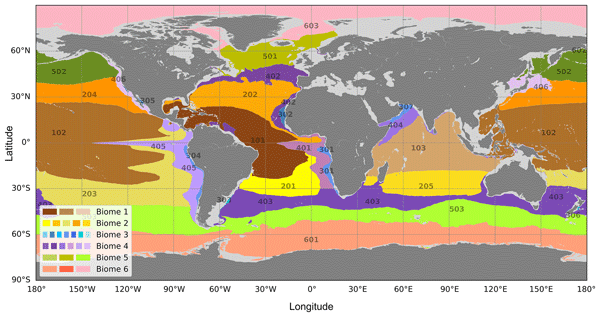
Micronekton are marine organisms gathering a wide diversity of taxa (crustaceans, fish, cephalopods) 2 to 20 cm in size. They are responsible for an important carbon export to the deep ocean and are the main prey for marine predators. We define provinces of homogeneous environmental parameters, representing areas of common micronekton biomass and vertical structure. We observe the evolution of the provinces in time from 1998 to 2023 to account for the seasonal to interannual variability.
Arne Bendinger, Sophie Cravatte, Lionel Gourdeau, Clément Vic, and Florent Lyard
Ocean Sci., 21, 1943–1966, https://doi.org/10.5194/os-21-1943-2025, https://doi.org/10.5194/os-21-1943-2025, 2025
Short summary
Short summary
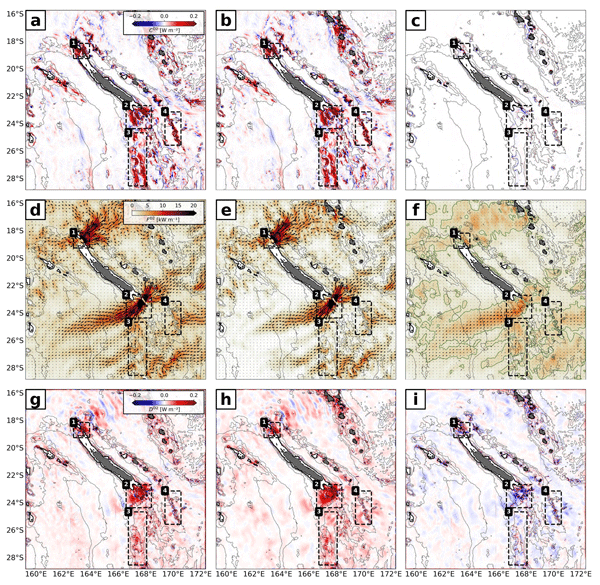
Temporal variability of the semidiurnal internal tide around New Caledonia is investigated using regional modeling. An important contribution to temporal variability not linked to the spring–neap tide cycle is due to the presence of mesoscale eddies both at the generation sites and in the propagation direction. The incoherent tide has a widespread signature in sea surface height (SSH), challenging the SSH observability of mesoscale to submesoscale dynamics.
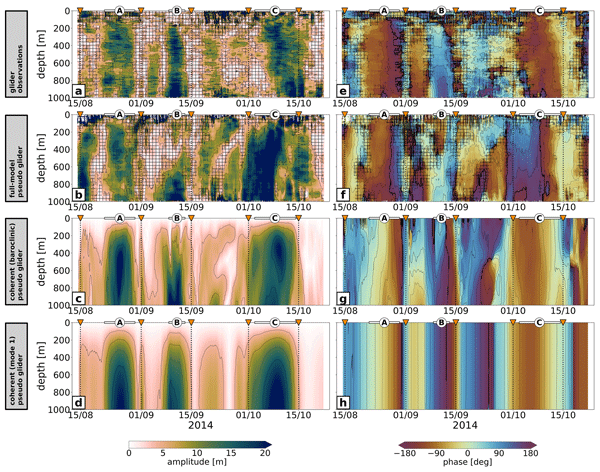
Arne Bendinger, Sophie Cravatte, Lionel Gourdeau, Luc Rainville, Clément Vic, Guillaume Sérazin, Fabien Durand, Frédéric Marin, and Jean-Luc Fuda
Ocean Sci., 20, 945–964, https://doi.org/10.5194/os-20-945-2024, https://doi.org/10.5194/os-20-945-2024, 2024
Short summary
Short summary
A unique dataset of glider observations reveals tidal beams south of New Caledonia – an internal-tide-generation hot spot in the southwestern tropical Pacific. Observations are in good agreement with numerical modeling output, highlighting the glider's capability to infer internal tides while assessing the model's realism of internal-tide dynamics. Discrepancies are in large part linked to eddy–internal-tide interactions. A methodology is proposed to deduce the internal-tide surface signature.
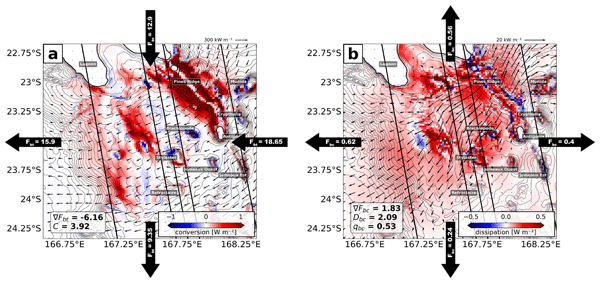
Arne Bendinger, Sophie Cravatte, Lionel Gourdeau, Laurent Brodeau, Aurélie Albert, Michel Tchilibou, Florent Lyard, and Clément Vic
Ocean Sci., 19, 1315–1338, https://doi.org/10.5194/os-19-1315-2023, https://doi.org/10.5194/os-19-1315-2023, 2023
Short summary
Short summary
New Caledonia is a hot spot of internal-tide generation due to complex bathymetry. Regional modeling quantifies the coherent internal tide and shows that most energy is converted in shallow waters and on very steep slopes. The region is a challenge for observability of balanced dynamics due to strong internal-tide sea surface height (SSH) signatures at similar wavelengths. Correcting the SSH for the coherent internal tide may increase the observability of balanced motion to < 100 km.
Cited articles
Amaya, D. J., Jacox, M. G., Fewings, M. R., Saba, V. S., Stuecker, M. F., Rykaczewski, R. R., Ross, A. C., Stock, C. A., Capotondi, A., Petrik, C. M., Bograd, S. J., Alexander, M. A., Cheng, W., Hermann, A. J., Kearney, K. A., and Powell, B. S.: Marine heatwaves need clear definitions so coastal communities can adapt, Nature, 616, 29–32, https://doi.org/10.1038/d41586-023-00924-2, 2023.
Andréfouët, S. and Adjeroud, M.: French Polynesia, in: World Seas: an Environmental Evaluation, Elsevier, 827–854, https://doi.org/10.1016/B978-0-08-100853-9.00039-7, 2019.
Andréfouët, S., Dutheil, C., Menkes, C. E., Bador, M., and Lengaigne, M.: Mass mortality events in atoll lagoons: environmental control and increased future vulnerability, Glob. Change Biol., 21, 195–205, https://doi.org/10.1111/gcb.12699, 2015.
Bian, C., Jing, Z., Wang, H., Wu, L., Chen, Z., Gan, B., and Yang, H.: Oceanic mesoscale eddies as crucial drivers of global marine heatwaves, Nat. Commun., 14, 2970, https://doi.org/10.1038/s41467-023-38811-z, 2023.
Bian, C., Jing, Z., Wang, H., and Wu, L.: Scale-Dependent Drivers of Marine Heatwaves Globally, Geophys. Res. Lett., 51, e2023GL107306, https://doi.org/10.1029/2023GL107306, 2024.
Bretherton, C. S., Widmann, M., Dymnikov, V. P., Wallace, J. M., and Bladé, I.: The Effective Number of Spatial Degrees of Freedom of a Time-Varying Field, J. Climate, 12, 1990–2009, https://doi.org/10.1175/1520-0442(1999)012<1990:TENOSD>2.0.CO;2, 1999.
Bruyère, O., Le Gendre, R., Chauveau, M., Bourgeois, B., Varillon, D., Butscher, J., Trophime, T., Follin, Y., Aucan, J., Liao, V., and Andréfouët, S.: Lagoon hydrodynamics of pearl farming atolls: the case of Raroia, Takapoto, Apataki and Takaroa (French Polynesia), Earth Syst. Sci. Data, 15, 5553–5573, https://doi.org/10.5194/essd-15-5553-2023, 2023.
Capotondi, A., Wittenberg, A. T., Kug, J.-S., Takahashi, K., and McPhaden, M. J.: ENSO Diversity, in: El Niño Southern Oscillation in a Changing Climate, American Geophysical Union (AGU), 65–86, https://doi.org/10.1002/9781119548164.ch4, 2020.
Capotondi, A., Rodrigues, R. R., Sen Gupta, A., Benthuysen, J. A., Deser, C., Frölicher, T. L., Lovenduski, N. S., Amaya, D. J., Le Grix, N., Xu, T., Hermes, J., Holbrook, N. J., Martinez-Villalobos, C., Masina, S., Roxy, M. K., Schaeffer, A., Schlegel, R. W., Smith, K. E., and Wang, C.: A global overview of marine heatwaves in a changing climate, Commun. Earth Environ., 5, 701, https://doi.org/10.1038/s43247-024-01806-9, 2024.
Chevillard, C., Le Gendre, R., Menkes, C., Izumo, T., Pagli, B., Van Wynsberge, S., and Cravatte, S.: Sensitivity of marine heatwaves metrics to SST products, focusing on the Tropical Pacific, EGUsphere [preprint], https://doi.org/10.5194/egusphere-2025-5417, 2025.
Cohen, J. T., Thompson, L., Maroon, E., Deppenmeier, A.-L., and Cai, C.: Object-Based Evaluation of Seasonal-to-Multiyear Marine Heatwave Predictions, Geophys. Res. Lett., 52, e2025GL115021, https://doi.org/10.1029/2025GL115021, 2025.
datagouv: Géographie administrative de la Polynésie française, Section Cadastre-Topographie de la Polynésie française, https://www.data.gouv.fr/fr/datasets/geographie-administrative-de-la-polynesie-francaise/ (last access: April 2025).
de Boisséson, E. and Balmaseda, M. A.: Predictability of marine heatwaves: assessment based on the ECMWF seasonal forecast system, Ocean Sci., 20, 265–278, https://doi.org/10.5194/os-20-265-2024, 2024.
DeCarlo, T. M., Gajdzik, L., Ellis, J., Coker, D. J., Roberts, M. B., Hammerman, N. M., Pandolfi, J. M., Monroe, A. A., and Berumen, M. L.: Nutrient-supplying ocean currents modulate coral bleaching susceptibility, Sci. Adv., 6, eabc5493, https://doi.org/10.1126/sciadv.abc5493, 2020.
Dee, D. P., Uppala, S. M., Simmons, A. J., Berrisford, P., Poli, P., Kobayashi, S., Andrae, U., Balmaseda, M. A., Balsamo, G., Bauer, P., Bechtold, P., Beljaars, A. C. M., Van De Berg, L., Bidlot, J., Bormann, N., Delsol, C., Dragani, R., Fuentes, M., Geer, A. J., Haimberger, L., Healy, S. B., Hersbach, H., Hólm, E. V., Isaksen, L., Kållberg, P., Köhler, M., Matricardi, M., McNally, A. P., Monge-Sanz, B. M., Morcrette, J.-J., Park, B. -K., Peubey, C., De Rosnay, P., Tavolato, C., Thépaut, J.-N., and Vitart, F.: The ERA-Interim reanalysis: configuration and performance of the data assimilation system, Q. J. Roy. Meteor. Soc., 137, 553–597, https://doi.org/10.1002/qj.828, 2011.
Deppenmeier, A.-L., Bryan, F. O., Kessler, W. S., and Thompson, L.: Modulation of Cross-Isothermal Velocities with ENSO in the Tropical Pacific Cold Tongue, J. Phys. Oceanogr., 51, 1559–1574, https://doi.org/10.1175/JPO-D-20-0217.1, 2021.
Dutheil, C., Lal, S., Lengaigne, M., Cravatte, S., Menkès, C., Receveur, A., Börgel, F., Gröger, M., Houlbreque, F., Le Gendre, R., Mangolte, I., Peltier, A., and Meier, H. E. M.: The massive 2016 marine heatwave in the Southwest Pacific: An “El Niño–Madden-Julian Oscillation” compound event, Sci. Adv., 10, eadp2948, https://doi.org/10.1126/sciadv.adp2948, 2024.
Elzahaby, Y., Schaeffer, A., Roughan, M., and Delaux, S.: Oceanic Circulation Drives the Deepest and Longest Marine Heatwaves in the East Australian Current System, Geophys. Res. Lett., 48, e2021GL094785, https://doi.org/10.1029/2021GL094785, 2021.
Elzahaby, Y., Schaeffer, A., Roughan, M., and Delaux, S.: Why the Mixed Layer Depth Matters When Diagnosing Marine Heatwave Drivers Using a Heat Budget Approach, Front. Clim., 4, https://doi.org/10.3389/fclim.2022.838017, 2022.
E.U. Copernicus Marine Service Information: Global Ocean Physics Reanalysis, E.U. Copernicus Marine Service Information [data set], https://doi.org/10.48670/moi-00021, 2023.
Glynn, P. W.: Widespread Coral Mortality and the 1982–83 El Niño Warming Event, Environ. Conserv., 11, 133–146, https://doi.org/10.1017/S0376892900013825, 1984.
Gonzalez-Espinosa, P. C. and Donner, S. D.: Cloudiness reduces the bleaching response of coral reefs exposed to heat stress, Glob. Change Biol., 27, 3474–3486, https://doi.org/10.1111/gcb.15676, 2021.
Gregory, C. H., Artana, C., Lama, S., León-FonFay, D., Sala, J., Xiao, F., Xu, T., Capotondi, A., Martinez-Villalobos, C., and Holbrook, N. J.: Global Marine Heatwaves Under Different Flavors of ENSO, Geophys. Res. Lett., 51, e2024GL110399, https://doi.org/10.1029/2024GL110399, 2024.
Gupta, H. and Sil, S.: Assessment of GHRSST and OISST Datasets in Identification of Marine Heat-Waves and Heat-Spikes, IEEE Geosci. Remote S., 21, 1–5, https://doi.org/10.1109/LGRS.2024.3362474, 2024.
Hédouin, L., Rouzé, H., Berthe, C., Perez-Rosales, G., Martinez, E., Chancerelle, Y., Galand, P. E., Lerouvreur, F., Nugues, M. M., Pochon, X., Siu, G., Steneck, R., and Planes, S.: Contrasting patterns of mortality in Polynesian coral reefs following the third global coral bleaching event in 2016, Coral Reefs, 39, 939–952, https://doi.org/10.1007/s00338-020-01914-w, 2020.
Hersbach, H., Bell, B., Berrisford, P., Hirahara, S., Horányi, A., Muñoz-Sabater, J., Nicolas, J., Peubey, C., Radu, R., Schepers, D., Simmons, A., Soci, C., Abdalla, S., Abellan, X., Balsamo, G., Bechtold, P., Biavati, G., Bidlot, J., Bonavita, M., De Chiara, G., Dahlgren, P., Dee, D., Diamantakis, M., Dragani, R., Flemming, J., Forbes, R., Fuentes, M., Geer, A., Haimberger, L., Healy, S., Hogan, R. J., Hólm, E., Janisková, M., Keeley, S., Laloyaux, P., Lopez, P., Lupu, C., Radnoti, G., de Rosnay, P., Rozum, I., Vamborg, F., Villaume, S., and Thépaut, J.-N.: The ERA5 global reanalysis, Q. J. Roy. Meteor. Soc., 146, 1999–2049, https://doi.org/10.1002/qj.3803, 2020.
Hobday, A. J., Alexander, L. V., Perkins, S. E., Smale, D. A., Straub, S. C., Oliver, E. C. J., Benthuysen, J. A., Burrows, M. T., Donat, M. G., Feng, M., Holbrook, N. J., Moore, P. J., Scannell, H. A., Sen Gupta, A., and Wernberg, T.: A hierarchical approach to defining marine heatwaves, Prog. Oceanogr., 141, 227–238, https://doi.org/10.1016/j.pocean.2015.12.014, 2016.
Hobday, A. J., Oliver, E. C. J., Gupta, A. S., Benthuysen, J. A., Burrows, M. T., Donat, M. G., Holbrook, N. J., Moore, P. J., Thomsen, M. S., Wernberg, T., and Smale, D. A.: Categorizing and Naming MARINE HEATWAVES, Oceanography, 31, 162–173, 2018.
Holbrook, N., Sen Gupta, A., Oliver, E., Hobday, A., Benthuysen, J., Scannell, H., Smale, D., and Wernberg, T.: Keeping pace with marine heatwaves, Nat. Rev. Earth Environ., 1, https://doi.org/10.1038/s43017-020-0068-4, 2020.
Holbrook, N. J., Scannell, H. A., Sen Gupta, A., Benthuysen, J. A., Feng, M., Oliver, E. C. J., Alexander, L. V., Burrows, M. T., Donat, M. G., Hobday, A. J., Moore, P. J., Perkins-Kirkpatrick, S. E., Smale, D. A., Straub, S. C., and Wernberg, T.: A global assessment of marine heatwaves and their drivers, Nat. Commun., 10, 2624, https://doi.org/10.1038/s41467-019-10206-z, 2019.
Holbrook, N. J., Hernaman, V., Koshiba, S., Lako, J., Kajtar, J. B., Amosa, P., and Singh, A.: Impacts of marine heatwaves on tropical western and central Pacific Island nations and their communities, Global Planet. Change, 208, 103680, https://doi.org/10.1016/j.gloplacha.2021.103680, 2022.
Huang, B., Liu, C., Banzon, V., Freeman, E., Graham, G., Hankins, B., Smith, T., and Zhang, H.-M.: Improvements of the Daily Optimum Interpolation Sea Surface Temperature (DOISST) Version 2.1, J. Climate, 34, 2923–2939, https://doi.org/10.1175/JCLI-D-20-0166.1, 2021.
Jacox, M. G., Alexander, M. A., Amaya, D., Becker, E., Bograd, S. J., Brodie, S., Hazen, E. L., Pozo Buil, M., and Tommasi, D.: Global seasonal forecasts of marine heatwaves, Nature, 604, 486–490, https://doi.org/10.1038/s41586-022-04573-9, 2022.
Lachs, L., Bythell, J. C., East, H. K., Edwards, A. J., Mumby, P. J., Skirving, W. J., Spady, B. L., and Guest, J. R.: Fine-Tuning Heat Stress Algorithms to Optimise Global Predictions of Mass Coral Bleaching, Remote Sens., 13, 2677, https://doi.org/10.3390/rs13142677, 2021.
Lal, S., Cravatte, S., Menkes, C., Macdonald, J., LeGendre, R., Mangolte, I., Dutheil, C., Holbrook, N., and Nicol, S.: Characterization of Past Marine Heatwaves around South Pacific Island Countries: What really matters?, EGUsphere [preprint], https://doi.org/10.5194/egusphere-2025-3281, 2025.
Le Gendre, R., Varillon, D., Fiat, S., Hocdé, R., de Ramon N'Yeurt, A., Andréfouët, S., Aucan, J., Cravatte, S., Duphil, M., Ganachaud, A., Gaudron, B., Kestenare, E., Liao, V., Pelletier, B., Peltier, A., Schaefer, A.-L., Trophime, T., Van Wynsberge, S., Dandonneau, Y., Allenbach, M., and Menkes, C.: ReefTEMPS: the Pacific Islands coastal temperature network, Earth Syst. Sci. Data, 17, 5277–5301, https://doi.org/10.5194/essd-17-5277-2025, 2025.
Lellouche, J.-M., Greiner, E., Le Galloudec, O., Garric, G., Regnier, C., Drevillon, M., Benkiran, M., Testut, C.-E., Bourdalle-Badie, R., Gasparin, F., Hernandez, O., Levier, B., Drillet, Y., Remy, E., and Le Traon, P.-Y.: Recent updates to the Copernicus Marine Service global ocean monitoring and forecasting real-time
Lellouche, J.-M., Greiner, E., Bourdallé-Badie, R., Garric, G., Melet, A., Drévillon, M., Bricaud, C., Hamon, M., Le Galloudec, O., Regnier, C., Candela, T., Testut, C.-E., Gasparin, F., Ruggiero, G., Benkiran, M., Drillet, Y., Le Traon, P.-Y., Bourdallé-Badie, R., Garric, G., Melet, A., Drévillon, M., Bricaud, C., Hamon, M., Le Galloudec, O., Regnier, C., Candela, T., Testut, C.-E., Gasparin, F., Ruggiero, G., Benkiran, M., Drillet, Y., and Le Traon, P.-Y.: The Copernicus Global
Madec, G., Bell, M., Benshila, R., Blaker, A., Boudrallé-Badie, R., Bricaud, C., Bruciaferri, D., Carneiro, D., Castrillo, M., Calvert, D., Chanut, J., Clementi, E., Coward, A., Lavergne, C. de, Dobricic, S., Epicoco, I., Éthé, C., Fiedler, E., Ford, D., Furner, R., Ganderton, J., Graham, T., Harle, J., Hutchinson, K., Iovino, D., King, R., Lea, D., Levy, C., Lovato, T., Maisonnave, E., Mak, J., Sanchez, J. M. C., Martin, M., Martin, N., Martins, D., Masson, S., Mathiot, P., Mele, F., Mocavero, S., Moulin, A., Müller, S., Nurser, G., Oddo, P., Paronuzzi, S., Paul, J., Peltier, M., Person, R., Rousset, C., Rynders, S., Samson, G., Schroeder, D., Storkey, D., Storto, A., Téchené, S., Vancoppenolle, M., and Wilson, C.: NEMO Ocean Engine Reference Manual, Zenodo, https://doi.org/10.5281/zenodo.1464816, 2024.
Marin, M., Feng, M., Bindoff, N. L., and Phillips, H. E.: Local Drivers of Extreme Upper Ocean Marine Heatwaves Assessed Using a Global Ocean Circulation Model, Front. Clim., 4, https://doi.org/10.3389/fclim.2022.788390, 2022.
Martinez, E., Ganachaud, A., Lefevre, J., and Maamaatuaiahutapu, K.: Central South Pacific thermocline water circulation from a high-resolution ocean model validated against satellite data: Seasonal variability and El Niño 1997–1998 influence, J. Geophys. Res.-Oceans, 114, https://doi.org/10.1029/2008JC004824, 2009.
Moisan, J. R. and Niiler, P. P.: The Seasonal Heat Budget of the North Pacific: Net Heat Flux and Heat Storage Rates (1950–1990), J. Phys. Oceanogr., 28, 401–421, https://doi.org/10.1175/1520-0485(1998)028<0401:TSHBOT>2.0.CO;2, 1998.
Mumby, P., Chisholm, J., Edwards, A., Andrefouet, S., and Jaubert, J.: Cloudy weather may have saved Society Island reef corals during the 1998 ENSO event, Mar. Ecol. Prog. Ser., 222, 209–216, https://doi.org/10.3354/meps222209, 2001a.
Mumby, P., Chisholm, J., Edwards, A., Clark, C., Roark, E., Andrefouet, S., and Jaubert, J.: Unprecedented bleaching-induced mortality in Porites spp. at Rangiroa Atoll, French Polynesia, Mar. Biol., 139, 183–189, https://doi.org/10.1007/s002270100575, 2001b.
Oliver, E. C. J., Donat, M. G., Burrows, M. T., Moore, P. J., Smale, D. A., Alexander, L. V., Benthuysen, J. A., Feng, M., Sen Gupta, A., Hobday, A. J., Holbrook, N. J., Perkins-Kirkpatrick, S. E., Scannell, H. A., Straub, S. C., and Wernberg, T.: Longer and more frequent marine heatwaves over the past century, Nat. Commun., 9, 1324, https://doi.org/10.1038/s41467-018-03732-9, 2018.
Oliver, E. C. J., Burrows, M. T., Donat, M. G., Sen Gupta, A., Alexander, L. V., Perkins-Kirkpatrick, S. E., Benthuysen, J. A., Hobday, A. J., Holbrook, N. J., Moore, P. J., Thomsen, M. S., Wernberg, T., and Smale, D. A.: Projected Marine Heatwaves in the 21st Century and the Potential for Ecological Impact, Front. Mar. Sci., 6, 734, https://doi.org/10.3389/fmars.2019.00734, 2019.
Oliver, E. C. J., Benthuysen, J. A., Darmaraki, S., Donat, M. G., Hobday, A. J., Holbrook, N. J., Schlegel, R. W., and Gupta, A. S.: Marine Heatwaves, Annu. Rev. Mar. Sci., 13, 313–342, https://doi.org/10.1146/annurev-marine-032720-095144, 2021.
Pagli, B., Izumo, T., Cravatte, S. E., Hopuare, M., Martinoni-Lapierre, S., Laurent, V., Menkes, C., Monselesan, D., and Auffray, S.: The Diverse Impacts of El Niño and La Niña Events over the South Pacific and in French Polynesia, J. Climate, 38, 2681–2701, https://doi.org/10.1175/JCLI-D-24-0408.1, 2025.
Paulson, C. A. and Simpson, J. J.: Irradiance Measurements in the Upper Ocean, J. Phys. Oceanogr., 7, 952–956, https://doi.org/10.1175/1520-0485(1977)007<0952:IMITUO>2.0.CO;2, 1977.
Petrelli, P.: Improved threshold and documents, GitHub [code], https://github.com/coecms/xmhw/releases/tag/0.7.0 (last access: June 2025), 2021.
Pilo, G. S., Holbrook, N. J., Kiss, A. E., and Hogg, A. McC.: Sensitivity of Marine Heatwave Metrics to Ocean Model Resolution, Geophys. Res. Lett., 46, 14604–14612, https://doi.org/10.1029/2019GL084928, 2019.
Schlegel, R. W., Oliver, E. C. J., and Chen, K.: Drivers of Marine Heatwaves in the Northwest Atlantic: The Role of Air–Sea Interaction During Onset and Decline, Front. Mar. Sci., 8, https://doi.org/10.3389/fmars.2021.627970, 2021.
Sen Gupta, A.: Marine heatwaves: definition duel heats up, Nature, 617, 465–465, https://doi.org/10.1038/d41586-023-01619-4, 2023.
Sen Gupta, A., Thomsen, M., Benthuysen, J. A., Hobday, A. J., Oliver, E., Alexander, L. V., Burrows, M. T., Donat, M. G., Feng, M., Holbrook, N. J., Perkins-Kirkpatrick, S., Moore, P. J., Rodrigues, R. R., Scannell, H. A., Taschetto, A. S., Ummenhofer, C. C., Wernberg, T., and Smale, D. A.: Drivers and impacts of the most extreme marine heatwave events, Sci. Rep., 10, 19359, https://doi.org/10.1038/s41598-020-75445-3, 2020.
Skirving, W., Marsh, B., De La Cour, J., Liu, G., Harris, A., Maturi, E., Geiger, E., and Eakin, C. M.: CoralTemp and the Coral Reef Watch Coral Bleaching Heat Stress Product Suite Version 3.1, Remote Sens., 12, 3856, https://doi.org/10.3390/rs12233856, 2020.
Smith, K. E., Sen Gupta, A., Amaya, D., Benthuysen, J. A., Burrows, M. T., Capotondi, A., Filbee-Dexter, K., Frölicher, T. L., Hobday, A. J., Holbrook, N. J., Malan, N., Moore, P. J., Oliver, E. C. J., Richaud, B., Salcedo-Castro, J., Smale, D. A., Thomsen, M., and Wernberg, T.: Baseline matters: Challenges and implications of different marine heatwave baselines, Prog. Oceanogr., 231, 103404, https://doi.org/10.1016/j.pocean.2024.103404, 2025.
Stackhouse, P. W., Cox, S. J., Mikovitz, J. C., and Zhang, T.: GEWEX (Global Energy and Water Exchanges Project): Surface Radiation Budget (SRB) Release 4 Integrated Product (IP4) – Algorithm Theoretical Basis Document and Evaluation, NASA, 2021.
Van Wynsberge, S., Menkes, C., Le Gendre, R., Passfield, T., and Andréfouët, S.: Are Sea Surface Temperature satellite measurements reliable proxies of lagoon temperature in the South Pacific?, Estuar. Coast. Shelf S., 199, 117–124, https://doi.org/10.1016/j.ecss.2017.09.033, 2017.
Van Wynsberge, S., Quéré, R., Andréfouët, S., Autret, E., and Le Gendre, R.: Spatial variability of temperature inside atoll lagoons assessed with Landsat-8 satellite imagery, Remote Sens. Appl. Soc. Environ., 36, 101340, https://doi.org/10.1016/j.rsase.2024.101340, 2024.
Vincent, E. M., Lengaigne, M., Menkes, C. E., Jourdain, N. C., Marchesiello, P., and Madec, G.: Interannual variability of the South Pacific Convergence Zone and implications for tropical cyclone genesis, Clim. Dynam., 36, 1881–1896, https://doi.org/10.1007/s00382-009-0716-3, 2011.
Vogt, L., Burger, F. A., Griffies, S. M., and Frölicher, T. L.: Local Drivers of Marine Heatwaves: A Global Analysis With an Earth System Model, Front. Clim., 4, https://doi.org/10.3389/fclim.2022.847995, 2022.
Watanabe, M., Kang, S. M., Collins, M., Hwang, Y.-T., McGregor, S., and Stuecker, M. F.: Possible shift in controls of the tropical Pacific surface warming pattern, Nature, 630, 315–324, https://doi.org/10.1038/s41586-024-07452-7, 2024.
Whitaker, H. and DeCarlo, T.: Re(de)fining degree-heating week: coral bleaching variability necessitates regional and temporal optimization of global forecast model stress metrics, Coral Reefs, 43, 969–984, https://doi.org/10.1007/s00338-024-02512-w, 2024.
Wyatt, A. S. J., Leichter, J. J., Washburn, L., Kui, L., Edmunds, P. J., and Burgess, S. C.: Hidden heatwaves and severe coral bleaching linked to mesoscale eddies and thermocline dynamics, Nat. Commun., 14, 25, https://doi.org/10.1038/s41467-022-35550-5, 2023.
Zaron, E. D.: Baroclinic Tidal Sea Level from Exact-Repeat Mission Altimetry, J. Phys. Oceanogr., 49, 193–210, https://doi.org/10.1175/JPO-D-18-0127.1, 2019.
Zhang, Y., Du, Y., Feng, M., and Hobday, A. J.: Vertical structures of marine heatwaves, Nat. Commun., 14, 1–12, https://doi.org/10.1038/s41467-023-42219-0, 2023.
Short summary
Marine heatwaves—periods of unusually warm ocean temperatures—are becoming more frequent and intense with climate change. These events can harm marine ecosystems, especially in vulnerable regions like French Polynesia. Here, we used satellite sea surface temperature data and ocean reanalysis to characterize past events. We investigated their characteristics, variability linked to El Niño Southern Oscillation, and the physical mechanisms driving their onset and decay across the region.
Marine heatwaves—periods of unusually warm ocean temperatures—are becoming more frequent and...


