
Articles | Volume 22, issue 2
https://doi.org/10.5194/os-22-1279-2026
© Author(s) 2026. This work is distributed under
the Creative Commons Attribution 4.0 License.
the Creative Commons Attribution 4.0 License.
https://doi.org/10.5194/os-22-1279-2026
© Author(s) 2026. This work is distributed under
the Creative Commons Attribution 4.0 License.
the Creative Commons Attribution 4.0 License.
Research article
| 
22 Apr 2026
Research article |
| 22 Apr 2026
| 22 Apr 2026
Physical and biological processes driving seasonal variability of Nitrate budget and biological productivity in the Gabon-Congo upwelling system
Landry Junior Mbang Essome
CORRESPONDING AUTHOR

Université de Toulouse, LEGOS (CNES/CNRS/IRD/UT), Toulouse, France
Laboratoire de Géosciences, de l'Environnement et Applications, Université Nationale des Sciences Technologies, Ingénierie et Mathématiques, Abomey, Benin
Gaël Alory
Université de Toulouse, LEGOS (CNES/CNRS/IRD/UT), Toulouse, France
Casimir Yelognissé Da-Allada
Laboratoire de Géosciences, de l'Environnement et Applications, Université Nationale des Sciences Technologies, Ingénierie et Mathématiques, Abomey, Benin
Department of Oceanography and Applications, International Chair in Mathematical Physics and Applications, University of Abomey-Calavi, Cotonou, Benin
Laboratoire d'Hydrologie Marine et Côtière, Institut de Recherches Halieutiques et Océanologiques du Bénin, Cotonou, Benin
Isabelle Dadou
Université de Toulouse, LEGOS (CNES/CNRS/IRD/UT), Toulouse, France
Roy Dorgeless Ngakala
Department of Oceanography and Applications, International Chair in Mathematical Physics and Applications, University of Abomey-Calavi, Cotonou, Benin
Department of Oceanography and Environment, Institut National de Recherche en Sciences Exactes et Naturelles, Pointe-Noire, Congo
Guillaume Morvan
Université de Toulouse, LEGOS (CNES/CNRS/IRD/UT), Toulouse, France
Related authors
No articles found.
Arnaud Bertrand, Monique Simier, Gabriel Vinicius Felix Afonso, Gael Alory, Alejandro Ariza, Ramilla Assunção, Jean-Christophe Auguet, François Baurand, Beatrice Bec, Delphine Bonnet, Léandro Ferreira Cabanez, Claire Carré, Alexis Chaigneau, Adilma de Lourdes Montenegro Cocentino, Isis Amalia Cordeiro, Alex Costa da Silva, Martin Coubard, Mauro de Melo Junior, Juan-Carlos Molinero, Jeremy Devesa, Gilles Domalain, Leandro Nole Eduardo, Gérard Eldin, Gabriel Bittencourt Farias, Guilherme Ferreira, Gabriela Guerra Araújo Abrantes Figueiredo, Thierry Frédou, Diaz Xiomara Garcia, Everton Giachini Tosetto, Júlio Guazzelli Gonzalez, Jacques Grelet, Sandrine Hillion, Anne Justino, Marina Cavalcanti Jales, Sírleis Rodrigues Lacerda, François Le Loc'h, Anne Lebourges-Dhaussy, Rayssa Siqueira Lima, Nathalia Lins-Silva, Alex Souza Lira, Simone Maria de Albuquerque Lira, Catarina Marcolin da Rocha, Júlia Rodrigues Martins, Anais Médieu, Catarina Melo, Pedro Augusto Mendes de Castro Melo, Michael Maia Mincarone, Magali Monnier, Jean-Marie Munaron, Sigrid Neumann-Leitão, Junior Miodeli Nogueira, Matheus Oliveira, Beatrice Padovani Ferreira, Latifa Pelage, David Point, Ulisses Pinheiro, Fabrice Roubaud, Gildas Roudaut, Pierre Rousselot, Julianna de Lemos Santana, Ralf Schwamborn, Maria da Glória Gonçalves Silva-Cunha, Andrey Soares, Jesser Fidelis Souza Filho, Jean-François Ternon, Paulo Travassos, Gary Vargas, Teodoro Vaske Jr., Renata P. S. Campelo, Bárbara Teixeira Villarins, and Flávia Lucena-Frédou
Earth Syst. Sci. Data Discuss., https://doi.org/10.5194/essd-2026-512, https://doi.org/10.5194/essd-2026-512, 2026
Preprint under review for ESSD
Short summary
Short summary
Understanding marine ecosystems requires observing environment, organisms, and interactions. Off Northeast Brazil, we conducted expeditions in 2015 and 2017 to measure ocean conditions, map distributions with acoustics, and sample from plankton to deep-sea fish. We identified 172,000 specimens, analysed food webs using chemical tracers, and measured contaminants. This dataset connects ocean physics to biodiversity across depths, providing an integrated view of a tropical marine ecosystem.
Amine M'hamdi, Ariane Koch-Larrouy, Anthony Bosse, Isabelle Dadou, Vincent Vantrepotte, and Alex Costa da Silva
EGUsphere, https://doi.org/10.5194/egusphere-2026-4862, https://doi.org/10.5194/egusphere-2026-4862, 2026
This preprint is open for discussion and under review for Ocean Science (OS).
Short summary
Short summary
Internal tides are underwater waves that can transport nutrients from deep waters toward the sunlit ocean. Using glider observations off the Amazon shelf, we compared vertical advection and turbulent mixing. Vertical advection supplied more nitrate and silicate on average, while turbulence became important during energetic events. Together, these processes change nutrient supply and balance, potentially influencing phytoplankton communities in the tropical Atlantic.
Philippe Gamet, Bimal K. Bhattacharya, Jean-Louis Roujean, Gilles Boulet, Corinne Salcedo, Albert Olioso, Kanishka Mallick, Marie Weiss, Emmanuelle Sarrazin, Emmanuelle Autret, Laure Roupioz, José Antonio Sobrino, Olivier Merlin, Ghislain Picard, Thomas H. G. Vidal, Mark Irvine, Rahul Nigam, Mehul Pandya, Simon Gascoin, Sébastien Marcq, Manoj K. Mishra, Emilie Delogu, Vincent Rivalland, Jordi Etchanchu, Jean-Louis Raynaud, Meenakshi Sarkar, Rishi K. Gangwar, Sushil K. Singh, Renaud Binet, Sara Arioli, Hervé Yésou, Isabelle Dadou, Alexei Kouraev, Julien Michel, Benoit Coudert, Samuel Mwangi, Nesrine Farhani, Ayan Das, Stéphane Saux-Picart, Thierry Tormos, Jean-François Piollé, Charles Verpoorter, Auline Rodler, Jonathan Leon Tavares, Jennifer Adams, Anand S. Sahadevan, Besavaraju Santhi Sree, Manikumar Vedantam, Dheeraj Adlakha, Laurence Buffet, Kathrin Naegeli, Itziar Barat, Jerome Demarty, Olivier Hagolle, and Philippe Maisongrande
EGUsphere, https://doi.org/10.5194/egusphere-2026-4492, https://doi.org/10.5194/egusphere-2026-4492, 2026
Short summary
Short summary
This paper highlights how the upcoming TRISHNA satellite mission (launching 2027) will transform Earth observation by providing high-resolution (60 m) thermal infrared imagery with sub-weekly revisits. It details the mission's design and its synergies with other future missions to significantly improve the monitoring of global surface temperature and its dynamics, water stress, and ecosystem energy processes.
Perrine Bauchot, Ariane Koch-Larrouy, Michel Tchilibou, Loren Carrère, Fabrice Hernandez, Guillaume Morvan, and Jérôme Chanut
Ocean Sci., 22, 2011–2025, https://doi.org/10.5194/os-22-2011-2026, https://doi.org/10.5194/os-22-2011-2026, 2026
Short summary
Short summary
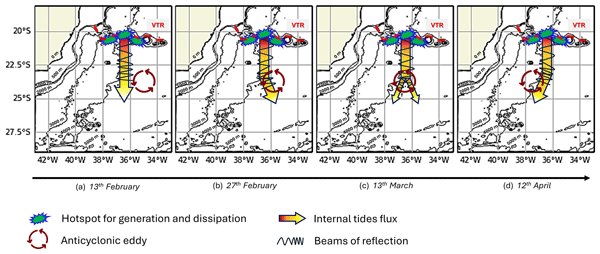
The Vitória–Trindade Ridge off the Brazilian coast is a hotspot for internal tides, which drive energy and nutrients exchanges in the ocean. Using satellite data and a high-resolution ocean model, we study what influences these small waves in this region. We show that internal tides are generated more strongly in summer and lose energy faster in winter. Ocean eddies may also affect their fate. These results are essential for understanding oceanic energy pathways and refine model predictions.
Amine M'hamdi, Ariane Koch-Larrouy, Isabelle Dadou, Carina Regina de Macedo, Fernand Assene, Vincent Vantrepotte, Guillaume Morvan, and Alex Costa da Silva
EGUsphere, https://doi.org/10.5194/egusphere-2026-2729, https://doi.org/10.5194/egusphere-2026-2729, 2026
Short summary
Short summary
We show that tides play a major role in structuring nutrient supply and phytoplankton variability across the Amazon shelf–offshore continuum, from the 15-day spring–neap cycle to seasonal timescales. By enhancing nitrate uplift, especially along the shelf break and internal-tide pathway, tides stimulate offshore chlorophyll growth, modulate the nitracline and deep chlorophyll maximum, and explain a large fraction of the seasonal nutrient signal.
Fabius Kouogang, Ariane Koch-Larrouy, Xavier Carton, Fernand Assene, Guillaume Morvan, and Moacyr Araujo
Ocean Sci., 22, 1545–1568, https://doi.org/10.5194/os-22-1545-2026, https://doi.org/10.5194/os-22-1545-2026, 2026
Short summary
Short summary
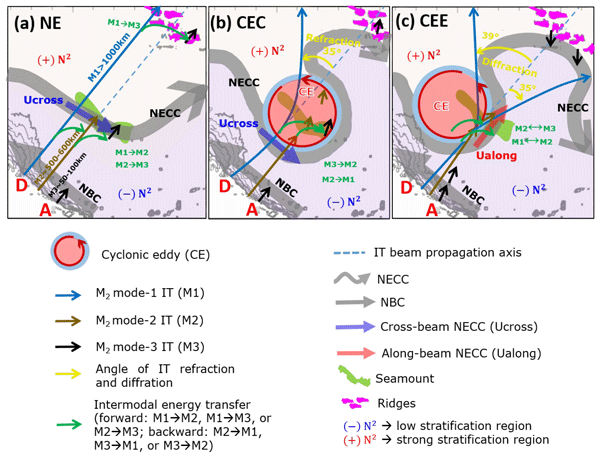
Our research investigates how large waves travel deep within the ocean. Using a detailed computer model, we show that when these deep waves meet giant ocean circulation, their path is dramatically changed. They can be bent off course, split apart, or stopped completely. An underwater mountain works with this circulation to transfer the wave energy between different ocean layers. Understanding this process is vital because it controls ocean mixing.
Carina Regina de Macedo, Ariane Koch-Larrouy, José Carlos Bastos da Silva, Jorge Manuel Magalhães, Fernand Assene, Manh Duy Tran, Isabelle Dadou, Amine M'Hamdi, Trung Kien Tran, and Vincent Vantrepotte
Ocean Sci., 22, 871–892, https://doi.org/10.5194/os-22-871-2026, https://doi.org/10.5194/os-22-871-2026, 2026
Short summary
Short summary
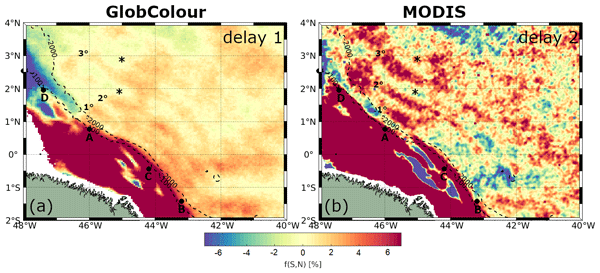
We investigated how ocean tides influence marine phytoplankton along the North Brazilian coast. Using satellite data from 2005 to 2021, we found that tides can either enhance or reduce phytoplankton growth on the continental shelf. Offshore, internal tides stimulate primary production along their pathways. These results improve our understanding of how tidal processes shape marine life in tropical coastal regions.
Chloé Goret, Ariane Koch-Larrouy, Fabius Kouogang, Carina Regina de Macedo, Amine M'Hamdi, Jorge M. Magalhães, José Carlos Bastos da Silva, Michel Tchilibou, Camila Artana, Isabelle Dadou, Antoine Delepoulle, Simon Barbot, Maxime Ballarotta, Loren Carrère, and Alex Costa da Silva
Ocean Sci., 22, 679–698, https://doi.org/10.5194/os-22-679-2026, https://doi.org/10.5194/os-22-679-2026, 2026
Short summary
Short summary
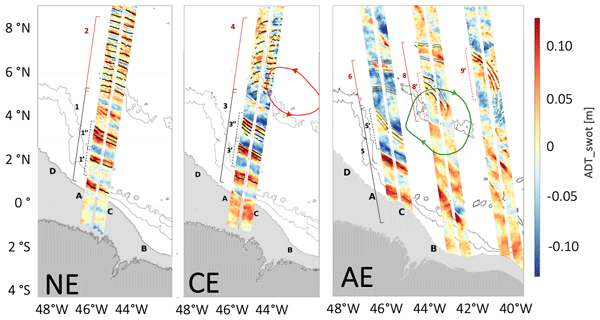
Using high-resolution satellite measurements, we observed how eddies off the Amazon shelf modify internal solitary waves. The results show that these waves can be deflected from their path, even split into two branches, and change their geometry when interacting with different types of eddies. This work provides new insight into the ocean’s complex dynamic interactions and could help guide future predictions of ocean behavior and its effects on coastal and marine ecosystems.
Fernand Assene, Ariane Koch-Larrouy, Carina Regina de Macedo, Isabelle Dadou, Michel Tchilibou, Guillaume Morvan, Damien Allain, Simon Barbot, Alex Costa da Silva, Jérôme Chanut, Vincent Vantrepotte, Florent Lyard, Edward Zaron, and Trung-Kien Tran
EGUsphere, https://doi.org/10.5194/egusphere-2026-557, https://doi.org/10.5194/egusphere-2026-557, 2026
Short summary
Short summary
We examine temperature (T) variability at two semidiurnal and one fortnightly frequencies in North Brazil using satellite-observed and modeled temperatures. Semidiurnal T variability is weak offshore but peaks over the shelf due to barotropic mixing. Below 100 m, internal tide (IT)-driven mixing causes strong T variability (0.6–2 °C). T fortnightly maximums (~0.15 °C) appear along IT pathways, showing their key role.
Amine M'hamdi, Ariane Koch-Larrouy, Alex Costa da Silva, Isabelle Dadou, Carina Regina de Macedo, Anthony Bosse, Vincent Vantrepotte, Habib Micaël Aguedjou, Trung-Kien Tran, Pierre Testor, Laurent Mortier, Arnaud Bertrand, Pedro Augusto Mendes de Castro Melo, James Lee, Marcelo Rollnic, and Moacyr Araujo
Ocean Sci., 21, 2873–2894, https://doi.org/10.5194/os-21-2873-2025, https://doi.org/10.5194/os-21-2873-2025, 2025
Short summary
Short summary
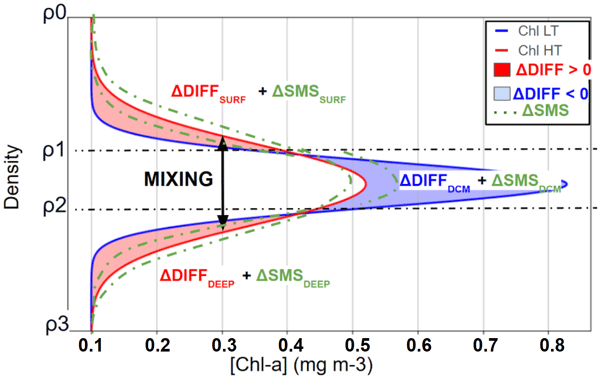
In the ocean off the Amazon shelf, internal waves caused by tides move water layers up and down and mix them. Using an underwater glider and satellites, we found internal tides redistribute chlorophyll from the deep chlorophyll maximum upward to the surface and downward to depth. Turbulent chlorophyll fluxes supply about 38 % of surface chlorophyll, and total chlorophyll increases by 14–29 % during strong tides, potentially affecting the marine food web.
Fernand Assene, Ariane Koch-Larrouy, Isabelle Dadou, Michel Tchilibou, Guillaume Morvan, Jérôme Chanut, Alex Costa da Silva, Vincent Vantrepotte, Damien Allain, and Trung-Kien Tran
Ocean Sci., 20, 43–67, https://doi.org/10.5194/os-20-43-2024, https://doi.org/10.5194/os-20-43-2024, 2024
Short summary
Short summary
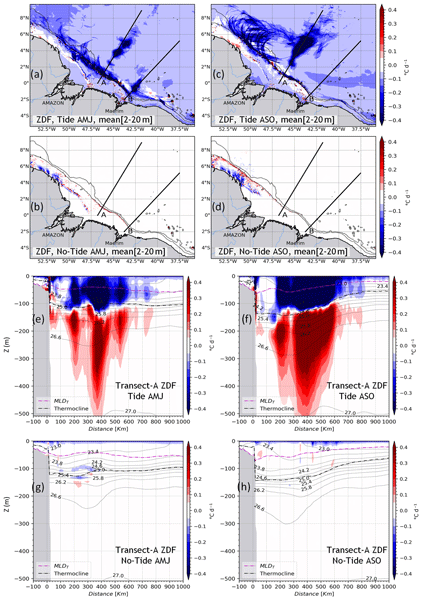
Twin simulations, with and without tides, are used to assess the impact of internal tides (ITs) on ocean temperature off the Amazon mouth at a seasonal scale. We found that in the surface layers, ITs and barotropic tides cause a cooling effect on sea surface temperature, subsequently leading to an increase in the net heat flux between the atmosphere and ocean. Vertical mixing is identified as the primary driver, followed by vertical and horizontal advection.
Peter Brandt, Gaël Alory, Founi Mesmin Awo, Marcus Dengler, Sandrine Djakouré, Rodrigue Anicet Imbol Koungue, Julien Jouanno, Mareike Körner, Marisa Roch, and Mathieu Rouault
Ocean Sci., 19, 581–601, https://doi.org/10.5194/os-19-581-2023, https://doi.org/10.5194/os-19-581-2023, 2023
Short summary
Short summary
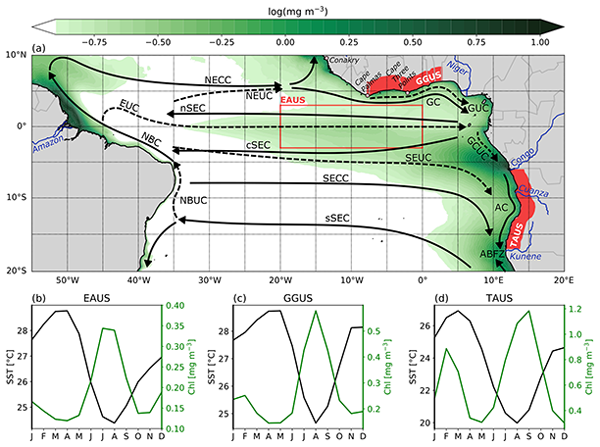
Tropical upwelling systems are among the most productive ecosystems globally. The tropical Atlantic upwelling undergoes a strong seasonal cycle that is forced by the wind. Local wind-driven upwelling and remote effects, particularly via the propagation of equatorial and coastal trapped waves, lead to an upward and downward movement of the nitracline. Turbulent mixing results in upward supply of nutrients. Here, we review the different physical processes responsible for biological productivity.
Roy Dorgeless Ngakala, Gaël Alory, Casimir Yélognissè Da-Allada, Olivia Estelle Kom, Julien Jouanno, Willi Rath, and Ezinvi Baloïtcha
Ocean Sci., 19, 535–558, https://doi.org/10.5194/os-19-535-2023, https://doi.org/10.5194/os-19-535-2023, 2023
Short summary
Short summary
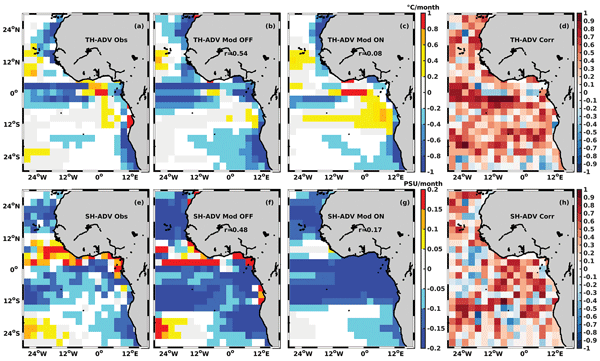
Surface heat flux is the main driver of the heat budget in the Senegal, Angola, and Benguela regions but not in the equatorial region. In the Senegal and Benguela regions, freshwater flux governs the salt budget, while in equatorial and Angola regions, oceanic processes are the main drivers. Results from numerical simulation show the important role of mesoscale advection for temperature and salinity variations in the mixed layer. Nonlinear processes unresolved by observations play a key role.
Cited articles
Aroucha, L. C., Lübbecke, J. F., Brandt, P., Schwarzkopf, F. U., and Biastoch, A.: River discharge impacts coastal southeastern tropical Atlantic sea surface temperature and circulation: a model-based analysis, Ocean Sci., 21, 661–678, https://doi.org/10.5194/os-21-661-2025, 2025.
Assene, F., Morel, Y., Delpech, A., Aguedjou, M., Jouanno, J., Cravatte, S., Marin, F., Ménesguen, C., Chaigneau, A., Dadou, I., Alory, G., Holmes, R., Bourlès, B., and Koch-larrouy, A.: From Mixing to the Large Scale Circulation: How the Inverse Cascade Is Involved in the Formation of the Subsurface Currents in the Gulf of Guinea, Fluids, 5, 147, https://doi.org/10.3390/fluids5030147, 2020.
Aumont, O. and Bopp, L.: Globalizing results from ocean insitu iron fertilization experiments, Global Biogeochem. Cy., 20, GB2017, https://doi.org/10.1029/2005GB002591, 2006.
Aumont, O., Belviso, S., and Monfray, P.: Dimethylsulfide (DMS) cycle with a 3-D ocean-biogeochemical model, Oceanogr. Lit. Rev., 11, 1637, https://doi.org/10.1029/1999JC000111, 1998.
Aumont, O., Ethé, C., Tagliabue, A., Bopp, L., and Gehlen, M.: PISCES-v2: an ocean biogeochemical model for carbon and ecosystem studies, Geosci. Model Dev., 8, 2465–2513, https://doi.org/10.5194/gmd-8-2465-2015, 2015.
Awo, F. M., Alory, G., Da-Allada, C. Y., Delcroix, T., Jouanno, J., Kestenare, E., and Baloïtcha, E.: On the seasonal and interannual variability of the sea surface salinity in the Gulf of Guinea, Clim. Dynam., 60, 2121–2140, https://doi.org/10.1007/s00382-022-06443-4, 2023.
Awo, F. M., Rouault, M., Ostrowski, M., Tomety, F. S., Da-Allada, C. Y., and Jouanno, J.: Seasonal cycle of sea surface salinity in the Angola Upwelling System, J. Geophys. Res.-Oceans, 127, e2022JC018518, https://doi.org/10.1029/2022JC018518, 2022.
Bachèlery, M. L.: Variabilité côtière physique et biogéochimique en Atlantique Sud-Est: rôle du forçage atmosphérique local versus téléconnexion océanique, PhD thesis, University of Paul Sabatier, Toulouse, France, 215 pp., https://theses.hal.science/tel-05004928 (last access: 11 April 2026), 2016.
Bachèlery, M.-L., Illig, S., and Dadou, I.: Interannual variability in the South-East Atlantic Ocean, focusing on the Benguela Upwelling System: Remote versus local forcing, J. Geophys. Res.-Oceans, 121, 284–310, https://doi.org/10.1002/2015JC011168, 2015.
Bourlès, B., Molinari, R. L., Johns, W. E., Gouriou, Y., and Carder, K. L.: The South Equatorial Undercurrent in the Atlantic Ocean, Geophys. Res. Lett., 31, L14301, https://doi.org/10.1029/2004GL020020, 2004.
Brandt, P., Alory, G., Awo, F. M., Dengler, M., Djakouré, S., Imbol Koungue, R. A., Jouanno, J., Körner, M., Roch, M., and Rouault, M.: Physical processes and biological productivity in the upwelling regions of the tropical Atlantic, Ocean Sci., 19, 581–601, https://doi.org/10.5194/os-19-581-2023, 2023.
Cabos, W., Sein, D. V., Pinto, J. G., Koseki, S., Álvarez-García, F. J., and Durán-Quesada, A. M.: The coastal upwelling system of the southeast Atlantic as simulated by a high-resolution coupled model, Clim. Dynam., 49, 1809–1828, https://doi.org/10.1007/s00382-016-3319-9, 2017.
Caniaux, G., Giordani, H., Redelsperger, J. L., Guichard, F., Key, E., and Wade, M.: Coupling between the Atlantic cold tongue and the West African monsoon in boreal spring and summer, J. Geophys. Res.-Oceans, 116, C04003, https://doi.org/10.1029/2010jc006570, 2011.
Carr, M.-E.: Estimation of potential productivity in Eastern Boundary Currents using remote sensing, Deep-Sea Res. Pt. II, 49, 59–80, https://doi.org/10.1016/S0967-0645(01)00094-7, 2002.
Chavez, F. P. and Messié, M.: A comparison of eastern boundary upwelling ecosystems, Prog. Oceanogr., 83, 80–96, https://doi.org/10.1016/j.pocean.2009.07.032, 2009.
Chin, T. M., Vazquez-Cuervo, J., and Armstrong, E.: A multi-scale high-resolution analysis of global sea surface temperature, Remote Sens. Environ., 200, 154–169, https://doi.org/10.1016/j.rse.2017.07.029, 2017.
Copernicus Marine Service: Global Ocean Colour (Copernicus-GlobColour), Multi-year data, Marine Data Store (MDS) [data set], https://doi.org/10.48670/moi-00281, 2023a.
Copernicus Marine Service: Global Ocean Gridded L4 Sea Level Anomalies (DUACS) and Derived Variables, Multi-year data, Marine Data Store (MDS) [data set], https://doi.org/10.48670/moi-00148, 2023b.
Dossa, A., Da-Allada, C., Herbert, G., and Bourlès, B.: Seasonal cycle of the salinity barrier layer revealed in the northeastern Gulf of Guinea, Afr. J. Mar. Sci., 41, 163–175, https://doi.org/10.2989/1814232X.2019.1616612, 2019.
Ducet, N., Le Traon, P.-Y., and Reverdun, G.: Global high-resolution mapping of ocean circulation from TOPEX/Poseidon and ERS-1 and -2, J. Geophys. Res. Oceans, 105, 19477–19498, https://doi.org/10.1029/2000jc900063, 2000.
Dunn, J. R. and Ridgway, K. R.: Mapping ocean properties in regions of complex topography, Deep-Sea Res. Pt. I, 49, 591–604, https://doi.org/10.1016/S0967-0637(01)00069-3, 2002.
ESR and Dohan, K.: Ocean Surface Current Analyses Real-time (OSCAR) Surface Currents – Interim 0.25 Degree (Version 2.0), Ver. 2.0. PO.DAAC [data set], CA, USA, https://doi.org/10.5067/OSCAR-25I20, 2022.
Estival, R., Quiniou, V., and Messager, C.: Real-time network of weather and ocean stations: public-private partnership on in-situ measurements in the Gulf of Guinea, Sea Technol., 54, 34–38, 2013.
FAO: Fishery and Aquaculture Country Profiles, Angola, Country Profile Fact Sheets, Fisheries and Aquaculture Division, https://www.fao.org/fishery/en/facp/ago?lang=en (last access: 11 April 2023), 2022.
Fréon, P., Barange, M., and Arístegui, J.: Eastern boundary upwelling ecosystems: integrative and comparative approaches, Prog. Oceanogr., 83, 1–14, https://doi.org/10.1016/j.pocean.2009.07.014, 2009.
Gutknecht, E., Dadou, I., Marchesiello, P., Cambon, G., Le Vu, B., Sudre, J., Garçon, V., Machu, E., Rixen, T., Kock, A., Flohr, A., Paulmier, A., and Lavik, G.: Nitrogen transfers off Walvis Bay: a 3-D coupled physical/biogeochemical modeling approach in the Namibian upwelling system, Biogeosciences, 10, 4117–4135, https://doi.org/10.5194/bg-10-4117-2013, 2013.
Hardman-Mountford, N. J. and McGlade, J. S.: Retrieval of phytoplankton biomass from ocean colour in the Benguela ecosystem, Remote Sens. Environ., 79, 11–23, https://doi.org/10.1016/S0034-4257(01)00236-0, 2002.
Hopkins, J., Lucas, M., Dufau, C., Sutton, M., Stum, J., Lauret, O., and Channelliere, C.: Detection and variability of the Congo River plume from satellite derived sea surface temperature, salinity, ocean colour and sea level, Remote Sens. Environ., 139, 365–385, https://doi.org/10.1016/j.rse.2013.08.015, 2013.
Hutchings, L., van der Lingen, C. D., Shannon, L. J., Crawford, R. J. M., Verheye, H. M. S., Bartholomae, C. H., van der Plas, A. K., Louw, D., Kreiner, A., Ostrowski, M., Fidel, Q., Barlow, R. G., Lamont, T., Coetzee, J., Shillington, F., Veitch, J., Currie, J. C., and Monteiro, P. M. S.: The Benguela Current: An ecosystem of four components, Prog. Oceanogr., 83, 15–32, https://doi.org/10.1016/j.pocean.2009.07.046, 2009.
Johns, W. E., Brandt, P., Lumpkin, R., Fischer, J., Hormann, V., Pirani, A., Schmid, C., and Bourlès, B.: Variation of upper ocean seasonal and interannual velocity structure in the eastern equatorial Atlantic, J. Phys. Oceanogr., 44, 1201–1212, https://doi.org/10.1175/JPO-D-13-0132.1, 2014.
Johnson, E. S., Bonjean, F., Lagerloef, G. S., Gunn, J. T., and Mitchum, G. T.: Validation and error analysis of OSCAR sea surface currents, J. Atmos. Ocean. Tech., 24, 688–701, https://doi.org/10.1175/JTECH1971.1, 2007.
Jouanno, J., Marin, F., du Penhoat, Y., Sheinbaum, J., and Cole, H.: Seasonal heat balance in the upper 100 m of the equatorial Atlantic Ocean, J. Geophys. Res.-Oceans, 116, C9, https://doi.org/10.1029/2010JC006912, 2011.
JPL MUR MEaSUREs Project: GHRSST Level 4 MUR Global Foundation Sea Surface Temperature Analysis, Ver. 4.1, PO.DAAC [data set], CA, USA, https://doi.org/10.5067/GHGMR-4FJ04, 2015.
Kobayashi, S., Ota, Y., Harada, Y., Ebita, A., Moriya, M., Onoda, H., Onogi, K., Kamiguchi, H., Kobayashi, C., Endo, H., Miyaoka, K., and Takahashi, K.: The JRA-55 Reanalysis: General specifications and basic characteristics, J. Meteorol. Soc. Jpn., 93, 5–48, https://doi.org/10.2151/jmsj.2015-001, 2015.
Kopte, R.: The Angola Current in a Tropical Seasonal Upwelling System: Seasonal Variability in Response to Remote Equatorial and Local Forcing, PhD thesis, Christian-Albrechts Universität Kiel, Germany, https://macau.uni-kiel.de/servlets/MCRFileNodeServlet/dissertation_derivate_00007334/20170928_dissertation_robert_kopte.pdf (last access: 11 April 2026), 2017.
Körner, M., Brandt, P., and Dengler, M.: Seasonal cycle of sea surface temperature in the tropical Angolan Upwelling System, Ocean Sci., 19, 121–139, https://doi.org/10.5194/os-19-121-2023, 2023.
Körner, M., Brandt, P., Illig, S., Dengler, M., Subramaniam, A., Bachèlery, M. L., and Krahmann, G.: Coastal trapped waves and tidal mixing control primary production in the tropical Angolan upwelling system, Sci. Adv., 10, adj6686, https://doi.org/10.1126/sciadv.adj6686, 2024.
Koseki, S., Cabos, W., Sein, D. V., and Mohino, E.: The role of the Gulf of Guinea upwelling in the atmospheric circulation of the tropical Atlantic in a high-resolution coupled model, Clim. Dynam., 51, 1017–1035, https://doi.org/10.1007/s00382-017-3896-2, 2018.
Koubanova, M., Koseki, S., and Keenlyside, N. S.: Seasonal variability of the Atlantic cold tongue and its relationship with the Angola-Benguela upwelling system, Clim. Dynam., 51, 2975–2993, https://doi.org/10.1007/s00382-018-4197-0, 2018.
Locarnini, M. M., Mishonov, A. V., Baranova, O. K., Boyer, T. P., Zweng, M. M., Garcia, H. E., Mishonov, A., and Smolyar, I.: World ocean atlas 2018, volume 1: Temperature, NOAA Atlas NESDIS, 52 pp., https://archimer.ifremer.fr/doc/00651/76338/77329.pdf (last access: 11 April 2026), 2018.
Loukos, H. and Mémery, L.: Simulation of the nitrate seasonal cycle in the equatorial Atlantic ocean during 1983 and 1984, J. Geophys. Res.-Oceans, 104, 15549–15573, https://doi.org/10.1029/1999JC900084, 1999.
Madec, G. and the NEMO System Team: NEMO Ocean Engine Reference Manual, Zenodo [code], https://doi.org/10.5281/zenodo.1464816, 2024.
Mbang Essome, L. J., Alory, G., Dadou, I., Da-Allada, C. Y., Ngakala, R. D., and Morvan, G. L.: Physical and biological processes driving seasonal variability of Nitrate budget and biological productivity in the Gabon-Congo upwelling system. In Ocean Science, Zenodo [code and data set], https://doi.org/10.5281/zenodo.19384386, 2026.
Messié, M. and Chavez, F. P.: Seasonal regulation of primary production in eastern boundary upwelling systems, Prog. Oceanogr., 134, 1–18, https://doi.org/10.1016/j.pocean.2014.10.011, 2015.
Monteiro, P., Dewitte, B., Scranton, M., Paulmier, A., and Van der Plas, A.: The role of open ocean boundary forcing on seasonal to decadal-scale variability and long-term change of natural shelf hypoxia, Environ. Res. Lett., 6, 024002, https://doi.org/10.1088/1748-9326/6/2/024002, 2011.
Ngakala, R. D., Alory, G., Da-Allada, C. Y., Dadou, I., Cardot, C., Morvan, G., and Baloïtcha, E.: Seasonal mixed layer temperature in the Congolese upwelling system, J. Geophys. Res.-Oceans, 130, e2023JC020528, https://doi.org/10.1029/2023JC020528, 2025.
Nieto, K. and Mélin, F.: Variability of chlorophyll a concentration in the Gulf of Guinea and its relation to physical oceanographic variables, Prog. Oceanogr., 151, 97–115, https://doi.org/10.1016/j.pocean.2016.12.001, 2017.
Nubi, O., Bourles, B., and Edokpayi, C.: On the Nutrient distribution and phytoplankton biomass in the Gulf of Guinea equatorial band as inferred from In-situ measurements, J. Oceanogr. Mar. Sci., 7, 1–11, https://doi.org/10.5897/JOMS2015.0125, 2016.
Ostrowski, M., da Silva, J. C. B., and Bazik-Sangolay, B.: The response of sound scatterers to El Niño- and La Niña-like oceanographic regimes in the southeastern Atlantic, ICES J. Mar. Sci., 66, 1063–1072, https://doi.org/10.1093/icesjms/fsp102, 2009.
Radenac, M.-H., Jouanno, J., Tchamabi, C. C., Awo, M., Bourlès, B., Arnault, S., and Aumont, O.: Physical drivers of the nitrate seasonal variability in the Atlantic cold tongue, Biogeosciences, 17, 529–545, https://doi.org/10.5194/bg-17-529-2020, 2020.
Resplandy, L., Hogikyan, A., Müller, J. D., Najjar, R. G., Bange, H. W., Bianchi, D., and Regnier, P.: A synthesis of global coastal ocean greenhouse gas fluxes, Global Biogeochem. Cy., 38, e2023GB007803, https://doi.org/10.1029/2023GB007803, 2024.
Richter, I.: Climate model biases in the eastern tropical oceans: Causes, impacts and ways forward, Wires Clim. Change, 6.3, 345–358, https://doi.org/10.1002/wcc.338, 2015.
Ridgway, K. R., Dunn, J. R., and Wilkin, J. L.: Ocean interpolation by four-dimensional least squares – Application to the waters around Australia, J. Atmos. Ocean. Tech., 19, 1357–1375, https://doi.org/10.1175/1520-0426(2002)019<1357:OIBFDW>2.0.CO;2, 2002.
Rouault, M.: Bi-annual intrusion of tropical water in the northern Benguela upwelling, Geophys. Res. Lett., 39, L12606, https://doi.org/10.1029/2012gl052099, 2012.
Scannell, H. A. and McPhaden, M. J.: Seasonal mixed layer temperature balance in the southeastern tropical Atlantic, J. Geophys. Res.-Oceans, 123, 5557–5570, https://doi.org/10.1029/2018JC014099, 2018.
Schott, F. A., Fischer, J., and Stramma, L.: Transports and pathways of the upper-layer circulation in the western tropical Atlantic, J. Phys. Oceanogr., 28, 1904–1928, https://doi.org/10.1175/1520-0485(1998)028<1904:TAPOTU>2.0.CO;2, 1998.
Siegfried, L., Schmidt, M., Mohrholz, V., Pogrzeba, H., Nardini, P., Böttinger, M., and Scheuermann, G.: The tropical-subtropical coupling in the Southeast Atlantic from the perspective of the northern Benguela upwelling system, PLOS ONE, 14, e0210083, https://doi.org/10.1371/journal.pone.0210083, 2019.
Sikhakolli, R., Sharma, R., Basu, S., Gohil, B. S., Sarkar, A., and Prasad, K. V. S. R.: Evaluation of OSCAR ocean surface current product in the tropical Indian Ocean using in situ data, J. Earth Syst. Sci., 122, 187–199, https://doi.org/10.1007/s12040-012-0258-7, 2013.
Sowman, M. and Cardoso, P.: Small-scale fisheries and food security strategies in countries in the Benguela Current Large Marine Ecosystem (BCLME) region: Angola, Namibia and South Africa, Mar. Policy, 34, 1163–1170, https://doi.org/10.1016/j.marpol.2010.03.016, 2010.
Tchipalanga, P., Dengler, M., Brandt, P., Kopte, R., Macueria, M., Coelho, P., Ostrowski, M., and Keenlyside, N. S.: Eastern Boundary Circulation and Hydrography Off Angola: Building Angolan Oceanographic Capacities, B. Am. Meteorol. Soc., 99, 1589–1605, https://doi.org/10.1175/Bams-D-17-0197.1, 2018.
Thiam, A., Alory, G., Jouanno, J., Da-Allada, C. Y., and Morvan, G.: Coastal upwelling in the Northern Gulf of Guinea: Seasonal cycle and mesoscale interactions, Ocean Model., 188, 102300, https://doi.org/10.1016/j.ocemod.2024.102300, 2024.
Tilstone, G., Smyth, T., Poulton, A., and Hutson, R.: Measured and remotely sensed estimates of primary production in the Atlantic Ocean from 1998 to 2005, Deep-Sea Res. Pt. II, 56, 918–930, https://doi.org/10.1016/j.dsr2.2008.10.034, 2009.
Topé, G. D. A., Alory, G., Djakouré, S., Da-Allada, C. Y., Jouanno, J., and Morvan, G.: How does the Niger River warm coastal waters in the Northern Gulf of Guinea?, Front. Mar. Sci., 10, 1187202, https://doi.org/10.3389/fmars.2023.1187202, 2023.
Tuchen, F. P., Brandt, P., Lübbecke, J. F., and Hummels, R.: Transports and pathways of the tropical AMOC return flow from Argo data and shipboard velocity measurements, J. Geophys. Res.-Oceans, 127, e2021JC018115, https://doi.org/10.1029/2021JC018115, 2022.
Voldoire, A., Belamari, S., and Lévy, M.: On the role of ocean-atmosphere interaction in the onset of the Atlantic cold tongue, Clim. Dynam., 53, 5437–5455, https://doi.org/10.1007/s00382-019-04717-0, 2019.
Xu, Z., Li, M., Patricola, C. M., and Chang, P.: Oceanic origin of southeast tropical Atlantic biases, Clim. Dynam., 43, 2915–2930, https://doi.org/10.1007/s00382-013-1901-y, 2014.
Zeng, Z., Brandt, P., Lamb, K. G., Greatbatch, R. J., Dengler, M., Claus, M., and Chen, X.: Three-dimensional numerical simulations of internal tides in the Angolan upwelling region, J. Geophys. Res.-Oceans, 126, e2020JC016460, https://doi.org/10.1029/2020JC016460, 2021.
Zuidema, P., Redemann, J., Haywood, J., Wood, R., Piketh, S., Hipondoka, M., and Formenti, P.: Smoke and clouds above the southeast Atlantic: Upcoming field campaigns probe absorbing aerosol's impact on climate, B. Am. Meteorol. Soc., 97, 1131–1135, https://doi.org/10.1175/BAMS-D-15-00032.1, 2016.
Zweng, M. M., Seidov, D., Boyer, T. P., Locarnini, M., Garcia, H. E., Mishonov, A. V., and Smolyar, I.: World ocean atlas 2018, volume 2: Salinity, NOAA Atlas NESDIS, 82, https://www.ncei.noaa.gov/data/oceans/woa/WOA18/DOC/woa18_vol2.pdf (last access: 11 April 2026), 2019.
Short summary
We used a high-resolution model to study how ocean currents and waves, especially coastal trapped waves, control nitrate variability in the Gabon-Congo upwelling system. This nutrient availability drives seasonal marine productivity, with the Congo River also adding significant nitrate. Our research clarifies the complex interplay of physical and biological factors, offering crucial insights for managing regional fisheries and assessing climate change impacts on this vital ecosystem.
We used a high-resolution model to study how ocean currents and waves, especially coastal...


