
Articles | Volume 22, issue 5
https://doi.org/10.5194/os-22-3225-2026
© Author(s) 2026. This work is distributed under
the Creative Commons Attribution 4.0 License.
the Creative Commons Attribution 4.0 License.
https://doi.org/10.5194/os-22-3225-2026
© Author(s) 2026. This work is distributed under
the Creative Commons Attribution 4.0 License.
the Creative Commons Attribution 4.0 License.
Research article
| 
20 Oct 2026
Research article |
| 20 Oct 2026
| 20 Oct 2026
Seasonal cycle in surface seawater isotopic composition
Gilles Reverdin
CORRESPONDING AUTHOR

Laboratoire LOCEAN/IPSL, Sorbonne Université – CNRS-IRD-MNHN, 75005 Paris, France
Claire Waelbroeck
Laboratoire LOCEAN/IPSL, Sorbonne Université – CNRS-IRD-MNHN, 75005 Paris, France
Lola Goeme
Laboratoire LOCEAN/IPSL, Sorbonne Université – CNRS-IRD-MNHN, 75005 Paris, France
Antje H. L. Voelker
Instituto Português do Mar e da Atmosfera (IPMA), Algés, Portugal
Center of Marine Sciences (CCMAR), Universidade do Algarve, Faro, Portugal
Hans Christian Steen-Larsen
Geophysical Institute, University of Bergen and Bjerknes Centre for Climate Research, Bergen, Norway
Related authors
Nicolas Metzl, Bronte Tilbrook, John Akl, Craig Neill, Alexandra Aymard, Claire Lo Monaco, Gilles Reverdin, Jean-Baptiste Sallée, Aude Barton, Frédéric Chevallier, and Marion Gehlen
EGUsphere, https://doi.org/10.5194/egusphere-2026-1664, https://doi.org/10.5194/egusphere-2026-1664, 2026
Short summary
Short summary
Ocean acidification is explored in the Adélie Land coastal region in East Antarctica. The region is a permanent CO2 sink leading to a positive increase of total CO2 concentrations and to a progressive decrease of pH and aragonite Ωar. The lowest surface Ωar of 1.2 was observed in winter 2024, a critical limit for some marine species such as pteropod. A projection in the future suggests that aragonite saturation state will occur as soon as 2055 in the Adélie Land region.
Nicolas Metzl, Jonathan Fin, Claire Lo Monaco, Claude Mignon, Samir Alliouane, Bruno Bombled, Jacqueline Boutin, Yann Bozec, Steeve Comeau, Pascal Conan, Laurent Coppola, Pascale Cuet, Eva Ferreira, Jean-Pierre Gattuso, Frédéric Gazeau, Catherine Goyet, Emilie Grossteffan, Bruno Lansard, Dominique Lefèvre, Nathalie Lefèvre, Coraline Leseurre, Sébastien Petton, Mireille Pujo-Pay, Christophe Rabouille, Gilles Reverdin, Céline Ridame, Peggy Rimmelin-Maury, Jean-François Ternon, Franck Touratier, Aline Tribollet, Thibaut Wagener, and Cathy Wimart-Rousseau
Earth Syst. Sci. Data, 17, 1075–1100, https://doi.org/10.5194/essd-17-1075-2025, https://doi.org/10.5194/essd-17-1075-2025, 2025
Short summary
Short summary
This work presents a new synthesis of 67 000 total alkalinity and total dissolved inorganic carbon observations obtained between 1993 and 2023 in the global ocean, coastal zones, and the Mediterranean Sea. We describe the data assemblage and associated quality control and discuss some potential uses of this dataset. The dataset is provided in a single format and includes the quality flag for each sample.
Gilles Reverdin, Claire Waelbroeck, Antje H. L. Voelker, and Hanno Meyer
Ocean Sci., 21, 567–575, https://doi.org/10.5194/os-21-567-2025, https://doi.org/10.5194/os-21-567-2025, 2025
Short summary
Short summary
Water isotopes in the ocean trace the freshwater exchanges between the ocean, the atmosphere, and the cryosphere and are used to investigate processes of the hydrological cycle. We illustrate offsets in seawater isotopic composition between different datasets that are larger than the expected variability that one often wants to explore. This highlights the need to share seawater isotopic composition samples dedicated to specific intercomparison of data produced in different laboratories.
Nicolas Metzl, Claire Lo Monaco, Coraline Leseurre, Céline Ridame, Gilles Reverdin, Thi Tuyet Trang Chau, Frédéric Chevallier, and Marion Gehlen
Ocean Sci., 20, 725–758, https://doi.org/10.5194/os-20-725-2024, https://doi.org/10.5194/os-20-725-2024, 2024
Short summary
Short summary
In the southern Indian Ocean, south of the polar front, an observed increase of sea surface fCO2 and a decrease of pH over 1985–2021 are mainly driven by anthropogenic CO2 uptake, but in the last decade (2010–2020) fCO2 and pH were stable in summer, highlighting the competitive balance between anthropogenic CO2 and primary production. In the water column the increase of anthropogenic CO2 concentrations leads to migration of the aragonite saturation state from 600 m in 1985 up to 400 m in 2021.
Nicolas Metzl, Jonathan Fin, Claire Lo Monaco, Claude Mignon, Samir Alliouane, David Antoine, Guillaume Bourdin, Jacqueline Boutin, Yann Bozec, Pascal Conan, Laurent Coppola, Frédéric Diaz, Eric Douville, Xavier Durrieu de Madron, Jean-Pierre Gattuso, Frédéric Gazeau, Melek Golbol, Bruno Lansard, Dominique Lefèvre, Nathalie Lefèvre, Fabien Lombard, Férial Louanchi, Liliane Merlivat, Léa Olivier, Anne Petrenko, Sébastien Petton, Mireille Pujo-Pay, Christophe Rabouille, Gilles Reverdin, Céline Ridame, Aline Tribollet, Vincenzo Vellucci, Thibaut Wagener, and Cathy Wimart-Rousseau
Earth Syst. Sci. Data, 16, 89–120, https://doi.org/10.5194/essd-16-89-2024, https://doi.org/10.5194/essd-16-89-2024, 2024
Short summary
Short summary
This work presents a synthesis of 44 000 total alkalinity and dissolved inorganic carbon observations obtained between 1993 and 2022 in the Global Ocean and the Mediterranean Sea at the surface and in the water column. Seawater samples were measured using the same method and calibrated with international Certified Reference Material. We describe the data assemblage, quality control and some potential uses of this dataset.
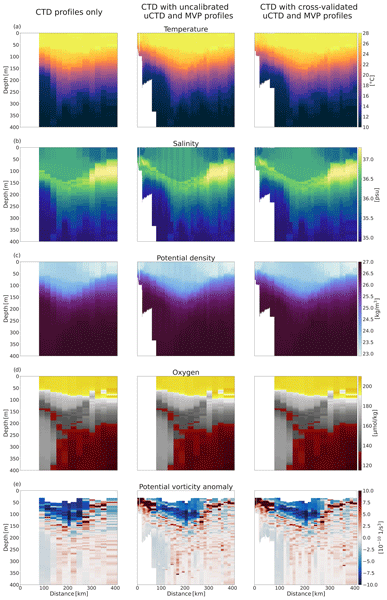
Pierre L'Hégaret, Florian Schütte, Sabrina Speich, Gilles Reverdin, Dariusz B. Baranowski, Rena Czeschel, Tim Fischer, Gregory R. Foltz, Karen J. Heywood, Gerd Krahmann, Rémi Laxenaire, Caroline Le Bihan, Philippe Le Bot, Stéphane Leizour, Callum Rollo, Michael Schlundt, Elizabeth Siddle, Corentin Subirade, Dongxiao Zhang, and Johannes Karstensen
Earth Syst. Sci. Data, 15, 1801–1830, https://doi.org/10.5194/essd-15-1801-2023, https://doi.org/10.5194/essd-15-1801-2023, 2023
Short summary
Short summary
In early 2020, the EUREC4A-OA/ATOMIC experiment took place in the northwestern Tropical Atlantic Ocean, a dynamical region where different water masses interact. Four oceanographic vessels and a fleet of autonomous devices were deployed to study the processes at play and sample the upper ocean, each with its own observing capability. The article first describes the data calibration and validation and second their cross-validation, using a hierarchy of instruments and estimating the uncertainty.
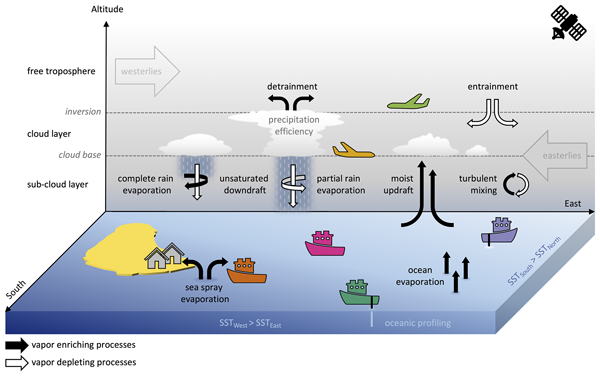
Adriana Bailey, Franziska Aemisegger, Leonie Villiger, Sebastian A. Los, Gilles Reverdin, Estefanía Quiñones Meléndez, Claudia Acquistapace, Dariusz B. Baranowski, Tobias Böck, Sandrine Bony, Tobias Bordsdorff, Derek Coffman, Simon P. de Szoeke, Christopher J. Diekmann, Marina Dütsch, Benjamin Ertl, Joseph Galewsky, Dean Henze, Przemyslaw Makuch, David Noone, Patricia K. Quinn, Michael Rösch, Andreas Schneider, Matthias Schneider, Sabrina Speich, Bjorn Stevens, and Elizabeth J. Thompson
Earth Syst. Sci. Data, 15, 465–495, https://doi.org/10.5194/essd-15-465-2023, https://doi.org/10.5194/essd-15-465-2023, 2023
Short summary
Short summary
One of the novel ways EUREC4A set out to investigate trade wind clouds and their coupling to the large-scale circulation was through an extensive network of isotopic measurements in water vapor, precipitation, and seawater. Samples were taken from the island of Barbados, from aboard two aircraft, and from aboard four ships. This paper describes the full collection of EUREC4A isotopic in situ data and guides readers to complementary remotely sensed water vapor isotope ratios.
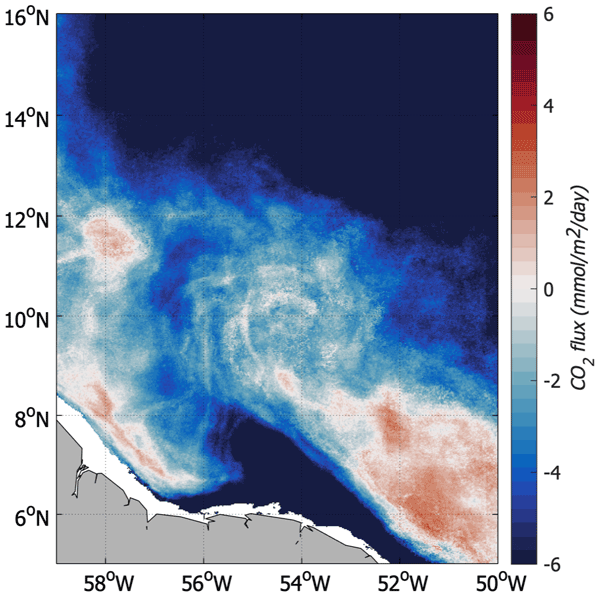
Léa Olivier, Jacqueline Boutin, Gilles Reverdin, Nathalie Lefèvre, Peter Landschützer, Sabrina Speich, Johannes Karstensen, Matthieu Labaste, Christophe Noisel, Markus Ritschel, Tobias Steinhoff, and Rik Wanninkhof
Biogeosciences, 19, 2969–2988, https://doi.org/10.5194/bg-19-2969-2022, https://doi.org/10.5194/bg-19-2969-2022, 2022
Short summary
Short summary
We investigate the impact of the interactions between eddies and the Amazon River plume on the CO2 air–sea fluxes to better characterize the ocean carbon sink in winter 2020. The region is a strong CO2 sink, previously underestimated by a factor of 10 due to a lack of data and understanding of the processes responsible for the variability in ocean carbon parameters. The CO2 absorption is mainly driven by freshwater from the Amazon entrained by eddies and by the winter seasonal cooling.
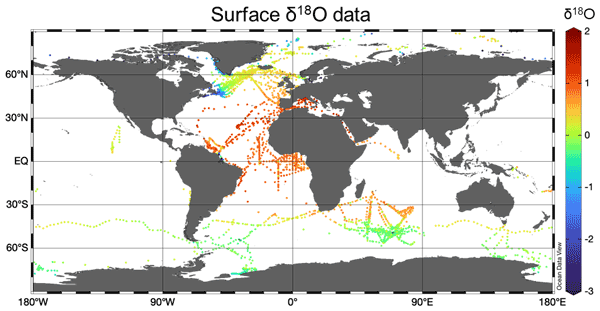
Gilles Reverdin, Claire Waelbroeck, Catherine Pierre, Camille Akhoudas, Giovanni Aloisi, Marion Benetti, Bernard Bourlès, Magnus Danielsen, Jérôme Demange, Denis Diverrès, Jean-Claude Gascard, Marie-Noëlle Houssais, Hervé Le Goff, Pascale Lherminier, Claire Lo Monaco, Herlé Mercier, Nicolas Metzl, Simon Morisset, Aïcha Naamar, Thierry Reynaud, Jean-Baptiste Sallée, Virginie Thierry, Susan E. Hartman, Edward W. Mawji, Solveig Olafsdottir, Torsten Kanzow, Anton Velo, Antje Voelker, Igor Yashayaev, F. Alexander Haumann, Melanie J. Leng, Carol Arrowsmith, and Michael Meredith
Earth Syst. Sci. Data, 14, 2721–2735, https://doi.org/10.5194/essd-14-2721-2022, https://doi.org/10.5194/essd-14-2721-2022, 2022
Short summary
Short summary
The CISE-LOCEAN seawater stable isotope dataset has close to 8000 data entries. The δ18O and δD isotopic data measured at LOCEAN have uncertainties of at most 0.05 ‰ and 0.25 ‰, respectively. Some data were adjusted to correct for evaporation. The internal consistency indicates that the data can be used to investigate time and space variability to within 0.03 ‰ and 0.15 ‰ in δ18O–δD17; comparisons with data analyzed in other institutions suggest larger differences with other datasets.
Coraline Leseurre, Claire Lo Monaco, Gilles Reverdin, Nicolas Metzl, Jonathan Fin, Claude Mignon, and Léa Benito
Biogeosciences, 19, 2599–2625, https://doi.org/10.5194/bg-19-2599-2022, https://doi.org/10.5194/bg-19-2599-2022, 2022
Short summary
Short summary
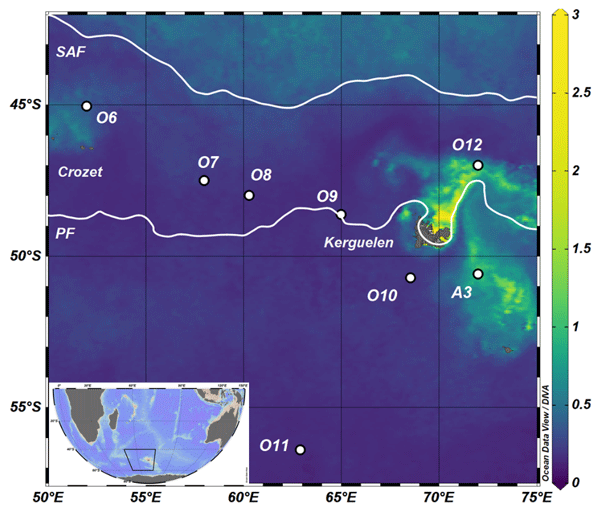
Decadal trends of fugacity of CO2 (fCO2), total alkalinity (AT), total carbon (CT) and pH in surface waters are investigated in different domains of the southern Indian Ocean (45°S–57°S) from ongoing and station observations regularly conducted in summer over the period 1998–2019. The fCO2 increase and pH decrease are mainly driven by anthropogenic CO2 estimated just below the summer mixed layer, as well as by a warming south of the polar front or in the fertilized waters near Kerguelen Island.
Helen K. Coxall, Thomas M. Cronin, Kate Darling, Katrine Husum, Tamara Handl, Brian T. Huber, Megh M. Kanvinde, Mohammad Razmjooei, Flor Vermassen, Antje H. L. Voelker, Tirza M. Weitkamp, and Matt O'Regan
J. Micropalaeontol., 45, 581–622, https://doi.org/10.5194/jm-45-581-2026, https://doi.org/10.5194/jm-45-581-2026, 2026
Short summary
Short summary
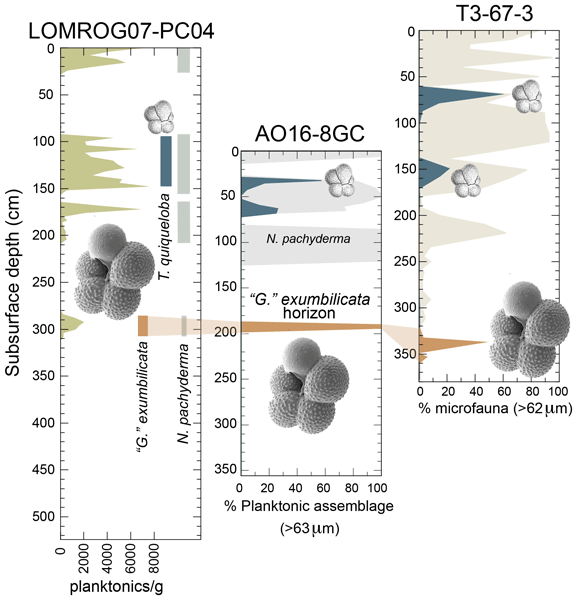
Today’s sea-ice-covered Arctic Ocean hosts only one species of calcifying planktonic foraminifera, unlike warmer oceans with diverse communities. Fossils show that other species once inhabited the Arctic, but their identities and environmental significance remain uncertain. Using detailed microscopy and hundreds of shell measurements, we resolve these fossil species and establish a new taxonomic framework providing the foundation for improved reconstructions of Quaternary Arctic climate history.
Saaya Hamamoto, Yoshinori Iizuka, Takuro Aizawa, Kaoru Kawakami, Mai Matsumoto, Sumito Matoba, Hayoung Bong, Kei Yoshimura, Atsushi Okazaki, Laura Jasmin Dietrich, Hans Christian Steen-Larsen, and Ryu Uemura
EGUsphere, https://doi.org/10.5194/egusphere-2026-3602, https://doi.org/10.5194/egusphere-2026-3602, 2026
Short summary
Short summary
We developed a new 150-year age scale for an ice core from southeast Greenland by matching its oxygen-isotope variations with climate-model simulations. The record resolves changes over several months and shows that snowfall remained nearly evenly distributed through the seasons from 1871 to 2020. This stability suggests that the regional balance of atmospheric circulation and moisture transport changed little at this site despite recent Arctic warming.
Nicolas Metzl, Bronte Tilbrook, John Akl, Craig Neill, Alexandra Aymard, Claire Lo Monaco, Gilles Reverdin, Jean-Baptiste Sallée, Aude Barton, Frédéric Chevallier, and Marion Gehlen
EGUsphere, https://doi.org/10.5194/egusphere-2026-1664, https://doi.org/10.5194/egusphere-2026-1664, 2026
Short summary
Short summary
Ocean acidification is explored in the Adélie Land coastal region in East Antarctica. The region is a permanent CO2 sink leading to a positive increase of total CO2 concentrations and to a progressive decrease of pH and aragonite Ωar. The lowest surface Ωar of 1.2 was observed in winter 2024, a critical limit for some marine species such as pteropod. A projection in the future suggests that aragonite saturation state will occur as soon as 2055 in the Adélie Land region.
Alyssa R. Atwood, Andrea L. Moore, Kristine L. DeLong, Sylvia E. Long, Sara C. Sanchez, Jessica A. Hargreaves, Chandler A. Morris, Raquel E. Pauly, Émilie P. Dassié, Thomas Felis, Antje H. L. Voelker, Sujata A. Murty, and Kim M. Cobb
Earth Syst. Sci. Data, 18, 1921–1941, https://doi.org/10.5194/essd-18-1921-2026, https://doi.org/10.5194/essd-18-1921-2026, 2026
Short summary
Short summary
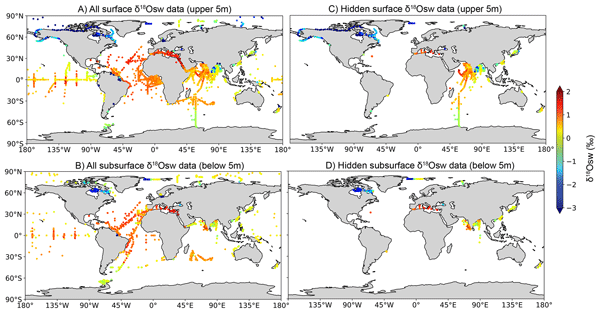
The stable isotopic composition of seawater is a valuable tool for studying the global water cycle in the past, present, and future. However, an active repository dedicated to archiving this type of data has been lacking, and many datasets remain hidden from public view. We have created a new database of observational seawater isotope data that is rich in metadata, publicly accessible, and machine readable to increase its availability and usability for a variety of Earth Science applications.
Thibaut Caley, Niclas Rieger, Martin Werner, Claire Waelbroeck, Héloise Barathieu, Tamara Happé, and Didier M. Roche
Clim. Past, 22, 247–263, https://doi.org/10.5194/cp-22-247-2026, https://doi.org/10.5194/cp-22-247-2026, 2026
Short summary
Short summary
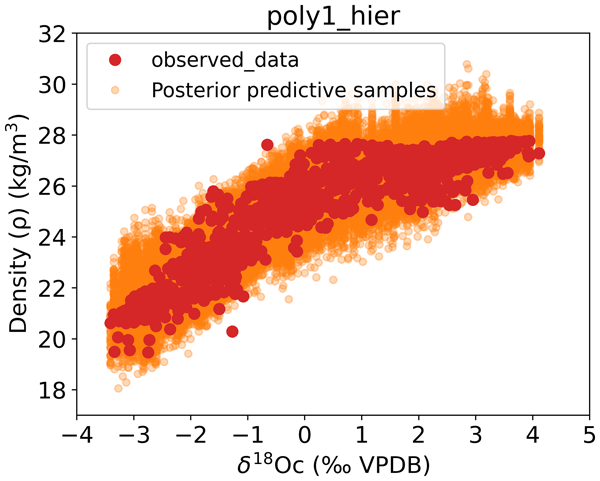
Density of seawater is a critical property that controls ocean dynamics. We developed the use of the δ18Oc of planktonic foraminifera as a surface paleodensity proxy for the ocean using Bayesian regression models calibrated to mean annual surface density. We reconstructed annual surface density during the last glacial maximum and late Holocene time periods. These results will be used to evaluate numerical climate models in their ability to simulate past ocean surface density.
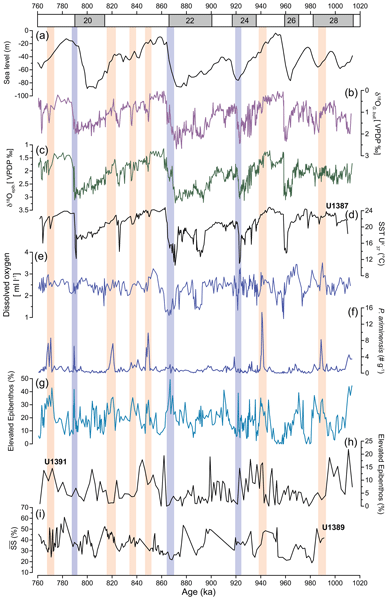
Giulia Silveira Molina, Gerhard Schmiedl, Francisco Jiménez-Espejo, Henning Kuhnert, Teresa Rodrigues, and Antje Helga Luise Voelker
J. Micropalaeontol., 45, 117–145, https://doi.org/10.5194/jm-45-117-2026, https://doi.org/10.5194/jm-45-117-2026, 2026
Short summary
Short summary
Benthic foraminifera from sediment cores collected in the Gulf of Cadiz were analysed to track ocean changes between 1014 and 761 kyr ago. Our results reveal shifts in species composition throughout the climate cycles. Oxygen loss occurred in the Mediterranean Outflow Water during warmer periods when solar insolation was intensified and productivity was higher. During cold periods, stronger bottom currents were identified by sand content and the abundance of the species Planulina ariminensis.
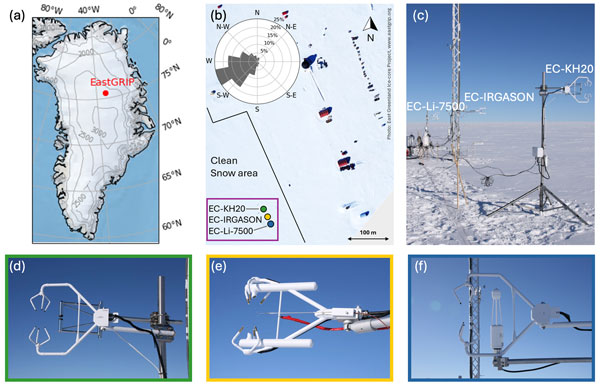
Ida Haven, Hans Christian Steen-Larsen, Laura J. Dietrich, Sonja Wahl, Jason E. Box, Michiel R. van den Broeke, Alun Hubbard, Stephan T. Kral, Joachim Reuder, and Maurice van Tiggelen
The Cryosphere, 20, 573–593, https://doi.org/10.5194/tc-20-573-2026, https://doi.org/10.5194/tc-20-573-2026, 2026
Short summary
Short summary
Three independent Eddy-Covariance measurement systems deployed on top of the Greenland Ice Sheet are compared. Using this dataset, we evaluate the reproducibility and quantify the differences between the systems. The fidelity of two regional climate models in capturing the seasonal variability in the latent and sensible heat flux between the snow surface and the atmosphere is assessed. We identify differences between observations and model simulations, especially during the winter period.
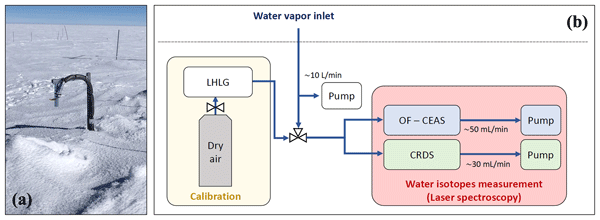
Inès Ollivier, Thomas Lauwers, Niels Dutrievoz, Cécile Agosta, Mathieu Casado, Elise Fourré, Christophe Genthon, Olivier Jossoud, Frédéric Prié, Hans Christian Steen-Larsen, and Amaëlle Landais
Earth Syst. Sci. Data, 17, 5655–5674, https://doi.org/10.5194/essd-17-5655-2025, https://doi.org/10.5194/essd-17-5655-2025, 2025
Short summary
Short summary
We present a novel 2.5-month record of the atmospheric water vapour isotopic composition during the austral summer 2023–2024 at Concordia Station on the Antarctic Plateau. We show that two independent laser spectrometers accurately record the diurnal variability of the atmospheric water vapour 𝛿18O, 𝛿D, and d-excess. We compare the measurements against outputs of the isotope-enabled general circulation model LMDZ6-iso to show how the data can be used to evaluate such models.
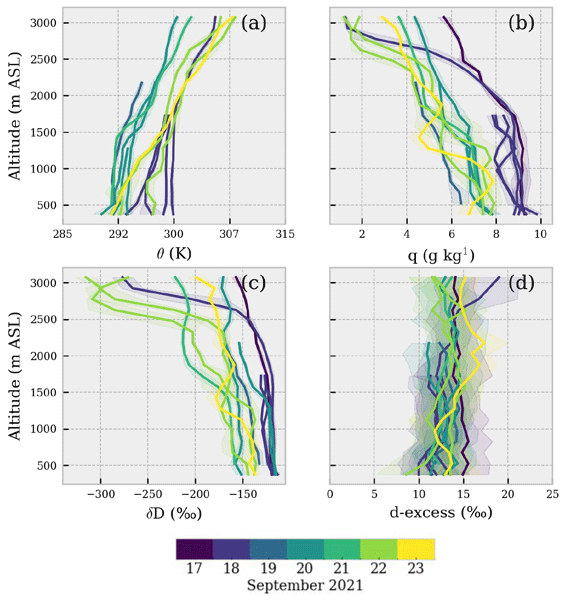
Daniele Zannoni, Hans Christian Steen-Larsen, Harald Sodemann, Iris Thurnherr, Cyrille Flamant, Patrick Chazette, Julien Totems, Martin Werner, and Myriam Raybaut
Atmos. Chem. Phys., 25, 9471–9495, https://doi.org/10.5194/acp-25-9471-2025, https://doi.org/10.5194/acp-25-9471-2025, 2025
Short summary
Short summary
High-resolution airborne observations reveal that mixing between the free troposphere and surface evapotranspiration flux primarily modulates the water vapor isotopic composition in the lower troposphere. Water vapor isotope structure variations occur on the scale of hundreds of meters, underlining the utility of stable isotopes for studying microscale atmospheric dynamics. This study also provides the basis for better validation of water vapor isotope remote sensing retrievals with surface observations.
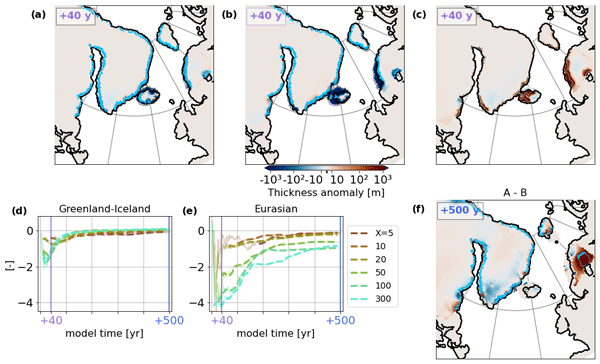
Louise Abot, Aurélien Quiquet, and Claire Waelbroeck
Clim. Past, 21, 1123–1142, https://doi.org/10.5194/cp-21-1123-2025, https://doi.org/10.5194/cp-21-1123-2025, 2025
Short summary
Short summary
This modeling study examines how the Northern Hemisphere ice sheets interact with oceans during the last glacial period. Amplified melting beneath the ice shelves results in increased freshwater release, cooling the Northern Hemisphere and slowing ocean circulation. Freshwater release and localized ocean cooling dampen ice discharges, showing complex feedback at the interface. This study emphasizes the need for additional modeling studies to clarify the role of the ocean in past abrupt events.
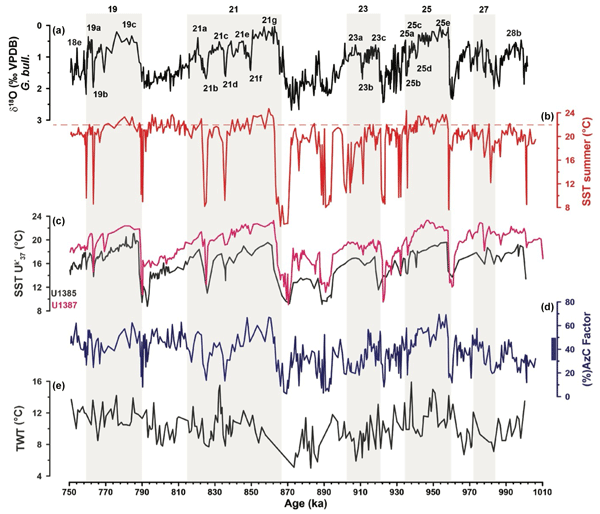
Aline Mega, Teresa Rodrigues, Emília Salgueiro, Mária Padilha, Henning Kuhnert, and Antje H. L. Voelker
Clim. Past, 21, 919–939, https://doi.org/10.5194/cp-21-919-2025, https://doi.org/10.5194/cp-21-919-2025, 2025
Short summary
Short summary
Our research explores climatic changes during the Early–Middle Pleistocene (1006–750 ka) on the southern Portuguese margin. We found that warm, subtropical-gyre-related conditions dominated. However, those conditions were occasionally interrupted by extreme cold events during the glacial periods. Our data show that these cold events, linked to changes in the North Atlantic's circulation, reached as far south as 36° N and significantly impacted marine ecosystems in the surface ocean.
Nicolas Metzl, Jonathan Fin, Claire Lo Monaco, Claude Mignon, Samir Alliouane, Bruno Bombled, Jacqueline Boutin, Yann Bozec, Steeve Comeau, Pascal Conan, Laurent Coppola, Pascale Cuet, Eva Ferreira, Jean-Pierre Gattuso, Frédéric Gazeau, Catherine Goyet, Emilie Grossteffan, Bruno Lansard, Dominique Lefèvre, Nathalie Lefèvre, Coraline Leseurre, Sébastien Petton, Mireille Pujo-Pay, Christophe Rabouille, Gilles Reverdin, Céline Ridame, Peggy Rimmelin-Maury, Jean-François Ternon, Franck Touratier, Aline Tribollet, Thibaut Wagener, and Cathy Wimart-Rousseau
Earth Syst. Sci. Data, 17, 1075–1100, https://doi.org/10.5194/essd-17-1075-2025, https://doi.org/10.5194/essd-17-1075-2025, 2025
Short summary
Short summary
This work presents a new synthesis of 67 000 total alkalinity and total dissolved inorganic carbon observations obtained between 1993 and 2023 in the global ocean, coastal zones, and the Mediterranean Sea. We describe the data assemblage and associated quality control and discuss some potential uses of this dataset. The dataset is provided in a single format and includes the quality flag for each sample.
Gilles Reverdin, Claire Waelbroeck, Antje H. L. Voelker, and Hanno Meyer
Ocean Sci., 21, 567–575, https://doi.org/10.5194/os-21-567-2025, https://doi.org/10.5194/os-21-567-2025, 2025
Short summary
Short summary
Water isotopes in the ocean trace the freshwater exchanges between the ocean, the atmosphere, and the cryosphere and are used to investigate processes of the hydrological cycle. We illustrate offsets in seawater isotopic composition between different datasets that are larger than the expected variability that one often wants to explore. This highlights the need to share seawater isotopic composition samples dedicated to specific intercomparison of data produced in different laboratories.
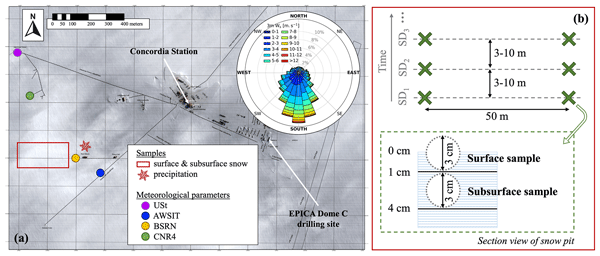
Inès Ollivier, Hans Christian Steen-Larsen, Barbara Stenni, Laurent Arnaud, Mathieu Casado, Alexandre Cauquoin, Giuliano Dreossi, Christophe Genthon, Bénédicte Minster, Ghislain Picard, Martin Werner, and Amaëlle Landais
The Cryosphere, 19, 173–200, https://doi.org/10.5194/tc-19-173-2025, https://doi.org/10.5194/tc-19-173-2025, 2025
Short summary
Short summary
The role of post-depositional processes taking place at the ice sheet's surface on the water stable isotope signal measured in polar ice cores is not fully understood. Using field observations and modelling results, we show that the original precipitation isotopic signal at Dome C, East Antarctica, is modified by post-depositional processes and provide the first quantitative estimation of their mean impact on the isotopic signal observed in the snow.
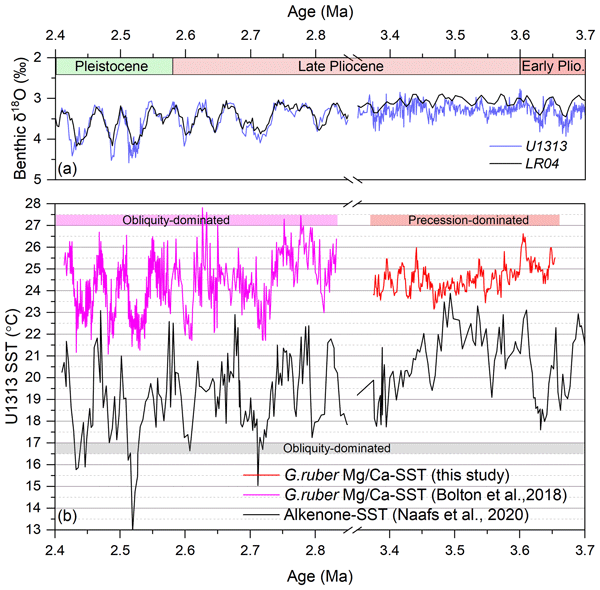
Xiaolei Pang, Antje H. L. Voelker, Sihua Lu, and Xuan Ding
Clim. Past, 20, 2103–2116, https://doi.org/10.5194/cp-20-2103-2024, https://doi.org/10.5194/cp-20-2103-2024, 2024
Short summary
Short summary
Our research discovered significant seasonal temperature variations in the North Atlantic's mid-latitudes during the early Late Pliocene. This highlights the necessity of using multiple methods to get a full picture of past climates, thus avoiding a biased understanding of the climate system. Moreover, our study reveals that the precession signal, which previously dominated surface temperature records, disappeared with the increased influence of the ice sheets in the Northern Hemisphere.
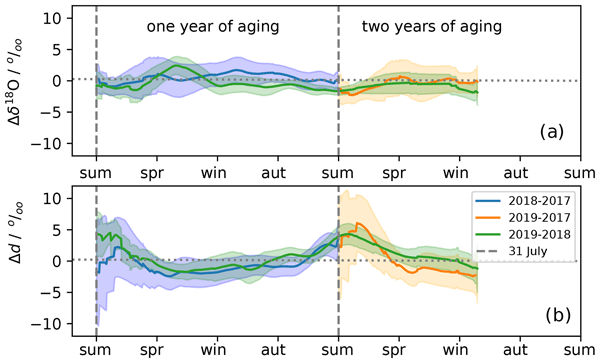
Michael S. Town, Hans Christian Steen-Larsen, Sonja Wahl, Anne-Katrine Faber, Melanie Behrens, Tyler R. Jones, and Arny Sveinbjornsdottir
The Cryosphere, 18, 3653–3683, https://doi.org/10.5194/tc-18-3653-2024, https://doi.org/10.5194/tc-18-3653-2024, 2024
Short summary
Short summary
A polar snow isotope dataset from northeast Greenland shows that snow changes isotopically after deposition. Summer snow sometimes enriches in oxygen-18, making it seem warmer than it actually was when the snow fell. Deuterium excess sometimes changes after deposition, making the snow seem to come from warmer, closer, or more humid places. After a year of aging, deuterium excess of summer snow layers always increases. Reinterpretation of deuterium excess used in climate models is necessary.
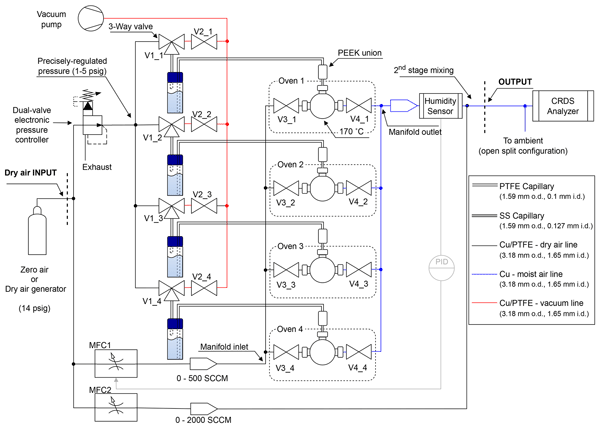
Hans Christian Steen-Larsen and Daniele Zannoni
Atmos. Meas. Tech., 17, 4391–4409, https://doi.org/10.5194/amt-17-4391-2024, https://doi.org/10.5194/amt-17-4391-2024, 2024
Short summary
Short summary
The water vapor generation module is completely scalable, allowing autonomous calibrations to use N standards and providing integration times only restricted by sample availability. We document improved reproducibility in 17O-excess liquid measurements. This module makes spectroscopy measurements comparable to mass spectrometry. We document that the vapor generation module can be used to analyze instrument performance and for vapor isotope calibration during field campaign measurements.
Nicolas Metzl, Claire Lo Monaco, Coraline Leseurre, Céline Ridame, Gilles Reverdin, Thi Tuyet Trang Chau, Frédéric Chevallier, and Marion Gehlen
Ocean Sci., 20, 725–758, https://doi.org/10.5194/os-20-725-2024, https://doi.org/10.5194/os-20-725-2024, 2024
Short summary
Short summary
In the southern Indian Ocean, south of the polar front, an observed increase of sea surface fCO2 and a decrease of pH over 1985–2021 are mainly driven by anthropogenic CO2 uptake, but in the last decade (2010–2020) fCO2 and pH were stable in summer, highlighting the competitive balance between anthropogenic CO2 and primary production. In the water column the increase of anthropogenic CO2 concentrations leads to migration of the aragonite saturation state from 600 m in 1985 up to 400 m in 2021.
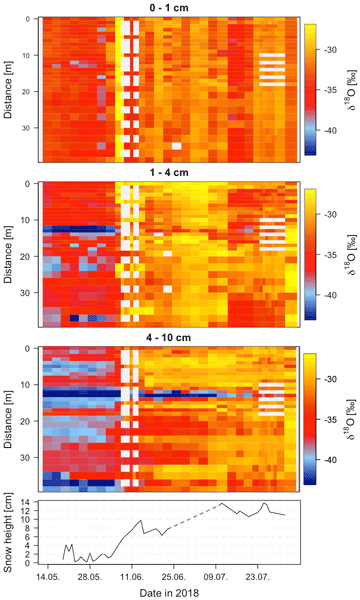
Alexandra M. Zuhr, Sonja Wahl, Hans Christian Steen-Larsen, Maria Hörhold, Hanno Meyer, Vasileios Gkinis, and Thomas Laepple
Earth Syst. Sci. Data, 16, 1861–1874, https://doi.org/10.5194/essd-16-1861-2024, https://doi.org/10.5194/essd-16-1861-2024, 2024
Short summary
Short summary
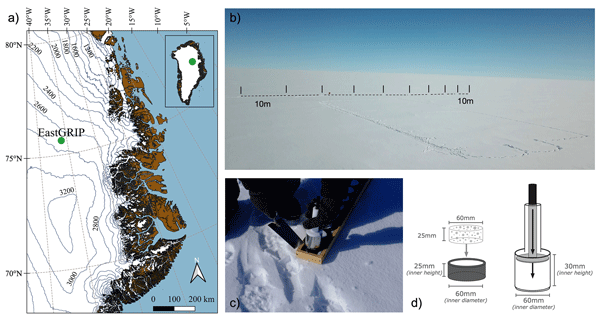
We present stable water isotope data from the accumulation zone of the Greenland ice sheet. A spatial sampling scheme covering 39 m and three depth layers was carried out between 14 May and 3 August 2018. The data suggest spatial and temporal variability related to meteorological conditions, such as wind-driven snow redistribution and vapour–snow exchange processes. The data can be used to study the formation of the stable water isotopes signal, which is seen as a climate proxy.
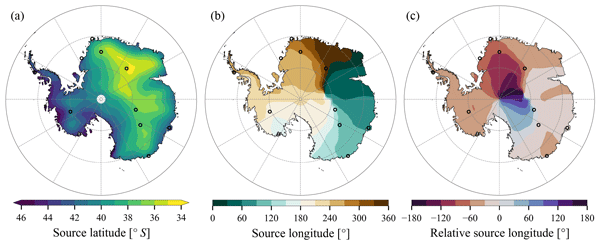
Qinggang Gao, Louise C. Sime, Alison J. McLaren, Thomas J. Bracegirdle, Emilie Capron, Rachael H. Rhodes, Hans Christian Steen-Larsen, Xiaoxu Shi, and Martin Werner
The Cryosphere, 18, 683–703, https://doi.org/10.5194/tc-18-683-2024, https://doi.org/10.5194/tc-18-683-2024, 2024
Short summary
Short summary
Antarctic precipitation is a crucial component of the climate system. Its spatio-temporal variability impacts sea level changes and the interpretation of water isotope measurements in ice cores. To better understand its climatic drivers, we developed water tracers in an atmospheric model to identify moisture source conditions from which precipitation originates. We find that mid-latitude surface winds exert an important control on moisture availability for Antarctic precipitation.
Laura J. Dietrich, Hans Christian Steen-Larsen, Sonja Wahl, Anne-Katrine Faber, and Xavier Fettweis
The Cryosphere, 18, 289–305, https://doi.org/10.5194/tc-18-289-2024, https://doi.org/10.5194/tc-18-289-2024, 2024
Short summary
Short summary
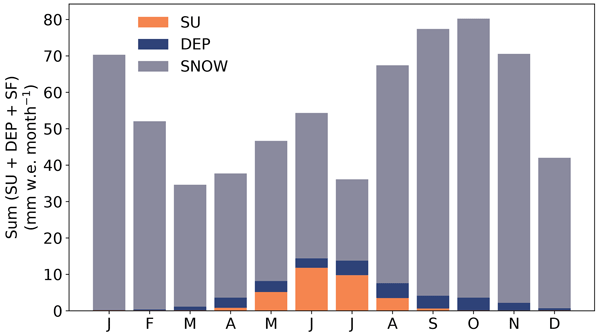
The contribution of the humidity flux to the surface mass balance in the accumulation zone of the Greenland Ice Sheet is uncertain. Here, we evaluate the regional climate model MAR using a multi-annual dataset of eddy covariance measurements and bulk estimates of the humidity flux. The humidity flux largely contributes to the summer surface mass balance (SMB) in the accumulation zone, indicating its potential importance for the annual SMB in a warming climate.
Nicolas Metzl, Jonathan Fin, Claire Lo Monaco, Claude Mignon, Samir Alliouane, David Antoine, Guillaume Bourdin, Jacqueline Boutin, Yann Bozec, Pascal Conan, Laurent Coppola, Frédéric Diaz, Eric Douville, Xavier Durrieu de Madron, Jean-Pierre Gattuso, Frédéric Gazeau, Melek Golbol, Bruno Lansard, Dominique Lefèvre, Nathalie Lefèvre, Fabien Lombard, Férial Louanchi, Liliane Merlivat, Léa Olivier, Anne Petrenko, Sébastien Petton, Mireille Pujo-Pay, Christophe Rabouille, Gilles Reverdin, Céline Ridame, Aline Tribollet, Vincenzo Vellucci, Thibaut Wagener, and Cathy Wimart-Rousseau
Earth Syst. Sci. Data, 16, 89–120, https://doi.org/10.5194/essd-16-89-2024, https://doi.org/10.5194/essd-16-89-2024, 2024
Short summary
Short summary
This work presents a synthesis of 44 000 total alkalinity and dissolved inorganic carbon observations obtained between 1993 and 2022 in the Global Ocean and the Mediterranean Sea at the surface and in the water column. Seawater samples were measured using the same method and calibrated with international Certified Reference Material. We describe the data assemblage, quality control and some potential uses of this dataset.
Claire Waelbroeck, Jerry Tjiputra, Chuncheng Guo, Kerim H. Nisancioglu, Eystein Jansen, Natalia Vázquez Riveiros, Samuel Toucanne, Frédérique Eynaud, Linda Rossignol, Fabien Dewilde, Elodie Marchès, Susana Lebreiro, and Silvia Nave
Clim. Past, 19, 901–913, https://doi.org/10.5194/cp-19-901-2023, https://doi.org/10.5194/cp-19-901-2023, 2023
Short summary
Short summary
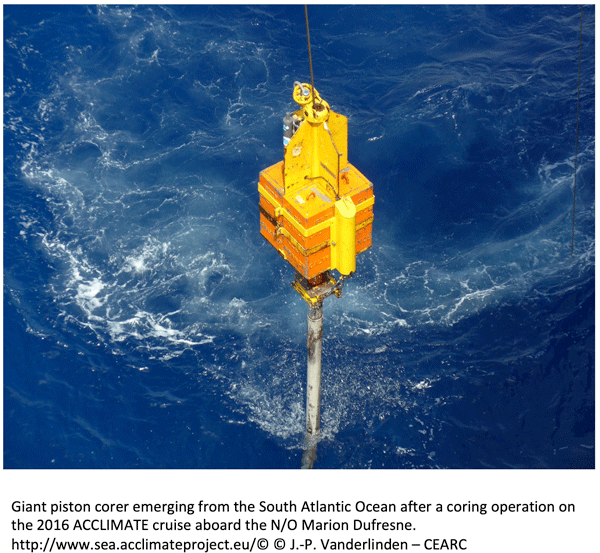
The precise geometry and extent of Atlantic circulation changes that accompanied rapid climate changes of the last glacial period are still unknown. Here, we combine carbon isotopic records from 18 Atlantic sediment cores with numerical simulations and decompose the carbon isotopic change across a cold-to-warm transition into remineralization and circulation components. Our results show that the replacement of southern-sourced by northern-sourced water plays a dominant role below ~ 3000 m depth.
Pierre L'Hégaret, Florian Schütte, Sabrina Speich, Gilles Reverdin, Dariusz B. Baranowski, Rena Czeschel, Tim Fischer, Gregory R. Foltz, Karen J. Heywood, Gerd Krahmann, Rémi Laxenaire, Caroline Le Bihan, Philippe Le Bot, Stéphane Leizour, Callum Rollo, Michael Schlundt, Elizabeth Siddle, Corentin Subirade, Dongxiao Zhang, and Johannes Karstensen
Earth Syst. Sci. Data, 15, 1801–1830, https://doi.org/10.5194/essd-15-1801-2023, https://doi.org/10.5194/essd-15-1801-2023, 2023
Short summary
Short summary
In early 2020, the EUREC4A-OA/ATOMIC experiment took place in the northwestern Tropical Atlantic Ocean, a dynamical region where different water masses interact. Four oceanographic vessels and a fleet of autonomous devices were deployed to study the processes at play and sample the upper ocean, each with its own observing capability. The article first describes the data calibration and validation and second their cross-validation, using a hierarchy of instruments and estimating the uncertainty.
Romilly Harris Stuart, Anne-Katrine Faber, Sonja Wahl, Maria Hörhold, Sepp Kipfstuhl, Kristian Vasskog, Melanie Behrens, Alexandra M. Zuhr, and Hans Christian Steen-Larsen
The Cryosphere, 17, 1185–1204, https://doi.org/10.5194/tc-17-1185-2023, https://doi.org/10.5194/tc-17-1185-2023, 2023
Short summary
Short summary
This empirical study uses continuous daily measurements from the Greenland Ice Sheet to document changes in surface snow properties. Consistent changes in snow isotopic composition are observed in the absence of deposition due to surface processes, indicating the isotopic signal of deposited precipitation is not always preserved. Our observations have potential implications for the interpretation of water isotopes in ice cores – historically assumed to reflect isotopic composition at deposition.
Andrew W. Seidl, Harald Sodemann, and Hans Christian Steen-Larsen
Atmos. Meas. Tech., 16, 769–790, https://doi.org/10.5194/amt-16-769-2023, https://doi.org/10.5194/amt-16-769-2023, 2023
Short summary
Short summary
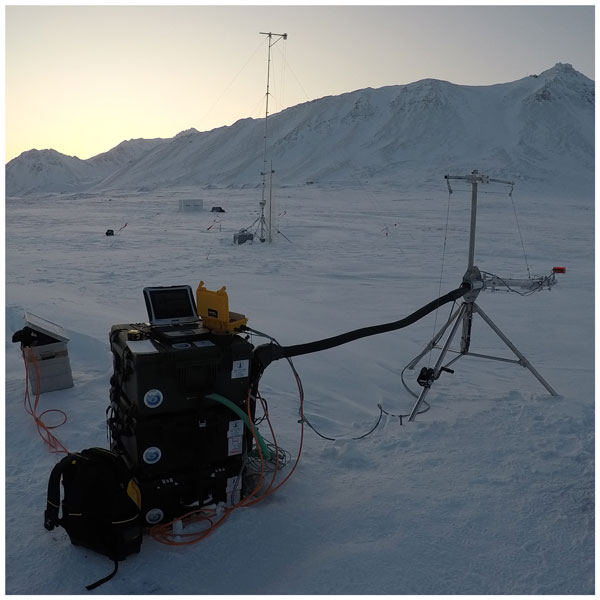
It is challenging to make field measurements of stable water isotopes in the Arctic. To this end, we present a modular stable-water-isotope analyzer profiling system. The system operated for a 2-week field campaign on Svalbard during the Arctic winter. We evaluate the system’s performance and analyze any potential impact that the field conditions might have had on the isotopic measurements and the system's ability to resolve isotope gradients in the lowermost layer of the atmosphere.
Adriana Bailey, Franziska Aemisegger, Leonie Villiger, Sebastian A. Los, Gilles Reverdin, Estefanía Quiñones Meléndez, Claudia Acquistapace, Dariusz B. Baranowski, Tobias Böck, Sandrine Bony, Tobias Bordsdorff, Derek Coffman, Simon P. de Szoeke, Christopher J. Diekmann, Marina Dütsch, Benjamin Ertl, Joseph Galewsky, Dean Henze, Przemyslaw Makuch, David Noone, Patricia K. Quinn, Michael Rösch, Andreas Schneider, Matthias Schneider, Sabrina Speich, Bjorn Stevens, and Elizabeth J. Thompson
Earth Syst. Sci. Data, 15, 465–495, https://doi.org/10.5194/essd-15-465-2023, https://doi.org/10.5194/essd-15-465-2023, 2023
Short summary
Short summary
One of the novel ways EUREC4A set out to investigate trade wind clouds and their coupling to the large-scale circulation was through an extensive network of isotopic measurements in water vapor, precipitation, and seawater. Samples were taken from the island of Barbados, from aboard two aircraft, and from aboard four ships. This paper describes the full collection of EUREC4A isotopic in situ data and guides readers to complementary remotely sensed water vapor isotope ratios.

Antoine Grisart, Mathieu Casado, Vasileios Gkinis, Bo Vinther, Philippe Naveau, Mathieu Vrac, Thomas Laepple, Bénédicte Minster, Frederic Prié, Barbara Stenni, Elise Fourré, Hans Christian Steen-Larsen, Jean Jouzel, Martin Werner, Katy Pol, Valérie Masson-Delmotte, Maria Hoerhold, Trevor Popp, and Amaelle Landais
Clim. Past, 18, 2289–2301, https://doi.org/10.5194/cp-18-2289-2022, https://doi.org/10.5194/cp-18-2289-2022, 2022
Short summary
Short summary
This paper presents a compilation of high-resolution (11 cm) water isotopic records, including published and new measurements, for the last 800 000 years from the EPICA Dome C ice core, Antarctica. Using this new combined water isotopes (δ18O and δD) dataset, we study the variability and possible influence of diffusion at the multi-decadal to multi-centennial scale. We observe a stronger variability at the onset of the interglacial interval corresponding to a warm period.
Léa Olivier, Jacqueline Boutin, Gilles Reverdin, Nathalie Lefèvre, Peter Landschützer, Sabrina Speich, Johannes Karstensen, Matthieu Labaste, Christophe Noisel, Markus Ritschel, Tobias Steinhoff, and Rik Wanninkhof
Biogeosciences, 19, 2969–2988, https://doi.org/10.5194/bg-19-2969-2022, https://doi.org/10.5194/bg-19-2969-2022, 2022
Short summary
Short summary
We investigate the impact of the interactions between eddies and the Amazon River plume on the CO2 air–sea fluxes to better characterize the ocean carbon sink in winter 2020. The region is a strong CO2 sink, previously underestimated by a factor of 10 due to a lack of data and understanding of the processes responsible for the variability in ocean carbon parameters. The CO2 absorption is mainly driven by freshwater from the Amazon entrained by eddies and by the winter seasonal cooling.
Gilles Reverdin, Claire Waelbroeck, Catherine Pierre, Camille Akhoudas, Giovanni Aloisi, Marion Benetti, Bernard Bourlès, Magnus Danielsen, Jérôme Demange, Denis Diverrès, Jean-Claude Gascard, Marie-Noëlle Houssais, Hervé Le Goff, Pascale Lherminier, Claire Lo Monaco, Herlé Mercier, Nicolas Metzl, Simon Morisset, Aïcha Naamar, Thierry Reynaud, Jean-Baptiste Sallée, Virginie Thierry, Susan E. Hartman, Edward W. Mawji, Solveig Olafsdottir, Torsten Kanzow, Anton Velo, Antje Voelker, Igor Yashayaev, F. Alexander Haumann, Melanie J. Leng, Carol Arrowsmith, and Michael Meredith
Earth Syst. Sci. Data, 14, 2721–2735, https://doi.org/10.5194/essd-14-2721-2022, https://doi.org/10.5194/essd-14-2721-2022, 2022
Short summary
Short summary
The CISE-LOCEAN seawater stable isotope dataset has close to 8000 data entries. The δ18O and δD isotopic data measured at LOCEAN have uncertainties of at most 0.05 ‰ and 0.25 ‰, respectively. Some data were adjusted to correct for evaporation. The internal consistency indicates that the data can be used to investigate time and space variability to within 0.03 ‰ and 0.15 ‰ in δ18O–δD17; comparisons with data analyzed in other institutions suggest larger differences with other datasets.
Coraline Leseurre, Claire Lo Monaco, Gilles Reverdin, Nicolas Metzl, Jonathan Fin, Claude Mignon, and Léa Benito
Biogeosciences, 19, 2599–2625, https://doi.org/10.5194/bg-19-2599-2022, https://doi.org/10.5194/bg-19-2599-2022, 2022
Short summary
Short summary
Decadal trends of fugacity of CO2 (fCO2), total alkalinity (AT), total carbon (CT) and pH in surface waters are investigated in different domains of the southern Indian Ocean (45°S–57°S) from ongoing and station observations regularly conducted in summer over the period 1998–2019. The fCO2 increase and pH decrease are mainly driven by anthropogenic CO2 estimated just below the summer mixed layer, as well as by a warming south of the polar front or in the fertilized waters near Kerguelen Island.
Kevin S. Rozmiarek, Bruce H. Vaughn, Tyler R. Jones, Valerie Morris, William B. Skorski, Abigail G. Hughes, Jack Elston, Sonja Wahl, Anne-Katrine Faber, and Hans Christian Steen-Larsen
Atmos. Meas. Tech., 14, 7045–7067, https://doi.org/10.5194/amt-14-7045-2021, https://doi.org/10.5194/amt-14-7045-2021, 2021
Short summary
Short summary
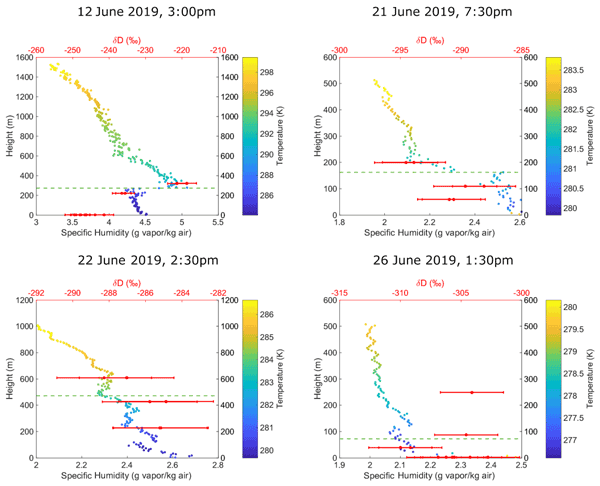
We have designed an unmanned aerial vehicle (UAV) sampling platform for operation in extreme polar environments that is capable of sampling atmospheric water vapor for subsequent measurement of water isotopes. During flight, we measure location, temperature, humidity, and pressure to determine the height of the planetary boundary layer (PBL) using algorithms, allowing for strategic decision-making by the pilot to collect samples in glass flasks contained in the nose cone of the UAV.
Abigail G. Hughes, Sonja Wahl, Tyler R. Jones, Alexandra Zuhr, Maria Hörhold, James W. C. White, and Hans Christian Steen-Larsen
The Cryosphere, 15, 4949–4974, https://doi.org/10.5194/tc-15-4949-2021, https://doi.org/10.5194/tc-15-4949-2021, 2021
Short summary
Short summary
Water isotope records in Greenland and Antarctic ice cores are a valuable proxy for paleoclimate reconstruction and are traditionally thought to primarily reflect precipitation input. However,
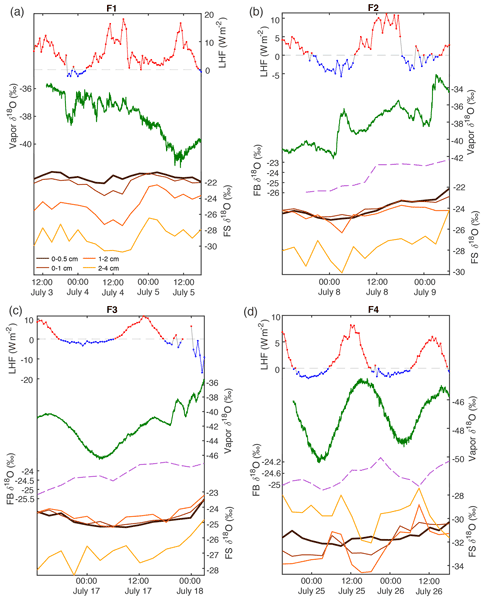
post-depositional processes are hypothesized to contribute to the isotope climate signal. In this study we use laboratory experiments, field experiments, and modeling to show that sublimation and vapor–snow isotope exchange can rapidly influence the isotopic composition of the snowpack.
Cited articles
Abram, N. J., Wright, N. M., Ellis, B., Dixon, B. C., Wurtzel, J. B., England, M. H., Ummenhofer, C. C., Philibosian, B., Cahyarani, S. Y., Yu, T.-L., Shen, C.-C., Cheng, H., Edwards, R. L., and Heslop, D.: Coupling of Indo-Pacific climate variability over the last millennium, Nature, 579, 385–392, https://doi.org/10.1038/s41586-020-2084-4, 2020.
Akhoudas, C., Sallée, J.-B., Reverdin, G., Haumann, A., Pauthenet, E., Chapman, C. C., Margirier, F., Lo Monaco, C., Metzl, N., Meilland, J., and Stranne, C.: Isotopic evidence for an intensified hydrological cycle in the Indian sector of the Southern Ocean, Nat. Comm., 14, 2763, https://doi.org/10.1038/s41467-023-38425-5, 2023.
Alory, G., Delcroix, T., Téchiné, P., Diverrès, D., Varillon, D., Cravatte, S., Gouriou, Y., Grelet, J., Jacquin, S., Kestenare, E., Maes, C., Morrow, R. M., Perrier, J., Reverdin, G., and Roubaud, F.: The French contribution to the Voluntary Observing Ships Network of Sea Surface Salinity, Deep-Sea Res. Pt. I, 105, 1–18, https://doi.org/10.1016/j.DSR.2015.08.005, 2015.
Aoki, S., Yamazaki, K., Hirano, D., Nomura, D., and Murase, H.: Distribution of stable oxygen isotope in seawater and implication on freshwater cycle off the coast from Wilkes to George V Land, East Antarctica, Prog. Oceanogr., 217, 103101, https://doi.org/10.1016/j.pocean.2023.103101, 2023.
Atwood, A. R., Moore, A. L., DeLong, K. L., Long, S. E., Sanchez, S. C., Hargreaves, J. A., Morris, C. A., Pauly, R. E., Dassié, É. P., Felis, T., Voelker, A. H. L., Murty, S. A., and Cobb, K. M.: The PAGES CoralHydro2k Seawater δ18O Database: a FAIR-aligned compilation of seawater δ18O data to uncover “hidden” insights from the global ocean, Earth Syst. Sci. Data, 18, 1921–1941, https://doi.org/10.5194/essd-18-1921-2026, 2026.
Atwood, A. R., Moore, A. L., Long, S., Pauly, R., DeLong, K., Wagner, A., and Hargreaves, J. A.: The CoralHydro2k Seawater δ18O Database, Past Global Changes Mag., 32, 59, https://doi.org/10.22498/pages.32.1.59, 2025.
Ayache, M., Dutay, J.-C., Mouchet, A., Tachikawa, K., Risi, C., and Ramstein, G.: Modelling the water isotope distribution in the Mediterranean using a high-resolution oceanic model (NEMO-MED12-watiso v1.0): evaluation of model results against in situ observations, Geosci. Mod. Dev., 17, 6627–6655, https://doi.org/10.5194/gmd-17-6627-2024, 2024.
Benetti, M., Reverdin, G., Pierre, C., Merlivat, L., Risi, C., Steen-Larsen, H. C., and Vimeux, F.: Deuterium excess in marine water vapor: dependency on relative humidity and surface wind speed during evaporation, J. Geophys. Res.-Atmos., 119, 584–593, https://doi.org/10.1002/2013JD020535, 2014.
Benetti, M., Reverdin, G., Pierre, C., Khatiwala, S., Tournadre, B., Olafsdottir, S., and Naamar, A.: Variability of sea ice melt and meteoric water input in the surface Labrador Current off Newfoundland, J. Geophys. Res.-Oceans, 121, 2841–2855, 2016.
Benetti, M., Reverdin, G., Aloisi, G., and Sveinbjörnsdóttir, A.: Stable isotopes in surface waters of the Atlantic Ocean: indicators of ocean-atmosphere water fluxes and oceanic mixing processes, J. Geophys. Res.-Oceans, 122, https://doi.org/10.1002/2017JC012712, 2017a.
Benetti, M., Sveinbjörnsdóttir, A. E., Ólafsdóttir, R., Leng, M. J., Arrowsmith, C., Debondt, K., Fripiat, F., and Aloisi, G.: Inter-comparison of salt effect correction for δ18O and δ2H measurements in seawater by CRDS and IRMS using the gas-H2O equilibration method, Mar. Chem., 194, 114–123, https://doi.org/10.1016/j.marchem.2017.05.010, 2017b.
Benway, H. M. and Mix, A. C.: Oxygen isotopes, upper-ocean salinity, and precipitation sources in the eastern tropical Pacific, Earth Planet. Sc. Lett., 224, 493–507, https://doi.org/10.1016/j.epsl.2004.05.014, 2004.
Bingham, F. M., Howden, S. D., and Koblinsky, C. J.: Sea surface salinity measurements in the historical database, J. Geophys. Res.-Oceans, 107, https://doi.org/10.1029/2000JC000767, 2002.
Boutin, J, Chao, Y., Asher, W. E., Delcroix, T., Drucker, R., Drushka, K., Kolodziejczyk, N., Lee, T., Reul, N., Reverdin, G., Schanze, J., Soloviev, A., Yu, L., Anderson, J., Brucker, L., Dinnat, E., W. L. Jones, W. L., Lagerloef, G., Maes, C., Meissner, T., Santos-Garcia, A., Tang, W., Vinogradova, N., and Ward, B.: Satellite and In Situ Salinity: Understanding Near-Surface Stratification and Subfootprint Variability, B. Am. Meteorol. Soc., 97, 1391–1407, https://doi.org/10.1175/BAMS-D-15-00032.1, 2016.
Boutin, J., Reul, N., Koehler, J., Martin, A., Catany, R., Guimbard, S., Rouffi, F., Vergely, J. L., Arias, M., Chakroun, M., Corato, G., Estella-Perez, V., Hasson, A., Josey, S., Khvorostyanov, D., Kolodziejczyk, N., Mignot, J., Olivier, L., Reverdin, G., Stammer, D., Supply, A., Thouvenin-Masson, C., Turiel, A., Vialard, J., Cipollini, P., Donlon, C., Sabia, R., and Mecklenburg, S.: Satellite-Based Sea Surface Salinity Designed for Ocean and Climate Studies, J. Geophys. Res. Oceans, 126, 11, https://doi.org/10.1029/2021JC017676, 2021.
Brady, E., Stevenson, S., Bailey, D., Liu, Z., Noone, D., Nusbaumer, J., Otto-Bliesner, B. L., Tabor, C., Thomas, R., Wong, T., Zhang, J., and Zhu, J.: The connected isotopic water cycle in the Community Earth System Model Version 1, J. Adv. Model. Earth Syst., 11, 8, https://doi.org/10.1029/2019MS001663, 2019.
Cauquoin, A., Werner, M., and Lohmann, G.: Water isotopes–climate relationships for the mid-holocene and preindustrial period simulated with an isotope-enabled version of MPI-ESM, Clim. Past, 15, 1913–1937, https://doi.org/10.5194/cp-15-1913-2019, 2019.
Conroy, J. L., Cobb, K. M., Lynch-Stieglitz, J., and Polissar, P. J.: Constraints on the salinity-oxygen isotope relationship in the central tropical Pacific Ocean, Mar. Chem., 161, 26–33, https://doi.org/10.1016/j.marchem.2014.02.001, 2014.
Conroy, J. L., Thompson, D. M., Cobb, K. M., Noone, D., Rea, S., and LeGrande, A. N.: Spatiotemporal variability in the δ18O-salinity relationship of seawater across the tropical Pacific, Paleoceanography, 32, 484–497, https://doi.org/10.1002/2016PA003073, 2017.
Craig, H. C. and Gordon, L. I.: Deuterium and oxygen 18 variations in the ocean and the marine atmosphere, in: Stable Isotopes in Oceanographic Studies and Paleotemperatures, edited by: Tongiorgi, E., Cons. Naz. di Rech., Spoleto, Italy, 9–130, 1965.
Da-Allada, C. Y., Alory, G., du Penhoat, Y., Kestenare, E., Durand, F., and Hounkonnou, N. M.: Seasonal mixed-layer salinity balance in the tropical Atlantic Ocean: mean state and seasonal cycle, J. Geophys. Res.-Oceans, 118, 332–345, https://doi.org/10.1029/2012JC008357, 2013.
Dassié, E. P., Hasson, A., Khodri, M., Lebas, N., and Linsley, B. K.: Spatiotemporal variability in the South Pacific convergence zone fresh pool eastern front from coral-derived surface salinity data, J. Climate, 31, 3265–3288, https://doi.org/10.1175/jcli-d-17-0071.1, 2018.
Delaygue, G., Jouzel, J., and Dutay, J.-C.: Oxygen 18-salinity relationship simulated by an oceanic general circulation model, Earth Planet. Sc. Lett., 178, 113–123, 2000.
Dissard, D., Reichart, G. J., Menkes, C., Mangeas, M., Frickenhaus, S., and Bijma, J.: Mg/Ca, Sr/Ca and stable isotopes from the planktonic foraminifera T. sacculifer: testing a multi-proxy approach for inferring paleotemperature and paleosalinity, Biogeosciences, 18, 423–439, https://doi.org/10.5194/bg-18-423-2021, 2021.
Dong, B., Kumar, R., Shirai, K., Drysdale, R. N., and Prendergast, A. L.: Advances in giant clam (Tridacnidae spp.) sclerochronology and sclerochemistry as a high-resolution palaeoenvironmental archive, Palaeogeogr. Palaeocl. Palaeoecol., 661, 112576, https://doi.org/10.1016/j.palaeo.2024.112576, 2025.
Frew, R. D., Dennis, P. F, Heywood, K. J., Meredith, M. P., and Boswell, S. M.: The oxygen isotope composition of water masses in the northern North Atlantic, Deep-Sea Res. Pt. I, 47, 2265–2286, 2000.
Glaubke, R. H., Wagner, A., and Sikes, E. L.: Characterizing the stable oxygen isotopic composition of the southeast Indian Ocean, Mar. Chem., 262, 177–185, https://doi.org/10.1016/j.marchem.2024.104397, 2024.
Hennig, A. N., Mucciarone, D. A., Jacobs, S. S., Mortlock, R. A., and Dunbar, R. B.: Meteoric water and glacial melt in the southeastern Amundsen Sea: a time series from 1994 to 2020, The Cryosphere, 18, 791–818, https://doi.org/10.5194/tc-18-791-2024, 2024.
Hilaire-Marcel, C., Kim, S. T., Landais, A., Ghosh, P., Assonov, S., Lécuyer, C., Blanchard, M., Meijer, H. A., and Steen-Larsen, H. C.: A stable isotope toolbox for water and inorganic carbon cycle studies, Na. Rev. Earth Environ., 2, 699–719, 2021.
Horikawa, K., Kodaira, T., Zhang, J., and Obata, H.: Salinity-oxygen isotope relationship during an El Niño (2014–2015) in the southwestern Pacific and comparisons with GEOSECS data (La Niña, 1973–1974), J. Mar. Chem., 249, https://doi.org/10.1016/j.marchem.2023.104222, 2023.
Hurrell, J. W., Kushnir, Y., Ottersen, G., and Visbeck, M.: An overview of the North Atlantic Oscillation, edited by: Hurrell, J. W., Kushnir, Y., Ottersen, G., and Visbeck, M., Geophys. Monog. Ser. 134, 35 pp, https://doi.org/10.1029/134GM01, 2005.
Konecky, B. L., McKay, N. P., Churakova (Sidorova), O. V., Comas-Bru, L., Dassié, E. P., DeLong, K. L., Falster, G. M., Fischer, M. J., Jones, M. D., Jonkers, L., Kaufman, D. S., Leduc, G., Managave, S. R., Martrat, B., Opel, T., Orsi, A. J., Partin, J. W., Sayani, H. R., Thomas, E. K., Thompson, D. M., Tyler, J. J., Abram, N. J., Atwood, A. R., Cartapanis, O., Conroy, J. L., Curran, M. A., Dee, S. G., Deininger, M., Divine, D. V., Kern, Z., Porter, T. J., Stevenson, S. L., von Gunten, L., and Iso2k Project Members: The Iso2k database: a global compilation of paleo-δ18O and δ2H records to aid understanding of Common Era climate, Earth Syst. Sci. Data, 12, 2261–2288, https://doi.org/10.5194/essd-12-2261-2020, 2020.
Konecky, B. L., McKay, N. P., Flaster, G. M., Stevenson, S. L., Fischer, M. J., Atwood, A. T., Thompson, D. M., Jones, M. D., Tyler, J. J., DeLong, K. L., Martrat, B., Thomas, E. K., Conroy, J. L., Dee, S. G., Jonkers, L., Churakova, O. V., Kern, Zoltan, Opel, T., Porter, T. J., Sayani, H. R., and Skrzypek, G.: Globally coherent water cycle response to temperature change during the past two millenia, Nat. Geosci., 16, 997–1004, https://doi.org/10.1038/s41561-023-01291-3, 2023.
Leduc, G., Sachs, J. P., Kawka, O. E., and Schneider, R. R.: Holocene changes in eastern equatorial Atlantic salinity as estimated by water isotopologues, Earth Planet. Sc. Lett., 362, 151–162, https://doi.org/10.1016/j.epsl.2012.12.003, 2013.
LeGrande, A. N. and Schmidt, G. A.: Global gridded data set of the oxygen isotopic composition in seawater, Geophys. Res. Lett., 33, https://doi.org/10.1029/2006gl026011, 2006.
Mulitza, S., Boltovskoy, D., Donner, B., Meggers, H., Paul, A., and Wefer, G.: Temperature: δ18O relationships of planktonic foraminifera collected from surface water, Palaeogeogr. Palaeocl., 202, 143–152, https://doi.org/10.1016/S0031-0182(03)00633-3, 2003.
O'Connor, G. K., Cobb, K. M., Sayani, H. R., Atwood, A. R., Grothe, P. R., Stevenson, S., Baum, J. K., Chen, T., Claar, D. C., Hitt, N. T., Lynch-Stieglitz, J., Mortlock, R. A., Schmidt, G. A., and Walter, R: Coral oxygen isotopic records capture the 2015–2016 El Niño Event in the central Equatorial Pacific, Geophys. Res. Lett., 48, e2021GL094036, https://doi.org/10.1029/2021GL094036, 2021.
Oppo, D. W., Schmidt, G. A., and LeGrande, A. N.: Seawater isotope constraints on tropical hydrology during the Holocene, Geophys. Res. Lett., 34, L13701, https://doi.org/10.1029/2007GL030017, 2007.
Phillips, H. E. and Joyce, T. M.: Bermuda's tale of two time series: Hydrostation S and BATS, J. Phys. Oceanogr., 37, 554–571, https://doi.org/10.1175/JPO2997.1, 2007.
Rebotim, A., Voelker, A. H. L., Jonkers, L., Waniek, J. J., Schulz, M., and Kucera, M.: Calcification depth of deep-dwelling planktonic foraminifera from the eastern North Atlantic constrained by stable oxygen isotope ratios of shells from stratified plankton tows, J. Micropalaeontol., 38, 113–131, https://doi.org/10.5194/jm-38-113-2019, 2019.
Reverdin, G., Kestenare, E., Frankignoul, C., and Delcroix, T.: In situ surface salinity in the tropical and subtropical Atlantic Ocean. Part I. Large scale variability, Prog. Oceanogr., 73, 311–340, https://doi.org/10.1016/j.pocean.2006.11.004, 2007.
Reverdin, G., Metzl, N., Olafsdottir, S., Racapé, V., Takahashi, T., Benetti, M., Valdimarsson, H., Benoit-Cattin, A., Danielsen, M., Fin, J., Naamar, A., Pierrot, D., Sullivan, K., Bringas, F., and Goni, G., SURATLANT: a 1993–2017 surface sampling in the central part of the North Atlantic subpolar gyre, Earth Syst. Sci. Data, 10, 1901–1924, https://doi.org/10.5194/essd-10-1901-2018, 2018.
Reverdin, G., Waelbroeck, C., Pierre, C., Akhoudas, C., Aloisi, G., Benetti, M., Bourlès, B., Danielsen, M., Demange, J., Diverrès, D., Gascard, J.-C., Houssais, M.-N., Le Goff, H., Lherminier, P., Lo Monaco, C., Mercier, H., Metzl, N., Morisset, S., Naamar, A., Reynaud, T., Sallée, J.-B., Thierry, V., Hartman, S. E., Mawji, E. W., Olafsdottir, S., Kanzow, T., Velo, A., Voelker, A., Yashayaev, I., Haumann, F. A., Leng, M. J., Arrowsmith, C., and Meredith, M.: The CISE-LOCEAN seawater isotopic database (1998–2021), Earth Syst. Sci. Data, 14, 2721–2735, https://doi.org/10.5194/essd-14-2721-2022, 2022.
Reverdin, G., Waelbroeck, C., Voelker, A. H., and Meyer, G.: Technical note: Large offsets between different datasets of seawater isotopic composition: an illustration of the need to reinforce intercalibration efforts, Ocean Sci., 21, 567–575, https://doi.org/10.5194/os-21-567-2025, 2025.
Roche, D. M. and Caley, T.: δ18O water isotope in the iLOVECLIM model (version 1.0) – Part 2: Evaluation of model results against observed δ18O in water samples, Geosci. Model Dev., 6, 1493–1504, https://doi.org/10.5194/gmd-6-1493-2013, 2013.
Salgueiro, E., Voelker, A. H. L., Martin, P. A., Rodrigues, T., Zúñiga, D., Froján, M., de la Granda, F., Villacieros-Robineau, N., Alonso-Pérez, F., Alberto, A., Rebotim, A., González-Álvarez, R., Castro, C. G., and Abrantes, F.: δ18O and Mg/Ca Thermometry in Planktonic Foraminifera: A Multiproxy Approach Toward Tracing Coastal Upwelling Dynamics, Paleoceanogr. Paleocl., 35, e2019PA003726, https://doi.org/10.1029/2019PA003726, 2020.
Schefuß, E., Schouten, S., and Schneider, R. R.: Climatic controls on central African hydrology during the past 20,000 years, Nature, 437, 1003–1006, https://doi.org/10.1038/nature03945, 2005.
Schmidt, G. A., LeGrande, A. N., and Hoffmann, G.: Water isotope expressions of intrinsic and forced variability in a coupled ocean-atmosphere model, J. Geophys. Res., 112, D10103, https://doi.org/10.1029/2006jd007781, 2007.
Schouten, S., Ossebaar, J., Schreiber, K., Kienhuis, M. V. M., Langer, G., Benthien, A., and Bijma, J.: The effect of temperature, salinity and growth rate on the stable hydrogen isotopic composition of long chain alkenones produced by Emiliania huxleyi and Gephyrocapsa oceanica, Biogeosciences, 3, 113–119, https://doi.org/10.5194/bg-3-113-2006, 2006.
Souchez, R., Tison, J.-L., and Jouzel, J.: Deuterium concentation and growth rate of Antarctic first-year ice, Geophys. Res. Lett., 15, 1385–1388, https://doi.org/10.1029/GL015i012p01385, 1988.
Steen-Larsen, H. C. and Zannoni, D.: A versatile water vapor generation module for vapor isotope calibration and liquid isotope measurements, Atmos. Meas. Tech., 17, 4391–4409, https://doi.org/10.5194/amt-17-4391-2024, 2024.
Thompson, D. M., Conroy, J. L., Konecky, B. L., Stevenson, S., DeLong, K. L., McKay, N., Reed, E., Jonkers, L., and Carré, M.: Ientifying hydro-sensitive coral 18O records for improving high-resolution temperature and salinity reconstruction, Geophys. Res. Lett., 49, e2021GL096153, https://doi.org/10.1029/2021GL096153, 2022.
Voelker, A., Colman, A., Olack, G., Waniek, J. J., and Hodell, D.: Oxygen and hydrogen isotope signatures of Northeast Atlantic water masses, Deep-Sea Res. Pt. II, 116, 89–106, https://doi.org/10.1016/j.dsr2.2014.11.006, 2015.
Wilke, I., Meggers, H., and Bickert, T.: Depth habitats and seasonal distributions of recent planktic foraminifers in the Canary Islands region (29° N) based on oxygen isotopes, Deep-Sea Res. Pt. I, 56, 89–106, https://doi.org/10.1016/j.dsr.2008.08.001, 2009.
Yu, L., Bingham, F. M., Dinnat, E. P., Fournier, S., Melnichenko, O., Tang, W., and Yueh, S. H.: Revisiting the global patterns of seasonal cycle in sea surface salinity, J. Geophys. Res.-Oceans, 126, https://doi.org/10.1029/2020JC016789, 2021.
Short summary
The distributions of water isotopic properties (δ18O, δ2H, deuterium excess) as a function of salinity are studied in the surface Atlantic Ocean and southwest Indian Ocean using the CISE-LOCEAN database. Large spatial gradients are found as well as a seasonal variability in the North Atlantic sub-polar gyre and in the equatorial Atlantic. Spatially averaged seasonal cycles are established in these regions, as well as at the BATS (Bermuda Atlantic Time-series Study) site (31°50' N, 64°10' W).
The distributions of water isotopic properties (δ18O, δ2H, deuterium excess) as a function of...


