Articles | Volume 22, issue 5
https://doi.org/10.5194/os-22-3055-2026
© Author(s) 2026. This work is distributed under
the Creative Commons Attribution 4.0 License.
https://doi.org/10.5194/os-22-3055-2026
© Author(s) 2026. This work is distributed under
the Creative Commons Attribution 4.0 License.
Nonlinear dynamics of time-variable slope circulation
Anna Lina Petruseviciute Sjur
CORRESPONDING AUTHOR
Department of Geosciences, University of Oslo, Oslo, Norway
Norwegian Meteorological Institute, Oslo, Norway
Pål Erik Isachsen
Department of Geosciences, University of Oslo, Oslo, Norway
Norwegian Meteorological Institute, Oslo, Norway
Johan Nilsson
Department of Meteorology, Stockholm University, Stockholm, Sweden
Susan Elizabeth Allen
Department of Earth, Ocean, and Atmospheric Sciences, University of British Columbia, Vancouver, Canada
Related authors
No articles found.
Karyn D. Suchy, Susan E. Allen, Akash R. Sastri, and Kelly V. Young
Biogeosciences, 23, 4667–4689, https://doi.org/10.5194/bg-23-4667-2026, https://doi.org/10.5194/bg-23-4667-2026, 2026
Short summary
Short summary
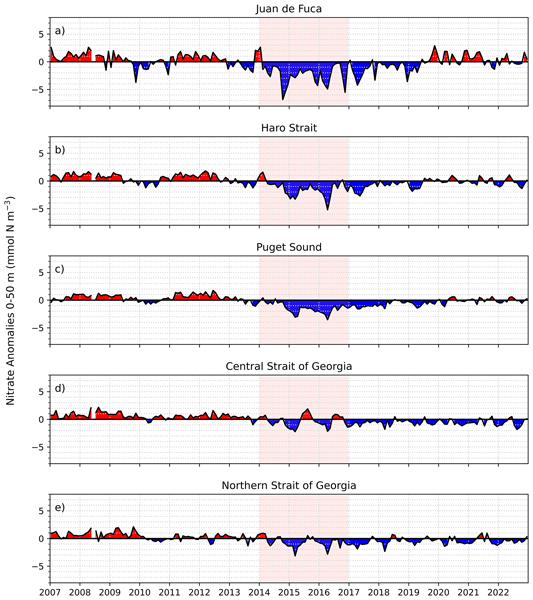
We used a biophysical model to examine the impacts of the 2014–2017 Northeast Pacific Marine Heatwave on plankton in the Salish Sea. Warming was strongest in the Juan de Fuca Strait, increasing phytoplankton growth. The Strait of Georgia showed stronger links to the North Pacific Gyre Oscillation with warming beyond 2017 and a reduction in large phytoplankton. Results highlight that multiple marine heatwaves can overlap within one waterbody, each with distinct effects on the local food web.
Becca Beutel, Susan E. Allen, Jilian Xiong, Jay T. Cullen, and Tia Anderlini
Biogeosciences, 22, 7309–7336, https://doi.org/10.5194/bg-22-7309-2025, https://doi.org/10.5194/bg-22-7309-2025, 2025
Short summary
Short summary
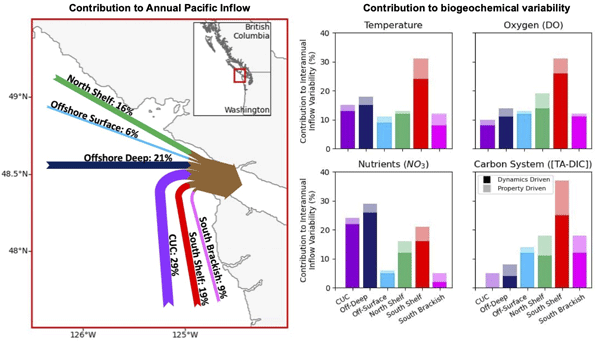
This study examines how variability in Pacific source waters influences the biogeochemistry of the Salish Sea. Using model simulations and observations, we traced the origins and properties of inflowing water and quantified the roles of circulation and property variability in shaping fluxes of oxygen, nutrients, and carbonate system tracers. These findings highlight key drivers of interannual change and their relevance under a changing climate.
Felicity A. Holmes, Jamie Barnett, Henning Åkesson, Mathieu Morlighem, Johan Nilsson, Nina Kirchner, and Martin Jakobsson
The Cryosphere, 19, 2695–2714, https://doi.org/10.5194/tc-19-2695-2025, https://doi.org/10.5194/tc-19-2695-2025, 2025
Short summary
Short summary
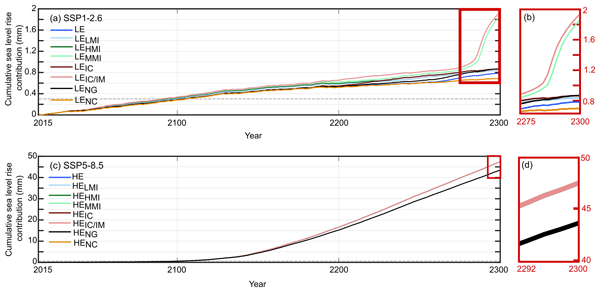
Northern Greenland contains some of the ice sheet's last remaining glaciers with floating ice tongues. One of these is Ryder Glacier, which has been relatively stable in recent decades, in contrast to nearby glaciers. Here, we use a computer model to simulate Ryder Glacier until 2300 under both a low- and a high-emissions scenario. Very high levels of surface melt under a high-emissions future lead to a sea level rise contribution that is an order of magnitude higher than under a low-emissions future.
Pedro A. Figueroa, Gonzalo S. Saldías, and Susan E. Allen
Ocean Sci., 21, 643–659, https://doi.org/10.5194/os-21-643-2025, https://doi.org/10.5194/os-21-643-2025, 2025
Short summary
Short summary
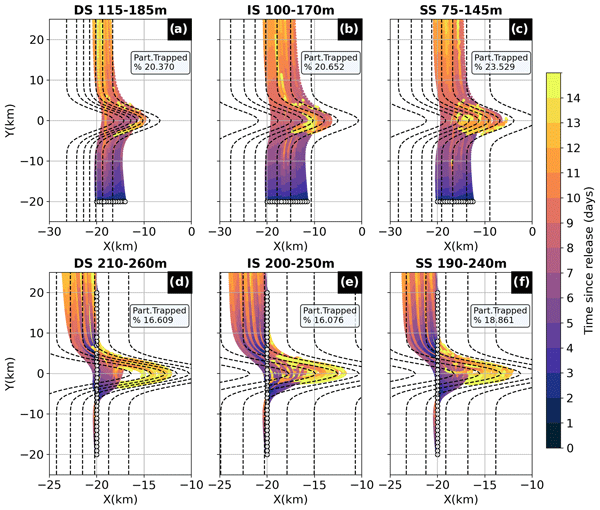
Submarine canyons are topographic features found along the continental slope worldwide. Here we use numerical simulations to study how a submarine canyon influences the circulation near the coast when winds moving poleward influence the region. Our results show that submarine canyons modify the circulation near the coast, causing strong velocities perpendicular to the coast. These changes can trap particles inside the canyon, an important mechanism to explain its role as a biological hotspot.
Mateusz Matuszak, Johannes Röhrs, Pål Erik Isachsen, and Martina Idžanović
Ocean Sci., 21, 401–418, https://doi.org/10.5194/os-21-401-2025, https://doi.org/10.5194/os-21-401-2025, 2025
Short summary
Short summary
Lagrangian coherent structures (LCSs) describe material transport in ocean flow by describing transport and accumulation regions. We discuss the implications of model flow field uncertainty for finite-time Lyapunov exponents (FTLEs), which under certain conditions approximate LCSs. FTLEs add value to forecasting when they are certain and long-lived. Averaging FTLEs reveals where they are more certain and long-lived, often influenced by bottom topography.
Laura Bianucci, Jennifer M. Jackson, Susan E. Allen, Maxim V. Krassovski, Ian J. W. Giesbrecht, and Wendy C. Callendar
Ocean Sci., 20, 293–306, https://doi.org/10.5194/os-20-293-2024, https://doi.org/10.5194/os-20-293-2024, 2024
Short summary
Short summary
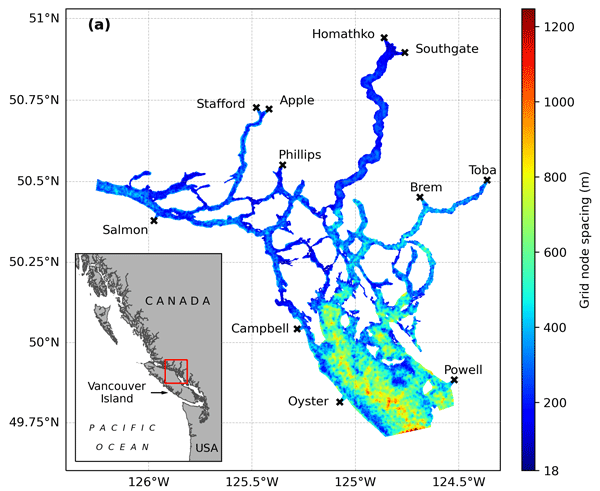
While the deeper waters in the coastal ocean show signs of climate-change-induced warming and deoxygenation, some fjords can keep cool and oxygenated waters in the subsurface. We use a model to investigate how these subsurface waters created during winter can linger all summer in Bute Inlet, Canada. We found two main mechanisms that make this fjord retentive: the typical slow subsurface circulation in such a deep, long fjord and the further speed reduction when the cold waters are present.
Håvard Espenes, Pål Erik Isachsen, and Ole Anders Nøst
Ocean Sci., 19, 1633–1648, https://doi.org/10.5194/os-19-1633-2023, https://doi.org/10.5194/os-19-1633-2023, 2023
Short summary
Short summary
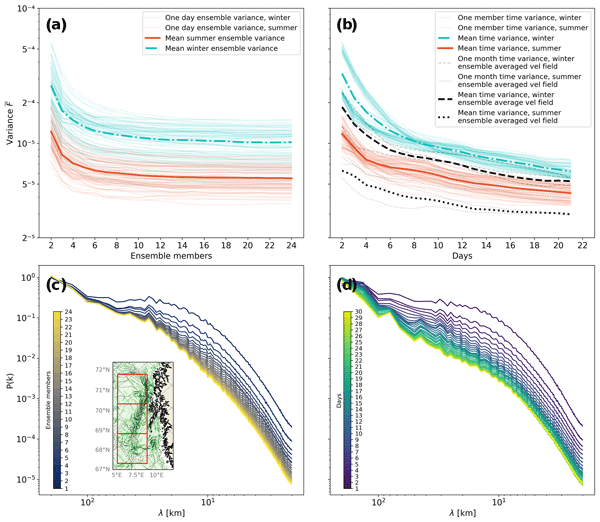
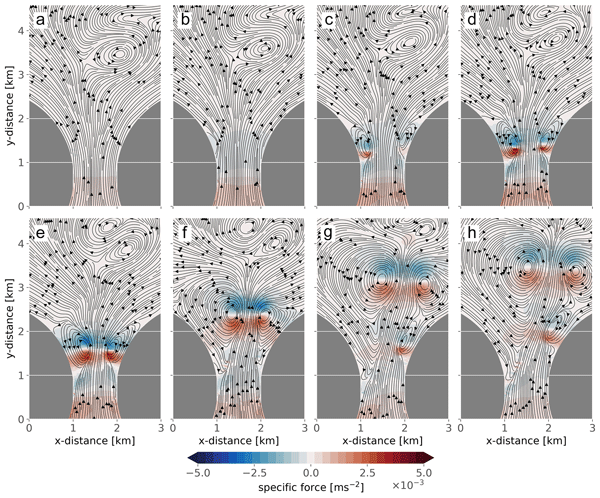
We show that tidally generated eddies generated near the constriction of a channel can drive a strong and fluctuating flow field far downstream of the channel constriction itself. The velocity signal has been observed in other studies, but this is the first study linking it to a physical process. Eddies such as those we found are generated because of complex coastal geometry, suggesting that, for example, land-reclamation projects in channels may enhance current shear over a large area.
Jonathan Wiskandt, Inga Monika Koszalka, and Johan Nilsson
The Cryosphere, 17, 2755–2777, https://doi.org/10.5194/tc-17-2755-2023, https://doi.org/10.5194/tc-17-2755-2023, 2023
Short summary
Short summary
Understanding ice–ocean interactions under floating ice tongues in Greenland and Antarctica is a major challenge in climate modelling and a source of uncertainty in future sea level projections. We use a high-resolution ocean model to investigate basal melting and melt-driven circulation under the floating tongue of Ryder Glacier, northwestern Greenland. We study the response to oceanic and atmospheric warming. Our results are universal and relevant for the development of climate models.
Johan Nilsson, Eef van Dongen, Martin Jakobsson, Matt O'Regan, and Christian Stranne
The Cryosphere, 17, 2455–2476, https://doi.org/10.5194/tc-17-2455-2023, https://doi.org/10.5194/tc-17-2455-2023, 2023
Short summary
Short summary
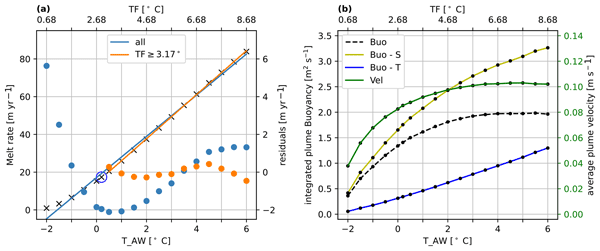
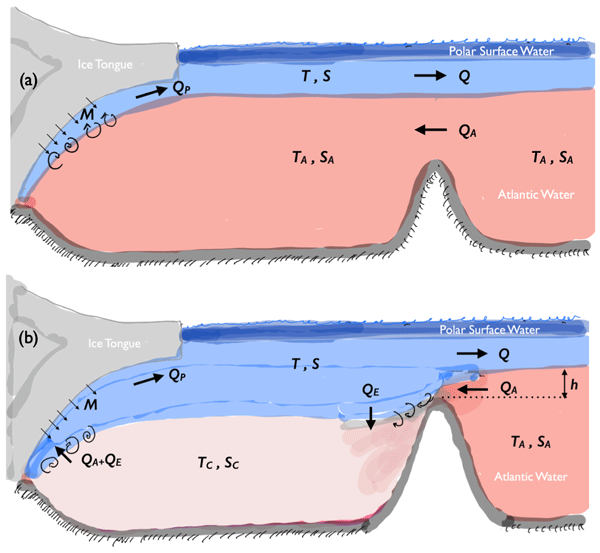
We investigate how topographical sills suppress basal glacier melt in Greenlandic fjords. The basal melt drives an exchange flow over the sill, but there is an upper flow limit set by the Atlantic Water features outside the fjord. If this limit is reached, the flow enters a new regime where the melt is suppressed and its sensitivity to the Atlantic Water temperature is reduced.
Tereza Jarníková, Elise M. Olson, Susan E. Allen, Debby Ianson, and Karyn D. Suchy
Ocean Sci., 18, 1451–1475, https://doi.org/10.5194/os-18-1451-2022, https://doi.org/10.5194/os-18-1451-2022, 2022
Short summary
Short summary
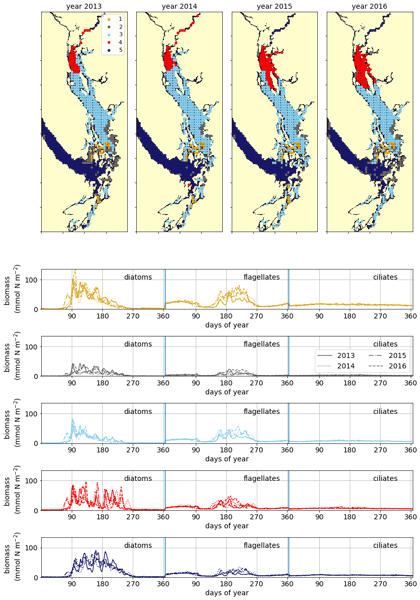
Understanding drivers of phytoplankton biomass in dynamic coastal regions is key to predicting present and future ecosystem functioning. Using a clustering-based method, we objectively determined biophysical provinces in a complex estuarine sea. The Salish Sea contains three major distinct provinces where phytoplankton dynamics are controlled by diverse stratification regimes. Our method is simple to implement and broadly applicable for identifying structure in large model-derived datasets.
Ben Moore-Maley and Susan E. Allen
Ocean Sci., 18, 143–167, https://doi.org/10.5194/os-18-143-2022, https://doi.org/10.5194/os-18-143-2022, 2022
Short summary
Short summary
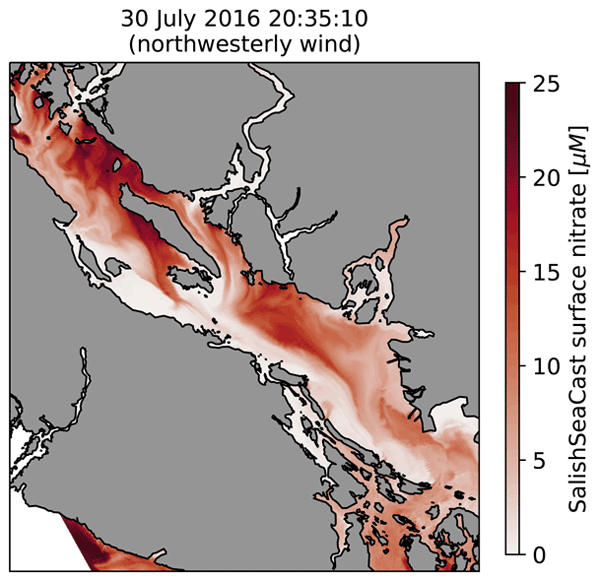
Inland seas are critical habitats for globally important fisheries, and the local food webs that support these fisheries are often limited by surface nutrient availability. In the Strait of Georgia, which supports several key northern Pacific fisheries, we identify wind-driven upwelling as a dominant source of summer surface nutrients using a high-resolution coupled ecosystem model. This newly identified underlying mechanism will inform interpretations of ecosystem variability in the region.
Eli Børve, Pål Erik Isachsen, and Ole Anders Nøst
Ocean Sci., 17, 1753–1773, https://doi.org/10.5194/os-17-1753-2021, https://doi.org/10.5194/os-17-1753-2021, 2021
Short summary
Short summary
Non-linear tidal dynamics can produce prominent time-mean transport in coastal regions where strong tidal currents interact with topography. We investigate tidal-induced transport using a tidally driven ocean model for Lofoten–Vesterålen in northern Norway and find that both tidal pumping and tidal rectification can play an important role for time-mean transport in the region. The study emphasizes the importance of non-linear tidal dynamics for time-mean transport in complex coastal regions.
Cited articles
Boyer, D. L., Zhang, X., and Pérenne, N.: Laboratory observations of rotating, stratified flow in the vicinity of a submarine canyon, Dynam. Atmos. Oceans, 31, 47–72, https://doi.org/10.1016/S0377-0265(99)00028-7, 2000. a
Bretherton, F. P. and Haidvogel, D. B.: Two-dimensional turbulence above topography, J. Fluid Mech., 78, 129–154, https://doi.org/10.1017/S002211207600236X, 1976. a, b
Brink, K. H.: Topographic Drag Due to Barotropic Flow over the Continental Shelf and Slope, J. Phys. Oceanogr., 16, 2150–2158, https://doi.org/10.1175/1520-0485(1986)016<2150:TDDTBF>2.0.CO;2, 1986. a
Brink, K. H.: Topographic rectification in a stratified ocean, J. Mar. Res., 69, 483–499, https://doi.org/10.1357/002224011799849354, 2011. a
Broomé, S. and Nilsson, J.: Stationary Sea Surface Height Anomalies in Cyclonic Boundary Currents: Conservation of Potential Vorticity and Deviations from Strict Topographic Steering, J. Phys. Oceanogr., 46, 2437–2456, https://doi.org/10.1175/JPO-D-15-0219.1, 2016. a
Constantinou, N. C. and Young, W. R.: Beta-plane turbulence above monoscale topography, J. Fluid Mech., 827, 415–447, https://doi.org/10.1017/jfm.2017.482, 2017. a, b
Dritschel, D. G. and McIntyre, M. E.: Multiple Jets as PV Staircases: The Phillips Effect and the Resilience of Eddy-Transport Barriers, J. Atmos. Sci., https://doi.org/10.1175/2007JAS2227.1, 2008. a, b
Egger, J.: Mountain torque and Rossby wave radiation, J. Atmos. Sci., 55, 2937–2945, 1998. a
Eurin, D.: Circulation and cross-shelf exchanges over an irregular coastal topography, Ph.D. thesis, University of British Columbia, https://doi.org/10.14288/1.0053157, 1999. a
Gill, A. E.: Atmosphere–Ocean Dynamics, no. 30 in International Geophysics Series, Academic Press, San Diego, ISBN 0-12-283522-0, 1982. a
Haidvogel, D. B. and Brink, K. H.: Mean Currents Driven by Topographic Drag over the Continental Shelf and Slope, J. Phys. Oceanogr., 16, 2159–2171, https://doi.org/10.1175/1520-0485(1986)016<2159:MCDBTD>2.0.CO;2, 1986. a, b, c, d
Holloway, G.: Systematic forcing of large-scale geophysical flows by eddy-topography interaction, J. Fluid Mech., 184, 463–476, https://doi.org/10.1017/S0022112087002970, 1987. a, b
Holloway, G.: Neptune effect: statistical mechanical forcing of ocean circulation, in: Stochastic Modelling in Physical Oceanography, edited by: Adler, R. J., Müller, P., and Rozovskii, B. L., Birkhäuser Boston, Boston, MA, 207–219, ISBN 978-1-4612-7533-6 978-1-4612-2430-3, https://doi.org/10.1007/978-1-4612-2430-3_8, 1996. a
Johnston, T. M. S., Sjur, A. L. P., Isachsen, P. E., and LaCasce, J. H.: Eddy- and Wind-Driven Circulation in the Enclosed Basins of the Norwegian Sea Evaluated Using a Model and Absolute Geostrophic Flow From Argo, J. Geophys. Res.-Oceans, 130, e2024JC021990, https://doi.org/10.1029/2024JC021990, 2025. a, b, c, d, e, f, g
Kallmyr, J.-A. H., Nilsson, J., Chafik, L., and Isachsen, P. E.: The Time-Mean Arctic Ocean Circulation as Seen Through Satellite Altimetry and Hydrography, J. Geophys. Res.-Oceans, 130, e2024JC022203, https://doi.org/10.1029/2024JC022203, 2025. a
Li, X., Wang, Q., Danilov, S., Koldunov, N., Liu, C., Müller, V., Sidorenko, D., and Jung, T.: Eddy activity in the Arctic Ocean projected to surge in a warming world, Nat. Clim. Change, 14, 156–162, https://doi.org/10.1038/s41558-023-01908-w, 2024. a
Miyama, T., Mitsudera, H., Nishigaki, H., and Furue, R.: Dynamics of a Quasi-Stationary Jet along the Subarctic Front in the North Pacific Ocean (the Western Isoguchi Jet): An Ideal Two-Layer Model, J. Phys. Oceanogr., 48, 807–830, https://doi.org/10.1175/JPO-D-17-0086.1, 2018. a
Muilwijk, M., Hattermann, T., Martin, T., and Granskog, M. A.: Future sea ice weakening amplifies wind-driven trends in surface stress and Arctic Ocean spin-up, Nat. Commun., 15, 6889, https://doi.org/10.1038/s41467-024-50874-0, 2024. a
Nilsson, J., Kallmyr, J.-A. H., and Isachsen, P. E.: Topographic Steering of the Upper Arctic Ocean Circulation by Deep Flows, Tellus A, 76, 206–226, https://doi.org/10.16993/tellusa.4072, 2024. a
Nøst, O. A. and Isachsen, P. E.: The large-scale time-mean ocean circulation in the Nordic Seas and Arctic Ocean estimated from simplified dynamics, J. Mar. Res., 61, 175–210, https://doi.org/10.1357/002224003322005069, 2003. a
Samelson, R. M. and Allen, J. S.: Quasi-Geostrophic Topographically Generated Mean Flow over the Continental Margin, J. Phys. Oceanogr., 17, 2043–2064, https://doi.org/10.1175/1520-0485(1987)017<2043:QGTGMF>2.0.CO;2, 1987. a
Sjur, A. L.: alpsjur/temporal-topo-flow: v1.1.1, Zenodo [code], https://doi.org/10.5281/zenodo.22247622, 2026a. a
Sjur, A. L. P.: Time evolution of velocity and relative vorticity, 128 days forcing period, Ocean Science, TIB AV-Portal [video], https://doi.org/10.5446/74040, 2026b. a, b, c
Sjur, A. L. P.: Time evolution of velocity and relative vorticity, 16 days forcing period, Ocean Science, TIB AV-Portal [video], https://doi.org/10.5446/74041, 2026c. a, b
Spall, M. A.: Wind-driven flow over topography, J. Mar. Res., 74, 229–248, 2016. a
Timmermans, M. and Marshall, J.: Understanding Arctic Ocean Circulation: A Review of Ocean Dynamics in a Changing Climate, J. Geophys. Res.-Oceans, 125, e2018JC014378, https://doi.org/10.1029/2018JC014378, 2020. a
Wagner, G. L., Silvestri, S., Constantinou, N. C., Ramadhan, A., Campin, J.-M., Hill, C., Chor, T., Strong-Wright, J., Lee, X. K., Poulin, F., Souza, A., Burns, K. J., Marshall, J., and Ferrari, R.: High-level, high-resolution ocean modeling at all scales with Oceananigans, arXiv [preprint], https://doi.org/10.48550/arXiv.2502.14148, 2025. a
Woodgate, R.: Arctic Ocean Circulation: Going Around at the Top of the World, Nature Education Knowledge, 4, 8, https://www.nature.com/scitable/knowledge/library/arctic-ocean-circulation-going-around-at-the-102811553/ (last access: 9 February 2026), 2013. a
Woodgate, R. A., Aagaard, K., Muench, R. D., Gunn, J., Björk, G., Rudels, B., Roach, A. T., and Schauer, U.: The Arctic Ocean Boundary Current along the Eurasian slope and the adjacent Lomonosov Ridge: Water mass properties, transports and transformations from moored instruments, Deep-Sea Res. Pt. I, 48, 1757–1792, https://doi.org/10.1016/S0967-0637(00)00091-1, 2001. a
Yang, J., Proshutinsky, A., and Lin, X.: Dynamics of an idealized Beaufort Gyre: 1. The effect of a small beta and lack of western boundaries, J. Geophys. Res.-Oceans, 121, 1249–1261, https://doi.org/10.1002/2015JC011296, 2016. a
Zhang, W. and Lentz, S. J.: Wind-Driven Circulation in a Shelf Valley. Part I: Mechanism of the Asymmetrical Response to Along-Shelf Winds in Opposite Directions, J. Phys. Oceanogr., https://doi.org/10.1175/JPO-D-17-0083.1, 2017. a, b
Zhang, X., Boyer, D. L., Pérenne, N., and Renouard, D. P.: Mean flow generation along a sloping region in a rotating homogeneous fluid, J. Geophys. Res.-Oceans, 101, 28597–28614, https://doi.org/10.1029/96JC02834, 1996. a

Short summary
Ocean currents along continental slopes do not respond linearly to changing winds. Nonlinearities arises from interactions between the flow and seafloor bumps. Using simplified simulations and theory, we investigate the dynamics of these nonlinear effects. Such effects are likely missed in coarse-grained climate models, with implications for representing ocean flow in areas such as the Arctic.
Ocean currents along continental slopes do not respond linearly to changing winds....