
Articles | Volume 22, issue 1
https://doi.org/10.5194/os-22-305-2026
© Author(s) 2026. This work is distributed under
the Creative Commons Attribution 4.0 License.
the Creative Commons Attribution 4.0 License.
https://doi.org/10.5194/os-22-305-2026
© Author(s) 2026. This work is distributed under
the Creative Commons Attribution 4.0 License.
the Creative Commons Attribution 4.0 License.
Research article
| 
29 Jan 2026
Research article |
| 29 Jan 2026
| 29 Jan 2026
Intrahalocline eddies in the Amundsen Basin observed in the distributed network from the MOSAiC expedition
Alejandra Quintanilla-Zurita
CORRESPONDING AUTHOR

Alfred-Wegener-Institut Helmholtz-Zentrum für Polar- und Meeresforschung, Bremerhaven, Germany
Benjamin Rabe
Alfred-Wegener-Institut Helmholtz-Zentrum für Polar- und Meeresforschung, Bremerhaven, Germany
Claudia Wekerle
Alfred-Wegener-Institut Helmholtz-Zentrum für Polar- und Meeresforschung, Bremerhaven, Germany
Torsten Kanzow
Alfred-Wegener-Institut Helmholtz-Zentrum für Polar- und Meeresforschung, Bremerhaven, Germany
Faculty of Physics, University of Bremen, Bremen, Germany
Ivan Kuznetsov
Alfred-Wegener-Institut Helmholtz-Zentrum für Polar- und Meeresforschung, Bremerhaven, Germany
Sinhue Torres-Valdes
Alfred-Wegener-Institut Helmholtz-Zentrum für Polar- und Meeresforschung, Bremerhaven, Germany
Enric Pallàs-Sanz
Centro de Investigación Científica y de Educación Superior de Ensenada, Baja California, Mexico
Ying-Chih Fang
Department of Oceanography, College of Marine Sciences, National Sun Yat-sen University, Kaohsiung, Taiwan
Related authors
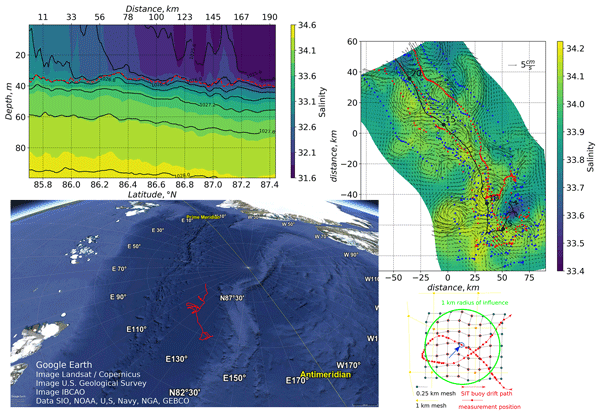
Ivan Kuznetsov, Benjamin Rabe, Alexey Androsov, Ying-Chih Fang, Mario Hoppmann, Alejandra Quintanilla-Zurita, Sven Harig, Sandra Tippenhauer, Kirstin Schulz, Volker Mohrholz, Ilker Fer, Vera Fofonova, and Markus Janout
Ocean Sci., 20, 759–777, https://doi.org/10.5194/os-20-759-2024, https://doi.org/10.5194/os-20-759-2024, 2024
Short summary
Short summary
Our research introduces a tool for dynamically mapping the Arctic Ocean using data from the MOSAiC experiment. Incorporating extensive data into a model clarifies the ocean's structure and movement. Our findings on temperature, salinity, and currents reveal how water layers mix and identify areas of intense water movement. This enhances understanding of Arctic Ocean dynamics and supports climate impact studies. Our work is vital for comprehending this key region in global climate science.
Torsten Kanzow, Rebecca A. McPherson, Claudia Wekerle, Wilken-Jon von Appen, Oliver Huhn, Donald A. Slater, and Andreas Münchow
EGUsphere, https://doi.org/10.5194/egusphere-2026-5184, https://doi.org/10.5194/egusphere-2026-5184, 2026
This preprint is open for discussion and under review for Ocean Science (OS).
Short summary
Short summary
Atlantic Water (AW) delivers heat to glaciers in Greenland, thereby causing melt. We reveal a cooling of the AW entering the world's largest fjord system, Kangertittivaq (East Greenland), after 2018. The cooling is present on the entire Northeast Greenland shelf, driven by cooling in the Nordic Seas. In the fjord, summertime glacier meltwater drives the flow of AW towards the prominent Daugaard Jensen Glacier. The cooling is as strong as the warming of AW at the fjord over the past half century.
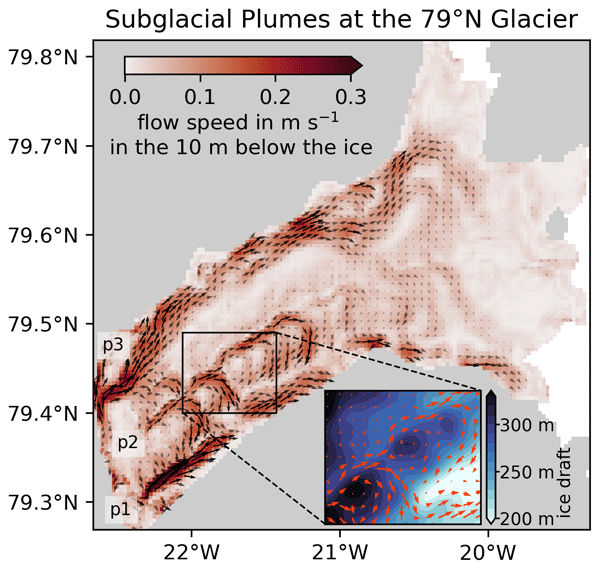
Markus Reinert, Claudia Wekerle, Knut Klingbeil, Marvin Lorenz, and Hans Burchard
The Cryosphere, 20, 4563–4584, https://doi.org/10.5194/tc-20-4563-2026, https://doi.org/10.5194/tc-20-4563-2026, 2026
Short summary
Short summary
The Greenland Ice Sheet is an important contributor to global sea level rise. In northern Greenland, floating glacier tongues are primarily melted by ocean currents. These processes are difficult to observe, so we developed a realistic numerical model to study ocean-driven melting at Greenland's largest floating ice tongue, the 79° North Glacier. Our simulation reveals the details of the oceanic currents bringing warm water toward the ice base, melting and shaping the glacier tongue from below.
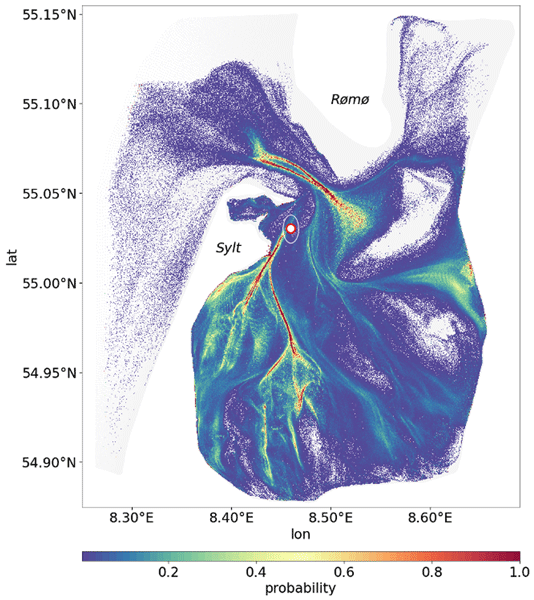
Gaziza Konyssova, Vera Sidorenko, Alexey Androsov, Sabine Horn, Sara Rubinetti, Ivan Kuznetsov, Karen Helen Wiltshire, and Justus van Beusekom
Biogeosciences, 22, 7745–7767, https://doi.org/10.5194/bg-22-7745-2025, https://doi.org/10.5194/bg-22-7745-2025, 2025
Short summary
Short summary
Combining long-term measurements, ocean modelling, and machine learning, we investigated the processes controlling suspended particulate matter concentrations in a Wadden Sea basin. Winter concentrations are shaped mainly by wind and tides, while biological activity exerts stronger influence in spring and summer. The study also reveals different short-term dynamics at shallow and deep sites, improving interpretation of long-term coastal observations.
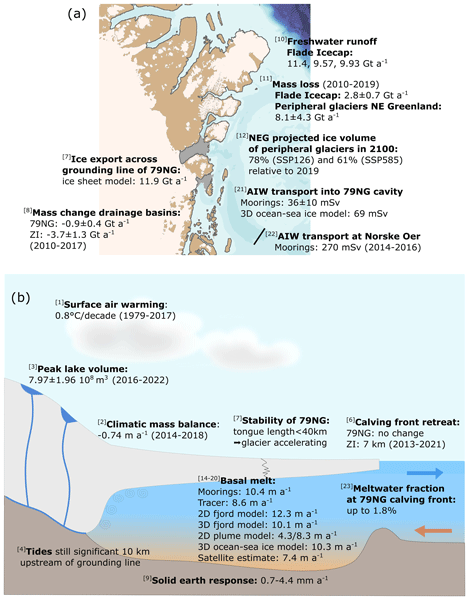
Torsten Kanzow, Angelika Humbert, Thomas Mölg, Mirko Scheinert, Matthias Braun, Hans Burchard, Francesca Doglioni, Philipp Hochreuther, Martin Horwath, Oliver Huhn, Maria Kappelsberger, Jürgen Kusche, Erik Loebel, Katrina Lutz, Ben Marzeion, Rebecca McPherson, Mahdi Mohammadi-Aragh, Marco Möller, Carolyne Pickler, Markus Reinert, Monika Rhein, Martin Rückamp, Janin Schaffer, Muhammad Shafeeque, Sophie Stolzenberger, Ralph Timmermann, Jenny Turton, Claudia Wekerle, and Ole Zeising
The Cryosphere, 19, 1789–1824, https://doi.org/10.5194/tc-19-1789-2025, https://doi.org/10.5194/tc-19-1789-2025, 2025
Short summary
Short summary
The Greenland Ice Sheet represents the second-largest contributor to global sea-level rise. We quantify atmosphere, ice and ocean processes related to the mass balance of glaciers in northeast Greenland, focusing on Greenland’s largest floating ice tongue, the 79° N Glacier. We find that together, the different in situ and remote sensing observations and model simulations reveal a consistent picture of a coupled atmosphere–ice sheet–ocean system that has entered a phase of major change.
Ole Pinner, Friederike Pollmann, Markus Janout, Gunnar Voet, and Torsten Kanzow
Ocean Sci., 21, 701–726, https://doi.org/10.5194/os-21-701-2025, https://doi.org/10.5194/os-21-701-2025, 2025
Short summary
Short summary
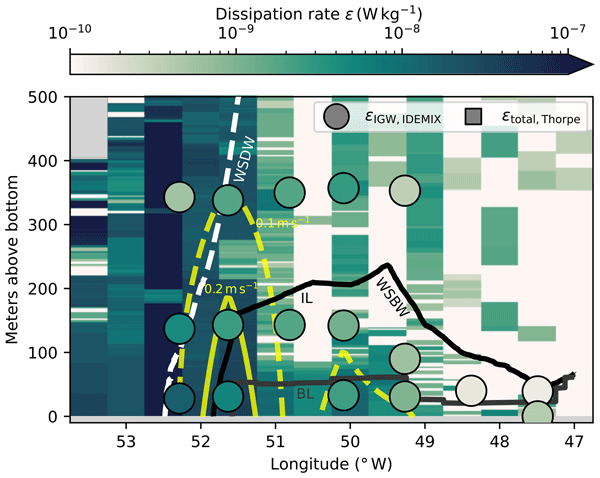
The Weddell Sea Bottom Water gravity current transports dense water from the continental shelf to the deep sea and is crucial for the formation of new deep-sea water. Building on vertical profiles and time series measured in the northwestern Weddell Sea, we apply three methods to distinguish turbulence caused by internal waves from that by other sources. We find that in the upper part of the gravity current, internal waves are important for the mixing of less dense water down into the current.
Frauke Bunsen, Judith Hauck, Sinhué Torres-Valdés, and Lars Nerger
Ocean Sci., 21, 437–471, https://doi.org/10.5194/os-21-437-2025, https://doi.org/10.5194/os-21-437-2025, 2025
Short summary
Short summary
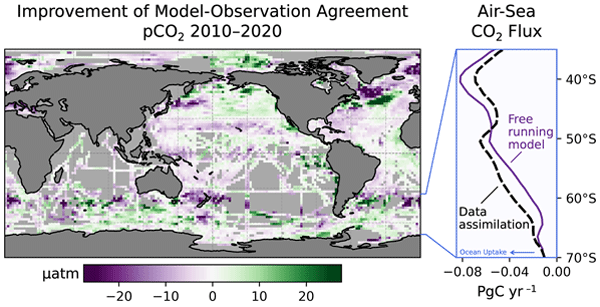
Computer models are often used to estimate the ocean's CO2 uptake due to a lack of direct observations. Because such idealized models do not match precisely with the real world, we combine real-world observations of ocean temperature and salinity with a model and study the effect on the modeled air–sea CO2 flux (2010–2020). The corrections of temperature and salinity have their largest effect on regional CO2 fluxes in the Southern Ocean in winter and a small effect on the global CO2 uptake.
Ivan Kuznetsov, Benjamin Rabe, Alexey Androsov, Ying-Chih Fang, Mario Hoppmann, Alejandra Quintanilla-Zurita, Sven Harig, Sandra Tippenhauer, Kirstin Schulz, Volker Mohrholz, Ilker Fer, Vera Fofonova, and Markus Janout
Ocean Sci., 20, 759–777, https://doi.org/10.5194/os-20-759-2024, https://doi.org/10.5194/os-20-759-2024, 2024
Short summary
Short summary
Our research introduces a tool for dynamically mapping the Arctic Ocean using data from the MOSAiC experiment. Incorporating extensive data into a model clarifies the ocean's structure and movement. Our findings on temperature, salinity, and currents reveal how water layers mix and identify areas of intense water movement. This enhances understanding of Arctic Ocean dynamics and supports climate impact studies. Our work is vital for comprehending this key region in global climate science.
Itzel Ruvalcaba Baroni, Elin Almroth-Rosell, Lars Axell, Sam T. Fredriksson, Jenny Hieronymus, Magnus Hieronymus, Sandra-Esther Brunnabend, Matthias Gröger, Ivan Kuznetsov, Filippa Fransner, Robinson Hordoir, Saeed Falahat, and Lars Arneborg
Biogeosciences, 21, 2087–2132, https://doi.org/10.5194/bg-21-2087-2024, https://doi.org/10.5194/bg-21-2087-2024, 2024
Short summary
Short summary
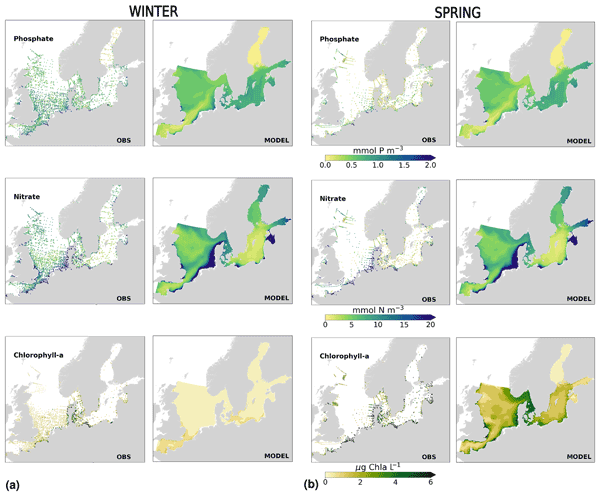
The health of the Baltic and North seas is threatened due to high anthropogenic pressure; thus, different methods to assess the status of these regions are urgently needed. Here, we validated a novel model simulating the ocean dynamics and biogeochemistry of the Baltic and North seas that can be used to create future climate and nutrient scenarios, contribute to European initiatives on de-eutrophication, and provide water quality advice and support on nutrient load reductions for both seas.
Cara Nissen, Ralph Timmermann, Mathias van Caspel, and Claudia Wekerle
Ocean Sci., 20, 85–101, https://doi.org/10.5194/os-20-85-2024, https://doi.org/10.5194/os-20-85-2024, 2024
Short summary
Short summary
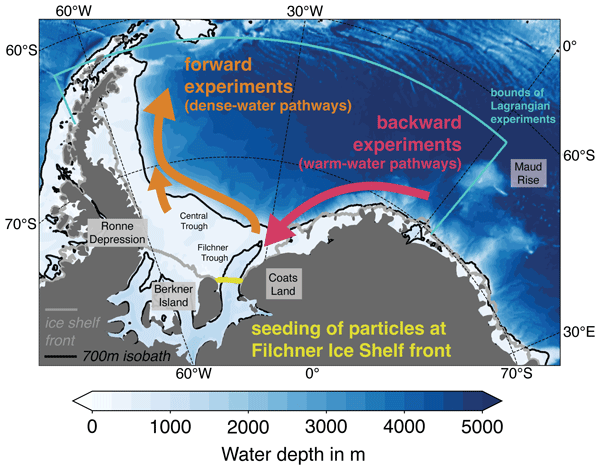
The southeastern Weddell Sea is important for global ocean circulation due to the cross-shelf-break exchange of Dense Shelf Water and Warm Deep Water, but their exact circulation pathways remain elusive. Using Lagrangian model experiments in an eddy-permitting ocean model, we show how present circulation pathways and transit times of these water masses on the continental shelf are altered by 21st-century climate change, which has implications for local ice-shelf basal melt rates and ecosystems.
Lukrecia Stulic, Ralph Timmermann, Stephan Paul, Rolf Zentek, Günther Heinemann, and Torsten Kanzow
Ocean Sci., 19, 1791–1808, https://doi.org/10.5194/os-19-1791-2023, https://doi.org/10.5194/os-19-1791-2023, 2023
Short summary
Short summary
In the southern Weddell Sea, the strong sea ice growth in coastal polynyas drives formation of dense shelf water. By using a sea ice–ice shelf–ocean model with representation of the changing icescape based on satellite data, we find that polynya sea ice growth depends on both the regional atmospheric forcing and the icescape. Not just strength but also location of the sea ice growth in polynyas affects properties of the dense shelf water and the basal melting of the Filchner–Ronne Ice Shelf.
Céline Heuzé, Oliver Huhn, Maren Walter, Natalia Sukhikh, Salar Karam, Wiebke Körtke, Myriel Vredenborg, Klaus Bulsiewicz, Jürgen Sültenfuß, Ying-Chih Fang, Christian Mertens, Benjamin Rabe, Sandra Tippenhauer, Jacob Allerholt, Hailun He, David Kuhlmey, Ivan Kuznetsov, and Maria Mallet
Earth Syst. Sci. Data, 15, 5517–5534, https://doi.org/10.5194/essd-15-5517-2023, https://doi.org/10.5194/essd-15-5517-2023, 2023
Short summary
Short summary
Gases dissolved in the ocean water not used by the ecosystem (or "passive tracers") are invaluable to track water over long distances and investigate the processes that modify its properties. Unfortunately, especially so in the ice-covered Arctic Ocean, such gas measurements are sparse. We here present a data set of several passive tracers (anthropogenic gases, noble gases and their isotopes) collected over the full ocean depth, weekly, during the 1-year drift in the Arctic during MOSAiC.
Ruibo Lei, Mario Hoppmann, Bin Cheng, Marcel Nicolaus, Fanyi Zhang, Benjamin Rabe, Long Lin, Julia Regnery, and Donald K. Perovich
The Cryosphere Discuss., https://doi.org/10.5194/tc-2023-25, https://doi.org/10.5194/tc-2023-25, 2023
Manuscript not accepted for further review
Short summary
Short summary
To characterize the freezing and melting of different types of sea ice, we deployed four IMBs during the MOSAiC second drift. The drifting pattern, together with a large snow accumulation, relatively warm air temperatures, and a rapid increase in oceanic heat close to Fram Strait, determined the seasonal evolution of the ice mass balance. The refreezing of ponded ice and voids within the unconsolidated ridges amplifies the anisotropy of the heat exchange between the ice and the atmosphere/ocean.
Francesca Doglioni, Robert Ricker, Benjamin Rabe, Alexander Barth, Charles Troupin, and Torsten Kanzow
Earth Syst. Sci. Data, 15, 225–263, https://doi.org/10.5194/essd-15-225-2023, https://doi.org/10.5194/essd-15-225-2023, 2023
Short summary
Short summary
This paper presents a new satellite-derived gridded dataset, including 10 years of sea surface height and geostrophic velocity at monthly resolution, over the Arctic ice-covered and ice-free regions, up to 88° N. We assess the dataset by comparison to independent satellite and mooring data. Results correlate well with independent satellite data at monthly timescales, and the geostrophic velocity fields can resolve seasonal to interannual variability of boundary currents wider than about 50 km.
Mario Hoppmann, Ivan Kuznetsov, Ying-Chih Fang, and Benjamin Rabe
Earth Syst. Sci. Data, 14, 4901–4921, https://doi.org/10.5194/essd-14-4901-2022, https://doi.org/10.5194/essd-14-4901-2022, 2022
Short summary
Short summary
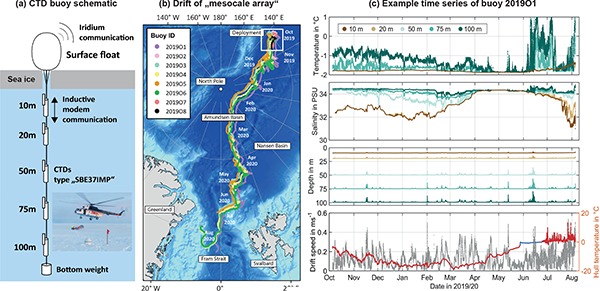
The role of eddies and fronts in the oceans is a hot topic in climate research, but there are still many related knowledge gaps, particularly in the ice-covered Arctic Ocean. Here we present a unique dataset of ocean observations collected by a set of drifting buoys installed on ice floes as part of the 2019/2020 MOSAiC campaign. The buoys recorded temperature and salinity data for 10 months, providing extraordinary insights into the properties and processes of the ocean along their drift.
Gilles Reverdin, Claire Waelbroeck, Catherine Pierre, Camille Akhoudas, Giovanni Aloisi, Marion Benetti, Bernard Bourlès, Magnus Danielsen, Jérôme Demange, Denis Diverrès, Jean-Claude Gascard, Marie-Noëlle Houssais, Hervé Le Goff, Pascale Lherminier, Claire Lo Monaco, Herlé Mercier, Nicolas Metzl, Simon Morisset, Aïcha Naamar, Thierry Reynaud, Jean-Baptiste Sallée, Virginie Thierry, Susan E. Hartman, Edward W. Mawji, Solveig Olafsdottir, Torsten Kanzow, Anton Velo, Antje Voelker, Igor Yashayaev, F. Alexander Haumann, Melanie J. Leng, Carol Arrowsmith, and Michael Meredith
Earth Syst. Sci. Data, 14, 2721–2735, https://doi.org/10.5194/essd-14-2721-2022, https://doi.org/10.5194/essd-14-2721-2022, 2022
Short summary
Short summary
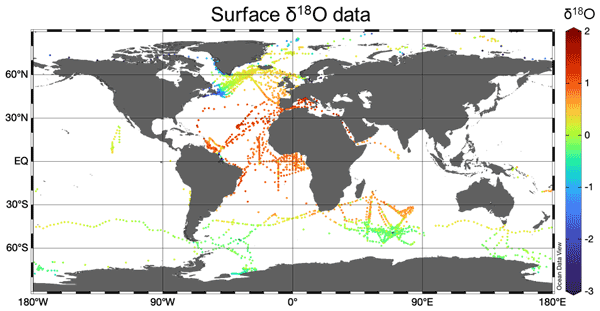
The CISE-LOCEAN seawater stable isotope dataset has close to 8000 data entries. The δ18O and δD isotopic data measured at LOCEAN have uncertainties of at most 0.05 ‰ and 0.25 ‰, respectively. Some data were adjusted to correct for evaporation. The internal consistency indicates that the data can be used to investigate time and space variability to within 0.03 ‰ and 0.15 ‰ in δ18O–δD17; comparisons with data analyzed in other institutions suggest larger differences with other datasets.
Vera Fofonova, Tuomas Kärnä, Knut Klingbeil, Alexey Androsov, Ivan Kuznetsov, Dmitry Sidorenko, Sergey Danilov, Hans Burchard, and Karen Helen Wiltshire
Geosci. Model Dev., 14, 6945–6975, https://doi.org/10.5194/gmd-14-6945-2021, https://doi.org/10.5194/gmd-14-6945-2021, 2021
Short summary
Short summary
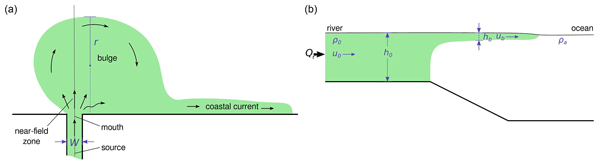
We present a test case of river plume spreading to evaluate coastal ocean models. Our test case reveals the level of numerical mixing (due to parameterizations used and numerical treatment of processes in the model) and the ability of models to reproduce complex dynamics. The major result of our comparative study is that accuracy in reproducing the analytical solution depends less on the type of applied model architecture or numerical grid than it does on the type of advection scheme.
Cited articles
Acheson, D. J.: Elementary fluid dynamics, Oxford University Press, https://doi.org/10.1093/oso/9780198596608.001.0001, 1990. a
Bush, J. W. and Woods, A. W.: An investigation of the link between lead-induced thermohaline convection and Arctic eddies, Geophysical Research Letters, 27, 1179–1182, 2000. a
Carmack, E. C., Yamamoto-Kawai, M., Haine, T. W. N., Bacon, S., Bluhm, B. A., Lique, C., Melling, H., Polyakov, I. V., Straneo, F., Timmermans, M.-L., and Williams, W. J.: Freshwater and its role in the Arctic Marine System: Sources, disposition, storage, export, and physical and biogeochemical consequences in the Arctic and global oceans, Journal of Geophysical Research: Biogeosciences, 121, 675–717, 2016. a
Castelão, G. and Johns, W.: Sea surface structure of North Brazil Current rings derived from shipboard and moored acoustic Doppler current profiler observations, Journal of Geophysical Research: Oceans, 116, C01010, https://doi.org/10.1029/2010JC006575, 2011. a
Chaigneau, A., Le Texier, M., Eldin, G., Grados, C., and Pizarro, O.: Vertical structure of mesoscale eddies in the eastern South Pacific Ocean: A composite analysis from altimetry and Argo profiling floats, Journal of Geophysical Research: Oceans, 116, C11025, https://doi.org/10.1029/2011JC007134, 2011. a
Cushman-Roisin, B. and Beckers, J.-M.: Introduction to geophysical fluid dynamics: physical and numerical aspects, in: vol. 101, Academic Press, ISBN 9780120887590, 2011. a
Danilov, S., Sidorenko, D., Wang, Q., and Jung, T.: The Finite-volumE Sea ice–Ocean Model (FESOM2), Geosci. Model Dev., 10, 765–789, https://doi.org/10.5194/gmd-10-765-2017, 2017. a
Della Penna, A. and Gaube, P.: Overview of (sub) mesoscale ocean dynamics for the NAAMES field program, Frontiers in Marine Science, 6, 384 https://doi.org/10.3389/fmars.2019.00384, 2019. a
Dilmahamod, A. F., Aguiar-González, B., Penven, P., Reason, C., De Ruijter, W., Malan, N., and Hermes, J.: SIDDIES Corridor: A major east-west pathway of long-lived surface and subsurface eddies crossing the subtropical south Indian Ocean, Journal of Geophysical Research: Oceans, 123, 5406–5425, 2018. a
Dugan, J., Mied, R., Mignerey, P., and Schuetz, A.: Compact, intrathermocline eddies in the Sargasso Sea, Journal of Geophysical Research: Oceans, 87, 385–393, 1982. a
Fine, E. C., MacKinnon, J. A., Alford, M. H., and Mickett, J. B.: Microstructure observations of turbulent heat fluxes in a warm-core Canada Basin eddy, Journal of Physical Oceanography, 48, 2397–2418, 2018. a
Hoppmann, M., Kuznetsov, I., Fang, Y.-C., and Rabe, B.: Mesoscale observations of temperature and salinity in the Arctic Transpolar Drift: a high-resolution dataset from the MOSAiC Distributed Network, Earth Syst. Sci. Data, 14, 4901–4921, https://doi.org/10.5194/essd-14-4901-2022, 2022. a
Jakobsson, M., Macnab, R., Mayer, L., Anderson, R., Edwards, M., Hatzky, J., Schenke, H. W., and Johnson, P.: An improved bathymetric portrayal of the Arctic Ocean: Implications for ocean modeling and geological, geophysical and oceanographic analyses, Geophysical Research Letters, 35, L07602, https://doi.org/10.1029/2008GL033520, 2008. a
Kikuchi, T., Hatakeyama, K., and Morison, J. H.: Distribution of convective lower halocline water in the eastern Arctic Ocean, Journal of Geophysical Research: Oceans, 109, C12030, https://doi.org/10.1029/2003JC002223, 2004. a, b
Kostianoy, A. and Belkin, I.: A survey of observations on intrathermocline eddies in the world ocean, in: Elsevier oceanography series, vol. 50, Elsevier, 821–841, https://doi.org/10.1016/S0422-9894(08)70223-X, 1989. a
Kuzmina, N., Zhurbas, V., Rudels, B., Stipa, T., Paka, V., and Muraviev, S.: Role of eddies and intrusions in the exchange processes in the Baltic halocline, Oceanology, 48, 149–158, 2008. a
Kuznetsov, I., Rabe, B., Androsov, A., Fang, Y.-C., Hoppmann, M., Quintanilla-Zurita, A., Harig, S., Tippenhauer, S., Schulz, K., Mohrholz, V., Fer, I., Fofonova, V., and Janout, M.: Dynamical reconstruction of the upper-ocean state in the central Arctic during the winter period of the MOSAiC expedition, Ocean Sci., 20, 759–777, https://doi.org/10.5194/os-20-759-2024, 2024. a
Lenn, Y.-D., Fer, I., Timmermans, M.-L., and MacKinnon, J. A.: Mixing in the Arctic Ocean, in: Ocean mixing, Elsevier, 275–299, https://doi.org/10.1016/B978-0-12-821512-8.00018-9, 2022. a, b
Li, X., Wang, Q., Danilov, S., Koldunov, N., Liu, C., Müller, V., Sidorenko, D., and Jung, T.: Eddy activity in the Arctic Ocean projected to surge in a warming world, Nature Climate Change, 14, 156–162, 2024. a
MacKinnon, J. A., Simmons, H. L., Hargrove, J., Thomson, J., Peacock, T., Alford, M. H., Barton, B. I., Boury, S., Brenner, S. D., Couto, N., Danielson, S. L., Fine, E. C., Graber, H. C., Guthrie, J., Hopkins, J. E., Jayne, S. R., Jeon, C., Klenz, T., Lee, C. M., Lenn, Y.-D., Lucas, A. J., Lund, B., Mahaffey, C., Norman, L., Rainville, L., Smith, M. M., Thomas, L. N., Torres-Valdés, S., and Wood, K. R.: A warm jet in a cold ocean, Nature communications, 12, 2418, https://doi.org/10.1038/s41467-021-22505-5, 2021. a
McDougall, T. J. and Barker, P. M.: Getting started with TEOS-10 and the Gibbs Seawater (GSW) oceanographic toolbox, Scor/iapso WG, 127, 1–28, 2011. a
McGillicuddy Jr, D. J.: Formation of intrathermocline lenses by eddy–wind interaction, Journal of Physical Oceanography, 45, 606–612, 2015. a
McWilliams, J. C.: Submesoscale, coherent vortices in the ocean, Reviews of Geophysics, 23, 165–182, 1985. a
McWilliams, J. C.: Vortex generation through balanced adjustment, Journal of Physical Oceanography, 18, 1178–1192, 1988. a
Meneghello, G., Marshall, J., Lique, C., Isachsen, P. E., Doddridge, E., Campin, J.-M., Regan, H., and Talandier, C.: Genesis and decay of mesoscale baroclinic eddies in the seasonally ice-covered interior Arctic Ocean, Journal of Physical Oceanography, 51, 115–129, 2021. a
Morison, J., Kwok, R., Peralta-Ferriz, C., Alkire, M., Rigor, I., Andersen, R., and Steele, M.: Changing arctic ocean freshwater pathways, Nature, 481, 66–70, 2012. a
Müller, V., Wang, Q., Koldunov, N., Danilov, S., Sidorenko, D., and Jung, T.: Variability of eddy kinetic energy in the Eurasian Basin of the Arctic Ocean inferred from a model simulation at 1-km resolution, Journal of Geophysical Research: Oceans, 129, e2023JC020139, https://doi.org/10.1029/2023JC020139, 2024. a
Nencioli, F., Kuwahara, V. S., Dickey, T. D., Rii, Y. M., and Bidigare, R. R.: Physical dynamics and biological implications of a mesoscale eddy in the lee of Hawai'i: Cyclone Opal observations during E-Flux III, Deep Sea Research Part II: Topical Studies in Oceanography, 55, 1252–1274, 2008. a, b, c
Nicolaus, M., Perovich, D. K., Spreen, G., Granskog, M. A., Von Albedyll, L., Angelopoulos, M., Anhaus, P., Arndt, S., Belter, H. J., Bessonov, V., Birnbaum, G., Brauchle, J., Calmer, R., Cardellach, E., Cheng, B., Clemens-Sewall, D., Dadic, R., Damm, E., De Boer, G., Demir, O., Dethloff, K., Divine, D. V., Fong, A. A., Fons, S., Frey, M. M., Fuchs, N., Gabarró, C., Gerland, S., Goessling, H. F., Gradinger, R., Haapala, J., Haas, C., Hamilton, J., Hannula, H.-R., Hendricks, S., Herber, A., Heuzé, C., Hoppmann, M., Høyland, K. V., Huntemann, M., Hutchings, J. K., Hwang, B., Itkin, P., Jacobi, H.-W., Jaggi, M., Jutila, A., Kaleschke, L., Katlein, C., Kolabutin, N., Krampe, D., Kristensen, S. S., Krumpen, T., Kurtz, N., Lampert, A., Lange, B. A., Lei, R., Light, B., Linhardt, F., Liston, G. E., Loose, B., Macfarlane, A. R., Mahmud, M., Matero, I. O., Maus, S., Morgenstern, A., Naderpour, R., Nandan, V., Niubom, A., Oggier, M., Oppelt, N., Pätzold, F., Perron, C., Petrovsky, T., Pirazzini, R., Polashenski, C., Rabe, B., Raphael, I. A., Regnery, J., Rex, M., Ricker, R., Riemann-Campe, K., Rinke, A., Rohde, J., Salganik, E., Scharien, R. K., Schiller, M., Schneebeli, M., Semmling, M., Shimanchuk, E., Shupe, M. D., Smith, M. M., Smolyanitsky, V., Sokolov, V., Stanton, T., Stroeve, J., Thielke, L., Timofeeva, A., Tonboe, R. T., Tavri, A., Tsamados, M., Wagner, D. N., Watkins, D., Webster, M., and Wendisch, M.: Overview of the MOSAiC expedition: Snow and sea ice, Elementa: Science of the Anthropocene, 10, 000046, https://doi.org/10.1525/elementa.2021.000046, 2022. a
Nixdorf, U., Dethloff, K., Rex, M., Shupe, M., Sommerfeld, A., Perovich, D. K., Nicolaus, M., Heuzé, C., Rabe, B., Loose, B., Damm, E., Gradinger, R., Fong, A., Maslowski, W., Rinke, A., Kwok, R., Spreen, G., Wendisch, M., Herber, A., Hirsekorn, M., Mohaupt, V., Frickenhaus, S., Immerz, A., Weiss-Tuider, K., König, B., Mengedoht, D., Regnery, J., Gerchow, P., Ransby, D., Krumpen, T., Morgenstern, A., Haas, C., Kanzow, T., Rack, F. R., Saitzev, V., Sokolov, V., Makarov, A., Schwarze, S., Wunderlich, T., Wurr, K., and Boetius, A.: MOSAiC extended acknowledgement, Zenodo, https://doi.org/10.5281/ZENODO.5179738, 2021. a
Nurser, A. J. G. and Bacon, S.: The Rossby radius in the Arctic Ocean, Ocean Sci., 10, 967–975, https://doi.org/10.5194/os-10-967-2014, 2014. a, b, c
Polyakov, I. V., Alkire, M. B., Bluhm, B. A., Brown, K. A., Carmack, E. C., Chierici, M., Danielson, S. L., Ellingsen, I., Ershova, E. A., Gårdfeldt, K., Ingvaldsen, R. B., Pnyushkov, A. V., Slagstad, D., and Wassmann, P.: Borealization of the Arctic Ocean in response to anomalous advection from sub-Arctic seas, Frontiers in Marine Science, 7, 491, https://doi.org/10.3389/fmars.2020.00491, 2020. a
Rabe, B., Karcher, M., Kauker, F., Schauer, U., Toole, J. M., Krishfield, R., Pisarev, S., Kikuchi, T., and Su, J.: Arctic Ocean basin liquid freshwater storage trend 1992–2012, Geophysical Research Letters, 41, 961–968, 2014. a
Rabe, B., Heuzé, C., Regnery, J., Aksenov, Y., Allerholt, J., Athanase, M., Bai, Y., Basque, C., Bauch, D., Baumann, T. M., Chen, D., Cole, S. T., Craw, L., Davies, A., Damm, E., Dethloff, K., Divine, D. V., Doglioni, F., Ebert, F., Fang, Y.-C., Fer, I., Fong, A. A., Gradinger, R., Granskog, M. A., Graupner, R., Haas, C., He, H., He, Y., Hoppmann, M., Janout, M., Kadko, D., Kanzow, T., Karam, S., Kawaguchi, Y., Koenig, Z., Kong, B., Krishfield, R. A., Krumpen, T., Kuhlmey, D., Kuznetsov, I., Lan, M., Laukert, G., Lei, R., Li, T., Torres-Valdés, S., Lin, L., Lin, L., Liu, H., Liu, N., Loose, B., Ma, X., McKay, R., Mallet, M., Mallett, R. D. C., Maslowski, W., Mertens, C., Mohrholz, V., Muilwijk, M., Nicolaus, M., O’Brien, J. K., Perovich, D., Ren, J., Rex, M., Ribeiro, N., Rinke, A., Schaffer, J., Schuffenhauer, I., Schulz, K., Shupe, M. D., Shaw, W., Sokolov, V., Sommerfeld, A., Spreen, G., Stanton, T., Stephens, M., Su, J., Sukhikh, N., Sundfjord, A., Thomisch, K., Tippenhauer, S., Toole, J. M., Vredenborg, M., Walter, M., Wang, H., Wang, L., Wang, Y., Wendisch, M., Zhao, J., Zhou, M., and Zhu, J.: Overview of the MOSAiC expedition: Physical oceanography, Elementa: Science of the Anthropocene, 10, 00062, https://doi.org/10.1525/elementa.2021.00062, 2022. a, b
Rabe, B., Cox, C. J., Fang, Y.-C., Goessling, H., Granskog, M. A., Hoppmann, M., Hutchings, J. K., Krumpen, T., Kuznetsov, I., Lei, R., Li, T., Maslowski, W., Nicolaus, M., Perovich, D., Persson, O., Regnery, J., Rigor, I., Shupe, M. D., Sokolov, V., Spreen, G., Stanton, T., Watkins, D. M., Blockley, E., Buenger, H. J., Cole, S., Fong, A., Haapala, J., Heuzé, C., Hoppe, C. J. M., Janout, M., Jutila, A., Katlein, C., Krishfield, R., Lin, L., Ludwig, V., Morgenstern, A., O'Brien, J., Zurita, A. Q., Rackow, T., Riemann-Campe, K., Rohde, J., Shaw, W., Smolyanitsky, V., Solomon, A., Sperling, A., Tao, R., Toole, J., Tsamados, M., Zhu, J., and Zuo, G.: The MOSAiC Distributed Network: Observing the coupled Arctic system with multidisciplinary, coordinated platforms, Elementa: Science of the Anthropocene, 12, 00103, https://doi.org/10.1525/elementa.2023.00103, 2024. a
Schulz, K., Büttner, S., Rogge, A., Janout, M., Hölemann, J., and Rippeth, T. P.: Turbulent mixing and the formation of an intermediate nepheloid layer above the Siberian continental shelf break, Geophysical Research Letters, 48, e2021GL092988, https://doi.org/10.1029/2021GL092988, 2021. a
Schulz, K., Koenig, Z., Muilwijk, M., Bauch, D., Hoppe, C. J. M., Droste, E. S., Hoppmann, M., Chamberlain, E. J., Laukert, G., Stanton, T., Quintanilla-Zurita, A., Fer, I., Heuzé, C., Karam, S., Mieruch-Schnülle, S., Baumann, T. M., Vredenborg, M., Tippenhauer, S., and Granskog, M. A.: The Eurasian Arctic Ocean along the MOSAiC drift in 2019–2020: an interdisciplinary perspective on physical properties and processes, Elementa: Science of the Anthropocene, 12, 00114, https://doi.org/10.1525/elementa.2023.00114, 2024. a
Shakespeare, C. J.: Curved density fronts: Cyclogeostrophic adjustment and frontogenesis, Journal of Physical Oceanography, 46, 3193–3207, 2016. a
Stanton, T. and Shaw, B.: Observations from Autonomous Ocean Flux Buoy 45 deployed at site L3 during the MOSAiC transpolar drift, Arctic Basin, 2019–2020, Arctic Data Center [data set], https://doi.org/10.18739/A26W96B3T, 2023. a, b
Stanton, T. P., Shaw, W. J., and Hutchings, J. K.: Observational study of relationships between incoming radiation, open water fraction, and ocean-to-ice heat flux in the Transpolar Drift: 2002–2010, Journal of Geophysical Research: Oceans, 117, 2011JC007871, https://doi.org/10.1029/2011JC007871, 2012. a
Thomas, L. N.: Formation of intrathermocline eddies at ocean fronts by wind-driven destruction of potential vorticity, Dynamics of Atmospheres and Oceans, 45, 252–273, 2008. a
Tippenhauer, S. and Rex, M.: Raw data of continuous VM-ADCP (vessel-mounted Acoustic Doppler Current Profiler) profile during POLARSTERN cruise PS122/1, PANGAEA [data set], https://doi.org/10.1594/PANGAEA.916092, 2020. a, b
Tippenhauer, S., Vredenborg, M., Heuzé, C., Ulfsbo, A., Rabe, B., Granskog, M. A., Allerholt, J., Balmonte, J. P., Campbell, R. G., Castellani, G., Chamberlain, E., Creamean, J., D'Angelo, A., Dietrich, U., Droste, E. S., Eggers, L., Fang, Y.-C., Fong, A. A., Gardner, J., Graupner, R., Grosse, J., He, H., Hildebrandt, N., Hoppe, C. J. M., Hoppmann, M., Kanzow, T., Karam, S., Koenig, Z., Kong, B., Kuhlmey, D., Kuznetsov, I., Lan, M., Liu, H., Mallet, M., Mohrholz, V., Muilwijk, M., Müller, O., Olsen, L. M., Rember, R., Ren, J., Sakinan, S., Schaffer, J., Schmidt, K., Schuffenhauer, I., Schulz, K., Shoemaker, K., Spahic, S., Sukhikh, N., Svenson, A., Torres-Valdés, S., Torstensson, A., Wischnewski, L., and Zhuang, Y.: Physical oceanography based on ship CTD during POLARSTERN cruise PS122, PANGAEA [data set], https://doi.org/10.1594/PANGAEA.959963, 2023. a, b
Toole, J. M., Krishfield, R. A., Timmermans, M.-L., and Proshutinsky, A.: The ice-tethered profiler: Argo of the Arctic, Oceanography, 24, 126–135, 2011. a
Toole, J. M., Krishfield, R., O'Brien, J. K., Houk, A. E., Cole, S. T., and Woods Hole Oceanographic Institution Ice-Tethered Profiler Program: Ice Tethered Profiler observations: Vertical profiles of temperature, salinity, oxygen, and ocean velocity from an Ice Tethered Profiler buoy system [ITP 94, ITP 102, ITP 111], NOAA National Centers for Environmental Information [data set], https://doi.org/10.7289/v5mw2f7x, 2016. a, b
Wang, J., Flierl, G. R., LaCasce, J. H., McClean, J. L., and Mahadevan, A.: Reconstructing the ocean's interior from surface data, Journal of Physical Oceanography, 43, 1611–1626, 2013. a
Woodgate, R. A., Aagaard, K., Muench, R. D., Gunn, J., Björk, G., Rudels, B., Roach, A., and Schauer, U.: The Arctic Ocean boundary current along the Eurasian slope and the adjacent Lomonosov Ridge: Water mass properties, transports and transformations from moored instruments, Deep Sea Research Part I: Oceanographic Research Papers, 48, 1757–1792, 2001. a
Zhao, M. and Timmermans, M.-L.: Vertical scales and dynamics of eddies in the Arctic Ocean's Canada Basin, Journal of Geophysical Research: Oceans, 120, 8195–8209, 2015. a
Zhao, M., Timmermans, M.-L., Krishfield, R., and Manucharyan, G.: Partitioning of kinetic energy in the Arctic Ocean's Beaufort Gyre, Journal of Geophysical Research: Oceans, 123, 4806–4819, 2018. a
Short summary
During a year-long Arctic expedition, we discovered nine underwater eddies beneath the sea ice in the central Arctic Ocean. These hidden structures form within a layered part of the ocean just below the surface and may reshape water layers and transport heat, freshwater, and nutrients. Using drifting ice platforms, we measured their size, depth, and motion to understand how they form.
During a year-long Arctic expedition, we discovered nine underwater eddies beneath the sea ice...


