
Articles | Volume 22, issue 5
https://doi.org/10.5194/os-22-2915-2026
© Author(s) 2026. This work is distributed under
the Creative Commons Attribution 4.0 License.
the Creative Commons Attribution 4.0 License.
Special issue:
https://doi.org/10.5194/os-22-2915-2026
© Author(s) 2026. This work is distributed under
the Creative Commons Attribution 4.0 License.
the Creative Commons Attribution 4.0 License.
Research article
| 
25 Sep 2026
Research article |
| 25 Sep 2026
| 25 Sep 2026
LETKF-based Ocean Research Analysis version 2.0 for a quasi-global domain (LORA-QG): validation and intercomparison with eddy-permitting global ocean reanalysis datasets

RIKEN Center for Computational Science (R-CCS), Kobe, 650-0047, Japan
RIKEN Center for Interdisciplinary Theoretical and Mathematical Sciences (iTHEMS), Kobe, 650-0047, Japan
Institute for Space-Earth Environmental Research, Nagoya University, Nagoya, Japan
Japan Marine Science Foundation, Mutsu, Japan
Takemasa Miyoshi
RIKEN Center for Computational Science (R-CCS), Kobe, 650-0047, Japan
RIKEN Center for Interdisciplinary Theoretical and Mathematical Sciences (iTHEMS), Kobe, 650-0047, Japan
Misako Kachi
Earth Observation Research Center, Japan Aerospace Exploration Agency (JAXA), Tsukuba, Japan
Related authors
Yuki Kobayashi, Shun Ohishi, and Takemasa Miyoshi
EGUsphere, https://doi.org/10.5194/egusphere-2026-2653, https://doi.org/10.5194/egusphere-2026-2653, 2026
Short summary
Short summary
Modern environmental forecasting combines computer simulations with real-world observations. Most systems assume errors in these sources are independent, but in reality, they are occasionally linked. We developed a new method to estimate the hidden correlations. Using a simplified atmospheric model, we showed our method successfully identifies the correlations and significantly improves prediction accuracy. This work provides a practical path toward more reliable weather and ocean forecasts.
Shun Ohishi, Takemasa Miyoshi, and Misako Kachi
Geosci. Model Dev., 15, 9057–9073, https://doi.org/10.5194/gmd-15-9057-2022, https://doi.org/10.5194/gmd-15-9057-2022, 2022
Short summary
Short summary
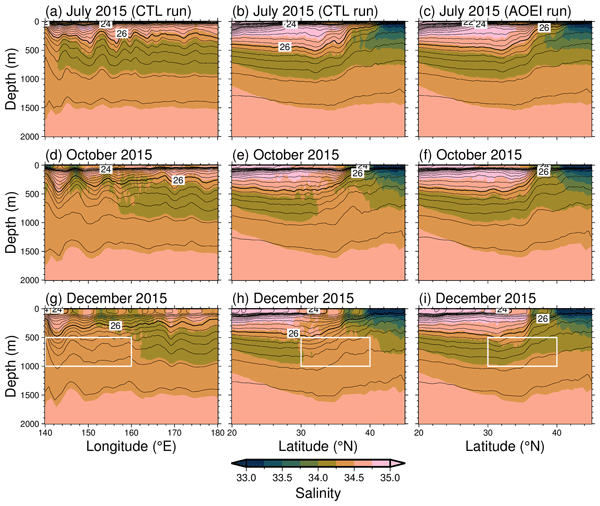
An adaptive observation error inflation (AOEI) method was proposed for atmospheric data assimilation to mitigate erroneous analysis updates caused by large observation-minus-forecast differences for satellite brightness temperature around clear- and cloudy-sky boundaries. This study implemented the AOEI with an ocean data assimilation system, leading to an improvement of analysis accuracy and dynamical balance around the frontal regions with large meridional temperature differences.

Shun Ohishi, Tsutomu Hihara, Hidenori Aiki, Joji Ishizaka, Yasumasa Miyazawa, Misako Kachi, and Takemasa Miyoshi
Geosci. Model Dev., 15, 8395–8410, https://doi.org/10.5194/gmd-15-8395-2022, https://doi.org/10.5194/gmd-15-8395-2022, 2022
Short summary
Short summary
We develop an ensemble-Kalman-filter-based regional ocean data assimilation system in which satellite and in situ observations are assimilated at a daily frequency. We find the best setting for dynamical balance and accuracy based on sensitivity experiments focused on how to inflate the ensemble spread and how to apply the analysis update to the model evolution. This study has a broader impact on more general data assimilation systems in which the initial shocks are a significant issue.
Kohei Cho, Misako Kachi, Rigen Shimada, and Josefino Comiso
ISPRS Ann. Photogramm. Remote Sens. Spatial Inf. Sci., XI-3-2026, 655–662, https://doi.org/10.5194/isprs-annals-XI-3-2026-655-2026, https://doi.org/10.5194/isprs-annals-XI-3-2026-655-2026, 2026
Kota Takeda and Takemasa Miyoshi
Nonlin. Processes Geophys., 33, 335–346, https://doi.org/10.5194/npg-33-335-2026, https://doi.org/10.5194/npg-33-335-2026, 2026
Short summary
Short summary
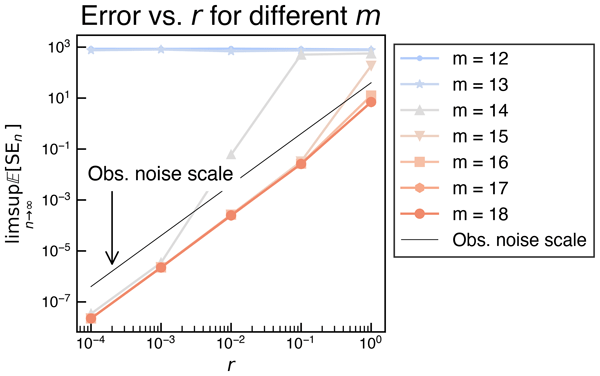
This study examines the minimum ensemble size for accurate geophysical forecasting using a method called the ensemble Kalman filter. We reformulate accuracy via observation noise-dependency to classify filter performance qualitatively. Through numerical experiments with a chaotic model, we link the minimum ensemble size for the accuracy to system's instability and propose an effective ensemble downsizing method that ensures both stability and accuracy.
Yuki Kobayashi, Shun Ohishi, and Takemasa Miyoshi
EGUsphere, https://doi.org/10.5194/egusphere-2026-2653, https://doi.org/10.5194/egusphere-2026-2653, 2026
Short summary
Short summary
Modern environmental forecasting combines computer simulations with real-world observations. Most systems assume errors in these sources are independent, but in reality, they are occasionally linked. We developed a new method to estimate the hidden correlations. Using a simplified atmospheric model, we showed our method successfully identifies the correlations and significantly improves prediction accuracy. This work provides a practical path toward more reliable weather and ocean forecasts.

Juan M. Guerrieri, Manuel Pulido, Takemasa Miyoshi, Arata Amemiya, and Juan J. Ruiz
Nonlin. Processes Geophys., 33, 33–49, https://doi.org/10.5194/npg-33-33-2026, https://doi.org/10.5194/npg-33-33-2026, 2026
Short summary
Short summary
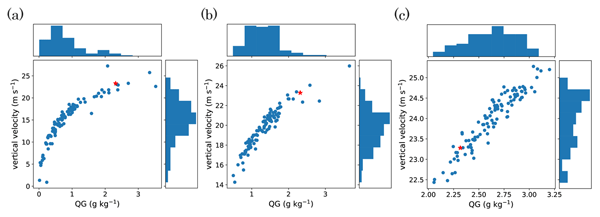
This work extends the Mapping Particle Filter to account for local dependencies. Two localization methods are tested: a global particle flow with local kernels, and iterative local mappings based on correlation radius. Using a two-scale Lorenz-96 truth and a one-scale forecast model, experiments with full/partial and linear/nonlinear observations show Root Mean Square Error reductions using localized Gaussian mixture priors, achieving competitive performance against Gaussian filters.
Arata Amemiya and Takemasa Miyoshi
Nonlin. Processes Geophys., 33, 1–16, https://doi.org/10.5194/npg-33-1-2026, https://doi.org/10.5194/npg-33-1-2026, 2026
Short summary
Short summary
The accurate estimation of atmospheric state variables from radar observation in rapidly growing deep convection, which causes heavy thunderstorms, is a major challenge. This study examines the advantage of incorporating radar observation data with very high frequency such as 30 s compared with the conventional case of 5 min, from a theoretical perspective.
Michael Goodliff and Takemasa Miyoshi
EGUsphere, https://doi.org/10.5194/egusphere-2025-933, https://doi.org/10.5194/egusphere-2025-933, 2025
Preprint archived
Short summary
Short summary
Data-driven models (DDMs) learn from large datasets to make predictions, but data limitations affect reliability. Data assimilation (DA) improves accuracy by combining real-world observations with computational models. This research explores how DA enhances DDMs despite limited data. We propose an algorithm using DA to refine DDM training iteratively. This work has broad implications for fields like meteorology, engineering, and environmental science, where accurate prediction is critical.
Tim Trent, Marc Schröder, Shu-Peng Ho, Steffen Beirle, Ralf Bennartz, Eva Borbas, Christian Borger, Helene Brogniez, Xavier Calbet, Elisa Castelli, Gilbert P. Compo, Wesley Ebisuzaki, Ulrike Falk, Frank Fell, John Forsythe, Hans Hersbach, Misako Kachi, Shinya Kobayashi, Robert E. Kursinski, Diego Loyola, Zhengzao Luo, Johannes K. Nielsen, Enzo Papandrea, Laurence Picon, Rene Preusker, Anthony Reale, Lei Shi, Laura Slivinski, Joao Teixeira, Tom Vonder Haar, and Thomas Wagner
Atmos. Chem. Phys., 24, 9667–9695, https://doi.org/10.5194/acp-24-9667-2024, https://doi.org/10.5194/acp-24-9667-2024, 2024
Short summary
Short summary
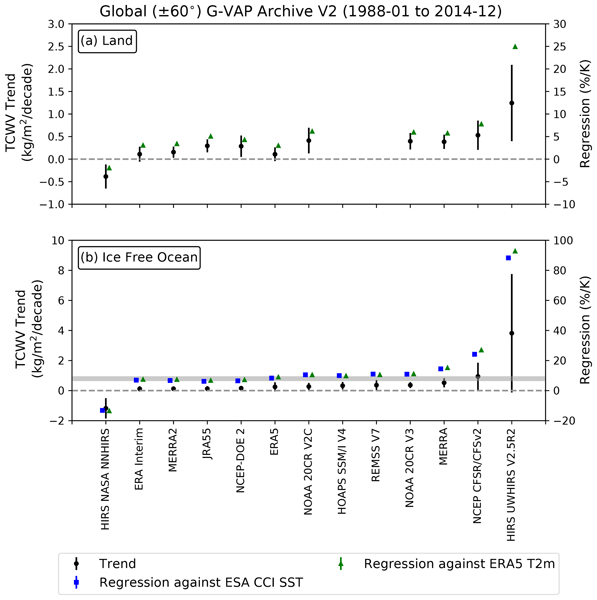
In a warmer future, water vapour will spend more time in the atmosphere, changing global rainfall patterns. In this study, we analysed the performance of 28 water vapour records between 1988 and 2014. We find sensitivity to surface warming generally outside expected ranges, attributed to breakpoints in individual record trends and differing representations of climate variability. The implication is that longer records are required for high confidence in assessing climate trends.
Kenta Kurosawa, Shunji Kotsuki, and Takemasa Miyoshi
Nonlin. Processes Geophys., 30, 457–479, https://doi.org/10.5194/npg-30-457-2023, https://doi.org/10.5194/npg-30-457-2023, 2023
Short summary
Short summary
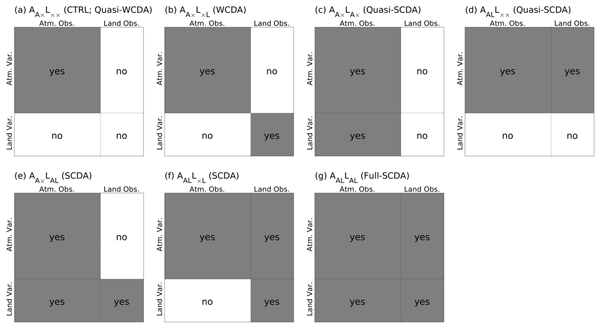
This study aimed to enhance weather and hydrological forecasts by integrating soil moisture data into a global weather model. By assimilating atmospheric observations and soil moisture data, the accuracy of forecasts was improved, and certain biases were reduced. The method was found to be particularly beneficial in areas like the Sahel and equatorial Africa, where precipitation patterns vary seasonally. This new approach has the potential to improve the precision of weather predictions.
Qiwen Sun, Takemasa Miyoshi, and Serge Richard
Nonlin. Processes Geophys., 30, 117–128, https://doi.org/10.5194/npg-30-117-2023, https://doi.org/10.5194/npg-30-117-2023, 2023
Short summary
Short summary
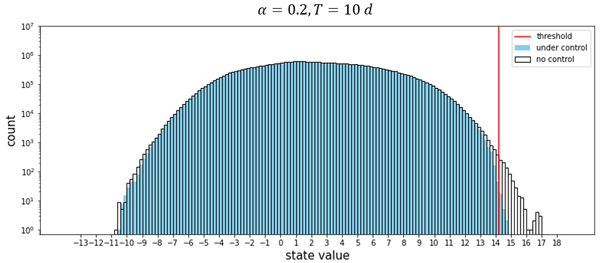
This paper is a follow-up of a work by Miyoshi and Sun which was published in NPG Letters in 2022. The control simulation experiment is applied to the Lorenz-96 model for avoiding extreme events. The results show that extreme events of this partially and imperfectly observed chaotic system can be avoided by applying pre-designed small perturbations. These investigations may be extended to more realistic numerical weather prediction models.
Tobias Necker, David Hinger, Philipp Johannes Griewank, Takemasa Miyoshi, and Martin Weissmann
Nonlin. Processes Geophys., 30, 13–29, https://doi.org/10.5194/npg-30-13-2023, https://doi.org/10.5194/npg-30-13-2023, 2023
Short summary
Short summary
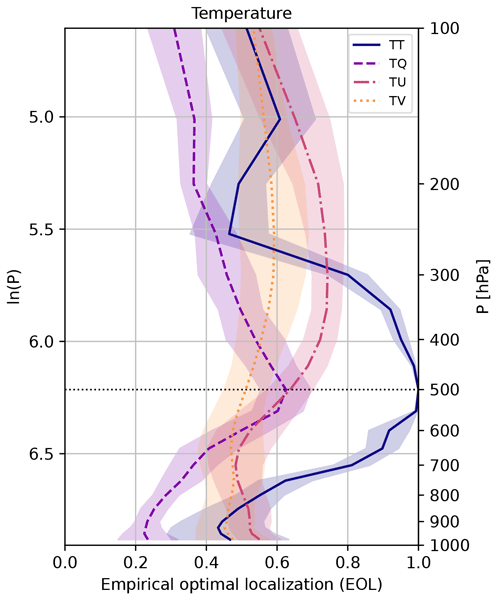
This study investigates vertical localization based on a convection-permitting 1000-member ensemble simulation. We derive an empirical optimal localization (EOL) that minimizes sampling error in 40-member sub-sample correlations assuming 1000-member correlations as truth. The results will provide guidance for localization in convective-scale ensemble data assimilation systems.
Shun Ohishi, Takemasa Miyoshi, and Misako Kachi
Geosci. Model Dev., 15, 9057–9073, https://doi.org/10.5194/gmd-15-9057-2022, https://doi.org/10.5194/gmd-15-9057-2022, 2022
Short summary
Short summary
An adaptive observation error inflation (AOEI) method was proposed for atmospheric data assimilation to mitigate erroneous analysis updates caused by large observation-minus-forecast differences for satellite brightness temperature around clear- and cloudy-sky boundaries. This study implemented the AOEI with an ocean data assimilation system, leading to an improvement of analysis accuracy and dynamical balance around the frontal regions with large meridional temperature differences.
Shun Ohishi, Tsutomu Hihara, Hidenori Aiki, Joji Ishizaka, Yasumasa Miyazawa, Misako Kachi, and Takemasa Miyoshi
Geosci. Model Dev., 15, 8395–8410, https://doi.org/10.5194/gmd-15-8395-2022, https://doi.org/10.5194/gmd-15-8395-2022, 2022
Short summary
Short summary
We develop an ensemble-Kalman-filter-based regional ocean data assimilation system in which satellite and in situ observations are assimilated at a daily frequency. We find the best setting for dynamical balance and accuracy based on sensitivity experiments focused on how to inflate the ensemble spread and how to apply the analysis update to the model evolution. This study has a broader impact on more general data assimilation systems in which the initial shocks are a significant issue.
Shunji Kotsuki, Takemasa Miyoshi, Keiichi Kondo, and Roland Potthast
Geosci. Model Dev., 15, 8325–8348, https://doi.org/10.5194/gmd-15-8325-2022, https://doi.org/10.5194/gmd-15-8325-2022, 2022
Short summary
Short summary
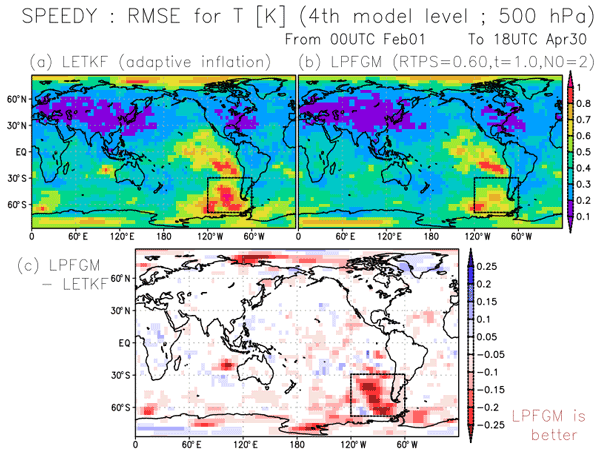
Data assimilation plays an important part in numerical weather prediction (NWP) in terms of combining forecasted states and observations. While data assimilation methods in NWP usually assume the Gaussian error distribution, some variables in the atmosphere, such as precipitation, are known to have non-Gaussian error statistics. This study extended a widely used ensemble data assimilation algorithm to enable the assimilation of more non-Gaussian observations.
Takemasa Miyoshi and Qiwen Sun
Nonlin. Processes Geophys., 29, 133–139, https://doi.org/10.5194/npg-29-133-2022, https://doi.org/10.5194/npg-29-133-2022, 2022
Short summary
Short summary
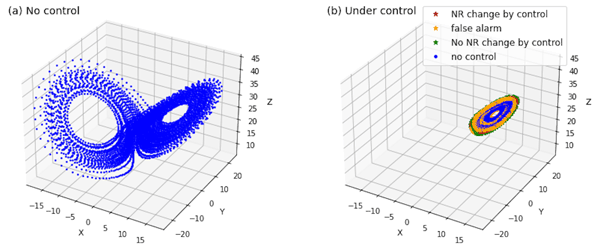
The weather is chaotic and hard to predict, but the chaos implies an effective control where a small control signal grows rapidly to make a big difference. This study proposes a control simulation experiment where we apply a small signal to control
naturein a computational simulation. Idealized experiments with a low-order chaotic system show successful results by small control signals of only 3 % of the observation error. This is the first step toward realistic weather simulations.
Juan Ruiz, Guo-Yuan Lien, Keiichi Kondo, Shigenori Otsuka, and Takemasa Miyoshi
Nonlin. Processes Geophys., 28, 615–626, https://doi.org/10.5194/npg-28-615-2021, https://doi.org/10.5194/npg-28-615-2021, 2021
Short summary
Short summary
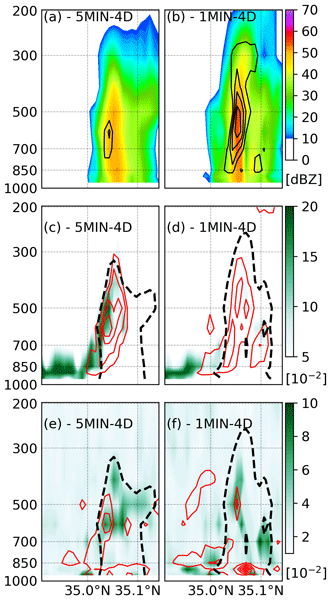
Effective use of observations with numerical weather prediction models, also known as data assimilation, is a key part of weather forecasting systems. For precise prediction at the scales of thunderstorms, fast nonlinear processes pose a grand challenge because most data assimilation systems are based on linear processes and normal distribution errors. We investigate how, every 30 s, weather radar observations can help reduce the effect of nonlinear processes and nonnormal distributions.
Cited articles
Amante, C. and Eakins, B. W.: ETOPO1 1 Arc-Minute Global Relief Model: Procedures, Data Sources and Analysis, NOAA Tech. Memo. NESDIS NGDC-24, Natl. Geophys. Data Cent., NOAA, https://doi.org/10.7289/V5C8276M, 2009.
Balmaseda, M. A., Hernandez, F., Storto, A., Palmer, M. D., Alves, O., Shi, L., Smith, G. C., Toyoda, T., Valdivieso, M., Barnier, B., Behringer, D., Boyer, T., Chang, Y.-S., Chepurin, G. A., Ferry, N., Forget, G., Fujii, Y., Good, S., Guinehut, S., Haines, K., Ishikawa, Y., Keeley, S., Köhl, A., Lee, T., Martin, M. J., Masina, S., Masuda, S., Meyssignac, B., Mogensen, K., Parent, L., Peterson, K. A., Tang, Y. M., Yin, Y., Vernieres, G., Wang, X., Waters, J., Wedd, R., Wang, O., Xue, Y., Chevallier, M., Lemieux, J.-F., Dupont, F., Kuragano, T., Kamachi, M., Awaji, T., Caltabiano, A., Wilmer-Becker, K., and Gaillard, F.: The Ocean Reanalyses Intercomparison Project (ORA-IP), J. Oper. Oceanogr., 8, s80–s97, https://doi.org/10.1080/1755876X.2015.1022329, 2015.
Bloom, S. C., Takacs, L. L., Da Silva, A. M., and Ledvina, D.: Data Assimilation Using Incremental Analysis Updates, Mon. Weather Rev., 124, 1256–1271, https://doi.org/10.1175/1520-0493(1996)124<1256:DAUIAU>2.0.CO;2, 1996.
Brasseur, P. and Verron, J.: The SEEK filter method for data assimilation in oceanography: a synthesis, Ocean Dynam., 56, 650–661, https://doi.org/10.1007/s10236-006-0080-3, 2006.
Brassington, G. B., Sakov, P., Divakaran, P., Aijaz, S., Sweeney-Van Kinderen, J., Huang, X., and Allen, S.: OceanMAPS v4.0i: a global eddy resolving EnKF ocean forecasting system, OCEANS 2023 – Limerick, 1–8, https://doi.org/10.1109/OCEANSLimerick52467.2023.10244383, 2023.
Brodeau, L., Barnier, B., Gulev, S. K., and Woods, C.: Climatologically Significant Effects of Some Approximations in the Bulk Parameterizations of Turbulent Air–Sea Fluxes, J. Phys. Oceanogr., 47, 5–28, https://doi.org/10.1175/JPO-D-16-0169.1, 2017.
Carton, J. A., Chepurin, G. A., and Chen, L.: SODA3: A New Ocean Climate Reanalysis, J. Climate, 31, 6967–6983, https://doi.org/10.1175/JCLI-D-18-0149.1, 2018.
Chamberlain, M. A., Oke, P. R., Fiedler, R. A. S., Beggs, H. M., Brassington, G. B., and Divakaran, P.: Next generation of Bluelink ocean reanalysis with multiscale data assimilation: BRAN2020, Earth Syst. Sci. Data, 13, 5663–5688, https://doi.org/10.5194/essd-13-5663-2021, 2021.
Chepurin, G. A., Carton, J. A., Sun, L., and Penny, S. G.: SODA4: a mesoscale ocean/sea ice reanalysis 1980–2024, EGUsphere [preprint], https://doi.org/10.5194/egusphere-2025-3810, 2025.
Cronin, M. F., Meinig, C., Sabine, C. L., Ichikawa, H., and Tomita, H.: Surface Mooring Network in the Kuroshio Extension, IEEE Syst. J., 2, 424–430, https://doi.org/10.1109/JSYST.2008.925982, 2008.
Cronin, M. F., Pelland, N. A., Emerson, S. R., and Crawford, W. R.: Estimating diffusivity from the mixed layer heat and salt balances in the North Pacific, J. Geophys. Res.-Oceans, 120, 7346–7362, https://doi.org/10.1002/2015JC011010, 2015.
Cummings, J. A. and Smedstad, O. M.: Variational Data Assimilation for the Global Ocean, in: Data Assimilation for Atmospheric, Oceanic and Hydrologic Applications (Vol. II), edited by: Park, S. K. and Xu, L., Springer, Berlin, Heidelberg, 303–343, https://doi.org/10.1007/978-3-642-35088-7_13, 2013.
Dee, D. P., Uppala, S. M., Simmons, A. J., Berrisford, P., Poli, P., Kobayashi, S., Andrae, U., Balmaseda, M. A., Balsamo, G., Bauer, P., Bechtold, P., Beljaars, A. C. M., Van De Berg, L., Bidlot, J., Bormann, N., Delsol, C., Dragani, R., Fuentes, M., Geer, A. J., Haimberger, L., Healy, S. B., Hersbach, H., Hólm, E. V., Isaksen, L., Kållberg, P., Köhler, M., Matricardi, M., McNally, A. P., Monge-Sanz, B. M., Morcrette, J.-J., Park, B.-K., Peubey, C., De Rosnay, P., Tavolato, C., Thépaut, J.-N., and Vitart, F.: The ERA-Interim reanalysis: configuration and performance of the data assimilation system, Q. J. Roy. Meteor. Soc., 137, 553–597, https://doi.org/10.1002/qj.828, 2011.
Delworth, T. L., Rosati, A., Anderson, W., Adcroft, A. J., Balaji, V., Benson, R., Dixon, K., Griffies, S. M., Lee, H.-C., Pacanowski, R. C., Vecchi, G. A., Wittenberg, A. T., Zeng, F., and Zhang, R.: Simulated Climate and Climate Change in the GFDL CM2.5 High-Resolution Coupled Climate Model, J. Climate, 25, 2755–2781, https://doi.org/10.1175/JCLI-D-11-00316.1, 2012.
Edson, J. B., Jampana, V., Weller, R. A., Bigorre, S. P., Plueddemann, A. J., Fairall, C. W., Miller, S. D., Mahrt, L., Vickers, D., and Hersbach, H.: On the Exchange of Momentum over the Open Ocean, J. Phys. Oceanogr., 43, 1589–1610, https://doi.org/10.1175/JPO-D-12-0173.1, 2013.
Elipot, S., Lumpkin, R., Perez, R. C., Lilly, J. M., Early, J. J., and Sykulski, A. M.: A global surface drifter data set at hourly resolution, J. Geophys. Res.-Oceans, 121, 2937–2966, https://doi.org/10.1002/2016JC011716, 2016.
Elipot, S., Sykulski, A., Lumpkin, R., Centurioni, L., and Pazos, M.: A dataset of hourly sea surface temperature from drifting buoys, Sci. Data, 9, 567, https://doi.org/10.1038/s41597-022-01670-2, 2022.
E.U. Copernicus Marine Service Information (CMEMS): Global Ocean Ensemble Physics Reanalysis, Marine Data Store (MDS) [data set], https://doi.org/10.48670/moi-00024, 2024.
E.U. Copernicus Marine Service Information (CMEMS): Global Ocean Along Track L3 Sea Surface Heights Reprocessed 1993 Ongoing Tailored For Data Assimilation, Marine Data Store (MDS) [data set], https://doi.org/10.48670/moi-00146, 2026.
Freeland, H.: A short history of Ocean Station Papa and Line P, Prog. Oceanogr., 75, 120–125, https://doi.org/10.1016/j.pocean.2007.08.005, 2007.
Griffies, S. M., Winton, M., Anderson, W. G., Benson, R., Delworth, T. L., Dufour, C. O., Dunne, J. P., Goddard, P., Morrison, A. K., Rosati, A., Wittenberg, A. T., Yin, J., and Zhang, R.: Impacts on Ocean Heat from Transient Mesoscale Eddies in a Hierarchy of Climate Models, J. Climate, 28, 952–977, https://doi.org/10.1175/JCLI-D-14-00353.1, 2015.
Hersbach, H., Bell, B., Berrisford, P., Hirahara, S., Horányi, A., Muñoz-Sabater, J., Nicolas, J., Peubey, C., Radu, R., Schepers, D., Simmons, A., Soci, C., Abdalla, S., Abellan, X., Balsamo, G., Bechtold, P., Biavati, G., Bidlot, J., Bonavita, M., De Chiara, G., Dahlgren, P., Dee, D., Diamantakis, M., Dragani, R., Flemming, J., Forbes, R., Fuentes, M., Geer, A., Haimberger, L., Healy, S., Hogan, R. J., Hólm, E., Janisková, M., Keeley, S., Laloyaux, P., Lopez, P., Lupu, C., Radnoti, G., De Rosnay, P., Rozum, I., Vamborg, F., Villaume, S., and Thépaut, J.: The ERA5 global reanalysis, Q. J. Roy. Meteor. Soc., 146, 1999–2049, https://doi.org/10.1002/qj.3803, 2020.
Hunt, B. R., Kostelich, E. J., and Szunyogh, I.: Efficient data assimilation for spatiotemporal chaos: a local ensemble transform Kalman filter, Physica D, 230, 112–126, https://doi.org/10.1016/j.physd.2006.11.008, 2007.
Jordi, A. and Wang, D.-P.: sbPOM: A parallel implementation of Princeton Ocean Model, Environ. Modell. Softw., 38, 59–61, https://doi.org/10.1016/j.envsoft.2012.05.013, 2012.
Kido, S., Nonaka, M., and Miyazawa, Y.: JCOPE-FGO: an eddy-resolving quasi-global ocean reanalysis product, Ocean Dynam., 72, 599–619, https://doi.org/10.1007/s10236-022-01521-z, 2022.
Kotsuki, S., Ota, Y., and Miyoshi, T.: Adaptive covariance relaxation methods for ensemble data assimilation: experiments in the real atmosphere, Q. J. Roy. Meteor. Soc., 143, 2001–2015, https://doi.org/10.1002/qj.3060, 2017.
Lellouche, J.-M., Le Galloudec, O., Drévillon, M., Régnier, C., Greiner, E., Garric, G., Ferry, N., Desportes, C., Testut, C.-E., Bricaud, C., Bourdallé-Badie, R., Tranchant, B., Benkiran, M., Drillet, Y., Daudin, A., and De Nicola, C.: Evaluation of global monitoring and forecasting systems at Mercator Océan, Ocean Sci., 9, 57–81, https://doi.org/10.5194/os-9-57-2013, 2013.
Lellouche, J.-M., Greiner, E., Bourdallé-Badie, R., Garric, G., Melet, A., Drévillon, M., Bricaud, C., Hamon, M., Le Galloudec, O., Regnier, C., Candela, T., Testut, C.-E., Gasparin, F., Ruggiero, G., Benkiran, M., Drillet, Y., and Le Traon, P.-Y.: The Copernicus Global
Locarnini, R. A., Mishonov, A. V., Baranova, O. K., Boyer, T. P., Zweng, M. M., Garcia, H. E., Reagan, J. R., Seidov, D., Weathers, K., Paver, C. R., and Smolyar, I.: World Ocean Atlas 2018, Volume 1: Temperature, edited by: Mishonov, A. (technical ed.), NOAA Atlas NESDIS 81, 52 pp., https://doi.org/10.25923/e5rn-9711, 2018.
Ma, W., Hibino, K., Yamamoto, K., Kachi, M., Oki, R., Yoshikawa, H., and Yoshimura, K.: A New Generation of Hydrological Condition Simulator Employing Physical Models and Satellite-Based Meteorological Data, Earth Space Sci., 11, e2023EA003228, https://doi.org/10.1029/2023EA003228, 2024.
Madec, G. and NEMO System Team: NEMO ocean engine reference manual, Zenodo, https://doi.org/10.5281/zenodo.1464816, 2024.
Martin, M. J., Balmaseda, M., Bertino, L., Brasseur, P., Brassington, G., Cummings, J., Fujii, Y., Lea, D. J., Lellouche, J.-M., Mogensen, K., Oke, P. R., Smith, G. C., Testut, C.-E., Waagbø, G. A., Waters, J., and Weaver, A. T.: Status and future of data assimilation in operational oceanography, J. Oper. Oceanogr., 8, s28–s48, https://doi.org/10.1080/1755876X.2015.1022055, 2015.
Meissner, T., Wentz, F. J., and Le Vine, D. M.: The Salinity Retrieval Algorithms for the NASA Aquarius Version 5 and SMAP Version 3 Releases, Remote Sens.-Basel, 10, 1121, https://doi.org/10.3390/rs10071121, 2018.
Mellor, G. L., Ezer, T., and Oey, L.-Y.: The Pressure Gradient Conundrum of Sigma Coordinate Ocean Models, J. Atmos. Ocean. Tech., 11, 1126–1134, https://doi.org/10.1175/1520-0426(1994)011<1126:TPGCOS>2.0.CO;2, 1994.
Mellor G. L., Häkkinen, S. M., Ezer, T., and Patchen, R. C.: A generalization of a sigma coordinate ocean model and an intercomparison of model vertical grids, in: Ocean Forecasting, Springer, Berlin, Heidelberg, https://doi.org/10.1007/978-3-662-22648-3_4, 2002.
Metzger, E. J., Smedstad, O. M., Thoppil, P., Hurlburt, H., Cummings, J., Walcraft, A., Zamudio, L., Franklin, D., Posey, P., Phelps, M., Hogan, P., Bub, F., and DeHaan, C.: US Navy Operational Global Ocean and Arctic Ice Prediction Systems, Oceanography, 27, 32–43, https://doi.org/10.5670/oceanog.2014.66, 2014.
Minamide, M. and Zhang, F.: Adaptive Observation Error Inflation for Assimilating All-Sky Satellite Radiance, Mon. Weather Rev., 145, 1063–1081, https://doi.org/10.1175/MWR-D-16-0257.1, 2017.
Miyazawa, Y., Miyama, T., Varlamov, S. M., Guo, X., and Waseda, T.: Open and coastal seas interactions south of Japan represented by an ensemble Kalman filter, Ocean Dynam., 62, 645–659, https://doi.org/10.1007/s10236-011-0516-2, 2012.
Miyoshi, T. and Yamane, S.: Local Ensemble Transform Kalman Filtering with an AGCM at a T159/L48 Resolution, Mon. Weather Rev., 135, 3841–3861, https://doi.org/10.1175/2007MWR1873.1, 2007.
Nakanishi, M. and Niino, H.: Development of an Improved Turbulence Closure Model for the Atmospheric Boundary Layer, J. Meteorol. Soc. Jpn., 87, 895–912, https://doi.org/10.2151/jmsj.87.895, 2009.
Ohishi, S. and Sakai, N.: shunohishi/sbPOM_LETKF_v2: sbPOM-LETKF v2.0 (Version v2.0) [Computer software], Zenodo [code], https://doi.org/10.5281/zenodo.19229782, 2026.
Ohishi, S., Hihara, T., Aiki, H., Ishizaka, J., Miyazawa, Y., Kachi, M., and Miyoshi, T.: An ensemble Kalman filter system with the Stony Brook Parallel Ocean Model v1.0, Geosci. Model Dev., 15, 8395–8410, https://doi.org/10.5194/gmd-15-8395-2022, 2022a.
Ohishi, S., Miyoshi, T., and Kachi, M.: An ensemble Kalman filter-based ocean data assimilation system improved by adaptive observation error inflation (AOEI), Geosci. Model Dev., 15, 9057–9073, https://doi.org/10.5194/gmd-15-9057-2022, 2022b.
Ohishi, S., Miyoshi, T., and Kachi, M.: LORA: a local ensemble transform Kalman filter-based ocean research analysis, Ocean Dynam., 73, 117–143, https://doi.org/10.1007/s10236-023-01541-3, 2023.
Ohishi, S., Miyoshi, T., and Kachi, M.: Impact of atmospheric forcing on SST biases in the LETKF-based ocean research analysis (LORA), Ocean Model., 189, 102357, https://doi.org/10.1016/j.ocemod.2024.102357, 2024a.
Ohishi, S., Miyoshi, T., Ando, T., Higashiuwatoko, T., Yoshizawa, E., Murakami, H., and Kachi, M.: LETKF-based Ocean Research Analysis (LORA) version 1.0, Geosci. Data J., 11, gdj3.271, https://doi.org/10.1002/gdj3.271, 2024b.
Ohishi, S., Miyoshi, T., and Kachi, M.: Deterministic and ensemble forecasts of the Kuroshio south of Japan, Ocean Dynam., 75, 92, https://doi.org/10.1007/s10236-025-01736-w, 2025.
Oke, P. R., Griffin, D. A., Schiller, A., Matear, R. J., Fiedler, R., Mansbridge, J., Lenton, A., Cahill, M., Chamberlain, M. A., and Ridgway, K.: Evaluation of a near-global eddy-resolving ocean model, Geosci. Model Dev., 6, 591–615, https://doi.org/10.5194/gmd-6-591-2013, 2013.
Penny, S. G., Kalnay, E., Carton, J. A., Hunt, B. R., Ide, K., Miyoshi, T., and Chepurin, G. A.: The local ensemble transform Kalman filter and the running-in-place algorithm applied to a global ocean general circulation model, Nonlin. Processes Geophys., 20, 1031–1046, https://doi.org/10.5194/npg-20-1031-2013, 2013.
Pham, D. T., Verron, J., and Roubaud, M. C.: A singular evolutive extended Kalman filter for data assimilation in oceanography, J. Marine Syst., 16, 323–340, https://doi.org/10.1016/S0924-7963(97)00109-7, 1998.
Shibata, A.: Effect of air-sea temperature difference on ocean microwave brightness temperature estimated from AMSR, SeaWinds, and buoys, J. Oceanogr., 63, 863–872, https://doi.org/10.1007/s10872-007-0073-y, 2007.
Smagorinsky, J., Manabe, S., and Holloway, J. L.: Numerical results from a nine-level general circulation model of the atmosphere, Mon. Weather Rev., 93, 727–768, https://doi.org/10.1175/1520-0493(1965)093<0727:NRFANL>2.3.CO;2, 1965.
Storto, A., Masina, S., and Navarra, A.: Evaluation of the CMCC eddy-permitting global ocean physical reanalysis system (C-GLORS, 1982–2012) and its assimilation components, Q. J. Roy. Meteor. Soc., 142, 738–758, https://doi.org/10.1002/qj.2673, 2016.
Sun, C., Thresher, A., Keeley, R., Hall, N., Hamilton, M., Chinn, P., Tran, A., Goni, G., de la Villeon, L. P., Carval, T., Cowen, L., Manzella, G., Gopalakrishna, V., Guerrero, R., Reseghetti, F., Kanno, Y., Klein, B., Rickard, L., Baldoni, A., Lin, S., Ji, F., and Nagaya, Y.: The Data Management System for the Global Temperature and Salinity Profile Programme, in: Proc. OceanObs'09: Sustained Ocean Observations and Information for Society, 931–938, https://doi.org/10.5270/OceanObs09.cwp.86, 2010.
Tsujino, H., Urakawa, S., Nakano, H., Small, R. J., Kim, W. M., Yeager, S. G., Danabasoglu, G., Suzuki, T., Bamber, J. L., Bentsen, M., Böning, C. W., Bozec, A., Chassignet, E. P., Curchitser, E., Dias, F. B., Durack, P. J., Griffies, S. M., Harada, Y., Ilicak, M., Josey, S. A., Kobayashi, C., Kobayashi, S., Komuro, Y., Large, W. G., Le Sommer, J., Marsland, S. J., Masina, S., Scheinert, M., Tomita, H., Valdivieso, M., and Yamazaki, D.: JRA-55 based surface dataset for driving ocean–sea-ice models (JRA55-do), Ocean Model., 130, 79–139, https://doi.org/10.1016/j.ocemod.2018.07.002, 2018.
Winton, M., Anderson, W. G., Delworth, T. L., Griffies, S. M., Hurlin, W. J., and Rosati, A.: Has coarse ocean resolution biased simulations of transient climate sensitivity?, Geophys. Res. Lett., 41, 8522–8529, https://doi.org/10.1002/2014GL061523, 2014.
Yin, Y., Alves, O., and Oke, P. R.: An Ensemble Ocean Data Assimilation System for Seasonal Prediction, Mon. Weather Rev., 139, 786–808, https://doi.org/10.1175/2010MWR3419.1, 2011.
Zhang, F., Snyder, C., and Sun, J.: Impacts of Initial Estimate and Observation Availability on Convective-Scale Data Assimilation with an Ensemble Kalman Filter, Mon. Weather Rev., 132, 1238–1253, https://doi.org/10.1175/1520-0493(2004)132<1238:IOIEAO>2.0.CO;2, 2004.
Zuo, H., Balmaseda, M. A., Tietsche, S., Mogensen, K., and Mayer, M.: The ECMWF operational ensemble reanalysis–analysis system for ocean and sea ice: a description of the system and assessment, Ocean Sci., 15, 779–808, https://doi.org/10.5194/os-15-779-2019, 2019.
Zweng, M. M., Reagan, J. R., Seidov, D., Boyer, T. P., Locarnini, R. A., Garcia, H. E., Mishonov, A. V., Baranova, O. K., Weathers, K., Paver, C. R., and Smolyar, I.: World Ocean Atlas 2018, Volume 2: Salinity, edited by: Mishonov, A. (technical ed.), NOAA Atlas NESDIS 82, 50 pp., https://doi.org/10.25923/9pgv-1224, 2018.
Short summary
We developed an eddy-permitting local ensemble Kalman filter (LETKF)-based Ocean Research Analysis (LORA) version 2.0 for a quasi-global domain (LORA-QG) covering the period from June 2002 onward. Validation shows that LORA-QG achieves accuracy comparable to existing global ocean reanalysis datasets. LORA-QG includes ensemble-based uncertainty estimates and individual terms of the heat and salinity budget equations, making it a valuable resource for ocean forecasting and process-based studies.
We developed an eddy-permitting local ensemble Kalman filter (LETKF)-based Ocean Research...


Special issue