
the Creative Commons Attribution 4.0 License.
the Creative Commons Attribution 4.0 License.
 | 16 Sep 2026
Seasonal and interannual drivers of Sargassum inundations in the Northern Gulf of Guinea
Clovis Thouvenin-Masson

Julien Jouanno
Sargassum strandings have become recurrent along the northern Gulf of Guinea (n-GoG) and are reported in the literature as having significant societal impacts, particularly on fisheries. However, persistent cloud cover limits satellite monitoring, complicating efforts to study the phenomenon. We combine satellite-derived observations, NEMO-Sarg simulations of transport, growth and stranding, and Lagrangian trajectories to identify the seasonal pathways and interannual controls of coastal arrivals during 2010–2024. Both observations and the model reveal a semiannual cycle, with coastal maxima in March–May and September–November. In both seasons, biomass is supplied mainly from the eastern tropical Atlantic (e-TA) rather than by local growth. Spring events are linked to biomass retained off Guinea and Sierra Leone during winter, together with an additional lower-latitude pool, whereas autumn events result from a larger upstream accumulation near the Intertropical Convergence Zone (ITCZ). Transport occurs through the North Equatorial Countercurrent (NECC) and Guinea Current (GC), with an advection time of two to three months between the e-TA and the n-GoG. After passing south of Cape Palmas, southerly winds drive Sargassum shoreward and help maintain it north of the Equator. Without windage and Stokes drift, Sargassum remains embedded in the Guinea Current, spreads farther across the Gulf and partly recirculates through the South Equatorial Current, potentially favouring wider proliferation. Stranding removes nearshore biomass and limits its persistence. Interannual variability depends on both upstream biomass supply and its position relative to Cape Palmas, especially in autumn. Both are linked to the Atlantic Meridional Mode, with negative phases shifting biomass southward and enhancing eastward transport into the n-GoG. These results provide a process-based framework for interpreting sparse observations and improving seasonal risk assessment and coastal preparedness in West Africa.
- Article
(12324 KB) - Full-text XML
- BibTeX
- EndNote


Pelagic Sargassum has become a major oceanographic and societal issue in the tropical Atlantic. Since 2011, large strandings have been documented in the Caribbean and Gulf of Mexico (Franks et al., 2012; Jouanno et al., 2025a; León-Pérez et al., 2021), along the Brazilian coast (Amorim et al., 2025; Sissini et al., 2017), and on West African shores (Sowah et al., 2022).
These events involve the two holopelagic species Sargassum natans and Sargassum fluitans, both historically associated with the Sargasso Sea (Carpenter and Cox, 1974; Niermann, 1986). Over the past decade, however, persistent populations have also proliferated in the tropical belt, forming the Great Atlantic Sargassum Belt (GASB), which extends from West Africa to the Caribbean and Gulf of Mexico (Wang et al., 2019). The GASB is considered the main source of the recurrent mass strandings affecting Caribbean coastlines.
Stranding events are now frequent and widespread and are considered a new natural hazard for tropical Atlantic coasts (e.g., Bernard et al., 2022; Jouanno et al., 2025b). Although floating Sargassum provides habitat and nursery grounds for many species (Witherington et al., 2012), its impacts at the coast are largely negative. Accumulated biomass depletes oxygen levels, degrades water quality, and harms seagrasses and corals (van Tussenbroek et al., 2017); during decomposition, stranded biomass also emits hydrogen sulfide and ammonia, potentially causing respiratory irritation, headaches, nausea, and other neurological symptoms in exposed populations (Resiere et al., 2018). In Mexico in 2018, more than 70 species died and water quality deterioration extended hundreds of meters offshore (Rodríguez-Martínez et al., 2019). At the same time, interest is growing in the use of this biomass for fertilizer, animal feed, biofuels, construction blocks, and bioplastics, although variable supply, logistical constraints, and compositional variability remain major challenges (Azcorra-May et al., 2022; Chávez et al., 2020; López Miranda et al., 2021; Maneein et al., 2021; Milledge and Harvey, 2016; Robledo et al., 2021; Thompson et al., 2020).
In West Africa, stranded biomass is estimated to be lower than in the Caribbean (Jouanno et al., 2025b), but documented quantities remain substantial and cause significant nuisance. A regional review further documents the ecological, socio-economic and health impacts and highlights the limited adaptive capacity and fragmented management responses (Saba et al., 2025). Reported impacts include foul odors, clogged fishing nets, reduced fish catches, and engine failures. Tourism and small-scale fisheries are especially vulnerable, and cleanup costs are high for governments (Atiglo et al., 2024).
The emergence of the North Equatorial Recirculation Region (NERR) as a key reservoir of the seasonal Sargassum proliferation has been documented by satellite since 2011 (Gower et al., 2013) and is now considered central to the GASB system (Johns et al., 2020; Jouanno et al., 2021, 2025a; Wang et al., 2019). The cause of the post-2011 proliferation remains debated. One hypothesis is that circulation anomalies associated with the extreme 2009–2010 North Atlantic Oscillation transported Sargassum from the Sargasso Sea into the tropical Atlantic (Johns et al., 2020; Jouanno et al., 2025a). A recent source-inversion study instead identified coastal West African waters as the most likely origin of the first major 2011 tropical Atlantic bloom (Beron-Vera et al., 2026). Once aggregated along the Intertropical Convergence Zone (ITCZ) in the tropical Atlantic, Sargassum is transported mainly by currents and wind drift toward the Caribbean (Putman et al., 2018, 2020; Brooks et al., 2018). It also recurrently reaches West African coasts, including the northern Gulf of Guinea (n-GoG) (Fidai et al., 2025).
Despite these impacts, research in the eastern tropical Atlantic (e-TA) and n-GoG remains sparse compared with the Caribbean. As of 4 August 2026, only 23 of the 676 records dated 2010 or later in the CERMES Sargassum Reference Repository were tagged “West Africa” (3.4 %; CERMES, 2026) closely matching the proportion previously reported by Atiglo et al. (2024). Existing studies nevertheless allow us to map the extent of the affected coastline (Fig. 2). Chemical and morphological analyses of beached biomass in Ghana and Nigeria have confirmed the presence of mixed populations of S. natans and S. fluitans (Addico and deGraft-Johnson, 2016; Oyesiku and Egunyomi, 2014). Surveys in Nigeria indicated that arrivals coincided with the rainy season (May–August), suggesting a link with monsoon dynamics (Solarin et al., 2014). Satellite-based detection along the coast from Sierra Leone to Nigeria between 2011 and 2016 confirmed the recurrence of nearshore aggregations, although cloud cover associated with the ITCZ hampered the analysis (Adet et al., 2017). Reported influx severity varies regionally: Ghana, Nigeria and Côte d'Ivoire are most frequently described as heavily impacted, whereas Benin is rarely documented (only DGEC and MCVDD, 2020). The recent synthesis by Fidai et al. (2025) provided the first systematic attempt to characterize seasonal and interannual variability of Sargassum influxes in the e-TA, including the GoG. Their results revealed peaks in September and in March–May, demonstrating that the regional seasonality differs from the well-established boreal spring–summer peak observed in the Caribbean. They also highlighted contrasting views on transport pathways: some authors argue for input from the Amazon plume and western sources, whereas others suggest export from the GoG itself toward the tropical Atlantic (Brooks et al., 2018; Fidai et al., 2025; Franks et al., 2016; Gobert et al., 2025). These findings underscore that, although Sargassum has become a regular feature of West African coasts, its seasonal cycle, variability, and drivers remain poorly understood compared with those of the western basin.
We investigate when and why Sargassum reaches the n-GoG and identify the physical and biogeochemical conditions associated with unusually strong coastal events. We combine 1/12° NEMO-Sarg simulations (Jouanno et al., 2021) with Lagrangian trajectories computed using Parcels (Delandmeter and Van Sebille, 2019). Section 2 describes the satellite product, numerical model, and analysis methods. Section 3 first evaluates the simulations against previous studies and remotely sensed Sargassum distributions. Backward Lagrangian analyses are then used to identify the main source regions and quantify transport times toward the Gulf of Guinea. The mechanisms controlling the seasonal cycle and interannual variability of Sargassum arrivals are subsequently investigated by relating the NEMO-Sarg modelled distribution to environmental forcing and through a suite of sensitivity experiments. Section 4 discusses the physical mechanisms underlying the modelled variability, together with the main limitations of the study, and Sect. 5 summarizes the principal conclusions and their broader implications.
2.1 Satellite-derived Sargassum fractional cover data
We used daily Sargassum fractional cover (FC) fields for January 2010–December 2024 from the AERIS/ICARE database processed by Descloitres et al. (2021). We did not perform a new Sargassum retrieval or detection in this study. The product is derived primarily from the Moderate Resolution Imaging Spectroradiometer (MODIS) aboard NASA's Aqua and Terra satellites. The processing applies ocean-colour atmospheric correction, cloud and sun-glint screening, contextual filtering of false detections, and coastal masks. FC is the dimensionless fraction of the ocean surface within a pixel covered by floating Sargassum; it is an areal-coverage metric, not a direct measurement of volume or wet mass. The underlying MODIS Alternative Floating Algae Index (AFAI) approach was evaluated against concomitant 20 m observations from the Sentinel-2 Multispectral Instrument (MSI), with coefficients of determination of 0.53–0.69 across three study sites and regression slopes not significantly different from unity. The detection threshold adopted in the retrieval was previously reported to capture approximately 95 % of Sargassum-containing pixels (Wang and Hu, 2016). Daily retrievals were averaged to weekly and monthly means on a 0.25° grid. We retained the number of valid daily observations per grid cell and month as a sampling-quality indicator. Cloud, sun glint, land adjacency, shallow water, suspended sediments, and coloured dissolved organic matter can reduce coverage or contaminate optical retrievals, particularly beneath the ITCZ and near the coast (Podlejski et al., 2022; Wang and Hu, 2016). These limitations are evaluated in Sect. 4.1.
2.2 Simulations of Sargassum dynamics
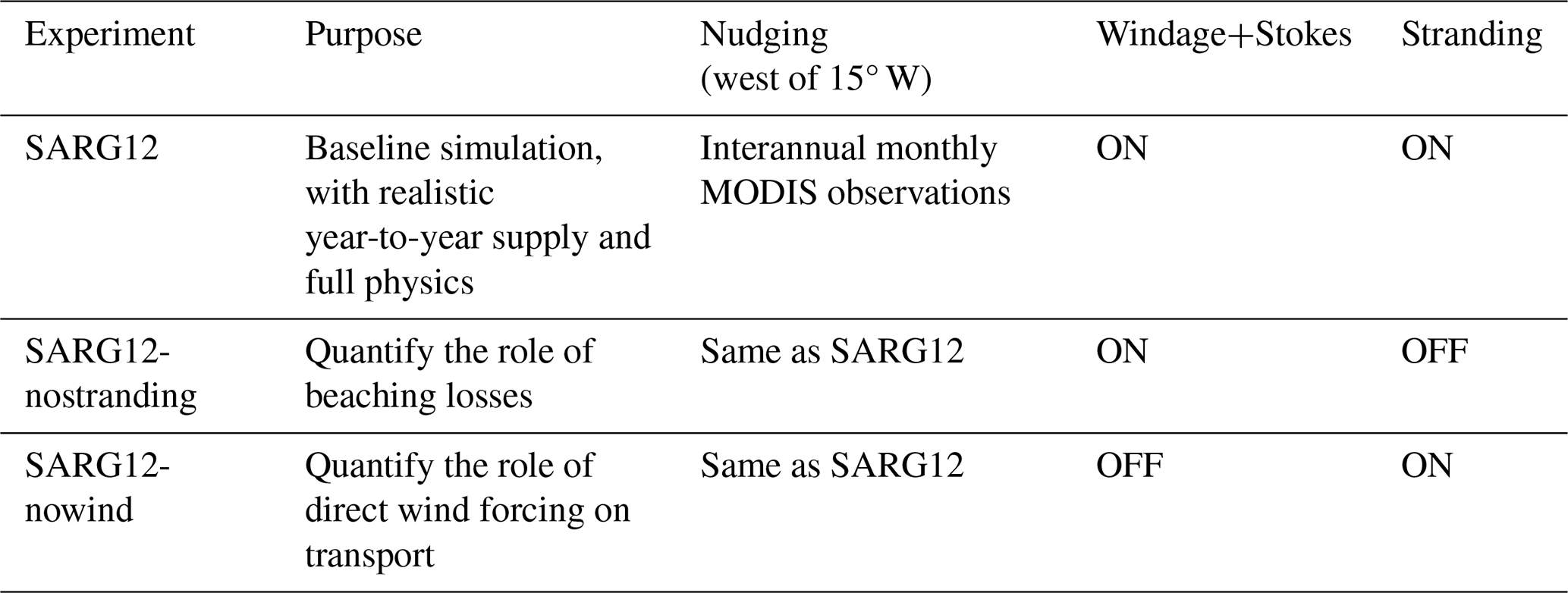
To account for the transport and growth-decay properties of Sargassum, we rely on the NEMO-Sarg1.0 model (Jouanno et al., 2021). This model explicitly couples the transport of pelagic Sargassum with a physiological module representing growth, nutrient uptake, and mortality. It is embedded within the NEMO ocean-circulation framework. The model transports carbon (C), nitrogen (N), and phosphorus (P) contents in a two-dimensional surface layer and represents carbon uptake, nutrient quotas, temperature-, light- and salinity-dependent growth, mortality, sinking, and coastal stranding. In particular, low salinity limits carbon uptake following the formulation of Jouanno et al. (2025a) (Fig. H1). Carbon content is the prognostic variable used to represent Sargassum biomass. As in Jouanno et al. (2025a) carbon content is converted to wet biomass using a carbon-to-dry-weight ratio of 0.27, a dry-to-wet ratio of 0.15 and to FC using an assumed areal density of 3.34 kg wet weight of Sargassum per m2. Model outputs are reported here as dimensionless FC for comparison with satellite observations. NEMO-Sarg has already been applied and validated in several contexts. In particular, it has demonstrated its ability to reproduce the emergence of the GASB (Jouanno et al., 2025a) and seasonal forecast experiments have shown predictive skill at lead time of up to seven months (Jouanno et al., 2023). However, because the model does not fully reproduce the observed interannual variations in biomass over recent years, as discussed in Jouanno et al. (2025a), we use here a version nudged towards 7 d averages of Sargassum FC derived from MODIS observations (see Sect. 2.1) following the approach described in Jouanno et al. (2025b). Nudging is applied west of 15° W, leaving the e-TA and the GoG free to evolve dynamically and biologically. This strategy allows the model to realistically represent the seasonal and interannual supply of Sargassum to the e-TA and GoG. Transport is represented as the sum of GLORYS12 surface currents, explicit Stokes drift, and a windage contribution equal to 0.1 % of the 10 m wind velocity derived from ERA5. Laboratory experiments have estimated direct Sargassum windage coefficients ranging from 0.02 % to 0.96 % (Olascoaga et al., 2023), encompassing the 0.1 % value used here. Table 1 summarizes these forcings. Stranding is implemented as a local carbon-biomass sink in ocean grid cells adjacent to land, at a rate of 0.08 d−1. Stranded biomass is removed from the floating pool rather than shifted to another ocean cell.
Table 1Summary of the forcings used in the SARG12 simulation and in this study. The forcings used in the sensitivity experiments are described below.

Sensitivity experiments were designed to identify the main sources of variability in Sargassum dynamics in the n-GoG. The reference simulation (SARG12) is compared with two sensitivity experiments in which a single process is modified. All simulations use identical ocean physics, biogeochemistry, atmospheric forcing, and model domain relative to the reference configuration. In SARG12-nostranding, coastal biomass loss due to stranding is suppressed, allowing assessment of the role of stranding in shaping the simulated Sargassum distribution within the GoG. In SARG12-nowind, both Stokes drift and windage are excluded, isolating the contribution of wind-driven processes to Sargassum transport. A summary of the experiments is provided in Table 2.
Table 2List of model experiments and differences between them.
2.3 Study domains
To diagnose how remote Sargassum stocks may contribute to coastal arrivals, we defined fixed geographic boxes, shown in Fig. 1. The n-GoG is our target region, where we compute a monthly mean Sargassum cover index. Two additional regions are used to characterize potential upstream pathways feeding the coast: a box around Cape Palmas and a broader eastern tropical Atlantic box (“e-TA”) that samples the NECC/GC corridor. The Sargassum index is calculated as the spatial mean of the dimensionless FC over all ocean grid cells within each box.
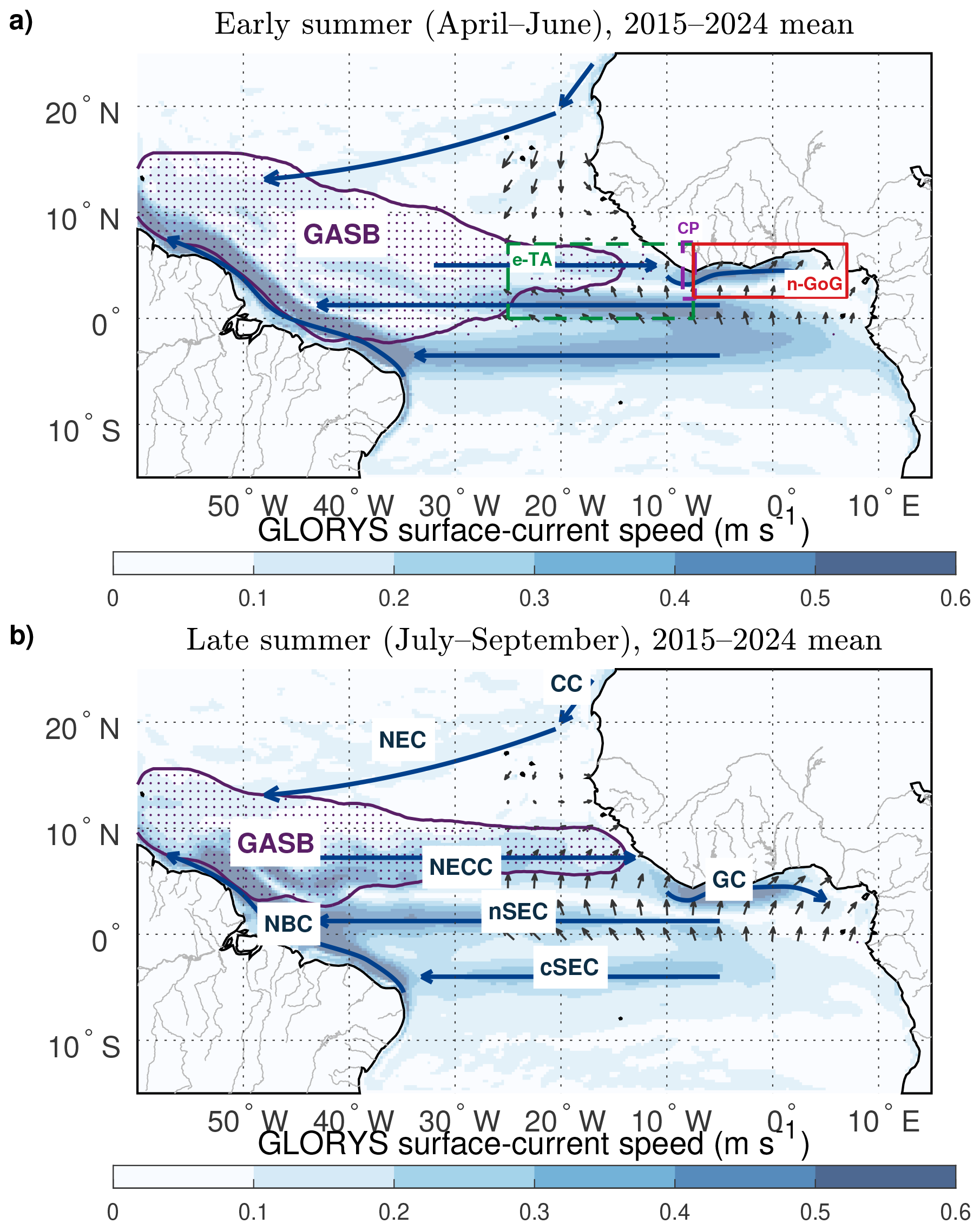
Figure 1Seasonal schematic of the principal surface-circulation features, Sargassum distribution, and analysis domains in the tropical Atlantic. Panels show the 2015–2024 mean conditions during (a) early summer (April–June) and (b) late summer (July–September). Blue shading represents GLORYS surface-current speed, while black vectors indicate the mean ERA5 10 m wind direction. Thick blue arrows schematically highlight the main circulation pathways, including the North Equatorial Current (NEC), North Equatorial Countercurrent (NECC), northern and central branches of the South Equatorial Current (nSEC and cSEC), North Brazil Current (NBC), Guinea Current (GC), and Canary Current (CC). The purple contour and stippling indicate the seasonal extent of the Great Atlantic Sargassum Belt (GASB), derived from MODIS observations. In panel (a), coloured boxes delimit three fixed analysis domains: the eastern tropical Atlantic (e-TA; green; 25–7.5° W, 0–7° N), the Cape Palmas gateway (CP; magenta; 8.5–7.5° W, 2–7° N), and the northern Gulf of Guinea region (n-GoG; red; 7.5° W–7° E, 2–7° N).
Within each box, we examine potential physical and biogeochemical drivers of Sargassum arrivals in the n-GoG. These variables include surface currents, Sea Surface Temperature (SST) and Sea Surface Salinity (SSS), 10 m winds, Stokes drift, chlorophyll, and nutrient concentrations; their sources and spatiotemporal resolutions are summarized in Table 1. Fields are averaged to monthly means before regional averaging and statistical analysis. Upstream signals are related to coastal events using the lags defined in Sect. 2.6.
2.4 Backward Lagrangian experiments
The transport pathways of floating Sargassum reaching the n-GoG are investigated using the Lagrangian framework Parcels (Amorim et al., 2025; Delandmeter and Van Sebille, 2019). For every simulation year, particles were released at mid-month in April and October from all n-GoG surface grid cells where simulated FC exceeded 2 × 10⁻⁵, and were then integrated backward for 120 d. Advection uses GLORYS surface currents plus a wind-driven velocity equal to 1 % of the 10 m wind. Unlike the NEMO-Sarg configuration, which represents Stokes drift and windage separately (Sect. 2.2), this 1 % coefficient is an effective leeway parameter intended to represent their combined influence, consistently with earlier Lagrangian studies (Marsh et al., 2021; Putman et al., 2018). Trajectories were integrated using a fourth-order Runge–Kutta scheme with a 6 h time step. Particle positions were accumulated in 0.1° × 0.1° bins to calculate the mean backward advection time and the fraction of all trajectory occurrences in each grid cell. These diagnostics provide complementary information on the characteristic transport timescales and the preferred transport corridors linking the tropical Atlantic to the n-GoG.
2.5 Forward Lagrangian experiments
To further assess the role of wind forcing in shaping Sargassum pathways from the e-TA toward the GoG, we performed a set of idealized forward Lagrangian experiments using the same Parcels framework and numerical settings as in Sect. 2.4. In contrast to the backward experiments, particles were seeded in the source region (e-TA) and integrated forward in time in order to quantify their subsequent dispersion and their potential to reach the GoG under different forcing assumptions.
For each month from January 2010 to December 2024, particles were released at mid-month from e-TA grid cells where simulated FC exceeded 2 × 10⁻⁵ and integrated forward for 360 d. Two configurations were considered: a no-wind experiment, using GLORYS surface currents only, and a wind-forced experiment, using effective surface currents including the wind-driven contribution equivalent to 1 % of the 10 m wind velocity, consistent with the parameterization adopted in Sect. 2.4 to represent the combined effects of windage and Stokes drift.
2.6 Event definition, composites, and time lags
We identified high- and low-Sargassum seasons using the monthly SARG12 FC index averaged over the n-GoG for 2010–2024. High-Sargassum months were defined as months in which the index exceeded its 75th percentile over the complete analysis period. Consecutive above-threshold months within the same season were treated as a single event. Seasons were defined as December–February (DJF), March–May (MAM), June–August (JJA), and September–November (SON), although the interannual analysis focused on MAM and SON. For each season, a year was classified as a high-Sargassum year when at least one month within that season exceeded the 75th-percentile threshold. Years with no above-threshold month in the season were classified as low-Sargassum years. The classification was performed independently for MAM and SON; therefore, the same calendar year could belong to different categories in the two seasons. Composite differences were calculated as the mean of high-Sargassum years minus the mean of low-Sargassum years.
Lagged relationships were used to account for the time required for Sargassum to be transported from upstream regions to the n-GoG. Lag selection was based on the backward Lagrangian experiments described in Sect. 2.4, which were first used to estimate characteristic transit times between the e-TA, the Cape Palmas gate, and the n-GoG. Accordingly, n-GoG arrivals in month M were compared with Sargassum FC at the Cape Palmas gate in month M−1 and in the e-TA during months M−2 to M−3. The corresponding transport-time diagnostics are presented in Sect. 3.2.
To characterize the large-scale climate state preceding each coastal season, we calculated the minimum Atlantic Meridional Mode (AMM) index over the six months preceding the target month. This metric represents the strongest negative AMM phase experienced during the period in which the upstream Sargassum distribution and transport pathways develop. Its relationship with the meridional position of Sargassum is evaluated in Fig. C1.
2.7 Model configuration and evaluation
We evaluate the simulation against two complementary but incomplete observational datasets. First, monthly and seasonal SARG12 FC is compared with the satellite FC product over the same 2010–2024 period for timing, spatial distribution, and relative event amplitude. Second, simulated coastal occurrences are compared qualitatively with published and institutional records of in situ or reported strandings compiled in Fig. 2. Because these records are heterogeneous and satellite sampling is incomplete beneath the ITCZ, these comparisons assess seasonal and spatial consistency rather than formally validating stranded biomass. Their limitations are discussed in Sect. 4.1. Before selecting the reference configuration, we tested several coastal-stranding rates (0.30, 0.06, and 0.08 d−1). Their influence on the persistence of coastal biomass was evaluated against satellite observations over the Côte d'Ivoire–Ghana and Togo–Benin–Nigeria sectors, using spatial distributions for the four seasons and seasonal and interannual FC variability. A stranding rate of 0.08 d−1 provided the closest overall agreement with the observed geographical distribution and temporal variability and was therefore retained in the reference configuration.
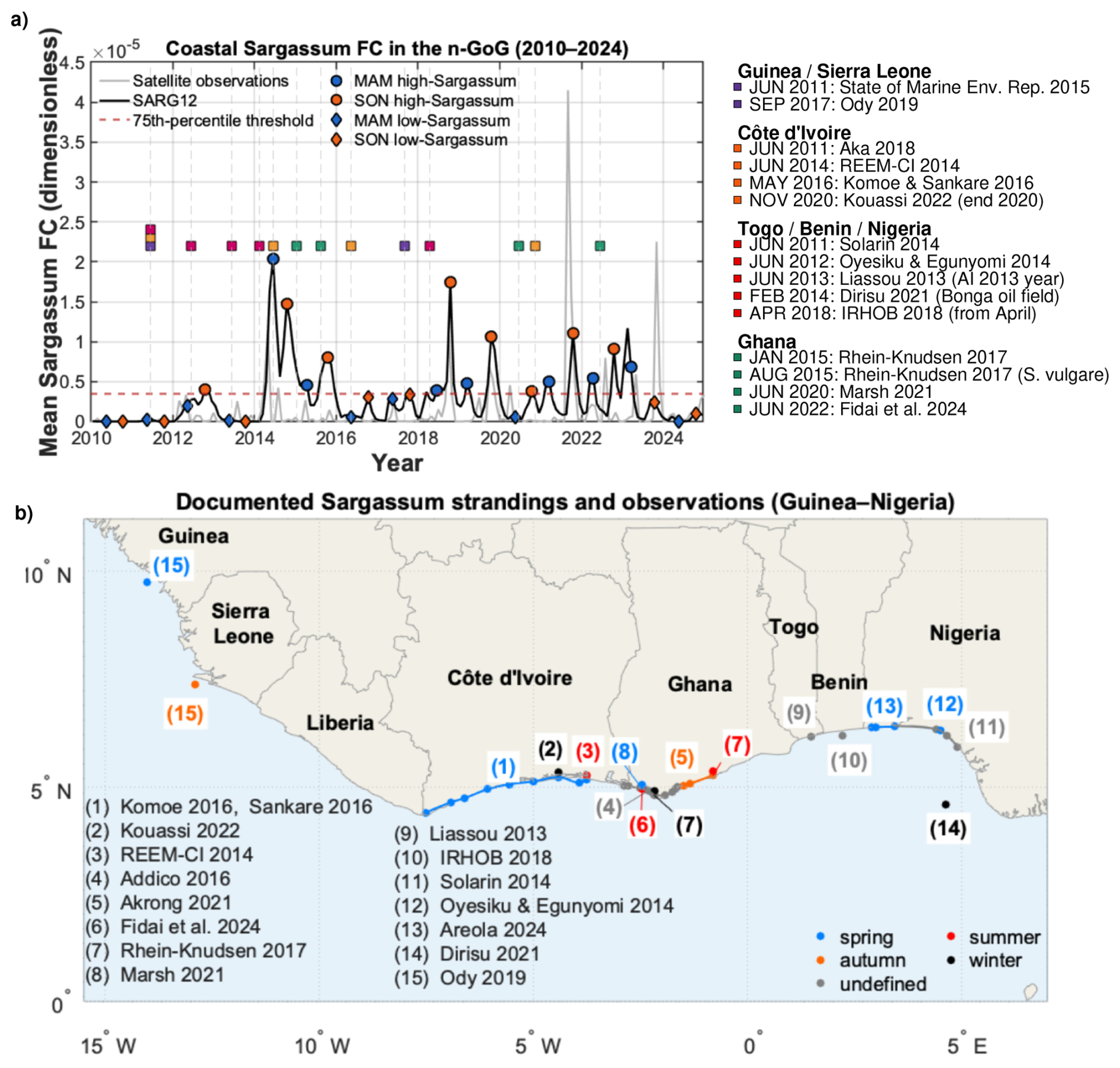
Figure 2Temporal and spatial distribution of coastal Sargassum in the Northern Gulf of Guinea (N-GoG), 2010–2024. (a) Time series of coastal Sargassum FC. The black line shows daily model-based mean coverage, while the grey line represents satellite observations. The dashed red line indicates the percentile-based event threshold. Blue and orange circles indicate high-Sargassum years in spring (MAM) and autumn (SON), respectively; blue and orange diamonds indicate the corresponding low-Sargassum years. Coloured squares above the time series indicate the dates of Sargassum occurrences documented in the literature, with colours identifying the corresponding coastal sectors listed in the legend. (b) Map of documented Sargassum strandings along the n-GoG coastline, from Liberia to Nigeria. Points are colour-coded by season of occurrence: blue (spring), yellow (summer), red (autumn), black (winter), and grey (undated). Numbers correspond to references in the bibliography (left).
3.1 Comparison of the model with observations and previous reports
The SARG12 time series shows a marked seasonal cycle of coastal Sargassum FC in the n-GoG between 2010 and 2024 (Fig. 2a). Coastal FC generally increases during boreal spring and autumn, although the timing and magnitude of these peaks vary considerably among years. The spring maximum generally occurs between March and May, whereas the second and often larger maximum occurs between September and November. Simulated FC remains comparatively low during winter and summer, although some events extend beyond these main seasons.
Satellite observations display a broadly consistent seasonal cycle, with recurrent Sargassum detections in spring and autumn and occasional detections during summer (Figs. 2 and 3). The strongest and most recurrent coastal signals occur along Côte d'Ivoire and Ghana, although detections extend eastward along the n-GoG coast in some years. The reference SARG12 simulation reproduces most of the observed seasonal and interannual variability. In particular, the model captures the major spring events observed in 2012, 2014, 2015, 2017, and 2022, with timing and amplitude broadly consistent with the satellite-derived FC estimates. Several autumn events are also reproduced, including those of 2014, 2018, 2021, and 2023, although their intensity is overestimated in 2014 and 2018 and underestimated in 2021 and 2023. The model does not reproduce the spring 2020 peak, and a further mismatch occurs from late 2022 to early 2023, when the simulated peaks precede those observed by satellite. The spatial comparison shows that the model reproduces the main coastal distribution detected by satellite, particularly along Côte d'Ivoire and Ghana (Fig. 3). Both datasets show their highest coastal FC during boreal autumn, together with weaker or more localized signals during the other seasons. The number of valid satellite observations is spatially and seasonally uneven, with fewer than 15 valid observations per month on average along much of the n-GoG coast (Fig. 3, right column).

Figure 3Seasonal climatologies of Sargassum FC and satellite sampling in the Gulf of Guinea during 2010–2024. The left column shows modelled FC from the reference SARG12 simulation, the middle column shows satellite-derived FC from MODIS, and the right column shows the mean number of valid daily satellite observations per grid cell and month. From top to bottom, the rows correspond to December–February, March–May, June–August, and September–November. Along much of the n-GoG coast, fewer than 15 valid satellite observations per month are available on average.
Published reports broadly support the seasonal and spatial patterns identified from SARG12 and satellite observations (Fig. 2b). Along the Guinea–Sierra Leone sector, Sargassum has been reported since 2011, with recurrent occurrences from boreal spring to autumn (Environment Protection Agency, 2015; Ody et al., 2019). In Côte d'Ivoire, coastal monitoring recorded strandings at Grand-Bassam in June 2014 (MINEDD, 2021) and more widely from Grand-Bassam to Tabou in May–June 2016 (Komoe et al., 2016), while Aka et al. (2018) identified a climatological maximum in May and reported the first national observations in 2011. In Ghana, strandings were reported from January to August 2015 at Egyambra and Mumford (Addico and deGraft-Johnson, 2016), with additional observations during 2017–2019 at Mumford, Komenda and Elmina (Akrong et al., 2021) and field observations of stranded Sargassum at Sanzule in 2022 (Fidai et al., 2024). Major inputs were also reported in 2011–2012 (Ackah-Baidoo, 2013; Fidai et al., 2020), while satellite and drifter analyses identified grounding events near Ghana in March 2011–2012 (Johns et al., 2020) and a spring event was reported in 2020 (Marsh et al., 2021). Farther east, year-round presence was reported in Togo in 2013 (Issifou et al., 2014), while arrivals in Benin were reported from April onward (DGEC and MCVDD, 2020). In Nigeria, spring–summer strandings were documented in Ondo State in 2012 (Oyesiku and Egunyomi, 2014), and a prolonged sequence occurred along the Lagos–Ogun coast from May 2011 to August 2012 (Solarin et al., 2014). Interviews from Badagry, Gberefu and Ajido indicate that the main events occur in autumn (Areola et al., 2025), while an offshore occurrence near the Bonga field was reported in February 2014 (Dirisu et al., 2021). Overall, these reports are broadly consistent with the seasonal timing and geographical distribution identified in SARG12 and satellite observations, particularly along the well-documented coasts of Côte d'Ivoire and Ghana.
3.2 Pathways of Sargassum reaching the n-GoG: Lagrangian advection
Backward trajectories released from Sargassum-rich grid cells in the n-GoG reveal a dominant west-to-east transport pathway connecting offshore regions of the e-TA to the n-GoG through the NECC–GC corridor (Fig. 4). Most trajectories pass through the e-TA approximately two to three months before reaching the n-GoG, whereas the final transit from the Cape Palmas sector to the coast generally occurs within about one month. These characteristic transport times provide the physical basis for the time lags used in the subsequent analysis of interannual variability (Sect. 3.5).
The spatial structure of the pathways differs between the two principal arrival seasons. Trajectories associated with April arrivals are distributed over a broad offshore sector of the e-TA and include pathways approaching the n-GoG from both the Guinea–Sierra Leone sector and lower-latitude waters (Fig. 4a, b). This broad distribution indicates that spring arrivals are connected to several upstream sectors rather than to a single narrow pathway. By contrast, trajectories associated with October arrivals are concentrated within a more coherent and continuous corridor extending eastward along the West African margin and through the NECC–GC system (Fig. 4c, d). The autumn pathway therefore appears more spatially constrained than the spring pathway, with trajectories converging toward Cape Palmas before entering the n-GoG.

Figure 4Backtracking diagnostics of coastal Sargassum in the n-GoG derived from Lagrangian simulations. Panels show results aggregated over all available years for two representative months: April (a–b) and October (c–d). Mean advection time (days) from the coastal release locations to the upstream positions of the backtracked trajectories is shown Colors indicate the average travel time required for floating Sargassum to reach each 0.1° × 0.1° grid cell. Relative density of trajectory points per grid cell (b, d) is expressed as a fraction of the total number of trajectory points. This metric highlights the spatial distribution and preferential pathways of the backtracked trajectories. Higher values reveal the dominant transport corridors linking the e-TA to the n-GoG.
3.3 Seasonality of Sargassum arrivals in the northern Gulf of Guinea
Since 2011, the seasonal cycle of Sargassum influxes in the n-GoG has followed a persistent pattern (Fig. 2): a first maximum in boreal spring (MAM), a decline during summer and a second maximum in autumn (SON). The Lagrangian diagnostics presented in Sect. 3.2 show advection times of approximately two to three months between offshore regions of the e-TA and the n-GoG, implying that coastal arrivals reflect oceanic conditions that developed several weeks to months upstream. We now examine the climatological factors underlying this seasonal pattern in each season (Fig. 5).
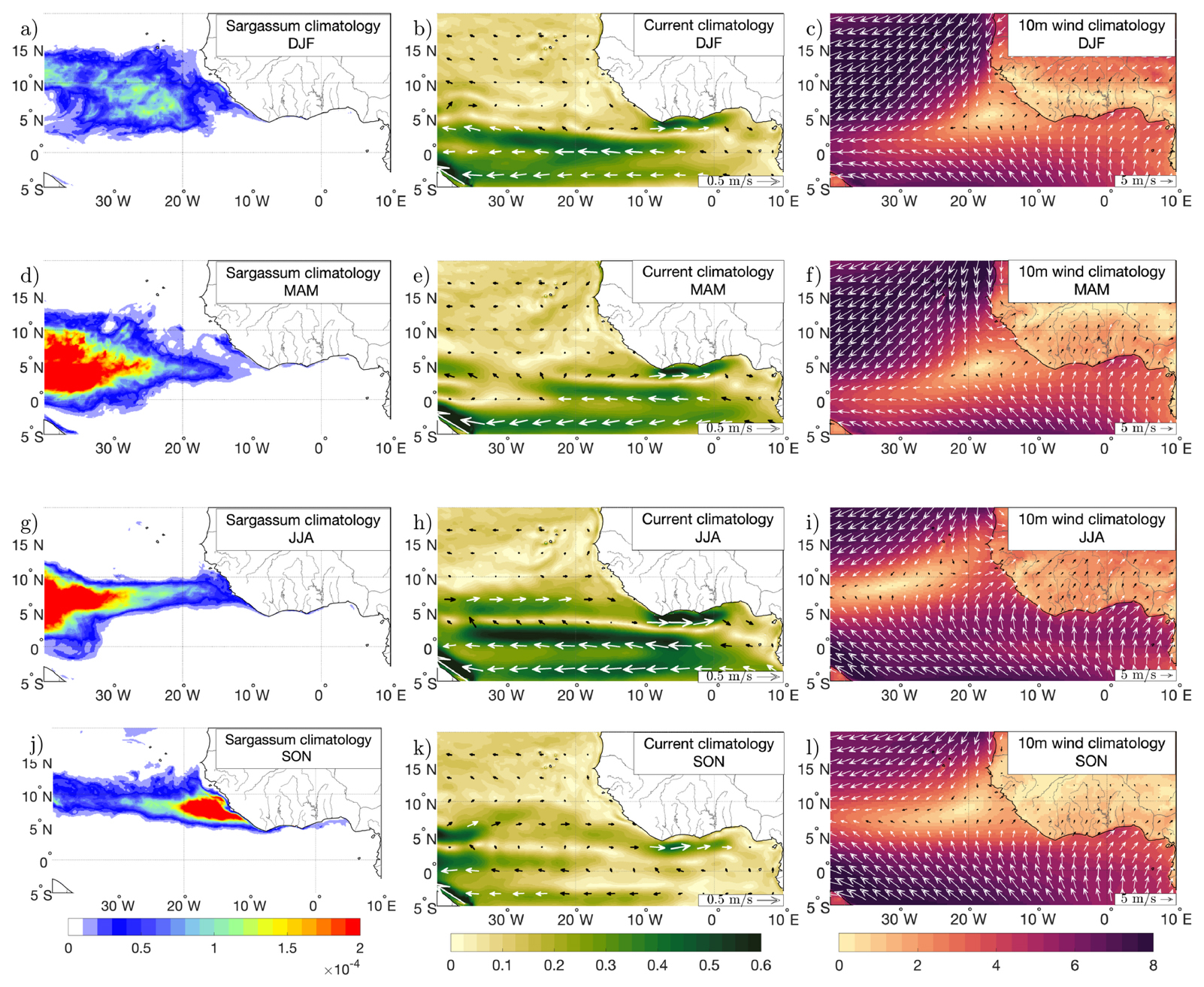
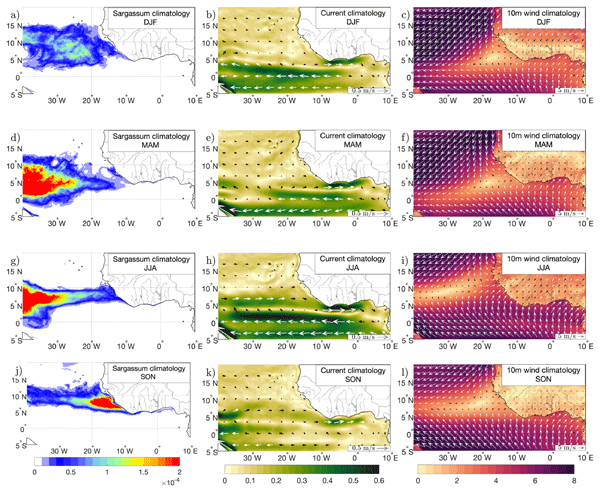
Figure 5Climatological Sargassum distribution and environmental conditions. (left) Mean Sargassum FC. (center) Surface currents (m s−1). (right) 10 m winds (vectors) over wind speed (m s−1). From top to bottom: DJF, MAM, JJA, and SON seasons.
During boreal winter and early spring, the ITCZ is located close to the equator and begins to migrate northward, while the West African monsoon and trade winds remain weak (e.g., Grodsky and Carton, 2003). The NECC is developing and can be intermittent; in its western part it may even reverse westward (Johns et al., 2020). Near Sierra Leone, the GC is present but weak and flows southeastward; the NECC and GC converge near Cape Palmas, while winds are directed toward the coast (Fig. 5b, c). Spring arrivals of Sargassum in the GoG reflect conditions established during late winter and are associated with two upstream Sargassum pools (Fig. 5a). First, a residual pool retained offshore of Guinea and Sierra Leone during winter is partly advected southeastward by the GC. Southwesterly winds are directed toward the coast and oppose southeastward advection along the Sierra Leone–Liberia coast (Fig. 5c). A second Sargassum pool is present closer to the Equator, near the seasonal convergence zone. Sargassum located sufficiently far south may enter the eastward-flowing NECC and pass south of Cape Palmas, although transport efficiency remains limited. Within the GoG during MAM, southerly winds (Fig. 5c), through windage and Stokes drift, tend to push Sargassum northward against the coastline. However, the GC remains attached to the coast and continues eastward, allowing part of the Sargassum biomass to remain within the current and to be transported farther east along the n-GoG. Coastal Sargassum biomass subsequently declines through summer, particularly along Côte d'Ivoire and Ghana, consistent with field observations (e.g., Komoe et al., 2016). The possible contribution of local physicochemical conditions to biomass persistence is discussed in Sect. 4.2. Farther east, along the coasts of Togo, Benin, and Nigeria, Sargassum arrivals occur later and can persist into summer and autumn. This eastward delay is consistent with the transit time from Cape Palmas and with the timing reported in coastal observations (Areola et al., 2025; Issifou et al., 2014; Solarin et al., 2014).
During late summer, the basin-scale circulation sets the stage for the autumn influx. Strengthened southeasterly trade winds and the monsoon intensify the NECC, which reaches its annual maximum and feeds directly into the GC, itself strongest along the West African coast during the rainy season (Binet, 1997; Djakouré et al., 2024). Given the two-to-three-month advection time, the autumn coastal maximum reflects the strong eastward transport established across the e-TA during late summer. By boreal autumn, Sargassum has accumulated along Guinea and Sierra Leone and is advected southeastward by the GC toward Cape Palmas (Fig. 5g). There, because the coastline changes orientation, the GC partly detaches from the coast and veers slightly southward (Fig. 5h), a feature known to reinforce upwelling off Côte d'Ivoire (e.g., Djakouré et al., 2017; Marchal and Picaut, 1977). Combined with prevailing southerly winds that push Sargassum northward (Fig. 5i, l), this configuration limits direct eastward transport and promotes strong coastal accumulation and stranding along Côte d'Ivoire and Ghana, as illustrated in Fig. F1. Once accumulated along the coast, Sargassum may persist under the relatively favourable physicochemical conditions prevailing during late summer and early autumn (Sect. 4.2). By late autumn (November), both the NECC and GC weaken (Fig. 5k) in association with the southward migration of the ITCZ, reducing further advection; most of the biomass then remains nearshore and strands, consistent with the widespread strandings reported in November. In early winter, weakening or reversal of the GC can advect part of the remaining Sargassum offshore Liberia northwestward. A persistent Sargassum pool remains offshore of Sierra Leone during early winter and may subsequently contribute to the following spring influx.
3.4 Sensitivity of the Sargassum distribution in the GoG to winds and stranding
The mechanisms controlling Sargassum accumulation in the n-GoG are further investigated through analysis of sensitivity experiments designed to isolate two key processes: the loss of Sargassum through stranding on the shoreline and the wind-driven transport due to windage and Stokes drift. These experiments allow us to quantify how coastal sinks and wind forcing influence the spatial distribution, persistence, and seasonal cycle of Sargassum reaching the n-GoG.
3.4.1 Effect of stranding
In SARG12-nostranding, coastal Sargassum FC remains higher for longer within the n-GoG coastal strip, with a slower decrease after the spring and autumn peaks than in the reference simulation (Fig. 6a). The timing of the seasonal maxima remains broadly unchanged, but their amplitude and duration increase. The difference map shows positive anomalies concentrated in nearshore grid cells, with the largest values between Côte d'Ivoire and Nigeria and smaller differences farther offshore (Fig. 6b). These results identify stranding as an important sink of coastal Sargassum after the seasonal peaks.

Figure 6Influence of stranding processes and wind forcing on Sargassum occurrence in the n-GoG. (a) Monthly climatology of mean Sargassum FC in the n-GoG for SARG12 (blue) and the sensitivity experiments SARG12-nostranding (yellow) and SARG12-nowind (red). (b–c) Spatial distribution of climatological differences in coastal Sargassum FC between the sensitivity experiments and the reference simulation, showing SARG12-nostranding minus SARG12 (b) and SARG12-nowind minus SARG12 (c). Positive values (red) indicate an increase in Sargassum cover relative to the reference simulation.
3.4.2 Effect of wind forcing
Removing wind forcing (SARG12-nowind run) fundamentally alters the circulation of Sargassum. In the e-TA, Sargassum shifts approximately 2° southward, highlighting the role of winds in maintaining Sargassum at higher latitudes (Fig. 6c). Around Cape Palmas, the absence of wind opposition to the GC also facilitates south-eastward advection. These two factors make Cape Palmas a less selective gateway: Sargassum enters the n-GoG every year, even when western biomass supply is weak, resulting in much higher Sargassum FC in n-GoG throughout the year (Fig. 6a, c). East of the cape, Sargassum remains embedded in the core of the GC and is advected eastward near ∼ 4° N, whereas in the wind-forced experiment trajectories are concentrated within a narrower coastal band, with enhanced coastal accumulation and strandings around Cape Palmas (Fig. 7). This contrast highlights the role of winds in deflecting Sargassum out of the GC and toward the coast after passing south of Cape Palmas, thereby creating the accumulation trap near Côte d'Ivoire and enabling strandings (Sect. 3.3, Fig. F1). Simulated nearshore concentrations along the Côte d'Ivoire–Ghana coast are comparable to those in the reference run despite a much larger basin-wide biomass (Fig. 6c), further emphasizing the regulatory role of stranding on coastal Sargassum abundance. A secondary consequence of the absence of winds is the emergence of a southern pathway that is absent in the reference simulation: forward Lagrangian experiments show that trajectories extend farther east, and some of them turn south along the GoG margin and reach about 5° S before recirculating westward within the SEC (Fig. 7h). This pathway is associated with persistent FC and a strong increase in simulated biomass in the southern GoG (Fig. 6c) and is discussed further in Sect. 4.5. Taken together, these results show that wind forcing plays three complementary roles in the simulated Sargassum circulation: it (i) influences the latitudinal position of Sargassum in the e-TA, (ii) promotes accumulation along the n-GoG coasts, and (iii) prevents southward propagation into the southern GoG.
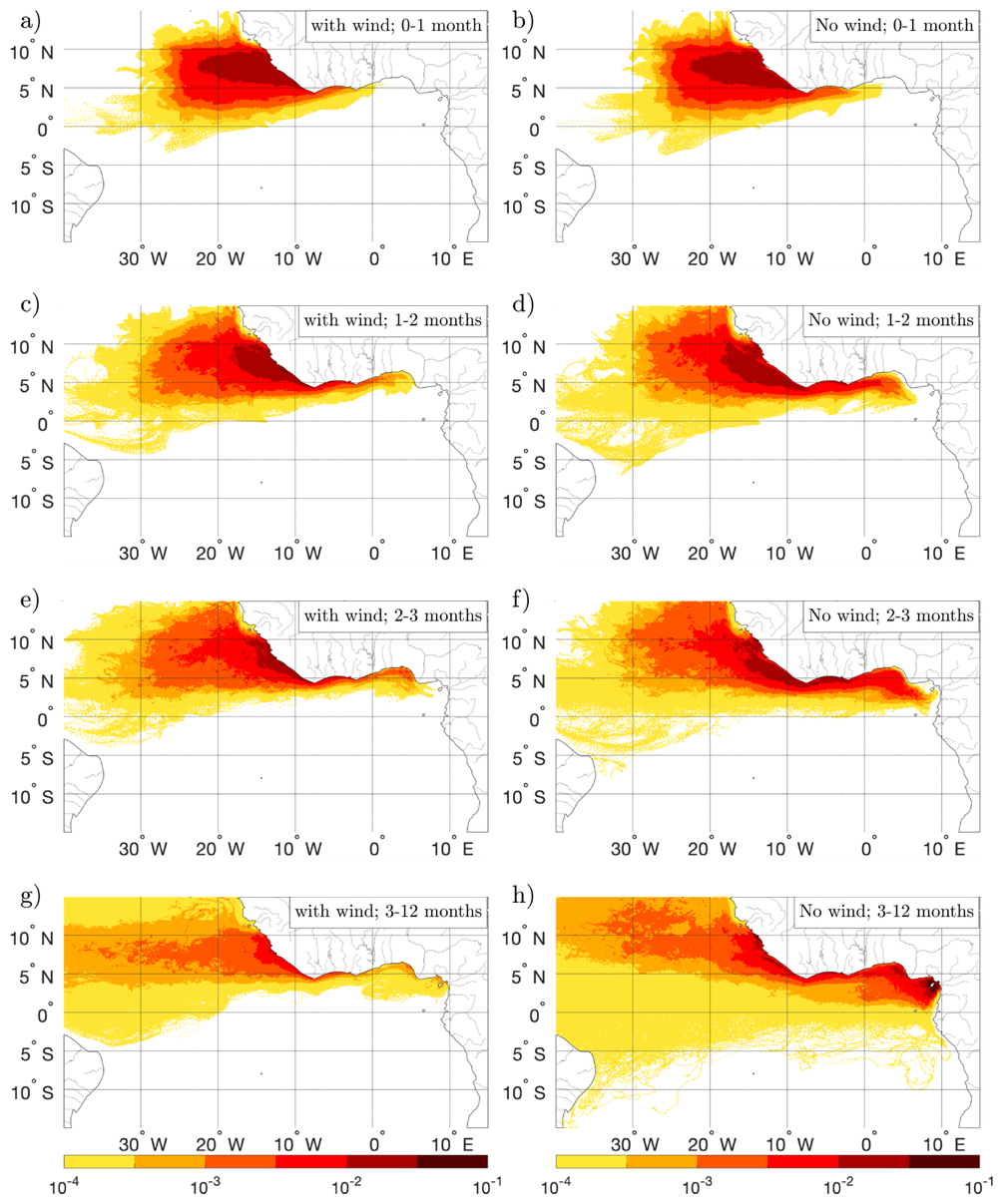
Figure 7Forward trajectory density from the e-TA, shown for four advection-time classes: 0–1 month (a–b), 1–2 months (c–d), 2–3 months (e–f), and 3–12 months (g–h). Left panels show the wind-forced experiment, right panels the no-wind experiment. Colors indicate trajectory density, expressed as the fraction of trajectory occurrences in each 0.1° × 0.1° grid cell, shown on a logarithmic scale.
3.5 Interannual variability of coastal Sargassum in the n-GoG
Interannual variability is examined separately for boreal spring and autumn, corresponding to the two seasonal maxima identified in Sect. 3.3.
3.5.1 Interannual variability in spring
The amount of Sargassum reaching the n-GoG in boreal spring is positively related to the Cape Palmas FC one month earlier (r2 = 0.34, Fig. 8c). This input is itself correlated with the Sargassum stock along the Sierra Leone–Liberia coast at the end of winter (r2 = 0.83, not shown). Spring n-GoG FC is also related to the AMM index (r2 = 0.54, Fig. 8a). In the corresponding composites, high-Sargassum years show a more southerly upstream Sargassum distribution between 0 and 5° N than low-Sargassum years (Fig. G1). The high-minus-low composite also shows a stronger NECC, with an average current-speed difference of approximately 0.15 m s−1, together with weaker shoreward components of the wind, windage, and Stokes drift along the Sierra Leone–Liberia coast and near Cape Palmas (Figs. G1 and B1). Relationships with conditions within the n-GoG are weaker (Fig. D1: r2 < 0.12 for all parameters).
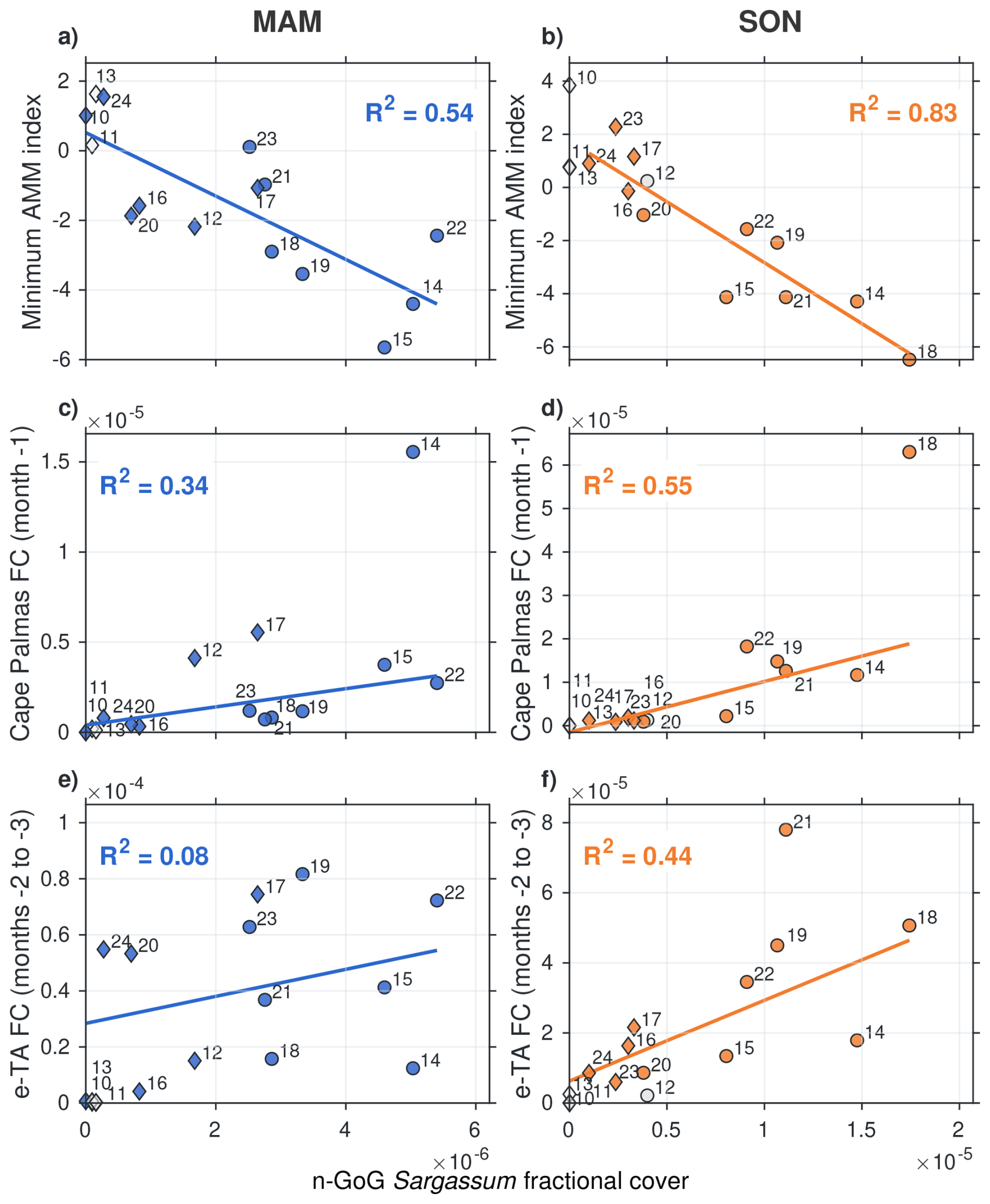
Figure 8Interannual relationships between coastal Sargassum FC in the n-GoG and large-scale controls, for MAM (left) and SON (right). (a, b) Minimum Atlantic Meridional Mode (AMM) index over the preceding 6 months versus coastal FC. (c, d) Cape Palmas FC versus coastal FC. (e, f) Equatorial Sargassum stock in the e-TA versus coastal FC. Coloured symbols indicate years with western supply (blue for MAM, orange for SON), whereas grey symbols indicate years without western supply. Labels indicate the last two digits of each year. Linear regressions and corresponding r2 values are shown for western-supply years only.
3.5.2 Interannual variability in autumn
In boreal autumn, coastal Sargassum arrivals in the n-GoG are strongly associated with the AMM (r2 = 0.83, Fig. 8b). High-Sargassum years are characterized by more negative AMM values, a southward displacement of the upstream Sargassum band, and a stronger NECC relative to low-Sargassum years (Fig. G2). The composites also show a reduction in the shoreward components of the wind, windage, and Stokes drift along the Sierra Leone–Liberia coast and near Cape Palmas (Fig. B1). By comparison, conditions within the n-GoG seem to play a secondary role (Fig. D1), except possibly near Nigeria, where the persistence of spring Sargassum through summer, as in 2014 and 2017, may provide an additional local biomass source. This is further supported by the relationship at Cape Palmas (Fig. 8d): coastal Sargassum in the n-GoG is also related to Cape Palmas FC one month earlier (r2 = 0.55), showing that the key control is the amount of offshore biomass advected into the Gulf, not local conditions after entry. The physical interpretation of the relationship between the AMM and coastal Sargassum arrivals is discussed in Sect. 4.4.
This study combined Eulerian simulations, Lagrangian trajectories, satellite observations, and published records to examine the processes controlling Sargassum arrivals in the n-GoG. Two seasonal influx periods dominate: spring (MAM) and autumn (SON). In both seasons, coastal arrivals depend on the availability of upstream biomass and its eastward transport through the NECC–GC corridor. Wind forcing and stranding then regulate the coastal and meridional distribution of the biomass after it passes south of Cape Palmas. At interannual timescales, two main factors emerge: the basin-scale Sargassum supply in the tropical Atlantic and the latitudinal position of the upstream biomass, which is associated with the AMM–ITCZ–NECC configuration.
4.1 Model evaluation and observational limitations
Direct quantitative validation remains difficult because published coastal records are sparse and uneven among countries and generally document only the presence and timing of strandings rather than standardized FC or biomass. Satellite observations provide broader coverage but are strongly limited by clouds, land contamination and optically complex coastal waters, particularly beneath the ITCZ (Fig. 3, right column).
These limitations complicate the interpretation of several discrepancies. Satellite signals south of the main n-GoG region, including off the Congo coast (e.g., Fig. 3), cannot currently be independently verified and may include false-positive detections associated with turbidity, river plumes or coloured dissolved organic matter. Similarly, the exceptionally high satellite peaks in September 2021 and November 2023 (Fig. 2) lack corresponding reports in the available literature, but the absence of systematic coastal monitoring prevents determining whether they represent real extreme events or retrieval overestimates.
The spring 2020 mismatch and the temporal offset from late 2022 to early 2023 could reflect errors in simulated transport or biological processes, satellite uncertainties, or both. Despite these limitations, the agreement among SARG12, satellite observations and published records in seasonal timing and broad spatial distribution supports the use of the simulation to investigate the mechanisms controlling Sargassum arrivals, although individual event magnitudes should not be regarded as quantitatively validated.
4.2 Influence of local physicochemical conditions
Although the seasonal evolution of Sargassum in the n-GoG is primarily controlled by upstream supply and circulation, local physicochemical conditions may modulate biomass persistence after arrival. During spring, coastal upwelling is weak and SST remains high, around 28 °C, while nutrient and chlorophyll a concentrations remain comparatively low (Figs. E1 and A1; Hardman-Mountford and McGlade, 2002). These conditions may limit local biomass development despite continued coastal accumulation driven by transport. Conditions change markedly during the summer monsoon. Coastal upwelling lowers SST to approximately 25–26 °C along Côte d'Ivoire and Ghana and supplies nutrient-rich subsurface waters to the surface, while river discharge may provide additional nutrient inputs (Figs. E1 and A1; Binet, 1997; Djakouré et al., 2024). These potentially favourable conditions do not prevent the summer decline in coastal Sargassum, which therefore appears to result primarily from the seasonal reduction in upstream supply after the spring influx, combined with the continued removal of nearshore biomass through stranding. River discharge also produces substantial but spatially heterogeneous coastal freshening (Fig. H1). Low salinity can adversely affect Sargassum physiology (Hanisak and Samuel, 1987); in NEMO-Sarg, this effect is represented by the limitation function described in Fig. H1a, which reduces carbon uptake. The simulated effect is generally weak to moderate along Côte d'Ivoire and Ghana but stronger farther east, particularly along Togo, Benin, and Nigeria. Reduced light availability due to turbidity may provide an additional constraint, while stronger wind and wave conditions may enhance fragmentation and stranding (Laval et al., 2025). These local effects may influence biomass persistence, but their contribution to the regional seasonal cycle appears secondary to the reduction in advective supply. During late summer and early autumn, coastal and equatorial upwelling maintain relatively cool, nutrient-enriched surface waters, and elevated chlorophyll a concentrations (Figs. E1 and A1; Djakouré et al., 2017). These conditions may favour the persistence of biomass transported into the Gulf during the strong autumn influx.
4.3 The Guinea–Sierra Leone winter reservoir and its connection to the n-GoG
Observational and modelling studies identify the Guinea–Sierra Leone sector as a recurrent region of Sargassum retention (Berline et al., 2020; Johns et al., 2020; Jouanno et al., 2025a; Wang et al., 2019). Our results show that biomass remaining offshore during winter can subsequently be transported southeastward by the GC toward Cape Palmas, contributing to the spring influx into the n-GoG (Figs. 5 and G1). The winter reservoir therefore represents an important source of both the seasonal spring maximum and its interannual variability.
Our study does not contradict the West African origin inferred by Beron-Vera et al. (2026). One year before the exceptional 2011 bloom, their most likely source lies near Guinea, close to the winter reservoir identified here, while at longer lead times their inferred source extends into the Gulf of Guinea. In our reference simulation, biomass transported from the Guinea–Sierra Leone reservoir accumulates and strands along the northern Gulf coast. The n-GoG therefore acts predominantly as a sink for Sargassum rather than as a recurrent source for the wider tropical Atlantic, although occasional export under anomalous circulation conditions cannot be excluded.
4.4 AMM influence on interannual Sargassum variability
The strong relationship between the AMM and coastal Sargassum arrivals likely reflects its broad influence on the tropical Atlantic ocean–atmosphere system. The AMM is a coupled ocean–atmosphere mode characterized by a meridional SST gradient across the tropical Atlantic, with its negative phase associated with relatively cooler SST anomalies in the tropical North Atlantic and warmer anomalies to the south. This SST pattern is associated with a southward displacement of the ITCZ and a reorganization of the tropical wind field (Chiang and Vimont, 2004; Nobre and Shukla, 1996). These large-scale changes can influence Sargassum transport toward the n-GoG through three complementary mechanisms. First, AMM-related wind-stress anomalies can modify the position and strength of the NECC (Hormann et al., 2012; Martín-Rey et al., 2023); in our negative-AMM/high-Sargassum composites, the NECC is stronger, enhancing eastward transport across the e-TA toward the West African margin. Second, these conditions coincide with weaker northward windage and Stokes drift along the Sierra Leone–Liberia coast, reducing the wind-driven opposition to southeastward transport by the GC and thereby facilitating Sargassum transport toward Cape Palmas. Third, negative AMM conditions may increase the amount of Sargassum available upstream: previous studies have associated negative AMM years with enhanced tropical Atlantic Sargassum biomass and stronger trade-wind/upwelling conditions (Skliris et al., 2022). The relationship between the AMM and n-GoG arrivals may therefore combine changes in upstream biomass supply, ocean-current transport, and wind-driven drift.
4.5 Southern (“cSEC”) export pathway
A southward export pathway from the GoG into the cSEC, and then toward northeastern Brazil and occasionally back into the NECC, has been proposed from drifter syntheses and connectivity analyses (Beron-Vera et al., 2022; Franks et al., 2016; Johns et al., 2020). In our reference simulations, however, this pathway does not emerge as a robust feature. Strong southerly monsoon winds and wave-driven drift trap Sargassum against the n-GoG coast, while downstream losses through stranding and senescence east of Cape Palmas further reduce the likelihood of coherent export south of the Equator. By contrast, the cSEC branch does emerge in our no-wind experiment, indicating that wind drift is the main limitation to this route. Additional idealized Lagrangian advection experiments both with and without wind forcing (Fig. 7) further support this interpretation. They show that some trajectories can cross into the Southern Hemisphere and reach the southern GoG, where environmental conditions may then become favourable for Sargassum proliferation whereas no such southward pathway occurs in the wind-forced experiment. The cSEC pathway may therefore be considered conditional: it may become active only under unusually large biomass surpluses in the n-GoG or under anomalous alongshore wind conditions, but it does not appear to represent a common present-day pathway for Sargassum.
Satellite observations also provide little support for this pathway, since any southward leakage would likely take the form of thin, low-fraction filaments that are difficult to detect under the persistent cloud cover of JJA–SON.
4.6 Implications for future Sargassum arrivals
Three points emerge regarding the possible long-term evolution of Sargassum arrivals in the n-GoG. First, the tropical Atlantic Sargassum baseline has remained elevated since 2011, increasing the amount of biomass potentially available for transport into the Gulf (Berline et al., 2020; Johns et al., 2020; Wang et al., 2019).
Second, forced trends in the AMM–ITCZ background state over the Atlantic remain uncertain. Theory and climate models suggest a narrowing and meridional displacement of the tropical rain belt, but the direction of this shift over the Atlantic depends on aerosol forcing, hemispheric energy contrasts, and changes in the Atlantic Meridional Overturning Circulation (AMOC; Byrne et al., 2018; Calvin et al., 2023; Donohoe et al., 2013; Hwang and Frierson, 2013). A more northerly mean ITCZ would reduce the frequency of negative AMM-like configurations and could weaken Sargassum delivery into the n-GoG. Conversely, a southward displacement of the ITCZ, for example under a weakened AMOC, would favor the positioning and transport of Sargassum toward the Gulf.
Third, wind forcing and stranding may change independently of upstream biomass supply. A change in the prevailing wind regime could alter both coastal stranding risk and the fraction of biomass exported toward the Southern Hemisphere. Future n-GoG inundation risk will therefore depend on the combined evolution of the basin-wide Sargassum baseline, the frequency of negative AMM configurations, and regional wind and circulation patterns.
This study identifies the principal transport processes controlling seasonal and interannual Sargassum arrivals in the n-GoG. Two recurrent coastal maxima occur in spring and autumn. Spring arrivals are primarily connected to biomass retained off Guinea and Sierra Leone during winter, together with a secondary equatorial pool in some years. Autumn arrivals are mainly supplied by larger upstream stocks transported eastward through the NECC–GC corridor. The Lagrangian experiments indicate characteristic transport times of approximately two to three months from the e-TA and approximately one month from Cape Palmas.
After passing south of Cape Palmas, southerly winds transport Sargassum toward the n-GoG coast and help maintain the biomass north of the Equator. Without windage and Stokes drift, Sargassum remains embedded in the GC, spreads more broadly across the Gulf, and is more readily displaced toward circulation connected with the cSEC. Stranding acts as an additional regulator by removing nearshore biomass and limiting its persistence after the seasonal arrival peaks.
Interannual variability reflects both the amount of upstream biomass and its latitudinal position relative to Cape Palmas, especially in autumn. Both factors are associated with the AMM: negative AMM configurations favor a more southerly upstream distribution and stronger eastward transport toward the Gulf. Local environmental conditions appear to exert a weaker influence on the magnitude of coastal arrivals, although they may affect survival and persistence after entry.
These results provide a process-based framework for interpreting sparse observations and improving seasonal risk assessment in West Africa. Upstream FC in the e-TA, biomass approaching Cape Palmas, and the preceding AMM state could provide complementary indicators of coastal arrival risk. The potential southern export pathway also warrants further investigation as a mechanism through which future changes in wind forcing could reorganize the tropical Atlantic Sargassum distribution.

Figure A1Seasonal climatologies of the biogeochemical surface environment in the eastern tropical Atlantic and Gulf of Guinea, averaged over all years of the analysis period. From left to right: phosphate, iron, and nitrate. From top to bottom: boreal winter (DJF), spring (MAM), summer (JJA), and autumn (SON). These fields provide the seasonal biogeochemical context potentially favorable to Sargassum development and maintenance upstream of the Gulf of Guinea.
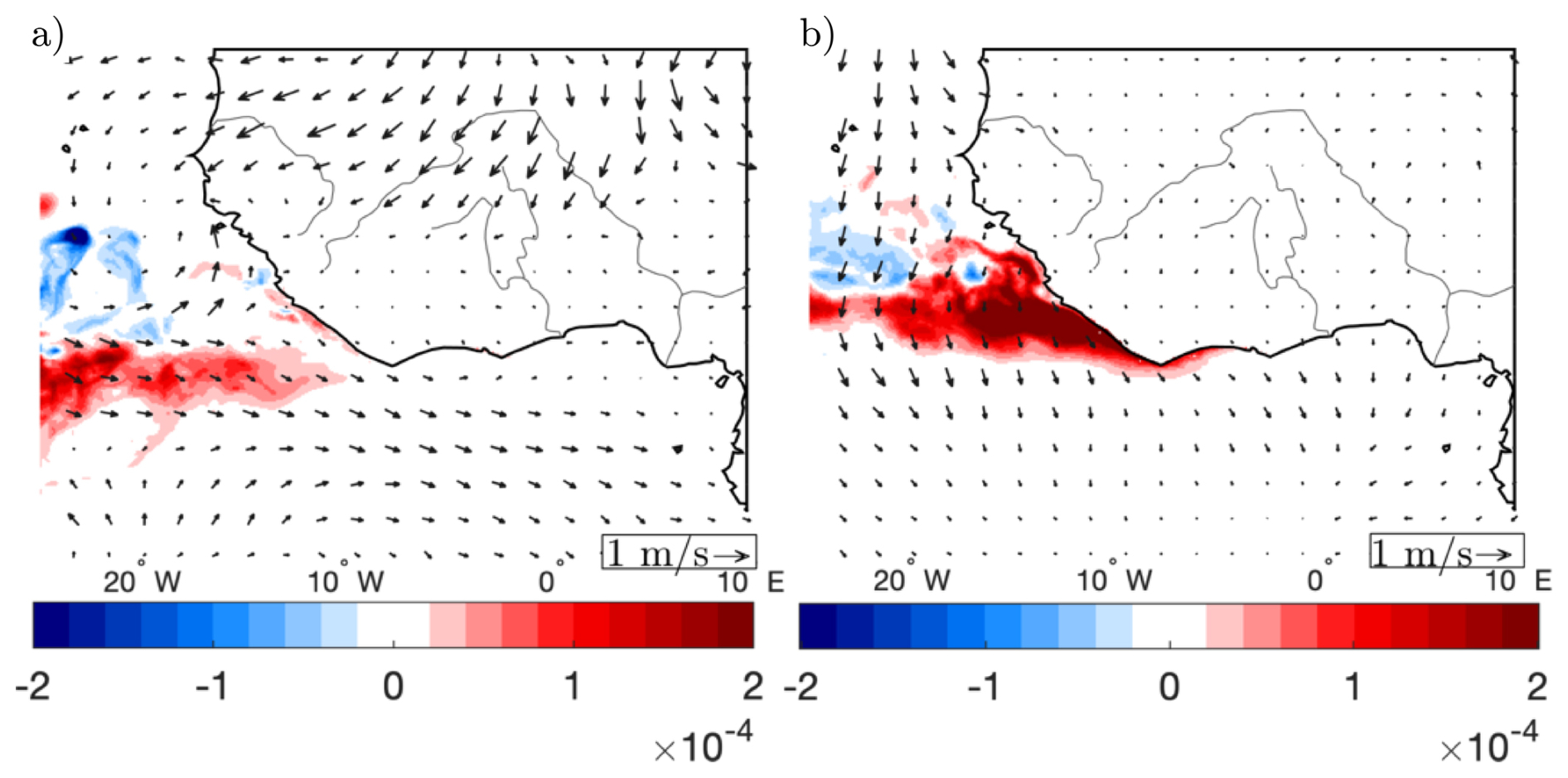
Figure B1High-minus-low-Sargassum composite differences in Sargassum FC and wind-driven transport during MAM (a) and SON (b). Colours show differences in Sargassum FC, and vectors show differences in the wind-driven velocity components.
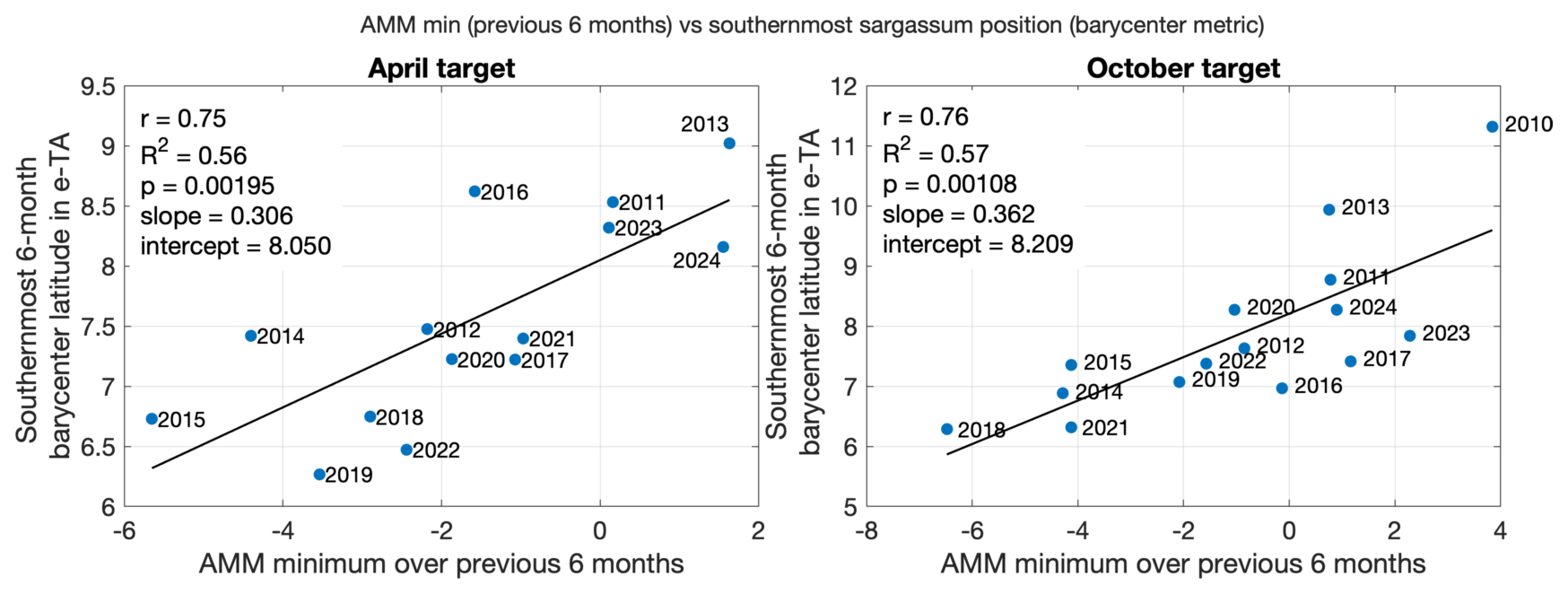
Figure C1Relationship between the minimum Atlantic Meridional Mode (AMM) index over the 6 months preceding the target month and the southernmost position of Sargassum in the eastern tropical Atlantic, estimated here from the latitude of the southernmost 6-month barycenter. Left: April target (AMM minimum over October–March). Right: October target (AMM minimum over April–September). Each point corresponds to one year, with the year indicated next to the marker. The black line shows the linear regression, and the corresponding statistics are reported in each panel.
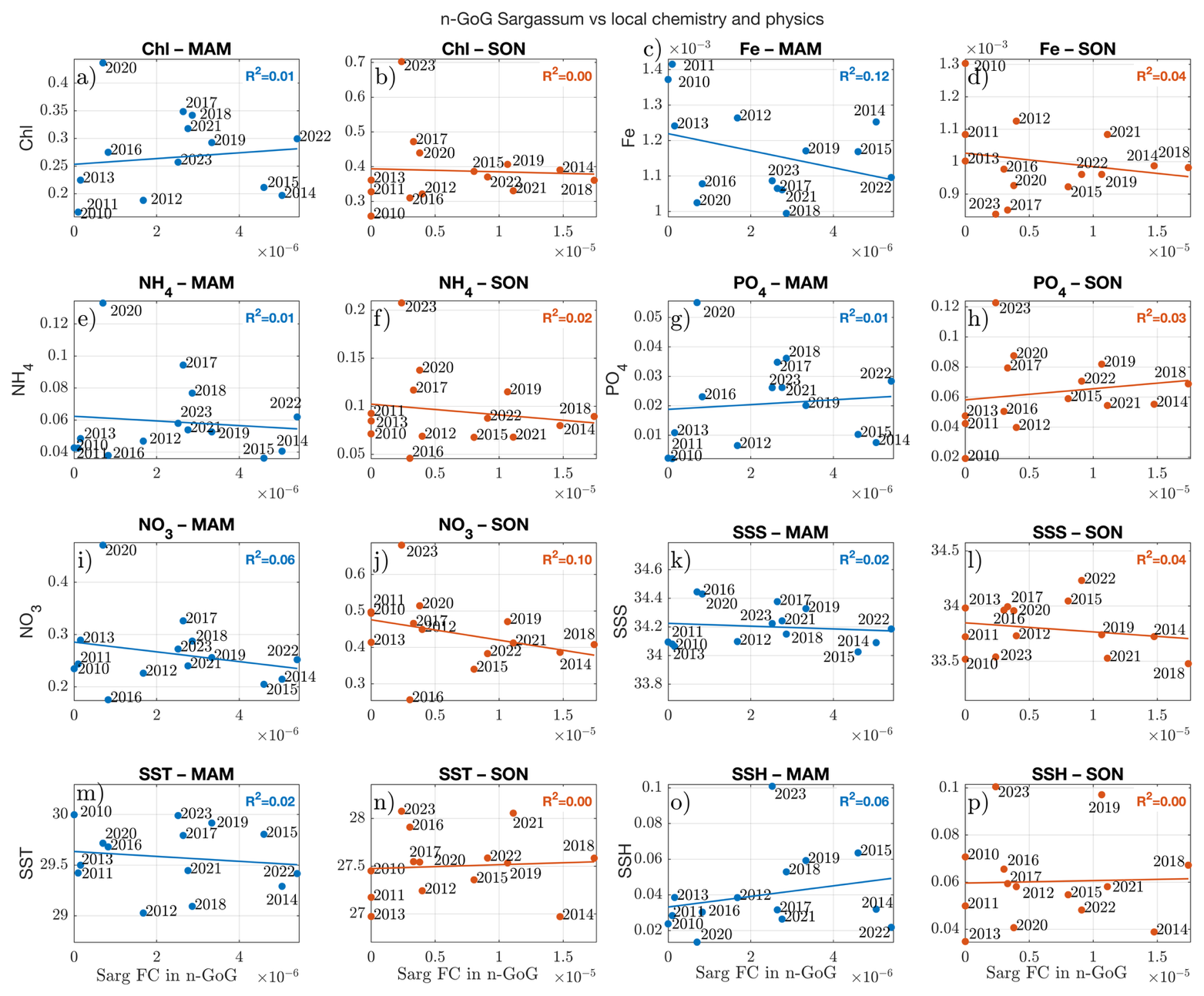
Figure D1Relationships between coastal Sargassum FC in the n-GoG and local biogeochemical and physical conditions, for MAM (left column of each pair) and SON (right column of each pair). Rows show chlorophyll (Chl), dissolved iron (Fe), ammonium (NH4), phosphate (PO4), nitrate (NO3), sea surface salinity (SSS), sea surface temperature (SST), and sea surface height (SSH). Each marker corresponds to 1 year (2010–2023), labeled by year. Solid lines indicate linear regressions, and the corresponding r2 values are given in each panel.
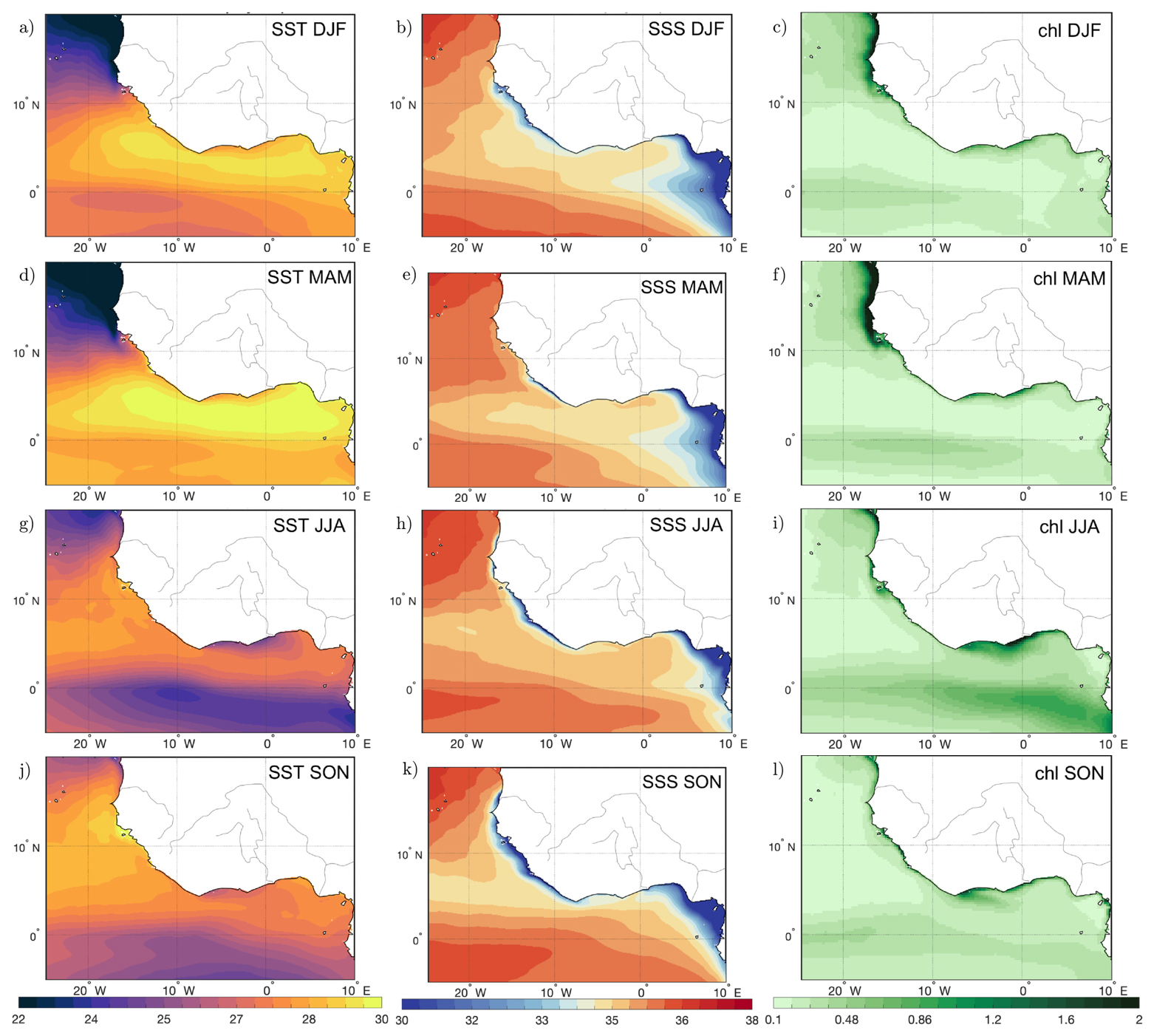
Figure E1Seasonal climatologies of the physical surface environment in the eastern tropical Atlantic and Gulf of Guinea, averaged over all years of the analysis period. From left to right: sea surface temperature (SST), sea surface salinity (SSS), and chlorophyll (chl). From top to bottom: boreal winter (DJF), spring (MAM), summer (JJA), and autumn (SON).
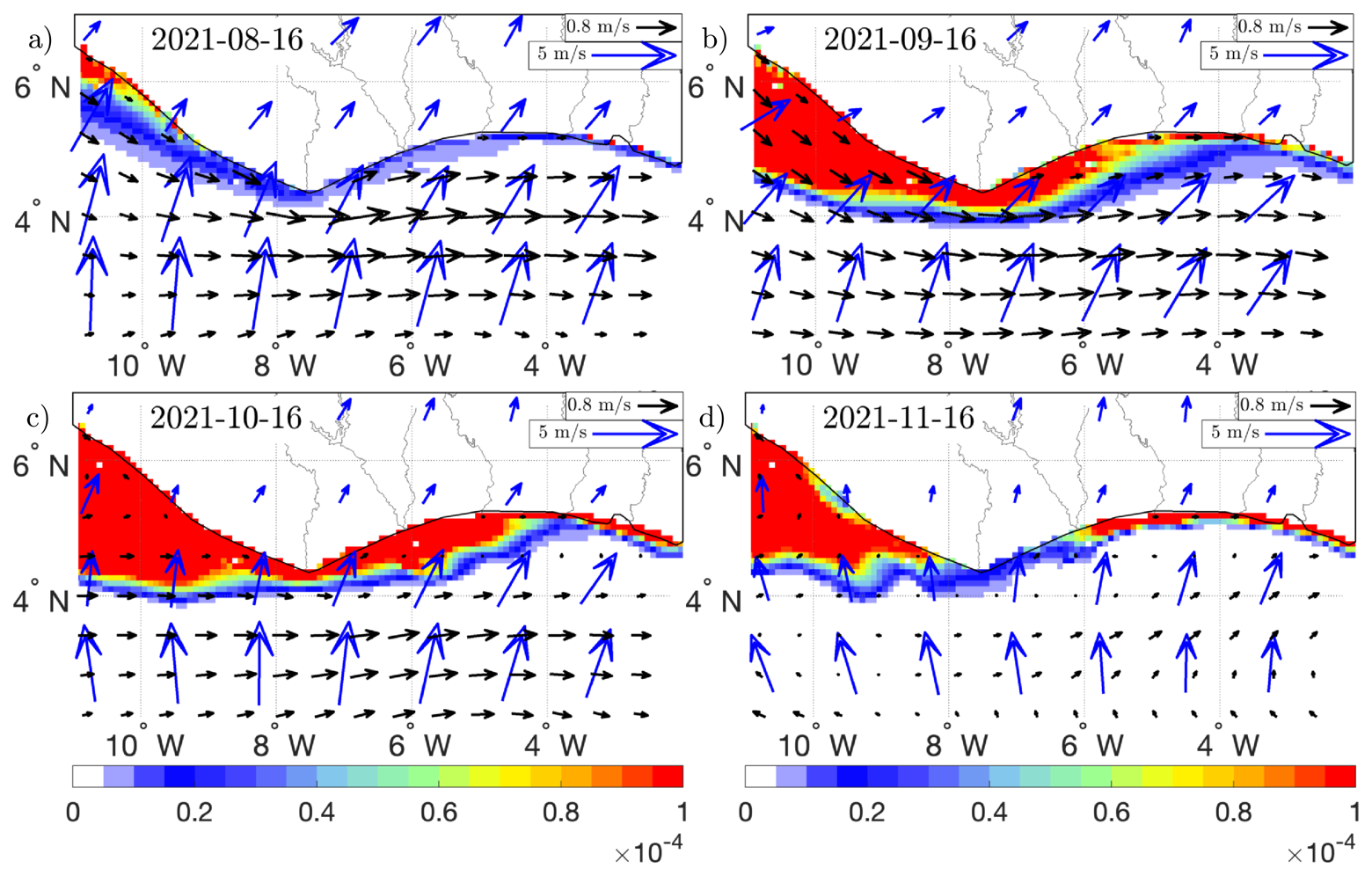
Figure F1Example of the accumulation conditions near Côte d'Ivoire during autumn 2021. Coloured shading shows Sargassum FC from SARG12 simulation, blue arrows indicate 10 m winds, and black arrows show surface currents. The main arrival of Sargassum along the Côte d'Ivoire shelf occurs in September–October (b–c). From August (a), strong southerly winds push Sargassum northward toward the coast, where currents weaken in October because the GC detaches from the coast (c), favouring retention and accumulation of Sargassum along the Côte d'Ivoire shelf until November (d).
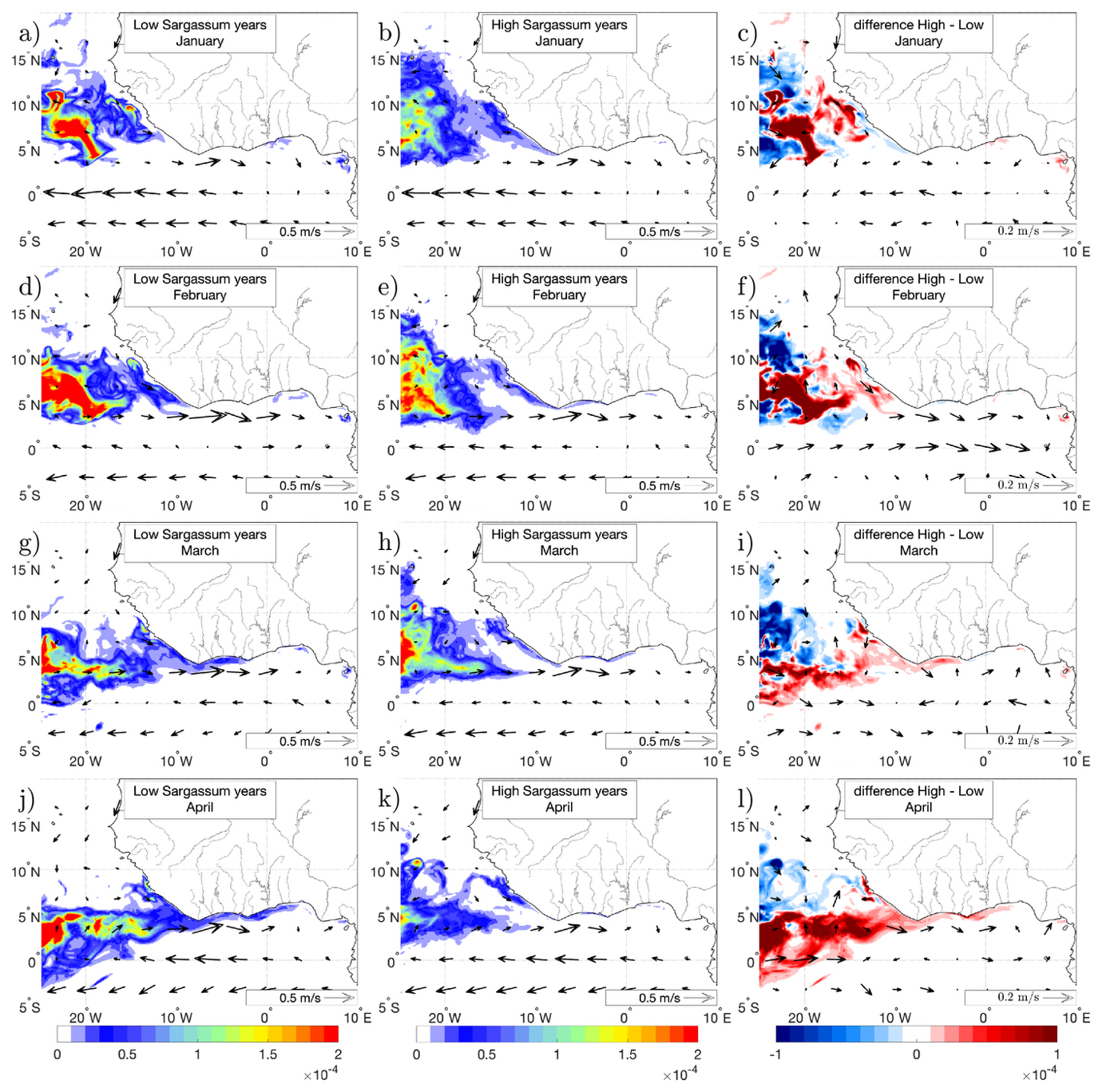
Figure G1MAM (March–May) composites and contrasts between low- and high-Sargassum years. Seasonal mean Sargassum FC for January, February, March, and April is shown from top to bottom. The left column shows the low-Sargassum composites, the middle column the high-Sargassum composites, and the right column their difference (high minus low). Surface currents are superimposed in the left and middle columns, while current differences are superimposed in the right column.
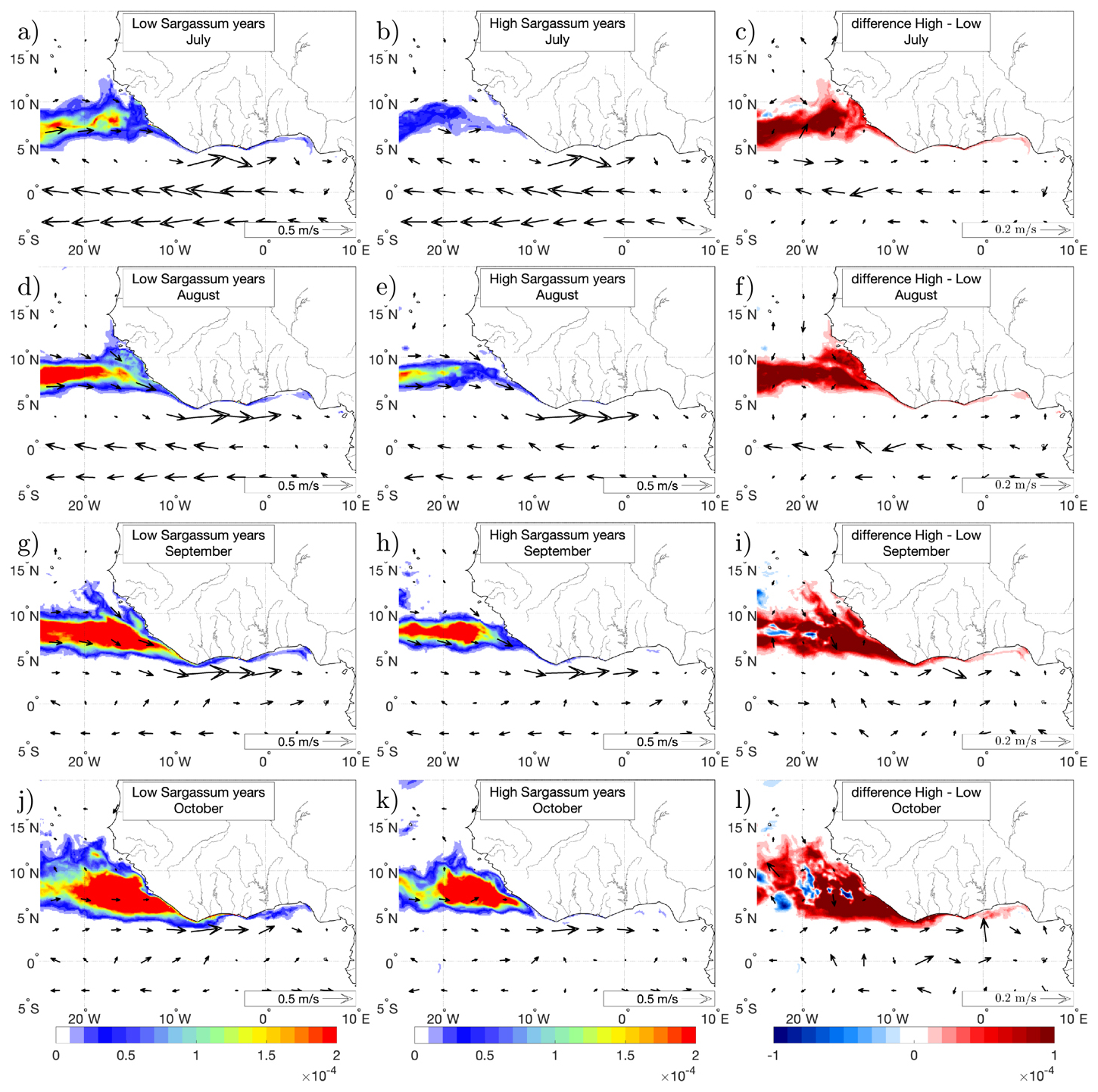
Figure G2Same as Fig. G1, but for autumn (SON).
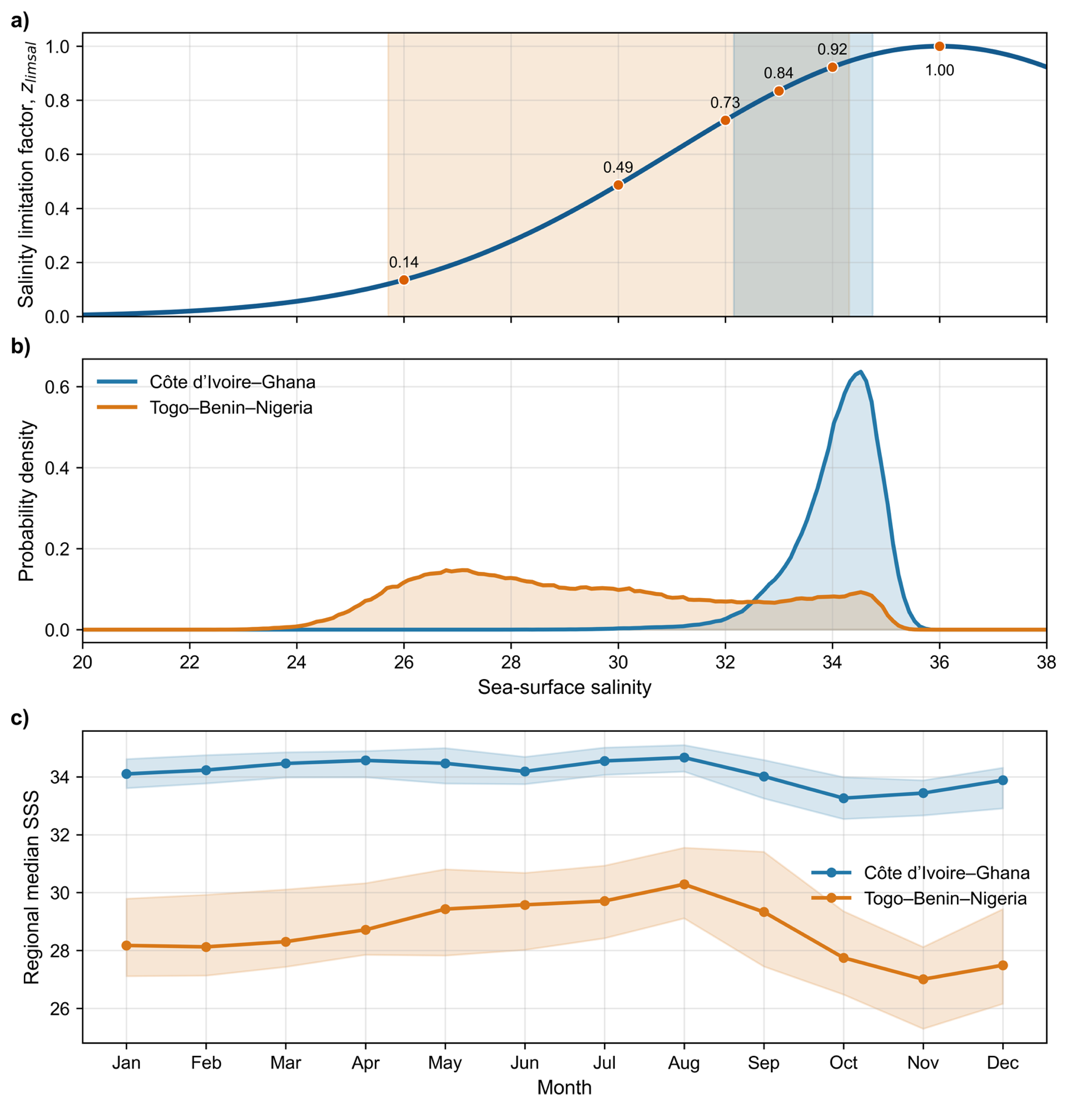
Figure H1Salinity limitation and distribution in first-row coastal ocean grid cells of the n-GoG during 2010–2024. (a) Salinity-limitation factor used in the NEMO-Sarg physiological module as a function of sea-surface salinity (SSS). Orange markers indicate representative values. Shaded areas indicate the ranges spanned by the seasonal 5th–95th percentile intervals of the climatological coastal-cell SSS in the Côte d'Ivoire–Ghana and Togo–Benin–Nigeria sectors. (b) Probability distributions of all daily cell-level SSS values in the two sectors, plotted on the same SSS axis as panel (a). (c) Monthly climatology of the daily spatial median SSS; shaded intervals indicate the 5th–95th percentile range of the daily regional medians.
The Atlantic Meridional Mode (AMM) index, computed from SST anomalies in the tropical Atlantic following the definition of Chiang and Vimont (2004) was obtained from NOAA (https://www.aoml.noaa.gov/phod/research/tav/tcv/amm/, last access: 17 September 2025). The Sargassum areal coverage database was processed by AERIS/ICARE data center at the University of Lille and is available at https://doi.org/10.12770/8fe1cdcb-f4ea-4c81-8543-50f0b39b4eca (Berline and Descloitres, 2021). The BIO4 biogeochemical simulations are available at E.U. Copernicus Marine Service Information (2025, https://doi.org/10.48670/moi-00015). GLORYS12V1 is available from the Copernicus Marine Data Store (Copernicus Marine Service, https://doi.org/10.48670/moi-00021, Mercator Ocean International, 2023). The Sargassum model is built upon the standard NEMO code (release 4.0.1, rev 11533), provided by Madec and the NEMO System Team (2023, https://doi.org/10.5281/zenodo.8167700). The NEMO code modified to include the Sargassum physiology and transport is available in the Zenodo archive at https://doi.org/10.5281/zenodo.4275901 (Jouanno and Benshila, 2020).
CTM and JJ designed the experiments and CTM carried them out. JJ developed the model code and performed the simulations. CTM prepared the manuscript with contributions from JJ.
The contact author has declared that neither of the authors has any competing interests.
Publisher's note: Copernicus Publications remains neutral with regard to jurisdictional claims made in the text, published maps, institutional affiliations, or any other geographical representation in this paper. The authors bear the ultimate responsibility for providing appropriate place names. Views expressed in the text are those of the authors and do not necessarily reflect the views of the publisher.
This research was supported by the Centre national d'études spatiales (CNES) through the TOSCA SARGAT project (grant nos. 10035 and 10513). Computing resources were provided by the Grand Équipement National de Calcul Intensif (grant no. GEN7298).
This paper was edited by Erik Van Sebille and reviewed by R. Marsh and one anonymous referee.
Ackah-Baidoo, A.: Fishing in troubled waters: oil production, seaweed and community-level grievances in the Western Region of Ghana, Community Dev. J., 48, 406–420, https://doi.org/10.1093/cdj/bst022, 2013.
Addico, G. N. D. and deGraft-Johnson, K. A. A.: Preliminary investigation into the chemical composition of the invasive brown seaweed Sargassum along the west coast of Ghana, Afr. J. Biotechnol., 15, 2184–2191, https://doi.org/10.5897/AJB2015.15177, 2016.
Adet, L., Nsofor, G. N., Ogunjobi, K. O., and Camara, B.: Knowledge of Climate Change and the Perception of Nigeria's Coastal Communities on the Occurrence of Sargassum natans and Sargassum fluitans, Open Access Libr. J., 4, 1–18, https://doi.org/10.4236/oalib.1104198, 2017.
Aka, K. S., Sankare, Y., Komoe, K., and N'Cho, A. J.: Influence des algues sargasses (sargassum fluitans, sargassum natans, sargassum natans) sur les activités socio–économiques le long du littoral ivoirien (Côte d'Ivoire – Afrique de l'ouest), Revue canadienne de géographie tropicale/Canadian journal of tropical geography, 5, 10–15, 2018.
Akrong, M. O., Anning, A. K., Addico, G. N. D., deGraft-Johnson, K. A. A., Adu-Gyamfi, A., Ale, M., and Meyer, A. S.: Spatio-temporal variations in seaweed diversity and abundance of selected coastal areas in Ghana, Regional Studies in Marine Science, 44, 101719, https://doi.org/10.1016/j.rsma.2021.101719, 2021.
Amorim, J. P. M. D., Carmo, A. M. C. D., and Martinelli Filho, J. E.: Sargassum transport to the Amazon Coast: Explaining the stranding through meteorological and oceanographic conditions, Harmful Algae, 149, 102955, https://doi.org/10.1016/j.hal.2025.102955, 2025.
Areola, F., Osanyinlusi, O., and Soyinka, O.: The Benefits And Challenges Of Sargassum Seaweed To The Local Fishing Communities In Nigeria, Journal of Research and Review in Science, 11, 1–11, https://www.jrrslasu.com/article-details.php?id=115 (last access: 10 September 2026), 2025.
Atiglo, D., Jayson-Quashigah, P.-N., Sowah, W., Tompkins, E. L., and Addo, K. A.: Misperception of drivers of risk alters willingness to adapt in the case of sargassum influxes in West Africa, Global Environ. Chang., 84, 102779, https://doi.org/10.1016/j.gloenvcha.2023.102779, 2024.
Azcorra-May, K. J., Olguin-Maciel, E., Domínguez-Maldonado, J., Toledano-Thompson, T., Leal-Bautista, R. M., Alzate-Gaviria, L., and Tapia-Tussell, R.: Sargassum biorefineries: potential opportunities towards shifting from wastes to products, Biomass Conv. Bioref., 14, 1837–1845, https://doi.org/10.1007/s13399-022-02407-2, 2022.
Berline, L. and Descloitres, J.: Cartes de répartition des couvertures de Sargasses dérivées de MODIS sur l'Atlantique, ODATIS [data set], https://doi.org/10.12770/8FE1CDCB-F4EA-4C81-8543-50F0B39B4ECA, 2021.
Berline, L., Ody, A., Jouanno, J., Chevalier, C., André, J.-M., Thibaut, T., and Ménard, F.: Hindcasting the 2017 dispersal of Sargassum algae in the Tropical North Atlantic, Mar. Pollut. Bull., 158, https://doi.org/10.1016/j.marpolbul.2020.111431, 2020.
Bernard, D., Biabiany, E., Cécé, R., Chery, R., and Sekkat, N.: Clustering analysis of the Sargassum transport process: application to beaching prediction in the Lesser Antilles, Ocean Sci., 18, 915–935, https://doi.org/10.5194/os-18-915-2022, 2022.
Beron-Vera, F. J., Olascoaga, M. J., Putman, N. F., Triñanes, J., Goni, G. J., and Lumpkin, R.: Dynamical geography and transition paths of Sargassum in the tropical Atlantic, AIP Adv., 12, 105107, https://doi.org/10.1063/5.0117623, 2022.
Beron-Vera, F. J., Olascoaga, M. J., Miron, P., and Bonner, G.: Tracing the origin of tropical North Atlantic Sargassum blooms to West Africa, PNAS Nexus, 5, pgag085, https://doi.org/10.1093/pnasnexus/pgag085, 2026.
Berthet, S., Séférian, R., Bricaud, C., Chevallier, M., Voldoire, A., and Ethé, C.: Evaluation of an Online Grid‐Coarsening Algorithm in a Global Eddy‐Admitting Ocean Biogeochemical Model, J. Adv. Model. Earth Syst., 11, 1759–1783, https://doi.org/10.1029/2019MS001644, 2019.
Binet, D.: Climate and pelagic fisheries in the Canary and Guinea currents 1964–1993: the role of trade winds and the southern oscillation, Oceanol. Acta, 20, 177–190, 1997.
Brooks, M. T., Coles, V. J., Hood, R. R., and Gower, J. F. R.: Factors controlling the seasonal distribution of pelagic Sargassum, Mar. Ecol. Prog. Ser., 599, 1–18, https://doi.org/10.3354/meps12646, 2018.
Byrne, M. P., Pendergrass, A. G., Rapp, A. D., and Wodzicki, K. R.: Response of the Intertropical Convergence Zone to Climate Change: Location, Width, and Strength, Curr. Clim. Change Rep., 4, 355–370, https://doi.org/10.1007/s40641-018-0110-5, 2018.
Calvin, K., Dasgupta, D., Krinner, G., Mukherji, A., Thorne, P. W., Trisos, C., Romero, J., Aldunce, P., Barrett, K., Blanco, G., Cheung, W. W. L., Connors, S., Denton, F., Diongue-Niang, A., Dodman, D., Garschagen, M., Geden, O., Hayward, B., Jones, C., Jotzo, F., Krug, T., Lasco, R., Lee, Y.-Y., Masson-Delmotte, V., Meinshausen, M., Mintenbeck, K., Mokssit, A., Otto, F. E. L., Pathak, M., Pirani, A., Poloczanska, E., Pörtner, H.-O., Revi, A., Roberts, D. C., Roy, J., Ruane, A. C., Skea, J., Shukla, P. R., Slade, R., Slangen, A., Sokona, Y., Sörensson, A. A., Tignor, M., Van Vuuren, D., Wei, Y.-M., Winkler, H., Zhai, P., Zommers, Z., Hourcade, J.-C., Johnson, F. X., Pachauri, S., Simpson, N. P., Singh, C., Thomas, A., Totin, E., Arias, P., Bustamante, M., Elgizouli, I., Flato, G., Howden, M., Méndez-Vallejo, C., Pereira, J. J., Pichs-Madruga, R., Rose, S. K., Saheb, Y., Sánchez Rodríguez, R., Ürge-Vorsatz, D., Xiao, C., Yassaa, N., Alegría, A., Armour, K., Bednar-Friedl, B., Blok, K., Cissé, G., Dentener, F., Eriksen, S., Fischer, E., Garner, G., Guivarch, C., Haasnoot, M., Hansen, G., Hauser, M., Hawkins, E., Hermans, T., Kopp, R., Leprince-Ringuet, N., Lewis, J., Ley, D., Ludden, C., Niamir, L., Nicholls, Z., Some, S., Szopa, S., Trewin, B., Van Der Wijst, K.-I., Winter, G., Witting, M., Birt, A., Ha, M., Romero, J., Kim, J., Haites, E. F., Jung, Y., Stavins, R., Birt, A., Ha, M., Orendain, D. J. A., Ignon, L., Park, S., Park, Y., Reisinger, A., Cammaramo, D., Fischlin, A., Fuglestvedt, J. S., Hansen, G., Ludden, C., Masson-Delmotte, V., Matthews, J. B. R., Mintenbeck, K., Pirani, A., Poloczanska, E., Leprince-Ringuet, N., and Péan, C.: IPCC, 2023: Climate Change 2023: Synthesis Report, Contribution of Working Groups I, II and III to the Sixth Assessment Report of the Intergovernmental Panel on Climate Change, edited by: Core Writing Team, Lee, H. and Romero, J., IPCC, Geneva, Switzerland, Intergovernmental Panel on Climate Change (IPCC), https://doi.org/10.59327/IPCC/AR6-9789291691647, 2023.
Carpenter, E. J. and Cox, J. L.: Production of pelagic Sargassum and a blue-green epiphyte in the western Sargasso Sea, Limnol. Oceanogr., 19, 429–436, https://doi.org/10.4319/lo.1974.19.3.0429, 1974.
CERMES: Sargassum Reference Repository, https://www.zotero.org/groups/2921152/sargassum_reference_repository/item-list (last access: 4 August 2026), 2026.
Chávez, V., Uribe-Martínez, A., Cuevas, E., Rodríguez-Martínez, R. E., van Tussenbroek, B. I., Francisco, V., Estévez, M., Celis, L. B., Monroy-Velázquez, L. V., Leal-Bautista, R., Álvarez-Filip, L., García-Sánchez, M., Masia, L., and Silva, R.: Massive Influx of Pelagic Sargassum spp. on the Coasts of the Mexican Caribbean 2014–2020: Challenges and Opportunities, Water, 12, 2908, https://doi.org/10.3390/w12102908, 2020.
Chiang, J. C. H. and Vimont, D. J.: Analogous Pacific and Atlantic Meridional Modes of Tropical Atmosphere–Ocean Variability, J. Climate, 17, 4143–4158, https://doi.org/10.1175/JCLI4953.1, 2004.
Delandmeter, P. and Van Sebille, E.: The Parcels v2.0 Lagrangian framework: new field interpolation schemes, Geosci. Model Dev., 12, 3571–3584, https://doi.org/10.5194/gmd-12-3571-2019, 2019.
Descloitres, J., Minghelli, A., Steinmetz, F., Chevalier, C., Chami, M., and Berline, L.: Revisited Estimation of Moderate Resolution Sargassum Fractional Coverage Using Decametric Satellite Data (S2-MSI), Remote Sens., 13, 5106, https://doi.org/10.3390/rs13245106, 2021.
DGEC and MCVDD: État de l'environnement marin du Bénin, DGEC, Cotonou, Bénin, https://mamiwataproject.org/wp-content/uploads/2020/09/SoME-report-Benin.pdf (last access: 10 September 2026), 2020.
Dirisu, A.-R., Uyi, H. S., and Uyi, M.: First report on the occurrence of Sargassum Weed Fish Histrio histrio (Lophiliformes: Antennariidae) in Nigeria deep water, Gulf of Guinea, J. Threat. Taxa, 13, 18899–18902, https://doi.org/10.11609/jott.4413.13.7.18899-18902, 2021.
Djakouré, S., Penven, P., Bourlès, B., Koné, V., and Veitch, J.: Respective Roles of the Guinea Current and Local Winds on the Coastal Upwelling in the Northern Gulf of Guinea, J. Phys. Oceanogr., 47, 1367–1387, https://doi.org/10.1175/JPO-D-16-0126.1, 2017.
Djakouré, S., Konaté, Y., Koné, V., Bosson, K., Koné, M., and Kouadio, K. Y.: Relationship between the Guinea Current and the Coastal Upwelling in Northern of Gulf of Guinea, Open Journal of Marine Science, 14, 63–77, https://doi.org/10.4236/ojms.2024.144004, 2024.
Donohoe, A., Marshall, J., Ferreira, D., and Mcgee, D.: The Relationship between ITCZ Location and Cross-Equatorial Atmospheric Heat Transport: From the Seasonal Cycle to the Last Glacial Maximum, J. Climate, 26, 3597–3618, https://doi.org/10.1175/JCLI-D-12-00467.1, 2013.
Environment Protection Agency: Sierra Leone State of the Marine Environment report 2015, Freetown, Sierra Leone, https://epa.gov.sl/wp-content/uploads/2021/12/State-of-Marine-Environment-Report.pdf (last access: 10 September 2026), 2015.
E.U. Copernicus Marine Service Information (CMEMS): Global Ocean Biogeochemistry Analysis and Forecast, Mercator Ocean International, https://doi.org/10.48670/moi-00015, 2025.
Fidai, Y. A., Donnelly, J., Tompkins, E. L., and Tonon, T.: A systematic review of floating and beach landing records of Sargassum beyond the Sargasso Sea, Environ. Res. Commun., 2, 122001, https://doi.org/10.1088/2515-7620/abd109, 2020.
Fidai, Y. A., Botelho Machado, C., Dominguez Almela, V., Oxenford, H. A., Jayson-Quashigah, P.-N., Tonon, T., and Dash, J.: Innovative spectral characterisation of beached pelagic sargassum towards remote estimation of biochemical and phenotypic properties, Sci. Total Environ., 914, 169789, https://doi.org/10.1016/j.scitotenv.2023.169789, 2024.
Fidai, Y. A., Dash, J., Tompkins, E., Atiglo, D. Y., Jayson-Quashigah, P.-N., Sowah, W. N. A., and Addo, K. A.: Sargassum Biomass Movement and Proliferation in the Eastern Tropical Atlantic, Phycology, 5, 17, https://doi.org/10.3390/phycology5020017, 2025.
Franks, J. S., Johnson, D. R., Ko, D.-S., Sanchez-Rubio, G., Hendon, J. R., and Lay, M.: Unprecedented influx of pelagic Sargassum along Caribbean Island coastlines during summer 2011, Proceedings of the 64th Gulf and Caribbean Fisheries Institute, 6–8, http://hdl.handle.net/1834/36124 (last access: 10 September 2026), 2012.
Franks, J. S., Johnson, D. R., and Ko, D. S.: Pelagic Sargassum in the tropical North Atlantic, Gulf and Caribbean Research, 27, https://doi.org/10.18785/gcr.2701.08, 2016.
Gobert, T., Connan, S., Johnson, D. R., and Waeles, M.: The Guiana current: a fast-lane to the Caribbean for holopelagic Sargassum contaminated in arsenic and cadmium, Harmful Algae, 150, 102981, https://doi.org/10.1016/j.hal.2025.102981, 2025.
Gower, J., Young, E., and King, S.: Satellite images suggest a new Sargassum source region in 2011, Remote Sens. Lett., 4, 764–773, https://doi.org/10.1080/2150704X.2013.796433, 2013.
Grodsky, S. A. and Carton, J. A.: The Intertropical Convergence Zone in the South Atlantic and the Equatorial Cold Tongue, J. Climate, 16, 723–733, https://doi.org/10.1175/1520-0442(2003)016<0723:TICZIT>2.0.CO;2, 2003.
Hanisak, M. D. and Samuel, M. A.: Growth rates in culture of several species of Sargassum from Florida, USA, Hydrobiologia, 151–152, 399–404, https://doi.org/10.1007/BF00046159, 1987.
Hardman-Mountford, N. J. and McGlade, J. M.: 5 Variability of physical environmental processes in the gulf of guinea and implications for fisheries recruitment, an investigation using remotely sensed SST, in: Large Marine Ecosystems, vol. 11, Elsevier, 49–66, https://doi.org/10.1016/S1570-0461(02)80027-1, 2002.
Hersbach, H., Bell, B., Berrisford, P., Hirahara, S., Horányi, A., Muñoz‐Sabater, J., Nicolas, J., Peubey, C., Radu, R., Schepers, D., Simmons, A., Soci, C., Abdalla, S., Abellan, X., Balsamo, G., Bechtold, P., Biavati, G., Bidlot, J., Bonavita, M., De Chiara, G., Dahlgren, P., Dee, D., Diamantakis, M., Dragani, R., Flemming, J., Forbes, R., Fuentes, M., Geer, A., Haimberger, L., Healy, S., Hogan, R. J., Hólm, E., Janisková, M., Keeley, S., Laloyaux, P., Lopez, P., Lupu, C., Radnoti, G., De Rosnay, P., Rozum, I., Vamborg, F., Villaume, S., and Thépaut, J.: The ERA5 global reanalysis, Q. J. Roy. Meteor. Soc., 146, 1999–2049, https://doi.org/10.1002/qj.3803, 2020.
Hormann, V., Lumpkin, R., and Foltz, G. R.: Interannual North Equatorial Countercurrent variability and its relation to tropical Atlantic climate modes, J. Geophys. Res., 117, https://doi.org/10.1029/2011JC007697, 2012.
Hwang, Y.-T. and Frierson, D. M. W.: Link between the double-Intertropical Convergence Zone problem and cloud biases over the Southern Ocean, Proc. Natl. Acad. Sci. USA., 110, 4935–4940, https://doi.org/10.1073/pnas.1213302110, 2013.
Issifou, L., Atanle, K., Radji, R., Lawson, H. L., Adjonou, K., Edorh, M. T., Kokutse, A. D., Mensah, A. A., and Kokou, K.: Checklist of tropical algae of Togo in the Guinean Gulf of West-Africa, Sci. Res.-Essays, 9, 932–958, https://doi.org/10.5897/SRE2014.6113, 2014.
Johns, E. M., Lumpkin, R., Putman, N. F., Smith, R. H., Muller-Karger, F. E., Rueda-Roa, T. D., Hu, C., Wang, M., Brooks, M. T., Gramer, L. J., and Werner, F. E.: The establishment of a pelagic Sargassum population in the tropical Atlantic: Biological consequences of a basin-scale long distance dispersal event, Prog. Oceanogr., 182, 102269, https://doi.org/10.1016/j.pocean.2020.102269, 2020.
Jouanno, J. and Benshila, R.: Sargassum distribution model based on the NEMO ocean modelling platform (0.0), Zenodo [code], https://doi.org/10.5281/ZENODO.4275901, 2020.
Jouanno, J., Benshila, R., Berline, L., Soulié, A., Radenac, M.-H., Morvan, G., Diaz, F., Sheinbaum, J., Chevalier, C., Thibaut, T., Changeux, T., Menard, F., Berthet, S., Aumont, O., Ethé, C., Nabat, P., and Mallet, M.: A NEMO-based model of Sargassum distribution in the tropical Atlantic: description of the model and sensitivity analysis (NEMO-Sarg1.0), Geosci. Model Dev., 14, 4069–4086, https://doi.org/10.5194/gmd-14-4069-2021, 2021.
Jouanno, J., Morvan, G., Berline, L., Benshila, R., Aumont, O., Sheinbaum, J., and Ménard, F.: Skillful Seasonal Forecast of Sargassum Proliferation in the Tropical Atlantic, Geophys. Res. Lett., 50, https://doi.org/10.1029/2023GL105545, 2023.
Jouanno, J., Berthet, S., Muller-Karger, F., Aumont, O., and Sheinbaum, J.: An extreme North Atlantic Oscillation event drove the pelagic Sargassum tipping point, Commun. Earth Environ., 6, 1–11, https://doi.org/10.1038/s43247-025-02074-x, 2025a.
Jouanno, J., Almar, R., Muller-Karger, F., Morvan, G., Van Tussenbroek, B., Benshila, R., Marchesiello, P., and Addo, K. A.: Socio-ecological vulnerability assessment to Sargassum arrivals, Sci. Rep., 15, 9998, https://doi.org/10.1038/s41598-025-94475-3, 2025b.
Komoe, K., Sankare, Y., Fofie, N. B. Y., Bamba, A., and Sahr, A. G.-S.: Taxonomic study of two species of Saragassum: Sargassum fluitans (Borgesen) Borgesen and Sargassum natans (Linnaneus) Gaillon (brown algae) collected in Côte d'Ivoire coasts, West Africa, Nature and Science, 14, 50–56, 2016.
Laval, M., Aimene, Y., Descloitres, J., Courtrai, L., Duarte-Neto, P., Salazar-Garibay, A., Costa Da Silva, A., Zongo, P., Dorville, R., and Chevalier, C.: The Influence of Wind on the Spatial Distribution of Pelagic Sargassum Aggregations in the Tropical Atlantic, Water, 17, 776, https://doi.org/10.3390/w17060776, 2025.
Lellouche, J.-M., Eric, G., Romain, B.-B., Gilles, G., Angélique, M., Marie, D., Clément, B., Mathieu, H., Olivier, L. G., Charly, R., Tony, C., Charles-Emmanuel, T., Florent, G., Giovanni, R., Mounir, B., Yann, D., and Pierre-Yves, L. T.: The Copernicus Global 1/12° Oceanic and Sea Ice GLORYS12 Reanalysis, Front. Earth Sci., 9, 698876, https://doi.org/10.3389/feart.2021.698876, 2021.
León-Pérez, M. C., McLaughlin, R., Chaparro, R., Krimsky, L., Klein, Z., Myers, A., and Ankersen, T. T.: Massive Influxes of Pelagic Sargassum in the Wider Caribbean Region, National Sea Grant Law Center and Puerto Rico Sea Grant, https://issuu.com/seagrantpr/docs/sargassum_english_1_ (last access: 10 September 2026), 2021.
López Miranda, J. L., Celis, L. B., Estévez, M., Chávez, V., van Tussenbroek, B. I., Uribe-Martínez, A., Cuevas, E., Rosillo Pantoja, I., Masia, L., Cauich-Kantun, C., and Silva, R.: Commercial Potential of Pelagic Sargassum spp. in Mexico, Front. Mar. Sci., 8, 768470, https://doi.org/10.3389/fmars.2021.768470, 2021.
Madec, G. and the NEMO System Team: NEMO Ocean Engine Reference Manual, Zenodo, https://doi.org/10.5281/zenodo.8167700, 2023.
Maneein, S., Milledge, J. J., Harvey, P. J., and Nielsen, B. V.: Methane production from Sargassum muticum: effects of seasonality and of freshwater washes, Energy and Built Environment, 2, 235–242, https://doi.org/10.1016/j.enbenv.2020.06.011, 2021.
Marchal, E. and Picaut, J.: Répartition et abondance évaluées par échointégration des poissons du plateau ivoiro-ghanéen en relation avec les upwellings locaux, J. Rech. Océanogr., 2, 39–57, https://www.documentation.ird.fr/hor/fdi:09120 (last access: 10 September 2026), 1977.
Marsh, R., Addo, K. A., Jayson-Quashigah, P.-N., Oxenford, H. A., Maxam, A., Anderson, R., Skliris, N., Dash, J., and Tompkins, E. L.: Seasonal Predictions of Holopelagic Sargassum Across the Tropical Atlantic Accounting for Uncertainty in Drivers and Processes: The Sartrac Ensemble Forecast System, Front. Mar. Sci., 8, 722524, https://doi.org/10.3389/fmars.2021.722524, 2021.
Martín-Rey, M., Vallès-Casanova, I., and Pelegrí, J. L.: Upper-Ocean Circulation and Tropical Atlantic Interannual Modes, J. Climate, 36, 2625–2643, https://doi.org/10.1175/JCLI-D-22-0184.1, 2023.
Mercator Ocean International: Global Ocean Physics Reanalysis, Copernicus Marine Service [data set], https://doi.org/10.48670/moi-00021, 2023.
Milledge, J. J. and Harvey, P. J.: Golden tides: problem or golden opportunity? The valorisation of Sargassum from beach inundations, J. Mar. Sci. Eng., 4, https://doi.org/10.3390/jmse4030060, 2016.
MINEDD: Résumé à l'attention des décideurs du premier Rapport sur l'état de l'environnement marin et côtier de la Côte d’Ivoire (REEM-CI), 20 pp., https://mamiwataproject.org/2021/06/08/cote-divoire-some-report/ (last access: 10 September 2026), 2021.
Niermann, U.: Distribution of Sargassum natans and some of its epibionts in the Sargasso Sea, Helgolander Meeresunters., 40, 343–353, 1986.
Nobre, P. and Shukla, J.: Variations of Sea Surface Temperature, Wind Stress, and Rainfall over the Tropical Atlantic and South America, J. Climate, 9, 2464–2479, https://doi.org/10.1175/1520-0442(1996)009<2464:VOSSTW>2.0.CO;2, 1996.
Ody, A., Thibaut, T., Berline, L., Changeux, T., André, J.-M., Chevalier, C., Blanfuné, A., Blanchot, J., Ruitton, S., Stiger-Pouvreau, V., Connan, S., Grelet, J., Aurelle, D., Guéné, M., Bataille, H., Bachelier, C., Guillemain, D., Schmidt, N., Fauvelle, V., Guasco, S., and Ménard, F.: From in situ to satellite observations of pelagic Sargassum distribution and aggregation in the Tropical North Atlantic Ocean, PLoS ONE, 14, https://doi.org/10.1371/journal.pone.0222584, 2019.
Olascoaga, M. J., Beron-Vera, F. J., Beyea, R. T., Bonner, G., Castellucci, M., Goni, G. J., Guigand, C., and Putman, N. F.: Physics-informed laboratory estimation of Sargassum windage, Phys. Fluids, 35, 111702, https://doi.org/10.1063/5.0175179, 2023.
Oyesiku, O. O. and Egunyomi, A.: Identification and chemical studies of pelagic masses of Sargassum natans (Linnaeus) Gaillon and S. fluitans (Borgessen) Borgesen (brown algae), found offshore in Ondo State, Nigeria, Afr. J. Biotechnol., 13, 1188–1193, https://doi.org/10.5897/AJB2013.12335, 2014.
Podlejski, W., Descloitres, J., Chevalier, C., Minghelli, A., Lett, C., and Berline, L.: Filtering out false Sargassum detections using context features, Front. Mar. Sci., 9, 960939, https://doi.org/10.3389/fmars.2022.960939, 2022.
Putman, N. F., Goni, G. J., Gramer, L. J., Hu, C., Johns, E. M., Triñanes, J., and Wang, M.: Simulating transport pathways of pelagic Sargassum from the Equatorial Atlantic into the Caribbean Sea, Prog. Oceanogr., 165, 205–214, https://doi.org/10.1016/j.pocean.2018.06.009, 2018.
Putman, N. F., Lumpkin, R., Olascoaga, M. J., Triñanes, J., and Goni, G. J.: Improving transport predictions of pelagic Sargassum, J. Exp. Mar. Biol. Ecol., 529, 151398, https://doi.org/10.1016/j.jembe.2020.151398, 2020.
Resiere, D., Valentino, R., Nevière, R., Banydeen, R., Gueye, P., Florentin, J., Cabié, A., Lebrun, T., Mégarbane, B., Guerrier, G., and Mehdaoui, H.: Sargassum seaweed on Caribbean islands: an international public health concern, The Lancet, 392, 2691, https://doi.org/10.1016/S0140-6736(18)32777-6, 2018.
Robledo, D., Vázquez-Delfín, E., Freile-Pelegrín, Y., Vásquez-Elizondo, R. M., Qui-Minet, Z. N., and Salazar-Garibay, A.: Challenges and Opportunities in Relation to Sargassum Events Along the Caribbean Sea, Front. Mar. Sci., 8, 699664, https://doi.org/10.3389/fmars.2021.699664, 2021.
Rodríguez-Martínez, R. E., Medina-Valmaseda, A. E., Blanchon, P., Monroy-Velázquez, L. V., Almazán-Becerril, A., Delgado-Pech, B., Vásquez-Yeomans, L., Francisco, V., and García-Rivas, M. C.: Faunal mortality associated with massive beaching and decomposition of pelagic Sargassum, Mar. Pollut. Bull., 146, 201–205, https://doi.org/10.1016/j.marpolbul.2019.06.015, 2019.
Saba, A. O., Fakoya, K. A., Adet, L., Sule, H. A., Ojewole, A. E., and Osho-Abdulgafar, N. F.: Sargassum influxes in West Africa: Impacts, challenges, and prospects for sustainable management, Harmful Algae, 150, 102982, https://doi.org/10.1016/j.hal.2025.102982, 2025.
Sissini, M. N., Barros Barreto, M. B. B., Széchy, M. T. M., Lucena, M. B., Oliveira, M. C., Gower, J., Liu, G., Oliviera Bastos, E., Milstein, D., Gusmāo, F., Martinelli-Filho, J. E., Alves-Lima, C., Colepicolo, P., Ameka, G., deGraft-Johnson, K. A. A., Gouvêa, L. P., Torrano-Silva, B., Jeremias Mello, T., Costa Lotufo, L. V., and Horta, P. A.: The floating Sargassum (Phaeophyceae) of the South Atlantic Ocean – likely scenarios, Phycologia, 56, 321–328, https://doi.org/10.2216/16-92.1, 2017.
Skliris, N., Marsh, R., Appeaning Addo, K., and Oxenford, H.: Physical drivers of pelagic sargassum bloom interannual variability in the Central West Atlantic over 2010–2020, Ocean Dynam., 72, 383–404, https://doi.org/10.1007/s10236-022-01511-1, 2022.
Solarin, B. B., Bolaji, D. A., Fakayode, O. S., and Akinnigbagbe, R. O.: Impacts of an invasive seaweed Sargassum hystrix var. fluitans (Børgesen 1914) on the fisheries and other economic implications for the Nigerian coastal waters, IOSR Journal of Agriculture and Veterinary Science, 7, 1–6, https://doi.org/10.9790/2380-07710106, 2014.
Sowah, W. N. A., Jayson-Quashigah, P.-N., Atiglo, D. Y., and Addo, K. A.: Socio-economic Impact of Sargassum Influx Events on Artisanal Fishing in Ghana, Research Square [preprint], https://doi.org/10.21203/rs.3.rs-1861970/v1, 2022.
Thompson, T. M., Young, B. R., and Baroutian, S.: Pelagic Sargassum for energy and fertiliser production in the Caribbean: A case study on Barbados, Renew. Sust. Energ. Rev., 118, 109564, https://doi.org/10.1016/j.rser.2019.109564, 2020.
van Tussenbroek, B. I., Hernández-Arana, H. A., Rodríguez-Martínez, R. E., Espinoza-Avalos, J., Canizales-Flores, H. M., González-Godoy, C. E., Barba-Santos, M. G., Vega-Zepeda, A., and Collado-Vides, L.: Severe impacts of brown tides caused by Sargassum spp. on near-shore Caribbean seagrass communities, Mar. Pollut. Bull., 122, 272–281, https://doi.org/10.1016/j.marpolbul.2017.06.057, 2017.
Wang, M. and Hu, C.: Mapping and quantifying Sargassum distribution and coverage in the Central West Atlantic using MODIS observations, Remote Sens. Environ., 183, 350–367, https://doi.org/10.1016/j.rse.2016.04.019, 2016.
Wang, M., Hu, C., Barnes, B. B., Mitchum, G., Lapointe, B., and Montoya, J. P.: The great Atlantic Sargassum belt, Science, 365, 83–87, https://doi.org/10.1126/science.aaw7912, 2019.
Witherington, B., Hirama, S., and Hardy, R.: Young sea turtles of the pelagic Sargassum-dominated drift community: habitat use, population density, and threats, Mar. Ecol. Prog. Ser., 463, 1–22, https://doi.org/10.3354/meps09970, 2012.