
Articles | Volume 22, issue 4
https://doi.org/10.5194/os-22-2333-2026
© Author(s) 2026. This work is distributed under
the Creative Commons Attribution 4.0 License.
the Creative Commons Attribution 4.0 License.
https://doi.org/10.5194/os-22-2333-2026
© Author(s) 2026. This work is distributed under
the Creative Commons Attribution 4.0 License.
the Creative Commons Attribution 4.0 License.
Research article
| 
04 Aug 2026
Research article |
| 04 Aug 2026
| 04 Aug 2026
Eddy kinetic energy and energy conversion rates along the Atlantic Water boundary current north of Svalbard

Department of Arctic Geophysics, University Centre in Svalbard (UNIS), Longyearbyen, Svalbard, Norway
Geophysical Institute, University of Bergen, Bergen, Norway
Ilker Fer
Geophysical Institute, University of Bergen, Bergen, Norway
Bjerknes Centre for Climate Research, Bergen, Norway
Department of Arctic Geophysics, University Centre in Svalbard (UNIS), Longyearbyen, Svalbard, Norway
Till M. Baumann
Institute of Marine Research, Bergen, Norway
Bjerknes Centre for Climate Research, Bergen, Norway
Jon Albretsen
Institute of Marine Research, Bergen, Norway
Lukas Frank
Department of Arctic Geophysics, University Centre in Svalbard (UNIS), Longyearbyen, Svalbard, Norway
Geophysical Institute, University of Bergen, Bergen, Norway
now at: SINTEF Ocean, Trondheim, Norway
Related authors
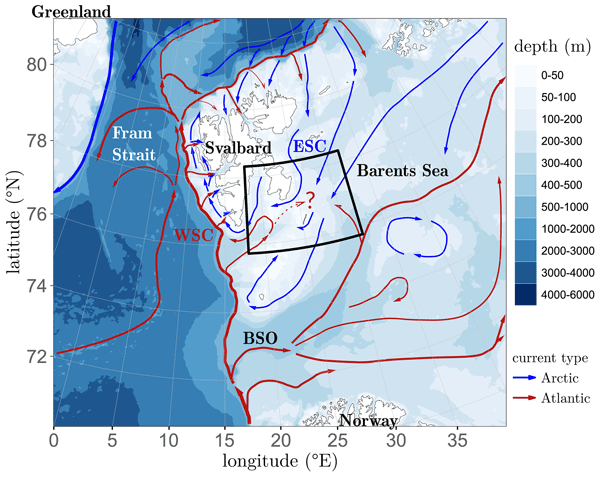
Kjersti Kalhagen, Ragnheid Skogseth, Till M. Baumann, Eva Falck, and Ilker Fer
Ocean Sci., 20, 981–1001, https://doi.org/10.5194/os-20-981-2024, https://doi.org/10.5194/os-20-981-2024, 2024
Short summary
Short summary
Atlantic water (AW) is a key driver of change in the Barents Sea. We studied an emerging pathway through the Svalbard Archipelago that allows AW to enter the Barents Sea. We found that the Atlantic sector near the study site has warmed over the past 2 decades; that Atlantic-origin waters intermittently enter the Barents Sea through the aforementioned pathway; and that heat transport is driven by tides, wind events, and variations in the upstream current system.
Silvana Gonzalez, Mari F. Jensen, Ingrid A. Johnsen, Randi Ingvaldsen, Jon Albretsen, Lars Asplin, Anne Sandvik, Vidar S. Lien, Solfrid Sætre Hjøllo, and Anne Britt Sandø
State Planet Discuss., https://doi.org/10.5194/sp-2026-2, https://doi.org/10.5194/sp-2026-2, 2026
Revised manuscript accepted for SP
Short summary
Short summary
Marine heatwaves occurrence is increasing, especially in northern oceans. In summer 2025, western/central Norway had the most intense event on record, with sea temperatures up to 22 °C. This event was shallow and developed quickly. It was mainly driven by unusual weather: strong solar radiation, weak winds, warm air, and persistent high pressure over Scandinavia. The occurrence of these rapid-forming events has important implications for predictability and adaptation.
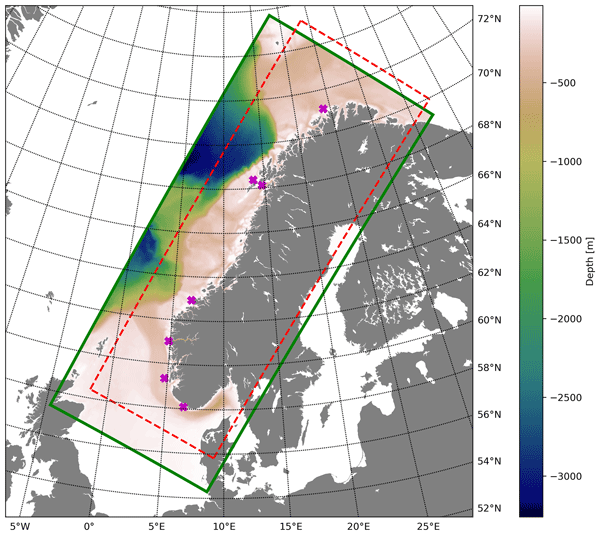
Kai Håkon Christensen, Jon Albretsen, Lars Asplin, Håvard Guldbrandsen Frøysa, Yvonne Gusdal, Silje Christine Iversen, Mari Fjalstad Jensen, Ingrid Askeland Johnsen, Nils Melsom Kristensen, Pål Næverlid Sævik, Anne Dagrun Sandvik, Magne Simonsen, Jofrid Skarðhamar, Ann Kristin Sperrevik, and Marta Trodahl
Geosci. Model Dev., 19, 2785–2798, https://doi.org/10.5194/gmd-19-2785-2026, https://doi.org/10.5194/gmd-19-2785-2026, 2026
Short summary
Short summary
This paper describes
Norkyst, the operational coastal ocean forecasting system for mainland Norway, which is now in version 3. The system produces five day forecasts of ocean currents, temperature, salinity, and sea surface height every day, and we also maintain an archive of historical data going back to 2012. We show that the outputs of Norkyst have sufficient quality so that it's intended use as a free public service supporting scientists, ocean managers, and industry is justified.
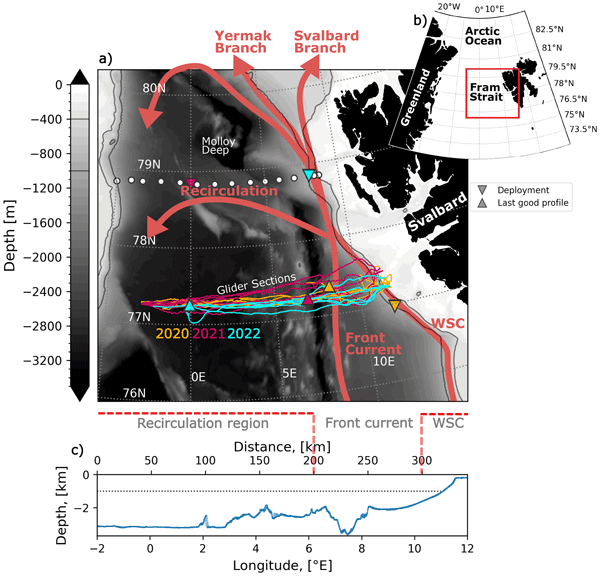
Vår Dundas and Ilker Fer
Ocean Sci., 22, 1003–1021, https://doi.org/10.5194/os-22-1003-2026, https://doi.org/10.5194/os-22-1003-2026, 2026
Short summary
Short summary
We used ocean gliders to measure separate circulation branches of warm Atlantic water flowing into the Arctic through a key passage west of Svalbard. Over three years, gliders revealed that two main current branches together carry about five million m3 s-1 northward, with large variations linked to wind patterns. These currents influence Arctic ice and climate. Our study shows gliders can capture changes missed by traditional methods, and year-round missions are needed for a complete picture.
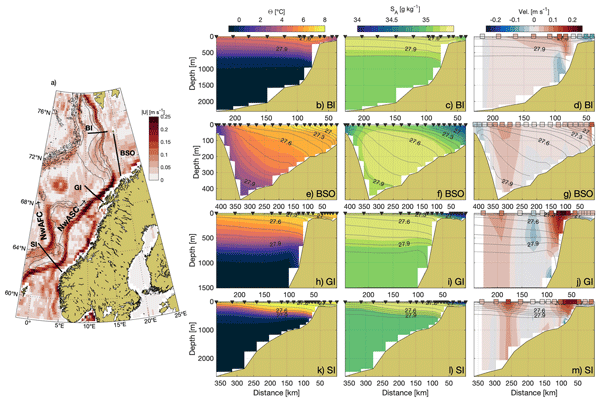
Till M. Baumann, Øystein Skagseth, Randi B. Ingvaldsen, and Kjell Arne Mork
Ocean Sci., 22, 17–29, https://doi.org/10.5194/os-22-17-2026, https://doi.org/10.5194/os-22-17-2026, 2026
Short summary
Short summary
Thirty years of in situ hydrographic measurements combined with satellite observations reveal that Atlantic Water flowing northward along Norway is cooling less than before. We find that reduced surface heat loss and faster advection are likely drivers, though their relative effect varies over time. These changes result in more ocean heat reaching the Arctic, with likely impacts on climate, sea ice, and marine ecosystems.
Gillian M. Damerell, Anthony Bosse, and Ilker Fer
Ocean Sci., 21, 2763–2785, https://doi.org/10.5194/os-21-2763-2025, https://doi.org/10.5194/os-21-2763-2025, 2025
Short summary
Short summary
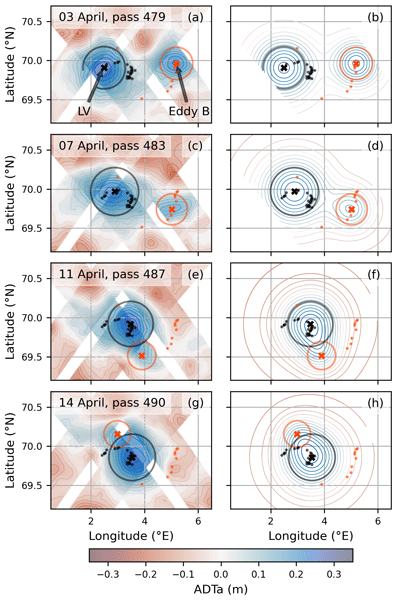
The Lofoten Vortex is an unusual feature in the ocean: a permanent eddy which does not dissipate as most eddies do. We have long thought that other eddies must merge into the vortex in order to maintain its heat content and energetics, but such mergers are very difficult to observe due to their transient, unpredictable nature. For the first time, we have observed a merger using an ocean glider and high-resolution satellite data and can document how the merger affects the properties of the vortex.
Lukas Frank, Jon Albretsen, Ragnheid Skogseth, Frank Nilsen, and Marius O. Jonassen
Ocean Sci., 21, 2419–2442, https://doi.org/10.5194/os-21-2419-2025, https://doi.org/10.5194/os-21-2419-2025, 2025
Short summary
Short summary
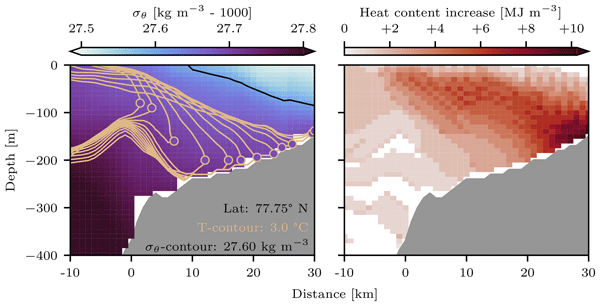
West of Svalbard, warm Atlantic Water frequently deviates from the West Spitsbergen Current onto shallow shelf areas, with significant implications for the regional climate system. The intrusions can be triggered by different processes, but their depths ultimately depend on the density difference between the intruding water and the ambient shelf water. These findings are an important step toward a better understanding of how warm Atlantic Water eventually reaches the fjords of Svalbard.
Kjersti Kalhagen, Ragnheid Skogseth, Till M. Baumann, Eva Falck, and Ilker Fer
Ocean Sci., 20, 981–1001, https://doi.org/10.5194/os-20-981-2024, https://doi.org/10.5194/os-20-981-2024, 2024
Short summary
Short summary
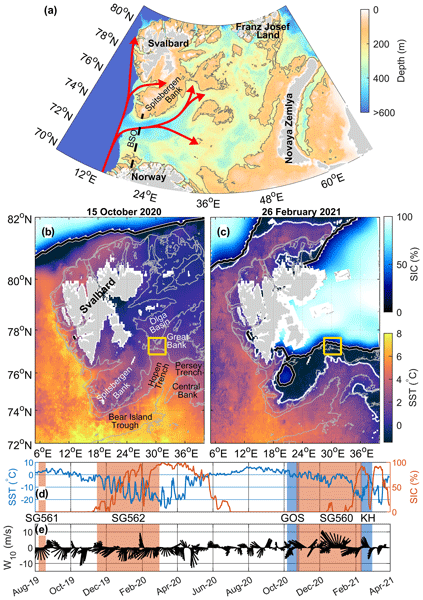
Atlantic water (AW) is a key driver of change in the Barents Sea. We studied an emerging pathway through the Svalbard Archipelago that allows AW to enter the Barents Sea. We found that the Atlantic sector near the study site has warmed over the past 2 decades; that Atlantic-origin waters intermittently enter the Barents Sea through the aforementioned pathway; and that heat transport is driven by tides, wind events, and variations in the upstream current system.
Eivind H. Kolås, Ilker Fer, and Till M. Baumann
Ocean Sci., 20, 895–916, https://doi.org/10.5194/os-20-895-2024, https://doi.org/10.5194/os-20-895-2024, 2024
Short summary
Short summary
In the northwestern Barents Sea, we study the Barents Sea Polar Front formed by Atlantic Water meeting Polar Water. Analyses of ship and glider data from October 2020 to February 2021 show a density front with warm, salty water intruding under cold, fresh water. Short-term variability is linked to tidal currents and mesoscale eddies, influencing front position, density slopes and water mass transformation. Despite seasonal changes in the upper layers, the front remains stable below 100 m depth.
Ivan Kuznetsov, Benjamin Rabe, Alexey Androsov, Ying-Chih Fang, Mario Hoppmann, Alejandra Quintanilla-Zurita, Sven Harig, Sandra Tippenhauer, Kirstin Schulz, Volker Mohrholz, Ilker Fer, Vera Fofonova, and Markus Janout
Ocean Sci., 20, 759–777, https://doi.org/10.5194/os-20-759-2024, https://doi.org/10.5194/os-20-759-2024, 2024
Short summary
Short summary
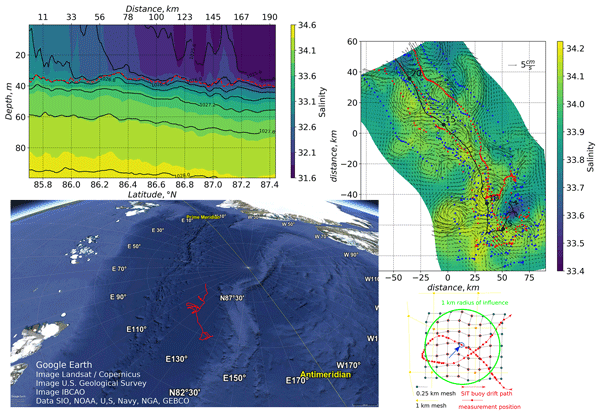
Our research introduces a tool for dynamically mapping the Arctic Ocean using data from the MOSAiC experiment. Incorporating extensive data into a model clarifies the ocean's structure and movement. Our findings on temperature, salinity, and currents reveal how water layers mix and identify areas of intense water movement. This enhances understanding of Arctic Ocean dynamics and supports climate impact studies. Our work is vital for comprehending this key region in global climate science.
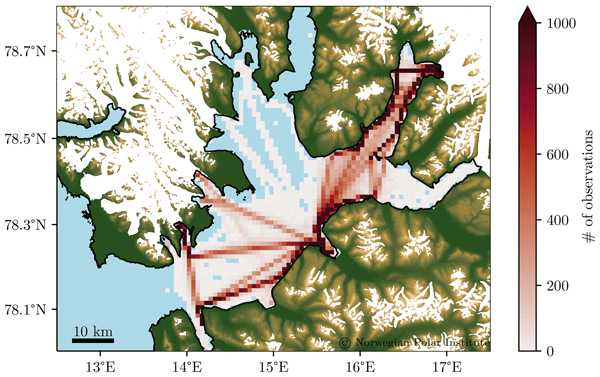
Lukas Frank, Marius Opsanger Jonassen, Teresa Remes, Florina Roana Schalamon, and Agnes Stenlund
Earth Syst. Sci. Data, 15, 4219–4234, https://doi.org/10.5194/essd-15-4219-2023, https://doi.org/10.5194/essd-15-4219-2023, 2023
Short summary
Short summary
The Isfjorden Weather Information Network (IWIN) provides continuous meteorological near-surface observations from Isfjorden in Svalbard. The network combines permanent automatic weather stations on lighthouses along the coast line with mobile stations on board small tourist cruise ships regularly trafficking the fjord during spring to autumn. All data are available online in near-real time. Besides their scientific value, IWIN data crucially enhance the safety of field activities in the region.
Pedro Duarte, Jostein Brændshøi, Dmitry Shcherbin, Pauline Barras, Jon Albretsen, Yvonne Gusdal, Nicholas Szapiro, Andreas Martinsen, Annette Samuelsen, Keguang Wang, and Jens Boldingh Debernard
Geosci. Model Dev., 15, 4373–4392, https://doi.org/10.5194/gmd-15-4373-2022, https://doi.org/10.5194/gmd-15-4373-2022, 2022
Short summary
Short summary
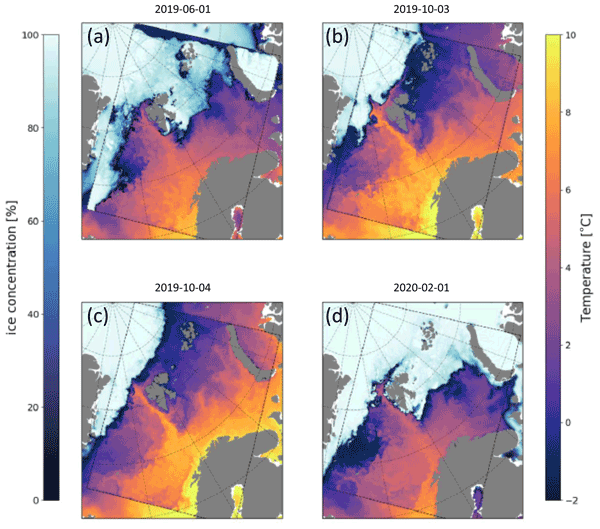
Sea ice models are often implemented for very large domains beyond the regions of sea ice formation, such as the whole Arctic or all of Antarctica. In this study, we implement changes in the Los Alamos Sea Ice Model, allowing it to be implemented for relatively small regions within the Arctic or Antarctica and yet considering the presence and influence of sea ice outside the represented areas. Such regional implementations are important when spatially detailed results are required.
Eivind H. Kolås, Tore Mo-Bjørkelund, and Ilker Fer
Ocean Sci., 18, 389–400, https://doi.org/10.5194/os-18-389-2022, https://doi.org/10.5194/os-18-389-2022, 2022
Short summary
Short summary
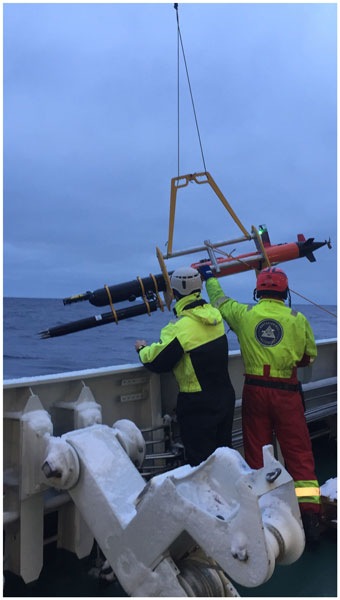
A turbulence instrument was installed on a light autonomous underwater vehicle (AUV) and deployed in the Barents Sea in February 2021. We present the data quality and discuss limitations when measuring turbulence from the AUV. AUV vibrations contaminate the turbulence measurements, yet the measurements were sufficiently cleaned when the AUV operated in turbulent environments. In quiescent environments the noise from the AUV became relatively large, making the turbulence measurements unreliable.
Sissal Vágsheyg Erenbjerg, Jon Albretsen, Knud Simonsen, Erna Lava Olsen, Eigil Kaas, and Bogi Hansen
Ocean Sci., 17, 1639–1655, https://doi.org/10.5194/os-17-1639-2021, https://doi.org/10.5194/os-17-1639-2021, 2021
Short summary
Short summary
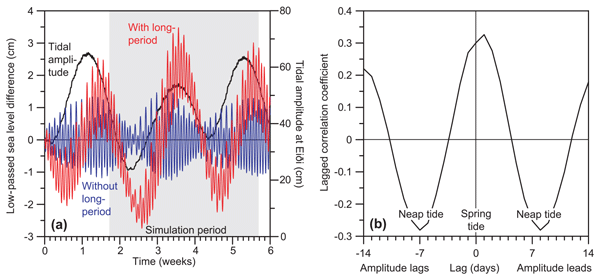
Here, we describe a strait that has narrow and shallow sills in both ends and is close to an amphidromic region. This generates tidally driven flows into and out of the strait, but with very different exchange rates across the entrances in both ends so that it behaves like a mixture between a strait and a fjord. Using a numerical model, we find a fortnightly signal in the net transport through the strait, generated by long-period tides. Our findings are verified by observations.
Cited articles
Aagaard, K., Foldvik, A., and Hillman, S. R.: The West Spitsbergen Current: disposition and water mass transformation, J. Geophys. Res.-Oceans, 92, 3778–3784, https://doi.org/10.1029/JC092iC04p03778, 1987. a
Ardyna, M. and Arrigo, K. R.: Phytoplankton dynamics in a changing Arctic ocean, Nat. Clim. Change, 10, 892–903, https://doi.org/10.1038/s41558-020-0905-y, 2020. a
Armitage, T. W. K., Manucharyan, G. E., Petty, A. A., Kwok, R., and Thompson, A. F.: Enhanced eddy activity in the Beaufort gyre in response to sea ice loss, Nat. Commun., 11, 761, https://doi.org/10.1038/s41467-020-14449-z, 2020. a
Asplin, L., Albretsen, J., Johnsen, I. A., and Sandvik, A. D.: The hydrodynamic foundation for salmon lice dispersion modeling along the Norwegian coast, Ocean Dynam., 70, 1151–1167, https://doi.org/10.1007/s10236-020-01378-0, 2020. a
Athanase, M., Provost, C., Pérez-Hernández, M. D., Sennéchael, N., Bertosio, C., Artana, C., Garric, G., and Lellouche, J.-M.: Atlantic water modification north of Svalbard in the Mercator physical system from 2007 to 2020, J. Geophys. Res.-Oceans, 125, e2020JC016463, https://doi.org/10.1029/2020JC016463, 2020. a
Beszczynska-Möller, A., Fahrbach, E., Schauer, U., and Hansen, E.: Variability in Atlantic water temperature and transport at the entrance to the Arctic ocean, 1997–2010, ICES J. Mar. Sci., 69, 852–863, https://doi.org/10.1093/icesjms/fss056, 2012. a
Budgell, W. P.: Numerical simulation of ice-ocean variability in the Barents Sea region: towards dynamical downscaling, Ocean Dynam., 55, 370–387, https://doi.org/10.1007/s10236-005-0008-3, 2005. a
Carmack, E., Polyakov, I., Padman, L., Fer, I., Hunke, E., Hutchings, J., Jackson, J., Kelley, D., Kwok, R., Layton, C., Melling, H., Perovich, D., Persson, O., Ruddick, B., Timmermans, M.-L., Toole, J., Ross, T., Vavrus, S., and Winsor, P.: Toward quantifying the increasing role of oceanic heat in sea ice loss in the new Arctic, B. Am. Meteorol. Soc., 96, 2079–2105, https://doi.org/10.1175/BAMS-D-13-00177.1, 2015. a, b
Charney, J. G. and Stern, M. E.: On the stability of internal baroclinic jets in a rotating atmosphere, J. Atmos. Sci., 19, 159–172, https://doi.org/10.1175/1520-0469(1962)019<0159:OTSOIB>2.0.CO;2, 1962. a
Codiga, D. L.: Unified Tidal Analysis and Prediction Using the UTide Matlab Functions, Tech. Rep. Technical Report 2011-01, Graduate School of Oceanography, University of Rhode Island, Narragansett, RI, USA, https://doi.org/10.13140/RG.2.1.3761.2008, 2011. a
Cushman-Roisin, B. and Beckers, J.: Introduction to Geophysical Fluid Dynamics: Physical and Numerical Aspects, International Geophysics, Elsevier Science, ISBN 9780120887590, 2011. a
Fer, I., Bosse, A., and Dugstad, J.: Norwegian Atlantic Slope Current along the Lofoten Escarpment, Ocean Sci., 16, 685–701, https://doi.org/10.5194/os-16-685-2020, 2020. a, b
Fer, I., Koenig, Z., Kolås, E. H., Baumann, T. M., and Kalhagen, K.: Physical oceanography data from moorings north of Svalbard, September 2018–September 2019, Norwegian Marine Data Centre [data set], https://doi.org/10.21335/NMDC-1852831792, 2022. a, b
Frank, L., Albretsen, J., Skogseth, R., Nilsen, F., and Jonassen, M. O.: Mechanisms of warm-water intrusions onto the West Spitsbergen Shelf during winter, Ocean Sci., 21, 2419–2442, https://doi.org/10.5194/os-21-2419-2025, 2025. a, b, c, d
Guo, C., Ilicak, M., Fer, I., Darelius, E., and Bentsen, M.: Baroclinic instability of the Faroe Bank Channel overflow, J. Phys. Oceanogr., 44, 2698–2717, https://doi.org/10.1175/JPO-D-14-0080.1, 2014. a
Håvik, L., Våge, K., Pickart, R. S., Harden, B., von Appen, W.-J., Jónsson, S., and Østerhus, S.: Structure and variability of the shelfbreak East Greenland current north of Denmark Strait, J. Phys. Oceanogr., 47, 2631–2646, https://doi.org/10.1175/JPO-D-17-0062.1, 2017. a, b, c
Isachsen, P. E., Vogt-Vincent, N. S., Johnson, H. L., and Nilsson, J.: Instability and mesoscale eddy fluxes in an idealized 3-layer Beaufort gyre, J. Geophys. Res.-Oceans, 129, e2023JC020757, https://doi.org/10.1029/2023JC020757, 2024. a
Jakobsson, M., Mayer, L., Coakley, B., Dowdeswell, J. A., Forbes, S., Fridman, B., Hodnesdal, H., Noormets, R., Pedersen, R., Rebesco, M., Schenke, H. W., Zarayskaya, Y., Accettella, D., Armstrong, A., Anderson, R. M., Bienhoff, P., Camerlenghi, A., Church, I., Edwards, M., Gardner, J. V., Hall, J. K., Hell, B., Hestvik, O., Kristoffersen, Y., Marcussen, C., Mohammad, R., Mosher, D., Nghiem, S. V., Pedrosa, M. T., Travaglini, P. G., and Weatherall, P.: The International Bathymetric Chart of the Arctic Ocean (IBCAO) Version 3.0, Geophys. Res. Lett., 39, https://doi.org/10.1029/2012GL052219, 2012. a
Jakobsson, M., Mayer, L. A., Bringensparr, C., Castro, C. F., Mohammad, R., Johnson, P., Ketter, T., Accettella, D., Amblas, D., An, L., Arndt, J. E., Canals, M., Casamor, J. L., Chauché, N., Coakley, B., Danielson, S., Demarte, M., Dickson, M.-L., Dorschel, B., Dowdeswell, J. A., Dreutter, S., Fremand, A. C., Gallant, D., Hall, J. K., Hehemann, L., Hodnesdal, H., Hong, J., Ivaldi, R., Kane, E., Klaucke, I., Krawczyk, D. W., Kristoffersen, Y., Kuipers, B. R., Millan, R., Masetti, G., Morlighem, M., Noormets, R., Prescott, M. M., Rebesco, M., Rignot, E., Semiletov, I., Tate, A. J., Travaglini, P., Velicogna, I., Weatherall, P., Weinrebe, W., Willis, J. K., Wood, M., Zarayskaya, Y., Zhang, T., Zimmermann, M., and Zinglersen, K. B.: The International Bathymetric Chart of the Arctic Ocean Version 4.0, Scientific Data, 7, 176, https://doi.org/10.1038/s41597-020-0520-9, 2020. a
Killworth, P. D.: Barotropic and baroclinic instability in rotating stratified fluids, Dynam. Atmos. Oceans, 4, 143–184, https://doi.org/10.1016/0377-0265(80)90013-5, 1980. a
Koenig, Z., Kalhagen, K., and Fer, I.: Ocean current, temperature and salinity measurements from moorings north of Svalbard: September 2018–November 2019, Tech. rep., University of Bergen, https://doi.org/10.21335/NMDC-1075977612, 2022a. a
Koenig, Z., Kalhagen, K., Kolås, E., Fer, I., Nilsen, F., and Cottier, F.: Atlantic water properties, transport and heat loss from mooring observations north of Svalbard, J. Geophys. Res.-Oceans, 127, e2022JC018568, https://doi.org/10.1029/2022JC018568, 2022b. a, b, c, d, e, f, g, h, i, j, k, l, m, n, o
Kolås, E. H., Koenig, Z., Fer, I., Nilsen, F., and Marnela, M.: Structure and transport of Atlantic water north of Svalbard from observations in summer and fall 2018, J. Geophys. Res.-Oceans, 125, e2020JC016174, https://doi.org/10.1029/2020JC016174, 2020. a, b
Li, X., Wang, Q., Danilov, S., Koldunov, N., Liu, C., Müller, V., Sidorenko, D., and Jung, T.: Eddy activity in the Arctic ocean projected to surge in a warming world, Nat. Clim. Change, 14, 156–162, https://doi.org/10.1038/s41558-023-01908-w, 2024. a, b
Lilly, J. M. and Olhede, S. C.: Higher-order properties of analytic wavelets, IEEE T. Signal Proces., 57, 146–160, https://doi.org/10.1109/tsp.2008.2007607, 2009. a
Lilly, J. M. and Olhede, S. C.: On the analytic wavelet transform, IEEE T. Inform. Theory, 56, 4135–4156, https://doi.org/10.1109/TIT.2010.2050935, 2010. a
Lilly, J. M. and Olhede, S. C.: Generalized morse wavelets as a superfamily of analytic wavelets, IEEE T. Signal Proces., 60, 6036–6041, https://doi.org/10.1109/TSP.2012.2210890, 2012. a
Manucharyan, G. E. and Thompson, A. F.: Submesoscale sea ice-ocean interactions in marginal ice zones, J. Geophys. Res.-Oceans, 122, 9455–9475, https://doi.org/10.1002/2017JC012895, 2017. a
Manucharyan, G. E. and Thompson, A. F.: Heavy footprints of upper-ocean eddies on weakened Arctic sea ice in marginal ice zones, Nat. Commun., 13, 2147, https://doi.org/10.1038/s41467-022-29663-0, 2022. a
Marshall, J. and Shutts, G.: A note on rotational and divergent eddy fluxes, J. Phys. Oceanogr., 11, 1677–1680, https://doi.org/10.1175/1520-0485(1981)011<1677:ANORAD>2.0.CO;2, 1981. a
Meneghello, G., Marshall, J., Lique, C., Isachsen, P. E., Doddridge, E., Campin, J.-M., Regan, H., and Talandier, C.: Genesis and decay of mesoscale baroclinic eddies in the seasonally ice-covered interior Arctic ocean, J. Phys. Oceanogr., 51, 115–129, https://doi.org/10.1175/JPO-D-20-0054.1, 2020. a
Müller, M., Batrak, Y., Kristiansen, J., Køltzow, M. A. Ø., Noer, G., and Korosov, A.: Characteristics of a convective-scale weather forecasting system for the European Arctic, Mon. Weather Rev., 145, 4771–4787, https://doi.org/10.1175/MWR-D-17-0194.1, 2017. a
Müller, V., Wang, Q., Koldunov, N., Danilov, S., Sidorenko, D., and Jung, T.: Variability of eddy kinetic energy in the Eurasian Basin of the Arctic ocean inferred from a model simulation at 1-km resolution, J. Geophys. Res.-Oceans, 129, e2023JC020139, https://doi.org/10.1029/2023JC020139, 2024. a, b, c
Nilsen, F., Gjevik, B., and Schauer, U.: Cooling of the West Spitsbergen current: isopycnal diffusion by topographic vorticity waves, J. Geophys. Res.-Oceans, 111, https://doi.org/10.1029/2005JC002991, 2006. a
Pérez-Hernández, M. D., Pickart, R. S., Pavlov, V., Våge, K., Ingvaldsen, R., Sundfjord, A., Renner, A. H. H., Torres, D. J., and Erofeeva, S. Y.: The Atlantic water boundary current north of Svalbard in late summer, J. Geophys. Res.-Oceans, 122, 2269–2290, https://doi.org/10.1002/2016JC012486, 2017. a, b, c
Pérez-Hernández, M. D., Pickart, R. S., Torres, D. J., Bahr, F., Sundfjord, A., Ingvaldsen, R., Renner, A. H. H., Beszczynska-Möller, A., von Appen, W.-J., and Pavlov, V.: Structure, transport, and seasonality of the Atlantic water boundary current north of Svalbard: results from a yearlong mooring array, J. Geophys. Res.-Oceans, 124, 1679–1698, https://doi.org/10.1029/2018JC014759, 2019. a
Pnyushkov, A., Polyakov, I. V., Padman, L., and Nguyen, A. T.: Structure and dynamics of mesoscale eddies over the Laptev Sea continental slope in the Arctic Ocean, Ocean Sci., 14, 1329–1347, https://doi.org/10.5194/os-14-1329-2018, 2018. a
Polyakov, I. V., Pnyushkov, A. V., Alkire, M. B., Ashik, I. M., Baumann, T. M., Carmack, E. C., Goszczko, I., Guthrie, J., Ivanov, V. V., Kanzow, T., Krishfield, R., Kwok, R., Sundfjord, A., Morison, J., Rember, R., and Yulin, A.: Greater role for Atlantic inflows on sea-ice loss in the Eurasian Basin of the Arctic ocean, Science, 356, 285–291, https://doi.org/10.1126/science.aai8204, 2017. a
Polyakov, I. V., Alkire, M. B., Bluhm, B. A., Brown, K. A., Carmack, E. C., Chierici, M., Danielson, S. L., Ellingsen, I., Ershova, E. A., Gårdfeldt, K., Ingvaldsen, R. B., Pnyushkov, A. V., Slagstad, D., and Wassmann, P.: Borealization of the Arctic ocean in response to anomalous advection from sub-Arctic seas, Frontiers in Marine Science, 7, https://doi.org/10.3389/fmars.2020.00491, 2020a. a
Polyakov, I. V., Rippeth, T. P., Fer, I., Alkire, M. B., Baumann, T. M., Carmack, E. C., Ingvaldsen, R., Ivanov, V. V., Janout, M., Lind, S., Padman, L., Pnyushkov, A. V., and Rember, R.: Weakening of cold halocline layer exposes sea ice to oceanic heat in the eastern Arctic ocean, J. Climate, 33, 8107–8123, https://doi.org/10.1175/JCLI-D-19-0976.1, 2020b. a
Renner, A. H. H., Sundfjord, A., Janout, M. A., Ingvaldsen, R. B., Beszczynska-Möller, A., Pickart, R. S., and Pérez-Hernández, M. D.: Variability and redistribution of heat in the Atlantic water boundary current north of Svalbard, J. Geophys. Res.-Oceans, 123, 6373–6391, https://doi.org/10.1029/2018JC013814, 2018. a, b, c
Richards, A. E., Johnson, H. L., and Lique, C.: Spatial and temporal variability of Atlantic water in the Arctic from 40 years of observations, J. Geophys. Res.-Oceans, 127, e2021JC018358, https://doi.org/10.1029/2021JC018358, 2022. a, b
Röhrs, J., Gusdal, Y., Rikardsen, E. S. U., Durán Moro, M., Brændshøi, J., Kristensen, N. M., Fritzner, S., Wang, K., Sperrevik, A. K., Idžanović, M., Lavergne, T., Debernard, J. B., and Christensen, K. H.: Barents-2.5km v2.0: an operational data-assimilative coupled ocean and sea ice ensemble prediction model for the Barents Sea and Svalbard, Geosci. Model Dev., 16, 5401–5426, https://doi.org/10.5194/gmd-16-5401-2023, 2023. a
Rudels, B., J. Friedrich, H., and Quadfasel, D.: The Arctic circumpolar boundary current, Deep-Sea Res. Pt. II, 46, 1023–1062, https://doi.org/10.1016/S0967-0645(99)00015-6, 1999. a
Schauer, U., Muench, R. D., Rudels, B., and Timokhov, L.: Impact of eastern Arctic shelf waters on the Nansen Basin intermediate layers, J. Geophys. Res.-Oceans, 102, 3371–3382, https://doi.org/10.1029/96JC03366, 1997. a
Schyberg, H., Yang, X., Køltzow, M. A. Ø., Amstrup, B., Bakketun, Å., Bazile, E., Bojarova, J., Box, J. E., Dahlgren, P., Hagelin, S., Homleid, M., Horányi, A., Høyer, J., Johansson, Å., Killie, M. A., Körnich, H., LeMoigne, P., Lindskog, M., Manninen, T., Nielsen-Englyst, P., Nielsen, K. P., Olsson, E., Palmason, B., PeraltaAros, C., Randriamampianina, R., Samuelsson, P., Stappers, R., Støylen, E., Thorsteinsson, S., Valkonen, T., and Wang, Z. Q.: Arctic regional reanalysis on single levels from 1991 to present, Copernicus Climate Change Service (C3S) Climate Data Store (CDS) [data set], https://doi.org/10.24381/cds.713858f6, 2020. a, b
Shchepetkin, A. F. and McWilliams, J. C.: The Regional Oceanic Modeling System (ROMS): a split-explicit, free-surface, topography-following-coordinate oceanic model, Ocean Model., 9, 347–404, https://doi.org/10.1016/j.ocemod.2004.08.002, 2005. a
Skogseth, R., Olivier, L. L. A., Nilsen, F., Falck, E., Fraser, N., Tverberg, V., Ledang, A. B., Vader, A., Jonassen, M. O., Søreide, J., Cottier, F., Berge, J., Ivanov, B. V., and Falk-Petersen, S.: Variability and decadal trends in the Isfjorden (Svalbard) ocean climate and circulation – an indicator for climate change in the European arctic, Prog. Oceanogr., 187, 102394, https://doi.org/10.1016/j.pocean.2020.102394, 2020. a
Spall, M. A. and Pedlosky, J.: Lateral coupling in baroclinically unstable flows, J. Phys. Oceanogr., 38, 1267–1277, https://doi.org/10.1175/2007JPO3906.1, 2008. a
Spall, M. A., Pickart, R. S., Fratantoni, P. S., and Plueddemann, A. J.: Western Arctic shelfbreak eddies: formation and transport, J. Phys. Oceanogr., 38, 1644–1668, https://doi.org/10.1175/2007JPO3829.1, 2008. a
Teigen, S. H., Nilsen, F., and Gjevik, B.: Barotropic Instability in the West Spitsbergen current, J. Geophys. Res.-Oceans, 115, https://doi.org/10.1029/2009JC005996, 2010. a, b
Teigen, S. H., Nilsen, F., Skogseth, R., Gjevik, B., and Beszczynska-Möller, A.: Baroclinic instability in the West Spitsbergen current, J. Geophys. Res.-Oceans, 116, https://doi.org/10.1029/2011JC006974, 2011. a
Våge, K., Pickart, R. S., Pavlov, V., Lin, P., Torres, D. J., Ingvaldsen, R., Sundfjord, A., and Proshutinsky, A.: The Atlantic water boundary current in the Nansen Basin: transport and mechanisms of lateral exchange, J. Geophys. Res.-Oceans, 121, 6946–6960, https://doi.org/10.1002/2016JC011715, 2016. a, b, c, d
Vallis, G. K. and Maltrud, M. E.: Generation of mean flows and jets on a beta plane and over topography, J. Phys. Oceanogr., 23, 1346–1362, 1993. a
von Appen, W.-J., Baumann, T., Janout, M., Koldunov, N., Lenn, Y.-D., Pickart, R., Scott, R., and Wang, Q.: Eddies and the distribution of eddy kinetic energy in the Arctic ocean, Oceanography, https://doi.org/10.5670/oceanog.2022.122, 2022. a, b
Wang, Q., Koldunov, N. V., Danilov, S., Sidorenko, D., Wekerle, C., Scholz, P., Bashmachnikov, I. L., and Jung, T.: Eddy kinetic energy in the Arctic ocean from a global simulation with a 1-km Arctic, Geophys. Res. Lett., 47, e2020GL088550, https://doi.org/10.1029/2020GL088550, 2020. a
Wekerle, C., Hattermann, T., Wang, Q., Crews, L., von Appen, W.-J., and Danilov, S.: Properties and dynamics of mesoscale eddies in Fram Strait from a comparison between two high-resolution ocean–sea ice models, Ocean Sci., 16, 1225–1246, https://doi.org/10.5194/os-16-1225-2020, 2020. a, b, c, d, e, f, g, h, i, j, k
Short summary
Warm Atlantic Water flowing eastward north of Svalbard loses heat faster than can be explained by cooling to the atmosphere and mixing alone. Using year-long mooring observations and an ocean model, we found that mesoscale variability and energy transfer into eddies are largest in autumn and winter, when the boundary current is also at its strongest and warmest. This mesoscale activity enhances lateral heat exchange and likely contributes to the observed cooling of Atlantic Water along its path.
Warm Atlantic Water flowing eastward north of Svalbard loses heat faster than can be explained...


