
Articles | Volume 22, issue 4
https://doi.org/10.5194/os-22-2249-2026
© Author(s) 2026. This work is distributed under
the Creative Commons Attribution 4.0 License.
the Creative Commons Attribution 4.0 License.
https://doi.org/10.5194/os-22-2249-2026
© Author(s) 2026. This work is distributed under
the Creative Commons Attribution 4.0 License.
the Creative Commons Attribution 4.0 License.
Research article
| 
27 Jul 2026
Research article |
| 27 Jul 2026
| 27 Jul 2026
Bottom topography effects on the internal wave climate in the Ionian Sea
Florian Kokoszka
Istituto di Scienze Marine, Consiglio Nazionale delle Ricerche, Naples 80133, Italy
Stazione Zoologica Anton Dohrn, Villa Comunale, Naples 80121, Italy
Stefania Sparnocchia
Istituto di Scienze Marine, Consiglio Nazionale delle Ricerche, Trieste 34149, Italy
Davide Cavaliere
Istituto di Scienze Marine, Consiglio Nazionale delle Ricerche, Rome 00133, Italy
Vincenzo Artale
Istituto di Scienze Marine, Consiglio Nazionale delle Ricerche, Rome 00133, Italy
Istituto Nazionale di Geofisica e Vulcanologia, Rome 00143, Italy
Mireno Borghini
Istituto di Scienze Marine, Consiglio Nazionale delle Ricerche, Lerici 19032, Italy
Beatrice Giambenedetti
Istituto Nazionale di Geofisica e Vulcanologia, Rome 00143, Italy
Federico Falcini
CORRESPONDING AUTHOR
Istituto di Scienze Marine, Consiglio Nazionale delle Ricerche, Rome 00133, Italy
Related authors
No articles found.
Margherita Costanzo, Vittorio Ernesto Brando, Federico Falcini, Christian Marchese, Luis Gonzalez Vilas, Emmanuel Boss, David Doxaran, Paola Potin, Stefan Simis, Tom Jordan, John Wood, Chiara Santinelli, Giancarlo Bachi, Giovanni Checcucci, Claudia Tropea, Marco Carloni, Mirco Guerrazzi, Silvia Valsecchi, Valtere Evangelista, Marie Helene Rio, Javier Alonso Concha, Paola Bertucci, Colomban de Vargas, Victor Martinez-Vicente, and the Tara Europa Team, the TREC-Tara Europa Operation and Management Team, and the TREC Consortium Coordinators
Earth Syst. Sci. Data Discuss., https://doi.org/10.5194/essd-2026-623, https://doi.org/10.5194/essd-2026-623, 2026
Preprint under review for ESSD
Short summary
Short summary
Qualcosa del genere potrebbe andare?: As part of the Traversing European Coastlines research program, the HyperBOOST (Hyperspectral Bio-Optical Observations Sailing on Tara) team collected an unprecedented dataset of optical and biogeochemical measurements during the Tara Europa Expedition. Covering diverse European coastal environments, this resource will improve satellite observations, support the development of new bio-optical models, and advance research on coastal marine ecosystems.
Nadia Lo Bue, Beatrice Giambenedetti, Davide Embriaco, Paolo Bagiacchi, Claudia Fratianni, Riccardo Vagni, and Giuditta Marinaro
Earth Syst. Sci. Data, 18, 5093–5115, https://doi.org/10.5194/essd-18-5093-2026, https://doi.org/10.5194/essd-18-5093-2026, 2026
Short summary
Short summary
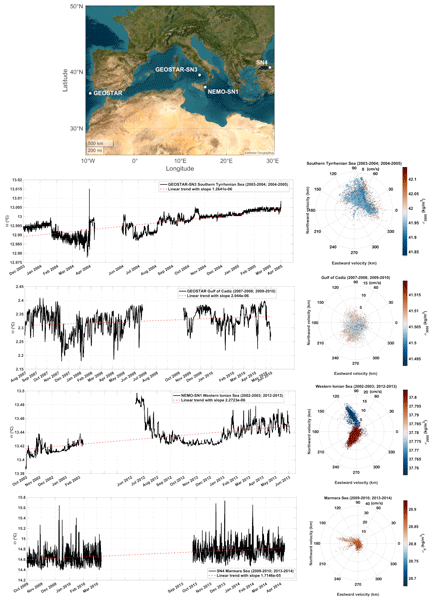
We present a set of long-term, high-resolution oceanographic datasets collected by benthic observatories in the deep Mediterranean Sea. These records provide valuable insights into deep-ocean dynamics and their potential influence on climate variability. Standardized post-processing and quality-control procedures ensure data reliability and usability for further analyses and model validation, helping to address key gaps in deep-sea monitoring and observation.
Florian Volmer Martin Kokoszka, Mireno Borghini, Katrin Schroeder, Jacopo Chiggiato, Joaquín Tintoré, Nikolaos Dimitrios Zarokanellos, Albert Miralles, Patricia Rivera Rodríguez, Manuel Rubio, Miguel Charcos, Benjamín Casas, and Anneke ten Doeschate
Earth Syst. Sci. Data, 18, 2203–2226, https://doi.org/10.5194/essd-18-2203-2026, https://doi.org/10.5194/essd-18-2203-2026, 2026
Short summary
Short summary
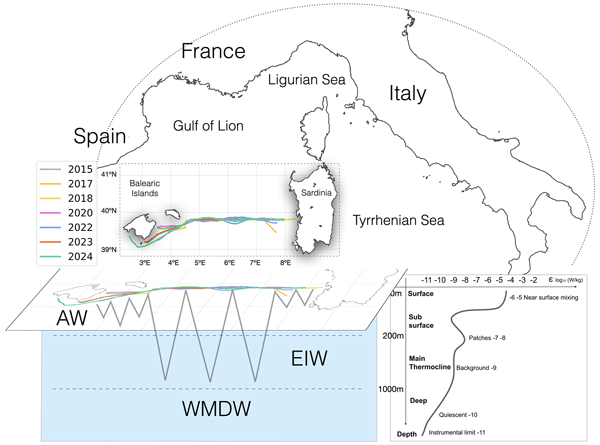
We present a unique dataset of underwater measurements collected by an autonomous glider in the western Mediterranean Sea. It reveals how ocean layers mix over seasons and years. Using sensors to detect small scale water movements, we estimated how mechanical energy and heat are transferred in the ocean. These data help scientists better understand ocean circulation and climate effects. All files and methods are openly shared to support future research.
Malek Belgacem, Katrin Schroeder, Marta Álvarez, Siv K. Lauvset, Jacopo Chiggiato, Mireno Borghini, Carolina Cantoni, Tiziana Ciuffardi, and Stefania Sparnocchia
Earth Syst. Sci. Data, 17, 5315–5336, https://doi.org/10.5194/essd-17-5315-2025, https://doi.org/10.5194/essd-17-5315-2025, 2025
Short summary
Short summary
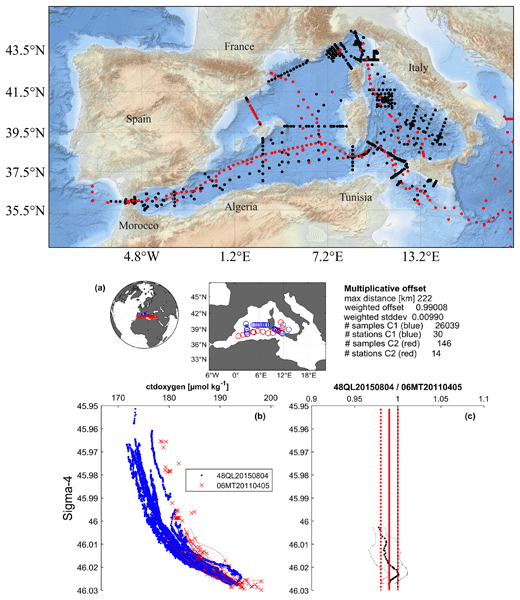
The Mediterranean Sea is changing rapidly, underscoring the urgent need for high-quality datasets to quantify trends and assess impacts on biogeochemical cycles. O2 is a key indicator of marine ecosystem health and plays a central role in CO2 and nutrient cycling. We compiled a regional-scale dataset of O2 in the western Mediterranean to provide a robust observational foundation for assessing O2 variability, associated with climate change, and anomalies related to deoxygenation processes.
Beatrice Giambenedetti, Nadia Lo Bue, and Vincenzo Artale
Ocean Sci., 20, 1209–1228, https://doi.org/10.5194/os-20-1209-2024, https://doi.org/10.5194/os-20-1209-2024, 2024
Short summary
Short summary
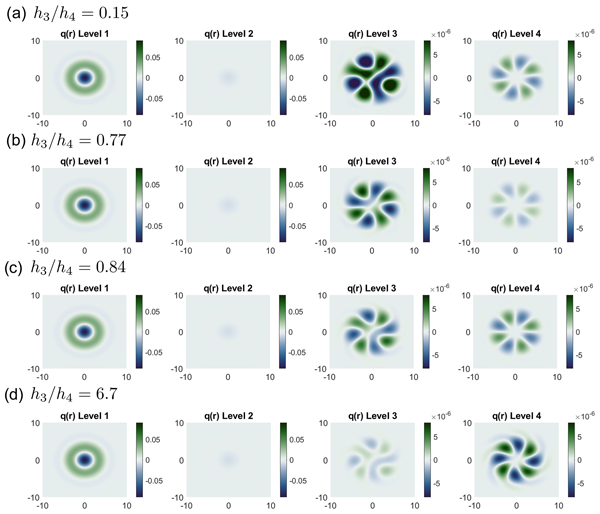
We used a simplified model to investigate how changes in abyssal stratification can impact the propagation of vortices in the ocean. Although abyssal stratification is typically considered stable, observations have shown that this is not always a good approximation. We found that changes in deep stratification can introduce variability into the patterns of the vortices. Despite the assumptions made in our model, our results are supported by seafloor observations in the Ionian Sea.
Tiziana Ciuffardi, Zoi Kokkini, Maristella Berta, Marina Locritani, Andrea Bordone, Ivana Delbono, Mireno Borghini, Maurizio Demarte, Roberta Ivaldi, Federica Pannacciulli, Anna Vetrano, Davide Marini, and Giovanni Caprino
Earth Syst. Sci. Data, 15, 1933–1946, https://doi.org/10.5194/essd-15-1933-2023, https://doi.org/10.5194/essd-15-1933-2023, 2023
Short summary
Short summary
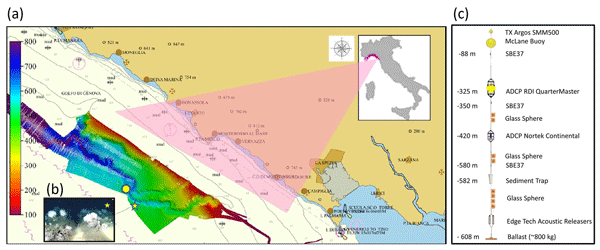
This paper presents the results of the first 2 years of the Levante Canyon Mooring, a mooring line placed since 2020 in the eastern Ligurian Sea, to study a canyon area at about 600 m depth characterized by the presence of cold-water living corals. It provides hydrodynamic and thermohaline measurements along the water column, describing a water-mass distribution coherent with previous evidence in the Ligurian Sea. The data also show a Northern Current episodic and local reversal during summer.
Francesco Paladini de Mendoza, Katrin Schroeder, Leonardo Langone, Jacopo Chiggiato, Mireno Borghini, Patrizia Giordano, Giulio Verazzo, and Stefano Miserocchi
Earth Syst. Sci. Data, 14, 5617–5635, https://doi.org/10.5194/essd-14-5617-2022, https://doi.org/10.5194/essd-14-5617-2022, 2022
Short summary
Short summary
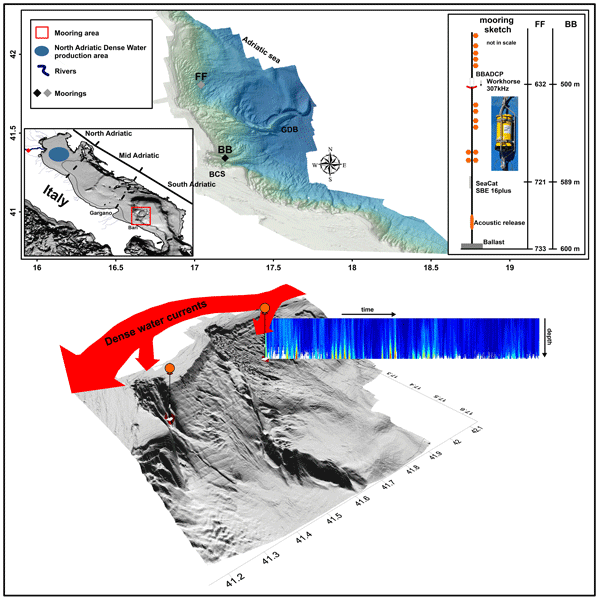
This work presents the dataset of continuous monitoring in the southern Adriatic Margin, providing a unique observatory of deep-water dynamics. The study area is influenced by episodic dense-water cascading, which is a fundamental process for water renewal and deep-water dynamics. Information about the frequency and intensity variations of these events is observed along a time series. The monitoring activities are still ongoing and the moorings are part of the EMSO-ERIC network.
Malek Belgacem, Katrin Schroeder, Alexander Barth, Charles Troupin, Bruno Pavoni, Patrick Raimbault, Nicole Garcia, Mireno Borghini, and Jacopo Chiggiato
Earth Syst. Sci. Data, 13, 5915–5949, https://doi.org/10.5194/essd-13-5915-2021, https://doi.org/10.5194/essd-13-5915-2021, 2021
Short summary
Short summary
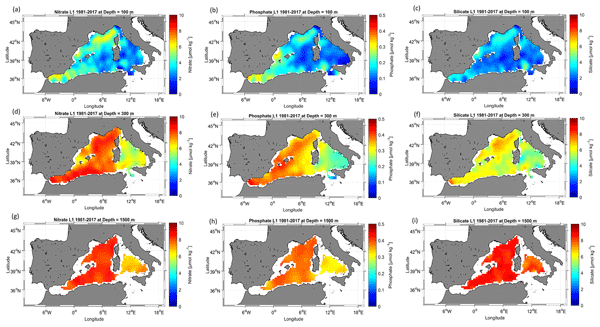
The Mediterranean Sea exhibits an anti-estuarine circulation, responsible for its low productivity. Understanding this peculiar character is still a challenge since there is no exact quantification of nutrient sinks and sources. Because nutrient in situ observations are generally infrequent and scattered in space and time, climatological mapping is often applied to sparse data in order to understand the biogeochemical state of the ocean. The dataset presented here partly addresses these issues.
Davide Zanchettin, Sara Bruni, Fabio Raicich, Piero Lionello, Fanny Adloff, Alexey Androsov, Fabrizio Antonioli, Vincenzo Artale, Eugenio Carminati, Christian Ferrarin, Vera Fofonova, Robert J. Nicholls, Sara Rubinetti, Angelo Rubino, Gianmaria Sannino, Giorgio Spada, Rémi Thiéblemont, Michael Tsimplis, Georg Umgiesser, Stefano Vignudelli, Guy Wöppelmann, and Susanna Zerbini
Nat. Hazards Earth Syst. Sci., 21, 2643–2678, https://doi.org/10.5194/nhess-21-2643-2021, https://doi.org/10.5194/nhess-21-2643-2021, 2021
Short summary
Short summary
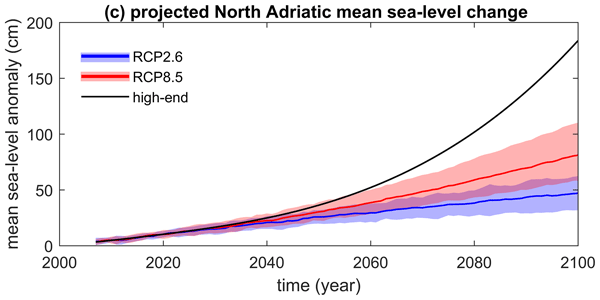
Relative sea level in Venice rose by about 2.5 mm/year in the past 150 years due to the combined effect of subsidence and mean sea-level rise. We estimate the likely range of mean sea-level rise in Venice by 2100 due to climate changes to be between about 10 and 110 cm, with an improbable yet possible high-end scenario of about 170 cm. Projections of subsidence are not available, but historical evidence demonstrates that they can increase the hazard posed by climatically induced sea-level rise.
Cited articles
Artale, V., Provenzale, A., and Santoleri, R.: Analysis of internal temperature oscillations of tidal period on the Sicilian continental shelf, Cont. Shelf Res., 9, 867–888, https://doi.org/10.1016/0278-4343(89)90063-0, 1989.
Artale, V., Calmanti, S., Malanotte-Rizzoli, P., Pisacane, G., Rupolo, V., and Tsimplis, M.: The Atlantic and Mediterranean Sea as connected systems, in: Developments in Earth and Environmental Sciences, Elsevier, 4, 283–323, https://doi.org/10.1016/S1571-9197(06)80008-X, 2006.
Artale, V., Falcini, F., Marullo, S., Bensi, M., Kokoszka, F., Iudicone, D., and Rubino, A.: Linking mixing processes and climate variability to the heat content distribution of the Eastern Mediterranean abyss, Sci. Rep., 8, 1–10, https://doi.org/10.1038/s41598-018-29343-4, 2018.
Bellacicco, M., Anagnostou, C., Falcini, F., Rinaldi, E., Tripsanas, K., and Salusti, E.: The 1987 Aegean dense water formation: A streamtube investigation by comparing theoretical model results, satellite, field, and numerical data with contourite distribution, Mar. Geol., 375, 120–133, https://doi.org/10.1016/j.margeo.2016.01.012, 2016.
Bensi, M., Rubino, A., Cardin, V., Hainbucher, D., and Mancero-Mosquera, I.: Structure and variability of the abyssal water masses in the Ionian Sea in the period 2003–2010, J. Geophys. Res.-Oceans, 118, 931–943, https://doi.org/10.1029/2012JC008178, 2013a.
Bensi, M., Cardin, V., Rubino, A., Notarstefano, G., and Poulain, P. M.: Effects of winter convection on the deep layer of the Southern Adriatic Sea in 2012, J. Geophys. Res.-Oceans, 118, 6064–6075, https://doi.org/10.1002/2013JC009432, 2013b.
Béranger, K., Mortier, L., Gasparini, G. P., Gervasio, L., Astraldi, M., and Crépon, M.: The dynamics of the Sicily Strait: a comprehensive study from observations and models, Deep-Sea Res. Pt. II, 51, 411–440, https://doi.org/10.1016/j.dsr2.2003.08.004, 2004.
Bergamasco, A. and Malanotte-Rizzoli, P.: The circulation of the Mediterranean Sea: a historical review of experimental investigations, Advances in Oceanography and Limnology, 1, 11–28, https://doi.org/10.1080/19475721.2010.491656, 2010.
Bindoff, N. L., Willebrand, J., Artale, V., Cazenave, A., Gregory, J. M., Gulev, S., Hanawa, K., Le Quere, C., Levitus, S., Nojiri, Y., and Shum, C. K.: Observations: oceanic climate change and sea level, Climate Change 2007: The Physical Science Basis, edited by: Solomon, S., Qin, D., Manning, M., Chen, Z., Marquis, M., Averyt, K. B., Tignor, M., and Miller, H. L., Cambridge University Press, Cambridge, UK, 747–845, ISBN 9780521880091, 2007.
Borghini, M., Falcini, F., Kokoszka, F., and Sparnocchia, S.: CTD and LADCP data from the KM3NET cruise, Ionian Sea, July 2007, SEANOE [data set], https://doi.org/10.17882/108742, 2025.
Budillon, G., Lo Bue, N., Siena, G., and Spezie, G.: Hydrographic characteristics of water masses and circulation in the Northern Ionian Sea, Deep-Sea Res. Pt. II, 57, 441–457, https://doi.org/10.1016/j.dsr2.2009.08.017, 2010.
Buffett, G. G., Krahmann, G., Klaeschen, D., Schroeder, K., Sallarès, V., Papenberg, C., Ranero, C. R., and Zitellini, N.: Seismic oceanography in the Tyrrhenian Sea: thermohaline staircases, eddies, and internal waves, J. Geophys. Res.-Oceans, 122, 8503–8523, https://doi.org/10.1002/2017JC012726, 2017.
Cairns, J. L. and Williams, G. O.: Internal wave observations from a midwater float, 2, J. Geophys. Res., 81, 1943–1950, https://doi.org/10.1029/JC081i012p01943, 1976.
Cavaliere, D., La Forgia, G., Adduce, C., Alpers, W., Martorelli, E., and Falcini, F.: Breaking location of Internal Solitary Waves over a sloping seabed, J. Geophys. Res.-Oceans, 126, e2020JC016669, https://doi.org/10.1029/2020JC016669, 2021.
Chinn, B. S., Girton, J. B., and Alford, M. H.: The impact of observed variations in the shear-to-strain ratio of internal waves on inferred turbulent diffusivities, J. Phys. Oceanogr., 46, 3299–3320, https://doi.org/10.1175/JPO-D-15-0161.1, 2016.
de Lavergne, C., Madec, G., Le Sommer, J., Nurser, A. G., and Naveira Garabato, A. C.: The impact of a variable mixing efficiency on the abyssal overturning, J. Phys. Oceanogr., 46, 663–681, https://doi.org/10.1175/JPO-D-14-0259.1, 2016.
Dematteis, G., Le Boyer, A., Pollmann, F., Polzin, K. L., Alford, M. H., Whalen, C. B., and Lvov, Y. V.: Interacting internal waves explain global patterns of interior ocean mixing, Nat. Commun., 15, 7468, https://doi.org/10.1038/s41467-024-51503-6, 2024.
Ferrari, R.: What goes down must come up, Nature, 513, 179–180, https://doi.org/10.1038/513179a, 2014.
Ferrari, R. and Wunsch, C.: Ocean Circulation Kinetic Energy: Reservoirs, Sources, and Sinks, Annu. Rev. Fluid Mech., 41, 253–282, https://doi.org/10.1146/annurev.fluid.40.111406.102139, 2009.
Ferrari, R., Mashayek, A., McDougall, T. J., Nikurashin, M., and Campin, J. M.: Turning ocean mixing upside down, J. Phys. Oceanogr., 46, 2239–2261, https://doi.org/10.1175/JPO-D-15-0244.1, 2016.
Ferron, B., Kokoszka, F., Mercier, H., and Lherminier, P.: Dissipation rate estimates from microstructure and finescale internal wave observations along the A25 Greenland–Portugal OVIDE line, J. Atmos. Ocean. Tech., 31, 2530–2543, https://doi.org/10.1175/JTECH-D-14-00036.1, 2014.
Ferron, B., Kokoszka, F., Mercier, H., Lherminier, P., Huck, T., Rios, A., and Thierry, V.: Variability of the turbulent kinetic energy dissipation along the A25 Greenland–Portugal transect repeated from 2002 to 2012, J. Phys. Oceanogr., 46, 1989–2003, https://doi.org/10.1175/JPO-D-15-0186.1, 2016.
Ferron, B., Bouruet Aubertot, P., Cuypers, Y., Schroeder, K., and Borghini, M.: How important are diapycnal mixing and geothermal heating for the deep circulation of the Western Mediterranean?, Geophys. Res. Lett., 44, 7845–7854, https://doi.org/10.1002/2017GL074169, 2017.
Gačić, M., Borzelli, G. E., Civitarese, G., Cardin, V., and Yari, S.: Can internal processes sustain reversals of the ocean upper circulation? The Ionian Sea example, Geophys. Res. Lett., 37, https://doi.org/10.1029/2010GL043216, 2010.
Gargett, A. E.: Do we really know how to scale the turbulent kinetic energy dissipation rate ε due to breaking of oceanic internal waves?, J. Geophys. Res.-Oceans, 95, 15971–15974, https://doi.org/10.1029/JC095iC09p15971, 1990.
Gargett, A. E. and Holloway, G.: Sensitivity of the GFDL ocean model to different diffusivities for heat and salt, J. Phys. Oceanogr., 22, 1158–1177, https://doi.org/10.1175/1520-0485(1992)022<1158:SOTGOM>2.0.CO;2, 1992.
Garrett, C. and Kunze, E.: Internal tide generation in the deep ocean, Annu. Rev. Fluid Mech., 39, 57–87, https://doi.org/10.1146/annurev.fluid.39.050905.110227, 2007.
Garrett, C. and Laurent, L. S.: Aspects of deep ocean mixing, J. Oceanogr., 58, 11–24, https://doi.org/10.1023/A:1015816515476, 2002.
Garrett, C. and Munk, W.: Space-time scales of internal waves: A progress report, J. Geophys. Res., 80, 291–297, https://doi.org/10.1029/JC080i003p00291, 1975.
Gerkema, T. and Shrira, V. I.: Near-inertial waves on the “nontraditional” β plane, J. Geophys. Res.-Oceans, 110, https://doi.org/10.1029/2004JC002519, 2005.
Gerkema, T. and Zimmerman, J. T. F.: An introduction to internal waves, Lecture Notes, Royal NIOZ, Texel, 207, https://www.vliz.be/imisdocs/publications/ocrd/60/307760.pdf (last access: 22 July 2026), 2008.
Giambenedetti, B., Lo Bue, N., Kokoszka, F., Artale, V., and Falcini, F.: Multi-Approach Analysis of Baroclinic Internal Tide Perturbation in the Ionian Sea Abyssal Layer (Mediterranean Sea), Geophys. Res. Lett., 50, e2023GL104311, https://doi.org/10.1029/2023GL104311, 2023.
Giambenedetti, B., Lo Bue, N., and Artale, V.: Study of the role of abyssal ocean stratification in the rearrangement of potential vorticity through the water column, Ocean Sci., 20, 1209–1228, https://doi.org/10.5194/os-20-1209-2024, 2024.
Henyey, F. S., Wright, J., and Flatté, S. M.: Energy and action flow through the internal wave field: An eikonal approach, J. Geophys. Res.-Oceans, 91, 8487–8495, https://doi.org/10.1029/JC091iC07p08487, 1986.
Holte, J. and Straneo, F.: Seasonal overturning of the Labrador Sea as observed by Argo floats, J. Phys. Oceanogr., 47, 2531–2543, https://doi.org/10.1175/JPO-D-17-0051.1, 2017.
Ijichi, T. and Hibiya, T.: Frequency-based correction of finescale parameterization of turbulent dissipation in the deep ocean, J. Atmos. Ocean. Tech., 32, 1526–1535, https://doi.org/10.1175/JTECH-D-15-0031.1, 2015.
Ijichi, T. and Hibiya, T.: Eikonal calculations for energy transfer in the deep-ocean internal wave field near mixing hotspots, J. Phys. Oceanogr., 47, 199–210, https://doi.org/10.1175/JPO-D-16-0093.1, 2017.
Katz, U. F.: KM3NeT: Towards a km3 Mediterranean neutrino telescope, Nucl. Instrum. Meth. A, 567, 457–461, https://doi.org/10.1016/j.nima.2006.05.235, 2006.
Kokoszka, F.: fszk/internal-waves-finescale: Finescale parameterization shear/strain GM (v1.0.0), Zenodo [code], https://doi.org/10.5281/zenodo.17170422, 2025.
Kunze, E., Firing, E., Hummon, J. M., Chereskin, T. K., and Thurnherr, A. M.: Global abyssal mixing inferred from lowered ADCP shear and CTD strain profiles, J. Phys. Oceanogr., 36, 1553–1576, https://doi.org/10.1175/JPO2926.1, 2006.
La Forgia, G., Cavaliere, D., Adduce, C., and Falcini, F.: Mixing efficiency for breaking internal solitary waves, J. Geophys. Res.-Oceans, 2021JC017275-TR, https://doi.org/10.1029/2021JC017275, 2021.
Ledwell, J. R., Montgomery, E. T., Polzin, K. L., Laurent, L. S., Schmitt, R. W., and Toole, J. M.: Evidence for enhanced mixing over rough topography in the abyssal ocean, Nature, 403, 179–182, https://doi.org/10.1038/35003164, 2000.
Legg, S. and Adcroft, A.: Internal wave breaking at concave and convex continental slopes, J. Phys. Oceanogr., 33, 2224–2246, https://doi.org/10.1175/1520-0485(2003)033<2224:IWBACA>2.0.CO;2, 2003.
MacKinnon, J. A., Zhao, Z., Whalen, C. B., Waterhouse, A. F., Trossman, D. S., Sun, O. M., Laurent, L. C. S., Simmons, H. L., Polzin, K., Pinkel, R., and Pickering, A.: Climate Process Team on Internal Wave–Driven Ocean Mixing, B. Am. Meteorol. Soc., 98, 2429–2454, https://doi.org/10.1175/BAMS-D-16-0030.1, 2017.
Malanotte-Rizzoli, P. and Hecht, A.: Large-scale properties of the eastern mediterranean-A review, Oceanol. Acta, 11, 323–335, 1988.
Malanotte-Rizzoli, P., Artale, V., Borzelli-Eusebi, G. L., Brenner, S., Crise, A., Gacic, M., Kress, N., Marullo, S., Ribera d'Alcalà, M., Sofianos, S., Tanhua, T., Theocharis, A., Alvarez, M., Ashkenazy, Y., Bergamasco, A., Cardin, V., Carniel, S., Civitarese, G., D'Ortenzio, F., Font, J., Garcia-Ladona, E., Garcia-Lafuente, J. M., Gogou, A., Gregoire, M., Hainbucher, D., Kontoyannis, H., Kovacevic, V., Kraskapoulou, E., Kroskos, G., Incarbona, A., Mazzocchi, M. G., Orlic, M., Ozsoy, E., Pascual, A., Poulain, P.-M., Roether, W., Rubino, A., Schroeder, K., Siokou-Frangou, J., Souvermezoglou, E., Sprovieri, M., Tintoré, J., and Triantafyllou, G.: Physical forcing and physical/biochemical variability of the Mediterranean Sea: a review of unresolved issues and directions for future research, Ocean Sci., 10, 281–322, https://doi.org/10.5194/os-10-281-2014, 2014.
Marotzke, J. and Scott, J. R.: Convective mixing and the thermohaline circulation, J. Phys. Oceanogr., 29, 2962–2970, https://doi.org/10.1175/1520-0485(1999)029<2962:CMATTC>2.0.CO;2, 1999.
Mashayek, A., Ferrari, R., Merrifield, S., Ledwell, J. R., St Laurent, L., and Garabato, A. N.: Topographic enhancement of vertical turbulent mixing in the Southern Ocean, Nat. Commun., 8, 1–12, https://doi.org/10.1038/ncomms14197, 2017.
Meccia, V. L., Borghini, M., and Sparnocchia, S.: Abyssal circulation and hydrographic conditions in the Western Ionian Sea during Spring–Summer 2007 and Autumn–Winter 2007–2008, Deep-Sea Res. Pt. I, 104, 26–40, 2015.
Miles, J. W.: On the stability of heterogeneous shear flows, J. Fluid Mech., 10, 496–508, https://doi.org/10.1017/S0022112061000305, 1961.
Millot, C. and Taupier-Letage, I.: Circulation in the Mediterranean sea, The Mediterranean Sea, 29–66, https://doi.org/10.1007/b107143, 2005.
Munk, W. H.: Abyssal recipes, in: Deep Sea Research and Oceanographic Abstracts, Elsevier, 13, 707–730, https://doi.org/10.1016/0011-7471(66)90602-4, 1966.
Munk, W. H.: Internal waves and small-scale processes. Evolution of Physical Oceanography: Scientific Surveys in Honor of Henry Stommel, edited by: Warren, B. A. and Wunsch, C., MIT Press, 264–291, 1981.
Munk, W. and Wunsch, C.: Abyssal recipes II: Energetics of tidal and wind mixing, Deep-Sea Res. Pt. I, 45, 1977–2010, https://doi.org/10.1016/S0967-0637(98)00070-3, 1998.
Musgrave, R., Pollmann, F., Kelly, S., and Nikurashin, M.: The lifecycle of topographically-generated internal waves, in: Ocean mixing, Elsevier, 117–144, https://doi.org/10.1016/B978-0-12-821512-8.00013-X, 2022.
Napolitano, E., Sannino, G., Artale, V., and Marullo, S.: Modeling the baroclinic circulation in the area of the Sicily channel: The role of stratification and energy diagnostics, J. Geophys. Res.-Oceans, 108, https://doi.org/10.1029/2002JC001502, 2003.
Nash, J. D., Kunze, E., Toole, J. M., and Schmitt, R. W.: Internal tide reflection and turbulent mixing on the continental slope, J. Phys. Oceanogr., 34, 1117–1134, https://doi.org/10.1175/1520-0485(2004)034<1117:ITRATM>2.0.CO;2, 2004.
Naveira Garabato, A. C., Spingys, C. P., Castro, B. F., Couto, N., Drake, H. F., Forryan, A., Gao, Z., Ma, Y., Mercier, H., Messias, M. J., and Ruan, X.: Connecting mixing to upwelling along the ocean's sloping boundary, Geophys. Res. Lett., 52, e2025GL119186, https://doi.org/10.1029/2025GL119186, 2025.
Nikurashin, M. and Ferrari, R.: Radiation and dissipation of internal waves generated by geostrophic motions impinging on small-scale topography: Theory, J. Phys. Oceanogr., 40, 1055–1074, https://doi.org/10.1175/2009JPO4199.1, 2010a.
Nikurashin, M. and Ferrari, R.: Radiation and dissipation of internal waves generated by geostrophic motions impinging on small-scale topography: Application to the Southern Ocean, J. Phys. Oceanogr., 40, 2025–2042, https://doi.org/10.1175/2010JPO4315.1, 2010b.
Nikurashin, M. and Ferrari, R.: Global energy conversion rate from geostrophic flows into internal lee waves in the deep ocean, Geophys. Res. Lett., 38, L08610, https://doi.org/10.1029/2011GL046576, 2011.
Nikurashin, M. and Ferrari, R.: Overturning circulation driven by breaking internal waves in the deep ocean, Geophys. Res. Lett., 40, 3133–3137, https://doi.org/10.1002/grl.50542, 2013.
Oddo, P., Poulain, P. M., Falchetti, S., Storto, A., and Zappa, G.: Internal tides in the central Mediterranean Sea: observational evidence and numerical studies, Ocean Dynam., 73, 145–163, https://doi.org/10.1007/s10236-023-01545-z, 2023.
Osborne, A. R. and Burch, T. L.: Internal solitons in the Andaman Sea, Science, 208, 451–460, https://doi.org/10.1126/science.208.4443.451, 1980.
Pinardi, N. and Masetti, E.: Variability of the large scale general circulation of the Mediterranean Sea from observations and modelling: a review, Palaeogeogr. Palaeocl., 158, 153–173, https://doi.org/10.1016/S0031-0182(00)00048-1, 2000.
Pollmann, F.: Global characterization of the ocean's internal wave spectrum, J. Phys. Oceanogr., 50, 1871–1891, https://doi.org/10.1175/JPO-D-19-0125.1, 2020.
Pollmann, F., Eden, C., and Olbers, D.: Evaluating the global internal wave model IDEMIX using finestructure methods, J. Phys. Oceanogr., 47, 2267–2289, https://doi.org/10.1175/JPO-D-16-0204.1, 2017.
Polzin, K. L.: Mesoscale eddy–internal wave coupling, Part II: Energetics and results from PolyMode, J. Phys. Oceanogr., 40, 789–801, https://doi.org/10.1175/2009JPO4039.1, 2010.
Polzin, K. L. and Lvov, Y. V.: Toward regional characterizations of the oceanic internal wavefield, Rev. Geophys., 49, https://doi.org/10.1029/2010RG000329, 2011.
Polzin, K., Kunze, E., Hummon, J., and Firing, E.: The finescale response of lowered ADCP velocity profiles, J. Atmos. Ocean. Tech., 19, 205–224, https://doi.org/10.1175/1520-0426(2002)019<0205:TFROLA>2.0.CO;2, 2002.
Polzin, K. L., Toole, J. M., Ledwell, J. R., and Schmitt, R. W.: Spatial variability of turbulent mixing in the abyssal ocean, Science, 276, 93–96, https://doi.org/10.1126/science.276.5309.93, 1997.
Polzin, K. L., Naveira Garabato, A. C., Huussen, T. N., Sloyan, B. M., and Waterman, S.: Finescale parameterizations of turbulent dissipation, J. Geophys. Res.-Oceans, 119, 1383–1419, https://doi.org/10.1002/2013JC008979, 2014.
Roether, W. and Schlitzer, R.: Eastern Mediterranean deep water renewal on the basis of chlorofluoromethane and tritium data, Dynam. Atmos. Oceans, 15, 333–354, https://doi.org/10.1016/0377-0265(91)90025-B, 1991.
Roether, W., Manca, B. B., Klein, B., Bregant, D., Georgopoulos, D., Beitzel, V., Kovačević, V., and Luchetta, A.: Recent changes in eastern Mediterranean deep waters, Science, 271, 333–335, https://doi.org/10.1126/science.271.5247.333, 1996.
Rubino, A., Falcini, F., Zanchettin, D., Bouche, V., Salusti, E., Bensi, M., Riccobene, G., De Bonis, G., Masullo, R., Simeone, F., and Piattelli, P.: Abyssal undular vortices in the Eastern Mediterranean basin, Nat. Commun., 3, 1–6, https://doi.org/10.1038/ncomms2019, 2012.
Ruddick, B.: A practical indicator of the stability of the water column to double-diffusive activity, Deep-Sea Res., 30, 1105–1107, https://doi.org/10.1016/0198-0149(83)90063-8, 1983.
Sannino, G., Carillo, A., Pisacane, G., and Naranjo, C.: On the relevance of tidal forcing in modelling the Mediterranean thermohaline circulation, Prog. Oceanogr., 134, 304–329, https://doi.org/10.1016/j.pocean.2015.03.002, 2015.
Schlitzer, R.: Ocean Data View, https://odv.awi.de/ (last access: 22 July 2026), 2018.
Schlitzer, R., Roether, W., Oster, H., Junghans, H. G., Hausmann, M., Johannsen, H., and Michelato, A.: Chlorofluoromethane and oxygen in the Eastern Mediterranean, Deep-Sea Res., 38, 1531–1551, https://doi.org/10.1016/0198-0149(91)90088-W, 1991.
Schneider, A., Tanhua, T., Roether, W., and Steinfeldt, R.: Changes in ventilation of the Mediterranean Sea during the past 25 year, Ocean Sci., 10, 1–16, https://doi.org/10.5194/os-10-1-2014, 2014.
Schroeder, K., Gasparini, G. P., Tangherlini, M., and Astraldi, M.: Deep and intermediate water in the western Mediterranean under the influence of the Eastern Mediterranean Transient, Geophys. Res. Lett., 33, https://doi.org/10.1029/2006GL027121, 2006.
Schroeder, K., Chiggiato, J., Bryden, H. L., Borghini, M., and Ben Ismail, S.: Abrupt climate shift in the Western Mediterranean Sea, Sci. Rep., 6, 23009, https://doi.org/10.1038/srep23009, 2016.
Seager, R., Osborn, T. J., Kushnir, Y., Simpson, I. R., Nakamura, J., and Liu, H.: Climate variability and change of Mediterranean-type climates, J. Climate, 32, 2887–2915, https://doi.org/10.1175/JCLI-D-18-0472.1, 2019.
Send, U. and Testor, P.: Direct observations reveal the deep circulation of the western Mediterranean Sea, J. Geophys. Res.-Oceans, 122, 10091–10098, https://doi.org/10.1002/2017JC013425, 2017.
Sheen, K. L., Brearley, J. A., Naveira Garabato, A. C., Smeed, D. A., Waterman, S., Ledwell, J. R., Meredith, M. P., St. Laurent, L., Thurnherr, A. M., Toole, J. M., and Watson, A. J.: Rates and mechanisms of turbulent dissipation and mixing in the Southern Ocean: Results from the Diapycnal and Isopycnal Mixing Experiment in the Southern Ocean (DIMES), J. Geophys. Res.-Oceans, 118, 2774–2792, https://doi.org/10.1002/jgrc.20217, 2013.
Somot, S., Sevault, F., and Déqué, M.: Transient climate change scenario simulation of the Mediterranean Sea for the twenty-first century using a high-resolution ocean circulation model, Clim. Dynam., 27, 851–879, https://doi.org/10.1007/s00382-006-0167-z, 2006.
Sparnocchia, S., Gasparini, G. P., Astraldi, M., Borghini, M., and Pistek, P.: Dynamics and mixing of the Eastern Mediterranean outflow in the Tyrrhenian basin, J. Marine Syst., 20, 301–317, https://doi.org/10.1016/S0924-7963(98)00074-8, 1999.
Sparnocchia, S., Gasparini, G. P., Schroeder, K., and Borghini, M.: Oceanographic conditions in the NEMO region during the KM3NeT project (April 2006–May 2009), Nucl. Instrum. Meth. A, S87–S90, 626–627, https://doi.org/10.1016/j.nima.2010.06.231, 2011.
St. Laurent, L. and Garrett, C.: The role of internal tides in mixing the deep ocean, J. Phys. Oceanogr., 32, 2882–2899, https://doi.org/10.1175/1520-0485(2002)032<2882:TROITI>2.0.CO;2, 2002.
St. Laurent, L., Naveira Garabato, A. C., Ledwell, J. R., Thurnherr, A. M., Toole, J. M., and Watson, A. J.: Turbulence and diapycnal mixing in Drake Passage, J. Phys. Oceanogr., 42, 2143–2152, https://doi.org/10.1175/JPO-D-12-027.1, 2012.
Takahashi, A., Hibiya, T., and Naveira Garabato, A. C.: Influence of the distortion of vertical wavenumber spectra on estimates of turbulent dissipation using the finescale parameterization: Eikonal calculations, J. Phys. Oceanogr., 51, 1723–1733, https://doi.org/10.1175/JPO-D-20-0196.1, 2021.
Theocharis, A., Klein, B., Nittis, K., and Roether, W.: Evolution and status of the Eastern Mediterranean Transient (1997–1999), J. Marine Syst., 33, 91–116, https://doi.org/10.1016/S0924-7963(02)00054-4, 2002.
Thorpe, S. A.: The turbulent ocean, Cambridge University Press, https://doi.org/10.1017/CBO9780511819933, 2005.
Thurnherr, A. M.: The Finescale Response of Lowered ADCP Velocity Measurements Processed with Different Methods, Atmos. Ocean. Technol., https://doi.org/10.1175/JTECH-D-11-00158.1, 2012.
Tsimplis, M. N., Zervakis, V., Josey, S. A., Peneva, E. L., Struglia, M. V., Stanev, E. V., Theocharis, A., Lionello, P., Malanotte-Rizzoli, P., Artale, V., and Tragou, E.: Changes in the oceanography of the Mediterranean Sea and their link to climate variability, in: Developments in earth and environmental sciences, Elsevier, 4, 227–282, https://doi.org/10.1016/S1571-9197(06)80007-8, 2006.
van Haren, H.: Intrusions and Turbulent Mixing above a Small Eastern Mediterranean Seafloor Slope, J. Phys. Oceanogr., 54, 1807–1821, https://doi.org/10.1175/JPO-D-24-0013.1, 2024.
van Haren, H. and Gostiaux, L.: Large internal waves advection in very weakly stratified deep Mediterranean waters, Geophys. Res. Lett., 38, https://doi.org/10.1029/2011GL049707, 2011.
van Haren, H. and Millot, C.: Rectilinear and circular inertial motions in the Western Mediterranean Sea, Deep-Sea Res. Pt. I, 51, 1441–1455, https://doi.org/10.1016/j.dsr.2004.07.009, 2004.
van Haren, H. and Millot, C.: Gyroscopic waves in the Mediterranean Sea, Geophys. Res. Lett., 32, https://doi.org/10.1029/2005GL023915, 2005.
Visbeck, M.: Deep velocity profiling using lowered acoustic Doppler current profilers: Bottom track and inverse solutions, J. Atmos. Ocean. Tech., 19, 794–807, https://doi.org/10.1175/1520-0426(2002)019<0794:DVPULA>2.0.CO;2, 2002.
Waldman, R., Brüggemann, N., Bosse, A., Spall, M., Somot, S., and Sevault, F.: Overturning the Mediterranean thermohaline circulation, Geophys. Res. Lett., 45, 8407–8415, https://doi.org/10.1029/2018GL078502, 2018.
Walin, G.: On the relation between sea-surface heat flow and thermal circulation in the ocean, Tellus, 34, 187–195, https://doi.org/10.1111/j.2153-3490.1982.tb01806.x, 1982.
Waterhouse, A. F., MacKinnon, J. A., Nash, J. D., Alford, M. H., Kunze, E., Simmons, H. L., Polzin, K. L., St. Laurent, L. C., Sun, O. M., Pinkel, R., and Talley, L. D.: Global patterns of diapycnal mixing from measurements and models, J. Phys. Oceanogr., 44, 1854–1872, https://doi.org/10.1175/JPO-D-13-0133.1, 2014.
Whalen, C. B., De Lavergne, C., Naveira Garabato, A. C., Klymak, J. M., MacKinnon, J. A., and Sheen, K. L.: Internal wave-driven mixing: Governing processes and consequences for climate, Nature Reviews Earth and Environment, 1, 606–621, https://doi.org/10.1038/s43017-020-0097-z, 2020.
Wright, D. G. and Stocker, T. F.: Sensitivities of a zonally averaged global ocean circulation model, J. Geophys. Res.-Oceans, 97, 12707–12730, https://doi.org/10.1029/92JC01168, 1992.
Wunsch, C. and Ferrari, R.: Vertical mixing, energy, and the general circulation of the oceans, Annu. Rev. Fluid Mech., 36, 281–314, https://doi.org/10.1146/annurev.fluid.36.050802.122121, 2004.
Wüst, G.: On the vertical circulation of the Mediterranean Sea, J. Geophys. Res., 66, 3261–3271, https://doi.org/10.1029/JZ066i010p03261, 1961.
Short summary
The deep Ionian Sea strongly influences how the Mediterranean water masses circulate. By studying how internal waves interact with the seafloor, we found that rougher terrain changes how wave energy is spread out. Energy shifts from large to small scales, affecting deep water mixing. These findings help improve models of Mediterranean circulation by showing how seafloor shape impacts mixing in the deep sea.
The deep Ionian Sea strongly influences how the Mediterranean water masses circulate. By...


