
Articles | Volume 22, issue 4
https://doi.org/10.5194/os-22-2179-2026
© Author(s) 2026. This work is distributed under
the Creative Commons Attribution 4.0 License.
the Creative Commons Attribution 4.0 License.
https://doi.org/10.5194/os-22-2179-2026
© Author(s) 2026. This work is distributed under
the Creative Commons Attribution 4.0 License.
the Creative Commons Attribution 4.0 License.
Research article
| 
20 Jul 2026
Research article |
| 20 Jul 2026
| 20 Jul 2026
Improving ocean bottom pressure fields using space gravity data in state estimation

Atmospheric and Environmental Research, JANUS Research Group, LLC, Lexington, MA, USA
E. Nishchitha S. Silva
Atmospheric and Environmental Research, JANUS Research Group, LLC, Lexington, MA, USA
Jet Propulsion Laboratory, California Institute of Technology, Pasadena, CA, USA
Ichiro Fukumori
Jet Propulsion Laboratory, California Institute of Technology, Pasadena, CA, USA
Mengnan Zhao
Atmospheric and Environmental Research, JANUS Research Group, LLC, Lexington, MA, USA
Related authors
Mengnan Zhao, Rui Ponte, Ou Wang, Ichiro Fukumori, and Ian Fenty
EGUsphere, https://doi.org/10.5194/egusphere-2026-4739, https://doi.org/10.5194/egusphere-2026-4739, 2026
This preprint is open for discussion and under review for The Cryosphere (TC).
Short summary
Short summary
Sea ice thickness plays an important role in the climate system, yet it remains one of the least constrained variables in climate models. Our study evaluates the uncertainties in sea ice data from ICESat-2 and CryoSat-2 missions and concludes that assimilating such sea ice data could substantially improve the sea ice fields being produced under the project for Estimating the Circulation and Climate of the Ocean (ECCO).
Joseph K. Ansong, Brian K. Arbic, Romain Bourdalle-Badié, Clément Bricaud, Jérôme Chanut, Dimitris Menemenlis, Richard D. Ray, Michael Schindelegger, Alan J. Wallcraft, He Wang, Alistair J. Adcroft, Frédéric Briol, Maarten C. Buijsman, Loren Carrère, Eric P. Chassignet, Gerald Dibarboure, Robert W. Hallberg, Christopher N. Hill, Ariane Koch-Larrouy, Florent Lyard, Matthew R. Mazloff, An T. Nguyen, Nicolas Picot, Rui M. Ponte, and Jay F. Shriver
EGUsphere, https://doi.org/10.5194/egusphere-2026-5064, https://doi.org/10.5194/egusphere-2026-5064, 2026
This preprint is open for discussion and under review for Ocean Science (OS).
Short summary
Short summary
We assess how well four high-resolution global ocean models reproduce surface and internal tides compared with satellite observations. Some models produce internal tides that are too strong, but including energy loss over rough seafloor improves their accuracy. Longer model records and higher resolution also improve agreement with observations. We further identify errors in the tidal forcing of widely used MITgcm simulations that reduce the accuracy of their simulated tides.
Carmine Donatelli, Christopher M. Little, Rui M. Ponte, and Stephen G. Yeager
Ocean Sci., 21, 2367–2377, https://doi.org/10.5194/os-21-2367-2025, https://doi.org/10.5194/os-21-2367-2025, 2025
Short summary
Short summary
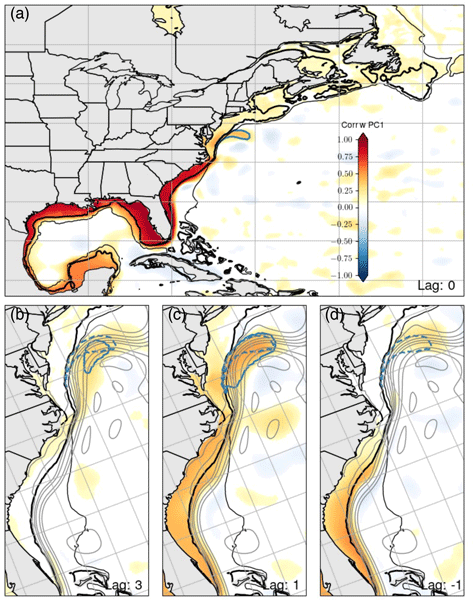
Assessing the spatiotemporal properties of intrinsic sea level variability is vital to improving predictions of coastal sea level changes. Here, we examined intrinsic sea level variability along the Southeast United States coast, an area of high and increasing societal vulnerability to sea level change, using numerical modeling. Our findings reveal that intrinsic coastal sea level variability is not negligible as previously thought and may exhibit predictability despite its chaotic nature.

Lara Börger, Michael Schindelegger, Mengnan Zhao, Rui M. Ponte, Anno Löcher, Bernd Uebbing, Jean-Marc Molines, and Thierry Penduff
Earth Syst. Dynam., 16, 75–90, https://doi.org/10.5194/esd-16-75-2025, https://doi.org/10.5194/esd-16-75-2025, 2025
Short summary
Short summary
Flows in the ocean are driven either by atmospheric forces or by small-scale internal disturbances that are inherently chaotic. We use computer simulation results to show that these chaotic oceanic disturbances can attain spatial scales large enough to alter the motion of Earth's pole of rotation. Given their size and unpredictable nature, the chaotic signals are a source of uncertainty when interpreting observed year-to-year polar motion changes in terms of other processes in the Earth system.
Mengnan Zhao, Rui Ponte, Ou Wang, Ichiro Fukumori, and Ian Fenty
EGUsphere, https://doi.org/10.5194/egusphere-2026-4739, https://doi.org/10.5194/egusphere-2026-4739, 2026
This preprint is open for discussion and under review for The Cryosphere (TC).
Short summary
Short summary
Sea ice thickness plays an important role in the climate system, yet it remains one of the least constrained variables in climate models. Our study evaluates the uncertainties in sea ice data from ICESat-2 and CryoSat-2 missions and concludes that assimilating such sea ice data could substantially improve the sea ice fields being produced under the project for Estimating the Circulation and Climate of the Ocean (ECCO).
Anastasia Romanou, Paul Lerner, Joy Romanski, Nancy Y. Kiang, Igor Aleinov, Maxwell Kelley, Ron L. Miller, Gary Russell, Reto Ruedy, Gavin A. Schmidt, Maria Z. Hakuba, and Ou Wang
Geosci. Model Dev., 19, 9131–9176, https://doi.org/10.5194/gmd-19-9131-2026, https://doi.org/10.5194/gmd-19-9131-2026, 2026
Short summary
Short summary
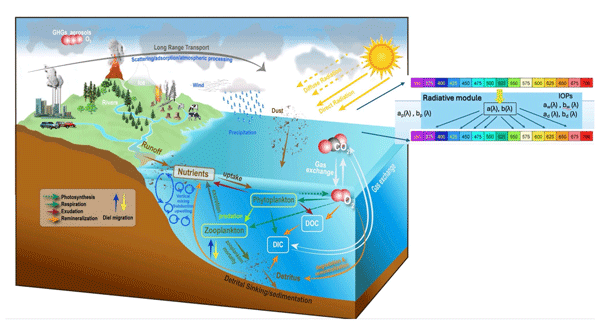
This paper describes simulations of the present climate using the NASA Goddard Institute for Space Studies Earth System model. Major highlight is the capability to include complex interactions of the different components of the Earth System, including biology, and compare well with a wide variety of observations. We demonstrate that this model can be used to address present, past and future changes in the Earth system and their impacts and interactions with ecosystems.
Joseph K. Ansong, Brian K. Arbic, Romain Bourdalle-Badié, Clément Bricaud, Jérôme Chanut, Dimitris Menemenlis, Richard D. Ray, Michael Schindelegger, Alan J. Wallcraft, He Wang, Alistair J. Adcroft, Frédéric Briol, Maarten C. Buijsman, Loren Carrère, Eric P. Chassignet, Gerald Dibarboure, Robert W. Hallberg, Christopher N. Hill, Ariane Koch-Larrouy, Florent Lyard, Matthew R. Mazloff, An T. Nguyen, Nicolas Picot, Rui M. Ponte, and Jay F. Shriver
EGUsphere, https://doi.org/10.5194/egusphere-2026-5064, https://doi.org/10.5194/egusphere-2026-5064, 2026
This preprint is open for discussion and under review for Ocean Science (OS).
Short summary
Short summary
We assess how well four high-resolution global ocean models reproduce surface and internal tides compared with satellite observations. Some models produce internal tides that are too strong, but including energy loss over rough seafloor improves their accuracy. Longer model records and higher resolution also improve agreement with observations. We further identify errors in the tidal forcing of widely used MITgcm simulations that reduce the accuracy of their simulated tides.
Mengnan Zhao, Christopher Little, Nathan Kurtz, Rachel Tilling, and Jesse Wimert
The Cryosphere, 20, 4313–4326, https://doi.org/10.5194/tc-20-4313-2026, https://doi.org/10.5194/tc-20-4313-2026, 2026
Short summary
Short summary
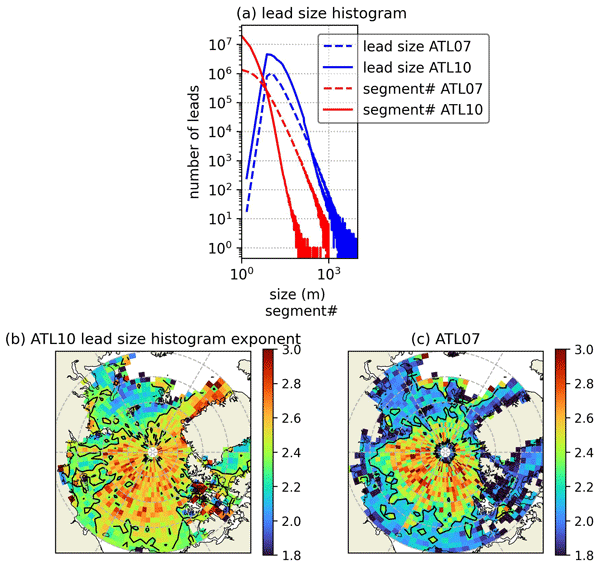
We take advantage of ICESat-2 satellite, which measures surface heights with nominal resolution of meters to tens of meters, to characterize a near pan-Arctic winter sea ice leads, meter-scale elongated cracks in ice, from 2018 to 2024. We find that lead fractions are higher near the ice edge and sizes follow a power-law distribution. Four distinct features in the temporal evolution of lead fraction are also identified, with fraction increase associated with larger leads.
Carmine Donatelli, Christopher M. Little, Rui M. Ponte, and Stephen G. Yeager
Ocean Sci., 21, 2367–2377, https://doi.org/10.5194/os-21-2367-2025, https://doi.org/10.5194/os-21-2367-2025, 2025
Short summary
Short summary
Assessing the spatiotemporal properties of intrinsic sea level variability is vital to improving predictions of coastal sea level changes. Here, we examined intrinsic sea level variability along the Southeast United States coast, an area of high and increasing societal vulnerability to sea level change, using numerical modeling. Our findings reveal that intrinsic coastal sea level variability is not negligible as previously thought and may exhibit predictability despite its chaotic nature.
Xue Feng, Matthew J. Widlansky, Tong Lee, Ou Wang, Magdalena A. Balmaseda, Hao Zuo, Gregory Dusek, William Sweet, and Malte F. Stuecker
Ocean Sci., 21, 1663–1676, https://doi.org/10.5194/os-21-1663-2025, https://doi.org/10.5194/os-21-1663-2025, 2025
Short summary
Short summary
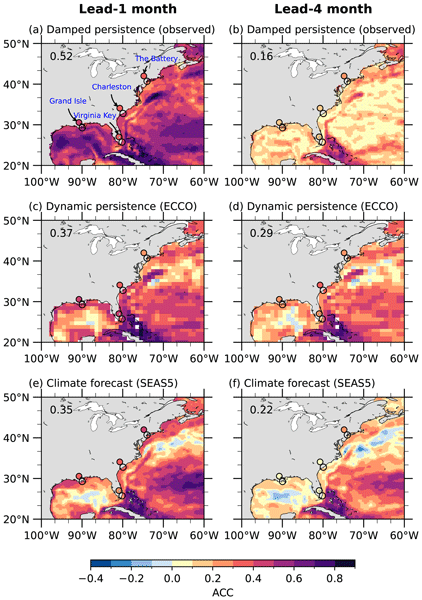
Forecasting sea level changes months in advance along the Gulf Coast and East Coast of the United States is challenging. Here, we present a method that uses past ocean states to forecast future sea levels, while assuming no knowledge of how the atmosphere will evolve other than its typical annual cycle near the ocean's surface. Our findings indicate that this method improves sea level outlooks for many locations along the Gulf Coast and East Coast, especially south of Cape Hatteras.
Lara Börger, Michael Schindelegger, Mengnan Zhao, Rui M. Ponte, Anno Löcher, Bernd Uebbing, Jean-Marc Molines, and Thierry Penduff
Earth Syst. Dynam., 16, 75–90, https://doi.org/10.5194/esd-16-75-2025, https://doi.org/10.5194/esd-16-75-2025, 2025
Short summary
Short summary
Flows in the ocean are driven either by atmospheric forces or by small-scale internal disturbances that are inherently chaotic. We use computer simulation results to show that these chaotic oceanic disturbances can attain spatial scales large enough to alter the motion of Earth's pole of rotation. Given their size and unpredictable nature, the chaotic signals are a source of uncertainty when interpreting observed year-to-year polar motion changes in terms of other processes in the Earth system.
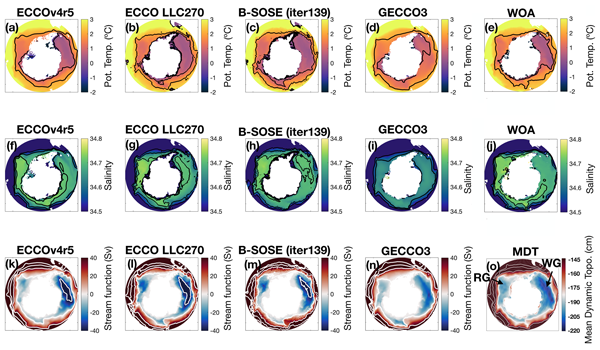
Yoshihiro Nakayama, Alena Malyarenko, Hong Zhang, Ou Wang, Matthis Auger, Yafei Nie, Ian Fenty, Matthew Mazloff, Armin Köhl, and Dimitris Menemenlis
Geosci. Model Dev., 17, 8613–8638, https://doi.org/10.5194/gmd-17-8613-2024, https://doi.org/10.5194/gmd-17-8613-2024, 2024
Short summary
Short summary
Global- and basin-scale ocean reanalyses are becoming easily accessible. However, such ocean reanalyses are optimized for their entire model domains and their ability to simulate the Southern Ocean requires evaluation. We conduct intercomparison analyses of Massachusetts Institute of Technology General Circulation Model (MITgcm)-based ocean reanalyses. They generally perform well for the open ocean, but open-ocean temporal variability and Antarctic continental shelves require improvements.
Cited articles
Androsov, A., Boebel, O., Schröter, J., Danilov, S., Macrander, A., and Ivanciu, I.: Ocean Bottom Pressure Variability: Can It Be Reliably Modeled?, J. Geophys. Res.-Oceans, 125, e2019JC015469, https://doi.org/10.1029/2019JC015469, 2020. a
Bonin, J., Pie, N., Tamisiea, M. E., Chambers, D., and Save, H.: GRACE and GRACE-FO mascons for ocean dynamic applications, Earth Syst. Sci. Data, 18, 3481–3505, https://doi.org/10.5194/essd-18-3481-2026, 2026. a, b
Caron, L., Ivins, E. R., Larour, E., Adhikari, S., Nilsson, J., and Blewitt, G.: GIA Model Statistics for GRACE Hydrology, Cryosphere, and Ocean Science, Geophys. Res. Lett., 45, 2203–2212, https://doi.org/10.1002/2017GL076644, 2018. a, b, c, d
Dahle, C., Boergens, E., Sasgen, I., Döhne, T., Reißland, S., Dobslaw, H., Klemann, V., Murböck, M., König, R., Dill, R., Sips, M., Sylla, U., Groh, A., Horwath, M., and Flechtner, F.: GravIS: mass anomaly products from satellite gravimetry, Earth Syst. Sci. Data, 17, 611–631, https://doi.org/10.5194/essd-17-611-2025, 2025. a, b
Dawson, A.: eofs: A Library for EOF Analysis of Meteorological, Oceanographic, and Climate Data, J. Open Res. Softw., 4, e14, https://doi.org/10.5334/jors.122, 2016. a
Etige, N.: nishsilva/GRACE_ECCO: ECCO-GRACE-codes v1.0.0 (Version ECCO-GRACE), Zenodo [computer software], https://doi.org/10.5281/zenodo.21380710, 2026. a
Forget, G., Campin, J. M., Heimbach, P., Hill, C. N., Ponte, R. M., and Wunsch, C.: ECCO version 4: an integrated framework for non-linear inverse modeling and global ocean state estimation, Geosci. Model Dev., 8, 3071–3104, https://doi.org/10.5194/gmd-8-3071-2015, 2015. a, b, c, d
Fukumori, I., Wang, O., Fenty, I., Forget, G., Heimbach, P., and Ponte, R. M.: ECCO version 4 release 4, Tech. Rep., Zenodo, https://doi.org/10.5281/zenodo.3765929, 2019. a, b, c, d
Gelaro, R., McCarty, W., Suárez, M. J., Todling, R., Molod, A., Takacs, L., Randles, C. A., Darmenov, A., Bosilovich, M. G., Reichle, R., Wargan, K., Coy, L., Cullather, R., Draper, C., Akella, S., Buchard, V., Conaty, A., da Silva, A. M., Gu, W., Kim, G.-K., Koster, R., Lucchesi, R., Merkova, D., Nielsen, J. E., Partyka, G., Pawson, S., Putman, W., Rienecker, M., Schubert, S. D., Sienkiewicz, M., and Zhao, B.: The Modern-Era Retrospective Analysis for Research and Applications, Version 2 (MERRA-2), J. Climate, 30, 5419–5454, https://doi.org/10.1175/JCLI-D-16-0758.1, 2017. a
Gill, A. and Niller, P.: The theory of the seasonal variability in the ocean, Deep-Sea Res. Oceanogr. Abstr., 20, 141–177, https://doi.org/10.1016/0011-7471(73)90049-1, 1973. a
Gouranton, C. G., Panet, I., Greff-Lefftz, M., Mandea, M., and Rosat, S.: GRACE Detection of Transient Mass Redistributions During a Mineral Phase Transition in the Deep Mantle, Geophys. Res. Lett., 52, e2025GL116408, https://doi.org/10.1029/2025GL116408, 2025. a, b
Greatbatch, R. J.: A note on the representation of steric sea level in models that conserve volume rather than mass, J. Geophys. Res.-Oceans, 99, 12767–12771, https://doi.org/10.1029/94JC00847, 1994. a
Gregory, J. M., Griffies, S. M., Hughes, C. W., Lowe, J. A., Church, J. A., Fukimori, I., Gomez, N., Kopp, R. E., Landerer, F., Le Cozannet, G., Ponte, R. M., Stammer, D., Tamisiea, M. E., and van de Wal, R. S. W.: Concepts and Terminology for sea Level: Mean, Variability and Change, Both Local and Global, Surv. Geophys., 40, 1251–1289, https://doi.org/10.1007/s10712-019-09525-z, 2019. a, b, c, d, e, f, g
Hakuba, M. Z., Fourest, S., Boyer, T., Meyssignac, B., Carton, J. A., Forget, G., Cheng, L., Giglio, D., Johnson, G. C., Kato, S., Killick, R. E., Kolodziejczyk, N., Kuusela, M., Landerer, F., Llovel, W., Locarnini, R., Loeb, N., Lyman, J. M., Mishonov, A., Pilewskie, P., Reagan, J., Storto, A., Sukianto, T., and von Schuckmann, K.: Trends and Variability in Earth's Energy Imbalance and Ocean Heat Uptake Since 2005, Surv. Geophys., 45, 1721–1756, https://doi.org/10.1007/s10712-024-09849-5, 2024. a
Han, S.-C., Riva, R., Sauber, J., and Okal, E.: Source parameter inversion for recent great earthquakes from a decade-long observation of global gravity fields, J. Geophys. Res.-Solid, 118, 1240–1267, https://doi.org/10.1002/jgrb.50116, 2013. a, b
Hughes, C. W., Stepanov, V. N., Fu, L.-L., Barnier, B., and Hargreaves, G. W.: Three forms of variability in Argentine Basin ocean bottom pressure, J. Geophys. Res., 112, C01011, https://doi.org/10.1029/2006JC003679, 2007. a
Köhl, A., Siegismund, F., and Stammer, D.: Impact of assimilating bottom pressure anomalies from GRACE on ocean circulation estimates, J. Geophys. Res.-Oceans, 117, https://doi.org/10.1029/2011JC007623, 2012. a, b, c, d
Landerer, F. and Wiese, D.: GRACE/GRACE-FO Level-4 Monthly Gravitational-Rotational-Deformation version 01 from NASA MEaSUREs HOMaGE, NASA, https://doi.org/10.5067/HMOGD-4JM01, 2025. a, b, c, d
Landerer, F. W., Wiese, D. N., Bentel, K., Boening, C., and Watkins, M. M.: North Atlantic meridional overturning circulation variations from GRACE ocean bottom pressure anomalies, Geophys. Res. Lett., 42, 8114–8121, https://doi.org/10.1002/2015GL065730, 2015. a, b
Landerer, F. W., Flechtner, F. M., Save, H., Webb, F. H., Bandikova, T., Bertiger, W. I., Bettadpur, S. V., Byun, S. H., Dahle, C., Dobslaw, H., Fahnestock, E., Harvey, N., Kang, Z., Kruizinga, G. L. H., Loomis, B. D., McCullough, C., Murböck, M., Nagel, P., Paik, M., Pie, N., Poole, S., Strekalov, D., Tamisiea, M. E., Wang, F., Watkins, M. M., Wen, H.-Y., Wiese, D. N., and Yuan, D.-N.: Extending the Global Mass Change Data Record: GRACE Follow-On Instrument and Science Data Performance, Geophys. Res. Lett., 47, e2020GL088306, https://doi.org/10.1029/2020GL088306, 2020. a
Makowski, J. K., Chambers, D. P., and Bonin, J. A.: Using ocean bottom pressure from the gravity recovery and climate experiment (GRACE) to estimate transport variability in the southern Indian Ocean, J. Geophys. Res.-Oceans, 120, 4245–4259, https://doi.org/10.1002/2014JC010575, 2015. a
Na, H., Watts, D. R., Park, J.-H., Jeon, C., Lee, H. J., Nonaka, M., and Greene, A. D.: Bottom pressure variability in the Kuroshio Extension driven by the atmosphere and ocean instabilities, J. Geophys. Res.- Oceans, 121, 6507–6519, https://doi.org/10.1002/2016JC012097, 2016. a
Nakayama, Y., Malyarenko, A., Zhang, H., Wang, O., Auger, M., Nie, Y., Fenty, I., Mazloff, M., Köhl, A., and Menemenlis, D.: Evaluation of MITgcm-based ocean reanalyses for the Southern Ocean, Geosci. Model Dev., 17, 8613–8638, https://doi.org/10.5194/gmd-17-8613-2024, 2024. a, b
Nilsson, J., Gardner, A. S., and Paolo, F. S.: Elevation change of the Antarctic Ice Sheet: 1985 to 2020, Earth Syst. Sci. Data, 14, 3573–3598, https://doi.org/10.5194/essd-14-3573-2022, 2022. a
Ponte, R. M.: A preliminary model study of the large-scale seasonal cycle in bottom pressure over the global ocean, J. Geophys. Res.-Oceans, 104, 1289–1300, https://doi.org/10.1029/1998JC900028, 1999. a
Ponte, R. M. and Schindelegger, M.: Seasonal Cycle in Sea Level Across the Coastal Zone, Earth Space Sci., 11, e2024EA003978, https://doi.org/10.1029/2024EA003978, 2024. a
Quinn, K. J. and Ponte, R. M.: Estimating weights for the use of time-dependent gravity recovery and climate experiment data in constraining ocean models, J. Geophys. Res.-Oceans, 113, https://doi.org/10.1029/2008JC004903, 2008. a, b, c
Rignot, E., Jacobs, S., Mouginot, J., and Scheuchl, B.: Ice-Shelf Melting Around Antarctica, Science, 341, 266–270, https://doi.org/10.1126/science.1235798, 2013. a
Saynisch, J., Bergmann-Wolf, I., and Thomas, M.: Assimilation of GRACE-derived oceanic mass distributions with a global ocean circulation model, J. Geod., 89, 121–139, https://doi.org/10.1007/s00190-014-0766-0, 2015. a, b
Simon, K. M. and Riva, R. E. M.: Uncertainty Estimation in Regional Models of Long-Term GIA Uplift and Sea Level Change: An Overview, J. Geophys. Res.-Solid, 125, e2019JB018983, https://doi.org/10.1029/2019JB018983, 2020. a
Stammer, D. and Cazenave, A. (Eds.): Applications of satellite altimetry over oceans and land surfaces, CRC Press, p. 643, https://doi.org/10.1201/9781315151779, 2017. a
Storto, A., Chierici, G., Pfeffer, J., Barnoud, A., Bourdalle-Badie, R., Blazquez, A., Cavaliere, D., Lalau, N., Coupry, B., Drevillon, M., Fourest, S., Larnicol, G., and Yang, C.: Variability in manometric sea level from reanalyses and observation-based products over the Arctic and North Atlantic oceans and the Mediterranean Sea, in: 8th edition of the Copernicus Ocean State Report (OSR8), edited by: von Schuckmann, K., Moreira, L., Grégoire, M., Marcos, M., Staneva, J., Brasseur, P., Garric, G., Lionello, P., Karstensen, J., and Neukermans, G., Copernicus Publications, State Planet, 4-osr8, 12, https://doi.org/10.5194/sp-4-osr8-12-2024, 2024. a, b
Swenson, S. and Wahr, J.: Post-processing removal of correlated errors in GRACE data, Geophys. Res. Lett., 33, https://doi.org/10.1029/2005GL025285, 2006. a
Tapley, B. D., Bettadpur, S., Watkins, M., and Reigber, C.: The gravity recovery and climate experiment: Mission overview and early results, Geophys. Res. Lett., 31, https://doi.org/10.1029/2004GL019920, 2004. a
Vinogradova, N. T., Ponte, R. M., Tamisiea, M. E., Quinn, K. J., Hill, E. M., and Davis, J. L.: Self-attraction and loading effects on ocean mass redistribution at monthly and longer time scales, J. Geophys. Res.-Oceans, 116, https://doi.org/10.1029/2011JC007037, 2011. a
Watkins, M. M., Wiese, D. N., Yuan, D.-N., Boening, C., and Landerer, F. W.: Improved Methods for Observing Earth's Time Variable Mass Distribution with GRACE Using Spherical Cap Mascons: Improved Gravity Observations from GRACE, J. Geophys. Res.-Solid, 120, 2648–2671, https://doi.org/10.1002/2014JB011547, 2015. a, b, c
WCRP Global Sea Level Budget Group: Global sea-level budget 1993–present, Earth Syst. Sci. Data, 10, 1551–1590, https://doi.org/10.5194/essd-10-1551-2018, 2018. a
Whitehouse, P. L.: Glacial isostatic adjustment modelling: historical perspectives, recent advances, and future directions, Earth Surf. Dynam., 6, 401–429, https://doi.org/10.5194/esurf-6-401-2018, 2018. a, b, c
Wiese, D. N., Yuan, D.-N., Boening, C., Landerer, F. W., and Watkins, M. M.: JPL GRACE and GRACE-FO Mascon Ocean, Ice, and Hydrology Equivalent Water Height Coastal Resolution Improvement (CRI) Filtered Release 06 Version 02, NASA, https://doi.org/10.5067/TEMSC-3JC62, 2019. a
Wiese, D. N., Yuan, D.-N., Boening, C., Landerer, F. W., and Watkins, M. M.: JPL GRACE and GRACE-FO Mascon Ocean, Ice, and Hydrology Equivalent Water Height CRI Filtered RL06.3Mv04, NASA, https://doi.org/10.5067/TEMSC-3JC634, 2024. a
Wunsch, C., Heimbach, P., Ponte, R. M., Fukumori, I., and Members, T. E.-G. C.: The Global General Circulation of the Ocean Estimated by the ECCO-Consortium, Oceanography, 22, https://doi.org/10.5670/oceanog.2009.41, 2009. a
Zhao, M., Ponte, R. M., and Penduff, T.: Global-scale random bottom pressure fluctuations from oceanic intrinsic variability, Sci. Adv., 9, eadg0278, https://doi.org/10.1126/sciadv.adg0278, 2023. a, b
Short summary
Ocean bottom pressure (pb) is a key variable for monitoring the ocean circulation, yet global space gravimetry observations offer limited coverage in space and time. Our work examines how to improve estimates of pb by optimally combining information in available data with an ocean circulation model. Results indicate that gravimetry data contain information complementary to that available in other ocean datasets and are thus important for determining variations in pb and related circulations.
Ocean bottom pressure (pb) is a key variable for monitoring the ocean circulation, yet global...


