
Articles | Volume 22, issue 4
https://doi.org/10.5194/os-22-2123-2026
© Author(s) 2026. This work is distributed under
the Creative Commons Attribution 4.0 License.
the Creative Commons Attribution 4.0 License.
https://doi.org/10.5194/os-22-2123-2026
© Author(s) 2026. This work is distributed under
the Creative Commons Attribution 4.0 License.
the Creative Commons Attribution 4.0 License.
Research article
| 
06 Jul 2026
Research article |
| 06 Jul 2026
| 06 Jul 2026
Wave-induced sediment resuspension potential in the Finnish Archipelago, Baltic Sea: integrating field measurements with large-scale numerical model simulations

Norwegian Meteorological Institute, Allégaten 70, 5007 Bergen, Norway
Mari Savela
City of Helsinki, Työpajankatu 8, 00580 Helsinki, Finland
Tvärminne Zoological Station, Faculty of Biological and Environmental Sciences, University of Helsinki, J.A. Palméns väg 260, 10900 Hangö, Finland
Heidi Pettersson
Finnish Meteorological Institute, P.O. Box 503, 00101 Helsinki, Finland
Victor Alari
Department of Marine Systems, Tallinn University of Technology, Akadeemia tee 15a, 12618 Tallinn, Estonia
Alf Norkko
Tvärminne Zoological Station, Faculty of Biological and Environmental Sciences, University of Helsinki, J.A. Palméns väg 260, 10900 Hangö, Finland
Related authors
Urmas Raudsepp, Ilja Maljutenko, Jan-Victor Björkqvist, Amirhossein Barzandeh, Sander Rikka, Aarne Männik, Siim Pärt, Priidik Lagemaa, Victor Alari, Kaimo Vahter, and Rivo Uiboupin
State Planet, 7-osr10, 14, https://doi.org/10.5194/sp-7-osr10-14-2026, https://doi.org/10.5194/sp-7-osr10-14-2026, 2026
Short summary
Short summary
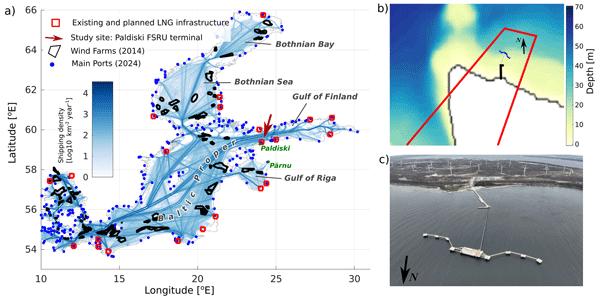
This study estimates extreme metocean conditions for the planned Floating Storage and Regasification Unit (FSRU) terminal on the Estonian coast of the Gulf of Finland. Observations, satellite products, reanalyses, and site-specific model data are used to derive 50-year return levels for wind, sea level, waves, and currents. The results support site-specific engineering assessments and place local extremes within the wider Baltic Sea context.
Jan-Victor Björkqvist and Victor Alari
EGUsphere, https://doi.org/10.5194/egusphere-2024-3477, https://doi.org/10.5194/egusphere-2024-3477, 2024
Preprint archived
Short summary
Short summary
Surface waves are generated by the wind and wave measurements can also be used to estimate the wind speed. This is beneficial in the open ocean where direct measurements of the wind are difficult. The wind speed deduced from wave measurements serve as a third estimate of the wind speed in addition to satellite measurements or numerical model results. We implemented such and algorithm to be used with wave data from a small buoy and validated it against direct wind measurements and model results.
Jan-Victor Björkqvist, Hedi Kanarik, Laura Tuomi, Lauri Niskanen, and Markus Kankainen
State Planet, 4-osr8, 10, https://doi.org/10.5194/sp-4-osr8-10-2024, https://doi.org/10.5194/sp-4-osr8-10-2024, 2024
Short summary
Short summary
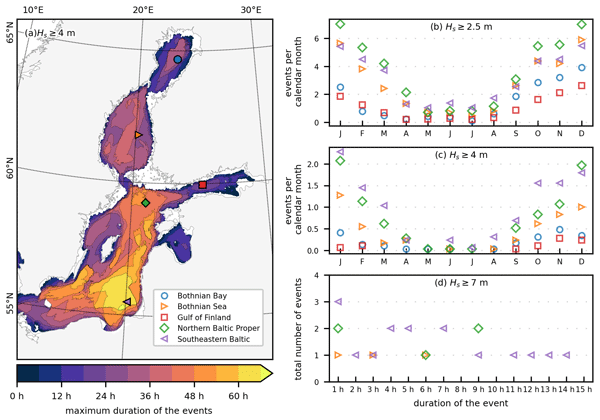
Typical wave statistics do not provide information on how often certain wave heights are exceeded and the length of such events. Our study found a strong seasonal dependence for 2.5 and 4 m wave events in the Baltic Sea. Wave heights of over 7 m occurred less than once per year. The number of 1 m wave events can double within 20 km in nearshore areas. Our results are important for all operations at sea, including ship traffic and fish farming.

Milla M. Johansson, Jan-Victor Björkqvist, Jani Särkkä, Ulpu Leijala, and Kimmo K. Kahma
Nat. Hazards Earth Syst. Sci., 22, 813–829, https://doi.org/10.5194/nhess-22-813-2022, https://doi.org/10.5194/nhess-22-813-2022, 2022
Short summary
Short summary
We analysed the correlation of sea level and wind waves at a coastal location in the Gulf of Finland using tide gauge data, wave measurements, and wave simulations. The correlation was positive for southwesterly winds and negative for northeasterly winds. Probabilities of high total water levels (sea level + wave crest) are underestimated if sea level and waves are considered independent. Suitably chosen copula functions can account for the dependence.
Jan-Victor Björkqvist, Siim Pärt, Victor Alari, Sander Rikka, Elisa Lindgren, and Laura Tuomi
Ocean Sci., 17, 1815–1829, https://doi.org/10.5194/os-17-1815-2021, https://doi.org/10.5194/os-17-1815-2021, 2021
Short summary
Short summary
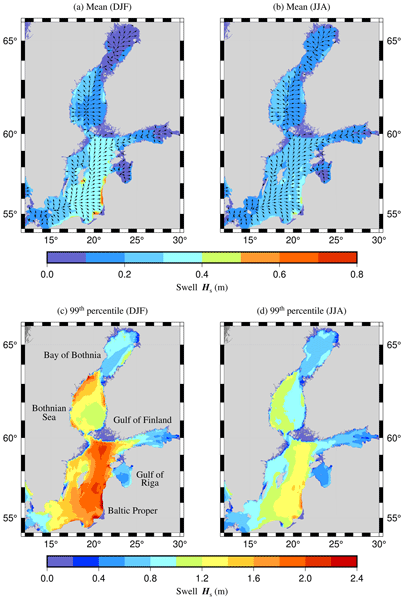
Waves that travel faster than the wind are called swell. Our study presents wave model statistics of swell waves in the Baltic Sea, since such statistics have not yet been reliably compiled. Our results confirm that long, high, and persistent swell is absent in the Baltic Sea. We found that the dependency between swell and wind waves differs in the open sea compared to nearshore areas. These distinctions are important for studies on how waves interact with the atmosphere and the sea floor.
Urmas Raudsepp, Ilja Maljutenko, Jan-Victor Björkqvist, Amirhossein Barzandeh, Sander Rikka, Aarne Männik, Siim Pärt, Priidik Lagemaa, Victor Alari, Kaimo Vahter, and Rivo Uiboupin
State Planet, 7-osr10, 14, https://doi.org/10.5194/sp-7-osr10-14-2026, https://doi.org/10.5194/sp-7-osr10-14-2026, 2026
Short summary
Short summary
This study estimates extreme metocean conditions for the planned Floating Storage and Regasification Unit (FSRU) terminal on the Estonian coast of the Gulf of Finland. Observations, satellite products, reanalyses, and site-specific model data are used to derive 50-year return levels for wind, sea level, waves, and currents. The results support site-specific engineering assessments and place local extremes within the wider Baltic Sea context.
Nishant Nishant, Janina Pykäri, Roel Lammerant, Anna Villnäs, Camilla Gustafsson, Alf Norkko, Gregory Cowie, and Tom Jilbert
EGUsphere, https://doi.org/10.5194/egusphere-2026-4456, https://doi.org/10.5194/egusphere-2026-4456, 2026
This preprint is open for discussion and under review for Biogeosciences (BG).
Short summary
Short summary
Carbon storage in shallow coastal sediments varies strongly with wave exposure and local environmental conditions. Across 20 shallow brackish-water coastal sites in Southern Finland, sheltered sediments held much more carbon than wave-exposed sediments. The carbon-rich sediments further showed more active ongoing carbon breakdown. Our approach highlights the diversity of shallow coastal seafloor environments in terms of sediment carbon storage and recycling.
Aki Vähä, Joachim Jansen, Kurt Spence, Joanna Norkko, Alf Norkko, and Ivan Mammarella
EGUsphere, https://doi.org/10.5194/egusphere-2026-3945, https://doi.org/10.5194/egusphere-2026-3945, 2026
Short summary
Short summary
Coasts are globally identified as sinks of carbon. We found that a coastal site in northern Baltic Sea acted as a small source of carbon dioxide into the atmosphere during 2022–2024. There was a seasonal pattern of carbon dioxide exchange: a sink during spring, a variable sink and source during summer, and a source during autumn and winter. Our gap-filling model identified wind speed and sea salinity as the most important environmental co-variates of the carbon dioxide exchange.

Nicolas-Xavier Geilfus, Bruno Delille, Anna Villnäs, and Alf Norkko
Biogeosciences, 23, 1931–1948, https://doi.org/10.5194/bg-23-1931-2026, https://doi.org/10.5194/bg-23-1931-2026, 2026
Short summary
Short summary
Coastal ecosystems strongly influence the global carbon cycle but remain poorly quantified. We measured surface pCO₂, CH₄, and N₂O concentrations in southwest Finland across an estuarine ecosystem. Greenhouse gases concentrations varied with salinity and habitat type. Riverine inputs and mixing with seawater, and primary production shaped greenhouse gases dynamics, emphasizing benthic control as a key yet uncertain driver of coastal carbon fluxes.
Dana Hellemann, Xiaole Sun, Tom Jilbert, Eva Ehrnsten, Lora Harris, Bo Gustafsson, Christoph Humborg, and Alf Norkko
EGUsphere, https://doi.org/10.5194/egusphere-2026-959, https://doi.org/10.5194/egusphere-2026-959, 2026
Short summary
Short summary
Using model-simulations and field data, we assess the effect of past eutrophication on present and future ammonium dynamics in coastal sediments of the Baltic Sea and their impact on the coastal ecosystem. Our results indicate a clear eutrophication legacy effect on the persistence of ammonium being released from the sediment to the water column, particularly under oxygen deficiency, with long-lasting effects into the far future and thus important implications for ecosystem recovery measures.

Margaret F. Williamson, Tom Jilbert, Alf Norkko, and Camilla Gustafsson
Biogeosciences, 23, 1327–1340, https://doi.org/10.5194/bg-23-1327-2026, https://doi.org/10.5194/bg-23-1327-2026, 2026
Short summary
Short summary
Reed bed carbon (C) storage is a topic of interest due to increased global distribution of reeds. C budgets to combat climate change often catalog reed beds as saltmarshes. Our findings show that reed beds are unique from saltmarshes, C storage is highest in reed bed sediments, and that reed bed zones may impact C storage. Further research into reed bed C is needed to better combat climate change and to ensure reeds are managed in a way that does not release excess C.
Maija Peltola, Roseline Thakur, Kurt Spence, Janne Lampilahti, Ronja Mäkelä, Sasu Karttunen, Ekaterina Ezhova, Sami Haapanala, Aki Vähä, Juha Kangasluoma, Tommy Chan, Pauli Paasonen, Joanna Norkko, Alf Norkko, Markku Kulmala, and Mikael Ehn
Atmos. Chem. Phys., 26, 489–513, https://doi.org/10.5194/acp-26-489-2026, https://doi.org/10.5194/acp-26-489-2026, 2026
Short summary
Short summary
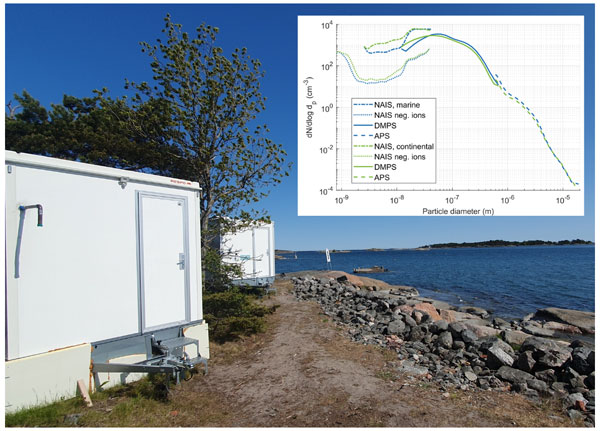
Here, we report aerosol properties from a new atmospheric observatory established at the Finnish Baltic Sea Coast. Aerosol formation was observed when air masses crossed over the continent whereas less newly formed particles were observed when the winds were from the sea. Aerosol formation was favoured by low condensation sink and sunny dry conditions.
Jan-Victor Björkqvist and Victor Alari
EGUsphere, https://doi.org/10.5194/egusphere-2024-3477, https://doi.org/10.5194/egusphere-2024-3477, 2024
Preprint archived
Short summary
Short summary
Surface waves are generated by the wind and wave measurements can also be used to estimate the wind speed. This is beneficial in the open ocean where direct measurements of the wind are difficult. The wind speed deduced from wave measurements serve as a third estimate of the wind speed in addition to satellite measurements or numerical model results. We implemented such and algorithm to be used with wave data from a small buoy and validated it against direct wind measurements and model results.
Jan-Victor Björkqvist, Hedi Kanarik, Laura Tuomi, Lauri Niskanen, and Markus Kankainen
State Planet, 4-osr8, 10, https://doi.org/10.5194/sp-4-osr8-10-2024, https://doi.org/10.5194/sp-4-osr8-10-2024, 2024
Short summary
Short summary
Typical wave statistics do not provide information on how often certain wave heights are exceeded and the length of such events. Our study found a strong seasonal dependence for 2.5 and 4 m wave events in the Baltic Sea. Wave heights of over 7 m occurred less than once per year. The number of 1 m wave events can double within 20 km in nearshore areas. Our results are important for all operations at sea, including ship traffic and fish farming.
Christoffer Hallgren, Johan Arnqvist, Erik Nilsson, Stefan Ivanell, Metodija Shapkalijevski, August Thomasson, Heidi Pettersson, and Erik Sahlée
Wind Energ. Sci., 7, 1183–1207, https://doi.org/10.5194/wes-7-1183-2022, https://doi.org/10.5194/wes-7-1183-2022, 2022
Short summary
Short summary
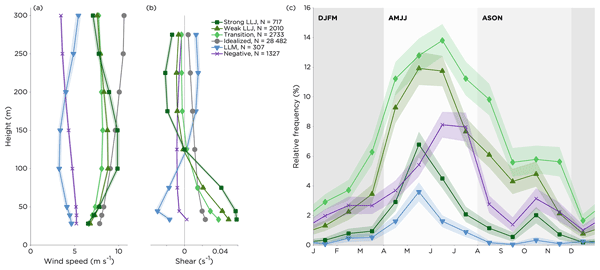
Non-idealized wind profiles with negative shear in part of the profile (e.g., low-level jets) frequently occur in coastal environments and are important to take into consideration for offshore wind power. Using observations from a coastal site in the Baltic Sea, we analyze in which meteorological and sea state conditions these profiles occur and study how they alter the turbulence structure of the boundary layer compared to idealized profiles.
Roseline C. Thakur, Lubna Dada, Lisa J. Beck, Lauriane L. J. Quéléver, Tommy Chan, Marjan Marbouti, Xu-Cheng He, Carlton Xavier, Juha Sulo, Janne Lampilahti, Markus Lampimäki, Yee Jun Tham, Nina Sarnela, Katrianne Lehtipalo, Alf Norkko, Markku Kulmala, Mikko Sipilä, and Tuija Jokinen
Atmos. Chem. Phys., 22, 6365–6391, https://doi.org/10.5194/acp-22-6365-2022, https://doi.org/10.5194/acp-22-6365-2022, 2022
Short summary
Short summary
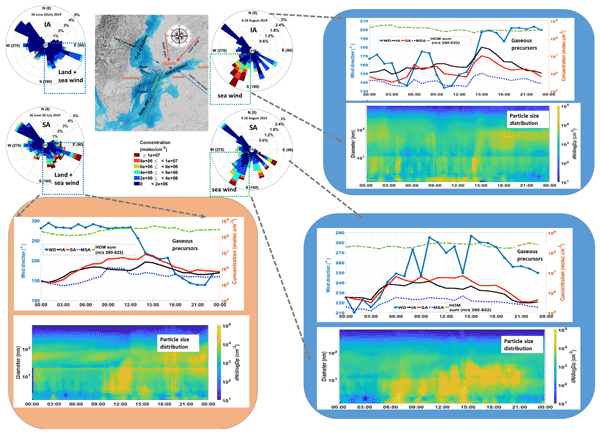
Every year intense cyanobacterial and macroalgal blooms occur in the Baltic Sea and in the coastal areas surrounding Helsinki, yet no studies have addressed the impact of biogenic emissions from these blooms on gas vapor concentrations, which in turn could influence new particle formation. This is the first study of its kind to address the chemistry driving new particle formation (NPF) during a bloom period in this region, highlighting the role of biogenic sulfuric acid and iodic acid.
Milla M. Johansson, Jan-Victor Björkqvist, Jani Särkkä, Ulpu Leijala, and Kimmo K. Kahma
Nat. Hazards Earth Syst. Sci., 22, 813–829, https://doi.org/10.5194/nhess-22-813-2022, https://doi.org/10.5194/nhess-22-813-2022, 2022
Short summary
Short summary
We analysed the correlation of sea level and wind waves at a coastal location in the Gulf of Finland using tide gauge data, wave measurements, and wave simulations. The correlation was positive for southwesterly winds and negative for northeasterly winds. Probabilities of high total water levels (sea level + wave crest) are underestimated if sea level and waves are considered independent. Suitably chosen copula functions can account for the dependence.
Jan-Victor Björkqvist, Siim Pärt, Victor Alari, Sander Rikka, Elisa Lindgren, and Laura Tuomi
Ocean Sci., 17, 1815–1829, https://doi.org/10.5194/os-17-1815-2021, https://doi.org/10.5194/os-17-1815-2021, 2021
Short summary
Short summary
Waves that travel faster than the wind are called swell. Our study presents wave model statistics of swell waves in the Baltic Sea, since such statistics have not yet been reliably compiled. Our results confirm that long, high, and persistent swell is absent in the Baltic Sea. We found that the dependency between swell and wind waves differs in the open sea compared to nearshore areas. These distinctions are important for studies on how waves interact with the atmosphere and the sea floor.

Jari Walden, Liisa Pirjola, Tuomas Laurila, Juha Hatakka, Heidi Pettersson, Tuomas Walden, Jukka-Pekka Jalkanen, Harri Nordlund, Toivo Truuts, Miika Meretoja, and Kimmo K. Kahma
Atmos. Chem. Phys., 21, 18175–18194, https://doi.org/10.5194/acp-21-18175-2021, https://doi.org/10.5194/acp-21-18175-2021, 2021
Short summary
Short summary
Ship emissions play an important role in the deposition of gaseous compounds and nanoparticles (Ntot), affecting climate, human health (especially in coastal areas), and eutrophication. Micrometeorological methods showed that ship emissions were mainly responsible for the deposition of Ntot, whereas they only accounted for a minor proportion of CO2 deposition. An uncertainty analysis applied to the fluxes and fuel sulfur content results demonstrated the reliability of the results.
Cited articles
Abdolali, A., Roland, A., van der Westhuysen, A., Meixner, J., Chawla, A., Hesser, T. J., Smith, J. M., and Sikiric, M. D.: Large-Scale Hurricane Modeling Using Domain Decomposition Parallelization and Implicit Scheme Implemented in WAVEWATCH III Wave Model, Coast. Eng., 157, 103656, https://doi.org/10.1016/j.coastaleng.2020.103656, 2020. a
Alari, V. and Raudsepp, U.: Simulation of Wave Damping Near Coast due to Offshore Wind Farms, J. Coastal Res., 28, 143–148, https://doi.org/10.2112/JCOASTRES-D-10-00054.1, 2012. a
Alenius, P., Myrberg, K., and Nekrasov, A.: The physical oceanography of the Gulf of Finland: a review, Boreal Environ. Res, 3, 97–125, 1998. a
Andersen, T. J. and Pejrup, M.: Biological Mediation of the Settling Velocity of Bed Material Eroded from an Intertidal Mudflat, the Danish Wadden Sea, Estuar. Coast. Shelf S., 54, 737–745, https://doi.org/10.1006/ecss.2001.0856, 2002. a
Andersen, T. J., Lund-Hansen, L. C., Pejrup, M., Jensen, K. T., and Mouritsen, K. N.: Biologically induced differences in erodibility and aggregation of subtidal and intertidal sediments: a possible cause for seasonal changes in sediment deposition, J. Marine Syst., 55, 123–138, https://doi.org/10.1016/j.jmarsys.2004.09.004, 2005. a
Björkqvist, J.-V., Lukas, I., Alari, V., van Vledder, G. P., Hulst, S., Pettersson, H., Behrens, A., and Männik, A.: Comparing a 41-year model hindcast with decades of wave measurements from the Baltic Sea, Ocean Eng., 152, 57–71, https://doi.org/10.1016/J.OCEANENG.2018.01.048, 2018. a
Björkqvist, J.-V., Vähä-Piikkiö, O., Alari, V., Kuznetsova, A., and Tuomi, L.: WAM, SWAN and WAVEWATCH III in the Finnish archipelago–the effect of spectral performance on bulk wave parameters, J. Oper. Oceanogr., 13, 55–70, https://doi.org/10.1080/1755876X.2019.1633236, 2020. a
Björkqvist, J.-V., Pettersson, H., and Roine, T.: Wave buoy data from the Tvärminne area from 2017, Zenodo [data set], https://doi.org/10.5281/zenodo.15781282, 2025. a
Black, K. S., Tolhurst, T. J., Paterson, D. M., and Hagerthey, S. E.: Working with Natural Cohesive Sediments, J. Hydraul. Eng., 128, 2–8, https://doi.org/10.1061/(ASCE)0733-9429(2002)128:1(2), 2002. a
Booij, N., Ris, R., and Holthuijsen, L. H.: A third-generation wave model for coastal regions 1. Model description and validation, J. Geophys. Res., 104, 7649–7666, https://doi.org/10.1029/98jc02622, 1999. a
Dade, W. B., Nowell, A. R. M., and Jumars, P. A.: Predicting erosion resistance of muds, Mar. Geol., 105, 285–297, https://doi.org/10.1016/0025-3227(92)90194-M, 1992. a, b
Datawell (BV): Datawell Waverider Reference Manual, https://datawell.nl/wp-content/uploads/2025/01/datawell_manual_dwr-mk3_dwr-g_wr-sg_2025-01-08.pdf (last access: 4 November 2025), 2025. a
Decho, A. W.: Microbial biofilms in intertidal systems: an overview, Cont. Shelf Res., 20, 1257–1273, https://doi.org/10.1016/S0278-4343(00)00022-4, 2000. a
de Deckere, E. M. G. T., Tolhurst, T. J., and de Brouwer, J. F. C.: Destabilization of Cohesive Intertidal Sediments by Infauna, Estuar. Coast. Shelf S., 53, 665–669, https://doi.org/10.1006/ecss.2001.0811, 2001. a
Edge, K. J., Dafforn, K. A., Simpson, S. L., Ringwood, A. H., and Johnston, E. L.: Resuspended contaminated sediments cause sublethal stress to oysters: A biomarker differentiates total suspended solids and contaminant effects, Environ. Toxicol. Chem., 34, 1345–1353, https://doi.org/10.1002/etc.2929, 2015. a
Eerola, K.: Twenty-One Years of Verification from the HIRLAM NWP System, Weather Forecast., 28, 270–285, https://doi.org/10.1175/WAF-D-12-00068.1, 2013. a
Giudici, A., Jankowski, M. Z., Männikus, R., Najafzadeh, F., Suursaar, Ü., and Soomere, T.: A comparison of Baltic Sea wave properties simulated using two modelled wind data sets, Estuar. Coast. Shelf S., 290, 108401, https://doi.org/10.1016/j.ecss.2023.108401, 2023. a
Grabowski, R. C., Droppo, I. G., and Wharton, G.: Erodibility of cohesive sediment: The importance of sediment properties, Earth-Sci. Rev., 105, 101–120, https://doi.org/10.1016/j.earscirev.2011.01.008, 2011. a, b, c
Green, M. O. and Coco, G.: Review of wave-driven sediment resuspension and transport in estuaries, Rev. Geophys., 52, 77–117, https://doi.org/10.1002/2013RG000437, 2014. a, b
Harris, R. J., Pilditch, C. A., Hewitt, J. E., Lohrer, A. M., Van Colen, C., Townsend, M., and Thrush, S. F.: Biotic interactions influence sediment erodibility on wave-exposed sandflats, Mar. Ecol.-Prog. Ser., 523, 15–30, 2015. a
Heiskanen, A.-S.: Factors governing sedimentation and pelagic nutrient cycles in the northern Baltic Sea, PhD thesis, doctoral dissertation, University of Helsinki, Helsinki, http://hdl.handle.net/10138/39314 (last access: 29 June 2026), 1998. a
Holthuijsen, L. H.: Waves in Oceanic and Coastal Waters, Cambridge University Press, Cambridge, https://doi.org/10.1017/CBO9780511618536, 2007. a, b
Jepsen, R., Roberts, J., and Lick, W.: Effects of Bulk Density on Sediment Erosion Rates, Water Air Soil Poll., 99, 21–31, https://doi.org/10.1023/A:1018355626070, 1997. a
Joensuu, M., Pilditch, C. A., Harris, R., Hietanen, S., Pettersson, H., and Norkko, A.: Sediment properties, biota, and local habitat structure explain variation in the erodibility of coastal sediments, Limnol. Oceanogr., 63, 173–186, https://doi.org/10.1002/lno.10622, 2018. a, b, c, d, e, f, g, h, i, j, k, l, m, n
Kaskela, A. M., Kotilainen, A. T., Alanen, U., Cooper, R., Green, S., Guinan, J., van Heteren, S., Kihlman, S., Van Lancker, V., Stevenson, A., and the EMODnet Geology Partners: Picking Up the Pieces—Harmonising and Collating Seabed Substrate Data for European Maritime Areas, Geosciences, 9, https://doi.org/10.3390/geosciences9020084, 2019. a
Koch, E. W., Ackerman, J. D., Verduin, J., and van Keulen, M.: Fluid Dynamics in Seagrass Ecology – from Molecules to Ecosystems, in: Seagrasses: Biology, Ecology and Conservation, Springer, Dordrecht, https://doi.org/10.1007/978-1-4020-2983-7_8, 2007. a
Le Hir, P., Monbet, Y., and Orvain, F.: Sediment erodability in sediment transport modelling: Can we account for biota effects?, Cont. Shelf Res., 27, 1116–1142, https://doi.org/10.1016/j.csr.2005.11.016, 2007. a, b, c
Madsen, J., Chambers, P., James, W., Koch, E., and Westlake, D.: The interaction between water movement, sediment dynamics and submersed macrophytes, Hydrobiologia, 444, 71–84, https://doi.org/10.1023/A:1017520800568, 2001. a
Michaud, E., Desrosiers, G., Mermillod-Blondin, F., Sundby, B., and Stora, G.: The functional group approach to bioturbation: II. The effects of the Macoma balthica community on fluxes of nutrients and dissolved organic carbon across the sediment–water interface, J. Exp. Mar. Biol. Ecol., 337, 178–189, 2006. a
Miettunen, E.: Circulation and transport dynamics in the Archipelago Sea, PhD thesis, University of Helsinki, http://hdl.handle.net/10138/587710 (last access: 22 June 2026), 2024. a
Mulsow, S., Boudreau, B. P., and Smith, J. A.: Bioturbation and porosity gradients, Limnol. Oceanogr., 43, 1–9, 1998. a
Pascolo, S., Petti, M., and Bosa, S.: On the Wave Bottom Shear Stress in Shallow Depths: The Role of Wave Period and Bed Roughness, Water, 10, 1348, https://doi.org/10.3390/w10101348, 2018. a
Pettersson, H., Kahma, K. K., and Tuomi, L.: Wave Directions in a Narrow Bay, J. Phys. Oceanogr., 40, 155–169, https://doi.org/10.1175/2009JPO4220.1, 2010. a
Roberts, J., Jepsen, R., Gotthard, D., and Lick, W.: Effects of Particle Size and Bulk Density on Erosion of Quartz Particles, J. Hydraul. Eng., 124, 1261–1267, https://doi.org/10.1061/(ASCE)0733-9429(1998)124:12(1261), 1998. a, b
Savela, M.: Hydrological and Sediment Dataset from the Tvärminne Coastal Area (2014–2015), Zenodo [data set], https://doi.org/10.5281/zenodo.15796802, 2025. a
Shields, A.: Anwendung der Ähnlichkeitsmechanik und der Turbulenzforschung auf die Geschiebebewegung, Preußische Versuchsanstalt für Wasserbau, Berlin, Germany, http://authors.library.caltech.edu/25992/1/Sheilds.pdf (last access: 22 June 2026), 1936. a
Soulsby, R.: Dynamics of Marine Sands, Thomas Telford Publishing, London, UK, https://doi.org/10.1680/doms.25844, 1997. a, b, c
Soulsby, R. L. and Whitehouse, R. J. S.: Threshold of Sediment Motion in Coastal Environments, Conference paper, Centre for Advanced Engineering, University of Canterbury, Christchurch, N.Z., https://search.informit.org/doi/10.3316/informit.929741720399033 (last access: 29 June 2026), 1997. a, b, c, d
Tuomi, L., Pettersson, H., Fortelius, C., Tikka, K., Björkqvist, J.-V., and Kahma, K. K.: Wave modelling in archipelagos, Coast. Eng., 83, 205–220, https://doi.org/10.1016/j.coastaleng.2013.10.011, 2014. a
Valanko, S.: Dispersal and metacommunity dynamics in a soft-sediment benthic system: how well is the seafloor connected?, Åbo Akademi University, https://urn.fi/URN:NBN:fi-fe201311117329 (last access: 29 June 2026), 2012. a
Westerlund, A., Tuomi, L., Alenius, P., Miettunen, E., and Vankevich, R. E.: Attributing mean circulation patterns to physical phenomena in the Gulf of Finland, Oceanologia, 60, 16–31, https://doi.org/10.1016/j.oceano.2017.05.003, 2018. a, b
Zhang, G., Hu, S., Yu, X., Zhang, H., and Gong, W.: Physical drivers and parameter sensitivities of pearl river-derived sediment dispersal on the Northern South China Sea Shelf: a modeling study, Ocean Sci., 21, 2041–2068, https://doi.org/10.5194/os-21-2041-2025, 2025. a
Zuur, A. F., Ieno, E. N., and Elphick, C. S.: A protocol for data exploration to avoid common statistical problems, Methods Ecol. Evol., 1, 3–14, https://doi.org/10.1111/j.2041-210X.2009.00001.x, 2010. a
Short summary
Strong motions caused by surface waves can set the material at the bottom in motion. How strong the wave motions need to be depends on the bottom type, for example mud or sand. We estimated how often waves can lift particles from the bottom by comparing wave model results to sea floor samples in the laboratory. We included the effect of seasonal biological activity, which was found to be significant.
Strong motions caused by surface waves can set the material at the bottom in motion. How strong...


