
Articles | Volume 22, issue 3
https://doi.org/10.5194/os-22-1745-2026
© Author(s) 2026. This work is distributed under
the Creative Commons Attribution 4.0 License.
the Creative Commons Attribution 4.0 License.
https://doi.org/10.5194/os-22-1745-2026
© Author(s) 2026. This work is distributed under
the Creative Commons Attribution 4.0 License.
the Creative Commons Attribution 4.0 License.
Research article
| 
02 Jun 2026
Research article |
| 02 Jun 2026
| 02 Jun 2026
Intraseasonal modulation of sea surface temperatures in the Tropical North Atlantic by African Easterly Waves
Marc Kakante Mendy
CORRESPONDING AUTHOR

Université de Toulouse, LEGOS (IRD/UT3/CNES/CNRS), Toulouse, France
Université Amadou Mahtar Mbow, UFR Sciences et Technologies Avancées, Pôle Urbain de Diamniadio, Diamniadio, Sénégal
Université Cheikh Anta Diop, Dakar, Sénégal
Florent Gasparin
Université de Toulouse, LEGOS (IRD/UT3/CNES/CNRS), Toulouse, France
Manon Gévaudan
Météo-France, CNRS, Université de Toulouse, CNRM, Toulouse, France
Moussa Diakhaté
Université Amadou Mahtar Mbow, Polytech, Pôle Urbain de Diamniadio, Diamniadio, Sénégal
Issa Sakho
Université Amadou Mahtar Mbow, UFR Sciences et Technologies Avancées, Pôle Urbain de Diamniadio, Diamniadio, Sénégal
Julien Jouanno
Université de Toulouse, LEGOS (IRD/UT3/CNES/CNRS), Toulouse, France
Related authors
No articles found.
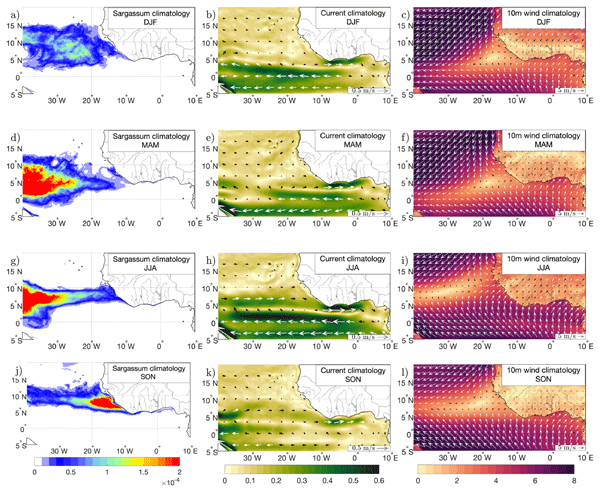
Clovis Thouvenin-Masson and Julien Jouanno
Ocean Sci., 22, 2835–2862, https://doi.org/10.5194/os-22-2835-2026, https://doi.org/10.5194/os-22-2835-2026, 2026
Short summary
Short summary
We studied why floating Sargassum seaweed repeatedly reaches the northern Gulf of Guinea, where it affects coastal activities such as fishing. By combining satellite observations with computer simulations, we found two main arrival seasons, in spring and autumn. Most events are driven by seaweed transported from the eastern tropical Atlantic, while winds push it toward the coast and beaching limits how long it persists. Year-to-year changes are linked to shifts in Atlantic climate.
Gaël Many, Julien Jouanno, Marc Lucas, Audrey Hasson, Jean-Michel Lellouche, and Yann Drillet
State Planet Discuss., https://doi.org/10.5194/sp-2026-30, https://doi.org/10.5194/sp-2026-30, 2026
Preprint under review for SP
Short summary
Short summary
Large Sargassum blooms have become a recurring feature of the Tropical Atlantic, affecting coastal areas and ecosystems. We studied satellite observations from 2002 to 2025 to understand how bloom size and severity vary through time and across regions. We developed two simple indicators to compare years and areas. The results reveal strong regional differences and show that 2025 was an exceptional basin-wide bloom, highlighting the value of consistent monitoring for tracking future events.
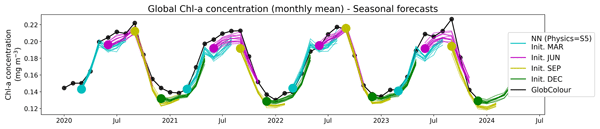
Gabriela Martinez Balbontin, Julien Jouanno, Rachid Benshila, Julien Lamouroux, Coralie Perruche, and Stefano Ciavatta
Biogeosciences, 23, 2601–2620, https://doi.org/10.5194/bg-23-2601-2026, https://doi.org/10.5194/bg-23-2601-2026, 2026
Short summary
Short summary
This study uses machine learning to predict global sea surface chlorophyll a, which is important for monitoring marine ecosystems and the carbon cycle. Using forecasts of sea surface temperature, salinity, height, and mixed layer depth, we generate global predictions up to six months ahead in just minutes. Our approach matches state-of-the-art numerical methods while being faster and more resource-efficient.
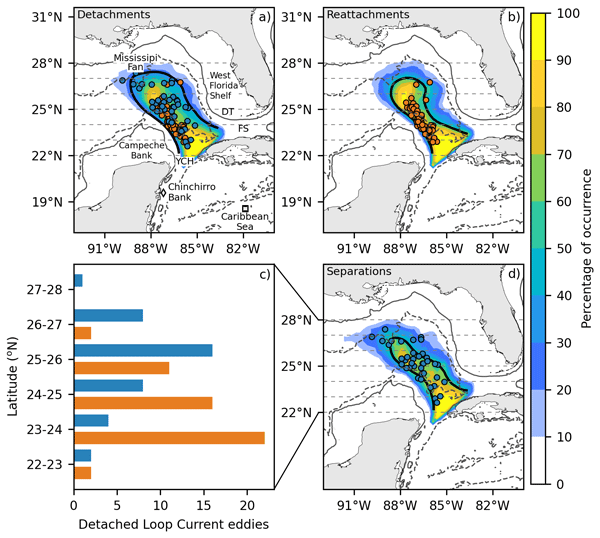
Marco Larrañaga, Julien Jouanno, Eric P. Chassignet, Giovanni Durante, Ilkyeong Ma, Julio Sheinbaum, and Lionel Renault
Ocean Sci., 22, 821–841, https://doi.org/10.5194/os-22-821-2026, https://doi.org/10.5194/os-22-821-2026, 2026
Short summary
Short summary
We analyze 29 years of satellite altimetry to investigate the detachment of Loop Current Eddies in the Gulf of Mexico. Over half of the Loop Current eddies reattach within a month, while 42 % separate and drift westward. Detachment requires the Loop Current to reach the Mississippi Fan and is strongly influenced by cyclonic eddies, whose configuration determines whether an eddy separates or reattaches to the Loop Current.
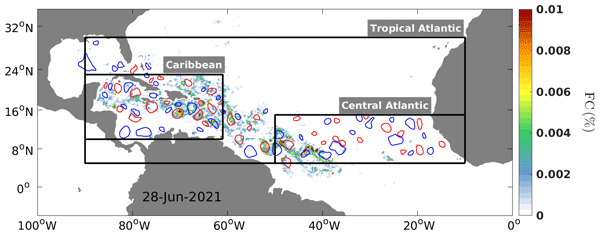
Rosmery Sosa-Gutierrez, Julien Jouanno, and Leo Berline
Ocean Sci., 21, 1505–1514, https://doi.org/10.5194/os-21-1505-2025, https://doi.org/10.5194/os-21-1505-2025, 2025
Short summary
Short summary
Since 2010, pelagic Sargassum spp. blooms have increased in several tropical Atlantic regions, causing socioeconomic and ecosystem impacts. Offshore structuration of Sargassum by mesoscale dynamics may influence transport and growth. Sargassum stays afloat, constantly interacting with currents, waves, winds, and mesoscale eddies. We find that anticyclones and cyclones effectively trap Sargassum throughout its propagation, with a greater tendency for cyclones to accumulate Sargassum.
Elsa Mohino, Paul-Arthur Monerie, Juliette Mignot, Moussa Diakhaté, Markus Donat, Christopher David Roberts, and Francisco Doblas-Reyes
Earth Syst. Dynam., 15, 15–40, https://doi.org/10.5194/esd-15-15-2024, https://doi.org/10.5194/esd-15-15-2024, 2024
Short summary
Short summary
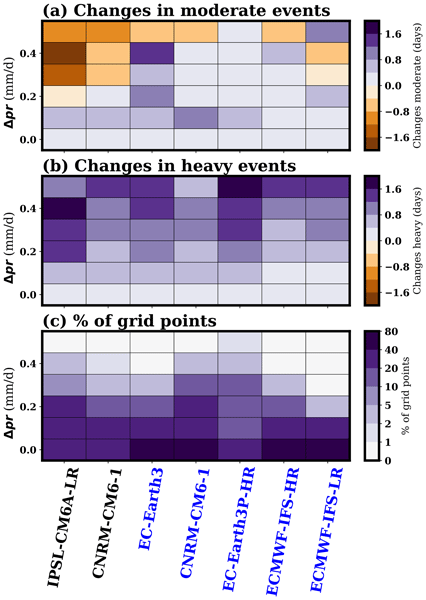
The impact of the Atlantic multidecadal variability (AMV) on the rainfall distribution and timing of the West African monsoon is not well known. Analysing model output, we find that a positive AMV enhances the number of wet days, daily rainfall intensity, and extremes over the Sahel and tends to prolong the monsoon length through later demise. Heavy rainfall events increase all over the Sahel, while moderate ones only occur in the north. Model biases affect the skill in simulating AMV impact.
Peter Brandt, Gaël Alory, Founi Mesmin Awo, Marcus Dengler, Sandrine Djakouré, Rodrigue Anicet Imbol Koungue, Julien Jouanno, Mareike Körner, Marisa Roch, and Mathieu Rouault
Ocean Sci., 19, 581–601, https://doi.org/10.5194/os-19-581-2023, https://doi.org/10.5194/os-19-581-2023, 2023
Short summary
Short summary
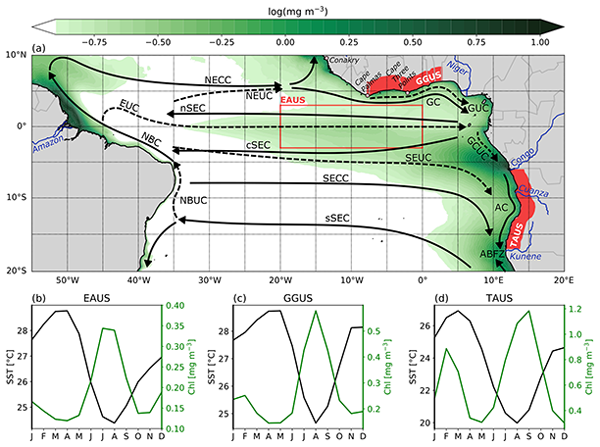
Tropical upwelling systems are among the most productive ecosystems globally. The tropical Atlantic upwelling undergoes a strong seasonal cycle that is forced by the wind. Local wind-driven upwelling and remote effects, particularly via the propagation of equatorial and coastal trapped waves, lead to an upward and downward movement of the nitracline. Turbulent mixing results in upward supply of nutrients. Here, we review the different physical processes responsible for biological productivity.
Roy Dorgeless Ngakala, Gaël Alory, Casimir Yélognissè Da-Allada, Olivia Estelle Kom, Julien Jouanno, Willi Rath, and Ezinvi Baloïtcha
Ocean Sci., 19, 535–558, https://doi.org/10.5194/os-19-535-2023, https://doi.org/10.5194/os-19-535-2023, 2023
Short summary
Short summary
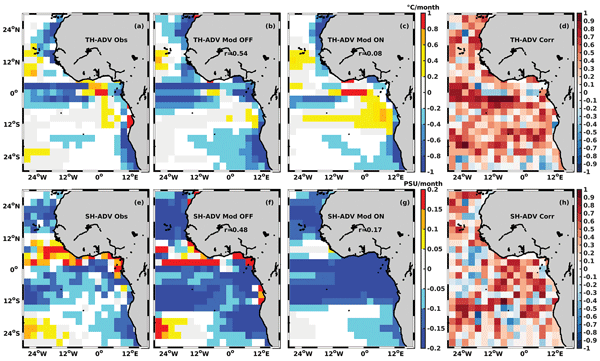
Surface heat flux is the main driver of the heat budget in the Senegal, Angola, and Benguela regions but not in the equatorial region. In the Senegal and Benguela regions, freshwater flux governs the salt budget, while in equatorial and Angola regions, oceanic processes are the main drivers. Results from numerical simulation show the important role of mesoscale advection for temperature and salinity variations in the mixed layer. Nonlinear processes unresolved by observations play a key role.
Sarah Berthet, Julien Jouanno, Roland Séférian, Marion Gehlen, and William Llovel
Earth Syst. Dynam., 14, 399–412, https://doi.org/10.5194/esd-14-399-2023, https://doi.org/10.5194/esd-14-399-2023, 2023
Short summary
Short summary
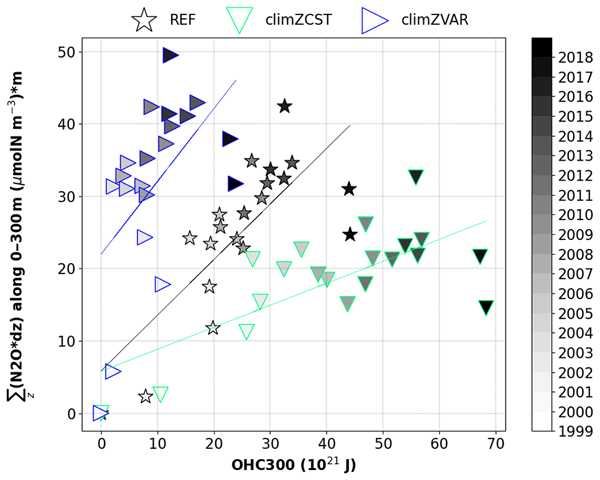
Phytoplankton absorbs the solar radiation entering the ocean surface and contributes to keeping the associated energy in surface waters. This natural effect is either not represented in the ocean component of climate models or its representation is simplified. An incomplete representation of this biophysical interaction affects the way climate models simulate ocean warming, which leads to uncertainties in projections of oceanic emissions of an important greenhouse gas (nitrous oxide).
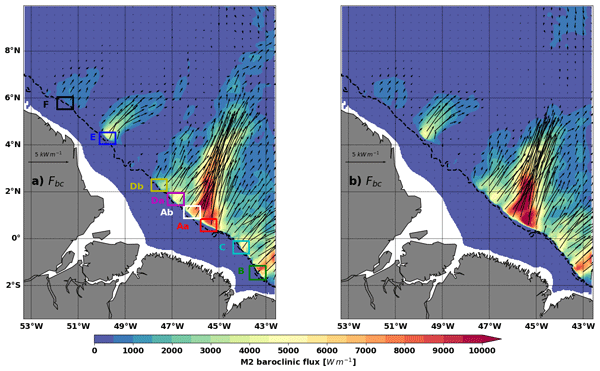
Michel Tchilibou, Ariane Koch-Larrouy, Simon Barbot, Florent Lyard, Yves Morel, Julien Jouanno, and Rosemary Morrow
Ocean Sci., 18, 1591–1618, https://doi.org/10.5194/os-18-1591-2022, https://doi.org/10.5194/os-18-1591-2022, 2022
Short summary
Short summary
This high-resolution model-based study investigates the variability in the generation, propagation, and sea height signature (SSH) of the internal tide off the Amazon shelf during two contrasted seasons. ITs propagate further north during the season characterized by weak currents and mesoscale eddies and a shallow and strong pycnocline. IT imprints on SSH dominate those of the geostrophic motion for horizontal scales below 200 km; moreover, the SSH is mainly incoherent below 70 km.
Cited articles
Banzon, V., Smith, T. M., Chin, T. M., Liu, C., and Hankins, W.: A long-term record of blended satellite and in situ sea-surface temperature for climate monitoring, modeling and environmental studies, Earth Syst. Sci. Data, 8, 165–176, https://doi.org/10.5194/essd-8-165-2016, 2016.
Bercos-Hickey, E. and Patricola, C. M.: Drivers of Atlantic tropical cyclogenesis: African easterly waves and the environment, Geophys. Res. Lett., 52, e2024GL112002, https://doi.org/10.1029/2024GL112002, 2025.
Bercos-Hickey, E., Nathan, T. R., and Chen, S.-H.: Saharan dust and the African easterly jet–African easterly wave system: structure, location and energetics, Q. J. Roy. Meteor. Soc., 143, 2797–2808, https://doi.org/10.1002/qj.3128, 2017.
Berry, G. J. and Thorncroft, C.: Case study of an intense African easterly wave, Mon. Weather Rev., 133, 752–766, https://doi.org/10.1175/MWR2884.1, 2005.
Bourlès, B., Araujo, M., McPhaden, M. J., Brandt, P., Foltz, G. R., Lumpkin, R., Giordani, H., Hernandez, F., Lefèvre, N., Nobre, P., Campos, E., Saravanan, R., Trotte-Duhà, J., Dengler, M., Hahn, J., Hummels, R., Lübbecke, J. F., Rouault, M., Cotrim, L., Sutton, A., Jochum, M., and Perez, R. C.: PIRATA: a sustained observing system for tropical Atlantic climate research and forecasting, Earth and Space Science, 6, 577–616, https://doi.org/10.1029/2018EA000428, 2019.
Burpee, R. W.: The Origin and Structure of Easterly Waves in the Lower Troposphere of North Africa, J. Atmos. Sci., 29, 77–90, https://doi.org/10.1175/1520-0469(1972)029<0077:TOASOE>2.0.CO;2, 1972.
Carlson, T. N.: Some Remarks on African Disturbances and Their Progress over the Tropical Atlantic, Mon. Weather Rev., 97, 716–726, https://doi.org/10.1175/1520-0493(1969)097<0716:SROADA>2.3.CO;2, 1969.
Charnock, H.: Wind stress on a water surface, Q. J. Roy. Meteor. Soc., 81, 639–640, https://doi.org/10.1002/qj.49708135027, 1955.
Craig, A., Valcke, S., and Coquart, L.: Development and performance of a new version of the OASIS coupler, OASIS3-MCT_3.0, Geosci. Model Dev., 10, 3297–3308, https://doi.org/10.5194/gmd-10-3297-2017, 2017.
Cromwell, T.: Circulation in a Meridional Plane in the Central Equatorial Pacific, J. Mar. Res., 12, 196–213, 1953.
Danso, D. K., Patricola, C. M., and Bercos-Hickey, E.: Influence of African easterly wave suppression on Atlantic tropical cyclone activity in a convection-permitting model, Geophys. Res. Lett., 49, e2022GL100590, https://doi.org/10.1029/2022GL100590, 2022.
D'Asaro, E. A.: The energy flux from the wind to near-inertial motions in the surface mixed layer, J. Phys. Oceanogr., 15, 1043–1059, 1985.
Deppenmeier, A.-L., Haarsma, R. J., Heerwaarden, C. van, and Hazeleger, W.: The southeastern tropical Atlantic SST bias investigated with a coupled atmosphere–ocean single-column model at a PIRATA mooring site, J. Climate, 33, 6255–6271, https://doi.org/10.1175/JCLI-D-19-0608.1, 2020.
Diedhiou, A., Janicot, S., Viltard, A., De Felice, P., and Laurent, H.: A fast moving easterly wave of the West Africa troposphere, Meteorol. Atmos. Phys., 69, 39–47, 1998a.
Diedhiou, A., Janicot, S., Viltard, A., and de Felice, P.: Evidence of two regimes of easterly waves over West Africa and the tropical Atlantic, Geophys. Res. Lett., 25, 2805–2808, 1998b.
Diedhiou, A., Janicot, S., Viltard, A., de Felice, P., and Laurent, H.: Easterly wave regimes and associated convection over West Africa and tropical Atlantic: results from the NCEP/NCAR and ECMWF reanalyses, Clim. Dynam., 15, 795–822, https://doi.org/10.1007/s003820050316, 1999.
Diedhiou, A., Janicot, S., Viltard, A., and de Félice, P.: Composite patterns of easterly disturbances over West Africa and the tropical Atlantic: a climatology from the 1979–95 NCEP/NCAR reanalyses, Clim. Dynam., 18, 241–253, https://doi.org/10.1007/s003820100173, 2001.
Diedhiou, A., Machado, L. A. T., and Laurent, H.: Mean kinematic characteristics of synoptic easterly disturbances over the Atlantic, Adv. Atmos. Sci., 27, 483–499, https://doi.org/10.1007/s00376-009-9092-5, 2010.
Donlon, C. J., Minnett, P. J., Gentemann, C., Nightingale, T. J., Barton, I. J., Ward, B., and Murray, M. J.: Toward improved validation of satellite sea surface skin temperature measurements for climate research, J. Climate, 15, 353–369, https://doi.org/10.1175/1520-0442(2002)015%3C0353:TIVOSS%3E2.0.CO;2, 2002.
Dunkerton, T. J., Montgomery, M. T., and Wang, Z.: Tropical cyclogenesis in a tropical wave critical layer: easterly waves, Atmos. Chem. Phys., 9, 5587–5646, https://doi.org/10.5194/acp-9-5587-2009, 2009.
Dutton, J. A.: Dynamics of atmospheric motion (formerly The Ceaseless Wind), Dover, New York, 617 pp., ISBN 0486684865, 1986.
Emanuel, K.: Increasing destructiveness of tropical cyclones over the past 30 years, Nature, 436, 686–688, https://doi.org/10.1038/nature03906, 2005.
Enfield, D. B. and Lee, S.: The heat balance of the Western Hemisphere warm pool, J. Climate, 18, 2662–2681, https://doi.org/10.1175/JCLI3427.1, 2005.
Fairall, C. W., Bradley, E. F., Hare, J. E., Grachev, A. A., and Edson, J. B.: Bulk parameterization of air–sea fluxes: Updates and verification for the COARE algorithm, J. Climate, 16, 571–591, https://doi.org/10.1175/1520-0442(2003)016<0571:BPOASF>2.0.CO;2, 2003.
Felice, P. D., Monkam, D., Viltard, A., and Ouss, C.: Characteristics of North African 6–9 day waves during summer 1981, Mon. Weather Rev., 118, 2624–2633, https://doi.org/10.1175/1520-0493(1990)118%3C2624:CONADW%3E2.0.CO;2, 1990.
Felice, P. de, Viltard, A., and Oubuih, J.: A synoptic-scale wave of 6–9-day period in the Atlantic tropical troposphere during summer 1981, Mon. Weather Rev., 121, 1291–1298, https://doi.org/10.1175/1520-0493(1993)121%3C1291:ASSWOD%3E2.0.CO;2, 1993.
Fleagle, R. G. and Businger, J. A.: An Introduction to Atmospheric Physics, 2nd edn., Academic Press, New York, 432 pp., ISBN 0122603559, 1980.
Ferry, N., Parent, L., Garric, G., Bricaud, C., Testut, C. E., Le Galloudec, O., Lellouche, J. M., Drevillon, M., Greiner, E., Barnier, B., Molines, J. M., Jourdain, N. C., Guinehut, S., Cabanes, C., and Zawadzki, L.: GLORYS2V1 global ocean reanalysis of the altimetric era (1992–2009) at mesoscale, Mercator Ocean Quarterly Newsletter, 44, 29–39, 2012.
Figa-Saldaña, J., Wilson, J. J. W., Attema, E., Gelsthorpe, R., Drinkwater, M. R., and Stoffelen, A.: The advanced scatterometer (ASCAT) on the meteorological operational (MetOp) platform: a follow on for European wind scatterometers, Can. J. Remote Sens., 28, 404–412, https://doi.org/10.5589/m02-035, 2002.
Fink, A. H. and Reiner, A.: Spatio-temporal variability of the relation between African easterly waves and West African squall lines in 1998 and 1999, J. Geophys. Res., 108, 4332, https://doi.org/10.1029/2002JD002816, 2003.
Foltz, G. R., Grodsky, S. A., Carton, J. A., and McPhaden, M. J.: Seasonal mixed layer heat budget of the tropical Atlantic Ocean, J. Geophys. Res.-Oceans, 108, https://doi.org/10.1029/2002JC001584, 2003.
Foltz, G. R., Hummels, R., Dengler, M., Perez, R. C., and Araujo, M.: Vertical turbulent cooling of the mixed layer in the Atlantic ITCZ and trade wind regions, J. Geophys. Res.-Oceans, 125, e2019JC015529, https://doi.org/10.1029/2019JC015529, 2020.
Figa-Saldaña, J., Wilson, J. J. W., Attema, E., Gelsthorpe, R., Drinkwater, M. R., and Stoffelen, A.: The advanced scatterometer (ASCAT) on the meteorological operational (MetOp) platform: A follow on for European wind scatterometers, Can. J. Remote Sens., 28, 404–412, https://doi.org/10.5589/m02-035, 2002.
Garnesson, P., Mangin, A., Fanton d'Andon, O., Demaria, J., and Bretagnon, M.: The CMEMS GlobColour chlorophyll a product based on satellite observation: multi-sensor merging and flagging strategies, Ocean Sci., 15, 819–830, https://doi.org/10.5194/os-15-819-2019, 2019.
Gévaudan, M., Jouanno, J., Durand, F., Morvan, G., Renault, L., and Samson, G.: Influence of ocean salinity stratification on the tropical Atlantic Ocean surface, Clim. Dynam., 57, 321–340, https://doi.org/10.1007/s00382-021-05713-z, 2021.
Gévaudan, M., Durand, F., and Jouanno, J.: Influence of the Amazon-Orinoco discharge interannual variability on the western tropical Atlantic salinity and temperature, J. Geophys. Res.-Oceans, 127, e2022JC018495, https://doi.org/10.1029/2022JC018495, 2022.
Gill, A. E.: Some simple solutions for heat-induced tropical circulation, Q. J. Roy. Meteor. Soc., 106, 447–462, https://doi.org/10.1002/qj.49710644905, 1980.
Graham, N. E. and Barnett, T. P.: Sea surface temperature, surface wind divergence, and convection over tropical oceans, Science, 238, 657–659, https://doi.org/10.1126/science.238.4827.657, 1987.
Grist, J. P.: Easterly waves over Africa. Part I: The seasonal cycle and contrasts between wet and dry years, Mon. Weather Rev., 130, 197–211, https://doi.org/10.1175/1520-0493(2002)130%3C0197:EWOAPI%3E2.0.CO;2, 2002.
Grist, J. P. and Nicholson, S. E.: A study of the dynamic factors influencing the rainfall variability in the West African Sahel, J. Climate, 14, 1337–1359, https://doi.org/10.1175/1520-0442(2001)014%3C1337:ASOTDF%3E2.0.CO;2, 2001.
Hastenrath, S. and Greischar, L.: Circulation mechanisms related to northeast Brazil rainfall anomalies, J. Geophys. Res.-Atmos., 98, 5093–5102, https://doi.org/10.1029/92JD02646, 1993.
Hersbach, H., Bell, B., Berrisford, P., Hirahara, S., Horányi, A., Muñoz-Sabater, J., Nicolas, J., Peubey, C., Radu, R., and Schepers, D.: The ERA5 global reanalysis, Q. J. Roy. Meteor. Soc., 146, 1999–2049, 2020.
Hsieh, J.-S. and Cook, K. H.: A study of the energetics of African easterly waves using a regional climate model, J. Atmos. Sci., 64, 421–440, https://doi.org/10.1175/JAS3851.1, 2007.
Huang, B., Liu, C., Freeman, E., Graham, G., Smith, T. S., and Zhang, H.: Assessment and Intercomparison of NOAA Daily Optimum Interpolation Sea Surface Temperature (DOISST) Version 2.1, J. Climate, 34, 7421–7441, https://doi.org/10.1175/JCLI-D-21-0001.1, 2021a.
Huang, B., Liu, C., Banzon, V., Freeman, E., Graham, G., Hankins, B., Smith, T., and Zhang, H.-M.: Improvements of the Daily Optimum Interpolation Sea Surface Temperature (DOISST) Version 2.1, J. Climate, 34, 2923–2939, https://doi.org/10.1175/JCLI-D-20-0166.1, 2021b.
Hummels, R., Dengler, M., Brandt, P., and Schlundt, M.: Diapycnal heat flux and mixed layer heat budget within the Atlantic cold tongue, Clim. Dynam., 43, 3179–3199, https://doi.org/10.1007/s00382-014-2339-6, 2014.
Hummels, R., Dengler, M., Rath, W., Foltz, G. R., Schütte, F., Fischer, T., and Brandt, P.: Surface cooling caused by rare but intense near-inertial wave induced mixing in the tropical Atlantic, Nat. Commun., 11, 3829, https://doi.org/10.1038/s41467-020-17601-x, 2020.
Janiga, M. A. and Thorncroft, C. D.: Regional differences in the kinematic and thermodynamic structure of African easterly waves, Q. J. Roy. Meteor. Soc., 139, 1598–1614, https://doi.org/10.1002/qj.2047, 2013.
Jiang, X., Su, H., Chen, S. S., and Ullrich, P. A.: Simulation of African easterly waves in a global climate model, J. Climate, 36, 1415–1433, https://doi.org/10.1175/JCLI-D-22-0090.1, 2023.
Jonville, T., Flamant, C., and Lavaysse, C.: Dynamical study of three African easterly waves in September 2021, Q. J. Roy. Meteor. Soc., 150, 2489–2509, 2024.
Jonville, T., Cornillault, E., Lavaysse, C., Peyrillé, P., and Flamant, C.: Distinguishing north and south African easterly waves with a spectral method: implication for tropical cyclogenesis from mergers in the North Atlantic, Q. J. Roy. Meteor. Soc., 151, e4909, https://doi.org/10.1002/qj.4909, 2025.
Jouanno, J., Marin, F., du Penhoat, Y., Sheinbaum, J., and Molines, J.-M.: Seasonal heat balance in the upper 100 m of the equatorial Atlantic Ocean, J. Geophys. Res.-Oceans, 116, https://doi.org/10.1029/2010JC006912, 2011a.
Jouanno, J., Marin, F., Penhoat, Y. du, Molines, J. M., and Sheinbaum, J.: Seasonal modes of surface cooling in the Gulf of Guinea, J. Phys. Oceanogr., 41, 1408–1416, https://doi.org/10.1175/JPO-D-11-031.1, 2011b.
Kiladis, G. N., Thorncroft, C. D., and Hall, N. M. J.: Three-dimensional structure and dynamics of African easterly waves. Part I: Observations, J. Atmos. Sci., 63, 2212–2230, https://doi.org/10.1175/JAS3741.1, 2006.
Lamb, P. J.: Sub-saharan rainfall update for 1982; continued drought, J. Climatol., 3, 419–422, 1983.
Large, W. G. and Pond, S.: Open Ocean Momentum Flux Measurements in Moderate to Strong Winds, J. Phys. Oceanogr., 11, 324–336, https://doi.org/10.1175/1520-0485(1981)011<0324:OOMFMI>2.0.CO;2, 1981.
Leroux, S. and Hall, N. M. J.: On the relationship between African easterly waves and the African easterly jet, J. Atmos. Sci., 66, 2303–2316, https://doi.org/10.1175/2009JAS2988.1, 2009.
Liu, W., Cook, K. H., and Vizy, E. K.: Role of the West African westerly jet in the seasonal and diurnal cycles of precipitation over West Africa, Clim. Dynam., 54, 843–861, https://doi.org/10.1007/s00382-019-05035-1, 2020.
Madec, G., Bell, M., Blaker, A., Bricaud, C., Bruciaferri, D., Castrillo, M., Calvert, D., Chanut, J., Clementi, E., Coward, A., Epicoco, I., Éthé, C., Ganderton, J., Harle, J., Hutchinson, K., Iovino, D., Lea, D., Lovato, T., Martin, M., Martin, N., Mele, F., Martins, D., Masson, S., Mathiot, P., Mele, F., Mocavero, S., Müller, S., Nurser, A. J. G., Paronuzzi, S., Peltier, M., Person, R., Rousset, C., Rynders, S., Samson, G., Téchené, S., Vancoppenolle, M., and Wilson, C.: NEMO Ocean Engine Reference Manual, Zenodo [code], https://doi.org/10.5281/zenodo.8167700, 2023.
Mendy, M. K.: Numerical output used for diagnostics in Mendy et al., figshare [data set], https://doi.org/10.6084/m9.figshare.30095101.v1, 2025.
Maritorena, S., d'Andon, O. H. F., Mangin, A., and Siegel, D. A.: Merged satellite ocean color data products using a bio-optical model: characteristics, benefits and issues, Remote Sens. Environ., 114, 1791–1804, https://doi.org/10.1016/j.rse.2010.04.002, 2010.
Mekonnen, A., Thorncroft, C. D., and Aiyyer, A. R.: Analysis of convection and its association with African easterly waves, J. Climate, 19, 5405–5421, https://doi.org/10.1175/JCLI3920.1, 2006.
Mickett, J. B., Serra, Y. L., Cronin, M. F., and Alford, M. H.: Resonant forcing of mixed layer inertial motions by atmospheric easterly waves in the northeast tropical Pacific, J. Phys. Oceanogr., 40, 401–416, https://doi.org/10.1175/2009JPO4276.1, 2010.
Moura, A. D. and Shukla, J.: On the dynamics of droughts in northeast Brazil: observations, theory and numerical experiments with a general circulation model, J. Atmos. Sci., 38, 2653–2675, https://doi.org/10.1175/1520-0469(1981)038%3C2653:OTDODI%3E2.0.CO;2, 1981.
Murray, M. J., Allen, M. R., Merchant, C. J., Harris, A. R., and Donlon, C. J.: Direct observations of skin-bulk SST variability, Geophys. Res. Lett., 27, 1171–1174, https://doi.org/10.1029/1999GL011133, 2000.
Nicholson, S. E.: A revised picture of the structure of the “monsoon” and land ITCZ over West Africa, Clim. Dynam., 32, 1155–1171, https://doi.org/10.1007/s00382-008-0514-3, 2009.
Nobre, P. and Shukla, J.: Variations of sea surface temperature, wind stress, and rainfall over the tropical Atlantic and South America, J. Climate, 9, 2464–2479, https://doi.org/10.1175/1520-0442(1996)009%3C2464:VOSSTW%3E2.0.CO;2, 1996.
Opoku-Ankomah, Y. and Cordery, I.: Atlantic sea surface temperatures and rainfall variability in Ghana, J. Climate, 7, 551–558, https://doi.org/10.1175/1520-0442(1994)007%3C0551:ASSTAR%3E2.0.CO;2, 1994.
Plueddemann, A. J. and Farrar, J. T.: Observations and models of the energy flux from the wind to mixed-layer inertial currents, Deep-Sea Res. Pt. II, 53, 5–30, https://doi.org/10.1016/j.dsr2.2005.10.017, 2006.
Raj, J., Bangalath, H. K., and Stenchikov, G.: Future projection of the African easterly waves in a high-resolution atmospheric general circulation model, Clim. Dynam., 61, 3081–3102, https://doi.org/10.1007/s00382-023-06720-y, 2023.
Reed, R. J., Klinker, E., and Hollingsworth, A.: The structure and characteristics of African easterly wave disturbances as determined from the ECMWF operational analysis/forecast system, Meteorol. Atmos. Phys., 38, 22–33, https://doi.org/10.1007/BF01029944, 1988.
Reffray, G., Bourdalle-Badie, R., and Calone, C.: Modelling turbulent vertical mixing sensitivity using a 1-D version of NEMO, Geosci. Model Dev., 8, 69–86, https://doi.org/10.5194/gmd-8-69-2015, 2015.
Reynolds, R. W., Smith, T. M., Liu, C., Chelton, D. B., Casey, K. S., and Schlax, M. G.: Daily high-resolution-blended analyses for sea surface temperature, J. Climate, 20, 5473–5496, https://doi.org/10.1175/2007JCLI1824.1, 2007.
Russell, J. O., Aiyyer, A., White, J. D., and Hannah, W.: Revisiting the connection between African easterly waves and Atlantic tropical cyclogenesis, Geophys. Res. Lett., 44, 587–595, https://doi.org/10.1002/2016GL071236, 2017.
Russell, J. O. H., Aiyyer, A., and Dylan White, J.: African easterly wave dynamics in convection-permitting simulations: rotational stratiform instability as a conceptual model, J. Adv. Model. Earth Sy., 12, e2019MS001706, https://doi.org/10.1029/2019MS001706, 2020.
Semunegus, H., Mekonnen, A., and Schreck III, C. J.: Characterization of convective systems and their association with African easterly waves, Int. J. Climatol., 37, 4486–4492, https://doi.org/10.1002/joc.5085, 2017.
Shi, Y., Huang, W., Wang, B., Yang, Z., He, X., and Qiu, T.: Origin of warm SST bias over the Atlantic cold tongue in the coupled climate model FGOALS-g2, Atmosphere-Basel, 9, https://doi.org/10.3390/atmos9070275, 2018.
Skamarock, W. C., Klemp, J. B., Dudhia, J., Gill, D. O., Liu, Z., Berner, J., Wang, W., Powers, J. G., Duda, M. G., Barker, D. M., and Huang, X.-Y.: A Description of the Advanced Research WRF Model Version 4, NCAR Tech. Note NCAR/TN-556+STR, 145 pp., https://doi.org/10.5065/1dfh-6p97, 2019.
Skinner, C. B. and Diffenbaugh, N. S.: The contribution of African easterly waves to monsoon precipitation in the CMIP3 ensemble, J. Geophys. Res.-Atmos., 118, 3590–3609, 2013.
Stommel, H.: Wind-drift near the equator, Deep Sea Research (1953), 6, 298–302, https://doi.org/10.1016/0146-6313(59)90088-7, 1959.
Sultan, B. and Janicot, S.: Abrupt shift of the ITCZ over West Africa and intra-seasonal variability, Geophys. Res. Lett., 27, 3353–3356, https://doi.org/10.1029/1999GL011285, 2000.
Sweet, W., Fett, R., Kerling, J., and Violette, P. L.: Air-sea interaction effects in the lower troposphere across the north wall of the Gulf Stream, Mon. Weather Rev., 109, 1042–1052, https://doi.org/10.1175/1520-0493(1981)109%3C1042:ASIEIT%3E2.0.CO;2, 1981.
Thompson, R. M., Payne, S. W., Recker, E. E., and Reed, R. J.: Structure and Properties of Synoptic-Scale Wave Disturbances in the Intertropical Convergence Zone of the Eastern Atlantic, J. Atmos. Sci., 36, 53–72, https://doi.org/10.1175/1520-0469(1979)036<0053:SAPOSS>2.0.CO;2, 1979.
Thorncroft, C. and Hodges, K.: African easterly wave variability and its relationship to Atlantic tropical cyclone activity, J. Climate, 14, 1166–1179, https://doi.org/10.1175/1520-0442(2001)014%3C1166:AEWVAI%3E2.0.CO;2, 2001.
Thorncroft, C. D., Hall, N. M. J., and Kiladis, G. N.: Three-dimensional structure and dynamics of African easterly waves. Part III: Genesis, J. Atmos. Sci., 65, 3596–3607, https://doi.org/10.1175/2008JAS2575.1, 2008.
Tomaziello, A. C. N., Carvalho, L. M. V., and Gandu, A. W.: Intraseasonal variability of the Atlantic intertropical convergence zone during austral summer and winter, Clim. Dynam., 47, 1717–1733, https://doi.org/10.1007/s00382-015-2929-y, 2016.
Valcke, S. and Redler, R.: The OASIS coupler, in: Earth System Modelling – Volume 3: Coupling Software and Strategies, edited by: Valcke, S., Redler, R., and Budich, R., Springer Berlin Heidelberg, Berlin, Heidelberg, https://doi.org/10.1007/978-3-642-23360-9_4, 23–32, 2012.
Viltard, A., de Felice, P., and Oubuih, J.: Comparison of the African and the 6–9 day wave-like disturbance patterns over West-Africa and the tropical Atlantic during summer 1985, Meteorol. Atmos. Phys., 62, 91–99, https://doi.org/10.1007/BF01037482, 1997.
Voldoire, A., Exarchou, E., Sanchez-Gomez, E., Demissie, T., Deppenmeier, A.-L., Frauen, C., Goubanova, K., Hazeleger, W., Keenlyside, N., and Koseki, S.: Role of wind stress in driving SST biases in the tropical Atlantic, Clim. Dynam., 53, 3481–3504, 2019.
Wade, M., Caniaux, G., and Du Penhoat, Y.: Variability of the mixed layer heat budget in the eastern equatorial Atlantic during 2005–2007 as inferred using Argo floats, J. Geophys. Res.-Oceans, 116, C08006, https://doi.org/10.1029/2010JC006683, 2011.
Waliser, D. E. and Graham, N. E.: Convective cloud systems and warm-pool sea surface temperatures: coupled interactions and self-regulation, J. Geophys. Res.-Atmos., 98, 12881–12893, https://doi.org/10.1029/93JD00872, 1993.
Wallace, J. M., Mitchell, T. P., and Deser, C.: The influence of sea-surface temperature on surface wind in the eastern equatorial Pacific: seasonal and interannual variability, J. Climate, 2, 1492–1499, https://doi.org/10.1175/1520-0442(1989)002%3C1492:TIOSST%3E2.0.CO;2, 1989.
Wane, D., Lazar, A., Wade, M., and Gaye, A. T.: A climatological study of the mechanisms controlling the seasonal meridional migration of the Atlantic warm pool in an OGCM, Atmosphere-Basel, 12, https://doi.org/10.3390/atmos12091224, 2021.
Wang, C., Enfield, D. B., Lee, S., and Landsea, C. W.: Influences of the Atlantic warm pool on Western Hemisphere summer rainfall and Atlantic hurricanes, J. Climate, 19, 3011–3028, https://doi.org/10.1175/JCLI3770.1, 2006.
Wang, C., Lee, S.-K., and Enfield, D. B.: Atlantic warm pool acting as a link between Atlantic multidecadal oscillation and Atlantic tropical cyclone activity, Geochem. Geophy. Geosy., 9, https://doi.org/10.1029/2007GC001809, 2008.
Webster, P. J., Holland, G. J., Curry, J. A., and Chang, H.-R.: Changes in tropical cyclone number, duration, and intensity in a warming environment, Science, 309, 1844–1846, https://doi.org/10.1126/science.1116448, 2005.
Wheeler, M. and Kiladis, G. N.: Convectively coupled equatorial waves: analysis of clouds and temperature in the wavenumber–frequency domain, J. Atmos. Sci., 56, 374–399, https://doi.org/10.1175/1520-0469(1999)056%3C0374:CCEWAO%3E2.0.CO;2, 1999.
Wu, M.-L. C., Reale, O., and Schubert, S. D.: A Characterization of African easterly waves on 2.5–6-day and 6–9-day time scales, J. Climate, 26, 6750–6774, https://doi.org/10.1175/JCLI-D-12-00336.1, 2013.
Short summary
The North Tropical Atlantic plays an important role in shaping climate in the region. In our study we examined how African Easterly Waves influence the ocean surface. Using numerical modelling and buoy records, we found that these waves can warm or cool the sea by more than half a degree. The faster waves have the strongest impact. Because sea temperature affects rainfall and storms, understanding these waves can help improve weather and climate forecasts.
The North Tropical Atlantic plays an important role in shaping climate in the region. In our...


