Articles | Volume 22, issue 3
https://doi.org/10.5194/os-22-1429-2026
© Author(s) 2026. This work is distributed under
the Creative Commons Attribution 4.0 License.
https://doi.org/10.5194/os-22-1429-2026
© Author(s) 2026. This work is distributed under
the Creative Commons Attribution 4.0 License.
Opinion: status, plans and needs of Southern Ocean modelling

GEOMAR Helmholtz Centre for Ocean Research Kiel, Kiel, Germany
Carolina O. Dufour
University of Brest, CNRS, Ifremer, IRD, Laboratoire d'Océanographie Physique et Spatiale (LOPS), IUEM, 29280 Plouzané, France
Andrew J. S. Meijers
British Antarctic Survey, Cambridge, United Kingdom
Alyce M. Hancock
Southern Ocean Observing System, International Project Office, Institute for Marine and Antarctic Studies, University of Tasmania, Hobart, Australia
Related authors
Andrew G. Pauling, Inga J. Smith, Torge Martin, Jeff K. Ridley, David P. Stevens, Max Thomas, Rebecca L. Beadling, Christopher Danek, Tore Hattermann, Qian Li, John Marshall, Morven Muilwijk, Ariaan Purich, and Neil C. Swart
EGUsphere, https://doi.org/10.5194/egusphere-2026-658, https://doi.org/10.5194/egusphere-2026-658, 2026
This preprint is open for discussion and under review for The Cryosphere (TC).
Short summary
Short summary
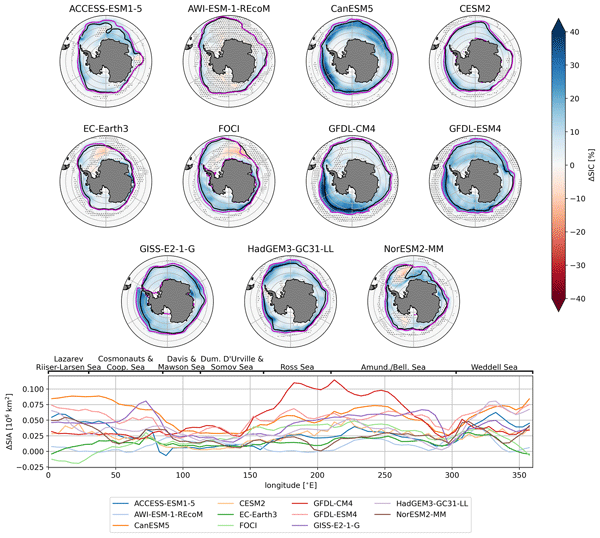
Climate models typically do not include meltwater entering the Southern Ocean due to Antarctic ice sheet mass loss. Previous work shows this meltwater drives sea ice growth, but the varying responses have been difficult to compare across models. We ran 11 climate models using the same meltwater input and found a wide range of sea ice responses depending on the background state in each model. Understanding this uncertainty in response is important for future projections of Antarctic sea ice.
Morven Muilwijk, Tore Hattermann, Rebecca L. Beadling, Neil C. Swart, Aleksi Nummelin, Chuncheng Guo, David M. Chandler, Petra M. Langebroek, Shenjie Zhou, Pierre Dutrieux, Jia-Jia Chen, Christopher Danek, Matthew H. England, Stephen M. Griffies, F. Alexander Haumann, André Jüling, Ombeline Jouet, Qian Li, Torge Martin, John Marshall, Andrew G. Pauling, Ariaan Purich, Zihan Song, Inga J. Smith, Max Thomas, Irene Trombini, Eveline C. van der Linden, and Xiaoqi Xu
The Cryosphere, 20, 1087–1117, https://doi.org/10.5194/tc-20-1087-2026, https://doi.org/10.5194/tc-20-1087-2026, 2026
Short summary
Short summary
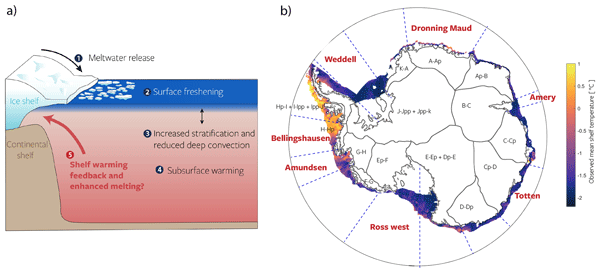
Antarctic meltwater affects ocean stratification and temperature, which in turn influences the rate of ice shelf melting – a coupling missing in most climate models. We analyze a suite of climate models with added meltwater to explore this feedback in different regions. While meltwater generally enhances ocean warming and melt, in West Antarctica most models simulate coastal cooling, suggesting a negative feedback that could slow future ice loss there.
Linus Shihora, Torge Martin, Anna Christina Hans, Rebecca Hummels, Michael Schindelegger, and Henryk Dobslaw
Ocean Sci., 21, 1533–1548, https://doi.org/10.5194/os-21-1533-2025, https://doi.org/10.5194/os-21-1533-2025, 2025
Short summary
Short summary
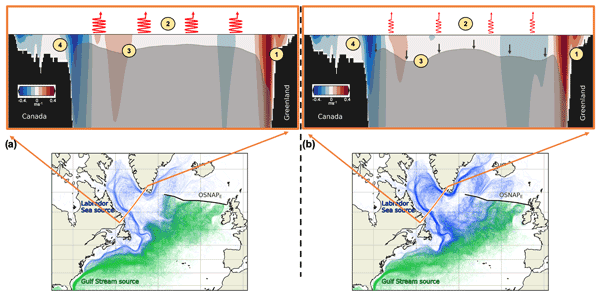
The Atlantic Meridional Overturning Circulation (AMOC) is a major part of the ocean circulation. Satellite gravimetry missions, like GRACE, which measure changes in Earth's mass distribution, could help monitor changes in the AMOC by detecting variations in ocean bottom pressure. To help assess if future satellite missions could detect these changes, we used ocean model simulation data to study their connection. Additionally, we created a synthetic data set for future satellite mission simulations.
Neil C. Swart, Torge Martin, Rebecca Beadling, Jia-Jia Chen, Christopher Danek, Matthew H. England, Riccardo Farneti, Stephen M. Griffies, Tore Hattermann, Judith Hauck, F. Alexander Haumann, André Jüling, Qian Li, John Marshall, Morven Muilwijk, Andrew G. Pauling, Ariaan Purich, Inga J. Smith, and Max Thomas
Geosci. Model Dev., 16, 7289–7309, https://doi.org/10.5194/gmd-16-7289-2023, https://doi.org/10.5194/gmd-16-7289-2023, 2023
Short summary
Short summary
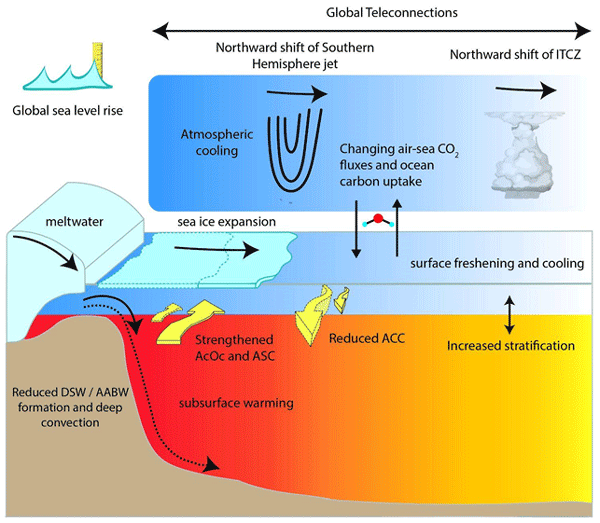
Current climate models typically do not include full representation of ice sheets. As the climate warms and the ice sheets melt, they add freshwater to the ocean. This freshwater can influence climate change, for example by causing more sea ice to form. In this paper we propose a set of experiments to test the influence of this missing meltwater from Antarctica using multiple different climate models.
Torge Martin and Arne Biastoch
Ocean Sci., 19, 141–167, https://doi.org/10.5194/os-19-141-2023, https://doi.org/10.5194/os-19-141-2023, 2023
Short summary
Short summary
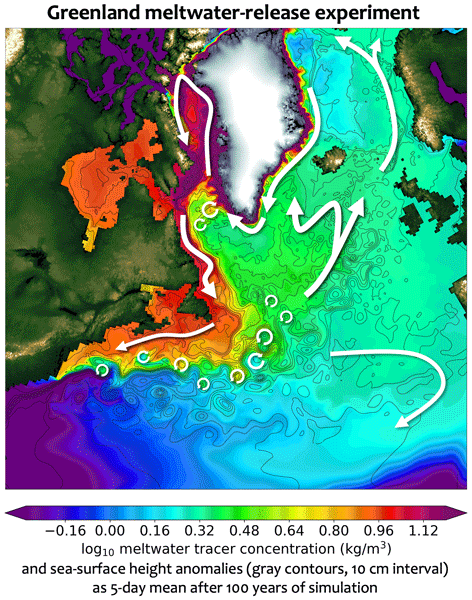
How is the ocean affected by continued Greenland Ice Sheet mass loss? We show in a systematic set of model experiments that atmospheric feedback needs to be accounted for as the large-scale ocean circulation is more than twice as sensitive to the meltwater otherwise. Coastal winds, boundary currents, and ocean eddies play a key role in redistributing the meltwater. Eddy paramterization helps the coarse simulation to perform better in the Labrador Sea but not in the North Atlantic Current region.
Alan D. Fox, Patricia Handmann, Christina Schmidt, Neil Fraser, Siren Rühs, Alejandra Sanchez-Franks, Torge Martin, Marilena Oltmanns, Clare Johnson, Willi Rath, N. Penny Holliday, Arne Biastoch, Stuart A. Cunningham, and Igor Yashayaev
Ocean Sci., 18, 1507–1533, https://doi.org/10.5194/os-18-1507-2022, https://doi.org/10.5194/os-18-1507-2022, 2022
Short summary
Short summary
Observations of the eastern subpolar North Atlantic in the 2010s show exceptional freshening and cooling of the upper ocean, peaking in 2016 with the lowest salinities recorded for 120 years. Using results from a high-resolution ocean model, supported by observations, we propose that the leading cause is reduced surface cooling over the preceding decade in the Labrador Sea, leading to increased outflow of less dense water and so to freshening and cooling of the eastern subpolar North Atlantic.
Arne Biastoch, Franziska U. Schwarzkopf, Klaus Getzlaff, Siren Rühs, Torge Martin, Markus Scheinert, Tobias Schulzki, Patricia Handmann, Rebecca Hummels, and Claus W. Böning
Ocean Sci., 17, 1177–1211, https://doi.org/10.5194/os-17-1177-2021, https://doi.org/10.5194/os-17-1177-2021, 2021
Short summary
Short summary
The Atlantic Meridional Overturning Circulation (AMOC) quantifies the impact of the ocean on climate and climate change. Here we show that a high-resolution ocean model is able to realistically simulate ocean currents. While the mean representation of the AMOC depends on choices made for the model and on the atmospheric forcing, the temporal variability is quite robust. Comparing the ocean model with ocean observations, we able to identify that the AMOC has declined over the past two decades.
Andrew G. Pauling, Inga J. Smith, Torge Martin, Jeff K. Ridley, David P. Stevens, Max Thomas, Rebecca L. Beadling, Christopher Danek, Tore Hattermann, Qian Li, John Marshall, Morven Muilwijk, Ariaan Purich, and Neil C. Swart
EGUsphere, https://doi.org/10.5194/egusphere-2026-658, https://doi.org/10.5194/egusphere-2026-658, 2026
This preprint is open for discussion and under review for The Cryosphere (TC).
Short summary
Short summary
Climate models typically do not include meltwater entering the Southern Ocean due to Antarctic ice sheet mass loss. Previous work shows this meltwater drives sea ice growth, but the varying responses have been difficult to compare across models. We ran 11 climate models using the same meltwater input and found a wide range of sea ice responses depending on the background state in each model. Understanding this uncertainty in response is important for future projections of Antarctic sea ice.
Noémie Planat, Carolina Olivia Dufour, Camille Lique, Jan Klaus Rieck, Claude Talandier, and Louis Bruno Tremblay
Ocean Sci., 22, 653–678, https://doi.org/10.5194/os-22-653-2026, https://doi.org/10.5194/os-22-653-2026, 2026
Short summary
Short summary
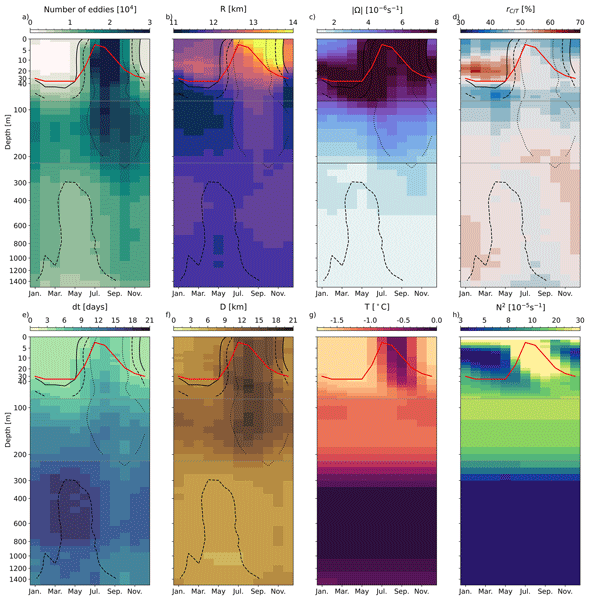
We detect and track mesoscale eddies in the Canadian Basin of the Arctic Ocean and describe their spatio-temporal characteristics in a high resolution pan-Arctic model. Results show eddies of typical size 12 km, lasting 10 d and travelling 11 km, with roughly an equal number of cyclones and anticyclones detected. Seasonal, decadal and interannual changes of the number of eddies detected show strong correlations with the ice cover, and with the mean circulation of the basin.
Morven Muilwijk, Tore Hattermann, Rebecca L. Beadling, Neil C. Swart, Aleksi Nummelin, Chuncheng Guo, David M. Chandler, Petra M. Langebroek, Shenjie Zhou, Pierre Dutrieux, Jia-Jia Chen, Christopher Danek, Matthew H. England, Stephen M. Griffies, F. Alexander Haumann, André Jüling, Ombeline Jouet, Qian Li, Torge Martin, John Marshall, Andrew G. Pauling, Ariaan Purich, Zihan Song, Inga J. Smith, Max Thomas, Irene Trombini, Eveline C. van der Linden, and Xiaoqi Xu
The Cryosphere, 20, 1087–1117, https://doi.org/10.5194/tc-20-1087-2026, https://doi.org/10.5194/tc-20-1087-2026, 2026
Short summary
Short summary
Antarctic meltwater affects ocean stratification and temperature, which in turn influences the rate of ice shelf melting – a coupling missing in most climate models. We analyze a suite of climate models with added meltwater to explore this feedback in different regions. While meltwater generally enhances ocean warming and melt, in West Antarctica most models simulate coastal cooling, suggesting a negative feedback that could slow future ice loss there.
Shenjie Zhou, Pierre Dutrieux, Claudia Giulivi, Andrew Meijers, Won Sang Lee, Tae-Wan Kim, Tore Hattermann, and Markus Janout
Earth Syst. Sci. Data Discuss., https://doi.org/10.5194/essd-2025-727, https://doi.org/10.5194/essd-2025-727, 2026
Revised manuscript under review for ESSD
Short summary
Short summary
A collection of temperature and salinity measurements made in the Southern Ocean and around Antarctic continental shelf seas is assembled and described in this paper. A gridded product developed out of these scattered data points is also described. The gridded product provide us a better view of contemporary mean status of the Southern Ocean and Antarctic shelf seas and help models to better reference the prediction of the future climate.
Yavor Kostov, Paul R. Holland, Kelly A. Hogan, James A. Smith, Nicolas C. Jourdain, Pierre Mathiot, Anna Olivé Abelló, Andrew H. Fleming, and Andrew J. S. Meijers
The Cryosphere, 20, 135–169, https://doi.org/10.5194/tc-20-135-2026, https://doi.org/10.5194/tc-20-135-2026, 2026
Short summary
Short summary
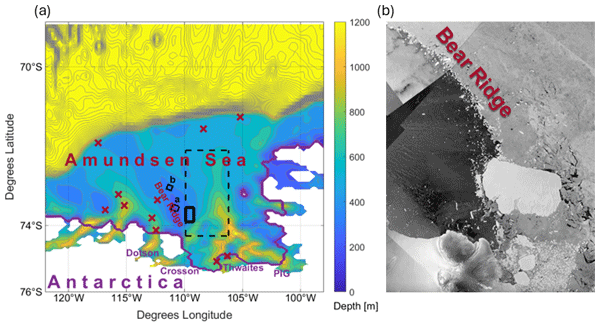
Icebergs ground when they reach shallow topography such as Bear Ridge in the Amundsen Sea. Grounded icebergs can block the transport of sea-ice and create areas of higher and lower sea-ice concentration. We introduce a physically and observationally motivated representation of grounding in an ocean model. In addition, we improve the way simulated icebergs respond to winds, ocean currents, and density differences in sea water. We analyse the forces acting on freely floating and grounded icebergs.
Linus Shihora, Torge Martin, Anna Christina Hans, Rebecca Hummels, Michael Schindelegger, and Henryk Dobslaw
Ocean Sci., 21, 1533–1548, https://doi.org/10.5194/os-21-1533-2025, https://doi.org/10.5194/os-21-1533-2025, 2025
Short summary
Short summary
The Atlantic Meridional Overturning Circulation (AMOC) is a major part of the ocean circulation. Satellite gravimetry missions, like GRACE, which measure changes in Earth's mass distribution, could help monitor changes in the AMOC by detecting variations in ocean bottom pressure. To help assess if future satellite missions could detect these changes, we used ocean model simulation data to study their connection. Additionally, we created a synthetic data set for future satellite mission simulations.
Ciara Pimm, Andrew J. S. Meijers, Dani C. Jones, and Richard G. Williams
Ocean Sci., 21, 1237–1253, https://doi.org/10.5194/os-21-1237-2025, https://doi.org/10.5194/os-21-1237-2025, 2025
Short summary
Short summary
Subantarctic mode water in the South Pacific Ocean is important due to its role in the uptake and transport of anthropogenic heat and carbon. The Subantarctic mode water region can be split into two pools using mixed-layer-depth properties. Sensitivity experiments are used to understand the effects of heating and wind on each pool. It is found that the optimal conditions to form large amounts of Subantarctic mode water in the South Pacific are local cooling and upstream warming combined.
Neil C. Swart, Torge Martin, Rebecca Beadling, Jia-Jia Chen, Christopher Danek, Matthew H. England, Riccardo Farneti, Stephen M. Griffies, Tore Hattermann, Judith Hauck, F. Alexander Haumann, André Jüling, Qian Li, John Marshall, Morven Muilwijk, Andrew G. Pauling, Ariaan Purich, Inga J. Smith, and Max Thomas
Geosci. Model Dev., 16, 7289–7309, https://doi.org/10.5194/gmd-16-7289-2023, https://doi.org/10.5194/gmd-16-7289-2023, 2023
Short summary
Short summary
Current climate models typically do not include full representation of ice sheets. As the climate warms and the ice sheets melt, they add freshwater to the ocean. This freshwater can influence climate change, for example by causing more sea ice to form. In this paper we propose a set of experiments to test the influence of this missing meltwater from Antarctica using multiple different climate models.
Dani C. Jones, Maike Sonnewald, Shenjie Zhou, Ute Hausmann, Andrew J. S. Meijers, Isabella Rosso, Lars Boehme, Michael P. Meredith, and Alberto C. Naveira Garabato
Ocean Sci., 19, 857–885, https://doi.org/10.5194/os-19-857-2023, https://doi.org/10.5194/os-19-857-2023, 2023
Short summary
Short summary
Machine learning is transforming oceanography. For example, unsupervised classification approaches help researchers identify underappreciated structures in ocean data, helping to generate new hypotheses. In this work, we use a type of unsupervised classification to identify structures in the temperature and salinity structure of the Weddell Gyre, which is an important region for global ocean circulation and for climate. We use our method to generate new ideas about mixing in the Weddell Gyre.
Torge Martin and Arne Biastoch
Ocean Sci., 19, 141–167, https://doi.org/10.5194/os-19-141-2023, https://doi.org/10.5194/os-19-141-2023, 2023
Short summary
Short summary
How is the ocean affected by continued Greenland Ice Sheet mass loss? We show in a systematic set of model experiments that atmospheric feedback needs to be accounted for as the large-scale ocean circulation is more than twice as sensitive to the meltwater otherwise. Coastal winds, boundary currents, and ocean eddies play a key role in redistributing the meltwater. Eddy paramterization helps the coarse simulation to perform better in the Labrador Sea but not in the North Atlantic Current region.
Alan D. Fox, Patricia Handmann, Christina Schmidt, Neil Fraser, Siren Rühs, Alejandra Sanchez-Franks, Torge Martin, Marilena Oltmanns, Clare Johnson, Willi Rath, N. Penny Holliday, Arne Biastoch, Stuart A. Cunningham, and Igor Yashayaev
Ocean Sci., 18, 1507–1533, https://doi.org/10.5194/os-18-1507-2022, https://doi.org/10.5194/os-18-1507-2022, 2022
Short summary
Short summary
Observations of the eastern subpolar North Atlantic in the 2010s show exceptional freshening and cooling of the upper ocean, peaking in 2016 with the lowest salinities recorded for 120 years. Using results from a high-resolution ocean model, supported by observations, we propose that the leading cause is reduced surface cooling over the preceding decade in the Labrador Sea, leading to increased outflow of less dense water and so to freshening and cooling of the eastern subpolar North Atlantic.
Arne Biastoch, Franziska U. Schwarzkopf, Klaus Getzlaff, Siren Rühs, Torge Martin, Markus Scheinert, Tobias Schulzki, Patricia Handmann, Rebecca Hummels, and Claus W. Böning
Ocean Sci., 17, 1177–1211, https://doi.org/10.5194/os-17-1177-2021, https://doi.org/10.5194/os-17-1177-2021, 2021
Short summary
Short summary
The Atlantic Meridional Overturning Circulation (AMOC) quantifies the impact of the ocean on climate and climate change. Here we show that a high-resolution ocean model is able to realistically simulate ocean currents. While the mean representation of the AMOC depends on choices made for the model and on the atmospheric forcing, the temporal variability is quite robust. Comparing the ocean model with ocean observations, we able to identify that the AMOC has declined over the past two decades.
Cited articles
Adusumilli, S., Fricker, H. A., Medley, B., Padman, L., and Siegfried, M. R.: Interannual variations in meltwater input to the Southern Ocean from Antarctic ice shelves, Nat. Geosci., 13, 616–620, https://doi.org/10.1038/s41561-020-0616-z, 2020.
Beadling, R. L., Russell, J. L., Stouffer, R. J., Mazloff, M., Talley, L. D., Goodman, P. J., Sallée, J. B., Hewitt, H. T., Hyder, P., and Pandde, A: Representation of Southern Ocean properties across coupled model intercomparison project generations: CMIP3 to CMIP6, J. Climate, 33, 6555–6581, https://doi.org/10.1175/JCLI-D-19-0970.1, 2020.
Bell, R. E. and Seroussi, H.: History, mass loss, structure, and dynamic behavior of the Antarctic Ice Sheet, Science, 367, 1321–1325, https://doi.org/10.1126/science.aaz5489, 2020.
Bruciaferri, D., Guiavarc'h, C., Hewitt, H. T., Harle, J., Almansi, M., Mathiot, P., and Colombo, P.: Localized general vertical coordinates for quasi-Eulerian ocean models: The Nordic overflows test-case, J. Adv. Model Earth Syst., 16, e2023MS003893, https://doi.org/10.1029/2023MS003893, 2024.
De Rydt, J., Jourdain, N. C., Nakayama, Y., van Caspel, M., Timmermann, R., Mathiot, P., Asay-Davis, X. S., Seroussi, H., Dutrieux, P., Galton-Fenzi, B., Holland, D., and Reese, R.: Experimental design for the Marine Ice Sheet–Ocean Model Intercomparison Project – phase 2 (MISOMIP2), Geosci. Model Dev., 17, 7105–7139, https://doi.org/10.5194/gmd-17-7105-2024, 2024.
Frölicher, T. L., Sarmiento, J. L., Paynter, D. J., Dunne, J. P., Krasting, J. P., and Winton, M.: Dominance of the Southern Ocean in Anthropogenic Carbon and Heat Uptake in CMIP5 Models, J. Climate, 28, 862–886, https://doi.org/10.1175/JCLI-D-14-00117.1, 2015.
Gordon, A. L.: Deep Antarctic convection west of Maud rise, J. Phys. Oceanogr., 8, 600–612, https://doi.org/10.1175/1520-0485(1978)008<0600:DACWOM>2.0.CO;2, 1978.
Hallberg, R.: Using a resolution function to regulate parameterizations of oceanic mesoscale eddy effects, Ocean Model., 72, 92–103, https://doi.org/10.1016/j.ocemod.2013.08.007, 2013.
Heuzé, C.: Antarctic Bottom Water and North Atlantic Deep Water in CMIP6 models, Ocean Sci., 17, 59–90, https://doi.org/10.5194/os-17-59-2021, 2021.
Huguenin, M. F., Holmes, R. M., and England, M. H.: Drivers and distribution of global ocean heat uptake over the last half century, Nat. Commun., 13, 4921, https://doi.org/10.1038/s41467-022-32540-5, 2022.
Hutchinson, K., Deshayes, J., Éthé, C., Rousset, C., de Lavergne, C., Vancoppenolle, M., Jourdain, N. C., and Mathiot, P.: Improving Antarctic Bottom Water precursors in NEMO for climate applications, Geosci. Model Dev., 16, 3629–3650, https://doi.org/10.5194/gmd-16-3629-2023, 2023.
Legg, S., Briegleb, B., Chang, Y., Chassignet, E. P., Danabasoglu, G., Ezer, T., Gordon, A. L., Griffies, S., Hallberg, R., Jackson, L., Large, W., Özgökmen, T. M., Peters, H., Price, J., Riemenschneider, U., Wu, W., Xu, X., and Yang, J.: Improving Oceanic Overflow Representation in Climate Models: The Gravity Current Entrainment Climate Process Team, B. Am. Meteorol. Soc., 90, 657–670, https://doi.org/10.1175/2008BAMS2667.1, 2009.
Li, Z., Groeskamp, S., Cerovečki, I., and England, M. H.: The Origin and Fate of Antarctic Intermediate Water in the Southern Ocean, J. Phys. Oceanogr., 52, 2873–2890, https://doi.org/10.1175/JPO-D-21-0221.1, 2022.
Martin, T., Dufour, C., Meijers, A., and Hancock, A.: Southern Ocean modelling survey (1.0) [Data set], Zenodo [data set], https://doi.org/10.5281/zenodo.17289776, 2025.
Moreno-Chamarro, E., Caron, L.-P., Loosveldt Tomas, S., Vegas-Regidor, J., Gutjahr, O., Moine, M.-P., Putrasahan, D., Roberts, C. D., Roberts, M. J., Senan, R., Terray, L., Tourigny, E., and Vidale, P. L.: Impact of increased resolution on long-standing biases in HighResMIP-PRIMAVERA climate models, Geosci. Model Dev., 15, 269–289, https://doi.org/10.5194/gmd-15-269-2022, 2022.
Noble, T. L., Rohling, E. J., Aitken, A. R. A., Bostock, H. C., Chase, Z., Gomez, N., Jong, L. M., King, M. A., Mackintosh, A. N., McCormack, F. S., McKay, R. M., Menviel, L., Phipps, S. J., Weber, M. E., Fogwill, C. J., Gayen, B., Golledge, N. R., Gwyther, D. E., Hogg, A. McC., Martos, Y. M., Pena-Molino, B., Roberts, J., van de Flierdt, T., and Williams, T.: The Sensitivity of the Antarctic Ice Sheet to a Changing Climate: Past, Present, and Future, Rev. Geophys., 58, e2019RG000663, https://doi.org/10.1029/2019RG000663, 2020.
Rackow, T., Danilov, S., Goessling, H. F., Hellmer, H. H., Sein, D. V., Semmler, T., Sidorenko, D., and Jung, T.: Delayed Antarctic sea-ice decline in high-resolution climate change simulations, Nat. Commun., 13, 637, https://doi.org/10.1038/s41467-022-28259-y, 2022.
Reintges, A., Martin, T., Latif, M., and Park, W.: Physical controls of Southern Ocean deep-convection variability in CMIP5 models and the Kiel Climate Model, Geophys. Res. Lett., 44, https://doi.org/10.1002/2017GL074087, 2017.
Silvano, A., Purkey, S., Gordon, A. L., Castagno, P., Stewart, A. L., Rintoul, S. R., Foppert, A., Gunn, K. L., Herraiz-Borreguero, L., Aoki, S., Nakayama, Y., Naveira Garabato, A. C., Spingys, C., Akhoudas, C. H., Sallée, J.-B., de Lavergne, C., Abrahamsen, E. P., Meijers, A. J. S., Meredith, M. P., Zhou, S., Tamura, T., Yamazaki, K., Ohshima, K. I., Falco, P., Budillon, G., Hattermann, T., Janout, M. A., Llanillo, P., Bowen, M. M., Darelius, E., Østerhus, S., Nicholls, K. W., Stevens, C., Fernandez, D., Cimoli, L., Jacobs, S. S., Morrison, A. K., Hogg, A. M., Haumann, F. A., Mashayek, A., Wang, Z., Kerr, R., Williams, G. D., and Lee, W. S.: Observing Antarctic Bottom Water in the Southern Ocean, Front. Mar. Sci., 10, 1221701, https://doi.org/10.3389/fmars.2023.1221701, 2023.
Stouffer, R. J., Eyring, V., Meehl, G. A., Bony, S., Senior, C., Stevens, B., and Taylor, K. E.: CMIP5 scientific gaps and recommendations for CMIP6, B. Am. Meteorol. Soc., 98, 95–105, https://doi.org/10.1175/BAMS-D-15-00013.1, 2017.
Williams, R. G., Meijers, A. J. S., Roussenov, V. M., Katavouta, A., Ceppi, P., Rosser, J. P., and Salvi, P.: Asymmetries in the Southern Ocean contribution to global heat and carbon uptake, Nat. Clim. Change, 14, 823–831, https://doi.org/10.1038/s41558-024-02066-3, 2024.
Zhang, Q., Liu, B., Li, S., and Zhou, T.: Understanding models' global sea surface temperature bias in mean state: From CMIP5 to CMIP6, Geophys. Res. Lett., 50, e2022GL100888, https://doi.org/10.1029/2022GL100888, 2023.
Editorial statement
In a community survey the Southern Ocean modelling community was addressed for gathering a profound basis of the current state of models, future developments and observational data needs. Based on almost 100 responses, the survey outcome is presented using conditional analysis and highlighting key science topics, major future model evolutions and, specifically, potential improvements for collaboration between the communities of modellers and observationalists. Conclusions are drawn that are anticipated to be informative of and helpful for the ongoing planning of the Antarctic InSync observational program and the next International Polar Year.
In a community survey the Southern Ocean modelling community was addressed for gathering a...
Short summary
In the next 7 years major observational programs will be launched to improve our understanding of the Southern Ocean, the changes it is experiencing and its role in global warming. For these to advance current knowledge, we believe intense exchange with the numerical modelling community is essential. The survey results presented help to identify urgently needed observations for model development and underline the importance to explore new avenues in communication, collaboration and education.
In the next 7 years major observational programs will be launched to improve our understanding...