
the Creative Commons Attribution 4.0 License.
the Creative Commons Attribution 4.0 License.
 | 05 May 2026
Opinion: status, plans and needs of Southern Ocean modelling
Carolina O. Dufour
Andrew J. S. Meijers
Alyce M. Hancock
In preparation for the SOOS/OCEAN:ICE Workshop on ice-ocean observation harmonization and future priorities agenda, a survey targeting the modelling community was conducted to assess research priorities for the Southern Ocean and Antarctica. While this initiative was tailored mostly towards physical ocean and ice modelling, its outcome specifically supports the design of field activities from the open Southern Ocean to the Antarctic shelf for the forthcoming Antarctica InSync campaign and is aligned with broader strategic planning efforts ahead of the next International Polar Year. The survey results are a useful basis to further communication between modeling and observing science communities. We believe this is crucial for optimizing campaign planning, achieving enhanced data usage and improving numerical experiments.
- Article
(835 KB) - Full-text XML
- BibTeX
- EndNote


The Southern Ocean is responsible for 83 % of the global ocean heat content increase over the historical period and more than 40 % of global ocean anthropogenic carbon uptake (Frölicher et al., 2015; Huguenin et al., 2022; Williams et al., 2024). Ocean heat is a major driver of the current Antarctic ice sheet mass imbalance (Adusumilli et al., 2020; Bell and Seroussi, 2020; Noble et al., 2020). Nevertheless, this part of the world ocean features some of the most severe and long-standing biases present in state-of-the-art climate models with far reaching implications for climate projections (Stouffer et al., 2017; Beadling et al., 2020; Moreno-Chamarro et al., 2022; Zhang et al., 2023).
Recently, two major programs have been launched, Antarctica InSync (https://www.antarctica-insync.org/, last access: 23 April 2026) and the 5th International Polar Year (IPY5, https://ipy5.info/, last access: 23 April 2026), to advance understanding of polar climate change and synchronize research across nations and disciplines. For both, coordinated observational campaigns with broad international participation are planned to take place in Antarctica and the Southern Ocean in 2027–2030 and 2032–2033, respectively. Research activities will expand beyond in situ observations to, amongst others, Earth observations and numerical modelling. Especially for Antarctica InSync an effort has been made to include modelling groups from the beginning, which lead to the survey presented here.
Full understanding of the processes and feedbacks of climate change in the Southern Ocean and Antarctica can only be gained by combining in situ observations, satellite reconnaissance and numerical modelling. The region is difficult to access, especially where ice covered, and direct observations thus remain sparse. Remote sensing is limited to the surface, at least for the ocean. And models are valuable tools but never perfect. The upcoming Antarctica InSync and the IPY5 programs are centered around field campaigns, which is logical, considering the need for strategically planning ship schedules and equipment acquisition years in advance. Satellite missions and model development follow again different cycles and routines, partly on even longer schedules. Dedicated numerical experiments can be accomplished on a much shorter time scale, though. Nevertheless, coordinating efforts across these science communities and intensifying exchange between them from early on in these major programs will be crucial for turning advanced process understanding into improved projections of the future climate in and beyond the southern high latitudes. Therefore, the survey initiative documented here supports a push for early integration of and engagement by the modeling community in these observation-driven efforts.
As a rather spontaneous effort, the survey was of ad hoc design. Despite being launched just before the northern hemisphere summer break, it received a relatively large number of completed responses [98], representing a broad cross-section of the ocean and climate modeling community. This great turnout is also owed to the endorsement by the Southern Ocean Observing System (SOOS, https://www.soos.aq/) and Climate and Ocean Variability, Predictability, and Change (CLIVAR, https://www.clivar.org/) offices and Scientific Steering Groups, who spread the call in the SOOS Update (Issue 31) and the CLIVAR Bulletin, respectively, in August 2025 as well as the sharing of the call across mailing lists of Antarctica InSync, APECS (https://www.apecs.is/), ASPeCt (https://aspectsouth.org/), BEPSII (https://sites.google.com/site/bepsiiwg140/home), BioEcoOcean (https://bioecoocean.org/), Polar-CORDEX (https://climate-cryosphere.org/polar-cordex/about/), Cryolist (https://lists.cryolist.org/mailman/listinfo/cryolist), the EU Polar Cluster (https://polarcluster.eu/), ICED (https://www.iced.ac.uk/), IMBeR (https://imber.info/), IMECaN (https://imber.info/imecan-interdisciplinary-marine-early-career-network/), MISOMIP2 (https://misomip.github.io/misomip2/), ObsSea4Clim (https://obssea4clim.eu/), Ocean Carbon & Biogeochemistry (https://www.us-ocb.org/), OCEAN:ICE (https://ocean-ice.eu/), CLIVAR's Ocean Modeling Development Panel (https://www.clivar.org/clivar-panels/omdp) and Southern Ocean Region Panel (https://www.clivar.org/clivar-panels/southern), POGO (https://pogo-ocean.org/), SCAR (https://scar.org/), SCOR (https://scor-int.org/), SOCCOM (https://soccom.org/), the CLIVAR task team and Community-MIP SOFIA (https://sofiamip.github.io/), and TipESM (https://tipesm.eu/). The last access for all URLs mentioned in this paragraph is 23 April 2026. This positive engagement of a large community yielded a valuable and unprecedented dataset that offers quantitative insights into current priorities and gaps in Southern Ocean research and modeling. It provides a robust foundation for ongoing and future strategic discussions regarding the alignment of modeling and observational efforts.
The survey was designed with primarily the physical ocean modeling community in mind and thus pre-defined answers often highlight physical oceanographic processes (see Appendix A). Although leaning towards such processes, coupled interactions with other components of the climate system, such as sea ice, ice shelves, and the atmosphere were considered as well. Contributions related to biogeochemical processes and ecosystem modeling were also encouraged though not covered comprehensively. It turns out that a more careful selection of the pre-defined answers would have been advantageous and likely beneficial for a broader coverage of these coupled processes. Relatively little use was made of the “Other” free text option by the respondents. Similarly, the survey started out with an emphasis on probing modelling groups using realistic regional Southern Ocean configurations and CMIP-class global climate and Earth system models to study the historical period and maybe 21st century projections. But it evolved into covering a much broader range of spatial and temporal scales, and model complexities, for which the respondents did make use of the free text comment fields. For pragmatic reasons, we limited the geographical region and defined the Southern Ocean as the area south of approximately 50° S in the survey context.
The following summary presents key findings of the survey. While the dataset (Martin et al., 2025) can be further explored, a first look already holds significant potential for informing cross-disciplinary planning and collaborative program development in the Southern Ocean and Antarctic research landscape.
About half of the 98 survey participants [48 %] identified as oceanographers, others see themselves as experts in coupled climate [13 %], sea ice [12 %], ice shelf cavity [10 %] and land ice [8.2 %] modelling. Colleagues studying processes at basin to global scales and from annual to centennial scales contributed two-thirds of the replies; less than a quarter indicated a research focus on mesoscale (10–100 km) processes with periods of months to seasons.
3.1 Model status and evolution
We asked the participants for the most problematic ocean model bias allowing a single choice only aiming for a clear emergence of the most pressing issue from the survey. About a quarter identified processes of the Antarctic continental margin (shelf seas, slope current, ice shelf cavities) as requiring most attention (Fig. 1). Further, open ocean deep convection and water mass transformation [both 14.3 %] and mixing were highlighted. Individual free text answers mentioned deep ocean circulation, modeling of biogeochemical cycles and the carbon pump, planetary boundary layer of ice-covered seas, and impacts on benthic ecosystems as other major model biases, which are not displayed in Fig. 1. The respondents related such biases in particular to global coupled climate [38 %] and ocean models [28 %] in general such as those used for the Climate Modelling Intercomparison Project (CMIP); this may, however, reflect the dominant area of expertise of the participants. Moreover, the respondents identified a dozen specific ocean models and state estimates as well as specifically high-resolution model versions that include some of these major biases (see published survey data for details; Martin et al., 2025). We emphasize that moving towards finer grid resolution alone may yield individual improvements but will not solve all the biases – as is documented in Moreno-Chamarro et al. (2022).
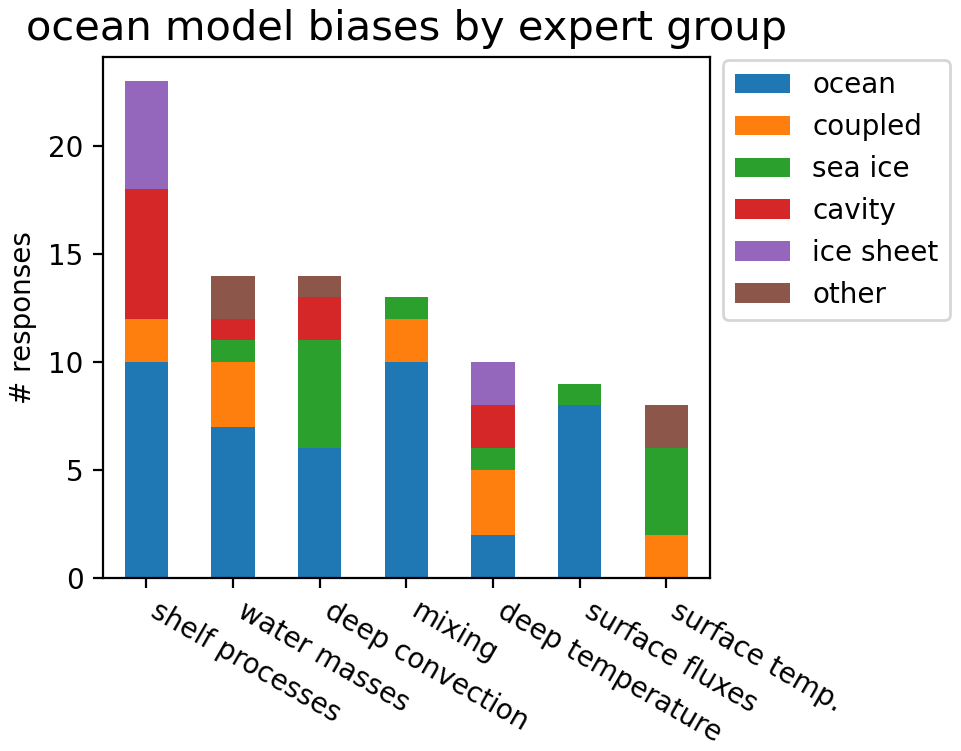
Figure 1“What is the most problematic ocean model bias?” Eight well-known issues were listed as pre-defined, single-choice answers to ensure emergence of the most pressing problems. In this distribution of the responses we merged seasonality of surface fluxes and air-sea CO2 flux into surface fluxes. The 91 responses (of 98 in total) are color-coded with respect to the area of expertise provided by the respective respondents. Here, “other” refers to all areas of expertise not explicitly listed, e.g. atmosphere and ecosystem.
It is important to understand that open ocean deep convection – while physically not unrealistic (Gordon, 1978) – is dramatically overestimated in many climate models, specifically those of coarse resolution, with consequences for ocean to atmosphere heat redistribution, sea ice coverage, bottom water characteristics, and eventually also internal climate variability (Reintges et al., 2017; Heuzé, 2021). In reality, most Antarctic Bottom Water (AABW) is formed on the continental shelf where sea ice formation and ice shelf melt play key roles in the transformation of upwelled deep water (Silvano et al., 2023) and so does mixing for its transformation into Antarctic Intermediate Water (AAIW) further equatorward (Li et al., 2022). To this end, nearly three-quarters of all participating experts pointed out biases that are inter-connected and play an imminent role in the formation of water masses, such as AABW and AAIW, crucial for the global overturning circulation and for the natural sequestration of heat and anthropogenic carbon.
Hence, it is no surprise that implementation of ice shelf cavities [20 %], convection parameterization [18 %], scale aware (mixing) parameterizations [15 %] and overflow parameterization [13 %] were listed as most urgent model development targets. There has been remarkable advancement in these directions over the past two decades (e.g., De Rydt et al., 2024; Legg et al., 2009; Bruciaferri et al., 2024). It has been demonstrated that these new developments can mitigate model biases in the Southern Ocean even at relatively coarse resolution despite remaining issues (e.g. for ice shelf cavities see Hutchinson et al., 2023). However, we believe there is often significant delay or inaction in implementing such advancements, as model development is rarely funded directly by dedicated research projects. The push for rapid research outcomes tends to favor easily implemented targets – the “low-hanging fruit” – over more complex, long-term efforts.
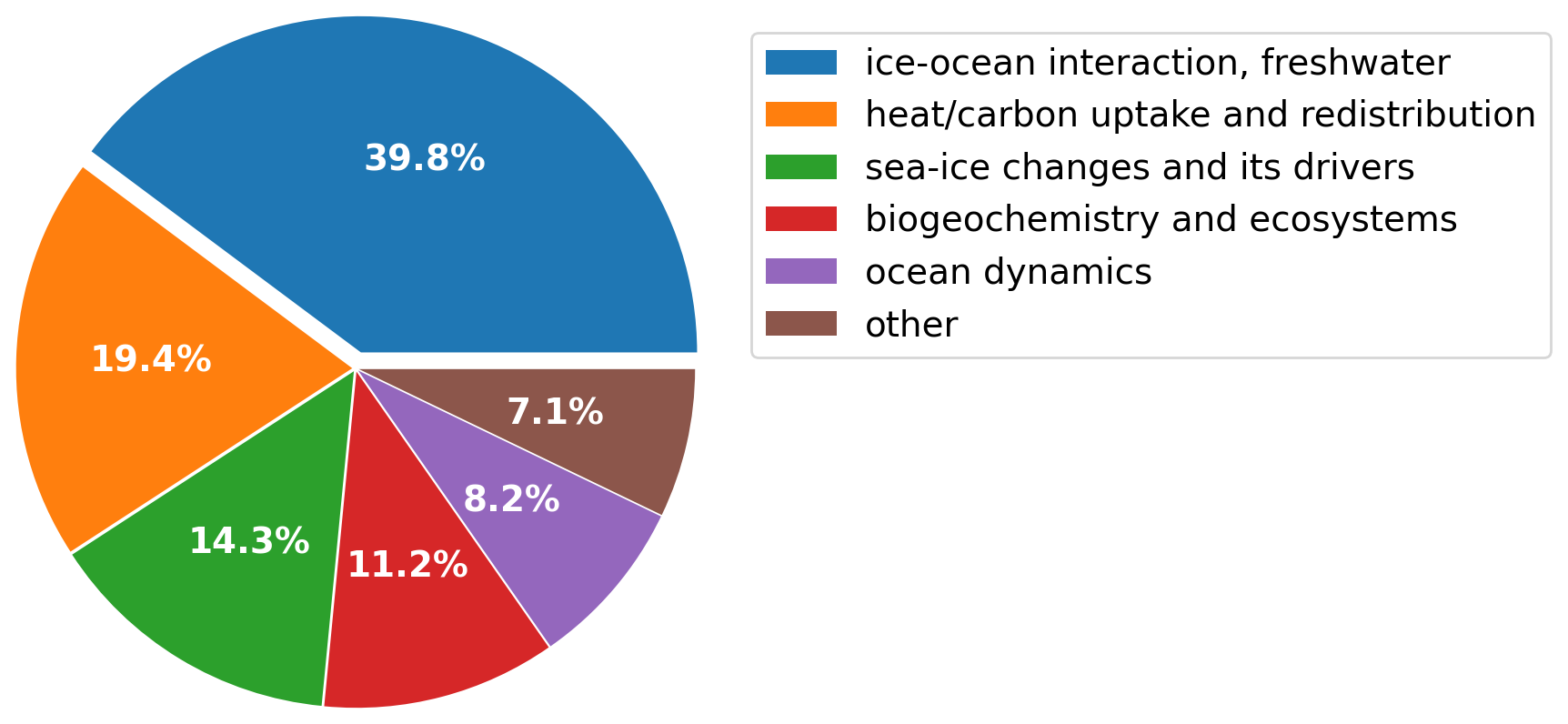
Figure 2“What is in your view the singular key science topic in the Southern Ocean?” The five most frequent answers were provided as part of seven examples and could be simply ticked. Pre-defined answers less picked were air-sea exchange and extreme events. Additional topics were given by the respondents as free text input. These include, amongst others, cloud-radiation processes, extreme events, nutrient redistribution and cross-disciplinary topics, and are collated as “other”.
This behavior is evident in the responses on near-term model evolution. Among those, increasing model complexity [27 %] and spatial resolution [24 %] stand out. Other goals such as improving or developing novel parameterizations and including artificial intelligence based modules are only considered by 11 %–13 % of the participants. In this case multiple answers were possible and participants ticked or listed 2–3 responses on average. It appears that preference is given to model complexity – evolving climate models into Earth system models by coupling more components, for example, ice sheets or biogeochemistry modules – over improving model physics. However, we think this could also be a sign of a more diversified, cross-disciplinary science landscape. As computing power keeps growing, resolving model issues by enhancing grid resolution appears to be a possible avenue to reduce biases (e.g., Rackow et al., 2022). But this is a costly option and impractical for applications on centennial time scales since proper representation of mesoscale dynamics in the high latitudes of the Southern Ocean requires grid spacing of 1/8–1/20° (and finer on the continental shelf), to properly resolve the Rossby radius (Hallberg, 2013, their Fig. 1). We suggest that new observations supporting model development could thus lead to improved and yet affordable simulations on a large range of spatial and temporal scales.
3.2 Scientific focus
Reducing the major model biases and advancing ocean and climate models as laid out above will be essential to address the key research topics identified in the survey responses. Freshwater, heat and carbon budgets are high on the scientific agenda of the modelling community (Fig. 2). Questions on process understanding and future evolution of the Antarctic ice sheet, its ice shelves and their interaction with the ocean through heat and meltwater dominate the results [40 %]. While this is research at the continental margin, heat and carbon uptake where the low latitude Southern Ocean plays a major role was named second [19 %], followed by interest in the recent and future sea ice trends [14 %]. On the one hand, these results are somewhat biased by the research areas of the participants. On the other hand, scientific interest has migrated poleward in the Southern Ocean, where major challenges have been identified, such as knowledge gaps in ice–ocean interaction affecting global sea level rise projections, and where new observational techniques for under-ice sampling and mesoscale ocean simulations have become available.
The results suggest that oceanic processes themselves, such as dynamics from mesoscale eddies to large-scale circulation, tides, waves and mixing are not “big questions” by themselves anymore despite remaining issues and their important role in current “grand challenges” like ice–ocean interaction, warm water intrusion onto the continental shelf and biogeochemical modeling. Further, we assume that the underrepresentation of biogeochemical and ecosystem research as well as atmospheric process understanding, most prominently clouds and aerosols, is likely a consequence of questionnaire design and the focus group addressed.
3.3 Observations used and needed
Before diving into a discussion on the observational needs of the modelling community, we would like to call attention to the data sources actually used. There is an unbroken preference by modellers to use gridded data products [28 %], i.e. statistically interpolated fusions of observations from various sources, and reanalysis or state estimates [21 %], which are based on a numerical model and incorporate observations through, e.g. assimilation techniques. Likely also due to their extensive spatial coverage, satellite-borne remote sensing products are favored as well [15 %]. Data from ship-borne instruments, moorings, and floats appear to be used less often directly [10 %–13 %]. We acknowledge that observational data of all kinds, in particular including in situ data, feed into the gridded products. Nevertheless, it is important to note that modelers tend to validate their simulations against these kind of “observations”, which in fact are advanced data products and rather not viewed as actual observations by the observing, sea-going science community. Further, any in situ data that are not included in such gridded products is likely less used or even overlooked by modelers and thus does not contribute as much to the improvement of models.
Based on our personal experience, modelers tend to lean on derived products, such as reanalyses and state estimates, because (1) observations are typically sparse and direct comparisons require complex subsampling of model output, (2) formats and platforms used to share observational data are still not unified and easily accessible to users despite ongoing efforts, and (3) original measurements require advanced background knowledge and interpretation for use in model validation. These issues can be mitigated by, for instance, providing open-source validation packages along with the measurements and the development of virtual instruments, i.e. tool boxes allowing for the subsampling of model output in ways emulating specific observational instruments. Further, we suggest that communication between the science communities should be strengthened. Additionally, educational programs, such as summer schools, could introduce instruments, proper data handling and aforementioned tool boxes to the next generation of modelers.
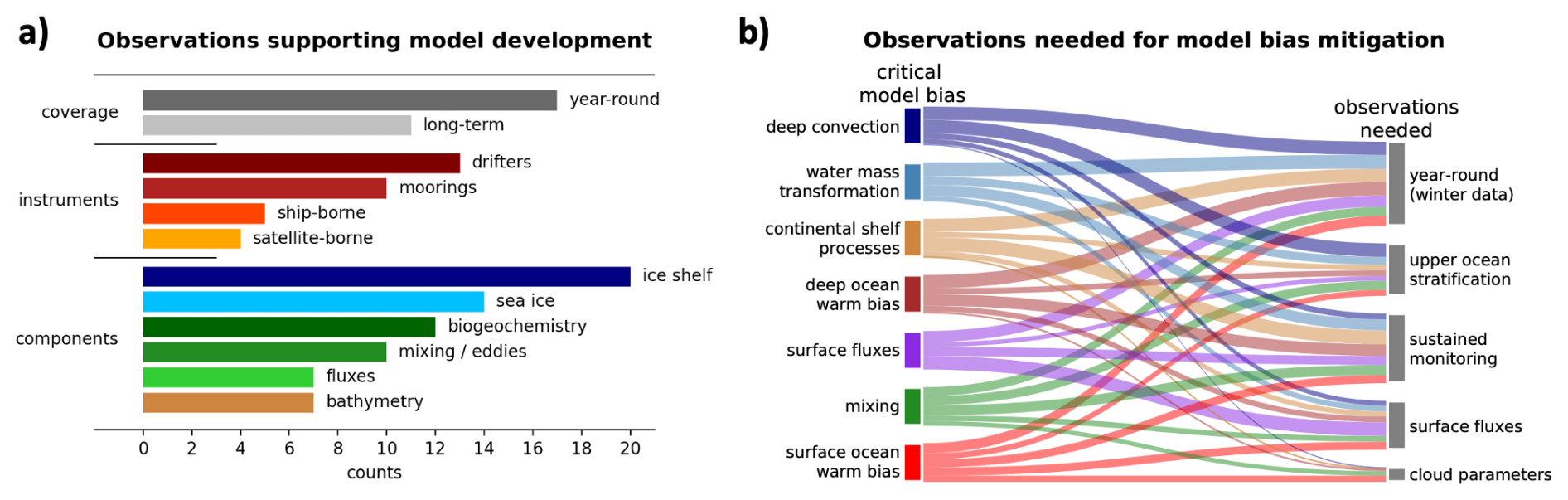
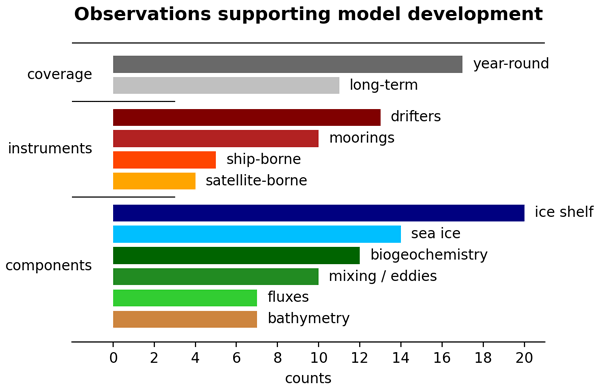
Figure 3(a) “Which kind of observations would further this [model] development?” (without pre-defined answers). Free text responses were grouped by key words (right hand side bar labels) and sorted into groups of temporal coverage, instrumentation/sensors/platform and Earth system components (left hand side labels). In total 130 responses were identified. (b) Linking the two questions “What is the most problematic ocean model bias?” and “Which observations could help understanding biases or further the process understanding?” by the same respondent. In both cases pre-defined answers were provided but free text replies were also possible; multiple choice was allowed. Overall 200 responses were cross-linked. The number of responses on the left side are normalized, see Fig. 1 for specific numbers.
For reducing observational gaps, especially with mitigating model biases in mind, modelers should be given and should take the opportunity to provide input to evolving observational programs early in the planning phase. In the end, this would ensure multiple use of the data collected. Figure 3a shows observations desired for bias mitigation with in situ observations clearly dominating over remote sensing data. This preference can be interpreted as a need for better process understanding in which in situ data are considered actual “ground truth” and often provide higher resolution in space and time, which is useful in several aspects, such as model validation, identifying of processes resolved at a given grid spacing, improving model parameterizations, etc. Another interpretation is that modellers are well aware of in situ measurements being crucial for better quality gridded products. And while such products are preferred in the actual validation process, the dire need for more ground truth data in a changing climate is acknowledged and its collection valued.
The scientific goals and observational plans of Antarctica InSync appear to be very much in line with the needs of the modelling community wishing for year-round data, especially in ice-covered seas and combining physical and biogeochemical measurements (Fig. 3a). The strong desire for winter observations and year-round monitoring in the Southern Ocean [29 %] is linked nearly equally to all major biases identified (Fig. 3b). As is already discussed by the Antarctica InSync community, building capacity for sustained monitoring in preparation for the International Polar Year in 2032–2033 and beyond would also strongly support model improvement and advancement [25 %]. Observations of the upper ocean stratification and surface fluxes would enable a better process understanding of the mixed layer and help to constrain vertical/diapycnal mixing parameterizations in models. Interestingly, the role of other climate system components causing biases in the ocean, for example, sea ice and snow, clouds and radiative processes, was not highly considered. This is likely owed to the limited choice of pre-defined answers we provided and the behavioral bias of the respondents preferring to tick one of those rather than entering individual answers. Nevertheless, we take this as an opportunity to point out the need for improved fundamental understanding and acknowledgement of coupled mechanisms and feedbacks within and beyond the focus group. Having better records of magnitude and variability of Southern Ocean surface fluxes of both physical and chemical quantities will help significantly. Similarly, any observations in support of heat and freshwater budgets, especially with a focus on ice–ocean interaction, will be instrumental in advancing models and improving climate projections. And last but not least, high-resolution bathymetry data of the Southern Ocean from the Antarctic Circumpolar Current to the continental margin and into the ice shelf cavities are urgently needed. Topography is a key ingredient for realistic simulations of the ocean circulation, specifically the import of Warm Deep Water and the export of dense bottom waters, and therefore crucial for reliable projections of ice shelf melting.
In conclusion, surveys like this provide a valuable overview of the current status, plans, and data needs not only for the Southern Ocean but also for the global modeling community. There are also some experiences to take away from this exercise, in particular how the pool of respondents shapes the usefulness of the survey, how to ask targeted questions without being exclusive, how pre-defined multiple-choice answers simplify the analysis but reduce the variety of responses, and which meta-information really is instrumental for interpreting the responses. All of this is well known and demonstrates the importance to involve experts on questionnaire design rather than constructing an ad hoc survey. Nevertheless, the feedback by the community to our survey has been very positive indicating that such surveys can be a valuable tool for future international program planning.
With the Antarctica InSync program in active planning and IPY5 approaching, we hope the results presented – with additional data available (Martin et al., 2025) – will inform both the scientific community and stakeholders to advance observations and models. The findings already contributed to the SOOS/OCEAN:ICE Workshop discussions and conclusions. Research priorities include ice–ocean interactions, Southern Ocean heat and carbon uptake, and the recent major changes in sea ice. Addressing these challenges requires model developments such as ice–shelf–ocean coupling, implementing biogeochemical processes, and applying higher resolution grids, alongside improved understanding of continental shelf processes and upper-ocean stratification. This, in turn, requires new observations in key regions with ice shelves most vulnerable to warm water intrusions and ocean circulation choke points. Further, the survey results call for stronger communication between the modeling and observing communities and dedicated data-use training for modelers. Antarctica InSync offers a major opportunity to advance such efforts.
Here we reproduce for convenience the survey introduction and questions along with the response options. A screenshot of the original questionnaire website is included in the survey dataset (Martin et al., 2025).
Southern Ocean modelling: status, plans and needs
In preparation of the SOOS/OCEAN:ICE/Antarctica InSync workshop on ice-ocean observation harmonisation and future priorities agenda, which will be held in Copenhagen in September this year and also serves for the planning of Antarctica InSync activities, we kindly ask for your input.
All of the 12 questions below focus on the Southern Ocean region (south of ∼50° S), physical ocean processes are prioritised but immediate interaction with other system components can be addressed (atmosphere, sea ice, ice shelves, biogeochemistry, ecosystem etc.), and the applications we have in mind range from realistic regional models in the Southern Ocean to CMIP-type global climate models (with or without further coupled components like ice shelves or biogeochemistry).
Please select from the multiple choice items or add an alternative item as “other”. This should not take more than 10 min.
Note, the first three questions on expertise and scales may help to “set the stage” for the answers of the other questions. If you work on very different scales, you may consider answering the questionnaire twice for different cases. A link for another response is provided after submitting the first one. Please respond until 15 September. (deadline extended)
Thank you for your time and effort.
Torge Martin (OMDP), Carolina Dufour (SORP), Andrew Meijers (SOOS), Alyce Hancock (SOOS)
This questionnaire is supported by SOOS and CLIVAR panels SORP and OMDP. The anonymous(!) data may be used by these panels for planning of further activities beyond the above mentioned workshop.
https://www.soos.aq (last access: 30 April 2026), https://www.clivar.org/clivar-panels/southern (last access: 30 April 2026), https://www.clivar.org/clivar-panels/omdp (last access: 30 April 2026)
-
What is your primary area of expertise?
This is independent of a focus on physical, biological or other processes.
- ◦
-
Ocean
- ◦
-
Sea ice
- ◦
-
Ice-shelf cavity
- ◦
-
Ice sheet/ice shelf/icebergs
- ◦
-
Atmosphere
- ◦
-
Coupled climate modelling
- ◦
-
Other:
-
What spatial scales do you work on?
- ◦
-
Submesoscale (<10 km)
- ◦
-
Mesoscale (10–100 km)
- ◦
-
Basin-scale (>100 km)
- ◦
-
Global impacts
-
What temporal scales do you work on?
- ◦
-
Days to weeks
- ◦
-
Months to seasons
- ◦
-
Years to decades
- ◦
-
Decades to centuries
- ◦
-
Beyond centuries
-
What is in your view the singular key science topic in the SO?
- ◦
-
Ocean dynamics (sub-/mesoscale eddies to large-scale circulation)
- ◦
-
Ice sheet/shelf–ocean interaction, fresh water
- ◦
-
Heat and/or carbon uptake and redistribution
- ◦
-
Sea–ice change and drivers/consequences thereof
- ◦
-
Air–sea exchange, incl. carbon/trace gasses
- ◦
-
Marine biogeochemistry and ecosystems
- ◦
-
Extreme events
- ◦
-
Other:
-
What kind of observational data do you preferably use?
[multiple answers allowed]
- ◦
-
Campaign based data (e.g. ship transects, gliders, …)
- ◦
-
Stationary, year-round data (e.g. moorings)
- ◦
-
Varied spatial and temporal coverage (e.g. Argo-Floats)
- ◦
-
Gridded data products integrating various data sources
- ◦
-
Reanalysis/ocean state estimate products
- ◦
-
Remote sensing data (please specify below)
- ◦
-
Other:
If you selected “Remote sensing data” above, please specify the variable and product here:
-
What is the most problematic ocean model bias?
- ◦
-
Surface warm bias, too small sea ice extent
- ◦
-
Deep warm bias
- ◦
-
Mixing
- ◦
-
Seasonality of surface fluxes
- ◦
-
Air–sea CO2 flux
- ◦
-
Water mass formation and characteristics (AABW, AAIW, …)
- ◦
-
Open-ocean convection (polynyas)
- ◦
-
Shelf processes (e.g. slope current, ice shelf cavities, overflows, …)
- ◦
-
Other:
-
Which type of model did you have in mind when answering the last question on biases?
For example, list model complexity, grid resolution, application case, or anything else.
-
Which observations could help understanding biases or further the process understanding? [multiple answers allowed]
- ◦
-
Winter data (year-round observations)
- ◦
-
Upper ocean stratification
- ◦
-
Surface fluxes
- ◦
-
Cloud observations
- ◦
-
Sustained monitoring
- ◦
-
Other:
-
Where do mismatches exist between traditionally observed quantities and model diagnostics (e.g. mixed layer depth)?
-
What is the most pressing ocean model development?
[multiple answers allowed]
- ◦
-
Implementation of ice shelf cavities
- ◦
-
Overflow parameterization, vertical coordinates
- ◦
-
Convection parameterization, vertical mixing
- ◦
-
Scale-aware parameterization, e.g. for eddies
- ◦
-
Biogeochemistry module
- ◦
-
Coupled ecosystem module
- ◦
-
Surface waves and/or tides
- ◦
-
Sea ice dynamics
- ◦
-
Other:
-
Where will you or your collaborators evolve ocean models towards over the next decade?
[multiple answers allowed]
- ◦
-
Coupling more Earth system components (ice sheets, biogeochemistry, …)
- ◦
-
Including more processes (tides, waves …)
- ◦
-
Novel parameterizations (submesoscale, scale-aware …)
- ◦
-
Higher resolution (horizontal and/or vertical)
- ◦
-
Unstructured grids, variable topography (wetting/drying, ice shelf cavity shape)
- ◦
-
AI-based model components (parameterizations, emulators, …)
- ◦
-
Other:
-
Which kind of observations would further this development?
Voluntary option: provide your contact details for further discussion regarding Antarctica InSync modeling activities: name, affiliation, e-mail (comma delimited please).
The survey results are available through Zenodo (https://doi.org/10.5281/zenodo.17289776, Martin et al., 2025).
TM conceived the original idea of conducting the survey, led the analysis and produced all figures. All authors contributed to the survey design, its content and writing of this manuscript. AMH explored different survey platforms and distributed the survey call.
The contact author has declared that none of the authors has any competing interests.
Publisher's note: Copernicus Publications remains neutral with regard to jurisdictional claims made in the text, published maps, institutional affiliations, or any other geographical representation in this paper. The authors bear the ultimate responsibility for providing appropriate place names. Views expressed in the text are those of the authors and do not necessarily reflect the views of the publisher.
The authors thank three anonymous reviewers and the editor Mario Hoppema for their positive feedback and helpful comments leading to a more careful interpretation of the survey. We specifically thank SOOS and CLIVAR for their support and endorsement of the survey facilitating this study. We are grateful to all the scientific networks and coordinators for widely spreading the survey call and all the participants for responding yielding such great turnout. Helpful comments on the questionnaire design by Chris Danek, Ivy Frenger, Alexander Haumann, Qian Li, Lavinia Patara, Ariaan Purich, David Stevens were much appreciated. The survey was conducted using Google Forms and we made use of the initial visualization of the statistics provided by this platform in material provided by Martin et al. (2025). This is OCEAN:ICE contribution no. 50. SOOS is a joint initiative of the Scientific Committee on Oceanic Research (SCOR) and the Scientific Committee on Antarctic Research (SCAR). SOOS sponsors include SCAR and SCOR, the Tasmanian State Government, CSIRO, the Australian Antarctica Program Partnership (AAPP), the Alfred Wegener Institute (AWI), OCEAN:ICE, the Swedish Polar Research Secretariat and the TÜBİTAK MAM Polar Research Institute. The SOOS International Project Office is hosted by the Institute for Marine and Antarctica Studies, University of Tasmania.
This research has been supported by the HORIZON EUROPE Food, Bioeconomy, Natural Resources, Agriculture and Environment (grant no. 101060452) and was also funded by UK Research and Innovation (UKRI) under the UK government's Horizon Europe funding Guarantee (grant no. 10048443).
The article processing charges for this open-access publication were covered by the GEOMAR Helmholtz Centre for Ocean Research Kiel.
This paper was edited by Mario Hoppema and reviewed by three anonymous referees.
Adusumilli, S., Fricker, H. A., Medley, B., Padman, L., and Siegfried, M. R.: Interannual variations in meltwater input to the Southern Ocean from Antarctic ice shelves, Nat. Geosci., 13, 616–620, https://doi.org/10.1038/s41561-020-0616-z, 2020.
Beadling, R. L., Russell, J. L., Stouffer, R. J., Mazloff, M., Talley, L. D., Goodman, P. J., Sallée, J. B., Hewitt, H. T., Hyder, P., and Pandde, A: Representation of Southern Ocean properties across coupled model intercomparison project generations: CMIP3 to CMIP6, J. Climate, 33, 6555–6581, https://doi.org/10.1175/JCLI-D-19-0970.1, 2020.
Bell, R. E. and Seroussi, H.: History, mass loss, structure, and dynamic behavior of the Antarctic Ice Sheet, Science, 367, 1321–1325, https://doi.org/10.1126/science.aaz5489, 2020.
Bruciaferri, D., Guiavarc'h, C., Hewitt, H. T., Harle, J., Almansi, M., Mathiot, P., and Colombo, P.: Localized general vertical coordinates for quasi-Eulerian ocean models: The Nordic overflows test-case, J. Adv. Model Earth Syst., 16, e2023MS003893, https://doi.org/10.1029/2023MS003893, 2024.
De Rydt, J., Jourdain, N. C., Nakayama, Y., van Caspel, M., Timmermann, R., Mathiot, P., Asay-Davis, X. S., Seroussi, H., Dutrieux, P., Galton-Fenzi, B., Holland, D., and Reese, R.: Experimental design for the Marine Ice Sheet–Ocean Model Intercomparison Project – phase 2 (MISOMIP2), Geosci. Model Dev., 17, 7105–7139, https://doi.org/10.5194/gmd-17-7105-2024, 2024.
Frölicher, T. L., Sarmiento, J. L., Paynter, D. J., Dunne, J. P., Krasting, J. P., and Winton, M.: Dominance of the Southern Ocean in Anthropogenic Carbon and Heat Uptake in CMIP5 Models, J. Climate, 28, 862–886, https://doi.org/10.1175/JCLI-D-14-00117.1, 2015.
Gordon, A. L.: Deep Antarctic convection west of Maud rise, J. Phys. Oceanogr., 8, 600–612, https://doi.org/10.1175/1520-0485(1978)008<0600:DACWOM>2.0.CO;2, 1978.
Hallberg, R.: Using a resolution function to regulate parameterizations of oceanic mesoscale eddy effects, Ocean Model., 72, 92–103, https://doi.org/10.1016/j.ocemod.2013.08.007, 2013.
Heuzé, C.: Antarctic Bottom Water and North Atlantic Deep Water in CMIP6 models, Ocean Sci., 17, 59–90, https://doi.org/10.5194/os-17-59-2021, 2021.
Huguenin, M. F., Holmes, R. M., and England, M. H.: Drivers and distribution of global ocean heat uptake over the last half century, Nat. Commun., 13, 4921, https://doi.org/10.1038/s41467-022-32540-5, 2022.
Hutchinson, K., Deshayes, J., Éthé, C., Rousset, C., de Lavergne, C., Vancoppenolle, M., Jourdain, N. C., and Mathiot, P.: Improving Antarctic Bottom Water precursors in NEMO for climate applications, Geosci. Model Dev., 16, 3629–3650, https://doi.org/10.5194/gmd-16-3629-2023, 2023.
Legg, S., Briegleb, B., Chang, Y., Chassignet, E. P., Danabasoglu, G., Ezer, T., Gordon, A. L., Griffies, S., Hallberg, R., Jackson, L., Large, W., Özgökmen, T. M., Peters, H., Price, J., Riemenschneider, U., Wu, W., Xu, X., and Yang, J.: Improving Oceanic Overflow Representation in Climate Models: The Gravity Current Entrainment Climate Process Team, B. Am. Meteorol. Soc., 90, 657–670, https://doi.org/10.1175/2008BAMS2667.1, 2009.
Li, Z., Groeskamp, S., Cerovečki, I., and England, M. H.: The Origin and Fate of Antarctic Intermediate Water in the Southern Ocean, J. Phys. Oceanogr., 52, 2873–2890, https://doi.org/10.1175/JPO-D-21-0221.1, 2022.
Martin, T., Dufour, C., Meijers, A., and Hancock, A.: Southern Ocean modelling survey (1.0) [Data set], Zenodo [data set], https://doi.org/10.5281/zenodo.17289776, 2025.
Moreno-Chamarro, E., Caron, L.-P., Loosveldt Tomas, S., Vegas-Regidor, J., Gutjahr, O., Moine, M.-P., Putrasahan, D., Roberts, C. D., Roberts, M. J., Senan, R., Terray, L., Tourigny, E., and Vidale, P. L.: Impact of increased resolution on long-standing biases in HighResMIP-PRIMAVERA climate models, Geosci. Model Dev., 15, 269–289, https://doi.org/10.5194/gmd-15-269-2022, 2022.
Noble, T. L., Rohling, E. J., Aitken, A. R. A., Bostock, H. C., Chase, Z., Gomez, N., Jong, L. M., King, M. A., Mackintosh, A. N., McCormack, F. S., McKay, R. M., Menviel, L., Phipps, S. J., Weber, M. E., Fogwill, C. J., Gayen, B., Golledge, N. R., Gwyther, D. E., Hogg, A. McC., Martos, Y. M., Pena-Molino, B., Roberts, J., van de Flierdt, T., and Williams, T.: The Sensitivity of the Antarctic Ice Sheet to a Changing Climate: Past, Present, and Future, Rev. Geophys., 58, e2019RG000663, https://doi.org/10.1029/2019RG000663, 2020.
Rackow, T., Danilov, S., Goessling, H. F., Hellmer, H. H., Sein, D. V., Semmler, T., Sidorenko, D., and Jung, T.: Delayed Antarctic sea-ice decline in high-resolution climate change simulations, Nat. Commun., 13, 637, https://doi.org/10.1038/s41467-022-28259-y, 2022.
Reintges, A., Martin, T., Latif, M., and Park, W.: Physical controls of Southern Ocean deep-convection variability in CMIP5 models and the Kiel Climate Model, Geophys. Res. Lett., 44, https://doi.org/10.1002/2017GL074087, 2017.
Silvano, A., Purkey, S., Gordon, A. L., Castagno, P., Stewart, A. L., Rintoul, S. R., Foppert, A., Gunn, K. L., Herraiz-Borreguero, L., Aoki, S., Nakayama, Y., Naveira Garabato, A. C., Spingys, C., Akhoudas, C. H., Sallée, J.-B., de Lavergne, C., Abrahamsen, E. P., Meijers, A. J. S., Meredith, M. P., Zhou, S., Tamura, T., Yamazaki, K., Ohshima, K. I., Falco, P., Budillon, G., Hattermann, T., Janout, M. A., Llanillo, P., Bowen, M. M., Darelius, E., Østerhus, S., Nicholls, K. W., Stevens, C., Fernandez, D., Cimoli, L., Jacobs, S. S., Morrison, A. K., Hogg, A. M., Haumann, F. A., Mashayek, A., Wang, Z., Kerr, R., Williams, G. D., and Lee, W. S.: Observing Antarctic Bottom Water in the Southern Ocean, Front. Mar. Sci., 10, 1221701, https://doi.org/10.3389/fmars.2023.1221701, 2023.
Stouffer, R. J., Eyring, V., Meehl, G. A., Bony, S., Senior, C., Stevens, B., and Taylor, K. E.: CMIP5 scientific gaps and recommendations for CMIP6, B. Am. Meteorol. Soc., 98, 95–105, https://doi.org/10.1175/BAMS-D-15-00013.1, 2017.
Williams, R. G., Meijers, A. J. S., Roussenov, V. M., Katavouta, A., Ceppi, P., Rosser, J. P., and Salvi, P.: Asymmetries in the Southern Ocean contribution to global heat and carbon uptake, Nat. Clim. Change, 14, 823–831, https://doi.org/10.1038/s41558-024-02066-3, 2024.
Zhang, Q., Liu, B., Li, S., and Zhou, T.: Understanding models' global sea surface temperature bias in mean state: From CMIP5 to CMIP6, Geophys. Res. Lett., 50, e2022GL100888, https://doi.org/10.1029/2022GL100888, 2023.