
Articles | Volume 22, issue 2
https://doi.org/10.5194/os-22-1353-2026
© Author(s) 2026. This work is distributed under
the Creative Commons Attribution 4.0 License.
the Creative Commons Attribution 4.0 License.
https://doi.org/10.5194/os-22-1353-2026
© Author(s) 2026. This work is distributed under
the Creative Commons Attribution 4.0 License.
the Creative Commons Attribution 4.0 License.
Research article
| 
27 Apr 2026
Research article |
| 27 Apr 2026
| 27 Apr 2026
Dynamic and steric sea-level changes due to a collapsing AMOC in the Community Earth System Model

Royal Netherlands Meteorological Institute, De Bilt, the Netherlands
Caroline A. Katsman
Royal Netherlands Meteorological Institute, De Bilt, the Netherlands
Environmental Fluid Mechanics Section, Department of Hydraulic Engineering, Faculty of Civil Engineering and Geosciences, Delft University of Technology, Delft, the Netherlands
Dewi Le Bars
Royal Netherlands Meteorological Institute, De Bilt, the Netherlands
Related authors
Emma J. V. Smolders, René M. van Westen, and Henk A. Dijkstra
Ocean Sci., 22, 1965–1985, https://doi.org/10.5194/os-22-1965-2026, https://doi.org/10.5194/os-22-1965-2026, 2026
Short summary
Short summary
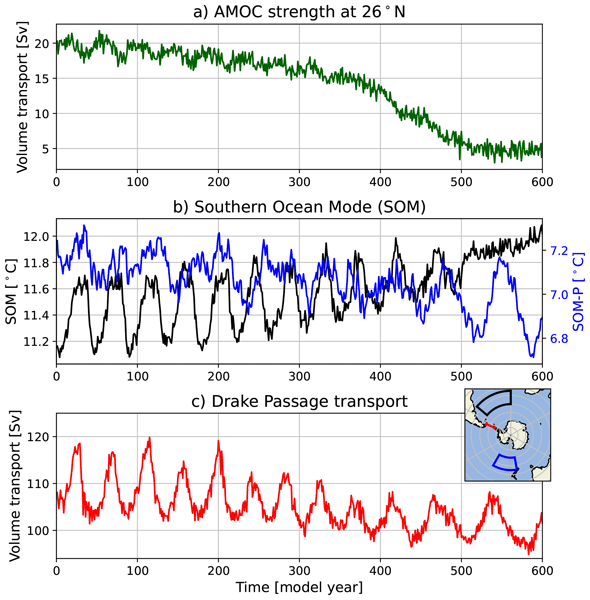
The Southern Ocean shows strong natural variability on multi-decadal time scales, known as the Southern Ocean Mode (SOM). Using high-resolution ocean simulations, we show that a collapse of the Atlantic Meridional Overturning Circulation (AMOC) strongly weakens the SOM. This weakening is linked to changes in ocean density, a slowdown of the Antarctic Circumpolar Current, and shifts in deep convection across the Southern Ocean.
René M. van Westen, Karin van der Wiel, Swinda K. J. Falkena, and Frank Selten
Hydrol. Earth Syst. Sci., 29, 6607–6630, https://doi.org/10.5194/hess-29-6607-2025, https://doi.org/10.5194/hess-29-6607-2025, 2025
Short summary
Short summary
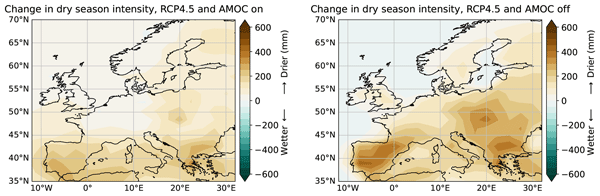
The Atlantic Meridional Overturning Circulation (AMOC) moderates the European climate. The AMOC is a tipping element and may collapse to a substantially weaker state under climate change. Such an event induces global and regional climate shifts. The European hydroclimate becomes drier under an AMOC collapse, this response is not considered in the
standardhydroclimate projections. Our results indicate a considerable influence of the AMOC on the European hydroclimate.
René M. van Westen, Elian Vanderborght, and Henk A. Dijkstra
Earth Syst. Dynam., 16, 2063–2085, https://doi.org/10.5194/esd-16-2063-2025, https://doi.org/10.5194/esd-16-2063-2025, 2025
Short summary
Short summary
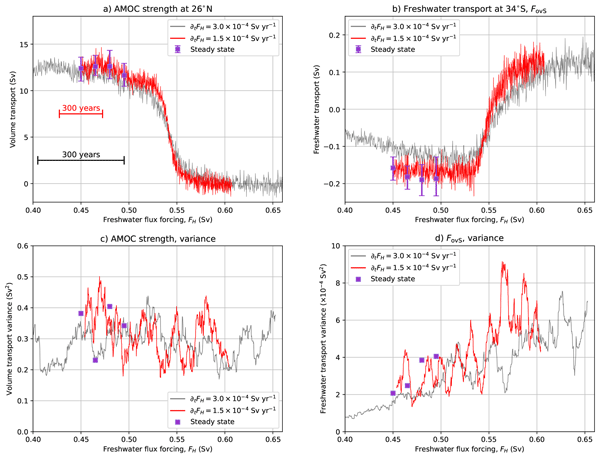
The Atlantic Meridional Overturning Circulation (AMOC) is a tipping element in the fully-coupled Community Earth System Model (CESM). Under varying freshwater flux forcing parameters or climate change, the AMOC may collapse from a relatively strong state to a substantially weaker state. It is important to understand the dynamics of the AMOC collapse in the CESM. We show that the stability of the AMOC in the CESM is controlled by only a few feedback processes.
René M. van Westen and Henk A. Dijkstra
Ocean Sci., 20, 549–567, https://doi.org/10.5194/os-20-549-2024, https://doi.org/10.5194/os-20-549-2024, 2024
Short summary
Short summary
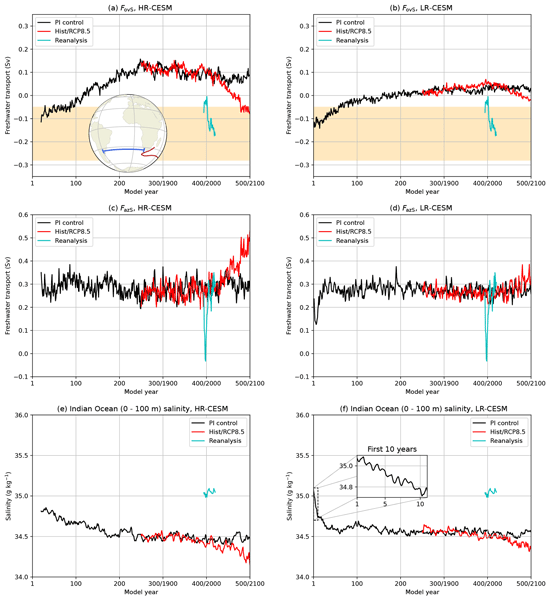
The Atlantic Meridional Overturning Circulation (AMOC) is an important component in the global climate system. Observations of the present-day AMOC indicate that it may weaken or collapse under global warming, with profound disruptive effects on future climate. However, AMOC weakening is not correctly represented because an important feedback is underestimated due to biases in the Atlantic's freshwater budget. Here we address these biases in several state-of-the-art climate model simulations.
Valérian Jacques-Dumas, René M. van Westen, Freddy Bouchet, and Henk A. Dijkstra
Nonlin. Processes Geophys., 30, 195–216, https://doi.org/10.5194/npg-30-195-2023, https://doi.org/10.5194/npg-30-195-2023, 2023
Short summary
Short summary
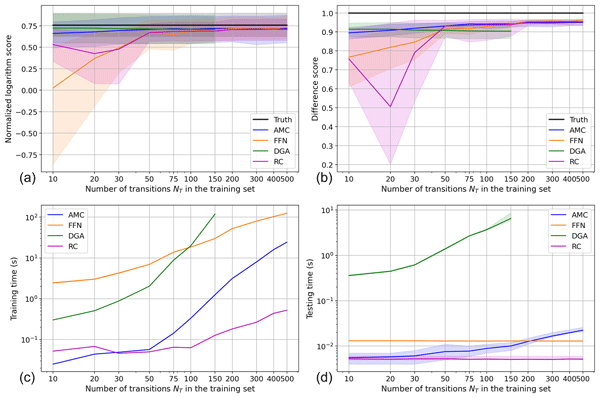
Computing the probability of occurrence of rare events is relevant because of their high impact but also difficult due to the lack of data. Rare event algorithms are designed for that task, but their efficiency relies on a score function that is hard to compute. We compare four methods that compute this function from data and measure their performance to assess which one would be best suited to be applied to a climate model. We find neural networks to be most robust and flexible for this task.
Eveline C. van der Linden, Klaus Wyser, Erwin Lambert, André Jüling, Dewi Le Bars, Sybren Drijfthout, and Irene Trombini
EGUsphere, https://doi.org/10.5194/egusphere-2026-4584, https://doi.org/10.5194/egusphere-2026-4584, 2026
This preprint is open for discussion and under review for Earth System Dynamics (ESD).
Short summary
Short summary
As Antarctica loses more ice, increasing amounts of fresh water enter the ocean and can change Earth's climate. We used a climate model in which Antarctic ice loss responds to changing ocean conditions. We found that this feedback first increases warming near the ice shelves but later slows both Antarctic and global warming by changing the ocean, sea ice, and atmosphere. These results show that including these interactions is important for improving long-term sea-level and climate projections.
Emma J. V. Smolders, René M. van Westen, and Henk A. Dijkstra
Ocean Sci., 22, 1965–1985, https://doi.org/10.5194/os-22-1965-2026, https://doi.org/10.5194/os-22-1965-2026, 2026
Short summary
Short summary
The Southern Ocean shows strong natural variability on multi-decadal time scales, known as the Southern Ocean Mode (SOM). Using high-resolution ocean simulations, we show that a collapse of the Atlantic Meridional Overturning Circulation (AMOC) strongly weakens the SOM. This weakening is linked to changes in ocean density, a slowdown of the Antarctic Circumpolar Current, and shifts in deep convection across the Southern Ocean.
Nora Fried, Renske Gelderloos, Oliver J. Tooth, Caroline A. Katsman, and M. Femke de Jong
Ocean Sci., 22, 1763–1780, https://doi.org/10.5194/os-22-1763-2026, https://doi.org/10.5194/os-22-1763-2026, 2026
Short summary
Short summary
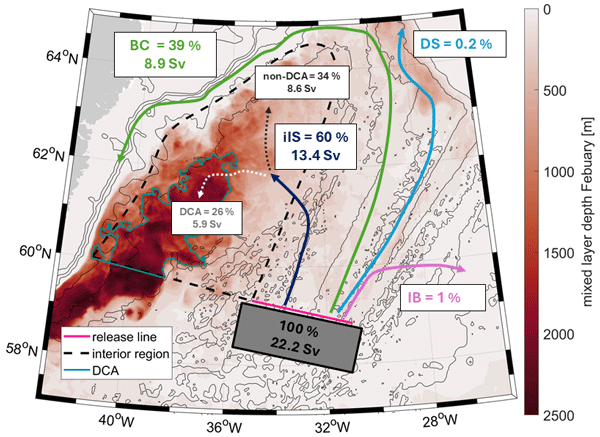
This study investigates how much warm and saline subtropical-origin water flowing in the Irminger Current (IC) can enter the Irminger Sea convection region by releasing virtual particles in an ocean model. We show that one quarter of IC waters enter the convection region with the potential to increase local stratification. Our results suggest that changes in the water mass properties of the IC have the potential to influence the strength of deep convection in the Irminger Sea.
René M. van Westen, Karin van der Wiel, Swinda K. J. Falkena, and Frank Selten
Hydrol. Earth Syst. Sci., 29, 6607–6630, https://doi.org/10.5194/hess-29-6607-2025, https://doi.org/10.5194/hess-29-6607-2025, 2025
Short summary
Short summary
The Atlantic Meridional Overturning Circulation (AMOC) moderates the European climate. The AMOC is a tipping element and may collapse to a substantially weaker state under climate change. Such an event induces global and regional climate shifts. The European hydroclimate becomes drier under an AMOC collapse, this response is not considered in the
standardhydroclimate projections. Our results indicate a considerable influence of the AMOC on the European hydroclimate.
René M. van Westen, Elian Vanderborght, and Henk A. Dijkstra
Earth Syst. Dynam., 16, 2063–2085, https://doi.org/10.5194/esd-16-2063-2025, https://doi.org/10.5194/esd-16-2063-2025, 2025
Short summary
Short summary
The Atlantic Meridional Overturning Circulation (AMOC) is a tipping element in the fully-coupled Community Earth System Model (CESM). Under varying freshwater flux forcing parameters or climate change, the AMOC may collapse from a relatively strong state to a substantially weaker state. It is important to understand the dynamics of the AMOC collapse in the CESM. We show that the stability of the AMOC in the CESM is controlled by only a few feedback processes.
Erwin Lambert, Dewi Le Bars, Eveline van der Linden, André Jüling, and Sybren Drijfhout
Earth Syst. Dynam., 16, 1303–1323, https://doi.org/10.5194/esd-16-1303-2025, https://doi.org/10.5194/esd-16-1303-2025, 2025
Short summary
Short summary
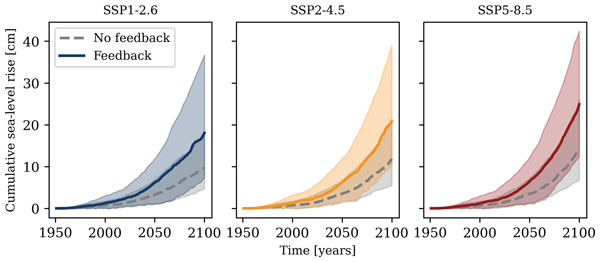
Ocean warming around Antarctica leads to ice melting and sea-level rise. The meltwater that flows into the surrounding ocean can lead to enhanced warming of the seawater, thereby again increasing melting and sea-level rise. This process, however, is not currently included in climate models. Through a simple mathematical approach, we find that this process can lead to more melting and greater sea-level rise, possibly increasing the Antarctic contribution to 21st century sea-level rise by 80 %.
Dewi Le Bars, Iris Keizer, and Sybren Drijfhout
Ocean Sci., 21, 1303–1314, https://doi.org/10.5194/os-21-1303-2025, https://doi.org/10.5194/os-21-1303-2025, 2025
Short summary
Short summary
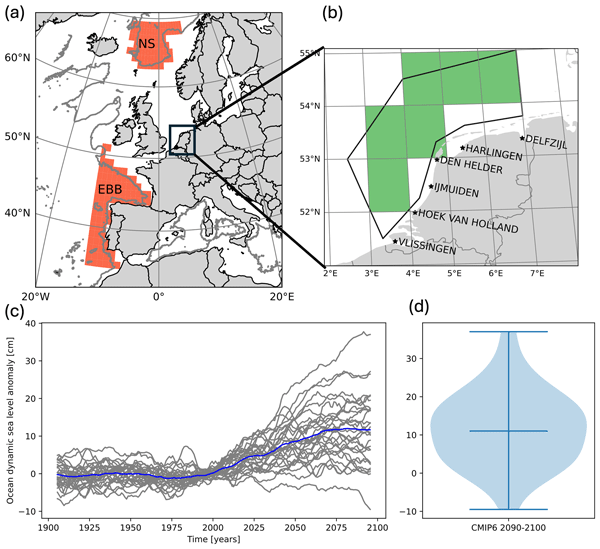
While preparing a new set of sea level scenarios for the Netherlands, we found out that many climate models overestimate the changes in ocean circulation for the last 30 years. To quantify this effect, we defined three methods that rely on diverse and independent observations: tide gauges, satellite altimetry, temperature and salinity in the ocean, land ice melt, etc. Based on these observations, we define a few methods to select models and discuss their advantages and disadvantages.
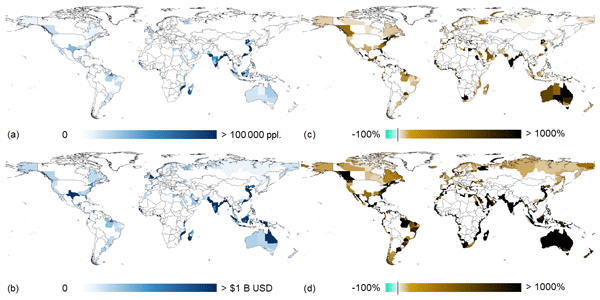
Eric Mortensen, Timothy Tiggeloven, Toon Haer, Bas van Bemmel, Dewi Le Bars, Sanne Muis, Dirk Eilander, Frederiek Sperna Weiland, Arno Bouwman, Willem Ligtvoet, and Philip J. Ward
Nat. Hazards Earth Syst. Sci., 24, 1381–1400, https://doi.org/10.5194/nhess-24-1381-2024, https://doi.org/10.5194/nhess-24-1381-2024, 2024
Short summary
Short summary
Current levels of coastal flood risk are projected to increase in coming decades due to various reasons, e.g. sea-level rise, land subsidence, and coastal urbanization: action is needed to minimize this future risk. We evaluate dykes and coastal levees, foreshore vegetation, zoning restrictions, and dry-proofing on a global scale to estimate what levels of risk reductions are possible. We demonstrate that there are several potential adaptation pathways forward for certain areas of the world.
René M. van Westen and Henk A. Dijkstra
Ocean Sci., 20, 549–567, https://doi.org/10.5194/os-20-549-2024, https://doi.org/10.5194/os-20-549-2024, 2024
Short summary
Short summary
The Atlantic Meridional Overturning Circulation (AMOC) is an important component in the global climate system. Observations of the present-day AMOC indicate that it may weaken or collapse under global warming, with profound disruptive effects on future climate. However, AMOC weakening is not correctly represented because an important feedback is underestimated due to biases in the Atlantic's freshwater budget. Here we address these biases in several state-of-the-art climate model simulations.
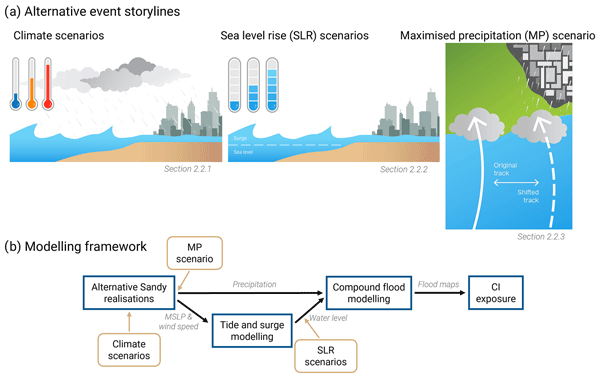
Henrique M. D. Goulart, Irene Benito Lazaro, Linda van Garderen, Karin van der Wiel, Dewi Le Bars, Elco Koks, and Bart van den Hurk
Nat. Hazards Earth Syst. Sci., 24, 29–45, https://doi.org/10.5194/nhess-24-29-2024, https://doi.org/10.5194/nhess-24-29-2024, 2024
Short summary
Short summary
We explore how Hurricane Sandy (2012) could flood New York City under different scenarios, including climate change and internal variability. We find that sea level rise can quadruple coastal flood volumes, while changes in Sandy's landfall location can double flood volumes. Our results show the need for diverse scenarios that include climate change and internal variability and for integrating climate information into a modelling framework, offering insights for high-impact event assessments.
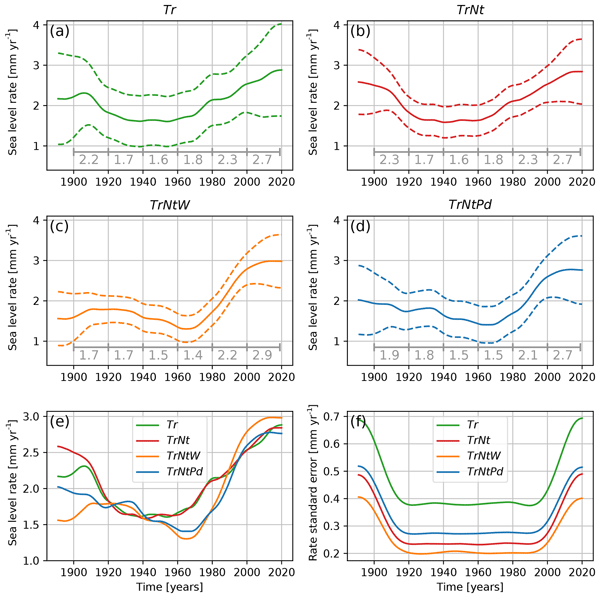
Iris Keizer, Dewi Le Bars, Cees de Valk, André Jüling, Roderik van de Wal, and Sybren Drijfhout
Ocean Sci., 19, 991–1007, https://doi.org/10.5194/os-19-991-2023, https://doi.org/10.5194/os-19-991-2023, 2023
Short summary
Short summary
Using tide gauge observations, we show that the acceleration of sea-level rise (SLR) along the coast of the Netherlands started in the 1960s but was masked by wind field and nodal-tide variations. This finding aligns with global SLR observations and expectations based on a physical understanding of SLR related to global warming.
Valérian Jacques-Dumas, René M. van Westen, Freddy Bouchet, and Henk A. Dijkstra
Nonlin. Processes Geophys., 30, 195–216, https://doi.org/10.5194/npg-30-195-2023, https://doi.org/10.5194/npg-30-195-2023, 2023
Short summary
Short summary
Computing the probability of occurrence of rare events is relevant because of their high impact but also difficult due to the lack of data. Rare event algorithms are designed for that task, but their efficiency relies on a score function that is hard to compute. We compare four methods that compute this function from data and measure their performance to assess which one would be best suited to be applied to a climate model. We find neural networks to be most robust and flexible for this task.
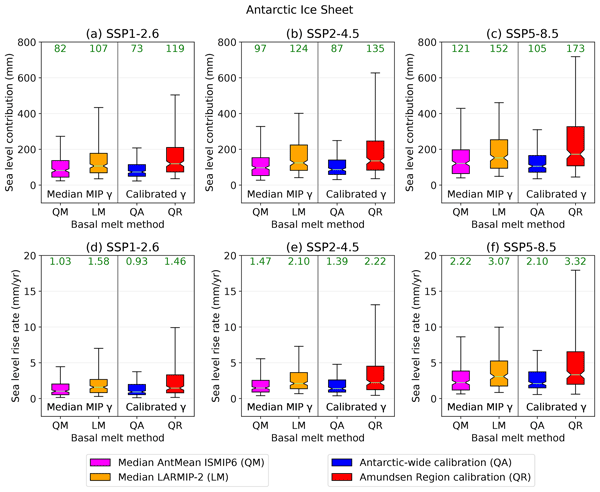
Eveline C. van der Linden, Dewi Le Bars, Erwin Lambert, and Sybren Drijfhout
The Cryosphere, 17, 79–103, https://doi.org/10.5194/tc-17-79-2023, https://doi.org/10.5194/tc-17-79-2023, 2023
Short summary
Short summary
The Antarctic ice sheet (AIS) is the largest uncertainty in future sea level estimates. The AIS mainly loses mass through ice discharge, the transfer of land ice into the ocean. Ice discharge is triggered by warming ocean water (basal melt). New future estimates of AIS sea level contributions are presented in which basal melt is constrained with ice discharge observations. Despite the different methodology, the resulting projections are in line with previous multimodel assessments.
Cited articles
Baker, J., Bell, M., Jackson, L., Vallis, G., Watson, A., and Wood, R.: Continued Atlantic overturning circulation even under climate extremes, Nature, https://doi.org/10.1038/s41586-024-08544-0, 2025. a
Bellomo, K. and Mehling, O.: Impacts and state-dependence of AMOC weakening in a warming climate, Geophys. Res. Lett., 51, e2023GL107624, https://doi.org/10.1029/2023GL107624, 2024. a
Bellomo, K., Meccia, V. L., D’Agostino, R., Fabiano, F., Larson, S. M., von Hardenberg, J., and Corti, S.: Impacts of a weakened AMOC on precipitation over the Euro-Atlantic region in the EC-Earth3 climate model, Clim. Dynam., 61, 3397–3416, https://doi.org/10.1007/s00382-023-06754-2, 2023. a
Biesbroek, R., Haasnoot, M., Mach, K. J., and Petersen, A. C.: Adaptation planning in the context of a weakening and possibly collapsing Atlantic Meridional Overturning Circulation (AMOC), Reg. Environ. Change, 25, 1–6, https://doi.org/10.1007/s10113-025-02434-5, 2025. a, b
Bingham, R. J. and Hughes, C. W.: Signature of the Atlantic meridional overturning circulation in sea level along the east coast of North America, Geophys. Res. Lett., 36, https://doi.org/10.1029/2008GL036215, 2009. a
Bonan, D. B., Thompson, A. F., Schneider, T., Zanna, L., Armour, K. C., and Sun, S.: Observational constraints imply limited future Atlantic meridional overturning circulation weakening, Nat. Geosci., 1–9, https://doi.org/10.1038/s41561-025-01709-0 2025. a, b
Brayshaw, D. J., Woollings, T., and Vellinga, M.: Tropical and extratropical responses of the North Atlantic atmospheric circulation to a sustained weakening of the MOC, J. Climate, 22, 3146–3155, https://doi.org/10.1175/2008JCLI2594.1 2009. a
Bryan, K.: The steric component of sea level rise associated with enhanced greenhouse warming: a model study, Clim. Dynam., 12, 545–555, https://doi.org/10.1007/BF00207938, 1996. a
Chen, C., Liu, W., and Wang, G.: Understanding the uncertainty in the 21st century dynamic sea level projections: The role of the AMOC, Geophys. Res. Lett., 46, 210–217, https://doi.org/10.1029/2018GL080676, 2019. a
Dangendorf, S., Calafat, F. M., Arns, A., Wahl, T., Haigh, I. D., and Jensen, J.: Mean sea level variability in the North Sea: Processes and implications, J. Geophys. Res.-Oceans, 119, https://doi.org/10.1002/2014JC009901, 2014. a
Ditlevsen, P. and Ditlevsen, S.: Warning of a forthcoming collapse of the Atlantic meridional overturning circulation, Nat. Commun., 14, 4254, https://doi.org/10.1038/s41467-023-39810-w, 2023. a
Drijfhout, S., Angevaare, J., Mecking, J. V., van Westen, R., and Rahmstorf, S.: Shutdown of northern Atlantic overturning after 2100 following deep mixing collapse in CMIP6 projections, Environ. Res. Lett., https://doi.org/10.1088/1748-9326/adfa3b, 2025. a, b
Dukowicz, J. K. and Smith, R. D.: Implicit free-surface method for the Bryan-Cox-Semtner ocean model, J. Geophys. Res.-Oceans, 99, 7991–8014, https://doi.org/10.1029/93JC03455, 1994.
Ferrero, B., Tonelli, M., Marcello, F., and Wainer, I.: Long-term regional dynamic sea level changes from CMIP6 projections, Adv. Atmos. Sci., 38, 157–167, https://doi.org/10.1007/s00376-020-0178-4, 2021. a, b
Fox-Kemper, B., Hewitt, H. T., Xiao, C., Aðalgeirsdóttir, G., Drijfhout, S. S., Edwards, T. L., Golledge, N. R., Hemer, M., Kopp, R. E., Krinner, G., Mix, A., Notz, D., Nowicki, S., Nurhati, I. S., Ruiz, L., Sallée, J.-B., Slangen, A. B. A., and Yu, Y.: Ocean, Cryosphere and Sea Level Change, in: Climate Change 2021: The Physical Science Basis. Contribution of Working Group I to the Sixth Assessment Report of the Intergovernmental Panel on Climate Change, 1211–1362, https://doi.org/10.1017/9781009157896.011, 2021. a, b, c, d
Frederikse, T., Landerer, F. W., and Caron, L.: The imprints of contemporary mass redistribution on local sea level and vertical land motion observations, Solid Earth, 10, 1971–1987, https://doi.org/10.5194/se-10-1971-2019, 2019. a
Gent, P. R. and Mcwilliams, J. C.: Isopycnal mixing in ocean circulation models, J. Phys. Oceanogr., 20, 150–155, https://doi.org/10.1175/1520-0485(1990)020%3C0150:IMIOCM%3E2.0.CO;2, 1990. a
Greatbatch, R. J.: A note on the representation of steric sea level in models that conserve volume rather than mass, J. Geophys. Res., 99, 12767–12771, https://doi.org/10.1029/94JC00847, 1994. a
Gregory, J. M., Griffies, S. M., Hughes, C. W., Lowe, J. A., Church, J. A., Fukimori, I., Gómez, N., Kopp, R. E., Landerer, F. W., Cozannet, G. L., Ponte, R. M., Stammer, D., Tamisiea, M. E., and van de Wal, R. S. W.: Concepts and terminology for sea level: Mean, variability and change, both local and global, Surv. Geophys., 40, 1251–1289, https://doi.org/10.1007/s10712-019-09525-z, 2019. a, b, c, d
Gregory, J. M., Bloch-Johnson, J., Couldrey, M. P., Exarchou, E., Griffies, S. M., Kuhlbrodt, T., Newsom, E., Saenko, O. A., Suzuki, T., Wu, Q., Urakawa, S., and Zanna, L.: A new conceptual model of global ocean heat uptake, Clim. Dynam., 62, 1669–1713, https://doi.org/10.1007/s00382-023-06989-z, 2024. a, b
Haasnoot, M., Van’t Klooster, S., and Van Alphen, J.: Designing a monitoring system to detect signals to adapt to uncertain climate change, Global Enviro. Chang., 52, 273–285, https://doi.org/10.1016/j.gloenvcha.2018.08.003, 2018. a, b
Hallberg, R.: Using a resolution function to regulate parameterizations of oceanic mesoscale eddy effects, Ocean Model., 72, 92–103, https://doi.org/10.1016/j.ocemod.2013.08.007, 2013. a
Hamlington, B., Bellas-Manley, A., Willis, J., Fournier, S., Vinogradova, N., Nerem, R., Piecuch, C., Thompson, P., and Kopp, R.: The rate of global sea level rise doubled during the past three decades, Commun. Earth Environ., 5, 601, https://doi.org/10.1038/s43247-024-01761-5, 2024. a, b
Hermans, T. H., Le Bars, D., Katsman, C. A., Camargo, C. M., Gerkema, T., Calafat, F. M., Tinker, J., and Slangen, A. B.: Drivers of interannual sea level variability on the northwestern European shelf, J. Geophys. Res.-Oceans, 125, e2020JC016325, https://doi.org/10.1029/2020JC016325, 2020. a
Howard, T., Palmer, M. D., Jackson, L. C., and Yamazaki, K.: Storm surge changes around the UK under a weakened Atlantic meridional overturning circulation, Environ. Res. Commun., 6, 035026, https://doi.org/10.1088/2515-7620/ad3368, 2024. a
Hunke, E. and Lipscomb, W.: The Los Alamos sea ice model, documentation and software, Technical Report LA-CC-06-012, 2008. a
Hussain, M. and Mahmud, I.: pyMannKendall: a python package for non parametric Mann Kendall family of trend tests, J. Open Source Softw., 4, 1556, https://doi.org/10.21105/joss.01556, 2019. a
Jackson, L., Kahana, R., Graham, T., Ringer, M., Woollings, T., Mecking, J., and Wood, R.: Global and European climate impacts of a slowdown of the AMOC in a high resolution GCM, Clim. Dynam., 45, 3299–3316, https://doi.org/10.1007/s00382-015-2540-2, 2015. a
Jacob, D., Goettel, H., Jungclaus, J., Muskulus, M., Podzun, R., and Marotzke, J.: Slowdown of the thermohaline circulation causes enhanced maritime climate influence and snow cover over Europe, Geophys. Res. Lett., 32, https://doi.org/10.1029/2005GL023286, 2005. a
Jesse, F., Le Bars, D., and Drijfhout, S.: Processes explaining increased ocean dynamic sea level in the North Sea in CMIP6, Environ. Res. Lett., 19, 044060, https://doi.org/10.1088/1748-9326/ad33d4, 2024. a
Katsman, C. A., Hazeleger, W., Drijfhout, S. S., van Oldenborgh, G. J., and Burgers, G.: Climate scenarios of sea level rise for the northeast Atlantic Ocean: a study including the effects of ocean dynamics and gravity changes induced by ice melt, Climatic Change, 91, 351–374, https://doi.org/10.1007/s10584-008-9442-9, 2008. a
Keizer, I., Le Bars, D., de Valk, C., Jüling, A., van de Wal, R., and Drijfhout, S.: The acceleration of sea-level rise along the coast of the Netherlands started in the 1960s, Ocean Sci., 19, 991–1007, https://doi.org/10.5194/os-19-991-2023, 2023. a
Landerer, F. W., Jungclaus, J. H., and Marotzke, J.: Regional dynamic and steric sea level change in response to the IPCC-A1B scenario, J. Phys. Oceanogr., 37, 296–312, https://doi.org/10.1175/JPO3013.1, 2007. a
Lawrence, D. M., Oleson, K. W., Flanner, M. G., Thornton, P. E., Swenson, S. C., Lawrence, P. J., Zeng, X., Yang, Z.-L., Levis, S., Sakaguchi, K., Bonan, G. B., and Slater, A. G.: Parameterization improvements and functional and structural advances in version 4 of the Community Land Model, J. Adv. Model. Earth Sy., 3, https://doi.org/10.1029/2011MS00045, 2011. a
Le Bars, D., Viebahn, J., and Dijkstra, H.: A Southern Ocean mode of multidecadal variability, Geophys. Res. Lett., 43, 2102–2110, https://doi.org/10.1002/2016GL068177 2016. a, b
Little, C. M., Hu, A., Hughes, C. W., McCarthy, G. D., Piecuch, C. G., Ponte, R. M., and Thomas, M. D.: The relationship between US East Coast sea level and the Atlantic meridional overturning circulation: A review, J. Geophys. Res.-Oceans, 124, 6435–6458, https://doi.org/10.1029/2019JC015152, 2019. a
Liu, W., Xie, S.-P., Liu, Z., and Zhu, J.: Overlooked possibility of a collapsed Atlantic Meridional Overturning Circulation in warming climate, Sci. Adv., 3, e1601666, https://doi.org/10.1126/sciadv.1601666, 2017. a
Liu, W., Fedorov, A. V., Xie, S.-P., and Hu, S.: Climate impacts of a weakened Atlantic Meridional Overturning Circulation in a warming climate, Sci. Adv., 6, eaaz4876, https://doi.org/10.1126/sciadv.aaz4876, 2020. a
Lyu, K., Zhang, X., and Church, J. A.: Regional dynamic sea level simulated in the CMIP5 and CMIP6 models: Mean biases, future projections, and their linkages, J. Climate, 33, 6377–6398, https://doi.org/10.1175/JCLI-D-19-1029.1, 2020. a, b
Meccia, V. L., Simolo, C., Bellomo, K., and Corti, S.: Extreme cold events in Europe under a reduced AMOC, Environ. Res. Lett., 19, 014054, https://doi.org/10.1088/1748-9326/ad14b0, 2024. a
Mimi, M. S. and Liu, W.: Atlantic Meridional Overturning Circulation slowdown modulates wind-driven circulations in a warmer climate, Commun. Earth Environ., 5, 727, https://doi.org/10.1038/s43247-024-01907-5, 2024. a
Neale, R. B., Richter, J., Park, S., Lauritzen, P. H., Vavrus, S. J., Rasch, P. J., and Zhang, M.: The mean climate of the Community Atmosphere Model (CAM4) in forced SST and fully coupled experiments, J. Climate, 26, 5150–5168, https://doi.org/10.1175/JCLI-D-12-00236.1, 2013. a
Nikurashin, M. and Vallis, G.: A theory of the interhemispheric meridional overturning circulation and associated stratification, J. Phys. Oceanogr., 42, 1652–1667, https://doi.org/10.1175/JPO-D-11-0189.1, 2012. a
Orihuela-Pinto, B., England, M. H., and Taschetto, A. S.: Interbasin and interhemispheric impacts of a collapsed Atlantic Overturning Circulation, Nat. Clim. Change, 12, 558–565, https://doi.org/10.1038/s41558-022-01380-y, 2022. a
Pardaens, A. K.: Evolution of trends in North Atlantic dynamic sea level in the twenty-first century, Clim. Dynam., 61, 1847–1865, https://doi.org/10.1007/s00382-023-06659-0, 2023. a, b
Richter, K., Riva, R., and Drange, H.: Impact of self-attraction and loading effects induced by shelf mass loading on projected regional sea level rise, Geophys. Res. Lett., 40, 1144–1148, https://doi.org/10.1002/grl.50265, 2013. a
Romanou, A., Rind, D., Jonas, J., Miller, R., Kelley, M., Russell, G., Orbe, C., Nazarenko, L., Latto, R., and Schmidt, G. A.: Stochastic bifurcation of the North Atlantic circulation under a midrange future climate scenario with the NASA-GISS ModelE, J. Climate, 36, 6141–6161, https://doi.org/10.1175/JCLI-D-22-0536.1, 2023.
Small, R. J., Bacmeister, J., Bailey, D. A., Baker, A., Bishop, S., Bryan, F. O., Caron, J., Dennis, J., Gent, P. R., Hsu, H.-M., Jochum, M., Lawrence, D. M., Muñoz-Acevedo, E., DiNezio, P., Scheitlin, T., Tomas, R. A., Tribbia, J., Tseng, Y., and Vertenstein, M.: A new synoptic scale resolving global climate simulation using the Community Earth System Model, J. Adv. Model. Earth Systems, 6, 1065–1094, https://doi.org/10.1002/2014MS000363, 2014. a
Smith, R., Jones, P., Briegleb, B., Bryan, F., Danabasoglu, G., Dennis, J., Dukowicz, J., Eden, C., Fox-Kemper, B., Gent, P., Hecht, M., Jayne, S., Jochum, M., Large, W., Lindsay, K., Maltrud, M., Norton, N., Peacock, S., Vertenstein, M., and Yeager, S.: The parallel ocean program (POP) reference manual: Ocean component of the community climate system model (CCSM), Rep. LAUR-01853, 141, 1–141, 2010. a
Smolders, E. J. V., van Westen, R. M., and Dijkstra, H. A.: Interaction of AMOC and Intrinsic Multi-decadal Southern Ocean Variability, EGUsphere [preprint], https://doi.org/10.5194/egusphere-2026-209, 2026. a
Steffelbauer, D. B., Riva, R. E., Timmermans, J. S., Kwakkel, J. H., and Bakker, M.: Evidence of regional sea-level rise acceleration for the North Sea, Environ. Res. Lett., 17, 074002, https://doi.org/10.1088/1748-9326/ac753a, 2022. a
Stewart, A. L. and Hogg, A. M.: Reshaping the Antarctic circumpolar current via Antarctic bottom water export, J. Phys. Oceanogr., 47, 2577–2601, https://doi.org/10.1175/JPO-D-17-0007.1, 2017. a
Toom, M. D., Dijkstra, H. A., Weijer, W., Hecht, M. W., Maltrud, M. E., and Van Sebille, E.: Response of a strongly eddying global ocean to North Atlantic freshwater perturbations, J. Phys. Oceanogr., 44, 464–481, https://doi.org/10.1175/JPO-D-12-0155.1, 2014. a
Turner, F. E., Malagon Santos, V., Edwards, T. L., Slangen, A. B., Nicholls, R. J., Le Cozannet, G., O’neill, J., and Adhikari, M.: Illustrative multi-centennial projections of global mean sea-level rise and their application, Earth's Future, 11, e2023EF003550, https://doi.org/10.1029/2023EF003550, 2023. a
van Westen, R. M. and Baatsen, M. L.: European temperature extremes under different AMOC scenarios in the community Earth system model, Geophys. Res. Lett., 52, e2025GL114611, https://doi.org/10.1029/2025GL114611, 2025. a, b, c
van Westen, R. M. and Dijkstra, H. A.: Southern Ocean origin of multidecadal variability in the North Brazil Current, Geophys. Res. Lett., 44, 10–540, https://doi.org/10.1002/2017GL074815, 2017. a
van Westen, R. M. and Dijkstra, H. A.: Ocean eddies strongly affect global mean sea-level projections, Sci. Adv., 7, eabf1674, https://doi.org/10.1126/sciadv.abf1674, 2021. a, b
van Westen, R. M. and Dijkstra, H. A.: Persistent climate model biases in the Atlantic Ocean's freshwater transport, Ocean Sci., 20, 549–567, https://doi.org/10.5194/os-20-549-2024, 2024. a
van Westen, R. M., Jacques-Dumas, V., Boot, A. A., and Dijkstra, H. A.: The role of sea ice insulation effects on the probability of AMOC transitions, J. Climate, 37, 6269–6284, https://doi.org/10.1175/JCLI-D-24-0060.1, 2024a. a, b, c
van Westen, R. M., van der Wiel, K., Falkena, S. K. J., and Selten, F.: Changing European hydroclimate under a collapsed AMOC in the Community Earth System Model, Hydrol. Earth Syst. Sci., 29, 6607–6630, https://doi.org/10.5194/hess-29-6607-2025, 2025b. a, b
van Westen, R. M., Vanderborght, E., and Dijkstra, H. A.: A saddle-node bifurcation may be causing the AMOC collapse in the Community Earth System Model, Earth Syst. Dynam., 16, 2063–2085, https://doi.org/10.5194/esd-16-2063-2025, 2025c. a
van Westen, R., Katsman, C., and Le Bars, D.: AMOC-induced dynamic sea-level changes in the CESM, Zenodo [code and data set], https://doi.org/10.5281/zenodo.18510016, 2026. a
Vanderborght, E., van Westen, R. M., and Dijkstra, H. A.: Feedback Processes causing an AMOC Collapse in the Community Earth System Model, J. Climate, https://doi.org/10.1175/JCLI-D-24-0570.1, 2025. a, b, c, d
Vellinga, M. and Wood, R. A.: Global climatic impacts of a collapse of the Atlantic thermohaline circulation, Climatic Change, 54, 251–267, https://doi.org/10.1023/A:1016168827653, 2002. a
Vogt, L., Sallée, J.-B., and de Lavergne, C.: Stratification and overturning circulation are intertwined controls on ocean heat uptake efficiency in climate models, Ocean Sci., 21, 1081–1103, https://doi.org/10.5194/os-21-1081-2025, 2025. a, b
Volkov, D. L., Zhang, K., Johns, W. E., Willis, J. K., Hobbs, W., Goes, M., Zhang, H., and Menemenlis, D.: Atlantic meridional overturning circulation increases flood risk along the United States southeast coast, Nat. Commun., 14, 5095, https://doi.org/10.1038/s41467-023-40848-z, 2023. a
Weijer, W., Maltrud, M., Hecht, M., Dijkstra, H., and Kliphuis, M.: Response of the Atlantic Ocean circulation to Greenland Ice Sheet melting in a strongly-eddying ocean model, Geophys. Res. Lett., 39, https://doi.org/10.1029/2012GL051611, 2012. a, b
Weijer, W., Cheng, W., Garuba, O. A., Hu, A., and Nadiga, B. T.: CMIP6 models predict significant 21st century decline of the Atlantic meridional overturning circulation, Geophys. Res. Lett., 47, e2019GL086075, https://doi.org/10.1029/2019GL086075, 2020. a, b
Wolfe, C. L. and Cessi, P.: Salt feedback in the adiabatic overturning circulation, J. Phys. Oceanogr., 44, 1175–1194, https://doi.org/10.1175/JPO-D-13-0154.1, 2014. a
Yin, J., Schlesinger, M. E., and Stouffer, R. J.: Model projections of rapid sea-level rise on the northeast coast of the United States, Nat. Geosci., 2, 262–266, https://doi.org/10.1038/ngeo462, 2009. a
Short summary
The Atlantic Meridional Overturning Circulation (AMOC) modulates the global climate and dynamic sea level. A transition of the AMOC to a much weaker state would cause a redistribution of dynamic sea level across the global ocean surface. Here, we analyse climate model simulations to investigate dynamic sea-level changes associated with a collapsing AMOC. Under an AMOC collapse, the dynamic sea level rises substantially in the North Atlantic Ocean.
The Atlantic Meridional Overturning Circulation (AMOC) modulates the global climate and dynamic...


