Articles | Volume 21, issue 6
https://doi.org/10.5194/os-21-3563-2025
© Author(s) 2025. This work is distributed under
the Creative Commons Attribution 4.0 License.
Special issue:
https://doi.org/10.5194/os-21-3563-2025
© Author(s) 2025. This work is distributed under
the Creative Commons Attribution 4.0 License.
Tracing suspended sediment fluxes using a glider: observations in a tidal shelf environment

Sabrina Homrani
CORRESPONDING AUTHOR
SEDIM laboratory, Shom, Brest 29200, France
current address: ENSTA Bretagne, STIC/MAD, Brest, 29200, France
Orens Pasqueron de Fommervault
ALSEAMAR company, ALCEN group, Rousset 13790, France
Mathieu Gentil
Aix-Marseille Univ., Université de Toulon, CNRS, IRD, MIO UM 110, Marseille, France
Frédéric Jourdin
CORRESPONDING AUTHOR
SEDIM laboratory, Shom, Brest 29200, France
Geo-Ocean laboratory, UBO University, Plouzané 29280, France
Xavier Durrieu de Madron
CEFREM laboratory, UPVD University, Perpignan 66000, France
François Bourrin
CEFREM laboratory, UPVD University, Perpignan 66000, France
Related authors
No articles found.
Marta Arjona-Camas, Xavier Durrieu de Madron, François Bourrin, Helena Fos, Anna Sanchez-Vidal, and David Amblas
Ocean Sci., 21, 3195–3219, https://doi.org/10.5194/os-21-3195-2025, https://doi.org/10.5194/os-21-3195-2025, 2025
Short summary
Short summary
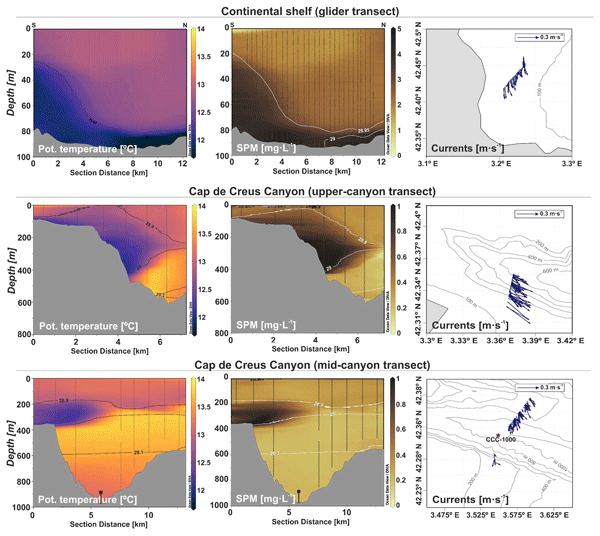
This study examines dense shelf water and sediment transport in the Cap de Creus Canyon during the mild winter of 2021–2022, using multiplatform-observational data and the MedSea Reanalysis product. Results show dense shelf waters on the shelf and upper canyon, contributing to Western Intermediate Water. Dense shelf water transport exhibit marked interannual variability, even under mild winters. MDSWC (mild dense shelf water cascading) events are expected to increase with climate change, favoring intermediate-water formation.
Alexandre Heumann, Félix Margirier, Emmanuel Rinnert, Pascale Lherminier, Carla Scalabrin, Louis Géli, Orens Pasqueron de Fommervault, and Laurent Béguery
Earth Syst. Sci. Data, 17, 4535–4554, https://doi.org/10.5194/essd-17-4535-2025, https://doi.org/10.5194/essd-17-4535-2025, 2025
Short summary
Short summary
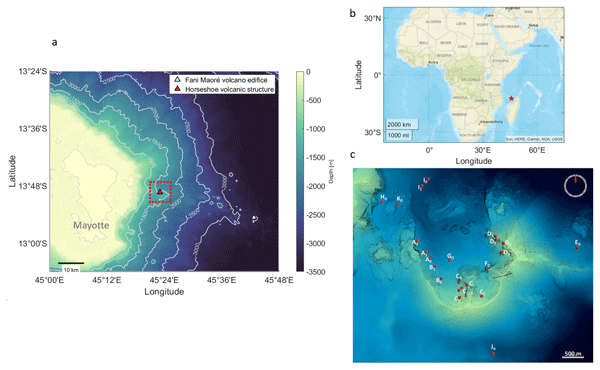
Following a seismic crisis in May 2018 in Mayotte, an observation network has been created with the given objective of monitoring the volcanic phenomena. A SeaExplorer glider has been deployed to supplement the data obtained during a series of oceanographic surveys. The glider performed a continuous monitoring over 30 months of the water column from the sea surface to 1250 m water depth, with the objective of acquiring the hydrological properties, water currents and dissolved gas concentrations.
Cited articles
Agrawal, Y. C. and Pottsmith, H. C.: Instruments for particle size and settling velocity observations in sediment transport, Mar. Geol., 168, 89–114, 2000. a
Boss, E. and Pegau, W. S.: Relationship of light scattering at an angle in the backward direction to the backscattering coefficient, Appl. Optics, 40, 5503–5507, 2001. a
Bosse, A. and Fer, I.: Mean structure and seasonality of the Norwegian Atlantic front current along the Mohn Ridge from repeated glider transects, Geophys. Res. Lett., 46, 13170–13179, https://doi.org/10.1029/2019GL084723, 2019. a
Bourrin, F., Many, G., De Madron, X. D., Martín, J., Puig, P., Houpert, L., Testor, P., Kunesch, S., Mahiouz, K., and Béguery, L.: Glider monitoring of shelf suspended particle dynamics and transport during storm and flooding conditions, Cont. Shelf Res., 109, 135–149, 2015. a
Cauchy, P., Heywood, K. J., Merchant, N. D., Risch, D., Queste, B. Y., and Testor, P.: Gliders for passive acoustic monitoring of the oceanic environment, Frontiers in Remote Sensing, 4, 1106533, https://doi.org/10.3389/frsen.2023.1106533, 2023. a
Davis, R. E., Eriksen, C. C., and Jones, C. P.: Autonomous Buoyancy-Driven Underwater Gliders, in: Technology and Applications of Autonomous Underwater Vehicles, edited by: Griffiths, G., CRC Press, 37–58, https://doi.org/10.1201/9780203522301, 2002. a
Downing, A., Thorne, P. D., and Vincent, C. E.: Backscattering from a suspension in the near field of a piston transducer, The Journal of the Acoustical Society of America, 97, 1614–1620, 1995. a
Downing, J.: Twenty-five years with OBS sensors: the good, the bad, and the ugly, Cont. Shelf Res., 26, 2299–2318, 2006. a
Dubrulle, C., Jouanneau, J., Lesueur, P., Bourillet, J.-F., and Weber, O.: Nature and rates of fine-sedimentation on a mid-shelf: “La Grande Vasière” (Bay of Biscay, France), Cont. Shelf Res., 27, 2099–2115, 2007. a
Durrieu de Madron, X., Wiberg, P. L., and Puig, P.: Sediment dynamics in the Gulf of Lions: the impact of extreme events, Cont. Shelf Res., 28, 1867–1876, https://doi.org/10.1016/j.csr.2008.08.001, 2008. a
Edge, W., Jones, N., Rayson, M., and Ivey, G.: Calibrated suspended sediment observations beneath large amplitude non-linear internal waves, J. Geophys. Res.-Oceans, 126, e2021JC017538, https://doi.org/10.1029/2021JC017538, 2021. a
Ellis, D., Washburn, L., Ohlmann, C., and Gotschalk, C.: Improved methods to calculate depth-resolved velocities from glider-mounted ADCPs, in: 2015 IEEE/OES Eleveth Current, Waves and Turbulence Measurement (CWTM), IEEE, 1–10, https://doi.org/10.1109/CWTM.2015.7098120, 2015. a, b, c, d
Estournel, C., Mikolajczak, G., Ulses, C., Bourrin, F., Canals, M., Charmasson, S., Doxaran, D., Duhaut, T., Durrieu de Madron, X., Marsaleix, P., Palanques, A., Puig, P., Radakovitch, O., Sanchez-Vidal, A., and Verney, R.: Sediment dynamics in the Gulf of Lion (NW Mediterranean Sea) during two autumn–winter periods with contrasting meteorological conditions, Prog. Oceanogr., 210, 102942, https://doi.org/10.1016/j.pocean.2022.102942, 2023. a
Ferré, B., De Madron, X. D., Estournel, C., Ulses, C., and Le Corre, G.: Impact of natural (waves and currents) and anthropogenic (trawl) resuspension on the export of particulate matter to the open ocean: application to the Gulf of Lion (NW Mediterranean), Cont. Shelf Res., 28, 2071–2091, 2008. a
Fettweis, M., Riethmüller, R., Verney, R., Becker, M., Backers, J., Baeye, M., Chapalain, M., Claeys, S., Claus, J., Cox, T., Deloffre, J., Depreiter, D., Druine, F., Flöser, G., Grünler, S., Jourdin, F., Lafite, R., Nauw, J., Nechad, B., Röttgers, R., Sottolichio, A., Van Engeland, T., Vanhaverbeke, W., and Vereecken, H.: Uncertainties associated with in situ high-frequency long-term observations of suspended particulate matter concentration using optical and acoustic sensors, Prog. Oceanogr., 178, 102162, https://doi.org/10.1016/j.pocean.2019.102162, 2019. a, b
Fong, D. A. and Monismith, S. G.: Evaluation of the accuracy of a ship-mounted, bottom-tracking ADCP in a near-shore coastal flow, J. Atmos. Ocean. Tech., 21, 1121–1128, 2004. a
Francois, R. and Garrison, G.: Sound absorption based on ocean measurements. Part II: boric acid contribution and equation for total absorption, The Journal of the Acoustical Society of America, 72, 1879–1890, 1982. a
Garlan, T., Gabelotaud, I., Lucas, S., and Marchès, E.: A world map of seabed sediment based on 50 years of knowledge, in: Proceedings of the 20th International Research Conference, New York, NY, USA, 3–4, https://doi.org/10.5281/zenodo.1317074, 2018. a
Gentil, M., Estournel, C., de Madron, X. D., Many, G., Miles, T., Marsaleix, P., Berné, S., and Bourrin, F.: Sediment dynamics on the outer-shelf of the Gulf of Lions during a storm: an approach based on acoustic glider and numerical modeling, Cont. Shelf Res., 240, 104721, https://doi.org/10.1016/j.csr.2022.104721, 2022. a, b, c
Glenn, S., Jones, C., Twardowski, M., Bowers, L., Kerfoot, J., Kohut, J., Webb, D., and Schofield, O.: Glider observations of sediment resuspension in a Middle Atlantic Bight fall transition storm, Limnol. Oceanogr., 53, 2180–2196, 2008. a
Gordon, R.: Principles of Operation a Practical Primer, RD Instruments, San Diego, https://www.teledynemarine.com/en-us/support/SiteAssets/RDI/Manuals and Guides/General Interest/BBPRIME.pdf (last access: 15 December 2025), 1996. a
Gostiaux, L. and van Haren, H.: Extracting meaningful information from uncalibrated backscattered echo intensity data, J. Atmos. Ocean. Tech., 27, 943–949, 2010. a
Grant, W. D. and Madsen, O. S.: The continental-shelf bottom boundary layer, Annu. Rev. Fluid Mech., 18, 265–305, 1986. a
Green, J. M., Simpson, J. H., Legg, S., and Palmer, M. R.: Internal waves, baroclinic energy fluxes and mixing at the European shelf edge, Cont. Shelf Res., 28, 937–950, 2008. a
Guillén, J., Bourrin, F., Palanques, A., De Madron, X. D., Puig, P., and Buscail, R.: Sediment dynamics during wet and dry storm events on the Têt inner shelf (SW Gulf of Lions), Mar. Geol., 234, 129–142, 2006. a
Haalboom, S., de Stigter, H., Duineveld, G., van Haren, H., Reichart, G.-J., and Mienis, F.: Suspended particulate matter in a submarine canyon (Whittard Canyon, Bay of Biscay, NE Atlantic Ocean): assessment of commonly used instruments to record turbidity, Mar. Geol., 434, 106439, https://doi.org/10.1016/j.margeo.2021.106439, 2021. a
Heiderich, J. and Todd, R. E.: Along-stream evolution of Gulf Stream volume transport, J. Phys. Oceanogr., 50, 2251–2270, https://doi.org/10.1175/JPO-D-19-0303.1, 2020. a
Homrani, S., Pasqueron de Fommervault, O., Gentil, M., Durrieu De Madron, X., Jourdin, F., and Bourrin, F.: MELANGE Dataset of “Tracing suspended sediment fluxes using a glider: observations in a tidal shelf environment” (Version v1), Zenodo [data set], https://doi.org/10.5281/zenodo.17723863, 2025. a
Ifremer: Data obtained from simulations of the Wave Watch III model, “Modeling and Analysis for Coastal Research” project (MARC), https://marc.ifremer.fr/en, last access: 26 January 2022. a
Inall, M. E., Toberman, M., Polton, J. A., Palmer, M. R., Green, J. M., and Rippeth, T. P.: Shelf seas baroclinic energy loss: pycnocline mixing and bottom boundary layer dissipation, J. Geophys. Res.-Oceans, 126, e2020JC016528, https://doi.org/10.1029/2020JC016528, 2021. a
Jakoboski, J., Todd, R. E., Owens, W. B., Karnauskas, K. B., and Rudnick, D. L.: Bifurcation and upwelling of the equatorial undercurrent west of the Galápagos Archipelago, J. Phys. Oceanogr., 50, 887–905, https://doi.org/10.1175/JPO-D-19-0110.1, 2020. a
Kitchener, B. G., Wainwright, J., and Parsons, A. J.: A review of the principles of turbidity measurement, Progress in Physical Geography, 41, 620–642, 2017. a
Le Menn, M. and Pacaud, L.: Calibration of currentmeters in direction: results obtained on a stock of instruments with a new calibration platform, in: 17th International Congress of Metrology, EDP Sciences, 01002, https://doi.org/10.1051/metrology/201501002, 2015. a
Lee, B. J., Fettweis, M., Toorman, E., and Molz, F. J.: Multimodality of a particle size distribution of cohesive suspended particulate matters in a coastal zone, J. Geophys. Res.-Oceans, 117, https://doi.org/10.1029/2011JC007552, 2012. a
Lohrmann, A.: Monitoring sediment concentration with acoustic backscattering instruments, Nortek Technical Note, 3, 1–5, 2001. a
Lynch, J. F., Irish, J. D., Sherwood, C. R., and Agrawal, Y. C.: Determining suspended sediment particle size information from acoustical and optical backscatter measurements, Cont. Shelf Res., 14, 1139–1165, 1994. a
Maa, J. P.-Y., Xu, J., and Victor, M.: Notes on the performance of an optical backscatter sensor for cohesive sediments, Mar. Geol., 104, 215–218, 1992. a
Many, G., Bourrin, F., de Madron, X. D., Pairaud, I., Gangloff, A., Doxaran, D., Ody, A., Verney, R., Menniti, C., Le Berre, D., and Jacquet, M.: Particle assemblage characterization in the Rhone River ROFI, J. Marine Syst., 157, 39–51, https://doi.org/10.1016/j.jmarsys.2015.12.010, 2016. a, b
Marchès, E., Perier, V., Morio, O., Garlan, T., Jourdin, F., and Lusven, A.: Poster: High frequency observation of turbidity near the seafloor in Brittany (NW France), in: IMBeR Future Oceans2 Open Science Conference 17–21 June 2019, Le Quartz Congress Centre, Brest 29200, France, https://doi.org/10.13140/RG.2.2.14778.20160, 2019. a
Mengual, B., Le Hir, P., Cayocca, F., and Garlan, T.: Bottom trawling contribution to the spatio-temporal variability of sediment fluxes on the continental shelf of the Bay of Biscay (France), Mar. Geol., 414, 77–91, 2019. a
Mikkelsen, O. A., Hill, P. S., Milligan, T. G., and Chant, R. J.: In situ particle size distributions and volume concentrations from a LISST-100 laser particle sizer and a digital floc camera, Cont. Shelf Res., 25, 1959–1978, 2005. a
Miles, T., Slade, W., and Glenn, S.: Sediment resuspension and transport from a glider-integrated Laser in Situ Scattering and Transmissometry (LISST) particle analyzer, J. Atmos. Ocean. Tech., 38, 1325–1341, https://doi.org/10.1175/JTECH-D-20-0207.1, 2021. a
Moum, J., Klymak, J., Nash, J., Perlin, A., and Smyth, W.: Energy transport by nonlinear internal waves, J. Phys. Oceanogr., 37, 1968–1988, 2007. a
Müller, P., Holloway, G., Henyey, F., and Pomphrey, N.: Nonlinear interactions among internal gravity waves, Rev. Geophys., 24, 493–536, 1986. a
Mullison, J.: Backscatter estimation using broadband acoustic doppler current profilers-updated, in: Proceedings of the ASCE Hydraulic Measurements and Experimental Methods Conference, Durham, NH, USA, 9–12, https://www.researchgate.net/publication/318541921_Backscatter_Estimation_Using_Broadband_Acoustic_Doppler_Current_Profilers-Updated (last access: 12 December 2025), 2017. a, b
Neukermans, G., Ruddick, K., Loisel, H., and Roose, P.: Optimization and quality control of suspended particulate matter concentration measurement using turbidity measurements, Limnol. Oceanogr.-Meth., 10, 1011–1023, 2012. a
Ouillon, S.: Why and how do we study sediment transport? Focus on coastal zones and ongoing methods, Water, 10, 390, https://doi.org/10.3390/w10040390, 2018. a
Palanques, A., Martín, J., Puig, P., Guillén, J., Company, J., and Sardà, F.: Evidence of sediment gravity flows induced by trawling in the Palamós (Fonera) submarine canyon (northwestern Mediterranean), Deep-Sea Res. Pt. I, 53, 201–214, 2006. a
Pasqueron de Fommervault, O., Besson, F., Beguery, L., Le Page, Y., and Lattes, P.: SeaExplorer underwater glider: a new tool to measure depth-resolved water currents profiles, in: OCEANS 2019-Marseille, IEEE, 1–6, https://doi.org/10.1109/OCEANSE.2019.8867228, 2019. a, b, c
Pieper, R. and Holliday, D.: Acoustic measurements of zooplankton distributions in the sea, ICES J. Mar. Sci., 41, 226–238, 1984. a
Rippeth, T. P., Simpson, J. H., Williams, E., and Inall, M. E.: Measurement of the rates of production and dissipation of turbulent kinetic energy in an energetic tidal flow: Red Wharf Bay revisited, J. Phys. Oceanogr., 33, 1889–1901, 2003. a
Rollo, C., Heywood, K. J., and Hall, R. A.: Glider observations of thermohaline staircases in the tropical North Atlantic using an automated classifier, Geosci. Instrum. Method. Data Syst., 11, 359–373, https://doi.org/10.5194/gi-11-359-2022, 2022. a
Rudnick, D. L.: Ocean research enabled by underwater gliders, Annu. Rev. Mar. Sci., 8, 519–541, 2016. a
Schmechtig, C., Poteau, A., Claustre, H., D'Ortenzio, F., Dall'Olmo, G., and Boss, E.: Processing BGC-Argo particle backscattering at the DAC level. Version 1.4, 7 March 2018, Archimer [data set], https://doi.org/10.13155/39459, 2018. a
Shirahata, K., Yoshimoto, S., Tsuchihara, T., and Ishida, S.: Digital filters to eliminate or separate tidal components in groundwater observation time-series data, Japan Agricultural Research Quarterly: JARQ, 50, 241–252, 2016. a
SHOM: MNT Bathymétrique de façade Atlantique (Projet Homonim), http://dx.doi.org/10.17183/MNT_ATL100m_ HOMONIM_WGS84 (last access: 25 March 2022), 2015. a
Signell, R. P., Beardsley, R. C., Graber, H., and Capotondi, A.: Effect of wave-current interaction on wind-driven circulation in narrow, shallow embayments, J. Geophys. Res.-Oceans, 95, 9671–9678, 1990. a
Stanton, T. K.: Simple approximate formulas for backscattering of sound by spherical and elongated objects, The Journal of the Acoustical Society of America, 86, 1499–1510, 1989. a
Thorne, P. D. and Hanes, D. M.: A review of acoustic measurement of small-scale sediment processes, Cont. Shelf Res., 22, 603–632, 2002. a
Todd, R. E., Rudnick, D. L., Mazloff, M. R., Davis, R. E., and Cornuelle, B. D.: Poleward flows in the southern California current system: glider observations and numerical simulation, J. Geophys. Res.-Oceans, 116, https://doi.org/10.1029/2010JC006536, 2011. a
Tolman, H. L.: User manual and system documentation of WAVEWATCH III TM version 3.14, Technical note, MMAB Contribution, 276, https://polar.ncep.noaa.gov/mmab/papers/tn276/MMAB_276.pdf 2009. a
Vagle, S., McNeil, C., and Steiner, N.: Upper ocean bubble measurements from the NE Pacific and estimates of their role in air-sea gas transfer of the weakly soluble gases nitrogen and oxygen, J. Geophys. Res.-Oceans, 115, https://doi.org/10.1029/2009JC005990, 2010. a
Van Haren, H.: Estimates of sea level, waves and winds from a bottom-mounted ADCP in a shelf sea, J. Sea Res., 45, 1–14, 2001. a
Vanhellemont, Q. and Ruddick, K.: Turbid wakes associated with offshore wind turbines observed with Landsat 8, Remote Sens. Environ., 145, 105–115, 2014. a
Wang, D., Wijesekera, H., Teague, W., Rogers, W., and Jarosz, E.: Bubble cloud depth under a hurricane, Geophys. Res. Lett., 38, https://doi.org/10.1029/2011GL047966, 2011. a
Zhang, X., Hu, L., and He, M.-X.: Scattering by pure seawater: effect of salinity, Optics express, 17, 5698–5710, 2009. a
Short summary
This article demonstrates that gliders equipped with current profilers and optical turbidity sensors are able to measure, with an acceptable accuracy of round 33 % (median of relative errors), the transport fluxes of suspended particulate matter flowing through the water column, in a tidal shelf sea (providing calibration of turbidity sensors). These results highlight the potential of gliders for quantifying sediment fluxes and advancing our understanding of coastal hydro-sedimentary processes.
This article demonstrates that gliders equipped with current profilers and optical turbidity...
Special issue