
Articles | Volume 21, issue 6
https://doi.org/10.5194/os-21-3541-2025
© Author(s) 2025. This work is distributed under
the Creative Commons Attribution 4.0 License.
the Creative Commons Attribution 4.0 License.
https://doi.org/10.5194/os-21-3541-2025
© Author(s) 2025. This work is distributed under
the Creative Commons Attribution 4.0 License.
the Creative Commons Attribution 4.0 License.
Research article
| Highlight paper
| 
18 Dec 2025
Research article | Highlight paper |
| 18 Dec 2025
| 18 Dec 2025
Estimating the AMOC from Argo profiles with machine learning trained on ocean simulations

GEOMAR Helmholtz Centre for Ocean Research Kiel, Kiel, Germany
Christian-Albrechts Universität zu Kiel, Kiel, Germany
Willi Rath
GEOMAR Helmholtz Centre for Ocean Research Kiel, Kiel, Germany
Matthias Renz
Christian-Albrechts Universität zu Kiel, Kiel, Germany
Arne Biastoch
GEOMAR Helmholtz Centre for Ocean Research Kiel, Kiel, Germany
Christian-Albrechts Universität zu Kiel, Kiel, Germany
Related authors
No articles found.
Xi Ruan, Stéphane Doléac, Laurent Bopp, Julian Mak, Franziska Schwarzkopf, Arne Biastoch, and Marina Lévy
EGUsphere, https://doi.org/10.5194/egusphere-2026-4891, https://doi.org/10.5194/egusphere-2026-4891, 2026
This preprint is open for discussion and under review for Biogeosciences (BG).
Short summary
Short summary
Carbon produced by ocean life traveling from the surface to the deep ocean can help keep our planet cooler. Using simulations, we find that physical ocean processes are an important yet poorly constrained pathway for transport to the deep North Atlantic. Despite regional contrasts in total transport, contributions remain similar. They shape seasonal carbon patterns alongside the dominant pathway. A finer simulation shows stronger transport. These imply the need to better represent ocean physics.
Tobias Schulzki, Franziska U. Schwarzkopf, and Arne Biastoch
Ocean Sci., 22, 2027–2058, https://doi.org/10.5194/os-22-2027-2026, https://doi.org/10.5194/os-22-2027-2026, 2026
Short summary
Short summary
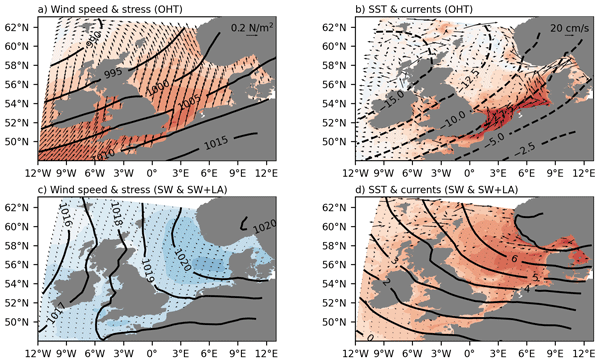
Marine heatwaves are periods of unusually warm ocean temperatures that can affect ecosystems and weather. In the North Sea, they have become more frequent over recent decades, but their peak intensity has decreased in many areas. Our results show that marine heatwaves depend on both short-term weather and longer seasonal to decadal variability. The local atmospheric conditions play a key role in the German Bight.
Gokhan Danabasoglu, Frederic S. Castruccio, Burcu Boza, Alice M. Barthel, Arne Biastoch, Adam Blaker, Alexandra Bozec, Diego Bruciaferri, Frank O. Bryan, Eric P. Chassignet, Yao Fu, Ian Grooms, Catherine Guiavarc'h, Hakase Hayashida, Andrew McC. Hogg, Ryan M. Holmes, Doroteaciro Iovino, Andrew E. Kiss, M. Susan Lozier, Gustavo Marques, Alex Megann, Franziska U. Schwarzkopf, Dave Storkey, Luke van Roekel, Jon Wolfe, Xiaobiao Xu, and Rong Zhang
Geosci. Model Dev., 19, 5071–5117, https://doi.org/10.5194/gmd-19-5071-2026, https://doi.org/10.5194/gmd-19-5071-2026, 2026
Short summary
Short summary
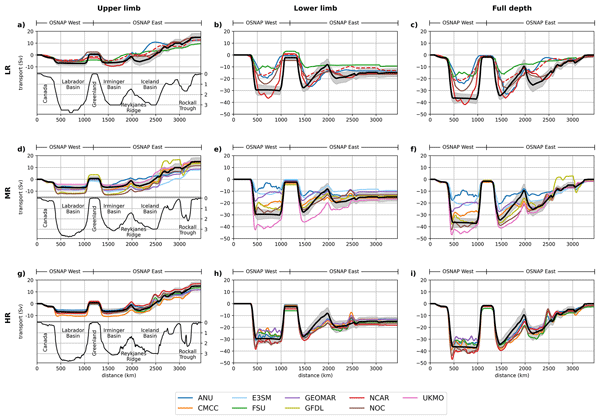
A comparison of simulated and observed overturning transports across the Overturning in the Subpolar North Atlantic Program sections is presented. Eighteen ocean simulations participate in the study with resolutions ranging from coarse to eddy-resolving. The simulated transports are in general agreement with observations, with better agreement at high resolution. Analyzing overturning circulations in both depth and density space together provides a more complete picture.
Tobias Schulzki, Franziska U. Schwarzkopf, and Arne Biastoch
Ocean Sci., 21, 2481–2504, https://doi.org/10.5194/os-21-2481-2025, https://doi.org/10.5194/os-21-2481-2025, 2025
Short summary
Short summary
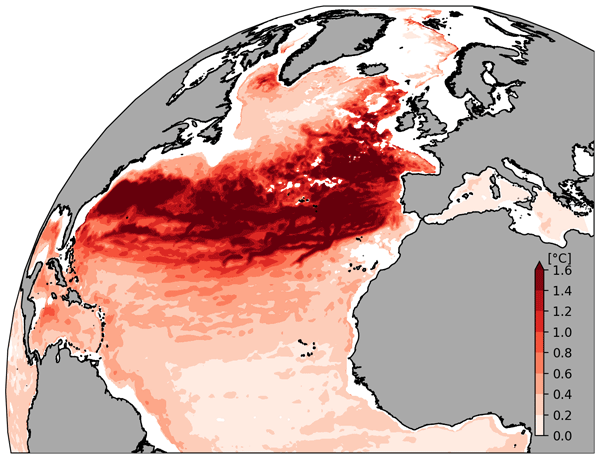
Exceptionally high ocean temperatures can cause long-lasting damage to marine ecosystems. Most existing knowledge about such temperature extremes is focused on near-surface waters, yet ecosystems also thrive at greater depths. In this study, we present a comprehensive analysis of temperature extremes across the entire Atlantic Ocean, from the surface to the seafloor. Our findings underscore the importance of the ocean circulation in driving extreme temperature events.
Léo C. Aroucha, Joke F. Lübbecke, Peter Brandt, Franziska U. Schwarzkopf, and Arne Biastoch
Ocean Sci., 21, 661–678, https://doi.org/10.5194/os-21-661-2025, https://doi.org/10.5194/os-21-661-2025, 2025
Short summary
Short summary
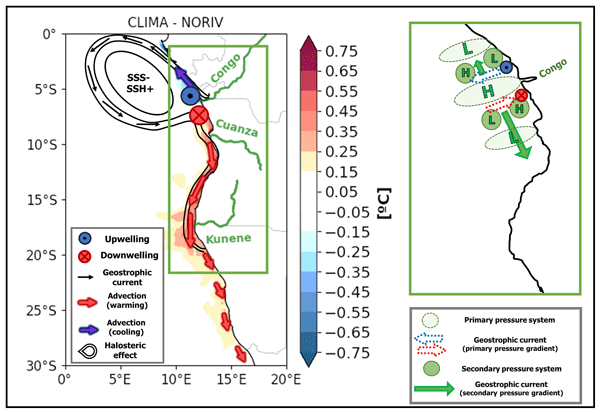
The west African coastal region sustains highly productive fisheries and marine ecosystems influenced by sea surface temperature. We use oceanic models to show that the freshwater input from land to ocean strengthens a surface northward (southward) coastal current north (south) of the Congo River mouth, promoting a transfer of cooler (warmer) waters to north (south) of the Congo discharge location. We highlight the significant impact of river discharge on ocean temperatures and circulation.
Hendrik Großelindemann, Frederic S. Castruccio, Gokhan Danabasoglu, and Arne Biastoch
Ocean Sci., 21, 93–112, https://doi.org/10.5194/os-21-93-2025, https://doi.org/10.5194/os-21-93-2025, 2025
Short summary
Short summary
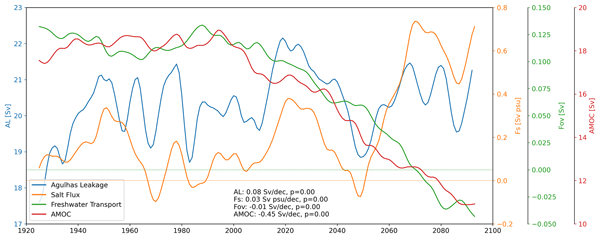
This study investigates the Agulhas Leakage and examines its role in the global ocean circulation. It utilises a high-resolution Earth system model and a preindustrial climate to look at the response of the Agulhas Leakage to the wind field and the Atlantic Meridional Overturning Circulation (AMOC) and its evolution under climate change. The Agulhas Leakage could influence the stability of the AMOC, whose possible collapse would impact the climate in the Northern Hemisphere.
Kristin Burmeister, Franziska U. Schwarzkopf, Willi Rath, Arne Biastoch, Peter Brandt, Joke F. Lübbecke, and Mark Inall
Ocean Sci., 20, 307–339, https://doi.org/10.5194/os-20-307-2024, https://doi.org/10.5194/os-20-307-2024, 2024
Short summary
Short summary
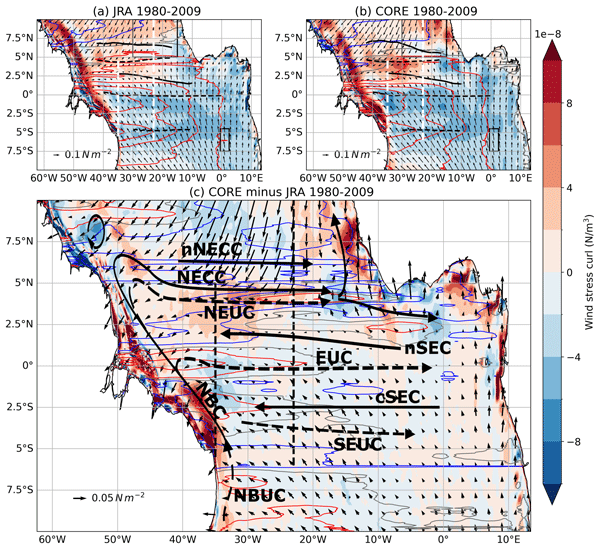
We apply two different forcing products to a high-resolution ocean model to investigate their impact on the simulated upper-current field in the tropical Atlantic. Where possible, we compare the simulated results to long-term observations. We find large discrepancies between the two simulations regarding the wind and current fields. We propose that long-term observations, once they have reached a critical length, need to be used to test the quality of wind-driven simulations.
Roy Dorgeless Ngakala, Gaël Alory, Casimir Yélognissè Da-Allada, Olivia Estelle Kom, Julien Jouanno, Willi Rath, and Ezinvi Baloïtcha
Ocean Sci., 19, 535–558, https://doi.org/10.5194/os-19-535-2023, https://doi.org/10.5194/os-19-535-2023, 2023
Short summary
Short summary
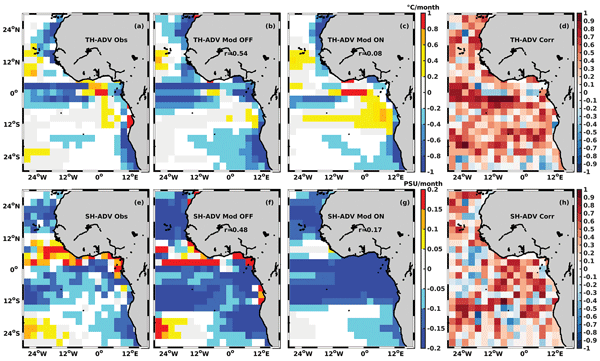
Surface heat flux is the main driver of the heat budget in the Senegal, Angola, and Benguela regions but not in the equatorial region. In the Senegal and Benguela regions, freshwater flux governs the salt budget, while in equatorial and Angola regions, oceanic processes are the main drivers. Results from numerical simulation show the important role of mesoscale advection for temperature and salinity variations in the mixed layer. Nonlinear processes unresolved by observations play a key role.
Torge Martin and Arne Biastoch
Ocean Sci., 19, 141–167, https://doi.org/10.5194/os-19-141-2023, https://doi.org/10.5194/os-19-141-2023, 2023
Short summary
Short summary
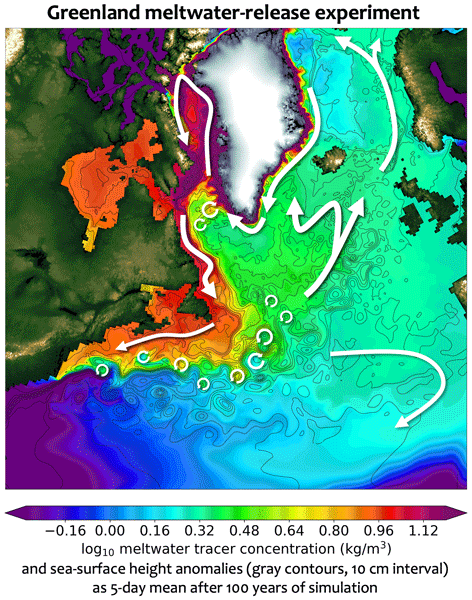
How is the ocean affected by continued Greenland Ice Sheet mass loss? We show in a systematic set of model experiments that atmospheric feedback needs to be accounted for as the large-scale ocean circulation is more than twice as sensitive to the meltwater otherwise. Coastal winds, boundary currents, and ocean eddies play a key role in redistributing the meltwater. Eddy paramterization helps the coarse simulation to perform better in the Labrador Sea but not in the North Atlantic Current region.
Alan D. Fox, Patricia Handmann, Christina Schmidt, Neil Fraser, Siren Rühs, Alejandra Sanchez-Franks, Torge Martin, Marilena Oltmanns, Clare Johnson, Willi Rath, N. Penny Holliday, Arne Biastoch, Stuart A. Cunningham, and Igor Yashayaev
Ocean Sci., 18, 1507–1533, https://doi.org/10.5194/os-18-1507-2022, https://doi.org/10.5194/os-18-1507-2022, 2022
Short summary
Short summary
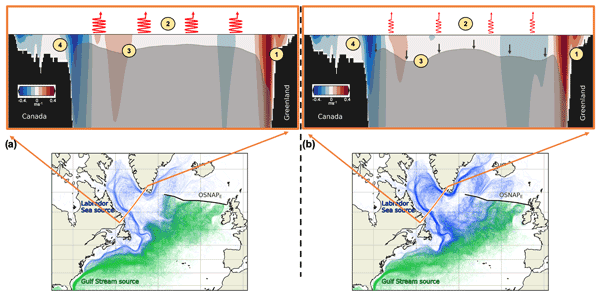
Observations of the eastern subpolar North Atlantic in the 2010s show exceptional freshening and cooling of the upper ocean, peaking in 2016 with the lowest salinities recorded for 120 years. Using results from a high-resolution ocean model, supported by observations, we propose that the leading cause is reduced surface cooling over the preceding decade in the Labrador Sea, leading to increased outflow of less dense water and so to freshening and cooling of the eastern subpolar North Atlantic.
Jörg Fröhle, Patricia V. K. Handmann, and Arne Biastoch
Ocean Sci., 18, 1431–1450, https://doi.org/10.5194/os-18-1431-2022, https://doi.org/10.5194/os-18-1431-2022, 2022
Short summary
Short summary
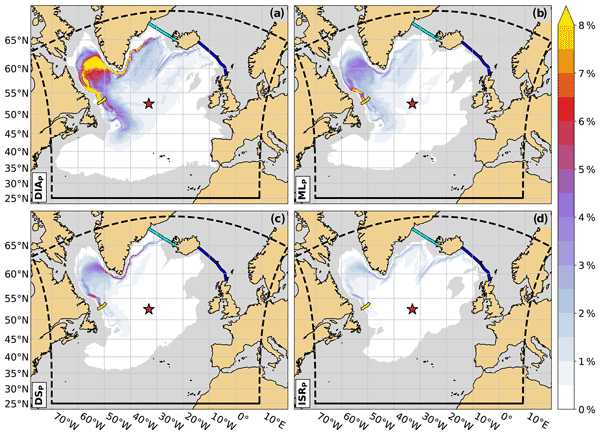
Three deep-water masses pass the southern exit of the Labrador Sea. Usually they are defined by explicit density intervals linked to the formation region. We evaluate this relation in an ocean model by backtracking the paths the water follows for 40 years: 48 % densify without contact to the atmosphere, 24 % densify in contact with the atmosphere, and 19 % are from the Nordic Seas. All three contribute to a similar density range at 53° N with weak specific formation location characteristics.
Takaya Uchida, Julien Le Sommer, Charles Stern, Ryan P. Abernathey, Chris Holdgraf, Aurélie Albert, Laurent Brodeau, Eric P. Chassignet, Xiaobiao Xu, Jonathan Gula, Guillaume Roullet, Nikolay Koldunov, Sergey Danilov, Qiang Wang, Dimitris Menemenlis, Clément Bricaud, Brian K. Arbic, Jay F. Shriver, Fangli Qiao, Bin Xiao, Arne Biastoch, René Schubert, Baylor Fox-Kemper, William K. Dewar, and Alan Wallcraft
Geosci. Model Dev., 15, 5829–5856, https://doi.org/10.5194/gmd-15-5829-2022, https://doi.org/10.5194/gmd-15-5829-2022, 2022
Short summary
Short summary
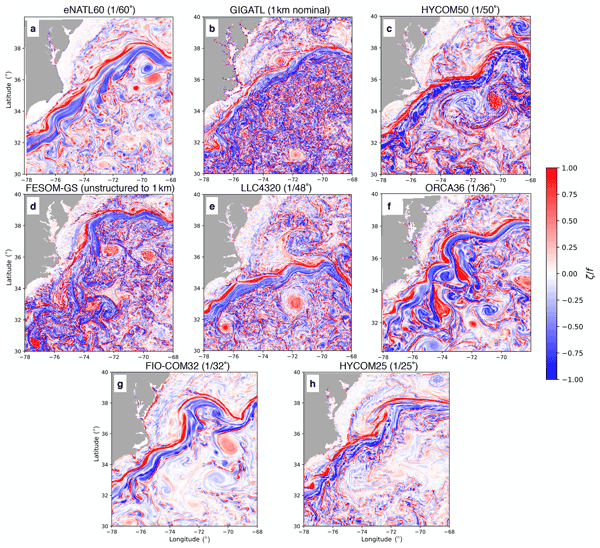
Ocean and climate scientists have used numerical simulations as a tool to examine the ocean and climate system since the 1970s. Since then, owing to the continuous increase in computational power and advances in numerical methods, we have been able to simulate increasing complex phenomena. However, the fidelity of the simulations in representing the phenomena remains a core issue in the ocean science community. Here we propose a cloud-based framework to inter-compare and assess such simulations.
Jens Zinke, Takaaki K. Watanabe, Siren Rühs, Miriam Pfeiffer, Stefan Grab, Dieter Garbe-Schönberg, and Arne Biastoch
Clim. Past, 18, 1453–1474, https://doi.org/10.5194/cp-18-1453-2022, https://doi.org/10.5194/cp-18-1453-2022, 2022
Short summary
Short summary
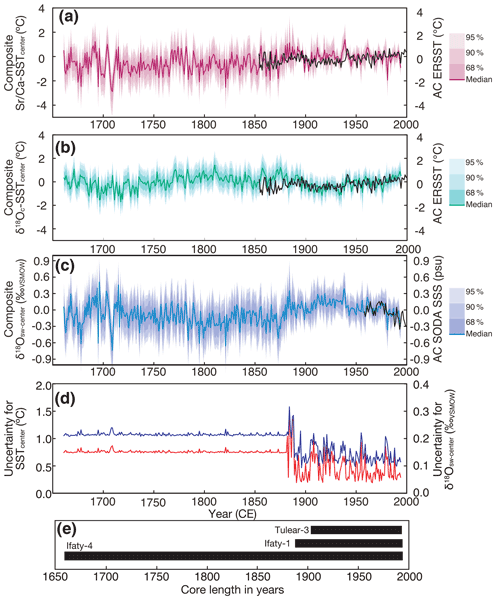
Salinity is an important and integrative measure of changes to the water cycle steered by changes to the balance between rainfall and evaporation and by vertical and horizontal movements of water parcels by ocean currents. However, salinity measurements in our oceans are extremely sparse. To fill this gap, we have developed a 334-year coral record of seawater oxygen isotopes that reflects salinity changes in the globally important Agulhas Current system and reveals its main oceanic drivers.
Ioana Ivanciu, Katja Matthes, Arne Biastoch, Sebastian Wahl, and Jan Harlaß
Weather Clim. Dynam., 3, 139–171, https://doi.org/10.5194/wcd-3-139-2022, https://doi.org/10.5194/wcd-3-139-2022, 2022
Short summary
Short summary
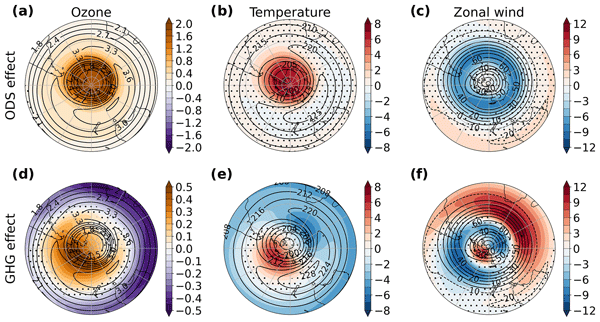
Greenhouse gas concentrations continue to increase, while the Antarctic ozone hole is expected to recover during the twenty-first century. We separate the effects of ozone recovery and of greenhouse gases on the Southern Hemisphere atmospheric and oceanic circulation, and we find that ozone recovery is generally reducing the impact of greenhouse gases, with the exception of certain regions of the stratosphere during spring, where the two effects reinforce each other.
Cited articles
Argo: Argo float data and metadata from Global Data Assembly Centre (Argo GDAC) – Snapshot of Argo GDAC of August 2025, SEANOE [data set], https://doi.org/10.17882/42182#110199, 2025. a, b
Baker, J. A., Bell, M. J., Jackson, L. C., Vallis, G. K., Watson, A. J., and Wood, R. A.: Continued Atlantic overturning circulation even under climate extremes, Nature, 638, 987–994, https://doi.org/10.1038/s41586-024-08544-0, 2025. a
Behrens, E., Biastoch, A., and Böning, C. W.: Spurious AMOC trends in global ocean sea-ice models related to subarctic freshwater forcing, Ocean Modelling, 69, 39–49, https://doi.org/10.1016/j.ocemod.2013.05.004, 2013. a
Biastoch, A., Böning, C. W., Getzlaff, J., Molines, J.-M., and Madec, G.: Causes of Interannual–Decadal Variability in the Meridional Overturning Circulation of the Midlatitude North Atlantic Ocean, Journal of Climate, 21, 6599–6615, https://doi.org/10.1175/2008JCLI2404.1, 2008. a
Biastoch, A., Schwarzkopf, F. U., Getzlaff, K., Rühs, S., Martin, T., Scheinert, M., Schulzki, T., Handmann, P., Hummels, R., and Böning, C. W.: Regional imprints of changes in the Atlantic Meridional Overturning Circulation in the eddy-rich ocean model VIKING20X, Ocean Sci., 17, 1177–1211, https://doi.org/10.5194/os-17-1177-2021, 2021. a, b, c, d, e, f, g, h, i
Böning, C. W., Wagner, P., Handmann, P., Schwarzkopf, F. U., Getzlaff, K., and Biastoch, A.: Decadal changes in Atlantic overturning due to the excessive 1990s Labrador Sea convection, Nature Communications, 14, 4635, https://doi.org/10.1038/s41467-023-40323-9, 2023. a, b, c
Caesar, L., McCarthy, G. D., Thornalley, D. J. R., Cahill, N., and Rahmstorf, S.: Current Atlantic Meridional Overturning Circulation weakest in last millennium, Nature Geoscience, 14, 118–120, https://doi.org/10.1038/s41561-021-00699-z, 2021. a
Cunningham, S. A., Kanzow, T., Rayner, D., Baringer, M. O., Johns, W. E., Marotzke, J., Longworth, H. R., Grant, E. M., Hirschi, J. J.-M., Beal, L. M., Meinen, C. S., and Bryden, H. L.: Temporal Variability of the Atlantic Meridional Overturning Circulation at 26.5° N, Science, 317, 935–938, https://doi.org/10.1126/science.1141304, 2007. a
Dale, M. and Fortin, M.-J.: From Graphs to Spatial Graphs, Annual Review of Ecology, Evolution, and Systematics, 41, 21–38, https://doi.org/10.1146/annurev-ecolsys-102209-144718, 2010. a
Debreu, L., Vouland, C., and Blayo, E.: AGRIF: Adaptive grid refinement in Fortran, Computers & Geosciences, 34, 8–13, https://doi.org/10.1016/j.cageo.2007.01.009, 2008. a
Delman, A. and Landerer, F.: Downscaling Satellite-Based Estimates of Ocean Bottom Pressure for Tracking Deep Ocean Mass Transport, Remote Sensing, 14, 1764, https://doi.org/10.3390/rs14071764, 2022. a
Dwivedi, R., Dave, D., Naik, H., Singhal, S., Omer, R., Patel, P., Qian, B., Wen, Z., Shah, T., Morgan, G., and Ranjan, R.: Explainable AI (XAI): Core Ideas, Techniques, and Solutions, ACM Computing Surveys, 55, 1–33, https://doi.org/10.1145/3561048, 2023. a
Elipot, S., Frajka-Williams, E., Hughes, C. W., and Willis, J. K.: The Observed North Atlantic Meridional Overturning Circulation: Its Meridional Coherence and Ocean Bottom Pressure, Journal of Physical Oceanography, 44, 517–537, https://doi.org/10.1175/JPO-D-13-026.1, 2014. a, b
Fisher, A., Rudin, C., and Dominici, F.: All models are wrong, but many are useful: Learning a variable's importance by studying an entire class of prediction models simultaneously, Journal of Machine Learning Research, 20, 1–81, 2019. a
Forget, G., Campin, J.-M., Heimbach, P., Hill, C. N., Ponte, R. M., and Wunsch, C.: ECCO version 4: an integrated framework for non-linear inverse modeling and global ocean state estimation, Geosci. Model Dev., 8, 3071–3104, https://doi.org/10.5194/gmd-8-3071-2015, 2015. a
Fox, A. D., Handmann, P., Schmidt, C., Fraser, N., Rühs, S., Sanchez-Franks, A., Martin, T., Oltmanns, M., Johnson, C., Rath, W., Holliday, N. P., Biastoch, A., Cunningham, S. A., and Yashayaev, I.: Exceptional freshening and cooling in the eastern subpolar North Atlantic caused by reduced Labrador Sea surface heat loss, Ocean Sci., 18, 1507–1533, https://doi.org/10.5194/os-18-1507-2022, 2022. a
Frajka-Williams, E., Meinen, C. S., Johns, W. E., Smeed, D. A., Duchez, A., Lawrence, A. J., Cuthbertson, D. A., McCarthy, G. D., Bryden, H. L., Baringer, M. O., Moat, B. I., and Rayner, D.: Compensation between meridional flow components of the Atlantic MOC at 26° N, Ocean Sci., 12, 481–493, https://doi.org/10.5194/os-12-481-2016, 2016. a, b
Frajka-Williams, E., Ansorge, I. J., Baehr, J., Bryden, H. L., Chidichimo, M. P., Cunningham, S. A., Danabasoglu, G., Dong, S., Donohue, K. A., Elipot, S., Heimbach, P., Holliday, N. P., Hummels, R., Jackson, L. C., Karstensen, J., Lankhorst, M., Le Bras, I. A., Lozier, M. S., McDonagh, E. L., Meinen, C. S., Mercier, H., Moat, B. I., Perez, R. C., Piecuch, C. G., Rhein, M., Srokosz, M. A., Trenberth, K. E., Bacon, S., Forget, G., Goni, G., Kieke, D., Koelling, J., Lamont, T., McCarthy, G. D., Mertens, C., Send, U., Smeed, D. A., Speich, S., Van Den Berg, M., Volkov, D., and Wilson, C.: Atlantic Meridional Overturning Circulation: Observed Transport and Variability, Frontiers in Marine Science, 6, 260, https://doi.org/10.3389/fmars.2019.00260, 2019. a, b, c
Frajka-Williams, E.: Estimating the Atlantic overturning at 26° N using satellite altimetry and cable measurements, Geophysical Research Letters, 42, 3458–3464, https://doi.org/10.1002/2015GL063220, 2015. a, b, c
Hernández-Guerra, A., Joyce, T. M., Fraile-Nuez, E., and Vélez-Belchí, P.: Using Argo data to investigate the Meridional Overturning Circulation in the North Atlantic, Deep Sea Research Part I: Oceanographic Research Papers, 57, 29–36, https://doi.org/10.1016/j.dsr.2009.10.003, 2010. a, b
Herrford, J., Brandt, P., Kanzow, T., Hummels, R., Araujo, M., and Durgadoo, J. V.: Seasonal variability of the Atlantic Meridional Overturning Circulation at 11° S inferred from bottom pressure measurements, Ocean Sci., 17, 265–284, https://doi.org/10.5194/os-17-265-2021, 2021. a
Hirschi, J. J., Barnier, B., Böning, C., Biastoch, A., Blaker, A. T., Coward, A., Danilov, S., Drijfhout, S., Getzlaff, K., Griffies, S. M., Hasumi, H., Hewitt, H., Iovino, D., Kawasaki, T., Kiss, A. E., Koldunov, N., Marzocchi, A., Mecking, J. V., Moat, B., Molines, J., Myers, P. G., Penduff, T., Roberts, M., Treguier, A., Sein, D. V., Sidorenko, D., Small, J., Spence, P., Thompson, L., Weijer, W., and Xu, X.: The Atlantic Meridional Overturning Circulation in High-Resolution Models, Journal of Geophysical Research: Oceans, 125, e2019JC015522, https://doi.org/10.1029/2019JC015522, 2020. a
Holte, J. and Straneo, F.: Seasonal Overturning of the Labrador Sea as Observed by Argo Floats, Journal of Physical Oceanography, 47, 2531–2543, https://doi.org/10.1175/JPO-D-17-0051.1, 2017. a
Ioffe, S. and Szegedy, C.: Batch normalization: accelerating deep network training by reducing internal covariate shift, in: Proceedings of the 32nd International Conference on International Conference on Machine Learning – Volume 37, ICML'15, Lille, France, 448–456, https://doi.org/10.48550/arXiv.1502.03167, 2015. a, b
Jackson, L. C., Biastoch, A., Buckley, M. W., Desbruyères, D. G., Frajka-Williams, E., Moat, B., and Robson, J.: The evolution of the North Atlantic Meridional Overturning Circulation since 1980, Nature Reviews Earth & Environment, 3, 241–254, https://doi.org/10.1038/s43017-022-00263-2, 2022. a
Jiang, W. and Luo, J.: Graph neural network for traffic forecasting: A survey, Expert Systems with Applications, 207, 117921, https://doi.org/10.1016/j.eswa.2022.117921, 2022. a, b
Johns, W. E., Beal, L. M., Baringer, M. O., Molina, J. R., Cunningham, S. A., Kanzow, T., and Rayner, D.: Variability of Shallow and Deep Western Boundary Currents off the Bahamas during 2004–05: Results from the 26° N RAPID–MOC Array, Journal of Physical Oceanography, 38, 605–623, https://doi.org/10.1175/2007JPO3791.1, 2008. a, b
Johns, W. E., Baringer, M. O., Beal, L. M., Cunningham, S. A., Kanzow, T., Bryden, H. L., Hirschi, J. J. M., Marotzke, J., Meinen, C. S., Shaw, B., and Curry, R.: Continuous, Array-Based Estimates of Atlantic Ocean Heat Transport at 26.5° N, Journal of Climate, 24, 2429–2449, https://doi.org/10.1175/2010JCLI3997.1, 2011. a
Johns, W. E., Elipot, S., Smeed, D. A., Moat, B., King, B., Volkov, D. L., and Smith, R. H.: Towards two decades of Atlantic Ocean mass and heat transports at 26.5° N, Philosophical Transactions of the Royal Society A: Mathematical, Physical and Engineering Sciences, 381, 20220188, https://doi.org/10.1098/rsta.2022.0188, 2023. a, b, c
Kanzow, T., Hirschi, J. J. M., Meinen, C., Rayner, D., Cunningham, S. A., Marotzke, J., Johns, W. E., Bryden, H. L., Beal, L. M., and Baringer, M. O.: A prototype system for observing the Atlantic Meridional Overturning Circulation – scientific basis, measurement and risk mitigation strategies, and first results, Journal of Operational Oceanography, 1, 19–28, https://doi.org/10.1080/1755876X.2008.11020092, 2008. a, b, c
Kanzow, T., Cunningham, S. A., Johns, W. E., Hirschi, J. J.-M., Marotzke, J., Baringer, M. O., Meinen, C. S., Chidichimo, M. P., Atkinson, C., Beal, L. M., Bryden, H. L., and Collins, J.: Seasonal Variability of the Atlantic Meridional Overturning Circulation at 26.5° N, Journal of Climate, 23, 5678–5698, https://doi.org/10.1175/2010JCLI3389.1, 2010. a, b, c
Landerer, F. W., Flechtner, F. M., Save, H., Webb, F. H., Bandikova, T., Bertiger, W. I., Bettadpur, S. V., Byun, S. H., Dahle, C., Dobslaw, H., Fahnestock, E., Harvey, N., Kang, Z., Kruizinga, G. L. H., Loomis, B. D., McCullough, C., Murböck, M., Nagel, P., Paik, M., Pie, N., Poole, S., Strekalov, D., Tamisiea, M. E., Wang, F., Watkins, M. M., Wen, H., Wiese, D. N., and Yuan, D.: Extending the Global Mass Change Data Record: GRACE Follow-On Instrument and Science Data Performance, Geophysical Research Letters, 47, e2020GL088306, https://doi.org/10.1029/2020GL088306, 2020. a
Latif, M. and Keenlyside, N. S.: A perspective on decadal climate variability and predictability, Deep Sea Research Part II: Topical Studies in Oceanography, 58, 1880–1894, https://doi.org/10.1016/j.dsr2.2010.10.066, 2011. a
Latif, M., Sun, J., Visbeck, M., and Hadi Bordbar, M.: Natural variability has dominated Atlantic Meridional Overturning Circulation since 1900, Nature Climate Change, 12, 455–460, https://doi.org/10.1038/s41558-022-01342-4, 2022. a
Li, F., Lozier, M. S., Bacon, S., Bower, A. S., Cunningham, S. A., De Jong, M. F., deYoung, B., Fraser, N., Fried, N., Han, G., Holliday, N. P., Holte, J., Houpert, L., Inall, M. E., Johns, W. E., Jones, S., Johnson, C., Karstensen, J., Le Bras, I. A., Lherminier, P., Lin, X., Mercier, H., Oltmanns, M., Pacini, A., Petit, T., Pickart, R. S., Rayner, D., Straneo, F., Thierry, V., Visbeck, M., Yashayaev, I., and Zhou, C.: Subpolar North Atlantic western boundary density anomalies and the Meridional Overturning Circulation, Nature Communications, 12, 3002, https://doi.org/10.1038/s41467-021-23350-2, 2021. a
Locarnini, R. A., Mishonov, A. V., Antonov, J. I., Boyer, T. P., Garcia, H. E., Baranova, O. K., Zweng, M. M., Paver, C. R., Reagan, J. R., Johnson, D. R., Hamilton, M., Seidov, D., and Levitus, S.: World ocean atlas 2013. Volume 1, Temperature, NOAA Atlas NESDIS series, https://doi.org/10.7289/V55X26VD, 2013. a
Lozier, M. S.: Overturning in the North Atlantic, Annual Review of Marine Science, 4, 291–315, https://doi.org/10.1146/annurev-marine-120710-100740, 2012. a
Markus, A. F., Kors, J. A., and Rijnbeek, P. R.: The role of explainability in creating trustworthy artificial intelligence for health care: A comprehensive survey of the terminology, design choices, and evaluation strategies, Journal of Biomedical Informatics, 113, 103655, https://doi.org/10.1016/j.jbi.2020.103655, 2021. a
McCarthy, G., Frajka-Williams, E., Johns, W. E., Baringer, M. O., Meinen, C. S., Bryden, H. L., Rayner, D., Duchez, A., Roberts, C., and Cunningham, S. A.: Observed interannual variability of the Atlantic meridional overturning circulation at 26.5° N, Geophysical Research Letters, 39, 2012GL052933, https://doi.org/10.1029/2012GL052933, 2012. a
McCarthy, G., Smeed, D., Johns, W., Frajka-Williams, E., Moat, B., Rayner, D., Baringer, M., Meinen, C., Collins, J., and Bryden, H.: Measuring the Atlantic Meridional Overturning Circulation at 26° N, Progress in Oceanography, 130, 91–111, https://doi.org/10.1016/j.pocean.2014.10.006, 2015. a, b, c, d, e, f, g, h
McCarthy, G. D. and Caesar, L.: Can we trust projections of AMOC weakening based on climate models that cannot reproduce the past?, Philosophical Transactions of the Royal Society A: Mathematical, Physical and Engineering Sciences, 381, 20220193, https://doi.org/10.1098/rsta.2022.0193, 2023. a
McCarthy, G. D., Hug, G., Smeed, D., Morris, K. J., and Moat, B.: Signal and Noise in the Atlantic Meridional Overturning Circulation at 26° N, Geophysical Research Letters, 52, e2025GL115055, https://doi.org/10.1029/2025GL115055, 2025. a, b
McMonigal, K., Beal, L. M., and Willis, J. K.: The Seasonal Cycle of the South Indian Ocean Subtropical Gyre Circulation as Revealed by Argo and Satellite Data, Geophysical Research Letters, 45, 9034–9041, https://doi.org/10.1029/2018GL078420, 2018. a
Meilă, M. and Zhang, H.: Manifold Learning: What, How, and Why, Annual Review of Statistics and Its Application, 11, 393–417, https://doi.org/10.1146/annurev-statistics-040522-115238, 2024. a
Moat, B. I., Smeed, D. A., Frajka-Williams, E., Desbruyères, D. G., Beaulieu, C., Johns, W. E., Rayner, D., Sanchez-Franks, A., Baringer, M. O., Volkov, D., Jackson, L. C., and Bryden, H. L.: Pending recovery in the strength of the meridional overturning circulation at 26° N, Ocean Sci., 16, 863–874, https://doi.org/10.5194/os-16-863-2020, 2020. a
Moat, B. I., Smeed, D. A., Rayner, D., Johns, W. E., Smith, R., Volkov, D., Elipot, S., Petit, T., Kajtar, J., Baringer, M. O., and Collins, J.: Atlantic meridional overturning circulation observed by the RAPID-MOCHA-WBTS (RAPID-Meridional Overturning Circulation and Heatflux Array-Western Boundary Time Series) array at 26N from 2004 to 2023 (v2023.1), NERC EDS British Oceanographic Data Centre NOC [data set], https://nora.nerc.ac.uk/id/eprint/538140/ (last access: 16 December 2025), 2024. a
Petit, T., Lozier, M. S., Rühs, S., Handmann, P., and Biastoch, A.: Propagation and Transformation of Upper North Atlantic Deep Water From the Subpolar Gyre to 26.5° N, Journal of Geophysical Research: Oceans, 128, e2023JC019726, https://doi.org/10.1029/2023JC019726, 2023. a
Reeve, K. A., Boebel, O., Strass, V., Kanzow, T., and Gerdes, R.: Horizontal circulation and volume transports in the Weddell Gyre derived from Argo float data, Progress in Oceanography, 175, 263–283, https://doi.org/10.1016/j.pocean.2019.04.006, 2019. a
Riser, S. C., Freeland, H. J., Roemmich, D., Wijffels, S., Troisi, A., Belbéoch, M., Gilbert, D., Xu, J., Pouliquen, S., Thresher, A., Le Traon, P.-Y., Maze, G., Klein, B., Ravichandran, M., Grant, F., Poulain, P.-M., Suga, T., Lim, B., Sterl, A., Sutton, P., Mork, K.-A., Vélez-Belchí, P. J., Ansorge, I., King, B., Turton, J., Baringer, M., and Jayne, S. R.: Fifteen years of ocean observations with the global Argo array, Nature Climate Change, 6, 145–153, https://doi.org/10.1038/nclimate2872, 2016. a
Roemmich, D., Johnson, G. C., Riser, S., Davis, R., Gilson, J., Owens, W. B., Garzoli, S. L., Schmid, C., and Ignaszweski, M.: The Argo Program: Observing the Global Ocean with Profiling Floats, Oceanography, 22, 34–43, http://www.jstor.org/stable/24860957 (last access: 16 December 2025), 2009. a
Roemmich, D., Alford, M. H., Claustre, H., Johnson, K., King, B., Moum, J., Oke, P., Owens, W. B., Pouliquen, S., Purkey, S., Scanderbeg, M., Suga, T., Wijffels, S., Zilberman, N., Bakker, D., Baringer, M., Belbeoch, M., Bittig, H. C., Boss, E., Calil, P., Carse, F., Carval, T., Chai, F., Conchubhair, D. O., d’Ortenzio, F., Dall’Olmo, G., Desbruyeres, D., Fennel, K., Fer, I., Ferrari, R., Forget, G., Freeland, H., Fujiki, T., Gehlen, M., Greenan, B., Hallberg, R., Hibiya, T., Hosoda, S., Jayne, S., Jochum, M., Johnson, G. C., Kang, K., Kolodziejczyk, N., Körtzinger, A., Traon, P.-Y. L., Lenn, Y.-D., Maze, G., Mork, K. A., Morris, T., Nagai, T., Nash, J., Garabato, A. N., Olsen, A., Pattabhi, R. R., Prakash, S., Riser, S., Schmechtig, C., Schmid, C., Shroyer, E., Sterl, A., Sutton, P., Talley, L., Tanhua, T., Thierry, V., Thomalla, S., Toole, J., Troisi, A., Trull, T. W., Turton, J., Velez-Belchi, P. J., Walczowski, W., Wang, H., Wanninkhof, R., Waterhouse, A. F., Waterman, S., Watson, A., Wilson, C., Wong, A. P. S., Xu, J., and Yasuda, I.: On the Future of Argo: A Global, Full-Depth, Multi-Disciplinary Array, Frontiers in Marine Science, 6, https://doi.org/10.3389/fmars.2019.00439, 2019. a
Rühs, S., Oliver, E. C. J., Biastoch, A., Böning, C. W., Dowd, M., Getzlaff, K., Martin, T., and Myers, P. G.: Changing Spatial Patterns of Deep Convection in the Subpolar North Atlantic, Journal of Geophysical Research: Oceans, 126, e2021JC017245, https://doi.org/10.1029/2021JC017245, 2021. a
Sanchez-Franks, A., Frajka-Williams, E., Moat, B. I., and Smeed, D. A.: A dynamically based method for estimating the Atlantic meridional overturning circulation at 26° N from satellite altimetry, Ocean Sci., 17, 1321–1340, https://doi.org/10.5194/os-17-1321-2021, 2021. a, b, c
Schiller-Weiss, I., Schulzki, T., Schwarzkopf, F. U., Martin, T., and Biastoch, A.: Sea Surface Height Response to Decadal-Scale AMOC Changes in an Eddy-Rich Ocean Model, Journal of Climate, 38, 5265–5283, https://doi.org/10.1175/JCLI-D-24-0646.1, 2025. a, b, c, d
Sinha, B., Smeed, D., McCarthy, G., Moat, B., Josey, S., Hirschi, J.-M., Frajka-Williams, E., Blaker, A., Rayner, D., and Madec, G.: The accuracy of estimates of the overturning circulation from basin-wide mooring arrays, Progress in Oceanography, 160, 101–123, https://doi.org/10.1016/j.pocean.2017.12.001, 2018. a
Smeed, D. A., Josey, S. A., Beaulieu, C., Johns, W. E., Moat, B. I., Frajka-Williams, E., Rayner, D., Meinen, C. S., Baringer, M. O., Bryden, H. L., and McCarthy, G. D.: The North Atlantic Ocean Is in a State of Reduced Overturning, Geophysical Research Letters, 45, 1527–1533, https://doi.org/10.1002/2017GL076350, 2018. a
Solodoch, A., Stewart, A. L., McC. Hogg, A., and Manucharyan, G. E.: Machine Learning-Derived Inference of the Meridional Overturning Circulation From Satellite-Observable Variables in an Ocean State Estimate, Journal of Advances in Modeling Earth Systems, 15, e2022MS003370, https://doi.org/10.1029/2022MS003370, 2023. a, b, c, d, e, f, g, h, i, j, k, l, m
Sonnewald, M. and Lguensat, R.: Revealing the Impact of Global Heating on North Atlantic Circulation Using Transparent Machine Learning, Journal of Advances in Modeling Earth Systems, 13, e2021MS002496, https://doi.org/10.1029/2021MS002496, 2021. a
Terhaar, J., Vogt, L., and Foukal, N. P.: Atlantic overturning inferred from air-sea heat fluxes indicates no decline since the 1960s, Nature Communications, 16, 222, https://doi.org/10.1038/s41467-024-55297-5, 2025. a
Tsujino, H., Urakawa, S., Nakano, H., Small, R. J., Kim, W. M., Yeager, S. G., Danabasoglu, G., Suzuki, T., Bamber, J. L., Bentsen, M., Böning, C. W., Bozec, A., Chassignet, E. P., Curchitser, E., Boeira Dias, F., Durack, P. J., Griffies, S. M., Harada, Y., Ilicak, M., Josey, S. A., Kobayashi, C., Kobayashi, S., Komuro, Y., Large, W. G., Le Sommer, J., Marsland, S. J., Masina, S., Scheinert, M., Tomita, H., Valdivieso, M., and Yamazaki, D.: JRA-55 based surface dataset for driving ocean–sea-ice models (JRA55-do), Ocean Modelling, 130, 79–139, https://doi.org/10.1016/j.ocemod.2018.07.002, 2018. a, b
Tsujino, H., Urakawa, L. S., Griffies, S. M., Danabasoglu, G., Adcroft, A. J., Amaral, A. E., Arsouze, T., Bentsen, M., Bernardello, R., Böning, C. W., Bozec, A., Chassignet, E. P., Danilov, S., Dussin, R., Exarchou, E., Fogli, P. G., Fox-Kemper, B., Guo, C., Ilicak, M., Iovino, D., Kim, W. M., Koldunov, N., Lapin, V., Li, Y., Lin, P., Lindsay, K., Liu, H., Long, M. C., Komuro, Y., Marsland, S. J., Masina, S., Nummelin, A., Rieck, J. K., Ruprich-Robert, Y., Scheinert, M., Sicardi, V., Sidorenko, D., Suzuki, T., Tatebe, H., Wang, Q., Yeager, S. G., and Yu, Z.: Evaluation of global ocean–sea-ice model simulations based on the experimental protocols of the Ocean Model Intercomparison Project phase 2 (OMIP-2), Geosci. Model Dev., 13, 3643–3708, https://doi.org/10.5194/gmd-13-3643-2020, 2020. a
van der Maaten, L. and Hinton, G.: Visualizing Data using t-SNE, Journal of Machine Learning Research, 9, 2579–2605, 2008. a
Willis, J. K.: Can in situ floats and satellite altimeters detect long-term changes in Atlantic Ocean overturning?, Geophysical Research Letters, 37, 2010GL042372, https://doi.org/10.1029/2010GL042372, 2010. a, b, c, d
Wölker, Y.: ywoelker/amoc_reconstruction: AMOC Reconstruction v.0.1.0, Zenodo [code], https://doi.org/10.5281/zenodo.15643942, 2025a. a, b
Wölker, Y.: ywoelker/AMOC-Reconstruction-from-Argo-profiles: Estimating AMOC from Argo Profiles with Machine Learning Trained on Ocean Simulations, Zenodo [code], https://doi.org/10.5281/zenodo.15644138, 2025b. a
Wölker, Y.: Estimating AMOC from Argo Profiles with Machine Learning Trained on Ocean Simulations [Experiment Results], Zenodo [data set], https://doi.org/10.5281/zenodo.15644013, 2025c. a
Wölker, Y., Beth, C., Renz, M., and Biastoch, A.: SUSTeR: Sparse Unstructured Spatio Temporal Reconstruction on Traffic Prediction, in: Proceedings of the 31st ACM International Conference on Advances in Geographic Information Systems, SIGSPATIAL '23, Association for Computing Machinery, New York, NY, USA, ISBN 9798400701689, https://doi.org/10.1145/3589132.3625631, 2023. a, b
Wölker, Y., Rath, W., and Biastoch, A.: Estimating AMOC from Argo Profiles with Machine Learning Trained on Ocean Simulations, Zenodo [data set], https://doi.org/10.5281/zenodo.15643439, 2025. a
Wong, A. P. S., Wijffels, S. E., Riser, S. C., Pouliquen, S., Hosoda, S., Roemmich, D., Gilson, J., Johnson, G. C., Martini, K., Murphy, D. J., Scanderbeg, M., Bhaskar, T. V. S. U., Buck, J. J. H., Merceur, F., Carval, T., Maze, G., Cabanes, C., André, X., Poffa, N., Yashayaev, I., Barker, P. M., Guinehut, S., Belbéoch, M., Ignaszewski, M., Baringer, M. O., Schmid, C., Lyman, J. M., McTaggart, K. E., Purkey, S. G., Zilberman, N., Alkire, M. B., Swift, D., Owens, W. B., Jayne, S. R., Hersh, C., Robbins, P., West-Mack, D., Bahr, F., Yoshida, S., Sutton, P. J. H., Cancouët, R., Coatanoan, C., Dobbler, D., Juan, A. G., Gourrion, J., Kolodziejczyk, N., Bernard, V., Bourlès, B., Claustre, H., D'Ortenzio, F., Le Reste, S., Le Traon, P.-Y., Rannou, J.-P., Saout-Grit, C., Speich, S., Thierry, V., Verbrugge, N., Angel-Benavides, I. M., Klein, B., Notarstefano, G., Poulain, P.-M., Vélez-Belchí, P., Suga, T., Ando, K., Iwasaska, N., Kobayashi, T., Masuda, S., Oka, E., Sato, K., Nakamura, T., Sato, K., Takatsuki, Y., Yoshida, T., Cowley, R., Lovell, J. L., Oke, P. R., Van Wijk, E. M., Carse, F., Donnelly, M., Gould, W. J., Gowers, K., King, B. A., Loch, S. G., Mowat, M., Turton, J., Rama Rao, E. P., Ravichandran, M., Freeland, H. J., Gaboury, I., Gilbert, D., Greenan, B. J. W., Ouellet, M., Ross, T., Tran, A., Dong, M., Liu, Z., Xu, J., Kang, K., Jo, H., Kim, S.-D., and Park, H.-M.: Argo Data 1999–2019: Two Million Temperature-Salinity Profiles and Subsurface Velocity Observations From a Global Array of Profiling Floats, Frontiers in Marine Science, 7, 700, https://doi.org/10.3389/fmars.2020.00700, 2020. a
Wu, Q., Jochum, M., Avery, J. E., Vettoretti, G., and Nuterman, R.: Machine Guided Derivation of the Atlantic Meridional Overturning Circulation (AMOC) Strength, Geophysical Research Letters, 52, e2024GL113454, https://doi.org/10.1029/2024GL113454, 2025. a, b
Zhang, R., Sutton, R., Danabasoglu, G., Kwon, Y., Marsh, R., Yeager, S. G., Amrhein, D. E., and Little, C. M.: A Review of the Role of the Atlantic Meridional Overturning Circulation in Atlantic Multidecadal Variability and Associated Climate Impacts, Reviews of Geophysics, 57, 316–375, https://doi.org/10.1029/2019RG000644, 2019. a
Zilberman, N. V., Roemmich, D. H., and Gilson, J.: Deep-Ocean Circulation in the Southwest Pacific Ocean Interior: Estimates of the Mean Flow and Variability Using Deep Argo Data, Geophysical Research Letters, 47, e2020GL0882, https://doi.org/10.1029/2020GL088342, 2020. a, b
Zilberman, N. V., Scanderbeg, M., Gray, A. R., and Oke, P. R.: Scripps Argo Trajectory-Based Velocity Product: Global Estimates of Absolute Velocity Derived from Core, Biogeochemical, and Deep Argo Float Trajectories at Parking Depth, Journal of Atmospheric and Oceanic Technology, 40, 361–374, https://doi.org/10.1175/JTECH-D-22-0065.1, 2023. a
Zweng, M. M., Reagan, J. R., Antonov, J. I., Locarnini, R. A., Mishonov, A. V., Boyer, T. P., Garcia, H. E., Baranova, O. K., Johnson, D. R., Seidov, 1948, D., Biddle, M. M., and Levitus, S.: World ocean atlas 2013. Volume 2, Salinity, NOAA Atlas NESDIS series, https://doi.org/10.7289/V5251G4D, 2013. a
Editorial statement
This is an important contribution to the science surrounding the Atlantic Meridional Overturning Circulation (known as AMOC), in particular with regard to observations and methods. This work may have strategic relevance for planning observations in the future. It also represents an interesting effort at incorporating artificial intelligence (AI) technology into obtaining optimal results from observational data analysis.
This is an important contribution to the science surrounding the Atlantic Meridional Overturning...
Short summary
The Atlantic Meridional Overturning Circulation (AMOC) is a large current system that helps regulating Earth's climate. Monitoring the AMOC relies on fixed instruments anchored to the seafloor. This study explores, in a high-resolution model, whether data from Argo floats, autonomous drifters collecting hydrographic profiles, can be used to monitor the AMOC cost-effectively with the help of Machine Learning. Results suggest that Argo floats can extend AMOC monitoring beyond current fixed arrays.
The Atlantic Meridional Overturning Circulation (AMOC) is a large current system that helps...


