
Articles | Volume 21, issue 6
https://doi.org/10.5194/os-21-3341-2025
© Author(s) 2025. This work is distributed under
the Creative Commons Attribution 4.0 License.
the Creative Commons Attribution 4.0 License.
https://doi.org/10.5194/os-21-3341-2025
© Author(s) 2025. This work is distributed under
the Creative Commons Attribution 4.0 License.
the Creative Commons Attribution 4.0 License.
Research article
| 
10 Dec 2025
Research article |
| 10 Dec 2025
| 10 Dec 2025
Observations of turbulent mixing in the Dotson Ice Shelf cavity
Maren Elisabeth Richter
CORRESPONDING AUTHOR

Centre for Ocean and Atmospheric Sciences, School of Environmental Sciences, University of East Anglia, Norwich, NR4 7TJ, United Kingdom
Karen J. Heywood
Centre for Ocean and Atmospheric Sciences, School of Environmental Sciences, University of East Anglia, Norwich, NR4 7TJ, United Kingdom
Rob A. Hall
Centre for Ocean and Atmospheric Sciences, School of Environmental Sciences, University of East Anglia, Norwich, NR4 7TJ, United Kingdom
Peter E. D. Davis
British Antarctic Survey, Cambridge, UK
Related authors
Greg H. Leonard, Kate E. Turner, Maren E. Richter, Maddy S. Whittaker, and Inga J. Smith
The Cryosphere, 15, 4999–5006, https://doi.org/10.5194/tc-15-4999-2021, https://doi.org/10.5194/tc-15-4999-2021, 2021
Short summary
Short summary
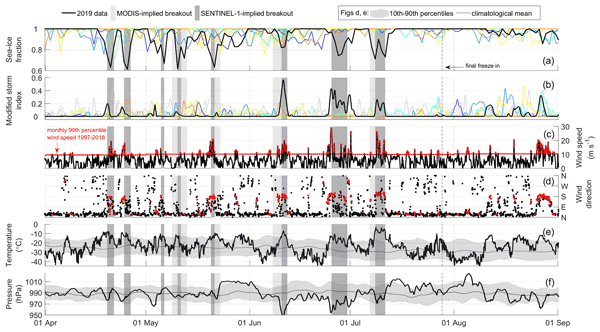
McMurdo Sound sea ice can generally be partitioned into two regimes: a stable fast-ice cover forming south of approximately 77.6° S and a more dynamic region north of 77.6° S that is regularly impacted by polynyas. In 2019, a stable fast-ice cover formed unusually late due to repeated break-out events. This subsequently affected sea-ice operations in the 2019/20 field season. We analysed the 2019 sea-ice conditions and found a strong correlation with unusually large southerly wind events.
Kaihe Yamazaki, Karen J. Heywood, Gillian M. Damerell, Marina Azaneu, and Maya I. Jakes
EGUsphere, https://doi.org/10.5194/egusphere-2026-6184, https://doi.org/10.5194/egusphere-2026-6184, 2026
This preprint is open for discussion and under review for Ocean Science (OS).
Short summary
Short summary
Seamounts can trap ocean currents and stir the water around them. Using two underwater glider surveys over a seamount near the tip of the Antarctic Peninsula, we show that a persistent eddy circling the seamount is held in place by the seafloor and partly driven by strong tides. Tidal mixing weakens the water layering over the summit and favours upwelling, which may supply nutrients to surface waters. The eddy can also trap giant icebergs, holding one for about 18 months.
Robert J. W. Brewin, Bethany Wilkinson, Xuerong Sun, Giorgio Dall'Olmo, Gavin H. Tilstone, Katharine R. Hendry, Sarah Breimann, Ian Brown, Angus Atkinson, Katrin Schmidt, Elisabetta Canuti, Meredith G. Meyer, Qi Zheng, Johannes J. Viljoen, Tom Bell, and Karen J. Heywood
EGUsphere, https://doi.org/10.5194/egusphere-2026-4398, https://doi.org/10.5194/egusphere-2026-4398, 2026
This preprint is open for discussion and under review for Ocean Science (OS).
Short summary
Short summary
Phytoplankton are the foundation of the Antarctic food web. Their size affects carbon storage in the ocean and energy transfer to krill, fish, and whales. Because the northwestern Weddell Sea is rarely sampled, little is known about phytoplankton size there. Using ship-based measurements and satellite data, we found medium-sized phytoplankton dominate rather than the smallest types that dominate warmer oceans. This provides a baseline for tracking ecosystem responses to climate change.
Meredith G. Meyer, Robert J. W. Brewin, Xuerong Sun, Clara Manno, Florence Atherden, Sasha J. Kramer, Giorgio Dall'Olmo, and Karen J. Heywood
EGUsphere, https://doi.org/10.5194/egusphere-2026-3148, https://doi.org/10.5194/egusphere-2026-3148, 2026
Short summary
Short summary
Antarctica is a key region for carbon cycling and export. The efficiency of carbon export has been linked to the type of phytoplankton dominating the system. Our results suggest diatoms, haptophytes, and cryptophytes are present in all water column samples despite substantial physical differences between sampling locations. Our data shows a strong relationship between the proportion of diatoms, haptophytes, and cryptophytes relative to all other phytoplankton and the magnitude of carbon flux.
Tom A. Jordan, Karen J. Heywood, Anna Wåhlin, Rob A. Hall, Atsuhiro Muto, Pierre Dutrieux, Kelly Hogan, James Girton, Karen E. Alley, and Erin Pettit
EGUsphere, https://doi.org/10.5194/egusphere-2025-6001, https://doi.org/10.5194/egusphere-2025-6001, 2026
Short summary
Short summary
The shape of the water filled cavity hidden beneath ice shelves is extremely important, but hard to measure. Gravity data collected from aircraft can be used to predict the shape. However, in the Dotson Crosson ice shelves in West Antarctica, new direct observations from autonomous platforms sent beneath the ice, and seismic observations from the ice surface showed gravity models were systematically too shallow. We explain why and provide a solution applicable her and in other ice shelves.
Gerd A. Bruss, Estel Font, Bastien Y. Queste, and Rob A. Hall
Ocean Sci., 22, 31–47, https://doi.org/10.5194/os-22-31-2026, https://doi.org/10.5194/os-22-31-2026, 2026
Short summary
Short summary
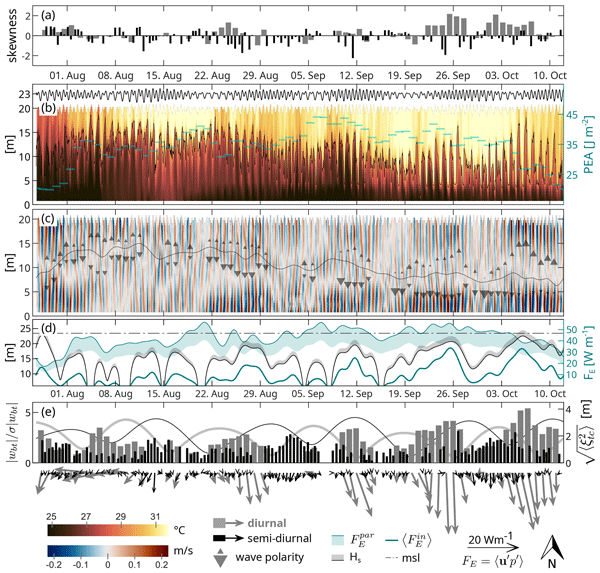
We studied internal tides in the Gulf of Oman, where they had not been observed in detail before. Using seabed instruments, we found that these underwater waves travel far inshore, strengthen as the season shifts toward fall, and stay predictable for weeks. They may bring cooler, low-oxygen water to coastal areas, influencing marine ecosystems and reef health.
Daisy D. Pickup, Dorothee C. E. Bakker, Karen J. Heywood, Francis Glassup, Emily M. Hammermeister, Sharon E. Stammerjohn, Gareth A. Lee, Socratis Loucaides, Bastien Y. Queste, Benjamin G. M. Webber, and Patricia L. Yager
Ocean Sci., 21, 2727–2741, https://doi.org/10.5194/os-21-2727-2025, https://doi.org/10.5194/os-21-2727-2025, 2025
Short summary
Short summary
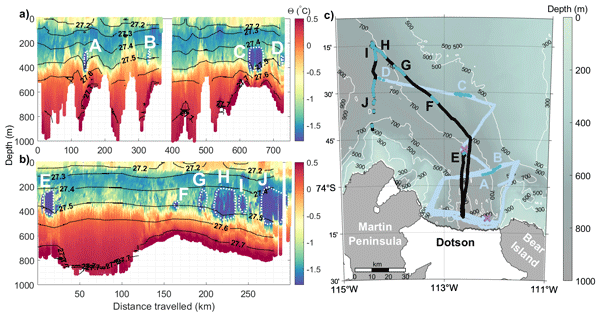
Autonomous platforms in the Amundsen Sea have allowed for detection of isolated water masses that are colder, saltier and denser than overlying water. They are also associated with a higher dissolved inorganic carbon concentration and lower pH. The water masses, referred to as lenses, could have implications for the transfer of heat and storage of carbon in the region. We hypothesise that they form in surrounding areas that experience intense cooling and sea ice formation in autumn/winter.
Christian T. Wild, Tasha Snow, Tiago S. Dotto, Peter E. D. Davis, Scott Tyler, Ted A. Scambos, Erin C. Pettit, and Karen J. Heywood
Ocean Sci., 21, 2605–2629, https://doi.org/10.5194/os-21-2605-2025, https://doi.org/10.5194/os-21-2605-2025, 2025
Short summary
Short summary
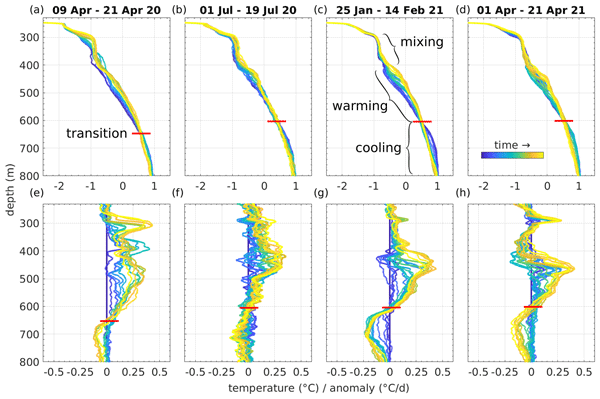
Thwaites Glacier is retreating due to warm ocean water melting it from below, but its thick ice shelf makes this heat hard to monitor. Using hot-water drilling, we placed sensors beneath the floating ice, revealing how surface freezing in Pine Island Bay influences heat at depth. Alongside gradual warming, we found bursts of heat that could speed up melting at the grounding zone, which may become more common as sea ice declines.
Shenjie Zhou, Pierre Dutrieux, Claudia F. Giulivi, Adrian Jenkins, Alessandro Silvano, Christopher Auckland, E. Povl Abrahamsen, Michael Meredith, Irena Vaňková, Keith Nicholls, Peter E. D. Davis, Svein Østerhus, Arnold L. Gordon, Christopher J. Zappa, Tiago S. Dotto, Ted Scambos, Kathryn L. Gunn, Stephen R. Rintoul, Shigeru Aoki, Craig Stevens, Chengyan Liu, Sukyoung Yun, Tae-Wan Kim, Won Sang Lee, Markus Janout, Tore Hattermann, Julius Lauber, Elin Darelius, Anna Wåhlin, Leo Middleton, Pasquale Castagno, Giorgio Budillon, Karen J. Heywood, Jennifer Graham, Stephen Dye, Daisuke Hirano, and Una Kim Miller
Earth Syst. Sci. Data, 17, 5693–5706, https://doi.org/10.5194/essd-17-5693-2025, https://doi.org/10.5194/essd-17-5693-2025, 2025
Short summary
Short summary
We created the first standardised dataset of in-situ ocean measurements time series from around Antarctica collected since 1970s. This includes temperature, salinity, pressure, and currents recorded by instruments deployed in icy, challenging conditions. Our analysis highlights the dominance of tidal currents and separates these from other patterns to study regional energy distribution. This unique dataset offers a foundation for future research on Antarctic ocean dynamics and ice interactions.
Meredith G. Meyer, Esther Portela, Walker O. Smith Jr., and Karen J. Heywood
Ocean Sci., 21, 1223–1236, https://doi.org/10.5194/os-21-1223-2025, https://doi.org/10.5194/os-21-1223-2025, 2025
Short summary
Short summary
During the annual phytoplankton bloom, rates of primary production and carbon export in the Ross Sea, Antarctica, are uncoupled from each other and from oxygen and carbon stocks. These biogeochemical rates support the high-productivity, low-export classification of the region and suggest that environmental factors influence these stocks and rates differently and make projections under future climate change scenarios difficult.
Ria Oelerich, Karen J. Heywood, Gillian M. Damerell, Marcel du Plessis, Louise C. Biddle, and Sebastiaan Swart
Ocean Sci., 19, 1465–1482, https://doi.org/10.5194/os-19-1465-2023, https://doi.org/10.5194/os-19-1465-2023, 2023
Short summary
Short summary
At the southern boundary of the Antarctic Circumpolar Current, relatively warm waters encounter the colder waters surrounding Antarctica. Observations from underwater vehicles and altimetry show that medium-sized cold-core eddies influence the southern boundary's barrier properties by strengthening the slopes of constant density lines across it and amplifying its associated jet. As a result, the ability of exchanging properties, such as heat, across the southern boundary is reduced.
Pierre L'Hégaret, Florian Schütte, Sabrina Speich, Gilles Reverdin, Dariusz B. Baranowski, Rena Czeschel, Tim Fischer, Gregory R. Foltz, Karen J. Heywood, Gerd Krahmann, Rémi Laxenaire, Caroline Le Bihan, Philippe Le Bot, Stéphane Leizour, Callum Rollo, Michael Schlundt, Elizabeth Siddle, Corentin Subirade, Dongxiao Zhang, and Johannes Karstensen
Earth Syst. Sci. Data, 15, 1801–1830, https://doi.org/10.5194/essd-15-1801-2023, https://doi.org/10.5194/essd-15-1801-2023, 2023
Short summary
Short summary
In early 2020, the EUREC4A-OA/ATOMIC experiment took place in the northwestern Tropical Atlantic Ocean, a dynamical region where different water masses interact. Four oceanographic vessels and a fleet of autonomous devices were deployed to study the processes at play and sample the upper ocean, each with its own observing capability. The article first describes the data calibration and validation and second their cross-validation, using a hierarchy of instruments and estimating the uncertainty.
Manoj Joshi, Robert A. Hall, David P. Stevens, and Ed Hawkins
Earth Syst. Dynam., 14, 443–455, https://doi.org/10.5194/esd-14-443-2023, https://doi.org/10.5194/esd-14-443-2023, 2023
Short summary
Short summary
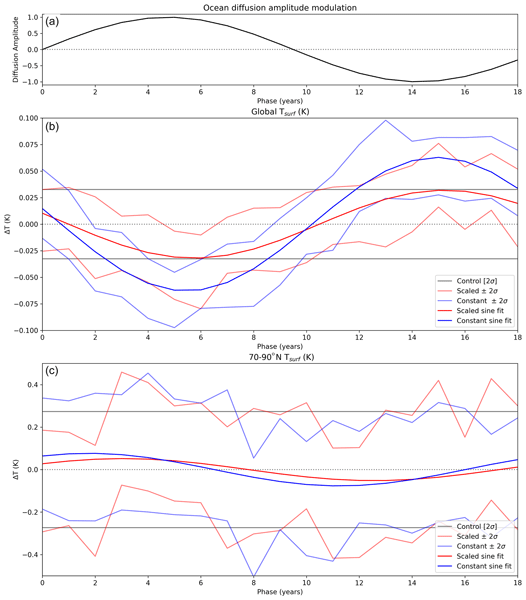
The 18.6-year lunar nodal cycle arises from variations in the angle of the Moon's orbital plane and affects ocean tides. In this work we use a climate model to examine the effect of this cycle on the ocean, surface, and atmosphere. The timing of anomalies is consistent with the so-called slowdown in global warming and has implications for when global temperatures will exceed 1.5 ℃ above pre-industrial levels. Regional anomalies have implications for seasonal climate areas such as Europe.

Peter M. F. Sheehan, Gillian M. Damerell, Philip J. Leadbitter, Karen J. Heywood, and Rob A. Hall
Ocean Sci., 19, 77–92, https://doi.org/10.5194/os-19-77-2023, https://doi.org/10.5194/os-19-77-2023, 2023
Short summary
Short summary
We calculate the rate of turbulent kinetic energy dissipation, i.e. the mixing driven by small-scale ocean turbulence, in the western tropical Atlantic Ocean via two methods. We find good agreement between the results of both. A region of elevated mixing is found between 200 and 500 m, and we calculate the associated heat and salt fluxes. We find that double-diffusive mixing in salt fingers, a common feature of the tropical oceans, drives larger heat and salt fluxes than the turbulent mixing.
Callum Rollo, Karen J. Heywood, and Rob A. Hall
Geosci. Instrum. Method. Data Syst., 11, 359–373, https://doi.org/10.5194/gi-11-359-2022, https://doi.org/10.5194/gi-11-359-2022, 2022
Short summary
Short summary
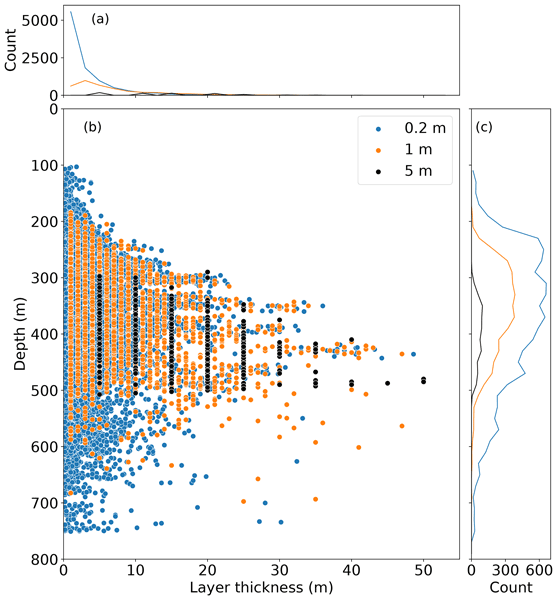
Using an underwater buoyancy-powered autonomous glider, we collected profiles of temperature and salinity from the ocean north-east of Barbados. Most of the temperature and salinity profiles contained staircase-like structures of alternating constant values and large gradients. We wrote an algorithm to identify these staircases. We hypothesise that these staircases are prevented from forming where background gradients in temperature and salinity are too great.
Michael P. Hemming, Jan Kaiser, Jacqueline Boutin, Liliane Merlivat, Karen J. Heywood, Dorothee C. E. Bakker, Gareth A. Lee, Marcos Cobas García, David Antoine, and Kiminori Shitashima
Ocean Sci., 18, 1245–1262, https://doi.org/10.5194/os-18-1245-2022, https://doi.org/10.5194/os-18-1245-2022, 2022
Short summary
Short summary
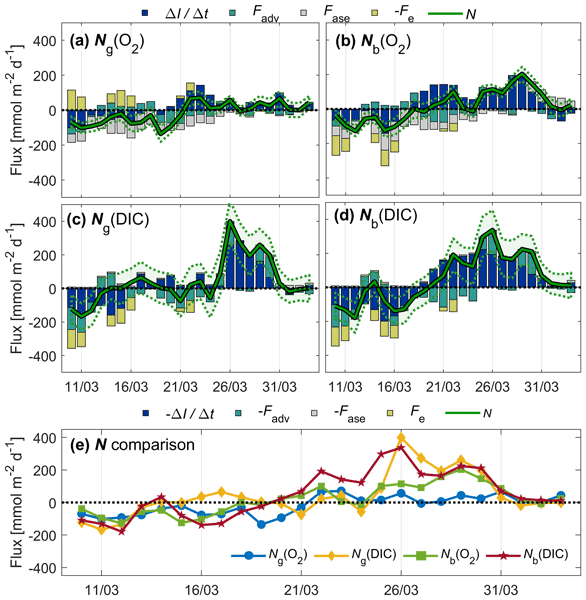
An underwater glider mission was carried out in spring 2016 near a mooring in the northwestern Mediterranean Sea. The glider deployment served as a test of a prototype ion-sensitive field-effect transistor pH sensor. Mean net community production rates were estimated from glider and buoy measurements of dissolved oxygen and inorganic carbon concentrations before and during the spring bloom. Incorporating advection is important for accurate mass budgets. Unexpected metabolic quotients were found.
Yixi Zheng, David P. Stevens, Karen J. Heywood, Benjamin G. M. Webber, and Bastien Y. Queste
The Cryosphere, 16, 3005–3019, https://doi.org/10.5194/tc-16-3005-2022, https://doi.org/10.5194/tc-16-3005-2022, 2022
Short summary
Short summary
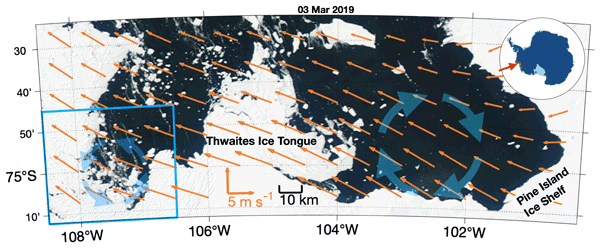
New observations reveal the Thwaites gyre in a habitually ice-covered region in the Amundsen Sea for the first time. This gyre rotates anticlockwise, despite the wind here favouring clockwise gyres like the Pine Island Bay gyre – the only other ocean gyre reported in the Amundsen Sea. We use an ocean model to suggest that sea ice alters the wind stress felt by the ocean and hence determines the gyre direction and strength. These processes may also be applied to other gyres in polar oceans.

Yanxin Wang, Karen J. Heywood, David P. Stevens, and Gillian M. Damerell
Ocean Sci., 18, 839–855, https://doi.org/10.5194/os-18-839-2022, https://doi.org/10.5194/os-18-839-2022, 2022
Short summary
Short summary
It is important that climate models give accurate projections of future extremes in summer and winter sea surface temperature because these affect many features of the global climate system. Our results demonstrate that some models would give large errors if used for future projections of these features, and models with more detailed representation of vertical structure in the ocean tend to have a better representation of sea surface temperature, particularly in summer.
Greg H. Leonard, Kate E. Turner, Maren E. Richter, Maddy S. Whittaker, and Inga J. Smith
The Cryosphere, 15, 4999–5006, https://doi.org/10.5194/tc-15-4999-2021, https://doi.org/10.5194/tc-15-4999-2021, 2021
Short summary
Short summary
McMurdo Sound sea ice can generally be partitioned into two regimes: a stable fast-ice cover forming south of approximately 77.6° S and a more dynamic region north of 77.6° S that is regularly impacted by polynyas. In 2019, a stable fast-ice cover formed unusually late due to repeated break-out events. This subsequently affected sea-ice operations in the 2019/20 field season. We analysed the 2019 sea-ice conditions and found a strong correlation with unusually large southerly wind events.
Cited articles
Alford, M. H., Girton, J. B., Voet, G., Carter, G. S., Mickett, J. B., and Klymak, J. M.: Turbulent mixing and hydraulic control of abyssal water in the Samoan Passage, Geophysical Research Letters, 40, 4668–4674, https://doi.org/10.1002/grl.50684, 2013. a
Asay-Davis, X. S., Cornford, S. L., Durand, G., Galton-Fenzi, B. K., Gladstone, R. M., Gudmundsson, G. H., Hattermann, T., Holland, D. M., Holland, D., Holland, P. R., Martin, D. F., Mathiot, P., Pattyn, F., and Seroussi, H.: Experimental design for three interrelated marine ice sheet and ocean model intercomparison projects: MISMIP v. 3 (MISMIP +), ISOMIP v. 2 (ISOMIP +) and MISOMIP v. 1 (MISOMIP1), Geosci. Model Dev., 9, 2471–2497, https://doi.org/10.5194/gmd-9-2471-2016, 2016. a, b
Bintanja, R., van Oldenborgh, G. J., Drijfhout, S. S., Wouters, B., and Katsman, C. A.: Important role for ocean warming and increased ice-shelf melt in Antarctic sea-ice expansion, Nature Geoscience, 6, 376–379, https://doi.org/10.1038/ngeo1767, 2013. a
Bronselaer, B., Winton, M., Griffies, S. M., Hurlin, W. J., Rodgers, K. B., Sergienko, O. V., Stouffer, R. J., and Russell, J. L.: Change in future climate due to Antarctic meltwater, Nature, 564, 53–58, https://doi.org/10.1038/s41586-018-0712-z, 2018. a, b
Davis, P. E. D. and Jenkins, A.: Autosub Long Range beneath Ronne Ice Shelf (2018): hydrographic, velocity and turbulence observations along the Modified Warm Deep Water Inflow, NERC EDS UK Polar Data Centre [data set], https://doi.org/10.5285/EB2F66FA-1C64-49AF-B9E8-CE3124CE3C03, 2022. a
Davis, P. E. D. and Nicholls, K. W.: Turbulence beneath Larsen C Ice Shelf, Antarctica (2012), UK Polar Data Centre [data set], https://doi.org/10.5285/16EE2665-D0D0-41B9-A046-23B0A7369C61, 2019a. a
Davis, P. E. D. and Nicholls, K. W.: Turbulence Observations Beneath Larsen C Ice Shelf, Antarctica, Journal of Geophysical Research: Oceans, 124, 5529–5550, https://doi.org/10.1029/2019jc015164, 2019b. a, b, c, d
Davis, P. E. D., Jenkins, A., Nicholls, K. W., Brennan, P. V., Abrahamsen, E. P., Heywood, K. J., Dutrieux, P., Cho, K., and Kim, T.: Variability in Basal Melting Beneath Pine Island Ice Shelf on Weekly to Monthly Timescales, Journal of Geophysical Research: Oceans, 123, 8655–8669, https://doi.org/10.1029/2018jc014464, 2018. a
Davis, P. E. D., Jenkins, A., Nicholls, K. W., Dutrieux, P., Schröder, M., Janout, M. A., Hellmer, H. H., Templeton, R., and McPhail, S.: Observations of Modified Warm Deep Water Beneath Ronne Ice Shelf, Antarctica, From an Autonomous Underwater Vehicle, Journal of Geophysical Research: Oceans, 127, https://doi.org/10.1029/2022jc019103, 2022. a, b, c, d, e, f, g, h, i, j, k, l, m, n, o, p, q, r, s
Davis, P. E. D., Nicholls, K. W., and Holland, D. M.: Thwaites MELT: Velocity microstructure profiles from the grounding zone region of Thwaites Glacier Eastern Ice Shelf (2020), NERC EDS UK Polar Data Centre [data set], https://doi.org/10.5285/2B33895B-5069-4C49-95BD-2624C980498B, 2024. a
Davis, P. E. D., Nicholls, K. W., Holland, D. M., Schmidt, B. E., Washam, P., Castro, B. F., Riverman, K. L., Smith, J. A., Anker, P. G. D., Mullen, A. D., Dichek, D., Clyne, E., and Makinson, K.: Lateral Fluxes Drive Basal Melting Beneath Thwaites Eastern Ice Shelf, West Antarctica, Geophysical Research Letters, 52, https://doi.org/10.1029/2024gl111873, 2025. a, b, c, d, e
Dotto, T. S., Hall, R. A., Heywood, K. J., Provost, P., and Platt, W.: Lowered Acoustic Doppler Current Profiler (LADCP) data collected in the Amundsen Sea for the TARSAN Project, January – February 2022, NERC EDS British Oceanographic Data Centre NOC [data set], https://doi.org/10.5285/18A8BE08-07C6-D76C-E063-7086ABC01604, 2024. a
Erofeeva, S., Greene, C. A., Howard, S. L., Padman, L., and Sutterley, T.: CATS2008_v2023: Circum-Antarctic Tidal Simulation 2008, version 2023, U.S. Antarctic Program (USAP) Data Center [data set], https://doi.org/10.15784/601772, 2024. a, b
Girton, J. B., Christianson, K., Dunlap, J., Dutrieux, P., Gobat, J., Lee, C., and Rainville, L.: Buoyancy-adjusting Profiling Floats for Exploration of Heat Transport, Melt Rates, and Mixing in the Ocean Cavities Under Floating Ice Shelves, in: OCEANS 2019 MTS/IEEE SEATTLE, 1–6, https://doi.org/10.23919/OCEANS40490.2019.8962744, 2019. a, b, c, d, e
Goodman, L., Levine, E. R., and Lueck, R. G.: On Measuring the Terms of the Turbulent Kinetic Energy Budget from an AUV, Journal of Atmospheric and Oceanic Technology, 23, 977–990, https://doi.org/10.1175/jtech1889.1, 2006. a
Gourmelen, N., Goldberg, D. N., Snow, K., Henley, S. F., Bingham, R. G., Kimura, S., Hogg, A. E., Shepherd, A., Mouginot, J., Lenaerts, J. T. M., Ligtenberg, S. R. M., and van de Berg, W. J.: Channelized Melting Drives Thinning Under a Rapidly Melting Antarctic Ice Shelf, Geophysical Research Letters, 44, 9796–9804, https://doi.org/10.1002/2017gl074929, 2017. a, b, c, d, e, f, g, h, i
Greene, C. A., Gardner, A. S., Schlegel, N.-J., and Fraser, A. D.: Antarctic calving loss rivals ice-shelf thinning, Nature, 609, 948–953, https://doi.org/10.1038/s41586-022-05037-w, 2022. a
Gwyther, D. E., Galton-Fenzi, B. K., Dinniman, M. S., Roberts, J. L., and Hunter, J. R.: The effect of basal friction on melting and freezing in ice shelf-ocean models, Ocean Modelling, 95, 38–52, https://doi.org/10.1016/j.ocemod.2015.09.004, 2015. a, b
Haine, T. W. N. and Marshall, J.: Gravitational, Symmetric, and Baroclinic Instability of the Ocean Mixed Layer, Journal of Physical Oceanography, 28, 634–658, https://doi.org/10.1175/1520-0485(1998)028<0634:gsabio>2.0.co;2, 1998. a
Hazel, P.: Numerical studies of the stability of inviscid stratified shear flows, Journal of Fluid Mechanics, 51, 39–61, https://doi.org/10.1017/s0022112072001065, 1972. a
Hellmer, H. H.: Impact of Antarctic ice shelf basal melting on sea ice and deep ocean properties, Geophysical Research Letters, 31, https://doi.org/10.1029/2004gl019506, 2004. a, b
Howard, L. N.: Note on a paper of John W. Miles, Journal of Fluid Mechanics, 10, 509, https://doi.org/10.1017/s0022112061000317, 1961. a
Jordan, T. A., Porter, D., Tinto, K., Millan, R., Muto, A., Hogan, K., Larter, R. D., Graham, A. G. C., and Paden, J. D.: New gravity-derived bathymetry for the Thwaites, Crosson, and Dotson ice shelves revealing two ice shelf populations, The Cryosphere, 14, 2869–2882, https://doi.org/10.5194/tc-14-2869-2020, 2020. a, b, c
Jourdain, N. C., Mathiot, P., Merino, N., Durand, G., Le Sommer, J., Spence, P., Dutrieux, P., and Madec, G.: Ocean circulation and sea‐ice thinning induced by melting ice shelves in the Amundsen Sea, Journal of Geophysical Research: Oceans, 122, 2550–2573, https://doi.org/10.1002/2016jc012509, 2017. a
Khazendar, A., Rignot, E., Schroeder, D. M., Seroussi, H., Schodlok, M. P., Scheuchl, B., Mouginot, J., Sutterley, T. C., and Velicogna, I.: Rapid submarine ice melting in the grounding zones of ice shelves in West Antarctica, Nature Communications, 7, https://doi.org/10.1038/ncomms13243, 2016. a, b, c, d
Kim, T., Yang, H. W., Dutrieux, P., Wåhlin, A. K., Jenkins, A., Kim, Y. G., Ha, H. K., Kim, C., Cho, K., Park, T., Park, J., Lee, S., and Cho, Y.: Interannual Variation of Modified Circumpolar Deep Water in the Dotson-Getz Trough, West Antarctica, Journal of Geophysical Research: Oceans, 126, https://doi.org/10.1029/2021jc017491, 2021. a, b, c
Kimura, S., Jenkins, A., Dutrieux, P., Forryan, A., Naveira Garabato, A. C., and Firing, Y.: Ocean mixing beneath Pine Island Glacier ice shelf, West Antarctica: ocean mixing beneath pig, Journal of Geophysical Research: Oceans, 121, 8496–8510, https://doi.org/10.1002/2016jc012149, 2016. a, b, c, d, e, f, g, h, i, j, k, l, m, n, o
King, B., Stone, M., Zhang, H. P., Gerkema, T., Marder, M., Scott, R. B., and Swinney, H. L.: Buoyancy frequency profiles and internal semidiurnal tide turning depths in the oceans, Journal of Geophysical Research: Oceans, 117, https://doi.org/10.1029/2011jc007681, 2012. a
Kolås, E. H., Mo-Bjørkelund, T., and Fer, I.: Technical note: Turbulence measurements from a light autonomous underwater vehicle, Ocean Sci., 18, 389–400, https://doi.org/10.5194/os-18-389-2022, 2022. a
Large, W. G., McWilliams, J. C., and Doney, S. C.: Oceanic vertical mixing: A review and a model with a nonlocal boundary layer parameterization, Reviews of Geophysics, 32, 363–403, https://doi.org/10.1029/94rg01872, 1994. a, b
Lilien, D. A., Joughin, I., Smith, B., and Shean, D. E.: Changes in flow of Crosson and Dotson ice shelves, West Antarctica, in response to elevated melt, The Cryosphere, 12, 1415–1431, https://doi.org/10.5194/tc-12-1415-2018, 2018. a, b, c, d
Lueck, R., Fer, I., Bluteau, C., Dengler, M., Holtermann, P., Inoue, R., LeBoyer, A., Nicholson, S.-A., Schulz, K., and Stevens, C.: Best practices recommendations for estimating dissipation rates from shear probes, Frontiers in Marine Science, 11, https://doi.org/10.3389/fmars.2024.1334327, 2024. a
McDougall, T. J. and Barker, P. M.: Getting started with TEOS-10 and the Gibbs Seawater (GSW) oceanographic toolbox, SCOR/IAPSO WG, 127, 1–28, 2011. a
Miles, J. W.: On the stability of heterogeneous shear flows, Journal of Fluid Mechanics, 10, 496, https://doi.org/10.1017/s0022112061000305, 1961. a
Milillo, P., Rignot, E., Rizzoli, P., Scheuchl, B., Mouginot, J., Bueso-Bello, J. L., Prats-Iraola, P., and Dini, L.: Rapid glacier retreat rates observed in West Antarctica, Nature Geoscience, 15, 48–53, https://doi.org/10.1038/s41561-021-00877-z, 2022. a, b, c, d
Morlighem, M., Rignot, E., Binder, T., Blankenship, D., Drews, R., Eagles, G., Eisen, O., Ferraccioli, F., Forsberg, R., Fretwell, P., Goel, V., Greenbaum, J. S., Gudmundsson, H., Guo, J., Helm, V., Hofstede, C., Howat, I., Humbert, A., Jokat, W., Karlsson, N. B., Lee, W. S., Matsuoka, K., Millan, R., Mouginot, J., Paden, J., Pattyn, F., Roberts, J., Rosier, S., Ruppel, A., Seroussi, H., Smith, E. C., Steinhage, D., Sun, B., Broeke, M. R. v. d., Ommen, T. D. v., Wessem, M. v., and Young, D. A.: Deep glacial troughs and stabilizing ridges unveiled beneath the margins of the Antarctic ice sheet, Nature Geoscience, 13, 132–137, https://doi.org/10.1038/s41561-019-0510-8, 2019. a
Mouginot, J., Rignot, E., and Scheuchl, B.: Sustained increase in ice discharge from the Amundsen Sea Embayment, West Antarctica, from 1973 to 2013, Geophysical Research Letters, 41, 1576–1584, https://doi.org/10.1002/2013gl059069, 2014. a, b, c, d
Muchowski, J., Arneborg, L., Umlauf, L., Holtermann, P., Eisbrenner, E., Humborg, C., Jakobsson, M., and Stranne, C.: Diapycnal Mixing Induced by Rough Small-Scale Bathymetry, Geophysical Research Letters, 50, https://doi.org/10.1029/2023gl103514, 2023. a
Nakayama, Y., Menemenlis, D., Schodlok, M., and Rignot, E.: Amundsen and Bellingshausen Seas simulation with optimized ocean, sea ice, and thermodynamic ice shelf model parameters, Journal of Geophysical Research: Oceans, 122, 6180–6195, https://doi.org/10.1002/2016jc012538, 2017. a
Nasmyth, P. W.: Oceanic turbulence, phdthesis, University of British Columbia, https://doi.org/10.14288/1.0302459, 1970. a
Naveira Garabato, A. C., Forryan, A., Dutrieux, P., Brannigan, L., Biddle, L. C., Heywood, K. J., Jenkins, A., Firing, Y. L., and Kimura, S.: Vigorous lateral export of the meltwater outflow from beneath an Antarctic ice shelf, Nature, 542, 219–222, https://doi.org/10.1038/nature20825, 2017. a, b, c, d
NSF/NERC ARTEMIS and ITGC TARSAN: Vertical ocean profiles collected by a Conductivity-Temperature-Depth (CTD) package in the Amundsen Sea, U.S. Antarctic Program (USAP) Data Center [data set], https://doi.org/10.15784/601785, 2024. a
Oakey, N. S.: Determination of the Rate of Dissipation of Turbulent Energy from Simultaneous Temperature and Velocity Shear Microstructure Measurements, Journal of Physical Oceanography, 12, 256–271, https://doi.org/10.1175/1520-0485(1982)012<0256:dotrod>2.0.co;2, 1982. a
Osborn, T. R.: Vertical Profiling of Velocity Microstructure, Journal of Physical Oceanography, 4, 109–115, https://doi.org/10.1175/1520-0485(1974)004<0109:vpovm>2.0.co;2, 1974. a
Osborn, T. R.: Estimates of the Local Rate of Vertical Diffusion from Dissipation Measurements, Journal of Physical Oceanography, 10, 83–89, https://doi.org/10.1175/1520-0485(1980)010<0083:eotlro>2.0.co;2, 1980. a, b
Padman, L., Fricker, H. A., Coleman, R., Howard, S., and Erofeeva, L.: A new tide model for the Antarctic ice shelves and seas, Annals of Glaciology, 34, 247–254, https://doi.org/10.3189/172756402781817752, 2002. a
Paolo, F. S., Fricker, H. A., and Padman, L.: Volume loss from Antarctic ice shelves is accelerating, Science, 348, 327–331, https://doi.org/10.1126/science.aaa0940, 2015. a
Polzin, K., Kunze, E., Hummon, J., and Firing, E.: The finescale response of lowered ADCP velocity profiles, Journal of Atmospheric and Oceanic Technology, 19, 205–224, https://doi.org/10.1175/1520-0426(2002)019<0205:tfrola>2.0.co;2, 2002. a
Polzin, K. L., Toole, J. M., Ledwell, J. R., and Schmitt, R. W.: Spatial Variability of Turbulent Mixing in the Abyssal Ocean, Science, 276, 93–96, https://doi.org/10.1126/science.276.5309.93, 1997. a
Richardson, G., Wadley, M. R., Heywood, K. J., Stevens, D. P., and Banks, H. T.: Short-term climate response to a freshwater pulse in the Southern Ocean, Geophysical Research Letters, 32, https://doi.org/10.1029/2004gl021586, 2005. a
Richter, M. E., Heywood, K. J., and Hall, R. A.: CTD, microstructure and ADCP data from Autosub Long Range under Dotson Ice Shelf, VMP data from the Dotson Ice Shelf front, (Version V1), Zenodo [data set], https://doi.org/10.5281/zenodo.15280917, 2025. a
Rignot, E., Jacobs, S., Mouginot, J., and Scheuchl, B.: Ice-Shelf Melting Around Antarctica, Science, 341, 266–270, https://doi.org/10.1126/science.1235798, 2013. a, b
Rignot, E., Mouginot, J., Morlighem, M., Seroussi, H., and Scheuchl, B.: Widespread, rapid grounding line retreat of Pine Island, Thwaites, Smith, and Kohler glaciers, West Antarctica, from 1992 to 2011, Geophysical Research Letters, 41, 3502–3509, https://doi.org/10.1002/2014gl060140, 2014. a
Rignot, E., Mouginot, J., Scheuchl, B., van den Broeke, M., van Wessem, M. J., and Morlighem, M.: Four decades of Antarctic Ice Sheet mass balance from 1979–2017, Proceedings of the National Academy of Sciences, 116, 1095–1103, https://doi.org/10.1073/pnas.1812883116, 2019. a, b, c
Robertson, R.: Tidally induced increases in melting of Amundsen Sea ice shelves, Journal of Geophysical Research: Oceans, 118, 3138–3145, https://doi.org/10.1002/jgrc.20236, 2013. a, b, c
Scheuchl, B., Mouginot, J., Rignot, E., Morlighem, M., and Khazendar, A.: Grounding line retreat of Pope, Smith, and Kohler Glaciers, West Antarctica, measured with Sentinel-1a radar interferometry data, Geophysical Research Letters, 43, 8572–8579, https://doi.org/10.1002/2016gl069287, 2016. a
Schodlok, M. P., Menemenlis, D., Rignot, E., and Studinger, M.: Sensitivity of the ice-shelf/ocean system to the sub-ice-shelf cavity shape measured by NASA IceBridge in Pine Island Glacier, West Antarctica, Annals of Glaciology, 53, 156–162, https://doi.org/10.3189/2012aog60a073, 2012. a, b, c
Scott, R. M., Brearley, J. A., Naveira Garabato, A. C., Venables, H. J., and Meredith, M. P.: Rates and Mechanisms of Turbulent Mixing in a Coastal Embayment of the West Antarctic Peninsula, Journal of Geophysical Research: Oceans, 126, https://doi.org/10.1029/2020jc016861, 2021. a, b
Silvano, A., Rintoul, S. R., Peña-Molino, B., Hobbs, W. R., van Wijk, E., Aoki, S., Tamura, T., and Williams, G. D.: Freshening by glacial meltwater enhances melting of ice shelves and reduces formation of Antarctic Bottom Water, Science Advances, 4, https://doi.org/10.1126/sciadv.aap9467, 2018. a, b, c
Thurnherr, A. M.: How To Process LADCP Data With the LDEO Software (Version IX.14), https://www.ldeo.columbia.edu/~ant/LADCP.html (last access: 14 November 2025), 2021. a
Twining, B. S. and Baines, S. B.: The Trace Metal Composition of Marine Phytoplankton, Annual Review of Marine Science, 5, 191–215, https://doi.org/10.1146/annurev-marine-121211-172322, 2013. a
van Manen, M., Aoki, S., Brussaard, C. P., Conway, T. M., Eich, C., Gerringa, L. J., Jung, J., Kim, T.-W., Lee, S., Lee, Y., Reichart, G.-J., Tian, H.-A., Wille, F., and Middag, R.: The role of the Dotson Ice Shelf and Circumpolar Deep Water as driver and source of dissolved and particulate iron and manganese in the Amundsen Sea polynya, Southern Ocean, Marine Chemistry, 246, 104161, https://doi.org/10.1016/j.marchem.2022.104161, 2022. a, b
Venables, E., Nicholls, K., Wolk, F., Makinson, K., and Anker, P.: Measuring turbulent dissipation rates beneath an Antarctic ice shelf, Marine Technology Society Journal, 48, 18–24, https://doi.org/10.4031/mtsj.48.5.8, 2014. a, b, c
Wåhlin, A., Alley, K. E., Begeman, C., Hegrenæs, Ø., Yuan, X., Graham, A. G. C., Hogan, K., Davis, P. E. D., Dotto, T. S., Eayrs, C., Hall, R. A., Holland, D. M., Kim, T. W., Larter, R. D., Ling, L., Muto, A., Pettit, E. C., Schmidt, B. E., Snow, T., Stedt, F., Washam, P. M., Wahlgren, S., Wild, C., Wellner, J., Zheng, Y., and Heywood, K. J.: Swirls and scoops: Ice base melt revealed by multibeam imagery of an Antarctic ice shelf, Science Advances, 10, https://doi.org/10.1126/sciadv.adn9188, 2024a. a, b, c, d, e, f, g
Wåhlin, A., Sjövall, A., Symons, M., Ling, L., Stedt, F., Eayrs, C., and Holland, D.: Data from AUV Ran missions during Nathaniel B. Palmer cruise NBP2202, Swedish National Data Service [data set], https://doi.org/10.5878/JEJ3-KV87, 2024b. a
Wåhlin, A. K., Steiger, N., Darelius, E., Assmann, K. M., Glessmer, M. S., Ha, H. K., Herraiz-Borreguero, L., Heuzé, C., Jenkins, A., Kim, T. W., Mazur, A. K., Sommeria, J., and Viboud, S.: Ice front blocking of ocean heat transport to an Antarctic ice shelf, Nature, 578, 568–571, https://doi.org/10.1038/s41586-020-2014-5, 2020. a, b
Walker, R. T., Dupont, T. K., Parizek, B. R., and Alley, R. B.: Effects of basal-melting distribution on the retreat of ice-shelf grounding lines, Geophysical Research Letters, 35, https://doi.org/10.1029/2008gl034947, 2008. a
Waterhouse, A. F., MacKinnon, J. A., Nash, J. D., Alford, M. H., Kunze, E., Simmons, H. L., Polzin, K. L., St. Laurent, L. C., Sun, O. M., Pinkel, R., Talley, L. D., Whalen, C. B., Huussen, T. N., Carter, G. S., Fer, I., Waterman, S., Naveira Garabato, A. C., Sanford, T. B., and Lee, C. M.: Global Patterns of Diapycnal Mixing from Measurements of the Turbulent Dissipation Rate, Journal of Physical Oceanography, 44, 1854–1872, https://doi.org/10.1175/jpo-d-13-0104.1, 2014. a, b
Yang, H. W., Kim, T.-W., Dutrieux, P., Wåhlin, A. K., Jenkins, A., Ha, H. K., Kim, C. S., Cho, K.-H., Park, T., Lee, S. H., and Cho, Y.-K.: Seasonal variability of ocean circulation near the Dotson Ice Shelf, Antarctica, Nature Communications, 13, https://doi.org/10.1038/s41467-022-28751-5, 2022. a, b, c, d, e
Short summary
Warm ocean water causes rapid melting of Antarctic glaciers. The circulation and mixing of warm water in ice shelf cavities is mostly unknown. We observed ocean currents and mixing under Dotson Ice Shelf. Mixing is low, with patches of higher mixing associated with stronger currents and vertical current shear. The levels of turbulent mixing will lead to negligible heat loss during the path of the warm water to the grounding line, leaving plenty of heat available to melt the ice shelf there.
Warm ocean water causes rapid melting of Antarctic glaciers. The circulation and mixing of warm...


