
Articles | Volume 21, issue 6
https://doi.org/10.5194/os-21-3241-2025
© Author(s) 2025. This work is distributed under
the Creative Commons Attribution 4.0 License.
the Creative Commons Attribution 4.0 License.
https://doi.org/10.5194/os-21-3241-2025
© Author(s) 2025. This work is distributed under
the Creative Commons Attribution 4.0 License.
the Creative Commons Attribution 4.0 License.
Research article
| 
02 Dec 2025
Research article |
| 02 Dec 2025
| 02 Dec 2025
Local and remote climatic drivers of extreme summer sea surface temperatures in the Arabian Gulf
Zouhair Lachkar
CORRESPONDING AUTHOR

Mubadala Arabian Center for Climate and Environmental Sciences, New York University Abu Dhabi, Abu Dhabi, UAE
Olivier Pauluis
Mubadala Arabian Center for Climate and Environmental Sciences, New York University Abu Dhabi, Abu Dhabi, UAE
Courant Institute of Mathematical Sciences, New York University, New York, USA
Francesco Paparella
Mubadala Arabian Center for Climate and Environmental Sciences, New York University Abu Dhabi, Abu Dhabi, UAE
Basit Khan
Mubadala Arabian Center for Climate and Environmental Sciences, New York University Abu Dhabi, Abu Dhabi, UAE
John A. Burt
Mubadala Arabian Center for Climate and Environmental Sciences, New York University Abu Dhabi, Abu Dhabi, UAE
Water Research Center, New York University Abu Dhabi, Abu Dhabi, UAE
Related authors

Said Ouala, Oussama Hidaoui, and Zouhair Lachkar
Earth Syst. Sci. Data, 18, 287–308, https://doi.org/10.5194/essd-18-287-2026, https://doi.org/10.5194/essd-18-287-2026, 2026
Short summary
Short summary
Ocean deoxygenation poses major challenges to marine life and can alter carbon cycling. Direct measurements of dissolved oxygen are sparse, and interpolation methods are needed to study the variability and changes in oxygen content. In this work, we used machine learning to improve estimates of oxygen levels across the global ocean. Our approach produces a new gridded product that captures detailed changes in oxygen over time and space.
Said Ouala, Oussama Hidaoui, and Zouhair Lachkar
EGUsphere, https://doi.org/10.5194/egusphere-2025-1771, https://doi.org/10.5194/egusphere-2025-1771, 2025
Preprint withdrawn
Short summary
Short summary
In this study, we develop a novel gridded ocean oxygen concentration product by combining observed oxygen data with emulated measurements derived from temperature and salinity profiles. This approach increases the density of observations, particularly in data-sparse regions, allowing for more accurate oxygen concentration estimates than current state-of-the-art products.
Zouhair Lachkar, Michael Mehari, Muchamad Al Azhar, Marina Lévy, and Shafer Smith
Biogeosciences, 18, 5831–5849, https://doi.org/10.5194/bg-18-5831-2021, https://doi.org/10.5194/bg-18-5831-2021, 2021
Short summary
Short summary
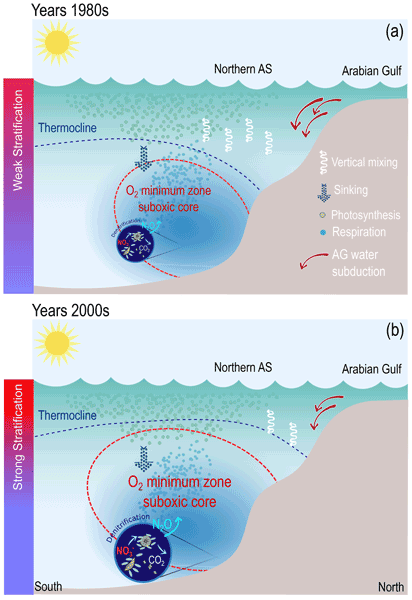
This study documents and quantifies a significant recent oxygen decline in the upper layers of the Arabian Sea and explores its drivers. Using a modeling approach we show that the fast local warming of sea surface is the main factor causing this oxygen drop. Concomitant summer monsoon intensification contributes to this trend, although to a lesser extent. These changes exacerbate oxygen depletion in the subsurface, threatening marine habitats and altering the local biogeochemistry.
Geórgenes H. Cavalcante, Filipe Vieira, Rita Bento, Aaron Bartholomew, and John A. Burt
EGUsphere, https://doi.org/10.5194/egusphere-2026-3183, https://doi.org/10.5194/egusphere-2026-3183, 2026
Short summary
Short summary
Sir Bu Nair Island hosts some of the healthiest coral reefs remaining in the Arabian Gulf, despite extreme summer heat. Using 17 months of measurements of water movement, sea level, and temperature, we found that local conditions are controlled by the combined effects of tides, winds, and periodic mixing events that can bring cooler water into the reef environment. These findings improve our understanding of how ocean processes may help reduce heat stress on corals and improve reef conditions.
Said Ouala, Oussama Hidaoui, and Zouhair Lachkar
Earth Syst. Sci. Data, 18, 287–308, https://doi.org/10.5194/essd-18-287-2026, https://doi.org/10.5194/essd-18-287-2026, 2026
Short summary
Short summary
Ocean deoxygenation poses major challenges to marine life and can alter carbon cycling. Direct measurements of dissolved oxygen are sparse, and interpolation methods are needed to study the variability and changes in oxygen content. In this work, we used machine learning to improve estimates of oxygen levels across the global ocean. Our approach produces a new gridded product that captures detailed changes in oxygen over time and space.
Basam Dahy, Rita Sousa, Mubbashra Sultan, and John A. Burt
Int. Arch. Photogramm. Remote Sens. Spatial Inf. Sci., XLVIII-G-2025, 331–338, https://doi.org/10.5194/isprs-archives-XLVIII-G-2025-331-2025, https://doi.org/10.5194/isprs-archives-XLVIII-G-2025-331-2025, 2025
Said Ouala, Oussama Hidaoui, and Zouhair Lachkar
EGUsphere, https://doi.org/10.5194/egusphere-2025-1771, https://doi.org/10.5194/egusphere-2025-1771, 2025
Preprint withdrawn
Short summary
Short summary
In this study, we develop a novel gridded ocean oxygen concentration product by combining observed oxygen data with emulated measurements derived from temperature and salinity profiles. This approach increases the density of observations, particularly in data-sparse regions, allowing for more accurate oxygen concentration estimates than current state-of-the-art products.

Edward C. Chan, Ilona J. Jäkel, Basit Khan, Martijn Schaap, Timothy M. Butler, Renate Forkel, and Sabine Banzhaf
Geosci. Model Dev., 18, 1119–1139, https://doi.org/10.5194/gmd-18-1119-2025, https://doi.org/10.5194/gmd-18-1119-2025, 2025
Short summary
Short summary
An enhanced emission module has been developed for the PALM model system, improving flexibility and scalability of emission source representation across different sectors. A model for parametrized domestic emissions has also been included, for which an idealized model run is conducted for particulate matter (PM10). The results show that, in addition to individual sources and diurnal variations in energy consumption, vertical transport and urban topology play a role in concentration distribution.
Patricia Glocke, Christopher C. Holst, Basit Khan, and Susanne A. Benz
Earth Syst. Dynam., 16, 55–74, https://doi.org/10.5194/esd-16-55-2025, https://doi.org/10.5194/esd-16-55-2025, 2025
Short summary
Short summary
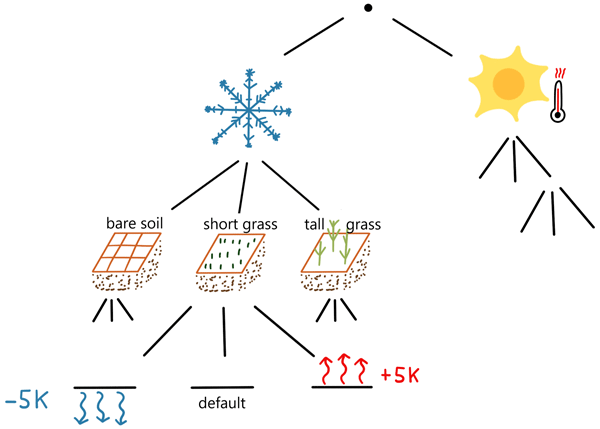
Utilizing the urban microclimate model PALM-4U, we show that temperature anomalies of ± 5 K at a depth of 2 m in the soil can impact atmospheric potential air temperatures within idealized domains. The impact depends on the season, time of day, land cover, and lateral boundary conditions of the domain. The magnitude of change depends mostly on seasonality and the time of day, ranging from 0.1 to 0.4 K. Land cover influences the absolute temperature but has a smaller impact on the magnitude.
Zouhair Lachkar, Michael Mehari, Muchamad Al Azhar, Marina Lévy, and Shafer Smith
Biogeosciences, 18, 5831–5849, https://doi.org/10.5194/bg-18-5831-2021, https://doi.org/10.5194/bg-18-5831-2021, 2021
Short summary
Short summary
This study documents and quantifies a significant recent oxygen decline in the upper layers of the Arabian Sea and explores its drivers. Using a modeling approach we show that the fast local warming of sea surface is the main factor causing this oxygen drop. Concomitant summer monsoon intensification contributes to this trend, although to a lesser extent. These changes exacerbate oxygen depletion in the subsurface, threatening marine habitats and altering the local biogeochemistry.
Cited articles
Al Senafi, F.: Atmosphere-ocean coupled variability in the arabian/persian gulf, Frontiers in Marine Science, 9, 809355, https://doi.org/10.3389/fmars.2022.809355, 2022. a, b
Amante, C. and Eakins, B. W.: ETOPO1 arc-minute global relief model: procedures, data sources and analysis, NOAA Technical Memorandum NESDIS NGDC-24, National Geophysical Data Center, NOAA, https://doi.org/10.7289/V5C8276M, 2009. a
Ashok, K. and Saji, N.: On the impacts of ENSO and Indian Ocean dipole events on sub-regional Indian summer monsoon rainfall, Natural Hazards, 42, 273–285, 2007. a
Attada, R., Dasari, H. P., Parekh, A., Chowdary, J. S., Langodan, S., Knio, O., and Hoteit, I.: The role of the Indian summer monsoon variability on Arabian Peninsula summer climate, Climate Dynamics, 52, 3389–3404, 2019. a
Auclair, F., Benshila, R., Bordois, L., Boutet, M., Brémond, M., Caillaud, M., Cambon, G., Capet, X., Debreu, L., Ducousso, N., Dufois, F., Dumas, F., Ethé, C., Gula, J., Hourdin, C., Illig, S., Jullien, S., Corre, M. L., Gac, S. L., Gentil, S. L., Lemarié, F., Marchesiello, P., Mazoyer, C., Morvan, G., Nguyen, C., Penven, P., Person, R., Pianezze, J., Pous, S., Renault, L., Roblou, L., Sepulveda, A., and Theetten, S.: Coastal and Regional Ocean COmmunity model (Version 1.0), Zenodo [code], https://doi.org/10.5281/zenodo.7415056, 2018. a
Baird, M. E., Green, R., Lowe, R., Mongin, M., and Bougeot, E.: Optimising cool-water injections to reduce thermal stress on coral reefs of the Great Barrier Reef, Plos one, 15, e0239978, https://doi.org/10.1371/journal.pone.0239978, 2020. a
Barnston, A. G. and Livezey, R. E.: Classification, seasonality and persistence of low-frequency atmospheric circulation patterns, Monthly weather review, 115, 1083–1126, 1987. a
Behera, S. K., Luo, J. J., Masson, S., Rao, S. A., Sakuma, H., and Yamagata, T.: A CGCM study on the interaction between IOD and ENSO, Journal of Climate, 19, 1688–1705, 2006. a
Ben-Hasan, A., Vahabnezhad, A., Burt, J. A., Alrushaid, T., and Walters, C. J.: Fishery implications of smaller asymptotic body size: Insights from fish in an extreme environment, Fisheries Research, 271, 106918, https://doi.org/10.1016/j.fishres.2023.106918, 2024. a
Benthuysen, J. A., Oliver, E. C., Feng, M., and Marshall, A. G.: Extreme marine warming across tropical Australia during austral summer 2015–2016, Journal of Geophysical Research: Oceans, 123, 1301–1326, 2018. a
Bordbar, M. H., Nasrolahi, A., Lorenz, M., Moghaddam, S., and Burchard, H.: The Persian Gulf and Oman Sea: Climate variability and trends inferred from satellite observations, Estuarine, Coastal and Shelf Science, 296, 108588, https://doi.org/10.1016/j.ecss.2023.108588, 2024. a, b, c, d
Burt, J. A., Paparella, F., Al-Mansoori, N., Al-Mansoori, A., and Al-Jailani, H.: Causes and consequences of the 2017 coral bleaching event in the southern Persian/Arabian Gulf, Coral Reefs, 38, 567–589, 2019. a
Burt, J. A., Camp, E., Enochs, I., Johansen, J., Morgan, K., Riegl, B., and Hoey, A.: Insights from extreme coral reefs in a changing world, Coral Reefs, 39, 495–507, 2020. a
Cai, W., Van Rensch, P., Cowan, T., and Hendon, H. H.: Teleconnection pathways of ENSO and the IOD and the mechanisms for impacts on Australian rainfall, Journal of Climate, 24, 3910–3923, 2011. a
Chapman, D. C.: Numerical treatment of cross-shelf open boundaries in a barotropic coastal ocean model, Journal of Physical oceanography, 15, 1060–1075, 1985. a
Chen, H.-C., Tseng, Y.-H., Hu, Z.-Z., and Ding, R.: Enhancing the ENSO predictability beyond the spring barrier, Scientific Reports, 10, 984, https://doi.org/10.1038/s41598-020-57853-7, 2020. a
Cheng, X., Chen, S., Chen, W., and Hu, P.: Observed impact of the Arctic Oscillation in boreal spring on the Indian Ocean Dipole in the following autumn and possible physical processes, Climate Dynamics, 61, 883–902, 2023. a
Chronis, T., Raitsos, D. E., Kassis, D., and Sarantopoulos, A.: The summer North Atlantic Oscillation influence on the eastern Mediterranean, Journal of Climate, 24, 5584–5596, 2011. a
Coelho, V., Fenner, D., Caruso, C., Bayles, B., Huang, Y., and Birkeland, C.: Shading as a mitigation tool for coral bleaching in three common Indo-Pacific species, Journal of Experimental Marine Biology and Ecology, 497, 152–163, 2017. a
Copernicus Climate Change Service, Climate Data Store: ORAS5 global ocean reanalysis monthly data from 1958 to present, Copernicus Climate Change Service (C3S) Climate Data Store (CDS) [data set], https://doi.org/10.24381/cds.67e8eeb7, 2021. a
Dai, A. and Trenberth, K. E.: Estimates of freshwater discharge from continents: Latitudinal and seasonal variations, Journal of hydrometeorology, 3, 660–687, 2002. a
Denaxa, D., Korres, G., Flaounas, E., and Hatzaki, M.: Investigating extreme marine summers in the Mediterranean Sea, Ocean Sci., 20, 433–461, https://doi.org/10.5194/os-20-433-2024, 2024. a
Duan, W. and Wei, C.: The ‘spring predictability barrier’for ENSO predictions and its possible mechanism: results from a fully coupled model, International Journal of Climatology, 33, 1280–1292, 2013. a
Dunstone, N., Smith, D. M., Hardiman, S. C., Hermanson, L., Ineson, S., Kay, G., Li, C., Lockwood, J. F., Scaife, A. A., Thornton, H., Ting, M., and Wang, L.: Skilful predictions of the summer North Atlantic Oscillation, Communications Earth & Environment, 4, 409, 2023. a
Egbert, G. D. and Erofeeva, S. Y.: Efficient inverse modeling of barotropic ocean tides, Journal of Atmospheric and Oceanic technology, 19, 183–204, 2002. a
European Centre for Medium-Range Weather Forecasts: ERA-Interim Project, Single Parameter 6-Hourly Surface Analysis and Surface Forecast Time Series, NSF National Center for Atmospheric Research [data set], https://doi.org/10.5065/D64747WN, 2012. a
Fairall, C. W., Bradley, E. F., Rogers, D. P., Edson, J. B., and Young, G. S.: Bulk parameterization of air-sea fluxes for tropical ocean-global atmosphere coupled-ocean atmosphere response experiment, Journal of Geophysical Research: Oceans, 101, 3747–3764, 1996. a
Flather, R.: A tidal model of the northwest European continental shelf, Mem. Soc. Roy. Sci. Liege, 10, 141–164, 1976. a
Garcia, H. E., Boyer, T. P., Baranova, O. K., Locarnini, R. A., Mishonov, A. V., Grodsky, A., Paver, C. R., Weathers, K. W., Smolyar, I. V., Reagan, J. R., Seidov, D., and Zweng, M. M.: World ocean atlas 2018: Product documentation, A. Mishonov, Technical Editor, https://data.nodc.noaa.gov/woa/WOA18/DOC/woa18documentation.pdf (last access: 1 January 2025), 2019. a
Gastineau, G. and Frankignoul, C.: Influence of the North Atlantic SST variability on the atmospheric circulation during the twentieth century, Journal of Climate, 28, 1396–1416, 2015. a
Gelaro, R., McCarty, W., Suárez, M. J., Todling, R., Molod, A., Takacs, L., Randles, C. A., Darmenov, A., Bosilovich, M. G., Reichle, R., and Wargan, K.: The modern-era retrospective analysis for research and applications, version 2 (MERRA-2), Journal of climate, 30, 5419–5454, 2017. a
Gove, J. M., Williams, G. J., Lecky, J., Brown, E., Conklin, E., Counsell, C., Davis, G., Donovan, M. K., Falinski, K., Kramer, L., and Kozar, K.: Coral reefs benefit from reduced land–sea impacts under ocean warming, Nature, 621, 536–542, 2023. a
Harrison, D. P.: An overview of environmental engineering methods for reducing coral bleaching stress, Oceanographic Processes of Coral Reefs, Physical and Biological Links in the Great Barrier Reef (2nd ed.), CRC Press, 403–418, https://doi.org/10.1201/9781003320425, 2024. a
Hersbach, H., Bell, B., Berrisford, P., Biavati, G., Horányi, A., Muñoz Sabater, J., Nicolas, J., Peubey, C., Radu, R., Rozum, I., Schepers, D., Simmons, A., Soci, C., Dee, D., Thépaut, J.-N.: ERA5 monthly averaged data on pressure levels from 1940 to present, Copernicus Climate Change Service (C3S) Climate Data Store (CDS) [data set], https://doi.org/10.24381/cds.6860a573, 2023. a, b
Holbrook, N. J., Scannell, H. A., Sen Gupta, A., Benthuysen, J. A., Feng, M., Oliver, E. C., Alexander, L. V., Burrows, M. T., Donat, M. G., Hobday, A. J., and Moore, P.J.: A global assessment of marine heatwaves and their drivers, Nature communications, 10, 2624, https://doi.org/10.1038/s41467-019-10206-z, 2019. a, b
Huang, B., Thorne, P. W., Banzon, V. F., Boyer, T., Chepurin, G., Lawrimore, J. H., Menne, M. J., Smith, T. M., Vose, R. S., and Zhang, H.-M.: NOAA extended reconstructed sea surface temperature (ERSST), version 5, https://doi.org/10.7289/V5T72FNM, 2017. a
Jiménez-Esteve, B. and Domeisen, D. I.: The tropospheric pathway of the ENSO–North Atlantic teleconnection, Journal of Climate, 31, 4563–4584, 2018. a
Johansen, J. L., Mitchell, M. D., Vaughan, G. O., Ripley, D. M., Shiels, H. A., and Burt, J. A.: Impacts of ocean warming on fish size reductions on the world’s hottest coral reefs, Nature communications, 15, 5457, https://doi.org/10.1038/s41467-024-49459-8, 2024. a
Kirtman, B. P. and Shukla, J.: Influence of the Indian summer monsoon on ENSO, Quarterly Journal of the Royal Meteorological Society, 126, 213–239, 2000. a
Kobayashi, S., Ota, Y., Harada, Y., Ebita, A., Moriya, M., Onoda, H., Onogi, K., Kamahori, H., Kobayashi, C., Endo, H., and Miyaoka, K.: The JRA-55 reanalysis: General specifications and basic characteristics, Journal of the Meteorological Society of Japan. Ser. II, 93, 5–48, 2015. a
Kohonen, T.: The basic SOM, in: Self-organizing maps, Springer, 105–176, https://doi.org/10.1007/978-3-642-56927-2_3, 2001. a, b
Kohonen, T., Kaski, S., Lagus, K., Salojarvi, J., Honkela, J., Paatero, V., and Saarela, A.: Self organization of a massive document collection, IEEE transactions on neural networks, 11, 574–585, 2000. a
Lachkar, Z.: Acceleration of warming, deoxygenation and acidification in the Arabian Gulf driven by weakening of summer winds, Zenodo [data set], https://doi.org/10.5281/zenodo.10987332, 2024. a
Lachkar, Z., Mehari, M., Al Azhar, M., Lévy, M., and Smith, S.: Fast local warming is the main driver of recent deoxygenation in the northern Arabian Sea, Biogeosciences, 18, 5831–5849, https://doi.org/10.5194/bg-18-5831-2021, 2021. a
Lachkar, Z., Mehari, M., Levy, M., Paparella, F., and Burt, J. A.: Recent expansion and intensification of hypoxia in the Arabian Gulf and its drivers, Frontiers in Marine Science, 9, 891378, https://doi.org/10.3389/fmars.2022.891378, 2022. a
Large, W. G., McWilliams, J. C., and Doney, S. C.: Oceanic vertical mixing: A review and a model with a nonlocal boundary layer parameterization, Reviews of Geophysics, 32, 363–403, 1994. a
Mac Nally, R. M.: Hierarchical partitioning as an interpretative tool in multivariate inference, Australian Journal of Ecology, 21, 224–228, https://doi.org/10.1111/j.1442-9993.1996.tb00602.x, 1996. a, b
Marchesiello, P., Debreu, L., and Couvelard, X.: Spurious diapycnal mixing in terrain-following coordinate models: The problem and a solution, Ocean Modelling, 26, 156–169, 2009. a
McPhaden, M. J.: Tropical Pacific Ocean heat content variations and ENSO persistence barriers, Geophysical research letters, 30, https://doi.org/10.1029/2003GL016872, 2003. a
Nandkeolyar, N., Raman, M., Kiran, G. S., and Ajai: Comparative analysis of sea surface temperature pattern in the eastern and western gulfs of Arabian Sea and the Red Sea in recent past using satellite data, International Journal of Oceanography, 2013, 501602, https://doi.org/10.1155/2013/501602, 2013. a, b, c, d
Niranjan Kumar, K. and Ouarda, T.: Precipitation variability over UAE and global SST teleconnections, Journal of Geophysical Research: Atmospheres, 119, 10–313, 2014. a
Oliver, E. C., Donat, M. G., Burrows, M. T., Moore, P. J., Smale, D. A., Alexander, L. V., Benthuysen, J. A., Feng, M., Sen Gupta, A., Hobday, A. J., and Holbrook, N.J.: Longer and more frequent marine heatwaves over the past century, Nature communications, 9, 1324, https://doi.org//10.1038/s41467-018-03732-9, 2018. a
Pathak, R., Dasari, H. P., Ashok, K., and Hoteit, I.: Dynamics of intensification of extreme precipitation events over the Arabian Peninsula derived from CMIP6 simulations, npj Climate and Atmospheric Science, 8, 126, https://doi.org/10.1038/s41612-025-01016-w, 2025. a
Riegl, B.: Climate change and coral reefs: different effects in two high-latitude areas (Arabian Gulf, South Africa), Coral reefs, 22, 433–446, 2003. a
Riegl, B., Johnston, M., Purkis, S., Howells, E., Burt, J., Steiner, S. C., Sheppard, C. R., and Bauman, A.: Population collapse dynamics in Acropora downingi, an Arabian/Persian Gulf ecosystem-engineering coral, linked to rising temperature, Global change biology, 24, 2447–2462, 2018. a
Shchepetkin, A. F. and McWilliams, J. C.: The regional oceanic modeling system (ROMS): a split-explicit, free-surface, topography-following-coordinate oceanic model, Ocean modelling, 9, 347–404, 2005. a
Vaughan, G. O., Al-Mansoori, N., and Burt, J. A.: The Arabian Gulf, in: World seas: An environmental evaluation, Elsevier, 1–23, https://doi.org/10.1016/B978-0-08-100853-9.00001-4, 2019. a, b
Vaughan, G. O., Shiels, H. A., and Burt, J. A.: Seasonal variation in reef fish assemblages in the environmentally extreme southern Persian/Arabian Gulf, Coral Reefs, 40, 405–416, 2021. a
Wallace, J. M. and Gutzler, D. S.: Teleconnections in the geopotential height field during the Northern Hemisphere winter, Monthly weather review, 109, 784–812, 1981. a
Webster, P. J. and Yang, S.: Monsoon and ENSO: Selectively interactive systems, Quarterly Journal of the Royal Meteorological Society, 118, 877–926, 1992. a
Xu, F., Wang, S., Li, Y., and Feng, J.: Synergistic effects of the winter North Atlantic Oscillation (NAO) and El Niño–Southern Oscillation (ENSO) on dust activities in North China during the following spring, Atmos. Chem. Phys., 24, 10689–10705, https://doi.org/10.5194/acp-24-10689-2024, 2024. a
Yao, Y., Wang, J., Yin, J., and Zou, X.: Marine heatwaves in China's marginal seas and adjacent offshore waters: past, present, and future, Journal of Geophysical Research: Oceans, 125, e2019JC015801, https://doi.org/10.1029/2019JC015801, 2020. a
Yu, Y., Notaro, M., Kalashnikova, O. V., and Garay, M. J.: Climatology of summer Shamal wind in the Middle East, Journal of Geophysical Research: Atmospheres, 121, 289–305, 2016. a
Zhang, W., Mei, X., Geng, X., Turner, A. G., and Jin, F.-F.: A nonstationary ENSO–NAO relationship due to AMO modulation, Journal of Climate, 32, 33–43, 2019. a
Zhang, Z., Wang, J., and Wang, F.: A new subsurface precursor across the spring predictability barrier for the ENSO prediction, Deep Sea Research Part I: Oceanographic Research Papers, 203, 104213, https://doi.org/10.1016/j.dsr.2023.104213, 2024. a
Zuo, H., Balmaseda, M. A., Tietsche, S., Mogensen, K., and Mayer, M.: The ECMWF operational ensemble reanalysis–analysis system for ocean and sea ice: a description of the system and assessment, Ocean Sci., 15, 779–808, https://doi.org/10.5194/os-15-779-2019, 2019. a
Short summary
An analysis of model and reanalysis data reveals that extreme summer sea surface temperatures in the Arabian/Persian Gulf are driven by weakened local Shamal winds and intensified monsoon winds over the Arabian Sea. These conditions – typically associated with La Niña and a negative North Atlantic Oscillation phase – increase air moisture over the Gulf and enhance surface heat trapping. The findings offer promising prospects for forecasting summer marine heatwaves in the Gulf.
An analysis of model and reanalysis data reveals that extreme summer sea surface temperatures in...


