
Articles | Volume 22, issue 2
https://doi.org/10.5194/os-22-923-2026
© Author(s) 2026. This work is distributed under
the Creative Commons Attribution 4.0 License.
the Creative Commons Attribution 4.0 License.
Special issue:
https://doi.org/10.5194/os-22-923-2026
© Author(s) 2026. This work is distributed under
the Creative Commons Attribution 4.0 License.
the Creative Commons Attribution 4.0 License.
Review article
| Highlight paper
| 
20 Mar 2026
Review article | Highlight paper |
| 20 Mar 2026
| 20 Mar 2026
Thermodynamic concepts used in physical oceanography
Trevor J. McDougall
CORRESPONDING AUTHOR

School of Mathematics and Statistics, University of New South Wales, Sydney, NSW 2052, Australia
Invited contribution by Trevor J. McDougall, recipient of the EGU Alfred Wegener Medal & Honorary Membership 2025.
Related authors
Trevor J. McDougall, Paul M. Barker, Rainer Feistel, and Fabien Roquet
Ocean Sci., 19, 1719–1741, https://doi.org/10.5194/os-19-1719-2023, https://doi.org/10.5194/os-19-1719-2023, 2023
Short summary
Short summary
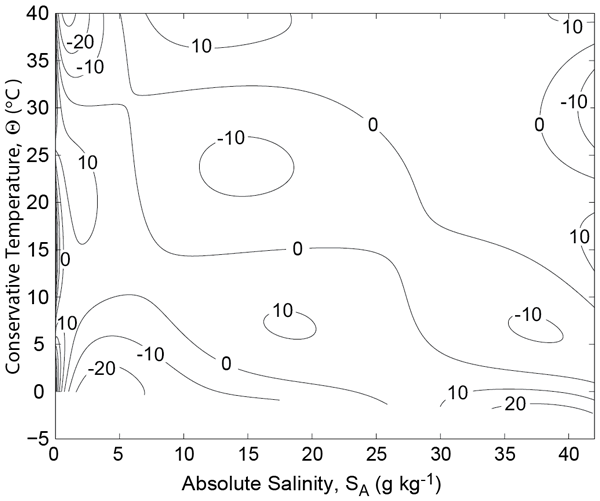
A thermodynamic potential is derived, with the temperature argument being Conservative Temperature. All thermodynamic quantities can be derived from this new thermodynamic potential function, and it enables the accurate (to computer machine precision) calculation of the in situ temperature and entropy of seawater. This new thermodynamic potential function adds fundamental thermodynamic justification to the adoption of Conservative Temperature in oceanography in 2010.
Karina von Schuckmann, Audrey Minière, Flora Gues, Francisco José Cuesta-Valero, Gottfried Kirchengast, Susheel Adusumilli, Fiammetta Straneo, Michaël Ablain, Richard P. Allan, Paul M. Barker, Hugo Beltrami, Alejandro Blazquez, Tim Boyer, Lijing Cheng, John Church, Damien Desbruyeres, Han Dolman, Catia M. Domingues, Almudena García-García, Donata Giglio, John E. Gilson, Maximilian Gorfer, Leopold Haimberger, Maria Z. Hakuba, Stefan Hendricks, Shigeki Hosoda, Gregory C. Johnson, Rachel Killick, Brian King, Nicolas Kolodziejczyk, Anton Korosov, Gerhard Krinner, Mikael Kuusela, Felix W. Landerer, Moritz Langer, Thomas Lavergne, Isobel Lawrence, Yuehua Li, John Lyman, Florence Marti, Ben Marzeion, Michael Mayer, Andrew H. MacDougall, Trevor McDougall, Didier Paolo Monselesan, Jan Nitzbon, Inès Otosaka, Jian Peng, Sarah Purkey, Dean Roemmich, Kanako Sato, Katsunari Sato, Abhishek Savita, Axel Schweiger, Andrew Shepherd, Sonia I. Seneviratne, Leon Simons, Donald A. Slater, Thomas Slater, Andrea K. Steiner, Toshio Suga, Tanguy Szekely, Wim Thiery, Mary-Louise Timmermans, Inne Vanderkelen, Susan E. Wjiffels, Tonghua Wu, and Michael Zemp
Earth Syst. Sci. Data, 15, 1675–1709, https://doi.org/10.5194/essd-15-1675-2023, https://doi.org/10.5194/essd-15-1675-2023, 2023
Short summary
Short summary
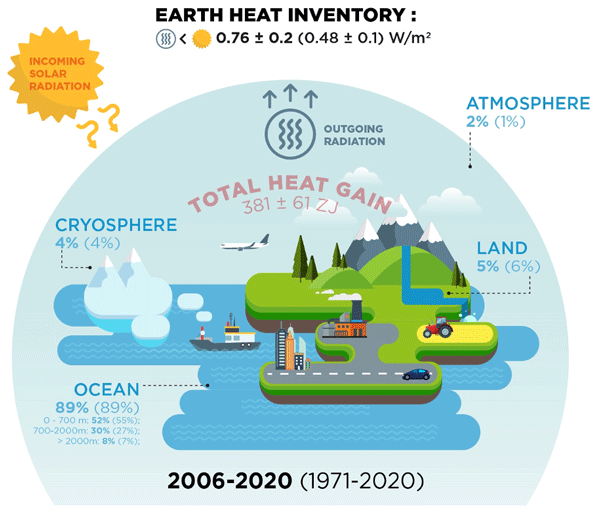
Earth's climate is out of energy balance, and this study quantifies how much heat has consequently accumulated over the past decades (ocean: 89 %, land: 6 %, cryosphere: 4 %, atmosphere: 1 %). Since 1971, this accumulated heat reached record values at an increasing pace. The Earth heat inventory provides a comprehensive view on the status and expectation of global warming, and we call for an implementation of this global climate indicator into the Paris Agreement’s Global Stocktake.
Trevor J. McDougall, Paul M. Barker, Ryan M. Holmes, Rich Pawlowicz, Stephen M. Griffies, and Paul J. Durack
Geosci. Model Dev., 14, 6445–6466, https://doi.org/10.5194/gmd-14-6445-2021, https://doi.org/10.5194/gmd-14-6445-2021, 2021
Short summary
Short summary
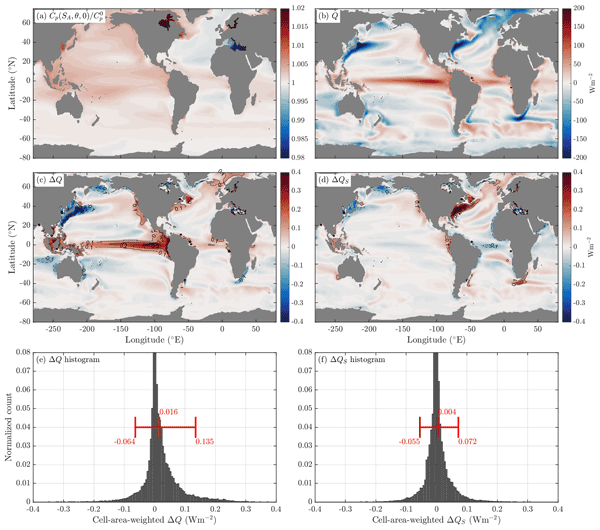
We show that the way that the air–sea heat flux is treated in ocean models means that the model's temperature variable should be interpreted as being Conservative Temperature, irrespective of whether the equation of state used in an ocean model is EOS-80 or TEOS-10.
Trevor J. McDougall, Paul M. Barker, Rainer Feistel, and Fabien Roquet
Ocean Sci., 19, 1719–1741, https://doi.org/10.5194/os-19-1719-2023, https://doi.org/10.5194/os-19-1719-2023, 2023
Short summary
Short summary
A thermodynamic potential is derived, with the temperature argument being Conservative Temperature. All thermodynamic quantities can be derived from this new thermodynamic potential function, and it enables the accurate (to computer machine precision) calculation of the in situ temperature and entropy of seawater. This new thermodynamic potential function adds fundamental thermodynamic justification to the adoption of Conservative Temperature in oceanography in 2010.
Karina von Schuckmann, Audrey Minière, Flora Gues, Francisco José Cuesta-Valero, Gottfried Kirchengast, Susheel Adusumilli, Fiammetta Straneo, Michaël Ablain, Richard P. Allan, Paul M. Barker, Hugo Beltrami, Alejandro Blazquez, Tim Boyer, Lijing Cheng, John Church, Damien Desbruyeres, Han Dolman, Catia M. Domingues, Almudena García-García, Donata Giglio, John E. Gilson, Maximilian Gorfer, Leopold Haimberger, Maria Z. Hakuba, Stefan Hendricks, Shigeki Hosoda, Gregory C. Johnson, Rachel Killick, Brian King, Nicolas Kolodziejczyk, Anton Korosov, Gerhard Krinner, Mikael Kuusela, Felix W. Landerer, Moritz Langer, Thomas Lavergne, Isobel Lawrence, Yuehua Li, John Lyman, Florence Marti, Ben Marzeion, Michael Mayer, Andrew H. MacDougall, Trevor McDougall, Didier Paolo Monselesan, Jan Nitzbon, Inès Otosaka, Jian Peng, Sarah Purkey, Dean Roemmich, Kanako Sato, Katsunari Sato, Abhishek Savita, Axel Schweiger, Andrew Shepherd, Sonia I. Seneviratne, Leon Simons, Donald A. Slater, Thomas Slater, Andrea K. Steiner, Toshio Suga, Tanguy Szekely, Wim Thiery, Mary-Louise Timmermans, Inne Vanderkelen, Susan E. Wjiffels, Tonghua Wu, and Michael Zemp
Earth Syst. Sci. Data, 15, 1675–1709, https://doi.org/10.5194/essd-15-1675-2023, https://doi.org/10.5194/essd-15-1675-2023, 2023
Short summary
Short summary
Earth's climate is out of energy balance, and this study quantifies how much heat has consequently accumulated over the past decades (ocean: 89 %, land: 6 %, cryosphere: 4 %, atmosphere: 1 %). Since 1971, this accumulated heat reached record values at an increasing pace. The Earth heat inventory provides a comprehensive view on the status and expectation of global warming, and we call for an implementation of this global climate indicator into the Paris Agreement’s Global Stocktake.
Trevor J. McDougall, Paul M. Barker, Ryan M. Holmes, Rich Pawlowicz, Stephen M. Griffies, and Paul J. Durack
Geosci. Model Dev., 14, 6445–6466, https://doi.org/10.5194/gmd-14-6445-2021, https://doi.org/10.5194/gmd-14-6445-2021, 2021
Short summary
Short summary
We show that the way that the air–sea heat flux is treated in ocean models means that the model's temperature variable should be interpreted as being Conservative Temperature, irrespective of whether the equation of state used in an ocean model is EOS-80 or TEOS-10.
Cited articles
Archimedes: On Floating Bodies I, translated and reproduced in full in: Heath, T. L., 1897: The Works of Archimedes, Cambridge University Press, Cambridge, 326 pp., https://dn790000.ca.archive.org/0/items/worksofarchimede00arch/worksofarchimede00arch.pdf (last access: 15 March 2026), 213 BCE.
Bacon, S. and Fofonoff, N.: Oceanic heat flux calculation, J. Atmos. Ocean. Techn., 13, 1327–1329, 1996.
Bai, X., Wang, X., Zhang, M., Wang, M., Yang, Bo., Su, J., and Wu, C.: An optical Michelson interferometric spectrometer-based seawater density sensor with improved long-term stability in the deep-sea trial, Measurement, 250, 117230, https://doi.org/10.1016/j.measurement.2025.117230, 2025.
Barker, P. M. and McDougall, T. J.: Two interpolation methods using multiply-rotated piecewise cubic Hermite interpolating polynomials, J. Atmos. Ocean. Tech., 37, 605–619, https://doi.org/10.1175/JTECH-D-19-0211.1, 2020.
Batchelor, G. K.: An Introduction to Fluid Dynamics, Cambridge University Press, 615 pp., 1970.
Baumgartner, M., Weigel, R., Harvey, A. H., Plöger, F., Achatz, U., and Spichtinger, P.: Reappraising the appropriate calculation of a common meteorological quantity: potential temperature, Atmos. Chem. Phys., 20, 15585–15616, https://doi.org/10.5194/acp-20-15585-2020, 2020.
Bryan, K.: Measurements of meridional heat transport by ocean currents, J. Geophys. Res., 67, 3403–3414, 1962.
Callen, H. B.: Thermodynamics and an Introduction to Thermostatistics, John Wiley and Sons, New York, 493 pp., 1985.
de Groot, S. R. and Mazur P.: Non-Equilibrium Thermodynamics, North-Holland Pub. Co., Amsterdam, Friedrich Vieweg und Sohn, ISBN 0-486-64741-2, 1984.
de Szoeke, R. A.: An effect of the thermobaric nonlinearity of the equation of state: a mechanism for sustaining solitary Rossby waves, J. Phys. Oceanogr., 34, 2042–2056, https://doi.org/10.1175/1520-0485(2004)034<2042:AEOTTN>2.0.CO;2, 2004.
de Szoeke, R. A., Springer, S. R., and Oxilia, D. M.: Orthobaric density: A thermodynamic variable for ocean circulation studies, J. Phys. Oceanogr., 30, 2830–2852, https://doi.org/10.1175/1520-0485(2001)031<2830:>2.0.CO;2, 2000.
Feistel, R.: A Gibbs function for seawater thermodynamics for −6 to 80 °C and salinity up to 120 g kg−1, Deep-Sea Res. Pt. I, 55, 1639–1671, 2008.
Feistel, R.: Thermodynamic properties of seawater, ice and humid air: TEOS-10, before and beyond, Ocean Sci., 14, 471–502, https://doi.org/10.5194/os-14-471-2018, 2018.
Feistel, R.: TEOS-10 and the climatic relevance of ocean–atmosphere interaction, Ocean Sci., 20, 1367–1402, https://doi.org/10.5194/os-20-1367-2024, 2024.
Feistel, R. and Wagner, W.: High pressure thermodynamic Gibbs functions of ice and sea ice, J. Mar. Res., 63, 95–139, 2005.
Feistel, R. and Wagner, W.: A New Equation of State for H2O ice Ih, J. Phys. Chem. Ref. Data, 35, 2, 1021–1047, 2006.
Feistel, R., Wright, D. G., Miyagawa, K., Harvey, A. H., Hruby, J., Jackett, D. R., McDougall, T. J., and Wagner, W.: Mutually consistent thermodynamic potentials for fluid water, ice and seawater: a new standard for oceanography, Ocean Sci., 4, 275–291, https://doi.org/10.5194/os-4-275-2008, 2008.
Filella, M., May, E. F., and May, P. M.: Thermodynamic Conventions, Int. J. Thermophys., 46, 61, https://doi.org/10.1007/s10765-025-03533-5, 2025.
Fofonoff, N. P.: Physical properties of seawater: A new salinity scale and equation of state for seawater, J. Geophys. Res., 90, 3332–3342, 1985.
Graham, F. S. and McDougall, T. J.: Quantifying the non-conservative production of Conservative Temperature, potential temperature and entropy, J. Phys. Oceanogr., 43, 838–862, 2013.
Griffies, S. M.: Fundamentals of Ocean Climate Models, Princeton University Press, 218 pp., ISBN 0-691-11892-2, 2004.
Groeskamp, S.: Observation-based quantification of physical processes that impact sea level, Ocean Sci., 22, 501–529, https://doi.org/10.5194/os-22-501-2026, 2026.
Groeskamp, S., Abernathey, R. P., and A. Klocker, A.: Water mass transformation by cabbeling and thermobaricity, Geophys. Res. Lett., 43, 10835–10845, https://doi.org/10.1002/2016GL070860, 2016.
Huang, R. X.: Defining the Spicity, J. Mar. Res., 69, 545–559, https://elischolar.library.yale.edu/journal_of_marine_research/317/ (last access: 15 March 2026), 2011.
Huang, R. X., Yu, L.-S. and Zhou, S.-Q.: New definition of potential spicity by the least square method, J. Geophys. Res., 123, 7351–7365, https://doi.org/10.1029/2018JC014306, 2018.
IOC, SCOR and IAPSO: The international thermodynamic equation of seawater – 2010: Calculation and use of thermodynamic properties, Intergovernmental Oceanographic Commission, Manuals and Guides No. 56, UNESCO (English), 196 pp, http://www.TEOS-10.org (last access: 15 March 2026), 2010.
Iselin, C. O'D.: The influence of vertical and lateral turbulence on the characteristics of the waters at mid-depths, Eos T. Am. Geophys. Un., 20, 414–417, 1939.
Iudicone, D., Madec, G., and McDougall, T. J.: Water-mass transformations in a neutral density framework and the key role of light penetration, J. Phys. Oceanogr., 38, 1357–1376, https://doi.org/10.1175/2007JPO3464.1, 2008.
Jackett, D. R. and McDougall, T. J.: An oceanographic variable for the characterization of intrusions and water masses, Deep-Sea Res., 32, 1195–1207, https://doi.org/10.1016/0198-0149(85)90003-2, 1985.
Jackett, D. R. and McDougall, T. J.: A neutral density variable for the world's oceans, J. Phys. Oceanogr., 27, 237–263, https://doi.org/10.1175/1520-0485(1997)027<0237:ANDVFT>2.0.CO;2, 1997.
Jenkins, A. and Williams, R.: The history of Standard Seawater for salinity measurements, Chapter 8 in: Chemical Reference Materials for Oceanography, edited by: Aoyama, M., Cheong, C., and Murata, A., Springer Oceanography, https://doi.org/10.1007/978-981-96-2520-8_8, 2025.
Klocker, A. and McDougall, T. J.: Influence of the nonlinear equation of state on global estimates of dianeutral advection and diffusion, J. Phys. Oceanogr., 40, 1690–1709, https://doi.org/10.1175/2010JPO4303.1, 2010a.
Klocker, A. and McDougall, T. J.: Quantifying the consequences of the ill-defined nature of neutral surfaces, J. Phys. Oceanogr., 40, 1866–1880, https://doi.org/10.1175/2009JPO4212.1, 2010b.
Klocker, A., McDougall, T. J., and Jackett, D. R.: A new method for forming approximately neutral surfaces, Ocean Sci., 5, 155–172, https://doi.org/10.5194/os-5-155-2009, 2009.
Landau, L. D. and Lifshitz, E. M.: Fluid Mechanics, Pergamon, 536 pp., 1959.
Lang, Y., Stanley, G. J., McDougall, T. J., and Barker, P. M.: A pressure-invariant Neutral Density variable for the World's Oceans, J. Phys. Oceanogr., 50, 3585–3604, https://doi.org/10.1175/JPO-D-19-0321.1, 2020.
Lang, Y., Stanley, G. J., and McDougall, T. J.: Spurious dianeutral advection and methods for its minimization, J. Phys. Oceanogr., 53, 1401–1427, https://doi.org/10.1175/JPO-D-22-0174.1, 2023.
Li, G., Wang, Y., Shi, A., Liu, Y., and Li, F.: Review of seawater fiber optic salinity sensors based on the refractive index detection principle, Sensors, 23, 2187, https://doi.org/10.3390/s23042187, 2023.
Li, Y., Church, J. A., McDougall, T. J., and Barker, P. M.: Sensitivity of observationally based estimates of ocean heat content and thermal expansion to vertical interpolation schemes, Geophys. Res. Lett., 49, e2022GL101079, https://doi.org/10.1029/2022GL101079, 2022.
McCarthy, G. D., Smeed, D. A., Johns, W. E., Frajka-Williams, E., Moat, B. I., Rayner, D., Baringer, M. O., Meinen, C. S., Collins, J., and Bryden, H. L.: Measuring the Atlantic meridional overturning circulation at 26° N, Prog. Oceanogr., 130, 91–111, https://doi.org/10.1016/j.pocean.2014.10.006, 2015.
McDougall, T. J.: Neutral surfaces, J. Phys. Oceanogr., 17, 1950–1964, https://doi.org/10.1175/1520-0485(1987)017<1950:NS>2.0.CO;2, 1987a.
McDougall, T. J.: Thermobaricity, cabbeling, and water-mass conversion, J. Geophys. Res., 92, 5448–5464, https://doi.org/10.1029/JC092iC05p05448, 1987b.
McDougall, T. J.: The vertical motion of submesoscale coherent vortices across neutral surfaces, J. Phys. Oceanogr., 17, 2334–2342, https://doi.org/10.1175/1520-0485(1987)017<2334:TVMOSC>2.0.CO;2, 1987c.
McDougall, T. J.: Neutral-surface potential vorticity, Prog. Oceanogr., 20, 185–221, https://doi.org/10.1016/0079-6611(88)90002-X, 1988.
McDougall, T. J.: Streamfunctions for the lateral velocity vector in a compressible ocean, J. Mar. Res., 47, 267–284, https://elischolar.library.yale.edu/journal_of_marine_research/1930/ (last access: 15 March 2026) 1989.
McDougall, T. J.: Parameterizing mixing in inverse models in Dynamics of Oceanic Internal Gravity Waves, in: Proceedings of the sixth 'Aha Huliko'a Hawaiian Winter Workshop, University of Hawaii at Manoa, edited by: Müller, P. and Henderson, D., 355–386, http://www.soest.hawaii.edu/PubServices/1991pdfs/McDougall.pdf (last access: 15 March 2026), 1991.
McDougall, T. J.: The influence of ocean mixing on the absolute velocity vector, J. Phys. Oceanogr., 25, 705–725, https://doi.org/10.1175/1520-0485(1995)025<0705:TIOOMO>2.0.CO;2, 1995.
McDougall, T. J.: Potential enthalpy: A conservative oceanic variable for evaluating heat content and heat fluxes, J. Phys. Oceanogr., 33, 945–963, 2003.
McDougall, T. J.: Software (MATLAB) to convert between temperature variables using the ocean thermodynamic potential in terms of Conservative Temperature, Zenodo [code], https://doi.org/10.5281/zenodo.11353750, 2024.
McDougall, T. J.: Review of “Quantifying energy barriers associated with density stratification in vertical displacements of water parcels” by Moreles, E., Romero, E., and Martinez-Lopez, B., https://egusphere.copernicus.org/preprints/2025/egusphere-2025-3359/egusphere-2025-3359-RC1-supplement.pdf (last access: 15 March 2026), 2026.
McDougall T. J. and Barker, P. M.: Getting started with TEOS-10 and the Gibbs Seawater (GSW) Oceanographic Toolbox, 28 pp., SCOR/IAPSO WG127, ISBN 978-0-646-55621-5, https://www.TEOS-10.org (last access: 15 March 2026), 2011.
McDougall, T. J. and Feistel, R.: What causes the adiabatic lapse rate?, Deep-Sea Res. Pt. I, 50, 1523–1535, 2003.
McDougall, T. J. and Jackett D. R.: On the helical nature of neutral trajectories in the ocean, Prog. Oceanogr., 20, 153–183, https://www.sciencedirect.com/science/article/abs/pii/0079661188900018?via%3Dihub (last access: 15 March 2026), 1988.
McDougall, T. J. and Jackett, D. R.: The material derivative of Neutral Density, J. Mar. Res., 63, 159–185, https://elischolar.library.yale.edu/journal_of_marine_research/75/ (last access: 15 March 2026), 2005a.
McDougall, T. J. and Jackett, D. R.: An assessment of orthobaric density in the global ocean, J. Phys. Oceanogr., 35, 2054–2075, https://doi.org/10.1175/JPO2796.1, 2005b.
McDougall, T. J. and Jackett, D. R.: The thinness of the ocean in
McDougall, T. J. and Klocker, A.: An approximate geostrophic streamfunction for use in density surfaces, Ocean Model., 32, 105–117, https://doi.org/10.1016/j.ocemod.2009.10.006, 2010.
McDougall, T. J. and Krzysik, O. A.: Spiciness, J. Mar. Res., 73, 141–152, https://elischolar.library.yale.edu/journal_of_marine_research/408/ (last access: 15 March 2026), 2015.
McDougall, T. J. and McIntosh, P. C.: The temporal-residual-mean velocity. Part II: Isopycnal interpretation and the tracer and momentum equations, J. Phys. Oceanogr., 31, 1222–1246, https://doi.org/10.1175/1520-0485(2001)031<1222:TTRMVP>2.0.CO;2, 2001.
McDougall, T. J. and You, Y.: Implications of the nonlinear equation of state for upwelling in the ocean interior, J. Geophys. Res., 95, 13263–13276, https://doi.org/10.1029/JC095iC08p13263, 1990.
McDougall, T. J., Church, J. A., and Jackett, D. R.: Does the nonlinearity of the equation of state impose an upper bound on the buoyancy frequency?, J. Mar. Res., 61, 745–764, 2003.
McDougall, T. J., Jackett, D. R., Millero, F. J., Pawlowicz, R., and Barker, P. M.: A global algorithm for estimating Absolute Salinity, Ocean Sci., 8, 1123–1134, https://doi.org/10.5194/os-8-1123-2012, 2012.
McDougall T. J., Feistel, R., and Pawlowicz, R.: Thermodynamics of seawater, in: Ocean Circulation and Climate (2nd edn.), edited by: Siedler, G., Griffies, S. M., Gould, J., and Church, J. A., Academic Press, 141–158, https://doi.org/10.1016/B978-0-12-391851-2.00006-4, 2013.
McDougall, T. J., Barker, P. M., Feistel, R., and Galton-Fenzi, B. K.: Melting of ice and sea ice into seawater, and frazil ice formation, J. Phys. Oceanogr., 44, 1751–1775, https://doi.org/10.1175/JPO-D-13-0253.1, 2014a.
McDougall, T. J., Groeskamp S., and Griffies, S. M.: On geometrical aspects of interior ocean mixing, J. Phys. Oceanogr., 44, 2164–2175, https://doi.org/10.1175/JPO-D-13-0270.1, 2014b.
McDougall, T. J., Groeskamp, S., and Griffies, S. M.: Comment on “Tailleux, R. Neutrality versus materiality: A thermodynamic theory of neutral surfaces. Fluids 2016, 1, 32”, Fluids, 2, 19, https://doi.org/10.3390/fluids2020019, 2017.
McDougall, T. J., Barker, P. M., Holmes, R. M., Pawlowicz, R., Griffies, S. M., and Durack, P. J.: The interpretation of temperature and salinity variables in numerical ocean model output and the calculation of heat fluxes and heat content, Geosci. Model Dev., 14, 6445–6466, https://doi.org/10.5194/gmd-14-6445-2021, 2021a.
McDougall, T. J., Barker, P. M., Stanley, G. J.: Spice variables and their use in physical oceanography, J. Geophys. Res.-Oceans, 126, e2019JC015936, https://doi.org/10.1029/2019JC015936, 2021b.
McDougall, T. J., Barker, P. M., Feistel, R., and Roquet, F.: A thermodynamic potential of seawater in terms of Absolute Salinity, Conservative Temperature, and in situ pressure, Ocean Sci., 19, 1719–1741, https://doi.org/10.5194/os-19-1719-2023, 2023.
Millero, F. J., Feistel, R., Wright, D. G., and McDougall, T. J.: The composition of Standard Seawater and the definition of the Reference-Composition Salinity Scale, Deep-Sea Res. Pt. I, 55, 50–72, 2008.
Müller, P. and Willebrand, J.: Compressibility effects in the thermohaline circulation: a manifestation of the temperature-salinity mode, Deep-Sea Res., 33, 559–571, https://www.sciencedirect.com/science/article/pii/0198014986900531 (last access: 15 March 2026), 1986.
Nycander, J.: Energy conversion, mixing energy, and neutral surfaces with a nonlinear equation of state, J. Phys. Oceanogr., 41, 28–41, https://doi.org/10.1175/2010JPO4250.1, 2011.
Onsager, L.: Reciprocal relations in irreversible processes. I., Phys. Rev., 37, 405–426, 1931a.
Onsager, L.: Reciprocal relations in irreversible processes. II., Phys. Rev., 38, 2265–2279, 1931b.
Pawlowicz, R.: A model for predicting changes in the electrical conductivity, practical salinity, and absolute salinity of seawater due to variations in relative chemical composition, Ocean Sci., 6, 361–378, https://doi.org/10.5194/os-6-361-2010, 2010.
Pawlowicz, R., Wright, D. G., and Millero, F. J.: The effects of biogeochemical processes on oceanic conductivity/salinity/density relationships and the characterization of real seawater, Ocean Sci., 7, 363–387, https://doi.org/10.5194/os-7-363-2011, 2011.
Pawlowicz, R., McDougall, T. J., Feistel, R., and Tailleux, R.: Preface An historical perspective on the development of the Thermodynamic Equation of Seawater – 2010, Ocean Sci., 8, 161–174, https://www.ocean-sci.net/8/161/2012/ (last access: 15 March 2026), 2012.
Pawlowicz, R., Feistel, R., McDougall, T. J., Ridout, P., Seitz, S., and Wolf, H.: Metrological challenges for measurements of key climatological observables: Part 2, Oceanic salinity, Metrologia, 53, R12–R25, https://doi.org/10.1088/0026-1394/53/1/R12, 2016.
Reid, J. L.: On the total geostrophic circulation of the North Atlantic Ocean: Flow patterns, tracers, and transports, Prog. Oceanogr., 33, 1–92, 1994.
Roquet, F., Madec, G., McDougall, T. J., and Barker, P. M.: Accurate polynomial expressions for the density and specific volume of seawater using the TEOS-10 standard, Ocean Model., 90, 29–43, https://doi.org/10.1016/j.ocemod.2015.04.002, 2015.
Saenz, J. A., Tailleux, R., Butler, E. D., Hughes, G. O., and Oliver, K. I. C.: Estimating Lorenz's reference state in an ocean with a nonlinear equation of state for seawater, J. Phys. Oceanogr., 45, 1242–1257, https://doi.org/10.1175/JPO-D-14-0105.1, 2015.
Smythe-Wright, D., Gould, W. J., McDougall, T. J., Sparnocchia, S., and Woodworth, P. L.: IAPSO: tales from the ocean frontier, Hist. Geo Space. Sci., 10, 137–150, https://doi.org/10.5194/hgss-10-137-2019, 2019.
Spall, M. A., Heywood, K., Kessler, W., Kunze, E., MacCready, P., Smith, J. A., and Speer, K.: Editorial, J. Phys. Oceanogr., 43, 837, https://doi.org/10.1175/JPO-D-13-082.1, 2013.
Stanley, G. J.: Neutral surface topology, Ocean Model., 138, 88–106, https://doi.org/10.1016/j.ocemod.2019.01.008, 2019a.
Stanley, G. J.: The exact geostrophic streamfunction for neutral surfaces, Ocean Model., 138, 107–121, https://doi.org/10.1016/j.ocemod.2019.04.002, 2019b.
Stanley, G. J., McDougall, T. J., and Barker, P. M.: Algorithmic improvements to finding approximately neutral surfaces, J. Adv. Model. Earth Sy., 13, e2020MS002436, https://doi.org/10.1029/2020MS002436, 2021.
Straub, D. N.: On thermobaric production of potential vorticity in the ocean, Tellus, 51A, 314–325, 1999.
Tailleux, R.: Identifying and quantifying nonconservative energy production/destruction terms in hydrostatic Boussinesq primitive equation models, Ocean Model., 34, 125–136, 2010.
Tailleux, R.: Observational and energetics constraints on the non-conservation of potential/Conservative Temperature and implications for ocean modelling, Ocean Model., 88, 26–37, 2015.
Tailleux, R.: Neutrality versus materiality: A thermodynamic theory of neutral surfaces, Fluids, 1, 32, https://doi.org/10.3390/fluids1040032, 2016a.
Tailleux, R.: Generalized patched potential density and thermodynamic neutral density: two new physically based quasi-neutral density variables for ocean water masses analyses and circulation studies, J. Phys. Oceanogr., 46, 3571–3584, https://doi.org/10.1175/JPO-D-16-0072.1, 2016b.
Uchida, H., Kayukawa, Y., and Maeda, Y.: Ultra high-resolution seawater density sensor based on a refractive index measurement using the spectroscopic interference method, Sci. Rep., 9, 15482, https://doi.org/10.1038/s41598-019-52020-z, 2019.
Uchida, H., Oe, M., and Wakita, M.: History of batch-batch comparative studies of International Association for the Physical Sciences of the Oceans Standard Seawater, Chapter 9 in: Chemical Reference Materials for Oceanography, edited by: Aoyama, M., Cheong, C., and Murata, A., Springer Oceanography, https://doi.org/10.1007/978-981-96-2520-8_8, 2025.
Valladares, J., Fennel, W., and Morozov, E. C.: Replacement of EOS-80 with the International Thermodynamic Equation of Seawater – 2010, Ocean Model., 40, 1, https://doi.org/10.1016/S1463-5003(11)00154-5, 2011.
Veronis, G.: On properties of seawater defined by temperature, salinity and pressure, J. Mar. Res., 30, 227–255, https://elischolar.library.yale.edu/journal_of_marine_research/1241/ (last access: 15 March 2026), 1972.
Warren, B. A.: Approximating the energy transport across oceanic sections, J. Geophys., Res., 104, 7915–7919, 1999.
Wright, D. G., Pawlowicz, R., McDougall, T. J., Feistel, R., and Marion, G. M.: Absolute Salinity, “Density Salinity” and the Reference-Composition Salinity Scale: present and future use in the seawater standard TEOS-10, Ocean Sci., 7, 1–26, https://doi.org/10.5194/os-7-1-2011, 2011.
Yang, S., Xu, J., Ji, L., Sun, Q., Zhang, M., Zhao, S., and Wu, C.: In-situ measurement of deep-sea salinity using optical salinometer based on Michelson interferometer, J. Mar. Sci. Eng., 12, 1569, https://doi.org/10.3390/jmse12091569, 2024.
Zanna L., Khatiwala S., Gregory J. M., Ison, J., and Heimbach P.: Global reconstruction of historical ocean heat storage and transport, P. Natl. Acad. Sci. USA, 116, 1126–1131, 2019.
Zhao, J., Deng, S.-M., Zhang, Y.-N., Xia, F., Zhao, Y., and Zhang, H.-G.: An in-situ seawater salinity sensor with temperature self-compensation based on hollow-core fiber, IEEE T. Instrum. Meas., 74, 1–8, https://ieeexplore.ieee.org/document/10902507 (last access: 15 March 2026), 2025.
Editorial statement
Sea water thermodynamics is arguably one of the most central and fundamental areas concerning oceanography: how should we measure/interpret something as basic as temperature, salinity, heat and/or energy of sea water? The review is a tour de force by one of the leading experts of the subject area, summarising the development of sea water thermodynamics to date (spanning the author's career), highlights important subtleties that oceanographers should know, and provides interesting outlooks for further directions for investigation. Make no mistake, the review is by no means an easy or a short read, and the material will require time and effort to digest properly. This is likely one of those journeys where there simply is no shortcut, but this is an excellent guide to help those willing to undertake that journey.
Sea water thermodynamics is arguably one of the most central and fundamental areas concerning...
Short summary
Marine science has adopted the Conservative Temperature and Absolute Salinity variables of TEOS-10 (the International Thermodynamic Equation Of Seawater - 2010), and here we review the thermodynamic theory behind this change of practice. Ocean heat content and the poleward oceanic heat flux are accurately evaluated using Conservative Temperature. Absolute Salinity incorporates the variable composition of seawater, and ocean models now need to incorporate this feature. The available methods for evaluating approximately neutral surfaces are also discussed.
Marine science has adopted the Conservative Temperature and Absolute Salinity variables of...


Special issue