
Articles | Volume 22, issue 2
https://doi.org/10.5194/os-22-893-2026
© Author(s) 2026. This work is distributed under
the Creative Commons Attribution 4.0 License.
the Creative Commons Attribution 4.0 License.
https://doi.org/10.5194/os-22-893-2026
© Author(s) 2026. This work is distributed under
the Creative Commons Attribution 4.0 License.
the Creative Commons Attribution 4.0 License.
Technical note
| 
19 Mar 2026
Technical note |
| 19 Mar 2026
| 19 Mar 2026
Best practices for estimating turbulent dissipation from oceanic single-point velocity timeseries observations
Cynthia E. Bluteau
CORRESPONDING AUTHOR

Institute of Ocean Sciences, Fisheries and Oceans Canada, Sidney BC, Canada
Danielle J. Wain
7 Lakes Alliance, Belgrade Lakes ME, USA
Julia C. Mullarney
Coastal Marine Group, School of Science, University of Waikato, Hamilton, New Zealand
Craig L. Stevens
Earth Sciences New Zealand, Wellington, New Zealand
Dept. Physics, University of Auckland, Auckland, New Zealand
Related authors
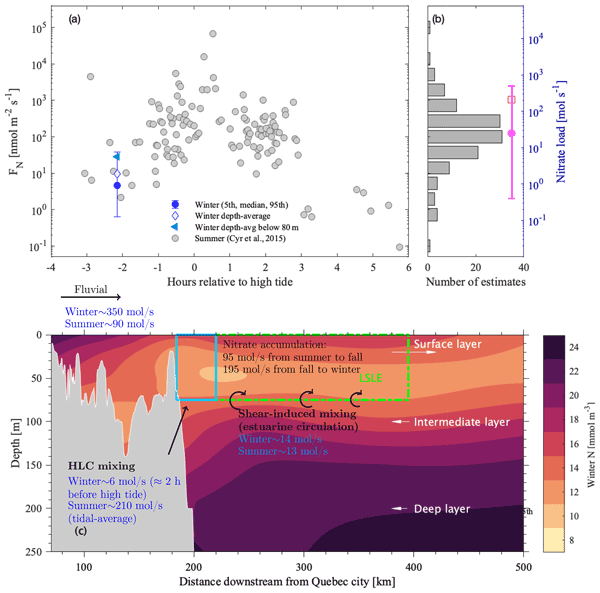
Cynthia Evelyn Bluteau, Peter S. Galbraith, Daniel Bourgault, Vincent Villeneuve, and Jean-Éric Tremblay
Ocean Sci., 17, 1509–1525, https://doi.org/10.5194/os-17-1509-2021, https://doi.org/10.5194/os-17-1509-2021, 2021
Short summary
Short summary
In 2018, the Canadian Coast Guard approved a science team to sample in tandem with its ice-breaking and ship escorting operations. This collaboration provided the first mixing observations during winter that covered the largest spatial extent of the St. Lawrence Estuary and the Gulf of St. Lawrence ever measured in any season. Contrary to previous assumptions, we demonstrate that fluvial nitrate inputs from upstream (i.e., Great Lakes) are the most significant source of nitrate in the estuary.
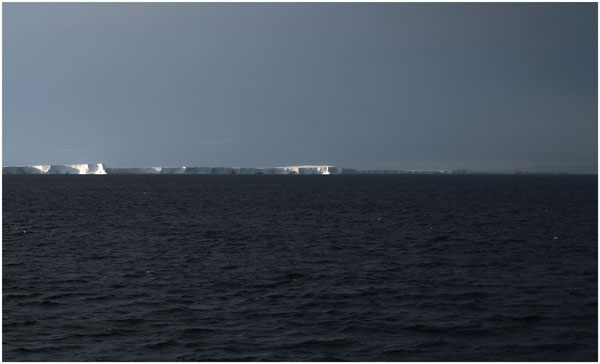
Liv Cornelissen, Sukyoung Yun, Jasmin McInerney, Brett Grant, Fiona Elliott, Seung-Tae Yoon, Christopher J. Zappa, Won Sang Lee, and Craig Stevens
Earth Syst. Sci. Data, 18, 3979–3996, https://doi.org/10.5194/essd-18-3979-2026, https://doi.org/10.5194/essd-18-3979-2026, 2026
Short summary
Short summary
We present a decade-long mooring time series from southern Terra Nova Bay, Ross Sea, begun in December 2014 as the “DITx” array. Three sites around the Drygalski Ice Tongue record temperature, salinity, pressure, and currents. The data highlight seasonal cycles and variability, informing studies of water mass formation, ice–ocean interactions, glaciology, and regional ecosystems.
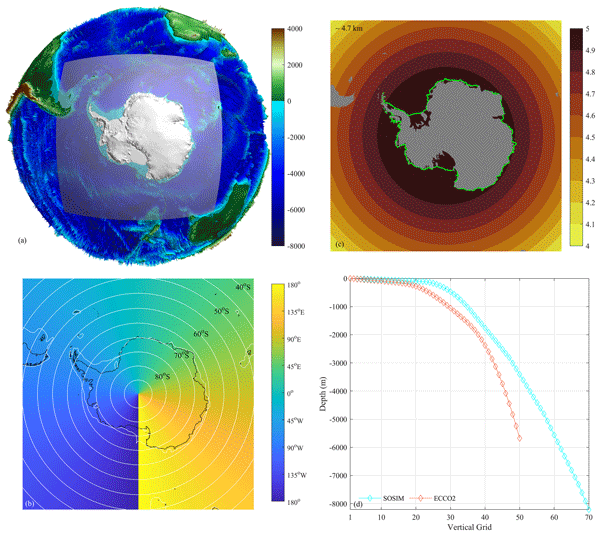
Chengyan Liu, Zhaomin Wang, Dake Chen, Xianxian Han, Hengling Leng, Xi Liang, Liangjun Yan, Xiang Li, Craig Stevens, Andrew McC. Hogg, Kazuya Kusahara, Kaihe Yamazaki, Kay I. Ohshima, Meng Zhou, Xiao Cheng, Dongxiao Wang, Changming Dong, Jiping Liu, Qinghua Yang, Xichen Li, Ruibo Lei, Minghu Ding, Zhaoru Zhang, Dujuan Kang, Di Qi, Tongya Liu, Jihai Dong, Lu An, Ru Chen, Tong Zhang, Xiaoming Hu, Bo Han, Haibo Bi, Qi Shu, Longjiang Mu, Shiming Xu, Hu Yang, Hailong Liu, Tingfeng Dou, Zhixuan Feng, Lei Zheng, Xueyuan Tang, Guitao Shi, Yongqing Cai, Bingrui Li, Yang Wu, Xia Lin, Wenjin Sun, Yu Liu, Kai Yu, Yu Zhang, Weizeng Shao, Xiaoyu Wang, Shaojun Zheng, Chengyi Yuan, Chunxia Zhou, Jian Liu, Yang Liu, Yue Xia, Xiaoyu Pan, Jiabao Zeng, Kechen Liu, Jiahao Fan, Chen Cheng, and Qi Li
Geosci. Model Dev., 19, 2985–3033, https://doi.org/10.5194/gmd-19-2985-2026, https://doi.org/10.5194/gmd-19-2985-2026, 2026
Short summary
Short summary
We developed a high-resolution computer model to simulate how the ocean, sea ice, and ice shelves interact around Antarctica. This helps us understand their critical role in global climate and sea-level rise. Our model successfully captures essential features like major currents and seasonal ice changes. Despite some remaining biases, it provides a useful tool for predicting future changes in this vital and rapidly evolving region.
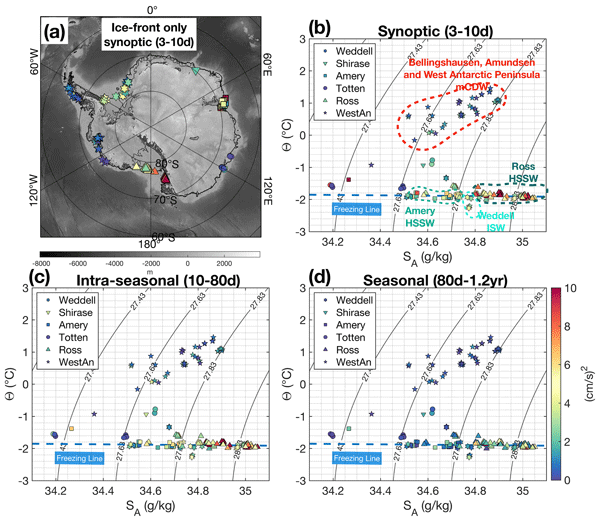
Shenjie Zhou, Pierre Dutrieux, Claudia F. Giulivi, Adrian Jenkins, Alessandro Silvano, Christopher Auckland, E. Povl Abrahamsen, Michael Meredith, Irena Vaňková, Keith Nicholls, Peter E. D. Davis, Svein Østerhus, Arnold L. Gordon, Christopher J. Zappa, Tiago S. Dotto, Ted Scambos, Kathryn L. Gunn, Stephen R. Rintoul, Shigeru Aoki, Craig Stevens, Chengyan Liu, Sukyoung Yun, Tae-Wan Kim, Won Sang Lee, Markus Janout, Tore Hattermann, Julius Lauber, Elin Darelius, Anna Wåhlin, Leo Middleton, Pasquale Castagno, Giorgio Budillon, Karen J. Heywood, Jennifer Graham, Stephen Dye, Daisuke Hirano, and Una Kim Miller
Earth Syst. Sci. Data, 17, 5693–5706, https://doi.org/10.5194/essd-17-5693-2025, https://doi.org/10.5194/essd-17-5693-2025, 2025
Short summary
Short summary
We created the first standardised dataset of in-situ ocean measurements time series from around Antarctica collected since 1970s. This includes temperature, salinity, pressure, and currents recorded by instruments deployed in icy, challenging conditions. Our analysis highlights the dominance of tidal currents and separates these from other patterns to study regional energy distribution. This unique dataset offers a foundation for future research on Antarctic ocean dynamics and ice interactions.
Alexandra Gossart, Alena Malyarenko, Liv Cornelissen, Craig Stevens, Una Miller, Christopher J. Zappa, Nancy Luca, Pasquale Castagno, and Giorgio Budillon
EGUsphere, https://doi.org/10.5194/egusphere-2025-4332, https://doi.org/10.5194/egusphere-2025-4332, 2025
Preprint archived
Short summary
Short summary
Polynyas are areas of open water that form within the sea ice during the Antarctic winter. They occur along the coastline and act as hotspots for air–sea interactions and sea-ice formation. We use the P-SKRIPSv2 model to simulate air–sea–ice–ocean interactions in the Ross Sea. Model results are compared with observations, and we test how changes in air–sea–ice coupling affect the system. Our findings show that P-SKRIPSv2 provides a valuable tool to study polynyasa and understand their dynamics.
Arnaud F. Valcarcel, Craig L. Stevens, Joanne M. O'Callaghan, and Sutara H. Suanda
Ocean Sci., 21, 965–987, https://doi.org/10.5194/os-21-965-2025, https://doi.org/10.5194/os-21-965-2025, 2025
Short summary
Short summary
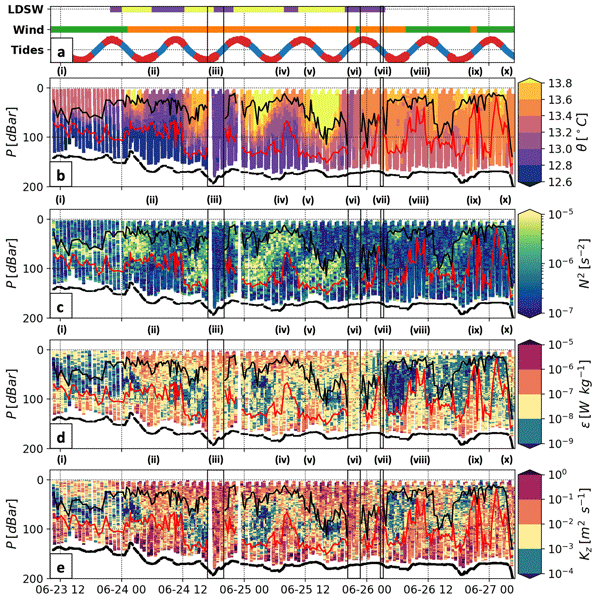
This paper describes underwater robotic measurements in an energetic strait. The data show how energy is transferred from winds and tides to turbulent processes. Boundary layers of strong turbulence affected the water from surface to seafloor across an unusually deep extent, except when fresher or warmer waters moved into the region. Numerical models revealed that turbulent energy transport allowed boundary layers to interact. This phenomenon may impact the biological structure of coastal seas.
Madelaine Rosevear, Benjamin Galton-Fenzi, and Craig Stevens
Ocean Sci., 18, 1109–1130, https://doi.org/10.5194/os-18-1109-2022, https://doi.org/10.5194/os-18-1109-2022, 2022
Short summary
Short summary
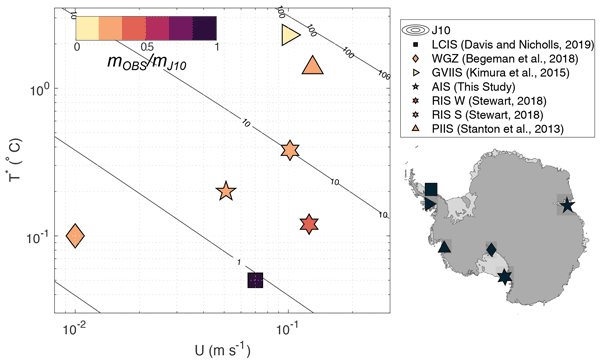
Understanding ocean-driven melting of Antarctic ice shelves is critical for predicting future sea level. However, ocean observations from beneath ice shelves are scarce. Here, we present unique ocean and melting data from the Amery Ice Shelf, East Antarctica. We use our observations to evaluate common methods of representing melting in ocean–climate models (melting
parameterisations) and show that these parameterisations overestimate melting when the ocean is warm and/or currents are weak.
Malgorzata Golub, Wim Thiery, Rafael Marcé, Don Pierson, Inne Vanderkelen, Daniel Mercado-Bettin, R. Iestyn Woolway, Luke Grant, Eleanor Jennings, Benjamin M. Kraemer, Jacob Schewe, Fang Zhao, Katja Frieler, Matthias Mengel, Vasiliy Y. Bogomolov, Damien Bouffard, Marianne Côté, Raoul-Marie Couture, Andrey V. Debolskiy, Bram Droppers, Gideon Gal, Mingyang Guo, Annette B. G. Janssen, Georgiy Kirillin, Robert Ladwig, Madeline Magee, Tadhg Moore, Marjorie Perroud, Sebastiano Piccolroaz, Love Raaman Vinnaa, Martin Schmid, Tom Shatwell, Victor M. Stepanenko, Zeli Tan, Bronwyn Woodward, Huaxia Yao, Rita Adrian, Mathew Allan, Orlane Anneville, Lauri Arvola, Karen Atkins, Leon Boegman, Cayelan Carey, Kyle Christianson, Elvira de Eyto, Curtis DeGasperi, Maria Grechushnikova, Josef Hejzlar, Klaus Joehnk, Ian D. Jones, Alo Laas, Eleanor B. Mackay, Ivan Mammarella, Hampus Markensten, Chris McBride, Deniz Özkundakci, Miguel Potes, Karsten Rinke, Dale Robertson, James A. Rusak, Rui Salgado, Leon van der Linden, Piet Verburg, Danielle Wain, Nicole K. Ward, Sabine Wollrab, and Galina Zdorovennova
Geosci. Model Dev., 15, 4597–4623, https://doi.org/10.5194/gmd-15-4597-2022, https://doi.org/10.5194/gmd-15-4597-2022, 2022
Short summary
Short summary
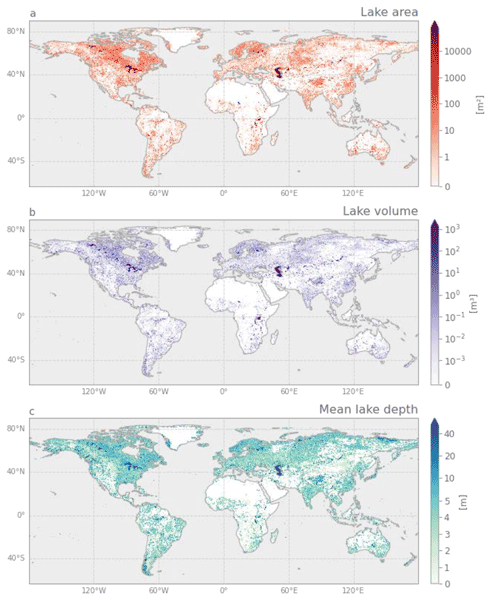
Lakes and reservoirs are warming across the globe. To better understand how lakes are changing and to project their future behavior amidst various sources of uncertainty, simulations with a range of lake models are required. This in turn requires international coordination across different lake modelling teams worldwide. Here we present a protocol for and results from coordinated simulations of climate change impacts on lakes worldwide.
Cynthia Evelyn Bluteau, Peter S. Galbraith, Daniel Bourgault, Vincent Villeneuve, and Jean-Éric Tremblay
Ocean Sci., 17, 1509–1525, https://doi.org/10.5194/os-17-1509-2021, https://doi.org/10.5194/os-17-1509-2021, 2021
Short summary
Short summary
In 2018, the Canadian Coast Guard approved a science team to sample in tandem with its ice-breaking and ship escorting operations. This collaboration provided the first mixing observations during winter that covered the largest spatial extent of the St. Lawrence Estuary and the Gulf of St. Lawrence ever measured in any season. Contrary to previous assumptions, we demonstrate that fluvial nitrate inputs from upstream (i.e., Great Lakes) are the most significant source of nitrate in the estuary.
Cited articles
Bluteau, C., Stevens, C., Wain, D., and Mullarney, J.: NetCDF templates and code for creating and loading ATOMIX ADV benchmark datasets, Zenodo [data set, code], https://doi.org/10.5281/zenodo.16798905, 2025. a, b, c
Brock, F. V.: A Nonlinear Filter to Remove Impulse Noise from Meteorological Data, Journal of Atmospheric and Oceanic Technology, 3, 51–58, https://doi.org/10.1175/1520-0426(1986)003<0051:ANFTRI>2.0.CO;2, 1986. a, b, c, d
Corrsin, S.: On local isotropy in turbulent shear flow, NACA R & M, https://ntrs.nasa.gov/citations/19930089981 (last access: 12 March 2026), 1958. a
D'Asaro, E. A.: Turbulence in the upper-ocean mixed layer, Annual Review of Marine Science, 6, 101–115, 2014. a
Davis, K. A. and Monismith, S. G.: The Modification of Bottom Boundary Layer Turbulence and Mixing by Internal Waves Shoaling on a Barrier Reef, J. Phys. Oceanogr., 41, 2223–2241, https://doi.org/10.1175/2011JPO4344.1, 2011. a, b
Davison, A. C. and Hinkley, D. V.: Bootstrap Methods and their Application, Cambridge University Press, https://doi.org/10.1017/cbo9780511802843, 1997. a, b
Fox-Kemper, B., Adcroft, A., Böning, C. W., Chassignet, E. P., Curchitser, E., Danabasoglu, G., Eden, C., England, M. H., Gerdes, R., Greatbatch, R. J., Griffies, S. M., Hallberg, R. W., Hanert, E., Heimbach, P., Hewitt, H. T., Hill, C. N., Komuro, Y., Legg, S., Le Sommer, J., Masina, S., Marsland, S. J., Penny, S. G., Qiao, F., Ringler, T. D., Treguier, A. M., Tsujino, H., Uotila, P., and Yeager, S. G.: Challenges and Prospects in Ocean Circulation Models, Front. Mar. Sci., 6, 65, https://doi.org/10.3389/fmars.2019.00065, 2019. a
Gargett, A. E., Osborn, T. R., and Nasmyth, P. W.: Local isotropy and the decay of turbulence in a stratified fluid, J. Fluid Mech., 144, 231–280, https://doi.org/10.1017/S0022112084001592, 1984. a, b, c, d
Goring, D. G. and Nikora, V. I.: Despiking acoustic Doppler velocimeter data, J. Hydraul. Eng., 128, 117–126, https://doi.org/10.1061/(ASCE)0733-9429(2002)128:1(117), 2002. a, b
Gregg, M. C.: Uncertainties and limitations in measuring ϵ and χT, J. Atmos. Oceanic Technol., 16, 1483–1490, https://doi.org/10.1175/1520-0426(1999)016<1483:UALIMA>2.0.CO;2, 1999. a
Han, N., Fan, Z., and Fang, S.: Phase unwrapping methods for solving the ambiguity in current velocity estimation based on combined signal design, Flow Measurement and Instrumentation, 59, 126–134, https://doi.org/10.1016/j.flowmeasinst.2017.12.001, 2018. a
Henchicks, P. J.: Comparison of turbulence measurements from a SonTek ADV and a Nobska MAVS, in: MTS/IEEE Oceans 2001. An Ocean Odyssey, Conference Proceedings (IEEE Cat. No. 01CH37295), IEEE, 3, 1860–1866, https://doi.org/10.1109/OCEANS.2001.968129, 2001. a
Ivey, G. N., Bluteau, C. E., and Jones, N. L.: Quantifying Diapycnal Mixing in an Energetic Ocean, J. Geophys. Res., 123, 346–357, https://doi.org/10.1002/2017JC013242, 2018. a
Kim, S.-C., Friedrichs, C. T., Maa, J. P.-Y., and Wright, L. D.: Estimating Bottom Stress in Tidal Boundary Layer from Acoustic Doppler Velocimeter Data, J. Hydraul. Eng., 126, 399–406, https://doi.org/10.1061/(ASCE)0733-9429(2000)126:6(399), 2000. a
Kundu, P. K.: Chapter 10 – Boundary Layers and Related Topics, in: Fluid Mechanics, edited by: Kundu, P. K., 299–348, Academic Press, San Diego, https://doi.org/10.1016/B978-0-12-428770-9.50016-1, 1990. a
Le Boyer, A., Couto, N., Alford, M. H., Drake, H. F., Bluteau, C. E., Hughes, K. G., Naveira Garabato, A. C., Moulin, A. J., Peacock, T., Fine, E. C., Mashayek, A., Cimoli, L., Meredith, M. P., Melet, A., Fer, I., Dengler, M., and Stevens, C. L.: Turbulent diapycnal fluxes as a pilot Essential Ocean Variable, Frontiers in Marine Science, 10, https://doi.org/10.3389/fmars.2023.1241023, 2023. a
Lemmin, U., Lhermitte, R., Nikora, V. I., and Goring, D. G.: ADV measurements of turbulence: can we improve their interpretation?, Journal of Hydraulic Engineering, 125, 987–988, 1999. a
Lhermitte, R. and Serafin, R.: Pulse-to-Pulse Coherent Doppler Sonar Signal Processing Techniques, Journal of Atmospheric and Oceanic Technology, 1, 293–308, https://doi.org/10.1175/1520-0426(1984)001<0293:PTPCDS>2.0.CO;2, 1984. a
Li, R., Voulgaris, G., and Wang, Y. P.: Turbulence structure and burst events observed in a tidally induced bottom boundary layer, Journal of Geophysical Research: Oceans, 127, e2021JC018036, https://doi.org/10.1029/2021JC018036, 2022. a
Lohrmann, A. and Nylund, S.: Pure coherent Doppler systems – how far can we push it?, in: 2008 IEEE/OES 9th Working Conference on Current Measurement Technology, IEEE, 19–24, https://doi.org/10.1109/CCM.2008.4480837, 2008. a, b
Lueck, R., Fer, I., Bluteau, C., Dengler, M., Holtermann, P., Inoue, R., LeBoyer, A., Nicholson, S.-A., Schulz, K., and Stevens, C.: Best practices recommendations for estimating dissipation rates from shear probes, Frontiers in Marine Science, 11, https://doi.org/10.3389/fmars.2024.1334327, 2024. a, b, c, d
Lumley, J. L.: Interpretation of Time Spectra Measured in High-Intensity Shear Flows, Phys. Fluids, 8, 1056–1062, https://doi.org/10.1063/1.1761355, 1965. a, b
Luznik, L., Gurka, R., Nimmo Smith, W. A. M., Zhu, W., Katz, J., and Osborn, T. R.: Distribution of Energy Spectra, Reynolds Stresses, Turbulence Production, and Dissipation in a Tidally Driven Bottom Boundary Layer, J. Phys. Oceanogr., 37, 1527–1550, https://doi.org/10.1175/JPO3076.1, 2007. a
Marusic, I., Monty, J. P., Hultmark, M., and Smits, A. J.: On the logarithmic region in wall turbulence, J. Fluid Mech., 716, https://doi.org/10.1017/jfm.2012.511, 2013. a
McGinnis, D. F., Sommer, S., Lorke, A., Glud, R. N., and Linke, P.: Quantifying tidally driven benthic oxygen exchange across permeable sediments: An aquatic eddy correlation study, J. Geophys. Res., 119, 6918–6932, https://doi.org/10.1002/2014JC010303, 2014. a, b
McMillan, J. M., Scannell, B., Mullarney, J. C., Wain, D. J., Lucas, N., and Lenn, Y. D.: Best practices for estimating the turbulent dissipation rate from velocity profiler measurements using structure function techniques, in preparation, 2026. a
Nortek: The Comprehensive Manual for Velocimeters, Nortek Manuals, Nortek, https://support.nortekgroup.com/hc/en-us/article_attachments/4551609336220 (last access: 12 March 2026), 2018. a
Nuttall, A. and Carter, G.: A generalized framework for power spectral estimation, IEEE Trans. Acoust., Speech, Signal Process., 28, 334–335, https://doi.org/10.1109/tassp.1980.1163412, 1980. a
Obukhov, A. M.: Turbulence in thermally inhomogeneous atmosphere, Tr. Inst. Teoret. Geofiz. Akad. Nauk SSSR, 1, 95–115, 1946. a
Ozmidov, R. V.: Energy distribution between oceanic motions of different scales, Izv. Atm. Ocean Phys., 1, 257–261, 1965. a
Percival, D. B. and Walden, A. T.: Combining Direct Spectral Estimators, 351–444, Cambridge Series in Statistical and Probabilistic Mathematics, Cambridge University Press, https://www.cambridge.org/core/books/abs/spectral-analysis-for-univariate-time-series/combining-direct-spectral-estimators/675322CB191F6D4E04C919AED7008006 (last access: 12 March 2026), 2020. a, b
Pope, S. B.: Turbulent flows, 1st edn., Cambridge University Press, https://doi.org/10.1017/CBO9780511840531, 2000. a, b, c, d
Ruddick, B., Anis, A., and Thompson, K.: Maximum likelihood spectral fitting: The Batchelor spectrum, J. Atmos. Oceanic Technol., 17, 1541–1555, https://doi.org/10.1175/1520-0426(2000)017<1541:MLSFTB>2.0.CO;2, 2000. a, b
Rusello, P. J.: A Practical Primer for Pulse Coherent Instruments, Nortek technical note no.: TN-027, NortekUSA, https://support.nortekgroup.com/hc/en-us/article_attachments/360010926619 (last access: 12 March 2026), 2009. a
Rusello, P. J., Lohrmann, A., Siegel, E., and Maddux, T.: Improvements in acoustic Doppler velocimetery, ISBN 2007017155, 2006. a
Saddoughi, S. G. and Veeravalli, S. V.: Local isotropy in turbulent boundary layers at high Reynolds number, J. Fluid Mech., 268, 333–372, https://doi.org/10.1017/S0022112094001370, 1994. a, b
Shcherbina, A. Y., D'Asaro, E. A., and Nylund, S.: Observing Finescale Oceanic Velocity Structure with an Autonomous Nortek Acoustic Doppler Current Profiler, Journal of Atmospheric and Oceanic Technology, 35, 411–427, https://doi.org/10.1175/jtech-d-17-0108.1, 2018. a, b
Sreenivasan, K. R.: On the universality of the Kolmogorov constant, Phys. Fluids, 7, 2778–2784, https://doi.org/10.1063/1.868656, 1995. a, b
Starkenburg, D., Metzger, S., Fochesatto, G. J., Alfieri, J. G., Gens, R., Prakash, A., and Cristóbal, J.: Assessment of Despiking Methods for Turbulence Data in Micrometeorology, Journal of Atmospheric and Oceanic Technology, 33, 2001–2013, https://doi.org/10.1175/JTECH-D-15-0154.1, 2016. a, b, c
Stewart, R. and Grant, H.: Early measurements of turbulence in the ocean: Motives and techniques, Journal of Atmospheric and Oceanic Technology, 16, 1467–1473, 1999. a
Tercan, A. E.: Least Absolute Deviation, 1–3, Springer International Publishing, https://doi.org/10.1007/978-3-030-26050-7_176-1, 2021. a
Trowbridge, J. and Elgar, S.: Turbulence Measurements in the Surf Zone, J. Phys. Oceanogr., 31, 2403–2417, https://doi.org/10.1175/1520-0485(2001)031<2403:TMITSZ>2.0.CO;2, 2001. a
Voulgaris, G. and Trowbridge, J. H.: Evaluation of the Acoustic Doppler Velocimeter (ADV) for Turbulence Measurements, J. Atmos. Oceanic Technol., 15, 272–289, https://doi.org/10.1175/1520-0426(1998)015<0272:EOTADV>2.0.CO;2, 1998. a, b
Wyngaard, J. C. and Clifford, S. F.: Taylor's Hypothesis and High–Frequency Turbulence Spectra, J. Atmospheric Sci., 34, 922–929, https://doi.org/10.1175/1520-0469(1977)034<0922:thahts>2.0.co;2, 1977. a, b
Zheng, Z., Harcourt, R. R., and D'Asaro, E. A.: Evaluating Monin–Obukhov Scaling in the Unstable Oceanic Surface Layer, J. Phys. Oceanogr., 51, 911–930, https://doi.org/10.1175/jpo-d-20-0201.1, 2021. a
Zippel, S. F., Farrar, J. T., Zappa, C. J., Miller, U., Laurent, L. S., Ijichi, T., Weller, R. A., McRaven, L., Nylund, S., and Bel, D. L.: Moored Turbulence Measurements Using Pulse-Coherent Doppler Sonar, Journal of Atmospheric and Oceanic Technology, 38, 1621–1639, https://doi.org/10.1175/JTECH-D-21-0005.1, 2021a. a
Zippel, S. F., Farrar, J. T., Zappa, C. J., Miller, U., Laurent, L. S., Ijichi, T., Weller, R. A., McRaven, L., Nylund, S., and Le Bel, D.: Moored Turbulence Measurements using Pulse-Coherent Doppler Sonar, Journal of Atmospheric and Oceanic Technology, https://doi.org/10.1175/jtech-d-21-0005.1, 2021b. a
Short summary
This article provides best practices for estimating an ocean turbulence parameter, epsilon, from velocity measurements. Improper data handling can lead to significant errors in the estimated mixing, propagating into estimates of heat transfers, salt, dissolved gases, and nutrients. The article explains how to process velocity datasets using benchmark datasets from different instruments and platforms in varied ocean environments. The datasets allow users to test their processing algorithms.
This article provides best practices for estimating an ocean turbulence parameter, epsilon, from...


