
Articles | Volume 22, issue 1
https://doi.org/10.5194/os-22-699-2026
© Author(s) 2026. This work is distributed under
the Creative Commons Attribution 4.0 License.
the Creative Commons Attribution 4.0 License.
https://doi.org/10.5194/os-22-699-2026
© Author(s) 2026. This work is distributed under
the Creative Commons Attribution 4.0 License.
the Creative Commons Attribution 4.0 License.
Research article
| 
18 Feb 2026
Research article |
| 18 Feb 2026
| 18 Feb 2026
Mechanisms driving mesoscale latent heat flux variations and mixed layer heat content evaluation in the Northwest Tropical Atlantic
Pablo Fernández
CORRESPONDING AUTHOR

Laboratoire d'Océanographie et du Climat: Expérimentations et Approches Numériques, Sorbonne Université, Paris, France
LMD/IPSL, École Normale Supérieure, Université PSL, CNRS, Sorbonne Université, École Polytechnique, IP Paris, France
Sabrina Speich
LMD/IPSL, École Normale Supérieure, Université PSL, CNRS, Sorbonne Université, École Polytechnique, IP Paris, France
Guillaume Lapeyre
LMD/IPSL, École Normale Supérieure, Université PSL, CNRS, Sorbonne Université, École Polytechnique, IP Paris, France
Claudia Pasquero
Department of Earth and Environmental Sciences, University of Milano – Bicocca, Milan, Italy
Carlos Conejero
LEGOS, University of Toulouse, IRD, CNRS, CNES, UPS, Toulouse, France
ENTROPIE (IRD, CNRS, Ifremer, Université de la Réunion, Université de la Nouvelle-Calédonie), Nouméa, New Caledonia
Lionel Renault
LEGOS, University of Toulouse, IRD, CNRS, CNES, UPS, Toulouse, France
Fabien Desbiolles
LEGOS, University of Toulouse, IRD, CNRS, CNES, UPS, Toulouse, France
Related authors
No articles found.
Beatrice Altamura, Artemis Ioannou, and Sabrina Speich
EGUsphere, https://doi.org/10.5194/egusphere-2026-6289, https://doi.org/10.5194/egusphere-2026-6289, 2026
This preprint is open for discussion and under review for Ocean Science (OS).
Short summary
Short summary
Mesoscale eddies are rotating oceanic currents key to ocean variability. In this study they are detected from Argo density profiles in the South Atlantic, using altimetry as a calibration reference in the period 2000–2025. The method reveals distinct surface and subsurface eddy distributions, with stronger subsurface intensification in cyclones. In the Cape Basin, both cyclone and anticyclone trajectories show evidence of subduction, linked to seasonal mixed-layer variability.
Leon-Cornelius Mock, René Schubert, Lionel Guez, Sabrina Speich, and Arne Biastoch
EGUsphere, https://doi.org/10.5194/egusphere-2026-6032, https://doi.org/10.5194/egusphere-2026-6032, 2026
This preprint is open for discussion and under review for Ocean Science (OS).
Short summary
Short summary
Ocean eddies in the Agulhas region off South Africa carry warm, salty water into the South Atlantic, shaping global ocean circulation and climate. We identified these eddies in full three dimensions, then tracked thousands to millions of virtual water parcels to see how long water stays trapped inside them. Comparing two simulations, we found that finer-scale motion lets water escape eddies faster. This suggests current climate models may overestimate the heat and salt these eddies transport.
Dante C. Napolitano, Jonathan Gula, Solange Coadou-Chaventon, Sabrina Speich, Cesar B. Rocha, James C. McWilliams, Dongxiao Zhang, and Xavier Carton
Ocean Sci., 22, 2425–2447, https://doi.org/10.5194/os-22-2425-2026, https://doi.org/10.5194/os-22-2425-2026, 2026
Short summary
Short summary
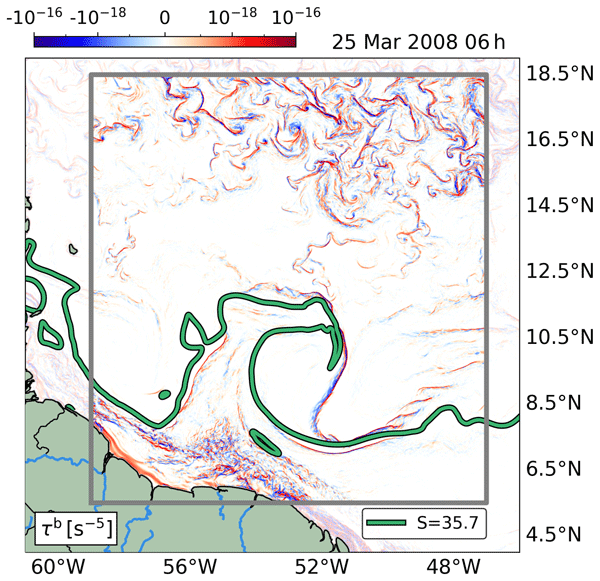
The Amazon River plume interaction with the North Brazil Current creates sharp temperature-salinity differences called fronts that are important for modulating air-sea interactions and biogeochemical cycles. This study uses data from robotic sailboats and a numerical model to provide a comprehensive picture of these fronts associated with the local dynamics. We characterize three distinct frontal regimes and the temperature-salinity relations linked to the Amazon discharge and current strength.
Marco Larrañaga, Julien Jouanno, Eric P. Chassignet, Giovanni Durante, Ilkyeong Ma, Julio Sheinbaum, and Lionel Renault
Ocean Sci., 22, 821–841, https://doi.org/10.5194/os-22-821-2026, https://doi.org/10.5194/os-22-821-2026, 2026
Short summary
Short summary
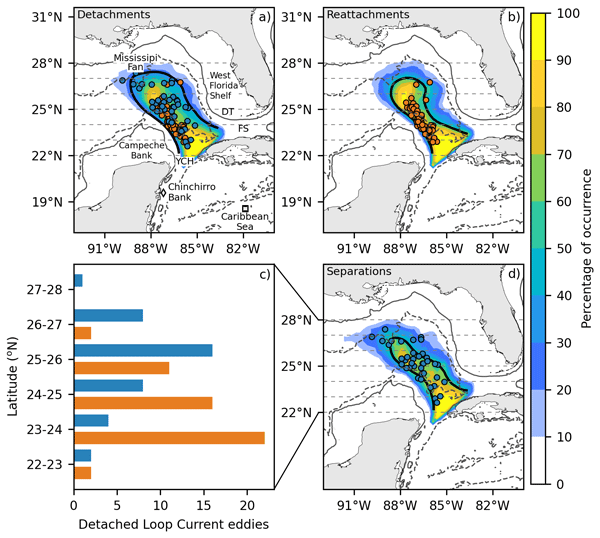
We analyze 29 years of satellite altimetry to investigate the detachment of Loop Current Eddies in the Gulf of Mexico. Over half of the Loop Current eddies reattach within a month, while 42 % separate and drift westward. Detachment requires the Loop Current to reach the Mississippi Fan and is strongly influenced by cyclonic eddies, whose configuration determines whether an eddy separates or reattaches to the Loop Current.
Audrey Minière, Karina von Schuckmann, and Sabrina Speich
Earth Syst. Sci. Data Discuss., https://doi.org/10.5194/essd-2026-106, https://doi.org/10.5194/essd-2026-106, 2026
Preprint under review for ESSD
Short summary
Short summary
This study assesses the sensitivity of global ocean heat content estimates to key methodological choices. Global trends are robust across methodological configurations. Most of the spread comes from the choice of temperature dataset, while other methodological impacts remain small. Our results show that both research and operational indicators consistently track global ocean warming, supporting their reliability and traceability for climate monitoring and Earth energy budget assessments.

Lisa Bernini, Leone Cavicchia, Fabien Desbiolles, Enrico Scoccimarro, and Claudia Pasquero
Weather Clim. Dynam., 7, 367–391, https://doi.org/10.5194/wcd-7-367-2026, https://doi.org/10.5194/wcd-7-367-2026, 2026
Short summary
Short summary
We studied why some Mediterranean storms intensify and begin to resemble tropical cyclones, becoming especially damaging. By comparing many storms, we found that strong cyclones form when powerful disturbances high in the atmosphere are present. If this happens over warm seas, storms are more likely to develop tropical-like features, while the cooling of the sea by the storm itself helps limit its lifetime. These findings can help improve early warnings and reduce risks in the region.

Alessandro Storer, Matteo Borgnino, Agostino Niyonkuru Meroni, Fabien Desbiolles, Carlos Conejero, Lionel Renault, and Claudia Pasquero
Adv. Sci. Res., 22, 103–110, https://doi.org/10.5194/asr-22-103-2025, https://doi.org/10.5194/asr-22-103-2025, 2025
Short summary
Short summary
We looked into how a numerical experiment represents the interactions between the air and the sea at scales of about 100–1000 km. We found that slight changes in sea surface temperature (SST) drive dramatic modifications in evaporation rates from the sea surface. Cold sea patches tend to cool down the air and to keep moisture trapped within the lower atmospheric layers. Warmer SST, instead, makes them more buoyant and inflate with drier air, thus diluting moisture over thicker air layers.
Yan Barabinot, Sabrina Speich, and Xavier Carton
Ocean Sci., 21, 2527–2553, https://doi.org/10.5194/os-21-2527-2025, https://doi.org/10.5194/os-21-2527-2025, 2025
Short summary
Short summary
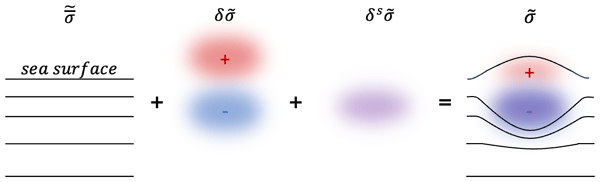
Mesoscale eddies, characterized by rotating currents, are ubiquitous in the ocean. However, their three-dimensional structure remains poorly observed and analyzed, with transport estimates often relying on approximations. To better quantify their shape, we propose a new theoretical framework based on geophysical fluid dynamics and apply it to field observations.
Kerry Emanuel, Tommaso Alberti, Stella Bourdin, Suzana J. Camargo, Davide Faranda, Emmanouil Flaounas, Juan Jesus Gonzalez-Aleman, Chia-Ying Lee, Mario Marcello Miglietta, Claudia Pasquero, Alice Portal, Hamish Ramsay, Marco Reale, and Romualdo Romero
Weather Clim. Dynam., 6, 901–926, https://doi.org/10.5194/wcd-6-901-2025, https://doi.org/10.5194/wcd-6-901-2025, 2025
Short summary
Short summary
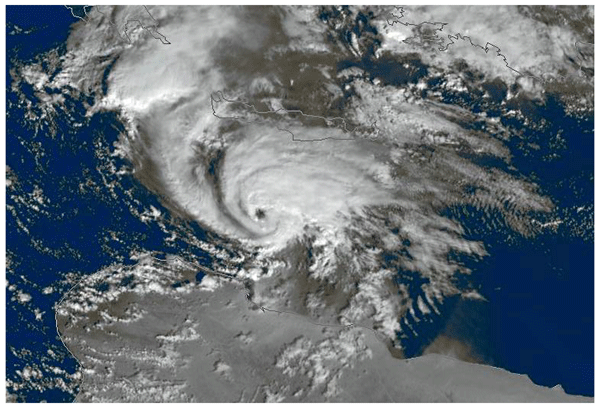
Storms strongly resembling hurricanes are sometimes observed to form well outside the tropics, even in polar latitudes. They behave capriciously, developing very rapidly and then dying just as quickly. We show that strong dynamical processes in the atmosphere can sometimes cause it to become much colder locally than the underlying ocean, creating the conditions for hurricanes to form but only over small areas and for short times. We call the resulting storms "CYCLOPs".
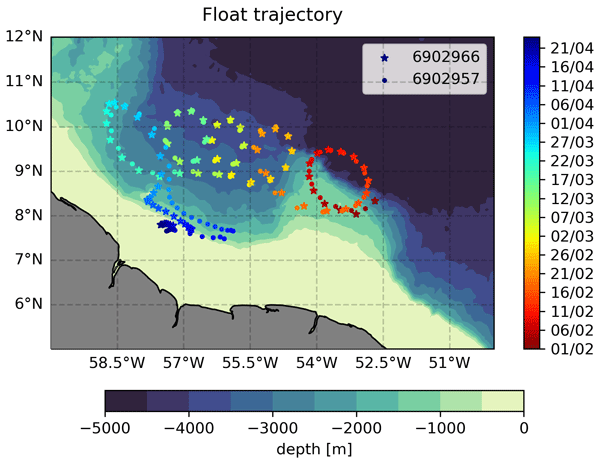
Yan Barabinot, Sabrina Speich, Xavier Carton, Pierre L'Hégaret, Corentin Subirade, Rémi Laxenaire, and Johannes Karstensen
Ocean Sci., 21, 1849–1872, https://doi.org/10.5194/os-21-1849-2025, https://doi.org/10.5194/os-21-1849-2025, 2025
Short summary
Short summary
Mesoscale eddies are rotating oceanic currents key to ocean variability. Off Brazil’s northeast coast, the North Brazil Current generates on average 4.5 eddies per year, which drift towards the West Indies, transporting waters from the Southern Hemisphere. Using data collected at sea by the EUREC4A-OA cruise, this study reveals that deep eddies transport 5 times more water than surface ones, reshaping our understanding of the regional water transport.
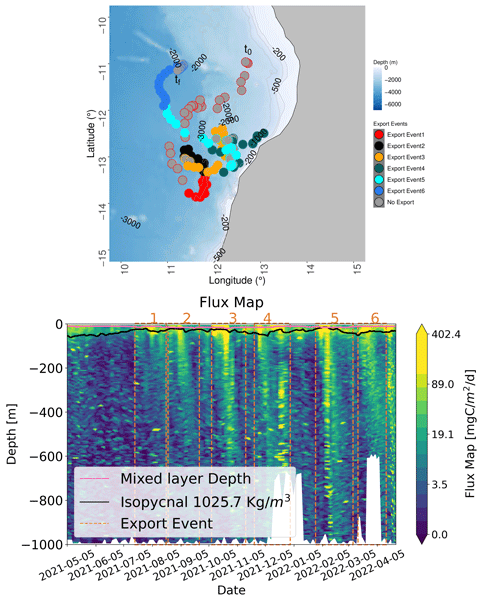
Yawouvi Dodji Soviadan, Miriam Beck, Joelle Habib, Alberto Baudena, Laetitia Drago, Alexandre Accardo, Remi Laxenaire, Sabrina Speich, Peter Brandt, Rainer Kiko, and Stemmann Lars
Biogeosciences, 22, 3485–3501, https://doi.org/10.5194/bg-22-3485-2025, https://doi.org/10.5194/bg-22-3485-2025, 2025
Short summary
Short summary
Key parameters representing the gravity flux in global models are sinking speed and vertical attenuation of exported material. We calculate, for the first time, these parameters in situ in the ocean for six intermittent blooms followed by export events using high-resolution (3 d) time series of 0–1000 m depth profiles from imaging sensors mounted on an Argo float. We show that sinking speed depends not only on size but also on the morphology of the particles, with density being an important property.
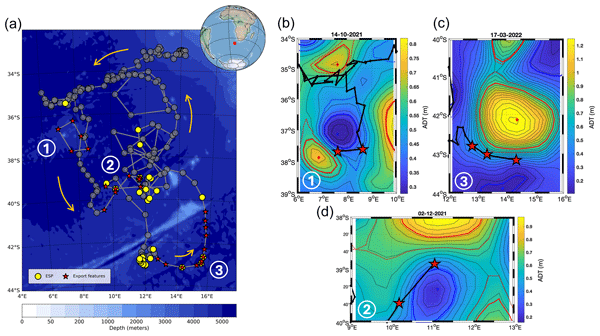
Alexandre Accardo, Rémi Laxenaire, Alberto Baudena, Sabrina Speich, Rainer Kiko, and Lars Stemmann
Biogeosciences, 22, 1183–1201, https://doi.org/10.5194/bg-22-1183-2025, https://doi.org/10.5194/bg-22-1183-2025, 2025
Short summary
Short summary
The open ocean helps mitigate climate change by storing CO2 via the biological carbon pump (BCP), which involves processes like organic carbon production at the surface and transferring it to the deep ocean via various pathways. By deploying an autonomous platform, we found significant marine snow accumulation from the surface to the mesopelagic zone in frontal regions between eddies. We suggest that the coupling of hydrodynamics at eddy edges and biological activity may enhance this process.
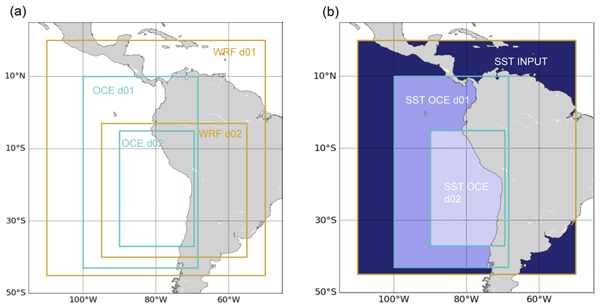
Sébastien Masson, Swen Jullien, Eric Maisonnave, David Gill, Guillaume Samson, Mathieu Le Corre, and Lionel Renault
Geosci. Model Dev., 18, 1241–1263, https://doi.org/10.5194/gmd-18-1241-2025, https://doi.org/10.5194/gmd-18-1241-2025, 2025
Short summary
Short summary
This article details a new feature we implemented in the popular regional atmospheric model WRF. This feature allows for data exchange between WRF and any other model (e.g. an ocean model) using the coupling library Ocean–Atmosphere–Sea–Ice–Soil Model Coupling Toolkit (OASIS3-MCT). This coupling interface is designed to be non-intrusive, flexible and modular. It also offers the possibility of taking into account the nested zooms used in WRF or in the models with which it is coupled.
Yan Barabinot, Sabrina Speich, and Xavier Carton
Ocean Sci., 21, 151–179, https://doi.org/10.5194/os-21-151-2025, https://doi.org/10.5194/os-21-151-2025, 2025
Short summary
Short summary
Mesoscale eddies are ubiquitous rotating currents in the ocean. Some eddies, called "materially coherent", are able to transport a different water mass from the surrounding water. By analyzing 3D eddy structures sampled during oceanographic cruises, we found that eddies can be nonmaterially coherent, accounting only for their surface properties, but materially coherent considering their properties at depth. Future studies cannot rely solely on satellite data to evaluate heat and salt transport.
Elisa Carli, Rosemary Morrow, Oscar Vergara, Robin Chevrier, and Lionel Renault
Ocean Sci., 19, 1413–1435, https://doi.org/10.5194/os-19-1413-2023, https://doi.org/10.5194/os-19-1413-2023, 2023
Short summary
Short summary
Oceanic eddies are the structures carrying most of the energy in our oceans. They are key to climate regulation and nutrient transport. We prepare for the Surface Water and Ocean Topography mission, studying eddy dynamics in the region south of Africa, where the Indian and Atlantic oceans meet, using models and simulated satellite data. SWOT will provide insights into the structures smaller than what is currently observable, which appear to greatly contribute to eddy kinetic energy and strain.
Jonathan Andrew Baker, Richard Renshaw, Laura Claire Jackson, Clotilde Dubois, Doroteaciro Iovino, Hao Zuo, Renellys C. Perez, Shenfu Dong, Marion Kersalé, Michael Mayer, Johannes Mayer, Sabrina Speich, and Tarron Lamont
State Planet, 1-osr7, 4, https://doi.org/10.5194/sp-1-osr7-4-2023, https://doi.org/10.5194/sp-1-osr7-4-2023, 2023
Short summary
Short summary
We use ocean reanalyses, in which ocean models are combined with observations, to infer past changes in ocean circulation and heat transport in the South Atlantic. Comparing these estimates with other observation-based estimates, we find differences in their trends, variability, and mean heat transport but closer agreement in their mean overturning strength. Ocean reanalyses can help us understand the cause of these differences, which could improve estimates of ocean transports in this region.
Alice Portal, Fabio D'Andrea, Paolo Davini, Mostafa E. Hamouda, and Claudia Pasquero
Weather Clim. Dynam., 4, 809–822, https://doi.org/10.5194/wcd-4-809-2023, https://doi.org/10.5194/wcd-4-809-2023, 2023
Short summary
Short summary
The differences between climate models can be exploited to infer how specific aspects of the climate influence the Earth system. This work analyses the effects of a negative temperature anomaly over the Tibetan Plateau on the winter atmospheric circulation. We show that models with a colder-than-average Tibetan Plateau present a reinforcement of the eastern Asian winter monsoon and discuss the atmospheric response to the enhanced transport of cold air from the continent toward the Pacific Ocean.
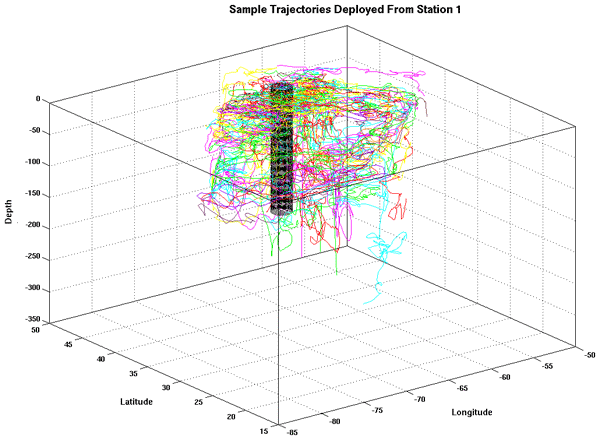
Saeed Hariri, Sabrina Speich, Bruno Blanke, and Marina Lévy
Ocean Sci., 19, 1183–1201, https://doi.org/10.5194/os-19-1183-2023, https://doi.org/10.5194/os-19-1183-2023, 2023
Short summary
Short summary
This work presents a series of studies conducted by the authors on the application of the Lagrangian approach for the connectivity analysis between different ocean locations in an idealized open-ocean model. We assess how the connectivity properties of typical oceanic flows are affected by the fine-scale circulation and discuss the challenges facing ocean connectivity estimates related to the spatial resolution. Our results are important to improve the understanding of marine ecosystems.
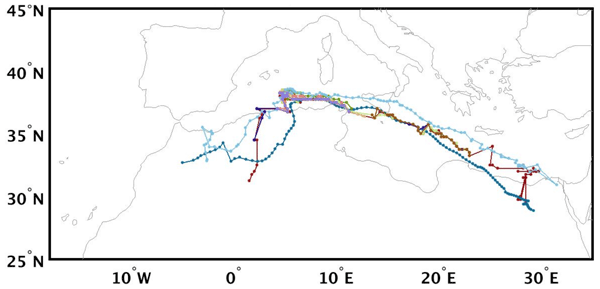
Emmanouil Flaounas, Leonardo Aragão, Lisa Bernini, Stavros Dafis, Benjamin Doiteau, Helena Flocas, Suzanne L. Gray, Alexia Karwat, John Kouroutzoglou, Piero Lionello, Mario Marcello Miglietta, Florian Pantillon, Claudia Pasquero, Platon Patlakas, María Ángeles Picornell, Federico Porcù, Matthew D. K. Priestley, Marco Reale, Malcolm J. Roberts, Hadas Saaroni, Dor Sandler, Enrico Scoccimarro, Michael Sprenger, and Baruch Ziv
Weather Clim. Dynam., 4, 639–661, https://doi.org/10.5194/wcd-4-639-2023, https://doi.org/10.5194/wcd-4-639-2023, 2023
Short summary
Short summary
Cyclone detection and tracking methods (CDTMs) have different approaches in defining and tracking cyclone centers. This leads to disagreements on extratropical cyclone climatologies. We present a new approach that combines tracks from individual CDTMs to produce new composite tracks. These new tracks are shown to correspond to physically meaningful systems with distinctive life stages.
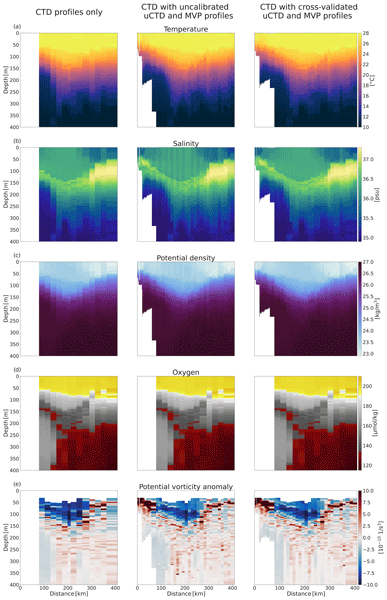
Pierre L'Hégaret, Florian Schütte, Sabrina Speich, Gilles Reverdin, Dariusz B. Baranowski, Rena Czeschel, Tim Fischer, Gregory R. Foltz, Karen J. Heywood, Gerd Krahmann, Rémi Laxenaire, Caroline Le Bihan, Philippe Le Bot, Stéphane Leizour, Callum Rollo, Michael Schlundt, Elizabeth Siddle, Corentin Subirade, Dongxiao Zhang, and Johannes Karstensen
Earth Syst. Sci. Data, 15, 1801–1830, https://doi.org/10.5194/essd-15-1801-2023, https://doi.org/10.5194/essd-15-1801-2023, 2023
Short summary
Short summary
In early 2020, the EUREC4A-OA/ATOMIC experiment took place in the northwestern Tropical Atlantic Ocean, a dynamical region where different water masses interact. Four oceanographic vessels and a fleet of autonomous devices were deployed to study the processes at play and sample the upper ocean, each with its own observing capability. The article first describes the data calibration and validation and second their cross-validation, using a hierarchy of instruments and estimating the uncertainty.
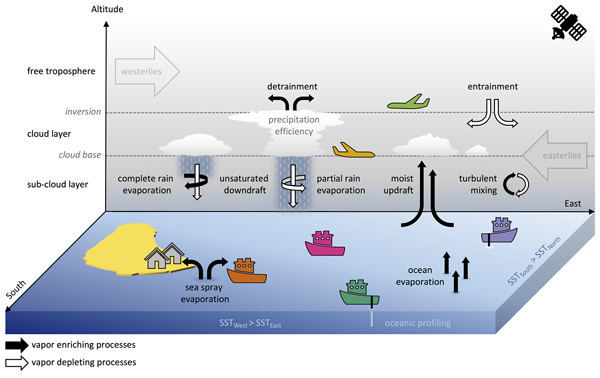
Adriana Bailey, Franziska Aemisegger, Leonie Villiger, Sebastian A. Los, Gilles Reverdin, Estefanía Quiñones Meléndez, Claudia Acquistapace, Dariusz B. Baranowski, Tobias Böck, Sandrine Bony, Tobias Bordsdorff, Derek Coffman, Simon P. de Szoeke, Christopher J. Diekmann, Marina Dütsch, Benjamin Ertl, Joseph Galewsky, Dean Henze, Przemyslaw Makuch, David Noone, Patricia K. Quinn, Michael Rösch, Andreas Schneider, Matthias Schneider, Sabrina Speich, Bjorn Stevens, and Elizabeth J. Thompson
Earth Syst. Sci. Data, 15, 465–495, https://doi.org/10.5194/essd-15-465-2023, https://doi.org/10.5194/essd-15-465-2023, 2023
Short summary
Short summary
One of the novel ways EUREC4A set out to investigate trade wind clouds and their coupling to the large-scale circulation was through an extensive network of isotopic measurements in water vapor, precipitation, and seawater. Samples were taken from the island of Barbados, from aboard two aircraft, and from aboard four ships. This paper describes the full collection of EUREC4A isotopic in situ data and guides readers to complementary remotely sensed water vapor isotope ratios.
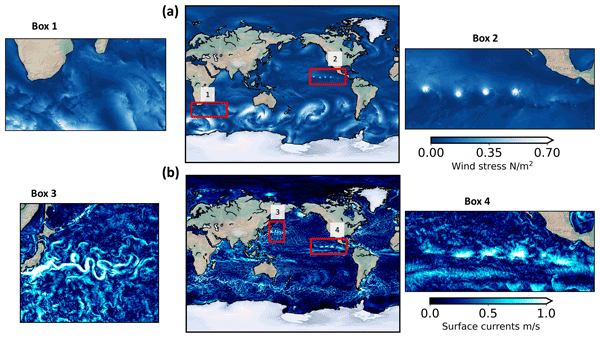
Hector S. Torres, Patrice Klein, Jinbo Wang, Alexander Wineteer, Bo Qiu, Andrew F. Thompson, Lionel Renault, Ernesto Rodriguez, Dimitris Menemenlis, Andrea Molod, Christopher N. Hill, Ehud Strobach, Hong Zhang, Mar Flexas, and Dragana Perkovic-Martin
Geosci. Model Dev., 15, 8041–8058, https://doi.org/10.5194/gmd-15-8041-2022, https://doi.org/10.5194/gmd-15-8041-2022, 2022
Short summary
Short summary
Wind work at the air-sea interface is the scalar product of winds and currents and is the transfer of kinetic energy between the ocean and the atmosphere. Using a new global coupled ocean-atmosphere simulation performed at kilometer resolution, we show that all scales of winds and currents impact the ocean dynamics at spatial and temporal scales. The consequential interplay of surface winds and currents in the numerical simulation motivates the need for a winds and currents satellite mission.
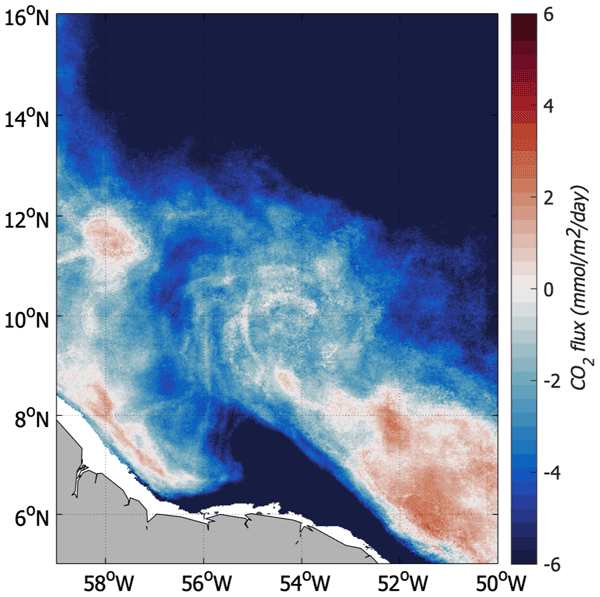
Léa Olivier, Jacqueline Boutin, Gilles Reverdin, Nathalie Lefèvre, Peter Landschützer, Sabrina Speich, Johannes Karstensen, Matthieu Labaste, Christophe Noisel, Markus Ritschel, Tobias Steinhoff, and Rik Wanninkhof
Biogeosciences, 19, 2969–2988, https://doi.org/10.5194/bg-19-2969-2022, https://doi.org/10.5194/bg-19-2969-2022, 2022
Short summary
Short summary
We investigate the impact of the interactions between eddies and the Amazon River plume on the CO2 air–sea fluxes to better characterize the ocean carbon sink in winter 2020. The region is a strong CO2 sink, previously underestimated by a factor of 10 due to a lack of data and understanding of the processes responsible for the variability in ocean carbon parameters. The CO2 absorption is mainly driven by freshwater from the Amazon entrained by eddies and by the winter seasonal cooling.
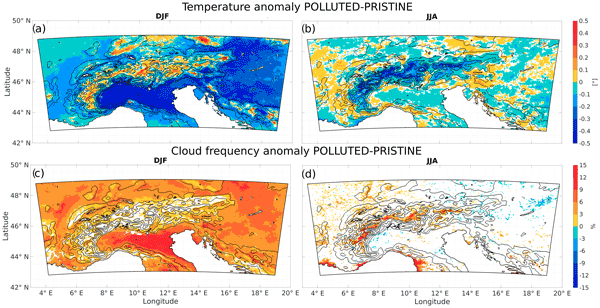
Anna Napoli, Fabien Desbiolles, Antonio Parodi, and Claudia Pasquero
Atmos. Chem. Phys., 22, 3901–3909, https://doi.org/10.5194/acp-22-3901-2022, https://doi.org/10.5194/acp-22-3901-2022, 2022
Short summary
Short summary
Aerosols are liquid or solid particles suspended in the air that can interact with radiation and clouds, modifying the meteoclimatic conditions. Using an atmospheric model, we study the climatological impact of aerosols through their effects on clouds in the Alps, a region characterized by high pollution levels in the densely populated surrounding flatlands. Results show that cloud cover, temperature, and precipitation are affected by aerosols, and the response varies with elevation and season.
Cited articles
Acquistapace, C., Meroni, A. N., Labbri, G., Lange, D., Späth, F., Abbas, S., and Bellenger, H.: Fast atmospheric response to a cold oceanic mesoscale patch in the north-western tropical Atlantic, J. Geophys. Res.-Atmos., 127, e2022JD036799, https://doi.org/10.1029/2022JD036799, 2022. a, b, c
Anderson, L. A., McGillicuddy Jr., D. J., Maltrud, M. E., Lima, I. D., and Doney, S. C.: Impact of eddy–wind interaction on eddy demographics and phytoplankton community structure in a model of the North Atlantic Ocean, Dynam. Atmos. Oceans, 52, 80–94, 2011. a
Balaguru, K., Chang, P., Saravanan, R., Leung, L. R., Xu, Z., Li, M., and Hsieh, J.-S.: Ocean barrier layers' effect on tropical cyclone intensification, P. Natl. Acad. Sci. USA, 109, 14343–14347, 2012. a
Bishop, S. P., Small, R. J., Bryan, F. O., and Tomas, R. A.: Scale-dependence of midlatitude air-sea interaction, J. Climate, 30, 8207–8221, https://doi.org/10.1175/JCLI-D-17-0159.1, 2017. a
Boutin, J., Vergely, J., Reul, N., Catany, R., Koehler, J., Martin, A., Rouffi, F., Arias, M., Chakroun, M., Corato, G., Estella-Perez, V., Guimbard, S., Hasson, A., Josey, S., Khvorostyanov, D., Kolodziejczyk, N., Mignot, J., Olivier, L., Reverdin, G., Stammer, D., Supply, A., Thouvenin-Masson, C., Turiel, A., Vialard, J., Cipollini, P., and Donlon, C.: ESA Sea Surface Salinity Climate Change Initiative (Sea_Surface_Salinity_cci): weekly and monthly sea surface salinity products, v03. 21, for 2010 to 2020, CEDA [data set], https://doi.org/10.5285/5920a2c77e3c45339477acd31ce62c3c, 2021. a, b
Breugem, W.-P., Chang, P., Jang, C., Mignot, J., and Hazeleger, W.: Barrier layers and tropical Atlantic SST biases in coupled GCMs, Tellus A, 60, 885–897, 2008. a
Bye, J. A.: Large-scale momentum exchange in the coupled atmosphere-ocean, in: Elsevier Oceanography Series, Vol. 40, Elsevier, 51–61, https://doi.org/10.1016/S0422-9894(08)70702-5, 1985. a, b
Chelton, D. and Xie, S.: Coupled atmosphere–ocean interactions at ocean mesoscales, Oceanography, 23, 52–69, 2010. a
Chelton, D. B., Esbensen, S. K., Schlax, M. G., Thum, N., Freilich, M. H., Wentz, F. J., Gentemann, C. L., McPhaden, M. J., and Schopf, P. S.: Observations of coupling between surface wind stress and sea surface temperature in the eastern tropical Pacific, J. Climate, 14, 1479–1498, 2001. a
Chelton, D. B., Schlax, M. G., and Samelson, R. M.: Summertime coupling between sea surface temperature and wind stress in the California Current System, J. Phys. Oceanogr., 37, 495–517, 2007. a
Chen, L., Jia, Y., and Liu, Q.: Oceanic eddy-driven atmospheric secondary circulation in the winter Kuroshio Extension region, J. Oceanogr., 73, 295–307, 2017. a
CLS: Global Ocean Gridded L 4 Sea Surface Heights And Derived Variables Reprocessed 1993 Ongoing, Copernicus Marine Environment Monitoring Service (CMEMS), under the Copernicus Programme of the European Union [data set], https://doi.org/10.48670/moi-00148, 2018. a
Coadou-Chaventon, S., Speich, S., Zhang, D., Rocha, C. B., and Swart, S.: Oceanic fronts driven by the Amazon freshwater plume and their thermohaline compensation at the submesoscale, J. Geophys. Res.-Oceans, 129, e2024JC021326, https://doi.org/10.1029/2024JC021326, 2024. a, b
Craig, A., Valcke, S., and Coquart, L.: Development and performance of a new version of the OASIS coupler, OASIS3-MCT_3.0, Geosci. Model Dev., 10, 3297–3308, https://doi.org/10.5194/gmd-10-3297-2017, 2017. a
Debreu, L., Marchesiello, P., Penven, P., and Cambon, G.: Two-way nesting in split-explicit ocean models: algorithms, implementation and validation, Ocean Model., 49, 1–21, 2012. a
Desbiolles, F., Blanke, B., Bentamy, A., and Grima, N.: Origin of fine-scale wind stress curl structures in the Benguela and Canary upwelling systems, J. Geophys. Res.-Oceans, 119, 7931–7948, 2014. a
Desbiolles, F., Meroni, A. N., Renault, L., and Pasquero, C.: Environmental control of wind response to sea surface temperature patterns in reanalysis dataset, J. Climate, 36, 3881–3893, 2023. a
Dewar, W. K. and Flierl, G. R.: Some effects of the wind on rings, J. Phys. Oceanogr., 17, 1653–1667, 1987. a
Eden, C. and Dietze, H.: Effects of mesoscale eddy/wind interactions on biological new production and eddy kinetic energy, J. Geophys. Res.-Oceans, 114, C05023, https://doi.org/10.1029/2008JC005129, 2009. a
Fernández, P., Speich, S., Borgnino, M., Meroni, A. N., Desbiolles, F., and Pasquero, C.: On the importance of the atmospheric coupling to the small-scale ocean in the modulation of latent heat flux, Frontiers in Marine Science, 10, 1136558, https://doi.org/10.3389/fmars.2023.1136558, 2023. a, b, c, d, e, f, g, h, i, j, k, l, m, n, o, p, q
Fernández, P., Speich, S., Bellenger, H., Lange Vega, D., Karstensen, J., Zhang, D., and Rocha, C. B.: On the mechanisms driving latent heat flux variations in the Northwest Tropical Atlantic, J. Geophys. Res.-Oceans, 129, e2023JC020658, https://doi.org/10.1029/2023JC020658 2024. a, b, c, d, e, f, g, h, i, j, k, l
Foltz, G. R. and McPhaden, M. J.: Impact of barrier layer thickness on SST in the central tropical North Atlantic, J. Climate, 22, 285–299, 2009. a
Foussard, A., Lapeyre, G., and Plougonven, R.: Response of surface wind divergence to mesoscale SST anomalies under different wind conditions, J. Atmos. Sci., 76, 2065–2082, 2019. a
Gaube, P., Chelton, D. B., Strutton, P. G., and Behrenfeld, M. J.: Satellite observations of chlorophyll, phytoplankton biomass, and Ekman pumping in nonlinear mesoscale eddies, J. Geophys. Res.-Oceans, 118, 6349–6370, 2013. a
Gaube, P., Chelton, D. B., Samelson, R. M., Schlax, M. G., and O'Neill, L. W.: Satellite observations of mesoscale eddy-induced Ekman pumping, J. Phys. Oceanogr., 45, 104–132, 2015. a
Gaube, P., Chickadel, C., Branch, R., and Jessup, A.: Satellite observations of SST-induced wind speed perturbation at the oceanic submesoscale, Geophys. Res. Lett., 46, 2690–2695, 2019. a
Gentemann, C. L., Clayson, C. A., Brown, S., Lee, T., Parfitt, R., Farrar, J. T., Bourassa, M., Minnett, P. J., Seo, H., Gille, S. T., and Zlotnicki, V.: FluxSat: measuring the ocean–atmosphere turbulent exchange of heat and moisture from space, Remote Sens.-Basel, 12, 1796, https://doi.org/10.3390/rs12111796, 2020. a
Gill, A. E.: Atmosphere-Ocean Dynamics, Vol. 30, Academic Press, https://doi.org/10.1016/s0074-6142(08)x6002-4, 1982. a
Girishkumar, M., Ashin, K., McPhaden, M., Balaji, B., and Praveenkumar, B.: Estimation of vertical heat diffusivity at the base of the mixed layer in the Bay of Bengal, J. Geophys. Res.-Oceans, 125, e2019JC015402, https://doi.org/10.1029/2019JC015402, 2020. a
Gruber, N., Lachkar, Z., Frenzel, H., Marchesiello, P., Münnich, M., McWilliams, J. C., Nagai, T., and Plattner, G.-K.: Eddy-induced reduction of biological production in eastern boundary upwelling systems, Nat. Geosci., 4, 787–792, 2011. a
Hayes, S., McPhaden, M., and Wallace, J.: The influence of sea-surface temperature on surface wind in the eastern equatorial Pacific: weekly to monthly variability, J. Climate, 2, 1500–1506, 1989. a
Hernandez, O., Jouanno, J., and Durand, F.: Do the Amazon and Orinoco freshwater plumes really matter for hurricane-induced ocean surface cooling?, J. Geophys. Res.-Oceans, 121, 2119–2141, 2016. a
Iyer, S., Drushka, K., Thompson, E. J., and Thomson, J.: Small-scale spatial variations of air-sea heat, moisture, and buoyancy fluxes in the tropical trade winds, J. Geophys. Res.-Oceans, 127, e2022JC018972, https://doi.org/10.1029/2022JC018972, 2022. a
Johns, W. E., Lee, T. N., Schott, F. A., Zantopp, R. J., and Evans, R. H.: The North Brazil Current retroflection: seasonal structure and eddy variability, J. Geophys. Res.-Oceans, 95, 22103–22120, 1990. a
Krishnamohan, K., Vialard, J., Lengaigne, M., Masson, S., Samson, G., Pous, S., Neetu, S., Durand, F., Shenoi, S., and Madec, G.: Is there an effect of Bay of Bengal salinity on the northern Indian Ocean climatological rainfall?, Deep-Sea Res. Pt. II, 166, 19–33, 2019. a
Leyba, I. M., Saraceno, M., and Solman, S. A.: Air-sea heat fluxes associated to mesoscale eddies in the Southwestern Atlantic Ocean and their dependence on different regional conditions, Clim. Dynam., 49, 2491–2501, 2017. a
Lindzen, R. S. and Nigam, S.: On the role of sea surface temperature gradients in forcing low-level winds and convergence in the tropics, J. Atmos. Sci., 44, 2418–2436, 1987. a
Liu, H., Li, W., Chen, S., Fang, R., and Li, Z.: Atmospheric response to mesoscale ocean eddies over the South China Sea, Adv. Atmos. Sci., 35, 1189–1204, 2018. a
Liu, Y., Yu, L., and Chen, G.: Characterization of sea surface temperature and air-sea heat flux anomalies associated with mesoscale eddies in the South China Sea, J. Geophys. Res.-Oceans, 125, e2019JC015470, https://doi.org/10.1029/2019JC015470, 2020. a
Ma, J., Xu, H., Dong, C., Lin, P., and Liu, Y.: Atmospheric responses to oceanic eddies in the Kuroshio Extension region, J. Geophys. Res.-Atmos., 120, 6313–6330, 2015. a
Ma, Z., Fei, J., Lin, Y., and Huang, X.: Modulation of clouds and rainfall by tropical cyclone's cold wakes, Geophys. Res. Lett., 47, e2020GL088873, https://doi.org/10.1029/2020GL088873, 2020. a
Maes, C. and O'Kane, T. J.: Seasonal variations of the upper ocean salinity stratification in the Tropics, J. Geophys. Res.-Oceans, 119, 1706–1722, 2014. a
Mahadevan, A., Jaeger, G. S., Freilich, M., Omand, M. M., Shroyer, E. L., and Sengupta, D.: Freshwater in the Bay of Bengal: its fate and role in air-sea heat exchange, Oceanography, 29, 72–81, 2016. a
Martin, A. P. and Richards, K. J.: Mechanisms for vertical nutrient transport within a North Atlantic mesoscale eddy, Deep-Sea Res. Pt. II, 48, 757–773, 2001. a
Meroni, A. N., Parodi, A., and Pasquero, C.: Role of SST patterns on surface wind modulation of a heavy midlatitude precipitation event, J. Geophys. Res.-Atmos., 123, 9081–9096, 2018. a
Meroni, A. N., Giurato, M., Ragone, F., and Pasquero, C.: Observational evidence of the preferential occurrence of wind convergence over sea surface temperature fronts in the Mediterranean, Q. J. Roy. Meteor. Soc., 146, 1443–1458, 2020. a
Mignot, J., Lazar, A., and Lacarra, M.: On the formation of barrier layers and associated vertical temperature inversions: a focus on the northwestern tropical Atlantic, J. Geophys. Res.-Oceans, 117, C02010, https://doi.org/10.1029/2011JC007435, 2012. a
Miller, J. R.: The salinity effect in a mixed layer ocean model, J. Phys. Oceanogr., 6, 29–35, 1976. a
Minobe, S., Kuwano-Yoshida, A., Komori, N., Xie, S.-P., and Small, R. J.: Influence of the Gulf Stream on the troposphere, Nature, 452, 206–209, 2008. a
Nagai, T., Gruber, N., Frenzel, H., Lachkar, Z., McWilliams, J. C., and Plattner, G.-K.: Dominant role of eddies and filaments in the offshore transport of carbon and nutrients in the California Current System, J. Geophys. Res.-Oceans, 120, 5318–5341, 2015. a
Oerder, V., Colas, F., Echevin, V., Masson, S., and Lemarié, F.: Impacts of the mesoscale ocean-atmosphere coupling on the Peru-Chile ocean dynamics: the current-induced wind stress modulation, J. Geophys. Res.-Oceans, 123, 812–833, 2018. a
Olivier, L., Boutin, J., Reverdin, G., Lefèvre, N., Landschützer, P., Speich, S., Karstensen, J., Labaste, M., Noisel, C., Ritschel, M., Steinhoff, T., and Wanninkhof, R.: Wintertime process study of the North Brazil Current rings reveals the region as a larger sink for CO2 than expected, Biogeosciences, 19, 2969–2988, https://doi.org/10.5194/bg-19-2969-2022, 2022. a, b
O'Neill, L. W., Chelton, D. B., Esbensen, S. K., and Wentz, F. J.: High-resolution satellite measurements of the atmospheric boundary layer response to SST variations along the Agulhas Return Current, J. Climate, 18, 2706–2723, 2005. a
Pailler, K., Bourles, B., and Gouriou, Y.: The barrier layer in the western tropical Atlantic Ocean, Geophys. Res. Lett., 26, 2069–2072, 1999. a
Pasquero, C., Desbiolles, F., and Meroni, A. N.: Air-sea interactions in the cold wakes of tropical cyclones, Geophys. Res. Lett., 48, e2020GL091185, https://doi.org/10.1029/2020GL091185, 2021. a, b
Renault, L., Lemarié, F., and Arsouze, T.: On the implementation and consequences of the oceanic currents feedback in ocean–atmosphere coupled models, Ocean Model., 141, 101423, https://doi.org/10.1016/j.ocemod.2019.101423, 2019a. a, b
Renault, L., Masson, S., Oerder, V., Colas, F., and McWilliams, J.: Modulation of the oceanic mesoscale activity by the mesoscale thermal feedback to the atmosphere, J. Phys. Oceanogr., 53, 1651–1667, 2023. a
Reverdin, G., Olivier, L., Foltz, G. R., Speich, S., Karstensen, J., Horstmann, J., Zhang, D., Laxenaire, R., Carton, X., Branger, H., Carrasco, R., and Boutin, J.: Formation and evolution of a freshwater plume in the northwestern tropical Atlantic in February 2020, J. Geophys. Res.-Oceans, 126, e2020JC016981, https://doi.org/10.1029/2020JC016981, 2021. a, b, c, d
Richardson, P., Hufford, G., Limeburner, R., and Brown, W.: North Brazil current retroflection eddies, J. Geophys. Res.-Oceans, 99, 5081–5093, 1994. a
Roberts, J. B., Clayson, C. A., and Robertson, F. R.: Seaflux Data Products V3, Earthdata [data set], https://doi.org/10.5067/SEAFLUX/DATA101, 2020. a
Shchepetkin, A. F. and McWilliams, J. C.: The regional oceanic modeling system (ROMS): a split-explicit, free-surface, topography-following-coordinate oceanic model, Ocean Model., 9, 347–404, 2005. a
Skamarock, W. C., Klemp, J. B., Dudhia, J., Gill, D. O., Barker, D. M., Duda, M. G., Huang, X.-Y., Wang, W., and Powers, J. G.: A description of the advanced research WRF version 3, NCAR technical note, 475, 10–5065, https://doi.org/10.5065/D68S4MVH, 2008. a
Small, R., Rousseau, V., Parfitt, R., Laurindo, L., O'Neill, L., Masunaga, R., Schneider, N., and Chang, P.: Near-surface wind convergence over the Gulf Stream – the role of SST revisited, J. Climate, 36, 5527–5548, 2023. a
Small, R. J., Xie, S.-P., and Wang, Y.: Numerical simulation of atmospheric response to Pacific tropical instability waves, J. Climate, 16, 3723–3741, 2003. a
Small, R. J., DeSzoeke, S. P., Xie, S. P., O'Neill, L., Seo, H., Song, Q., Cornillon, P., Spall, M., and Minobe, S.: Air-sea interaction over ocean fronts and eddies, Dynam. Atmos. Oceans, 45, 274–319, 2008. a
Subirade, C., L'Hégaret, P., Speich, S., Laxenaire, R., Karstensen, J., and Carton, X.: Combining an eddy detection algorithm with in-situ measurements to study north Brazil current rings, Remote Sens.-Basel, 15, 1897, https://doi.org/10.3390/rs15071897, 2023. a
Vialard, J. and Delecluse, P.: An OGCM study for the TOGA decade. Part I: Role of salinity in the physics of the western Pacific fresh pool, J. Phys. Oceanogr., 28, 1071–1088, 1998. a
Villas Bôas, A., Sato, O., Chaigneau, A., and Castelão, G.: The signature of mesoscale eddies on the air-sea turbulent heat fluxes in the South Atlantic Ocean, Geophys. Res. Lett., 42, 1856–1862, 2015. a
Wallace, J. M., Mitchell, T., and Deser, C.: The influence of sea-surface temperature on surface wind in the eastern equatorial Pacific: seasonal and interannual variability, J. Climate, 2, 1492–1499, 1989. a
Xu, H., Xu, M., Xie, S.-P., and Wang, Y.: Deep atmospheric response to the spring Kuroshio over the East China Sea, J. Climate, 24, 4959–4972, 2011. a
Short summary
We use a high-resolution ocean-atmosphere coupled simulation to assess the effects of fine-scale sea surface temperature, surface currents, and ocean vertical stratification on the spatial variability of latent heat flux in the Northwest Tropical Atlantic. The results show significant impacts from these three variables in latent heat flux. They stress the need to account for fine-scale ocean processes in the coarser global coupled models even in relatively quiescent regions like the tropics.
We use a high-resolution ocean-atmosphere coupled simulation to assess the effects of fine-scale...


