
Articles | Volume 22, issue 1
https://doi.org/10.5194/os-22-565-2026
© Author(s) 2026. This work is distributed under
the Creative Commons Attribution 4.0 License.
the Creative Commons Attribution 4.0 License.
https://doi.org/10.5194/os-22-565-2026
© Author(s) 2026. This work is distributed under
the Creative Commons Attribution 4.0 License.
the Creative Commons Attribution 4.0 License.
Research article
| 
12 Feb 2026
Research article |
| 12 Feb 2026
| 12 Feb 2026
The Arctic overturning circulation: transformations, pathways and timescales

Geophysical Institute, University of Bergen and Bjerknes Centre for Climate Research, Bergen, Norway
Carlo Mans
Geophysical Institute, University of Bergen and Bjerknes Centre for Climate Research, Bergen, Norway
Marius Årthun
Geophysical Institute, University of Bergen and Bjerknes Centre for Climate Research, Bergen, Norway
Kristofer Döös
Department of Meteorology, Stockholm University, Stockholm, Sweden
Dafydd Gwyn Evans
National Oceanography Centre, Southampton, UK
Yanchun He
Nansen Environmental and Remote Sensing Center and Bjerknes Centre for Climate Research, Bergen, Norway
Related authors
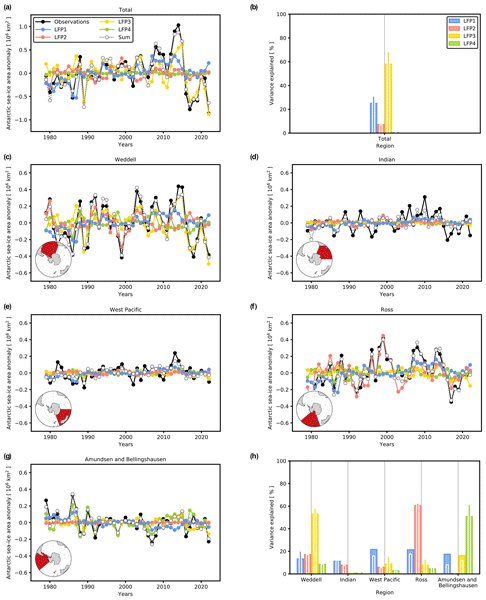
David B. Bonan, Jakob Dörr, Robert C. J. Wills, Andrew F. Thompson, and Marius Årthun
The Cryosphere, 18, 2141–2159, https://doi.org/10.5194/tc-18-2141-2024, https://doi.org/10.5194/tc-18-2141-2024, 2024
Short summary
Short summary
Antarctic sea ice has exhibited variability over satellite records, including a period of gradual expansion and a period of sudden decline. We use a novel statistical method to identify sources of variability in observed Antarctic sea ice changes. We find that the gradual increase in sea ice is likely related to large-scale temperature trends, and periods of abrupt sea ice decline are related to specific flavors of equatorial tropical variability known as the El Niño–Southern Oscillation.
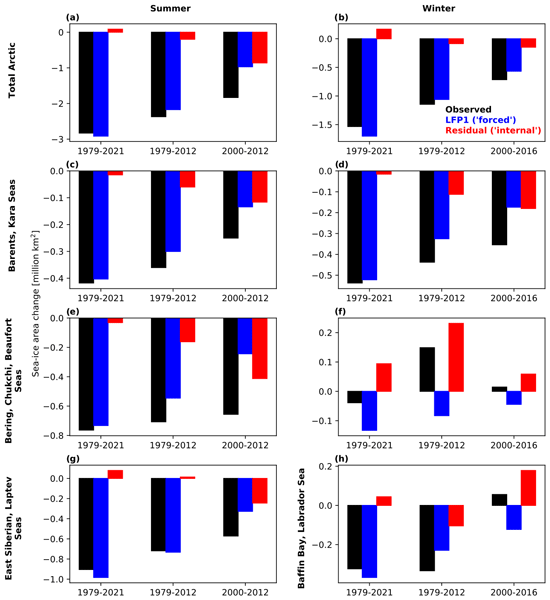
Jakob Simon Dörr, David B. Bonan, Marius Årthun, Lea Svendsen, and Robert C. J. Wills
The Cryosphere, 17, 4133–4153, https://doi.org/10.5194/tc-17-4133-2023, https://doi.org/10.5194/tc-17-4133-2023, 2023
Short summary
Short summary
The Arctic sea-ice cover is retreating due to climate change, but this retreat is influenced by natural (internal) variability in the climate system. We use a new statistical method to investigate how much internal variability has affected trends in the summer and winter Arctic sea-ice cover using observations since 1979. Our results suggest that the impact of internal variability on sea-ice retreat might be lower than what climate models have estimated.

Ole Rieke, Marius Årthun, and Jakob Simon Dörr
The Cryosphere, 17, 1445–1456, https://doi.org/10.5194/tc-17-1445-2023, https://doi.org/10.5194/tc-17-1445-2023, 2023
Short summary
Short summary
The Barents Sea is the region of most intense winter sea ice loss, and future projections show a continued decline towards ice-free conditions by the end of this century but with large fluctuations. Here we use climate model simulations to look at the occurrence and drivers of rapid ice change events in the Barents Sea that are much stronger than the average ice loss. A better understanding of these events will contribute to improved sea ice predictions in the Barents Sea.
Verena Jung, Aitor Aldama Campino, Joakim Kjellsson, and Kristofer Döös
EGUsphere, https://doi.org/10.5194/egusphere-2026-3561, https://doi.org/10.5194/egusphere-2026-3561, 2026
Short summary
Short summary
We developed an open-source code to compute the diathermohaline stream function. It combines the ocean dynamics such as volume transports with changes in temperature and salinity. With this compact representation, the method enables comparisons across ocean models and gridded ocean data sets. The study demonstrates the application by comparing global ocean model data of different resolutions and makes the code publicly available, providing an important contribution for evaluating ocean models.
Miriam F. Sterl, Carlo J. Mans, Alberto C. Naveira Garabato, and Sjoerd Groeskamp
EGUsphere, https://doi.org/10.5194/egusphere-2026-2566, https://doi.org/10.5194/egusphere-2026-2566, 2026
Short summary
Short summary
Large oceanic 'whirls', called eddies, can mix ocean properties such as heat or salt. The mixing strength is tricky to measure directly. We present a new method to derive the mixing strength based on data from a mooring; a cable from the seafloor to the surface, with instruments along it. We apply our method to a mooring in the Southern Ocean and show that it confirms some important features predicted from theory. The method can be a valuable tool to increase our understanding of ocean mixing.
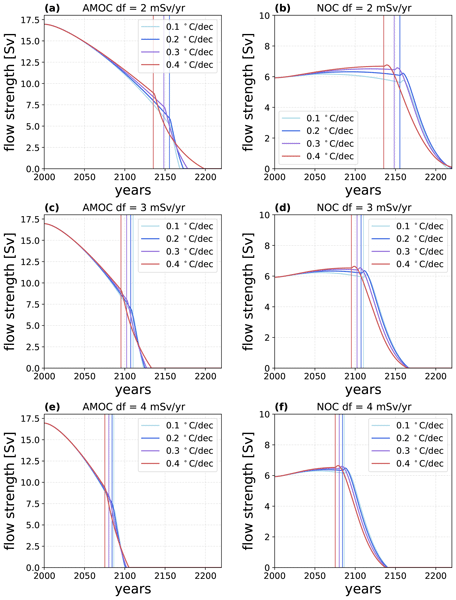
Sasha Roewer, Lukas Fiedler, Marius Årthun, Willem Huiskamp, and Stefan Rahmstorf
Ocean Sci., 22, 1195–1211, https://doi.org/10.5194/os-22-1195-2026, https://doi.org/10.5194/os-22-1195-2026, 2026
Short summary
Short summary
The Atlantic Meridional Overturning Circulation (AMOC) is weakening in response to global warming, while the Nordic Seas Overturning Circulation (NOC) is projected to strengthen. We suggest a feedback mechanism in which a weakened AMOC leads to reduced salt transport into the North Atlantic, decreasing the density in that region and potentially strengthening the NOC.
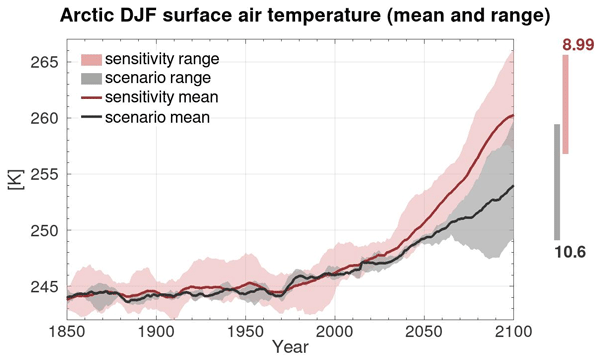
Lise Seland Graff, Jerry Tjiputra, Ada Gjermundsen, Andreas Born, Jens Boldingh Debernard, Heiko Goelzer, Yan-Chun He, Petra Margaretha Langebroek, Aleksi Nummelin, Dirk Olivié, Øyvind Seland, Trude Storelvmo, Mats Bentsen, Chuncheng Guo, Andrea Rosendahl, Dandan Tao, Thomas Toniazzo, Camille Li, Stephen Outten, and Michael Schulz
Earth Syst. Dynam., 16, 1671–1698, https://doi.org/10.5194/esd-16-1671-2025, https://doi.org/10.5194/esd-16-1671-2025, 2025
Short summary
Short summary
The magnitude of future Arctic amplification is highly uncertain. Using the Norwegian Earth System Model, we explore the effect of improving the representation of clouds, ocean eddies, the Greenland ice sheet, sea ice, and ozone on the projected Arctic winter warming in a coordinated experiment set. These improvements all lead to enhanced projected Arctic warming, with the largest changes found in the sea ice retreat regions and the largest uncertainty found on the Atlantic side.
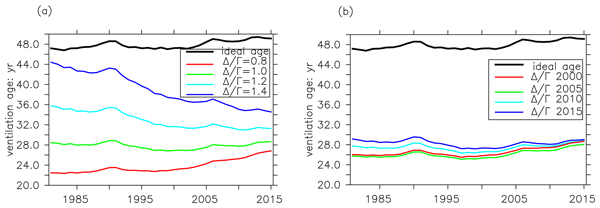
Haichao Guo, Wolfgang Koeve, Andreas Oschlies, Yan-Chun He, Tronje Peer Kemena, Lennart Gerke, and Iris Kriest
Ocean Sci., 21, 1167–1182, https://doi.org/10.5194/os-21-1167-2025, https://doi.org/10.5194/os-21-1167-2025, 2025
Short summary
Short summary
We evaluated the effectiveness of the inverse Gaussian transit time distribution (IG-TTD) with respect to estimating the mean state and temporal changes of seawater age, defined as the duration since water last had contact with the atmosphere, within the tropical thermocline. Results suggest that the IG-TTD underestimates seawater age. Moreover, the IG-TTD constrained by a single tracer gives spurious trends in water age. Incorporating an additional tracer improves IG-TTD's accuracy for estimating temporal change of seawater age.
David B. Bonan, Jakob Dörr, Robert C. J. Wills, Andrew F. Thompson, and Marius Årthun
The Cryosphere, 18, 2141–2159, https://doi.org/10.5194/tc-18-2141-2024, https://doi.org/10.5194/tc-18-2141-2024, 2024
Short summary
Short summary
Antarctic sea ice has exhibited variability over satellite records, including a period of gradual expansion and a period of sudden decline. We use a novel statistical method to identify sources of variability in observed Antarctic sea ice changes. We find that the gradual increase in sea ice is likely related to large-scale temperature trends, and periods of abrupt sea ice decline are related to specific flavors of equatorial tropical variability known as the El Niño–Southern Oscillation.
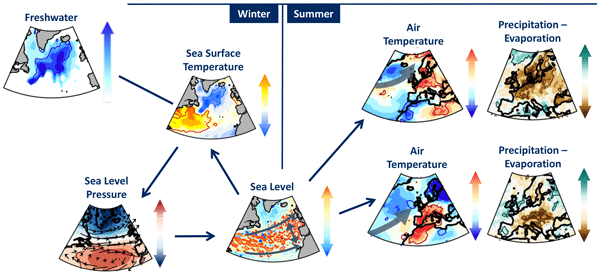
Marilena Oltmanns, N. Penny Holliday, James Screen, Ben I. Moat, Simon A. Josey, D. Gwyn Evans, and Sheldon Bacon
Weather Clim. Dynam., 5, 109–132, https://doi.org/10.5194/wcd-5-109-2024, https://doi.org/10.5194/wcd-5-109-2024, 2024
Short summary
Short summary
The melting of land ice and sea ice leads to freshwater input into the ocean. Based on observations, we show that stronger freshwater anomalies in the subpolar North Atlantic in winter are followed by warmer and drier weather over Europe in summer. The identified link indicates an enhanced predictability of European summer weather at least a winter in advance. It further suggests that warmer and drier summers over Europe can become more frequent under increased freshwater fluxes in the future.
Jakob Simon Dörr, David B. Bonan, Marius Årthun, Lea Svendsen, and Robert C. J. Wills
The Cryosphere, 17, 4133–4153, https://doi.org/10.5194/tc-17-4133-2023, https://doi.org/10.5194/tc-17-4133-2023, 2023
Short summary
Short summary
The Arctic sea-ice cover is retreating due to climate change, but this retreat is influenced by natural (internal) variability in the climate system. We use a new statistical method to investigate how much internal variability has affected trends in the summer and winter Arctic sea-ice cover using observations since 1979. Our results suggest that the impact of internal variability on sea-ice retreat might be lower than what climate models have estimated.
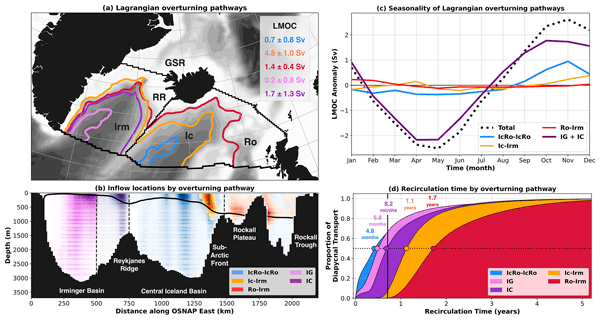
Oliver John Tooth, Helen Louise Johnson, Chris Wilson, and Dafydd Gwyn Evans
Ocean Sci., 19, 769–791, https://doi.org/10.5194/os-19-769-2023, https://doi.org/10.5194/os-19-769-2023, 2023
Short summary
Short summary
This study uses the trajectories of water parcels traced within an ocean model simulation to identify the pathways responsible for the seasonal cycle of dense water formation (overturning) in the eastern subpolar North Atlantic. We show that overturning seasonality is due to the fastest water parcels circulating within the eastern basins in less than 8.5 months. Slower pathways set the average strength of overturning in this region since water parcels cannot escape intense wintertime cooling.
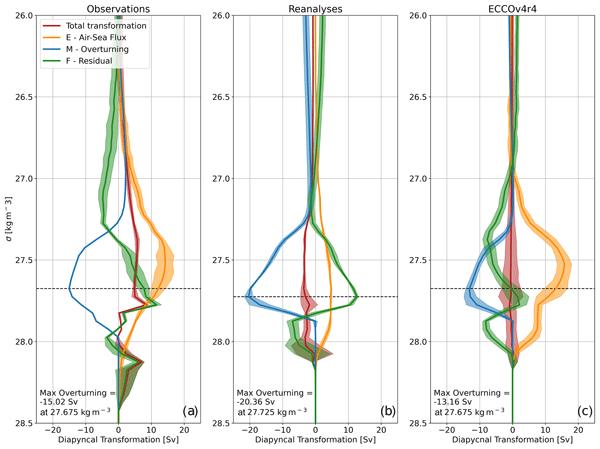
Dafydd Gwyn Evans, N. Penny Holliday, Sheldon Bacon, and Isabela Le Bras
Ocean Sci., 19, 745–768, https://doi.org/10.5194/os-19-745-2023, https://doi.org/10.5194/os-19-745-2023, 2023
Short summary
Short summary
This study investigates the processes that form dense water in the high latitudes of the North Atlantic to determine how they affect the overturning circulation in the Atlantic. We show for the first time that turbulent mixing is an important driver in the formation of dense water, along with the loss of heat from the ocean to the atmosphere. We point out that the simulation of turbulent mixing in ocean–climate models must improve to better predict the ocean's response to climate change.
Ole Rieke, Marius Årthun, and Jakob Simon Dörr
The Cryosphere, 17, 1445–1456, https://doi.org/10.5194/tc-17-1445-2023, https://doi.org/10.5194/tc-17-1445-2023, 2023
Short summary
Short summary
The Barents Sea is the region of most intense winter sea ice loss, and future projections show a continued decline towards ice-free conditions by the end of this century but with large fluctuations. Here we use climate model simulations to look at the occurrence and drivers of rapid ice change events in the Barents Sea that are much stronger than the average ice loss. A better understanding of these events will contribute to improved sea ice predictions in the Barents Sea.

Dipanjan Dey, Aitor Aldama Campino, and Kristofer Döös
Hydrol. Earth Syst. Sci., 27, 481–493, https://doi.org/10.5194/hess-27-481-2023, https://doi.org/10.5194/hess-27-481-2023, 2023
Short summary
Short summary
One of the most striking and robust features of climate change is the acceleration of the atmospheric water cycle branch. Earlier studies were able to provide a quantification of the global atmospheric water cycle, but they missed addressing the atmospheric water transport connectivity within and between ocean basins and land. These shortcomings were overcome in the present study and presented a complete synthesised and quantitative view of the atmospheric water cycle.
Marilena Oltmanns, N. Penny Holliday, James Screen, D. Gwyn Evans, Simon A. Josey, Sheldon Bacon, and Ben I. Moat
Weather Clim. Dynam. Discuss., https://doi.org/10.5194/wcd-2021-79, https://doi.org/10.5194/wcd-2021-79, 2021
Revised manuscript not accepted
Short summary
Short summary
The Arctic is currently warming twice as fast as the global average. This results in enhanced melting and thus freshwater releases into the North Atlantic. Using a combination of observations and models, we show that atmosphere-ocean feedbacks initiated by freshwater releases into the North Atlantic lead to warmer and drier weather over Europe in subsequent summers. The existence of this dynamical link suggests that European summer weather can potentially be predicted months to years in advance.
Cited articles
Aagaard, K., Coachman, L. K., and Carmack, E.: On the halocline of the Arctic Ocean, Deep-Sea Res., 28, 529–545, https://doi.org/10.1016/0198-0149(81)90115-1, 1981. a, b
Aksenov, Y., Ivanov, V. V., Nurser, A. J. G., Bacon, S., Polyakov, I. V., Coward, A. C., Naveira-Garabato, A. C., and Beszczynska-Moeller, A.: The Arctic circumpolar boundary current, J. Geophys. Res.-Oceans, 116, https://doi.org/10.1029/2010JC006637, 2011. a
Aldama-Campino, A., Döös, K., Kjellsson, J., and Jönsson, B.: TRACMASS: Formal release of version 7.0, Zenodo [code], https://doi.org/10.5281/zenodo.4337926, 2020. a, b
Årthun, M.: Surface-forced variability in the Nordic Seas overturning circulation and overflows, Geophys. Res. Lett., 50, e2023GL104158, https://doi.org/10.1029/2023GL104158, 2023. a
Årthun, M., Ingvaldsen, R., Smedsrud, L., and Schrum, C.: Dense water formation and circulation in the Barents Sea, Deep-Sea Res., 58, 801–817, https://doi.org/10.1016/j.dsr.2011.06.001, 2011. a
Årthun, M., Eldevik, T., and Smedsrud, L. H.: The role of Atlantic heat transport in future Arctic winter sea ice loss, J. Climate, 32, 3327–3341, https://doi.org/10.1175/JCLI-D-18-0750.1, 2019. a
Årthun, M., Brakstad, A., Dörr, J., Johnson, H. L., Mans, C., Semper, S., and Våge, K.: Atlantification drives recent strengthening of the Arctic overturning circulation, Science Advances, 11, eadu1794, https://doi.org/10.1126/sciadv.adu1794, 2025. a, b, c, d
Asbjørnsen, H. and Årthun, M.: Deconstructing future AMOC decline at 26.5°N, Geophys. Res. Lett., 50, e2023GL103515, https://doi.org/10.1029/2023GL103515, 2023. a
Athanase, M., Provost, C., Pérez-Hernández, M. D., Sennéchael, N., Bertosio, C., Artana, C., Garric, G., and Lellouche, J.-M.: Atlantic water modification north of Svalbard in the Mercator physical system from 2007 to 2020, J. Geophys. Res.-Oceans, 125, e2020JC016463, https://doi.org/10.1029/2020JC016463, 2020. a, b
Bacon, S., Garabato, A. C. N., Aksenov, Y., Brown, N. J., and Tsubouchi, T.: Arctic Ocean boundary exchanges: a review, Oceanography, 35, 94–102, https://doi.org/10.5670/oceanog.2022.133, 2022. a
Berglund, S., Döös, K., and Nycander, J.: Lagrangian tracing of the water–mass transformations in the Atlantic Ocean, Tellus A, 69, 1306311, https://doi.org/10.1080/16000870.2017.1306311, 2017. a
Berglund, S., Döös, K., Groeskamp, S., and McDougall, T.: North Atlantic ocean circulation and related exchange of heat and salt between water masses, Geophys. Res. Lett., 50, e2022GL100989, https://doi.org/10.1029/2022GL100989, 2023. a
Beszczynska-Möller, A., Woodgate, R., Lee, C., Melling, H., and Karcher, M.: A synthesis of exchanges through the main oceanic gateways to the Arctic Ocean, Oceanography, 24, 82–99, https://doi.org/10.5670/oceanog.2011.59, 2011. a, b
Beszczynska-Möller, A., Fahrbach, E., Schauer, U., and Hansen, E.: Variability in Atlantic water temperature and transport at the entrance to the Arctic Ocean, 1997–2010, ICES J. Mar. Sci., 69, 852–863, https://doi.org/10.1093/icesjms/fss056, 2012. a
Bretones, A., Nisancioglu, K. H., Jensen, M. F., Brakstad, A., and Yang, S.: Transient increase in Arctic deep-water formation and ocean circulation under sea-ice retreat, J. Climate, 35, 109–124, 2022. a
Buckley, M. W., Lozier, M. S., Desbruyères, D., and Evans, D. G.: Buoyancy forcing and the subpolar Atlantic meridional overturning circulation, Philos. T. Roy. Soc. A, 381, 20220181, https://doi.org/10.1098/rsta.2022.0181, 2023. a, b, c, d
Carmack, E. and Wassmann, P.: Food webs and physical–biological coupling on pan-Arctic shelves: unifying concepts and comprehensive perspectives, Prog. Oceanogr., 71, 446–477, https://doi.org/10.1016/j.pocean.2006.10.004, 2006. a
Chafik, L. and Rossby, T.: Volume, heat, and freshwater divergences in the subpolar North Atlantic suggest the Nordic Seas as key to the state of the meridional overturning circulation, Geophys. Res. Lett., 46, 4799–4808, 2019. a
Coachman, L. and Barnes, C.: The movement of Atlantic water in the Arctic Ocean, Arctic, 16, 8–16, 1963. a
Cornish, S. B., Johnson, H. L., Mallett, R. D. C., Dörr, J., Kostov, Y., and Richards, A. E.: Rise and fall of sea ice production in the Arctic Ocean's ice factories, Nat. Commun., 13, 7800, https://doi.org/10.1038/s41467-022-34785-6, 2022. a
Cottier, F. R. and Venables, E. J.: On the double-diffusive and cabbeling environment of the Arctic Front, West Spitsbergen, Polar Res., 26, 152–159, https://doi.org/10.1111/j.1751-8369.2007.00024.x, 2007. a
Curry, B., Lee, C. M., and Petrie, B.: Volume, freshwater, and heat fluxes through Davis Strait, 2004–05, J. Phys. Oceanogr., 41, 429–436, https://doi.org/10.1175/2010JPO4536.1, 2011. a
Dey, D., Marsh, R., Drijfhout, S., Josey, S. A., Sinha, B., Grist, J., and Döös, K.: Formation of the Atlantic Meridional Overturning Circulation lower limb is critically dependent on Atlantic-Arctic mixing, Nat. Commun., 15, 7341, https://doi.org/10.1038/s41467-024-51777-w, 2024. a
Dickson, R. R. and Brown, J.: The production of North Atlantic Deep Water: sources, rates, and pathways, J. Geophys. Res.-Oceans, 99, 12319–12341, 1994. a
Dörr, J.: Lagrangian trajectory data in the Arctic Ocean, Zenodo [data set], https://doi.org/10.5281/zenodo.17047094, 2025. a
Dörr, J., Årthun, M., Eldevik, T., and Sandø, A. B.: Expanding influence of Atlantic and Pacific Ocean heat transport on winter sea-ice variability in a warming Arctic, J. Geophys. Res.-Oceans, 129, e2023JC019900, https://doi.org/10.1029/2023JC019900, 2024. a
Döös, K., Jönsson, B., and Kjellsson, J.: Evaluation of oceanic and atmospheric trajectory schemes in the TRACMASS trajectory model v6.0, Geosci. Model Dev., 10, 1733–1749, https://doi.org/10.5194/gmd-10-1733-2017, 2017. a
Dussin, R., Barnier, B., Brodeau, L., and Molines, J. M.: The Making of the Drakkar Forcing Set DFS5, Zenodo, https://doi.org/10.5281/zenodo.1209243, 2018. a
Eldevik, T. and Nilsen, J. E. Ø.: The Arctic–Atlantic Thermohaline Circulation, J. Climate, 26, 8698–8705, https://doi.org/10.1175/JCLI-D-13-00305.1, 2013. a, b
Evans, D. G.: Code for Water Mass Transformation Analysis, Github [code], https://github.com/dgwynevans/wmt (last access: 1 June 2024), 2023. a
Evans, D. G., Zika, J. D., Naveira Garabato, A. C., and Nurser, A. J. G.: The imprint of Southern Ocean overturning on seasonal water mass variability in Drake Passage, J. Geophys. Res.-Oceans, 119, 7987–8010, https://doi.org/10.1002/2014JC010097, 2014. a, b
Fer, I., Müller, M., and Peterson, A. K.: Tidal forcing, energetics, and mixing near the Yermak Plateau, Ocean Sci., 11, 287–304, https://doi.org/10.5194/os-11-287-2015, 2015. a
Groeskamp, S., Griffies, S. M., Iudicone, D., Marsh, R., Nurser, A. G., and Zika, J. D.: The water mass transformation framework for ocean physics and biogeochemistry, Annu. Rev. Mar. Sci., 11, 271–305, https://doi.org/10.1146/annurev-marine-010318-095421, 2019. a
Hieronymus, M., Nilsson, J., and Nycander, J.: Water mass transformation in salinity–temperature space, J. Phys. Oceanogr., 44, 2547–2568, https://doi.org/10.1175/JPO-D-13-0257.1, 2014. a
Ivanov, V. V., Danshina, A. V., Smirnov, A. V., and Filchuk, K. V.: Transformation of the atlantic water between svalbard and Franz Joseph Land in the late winter 2018–2019, Deep-Sea Res. Pt. I, 206, 104280, https://doi.org/10.1016/j.dsr.2024.104280, 2024. a, b, c
Janout, M. A. and Lenn, Y.-D.: Semidiurnal tides on the Laptev Sea Shelf with implications for shear and vertical mixing, J. Phys. Oceanogr., 44, 202–219, https://doi.org/10.1175/JPO-D-12-0240.1, 2014. a
Janout, M. A., Hölemann, J., Timokhov, L., Gutjahr, O., and Heinemann, G.: Circulation in the northwest Laptev Sea in the eastern Arctic Ocean: crossroads between Siberian River water, Atlantic water and polynya-formed dense water, J. Geophys. Res.-Oceans, 122, 6630–6647, https://doi.org/10.1002/2017JC013159, 2017. a
Karam, S., Heuzé, C., Hoppmann, M., and de Steur, L.: Continued warming of deep waters in the Fram Strait, Ocean Sci., 20, 917–930, https://doi.org/10.5194/os-20-917-2024, 2024. a
Kelly, S., Popova, E., Aksenov, Y., Marsh, R., and Yool, A.: Lagrangian modeling of Arctic Ocean circulation pathways: impact of advection on spread of pollutants, J. Geophys. Res.-Oceans, 123, 2882–2902, https://doi.org/10.1002/2017JC013460, 2018. a, b
Kelly, S. J., Proshutinsky, A., Popova, E. K., Aksenov, Y. K., and Yool, A.: On the origin of water masses in the Beaufort Gyre, J. Geophys. Res.-Oceans, 124, 4696–4709, https://doi.org/10.1029/2019JC015022, 2019. a, b
Lique, C. and Thomas, M. D.: Latitudinal shift of the Atlantic Meridional Overturning Circulation source regions under a warming climate, Nat. Clim. Change, 8, 1013–1020, 2018. a
Lique, C., Treguier, A. M., Blanke, B., and Grima, N.: On the origins of water masses exported along both sides of Greenland: a Lagrangian model analysis, J. Geophys. Res.-Oceans, 115, https://doi.org/10.1029/2009JC005316, 2010. a
Moat, B. I., Josey, S. A., and Sinha, B.: Impact of Barents Sea winter air-sea exchanges on Fram Strait dense water transport, J. Geophys. Res.-Oceans, 119, 1009–1021, https://doi.org/10.1002/2013JC009220, 2014. a, b
Moat, B. I., Josey, S. A., Sinha, B., Blaker, A. T., Smeed, D. A., McCarthy, G. D., Johns, W. E., Hirschi, J. J.-M., Frajka-Williams, E., Rayner, D., Duchez, A., and Coward, A. C.: Major variations in subtropical North Atlantic heat transport at short (5 day) timescales and their causes, J. Geophys. Res.-Oceans, 121, 3237–3249, https://doi.org/10.1002/2016JC011660, 2016. a, b
Notz, D. and SIMIP community: Arctic sea ice in CMIP6, Geophys. Res. Lett., 47, e2019GL086749, https://doi.org/10.1029/2019GL086749, 2020. a
Nurser, A. J. G. and Griffies, S. M.: Relating the diffusive salt flux just below the ocean surface to boundary freshwater and salt fluxes, J. Phys. Oceanogr., https://doi.org/10.1175/JPO-D-19-0037.1, 2019. a
Orvik, K. A. and Niiler, P.: Major pathways of Atlantic water in the northern North Atlantic and Nordic Seas toward Arctic, Geophys. Res. Lett., 29, 2–1, 2002. a
Pasqualini, A., Schlosser, P., Newton, R., Smethie Jr., W. M., and Friedrich, R.: A multi-decade tracer study of the circulation and spreading rates of Atlantic water in the Arctic Ocean, J. Geophys. Res.-Oceans, 129, e2023JC020738, https://doi.org/10.1029/2023JC020738, 2024. a, b, c
Petit, T., Lozier, M. S., Josey, S. A., and Cunningham, S. A.: Atlantic deep water formation occurs primarily in the Iceland Basin and Irminger Sea by local buoyancy forcing, Geophys. Res. Lett., 47, e2020GL091028, https://doi.org/10.1029/2020GL091028, 2020. a
Polyakov, I., Pnyushkov, A. V., Alkire, M. B., Ashik, I. M., Baumann, T. M., Carmack, E. C., Goszczko, I., Guthrie, J., Ivanov, V. V., Kanzow, T., Krishfield, R., Kwok, R., Sundfjord, A., Morison, J., Rember, R., and Yulin, A.: Greater role for Atlantic inflows on sea-ice loss in the Eurasian Basin of the Arctic Ocean, Science, 356, 285–291, https://doi.org/10.1126/science.aai8204, 2017. a
Renner, A. H. H., Sundfjord, A., Janout, M. A., Ingvaldsen, R. B., Beszczynska-Möller, A., Pickart, R. S., and Pérez-Hernández, M. D.: Variability and redistribution of heat in the Atlantic water boundary current north of Svalbard, J. Geophys. Res.-Oceans, 123, 6373–6391, https://doi.org/10.1029/2018JC013814, 2018. a
Rippeth, T. P., Lincoln, B. J., Lenn, Y.-D., Green, J. A. M., Sundfjord, A., and Bacon, S.: Tide-mediated warming of Arctic halocline by Atlantic heat fluxes over rough topography, Nat. Geosci., 8, 191–194, https://doi.org/10.1038/ngeo2350, 2015. a
Rudels, B., Jones, E. P., Schauer, U., and Eriksson, P.: Atlantic sources of the Arctic Ocean surface and halocline waters, Polar Res., 23, 181–208, 2004. a
Rudels, B., Korhonen, M., Schauer, U., Pisarev, S., Rabe, B., and Wisotzki, A.: Circulation and transformation of Atlantic water in the Eurasian Basin and the contribution of the fram strait inflow branch to the Arctic Ocean heat budget, Prog. Oceanogr., 132, 128–152, https://doi.org/10.1016/j.pocean.2014.04.003, 2015. a, b, c
Saloranta, T. M., and Haugan, P. M.: Northward cooling and freshening of the warm core of the West Spitsbergen Current, Polar Res., 23, 79–88, https://doi.org/10.3402/polar.v23i1.6268, 2004. a
Schauer, U., Rudels, B., Jones, E. P., Anderson, L. G., Muench, R. D., Björk, G., Swift, J. H., Ivanov, V., and Larsson, A.-M.: Confluence and redistribution of Atlantic water in the Nansen, Amundsen and Makarov basins, Ann. Geophys., 20, 257–273, https://doi.org/10.5194/angeo-20-257-2002, 2002. a, b
Skagseth, Ø., Eldevik, T., Årthun, M., Asbjørnsen, H., Lien, V. S., and Smedsrud, L. H.: Reduced efficiency of the Barents Sea cooling machine, Nat. Clim. Chang., 10, 661–666, https://doi.org/10.1038/s41558-020-0772-6, 2020. a, b, c
Smedsrud, L. H., Esau, I., Ingvaldsen, R. B., Eldevik, T., Haugan, P. M., Li, C., Lien, V. S., Olsen, A., Omar, A. M., Otterå, O. H., Risebrobakken, B., Sandø, A. B., Semenov, V. A., and Sorokina, S. A.: The role of the Barents Sea in the Arctic climate system, Rev. Geophys., 51, 415–449, https://doi.org/10.1002/rog.20017, 2013. a, b
Smedsrud, L. H., Muilwijk, M., Brakstad, A., Madonna, E., Lauvset, S. K., Spensberger, C., Born, A., Eldevik, T., Drange, H., Jeansson, E., Li, C., Olsen, A., Skagseth, Ø., Slater, D. A., Straneo, F., Våge, K., and Årthun, M.: Nordic seas heat loss, Atlantic inflow, and Arctic sea ice cover over the last century, Rev. Geophys., 60, e2020RG000725, https://doi.org/10.1029/2020RG000725, 2022. a
Steele, M., Morley, R., and Ermold, W.: PHC: a global ocean hydrography with a high-quality Arctic Ocean, J. Climate, 14, 2079–2087, https://doi.org/10.1175/1520-0442(2001)014<2079:PAGOHW>2.0.CO;2, 2001. a, b
Stroeve, J. and Notz, D.: Changing state of Arctic sea ice across all seasons, Environ. Res. Lett., 13, 103001, https://doi.org/10.1088/1748-9326/aade56, 2018. a
Timmermans, M.-L. and Marshall, J.: Understanding Arctic Ocean circulation: a review of ocean dynamics in a changing climate, J. Geophys. Res.-Oceans, 125, e2018JC014378, https://doi.org/10.1029/2018JC014378, 2020. a, b
Tooth, O. J., Foukal, N. P., Johns, W. E., Johnson, H. L., and Wilson, C.: Lagrangian decomposition of the Atlantic Ocean heat transport at 26.5°N, Geophys. Res. Lett., 51, e2023GL107399, https://doi.org/10.1029/2023GL107399, 2024. a, b
Wefing, A.-M., Casacuberta, N., Christl, M., Gruber, N., and Smith, J. N.: Circulation timescales of Atlantic Water in the Arctic Ocean determined from anthropogenic radionuclides, Ocean Sci., 17, 111–129, https://doi.org/10.5194/os-17-111-2021, 2021. a, b
Weijer, W., Cheng, W., Garuba, O. A., Hu, A., and Nadiga, B. T.: CMIP6 models predict significant 21st century decline of the Atlantic meridional overturning circulation, Geophys. Res. Lett., 47, e2019GL086075, https://doi.org/10.1029/2019GL086075, 2020. a
Wilson, C., Aksenov, Y., Rynders, S., Kelly, S. J., Krumpen, T., and Coward, A. C.: Significant variability of structure and predictability of Arctic Ocean surface pathways affects basin-wide connectivity, Communications Earth and Environment, 2, 1–10, https://doi.org/10.1038/s43247-021-00237-0, 2021. a
Woodgate, R. A.: Increases in the Pacific inflow to the Arctic from 1990 to 2015, and insights into seasonal trends and driving mechanisms from year-round Bering Strait mooring data, Prog. Oceanogr., 160, 124–154, https://doi.org/10.1016/j.pocean.2017.12.007, 2018. a
Yeager, S., Castruccio, F., Chang, P., Danabasoglu, G., Maroon, E., Small, J., Wang, H., Wu, L., and Zhang, S.: An outsized role for the Labrador Sea in the multidecadal variability of the Atlantic overturning circulation, Science Advances, 7, eabh3592, https://doi.org/10.1126/sciadv.abh3592, 2021. a
Zhang, R. and Thomas, M.: Horizontal circulation across density surfaces contributes substantially to the long-term mean northern Atlantic Meridional Overturning Circulation, Communications Earth and Environment, 2, 1–12, https://doi.org/10.1038/s43247-021-00182-y, 2021. a, b
Zou, S., Petit, T., Li, F., and Lozier, M. S.: Observation-based estimates of water mass transformation and formation in the Labrador Sea, J. Phys. Oceanogr., https://doi.org/10.1175/JPO-D-23-0235.1, 2024. a, b
Short summary
The Arctic Ocean plays a key role in the global ocean circulation by producing dense waters that feed the lower limb of the Atlantic meridional overturning circulation (AMOC). We use a high-resolution ocean simulation to investigate the pathways and mechanisms through which these dense waters are formed in the Arctic. Our results show that surface cooling in the Barents Sea dominates the dense water production, but that internal mixing plays a role at high densities.
The Arctic Ocean plays a key role in the global ocean circulation by producing dense waters that...


