Articles | Volume 22, issue 4
https://doi.org/10.5194/os-22-2405-2026
© Author(s) 2026. This work is distributed under
the Creative Commons Attribution 4.0 License.
https://doi.org/10.5194/os-22-2405-2026
© Author(s) 2026. This work is distributed under
the Creative Commons Attribution 4.0 License.
Water mass modification of the warm Atlantic Inflow towards the Arctic across the Iceland-Faroe Ridge

Guðrið Eriksdóttir
CORRESPONDING AUTHOR
Faroe Marine Research Institute, Tórshavn, Faroe Islands
Bogi Hansen
Faroe Marine Research Institute, Tórshavn, Faroe Islands
Karin Margretha H. Larsen
Faroe Marine Research Institute, Tórshavn, Faroe Islands
University of the Faroe Islands, Tórshavn, Faroe Islands
Steffen M. Olsen
Danish Meteorological Institute, Copenhagen, Denmark
Andrea M. U. Gierisch
Danish Meteorological Institute, Copenhagen, Denmark
Sólveig Rósa Ólafsdóttir
Marine and Freshwater Research Institute, Hafnarfjörður, Iceland
Related authors
No articles found.
Angel Ruiz-Angulo, Esther Portela, Charly de Marez, Andreas Macrander, Sólveig Rósa Ólafsdóttir, Thomas Meunier, Steingrímur Jónsson, and M. Dolores Pérez-Hernández
Ocean Sci., 22, 1727–1743, https://doi.org/10.5194/os-22-1727-2026, https://doi.org/10.5194/os-22-1727-2026, 2026
Short summary
Short summary
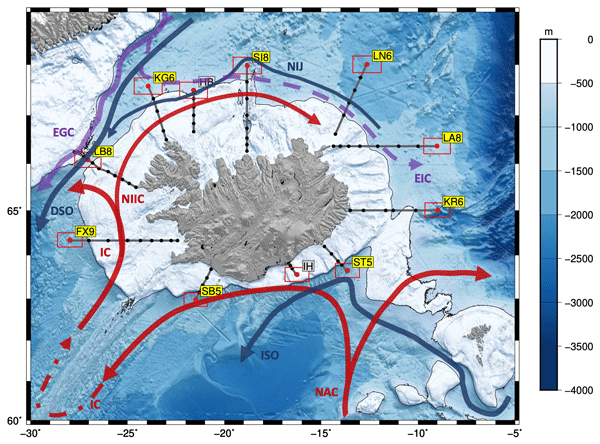
Analysis of 1990–2019 hydrographic around Iceland identifies three dynamical regions: an α-ocean south with warm Atlantic Water and deep mixed layers, a β-ocean northwest with salinity-dominated stratification and shallow mixed layers, and a northeastern transition zone with seasonal shifts. Waters warmed, especially in the northeast, showing Atlantification. Density decreases occur in the south, while other regions show density-compensated variability, with no clear trend in mixed layer depth.
Alexander Hayward, Nishka Dasgupta, Ronan McAdam, Mark R. Payne, Roshin P. Raj, Giulia Bonino, Sourav Chatterjee, Vincent Combes, Dimitra Denaxa, Francesco De Rovere, Pia Englyst, Veera Haapaniemi, Paul Hargous, Jacob Høyer, K. Ajith Joseph, Beatriz Lopes, Ana Oliveira, João Paixão, Fabiola Silva, Saradhy Surendran, Artemis Zegna-Rata, and Steffen Olsen
Earth Syst. Sci. Data Discuss., https://doi.org/10.5194/essd-2025-590, https://doi.org/10.5194/essd-2025-590, 2025
Revised manuscript accepted for ESSD
Short summary
Short summary
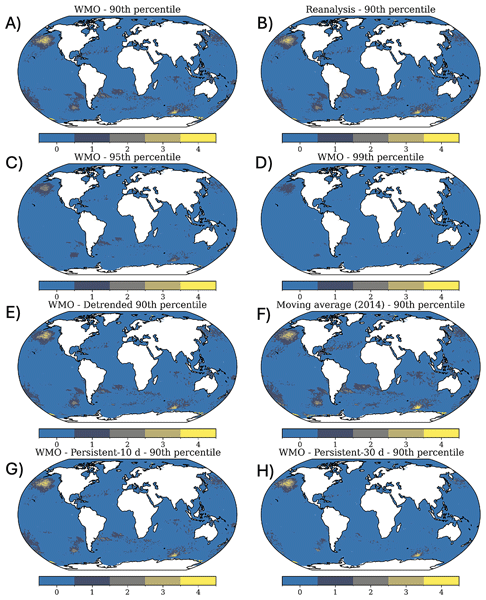
We present a global marine heatwave dataset (1982–2024) based on satellite sea surface temperature. The dataset applies multiple definitions in parallel, varying baselines, thresholds, detrending, and event durations. It enables consistent comparisons of marine heatwave characterisation across methods and supports climate monitoring, model evaluation, and ecological impact studies.
Anna Pedersen, Carolin R. Löscher, and Steffen M. Olsen
Biogeosciences, 22, 5009–5029, https://doi.org/10.5194/bg-22-5009-2025, https://doi.org/10.5194/bg-22-5009-2025, 2025
Short summary
Short summary
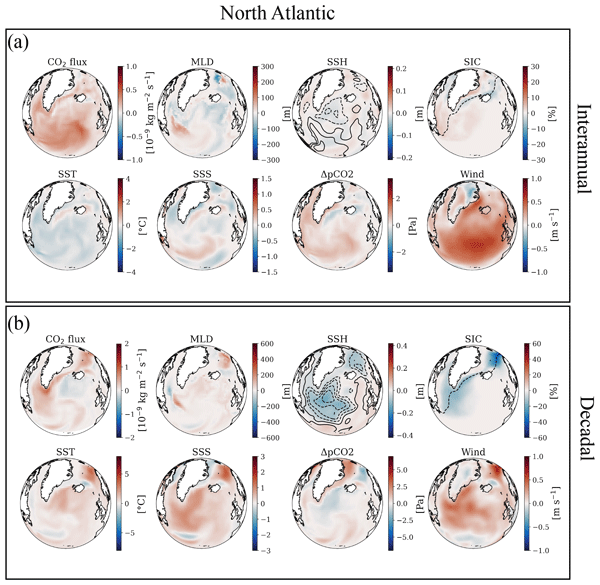
The North Atlantic plays a crucial role in absorbing atmospheric CO2, but its air–sea CO2 flux varies across time and space. Using historical climate model simulations, we investigate how physical and oceanic processes drive the variability. Our results show that sea ice, temperature, salinity, wind stress, and ocean circulation shape CO2 exchange, with short-term fluctuations playing a dominant role. Understanding these complex interactions is key to predicting future ocean carbon uptake.
Sofie Hedetoft, Olivia Bang Brinck, Ruth Mottram, Andrea M. U. Gierisch, Steffen Malskær Olsen, Martin Olesen, Nicolaj Hansen, Anders Anker Bjørk, Erik Loebel, Anne Solgaard, and Peter Thejll
EGUsphere, https://doi.org/10.5194/egusphere-2025-1907, https://doi.org/10.5194/egusphere-2025-1907, 2025
Short summary
Short summary
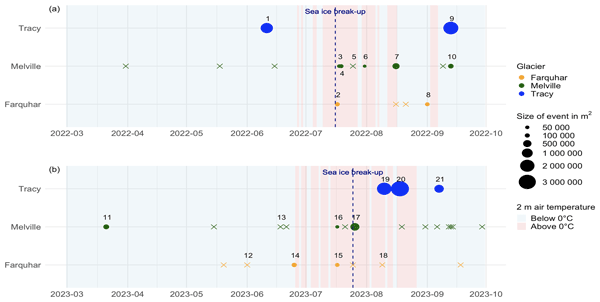
Iceberg mélange is the jumble of icebergs in front of some glaciers that calve into the sea. Some studies suggest mélange might help to control the retreat of glaciers. We studied 3 glaciers in NW Greenland where we used GPS sensors and satellites to track ice movement. We found that glaciers push forward and calve all year, including when mélange and landfast sea ice are present, suggesting mélange is not important in supporting glaciers, but may influence the seasonal calving cycle.
Nico Lange, Björn Fiedler, Marta Álvarez, Alice Benoit-Cattin, Heather Benway, Pier Luigi Buttigieg, Laurent Coppola, Kim Currie, Susana Flecha, Dana S. Gerlach, Makio Honda, I. Emma Huertas, Siv K. Lauvset, Frank Muller-Karger, Arne Körtzinger, Kevin M. O'Brien, Sólveig R. Ólafsdóttir, Fernando C. Pacheco, Digna Rueda-Roa, Ingunn Skjelvan, Masahide Wakita, Angelicque White, and Toste Tanhua
Earth Syst. Sci. Data, 16, 1901–1931, https://doi.org/10.5194/essd-16-1901-2024, https://doi.org/10.5194/essd-16-1901-2024, 2024
Short summary
Short summary
The Synthesis Product for Ocean Time Series (SPOTS) is a novel achievement expanding and complementing the biogeochemical data landscape by providing consistent and high-quality biogeochemical time-series data from 12 ship-based fixed time-series programs. SPOTS covers multiple unique marine environments and time-series ranges, including data from 1983 to 2021. All in all, it facilitates a variety of applications that benefit from the collective value of biogeochemical time-series observations.
Christoph Heinze, Thorsten Blenckner, Peter Brown, Friederike Fröb, Anne Morée, Adrian L. New, Cara Nissen, Stefanie Rynders, Isabel Seguro, Yevgeny Aksenov, Yuri Artioli, Timothée Bourgeois, Friedrich Burger, Jonathan Buzan, B. B. Cael, Veli Çağlar Yumruktepe, Melissa Chierici, Christopher Danek, Ulf Dieckmann, Agneta Fransson, Thomas Frölicher, Giovanni Galli, Marion Gehlen, Aridane G. González, Melchor Gonzalez-Davila, Nicolas Gruber, Örjan Gustafsson, Judith Hauck, Mikko Heino, Stephanie Henson, Jenny Hieronymus, I. Emma Huertas, Fatma Jebri, Aurich Jeltsch-Thömmes, Fortunat Joos, Jaideep Joshi, Stephen Kelly, Nandini Menon, Precious Mongwe, Laurent Oziel, Sólveig Ólafsdottir, Julien Palmieri, Fiz F. Pérez, Rajamohanan Pillai Ranith, Juliano Ramanantsoa, Tilla Roy, Dagmara Rusiecka, J. Magdalena Santana Casiano, Yeray Santana-Falcón, Jörg Schwinger, Roland Séférian, Miriam Seifert, Anna Shchiptsova, Bablu Sinha, Christopher Somes, Reiner Steinfeldt, Dandan Tao, Jerry Tjiputra, Adam Ulfsbo, Christoph Völker, Tsuyoshi Wakamatsu, and Ying Ye
Biogeosciences Discuss., https://doi.org/10.5194/bg-2023-182, https://doi.org/10.5194/bg-2023-182, 2023
Revised manuscript not accepted
Short summary
Short summary
For assessing the consequences of human-induced climate change for the marine realm, it is necessary to not only look at gradual changes but also at abrupt changes of environmental conditions. We summarise abrupt changes in ocean warming, acidification, and oxygen concentration as the key environmental factors for ecosystems. Taking these abrupt changes into account requires greenhouse gas emissions to be reduced to a larger extent than previously thought to limit respective damage.
Michael Mayer, Takamasa Tsubouchi, Susanna Winkelbauer, Karin Margretha H. Larsen, Barbara Berx, Andreas Macrander, Doroteaciro Iovino, Steingrímur Jónsson, and Richard Renshaw
State Planet, 1-osr7, 14, https://doi.org/10.5194/sp-1-osr7-14-2023, https://doi.org/10.5194/sp-1-osr7-14-2023, 2023
Short summary
Short summary
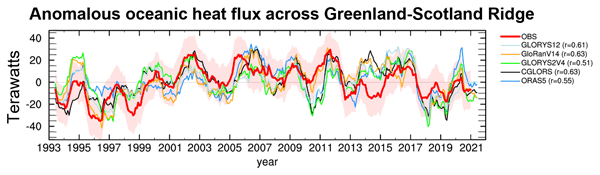
This paper compares oceanic fluxes across the Greenland–Scotland Ridge (GSR) from ocean reanalyses to largely independent observational data. Reanalyses tend to underestimate the inflow of warm waters of subtropical Atlantic origin and hence oceanic heat transport across the GSR. Investigation of a strong negative heat transport anomaly around 2018 highlights the interplay of variability on different timescales and the need for long-term monitoring of the GSR to detect forced climate signals.
Bogi Hansen, Karin M. H. Larsen, Hjálmar Hátún, Steffen M. Olsen, Andrea M. U. Gierisch, Svein Østerhus, and Sólveig R. Ólafsdóttir
Ocean Sci., 19, 1225–1252, https://doi.org/10.5194/os-19-1225-2023, https://doi.org/10.5194/os-19-1225-2023, 2023
Short summary
Short summary
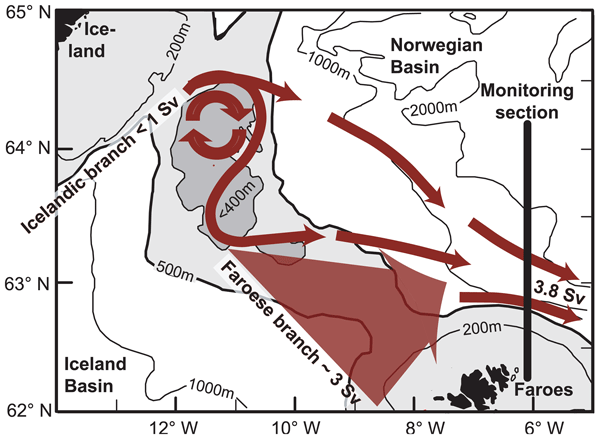
Based on in situ observations combined with sea level anomaly (SLA) data from satellite altimetry, volume as well as heat (relative to 0 °C) transport of the Iceland–Faroe warm-water inflow towards the Arctic (IF inflow) increased from 1993 to 2021. The reprocessed SLA data released in December 2021 represent observed variations accurately. The IF inflow crosses the Iceland–Faroe Ridge in two branches, with retroflection in between. The associated coupling to overflow reduces predictability.
Gilles Reverdin, Claire Waelbroeck, Catherine Pierre, Camille Akhoudas, Giovanni Aloisi, Marion Benetti, Bernard Bourlès, Magnus Danielsen, Jérôme Demange, Denis Diverrès, Jean-Claude Gascard, Marie-Noëlle Houssais, Hervé Le Goff, Pascale Lherminier, Claire Lo Monaco, Herlé Mercier, Nicolas Metzl, Simon Morisset, Aïcha Naamar, Thierry Reynaud, Jean-Baptiste Sallée, Virginie Thierry, Susan E. Hartman, Edward W. Mawji, Solveig Olafsdottir, Torsten Kanzow, Anton Velo, Antje Voelker, Igor Yashayaev, F. Alexander Haumann, Melanie J. Leng, Carol Arrowsmith, and Michael Meredith
Earth Syst. Sci. Data, 14, 2721–2735, https://doi.org/10.5194/essd-14-2721-2022, https://doi.org/10.5194/essd-14-2721-2022, 2022
Short summary
Short summary
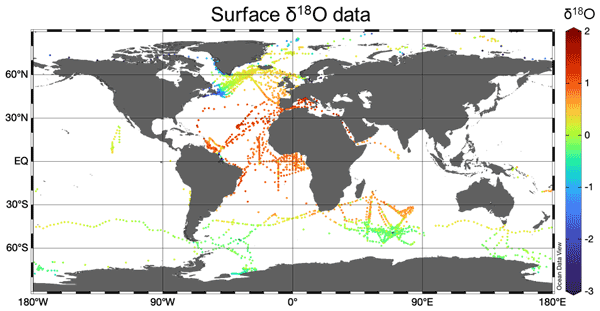
The CISE-LOCEAN seawater stable isotope dataset has close to 8000 data entries. The δ18O and δD isotopic data measured at LOCEAN have uncertainties of at most 0.05 ‰ and 0.25 ‰, respectively. Some data were adjusted to correct for evaporation. The internal consistency indicates that the data can be used to investigate time and space variability to within 0.03 ‰ and 0.15 ‰ in δ18O–δD17; comparisons with data analyzed in other institutions suggest larger differences with other datasets.
Imke Sievers, Andrea M. U. Gierisch, Till A. S. Rasmussen, Robinson Hordoir, and Lars Stenseng
The Cryosphere Discuss., https://doi.org/10.5194/tc-2022-84, https://doi.org/10.5194/tc-2022-84, 2022
Preprint withdrawn
Short summary
Short summary
To predict Arctic sea ice models are used. Many ice models exists. They all are skill full, but give different results. Often this differences result from forcing as for example air temperature. Other differences result from the way the physical equations are solved in the model. In this study two commonly used models are compared under equal forcing, to find out how much the models differ under similar external forcing. The results are compared to observations and to eachother.
Filippa Fransner, Friederike Fröb, Jerry Tjiputra, Nadine Goris, Siv K. Lauvset, Ingunn Skjelvan, Emil Jeansson, Abdirahman Omar, Melissa Chierici, Elizabeth Jones, Agneta Fransson, Sólveig R. Ólafsdóttir, Truls Johannessen, and Are Olsen
Biogeosciences, 19, 979–1012, https://doi.org/10.5194/bg-19-979-2022, https://doi.org/10.5194/bg-19-979-2022, 2022
Short summary
Short summary
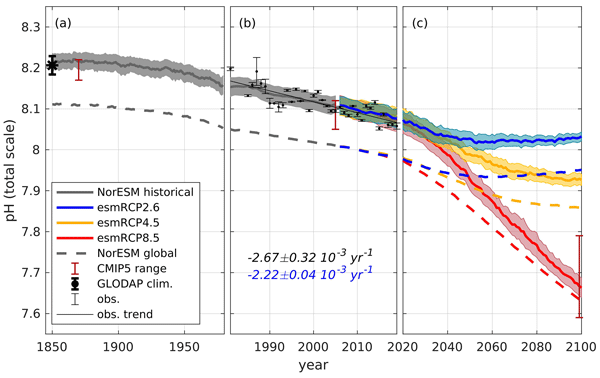
Ocean acidification, a direct consequence of the CO2 release by human activities, is a serious threat to marine ecosystems. In this study, we conduct a detailed investigation of the acidification of the Nordic Seas, from 1850 to 2100, by using a large set of samples taken during research cruises together with numerical model simulations. We estimate the effects of changes in different environmental factors on the rate of acidification and its potential effects on cold-water corals.
Yu Yan, Wei Gu, Andrea M. U. Gierisch, Yingjun Xu, and Petteri Uotila
Geosci. Model Dev., 15, 1269–1288, https://doi.org/10.5194/gmd-15-1269-2022, https://doi.org/10.5194/gmd-15-1269-2022, 2022
Short summary
Short summary
In this study, we developed NEMO-Bohai, an ocean–ice model for the Bohai Sea, China. This study presented the scientific design and technical choices of the parameterizations for the NEMO-Bohai model. The model was calibrated and evaluated with in situ and satellite observations of ocean and sea ice. NEMO-Bohai is intended to be a valuable tool for long-term ocean and ice simulations and climate change studies.
Sissal Vágsheyg Erenbjerg, Jon Albretsen, Knud Simonsen, Erna Lava Olsen, Eigil Kaas, and Bogi Hansen
Ocean Sci., 17, 1639–1655, https://doi.org/10.5194/os-17-1639-2021, https://doi.org/10.5194/os-17-1639-2021, 2021
Short summary
Short summary
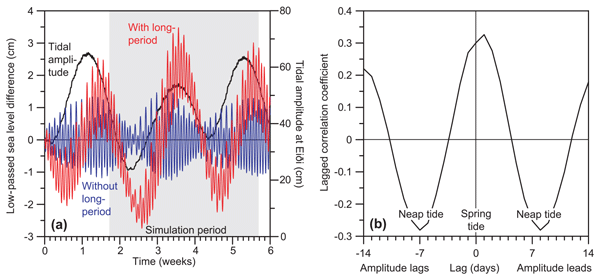
Here, we describe a strait that has narrow and shallow sills in both ends and is close to an amphidromic region. This generates tidally driven flows into and out of the strait, but with very different exchange rates across the entrances in both ends so that it behaves like a mixture between a strait and a fjord. Using a numerical model, we find a fortnightly signal in the net transport through the strait, generated by long-period tides. Our findings are verified by observations.
Cited articles
Argo: Argo float data and metadata from Global Data Assembly Centre (Argo GDAC), SEANOE, https://doi.org/10.17882/42182, 2026.
Arias, P. A., Bellouin, N., Coppola, E., Jones, R. G., Krinner, G., Marotzke, J., Naik, V., Palmer, M. D., Plattner, G.-K., Rogelj, J., Rojas, M., Sillmann, J., Storelvmo, T., Thorne, P. W., Trewin, B., Achuta Rao, K., Adhikary, B., Allan, R. P., Armour, K., Bala, G., Barimalala, R., Berger, S., Canadell, J. G., Cassou, C., Cherchi, A., Collins, W., Collins, W. D., Connors, S. L., Corti, S., Cruz, F., Dentener, F. J., Dereczynski, C., Di Luca, A., Diongue Niang, A., Doblas-Reyes, F. J., Dosio, A., Douville, H., Engelbrecht, F., Eyring, V., Fischer, E., Forster, P., Fox-Kemper, B., Fuglestvedt, J. S., Fyfe, J. C., Gillett, N. P., Goldfarb, L., Gorodetskaya, I., Gutierrez, J. M., Hamdi, R., Hawkins, E., Hewitt, H. T., Hope, P., Islam, A. S., Jones, C., Kaufman, D. S., Kopp, R. E., Kosaka, Y., Kossin, J., Krakovska, S., Lee, J.-Y., Li, J., Mauritsen, T., Maycock, T. K., Meinshausen, M., Min, S.-K., Monteiro, P. M. S., Ngo-Duc, T., Otto, F., Pinto, I., Pirani, A., Raghavan, K., Ranasinghe, R., Ruane, A. C., Ruiz, L., Sallée, J.-B., Samset, B. H., Sathyendranath, S., Seneviratne, S. I., Sörensson, A. A., Szopa, S., Takayabu, I., Tréguier, A.-M., van den Hurk, B., Vautard, R., von Schuckmann, K., Zaehle, S., Zhang, X., and Zickfeld, K.: Technical Summary, in: Climate Change 2021: The Physical Science Basis, Contribution of Working Group I to the Sixth Assessment Report of the Intergovernmental Panel on Climate Change, edited by: Masson-Delmotte, V., Zhai, P., Pirani, A., Connors, S. L., Péan, C., Berger, S., Caud, N., Chen, Y., Goldfarb, Z., Gomis, M. I., Huang, M., Leitzell, K., Lonnoy, E., Matthews, J. B. R., Maycock, T. K., Waterfield, T., Yelekçi, O., Yu, R., and Zhou, B., Cambridge University Press, Cambridge, United Kingdom and New York, NY, USA, 33–144, https://doi.org/10.1017/9781009157896.002, 2021.
Årthun, M., Eldevik, T., Viste, E., Drange, H., Furevik, T., Johnson, H. L., and Keenlyside, N. S.: Skillful prediction of northern climate provided by the ocean, Nat. Commun., 8, https://doi.org/10.1038/NCOMMS15875, 2017.
Årthun, M., Brakstad, A., Dörr, J., Johnson, H. L., Mans, C., Semper, S., and Våge, K.: Atlantification drives recent strengthening of the Arctic overturning circulation, Sci. Adv., 11, eadu1794, https://doi.org/10.1126/SCIADV.ADU1794, 2025.
Beaird, N. L., Rhines, P. B., and Eriksen, C. C.: Overflow waters at the Iceland-Faroe Ridge observed in multiyear seaglider surveys, J. Phys. Oceanogr., 43, 2334–2351, https://doi.org/10.1175/JPO-D-13-029.1, 2013.
Beaird, N. L., Rhines, P. B., and Eriksen, C. C.: Observations of seasonal subduction at the Iceland-Faroe Front, J. Geophys. Res.-Oceans, 121, 4026–4040, https://doi.org/10.1002/2015JC011501, 2016.
Biri, S. and Klein, B.: North Atlantic Sub-Polar Gyre Climate Index: A New Approach, J. Geophys. Res.-Oceans, 124, 4222–4237, https://doi.org/10.1029/2018JC014822, 2019.
Brambilla, E. and Talley, L. D.: Surface drifter exchange between the North Atlantic subtropical and subpolar gyres, J. Geophys. Res.-Oceans, 111, https://doi.org/10.1029/2005JC003146, 2006.
Buckley, M. W. and Marshall, J.: Observations, inferences, and mechanisms of the Atlantic Meridional Overturning Circulation: A review, Rev. Geophys., 54, 5–63, https://doi.org/10.1002/2015RG000493, 2016.
Childers, K. H., Flagg, C. N., and Rossby, T.: Direct velocity observations of volume flux between Iceland and the Shetland Islands, J. Geophys. Res.-Oceans, 119, 5934–5944, https://doi.org/10.1002/2014JC009946, 2014.
Childers, K. H., Flagg, C. N., Rossby, T., and Schrum, C.: Directly measured currents and estimated transport pathways of Atlantic Water between 59.58N and the Iceland-Faroes-Scotland Ridge, Tellus A, 67, 28067, https://doi.org/10.3402/tellusa.v67.28067, 2015.
Cushman-Roisin, B.: Introduction to Geophysical Fluid Dynamics, Prentice-Hall, Inc., New Jersey, ISBN 0-13-353301-8, 1994.
de Marez, C., Ruiz-Angulo, A., and Gula, J.: Mesoscale Induced Vertical Fluxes Over the Iceland-Faroe Ridge, Geophys. Res. Lett., 52, https://doi.org/10.1029/2025GL115520, 2025.
Dickson, R. R. and Brown, J.: The production of North Atlantic deep water, sources, rates, and pathways, J. Geophys. Res., 99, 12319–12341, https://doi.org/10.1029/94JC00530, 1994.
Fogelqvist, E., Blindheim, J., Tanhua, T., Østerhus, S., Buch, E., and Rey, F.: Greenland–Scotland overflow studied by hydro-chemical multivariate analysis, Deep-Sea Res. Pt. I, 50, 73–102, https://doi.org/10.1016/S0967-0637(02)00131-0, 2003.
Foukal, N. P. and Lozier, M. S.: Assessing variability in the size and strength of the North Atlantic subpolar gyre, J. Geophys. Res.-Oceans, 122, 6295–6308, https://doi.org/10.1002/2017JC012798, 2017.
Geyer, F., Østerhus, S., Hansen, B., and Quadfasel, D.: Observations of highly regular oscillations in the overflow plume downstream of the Faroe Bank Channel, J. Geophys. Res., 111, C12020, https://doi.org/10.1029/2006JC003693, 2006.
González-Pola, C., Larsen, K. M. H., Fratantoni, P., and Beszczynska-Möller, A. (Eds.): ICES Report on ocean climate 2020, ICES Cooperative Research Reports, 356, 121, https://doi.org/10.17895/ices.pub.19248602, 2022.
Häkkinen, S. and Rhines, P. B.: Decline of Subpolar North Atlantic Circulation during the 1990s, Science, 304, 555–559, https://doi.org/10.1126/SCIENCE.1094917, 2004.
Hansen, B. and Meincke, J.: Eddies and meanders in the Iceland-Faroe Ridge area, Deep-Sea Res. Pt. A., 26, 1067–1082, https://doi.org/10.1016/0198-0149(79)90048-7, 1979.
Hansen, B. and Østerhus, S.: North Atlantic-Nordic Seas exchanges, Prog. Oceanogr., 45, 109–208, https://doi.org/10.1016/S0079-6611(99)00052-X, 2000.
Hansen, B., Østerhus, S., Hátún, H., Kristiansen, R., and Larsen, K. M. H.: The Iceland-Faroe inflow of Atlantic water to the Nordic Seas, Prog. Oceanogr., 59, 4, 443–474, https://doi.org/10.1016/j.pocean.2003.10.003, 2003.
Hansen, B., Hátún, H., Kristiansen, R., Olsen, S. M., and Østerhus, S.: Stability and forcing of the Iceland-Faroe inflow of water, heat, and salt to the Arctic, Ocean Sci., 6, 1013–1026, https://doi.org/10.5194/os-6-1013-2010, 2010.
Hansen, B., Larsen, K. M. H., Hátún, H., Kristiansen, R., Mortensen, E., and Østerhus, S.: Transport of volume, heat, and salt towards the Arctic in the Faroe Current 1993–2013, Ocean Sci., 11, 743–757, https://doi.org/10.5194/os-11-743-2015, 2015.
Hansen, B., Larsen, K. M. H., Hátún, H., Olsen, S. M., Gierisch, A. M. U., Østerhus, S., and Ólafsdóttir, S. R.: The Iceland–Faroe warm-water flow towards the Arctic estimated from satellite altimetry and in situ observations, Ocean Sci., 19, 1225–1252, https://doi.org/10.5194/os-19-1225-2023, 2023.
Hátún, H. and Chafik, L.: On the Recent Ambiguity of the North Atlantic Subpolar Gyre Index, J. Geophys. Res.-Oceans, 123, 5072–5076, https://doi.org/10.1029/2018JC014101, 2018.
Hátún, H., Sande, A. B., Drange, H., Hansen, B., and Valdimarsson, H.: Influence of the Atlantic Subpolar Gyre on the Thermohaline Circulation, Science, 309, 1841–1844, https://doi.org/10.1126/SCIENCE.1114777, 2005.
Jakobsen, P. K., Ribergaard, M. H., Quadfasel, D., Schmith, T., and Hughes, C. W.: Near-surface circulation in the northern North Atlantic as inferred from Lagrangian drifters: Variability from the mesoscale to interannual, J. Geophys. Res, 108, 3251, https://doi.org/10.1029/2002JC001554, 2003.
Jochumsen, K., Schnurr, S. M., and Quadfasel, D.: Bottom temperature and salinity distribution and its variability around Iceland, Deep-Sea Res. Pt. I, 111, 79–90, https://doi.org/10.1016/J.DSR.2016.02.009, 2016.
Knudsen, M.: Den Danske Ingolf-expedition, Bianco Lunos Kgl Hof-Bogtrykkeri (F. Dreyer), København, 1, 21–154, https://hdl.handle.net/2027/uc1.31210011308259 (last access: 4 August 2026), 1898.
Koman, G., Johns, W. E., Houk, A., Houpert, L., and Li, F.: Circulation and overturning in the eastern North Atlantic subpolar gyre, Prog. Oceanogr., 208, 102884, https://doi.org/10.1016/j.pocean.2022.102884, 2022.
Larsen, K. M. H., Hátún, H., Hansen, B., and Kristiansen, R.: Atlantic water in the Faroe area: sources and variability, ICES J. Mar. Sci., 69, 802–808, https://doi.org/10.1093/icesjms/fss028, 2012.
Meincke, J.: The hydrographic section along the Iceland–Faroe Ridge carried out by R.V. “Anton Dohrn” in 1959–1971, Berichte der Deutschen Wissenschaftlichen Kommission für Meeresforschung, 22, 372–384, 1972.
Meincke, J.: On the distribution of low salinity intermediate waters around the Faroes, Deutsche Hydrographische Zeitschrift, 31, 50–64, https://doi.org/10.1007/BF02226000, 1978.
Mulet, S., Rio, M.-H., Etienne, H., Artana, C., Cancet, M., Dibarboure, G., Feng, H., Husson, R., Picot, N., Provost, C., and Strub, P. T.: The new CNES-CLS18 global mean dynamic topography, Ocean Sci., 17, 789–808, https://doi.org/10.5194/os-17-789-2021, 2021.
Olsen, S. M., Hansen, B., Østerhus, S., Quadfasel, D., and Valdimarsson, H.: Biased thermohaline exchanges with the Arctic across the Iceland–Faroe Ridge in ocean climate models, Ocean Sci., 12, 545–560, https://doi.org/10.5194/os-12-545-2016, 2016.
Østerhus, S., Woodgate, R., Valdimarsson, H., Turrell, B., de Steur, L., Quadfasel, D., Olsen, S. M., Moritz, M., Lee, C. M., Larsen, K. M. H., Jónsson, S., Johnson, C., Jochumsen, K., Hansen, B., Curry, B., Cunningham, S., and Berx, B.: Arctic Mediterranean exchanges: a consistent volume budget and trends in transports from two decades of observations, Ocean Sci., 15, 379–399, https://doi.org/10.5194/os-15-379-2019, 2019.
Perkins, H., Hopkins, T. S., Malmberg, S.-A., Poulain, P.-M., and Warn-Varnas, A.: Oceanographic conditions east of Iceland, J. Geophys. Res., 103, 531–552, https://doi.org/10.1029/98JC00890, 1998.
Poulain, P. M., Gerin, R., Mauri, E., and Pennel, R.: Wind Effects on Drogued and Undrogued Drifters in the Eastern Mediterranean, J. Atmos. Ocean. Tech., 26, 1144–1156, https://doi.org/10.1175/2008JTECHO618.1, 2009.
Read, J. F. and Pollard, R. T.: Water Masses in the Region of the Iceland-Færoes Front, J. Phys. Oceanogr., 22, https://doi.org/10.1175/1520-0485(1992)022<1365:WMITRO>2.0.CO;2, 1992.
Roemmich, D. and Gilson, J.: The 2004–2008 mean and annual cycle of temperature, salinity, and steric height in the global ocean from the Argo Program, Prog. Oceanogr., 82, 81–100, https://doi.org/10.1016/J.POCEAN.2009.03.004, 2009.
Rossby, T., Prater, M. D., and Søiland, H.: Pathways of inflow and dispersion of warm waters in the Nordic seas, J. Geophys. Res-Oceans., 114, C04011, https://doi.org/10.1029/2008JC005073, 2009.
Sutton, R. T. and Allen, M. R.: Decadal predictability of North Atlantic sea surface temperature and climate, Nature, 388, 563–567, https://doi.org/10.1038/41523, 1997.
Tait, J. B.: The Iceland-Faroe Ridge International (ICES) “Overflow” Expedition, May–June 1960, Rapports et Procès-Verbaux des Rèunions du Conseil International pour l'Exploration de la Mer, 157, 71, https://epic.awi.de/id/eprint/27312/1/Tai1967a.pdf (last access: 4 August 2026), 1967.
Tranchant, Y.-T., Legresy, B., Foppert, A., Pena-Molino, B., and Phillips, H. E.: SWOT reveals fine-scale balanced motions and dispersion properties in the Antarctic Circumpolar Current, Earth Space Sci., https://doi.org/10.22541/ESSOAR.173655552.25945463/V2, 2025.
Ullgren, J. E., Darelius, E., and Fer, I.: Volume transport and mixing of the Faroe Bank Channel overflow from one year of moored measurements, Ocean Sci., 12, 451–470, https://doi.org/10.5194/os-12-451-2016, 2016.
Worsfold, M., Good, S., Atkinson, C., and Embury, O.: Presenting a Long-Term, Reprocessed Dataset of Global Sea Surface Temperature Produced Using the OSTIA System, Remote Sens., 16, 3358, https://doi.org/10.3390/RS16183358, 2024.
Short summary
The Atlantic inflow across the Iceland-Faroe Ridge carries almost half of the warm water towards the Arctic. This study explores the modifications of the Atlantic water on its way to and across this underwater ridge. While crossing the ridge, the water is strongly cooled and freshened, which can reduce the ability for deep-water formation. Understanding these processes is important for improving ocean and climate models so more realistic forecasts can be made in a warming climate.
The Atlantic inflow across the Iceland-Faroe Ridge carries almost half of the warm water towards...