
Articles | Volume 22, issue 4
https://doi.org/10.5194/os-22-2143-2026
© Author(s) 2026. This work is distributed under
the Creative Commons Attribution 4.0 License.
the Creative Commons Attribution 4.0 License.
Special issue:
https://doi.org/10.5194/os-22-2143-2026
© Author(s) 2026. This work is distributed under
the Creative Commons Attribution 4.0 License.
the Creative Commons Attribution 4.0 License.
Research article
| 
09 Jul 2026
Research article |
| 09 Jul 2026
| 09 Jul 2026
Filamentogenesis and Filamentolysis of a Low-Density Filament: Dynamic Processes in the Near-Surface Ocean Under Tidal Forcing
Michelle Albinus
CORRESPONDING AUTHOR

Carl von Ossietzky Universität, Institute for Chemistry and Biology of the Marine Environment, Marine Sensorsystems, Oldenburg, Germany
Thomas H. Badewien
Carl von Ossietzky Universität, Institute for Chemistry and Biology of the Marine Environment, Marine Sensorsystems, Oldenburg, Germany
Lisa Gassen
Carl von Ossietzky Universität, Institute for Chemistry and Biology of the Marine Environment, Processing and Sensing of Marine Interfaces, Oldenburg, Germany
Oliver Wurl
Carl von Ossietzky Universität, Institute for Chemistry and Biology of the Marine Environment, Processing and Sensing of Marine Interfaces, Oldenburg, Germany
Jens Meyerjürgens
CORRESPONDING AUTHOR
Carl von Ossietzky Universität, Institute for Chemistry and Biology of the Marine Environment, Marine Sensorsystems, Oldenburg, Germany
German Aerospace Center (DLR), Institute for the Protection of Maritime Infrastructures, Fischkai 1, 27572 Bremerhaven, Germany
Related authors
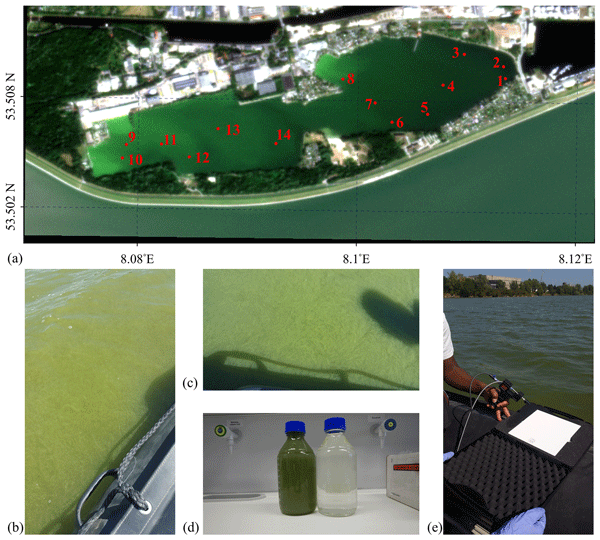
Shungudzemwoyo P. Garaba, Michelle Albinus, Guido Bonthond, Sabine Flöder, Mario L. M. Miranda, Sven Rohde, Joanne Y. L. Yong, and Jochen Wollschläger
Earth Syst. Sci. Data, 15, 4163–4179, https://doi.org/10.5194/essd-15-4163-2023, https://doi.org/10.5194/essd-15-4163-2023, 2023
Short summary
Short summary
These high-quality data document a harmful algal bloom dominated by Nodularia spumigena, a cyanobacterium that has been recurring in waters around the world, using advanced water observation technologies. We also showcase the benefits of experiments of opportunity and the issues with obtaining synoptic spatio-temporal data for monitoring water quality. The dataset can be leveraged to gain more knowledge on related blooms, develop detection algorithms and optimize future monitoring efforts.
Samuel Mintah Ayim and Oliver Wurl
EGUsphere, https://doi.org/10.5194/egusphere-2026-4866, https://doi.org/10.5194/egusphere-2026-4866, 2026
This preprint is open for discussion and under review for Ocean Science (OS).
Short summary
Short summary
We investigated whether small-scale changes in seawater properties at the ocean surface reflect those below. An autonomous surface vehicle measured water density at the ultra-thin skin layer and one meter deep in the German Bight. Skin density patterns frequently differed from the underlying water and were driven more by salinity than temperature. This suggests that satellite observations of the ocean skin may not accurately represent underlying water dynamics in complex coastal waters.
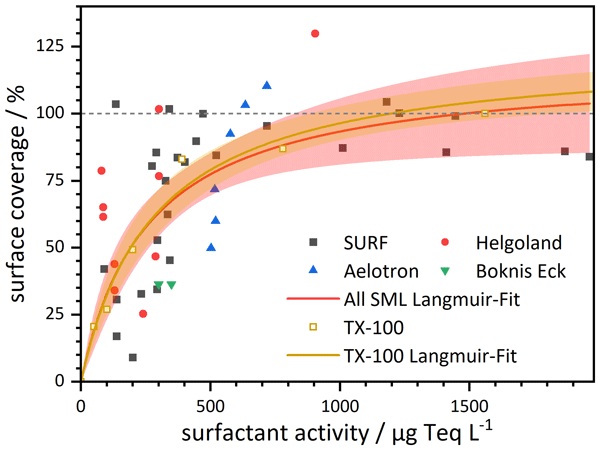
Falko Asmussen-Schäfer, Mariana Ribas-Ribas, Oliver Wurl, and Gernot Friedrichs
Biogeosciences, 23, 3159–3178, https://doi.org/10.5194/bg-23-3159-2026, https://doi.org/10.5194/bg-23-3159-2026, 2026
Short summary
Short summary
We developed an approach to quantify how molecules accumulate at the ocean surface on a nanometer scale. By combining laser spectroscopy with an electrochemical technique, we determined how densely these molecular films cover the water surface. Such single-molecule-thick layers can strongly affect gas transfer between the ocean and the atmosphere. Comparing our measurements with existing datasets allowed us to generate an initial global estimate of surfactant surface coverage potential.

Amavi Silva, Surandokht Nikzad, Theresa Barthelmeß, Anja Engel, Hartmut Herrmann, Manuela van Pinxteren, Kai Wirtz, Oliver Wurl, and Markus Schartau
Biogeosciences, 23, 1697–1718, https://doi.org/10.5194/bg-23-1697-2026, https://doi.org/10.5194/bg-23-1697-2026, 2026
Short summary
Short summary
We conducted the first meta-analysis combining marine and freshwater studies to understand organic matter enrichment in the surface microlayer. Nitrogen-rich, particulate compounds are often enriched, with patterns varying by multiple factors. We recommend tracking both absolute concentrations and normalized enrichment patterns to better assess ecological conditions. Our study also introduces improved statistical methods for analyzing and comparing surface microlayer data.

Carsten Rauch, Lisa Deyle, Leonie Jaeger, Edgar Fernando Cortés-Espinoza, Mariana Ribas-Ribas, Josefine Karnatz, Anja Engel, and Oliver Wurl
Ocean Sci., 22, 403–426, https://doi.org/10.5194/os-22-403-2026, https://doi.org/10.5194/os-22-403-2026, 2026
Short summary
Short summary
Microsensors measuring oxygen and temperature were used to gain high-resolution profiles across the surface of a water basin, in which an algal bloom was induced. These novel data show that the oxygen at the sea surface is highly influenced by algal blooms, while the temperature is only indirectly affected by them. Since algal blooms occur globally, this has considerable implications for calculating global air-sea exchanges of gases or heat, especially under low-wind conditions.
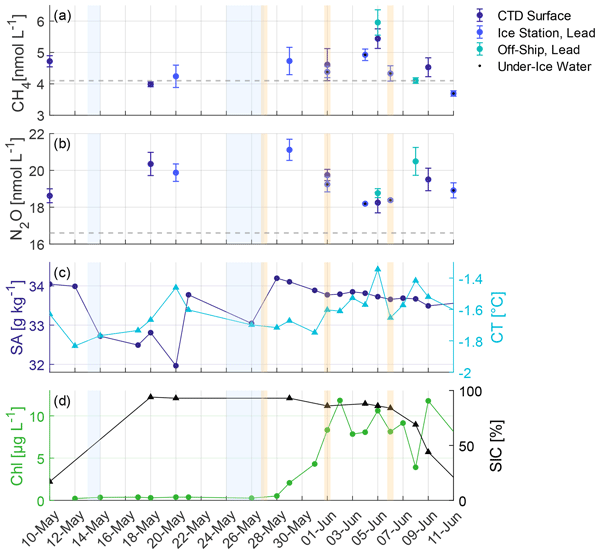
Lina A. Holthusen, Hermann W. Bange, Thomas H. Badewien, Julia C. Muchowski, Tina Santl-Temkiv, Jennie Spicker Schmidt, Oliver Wurl, and Damian L. Arévalo-Martínez
The Cryosphere, 20, 535–550, https://doi.org/10.5194/tc-20-535-2026, https://doi.org/10.5194/tc-20-535-2026, 2026
Short summary
Short summary
In spring 2023, in the Fram Strait, we investigated the near-surface distribution of the greenhouse gases methane and nitrous oxide in open leads and under sea ice to address the lack of observations in the Arctic Ocean. The study area acted as a source for both gases, and the onset of sea ice melt affected their concentrations and emissions. Surface-active substances accumulated in the sea-surface microlayer of open leads during an algal bloom, potentially attenuating greenhouse gas emissions.
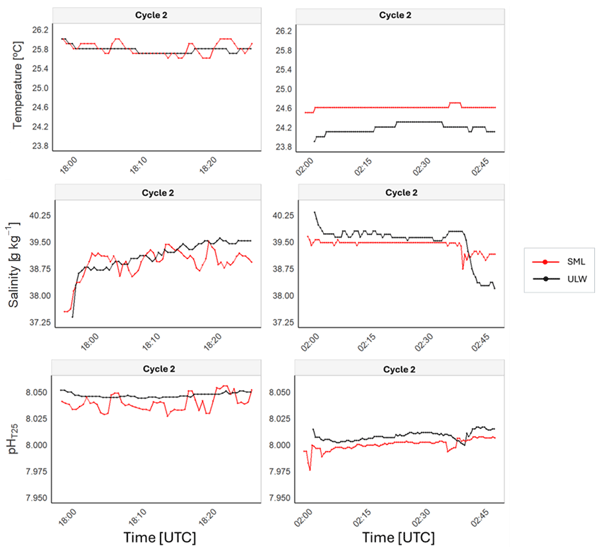
Ander López-Puertas, Oliver Wurl, Sanja Frka, and Mariana Ribas-Ribas
Ocean Sci., 21, 3471–3485, https://doi.org/10.5194/os-21-3471-2025, https://doi.org/10.5194/os-21-3471-2025, 2025
Short summary
Short summary
We studied how daily cycles affect inorganic carbon variables in the ocean's surface microlayer. Using data from three full days and nights off the Croatian coast, we found that thermohaline properties and key indicators like pH and pCO₂ change significantly from day to night. Ignoring nighttime conditions may lead to global carbon budget errors and highlights the need for continuous ocean observations.
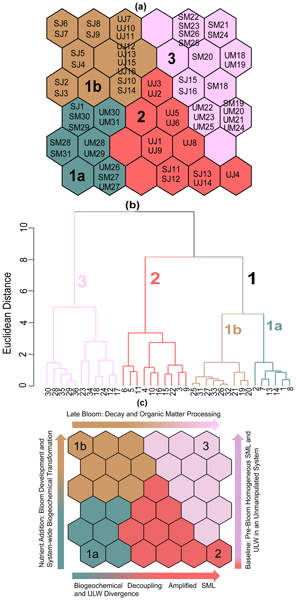
Riaz Bibi, Mariana Ribas-Ribas, Leonie Jaeger, Carola Lehners, Lisa Gassen, Edgar Fernando Cortés-Espinoza, Jochen Wollschläger, Claudia Thölen, Hannelore Waska, Jasper Zöbelein, Thorsten Brinkhoff, Isha Athale, Rüdiger Röttgers, Michael Novak, Anja Engel, Theresa Barthelmeß, Josefine Karnatz, Thomas Reinthaler, Dmytro Spriahailo, Gernot Friedrichs, Falko Asmussen Schäfer, and Oliver Wurl
Biogeosciences, 22, 7563–7589, https://doi.org/10.5194/bg-22-7563-2025, https://doi.org/10.5194/bg-22-7563-2025, 2025
Short summary
Short summary
A multidisciplinary mesocosm study was conducted to investigate biogeochemical processes and their relationships in the sea-surface microlayer and underlying water during an induced phytoplankton bloom. Phytoplankton-derived organic matter, fuelled microbial activity and biofilm formation, supporting high bacterial abundance. Distinct temporal patterns in biogeochemical parameters and greater variability in the sea-surface microlayer highlight its influence on air–sea interactions.
Edgar Fernando Cortés-Espinoza, Alisa Wüst, Ander Lopéz-Puertas, Oliver Wurl, José Martín Hernández-Ayón, Hannelore Waska, and Mariana Ribas-Ribas
EGUsphere, https://doi.org/10.5194/egusphere-2025-5265, https://doi.org/10.5194/egusphere-2025-5265, 2025
Short summary
Short summary
In a mesocosm experiment, we measured carbon system variables to examine how organic matter accumulation increases organic alkalinity and alters seawater pH in the sea-surface microlayer and underlying water during an induced phytoplankton bloom. Organic alkalinity was consistently higher in the sea-surface microlayer, and during bloom peak its pH effect extended into the underlying water, reducing and sometimes reversing surface–subsurface pH differences.
Lisa Gassen, Samuel M. Ayim, Leonie Jaeger, Jens Meyerjürgens, Mariana Ribas-Ribas, and Oliver Wurl
Ocean Sci., 21, 2787–2804, https://doi.org/10.5194/os-21-2787-2025, https://doi.org/10.5194/os-21-2787-2025, 2025
Short summary
Short summary
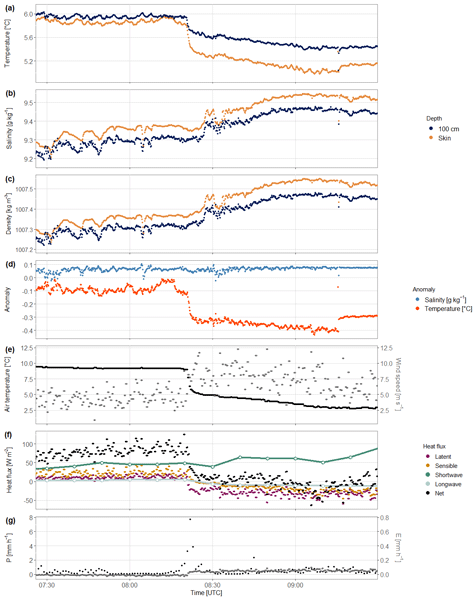
This study investigates how abrupt weather changes, such as shifts in air temperature, wind speed and precipitation, impact temperature and salinity in the ocean’s skin layer (upper first millimetre). Two events in the harbour of Bremerhaven and one event in the North Sea revealed that the skin layer reacts instantly, with greater temperature changes than those at a depth of 100 cm, underscoring its key role in air-sea interactions and climate dynamics.
Lisa Deyle, Thomas H. Badewien, Oliver Wurl, and Jens Meyerjürgens
Earth Syst. Sci. Data, 16, 2099–2112, https://doi.org/10.5194/essd-16-2099-2024, https://doi.org/10.5194/essd-16-2099-2024, 2024
Short summary
Short summary
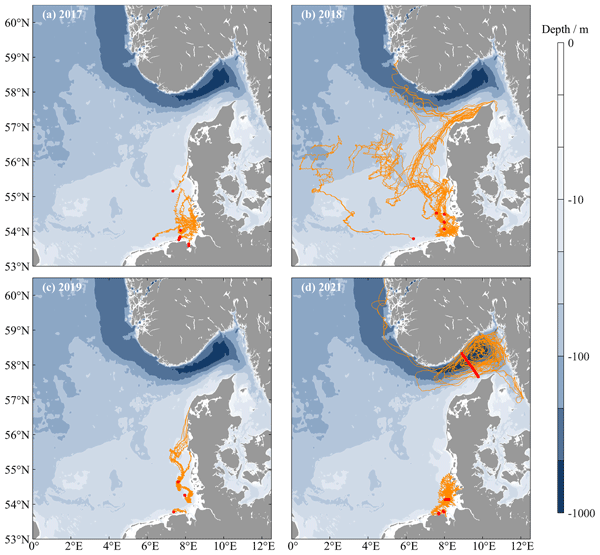
A dataset from the North Sea of 85 surface drifters from 2017–2021 is presented. Surface drifters enable the analysis of ocean currents by determining the velocities of surface currents and tidal effects. The entire North Sea has not been studied using drifters before, but the analysis of ocean currents is essential, e.g., to understand the pathways of plastic. The results show that there are strong tidal effects in the shallow North Sea area and strong surface currents in the deep areas.
Shungudzemwoyo P. Garaba, Michelle Albinus, Guido Bonthond, Sabine Flöder, Mario L. M. Miranda, Sven Rohde, Joanne Y. L. Yong, and Jochen Wollschläger
Earth Syst. Sci. Data, 15, 4163–4179, https://doi.org/10.5194/essd-15-4163-2023, https://doi.org/10.5194/essd-15-4163-2023, 2023
Short summary
Short summary
These high-quality data document a harmful algal bloom dominated by Nodularia spumigena, a cyanobacterium that has been recurring in waters around the world, using advanced water observation technologies. We also showcase the benefits of experiments of opportunity and the issues with obtaining synoptic spatio-temporal data for monitoring water quality. The dataset can be leveraged to gain more knowledge on related blooms, develop detection algorithms and optimize future monitoring efforts.
Manuela van Pinxteren, Tiera-Brandy Robinson, Sebastian Zeppenfeld, Xianda Gong, Enno Bahlmann, Khanneh Wadinga Fomba, Nadja Triesch, Frank Stratmann, Oliver Wurl, Anja Engel, Heike Wex, and Hartmut Herrmann
Atmos. Chem. Phys., 22, 5725–5742, https://doi.org/10.5194/acp-22-5725-2022, https://doi.org/10.5194/acp-22-5725-2022, 2022
Short summary
Short summary
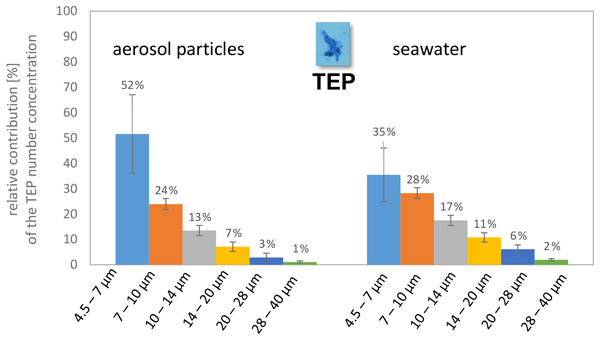
A class of marine particles (transparent exopolymer particles, TEPs) that is ubiquitously found in the world oceans was measured for the first time in ambient marine aerosol particles and marine cloud waters in the tropical Atlantic Ocean. TEPs are likely to have good properties for influencing clouds. We show that TEPs are transferred from the ocean to the marine atmosphere via sea-spray formation and our results suggest that they can also form directly in aerosol particles and in cloud water.
Cited articles
Archer, M., Schaeffer, A., Keating, S., Roughan, M., Holmes, R., and Siegelman, L.: Observations of submesoscale variability and frontal subduction within the mesoscale eddy field of the Tasman Sea, J. Phys. Oceanogr., 50, 1509–1529, https://doi.org/10.1175/JPO-D-19-0131.1, 2020.
Berta, M., Griffa, A., Magaldi, M. G., Özgökmen, T. M., Poje, A. C., Haza, A. C., and Olascoaga, M. J.: Improved surface velocity and trajectory estimates in the Gulf of Mexico from blended satellite altimetry and drifter data, J. Atmos. Ocean. Tech., 32, 1880–1901, https://doi.org/10.1175/JTECH-D-14-00226.1, 2015.
Berta, M., Griffa, A., Özgökmen, T. M., and Poje, A. C.: Submesoscale evolution of surface drifter triads in the Gulf of Mexico, Geophys. Res. Lett., 43, 11–751, https://doi.org/10.1002/2016GL070357, 2016.
Burchard, H. and Badewien, T. H.: Thermohaline residual circulation of the Wadden Sea, Ocean Dynam., 65, 1717–1730, https://doi.org/10.1007/s10236-015-0895-x, 2015.
Chegini, F., Holtermann, P., Kerimoglu, O., Becker, M., Kreus, M., Klingbeil, K., Gräwe, U., Winter, C., and Burchard, H.: Processes of stratification and destratification during an extreme river discharge event in the German Bight ROFI, J. Geophys. Res.-Oceans, 125, e2019JC015987, https://doi.org/10.1029/2019JC015987, 2020.
Chrysagi, E., Umlauf, L., Holtermann, P., Klingbeil, K., and Burchard, H.: High-resolution simulations of submesoscale processes in the Baltic Sea: The role of storm events, J. Geophys. Res.-Oceans, 126, e2020JC016411, https://doi.org/10.1029/2020JC016411, 2021.
Copernicus Marine Service Information (CMEMS): European North West Shelf/Iberia Biscay Irish Seas – High Resolution ODYSSEA L4 Sea Surface Temperature Analysis, E. U. Copernicus Marine Service Information (CMEMS). Marine Data Store (MDS), https://doi.org/10.48670/moi-00152, 2023.
Copernicus Marine Service Information (CMEMS): Atlantic–European North West Shelf – Ocean Physics Analysis and Forecast, E. U. Copernicus Marine Service Information (CMEMS). Marine Data Store (MDS), https://doi.org/10.48670/moi-00054, 2024.
Deyle, L., Badewien, T. H., Wurl, O., and Meyerjürgens, J.: Lagrangian surface drifter observations in the North Sea: an overview of high-resolution tidal dynamics and surface currents, Earth Syst. Sci. Data, 16, 2099–2112, https://doi.org/10.5194/essd-16-2099-2024, 2024.
Drinkwater, K. F. and Loder, J. W.: Near-surface horizontal convergence and dispersion near the tidal-mixing front on Northeastern Georges Bank, Deep-Sea Res. Pt. II, 48, 311–339, https://doi.org/10.1016/S0967-0645(00)00084-9, 2001.
Esposito, G., Donnet, S., Berta, M., Shcherbina, A. Y., Freilich, M., Centurioni, L., D'Asaro, E. A., Farrar, J. T., Johnston, T. M. S., Mahadevan, A., Özgökmen, T., Pascual, A., Poulain P-M., Ruiz, S., Tarry D. R, and Griffa, A.: Inertial Oscillations and Frontal Processes in an Alboran Sea Jet: Effects on Divergence and Vertical Transport, J. Geophys. Res.-Oceans, 128, e2022JC019004, https://doi.org/10.1029/2022JC019004, 2023.
Essink, S., Hormann, V., Centurioni, L. R., and Mahadevan, A.: On characterizing ocean kinematics from surface drifters, J. Atmos. Ocean. Tech., 39, 1183–1198, https://doi.org/10.1175/JTECH-D-21-0068.1, 2022.
Garcia-Jove, M., Mourre, B., Zarokanellos, N. D., Lermusiaux, P. F., Rudnick, D. L., and Tintoré, J.: Frontal dynamics in the Alboran Sea: 2. Processes for vertical velocities development, J. Geophys. Res.-Oceans, 127, e2021JC017428, https://doi.org/10.1029/2021JC017428, 2022.
Gassen, L., Badewien, T. H., Ewald, J., Ribas-Ribas, M., and Wurl, O.: Temperature and salinity anomalies in the sea surface microlayer of the South Pacific during precipitation events, J. Geophys. Res.-Oceans, 128, e2023JC019638, https://doi.org/10.1029/2023JC019638, 2023.
Goßmann, I., Meyerjürgens, J., Albinus, M., Achtner, C., Robinson, B. T., Held, A., Lehners, C., Gassen, L., Ayim, S. M., Badewien, T. H., Scholz-Böttcher, B., and Wurl, O.: What influences the distribution of microplastics in the marine environment? An interdisciplinary study reveals key factors driving microplastic in the North Sea, Sci. Total Environ., 964, 178589, https://doi.org/10.1016/j.scitotenv.2025.178589, 2025.
Hill, A. E., James, I. D., Linden, P. F., Matthews, J. P., Prandle, D., Simpson, J. H., Gmitrowicz, E. M., Smeed, D. A., Lwiza, K. M. M., Durazo, R., and Bowers, D. G.: Dynamics of tidal mixing fronts in the North Sea, Philos. T. R. Soc. A, 343, 431–446, https://doi.org/10.1098/rsta.1993.0057, 1993.
Holt, J. and Umlauf, L.: Modelling the tidal mixing fronts and seasonal stratification of the Northwest European Continental shelf, Cont. Shelf Res., 28, 887–903, https://doi.org/10.1016/j.csr.2008.01.012, 2008.
Huntley, H. S., Berta, M., Esposito, G., Griffa, A., Mourre, B., and Centurioni, L.: Conditions for Reliable Divergence Estimates from Drifter Triplets, J. Atmos. Ocean. Tech., 39, 1499–1523, https://doi.org/10.1175/JTECH-D-21-0161.1, 2022.
Jakes, M. I., Phillips, H. E., Foppert, A., Cyriac, A., Bindoff, N. L., Rintoul, S. R., and Thompson, A. F.: Observational Evidence of Cold Filamentary Intensification in an Energetic Meander of the Antarctic Circumpolar Current, J. Phys. Oceanogr., 54, 717–740, https://doi.org/10.1175/JPO-D-23-0085.1, 2024.
Johnson, L., Lee, C. M., D'Asaro, E. A., Thomas, L., and Shcherbina, A.: Restratification at a California current upwelling front. Part I: Observations, J. Phys. Oceanogr., 50, 1455–1472, https://doi.org/10.1175/JPO-D-19-0203.1, 2020.
Kawai, H.: Scale dependence of divergence and vorticity of near-surface flows in the sea: Part 1. Measurements and calculations of area-averaged divergence and vorticity, J. Oceanogr. Soc. Jpn., 41, 157–166, https://doi.org/10.1007/BF02111115, 1985.
Lapeyre, G. and Klein, P.: Impact of the small-scale elongated filaments on the oceanic vertical pump, J. Mar. Res., 64, 835–851, https://doi.org/10.1357/002224006779698369, 2006.
Mahadevan, A. and Tandon, A.: An analysis of mechanisms for submesoscale vertical motion at ocean fronts, Ocean Model., 14, 241–256, https://doi.org/10.1016/j.ocemod.2006.05.006, 2006.
McWilliams, J. C., Colas, F., and Molemaker, M. J.: Cold filamentary intensification and oceanic surface convergence lines, Geophys. Res. Lett., 36, https://doi.org/10.1029/2009GL039402, 2009.
McWilliams, J. C., Gula, J., Molemaker, M. J., Renault, L., and Shchepetkin, A. F.: Filament frontogenesis by boundary layer turbulence, J. Phys. Oceanogr., 45, 1988–2005, https://doi.org/10.1175/JPO-D-14-0211.1, 2015.
Meyer, J., Voynova, Y. G., Van Dam, B., Luitjens, L., Daehne, D., and Thomas, H.: Intertidal regions regulate seasonal coastal carbonate system dynamics in the East Frisian Wadden Sea, Biogeosciences, 22, 6255–6273, https://doi.org/10.5194/bg-22-6255-2025, 2025.
Meyerjürgens, J., Badewien, T. H., Garaba, S. P., Wolff, J. O., and Zielinski, O.: A state-of-the-art compact surface drifter reveals pathways of floating marine litter in the German bight, Front. Marine Sci., 6, 58, https://doi.org/10.3389/fmars.2019.00058, 2019.
Meyerjürgens, J., Ricker, M., Schakau, V., Badewien, T. H., and Stanev, E. V.: Relative dispersion of surface drifters in the North Sea: The effect of tides on mesoscale diffusivity, J. Geophys. Res.-Oceans, 125, e2019JC015925, https://doi.org/10.1029/2019JC015925, 2020.
Molinari, R. and Kirwan, A. D.: Calculations of differential kinematic properties from Lagrangian observations in the western Caribbean Sea, J. Phys. Oceanogr., 5, 483–491, https://doi.org/10.1175/1520-0485(1975)005<0483:CODKPF>2.0.CO;2, 1975.
Núñez-Riboni, I. and Akimova, A.: Quantifying the impact of the major driving mechanisms of inter-annual variability of salinity in the North Sea, Prog. Oceanogr., 154, 25–37, https://doi.org/10.1016/j.pocean.2017.04.004, 2017.
Rudnick, D. L.: On the skewness of vorticity in the upper ocean, Geophys. Res. Lett., 28, 2045–2048, https://doi.org/10.1029/2000GL012265, 2001.
Ricker, M., Meyerjürgens, J., Badewien, T. H., and Stanev, E. V.: Lagrangian methods for visualizing and assessing frontal dynamics of floating marine litter with a focus on tidal basins, Chemical Oceanography of Frontal Zones, 407–442, https://doi.org/10.1007/698_2021_812, 2021.
Rypina, I. I., Getscher, T. R., Pratt, L. J., and Mourre, B.: Observing and quantifying ocean flow properties using drifters with drogues at different depths, J. Phys. Oceanogr., 51, 2463–2482, https://doi.org/10.1175/JPO-D-20-0291.1, 2021.
Schubert, R., Gula, J., Greatbatch, R. J., Baschek, B., and Biastoch, A.: The submesoscale kinetic energy cascade: Mesoscale absorption of submesoscale mixed layer eddies and frontal downscale fluxes, J. Phys. Oceanogr., 50, 2573–2589, https://doi.org/10.1175/JPO-D-19-0311.1, 2020.
Shcherbina, A. Y., D'Asaro, E. A., Lee, C. M., Klymak, J. M., Molemaker, M. J., and McWilliams, J. C.: Statistics of vertical vorticity, divergence, and strain in a developed submesoscale turbulence field, Geophys. Res. Lett., 40, 4706–4711, https://doi.org/10.1002/grl.50919, 2013.
Shinki, M., Wendeberg, M., Vagle, S., Cullen, J. T., and Hore, D. K.: Characterization of adsorbed microlayer thickness on an oceanic glass plate sampler, Limnol. Oceanogr.-Meth., 10, 728–735, https://doi.org/10.4319/lom.2012.10.728, 2012.
Simpson, J. H., Brown, J., Matthews, J., and Allen, G.: Tidal straining, density currents, and stirring in the control of estuarine stratification, Estuaries, 13, 125–132, https://doi.org/10.2307/1351581, 1990.
Stanev, E. V., Al-Nadhairi, R., Staneva, J., Schulz-Stellenfleth, J., and Valle-Levinson, A.: Tidal wave transformations in the German Bight, Ocean Dynam., 64, 951–968, https://doi.org/10.1007/s10236-014-0733-6, 2014.
Sun, Y. J. and Cho, Y. K.: Tidal front and its relation to the biological process in coastal water, Ocean Sci. J., 45, 243–251, https://doi.org/10.1007/s12601-010-0022-3, 2010.
Tarry, D. R., Essink, S., Pascual, A., Ruiz, S., Poulain, P. M., Özgökmen, T., Centurioni, L. R., Farrar, J. T., Shcherbina, A., Mahadevan, A., and D'Asaro, E.: Frontal convergence and vertical velocity measured by drifters in the Alboran Sea, J. Geophys. Res.-Oceans, 126, e2020JC016614, https://doi.org/10.1029/2020JC016614, 2021.
Tarry, D. R., Ruiz, S., Johnston, T. S., Poulain, P. M., Özgökmen, T., Centurioni, L. R., Berta, M., Esposito, G., Farrar, J. T., Mahadevan, A., and Pascual, A.: Drifter observations reveal intense vertical velocity in a surface ocean front, Geophys. Res. Lett., 49, e2022GL098969, https://doi.org/10.1029/2022GL098969, 2022.
Thomas, L. N. and Lee, C. M.: Intensification of ocean fronts by down-front winds, J. Phys. Oceanogr., 35, 1086–1102, https://doi.org/10.1175/JPO2737.1, 2005.
Thomas, L. N., Tandon, A., and Mahadevan, A.: Submesoscale processes and dynamics, Ocean modeling in an Eddying Regime, Geoph. Monog. Series, 177, 17–38, https://doi.org/10.1029/177GM04, 2008.
Timko, P. G., Arbic, B. K., Hyder, P., Richman, J. G., Zamudio, L., O'Dea, E., Wallcraft, A. J., and Shriver, J. F.: Assessment of shelf sea tides and tidal mixing fronts in a global ocean model, Ocean Model., 136, 66–84, https://doi.org/10.1016/j.ocemod.2019.02.008, 2019.
Van Heijst, G. J. F.: On the dynamics of a tidal mixing front, in: Elsevier oceanography series, vol. 42, Elsevier, 165–194, https://doi.org/10.1016/S0422-9894(08)71045-6, 1986.
Vélez-Belchí, P. and Tintoré, J.: Vertical velocities at an ocean front, Sci. Mar., 65, 291–300, https://doi.org/10.3989/scimar.2001.65s1291, 2001.
Villa Castrillón, L., Ricker, M., Staneva, J., Meyerjürgens, J., Badewien, T. H., and Stanev, E. V.: Relative dispersion and relative diffusivities in an ocean-wave coupled model of the North Sea, Ocean Dynam., 74, 555–567, https://doi.org/10.1007/s10236-024-01619-6, 2024.
Wurl, O., Stolle, C., Van Thuoc, C., Thu, P. T., and Mari, X.: Biofilm-like properties of the sea surface and predicted effects on air–sea CO2 exchange, Prog. Oceanogr., 144, 15–24, https://doi.org/10.1016/j.pocean.2016.03.002, 2016.
Wurl, O., Gassen, L., Badewien, T. H., Braun, A., Emig, S., Holthusen, L. A., Lehners, C., Meyerjürgens, J., and Ribas, M. R.: HALOBATES: An Autonomous Surface Vehicle for High-Resolution Mapping of the Sea Surface Microlayer and Near-Surface Layer on Essential Climate Variables, J. Atmos. Ocean. Tech., 41, 1197–1211, https://doi.org/10.1175/JTECH-D-24-0021.1, 2024.
Zhang, Z., Liu, Y., Qiu, B., Luo, Y., Cai, W., Yuan, Q., Liu, Y., Zhang, H., Liu, H., Miao, M., Zhang, J., Zhao, W., and Tian, J.: Submesoscale inverse energy cascade enhances Southern Ocean eddy heat transport, Nat. Commun., 14, 1335, https://doi.org/10.1038/s41467-023-44386-6, 2023.
Zhao, C., Daewel, U., and Schrum, C.: Tidal impacts on primary production in the North Sea, Earth Syst. Dynam., 10, 287–317, https://doi.org/10.5194/esd-10-287-2019, 2019.
Short summary
This study reveals the structure and alteration of a narrow freshwater-driven ocean low-density filament and its evolution through tidal modulationa an dlocale filament kinematics. Using multi-platform in situ observations, it is shown that these submesoscale features can rapidly being altered and reshape in near-surface waters, influencing how energy and heat alter just below the ocean-atmosphere interface.
This study reveals the structure and alteration of a narrow freshwater-driven ocean low-density...


Special issue