
the Creative Commons Attribution 4.0 License.
the Creative Commons Attribution 4.0 License.
 | 18 May 2026
Cuban coral traces annual hydrologically driven variability in δ234U values since the end of the Little Ice Age
Sahra Greve
Norbert Frank
Paolo Montagna
Carlos Manuel Alonso-Hernández
Miguel Gomez-Batista
Eric Douville
Sophie Warken
The natural uranium isotope ratio of 234U 238U in seawater behaves conservatively at basin scale, yet it can be regionally affected by continental freshwater discharge at decadal to centennial timescales. Here, we analyse annual variations in the 234U 238U isotope ratio, expressed as ‰-deviation from radioactive equilibrium as δ234U, of a coral from Cuba. Over the past 237 years, the mean δ234U value of the coral was 145.7±0.1 ‰ (1σM), which is identical to that of modern open ocean seawater, whereas the average variation over the past century has been ±3.7 ‰. This moderate variability is, however, significantly greater than the external precision and reproducibility of measurements of ±0.55 ‰ (2σM). Moreover, the δ234U values coincide inversely with regional precipitation, suggesting excess 234U contribution from regional freshwater runoff. The most important finding is a strong increase in annual δ234U variability to ±8.1 ‰ during the end of the Little Ice Age (LIA, 1778–1847). We suggest that the increased δ234U dynamics reflect substantial excess 234U contributions from the Mississippi, far greater variability in the local freshwater fluxes to the Gulf of Mexico, and/or reduced advective currents during the LIA. This study demonstrates that yet unexplored variability in coral δ234U records within the presently known range of seawater δ234U may be attributed to local and advected freshwater sources, which opens a new pathway for reconstructing these processes over time. Moreover, it places strong constraints on the initial δ234U variability of fossil corals in light of ultra high-precision 230Th/U dating.
- Article
(2851 KB) - Full-text XML
-
Supplement
(1060 KB) - BibTeX
- EndNote


In the modern ocean, uranium is conservative, with a residence time of 200–400 ka (Ku et al., 1977; Dunk et al., 2002), far larger than the global ocean mixing timescale of approximately 1 ka, which allows for homogenization of the U content with a conservative behaviour vs. salinity (Not et al., 2012) and isotopic composition of the world oceans. Consequently, owing to the continuous production of 234U via 234Th and 234Pa from the decay of 238U, with a half-life of 4.4683×10⁹ years (Jaffey et al., 1971; Ivanovich and Harmon, 1992; Cheng et al., 2013), the activity ratio of 234U 238U (also expressed as ‰-deviation from radioactive equilibrium δ234U) in seawater also remains predominantly conservative (Henderson, 2002; Robinson et al., 2004a; Andersen et al., 2010).
However, seawater δ234U (δ234USW) is in radioactive disequilibrium in the global ocean (Ku et al., 1977; Chen et al., 1986; Delanghe et al., 2002; Robinson et al., 2004a; Andersen et al., 2010, 2015; Kipp et al., 2022) due to the continuous input of excess 234U from rivers and submarine groundwater (Robinson et al., 2004a; Andersen et al., 2010; Li et al., 2023). Typically, these waters are enriched in 234U due to the α-recoil process of radioactive decay from 238U to 234U, leading to preferential release of 234U into the hydrological environment (Kigoshi, 1971; Chabaux et al., 2008). 234U enrichment is highly variable (Dunk et al., 2002) and is influenced by physical and chemical weathering, resulting in the global ocean exhibiting an excess of approximately 15 % from secular equilibrium (Ku et al., 1977; Chen et al., 1986; Delanghe et al., 2002; Robinson et al., 2004a; Andersen et al., 2010, 2015; Kipp et al., 2022). A recent reassessment of the open ocean confirmed a constant δ234U value of 145.55 ‰ (standard error of the mean (σM) = ±0.28 ‰), with a range of 1.30 ‰ (Kipp et al., 2022). Modern corals have been analysed for their δ234U values to confirm the δ234USW uniformity observed in modern ocean far from continental sources of marine uranium (Chen et al., 1986; Delanghe et al., 2002; Robinson et al., 2004b; Andersen et al., 2010, 2015; Kipp et al., 2022). Variations in the δ234U values of fossil corals have been attributed to either diagenetic overprint or large-scale ice volume (climate)-driven changes in the excess 234U flux (Dunk et al., 2002; Henderson, 2002; Robinson et al., 2004a, b; Esat and Yokoyama, 2010; Chutcharavan et al., 2018). Several studies have proposed that per mil deviations from modern ocean δ234U values observed in fossil corals during the last glacial maximum reflect sea-level control on the excess 234U flux (Esat and Yokoyama, 2006, 2010; Chutcharavan et al., 2018). The observed 4 ‰–8 ‰ decrease in glacial seawater δ234U values is suspected to represent a reduction in continental runoff or the oxidation and release of U stored in interglacial deposits of U from the reducing environment of, for example, mangrove forests. A recent study further revealed elevated δ234U in relation to an Antarctic meltwater plume (Li et al., 2023). Nevertheless, the reconstruction of past δ234U values can be hampered by subaerial coral diagenesis (Scholz et al., 2004; Frank et al., 2006) or U-series open system behaviour caused by the recoil process of coral embedded sediment (Henderson et al., 1993; Gallup et al., 1994; Henderson and Slowey, 2000; Thompson et al., 2003; Villemant and Feuillet, 2003; Frank et al., 2006). Tropical surface-dwelling corals are always situated in shelf environments, with potential influences of U contributions from local river discharge, submarine groundwater releases, or even the distant transport of freshwater from larger river systems.
Consequently, by examining postmodern, well-preserved and annually resolved corals, the oceanic U isotopic composition can be investigated to identify any potential systematic local or regional disturbances from freshwater fluxes through rivers and submarine groundwater. To detect subtle changes in oceanic and coral U isotopic compositions, multicollector inductively coupled plasma source mass spectrometry (MC-ICP-MS) is a well-established precise instrumentation for isotopes, that offers external reproducibility better than 1 ‰. Thus, we evaluated the external precision of such measurements via a recently published semi-static data acquisition by Kerber et al. (2023). An external reproducibility of 0.55 ‰ (2σM) was achieved on seawater and modern aragonitic coral fragments.
To assess the potential impact of shelf water processes on the U isotopic composition of tropical corals and to reveal the potential of U isotopes as freshwater tracer, we selected a long-lived Orbicella faveolata coral colony in the western tropical North Atlantic, for which both regional freshwater releases and distant freshwater influence, such as advective transport from the Mississippi River seemed plausible. The tropical Atlantic Ocean is an ideal location for testing potential links between δ234U and hydrological and oceanographic conditions at the sub-centennial scale. The northern Caribbean is part of the Atlantic Warm Pool (AWP), which is defined by the sea surface temperature (SST) isotherm exceeding 28.5 °C, which forms each year during early summer (June) and extends into the Gulf of Mexico and the western tropical North Atlantic as summer progresses (July–October) (Wang and Enfield, 2001; Wang et al., 2008). In relation to the AWP and the Intertropical Convergence Zone (ITCZ), the Caribbean hydroclimate is characterized by a wet season from April to October (Martinez et al., 2019), during which hurricanes are also commonly observed (Terry and Kim, 2015). Especially for the Little Ice Age (LIA), which spanned from approximately 1400–1850 (Hodell et al., 2005), substantial changes in the Caribbean SST hydroclimate and potential oceanic circulation have been reconstructed (Haug et al., 2001; Hodell et al., 2005; Richey et al., 2009; Johnson, 2011; Kennett et al., 2012; Fensterer et al., 2013; DeLong et al., 2014; Burn et al., 2016). Consequently, through the study of annual excess 234U variability along a coral core drilled in a colony located at the north of Cuba, we aimed to qualitatively resolve freshwater fluxes into the Gulf of Mexico since the LIA.
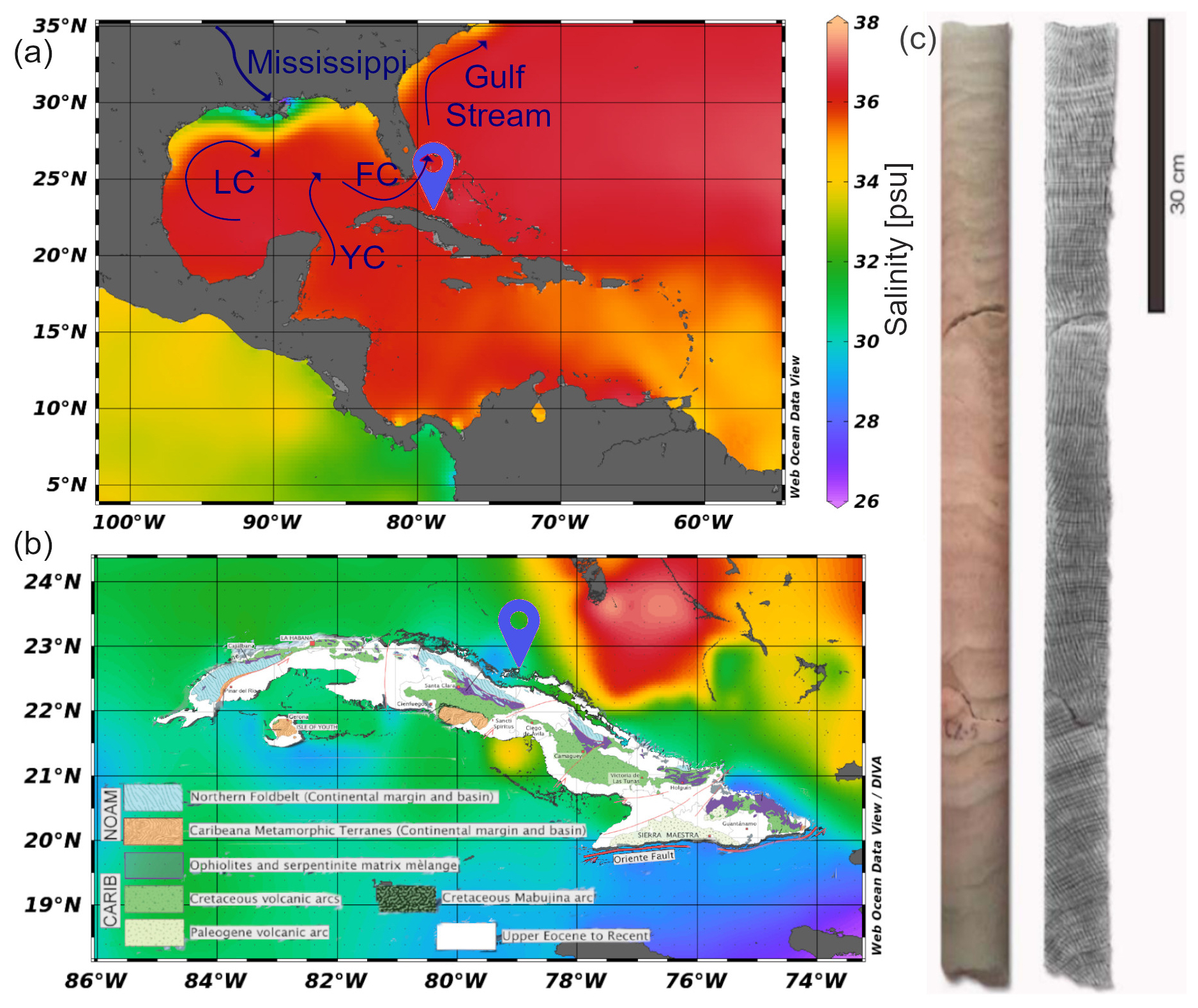
Figure 1(a) Caribbean annual sea surface salinity (Schlitzer, 2025) with the location of the selected coral core on the northern shore of Cuba, directly influenced by the Florida Current (FC) travelling eastwards from Yucatan Current (YC) and the Gulf of Mexico forming the Gulf Stream. The Loop Current (LC) carries the less saline Mississippi water towards the coral. (b) Annual sea surface salinity off the coast of Cuba (Schlitzer, 2025); less salinity is observed at the core location due to terrestrial runoff. With generalized geologic-tectonic map of Cuba modified from Iturralde-Vinent et al. (2016). (c) X-ray image of the slab used in the optical densitometry analysis and photograph of the analysed core (CSM-1) with visible green banding.
2.1 Coral location
For this study, we investigated a coral drill core (CSM-1), 97 cm in length, that was collected in March 2016 from the Sabana Camaguey Archipelago, northern Cuba, approximately 20 km from the main island (Fig. 1) (Alonso-Hernández et al., 2022). The core was obtained from a scleractinian coral colony of the genus Orbicella faveolata located at approximately 10 m depth in the Cayo Santa María area (79.10° W, 22.66° N). The core was dated via sclerochronology on the basis of radiographic density images, revealing an age of 237 years, ranging from 1778 to 2015 (Alonso-Hernández et al., 2022). The method has an approximate ±1 year uncertainty, which may increase progressively with depth from the top of the coral core (Buddemeier et al., 1974). Additionally, the coral exhibited green growth bands with high Mg contents, possibly due to the incorporation of relatively high levels of organic material into the coral skeleton (Cuny-Guirriec et al., 2019; Alonso-Hernández et al., 2022).
The climate of the region is influenced by the southwestern edge of the high-pressure system over the Atlantic (Fig. S1 in the Supplement). The summer and fall seasons correspond to the rainy season with occasional extreme events, such as hurricanes. Hurricanes typically track west- and northwards approximately once every 20 years, affecting mainly the southeast coast of Cuba (Limia et al., 2003; Terry and Kim, 2015). During the winter season, the hydroclimate tends to be dry, with precipitation rates decreasing from 250 mm per month in summer to as low as 25 mm per month in winter (Vose et al., 1992).
The location of the sample core lies within the Florida Strait (Fig. 1), serving as the outflow path for water masses from the Gulf of Mexico, with an estimated flow rate of 28 Sv (Leaman et al., 1995). As a result, the coral is influenced primarily by waters originating from the Caribbean and Gulf of Mexico, as well as very local continental runoff from the northern part of Cuba and eutrophic waters from mangroves bordering the southern key. An additional major yet distant source of freshwater, the Mississippi River, is located approximately 2500 km away, but its flood plumes can extend hundreds of kilometres into the Atlantic (Hitchcock et al., 1997). This large North American river has an annual discharge rate of 0.015 Sv, which can increase fivefold during major flood events. In addition, the Mississippi carries large volumes of sediment particles, which have halved during the past century due to the creation of dams (Folwell, 1921; Carroll, 1990). The mean δ234U value of the Mississippi waters was assessed to be 335 ‰ ± 110 ‰, including strong seasonal variability (Grzymko et al., 2007).
2.2 Sampling treatment and U extraction
The separation of uranium from the sample carbonate matrix followed the protocol established by Wefing et al. (2017), with modifications outlined by Kerber et al. (2023). Approximately 50–100 mg of the skeletal aragonite sample underwent ultrasonic cleaning and subsequent dissolution in 7 N HNO3. To serve as a concentration reference, 100 µL of TriSpike, a mixture containing the synthetic isotopes 233U, 236U and 229Th, was added. Next, uranium was purified through ion exchange chemistry via U/TEVA resin. To remove Ca and other matrix elements, 300 µL U/TEVA chromatographic ion exchange columns were rinsed three times with 7 N HNO3. Uranium was then eluted using 3 N and 1 N HCl successively (Horwitz et al., 1992). The sample was dried and redissolved, and the column purification was repeated until the Ca concentration of the final solution was <10 ppm. For MC-ICP-MS measurements, the final uranium fraction was evaporated and dissolved in 1.2 mL of 1 % HNO3 + 0.05 % HF, with any particulates removed by centrifugation.
2.3 MC-ICP-MS measurement
Measurements were conducted at the Institute of Environmental Physics in Heidelberg using a multicollector ICP-MS (ThermoFisher Neptuneplus) coupled with an ARIDUS II desolvating nebulizer system and an ESI-SC autosampler. The cup configurations and mounted amplifiers used, as well as the data treatment protocols, are presented in detail in Kerber et al. (2023).
Measurements were conducted via the standard bracketing method with the Harwell-Uraninite 1 (HU-1) standard to ensure measurement stability and correct for machine drift. HU-1 was used as an internal bracketing standard for instrumental normalization, its measured 234U 238U ratio was fixed to a constant reference value during data reduction. This step serves purely as an instrumental correction and does not imply a physical assumption of secular equilibrium. Data evaluation was performed using a Python script for Th/U dating analysis based on Kerber et al. (2025). This script encompasses instrumental background corrections, identification and correction of signal outliers, and adjustment for mass bias, accounting for hydride formation, and addressing tailing and scattering of 238U. δ234U was calculated via the processed activity ratio of 234U 238U and is expressed in per mil (‰) using the following Eq. (1).
with decay constants of (Jaffey et al., 1971) and (Cheng et al., 2013). The updated 234U half-life (Hu et al., 2025) differs only marginally from that of Cheng et al. (2013) and has a negligible effect on δ234U (<0.1 ‰). All δ234U values are thus reported on an activity-based scale defined by the adopted decay constants. Internal errors were determined as 2σ from each measurement, whereas external errors were determined through repeated measurements of the NBS-CRM-112A (CRM112A) standard and an in-house seawater standard.
3.1 Accuracy
The combined procedual replicates yielded a mean variability of 0.35 ‰, with a 2σ reproducibility of 0.54 ‰ (n=6) in δ234U values across replicate groups. The standard deviation from the in-house seawater standard also falls into that range at 0.55 ‰ (2σ, n=11). The external error was determined by repeated measurements of CRM112A in each measurement batch. The analyses resulted in a renormalisation of the mean value of δ234U (CRM112A) to −38.48 ‰ (±0.30 ‰, ‰, n=16).
Figure 2 shows the δ234U values of CRM112A. Further advances in coral δ234U measurements are described in Greve et al. (2026a).
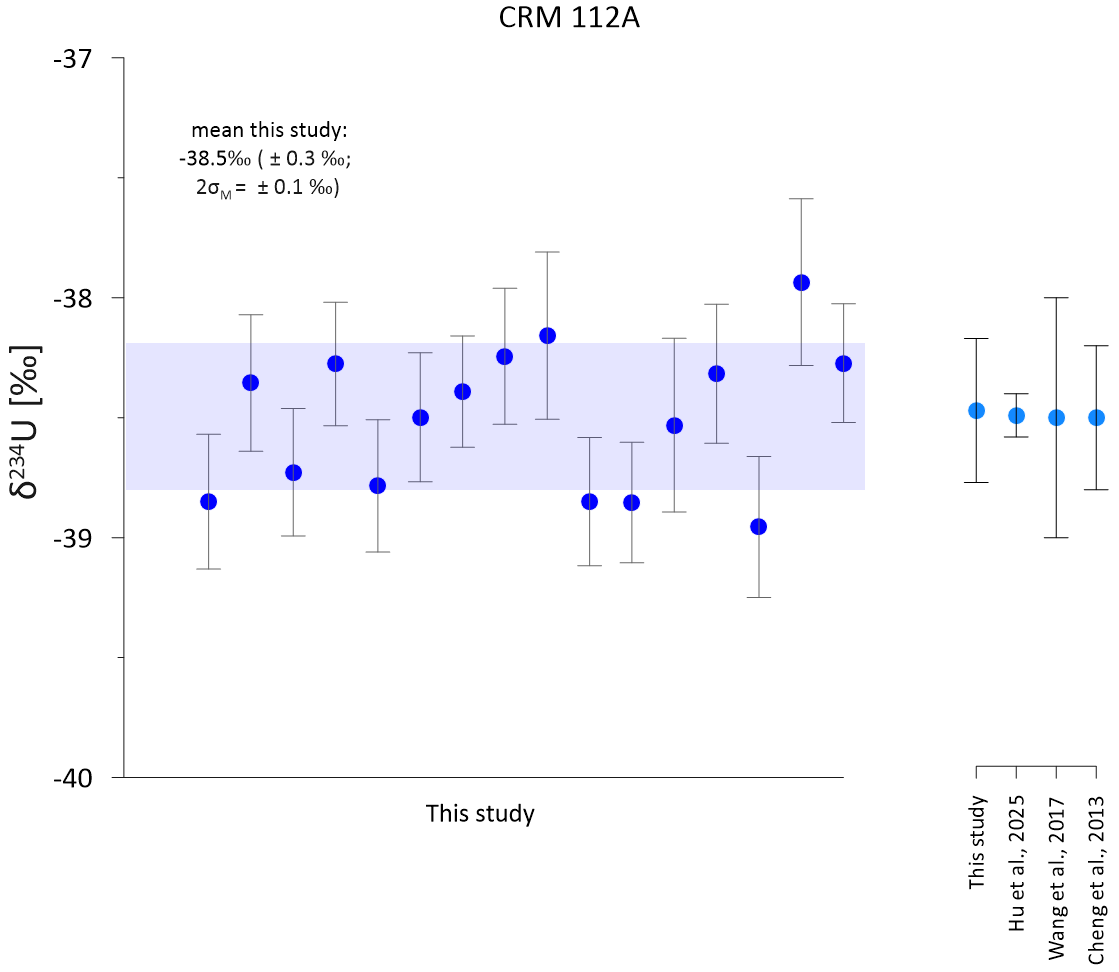
Figure 2The CRM112A standard was repeatedly measured. The mean value of −38.5 ‰ ±0.3 ‰ is in line with other studies (Cheng et al., 2013; Wang et al., 2017; Hu et al., 2025).
3.2 Coral samples
Figure 3 shows a total of 104 samples that were collected from the 237-year record of the coral, with each sample representing an integration of one year. These annual samples present a mean δ234U value of 145.75 ‰, with a standard deviation of 1.22 ‰. The large data ensemble and small variance contribute to an uncertainty in the mean value of ±0.24 ‰ (2σM, n=104). This uncertainty of the mean is comparable to that obtained for the CRM112A standard (Fig. 2). The measured mean δ234U value of 145.75 ‰ is identical to that of modern seawater (Kipp et al., 2022). Analysis of the small-scale variability within the last 165 years from 1850–2014 reveals a range of 3.32 ‰, from 144.35 ‰ to 147.27 ‰. This variance is 2.5 times greater than that observed in modern seawater (Kipp et al., 2022). Notably, an even higher variability is observed in earlier years, specifically from 1778–1846, during which the δ234U values exhibit a total variance of 8.10 ‰, fluctuating from 143.17 ‰ to 151.27 ‰.
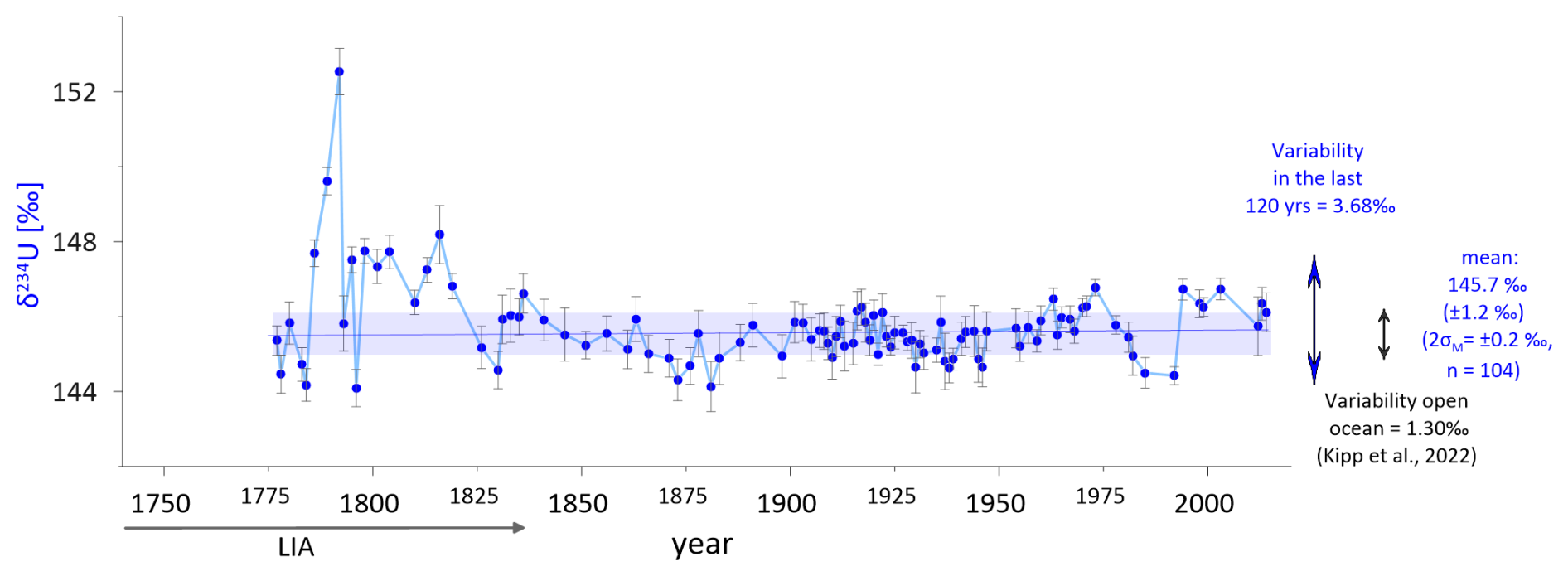
Figure 3Annual δ234U measurements (n=104) of a 237-year-old coral. The mean of 145.75 ‰ (±0.24 ‰) is identical to the open ocean value of 145.55 ‰ (±0.28 ‰) (Kipp et al., 2022). The largest deviations from 143.17 ‰ to 151.27 ‰ were observed from 1778–1846 at the end of the Little Ice Age (LIA), with the peak value occurring in 1792. The variability in the coral δ234U over the last 165 years is approximately 2.5 times greater than the variance expected from observations in the open ocean (Kipp et al., 2022).
4.1 Seawater δ234U from coral aragonite
Corals incorporate the uranium isotopic ratio of seawater (δ234USW) into their skeleton without measurable fractionation (Robinson et al., 2004b; Wang et al., 2017; Kipp et al., 2022). However, one known factor that can cause fractionation is the postdepositional diagenetic alteration of the coral skeletal material (Delanghe et al., 2002; Robinson et al., 2004b; Wang et al., 2017).
Uranium isotope variations in the Cuban coral are independent of growth parameters (e.g., density) or green banding with high Mg concentration (Fig. S3) (Alonso-Hernández et al., 2022). As Mg Ca is the proxy most sensitive to skeleton diagenesis, such as calcite or secondary aragonite formation (Allison et al., 2007; Hathorne et al., 2011), the absence of correlation between δ234U and Mg Ca suggests that diagenesis has not influenced the δ234U values along the core. Studies have shown that secondary aragonite also has a higher U content than primary skeletal aragonite does (Eggins et al., 2005; Allison et al., 2007; Hathorne et al., 2011), which implies a possible correlation between uranium content and isotopic composition. This correlation was not detected in our results (Table S1 and Fig. S3). Furthermore, a diagenetic overprint could result in extraordinarily high δ234U values exceeding 10 ‰ above those of seawater. According to Chutcharavan et al. (2018), a benchmark of 156 ‰ is used to indicate diagenetic alteration of fossil coral material. However, in the coral analysed here, no such elevated values were observed. Consequently, these observations, as well as the excellent agreement of the mean isotopic compositions of corals with those of modern seawater, allow us to conclude that the CSM-1 coral can be used to monitor the U isotopic compositions of local seawater over the past 237 years.
Studies conducted in restricted ocean basins have demonstrated a δ234U offset towards higher values, a shift attributed to the substantial influence of meltwater or river discharge (Andersen et al., 2007; Zhou et al., 2015; Wang et al., 2017; Arendt et al., 2018). Despite the Caribbean being a semi-enclosed basin, it receives a high inflow rate of Atlantic waters, estimated at 28 Sv, which exit the Caribbean and Gulf of Mexico near the sample location (Johns et al., 2002). These substantial throughflow rates support the strong control of seawater on the coral mean δ234U values.
4.2 Coral δ234U values as a proxy for hydrological variation
With excellent reproducibility and overall high precision, even subtle variability can be resolved. The variability in seawater δ234Usw was recently reported to be 1.3 ‰ (Kipp et al., 2022). Under different climate and global weathering conditions, such as during the last sea level low stand and maximum global ice volume, i.e., the Last Glacial Maximum, seawater δ234Usw decreased systematically worldwide by 6±2 ‰ (Henderson, 2002; Esat and Yokoyama, 2006; Chutcharavan et al., 2018). The major sources of isotopic variability in the surface ocean are continental runoff and submerged groundwater. Continental freshwater has a very large range of δ234U values from as low as 70 ‰ to 1030 ‰, depending on the continental U cycle driven by erosion and the type of regional weathering (Dunk et al., 2002; Li et al., 2018). In the tropics, chemical weathering prevails, reducing the excess leaching of 234U from the host rock. Moreover, the residence times of freshwater in karstic environments, such as in the Cuban core location, are within days or months to years, resulting in δ234U values that are at the lower end of the freshwater scale (Dunk et al., 2002; Paces et al., 2002; Gonzalez-De Zayas et al., 2013; Iturralde-Vinent et al., 2016). Thus, changes in the local freshwater contribution to the ocean could cause the δ234Usw values to shift slightly lower than those of seawater. The annual precipitation from 1960–2008 near the coral location has a mean of 482.9 mm yr−1 and varies by approximately 124.5 mm yr−1 (Centella-Artola et al., 2023). Thus, the interannual precipitation variability indicates substantial variations of at least ±25 % in the local freshwater supply.
Over the past 120 years, the coral record has shown considerable variability on decadal timescales, which is approximately 2–3 times greater than that expected in open ocean seawater (Fig. 3) (Andersen et al., 2010; Kipp et al., 2022). Interestingly, the δ234U variations have exhibited a negative correlation with the regional precipitation record since 1960 (, p<0.05, n=21) (Fig. 4) (Centella-Artola et al., 2023).
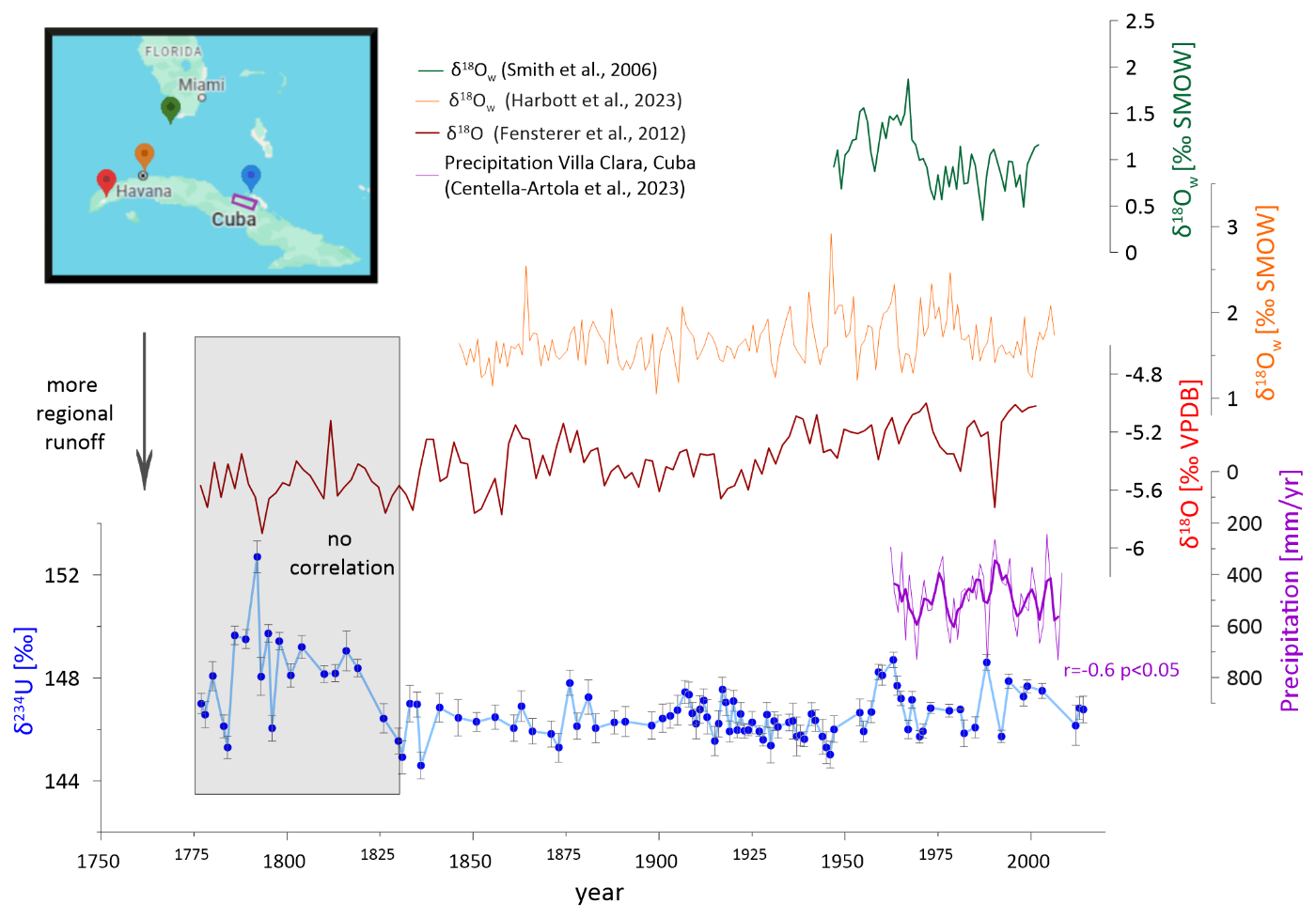
Figure 4The δ234U values from the analysed coral in central northern Cuba (blue) are negatively correlated (, p<0.05) with a precipitation record from the same region, starting in 1960 (purple; inverted y axis) (Centella-Artola et al., 2023). Similar patterns are observed with δ18Ow values calculated from corals from southern Florida (green) (Smith et al., 2006) and northern Cuba (orange) (Harbott et al., 2023), with high δ234U values corresponding to high δ18Ow values. Additionally, since 1860, there has been a similar trend in the δ18O values from a stalagmite in northwestern Cuba, which are interpreted as a precipitation indicator (red) (Fensterer et al., 2012). These alignments show a visible influence of precipitation on the δ234U values of the coastal waters in which the coral lived, with low δ234U values representing greater runoff influences. In the period from 1778–1860, there appears to be no such trend between the stalagmite record and the coral record, likely indicating a substantial marine influence on the coral during the end of the Little Ice Age. Inserted map: Imagery © 2025 INEGI, Map data © 2025 Google.
These subtle variations in δ234U are close to the reproducibility limit of the U isotope measurements but are still statistically noteworthy. The local δ234USW value is dependent on the input of terrestrial sourced freshwater, such as river runoff and submarine groundwater discharge. In Cuba, the residence time of precipitated water is relatively short and in the range of days to months due to the karstic terrain (Gonzalez-De Zayas et al., 2013; Iturralde-Vinent et al., 2016). Uranium isotopic compositions in groundwater are influenced by both redox conditions and uranium concentrations. Typically, an inverse relationship exists between groundwater uranium concentration and δ234U; deep, reducing groundwaters with low uranium concentrations tend to show higher δ234U values than oxic, near-surface waters with higher concentrations (Osmond and Cowart, 1976; Asikainen, 1981). Redox conditions also influence uranium mobility and isotope fractionation, with well-oxidizing groundwaters yielding lower activity ratios (Suksi et al., 2006). Catchment-scale denudation further affects these ratios: a U-shaped relationship has been observed, where both low and high denudation rates correspond to elevated δ234U values, while intermediate rates yield lower values (Li et al., 2018). Studies from the Yucatán Peninsula and Tampa Bay, Florida, have reported low δ234U values in groundwater and estuarine waters, which also showed relatively high uranium concentrations (Osmond and Cowart, 2000; Swarzenski and Baskaran, 2007; Schorndorf et al., 2023). The low δ234U values in the coral may therefore reflect shallow groundwater runoff influenced by oxidizing conditions and/or moderate denudation rates in riverine waters in the region. Hence, the freshwater runoff coming from the Carbonate Hinterland (Iturralde-Vinent et al., 2016) and related to precipitation may lead to a moderate decrease of δ234U values in coastal seawater. This process likely explains the anticorrelation of coral δ234U values, where lower δ234U values coincided with high annual precipitation over the last 50 years (Fig. 4). A study of a sediment core situated approximately 100 km east of the analysed coral core revealed a freshwater influence on organic matter by approximately 15 % from 1900–1970 (Alonso-Hernández et al., 2022). During this time, the coral exhibited a mean δ234U of 145.25 ‰, at the lower limit of open ocean seawater, possibly reflecting a persistent but minor local freshwater influence. The influence on δ234U is likely far lower than that observed for organic matter by Alonso-Hernández et al. (2020) because of the lack of high-discharge rivers nearby.
A commonly used proxy for sea surface salinity is stable oxygen isotopes in seawater (δ18Osw), as they depend on both freshwater influx and evaporation (Leder et al., 1996; Gagan et al., 1998, 2000; Ren et al., 2003). A comparison with reconstructed δ18Osw values from tropical corals in proximity to the sample location also revealed similarities at annual time scales (Fig. 4) (Table S2) (Smith et al., 2006; Harbott et al., 2023). The δ18Osw is calculated from the measured coral δ18O values (Smith et al., 2006), which are influenced by seawater δ18Osw and temperature. By subtracting the temperature component derived from the Sr/Ca record of the same coral, the δ18Osw at the time of coral growth can be calculated (Ren et al., 2003). Note that the SST, estimated via the Li Ca ratio (Alonso-Hernández et al., 2022), is not significant correlated with the coral δ234U values (Fig. S2).
For the 19th century, the coral δ234U values aligned with the δ18O record of a stalagmite from western Cuba, interpreted as a proxy for rainfall amount (Fensterer et al., 2012). This alignment falls within the uncertainty of the stalagmite age model (Fig. 4). Before 1860, the stalagmite and coral records diverged from one another, suggesting a potential additional source of δ234U and its variability. Here, we propose that this source is linked to distant freshwater discharge from the North American continent and/or a synchronous reduction in the strength of the Gulf of Mexico current, which is not traced by the hydroclimate record of the stalagmite.
4.3 Variability during the LIA
The highest variability in the coral δ234U values occurred between 1778 and 1846, with δ234U values ranging from 144.1 ‰ to 152.5 ‰ . This time interval of high δ234U variability coincides with the end of a period of colder SSTs in the Caribbean during the LIA (Winter et al., 2000; Haase-Schramm et al., 2003; Kilbourne et al., 2008).
4.3.1 Fast and high local runoff
Some studies inferred reduced precipitation during the LIA, including Haug et al. (2001) for the southern Caribbean, Hodell et al. (2005) for the Yucatan Peninsula and Richey et al. (2009) for the Gulf of Mexico. However, other studies have reported highly variable amounts of rainfall in the northern part of the Caribbean and the Gulf of Mexico (Kennett et al., 2012; Fensterer et al., 2013; DeLong et al., 2014; Burn et al., 2016). Historical records in Cuba also documented periods of drought interspersed with several severe hurricanes in the late 1700s (Johnson, 2011) (Fig. 5). A high amount of local precipitation with fast discharge rates can explain the low δ234U values recorded in the coral, as discussed above. The punctuated low values recorded by the coral suggest multiple local extreme precipitation events, particularly from 1778–1847 (Fig. 5). Wang and Enfield (2001) reported that an extended Atlantic Warm Pool fuels precipitation and the frequency of more intense tropical storms. Additionally, DeLong et al. (2014) linked fluctuating SSTs in Dry Tortugas and Puerto Rico (Kilbourne et al., 2008) to a variability in the size of the western hemispheric warm pool. The reconstructed SST from the Li Ca in the analysed coral also exhibited high variability during that time (Alonso-Hernández et al., 2022). Therefore, fluctuating δ234U values further support times of fast and high local runoff.
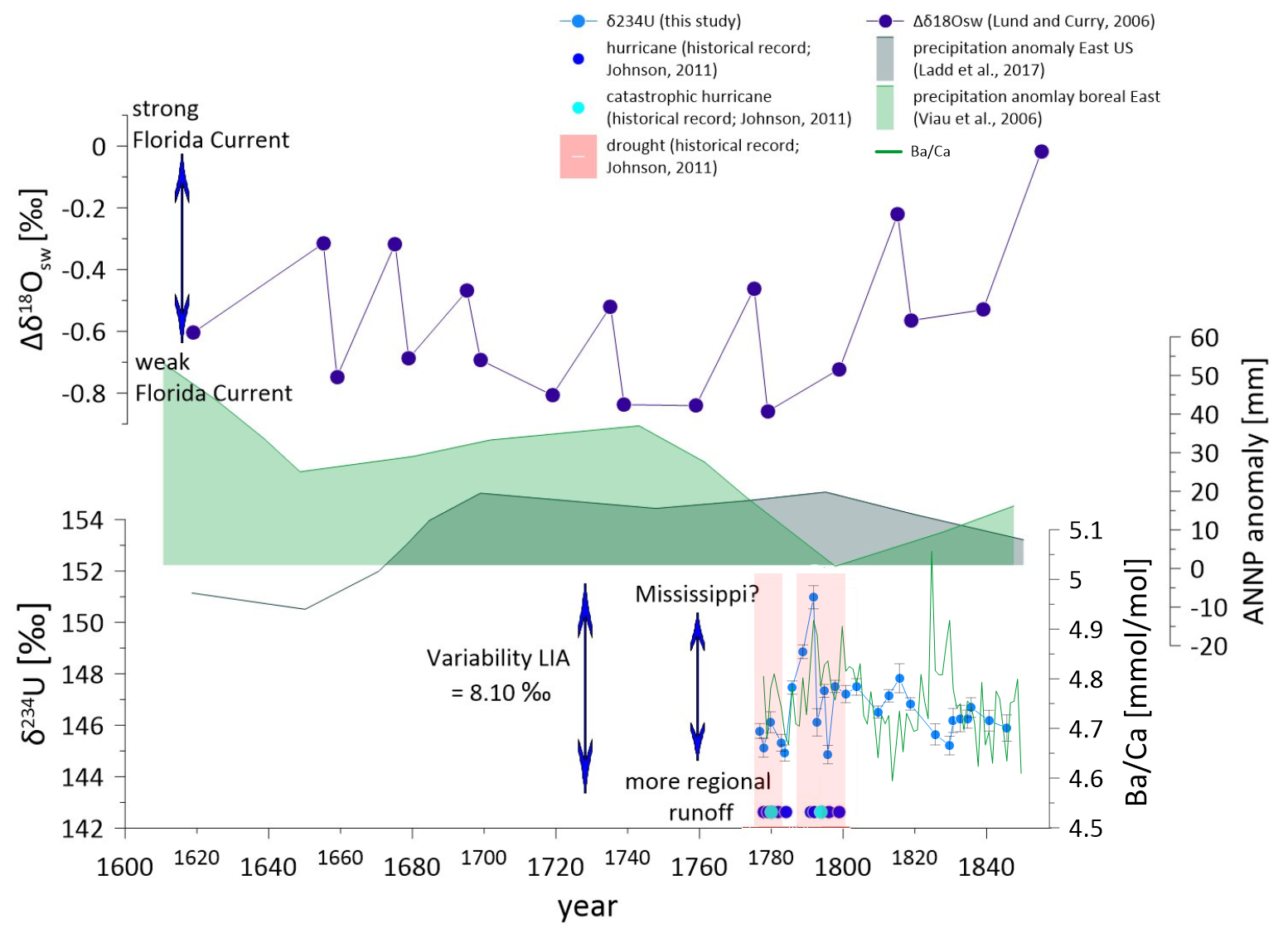
Figure 5δ234U values (blue) from 1778–1850 plotted together with the timing of hydrological events documented in historical records (Johnson, 2011), indicating times of high hydrological fluctuation with droughts (red), hurricanes (dark blue), and catastrophic hurricanes (light blue).The green line shows Ba Ca ratios of the coral core corresponding to the δ234U values. Florida Current strength is inferred from Δδ18Osw differences between the Gulf of Mexico and the Bahamas Channel (purple; Lund and Curry, 2006), where more negative values reflect a weaker current during the LIA. Superimposed precipitation anomalies over eastern North America (dark green; Ladd et al., 2018) and the boreal east (light green; Viau et al., 2006) show enhanced precipitation during this same interval, consistent with a weakened Florida Current and elevated variability in δ234U values.
Another possible influence on the δ234U values is land use change on the Cuban island. Beginning around 1820, widespread deforestation was undertaken to expand sugarcane cultivation (Monzote, 2008). This deforestation likely increased soil erosion and enhanced continuous runoff into coastal waters (Monzote, 2024). Prior to widespread deforestation, uranium delivery to coastal waters was limited in magnitude and more episodic, as forest cover suppressed soil erosion and regulated hydrological fluxes (Palmer and Edmond, 1993; Zhang et al., 2023). Under these conditions, the isotopic composition of uranium was strongly influenced by local lithological heterogeneity. Inputs derived from shallowly weathered soils would have carried elevated δ234U values due to preferential leaching of 234U, whereas contributions from less-weathered bedrock or carbonate units closer to secular equilibrium could have lowered 234U toward or below the marine mean (Chabaux et al., 2008; Li et al., 2018). The archive therefore records large variability, including excursions to relatively low δ234U values, reflecting the sensitivity of the system to short-term and spatially heterogeneous sources.
Following the onset of large-scale deforestation in the early nineteenth century, enhanced and continuous soil erosion generated a greater and more sustained flux of weathering-derived uranium to the coastal environment (Chabaux et al., 2008; Li et al., 2018; Monzote, 2024). Because 234U is preferentially mobilized during chemical weathering, this terrestrial input typically carried δ234U values above equilibrium (Chabaux et al., 2008; Li et al., 2018). The larger and more consistent flux buffered the influence of localized or episodic inputs, leading to a stabilization of δ234U values in the archive and their convergence toward the oceanic mean.
Figure 5 shows the Ba Ca record of the coral core, and exhibits a positive covariation with the δ234U record except for a particular strong Ba Ca peak surrounding the year 1820 to 1830. The correspondence suggests that both proxies respond to a common environmental driver, potentially linked to changes in terrigenous input or nearshore hydrographic conditions. Periods of enhanced Ba Ca and δ234U broadly coincide with phases of precipitation extrems until 1820, when Ba Ca decouples from δ234U. This event coincids with intensified land-use change on Cuba, including widespread deforestation after 1820, which has been shown to increase soil erosion and the export of particulate and dissolved material to the coastal ocean. During the same time interval, precipitation moderately increases as indicated by the speleothem δ18O values (Fig. 4). Obviously Ba Ca response more sensitive to such local vegetation and soil changes that coincide with precipitation changes as compared to δ234U, which does not reveal a significant increase during those years.
Therefore, the lack of synchronous variability between the coral δ234U record and the stalagmite δ18O record from Cuba (Fensterer et al., 2012) suggests that local precipitation changes can unlikely explain the observed δ234U variability between the years 1780–1850. Together, these observations imply that the δ234U signal recorded in the coral reflects marine and to a lesser degree regional land-use-related influences rather than a simple response to island-scale rainfall variability.
4.3.2 Possible Mississippi influence
With a smaller warm pool, precipitation over the eastern North American continent has increased due to changes in atmospheric circulation (Wang et al., 2008; Ladd et al., 2018). This enhancement also extended to parts of the Mississippi recharge basin (Ladd et al., 2018), potentially leading to increased runoff. The Mississippi River was found to have elevated δ234U values averaging approximately 335 ‰, with strong seasonal variations and values reaching up to 450 ‰ (Grzymko et al., 2007). During the end of the LIA, the coral δ234U values are frequently elevated by >3 ‰ compared with those in the mean ocean and are even more significant than those in locally depleted runoff. Thus, we hypothesize that these elevated δ234U values resulted from 234U-enriched waters from Mississippi that reached the Gulf of Mexico and induced excess 234U to the coral site. Upon discharge, the river plume is carried westward and southwestward along the Louisiana–Texas shelf within the Gulf's general cyclonic circulation, often described as the Mexican Current system, which flows counter to the eastward Loop Current (Androulidakis and Kourafalou, 2013). Although this circulation pattern tends to retain Mississippi-derived material within the western Gulf, episodic entrainment into the Loop Current has been documented during periods of strong eddy activity or northward Loop Current extensions (Muller-Karger, 2000; Morey et al., 2003; Androulidakis and Kourafalou, 2013). Once incorporated into the Loop Current, dissolved constituents such as uranium could be transported eastward through the Florida Strait and subsequently redistributed in the southern Florida Strait along the northern Cuban shelf (Fratantoni et al., 1998; Androulidakis et al., 2020). Indeed, analysis of satellite salinity measurements indicates, that Mississippi-sourced waters can extend as far as the Florida Straight (Cummings and Smedstad, 2013). Because uranium in seawater is conservative, with a residence time on the order of 400–500 kyr (Jaffey et al., 1971; Chen et al., 1986), inputs from the Mississippi would rapidly mix with the surrounding marine reservoir. While this makes it unlikely that Mississippi-derived uranium dominated the local isotopic budget, periodic variability of the Loop Current or increased fluvial fluxes could have enhanced its relative contribution. Such variability may have contributed to shifts in δ234U values at the site, particularly prior to the stabilization associated with 19th-century land-use change on Cuba and under differing oceanographic settings.
The LIA likely made the Gulf of Mexico-Caribbean system more dynamic and variable. Periods of stronger winds and increased Mississippi River discharge would have enhanced the eastward advection of river water across the northern Gulf and its subsequent entrainment into the Loop Current, favouring export toward the Straits of Florida and the northern Cuban shelf (Muller-Karger, 2000; Morey et al., 2003). At the same time, wind forcing and Caribbean eddies exert strong control over Loop Current extension and eddy shedding, at times shortening the shedding period to 3–7 months or prolonging it to 14–16 months (Oey et al., 2003). Thus, while enhanced storminess and runoff during the LIA may have increased the potential for Mississippi River influence on Cuban shelf waters, alternating phases of Loop Current suppression by Caribbean anticyclones would have periodically dampened this transport. Explaining the high variability in the δ234U values from the coral during the End of the LIA.
A strong Caribbean current would more efficiently dilute any freshwater signal than a reduced Gulf of Mexico throughflow. During the LIA, Lund et al. (2006) reported a decrease in the throughflow rate at the Florida Strait by approximately 10 %, predominantly in the wind-driven part of the Florida Current. This reduction, coupled with an increase in precipitation over the eastern part of the North American continent (Lund et al., 2006; Ladd et al., 2018), could reasonably account for a higher total U discharge from the Mississippi River. This scenario likely contributed to the observed punctuated increase in δ234U values of 2 ‰–3 ‰ during the LIA. Lund and Curry (2006) and Richey et al. (2009) further suggested saltier conditions in the Gulf of Mexico during the LIA, bringing the Caribbean Basin closer to today's conditions of semi-enclosed basins such as the Mediterranean Sea. These basins present elevated δ234U values due to restricted access from open ocean seawater, high evaporation rates and the input of much freshwater and submerged groundwater from terrestrial sources (Border, 2020). However, changes in throughflow of up to 10 % are small overall compared with possible major changes in U runoff and its isotopic composition.
Given the capacity for Ba and other trace elements to be transported over large distances within the Gulf of Mexico, enhanced influence of the Mississippi River plume represents a plausible cause for the correlation of Ba Ca and δ234U in the coral core observed at the end of LIA, with the exception of a local induced strong Ba Ca increase from deforestation over the years 1820 to 1830.
This interpretation is consistent with the absence of coherent variability between the coral δ234U record and the Cuban stalagmite δ18O record (Fensterer et al., 2012), which argues against island-scale precipitation and local runoff as the dominant controls. Instead, the decoupling of these records points toward a stronger role for large-scale river discharge and marine transport processes of U into the Gulf of Mexico as a whole. In this context, increased Mississippi uranium runoff into the Gulf of Mexico during the terminal phase of the LIA, potentially associated with enhanced meltwater and sediment fluxes from higher latitudes, provides a viable explanation for the elevated δ234U values observed during this interval.
The discussion above assumes that the δ234U values in the coral are influenced solely by Mississippi freshwater and seawater, neglecting the potential impact of other sources with different δ234U ratios. The reduced wind-driven portion of the Florida Current, which originates from the North Atlantic Subtropical Gyre (Lund et al., 2006), results in a greater contribution of South Atlantic sourced water, potentially affecting the coral δ234U ratios. South Atlantic waters are further influenced by the significant discharge of the Amazon and Orinoco rivers near the entrance of the Caribbean (Vorosmarty et al., 1998; Paterne et al., 2023). The Amazon River has elevated δ234U values of 204 ‰ (±4 ‰) (Swarzenski et al., 2004; Border, 2020). However, a study of uranium concentrations and δ234U values in the Amazon delta identified an uranium sink due to anaerobic conditions (Border, 2020), suggesting that Amazon-derived uranium does not have a significant large-scale influence on Cuban corals. Changes in Florida Current strength may have influenced the residence time of river-derived signals within the Gulf of Mexico. However, circulation changes alone are unlikely to generate the observed elevation in δ234U values without the presence of a high-δ234U freshwater endmember. The Mississippi River represents such a source of isotopically enriched uranium injected into the Gulf of Mexico and its variability is consistent with the observed covariance between Ba Ca and δ234U in the coral record. Taken together, the available constraints are most consistent with enhanced Mississippi discharge as a principal contributor to the late LIA δ234U variability, with circulation changes influencing the magnitude and expression of the signal. These changes end around the year 1820, when global temperatures start increasing. Between 1820 to 1830 rapid local deforestation of the Cuba Island caused a pulse of Ba runoff to the ocean.
Further spatially resolved δ234U records, particularly from sites proximal to the Mississippi River mouth such as Flower Garden Banks (DeLong et al., 2023), would allow quantitative evaluation of the predicted fluvial gradient and help constrain the relative contributions of discharge versus circulation changes. Additional groundwater characterization and broader Caribbean coral records would refine the regional hydrographic context of the late LIA variability.
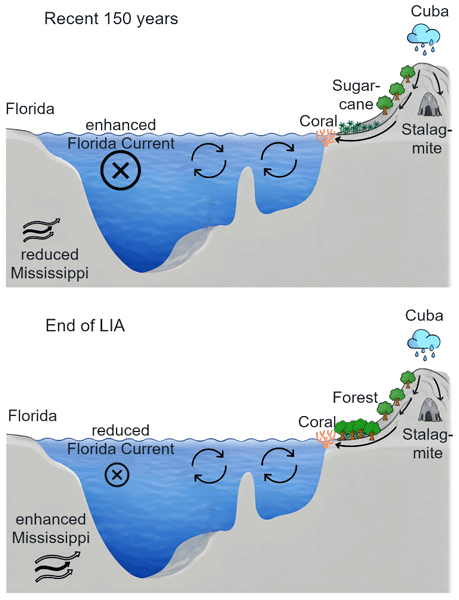
This study presents the first annually resolved coral δ234U record spanning 237 years of seawater δ234U from the northern part of Cuba, which was obtained via analysis of the uranium isotopic composition along a coral core of Orbicella faveolata. Our results confirm that coral δ234U reliably records the seawater composition (δ234USW) without significant diagenetic alteration, as evidenced by the lack of correlation between δ234U, density and Mg Ca ratios. The coral has a mean δ234U value of 145.74 ‰ (±0.2 ‰), which is identical to the open ocean value of 145.55 ‰ (±0.28 ‰). Decadal δ234U variations are approximately 2–3 times greater than those in open ocean seawater and correlate inversely with regional precipitation since 1960 (, p<0.05), suggesting an influence of local terrestrial freshwater input, likely from surface runoff and submerged groundwaters. From 1778–1846, coinciding with the end of the Little Ice Age, the δ234U record exhibited high variability, with values ranging from 143.40 ‰ to 151.50 ‰, which suggests substantial hydrological changes characterized by severe droughts and increased hurricane activity. Changes in atmospheric circulation during that time also led to increased precipitation over the eastern North American continent, including the Mississippi drainage basin. Thus, elevated δ234U values are potentially related to stronger winds and increased freshwater input from the Mississippi River, and reduced throughflow in the Florida Strait, which have enhanced the potential for river water to reach the northern Cuban shelf as shown schematically in Fig. 6. And caused a 2 ‰–3 ‰ increase in coral δ234U, with a greater variability during the end of the LIA. However, the influence of other far more distant freshwater sources, such as the Amazon River, was likely minimal due to localized uranium sinks. This study highlights the potential of coral δ234U as a promising proxy for reconstructing past hydrographic and riverine variability.
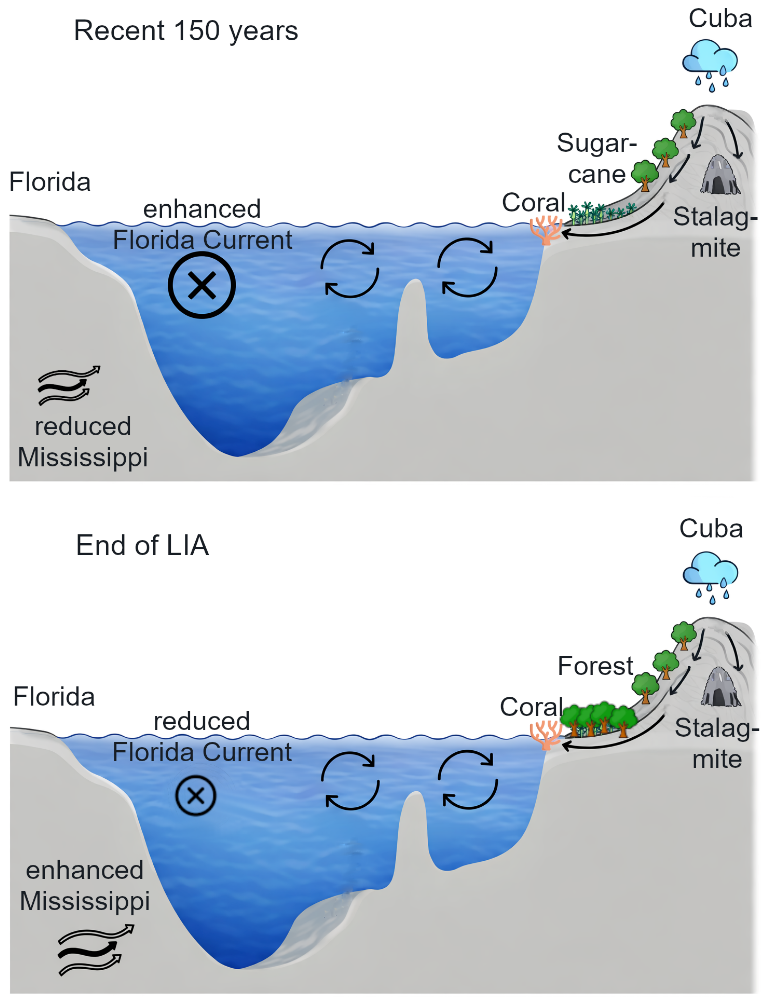
Figure 6Schematic comparison of environmental conditions during the end of the Little Ice Age (LIA) and the last ∼150 years. The lower panel depicts the terminal LIA, characterized by enhanced Mississippi River discharge, reduced Florida Current strength, and predominantly forested land cover in Cuba. The upper panel represents the recent period, with reduced Mississippi influence, strengthened Florida Current transport, and expanded agricultural land use in Cuba. Arrows indicate relative changes in river input, ocean circulation, and terrestrial runoff pathways affecting the coral site north of Cuba.
The raw data of the figures and tables presented in this paper are found in the Supplement and at the PANGAEA open data library (https://doi.org/10.1594/PANGAEA.973159, Greve et al., 2026b).
The supplement related to this article is available online at https://doi.org/10.5194/os-22-1529-2026-supplement.
SG: conceptualization, data production, interpretation and writing. NF: conceptualization, MC-ICPMS support, mentoring, and data quality control. SW: conceptualization, and hydroclimate records from speleothems. PM: sample supply, SST calculation and trace element measurement. ED: trace element measurement. CAH: sample supply, SST calculation. MGB: sample supply.
The contact author has declared that none of the authors has any competing interests.
Publisher's note: Copernicus Publications remains neutral with regard to jurisdictional claims made in the text, published maps, institutional affiliations, or any other geographical representation in this paper. The authors bear the ultimate responsibility for providing appropriate place names. Views expressed in the text are those of the authors and do not necessarily reflect the views of the publisher.
We thank René Eichstädter for analytical support, as well as Athulya Babu and Marius Feuerle for their assistance in the laboratory.
This research has been supported by the Deutsche Forschungsgemeinschaft (grant nos. 468685637, 441832482, and 247825108).
This paper was edited by Xinping Hu and reviewed by two anonymous referees.
Allison, N., Finch, A. A., Webster, J. M., and Clague, D. A.: Palaeoenvironmental records from fossil corals: The effects of submarine diagenesis on temperature and climate estimates, Geochim. Cosmochim. Ac., 71, 4693–4703, https://doi.org/10.1016/j.gca.2007.07.026, 2007.
Alonso-Hernández, C. M., Fanelli, E., Diaz-Asencio, M., Santamaría, J. M., and Morera-Gómez, Y.: Carbon and nitrogen isotopes to distinguish sources of sedimentary organic matter in a Caribbean estuary, Isotop. Environ. Health Stud., 56, 654–672, https://doi.org/10.1080/10256016.2020.1819263, 2020.
Alonso-Hernández, C. M., Gómez-Batista, M., Helguera Pedraza, Y., Hernández-Albernas, J., Rico-Esenaro, S. D., Ruiz-Fernández, A. C., Sánchez-Cabeza, J. A., Douville, E., and Montagna, P.: Registro de temperatura superficial del mar (1778–2015) en Orbicella faveolata (Cnidaria: Scleractinia) del arrecife Cayo Santa María, Cuba, Revista de Investigaciones Marinas, 42, 37–53, 2022.
Andersen, M. B., Stirling, C. H., Porcelli, D., Halliday, A. N., Andersson, P. S., and Baskaran, M.: The tracing of riverine U in Arctic seawater with very precise234U/238U measurements, Earth Planet. Sc. Lett., 259, 171–185, https://doi.org/10.1016/j.epsl.2007.04.051, 2007.
Andersen, M. B., Stirling, C. H., Zimmermann, B., and Halliday, A. N.: Precise determination of the open ocean 234U/238U composition, Geochem. Geophy. Geosy., 11, https://doi.org/10.1029/2010gc003318, 2010.
Andersen, M. B., Elliott, T., Freymuth, H., Sims, K. W., Niu, Y., and Kelley, K. A.: The terrestrial uranium isotope cycle, Nature, 517, 356–359, https://doi.org/10.1038/nature14062, 2015.
Androulidakis, Y., Kourafalou, V., Le Hénaff, M., Kang, H., Ntaganou, N., and Hu, C.: Gulf Stream evolution through the Straits of Florida: the role of eddies and upwelling near Cuba, Ocean Dynam., 70, 1005–1032, https://doi.org/10.1007/s10236-020-01381-5, 2020.
Androulidakis, Y. S. and Kourafalou, V. H.: On the processes that influence the transport and fate of Mississippi waters under flooding outflow conditions, Ocean Dynam., 63, 143–164, https://doi.org/10.1007/s10236-012-0587-8, 2013.
Arendt, C. A., Aciego, S. M., Sims, K. W. W., Das, S. B., Sheik, C., and Stevenson, E. I.: Influence of glacial meltwater on global seawater δ234U, Geochim. Cosmochim. Ac., 225, 102–115, https://doi.org/10.1016/j.gca.2018.01.007, 2018.
Asikainen, M.: State of disequilibrium between 238U, 234U, 226Ra and 222n in groundwater from bedrock, Geochim. Cosmochim. Ac., 45, 201–206, https://doi.org/10.1016/0016-7037(81)90163-0, 1981.
Border, E. C.: Variability of δ234U in the Mediterranean Sea, Amazon Estuary, and Atlantic Ocean, INIS, http://inis.iaea.org/search/search.aspx?orig_q=RN:52022202 (last access: June 2025), 2020.
Buddemeier, R. W., Maragos, J. E., and Knutson, D. W.: Radiographic studies of reef coral exoskeletons: Rates and patterns of coral growth, J. Exp. Mar. Biol. Ecol., 14, 179–199, https://doi.org/10.1016/0022-0981(74)90024-0, 1974.
Burn, M. J., Holmes, J., Kennedy, L. M., Bain, A., Marshall, J. D., and Perdikaris, S.: A sediment-based reconstruction of Caribbean effective precipitation during the `Little Ice Age' from Freshwater Pond, Barbuda, Holocene, 26, 1237–1247, https://doi.org/10.1177/0959683616638418, 2016.
Carroll, J. L.: Dams and Damages: The Ojibway, the United States, and the Mississippi Headwaters Reservoirs, Minnesota History, 52, 2–15, 1990.
Centella-Artola, A., Bezanilla-Morlot, A., Serrano-Notivoli, R., Vazquez-Montenegro, R., Sierra-Lorenzo, M., and Chang-Dominguez, D.: A new long term gridded daily precipitation dataset at high-resolution for Cuba (CubaPrec1), Data Brief, 48, 109294, https://doi.org/10.1016/j.dib.2023.109294, 2023.
Chabaux, F., Bourdon, B., and Riotte, J.: Chapter 3 U-Series Geochemistry in Weathering Profiles, River Waters and Lakes, in: Radioactivity in the Environment, Vol. 13, edited by: Krishnaswami, S. and Cochran, J. K., Elsevier, 49–104, https://doi.org/10.1016/S1569-4860(07)00003-4, 2008.
Chen, J. H., Lawrence Edwards, R., and Wasserburg, G. J.: 238U, 234U and 232Th in seawater, Earth Planet. Sc. Lett., 80, 241–251, https://doi.org/10.1016/0012-821X(86)90108-1, 1986.
Cheng, H., Lawrence Edwards, R., Shen, C.-C., Polyak, V. J., Asmerom, Y., Woodhead, J., Hellstrom, J., Wang, Y., Kong, X., Spötl, C., Wang, X., and Calvin Alexander, E.: Improvements in 230Th dating, 230Th and 234U half-life values, and U–Th isotopic measurements by multi-collector inductively coupled plasma mass spectrometry, Earth Planet. Sc. Lett., 371–372, 82–91, https://doi.org/10.1016/j.epsl.2013.04.006, 2013.
Chutcharavan, P. M., Dutton, A., and Ellwood, M. J.: Seawater 234U/238U recorded by modern and fossil corals, Geochim. Cosmochim. Ac., 224, 1–17, https://doi.org/10.1016/j.gca.2017.12.017, 2018.
Cummings, J. A. and Smedstad, O. M.: Variational Data Assimilation for the Global Ocean, in: Data Assimilation for Atmospheric, Oceanic and Hydrologic Applications, Vol. II, edtited by: Park, S. K. and Xu, L., Springer, Berlin, Heidelberg, 303–343, https://doi.org/10.1007/978-3-642-35088-7_13, 2013.
Cuny-Guirriec, K., Douville, E., Reynaud, S., Allemand, D., Bordier, L., Canesi, M., Mazzoli, C., Taviani, M., Canese, S., McCulloch, M., Trotter, J., Rico-Esenaro, S. D., Sanchez-Cabeza, J.-A., Ruiz-Fernández, A. C., Carricart-Ganivet, J. P., Scott, P. M., Sadekov, A., and Montagna, P.: Coral Li/Mg thermometry: Caveats and constraints, Chem. Geol., 523, 162–178, https://doi.org/10.1016/j.chemgeo.2019.03.038, 2019.
Delanghe, D., Bard, E., and Hamelin, B.: New TIMS constraints on the uranium-238 and uranium-234 in seawaters from the main ocean basins and the Mediterranean Sea, Mar. Chem., 80, 79–93, https://doi.org/10.1016/S0304-4203(02)00100-7, 2002.
DeLong, K. L., Flannery, J. A., Poore, R. Z., Quinn, T. M., Maupin, C. R., Lin, K., and Shen, C.-C.: A reconstruction of sea surface temperature variability in the southeastern Gulf of Mexico from 1734 to 2008 C.E. using cross-dated Sr/Ca records from the coral Siderastrea siderea, Paleoceanography, 29, 403–422, https://doi.org/10.1002/2013PA002524, 2014.
DeLong, K. L., Palmer, K., Wagner, A. J., Weerabaddana, M. M., Slowey, N., Herrmann, A. D., Duprey, N., Martínez-García, A., Jung, J., Hajdas, I., Rose, N. L., Roberts, S. L., Roberts, L. R., Cundy, A. B., Gaca, P., Milton, J. A., Yang, H., Turner, S. D., Huang, C.-Y., and Zinke, J.: The Flower Garden Banks Siderastrea siderea coral as a candidate Global boundary Stratotype Section and Point for the Anthropocene series, Anthrop. Rev., 10, 225–250, https://doi.org/10.1177/20530196221147616, 2023.
Dunk, R. M., Mills, R. A., and Jenkins, W. J.: A reevaluation of the oceanic uranium budget for the Holocene, Chem. Geol., 190, 45–67, https://doi.org/10.1016/S0009-2541(02)00110-9, 2002.
Eggins, S. M., Grün, R., McCulloch, M. T., Pike, A. W. G., Chappell, J., Kinsley, L., Mortimer, G., Shelley, M., Murray-Wallace, C. V., Spötl, C., and Taylor, L: In situ U-series dating by laser-ablation multi-collector ICPMS: new prospects for Quaternary geochronology, Quaternary Sci. Rev., 24, 2523–2538, https://doi.org/10.1016/j.quascirev.2005.07.006, 2005.
Esat, T. M. and Yokoyama, Y.: Variability in the uranium isotopic composition of the oceans over glacial–interglacial timescales, Geochim. Cosmochim. Ac., 70, 4140–4150, https://doi.org/10.1016/j.gca.2006.06.013, 2006.
Esat, T. M. and Yokoyama, Y.: Coupled uranium isotope and sea-level variations in the oceans, Geochim. Cosmochim. Ac., 74, 7008–7020, https://doi.org/10.1016/j.gca.2010.09.007, 2010.
Fensterer, C., Scholz, D., Hoffmann, D., Spötl, C., Pajón, J. M., and Mangini, A.: Cuban stalagmite suggests relationship between Caribbean precipitation and the Atlantic Multidecadal Oscillation during the past 1.3 ka, Holocene, 22, 1405–1412, https://doi.org/10.1177/0959683612449759, 2012.
Fensterer, C., Scholz, D., Hoffmann, D. L., Spötl, C., Schröder-Ritzrau, A., Horn, C., Pajón, J. M., and Mangini, A.: Millennial-scale climate variability during the last 12.5 ka recorded in a Caribbean speleothem, Earth Planeta. Sc. Lett., 361, 143–151, https://doi.org/10.1016/j.epsl.2012.11.019, 2013.
Folwell, W. W.: A History of Minnesota, Minnesota Historical Society, https://books.google.de/books?id=2SYUAAAAYAAJ (last access: September 2025), 1921.
Frank, N., Turpin, L., Cabioch, G., Blamart, D., Tressens-Fedou, M., Colin, C., and Jean-Baptiste, P.: Open system U-series ages of corals from a subsiding reef in New Caledonia: Implications for sea level changes, and subsidence rate, Earth Planet. Sc. Lett., 249, 274–289, https://doi.org/10.1016/j.epsl.2006.07.029, 2006.
Fratantoni, P. S., Lee, T. N., Podesta, G. P., and Muller-Karger, F.: The influence of Loop Current perturbations on the formation and evolution of Tortugas eddies in the southern Straits of Florida, J. Geophys. Res.-Oceans, 103, 24759–24779, https://doi.org/10.1029/98JC02147, 1998.
Gagan, M. K., Ayliffe, L. K., Hopley, D., Cali, J. A., Mortimer, G. E., Chappell, J., McCulloch, M. T., and Head, M. J.: Temperature and Surface-Ocean Water Balance of the Mid-Holocene Tropical Western Pacific, Science, 279, 1014–1018, https://doi.org/10.1126/science.279.5353.1014, 1998.
Gagan, M. K., Ayliffe, L. K., Beck, J. W., Cole, J. E., Druffel, E. R. M., Dunbar, R. B., and Schrag, D. P.: New views of tropical paleoclimates from corals, Quaternary Sci. Rev., 19, 45–64, https://doi.org/10.1016/S0277-3791(99)00054-2, 2000.
Gallup, C. D., Edwards, R. L., and Johnson, R. G.: The timing of high sea levels over the past 200,000 years, Science, 263, 796–800, https://doi.org/10.1126/science.263.5148.796, 1994.
Gonzalez-De Zayas, R., Merino-Ibarra, M., Soto-Jimenez, M. F., and Castillo-Sandoval, F. S.: Biogeochemical responses to nutrient inputs in a Cuban coastal lagoon: runoff, anthropogenic, and groundwater sources, Environ. Monit. Assess., 185, 10101–10114, https://doi.org/10.1007/s10661-013-3316-y, 2013.
Greve, S., Frank, N., Montagna, P., Winter, A., Rico-Esenaro, S. D., Carricart-Ganivet, J. P., and Hetzinger, S.: Precision measurement of δ234U in annually banded tropical corals, Geochronology, in preparation, 2026a.
Greve, S., Frank, N., Montagna, P., Alonso-Hernandez, C., Douville, E., and Warken, S.: δ234U Values of the last 230 years in a Cuban coral ranging from 1777 to 2014 [dataset], PANGAEA [data set], https://doi.org/10.1594/PANGAEA.973159, 2026b.
Grzymko, T. J., Marcantonio, F., McKee, B. A., and Mike Stewart, C.: Temporal variability of uranium concentrations and 234U 238U activity ratios in the Mississippi river and its tributaries, Chem. Geol., 243, 344–356, https://doi.org/10.1016/j.chemgeo.2007.05.024, 2007.
Haase-Schramm, A., Böhm, F., Eisenhauer, A., Dullo, W.-C., Joachimski, M. M., Hansen, B., and Reitner, J.: Sr Ca ratios and oxygen isotopes from sclerosponges: Temperature history of the Caribbean mixed layer and thermocline during the Little Ice Age, Paleoceanography, 18, https://doi.org/10.1029/2002PA000830, 2003.
Harbott, M., Wu, H. C., Kuhnert, H., Jimenez, C., González-Díaz, P., and Rixen, T.: A Warming Southern Gulf of Mexico: Reconstruction of Anthropogenic Environmental Changes From a Siderastrea siderea Coral on the Northern Coast of Cuba, Paleoceanogr. Paleoclimatol., 38, e2023PA004717, https://doi.org/10.1029/2023PA004717, 2023.
Hathorne, E. C., Felis, T., James, R. H., and Thomas, A.: Laser ablation ICP-MS screening of corals for diagenetically affected areas applied to Tahiti corals from the last deglaciation, Geochim. Cosmochim. Ac., 75, 1490–1506, https://doi.org/10.1016/j.gca.2010.12.011, 2011.
Haug, H. G., Konrad, A. H., Daniel, M. S., Larry, C. P., and Ursula, R.: Southward Migration of the Intertropical Convergence Zone Through the Holocene, Science, 293, 1304–1308, https://doi.org/10.1126/science.1059725, 2001.
Henderson, G. M.: Seawater (234U/238U) during the last 800 thousand years, Earth Planet. Sc. Lett., 199, 97–110, https://doi.org/10.1016/S0012-821X(02)00556-3, 2002.
Henderson, G. M. and Slowey, N. C.: Evidence from U–Th dating against Northern Hemisphere forcing of the penultimate deglaciation, Nature, 404, 61–66, https://doi.org/10.1038/35003541, 2000.
Henderson, G. M., Cohen, A. S., and O'Nions, R. K.: 234U 238U ratios and 230Th ages for Hateruma Atoll corals: implications for coral diagenesis and seawater 234U 238U ratios, Earth Planet. Sc. Lett., 115, 65–73, https://doi.org/10.1016/0012-821X(93)90213-S, 1993.
Hitchcock, G. L., Wiseman, W. J., Boicourt, W. C., Mariano, A. J., Walker, N., Nelsen, T. A., and Ryan, E.: Property fields in an effluent plume of the Mississippi river, J. Mar. Syst., 12, 109–126, https://doi.org/10.1016/S0924-7963(96)00092-9, 1997.
Hodell, D. A., Brenner, M., Curtis, J. H., Medina-González, R., Ildefonso-Chan Can, E., Albornaz-Pat, A., and Guilderson, T. P.: Climate change on the Yucatan Peninsula during the Little Ice Age, Quatern. Res., 63, 109–121, https://doi.org/10.1016/j.yqres.2004.11.004, 2005.
Horwitz, E. P., Dietz, M. L., Chlanzla, R., and Diamond, H.: Separation and preconcentration of uranium from acidic media by extraction chromatography, Analyt. Chem. Ac., 226, 25–37, 1992.
Hu, H.-M., Shen, C.-C., Cheng, H., Woodhead, J. D., Edwards, R. L., Zhao, J.-X., Huang, C.-Y., Lu, P.-Y., Chien, W.-Y., Wang, J., Jia, X., Yokoyama, Y., Cai, Y., and Zachariáš, J.: Sub-epsilon natural 234U/238U measurements refine the 234U half-life and U–Th geochronology, Sci. Adv., 11, eadu8117, https://doi.org/10.1126/sciadv.adu8117, 2025.
Iturralde-Vinent, M. A., García-Casco, A., Rojas-Agramonte, Y., Proenza, J. A., Murphy, J. B., and Stern, R. J.: The geology of Cuba: A brief overview and synthesis, GSA Today, 26, 4–10, https://doi.org/10.1130/gsatg296a.1, 2016.
Ivanovich, M. and Harmon, R. S.: Uranium-series disequilibrium: applications to earth, marine, and environmental sciences, in: 2nd Edn., Clarendon Press, Oxford, UK, ISBN 0 19 854278 X GBN, 1992.
Jaffey, A. H., Flynn, K. F., Glendenin, L. E., Bentley, W. C., and Essling, A. M.: Precision Measurement of Half-Lives and Specific Activities of 235U and 238U, Phys. Rev. C, 4, 1889–1906, https://doi.org/10.1103/PhysRevC.4.1889, 1971.
Johns, W. E., Townsend, T. L., Fratantoni, D. M., and Wilson, W. D.: On the Atlantic inflow to the Caribbean Sea, Deep-Sea Res. Pt. I, 49, 211–243, https://doi.org/10.1016/S0967-0637(01)00041-3, 2002.
Johnson, S.: Climate and Catastrophe in Cuba and the Atlantic World in the Age of Revolution, University of North Carolina Press, https://doi.org/10.5149/9780807869345_johnson, 2011.
Kennett, D. J., Breitenbach, S. F. M., Aquino, V. V., Asmerom, Y., Awe, J., Baldini, J. U. L., Bartlein, P., Culleton, B. J., Ebert, C., Jazwa, C., Macri, M. J., Marwan, N., Polyak, V., Prufer, K. M., Ridley, H. E., Sodemann, H., Winterhalder, B., and Haug, G. H.: Development and Disintegration of Maya Political Systems in Response to Climate Change, Science, 338, 788–791, https://doi.org/10.1126/science.1226299, 2012.
Kerber, I. K., Arps, J., Eichstädter, R., Kontor, F., Dornick, C., Schröder-Ritzrau, A., Babu, A., Warken, S., and Frank, N.: Simultaneous U and Th isotope measurements for U-series dating using MCICPMS, Nucl. Instrum. Meth. Phys. Res. Sect. B, 539, 169–178, https://doi.org/10.1016/j.nimb.2023.04.003, 2023.
Kerber, I. K., Kontor, F., Mielke, A., Warken, S., and Frank, N.: Technical note: “U–Th Analysis” – an open-source software dedicated to MCICPMS U-series-data treatment and evaluation, Geochronology, 7, 1–13, https://doi.org/10.5194/gchron-7-1-2025, 2025.
Kigoshi, K.: Alpha-Recoil Thorium-234: Dissolution into Water and the Uranium-234/Uranium-238 Disequilibrium in Nature, Science, 173, 47–48, 1971.
Kilbourne, K. H., Quinn, T. M., Webb, R., Guilderson, T., Nyberg, J., and Winter, A.: Paleoclimate proxy perspective on Caribbean climate since the year 1751: Evidence of cooler temperatures and multidecadal variability, Paleoceanography, 23, https://doi.org/10.1029/2008pa001598, 2008.
Kipp, M. A., Li, H., Ellwood, M. J., John, S. G., Middag, R., Adkins, J. F., and Tissot, F. L. H.: 238U, 235U and 234U in seawater and deep-sea corals: A high-precision reappraisal, Geochim. Cosmochim. Ac., 336, 231–248, https://doi.org/10.1016/j.gca.2022.09.018, 2022.
Ku, T.-L., Knauss, K. G., and Mathieu, G. G.: Uranium in open ocean: concentration and isotopic composition, Deep-Sea Res., 24, 1005–1017, 1977.
Ladd, M., Viau, A., Way, R., Gajewski, K., and Sawada, M.: Variations in precipitation in North America during the past 2000 years, Holocene, 28, 667–675, https://doi.org/10.1177/0959683617735583, 2018.
Leaman, K. D., Vertes, P. S., Atkinson, L. P., Lee, T. N., Hamilton, P., and Waddell, E.: Transport, potential vorticity, and current/temperature structure across Northwest Providence and Santaren Channels and the Florida Current off Cay Sal Bank, J. Geophys. Res.-Oceans, 100, 8561–8569, https://doi.org/10.1029/94JC01436, 1995.
Leder, J. J., Swart, P. K., Szmant, A. M., and Dodge, R. E.: The origin of variations in the isotopic record of scleractinian corals: I. Oxygen, Geochim. Cosmochim. Ac., 60, 2857–2870, https://doi.org/10.1016/0016-7037(96)00118-4, 1996.
Li, L., Chen, J., Chen, T., Chen, Y., Hedding, D. W., Li, G., Li, L., Li, T., Robinson, L. F., West, A. J., Wu, W., You, C.-F., Zhao, L., and Li, G.: Weathering dynamics reflected by the response of riverine uranium isotope disequilibrium to changes in denudation rate, Earth Planet. Sc. Lett., 500, 136–144, https://doi.org/10.1016/j.epsl.2018.08.008, 2018.
Li, T., Robinson, L. F., MacGilchrist, G. A., Chen, T., Stewart, J. A., Burke, A., Wang, M., Li, G., Chen, J., and Rae, J. W. B.: Enhanced subglacial discharge from Antarctica during meltwater pulse 1A, Nat. Commun., 14, 7327, https://doi.org/10.1038/s41467-023-42974-0, 2023.
Limia, M., Vega, R., and Pérez, R.: Climatología de los ciclones tropicales que han afectado a Cuba y sus provincias, Memorias del X Congreso Latinoamericano e Ibérico de Meteorología “La meteorología y el desarrollo sostenible”, La Habana, Cuba, http://rcm.insmet.cu (last access: January 2025) 2003.
Lund, D. C. and Curry, W.: Florida Current surface temperature and salinity variability during the last millennium, Paleoceanography, 21, https://doi.org/10.1029/2005PA001218, 2006.
Lund, D. C., Lynch-Stieglitz, J., and Curry, W. B.: Gulf Stream density structure and transport during the past millennium, Nature, 444, 601–604, https://doi.org/10.1038/nature05277, 2006.
Martinez, C., Goddard, L., Kushnir, Y., and Ting, M.: Seasonal climatology and dynamical mechanisms of rainfall in the Caribbean, Clim. Dynam., 53, 825–846, https://doi.org/10.1007/s00382-019-04616-4, 2019.
Monzote, R. F.: From rainforest to cane field in Cuba: an environmental history since 1492, Univ. of North Carolina Press, https://doi.org/10.5149/9780807888865_funes_monzote, 2008.
Monzote, R. F.: Land Use in the Caribbean from the Mid-Nineteenth Century to 1950, The Anthropocene as Multiple Crisis: Perspectives from Latin America, in: Land Use – Handbook of the Anthropocene in Latin America I, edtied by: Kaltmeier, O., López Sandoval, M. F., Pádua, J. A., and Zarrilli, A. G., Bielefeld University Press, Bielefeld, 281–286, https://doi.org/10.14361/9783839470114, 2024.
Morey, S. L., Martin, P. J., O'Brien, J. J., Wallcraft, A. A., and Zavala-Hidalgo, J.: Export pathways for river discharged fresh water in the northern Gulf of Mexico, J. Geophys. Res.-Oceans, 108, https://doi.org/10.1029/2002JC001674, 2003.
Muller-Karger, F. E.: The spring 98 northeastern Gulf of Mexico (NEGOM) cold water event: Remote sensing evidence for upwelling and for eastward advection of Mississippi water (or: How an errant Loop Current anticyclone took the NEGOM for a spin), Gulf of Mexico, Science, 18, 6, https://doi.org/10.18785/goms.1801.06, 2000.
Not, C., Brown, K., Ghaleb, B., and Hillaire-Marcel, C.: Conservative behavior of uranium vs. salinity in Arctic sea ice and brine, Mar. Chem., 130–131, 33–39, https://doi.org/10.1016/j.marchem.2011.12.005, 2012.
Oey, L.-Y., Lee, H.-C., and Schmitz Jr., W. J.: Effects of winds and Caribbean eddies on the frequency of Loop Current eddy shedding: A numerical model study, J. Geophys. Res.-Oceans, 108, https://doi.org/10.1029/2002JC001698, 2003.
Osmond, J. and Cowart, J.: The theory and uses of natural uranium isotopic variations in hydrology, Atom. Energ. Rev., 14, 621–679, 1976.
Osmond, J. K. and Cowart, J. B.: U-Series Nuclides as Tracers in Groundwater Hydrology, in: Environmental Tracers in Subsurface Hydrology, edited by: Cook, P. G. and Herczeg, A. L., Springer, USA, 145–173, https://doi.org/10.1007/978-1-4615-4557-6_5, 2000.
Paces, J. B., Ludwig, K. R., Peterman, Z. E., and Neymark, L. A.: 234U/238U evidence for local recharge and patterns of ground-water flow in the vicinity of Yucca Mountain, Nevada, USA, Appl. Geochem., 17, 751–779, https://doi.org/10.1016/S0883-2927(02)00037-9, 2002.
Palmer, M. R. and Edmond, J. M.: Uranium in river water, Geochim. Cosmochim. Ac., 57, 4947–4955, https://doi.org/10.1016/0016-7037(93)90131-F, 1993.
Paterne, M., Druffel, E. R. M., Guilderson, T. P., Blamart, D., Moreau, C., Weil-Accardo, J., and Feuillet, N.: Pulses of South Atlantic water into the tropical North Atlantic since 1825 from coral isotopes, Sci. Adv., 9, eadi1687, https://doi.org/10.1126/sciadv.adi1687, 2023.
Ren, L., Braddock, K. L., Gerard, M. W., Daniel, P. S., and Ove, H.-G.: Deconvolving the δ18O seawater component from subseasonal coral δ18O and Sr/Ca at Rarotonga in the southwestern subtropical Pacific for the period 1726 to 1997, Geochim. Cosmochim. Ac., 67, 1609–1621, https://doi.org/10.1016/S0016-7037(02)00917-1, 2003.
Richey, J. N., Poore, R. Z., Flower, B. P., Quinn, T. M., and Hollander, D. J.: Regionally coherent Little Ice Age cooling in the Atlantic Warm Pool, Geophys. Res. Lett., 36, https://doi.org/10.1029/2009GL040445, 2009.
Robinson, L. F., Henderson, G. M., Hall, L., and Matthews, I.: Climatic Control of Riverine and Seawater Uranium-Isotope Ratios, Science, 305, 851–854, 2004a.
Robinson, L. F., Belshaw, N. S., and Henderson, G. M.: U and Th concentrations and isotope ratios in modern carbonates and waters from the Bahamas, Geochim. Cosmochim. Ac., 68, 1777–1789, https://doi.org/10.1016/j.gca.2003.10.005, 2004b.
Schlitzer, R.: Ocean Data View, https://odv.awi.de/ (last access: April 2026), 2025.
Scholz, D., Mangini, A., and Felis, T.: U-series dating of diagenetically altered fossil reef corals, Earth Planet. Sc. Lett., 218, 163–178, https://doi.org/10.1016/S0012-821X(03)00647-2, 2004.
Schorndorf, N., Frank, N., Ritter, S. M., Warken, S. F., Scholz, C., Keppler, F., Scholz, D., Weber, M., Aviles Olguin, J., and Stinnesbeck, W.: Mid- to late Holocene sea-level rise recorded in Hells Bells 234U 238U ratio and geochemical composition, Sci. Rep., 13, 10011, https://doi.org/10.1038/s41598-023-36777-y, 2023.
Smith, J. M., Quinn, T. M., Helmle, K. P., and Halley, R. B.: Reproducibility of geochemical and climatic signals in the Atlantic coral Montastraea faveolata, Paleoceanography, 21, https://doi.org/10.1029/2005PA001187, 2006.
Suksi, J., Rasilainen, K., and Pitkänen, P.: Variations in 234U 238U activity ratios in groundwater – A key to flow system characterisation?, Phys. Chem. Earth A/B/C, 31, 556–571, 2006.
Swarzenski, P., Campbell, P., Porcelli, D., and McKee, B.: The estuarine chemistry and isotope systematics of 234,238U in the Amazon and Fly Rivers, Cont. Shelf Res., 24, 2357–2372, https://doi.org/10.1016/j.csr.2004.07.025, 2004.
Swarzenski, P. W. and Baskaran, M.: Uranium distribution in the coastal waters and pore waters of Tampa Bay, Florida, Mar. Chem., 104, 43–57, https://doi.org/10.1016/j.marchem.2006.05.002, 2007.
Terry, J. P. and Kim, I.-H.: Morphometric analysis of tropical storm and hurricane tracks in the North Atlantic basin using a sinuosity-based approach, Int. J. Climatol., 35, 923–934, https://doi.org/10.1002/joc.4027, 2015.
Thompson, W. G., Spiegelman, M. W., Goldstein, S. L., and Speed, R. C.: An open-system model for U-series age determinations of fossil corals, Earth Planet. Sc. Lett., 210, 365–381, https://doi.org/10.1016/S0012-821X(03)00121-3, 2003.
Viau, A. E., Gajewski, K., Sawada, M. C., and Fines, P.: Millennial-scale temperature variations in North America during the Holocene, J. Geophys. Res.-Atmos., 111, https://doi.org/10.1029/2005JD006031, 2006.
Villemant, B. and Feuillet, N.: Dating open systems by the 238U–234U–230Th method: application to Quaternary reef terraces, Earth Planet. Sc. Lett., 210, 105–118, https://doi.org/10.1016/S0012-821X(03)00100-6, 2003.
Vorosmarty, C. J., Fekete, B. M., and Tucker, B. A.: Global River Discharge, 1807–1991, V[ersion]. 1.1 (RivDIS), ORNL Distributed Active Archive Center, https://doi.org/10.3334/ORNLDAAC/199, 1998.
Vose, R. S., Schmoyer, R. L., Steurer, P., Peterson, T. C., Heim, R., Karl, T. R., and Eischeid, J. K.: The Global Historical Climatology Network: Long-term monthly temperature, precipitation, sea level pressure, and station pressure data, Publication No. 3912, Environmental Sciek_ces Division, https://www.ncei.noaa.gov/products/land-based-station/global-historical-climatology-network-monthly (last access: April 2025), 1992.
Wang, C. and Enfield, D. B.: The Tropical Western Hemisphere Warm Pool, Geophys. Res. Lett., 28, 1635–1638, https://doi.org/10.1029/2000GL011763, 2001.
Wang, C., Lee, S.-K., and Enfield, D. B.: Climate Response to Anomalously Large and Small Atlantic Warm Pools during the Summer, J. Climate, 21, 2437–2450, https://doi.org/10.1175/2007JCLI2029.1, 2008.
Wang, L., Ma, Z., Sun, Z., Wang, Y., Wang, X., Cheng, H., and Xiao, J.: U concentration and 234U/238U of seawater from the Okinawa Trough and Indian Ocean using MC-ICPMS with SEM protocols, Mar. Chem., 196, 71–80, https://doi.org/10.1016/j.marchem.2017.08.001, 2017.
Wefing, A.-M., Arps, J., Blaser, P., Wienberg, C., Hebbeln, D., and Frank, N.: High precision U-series dating of scleractinian cold-water corals using an automated chromatographic U and Th extraction, Chem. Geol., 475, 140–148, https://doi.org/10.1016/j.chemgeo.2017.10.036, 2017.
Winter, A., Ishioroshi, H., Watanabe, T., Oba, T., and Christy, J.: Caribbean sea surface temperatures: Two-to-three degrees cooler than present during the Little Ice Age, Geophys. Res. Lett., 27, 3365–3368, https://doi.org/10.1029/2000GL011426, 2000.
Zhang, T., Jiang, X., Liu, Q., Shang, T., Zhong, X., and Meng, C.: Changes of active particulate uranium under the Water-Sediment Regulation Scheme in the lower Yellow River: Potential impact to the uranium flux into the global ocean, Mar. Pollut. Bull., 192, 115014. https://doi.org/10.1016/j.marpolbul.2023.115014, 2023.
Zhou, J., Du, J., Moore, W. S., Qu, J., and Zhang, G.: Concentrations and fluxes of uranium in two major Chinese rivers: The Changjiang River and the Huanghe River, Estuar. Coast. Shelf Sci., 152, 56–64, https://doi.org/10.1016/j.ecss.2014.11.004, 2015.