
Articles | Volume 22, issue 2
https://doi.org/10.5194/os-22-1003-2026
© Author(s) 2026. This work is distributed under
the Creative Commons Attribution 4.0 License.
the Creative Commons Attribution 4.0 License.
Special issue:
https://doi.org/10.5194/os-22-1003-2026
© Author(s) 2026. This work is distributed under
the Creative Commons Attribution 4.0 License.
the Creative Commons Attribution 4.0 License.
Research article
| 
25 Mar 2026
Research article |
| 25 Mar 2026
| 25 Mar 2026
Atlantic Water flow through Fram Strait to the Arctic Ocean measured by repeated glider transects
Vår Dundas
Geophysical Institute, University of Bergen, and Bjerknes Centre for Climate Research, Bergen, Norway
now at: Nansen Environmental and Remote Sensing Center, Bergen, Norway
Geophysical Institute, University of Bergen, and Bjerknes Centre for Climate Research, Bergen, Norway
Related authors
Vår Dundas, Kjersti Daae, Elin Darelius, Markus Janout, Jean-Baptiste Sallée, and Svein Østerhus
Ocean Sci., 21, 3069–3088, https://doi.org/10.5194/os-21-3069-2025, https://doi.org/10.5194/os-21-3069-2025, 2025
Short summary
Short summary
Moored observations confirm that strong ocean surface stress events ("storms'') can increase the speed of the Antarctic Slope Current and the circulation in the Filchner Trough region. Roughly 25 % of the identified storm events also cause an increased southward current speed on the continental shelf. Such enhanced circulation on the shelf increases the likelihood that warm summer inflow reaches the Filchner Ice Front and cavity before it is lost to the atmosphere during winter.
Elin Darelius, Vår Dundas, Markus Janout, and Sandra Tippenhauer
Ocean Sci., 19, 671–683, https://doi.org/10.5194/os-19-671-2023, https://doi.org/10.5194/os-19-671-2023, 2023
Short summary
Short summary
Antarctica's ice shelves are melting from below as ocean currents bring warm water into the ice shelf cavities. The melt rates of the large Filchner–Ronne Ice Shelf in the southern Weddell Sea are currently low, as the water in the cavity is cold. Here, we present data from a scientific cruise to the region in 2021 and show that the warmest water at the upper part of the continental slope is now about 0.1°C warmer than in previous observations, while the surface water is fresher than before.
Vår Dundas, Elin Darelius, Kjersti Daae, Nadine Steiger, Yoshihiro Nakayama, and Tae-Wan Kim
Ocean Sci., 18, 1339–1359, https://doi.org/10.5194/os-18-1339-2022, https://doi.org/10.5194/os-18-1339-2022, 2022
Short summary
Short summary
Ice shelves in the Amundsen Sea are thinning rapidly as ocean currents bring warm water into cavities beneath the floating ice. We use 2-year-long mooring records and 16-year-long model simulations to describe the hydrography and circulation near the ice front between Siple and Carney Islands. We find that temperatures here are lower than at neighboring ice fronts and that the transport of heat toward the cavity is governed by wind stress over the Amundsen Sea continental shelf.
Kjersti Kalhagen, Ilker Fer, Till M. Baumann, Jon Albretsen, and Lukas Frank
Ocean Sci., 22, 2333–2355, https://doi.org/10.5194/os-22-2333-2026, https://doi.org/10.5194/os-22-2333-2026, 2026
Short summary
Short summary
Warm Atlantic Water flowing eastward north of Svalbard loses heat faster than can be explained by cooling to the atmosphere and mixing alone. Using year-long mooring observations and an ocean model, we found that mesoscale variability and energy transfer into eddies are largest in autumn and winter, when the boundary current is also at its strongest and warmest. This mesoscale activity enhances lateral heat exchange and likely contributes to the observed cooling of Atlantic Water along its path.
Vår Dundas, Kjersti Daae, Elin Darelius, Markus Janout, Jean-Baptiste Sallée, and Svein Østerhus
Ocean Sci., 21, 3069–3088, https://doi.org/10.5194/os-21-3069-2025, https://doi.org/10.5194/os-21-3069-2025, 2025
Short summary
Short summary
Moored observations confirm that strong ocean surface stress events ("storms'') can increase the speed of the Antarctic Slope Current and the circulation in the Filchner Trough region. Roughly 25 % of the identified storm events also cause an increased southward current speed on the continental shelf. Such enhanced circulation on the shelf increases the likelihood that warm summer inflow reaches the Filchner Ice Front and cavity before it is lost to the atmosphere during winter.
Gillian M. Damerell, Anthony Bosse, and Ilker Fer
Ocean Sci., 21, 2763–2785, https://doi.org/10.5194/os-21-2763-2025, https://doi.org/10.5194/os-21-2763-2025, 2025
Short summary
Short summary
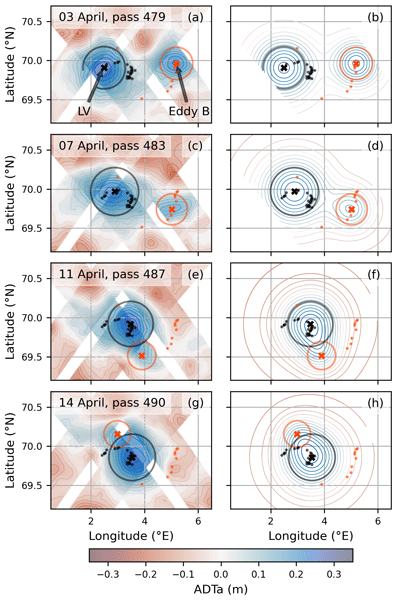
The Lofoten Vortex is an unusual feature in the ocean: a permanent eddy which does not dissipate as most eddies do. We have long thought that other eddies must merge into the vortex in order to maintain its heat content and energetics, but such mergers are very difficult to observe due to their transient, unpredictable nature. For the first time, we have observed a merger using an ocean glider and high-resolution satellite data and can document how the merger affects the properties of the vortex.
Kjersti Kalhagen, Ragnheid Skogseth, Till M. Baumann, Eva Falck, and Ilker Fer
Ocean Sci., 20, 981–1001, https://doi.org/10.5194/os-20-981-2024, https://doi.org/10.5194/os-20-981-2024, 2024
Short summary
Short summary
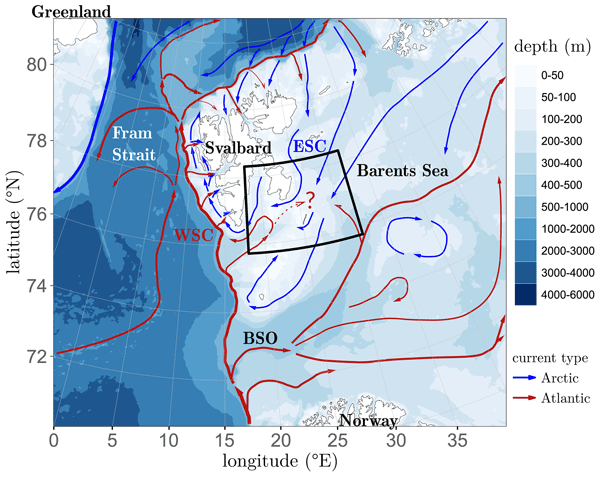
Atlantic water (AW) is a key driver of change in the Barents Sea. We studied an emerging pathway through the Svalbard Archipelago that allows AW to enter the Barents Sea. We found that the Atlantic sector near the study site has warmed over the past 2 decades; that Atlantic-origin waters intermittently enter the Barents Sea through the aforementioned pathway; and that heat transport is driven by tides, wind events, and variations in the upstream current system.
Eivind H. Kolås, Ilker Fer, and Till M. Baumann
Ocean Sci., 20, 895–916, https://doi.org/10.5194/os-20-895-2024, https://doi.org/10.5194/os-20-895-2024, 2024
Short summary
Short summary
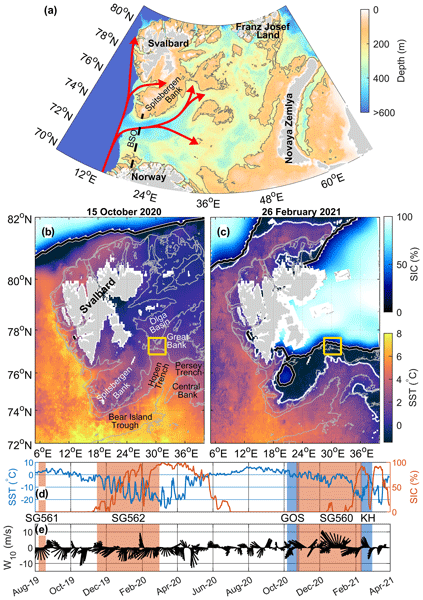
In the northwestern Barents Sea, we study the Barents Sea Polar Front formed by Atlantic Water meeting Polar Water. Analyses of ship and glider data from October 2020 to February 2021 show a density front with warm, salty water intruding under cold, fresh water. Short-term variability is linked to tidal currents and mesoscale eddies, influencing front position, density slopes and water mass transformation. Despite seasonal changes in the upper layers, the front remains stable below 100 m depth.
Ivan Kuznetsov, Benjamin Rabe, Alexey Androsov, Ying-Chih Fang, Mario Hoppmann, Alejandra Quintanilla-Zurita, Sven Harig, Sandra Tippenhauer, Kirstin Schulz, Volker Mohrholz, Ilker Fer, Vera Fofonova, and Markus Janout
Ocean Sci., 20, 759–777, https://doi.org/10.5194/os-20-759-2024, https://doi.org/10.5194/os-20-759-2024, 2024
Short summary
Short summary
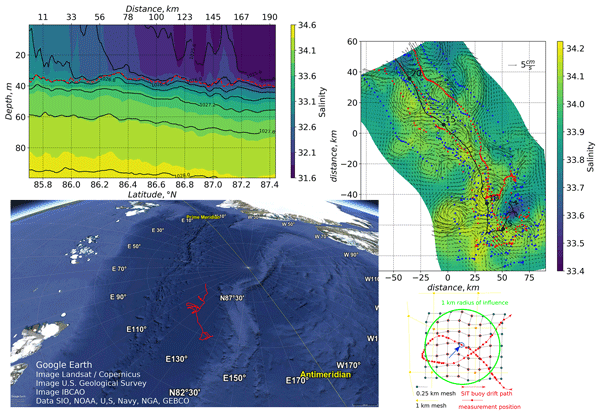
Our research introduces a tool for dynamically mapping the Arctic Ocean using data from the MOSAiC experiment. Incorporating extensive data into a model clarifies the ocean's structure and movement. Our findings on temperature, salinity, and currents reveal how water layers mix and identify areas of intense water movement. This enhances understanding of Arctic Ocean dynamics and supports climate impact studies. Our work is vital for comprehending this key region in global climate science.
Elin Darelius, Vår Dundas, Markus Janout, and Sandra Tippenhauer
Ocean Sci., 19, 671–683, https://doi.org/10.5194/os-19-671-2023, https://doi.org/10.5194/os-19-671-2023, 2023
Short summary
Short summary
Antarctica's ice shelves are melting from below as ocean currents bring warm water into the ice shelf cavities. The melt rates of the large Filchner–Ronne Ice Shelf in the southern Weddell Sea are currently low, as the water in the cavity is cold. Here, we present data from a scientific cruise to the region in 2021 and show that the warmest water at the upper part of the continental slope is now about 0.1°C warmer than in previous observations, while the surface water is fresher than before.
Vår Dundas, Elin Darelius, Kjersti Daae, Nadine Steiger, Yoshihiro Nakayama, and Tae-Wan Kim
Ocean Sci., 18, 1339–1359, https://doi.org/10.5194/os-18-1339-2022, https://doi.org/10.5194/os-18-1339-2022, 2022
Short summary
Short summary
Ice shelves in the Amundsen Sea are thinning rapidly as ocean currents bring warm water into cavities beneath the floating ice. We use 2-year-long mooring records and 16-year-long model simulations to describe the hydrography and circulation near the ice front between Siple and Carney Islands. We find that temperatures here are lower than at neighboring ice fronts and that the transport of heat toward the cavity is governed by wind stress over the Amundsen Sea continental shelf.
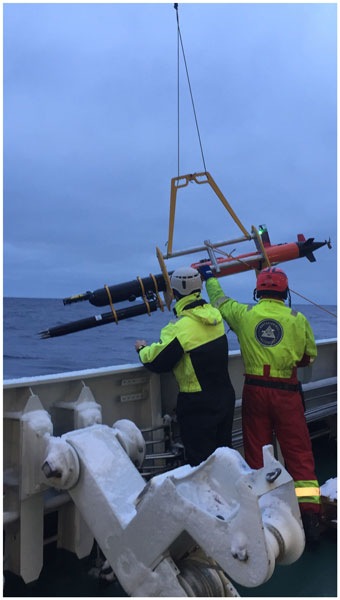
Eivind H. Kolås, Tore Mo-Bjørkelund, and Ilker Fer
Ocean Sci., 18, 389–400, https://doi.org/10.5194/os-18-389-2022, https://doi.org/10.5194/os-18-389-2022, 2022
Short summary
Short summary
A turbulence instrument was installed on a light autonomous underwater vehicle (AUV) and deployed in the Barents Sea in February 2021. We present the data quality and discuss limitations when measuring turbulence from the AUV. AUV vibrations contaminate the turbulence measurements, yet the measurements were sufficiently cleaned when the AUV operated in turbulent environments. In quiescent environments the noise from the AUV became relatively large, making the turbulence measurements unreliable.
Cited articles
Aagaard, K., Foldvik, A., and Hillman, S. R.: The West Spitsbergen Current- Disposition and water mass transformation, J. Geophys. Res., 92, 3778–3784, 1987. a
Busecke, J., Gregor, L., Balwada, D., Thomsen, S., Giddy, I. S., Rollo, C., and tjryankeogh: GliderToolsCommunity/GliderTools: v2021.05.26, Zenodo [code], https://doi.org/10.5281/zenodo.4815417, 2021. a
Dale, D., Christl, M., Vockenhuber, C., Macrander, A., Ólafsdóttir, S., Middag, R., and Casacuberta, N.: Tracing Ocean Circulation and Mixing From the Arctic to the Subpolar North Atlantic Using the 129I-236U Dual Tracer, J. Geophys. Res., 129, e2024JC021211, https://doi.org/10.1029/2024JC021211, 2024. a
Eriksen, C. C., Osse, T. J., Light, R. D., Wen, T., Lehman, T. W., Sabin, P. L., Ballard, J. W., and Chiodi, AM.: Seaglider: a long-range autonomous underwater vehicle for oceanographic research, IEEE J. Oceanic Eng., 26, 424–436, https://doi.org/10.1109/48.972073, 2001. a, b
Fer, I., Peterson, A. K., and Nilsen, F.: Atlantic Water Boundary Current Along the Southern Yermak Plateau, Arctic Ocean, J. Geophys. Res., 128, e2023JC019645, https://doi.org/10.1029/2023JC019645, 2023. a
Fer, I., Brakstad, A., Damerell, G. M., and Elliott, F.: Physical oceanography data from Seaglider missions west of Svalbard, October 2020 – February 2023, Norwegian Marine Data Centre [data set], https://doi.org/10.21335/NMDC-1222822416, 2025. a, b, c, d
Frank, L., Albretsen, J., Skogseth, R., Nilsen, F., and Jonassen, M. O.: Mechanisms of warm-water intrusions onto the West Spitsbergen Shelf during winter, Ocean Sci., 21, 2419–2442, https://doi.org/10.5194/os-21-2419-2025, 2025. a, b
Global Ocean Gridded L4 Sea Surface Heights And Derived Variables Reprocessed 1993 Ongoing: E.U. Copernicus Marine Service Information (CMEMS), Marine Data Store (MDS) [data set], https://doi.org/10.48670/moi-00148, 2024. a, b, c
Gregor, L., Ryan-Keogh, T. J., Nicholson, S.-A., du Plessis, M., Giddy, I., and Swart, S.: GliderTools: A Python Toolbox for Processing Underwater Glider Data, Front. Mar. Sci., 6, 1–13, https://doi.org/10.3389/fmars.2019.00738, 2019. a, b
Hersbach, H., Bell, B., Berrisford, P., Biavati, G., Horányi, A., Muñoz Sabater, J., Nicolas, J., Peubey, C., Radu, R., Rozum, I., Schepers, D., Simmons, A., Soci, C., Dee, D., and Thépaut, J.-N.: ERA5 hourly data on single levels from 1940 to present, Copernicus Climate Change Service (C3S) Climate Data Store (CDS) [data set], https://doi.org/10.24381/cds.adbb2d47, 2023. a, b, c
Hofmann, Z., von Appen, W.-J., and Wekerle, C.: Seasonal and Mesoscale Variability of the Two Atlantic Water Recirculation Pathways in Fram Strait, J. Geophys. Res., 126, e2020JC017057, https://doi.org/10.1029/2020JC017057, 2021. a, b, c, d
Huang, J., Pickart, R. S., Chen, Z., and Huang, R. X.: Role of air-sea heat flux on the transformation of Atlantic Water encircling the Nordic Seas, Nat. Commun., 14, 141, https://doi.org/10.1038/s41467-023-35889-3, 2023. a
Ingvaldsen, R. B., Assmann, K. M., Primicerio, R., Fossheim, M., Polyakov, I. V., and Dolgov, A. V.: Physical manifestations and ecological implications of Arctic Atlantification, Nat. Rev. Earth Environ., 2, 874–889, https://doi.org/10.1038/s43017-021-00228-x, 2021. a
Jakobsson, M., Mayer, L. A., Bringensparr, C., Castro, C. F., Mohammad, R., Johnson, P., Ketter, T., Accettella, D., Amblas, D., An, L., Arndt, J. E., Canals, M., and Casamor, J. L.: The International Bathymetric Chart of the Arctic Ocean Version 4.0, Sci. Data, 7, https://doi.org/10.1038/s41597-020-0520-9, 2020. a, b
Kolås, E. H., Koenig, Z., Fer, I., Nilsen, F., and Marnela, M.: Structure and Transport of Atlantic Water North of Svalbard From Observations in Summer and Fall 2018, J. Geophys. Res., 125, e2020JC016174, https://doi.org/10.1029/2020jc016174, 2020. a, b
Kolås, E. H., Baumann, T. M., Skogseth, R., Koenig, Z., and Fer, I.: Circulation and Hydrography in the Northwestern Barents Sea: Insights From Recent Observations and Historical Data (1950–2022), J. Geophys. Res., 129, e2023JC020211, https://doi.org/10.1029/2023JC020211, 2024. a, b
Manley, T. O.: Branching of Atlantic Water within the Greenland- Spitsbergen passage: An estimate of recirculation, J. Geophys. Res., 100, 20627–20634, 1995. a
Marnela, M., Rudels, B., Houssais, M.-N., Beszczynska-Möller, A., and Eriksson, P. B.: Recirculation in the Fram Strait and transports of water in and north of the Fram Strait derived from CTD data, Ocean Sci., 9, 499–519, https://doi.org/10.5194/os-9-499-2013, 2013. a
McPherson, R. A., Wekerle, C., and Kanzow, T.: Shifts of the Recirculation Pathways in Central Fram Strait Drive Atlantic Intermediate Water Variability on Northeast Greenland Shelf, J. Geophys. Res., 128, e2023JC019915, https://doi.org/10.1029/2023JC019915, 2023. a
Mork, K. A. and Skagseth, Ø.: A quantitative description of the Norwegian Atlantic Current by combining altimetry and hydrography, Ocean Sci., 6, 901–911, https://doi.org/10.5194/os-6-901-2010, 2010. a
Orvik, K. A. and Niiler, P.: Major pathways of Atlantic water in the northern North Atlantic and Nordic Seas toward Arctic, Geophys. Res. Lett., 29, 1896, https://doi.org/10.1029/2002GL015002, 2002. a, b
Polyakov, I. V., Pnyushkov, A. V., Charette, M., Cho, K.-H., Jung, J., Kipp, L., Muilwijk, M., Whitmore, L., Yang, E. J., and Yoo, J.: Atlantification advances into the Amerasian Basin of the Arctic Ocean, Sci. Adv., 11, eadq7580, https://doi.org/10.1126/sciadv.adq7580, 2025. a
Quadfasel, D., Gascard, J. C., and Koltermann, K. P.: Large-scale oceanography in Fram Strait during the 1984 Marginal Ice-Zone Experiment, J. Geophys. Res., 92, 6719–6728, 1987. a
Rudels, B.: Arctic Ocean circulation, processes and water masses: A description of observations and ideas with focus on the period prior to the International Polar Year 2007–2009, Prog. Oceanogr., 132, 22–67, https://doi.org/10.1016/j.pocean.2013.11.006, 2015. a
Rudels, B., Björk, J., Nilsson, J., Winsor, P., Lake, I., and Nohr, C.: The interaction between waters from the Arctic Ocean and the Nordic Seas north of Fram Strait and along the East Greenland Current: results from the Arctic Ocean-02 Oden expedition, J. Mar. Syst., 55, 1–30, https://doi.org/10.1016/j.jmarsys.2004.06.008, 2005. a, b
Rudnick, D. L.: Ocean research enabled by underwater gliders, Annu. Rev. Mar. Sci., 8, 519–541, https://doi.org/10.1146/annurev-marine-122414-033913, 2016. a, b
Schauer, U., Fahrbach, E., Østerhus, S., and Rohardt, G.: Arctic warming through the Fram Strait: Oceanic heat transport from 3 years of measurements, J. Geophys. Res., 109, 206026, https://doi.org/10.1029/2003JC001823, 2004. a
Testor, P., de Young, B., Rudnick, D. L., Glenn, S., Hayes, D., Lee, C. M., Pattiaratchi, C., Hill, K., Heslop, E., Turpin, V., Alenius, P., Barrera, C., Barth, J. A., Beaird, N., Bécu, G., Bosse, A., Bourrin, F., Brearley, J. A., Chao, Y., Chen, S., Chiggiato, J., Coppola, L., Crout, R., Cummings, J., Curry, B., Curry, R., Davis, R., Desai, K., DiMarco, S., Edwards, C., Fielding, S., Fer, I., Frajka-Williams, E., Gildor, H., Goni, G., Gutierrez, D., Haugan, P., Hebert, D., Heiderich, J., Henson, S., Heywood, K., Hogan, P., Houpert, L., Huh, S., E. Inall, M., Ishii, M., Ito, S.-i., Itoh, S., Jan, S., Kaiser, J., Karstensen, J., Kirkpatrick, B., Klymak, J., Kohut, J., Krahmann, G., Krug, M., McClatchie, S., Marin, F., Mauri, E., Mehra, A., P. Meredith, M., Meunier, T., Miles, T., Morell, J. M., Mortier, L., Nicholson, S., O'Callaghan, J., O'Conchubhair, D., Oke, P., Pallàs-Sanz, E., Palmer, M., Park, J., Perivoliotis, L., Poulain, P.-M., Perry, R., Queste, B., Rainville, L., Rehm, E., Roughan, M., Rome, N., Ross, T., Ruiz, S., Saba, G., Schaeffer, A., Schönau, M., Schroeder, K., Shimizu, Y., Sloyan, B. M., Smeed, D., Snowden, D., Song, Y., Swart, S., Tenreiro, M., Thompson, A., Tintore, J., Todd, R. E., Toro, C., Venables, H., Wagawa, T., Waterman, S., Watlington, R. A., and Wilson, D.: OceanGliders: A Component of the Integrated GOOS, Front. Mar. Sci., 6, https://doi.org/10.3389/fmars.2019.00422, 2019. a
von Appen, W.-J., Schauer, U., Hattermann, T., and Beszczynska-Möller, A.: Seasonal Cycle of Mesoscale Instability of the West Spitsbergen Current, J. Phys. Oceanogr., 46, 1231–1254, https://doi.org/10.1175/jpo-d-15-0184.1, 2016. a
Walczowski, W.: Atlantic Water in the Nordic Seas: Properties, Variability, Climatic Importance, Springer Cham, https://doi.org/10.1007/978-3-319-01279-7, 2013. a
Walczowski, W., Piechura, J., Osinski, R., and Wieczorek, P.: The West Spitsbergen Current volume and heat transport from synoptic observations in summer, Deep-Sea Res. Pt. I, 52, 1374–1391, 2005. a
Waskom, M. L.: seaborn: statistical data visualization, Journal of Open Source Software, 6, 3021, https://doi.org/10.21105/joss.03021, 2021. a
Short summary
We used ocean gliders to measure separate circulation branches of warm Atlantic water flowing into the Arctic through a key passage west of Svalbard. Over three years, gliders revealed that two main current branches together carry about five million m3 s-1 northward, with large variations linked to wind patterns. These currents influence Arctic ice and climate. Our study shows gliders can capture changes missed by traditional methods, and year-round missions are needed for a complete picture.
We used ocean gliders to measure separate circulation branches of warm Atlantic water flowing...


Special issue