Articles | Volume 21, issue 4
https://doi.org/10.5194/os-21-1461-2025
© Author(s) 2025. This work is distributed under
the Creative Commons Attribution 4.0 License.
https://doi.org/10.5194/os-21-1461-2025
© Author(s) 2025. This work is distributed under
the Creative Commons Attribution 4.0 License.
Determining the depth and upwelling speed of the equatorial Ekman layer from surface drifter trajectories
Nathan Paldor
CORRESPONDING AUTHOR
Fredy & Nadine Herrmann Institute of Earth Sciences, Hebrew University of Jerusalem, Edmond J. Safra Campus, Givat Ram, 9190401 Jerusalem, Israel
Yair De-Leon
Fredy & Nadine Herrmann Institute of Earth Sciences, Hebrew University of Jerusalem, Edmond J. Safra Campus, Givat Ram, 9190401 Jerusalem, Israel
Related authors
Itamar Yacoby, Hezi Gildor, and Nathan Paldor
Ocean Sci., 21, 2805–2828, https://doi.org/10.5194/os-21-2805-2025, https://doi.org/10.5194/os-21-2805-2025, 2025
Short summary
Short summary
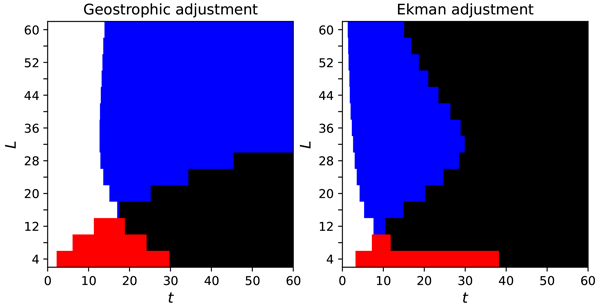
The paper examines the applicability of known linear wave theories to numerical simulations of two, zonally invariant, fundamental problems of Physical Oceanography: Geostrophic adjustment and Ekman Adjustment. By simulating the problems with a modified version of the Massachusetts Institute of Technology General Circulation Model (MITgcm) we show that neither of the known wave theories can explain the results of the simulations in large and small meridional domains and for long and short times.
Nathan Paldor and Lazar Friedland
EGUsphere, https://doi.org/10.5194/egusphere-2025-5187, https://doi.org/10.5194/egusphere-2025-5187, 2025
This preprint is open for discussion and under review for Ocean Science (OS).
Short summary
Short summary
The work develops a Lagrangian theory of the transport on the continental shelf forced by periodically rotating wind driven. A strong resonance occurs when the wind stress rotates counterclockwise at the local Coriolis frequency, manifested in a fast longshore drift. For clockwise sub-inertial wind rotation the drift is directed with the coast to its right while in all other frequencies the drift is directed with the coast to its left.
Itamar Yacoby, Nathan Paldor, and Hezi Gildor
Ocean Sci., 19, 1163–1181, https://doi.org/10.5194/os-19-1163-2023, https://doi.org/10.5194/os-19-1163-2023, 2023
Short summary
Short summary
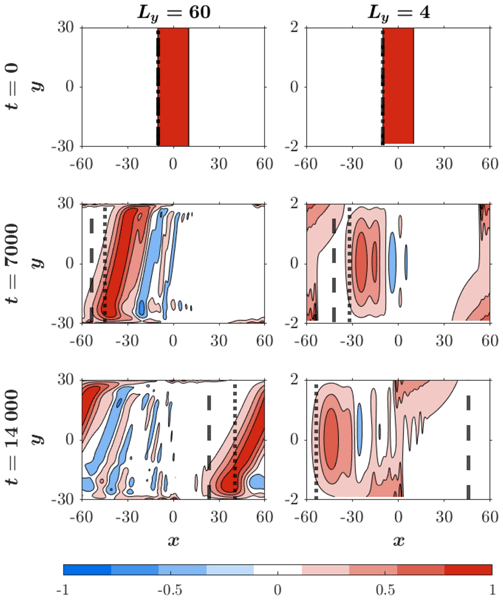
The transition from an arbitrary initial sea surface height to a geostrophic balance in which the velocity is steady was solved last century for constant Coriolis frequency, f(y), where y is the latitude. This study extends the theory to the realistic case in which f(y) is linear with y. We find that the variation in f(y) translates the steady geostrophic state westward as low-frequency Rossby waves that are harmonic in narrow domains and trapped near the equatorward boundary in wide ones.
Itamar Yacoby, Hezi Gildor, and Nathan Paldor
Ocean Sci., 21, 2805–2828, https://doi.org/10.5194/os-21-2805-2025, https://doi.org/10.5194/os-21-2805-2025, 2025
Short summary
Short summary
The paper examines the applicability of known linear wave theories to numerical simulations of two, zonally invariant, fundamental problems of Physical Oceanography: Geostrophic adjustment and Ekman Adjustment. By simulating the problems with a modified version of the Massachusetts Institute of Technology General Circulation Model (MITgcm) we show that neither of the known wave theories can explain the results of the simulations in large and small meridional domains and for long and short times.
Nathan Paldor and Lazar Friedland
EGUsphere, https://doi.org/10.5194/egusphere-2025-5187, https://doi.org/10.5194/egusphere-2025-5187, 2025
This preprint is open for discussion and under review for Ocean Science (OS).
Short summary
Short summary
The work develops a Lagrangian theory of the transport on the continental shelf forced by periodically rotating wind driven. A strong resonance occurs when the wind stress rotates counterclockwise at the local Coriolis frequency, manifested in a fast longshore drift. For clockwise sub-inertial wind rotation the drift is directed with the coast to its right while in all other frequencies the drift is directed with the coast to its left.
Itamar Yacoby, Nathan Paldor, and Hezi Gildor
Ocean Sci., 19, 1163–1181, https://doi.org/10.5194/os-19-1163-2023, https://doi.org/10.5194/os-19-1163-2023, 2023
Short summary
Short summary
The transition from an arbitrary initial sea surface height to a geostrophic balance in which the velocity is steady was solved last century for constant Coriolis frequency, f(y), where y is the latitude. This study extends the theory to the realistic case in which f(y) is linear with y. We find that the variation in f(y) translates the steady geostrophic state westward as low-frequency Rossby waves that are harmonic in narrow domains and trapped near the equatorward boundary in wide ones.
Cited articles
Bubnov, V. A.: Vertical motion in the Central Equatorial Pacific, Oceanol. Acta, Gauthier-Villars, Special issue (0399-1784) Gauthier-Villars, 1987.
Brady, E. C. and Bryden, H. L.: Estimating vertical velocity on the Equator, Oceanol. Acta, Special issue (0399-1784) Gauthier-Villars, 1987.
Czaja, A. and Marshall, J.: The partitioning of poleward heat transport between the atmosphere and ocean, J. Atmos. Sci., 63, 1498–1511, https://doi.org/10.1175/JAS3695.1, 2006.
Ekman, V. W.: On the influence of earth's rotation on ocean-currents, Ark. Mat. Astr. Fys., 2, 1–52, 1905.
Goldstein, H.: Classical Mechanics, Addison-Wesley, Inc., ISBN 978020131611, 1980.
Halpern, D. and Freitag, H. D.: Vertical motion in the upper ocean of the equatorial Eastern Pacific, Oceanol. Acta, Special issue, Gauthier-Villars, https://archimer.ifremer.fr/doc/00267/37842/ (last access: 28 February 2025), 1987.
Halpern, D., Knox, R. A., Luther, D. S., and Philander, S. G. H.: estimates of equatorial upwelling between 140° and 110°,W during 1984, J. Geophys. Res.-Oceans., 94, 8018–8020, https://doi.org/10.1029/JC094iC06p08018, 1989.
Hansen, D. V. and Paul, C. A.: vertical motion in the Eastern equatorial Pacific inferred from drifting buoys, Oceanol. Acta, Special issue, Gauthier-Villars, https://archimer.ifremer.fr/doc/00267/37843/ (last access: 28 February 2025), 1987.
Hartmann, D. L.: Global Physical Climatology, 2nd edn., Elsevier Inc., https://doi.org/10.1016/C2009-0-00030-0, 2016.
Hastenrath, S. and Polzin, D.: Dynamics of the surface win field over the equatorial Indian Ocean, Q. J. Roy Meteor. Soc., 130, 503–517, https://doi.org/10.1256/qj.03.79, 2004.
Johnson, G. C., McPhaden, M. J., and Firing, E.: Equatorial Pacific Ocean Horizontal Velocity, Divergence, and upwelling, J. Phys. Oceanogr., 31, 839–849, https://doi.org/10.1175/1520-0485(2001)031<0839:EPOHVD>2.0.CO;2, 2001.
Knauss, J. A.: Introduction to Physical Oceanography, 2nd edn., Prentice Hall, Inc., ISBN 0-13-238155-9, 1996.
Lagerloef, G. S. E., Mitchum, G. T., Lukas, R. B., and Niiler, P. P.: Tropical Pacific near-surface currents estimated from altimeter, wind, and drifter data, J. Geophys. Res.-Oceans, 104, 23313–23326, https://doi.org/10.1029/1999JC900197, 1999.
Lukas, R. and Lindstrom, E.: The mixed layer of the western equatorial Pacific Ocean, J. Geophys. Res.-Oceans., 96, 3343–3357, https://doi.org/10.1029/90JC01951, 1991.
Lumpkin, R., Ozgokmen, T., and Centurioni, L.: Advances in the application of surface drifters, Annu. Rev. Mar. Sci., 9, 59–81, https://doi.org/10.1146/annurev-marine-010816-060641, 2017.
NOAA/CoastWatch: Wind Stress, QuikSCAT SeaWinds, 0.125°, Global, Science Quality, 1999–2009 (3 Day), DATA.GOV [data set], https://catalog.data.gov/dataset/wind-stress-quikscat-seawinds-0-125a-global-science-quality-1999-2009-3-day, last access: 22 September 2024.
NOAA/AOM/GDP: Global Drifter Program – 6 Hour Interpolated QC Drifter Data, ERDDAP [data set], https://erddap.aoml.noaa.gov/gdp/erddap/tabledap/drifter_6hour_qc.html, last access: 30 August 2024.
Paldor, N.: A Lagrangian theory of equatorial upwelling, Phys. Fluids, 36, 046605, https://doi.org/10.1063/5.0202412, 2024.
Paldor, N. and Friedland, L.: Wind-driven transport of the spherical earth, Phys. Fluids, 35, 056604, https://doi.org/10.5194/os-19-93-2023, 2023.
Poulain, P.-M.: Estimates of Horizontal Divergence and Vertical Velocity in the Equatorial Pacific, J. Phys. Oceanogr., 23, 601–607, 1993.
Quay, P. D., Stuiver, M. and Brocker, W. S.: Upwelling rates for the equatorial Pacific Ocean derived from the bomb 14C distribution, J. Mar. Res., 41, 769–792, 1983.
RomKedar, V., Dvorkin, Y., and Paldor, N.: Chaotic Hamiltonian Dynamics of particle's motion in the atmosphere, Physica D, 106, 389–431, https://doi.org/10.1016/S0167-2789(97)00015-8, 1997.
Talley, L. D., Pickard, G. L., Emery, W. J., and Swift, J. H.: Descriptive Physical Oceanography: An Introduction, 6th edn., Academic Press, ISBN 978-0-7506-4552-2, 2011.
Weingartner, T. J. and Weisberg, R. H.: On the annual cycle of equatorial upwelling in the central Atlantic Ocean, J. Phys. Oceanogr., 21, 68–82, https://doi.org/10.1175/1520-0485(1991)021<0068:OTACOE>2.0.CO;2, 1991.
Wyrtki, K.: An estimate of equatorial upwelling in the Pacific, J. Phys. Oceanogr., 11, 1205–1214, https://doi.org/10.1175/1520-0485(1981)011<1205:AEOEUI>2.0.CO;2, 1981.
Zhang, L., Li, Y., and Li, J.: Impact of equatorial wind stress on Ekman transport during the mature phase of the Indian Ocean Dipole, Clim. Dynam., 59, 1253–1264, https://doi.org/10.1007/s00382-022-06183-7, 2022.
Short summary
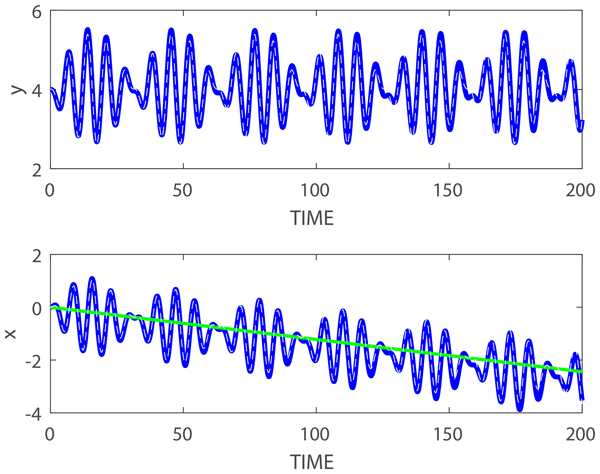
The study combines archived surface drifter trajectories along the Equator with a novel extension of Ekman's wind-driven theory to the equatorial β-plane in order to estimate the depth of the equatorial Ekman layer and the speed of upwelling into it. The analysis provides a direct estimate of the depth of the equatorial Ekman layer based on observed drifter trajectories and does not involve the 3D continuity equation, which is only used for estimating the upwelling speed.
The study combines archived surface drifter trajectories along the Equator with a novel...