Articles | Volume 22, issue 1
https://doi.org/10.5194/os-22-75-2026
© Author(s) 2026. This work is distributed under
the Creative Commons Attribution 4.0 License.
https://doi.org/10.5194/os-22-75-2026
© Author(s) 2026. This work is distributed under
the Creative Commons Attribution 4.0 License.
Metrological concepts applied to Total Alkalinity measurements in seawater: reference materials, inter-laboratory comparison and uncertainty budget

Laboratoire National de Métrologie et d'Essais (LNE), Paris, 75015, France
Aix Marseille Université, CNRS, IRD, MIO, Marseille, 13288, France
Samir Alliouane
Sorbonne Université, CNRS, Laboratoire d'Océanographie de Villefranche, LOV, Villefranche-sur-Mer, 06230, France
Thierry Cariou
IRD, UAR191, Instrumentation, Moyens Analytiques, Observatoires en Géophysique et Océanographie (IMAGO), Technopôle de Brest-Iroise, Plouzané, 29280, France
Jonathan Fin
Laboratoire LOCEAN/IPSL, Sorbonne Université-CNRS-IRD-MNHN, Paris, 75005, France
present address: Institut des Sciences de la Terre, Grenoble, 38058, France
Paola Fisicaro
Laboratoire National de Métrologie et d'Essais (LNE), Paris, 75015, France
Thibaut Wagener
Aix Marseille Université, CNRS, IRD, MIO, Marseille, 13288, France
Related authors
No articles found.
Marta Álvarez, Maribel I. García-Ibáñez, Nico Lange, Alex Kozyr, Antón Velo, Toste Tanhua, Giuseppe Civitarese, Carolina Cantoni, Malek Belgacem, Katrin Schroeder, Rubén Acerbi, Laurent Coppola, Thibaut Wagener, Noelia M. Fajar, Susana Flecha, Michele Giani, Louisa Giannoudi, Elisa F. Guallart, Abed El Rahman Hassoun, Emma I. Huertas, Valeria Ibello, Mehdia A. Keraghel, Ferial Louanchi, Anna Luchetta, Fiz F. Pérez, Carsten Schirnick, Ekaterini Souvermezoglou, Lidia Urbini, Monserrat Vidal, and Patrizia Ziveri
Earth Syst. Sci. Data Discuss., https://doi.org/10.5194/essd-2025-759, https://doi.org/10.5194/essd-2025-759, 2025
Preprint under review for ESSD
Short summary
Short summary
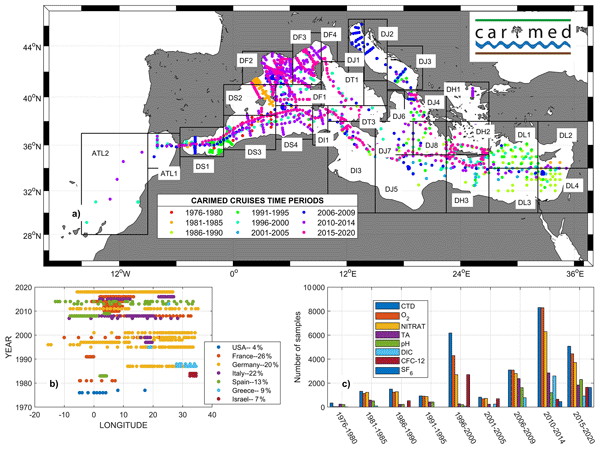
CARIMED (CARbon, tracers, and ancillary data In the MEDiterranean Sea) is a high-quality, FAIR dataset integrating hydrographic, biogeochemical, and transient tracer data from 46 research cruises (1976–2018) across the Mediterranean Sea. The data underwent rigorous, basin-adapted quality control to remove systematic biases, unifying four decades of fragmented data, delivering two complementary products: the aggregated original cruise data product and the bias-adjusted data synthesis product.
Nicolas Metzl, Jonathan Fin, Claire Lo Monaco, Claude Mignon, Samir Alliouane, Bruno Bombled, Jacqueline Boutin, Yann Bozec, Steeve Comeau, Pascal Conan, Laurent Coppola, Pascale Cuet, Eva Ferreira, Jean-Pierre Gattuso, Frédéric Gazeau, Catherine Goyet, Emilie Grossteffan, Bruno Lansard, Dominique Lefèvre, Nathalie Lefèvre, Coraline Leseurre, Sébastien Petton, Mireille Pujo-Pay, Christophe Rabouille, Gilles Reverdin, Céline Ridame, Peggy Rimmelin-Maury, Jean-François Ternon, Franck Touratier, Aline Tribollet, Thibaut Wagener, and Cathy Wimart-Rousseau
Earth Syst. Sci. Data, 17, 1075–1100, https://doi.org/10.5194/essd-17-1075-2025, https://doi.org/10.5194/essd-17-1075-2025, 2025
Short summary
Short summary
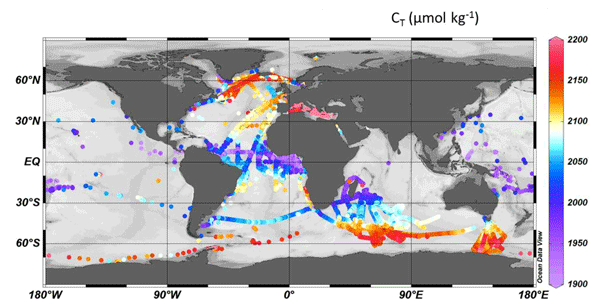
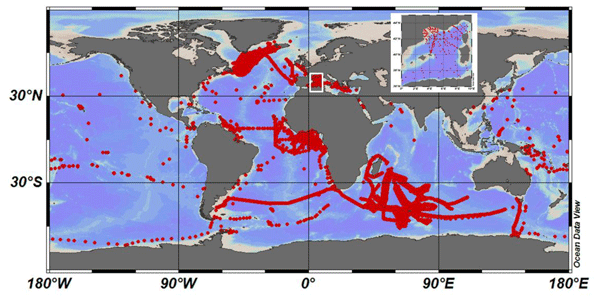
This work presents a new synthesis of 67 000 total alkalinity and total dissolved inorganic carbon observations obtained between 1993 and 2023 in the global ocean, coastal zones, and the Mediterranean Sea. We describe the data assemblage and associated quality control and discuss some potential uses of this dataset. The dataset is provided in a single format and includes the quality flag for each sample.
Anaïs Lebrun, Cale A. Miller, Marc Meynadier, Steeve Comeau, Pierre Urrutti, Samir Alliouane, Robert Schlegel, Jean-Pierre Gattuso, and Frédéric Gazeau
Biogeosciences, 21, 4605–4620, https://doi.org/10.5194/bg-21-4605-2024, https://doi.org/10.5194/bg-21-4605-2024, 2024
Short summary
Short summary
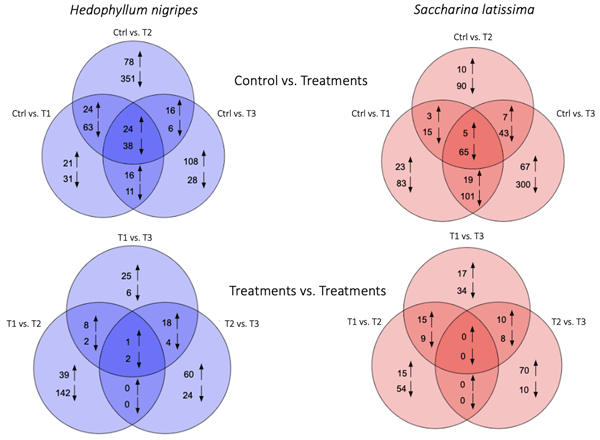
We tested the effects of warming, low salinity, and low irradiance on Arctic kelps. We show that growth rates were similar across species and treatments. Alaria esculenta is adapted to low-light conditions. Saccharina latissima exhibited nitrogen limitation, suggesting coastal erosion and permafrost thawing could be beneficial. Laminaria digitata did not respond to the treatments. Gene expression of Hedophyllum nigripes and S. latissima indicated acclimation to the experimental treatments.
Lucille Barré, Frédéric Diaz, Thibaut Wagener, Camille Mazoyer, Christophe Yohia, and Christel Pinazo
Geosci. Model Dev., 17, 5851–5882, https://doi.org/10.5194/gmd-17-5851-2024, https://doi.org/10.5194/gmd-17-5851-2024, 2024
Short summary
Short summary
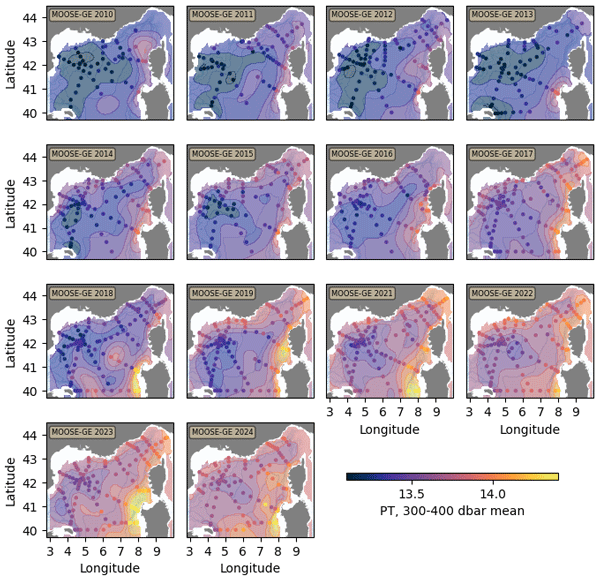
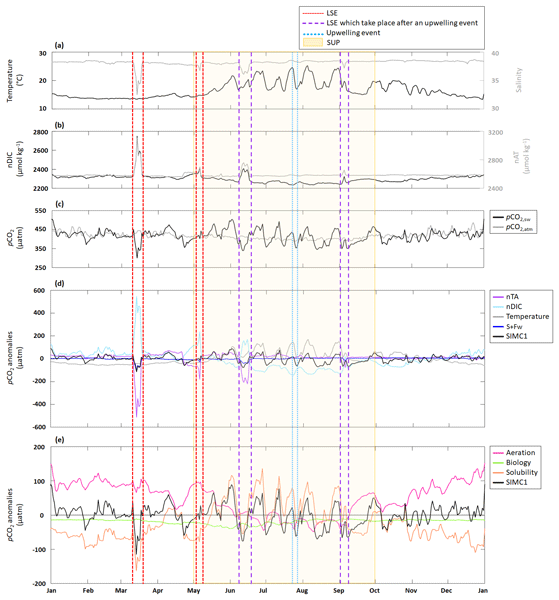
The carbonate system is typically studied using measurements, but modeling can contribute valuable insights. Using a biogeochemical model, we propose a new representation of total alkalinity, dissolved inorganic carbon, pCO2, and pH in a highly dynamic Mediterranean coastal area, the Bay of Marseille, a useful addition to measurements. Through a detailed analysis of pCO2 and air–sea CO2 fluxes, we show that variations are strongly impacted by the hydrodynamic processes that affect the bay.
Sébastien Petton, Fabrice Pernet, Valérian Le Roy, Matthias Huber, Sophie Martin, Éric Macé, Yann Bozec, Stéphane Loisel, Peggy Rimmelin-Maury, Émilie Grossteffan, Michel Repecaud, Loïc Quemener, Michael Retho, Soazig Manac'h, Mathias Papin, Philippe Pineau, Thomas Lacoue-Labarthe, Jonathan Deborde, Louis Costes, Pierre Polsenaere, Loïc Rigouin, Jérémy Benhamou, Laure Gouriou, Joséphine Lequeux, Nathalie Labourdette, Nicolas Savoye, Grégory Messiaen, Elodie Foucault, Vincent Ouisse, Marion Richard, Franck Lagarde, Florian Voron, Valentin Kempf, Sébastien Mas, Léa Giannecchini, Francesca Vidussi, Behzad Mostajir, Yann Leredde, Samir Alliouane, Jean-Pierre Gattuso, and Frédéric Gazeau
Earth Syst. Sci. Data, 16, 1667–1688, https://doi.org/10.5194/essd-16-1667-2024, https://doi.org/10.5194/essd-16-1667-2024, 2024
Short summary
Short summary
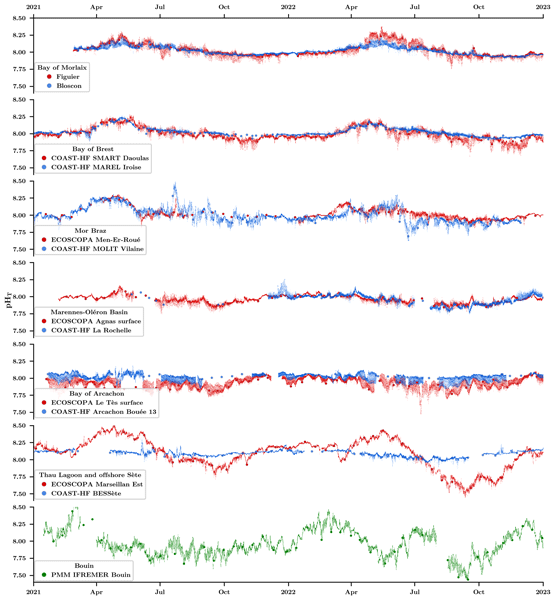
Our research highlights the concerning impact of rising carbon dioxide levels on coastal areas. To better understand these changes, we've established an observation network in France. By deploying pH sensors and other monitoring equipment at key coastal sites, we're gaining valuable insights into how various factors, such as freshwater inputs, tides, temperature, and biological processes, influence ocean pH.
Cale A. Miller, Pierre Urrutti, Jean-Pierre Gattuso, Steeve Comeau, Anaïs Lebrun, Samir Alliouane, Robert W. Schlegel, and Frédéric Gazeau
Biogeosciences, 21, 315–333, https://doi.org/10.5194/bg-21-315-2024, https://doi.org/10.5194/bg-21-315-2024, 2024
Short summary
Short summary
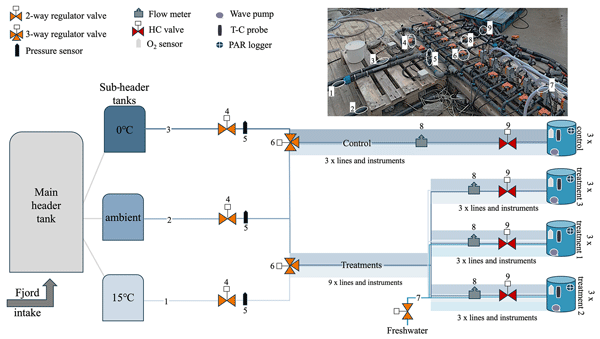
This work describes an experimental system that can replicate and manipulate environmental conditions in marine or aquatic systems. Here, we show how the temperature and salinity of seawater delivered from a fjord is manipulated to experimental tanks on land. By constantly monitoring temperature and salinity in each tank via a computer program, the system continuously adjusts automated flow valves to ensure the seawater in each tank matches the targeted experimental conditions.
Nicolas Metzl, Jonathan Fin, Claire Lo Monaco, Claude Mignon, Samir Alliouane, David Antoine, Guillaume Bourdin, Jacqueline Boutin, Yann Bozec, Pascal Conan, Laurent Coppola, Frédéric Diaz, Eric Douville, Xavier Durrieu de Madron, Jean-Pierre Gattuso, Frédéric Gazeau, Melek Golbol, Bruno Lansard, Dominique Lefèvre, Nathalie Lefèvre, Fabien Lombard, Férial Louanchi, Liliane Merlivat, Léa Olivier, Anne Petrenko, Sébastien Petton, Mireille Pujo-Pay, Christophe Rabouille, Gilles Reverdin, Céline Ridame, Aline Tribollet, Vincenzo Vellucci, Thibaut Wagener, and Cathy Wimart-Rousseau
Earth Syst. Sci. Data, 16, 89–120, https://doi.org/10.5194/essd-16-89-2024, https://doi.org/10.5194/essd-16-89-2024, 2024
Short summary
Short summary
This work presents a synthesis of 44 000 total alkalinity and dissolved inorganic carbon observations obtained between 1993 and 2022 in the Global Ocean and the Mediterranean Sea at the surface and in the water column. Seawater samples were measured using the same method and calibrated with international Certified Reference Material. We describe the data assemblage, quality control and some potential uses of this dataset.
Lucille Barré, Frédéric Diaz, Thibaut Wagener, France Van Wambeke, Camille Mazoyer, Christophe Yohia, and Christel Pinazo
Geosci. Model Dev., 16, 6701–6739, https://doi.org/10.5194/gmd-16-6701-2023, https://doi.org/10.5194/gmd-16-6701-2023, 2023
Short summary
Short summary
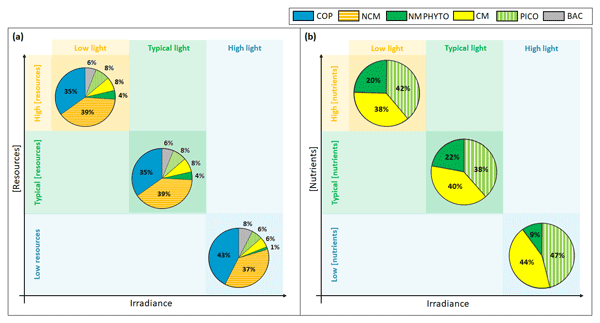
While several studies have shown that mixotrophs play a crucial role in the carbon cycle, the impact of environmental forcings on their dynamics remains poorly investigated. Using a biogeochemical model that considers mixotrophs, we study the impact of light and nutrient concentration on the ecosystem composition in a highly dynamic Mediterranean coastal area: the Bay of Marseille. We show that mixotrophs cope better with oligotrophic conditions compared to strict auto- and heterotrophs.
Jean-Pierre Gattuso, Samir Alliouane, and Philipp Fischer
Earth Syst. Sci. Data, 15, 2809–2825, https://doi.org/10.5194/essd-15-2809-2023, https://doi.org/10.5194/essd-15-2809-2023, 2023
Short summary
Short summary
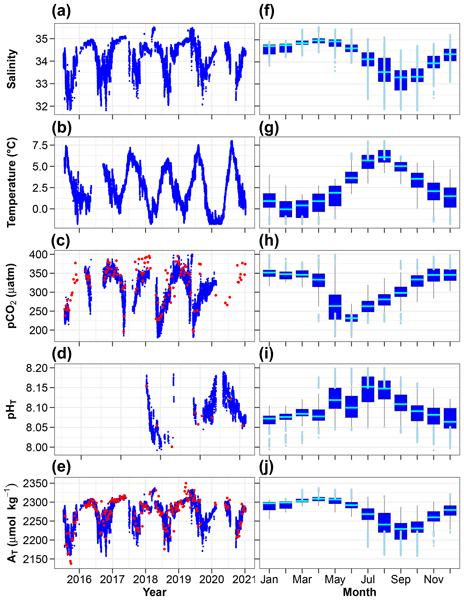
The Arctic Ocean is subject to high rates of ocean warming and acidification, with critical implications for marine organisms, ecosystems and the services they provide. We report here on the first high-frequency (1 h), multi-year (5 years) dataset of the carbonate system at a coastal site in a high-Arctic fjord (Kongsfjorden, Svalbard). This site is a significant sink for CO2 every month of the year (9 to 17 mol m-2 yr-1). The saturation state of aragonite can be as low as 1.3.
Anna Kolomijeca, Lukas Marx, Sarah Reynolds, Thierry Cariou, Edward Mawji, and Cedric Boulart
Ocean Sci., 18, 1377–1388, https://doi.org/10.5194/os-18-1377-2022, https://doi.org/10.5194/os-18-1377-2022, 2022
Short summary
Short summary
More and more studies indicate that the open ocean can be a significant source of methane, the second greenhouse gas after CO2. Our study in the subtropical North Atlantic Ocean shows that a significant part of the methane flux to the atmosphere is related to cyanobacteria, which are ubiquitous phytoplankton that produce methane as part of their metabolic activity. This study is a response to the lack of data on the role of the oceans in the methane budget in the context of climate change.
Matthieu Bressac, Thibaut Wagener, Nathalie Leblond, Antonio Tovar-Sánchez, Céline Ridame, Vincent Taillandier, Samuel Albani, Sophie Guasco, Aurélie Dufour, Stéphanie H. M. Jacquet, François Dulac, Karine Desboeufs, and Cécile Guieu
Biogeosciences, 18, 6435–6453, https://doi.org/10.5194/bg-18-6435-2021, https://doi.org/10.5194/bg-18-6435-2021, 2021
Short summary
Short summary
Phytoplankton growth is limited by the availability of iron in about 50 % of the ocean. Atmospheric deposition of desert dust represents a key source of iron. Here, we present direct observations of dust deposition in the Mediterranean Sea. A key finding is that the input of iron from dust primarily occurred in the deep ocean, while previous studies mainly focused on the ocean surface. This new insight will enable us to better represent controls on global marine productivity in models.
Frédéric Gazeau, France Van Wambeke, Emilio Marañón, Maria Pérez-Lorenzo, Samir Alliouane, Christian Stolpe, Thierry Blasco, Nathalie Leblond, Birthe Zäncker, Anja Engel, Barbara Marie, Julie Dinasquet, and Cécile Guieu
Biogeosciences, 18, 5423–5446, https://doi.org/10.5194/bg-18-5423-2021, https://doi.org/10.5194/bg-18-5423-2021, 2021
Short summary
Short summary
Our study shows that the impact of dust deposition on primary production depends on the initial composition and metabolic state of the tested community and is constrained by the amount of nutrients added, to sustain both the fast response of heterotrophic prokaryotes and the delayed one of phytoplankton. Under future environmental conditions, heterotrophic metabolism will be more impacted than primary production, therefore reducing the capacity of surface waters to sequester anthropogenic CO2.
Matthieu Roy-Barman, Lorna Foliot, Eric Douville, Nathalie Leblond, Fréderic Gazeau, Matthieu Bressac, Thibaut Wagener, Céline Ridame, Karine Desboeufs, and Cécile Guieu
Biogeosciences, 18, 2663–2678, https://doi.org/10.5194/bg-18-2663-2021, https://doi.org/10.5194/bg-18-2663-2021, 2021
Short summary
Short summary
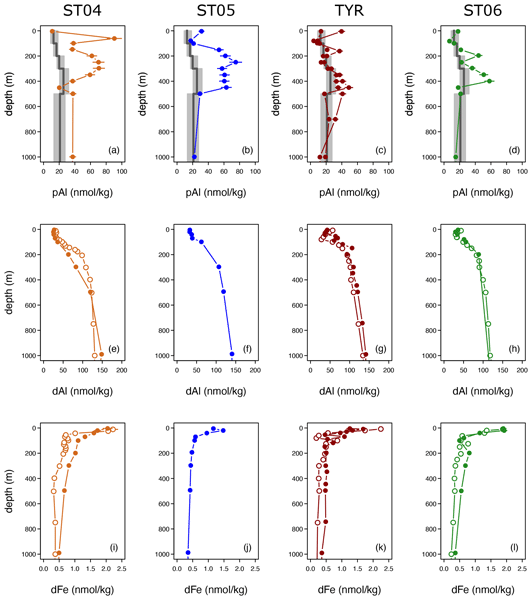
The release of insoluble elements such as aluminum (Al), iron (Fe), rare earth elements (REEs), thorium (Th) and protactinium (Pa) when Saharan dust falls over the Mediterranean Sea was studied during tank experiments under present and future climate conditions. Each element exhibited different dissolution kinetics and dissolution fractions (always lower than a few percent). Changes in temperature and/or pH under greenhouse conditions lead to a lower Th release and a higher light REE release.
Katixa Lajaunie-Salla, Frédéric Diaz, Cathy Wimart-Rousseau, Thibaut Wagener, Dominique Lefèvre, Christophe Yohia, Irène Xueref-Remy, Brian Nathan, Alexandre Armengaud, and Christel Pinazo
Geosci. Model Dev., 14, 295–321, https://doi.org/10.5194/gmd-14-295-2021, https://doi.org/10.5194/gmd-14-295-2021, 2021
Short summary
Short summary
A biogeochemical model of planktonic food webs including a carbonate balance module is applied in the Bay of Marseille (France) to represent the carbon marine cycle expected to change in the future owing to significant increases in anthropogenic emissions of CO2. The model correctly simulates the ranges and seasonal dynamics of most variables of the carbonate system (pH). This study shows that external physical forcings have an important impact on the carbonate equilibrium in this coastal area.
Cited articles
Acquafredda, M., Cochran, C., Busch, D. S., Jewett, L., Edmonds, H., and Dickson, A. G.: Understanding the Current Use and Future Needs of CO2 in Seawater Certified Reference Materials, NOAA Technical Memorandum OAR-OAP-5, https://doi.org/10.25923/ANC4-GJ33, 2022.
Bockmon, E. E. and Dickson, A. G.: An inter-laboratory comparison assessing the quality of seawater carbon dioxide measurements, Marine Chemistry, 171, 36–43, https://doi.org/10.1016/j.marchem.2015.02.002, 2015.
Boggs, P. T., Byrd, R. H., Rogers, J. E., and Schnabel, R. B.: User's reference guide for ODRPACK version 2.01::software for weighted orthogonal distance regression, NIST, https://doi.org/10.6028/nist.ir.4834, 1992.
Capitaine, G., Fisicaro, P., and Wagener, T. Towards improved metrological traceability of seawater Total Alkalinity measurements: advancing assessment of Ocean Alkalinity Enhancement, in preparation, 2026.
Dickson, A. G.: An exact definition of total alkalinity and a procedure for the estimation of alkalinity and total inorganic carbon from titration data, Deep Sea Research Part A. Oceanographic Research Papers, 28, 609–623, https://doi.org/10.1016/0198-0149(81)90121-7, 1981.
Dickson, A. G.: Standards for Ocean Measurements, Oceanography, 23, 34–47, https://www.jstor.org/stable/24860884, 2010.
Dickson, A. G., Afghan, J. D., and Anderson, G. C.: Reference materials for oceanic CO2 analysis: a method for the certification of total alkalinity, Marine Chemistry, 80, 185–197, https://doi.org/10.1016/S0304-4203(02)00133-0, 2003.
Dickson, A. G., Sabine, C. L., and Christian, J. R. (Eds. ): Guide to Best Practices for Ocean CO2 Measurements, PICES Special Publication 3, 191, https://www.ncei.noaa.gov/access/ocean-carbon-acidification-data-system/oceans/Handbook_2007.html (last access: 6 January 2026), 2007.
Edmond, J. M.: High precision determination of titration alkalinity and total carbon dioxide content of sea water by potentiometric titration, Deep Sea Research and Oceanographic Abstracts, 17, 737–750, https://doi.org/10.1016/0011-7471(70)90038-0, 1970.
Gattuso, J.-P., Epitalon, J.-M., Lavigne, H., and Orr, J.: seacarb: seawater carbonate chemistry. R package: version 3.3.1, Zenodo, https://doi.org/10.5281/zenodo.595096, 2021.
GOA-ON: Global Ocean Acidification Observing Network (GOA-ON): Implementation Strategy, https://www.goa-on.org (last access: 4 January 2024), 2019.
Gran, G.: Determination of the equivalence point in potentiometric titrations. Part II, Analyst, 77, 661–671, https://doi.org/10.1039/AN9527700661, 1952.
Greenberg, D. M., Moberg, E. G., and Allen, E. C.: Determination of carbon dioxide and titratable base in sea water, Ind. Eng. Chem. Anal. Ed., 4, 309–313, https://doi.org/10.1021/ac50079a031, 1932.
ISO 21748: Guidance for the use of repeatability, reproducibility and trueness estimates in measurement uncertainty evaluation, https://doi.org/10.3403/30191983u, 2017.
ISO 13528: Statistical methods for use in proficiency testing by interlaboratory comparison, https://doi.org/10.3403/30057947u, 2022.
ISO 33405:2024: Reference materials – Approaches for characterization and assessment of homogeneity and stability, https://doi.org/10.3403/30473104, 2024.
JCGM 100:2008: Evaluation of Measurement Data-Guide to the Expression of Uncertainty in Measurement, https://doi.org/10.59161/jcgm100-2008e, 2008a.
JCGM 101:2008, Evaluation of measurement data – Supplement 1 to the “Guide to the expression of uncertainty in measurement” – Propagation of distributions using a Monte Carlo method, https://doi.org/10.59161/jcgm101-2008, 2008b.
JCGM 200:2012: International vocabulary of metrology (VIM) – Basic and general concepts and associated terms, https://doi.org/10.59161/jcgm200-2012, 2012.
Lefevre, D.: MOOSE (ANTARES), ANTARES station, https://doi.org/10.18142/233, 2010.
Linsinger, T. P. J., Pauwels, J., Lamberty, A., Schimmel, H. G., van der Veen, A. M. H., and Siekmann, L.: Estimating the uncertainty of stability for matrix CRMs, Fresenius J. Anal. Chem., 370, 183–188, https://doi.org/10.1007/s002160100719, 2001.
Llido, J.: PIRATA-FR33 cruise, RV Thalassa, PIRATA cruise, https://doi.org/10.17600/18002398, 2023.
Martín, J., Velázquez, N., and Asuero, A. G.: Youden Two-Sample Method, Quality Control and Assurance-An Ancient Greek Term Re-Mastered, https://doi.org/10.5772/66397, 2017.
Martz, T. and Dickson, A. G.: Tracer Monitored Titrations: Measurement of Total Alkalinity, Analytical Chemistry, 78, 1817–1826, https://doi.org/10.1021/ac0516133, 2006.
Meija, J., Coplen, T. B., Berglund, M., Brand, W. A., Bièvre, P. D., Gröning, M., Holden, N. E., Irrgeher, J., Loss, R. D., Walczyk, T., and Prohaska, T.: Atomic weights of the elements 2013 (IUPAC Technical Report), Pure and Applied Chemistry, 88, 265–291, https://doi.org/10.1515/pac-2015-0305, 2016.
Millero, F. J., Lee, K., and Roche, M.: Distribution of alkalinity in the surface waters of the major oceans, Marine Chemistry, 60, 111–130, https://doi.org/10.1016/S0304-4203(97)00084-4, 1998.
Mos, B., Holloway, C., Kelaher, B. P., Santos, I. R., and Dworjanyn, S. A.: Alkalinity of diverse water samples can be altered by mercury preservation and borosilicate vial storage, Sci. Rep., 11, 9961, https://doi.org/10.1038/s41598-021-89110-w, 2021.
Muller, J. W.: Possible advantages of a robust evaluation of comparisons, J. Res. Natl. Inst. Stand. Technol., 105, 551, https://doi.org/10.6028/jres.105.044, 2000.
Okamura, K., Kimoto, H., Hatta, M., Noguchi, T., Nakaoka, A., Suzue, T., and Kimoto, T.: Potentiometric open-cell titration for seawater alkalinity considering temperature dependence of titrant density and Nernst response of pH electrode, Geochem. J., 48, 153–163, https://doi.org/10.2343/geochemj.2.0296, 2014.
Pawlowicz, R.: TEOS-10 Primer, What every oceanographer needs to know about TEOS-10, https://www.teos-10.org, 2013.
Pratt, K. W.: Measurement of pHT values of Tris buffers in artificial seawater at varying mole ratios of Tris:Tris⋅ HCl, Marine Chemistry, 162, 89–95, https://doi.org/10.1016/j.marchem.2014.03.003, 2014.
Schulz, K. G., Bach, L. T., and Dickson, A. G.: Seawater carbonate chemistry considerations for ocean alkalinity enhancement research: theory, measurements, and calculations, in: Guide to Best Practices in Ocean Alkalinity Enhancement Research, edited by: Oschlies, A., Stevenson, A., Bach, L. T., Fennel, K., Rickaby, R. E. M., Satterfield, T., Webb, R., and Gattuso, J.-P., Copernicus Publications, State Planet, 2-oae2023, 2, https://doi.org/10.5194/sp-2-oae2023-2-2023, 2023.
WMO: United Nations Environment Programme (UNEP), International Science Council (ISC), Scientific and Cultural Organization (IOC-UNESCO) Intergovernmental Oceanographic Commission of the United Nations Educational, 2022, The 2022 GCOS Implementation Plan (GCOS-244), https://library.wmo.int/records/item/58104-the-2022-gcos-implementation-plan-gcos-244, last access: 4 January 2024.
Wolf-Gladrow, D. A., Zeebe, R. E., Klaas, C., Körtzinger, A., and Dickson, A. G.: Total alkalinity: The explicit conservative expression and its application to biogeochemical processes, Marine Chemistry, 106, 287–300, https://doi.org/10.1016/j.marchem.2007.01.006, 2007.
Youden, W. J.: Graphical diagnosis of Interlaboratory Test Results, Industrial Quality Control, XV, https://doi.org/10.1080/00224065.1972.11980509, 1959.
Short summary
Measuring total alkalinity in seawater is essential for understanding and monitoring the ocean carbonate system. To improve the reliability of these measurements, we developed reference materials and tested them in an inter-laboratory comparison. We also thoroughly quantified, for the first time, the uncertainty of the standard measurement method. These results, as well as the key metrological tools developed, support more accurate long-term monitoring of the ocean carbonate system.
Measuring total alkalinity in seawater is essential for understanding and monitoring the ocean...