
Articles | Volume 22, issue 1
https://doi.org/10.5194/os-22-653-2026
© Author(s) 2026. This work is distributed under
the Creative Commons Attribution 4.0 License.
the Creative Commons Attribution 4.0 License.
https://doi.org/10.5194/os-22-653-2026
© Author(s) 2026. This work is distributed under
the Creative Commons Attribution 4.0 License.
the Creative Commons Attribution 4.0 License.
Research article
| 
17 Feb 2026
Research article |
| 17 Feb 2026
| 17 Feb 2026
Characteristics of ocean mesoscale eddies in the Canadian Basin from a high resolution pan-Arctic model
Noémie Planat
CORRESPONDING AUTHOR

McGill University, Departement of Atmospheric and Oceanic Sciences, Montréal, Québec, Canada
Carolina Olivia Dufour
McGill University, Departement of Atmospheric and Oceanic Sciences, Montréal, Québec, Canada
University of Brest, CNRS, Ifremer, IRD, Laboratoire d'Océanographie Physique et Spatiale (LOPS), IUEM, 29280 Plouzané, France
Camille Lique
University of Brest, CNRS, Ifremer, IRD, Laboratoire d'Océanographie Physique et Spatiale (LOPS), IUEM, 29280 Plouzané, France
Jan Klaus Rieck
McGill University, Departement of Atmospheric and Oceanic Sciences, Montréal, Québec, Canada
Claude Talandier
University of Brest, CNRS, Ifremer, IRD, Laboratoire d'Océanographie Physique et Spatiale (LOPS), IUEM, 29280 Plouzané, France
Louis Bruno Tremblay
McGill University, Departement of Atmospheric and Oceanic Sciences, Montréal, Québec, Canada
Related authors
No articles found.
Florence L. Beaudry and L. Bruno Tremblay
EGUsphere, https://doi.org/10.5194/egusphere-2026-2911, https://doi.org/10.5194/egusphere-2026-2911, 2026
Short summary
Short summary
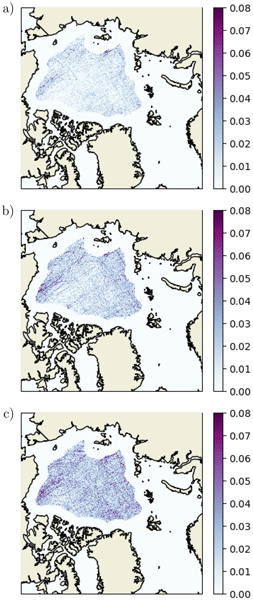
Sea ice in the Arctic Ocean moves under the action of waves and currents, causing it to deform along narrow lines where the ice opens or piles up. A standard way to evaluate whether models reproduce this behavior relies on how deformation changes with scale. Using synthetic ice fields, we show that this metric responds to how much opening and closing is happening overall, rather than to the organization of the deformation itself, raising caution to its use as a model evaluation tool.
Torge Martin, Carolina O. Dufour, Andrew J. S. Meijers, and Alyce M. Hancock
Ocean Sci., 22, 1429–1437, https://doi.org/10.5194/os-22-1429-2026, https://doi.org/10.5194/os-22-1429-2026, 2026
Short summary
Short summary
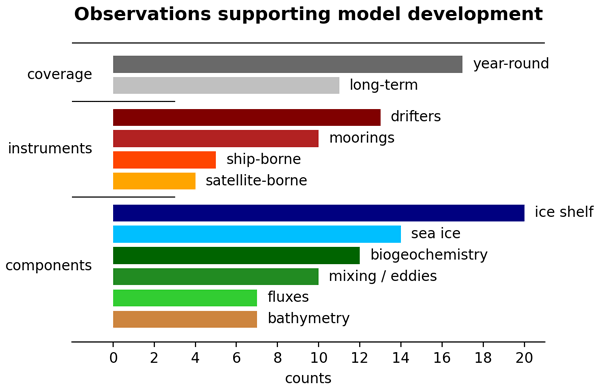
In the next 7 years major observational programs will be launched to improve our understanding of the Southern Ocean, the changes it is experiencing and its role in global warming. For these to advance current knowledge, we believe intense exchange with the numerical modelling community is essential. The survey results presented help to identify urgently needed observations for model development and underline the importance to explore new avenues in communication, collaboration and education.
Damien Ringeisen, Bruno Tremblay, Jean-Francois Lemieux, and Martin Losch
EGUsphere, https://doi.org/10.5194/egusphere-2026-1845, https://doi.org/10.5194/egusphere-2026-1845, 2026
Short summary
Short summary
Sea ice moves and deforms as wind and ocean currents push it around, creating narrow fracture lines on the surface. To accurately reproduce these fracture patterns in computer models used for climate predictions and navigation, we tested a mathematical approach to sea ice dynamics, common in other fields but rare in sea ice modeling, to see if it could better capture these patterns. Our results show this approach could improve fracture representation, though it requires more computing power.
Amélie Simon, Pierre Tandeo, Florian Sévellec, and Camille Lique
The Cryosphere, 19, 6639–6658, https://doi.org/10.5194/tc-19-6639-2025, https://doi.org/10.5194/tc-19-6639-2025, 2025
Short summary
Short summary
Through a machine learning technique based on seasonal cycles of sea-ice concentration from satellite data over the last 4 decades, our research shows that four regions are sufficient to best regionalize the Arctic. These regions are mainly organized into latitudinal bands and evolve in time and space. The descriptor proposed to monitor Arctic sea-ice changes is the probability to belong to each region. The probability to belong to the permanent sea-ice regions has decreased by 3.1 % per decade.
Jean-François Lemieux, Mathieu Plante, Nils Hutter, Damien Ringeisen, Bruno Tremblay, François Roy, and Philippe Blain
The Cryosphere, 19, 5639–5654, https://doi.org/10.5194/tc-19-5639-2025, https://doi.org/10.5194/tc-19-5639-2025, 2025
Short summary
Short summary
In sea ice models, the flow rule determines how sea ice deforms (opening, closing and shearing) when critical stresses are reached. We implemented in CICE a novel approach to define the flow rule. This is a useful capability as it allows to independently optimize critical stresses and deformations. As opposed to the standard flow rule, the novel approach can lead to a thicker and more active sea ice cover with narrower deformations.
Mathieu Plante, Jean-François Lemieux, L. Bruno Tremblay, Amélie Bouchat, Damien Ringeisen, Philippe Blain, Stephen Howell, Mike Brady, Alexander S. Komarov, Béatrice Duval, Lekima Yakuden, and Frédérique Labelle
Earth Syst. Sci. Data, 17, 423–434, https://doi.org/10.5194/essd-17-423-2025, https://doi.org/10.5194/essd-17-423-2025, 2025
Short summary
Short summary
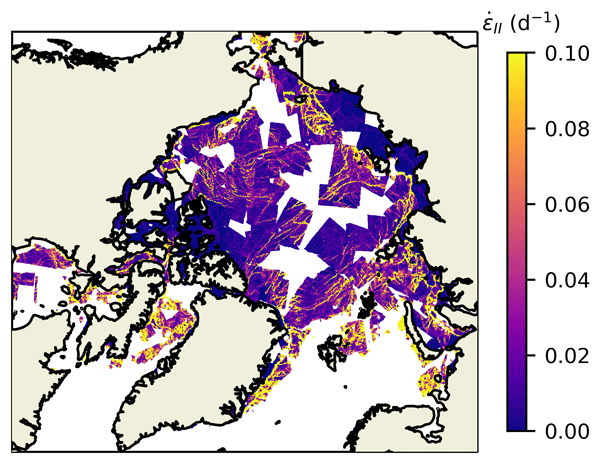
Sea ice forms a thin boundary between the ocean and the atmosphere, with complex, crust-like dynamics and ever-changing networks of sea ice leads and ridges. Statistics of these dynamical features are often used to evaluate sea ice models. Here, we present a new pan-Arctic dataset of sea ice deformations derived from satellite imagery, from 1 September 2017 to 31 August 2023. We discuss the dataset coverage and some limitations associated with uncertainties in the computed values.
Sofia Allende, Anne Marie Treguier, Camille Lique, Clément de Boyer Montégut, François Massonnet, Thierry Fichefet, and Antoine Barthélemy
Geosci. Model Dev., 17, 7445–7466, https://doi.org/10.5194/gmd-17-7445-2024, https://doi.org/10.5194/gmd-17-7445-2024, 2024
Short summary
Short summary
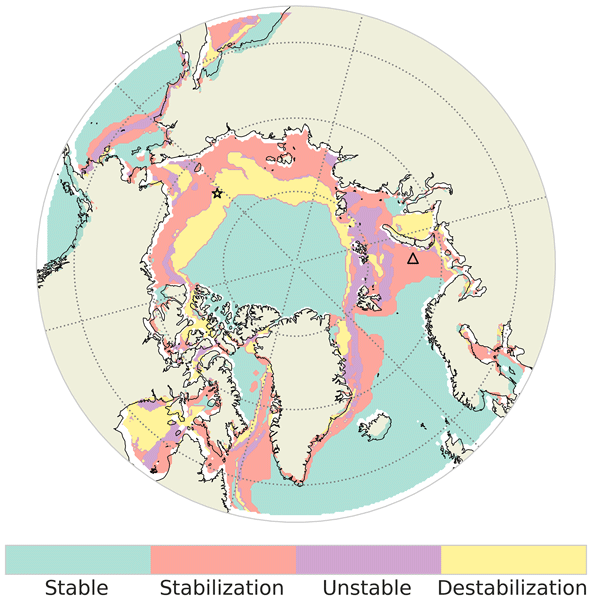
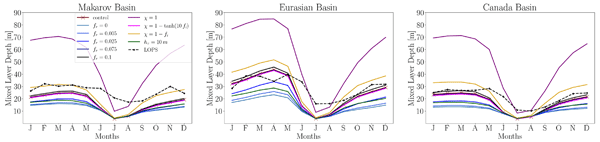
We study the parameters of the turbulent-kinetic-energy mixed-layer-penetration scheme in the NEMO model with regard to sea-ice-covered regions of the Arctic Ocean. This evaluation reveals the impact of these parameters on mixed-layer depth, sea surface temperature and salinity, and ocean stratification. Our findings demonstrate significant impacts on sea ice thickness and sea ice concentration, emphasizing the need for accurately representing ocean mixing to understand Arctic climate dynamics.
Antoine Savard and Bruno Tremblay
The Cryosphere, 18, 2017–2034, https://doi.org/10.5194/tc-18-2017-2024, https://doi.org/10.5194/tc-18-2017-2024, 2024
Short summary
Short summary
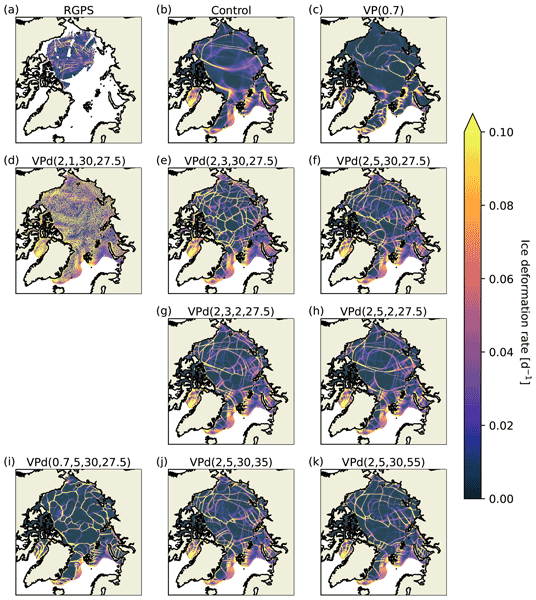
We include a suitable plastic damage parametrization in the standard viscous–plastic (VP) sea ice model to disentangle its effect from resolved model physics (visco-plastic with and without damage) on its ability to reproduce observed scaling laws of deformation. This study shows that including a damage parametrization in the VP model improves its performance in simulating the statistical behavior of fracture patterns. Therefore, a damage parametrization is a powerful tuning knob.
Mathieu Plante, Jean-François Lemieux, L. Bruno Tremblay, Adrienne Tivy, Joey Angnatok, François Roy, Gregory Smith, Frédéric Dupont, and Adrian K. Turner
The Cryosphere, 18, 1685–1708, https://doi.org/10.5194/tc-18-1685-2024, https://doi.org/10.5194/tc-18-1685-2024, 2024
Short summary
Short summary
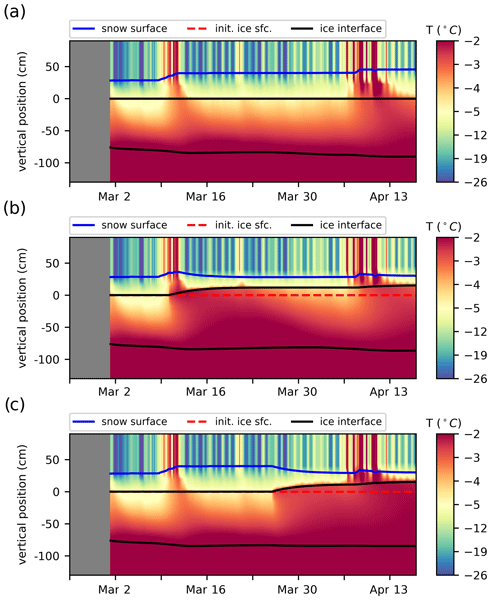
We use a sea ice model to reproduce ice growth observations from two buoys deployed on coastal sea ice and analyze the improvements brought by new physics that represent the presence of saline liquid water in the ice interior. We find that the new physics with default parameters degrade the model performance, with overly rapid ice growth and overly early snow flooding on top of the ice. The performance is largely improved by simple modifications to the ice growth and snow-flooding algorithms.
Oreste Marquis, Bruno Tremblay, Jean-François Lemieux, and Mohammed Islam
The Cryosphere, 18, 1013–1032, https://doi.org/10.5194/tc-18-1013-2024, https://doi.org/10.5194/tc-18-1013-2024, 2024
Short summary
Short summary
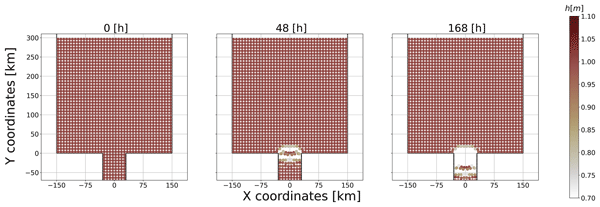
We developed a standard viscous–plastic sea-ice model based on the numerical framework called smoothed particle hydrodynamics. The model conforms to the theory within an error of 1 % in an idealized ridging experiment, and it is able to simulate stable ice arches. However, the method creates a dispersive plastic wave speed. The framework is efficient to simulate fractures and can take full advantage of parallelization, making it a good candidate to investigate sea-ice material properties.
Anne Marie Treguier, Clement de Boyer Montégut, Alexandra Bozec, Eric P. Chassignet, Baylor Fox-Kemper, Andy McC. Hogg, Doroteaciro Iovino, Andrew E. Kiss, Julien Le Sommer, Yiwen Li, Pengfei Lin, Camille Lique, Hailong Liu, Guillaume Serazin, Dmitry Sidorenko, Qiang Wang, Xiaobio Xu, and Steve Yeager
Geosci. Model Dev., 16, 3849–3872, https://doi.org/10.5194/gmd-16-3849-2023, https://doi.org/10.5194/gmd-16-3849-2023, 2023
Short summary
Short summary
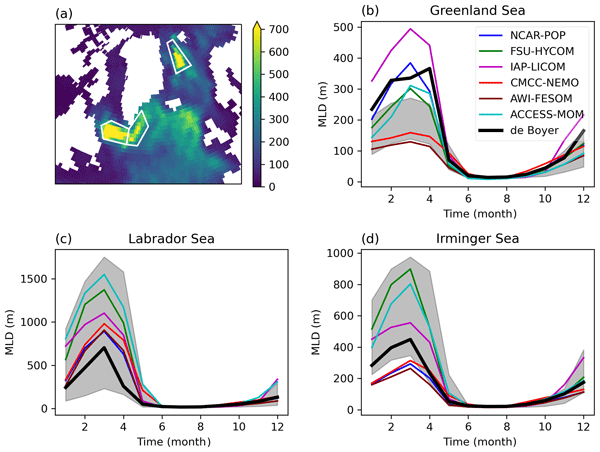
The ocean mixed layer is the interface between the ocean interior and the atmosphere and plays a key role in climate variability. We evaluate the performance of the new generation of ocean models for climate studies, designed to resolve
ocean eddies, which are the largest source of ocean variability and modulate the mixed-layer properties. We find that the mixed-layer depth is better represented in eddy-rich models but, unfortunately, not uniformly across the globe and not in all models.
Guillaume Boutin, Einar Ólason, Pierre Rampal, Heather Regan, Camille Lique, Claude Talandier, Laurent Brodeau, and Robert Ricker
The Cryosphere, 17, 617–638, https://doi.org/10.5194/tc-17-617-2023, https://doi.org/10.5194/tc-17-617-2023, 2023
Short summary
Short summary
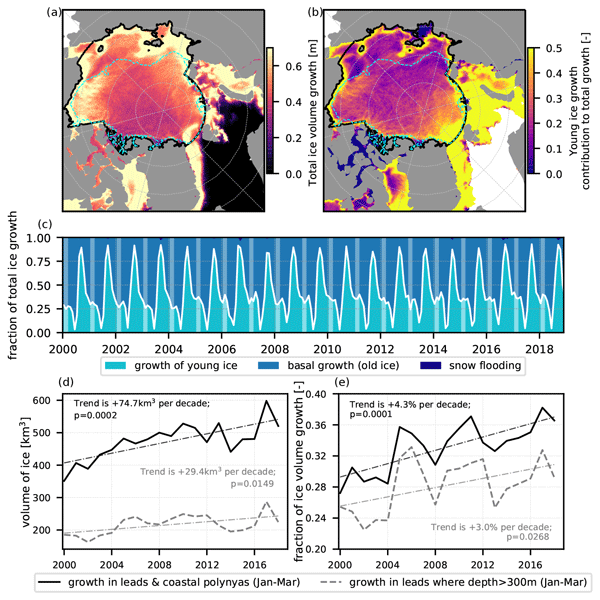
Sea ice cover in the Arctic is full of cracks, which we call leads. We suspect that these leads play a role for atmosphere–ocean interactions in polar regions, but their importance remains challenging to estimate. We use a new ocean–sea ice model with an original way of representing sea ice dynamics to estimate their impact on winter sea ice production. This model successfully represents sea ice evolution from 2000 to 2018, and we find that about 30 % of ice production takes place in leads.
Charles Brunette, L. Bruno Tremblay, and Robert Newton
The Cryosphere, 16, 533–557, https://doi.org/10.5194/tc-16-533-2022, https://doi.org/10.5194/tc-16-533-2022, 2022
Short summary
Short summary
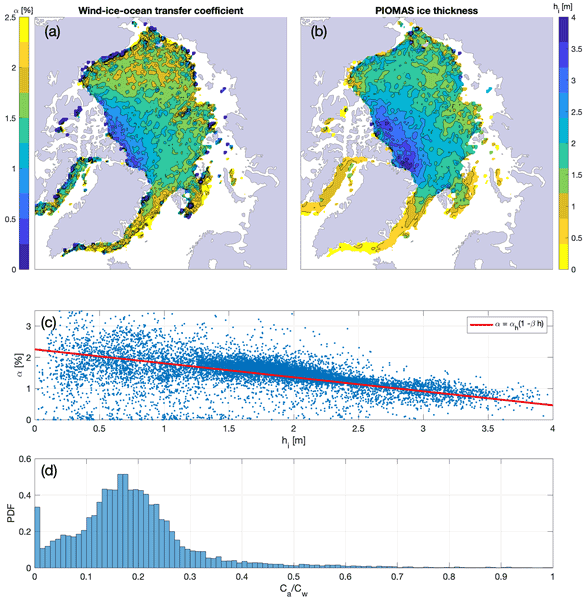
Sea ice motion is a versatile parameter for monitoring the Arctic climate system. In this contribution, we use data from drifting buoys, winds, and ice thickness to parameterize the motion of sea ice in a free drift regime – i.e., flowing freely in response to the forcing from the winds and ocean currents. We show that including a dependence on sea ice thickness and taking into account a climatology of the surface ocean circulation significantly improves the accuracy of sea ice motion estimates.
Mathieu Plante and L. Bruno Tremblay
The Cryosphere, 15, 5623–5638, https://doi.org/10.5194/tc-15-5623-2021, https://doi.org/10.5194/tc-15-5623-2021, 2021
Short summary
Short summary
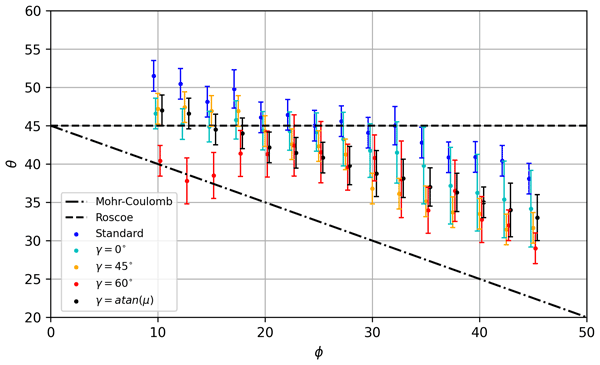
We propose a generalized form for the damage parameterization such that super-critical stresses can return to the yield with different final sub-critical stress states. In uniaxial compression simulations, the generalization improves the orientation of sea ice fractures and reduces the growth of numerical errors. Shear and convergence deformations however remain predominant along the fractures, contrary to observations, and this calls for modification of the post-fracture viscosity formulation.
Cited articles
Antonov, J. I., Seidov, D., Boyer, T. P., Locarnini, R. A., Mishonov, A. V., Garcia, H. E., Baranova, O. K., Zweng, M. M., and Johnson, D. R.: World Ocean Atlas 2009, Volume 2: Salinity, edtited by: Levitus, S., NOAA Atlas NESDIS 69, US Government Printing Office, Washington, D.C., 184 pp., https://www.nodc.noaa.gov/OC5/WOA09/pubwoa09.html (last access: 12 February 2026), 2010. a, b
Armitage, T. W. K., Bacon, S., Ridout, A. L., Petty, A. A., Wolbach, S., and Tsamados, M.: Arctic Ocean surface geostrophic circulation 2003–2014, The Cryosphere, 11, 1767–1780, https://doi.org/10.5194/tc-11-1767-2017, 2017. a
Armitage, T. W. K., Manucharyan, G. E., Petty, A. A., Kwok, R., and Thompson, A. F.: Enhanced eddy activity in the Beaufort Gyre in response to sea ice loss, Nat. Commun., 11, 761, https://doi.org/10.1038/s41467-020-14449-z, 2020. a, b, c
Barnier, B., Blaker, A., Biastoch, A., Boening, C., Coward, A. C., Deshayes, J., Duchez, A., Hirschi, J., Sommer, J. L., Madec, G., Maze, G., Molines, J.-M., New, A., Penduff, T., Scheinert, M., Talandier, C., and Treguier, A.-M.: DRAKKAR:develop ing high resolution ocean components for European Earth system models, Vol. 19, CLIVAR Exchanges No. 65, https://oceanrep.geomar.de/id/eprint/30681 (last access: 12 February 2026), 2014. a
Barton, B. I., Lique, C., Lenn, Y., and Talandier, C.: An Ice‐Ocean Model Study of the Mid‐2000s Regime Change in the Barents Sea, J. Geophys. Res.-Oceans, 127, e2021JC018280, https://doi.org/10.1029/2021JC018280, 2022. a
Batrak, Y. and Müller, M.: On the warm bias in atmospheric reanalyses induced by the missing snow over Arctic sea-ice, Nat. Commun., 10, 4170, https://doi.org/10.1038/s41467-019-11975-3, 2019. a
Beech, N., Rackow, T., Semmler, T., and Jung, T.: High-latitude Southern Ocean eddy activity projected to evolve with anthropogenic climate change, Commun. Earth Environ., 6, https://doi.org/10.1038/s43247-025-02221-4, 2025. a, b
Brannigan, L., Johnson, H., Lique, C., Nycander, J., and Nilsson, J.: Generation of subsurface anticyclones at Arctic surface fronts due to a surface stress, J. Phys. Oceanogr., 47, 2653–2671, 2017. a
Carpenter, J. R. and Timmermans, M.-L.: Deep mesoscale eddies in the Canada Basin, Arctic Ocean, Geophys. Res. Lett., 39, 2012GL053025, https://doi.org/10.1029/2012GL053025, 2012. a, b, c, d
Cavalieri, D. J., Gloersen, P., and Campbell, W. J.: Determination of sea ice parameters with the NIMBUS 7 SMMR, J. Geophys. Res.-Atmos., 89, 5355–5369, https://doi.org/10.1029/JD089iD04p05355, 1984. a
Chelton, D. B., Schlax, M. G., Samelson, R. M., and De Szoeke, R. A.: Global observations of large oceanic eddies, Geophys. Res. Lett., 34, 2007GL030812, https://doi.org/10.1029/2007GL030812, 2007. a
Chelton, D. B., Schlax, M. G., and Samelson, R. M.: Global observations of nonlinear mesoscale eddies, Prog. Oceanogr., 91, 167–216, https://doi.org/10.1016/j.pocean.2011.01.002, 2011. a, b
Comiso, J. C.: Characteristics of Arctic winter sea ice from satellite multispectral microwave observations, J. Geophys. Res., 91, 975, https://doi.org/10.1029/JC091iC01p00975, 1986. a
Corlett, W. B. and Pickart, R. S.: The Chukchi slope current, Prog. Oceanogr., 153, 50–65, https://doi.org/10.1016/j.pocean.2017.04.005, 2017. a
D'Asaro, E. A.: Generation of submesoscale vortices: A new mechanism, J. Geophys. Res.-Oceans, 93, 6685–6693, https://doi.org/10.1029/JC093iC06p06685, 1988. a, b, c
de Lavergne, C., Madec, G., Capet, X., Maze, G., and Roquet, F.: Getting to the bottom of the ocean, Nat. Geosci., 9, 857–858, https://doi.org/10.1038/ngeo2850, 2016. a
DiGirolamo, N. E., Parkinson, C. L., Cavalieri, D. J., Gloersen, P., and Zwally, H. J.: Sea Ice Concentrations from Nimbus-7 SMMR and DMSP SSM/I-SSMIS Passive Microwave Data, NSIDC [data set], https://doi.org/10.5067/MPYG15WAA4WX, 2022. a, b
Dupont, F., Higginson, S., Bourdallé-Badie, R., Lu, Y., Roy, F., Smith, G. C., Lemieux, J.-F., Garric, G., and Davidson, F.: A high-resolution ocean and sea-ice modelling system for the Arctic and North Atlantic oceans, Geosci. Model Dev., 8, 1577–1594, https://doi.org/10.5194/gmd-8-1577-2015, 2015. a
Giles, K. A., Laxon, S. W., Ridout, A. L., Wingham, D. J., and Bacon, S.: Western Arctic Ocean freshwater storage increased by wind-driven spin-up of the Beaufort Gyre, Nat. Geosci., 5, 194–197, https://doi.org/10.1038/ngeo1379, 2012. a
Giulivi, C. F. and Gordon, A. L.: Isopycnal displacements within the Cape Basin thermocline as revealed by the Hydrographic Data Archive, Deep-Sea Res. Pt. I, 53, 1285–1300, https://doi.org/10.1016/j.dsr.2006.05.011, 2006. a, b
Gupta, M., Gürcan, E., and Thompson, A. F.: Eddy‐Induced Dispersion of Sea Ice Floes at the Marginal Ice Zone, Geophys. Res. Lett., 51, e2023GL105656, https://doi.org/10.1029/2023GL105656, 2024. a
Hersbach, H., Bell, B., Berrisford, P., Hirahara, S., Horányi, A., Muñoz‐Sabater, J., Nicolas, J., Peubey, C., Radu, R., Schepers, D., Simmons, A., Soci, C., Abdalla, S., Abellan, X., Balsamo, G., Bechtold, P., Biavati, G., Bidlot, J., Bonavita, M., De Chiara, G., Dahlgren, P., Dee, D., Diamantakis, M., Dragani, R., Flemming, J., Forbes, R., Fuentes, M., Geer, A., Haimberger, L., Healy, S., Hogan, R. J., Hólm, E., Janisková, M., Keeley, S., Laloyaux, P., Lopez, P., Lupu, C., Radnoti, G., De Rosnay, P., Rozum, I., Vamborg, F., Villaume, S., and Thépaut, J.: The ERA5 global reanalysis, Q. J. Roy. Meteorol. Soc., 146, 1999–2049, https://doi.org/10.1002/qj.3803, 2020. a
Hu, X., Myers, P. G., and Lu, Y.: Pacific Water Pathway in the Arctic Ocean and Beaufort Gyre in Two Simulations With Different Horizontal Resolutions, J. Geophys. Res., 124, 6414–6432, https://doi.org/10.1029/2019JC015111, 2019. a
Hunkins, K. L.: Subsurface eddies in the Arctic Ocean, Tech. rep., in: volume 21, Pergamon Press, https://doi.org/10.1016/0011-7471(74)90064-3, 1974. a, b, c, d
Isern-Fontanet, J., Garcia-Ladona, E., and Font, J.: Identification of Marine Eddies from Altimetric Maps, J. Atmos. Ocean. Tech., 20, 772–778, https://doi.org/10.1175/1520-0426(2003)20<772:IOMEFA>2.0.CO;2, 2003. a
Karcher, M., Smith, J. N., Kauker, F., Gerdes, R., and Smethie, W. M.: Recent changes in Arctic Ocean circulation revealed by iodine-129 observations and modeling, J. Geophys. Res.-Oceans, 117, https://doi.org/10.1029/2011JC007513, 2012. a
Kinnard, C., Zdanowicz, C. M., Fisher, D. A., Isaksson, E., de Vernal, A., and Thompson, L. G.: Reconstructed changes in Arctic sea ice over the past 1,450 years, Nature, 479, 509–512, https://doi.org/10.1038/nature10581, 2011. a
Kwok, R.: Arctic sea ice thickness, volume, and multiyear ice coverage: losses and coupled variability (1958–2018), Environ. Res. Lett., 13, 105005, https://doi.org/10.1088/1748-9326/aae3ec, 2018. a
Lellouche, J.-M., Greiner, E., Le Galloudec, O., Garric, G., Regnier, C., Drevillon, M., Benkiran, M., Testut, C.-E., Bourdalle-Badie, R., Gasparin, F., Hernandez, O., Levier, B., Drillet, Y., Remy, E., and Le Traon, P.-Y.: Recent updates to the Copernicus Marine Service global ocean monitoring and forecasting real-time
Levitus, S., Locarnini, R. A., Boyer, T. P., Mishonov, A. V., Antonov, J. I., Garcia, H. E., Baranova, O. K., Zweng, M. M., Johnson, D. R., and Seidov, D.: World Ocean Atlas 2009, Volume 1: Temperature, edited by: Levitus, S., NOAA Atlas NESDIS 68, US Government Printing Office, Washington, D.C., 184 pp., https://www.nodc.noaa.gov/OC5/WOA09/pubwoa09.html (last access: 12 February 2026), 2010. a
Li, J., Pickart, R. S., Lin, P., Bahr, F., Arrigo, K. R., Juranek, L., and Yang, X.: The Atlantic Water Boundary Current in the Chukchi Borderland and Southern Canada Basin, J. Geophys. Res.-Oceans, 125, e2020JC016197, https://doi.org/10.1029/2020JC016197, 2020. a
Lique, C. and Johnson, H. L.: Is there any imprint of the wind variability on the Atlantic Water circulation within the Arctic Basin?, Geophys. Res. Lett., 42, 9880–9888, https://doi.org/10.1002/2015GL066141, 2015. a
Lique, C., Johnson, H. L., and Davis, P. E. D.: On the Interplay between the Circulation in the Surface and the Intermediate Layers of the Arctic Ocean, J. Phys. Oceanogr., 45, 1393–1409, https://doi.org/10.1175/JPO-D-14-0183.1, 2015. a, b
Liu, C., Wang, Q., Danilov, S., Koldunov, N. V., Müller, V., Li, X., Sidorenko, D., and Zhang, S.: Spatial Scales of Kinetic Energy in the Arctic Ocean, J. Geophys. Res.-Oceans, 129, e2023JC020013, https://doi.org/10.1029/2023JC020013, 2024. a, b, c, d
Locarnini, R. A., Mishonov, A. V., Baranova, O. K., Reagan, J. R., Boyer, T. P., Seidov, D., Wang, Z., Garcia, H. E., Bouchard, C., Cross, S. L., Paver, C. R., and Dukhovskoy, D.: World Ocean Atlas 2023, Volume 1: Temperature, NOAA National Centers for Environmental Information, https://doi.org/10.25923/54BH-1613, 2024. a, b
MacKinnon, J. A., Simmons, H. L., Hargrove, J., Thomson, J., Peacock, T., Alford, M. H., Barton, B. I., Boury, S., Brenner, S. D., Couto, N., Danielson, S. L., Fine, E. C., Graber, H. C., Guthrie, J., Hopkins, J. E., Jayne, S. R., Jeon, C., Klenz, T., Lee, C. M., Lenn, Y.-D., Lucas, A. J., Lund, B., Mahaffey, C., Norman, L., Rainville, L., Smith, M. M., Thomas, L. N., Torres-Valdés, S., and Wood, K. R.: A warm jet in a cold ocean, Nat. Commun., 12, 2418, https://doi.org/10.1038/s41467-021-22505-5, 2021. a, b, c
Madec, G., Bell, M., Blaker, A., Bricaud, C., Bruciaferri, D., Castrillo, M., Calvert, D., Chanut, J., Clementi, E., Coward, A. C., Epicoco, I., Éthé, C., Ganderton, J., Harle, J., Hutchinson, K., Iovino, D., Lea, D., Lovato, T., Martin, M., Martin, N., Mele, F., Martins, D., Masson, S., Mathiot, P., Mocavero, S., Müller, S., Nurser, A. G., Paronuzzi, S., Peltier, M., Person, R., Rousset, C., Rynders, S., Samson, G., Téchené, S., Vancoppenolle, M., and Wilson, C.: NEMO Ocean Engine Reference Manual, v4.2.1, Zenodo, https://doi.org/10.5281/zenodo.8167700,2023. a
Manley, T. O. and Hunkins, K. L.: Mesoscale eddies of the Arctic Ocean, J. Geophys. Res.-Oceans, 90, 4911–4930, https://doi.org/10.1029/JC090iC03p04911, 1985. a
Manucharyan, G. E. and Isachsen, P. E.: Critical Role of Continental Slopes in Halocline and Eddy Dynamics of the Ekman-Driven Beaufort Gyre, J. Geophys. Res.-Oceans, 124, 2679–2696, https://doi.org/10.1029/2018JC014624, 2019. a
Manucharyan, G. E. and Spall, M. A.: Wind‐driven freshwater buildup and release in the Beaufort Gyre constrained by mesoscale eddies, Geophys. Res. Lett., 43, 273–282, https://doi.org/10.1002/2015GL065957, 2016. a
Manucharyan, G. E. and Stewart, A. L.: Stirring of interior potential vorticity gradients as a formation mechanism for large subsurface-intensified eddies in the Beaufort Gyre, J. Phys. Oceanogr., 52, 3349–3370, https://doi.org/10.1175/jpo-d-21-0040.1, 2022. a, b, c
Manucharyan, G. E. and Thompson, A. F.: Heavy footprints of upper-ocean eddies on weakened Arctic sea ice in marginal ice zones, Nat. Commun., 13, 2147, https://doi.org/10.1038/s41467-022-29663-0, 2022. a, b, c
Manucharyan, G. E. and Timmermans, M.-L.: Generation and Separation of Mesoscale Eddies from Surface Ocean Fronts, J. Phys. Oceanogr., 43, 2545–2562, https://doi.org/10.1175/JPO-D-13-094.1, 2013. a, b, c, d
Manucharyan, G. E., Spall, M. A., and Thompson, A. F.: A Theory of the Wind-Driven Beaufort Gyre Variability, J. Phys. Oceanogr., 46, 3263–3278, https://doi.org/10.1175/JPO-D-16-0091.1, 2016. a
Martínez‐Moreno, J., Lique, C., and Talandier, C.: Sea Ice Heterogeneity as a Result of Ocean Eddy Activity During the Ice Growth Season, Geophys. Res. Lett., 52, e2024GL113645, https://doi.org/10.1029/2024GL113645, 2025. a
McLaughlin, F. A., Carmack, E. C., Williams, W. J., Zimmermann, S., Shimada, K., and Itoh, M.: Joint effects of boundary currents and thermohaline intrusions on the warming of Atlantic water in the Canada Basin, 1993–2007, J. Geophys. Res.-Oceans, 114, 2008JC005001, https://doi.org/10.1029/2008JC005001, 2009. a
Meier, W. and Stroeve, J.: An Updated Assessment of the Changing Arctic Sea Ice Cover, Oceanography, 35, 10–19, https://doi.org/10.5670/oceanog.2022.114, 2022. a, b
Meneghello, G., Marshall, J., Timmermans, M.-L., and Scott, J.: Observations of Seasonal Upwelling and Downwelling in the Beaufort Sea Mediated by Sea Ice, J. Phys. Oceanogr., 48, 795–805, https://doi.org/10.1175/JPO-D-17-0188.1, 2018. a
Meneghello, G., Doddridge, E., Marshall, J., Scott, J., and Campin, J.-M.: Exploring the Role of the “Ice–Ocean Governor” and Mesoscale Eddies in the Equilibration of the Beaufort Gyre: Lessons from Observations, J. Phys. Oceanog., 50, 269–277, https://doi.org/10.1175/JPO-D-18-0223.1, 2020. a, b
Meneghello, G., Marshall, J., Lique, C., Isachsen, L. E., Doddridge, E., Campin, J.-M., Regan, H. C., and Talandier, C.: Genesis and Decay of Mesoscale Baroclinic Eddies in the Seasonally Ice-Covered Interior Arctic Ocean, J. Phys. Oceanogr., 51, 115–129, https://doi.org/10.1175/JPO-D-20-0054.1, 2021. a, b, c, d, e, f, g, h, i, j
Meredith, M., Heywood, K., Dennis, P., Goldson, L., White, R., Fahrbach, E., Schauer, U., and Østerhus, S.: Freshwater fluxes through the Western Fram Strait, Geophys. Res. Lett., 28, 1615–1618, https://doi.org/10.1029/2000GL011992, 2001. a
Nencioli, F., Dong, C., Dickey, T., Washburn, L., and McWilliams, J. C.: A Vector Geometry-Based Eddy Detection Algorithm and Its Application to a High-Resolution Numerical Model Product and High-Frequency Radar Surface Velocities in the Southern California Bight, J. Atmos. Ocean. Tech., 27, 564–579, https://doi.org/10.1175/2009JTECHO725.1, 2010. a
Nurser, A. J. G. and Bacon, S.: The Rossby radius in the Arctic Ocean, Ocean Sci., 10, 967–975, https://doi.org/10.5194/os-10-967-2014, 2014. a, b, c
Okubo, A.: Horizontal dispersion of floatable particles in the vicinity of velocity singularities such as convergences, Deep-Sea Res. Oceanogr. Abstr., 17, 445–454, https://doi.org/10.1016/0011-7471(70)90059-8, 1970. a
Pasquero, C., Provenzale, A., and Babiano, A.: Parameterization of dispersion in two-dimensional turbulence, J. Fluid Mech., 439, 279–303, https://doi.org/10.1017/S0022112001004499, 2001. a
Pedlosky, J.: Geophysical Fluid Dynamics, Springer, ISBN 978-3-540-90745-9, 1982. a
Pickart, R. S., Weingartner, T. J., Pratt, L. J., Zimmermann, S., and Torres, D. J.: Flow of winter-transformed Pacific water into the Western Arctic, Deep-Sea Res. Pt. II, 52, 3175–3198, https://doi.org/10.1016/j.dsr2.2005.10.009, 2005. a
Planat, N.: Detection_tracking_CB, Zenodo [code], https://doi.org/10.5281/zenodo.18482600, 2025a. a
Planat, N.: Detection and tracking of mesoscale eddies in the Canada Basin in CREG12. Dataset for 30, 69, 147, and 508 m, Zenodo [data set], https://doi.org/10.5281/zenodo.18621827, 2025b. a
Planat, N., Tremblay, L. B., Dufour, C. O., and Straub, D.: Seasonal and Decadal Geostrophic Pathways of Pacific and Atlantic Waters in the Arctic Amerasian Basin From Observations, J. Geophys. Res.-Oceans, 130, e2024JC021560, https://doi.org/10.1029/2024JC021560, 2025. a, b, c, d
Proshutinsky, A., Krishfield, R., Timmermans, M.-L., Toole, J., Carmack, E. C., McLaughlin, F. A., Williams, W. J., Zimmermann, S., Itoh, M., and Shimada, K.: Beaufort Gyre freshwater reservoir: State and variability from observations, J. Geophys. Res.-Oceans, 114, C00A10, https://doi.org/10.1029/2008JC005104, 2009. a
Rampal, P., Weiss, J., and Marsan, D.: Positive trend in the mean speed and deformation rate of Arctic sea ice, 1979–2007, J. Geophys. Res.-Oceans, 114, https://doi.org/10.1029/2008JC005066, 2009. a
Reagan, J. R., Seidov, D., Wang, Z., Dukhovskoy, D., Boyer, T. P., Locarnini, R. A., Baranova, O. K., Mishonov, A. V., Garcia, H. E., Bouchard, C., Cross, S. L., and Paver, C. R.: World Ocean Atlas 2023, Volume 2: Salinity, NOAA National Centers for Environmental Information, https://doi.org/10.25923/70QT-9574, 2024. a, b
Regan, H. C., Lique, C., and Armitage, T. W. K.: The Beaufort Gyre Extent, Shape, and Location Between 2003 and 2014 From Satellite Observations, J. Geophys. Res., 114, 844–862, https://doi.org/10.1029/2018JC014379, 2019. a
Rieck, J. K. and Rath, W.: jk-rieck/eddytools: v2022.09 (v2022.09), Zenodo [code], https://doi.org/10.5281/zenodo.14994060, 2025. a
Rieck, J. K., Dufour, C. O., Nadeau, L.-P., and Thompson, A. F.: Heat Transport toward Sea Ice by Transient Processes and Coherent Mesoscale Eddies in an Idealized Southern Ocean, J. Phys. Oceanogr., 55, 377–396, https://doi.org/10.1175/JPO-D-24-0073.1, 2025a. a, b, c
Rieck, J. K., Martínez Moreno, J., Lique, C., Dufour, C. O., and Talandier, C.: Mean Kinetic Energy and Its Projected Changes Dominate Over Eddy Kinetic Energy in the Arctic Ocean, Geophys. Res. Lett., 52, e2025GL117957, https://doi.org/10.1029/2025GL117957, 2025b. a, b, c, d
Smith, K. S. and Vallis, G. K.: The Scales and Equilibration of Midocean Eddies: Freely Evolving Flow, J. Phys. Oceanogr., 31, 554–571, https://doi.org/10.1175/1520-0485(2001)031<0554:TSAEOM>2.0.CO;2, 2001. a
Spall, M. A., Pickart, R. S., Fratantoni, P. S., and Plueddemann, A. J.: Western Arctic Shelfbreak Eddies: Formation and Transport, J. Phys. Oceanogr., 38, 1644–1668, https://doi.org/10.1175/2007JPO3829.1, 2008. a, b
Spall, M. A., Pickart, R. S., Li, M., Itoh, M., Lin, P., Kikuchi, T., and Qi, Y.: Transport of Pacific Water Into the Canada Basin and the Formation of the Chukchi Slope Current, J. Geophys. Res.-Oceans, 123, 7453–7471, https://doi.org/10.1029/2018JC013825, 2018. a
Stegner, A., Le Vu, B., Dumas, F., Ghannami, M. A., Nicolle, A., Durand, C., and Faugere, Y.: Cyclone‐Anticyclone Asymmetry of Eddy Detection on Gridded Altimetry Product in the Mediterranean Sea, J. Geophys. Res.-Oceans, 126, e2021JC017475, https://doi.org/10.1029/2021JC017475, 2021. a, b
Talandier, C. and Lique, C.: CREG12.L75-REF12, Zenodo [data set], https://doi.org/10.5281/ZENODO.13491948, 2024. a, b
Timmermans, M.-L., Toole, J., Proshutinsky, A., Krishfield, R., and Plueddemann, A. J.: Eddies in the Canada Basin, Arctic Ocean, Observed from Ice-Tethered Profilers, J. Phys. Oceanogr., 38, 133–145, https://doi.org/10.1175/2007JPO3782.1, 2008. a
Toole, J., Krishfield, R., Timmermans, M.-L., and Proshutinsky, A.: The Ice-Tethered Profiler: Argo of the Arctic, Oceanography, 24, 126–135, https://doi.org/10.5670/oceanog.2011.64, 2011. a
Tulloch, R., Marshall, J., Hill, C., and Smith, K. S.: Scales, Growth Rates, and Spectral Fluxes of Baroclinic Instability in the Ocean, J. Phys. Oceanogr., 41, 1057–1076, https://doi.org/10.1175/2011JPO4404.1, 2011. a
Vancoppenolle, M., Rousset, C., Blockley, E., Aksenov, Y., Feltham, D. L., Fichefet, T., Garric, G., Guémas, V., Iovino, D., Keeley, S., Madec, G., Massonnet, F., Ridley, J., Schroeder, D., and Tietsche, S.: SI3, the NEMO Sea Ice Engine, Zenodo, https://doi.org/10.5281/ZENODO.7534900, 2023. a
von Appen, W.-J. and Pickart, R. S.: Two configurations of the western Arctic shelfbreak current in summer, J. Phys. Oceanogr., 42, 329–351, 2012. a
Wang, Q., Koldunov, N. V., Danilov, S., Sidorenko, D., Wekerle, C., Scholz, P., Bashmachnikov, I. L., and Jung, T.: Eddy Kinetic Energy in the Arctic Ocean From a Global Simulation With a 1-km Arctic, Geophys. Res. Lett., 47, https://doi.org/10.1029/2020GL088550, 2020. a
Watanabe, E.: Beaufort shelf break eddies and shelf-basin exchange of Pacific summer water in the western Arctic Ocean detected by satellite and modeling analyses, J. Geophys. Res., 116, C08034, https://doi.org/10.1029/2010JC006259, 2011. a
Watanabe, E., Onodera, J., Harada, N., Honda, M. C., Kimoto, K., Kikuchi, T., Nishino, S., Matsuno, K., Yamaguchi, A., Ishida, A., and Kishi, M. J.: Enhanced role of eddies in the Arctic marine biological pump, Nat. Commun., 5, 3950, https://doi.org/10.1038/ncomms4950, 2014. a
Weiss, J.: The dynamics of enstrophy transfer in two-dimensional hydrodynamics, Physica D, 48, 273–294, https://doi.org/10.1016/0167-2789(91)90088-Q, 1991. a
Weiss‐Gibbons, T., Tefs, A., Hu, X., Stadnyk, T. A., and Myers, P. G.: Sensitivity of Simulated Arctic Ocean Salinity and Strait Transport to Interannually Variable Hydrologic Model Based Runoff, J. Geophys. Res.-Oceans, 129, e2023JC020536, https://doi.org/10.1029/2023JC020536, 2024. a
Woodgate, R. A.: Increases in the Pacific inflow to the Arctic from 1990 to 2015, and insights into seasonal trends and driving mechanisms from year-round Bering Strait mooring data, Prog. Oceanogr., 160, 124–154, https://doi.org/10.1016/j.pocean.2017.12.007, 2018. a
Zhang, J. and Rothrock, D. A.: Modeling Global Sea Ice with a Thickness and Enthalpy Distribution Model in Generalized Curvilinear Coordinates, Mon. Weather Rev., 131, 845–861, https://doi.org/10.1175/1520-0493(2003)131<0845:MGSIWA>2.0.CO;2, 2003. a, b, c
Zhang, J., Steele, M., Runciman, K., Dewey, S., Morison, J., Lee, C. M., Rainville, L., Cole, S., Krishfield, R., Timmermans, M.-L., and Toole, J.: The Beaufort Gyre intensification and stabilization: A model‐observation synthesis, J. Geophys. Res., 121, 7933–7952, https://doi.org/10.1002/2016JC012196, 2016. a
Zhao, M. and Timmermans, M.-L.: Vertical scales and dynamics of eddies in the Arctic Ocean's Canada Basin, J. Geophys. Res.-Oceans, 120, 8195–8209, https://doi.org/10.1002/2015JC011251, 2015. a, b
Short summary
We detect and track mesoscale eddies in the Canadian Basin of the Arctic Ocean and describe their spatio-temporal characteristics in a high resolution pan-Arctic model. Results show eddies of typical size 12 km, lasting 10 d and travelling 11 km, with roughly an equal number of cyclones and anticyclones detected. Seasonal, decadal and interannual changes of the number of eddies detected show strong correlations with the ice cover, and with the mean circulation of the basin.
We detect and track mesoscale eddies in the Canadian Basin of the Arctic Ocean and describe...


