
Articles | Volume 22, issue 1
https://doi.org/10.5194/os-22-257-2026
© Author(s) 2026. This work is distributed under
the Creative Commons Attribution 4.0 License.
the Creative Commons Attribution 4.0 License.
https://doi.org/10.5194/os-22-257-2026
© Author(s) 2026. This work is distributed under
the Creative Commons Attribution 4.0 License.
the Creative Commons Attribution 4.0 License.
Research article
| 
22 Jan 2026
Research article |
| 22 Jan 2026
| 22 Jan 2026
Bottom mixed layer derivation and spatial variability over the central and eastern abyssal Pacific Ocean

School of Biological Sciences, University of Western Australia, Crawley, Australia
Oceans Institute, University of Western Australia, Crawley, Australia
Devin Harrison
Kelpie Geoscience Ltd., Edinburgh, United Kingdom
Nicole Jones
Oceans Institute, University of Western Australia, Crawley, Australia
School of Earth and Oceans, University of Western Australia, Crawley, Australia
Joanne O'Callaghan
Department of Physics, University of Auckland, Auckland, New Zealand
Oceanly Science Limited, Wellington, New Zealand
Taimoor Sohail
School of Geography, Earth and Atmospheric Science, University of Melbourne, Melbourne, Australia
Todd Bond
School of Biological Sciences, University of Western Australia, Crawley, Australia
Oceans Institute, University of Western Australia, Crawley, Australia
Heather Stewart
Kelpie Geoscience Ltd., Edinburgh, United Kingdom
Alan Jamieson
School of Biological Sciences, University of Western Australia, Crawley, Australia
Oceans Institute, University of Western Australia, Crawley, Australia
Related authors
Jessica Kolbusz, Jan Zika, Charitha Pattiaratchi, and Alan Jamieson
Ocean Sci., 20, 123–140, https://doi.org/10.5194/os-20-123-2024, https://doi.org/10.5194/os-20-123-2024, 2024
Short summary
Short summary
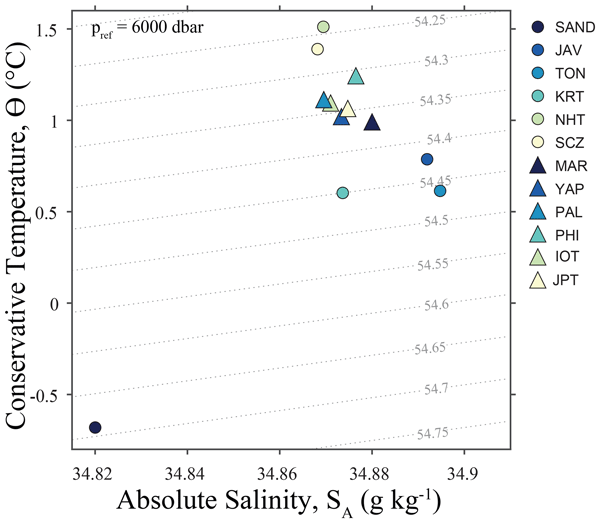
We collected observations of the ocean environment at depths over 6000 m in the Southern Ocean, Indian Ocean, and western Pacific using sensor-equipped landers. We found that trench locations impact the water characteristics over these depths. Moving northward, they generally warmed but differed due to their position along bottom water circulation paths. These insights stress the importance of further research in understanding the environment of these deep regions and their importance.
Chris A. Whitwell, Nicole L. Jones, Greg N. Ivey, and Matthew D. Rayson
EGUsphere, https://doi.org/10.5194/egusphere-2026-2498, https://doi.org/10.5194/egusphere-2026-2498, 2026
Short summary
Short summary
Ocean mixing is a process that plays an important role in the transport of heat, matter and momentum. We present 5 years of ocean mixing measurements from four locations off the coastline of Australia. We show that most of the mixing is the result of infrequent events where there were energetic flows, and that the rate of mixing changed with the season and the strength and direction of the tides. Finally, we provide advice on how to best measure ocean mixing.
Adèle Moncuquet, Nicole L. Jones, Lucie Bordois, François Dufois, and Pascal Lazure
Ocean Sci., 21, 3375–3395, https://doi.org/10.5194/os-21-3375-2025, https://doi.org/10.5194/os-21-3375-2025, 2025
Short summary
Short summary
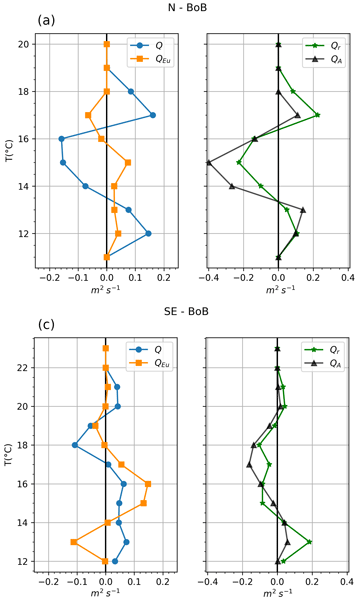
Internal waves along the Bay of Biscay coast transport water distinctly: surface and seafloor water moves shoreward while mid-depth water moves offshore, matching linear internal tide theory. This transport equals effects of moderate winds that typically dominate. Internal waves were the main transport at one site and enhanced shoreward flow near the seabed at another. Understanding these patterns could explain movement of nutrients, sediments, and pollutants affecting coastal ecosystems.
Arnaud F. Valcarcel, Craig L. Stevens, Joanne M. O'Callaghan, and Sutara H. Suanda
Ocean Sci., 21, 965–987, https://doi.org/10.5194/os-21-965-2025, https://doi.org/10.5194/os-21-965-2025, 2025
Short summary
Short summary
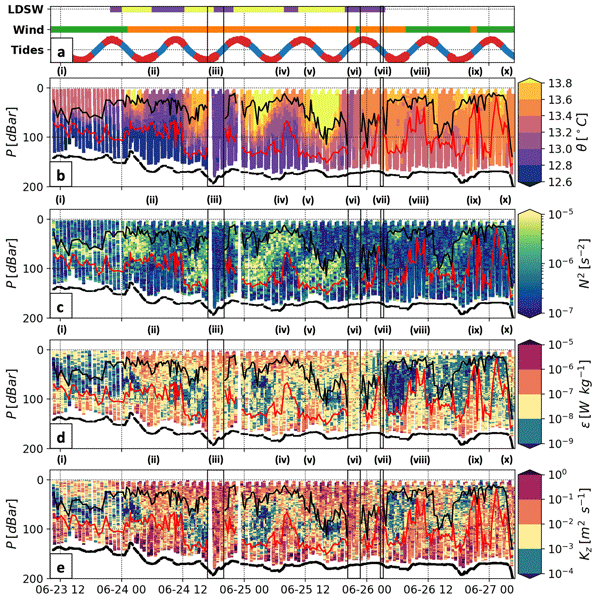
This paper describes underwater robotic measurements in an energetic strait. The data show how energy is transferred from winds and tides to turbulent processes. Boundary layers of strong turbulence affected the water from surface to seafloor across an unusually deep extent, except when fresher or warmer waters moved into the region. Numerical models revealed that turbulent energy transport allowed boundary layers to interact. This phenomenon may impact the biological structure of coastal seas.
Aurelien Luigi Serge Ponte, Lachlan C. Astfalck, Matthew D. Rayson, Andrew P. Zulberti, and Nicole L. Jones
Nonlin. Processes Geophys., 31, 571–586, https://doi.org/10.5194/npg-31-571-2024, https://doi.org/10.5194/npg-31-571-2024, 2024
Short summary
Short summary
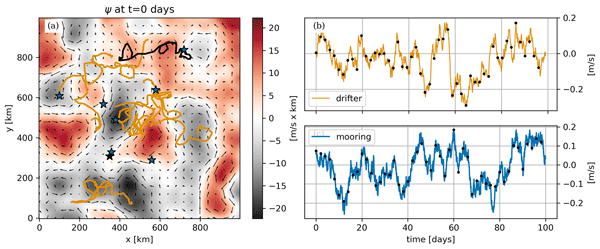
We propose a novel method for the estimation of ocean surface flow properties in terms of its energy and spatial and temporal scales. The method relies on flow observations collected either at a fixed location or along the flow, as would be inferred from the trajectory of freely drifting platforms. The accuracy of the method is quantified in several experimental configurations. We innovatively demonstrate that freely drifting platforms, even in isolation, can be used to capture flow properties.
Jessica Kolbusz, Jan Zika, Charitha Pattiaratchi, and Alan Jamieson
Ocean Sci., 20, 123–140, https://doi.org/10.5194/os-20-123-2024, https://doi.org/10.5194/os-20-123-2024, 2024
Short summary
Short summary
We collected observations of the ocean environment at depths over 6000 m in the Southern Ocean, Indian Ocean, and western Pacific using sensor-equipped landers. We found that trench locations impact the water characteristics over these depths. Moving northward, they generally warmed but differed due to their position along bottom water circulation paths. These insights stress the importance of further research in understanding the environment of these deep regions and their importance.
Rafael Santana, Helen Macdonald, Joanne O'Callaghan, Brian Powell, Sarah Wakes, and Sutara H. Suanda
Geosci. Model Dev., 16, 3675–3698, https://doi.org/10.5194/gmd-16-3675-2023, https://doi.org/10.5194/gmd-16-3675-2023, 2023
Short summary
Short summary
We show the importance of assimilating subsurface temperature and velocity data in a model of the East Auckland Current. Assimilation of velocity increased the representation of large oceanic vortexes. Assimilation of temperature is needed to correctly simulate temperatures around 100 m depth, which is the most difficult region to simulate in ocean models. Our simulations showed improved results in comparison to the US Navy global model and highlight the importance of regional models.
Cited articles
Alford, M. H., MacKinnon, J. A., Zhao, Z., Pinkel, R., Klymak, J., and Peacock, T.: Internal waves across the Pacific, Geophysical Research Letters, 34, https://doi.org/10.1029/2007gl031566, 2007. a
Alford, M. H., Girton, J. B., Voet, G., Carter, G. S., Mickett, J. B., and Klymak, J. M.: Turbulent mixing and hydraulic control of abyssal water in the Samoan Passage, Geophysical Research Letters, 40, 4668–4674, 2013. a
Arbic, B. K., Shriver, J. F., Hogan, P. J., Hurlburt, H. E., McClean, J. L., Metzger, E. J., Scott, R. B., Sen, A., Smedstad, O. M., and Wallcraft, A. J.: Estimates of bottom flows and bottom boundary layer dissipation of the oceanic general circulation from global high-resolution models, Journal of Geophysical Research: Oceans, 114, https://doi.org/10.1029/2008JC005072, 2009. a
Bühler, O. and McIntyre, M. E.: Wave capture and wave–vortex duality, Journal of Fluid Mechanics, 534, 67–95, https://doi.org/10.1017/s0022112005004374, 2005. a
Carvalho, T. P., Soares, F. A. A. M. N., Vita, R., Francisco, R. d. P., Basto, J. P., and Alcalá, S. G. S.: A systematic literature review of machine learning methods applied to predictive maintenance, Computers & Industrial Engineering, 137, 106024, https://doi.org/10.1016/j.cie.2019.106024, 2019. a
Chandler, M., Zilberman, N. V., and Sprintall, J.: The deep western boundary current of the Southwest Pacific Basin: Insights from Deep Argo, Journal of Geophysical Research: Oceans, 129, e2024JC021098, https://doi.org/10.1029/2024JC021098, 2024. a
Chen, S.-Y. S., Ouillon, R., Muñoz-Royo, C., and Peacock, T.: Oceanic bottom mixed layer in the Clarion–Clipperton Zone: potential influence on deep-seabed mining plume dispersal, Environ. Fluid Mech., 23, 579–602, https://doi.org/10.1007/s10652-023-09920-6, 2023. a, b, c
Chu, P. C. and Fan, C.: Maximum angle method for determining mixed layer depth from seaglider data, J. Oceanogr., 67, 219–230, https://doi.org/10.1007/s10872-011-0019-2, 2011. a
de Lavergne, C., Falahat, S., Madec, G., Roquet, F., Nycander, J., and Vic, C.: Global maps of internal tide generation and dissipation, SEANOE [data set], https://doi.org/10.17882/58105, 2018. a
Drake, H. F., Ruan, X., Callies, J., Ogden, K., Thurnherr, A. M., and Ferrari, R.: Dynamics of Eddying Abyssal Mixing Layers over Sloping Rough Topography, Journal of Physical Oceanography, 52, 3199–3219, https://doi.org/10.1175/JPO-D-22-0009.1, 2022. a, b
Edge, W. C., Jones, N. L., Rayson, M. D., and Ivey, G. N.: Calibrated Suspended Sediment Observations Beneath Large Amplitude Non-Linear Internal Waves, Journal of Geophysical Research: Oceans, 126, https://doi.org/10.1029/2021JC017538, 2021. a
Evans, J. S., Oakleaf, J., and Cushman, S. A.: An ArcGIS Toolbox for Surface Gradient and Geomorphometric Modeling, version 2.0-0, Github [code], https://github.com/jeffreyevans/GradientMetrics (last access: 12 June 2025), 2019. a
Finnigan, T., Luther, D., and Lukas, R.: Observations of enhanced diapycnal mixing near the Hawaiian Ridge, Journal of Physical Oceanography, 32, 2988–3002, 2002. a
Foster, D., Gagne, D. J., and Whitt, D. B.: Probabilistic Machine Learning Estimation of Ocean Mixed Layer Depth From Dense Satellite and Sparse In Situ Observations, Journal of Advances in Modeling Earth Systems, 13, e2021MS002474, https://doi.org/10.1029/2021ms002474, 2021. a
Fox-Kemper, B., Adcroft, A., Böning, C. W., Chassignet, E. P., Curchitser, E., Danabasoglu, G., Eden, C., England, M. H., Gerdes, R., Greatbatch, R. J., Griffies, S. M., Hallberg, R. W., Hanert, E., Heimbach, P., Hewitt, H. T., Hill, C. N., Komuro, Y., Legg, S., Le Sommer, J., Masina, S., Marsland, S. J., Penny, S. G., Qiao, F., Ringler, T. D., Treguier, A. M., Tsujino, H., Uotila, P., and Yeager, S. G.: Challenges and Prospects in Ocean Circulation Models, Frontiers in Marine Science, 6, https://doi.org/10.3389/fmars.2019.00065, 2019. a, b
Fuhr, M., Laukert, G., Yu, Y., Nürnberg, D., and Frank, M.: Tracing water mass mixing from the equatorial to the North Pacific Ocean with dissolved neodymium isotopes and concentrations, Frontiers in Marine Science, 7, 603761, https://doi.org/10.3389/fmars.2020.603761, 2021. a, b, c
GEBCO Compilation Group: 2024 Grid – a continuous terrain model of the global oceans and land, British Oceanographic Data Centre [data], https://www.bodc.ac.uk/data/published_data_library/catalogue/10.5285/1c44ce99-0a0d-5f4f-e063-7086abc0ea0f/ (last access: 12 June 2025), 2024. a
Greenewalt, D. and Gordon, C. M.: Short-term variability in the bottom boundary layer of the deep Ocean, Journal of Geophysical Research: Oceans, 83, 4713–4716, https://doi.org/10.1029/jc083ic09p04713, 1978. a
Gula, J., Molemaker, M. J., and McWilliams, J. C.: Topographic generation of submesoscale centrifugal instability and energy dissipation, Nature Communications, 7, 12811, https://doi.org/10.1038/ncomms12811, 2016. a, b
Harris, P., Macmillan-Lawler, M., Rupp, J., and Baker, E.: Geomorphology of the oceans, Marine Geology, 352, 4–24, https://doi.org/10.1016/j.margeo.2014.01.011, 2014. a
Hjelmervik, K. and Hjelmervik, K. T.: Time-calibrated estimates of oceanographic profiles using empirical orthogonal functions and clustering, Ocean Dynamics, 64, 655–665, https://doi.org/10.1007/s10236-014-0704-y, 2014. a
Hogg, N., Biscaye, P., Gardner, W., and Schmitz, W.: On the transport and modification of Antarctic Bottom Water in the Vema Channel, Journal of Marine Research, 40, 231–263, 1982. a
Holmes, R. M., Moum, J. N., and Thomas, L. N.: Evidence for seafloor-intensified mixing by surface-generated equatorial waves, Geophysical Research Letters, 43, 1202–1210, https://doi.org/10.1002/2015GL066472, 2016. a
Holmes, R. M., de Lavergne, C., and McDougall, T. J.: Ridges, Seamounts, Troughs, and Bowls: Topographic Control of the Dianeutral Circulation in the Abyssal Ocean, Journal of Physical Oceanography, 48, 861–882, https://doi.org/10.1175/JPO-D-17-0141.1, 2018. a
Huang, P.-Q., Cen, X.-R., Lu, Y.-Z., Guo, S.-X., and Zhou, S.-Q.: An Integrated Method for Determining the Oceanic Bottom Mixed Layer Thickness Based on WOCE Potential Temperature Profiles, Journal of Atmospheric and Oceanic Technology, 35, 2289–2301, https://doi.org/10.1175/JTECH-D-18-0016.1, 2018a. a, b, c, d, e
Huang, P.-Q., Lu, Y.-Z., and Zhou, S.-Q.: An Objective Method for Determining Ocean Mixed Layer Depth with Applications to WOCE Data, Journal of Atmospheric and Oceanic Technology, https://doi.org/10.1175/JTECH-D-17-0104.1, 2018b. a, b, c, d
Hull, T., Johnson, M., Greenwood, N., and Kaiser, J.: Bottom mixed layer oxygen dynamics in the Celtic Sea, Biogeochemistry, 149, 263–289, 2020. a
Imchen, I., Neetu, S., Rajmohan, S., Adithyan, V., and Sohan, P. M.: Estimation of ocean mixed-layer depth using machine learning techniques, Ocean Dynamics, 75, 61, https://doi.org/10.1007/s10236-025-01708-0, 2025. a, b
Jamieson, A., Stewart, H., Kolbusz, T., Nester, J., and Nester, G.: Trans-Pacific Transit Expedition Report, Tech. rep., Inkfish Open Ocean Program, Zenodo, https://doi.org/0.5281/zenodo.14103855, 2024. a
Jayne, S. R., Laurent, L. C. S., and Gille, S. T.: Connections between ocean bottom topography and Earth's climate, Oceanography, 17, 65–74, 2004. a
Johnson, G. C. and Purkey, S. G.: Refined estimates of global ocean deep and abyssal decadal warming trends, Geophysical Research Letters, 51, e2024GL111229, https://doi.org/10.1029/2024GL111229, 2024. a
Kato, F. and Kawabe, M.: Volume transport and distribution of deep circulation at 165° W in the North Pacific, Deep Sea Research Part I: Oceanographic Research Papers, 56, 2077–2087, https://doi.org/10.1016/j.dsr.2009.08.004, 2009. a
Katsumata, K., Purkey, S. G., Cowley, R., Sloyan, B. M., Diggs, S. C., Moore, T. S., Talley, L. D., and Swift, J. H.: GO-SHIP Easy Ocean: Gridded ship-based hydrographic section of temperature, salinity, and dissolved oxygen, Scientific Data, 9, 103, https://doi.org/10.1038/s41597-022-01212-w, 2022. a, b, c, d
Katsumata, K., Purkey, S., Cowley, R., Sloyan, B., Diggs, S., Moore, T., Talley, L., and Swift, J.: GO-SHIP Easy Ocean: Formatted and gridded ship-based hydrographic section data, Zenodo [data set], https://doi.org/10.5281/zenodo.13315689, 2024. a, b
Kelly, S. M., Nash, J. D., and Kunze, E.: Internal-tide energy over topography, Journal of Geophysical Research: Oceans, 115, https://doi.org/10.1029/2009jc005618, 2010. a
Kolbusz, J. and Jamieson, A.: Temperature-pressure data over the central and eastern abyssal Pacific Ocean from the Trans-Pacific Transit Expedition, Zenodo [data set], https://doi.org/10.5281/zenodo.15536316, 2025. a
Kunze, E., MacKay, C., McPhee-Shaw, E. E., Morrice, K., Girton, J. B., and Terker, S. R.: Turbulent Mixing and Exchange with Interior Waters on Sloping Boundaries, Journal of Physical Oceanography, https://doi.org/10.1175/JPO-D-11-075.1, 2012. a, b, c
Large, W. G., McWilliams, J. C., and Doney, S. C.: Oceanic vertical mixing: A review and a model with a nonlocal boundary layer parameterization, Reviews of Geophysics, 32, 363–403, https://doi.org/10.1029/94RG01872, 1994. a
Laurent, L. S. and Garrett, C.: The Role of Internal Tides in Mixing the Deep Ocean, Journal of Physical Oceanography, 32, 2882–2899, https://doi.org/10.1175/1520-0485(2002)032<2882:troiti>2.0.co;2, 2002. a
Legg, S., Hallberg, R., and Girton, J.: Comparison of entrainment in overflows simulated by z-coordinate, isopycnal and non-hydrostatic models, Ocean Modelling, 11, 69–97, https://doi.org/10.1016/j.ocemod.2004.11.006, 2006. a
Lukas, R., Santiago-Mandujano, F.and Frederick Bingham, F., and Mantyla, A.: Cold bottom water events observed in the Hawaii Ocean Time-series: implications for vertical mixing, Deep Sea Research Part I: Oceanographic Research Papers, 48, 995–1021, https://doi.org/10.1016/S0967-0637(00)00078-9, 2001. a
Maneewongvatana, S. and Mount, D. M.: Analysis of approximate nearest neighbor searching with clustered point sets, arXiv [preprint], https://doi.org/10.48550/arxiv.cs/9901013, 1999. a
Marshall, J. and Speer, K.: Closure of the meridional overturning circulation through Southern Ocean upwelling, Nature Geosci., 5, 171–180, https://doi.org/10.1038/ngeo1391, 2012. a
Mashayek, A., Gula, J., Baker, L. E., Naveira Garabato, A. C., Cimoli, L., Riley, J. J., and de Lavergne, C.: On the role of seamounts in upwelling deep-ocean waters through turbulent mixing, Proceedings of the National Academy of Sciences, 121, e2322163121, https://doi.org/10.1073/pnas.2322163121, 2024. a
Mathur, M., Carter, G. S., and Peacock, T.: Topographic scattering of the low-mode internal tide in the deep ocean, Journal of Geophysical Research: Oceans, 119, 2165–2182, https://doi.org/10.1002/2013jc009152, 2014. a
Maze, G.: Coherent heat patterns revealed by unsupervised classification of Argo temperature profiles in the North Atlantic Ocean, Progress in Oceanography, 151, 275–292, https://doi.org/10.1016/j.pocean.2016.12.008, 2017. a, b, c
McDougall, T. and Ferrari, R.: Abyssal upwelling and downwelling driven by near-boundary mixing, Journal of Physical Oceanography, 47, 261–283, https://doi.org/10.1175/JPO-D-16-0082.1, 2017. a
McDougall, T. J. and Barker, P. M.: Getting started with TEOS-10 65 and the Gibbs Seawater (GSW) oceanographic toolbox, SCOR/IAPSO WG 127, 28 pp., ISBN 978-0-646-55621-5, 2011. a
McDougall, T. J. and Jackett, D. R.: The Thinness of the Ocean in S–theta–p Space and the Implications for Mean Diapycnal Advection, Journal of Physical Oceanography, 37, 1714–1732, https://doi.org/10.1175/JPO3114.1, 2007. a, b, c
Melet, A., Nikurashin, M., Muller, C., Falahat, S., Nycander, J., Timko, P., Arbic, B., and Goff, J.: Internal tide generation by abyssal hills using analytical theory, Journal of Geophysical Research: Oceans, 118, 6303–6318, https://doi.org/10.1002/2013JC009212, 2013. a
Müller, P. and Xu, N.: Scattering of Oceanic Internal Gravity Waves off Random Bottom Topography, Journal of Physical Oceanography, 22, 474–488, https://doi.org/10.1175/1520-0485(1992)022<0474:sooigw>2.0.co;2, 1992. a
Munk, W. H.: Abyssal recipes, Deep Sea Research and Oceanographic Abstracts, 13, 707–730, https://doi.org/10.1016/0011-7471(66)90602-4, 1966. a
Nash, J. D., Alford, M. H., Kunze, E., Martini, K., and Kelly, S.: Hotspots of deep ocean mixing on the Oregon continental slope, Geophysical Research Letters, 34, https://doi.org/10.1029/2006gl028170, 2007. a
Nikurashin, M. and Ferrari, R.: Global energy conversion rate from geostrophic flows into internal lee waves in the deep ocean: Internal Lee Waves in the Ocean, Geophys. Res. Lett., 38, https://doi.org/10.1029/2011GL046576, 2011. a
Nikurashin, M. and Legg, S.: A Mechanism for Local Dissipation of Internal Tides Generated at Rough Topography, Journal of Physical Oceanography, 41, 378–395, https://doi.org/10.1175/2010jpo4522.1, 2011. a
Oka, A. and Niwa, Y.: Pacific deep circulation and ventilation controlled by tidal mixing away from the sea bottom, Nat. Commun., 4, https://doi.org/10.1038/ncomms3419, 2013. a, b
Pedregosa, F., Varoquaux, G., Gramfort, A., Michel, V., Thirion, B., Grisel, O., Blondel, M., Prettenhofer, P., Weiss, R., Dubourg, V., Vanderplas, J., Passos, A., Cournapeau, D., Brucher, M., Perrot, M., and Duchesnay, E.: Scikit-learn: Machine Learning in Python, Journal of Machine Learning Research, 12, 2825–2830, 2011. a, b, c, d, e, f
Perlin, A., Moum, J. N., and Klymak, J. M.: Response of the bottom boundary layer over a sloping shelf to variations in alongshore wind, Journal of Geophysical Research: Oceans, 110, https://doi.org/10.1029/2004JC002500, 2005. a
Polzin, K. L.: Mesoscale Eddy–Internal Wave Coupling. Part I: Symmetry, Wave Capture, and Results from the Mid-Ocean Dynamics Experiment, Journal of Physical Oceanography, 38, 2556–2574, https://doi.org/10.1175/2008jpo3666.1, 2008. a
Polzin, K. L. and McDougall, T. J.: Chapter 7: Mixing at the ocean's bottom boundary, in: Ocean Mixing, Elsevier, 145–180, https://doi.org/10.1016/b978-0-12-821512-8.00014-1, 2022. a
Polzin, K. L., Garabato, A. C. N., Abrahamsen, E. P., Jullion, L., and Meredith, M. P.: Boundary mixing in Orkney Passage outflow, Journal of Geophysical Research: Oceans, 119, 8627–8645, https://doi.org/10.1002/2014JC010099, 2014. a
RBR: RBRduet3 T.D: dual-channel compact logger, https://rbr-global.com/products/compact-loggers/rbrduet-td/ (last access: 29 November 2024), 2024. a
Riley, S. J., DeGloria, S. D., and Elliot, R.: Index that quantifies topographic heterogeneity, Intermountain Journal of Sciences, 5, 23–27, 1999. a
Ruan, X., Thompson, A. F., Flexas, M. M., and Sprintall, J.: Contribution of topographically generated submesoscale turbulence to Southern Ocean overturning, Nature Geosci., 10, 840–845, https://doi.org/10.1038/ngeo3053, 2017. a
Ryan, W. B. F., Carbotte, S. M., Coplan, J. O., O'Hara, S., Melkonian, A., Arko, R., Weissel, R. A., Ferrini, V., Goodwillie, A., Nitsche, F., Bonczkowski, J., and Zemsky, R.: Global Multi-Resolution Topography synthesis, Geochemistry, Geophysics, Geosystems, 10, https://doi.org/10.1029/2008GC002332, 2009. a, b, c, d
St. Laurent, L. C., Toole, J. M., and Schmitt, R. W.: Buoyancy Forcing by Turbulence above Rough Topography in the Abyssal Brazil Basin, Journal of Physical Oceanography, 31, 3476–3495, https://doi.org/10.1175/1520-0485(2001)031<3476:BFBTAR>2.0.CO;2, 2001. a
Strobl, C., Boulesteix, A.-L., Kneib, T., Augustin, T., and Zeileis, A.: Conditional variable importance for random forests, BMC Bioinformatics, 9, 307, https://doi.org/10.1186/1471-2105-9-307, 2008. a
Talley, L. D.: Closure of the global overturning circulation through the Indian, Pacific, and Southern Oceans: Schematics and transports, Oceanography, 26, 80–97, 2013. a
Tatebe, H., Tanaka, Y., Komuro, Y., and Hasumi, H.: Impact of deep ocean mixing on the climatic mean state in the Southern Ocean, Sci. Rep., 8, 14479, https://doi.org/10.1038/s41598-018-32768-6, 2018. a
Thomson, R. E. and Fine, I. V.: Estimating Mixed Layer Depth from Oceanic Profile Data, Journal of Atmospheric and Oceanic Technology, 20, 319–329, https://doi.org/10.1175/1520-0426(2003)020<0319:EMLDFO>2.0.CO;2, 2003. a, b
Thurnherr, A. M., Clément, L., Laurent, L. S., Ferrari, R., and Ijichi, T.: Transformation and Upwelling of Bottom Water in Fracture Zone Valleys, Journal of Physical Oceanography, https://doi.org/10.1175/JPO-D-19-0021.1, 2020. a, b
Todd, R. E.: High-frequency internal waves and thick bottom mixed layers observed by gliders in the Gulf Stream, Geophysical Research Letters, 44, 6316–6325, 2017. a
van Haren, H., Voet, G., Alford, M. H., Fernández-Castro, B., Naveira Garabato, A. C., Wynne-Cattanach, B. L., Mercier, H., and Messias, M.-J.: Near-slope turbulence in a Rockall canyon, Deep Sea Research Part I: Oceanographic Research Papers, 206, 104277, https://doi.org/10.1016/j.dsr.2024.104277, 2024. a, b, c, d
Virtanen, P., Gommers, R., Oliphant, T. E., Haberland, M., Reddy, T., Cournapeau, D., Burovski, E., Peterson, P., Weckesser, W., Bright, J., van der Walt, S. J., Brett, M., Wilson, J., Millman, K. J., Mayorov, N., Nelson, A. R. J., Jones, E., Kern, R., Larson, E., Carey, C. J., Polat, İ., Feng, Y., Moore, E. W., VanderPlas, J., Laxalde, D., Perktold, J., Cimrman, R., Henriksen, I., Quintero, E. A., Harris, C. R., Archibald, A. M., Ribeiro, A. H., Pedregosa, F., van Mulbregt, P., and SciPy 1.0 Contributors: SciPy 1.0: Fundamental Algorithms for Scientific Computing in Python, Nature Methods, 17, 261–272, https://doi.org/10.1038/s41592-019-0686-2, 2020. a
Wunsch, C.: On oceanic boundary mixing, Deep-Sea Research and Oceanographic Abstracts, 17, 293–301, https://doi.org/10.1016/0011-7471(70)90022-7, 1970. a
Wunsch, C.: A simplified ocean physics? Revisiting abyssal recipes, Journal of Physical Oceanography, 53, 1387–1400, 2023. a
Wunsch, C. and Ferrari, R.: Vertical Mixing, Energy, and the General Circulation of the Oceans, Annual Review of Fluid Mechanics, 36, 281–314, https://doi.org/10.1146/annurev.fluid.36.050802.122121, 2004. a
Wynne-Cattanach, B. L., Couto, N., Drake, H. F., Ferrari, R., Le Boyer, A., Mercier, H., Messias, M.-J., Ruan, X., Spingys, C. P., van Haren, H., Voet, G., Polzin, K., Naveira Garabato, A., and Alford, M. H.: Observations of diapycnal upwelling within a sloping submarine canyon, Nature, 630, 884–890, 2024. a, b, c
Ye, X. and Zhou, W.: Unsupervised Classification of Global Temperature Profiles Based on Gaussian Mixture Models, Journal of Marine Science and Engineering, 13, 92, https://doi.org/10.3390/jmse13010092, 2025. a
Zaron, E. D.: Baroclinic Tidal Sea Level from Exact-Repeat Mission Altimetry, Journal of Physical Oceanography, 49, 193–210, https://doi.org/10.1175/JPO-D-18-0127.1, 2019. a
Zhang, Q., Qian, C., and Dong, C.: A machine learning approach to quality-control Argo temperature data, Atmospheric and Oceanic Science Letters, 16, 100292, https://doi.org/10.1016/j.aosl.2022.100292, 2023. a
Zulberti, A. P., Jones, N. L., Rayson, M. D., and Ivey, G. N.: Mean and Turbulent Characteristics of a Bottom Mixing-Layer Forced by a Strong Surface Tide and Large Amplitude Internal Waves, Journal of Geophysical Research: Oceans, 127, https://doi.org/10.1029/2020JC017055, 2022. a
Short summary
The bottom mixed layer is where water at the seafloor mixes with the water column above it, helping to move heat and nutrients around the ocean. Using new observations from the Pacific Ocean and publicly available data, we found that depth, seafloor shape, and internal wave energy losses explain much of the variation in the bottom mixed layer thickness. Our findings offer new insights into how these seafloor regions change over an abyssal region and where future measurements should focus.
The bottom mixed layer is where water at the seafloor mixes with the water column above it,...


