
Articles | Volume 22, issue 3
https://doi.org/10.5194/os-22-1483-2026
© Author(s) 2026. This work is distributed under
the Creative Commons Attribution 4.0 License.
the Creative Commons Attribution 4.0 License.
https://doi.org/10.5194/os-22-1483-2026
© Author(s) 2026. This work is distributed under
the Creative Commons Attribution 4.0 License.
the Creative Commons Attribution 4.0 License.
Research article
| 
11 May 2026
Research article |
| 11 May 2026
| 11 May 2026
Climatology and annual cycle of global ocean dissolved oxygen represented by multiple observational gridded products

International Center for Climate and Environment Sciences, Institute of Atmospheric Physics, Chinese Academy of Sciences, Beijing, China
Lijing Cheng
State Key Laboratory of Earth System Numerical Modeling and Application, Institute of Atmospheric Physics, Chinese Academy of Sciences, Beijing, China
Takamitsu Ito
School of Earth and Atmospheric Sciences, Georgia Institute of Technology, Atlanta, Georgia, USA
Hernan E. Garcia
NOAA, National Centers for Environmental Information, Silver Spring, Maryland, USA
Zhankun Wang
NOAA, National Centers for Environmental Information, Silver Spring, Maryland, USA
Jonathan D. Sharp
Cooperative Institute for Climate, Ocean, and Ecosystem Studies, University of Washington, Seattle, Washington, USA
Pacific Marine Environmental Laboratory, National Oceanic and Atmospheric Administration, Seattle, Washington, USA
Christopher J. Roach
Institute for Marine and Antarctic Studies, University of Tasmania, Hobart, Australia
Shoshiro Minobe
Department of Earth and Planetary Sciences, Faculty of Science, Hokkaido University, Sapporo, Japan
Yuntao Zhou
School of Oceanography, Shanghai Jiao Tong University, Shanghai, China
School of Information Science and Electronic Engineering, Shanghai Jiao Tong University, Shanghai, China
Gian Giacomo Navarra
Department of Geosciences, Princeton University, Princeton, New Jersey, USA
Seth M. Bushinsky
Department of Oceanography, School of Ocean and Earth Science and Technology, University of Hawaii at Manoa, Honolulu, Hawaii, USA
Related authors
Viktor Gouretski, Lijing Cheng, and Juan Du
Earth Syst. Sci. Data Discuss., https://doi.org/10.5194/essd-2026-416, https://doi.org/10.5194/essd-2026-416, 2026
Revised manuscript under review for ESSD
Short summary
Short summary
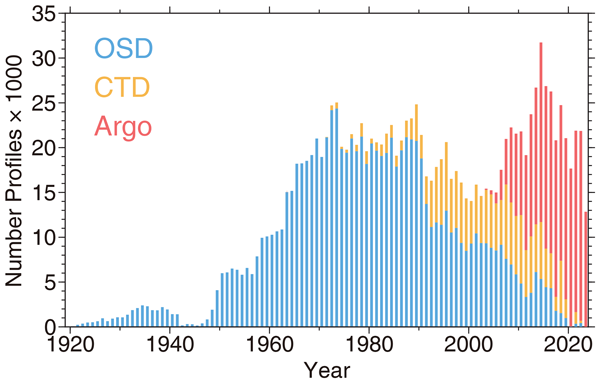
This study depicts a three-step quality control procedure applied to the Nansen cast temperature profiles (1873–2025, especially before 1970), including automatic/manual quality control and temperature anomaly quality control. Corrections for depth bias are also suggested with improved vertical interpolation procedure. Based on this dataset we access for the first time the change of the ocean heat content of the upper 2000 m layer over a 100 year time period between 1870s and 2020s.
Viktor Gouretski, Lijing Cheng, Juan Du, Xiaogang Xing, Fei Chai, and Zhetao Tan
Earth Syst. Sci. Data, 16, 5503–5530, https://doi.org/10.5194/essd-16-5503-2024, https://doi.org/10.5194/essd-16-5503-2024, 2024
Short summary
Short summary
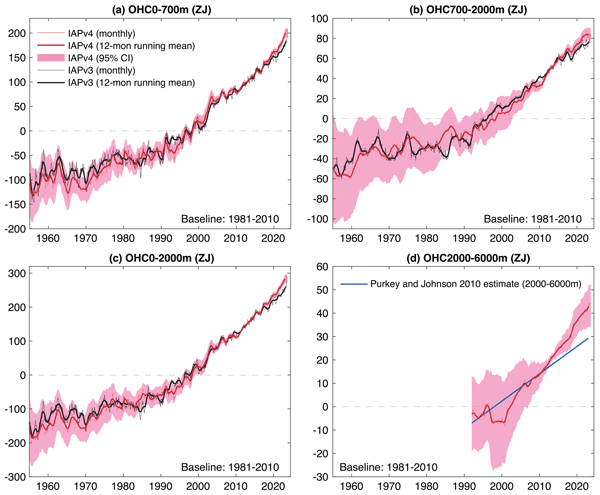
High-quality observations are crucial to understanding ocean oxygen changes and their impact on marine biota. We developed a quality control procedure to ensure the high quality of the heterogeneous ocean oxygen data archive and to prove data consistency. Oxygen data obtained by means of oxygen sensors on autonomous Argo floats were compared with reference data based on the chemical analysis, and estimates of the residual offsets were obtained.
Lijing Cheng, Yuying Pan, Zhetao Tan, Huayi Zheng, Yujing Zhu, Wangxu Wei, Juan Du, Huifeng Yuan, Guancheng Li, Hanlin Ye, Viktor Gouretski, Yuanlong Li, Kevin E. Trenberth, John Abraham, Yuchun Jin, Franco Reseghetti, Xiaopei Lin, Bin Zhang, Gengxin Chen, Michael E. Mann, and Jiang Zhu
Earth Syst. Sci. Data, 16, 3517–3546, https://doi.org/10.5194/essd-16-3517-2024, https://doi.org/10.5194/essd-16-3517-2024, 2024
Short summary
Short summary
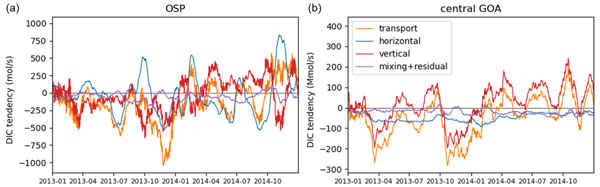
Observational gridded products are essential for understanding the ocean, the atmosphere, and climate change; they support policy decisions and socioeconomic developments. This study provides an update of an ocean subsurface temperature and ocean heat content gridded product, named the IAPv4 data product, which is available for the upper 6000 m (119 levels) since 1940 (more reliable after ~1955) for monthly and 1° × 1° temporal and spatial resolutions.
Aoran Sun, Chunling Zhang, Huangxin Yang, and Yuntao Zhou
EGUsphere, https://doi.org/10.5194/egusphere-2026-4384, https://doi.org/10.5194/egusphere-2026-4384, 2026
Short summary
Short summary
Temperature and chlorophyll-a fronts in the northwestern Pacific are modulated by ocean eddies. Analysis of daily satellite data from 2014 to 2023 shows that eddy polarity and strength control frontal coupling intensity, while chlorophyll-a fronts respond several days later than temperature fronts. This time lag indicates that biological responses to eddy forcing are inherently slower than physical adjustments.
Chaim I. Garfinkel, David Avisar, Wenjuan Huo, Ales Kuchar, Shoshiro Minobe, Scott Osprey, Katharina Perny, and Jonathon S. Wright
EGUsphere, https://doi.org/10.5194/egusphere-2026-3738, https://doi.org/10.5194/egusphere-2026-3738, 2026
Short summary
Short summary
Whether tropical volcanic eruptions lead to a circulation response in winter is still unclear. We re-evaluate this effect using large ensembles from eight separate models with only one time-varying external forcing: volcanic aerosols. We find that 75 % of models simulate the previously proposed effect, but that the signal requires at least 30 eruptions before it emerges robustly from the noise. Furthermore, we demonstrate that the El Niño signal differs from natural El Niño events.

Zhaokun Wang, Bin Lu, Yi Xin, Takamitsu Ito, Lei Zhou, Lijing Cheng, Yuanlong Li, Xinbing Wang, and Meng Jin
Earth Syst. Sci. Data, 18, 5069–5092, https://doi.org/10.5194/essd-18-5069-2026, https://doi.org/10.5194/essd-18-5069-2026, 2026
Short summary
Short summary
We present Jingwei-Nutrients, a global monthly data product of ocean nitrate, phosphate, and silicate from 1965 to 2023 down to 2000 meters. Built using a multi-task deep learning framework, it combines sparse historical observations with hydrographic information. This continuous record helps scientists understand marine ecosystems and climate change responses. We also provide the Jingwei web platform (https://jingwei.acemap.info) for dynamic data exploration and visualization without coding.
Viktor Gouretski, Lijing Cheng, and Juan Du
Earth Syst. Sci. Data Discuss., https://doi.org/10.5194/essd-2026-416, https://doi.org/10.5194/essd-2026-416, 2026
Revised manuscript under review for ESSD
Short summary
Short summary
This study depicts a three-step quality control procedure applied to the Nansen cast temperature profiles (1873–2025, especially before 1970), including automatic/manual quality control and temperature anomaly quality control. Corrections for depth bias are also suggested with improved vertical interpolation procedure. Based on this dataset we access for the first time the change of the ocean heat content of the upper 2000 m layer over a 100 year time period between 1870s and 2020s.
Yumi Abe, Takamitsu Ito, Amanda H. V. Timmerman, Christopher T. Reinhard, and Joseph P. Montoya
Biogeosciences, 23, 3871–3885, https://doi.org/10.5194/bg-23-3871-2026, https://doi.org/10.5194/bg-23-3871-2026, 2026
Short summary
Short summary
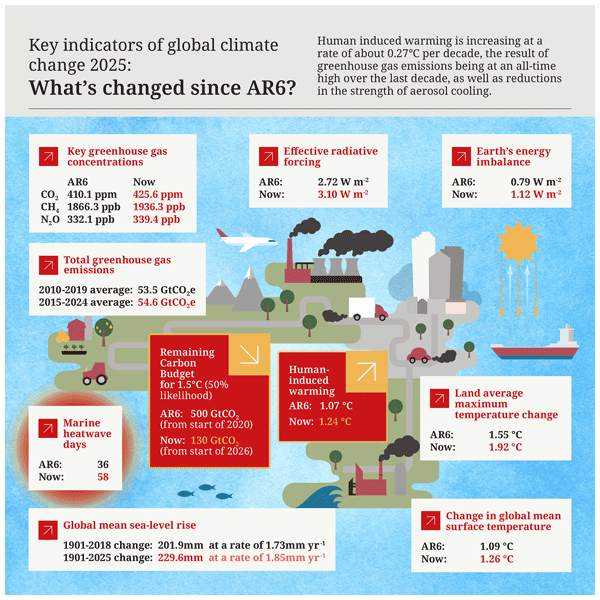
Marine heatwaves are defined by periods of unusually high sea temperature. Although warmer seawater usually reduces the ocean’s ability to absorb carbon dioxide, observations in the Gulf of Alaska showed a surprising drop in carbon dioxide during the 2014–2015 “Blob” heatwave. Using an ocean biogeochemical model, we found that this decline resulted from reduced dissolved inorganic carbon caused by weakened physical supply in winter 2013, just before the Blob began.
Piers M. Forster, Tristram Walsh, Chris Smith, William F. Lamb, Robin Lamboll, Christophe Cassou, Mathias Hauser, Zeke Hausfather, June-Yi Lee, Matthew D. Palmer, Karina von Schuckmann, Aimée B. A. Slangen, Sophie Szopa, Blair Trewin, Jeongeun Yun, Nathan P. Gillett, Stuart Jenkins, H. Damon Matthews, Krishnan Raghavan, Aurélien Ribes, Joeri Rogelj, Debbie Rosen, Xuebin Zhang, Myles Allen, Robbie M. Andrew, Chris Atkinson, Richard A. Betts, Antonio Bombelli, Samantha N. Burgess, Lijing Cheng, Helen E. Claxton, Pierre Friedlingstein, Thomas L. Frölicher, Catia M. Domingues, Thomas Gasser, Catherine H. Gregory, Rachel M. Hoesly, Daniel Huppmann, Masayoshi Ishii, Christopher Kadow, Alexia Karwat, John Kennedy, Rachel E. Killick, Mahesh V. M. Kovilakam, Paul B. Krummel, Xin Lan, Jean-François Lamarque, Aurélien Liné, Belén Martín-Míguez, Didier P. Monselesan, Colin Morice, Jens Mühle, Pino Mussak, Glen P. Peters, Anna Pirani, Julia Pongratz, Matthew Rigby, Robert Rohde, Abhishek Savita, Sonia I. Seneviratne, Steven J. Smith, Ghassan Taha, Caterina Tassone, Peter Thorne, Christopher Wells, Luke M. Western, Guido R. van der Werf, Susan E. Wijffels, Marco Zecchetto, Junting Zhong, Xiao-Ye Zhang, Valérie Masson-Delmotte, and Panmao Zhai
Earth Syst. Sci. Data, 18, 3889–3933, https://doi.org/10.5194/essd-18-3889-2026, https://doi.org/10.5194/essd-18-3889-2026, 2026
Short summary
Short summary
We give our annual update of key climate indicators. Our work quantifies the human contribution to global warming and the pace of climate change. This represents a large effort by the international community akin to an Intergovernmental Panel on Climate Change (IPCC) report.
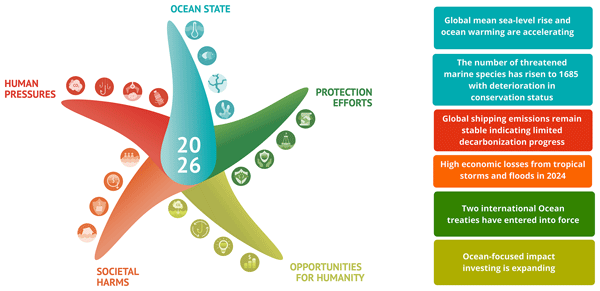
Marina Lévy, Karina von Schuckmann, Mahé Butel, William W. L. Cheung, Joachim Claudet, Thomas L. Frölicher, Patrice Guillotreau, Peter Haugan, Janine Adams, Diva Amon, Tamatoa Bambridge, Cynthia Barzuna, Bruno Blanke, Lijing Cheng, Sanae Chiba, Jorge Cortés, Pierre Friedlingstein, Jean-Pierre Gattuso, Stefan Gelcich, Jessica Gephart, Deborah Greaves, Audrey Hasson, Claire Jolly, Daoji Li, Yunne-Jai Shin, Aimée Slangen, Mere Takoko, Olivier Thébaud, Adrien Vincent, and Patrick Vincent
State Planet, 7-osr10, 1, https://doi.org/10.5194/sp-7-osr10-1-2026, https://doi.org/10.5194/sp-7-osr10-1-2026, 2026
Short summary
Short summary
The Starfish Barometer provides an annual, science-based synthesis of global Ocean-related developments, structured around five interconnected dimensions: the Ocean state, human pressures, societal harms, protection efforts, and opportunities for humanity. It is released each year on World Ocean Day. This article presents the second edition of the Barometer, which shows a growing gap between increasing human pressures on the Ocean and the efforts being made to protect it and drive change.
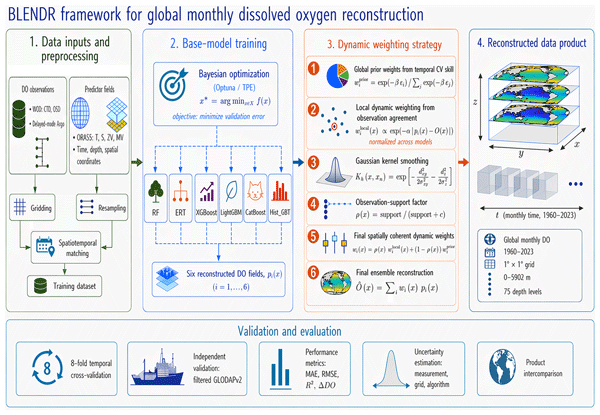
Mingyu Han, Xiaogang Xing, and Yuntao Zhou
Earth Syst. Sci. Data, 18, 3757–3777, https://doi.org/10.5194/essd-18-3757-2026, https://doi.org/10.5194/essd-18-3757-2026, 2026
Short summary
Short summary
We combined ship and float measurements with machine learning to reconstruct monthly dissolved oxygen in the global ocean from 1960 to 2023, from the surface to 5902 m. The results reveal a persistent loss of oxygen, strongest below the surface and in major low-oxygen zones, with recent acceleration in several ocean regions. This open dataset supports climate research and assessments of risks for marine ecosystems.
Seth M. Bushinsky, Zachary Nachod, Mathilde Jutras, Daniela König, Shannon McClish, and Charles Addey
Earth Syst. Sci. Data Discuss., https://doi.org/10.5194/essd-2026-311, https://doi.org/10.5194/essd-2026-311, 2026
Revised manuscript under review for ESSD
Short summary
Short summary
In this work we describe the creation of a secondary quality-controlled dataset for profiling float data. We focus on oxygen, nitrate, and pH measurements, using a mix of automated and manual detection methods to identify data points and profiles that are likely to be bad data. This work grew out of our individual recognition that spurious data exist in these widely used data and the need to remove these data before many types of oceanographic analyses can take place.
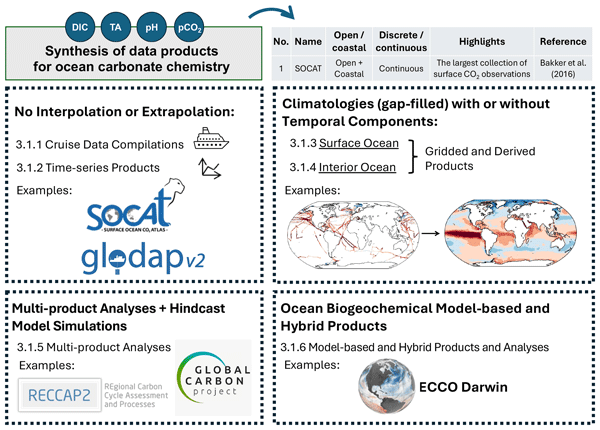
Li-Qing Jiang, Amanda Fay, Jens Daniel Müller, Luke Gregor, Alizée Roobaert, Lydia Keppler, Dustin Carroll, Siv K. Lauvset, Tim DeVries, Judith Hauck, Christian Rödenbeck, Nicolas Metzl, Andrea J. Fassbender, Jean-Pierre Gattuso, Peter Landschützer, Rik Wanninkhof, Christopher Sabine, Simone R. Alin, Mario Hoppema, Are Olsen, Matthew P. Humphreys, Kunal Chakraborty, Ana C. Franco, Kumiko Azetsu-Scott, Dorothee C. E. Bakker, Leticia Barbero, Nicholas R. Bates, Nicole Besemer, Henry C. Bittig, Albert E. Boyd, Daniel Broullón, Wei-Jun Cai, Brendan R. Carter, Thi-Tuyet-Trang Chau, Chen-Tung Arthur Chen, Frédéric Cyr, John E. Dore, Ian Enochs, Richard A. Feely, Hernan E. Garcia, Marion Gehlen, Prasanna Kanti Ghoshal, Lucas Gloege, Melchor González-Dávila, Nicolas Gruber, Debby Ianson, Yosuke Iida, Masao Ishii, Apurva Padamnabh Joshi, Esther Kennedy, Alex Kozyr, Nico Lange, Claire Lo Monaco, Derek P. Manzello, Galen A. McKinley, Natalie M. Monacci, Xose A. Padin, Ana M. Palacio-Castro, Fiz F. Pérez, J. Magdalena Santana-Casiano, Jonathan Sharp, Adrienne Sutton, Jim Swift, Toste Tanhua, Maciej Telszewski, Jens Terhaar, Ruben van Hooidonk, Anton Velo, Andrew J. Watson, Angelicque E. White, Zelun Wu, Liang Xue, Hyelim Yoo, Jiye Zeng, and Guorong Zhong
Earth Syst. Sci. Data, 18, 1405–1462, https://doi.org/10.5194/essd-18-1405-2026, https://doi.org/10.5194/essd-18-1405-2026, 2026
Short summary
Short summary
This review article provides an overview of 68 existing ocean carbonate chemistry data products and data product sets, encompassing a broad range of types, including compilations of cruise datasets, gap-filled observational products, model simulations, and more. It is designed to help researchers identify and access the data products that best support their scientific objectives, thereby facilitating progress in understanding the ocean's changing carbonate chemistry.
Yuming Jin, Britton B. Stephens, Eric J. Morgan, Manfredi Manizza, and Jonathan Sharp
Earth Syst. Sci. Data Discuss., https://doi.org/10.5194/essd-2025-738, https://doi.org/10.5194/essd-2025-738, 2025
Revised manuscript under review for ESSD
Short summary
Short summary
We produce monthly air-sea O2 flux estimates (2004–2024) on a 1°×1° grid using machine learning-based dissolved oxygen fields (GOBAI-O2, Sharp et al., 2023). Fluxes are calculated with multiple gas exchange schemes and wind products, then constrained to match independent regional to global annual mean fluxes estimates. We evaluate flux seasonal cycles and annual patterns against atmospheric O2 observations and quantify flux uncertainties from multiple sources.
Ben A. Cala, Mariette Wolthers, Olivier Sulpis, Jonathan D. Sharp, and Matthew P. Humphreys
EGUsphere, https://doi.org/10.5194/egusphere-2025-5059, https://doi.org/10.5194/egusphere-2025-5059, 2025
Preprint archived
Short summary
Short summary
Magnesium calcites are minerals produced by some marine organisms. Understanding how these minerals dissolve helps us to predict how the ocean stores carbon. We developed a new method to calculate the solubility of these minerals in seawater, using existing laboratory data and taking into account the effects of temperature, salinity and pressure. Applying this method globally, we found that magnesium calcites dissolve deeper than previously thought.
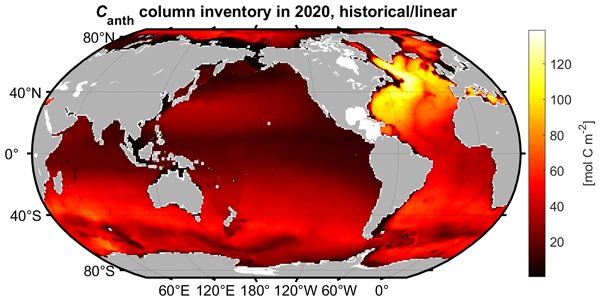
Brendan R. Carter, Jörg Schwinger, Rolf Sonnerup, Andrea J. Fassbender, Jonathan D. Sharp, Larissa M. Dias, and Daniel E. Sandborn
Earth Syst. Sci. Data, 17, 3073–3088, https://doi.org/10.5194/essd-17-3073-2025, https://doi.org/10.5194/essd-17-3073-2025, 2025
Short summary
Short summary
We infer ocean gas exchange and circulation from ocean tracer measurements and use this to create code to estimate the amount of carbon dioxide dissolved in the ocean that is there due to human emissions of CO2 into the atmosphere. The code works across the ocean depths for the past, present, or future from information about the location, temperature, and salinity of the seawater. We produce a data product with estimates throughout the ocean throughout the last ~300 and the next ~500 years.
Piers M. Forster, Chris Smith, Tristram Walsh, William F. Lamb, Robin Lamboll, Christophe Cassou, Mathias Hauser, Zeke Hausfather, June-Yi Lee, Matthew D. Palmer, Karina von Schuckmann, Aimée B. A. Slangen, Sophie Szopa, Blair Trewin, Jeongeun Yun, Nathan P. Gillett, Stuart Jenkins, H. Damon Matthews, Krishnan Raghavan, Aurélien Ribes, Joeri Rogelj, Debbie Rosen, Xuebin Zhang, Myles Allen, Lara Aleluia Reis, Robbie M. Andrew, Richard A. Betts, Alex Borger, Jiddu A. Broersma, Samantha N. Burgess, Lijing Cheng, Pierre Friedlingstein, Catia M. Domingues, Marco Gambarini, Thomas Gasser, Johannes Gütschow, Masayoshi Ishii, Christopher Kadow, John Kennedy, Rachel E. Killick, Paul B. Krummel, Aurélien Liné, Didier P. Monselesan, Colin Morice, Jens Mühle, Vaishali Naik, Glen P. Peters, Anna Pirani, Julia Pongratz, Jan C. Minx, Matthew Rigby, Robert Rohde, Abhishek Savita, Sonia I. Seneviratne, Peter Thorne, Christopher Wells, Luke M. Western, Guido R. van der Werf, Susan E. Wijffels, Valérie Masson-Delmotte, and Panmao Zhai
Earth Syst. Sci. Data, 17, 2641–2680, https://doi.org/10.5194/essd-17-2641-2025, https://doi.org/10.5194/essd-17-2641-2025, 2025
Short summary
Short summary
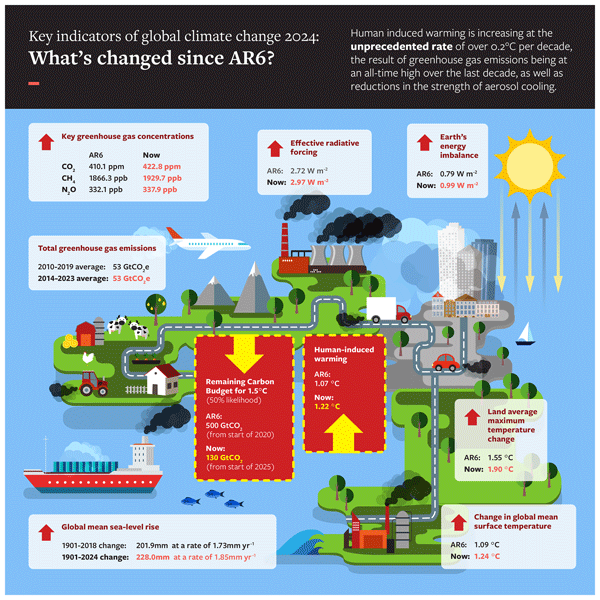
In a rapidly changing climate, evidence-based decision-making benefits from up-to-date and timely information. Here we compile monitoring datasets to track real-world changes over time. To make our work relevant to policymakers, we follow methods from the Intergovernmental Panel on Climate Change (IPCC). Human activities are increasing the Earth's energy imbalance and driving faster sea-level rise compared to the IPCC assessment.
Mingyu Han and Yuntao Zhou
Earth Syst. Sci. Data Discuss., https://doi.org/10.5194/essd-2025-273, https://doi.org/10.5194/essd-2025-273, 2025
Manuscript not accepted for further review
Short summary
Short summary
In recent decades, ocean oxygen levels have fallen steadily, threatening marine life and ecosystem health. To fill gaps in sparse observations, we used an advanced ensemble of six machine learning models to reconstruct monthly oxygen maps from the surface down to 5902 m, covering 1960–2023. Our dataset reveals where and how fast oxygen loss is occurring, especially in deeper waters, and provides a reliable resource for studying climate impacts on oceans and guiding conservation efforts.
Guorong Zhong, Xuegang Li, Jinming Song, Baoxiao Qu, Fan Wang, Yanjun Wang, Bin Zhang, Lijing Cheng, Jun Ma, Huamao Yuan, Liqin Duan, Ning Li, Qidong Wang, Jianwei Xing, and Jiajia Dai
Earth Syst. Sci. Data, 17, 719–740, https://doi.org/10.5194/essd-17-719-2025, https://doi.org/10.5194/essd-17-719-2025, 2025
Short summary
Short summary
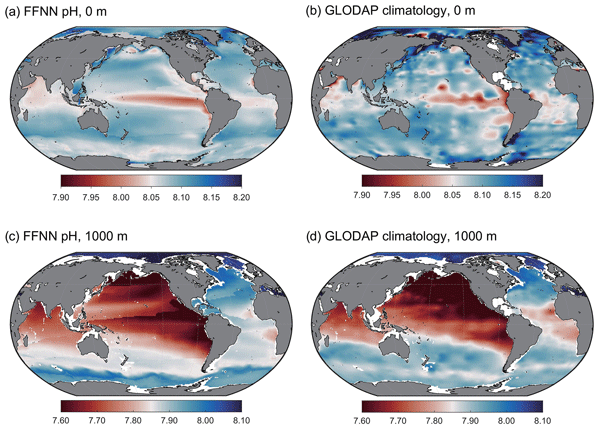
The continuous uptake of atmospheric CO2 by the ocean leads to decreasing seawater pH, which is an ongoing threat to the marine ecosystem. This pH change has been globally documented in the surface ocean, but information is limited below the surface. Here, we present a monthly 1° gridded product of global seawater pH based on a machine learning method and real pH observations. The pH product covers the years from 1992 to 2020 and depths from 0 to 2000 m.
Simona Simoncelli, Franco Reseghetti, Claudia Fratianni, Lijing Cheng, and Giancarlo Raiteri
Earth Syst. Sci. Data, 16, 5531–5561, https://doi.org/10.5194/essd-16-5531-2024, https://doi.org/10.5194/essd-16-5531-2024, 2024
Short summary
Short summary
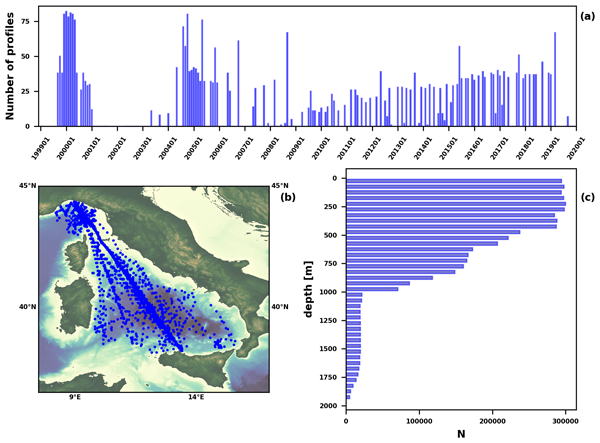
This data review is about the reprocessing of historical eXpendable BathyThermograp (XBT) profiles from the Ligurian and Tyrrhenian seas over the time period 1999–2019. A new automated quality control analysis has been performed starting from the original raw data and operational log sheets. The data have been formatted and standardized according to the latest community best practices, and all available metadata have been inserted, including calibration information and uncertainty specification.
Viktor Gouretski, Lijing Cheng, Juan Du, Xiaogang Xing, Fei Chai, and Zhetao Tan
Earth Syst. Sci. Data, 16, 5503–5530, https://doi.org/10.5194/essd-16-5503-2024, https://doi.org/10.5194/essd-16-5503-2024, 2024
Short summary
Short summary
High-quality observations are crucial to understanding ocean oxygen changes and their impact on marine biota. We developed a quality control procedure to ensure the high quality of the heterogeneous ocean oxygen data archive and to prove data consistency. Oxygen data obtained by means of oxygen sensors on autonomous Argo floats were compared with reference data based on the chemical analysis, and estimates of the residual offsets were obtained.
Christopher J. Roach, Joao Marcos A. C. de Souza, Erik Behrens, and Stephen J. Stuart
EGUsphere, https://doi.org/10.5194/egusphere-2024-1962, https://doi.org/10.5194/egusphere-2024-1962, 2024
Preprint archived
Short summary
Short summary
We have used a 5 km regional ocean model for New Zealand forced with a coarser resolution global model to project changes in under medium and high emissions scenarios. This is necessary since the global model is unable to resolve the small scale processes on the continental shelf which determine climate change may influence fisheries and aquaculture. We see the upper ocean warms at similar rates all around New Zealand, but that the deep ocean shows more rapid warming in the west and south.
Karina von Schuckmann, Lorena Moreira, Mathilde Cancet, Flora Gues, Emmanuelle Autret, Jonathan Baker, Clément Bricaud, Romain Bourdalle-Badie, Lluis Castrillo, Lijing Cheng, Frederic Chevallier, Daniele Ciani, Alvaro de Pascual-Collar, Vincenzo De Toma, Marie Drevillon, Claudia Fanelli, Gilles Garric, Marion Gehlen, Rianne Giesen, Kevin Hodges, Doroteaciro Iovino, Simon Jandt-Scheelke, Eric Jansen, Melanie Juza, Ioanna Karagali, Thomas Lavergne, Simona Masina, Ronan McAdam, Audrey Minière, Helen Morrison, Tabea Rebekka Panteleit, Andrea Pisano, Marie-Isabelle Pujol, Ad Stoffelen, Sulian Thual, Simon Van Gennip, Pierre Veillard, Chunxue Yang, and Hao Zuo
State Planet, 4-osr8, 1, https://doi.org/10.5194/sp-4-osr8-1-2024, https://doi.org/10.5194/sp-4-osr8-1-2024, 2024
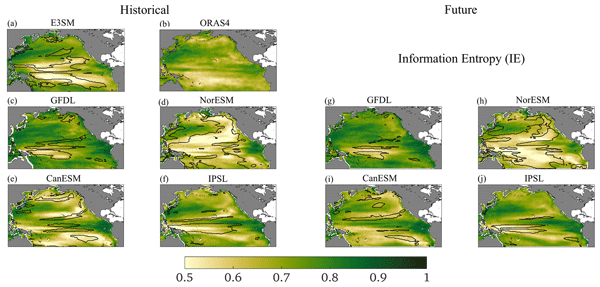
Lyuba Novi, Annalisa Bracco, Takamitsu Ito, and Yohei Takano
Biogeosciences, 21, 3985–4005, https://doi.org/10.5194/bg-21-3985-2024, https://doi.org/10.5194/bg-21-3985-2024, 2024
Short summary
Short summary
We explored the relationship between oxygen and stratification in the North Pacific Ocean using a combination of data mining and machine learning. We used isopycnic potential vorticity (IPV) as an indicator to quantify ocean ventilation and analyzed its predictability, a strong O2–IPV connection, and predictability for IPV in the tropical Pacific. This opens new routes for monitoring ocean O2 through few observational sites co-located with more abundant IPV measurements in the tropical Pacific.
Lijing Cheng, Yuying Pan, Zhetao Tan, Huayi Zheng, Yujing Zhu, Wangxu Wei, Juan Du, Huifeng Yuan, Guancheng Li, Hanlin Ye, Viktor Gouretski, Yuanlong Li, Kevin E. Trenberth, John Abraham, Yuchun Jin, Franco Reseghetti, Xiaopei Lin, Bin Zhang, Gengxin Chen, Michael E. Mann, and Jiang Zhu
Earth Syst. Sci. Data, 16, 3517–3546, https://doi.org/10.5194/essd-16-3517-2024, https://doi.org/10.5194/essd-16-3517-2024, 2024
Short summary
Short summary
Observational gridded products are essential for understanding the ocean, the atmosphere, and climate change; they support policy decisions and socioeconomic developments. This study provides an update of an ocean subsurface temperature and ocean heat content gridded product, named the IAPv4 data product, which is available for the upper 6000 m (119 levels) since 1940 (more reliable after ~1955) for monthly and 1° × 1° temporal and spatial resolutions.
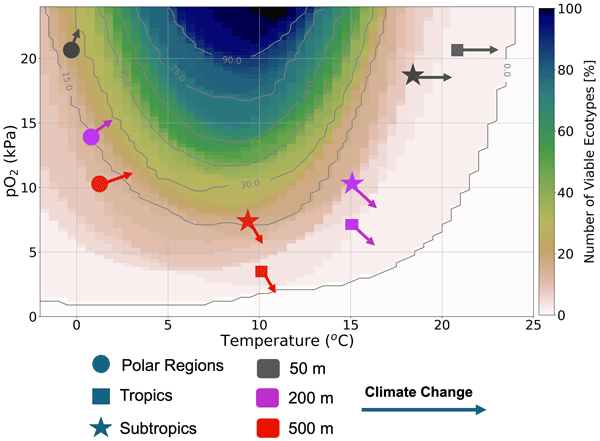
Precious Mongwe, Matthew Long, Takamitsu Ito, Curtis Deutsch, and Yeray Santana-Falcón
Biogeosciences, 21, 3477–3490, https://doi.org/10.5194/bg-21-3477-2024, https://doi.org/10.5194/bg-21-3477-2024, 2024
Short summary
Short summary
We use a collection of measurements that capture the physiological sensitivity of organisms to temperature and oxygen and a CESM1 large ensemble to investigate how natural climate variations and climate warming will impact the ability of marine heterotrophic marine organisms to support habitats in the future. We find that warming and dissolved oxygen loss over the next several decades will reduce the volume of ocean habitats and will increase organisms' vulnerability to extremes.
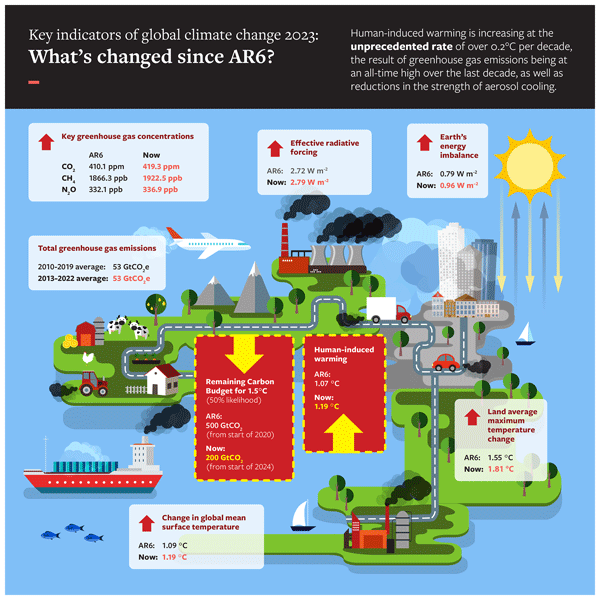
Piers M. Forster, Chris Smith, Tristram Walsh, William F. Lamb, Robin Lamboll, Bradley Hall, Mathias Hauser, Aurélien Ribes, Debbie Rosen, Nathan P. Gillett, Matthew D. Palmer, Joeri Rogelj, Karina von Schuckmann, Blair Trewin, Myles Allen, Robbie Andrew, Richard A. Betts, Alex Borger, Tim Boyer, Jiddu A. Broersma, Carlo Buontempo, Samantha Burgess, Chiara Cagnazzo, Lijing Cheng, Pierre Friedlingstein, Andrew Gettelman, Johannes Gütschow, Masayoshi Ishii, Stuart Jenkins, Xin Lan, Colin Morice, Jens Mühle, Christopher Kadow, John Kennedy, Rachel E. Killick, Paul B. Krummel, Jan C. Minx, Gunnar Myhre, Vaishali Naik, Glen P. Peters, Anna Pirani, Julia Pongratz, Carl-Friedrich Schleussner, Sonia I. Seneviratne, Sophie Szopa, Peter Thorne, Mahesh V. M. Kovilakam, Elisa Majamäki, Jukka-Pekka Jalkanen, Margreet van Marle, Rachel M. Hoesly, Robert Rohde, Dominik Schumacher, Guido van der Werf, Russell Vose, Kirsten Zickfeld, Xuebin Zhang, Valérie Masson-Delmotte, and Panmao Zhai
Earth Syst. Sci. Data, 16, 2625–2658, https://doi.org/10.5194/essd-16-2625-2024, https://doi.org/10.5194/essd-16-2625-2024, 2024
Short summary
Short summary
This paper tracks some key indicators of global warming through time, from 1850 through to the end of 2023. It is designed to give an authoritative estimate of global warming to date and its causes. We find that in 2023, global warming reached 1.3 °C and is increasing at over 0.2 °C per decade. This is caused by all-time-high greenhouse gas emissions.
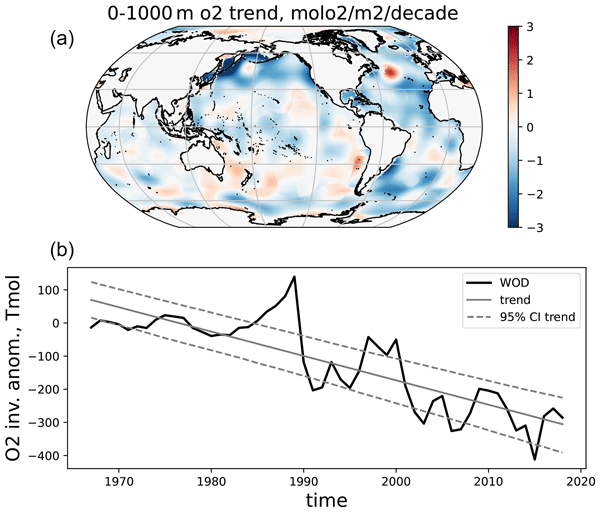
Takamitsu Ito, Hernan E. Garcia, Zhankun Wang, Shoshiro Minobe, Matthew C. Long, Just Cebrian, James Reagan, Tim Boyer, Christopher Paver, Courtney Bouchard, Yohei Takano, Seth Bushinsky, Ahron Cervania, and Curtis A. Deutsch
Biogeosciences, 21, 747–759, https://doi.org/10.5194/bg-21-747-2024, https://doi.org/10.5194/bg-21-747-2024, 2024
Short summary
Short summary
This study aims to estimate how much oceanic oxygen has been lost and its uncertainties. One major source of uncertainty comes from the statistical gap-filling methods. Outputs from Earth system models are used to generate synthetic observations where oxygen data are extracted from the model output at the location and time of historical oceanographic cruises. Reconstructed oxygen trend is approximately two-thirds of the true trend.
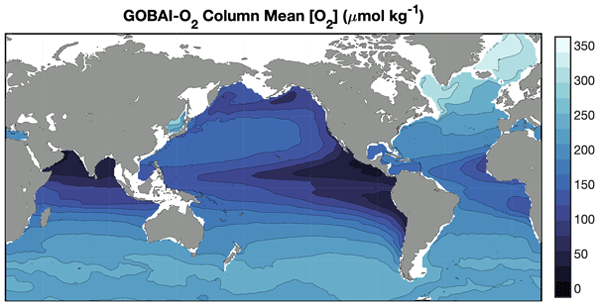
Jonathan D. Sharp, Andrea J. Fassbender, Brendan R. Carter, Gregory C. Johnson, Cristina Schultz, and John P. Dunne
Earth Syst. Sci. Data, 15, 4481–4518, https://doi.org/10.5194/essd-15-4481-2023, https://doi.org/10.5194/essd-15-4481-2023, 2023
Short summary
Short summary
Dissolved oxygen content is a critical metric of ocean health. Recently, expanding fleets of autonomous platforms that measure oxygen in the ocean have produced a wealth of new data. We leverage machine learning to take advantage of this growing global dataset, producing a gridded data product of ocean interior dissolved oxygen at monthly resolution over nearly 2 decades. This work provides novel information for investigations of spatial, seasonal, and interannual variability in ocean oxygen.
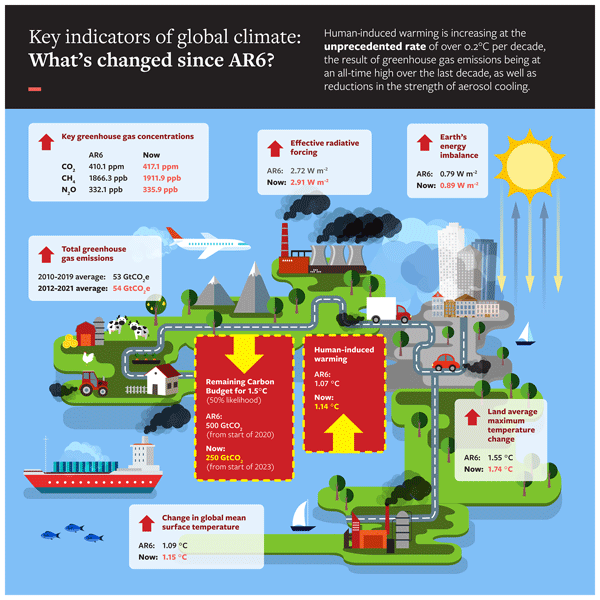
Piers M. Forster, Christopher J. Smith, Tristram Walsh, William F. Lamb, Robin Lamboll, Mathias Hauser, Aurélien Ribes, Debbie Rosen, Nathan Gillett, Matthew D. Palmer, Joeri Rogelj, Karina von Schuckmann, Sonia I. Seneviratne, Blair Trewin, Xuebin Zhang, Myles Allen, Robbie Andrew, Arlene Birt, Alex Borger, Tim Boyer, Jiddu A. Broersma, Lijing Cheng, Frank Dentener, Pierre Friedlingstein, José M. Gutiérrez, Johannes Gütschow, Bradley Hall, Masayoshi Ishii, Stuart Jenkins, Xin Lan, June-Yi Lee, Colin Morice, Christopher Kadow, John Kennedy, Rachel Killick, Jan C. Minx, Vaishali Naik, Glen P. Peters, Anna Pirani, Julia Pongratz, Carl-Friedrich Schleussner, Sophie Szopa, Peter Thorne, Robert Rohde, Maisa Rojas Corradi, Dominik Schumacher, Russell Vose, Kirsten Zickfeld, Valérie Masson-Delmotte, and Panmao Zhai
Earth Syst. Sci. Data, 15, 2295–2327, https://doi.org/10.5194/essd-15-2295-2023, https://doi.org/10.5194/essd-15-2295-2023, 2023
Short summary
Short summary
This is a critical decade for climate action, but there is no annual tracking of the level of human-induced warming. We build on the Intergovernmental Panel on Climate Change assessment reports that are authoritative but published infrequently to create a set of key global climate indicators that can be tracked through time. Our hope is that this becomes an important annual publication that policymakers, media, scientists and the public can refer to.
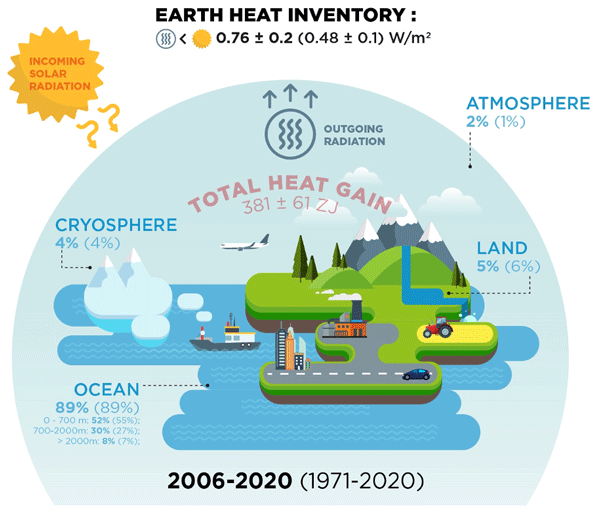
Karina von Schuckmann, Audrey Minière, Flora Gues, Francisco José Cuesta-Valero, Gottfried Kirchengast, Susheel Adusumilli, Fiammetta Straneo, Michaël Ablain, Richard P. Allan, Paul M. Barker, Hugo Beltrami, Alejandro Blazquez, Tim Boyer, Lijing Cheng, John Church, Damien Desbruyeres, Han Dolman, Catia M. Domingues, Almudena García-García, Donata Giglio, John E. Gilson, Maximilian Gorfer, Leopold Haimberger, Maria Z. Hakuba, Stefan Hendricks, Shigeki Hosoda, Gregory C. Johnson, Rachel Killick, Brian King, Nicolas Kolodziejczyk, Anton Korosov, Gerhard Krinner, Mikael Kuusela, Felix W. Landerer, Moritz Langer, Thomas Lavergne, Isobel Lawrence, Yuehua Li, John Lyman, Florence Marti, Ben Marzeion, Michael Mayer, Andrew H. MacDougall, Trevor McDougall, Didier Paolo Monselesan, Jan Nitzbon, Inès Otosaka, Jian Peng, Sarah Purkey, Dean Roemmich, Kanako Sato, Katsunari Sato, Abhishek Savita, Axel Schweiger, Andrew Shepherd, Sonia I. Seneviratne, Leon Simons, Donald A. Slater, Thomas Slater, Andrea K. Steiner, Toshio Suga, Tanguy Szekely, Wim Thiery, Mary-Louise Timmermans, Inne Vanderkelen, Susan E. Wjiffels, Tonghua Wu, and Michael Zemp
Earth Syst. Sci. Data, 15, 1675–1709, https://doi.org/10.5194/essd-15-1675-2023, https://doi.org/10.5194/essd-15-1675-2023, 2023
Short summary
Short summary
Earth's climate is out of energy balance, and this study quantifies how much heat has consequently accumulated over the past decades (ocean: 89 %, land: 6 %, cryosphere: 4 %, atmosphere: 1 %). Since 1971, this accumulated heat reached record values at an increasing pace. The Earth heat inventory provides a comprehensive view on the status and expectation of global warming, and we call for an implementation of this global climate indicator into the Paris Agreement’s Global Stocktake.
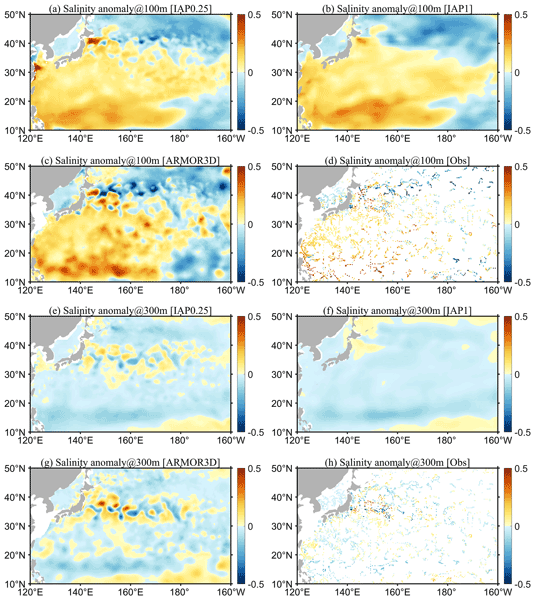
Tian Tian, Lijing Cheng, Gongjie Wang, John Abraham, Wangxu Wei, Shihe Ren, Jiang Zhu, Junqiang Song, and Hongze Leng
Earth Syst. Sci. Data, 14, 5037–5060, https://doi.org/10.5194/essd-14-5037-2022, https://doi.org/10.5194/essd-14-5037-2022, 2022
Short summary
Short summary
A high-resolution gridded dataset is crucial for understanding ocean processes at various spatiotemporal scales. Here we used a machine learning approach and successfully reconstructed a high-resolution (0.25° × 0.25°) ocean subsurface (1–2000 m) salinity dataset for the period 1993–2018 (monthly) by merging in situ salinity profile observations with high-resolution satellite remote-sensing data. This new product could be useful in various applications in ocean and climate fields.
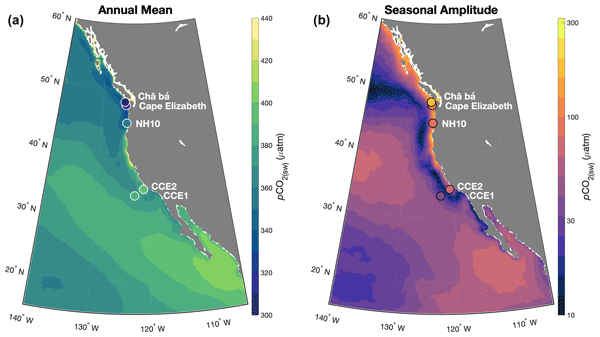
Jonathan D. Sharp, Andrea J. Fassbender, Brendan R. Carter, Paige D. Lavin, and Adrienne J. Sutton
Earth Syst. Sci. Data, 14, 2081–2108, https://doi.org/10.5194/essd-14-2081-2022, https://doi.org/10.5194/essd-14-2081-2022, 2022
Short summary
Short summary
Oceanographers calculate the exchange of carbon between the ocean and atmosphere by comparing partial pressures of carbon dioxide (pCO2). Because seawater pCO2 is not measured everywhere at all times, interpolation schemes are required to fill observational gaps. We describe a monthly gap-filled dataset of pCO2 in the northeast Pacific Ocean off the west coast of North America created by machine-learning interpolation. This dataset is unique in its robust representation of coastal seasonality.
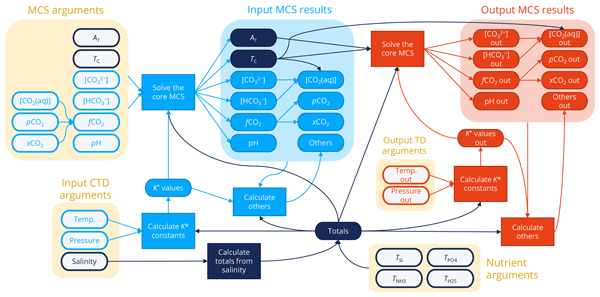
Matthew P. Humphreys, Ernie R. Lewis, Jonathan D. Sharp, and Denis Pierrot
Geosci. Model Dev., 15, 15–43, https://doi.org/10.5194/gmd-15-15-2022, https://doi.org/10.5194/gmd-15-15-2022, 2022
Short summary
Short summary
The ocean helps to mitigate our impact on Earth's climate by absorbing about a quarter of the carbon dioxide (CO2) released by human activities each year. However, once absorbed, chemical reactions between CO2 and water reduce seawater pH (
ocean acidification), which may have adverse effects on marine ecosystems. Our Python package, PyCO2SYS, models the chemical reactions of CO2 in seawater, allowing us to quantify the corresponding changes in pH and related chemical properties.
Cited articles
Bindoff, N. L., Cheung, W. W. L., Kairo, J. G., Arístegui, J., Guinder, V. A., Hallberg, R., Hilmi, N., Jiao, N., Karim, M. S., Levin, L., O'Donoghue, S., Purca Cuicapusa, S. R., Rinkevich, B., Suga, T., Tagliabue, A., and Williamson, P.: Changing Ocean, marine ecosystems, and dependent communities, In: IPCC Special Report on the Ocean and Cryosphere in a Changing Climate, Cambridge University Press, Cambridge, UK and New York, NY, USA, 447–587, https://doi.org/10.1017/9781009157964.007, 2019.
Boyer, T. P., Baranova, O. K., Coleman, C., Garcia, H. E., Grodsky, A., Locarnini, R. A., Mishonov, A. V., Paver, C. R., Reagan, J. R., Seidov, D., Smolyar, I. V., Weathers, K., and Zweng, M. M.: World Ocean Database 2018, Mishonov, A. V., Technical Editor, NOAA Atlas NESDIS 87, https://www.ncei.noaa.gov/sites/default/files/2020-04/wod_intro_0.pdf (last access: 8 May 2026), 2018.
Breitburg, D., Levin, L. A., Oschlies, A., Grégoire, M., Chavez, F. P., Conley, D. J., Garçon, V., Gilbert, D., Gutiérrez, D., Isensee, K., Jacinto, G. S., Limburg, K. E., Montes, I., Naqvi, S. W. A., Pitcher, G. C., Rabalais, N. N., Roman, M. R., Rose, K. A., Seibel, B. A., Telszewski, M., Yasuhara, M., and Zhang, J.: Declining oxygen in the global ocean and coastal waters, Science, 359, eaam7240, https://doi.org/10.1126/science.aam7240, 2018.
Cheng, L. and Zhu, J.: Benefits of CMIP5 Multimodel Ensemble in Reconstructing Historical Ocean Subsurface Temperature Variations, J. Climate, 29, 5393–5416, https://doi.org/10.1175/JCLI-D-15-0730.1, 2016.
Cheng, L., Trenberth, K. E., Fasullo, J., Boyer, T., Abraham, J., and Zhu, J.: Improved estimates of ocean heat content from 1960 to 2015, Sci. Adv., 3, e1601545, https://doi.org/10.1126/sciadv.1601545, 2017.
Cheng, L., Pan, Y., Tan, Z., Zheng, H., Zhu, Y., Wei, W., Du, J., Yuan, H., Li, G., Ye, H., Gouretski, V., Li, Y., Trenberth, K. E., Abraham, J., Jin, Y., Reseghetti, F., Lin, X., Zhang, B., Chen, G., Mann, M. E., and Zhu, J.: IAPv4 ocean temperature and ocean heat content gridded dataset, Earth Syst. Sci. Data, 16, 3517–3546, https://doi.org/10.5194/essd-16-3517-2024, 2024.
Deutsch, C., Brix, H., Ito, T., Frenzel, H., and Thompson, L.: Climate-forced variability of ocean hypoxia, Science, 333, 336–339, https://doi.org/10.1126/science.1202422, 2011.
Garcia, H. E. and Gordon, L. I.: Oxygen solubility in seawater: Better fitting equations, Limnol. Oceanogr., 37, 1307–1312, https://doi.org/10.4319/lo.1992.37.6.1307, 1992.
Garcia, H. E., Boyer, T. P., Levitus, S., Locarnini, R. A., and Antonov, J.: On the variability of dissolved oxygen and apparent oxygen utilization content for the upper world ocean: 1955 to 1998, Geophys. Res. Lett., 32, L09604, https://doi.org/10.1029/2004GL022286, 2005a.
Garcia, H. E., Boyer, T. P., Levitus, S., Locarnini, R. A., and Antonov, J.: Climatological annual cycle of upper ocean oxygen content anomaly, Geophys. Res. Lett., 32, L05611, https://doi.org/10.1029/2004GL021745, 2005b.
Garcia, H. E., Weathers, K., Paver, C. R., Smolyar, I., Boyer, T. P., Locarnini, R. A., Zweng, M. M., Mishonov, A. V., Baranova, O. K., Seidov, D., and Reagan, J. R.: World Ocean Atlas 2018, Volume 3: Dissolved Oxygen, Apparent Oxygen Utilization, and Oxygen Saturation, edited by: Mishonov, A., NOAA Atlas NESDIS 83, https://www.ncei.noaa.gov/sites/default/files/2020-04/woa18_vol3.pdf, 2018.
Garcia, H. E., Wang, Z., Bouchard, C., Cross, S. L., Paver, C. R., Reagan, J. R., Boyer, T. P., Locarnini, R. A., Mishonov, A. V., Baranova, O. K., Seidov, D., and Dukhovskoy, D.: World Ocean Atlas 2023, Volume 3: Dissolved Oxygen, Apparent Oxygen Utilization, Dissolved Oxygen Saturation, and 30-year Climate Normal, A. Mishonov Technical Editor, NOAA Atlas NESDIS 91, 100 pp., https://doi.org/10.25923/rb67-ns53, 2024.
Garcia-Soto, C., Cheng, L., Caesar, L., Schmidtko, S., Jewett, E. B., Cheripka, A., Rigor, I., Caballero, A., Chiba, S., Báez, J. C., Zielinski, T., and Abraham, J. P.: An Overview of Ocean Climate Change Indicators: Sea Surface Temperature, Ocean Heat Content, Ocean pH, Dissolved Oxygen Concentration, Arctic Sea Ice Extent, Thickness and Volume, Sea Level and Strength of the AMOC (Atlantic Meridional Overturning Circulation), Front. Mar. Sci., 8, 642372, https://doi.org/10.3389/fmars.2021.642372, 2021.
GODIP-DO Group: Global Dissolved Oxygen Gridded Climatological Datasets, Zenodo [data set], https://doi.org/10.5281/zenodo.16664650, 2025.
Gouretski, V., Cheng, L., Du, J., Xing, X., and Chai, F.: A quality-controlled and bias-adjusted global ocean oxygen profile dataset, Marine Science Data Center of the Chinese Academy of Sciences [data set], https://doi.org/10.12157/IOCAS.20231208.001, 2024a.
Gouretski, V., Cheng, L., Du, J., Xing, X., Chai, F., and Tan, Z.: A consistent ocean oxygen profile dataset with new quality control and bias assessment, Earth Syst. Sci. Data, 16, 5503–5530, https://doi.org/10.5194/essd-16-5503-2024, 2024b.
Grégoire, M., Garçon, V., Garcia, H., Breitburg, D., Isensee, K., Oschlies, A., Telszewski, M., Barth, A., Bittig, H. C., Carstensen, J., Carval, T., Chai, F., Chavez, F., Conley, D., Coppola, L., Crowe, S., Currie, K., Dai, M., Deflandre, B., Dewitte, B., Diaz, R., Garcia-Robledo, E., Gilbert, D., Giorgetti, A., Glud, R., Gutierrez, D., Hosoda, S., Ishii, M., Jacinto, G., Langdon, C., Lauvset, S. K., Levin, L. A., Limburg, K. E., Mehrtens, H., Montes, I., Naqvi, W., Paulmier, A., Pfeil, B., Pitcher, G., Pouliquen, S., Rabalais, N., Rabouille, C., Recape, V., Roman, M., Rose, K., Rudnick, D., Rummer, J., Schmechtig, C., Schmidtko, S., Seibel, B., Slomp, C., Sumalia, U. R., Tanhua, T., Thierry, V., Uchida, H., Wanninkhof, R., and Yasuhara, M.: A Global Ocean Oxygen Database and Atlas for Assessing and Predicting Deoxygenation and Ocean Health in the Open and Coastal Ocean, Front. Mar. Sci., 8, 1–29, https://doi.org/10.3389/fmars.2021.724913, 2021.
Gulev, S. K., Thorne, P. W., Ahn, J., Dentener, F. J., Domingues, C. M., Gerland, S., Gong, D., Kaufman, D. S., Nnamchi, H. C., Quaas, J., Rivera, J. A., Sathyendranath, S. L., Smith, S. L., Trewin, B., von Schuckmann, K., and Vose, R. S.: Changing State of the Climate System, in: Climate Change 2021: The Physical Science Basis. Contribution of Working Group I to the Sixth Assessment Report of the Intergovernmental Panel on Climate Change, edited by: Masson-Delmotte, V., Zhai, P., Pirani, A., Connors, S. L., Péan, C., Berger, S., Caud, N., Chen, Y., Goldfarb, L., Gomis, M. I., Huang, M., Leitzell, K., Lonnoy, E., Matthews, J. B. R., Maycock, T. K., Waterfield, T., Yelekçi, O., Yu, R., and Zhou, B., Cambridge University Press, Cambridge, United Kingdom and New York, NY, USA, 287–422, https://doi.org/10.1017/9781009157896.004, 2021.
Huang, S., Shao, J., Chen, Y., Qi, J., Wu, S., Zhang, F., He, X., and Du, Z.: Reconstruction of dissolved oxygen in the Indian Ocean from 1980 to 2019 based on machine learning techniques, Front. Mar. Sci., 10, 1291232, https://doi.org/10.3389/fmars.2023.1291232, 2023.
IOC, SCOR, and IAPSO: The International thermodynamic equation of seawater-2010: Calculation and use of thermodynamic properties, Intergovernmental Oceanographic Commission, Manuals and Guides No. 56, UNESCO, https://www.teos-10.org/pubs/TEOS-10_Manual.pdf (last access: 8 May 2026), 2010.
Ito, T., Minobe, S., Long, M. C., and Deutsch, C.: Upper ocean O2 trends: 1958–2015, Geophys. Res. Lett., 44, 4214–4223, https://doi.org/10.1002/2017GL073613, 2017.
Ito, T., Cervania, A., Cross, K., Ainchwar, S., and Delawalla, S.: Mapping dissolved oxygen concentrations by combining shipboard and Argo observations using machine learning algorithms, J. Geophys. Res.-Mach. Learn. Comput., 1, e2024JH000272, https://doi.org/10.1029/2024JH000272, 2024.
Ito, T., Garcia, H. E., Wang, Z., Cheng, L., Du, J., Roach, C. J., Sharp, J. D., Minobe, S., Zhou, Y., Lu, B., Navarra, G. G., and Bushinsky, S. M.: Assessing the observational uncertainties of dissolved oxygen climatology and seasonal cycle through a coordinated intercomparison project, Global Biogeochem. Cy., 39, e2025GB008751, https://doi.org/10.1029/2025GB008751, 2025.
Keeling, R. F., Körtzinger, A., and Gruber, N.: Ocean Deoxygenation in a Warming world, Annu. Rev. Mar. Sci., 2, 199–229, https://doi.org/10.1146/annurev.marine.010908.163855, 2010.
Koelling, J., Atamanchuk, D., Karstensen, J., Handmann, P., and Wallace, D. W. R.: Oxygen export to the deep ocean following Labrador Sea Water formation, Biogeosciences, 19, 437–454, https://doi.org/10.5194/bg-19-437-2022, 2022.
Kwiecinski, J. V. and Babbin, A. R.: A high-resolution atlas of the eastern tropical Pacific oxygen deficient zones, Global Biogeochem. Cy., 35, e2021GB007001, https://doi.org/10.1029/2021GB007001, 2021.
Lauvset, S. K., Key, R. M., Olsen, A., van Heuven, S., Velo, A., Lin, X., Schirnick, C., Kozyr, A., Tanhua, T., Hoppema, M., Jutterström, S., Steinfeldt, R., Jeansson, E., Ishii, M., Perez, F. F., Suzuki, T., and Watelet, S.: A new global interior ocean mapped climatology: the 1° × 1° GLODAP version 2, Earth Syst. Sci. Data, 8, 325–340, https://doi.org/10.5194/essd-8-325-2016, 2016.
Levin, L. A.: Manifestation, drivers, and emergence of open ocean deoxygenation, Annu. Rev. Mar. Sci., 10, 229–260, https://doi.org/10.1146/annurev-marine-121916-063359, 2018.
Liu, Q. H., Bao, S. L., Yan, H. Q., Wang, H. Z., and Zhang, R.: Enhancing sea surface salinity short-term prediction using physically informed deep learning, Appl. Ocean Res., 165, 104832, https://doi.org/10.1016/j.apor.2025.104832, 2025.
Lu, B., Zhao, Z., Han, L. Y., Gan, X. Y., Zhou, Y. T., Zhou, L., Fu, L. Y., Wang, X. B., Zhou, C. H., and Zhang, J.: OxyGenerator: Reconstructing global ocean deoxygenation over a century with deep learning, Proceedings of the 41st International Conference on Machine Learning, PMLR 235, 33219–33242, https://proceedings.mlr.press/v235/lu24n.html (last access: 8 May 2026), 2024.
Martin, A. P.: The seasonal smorgasbord of the seas, Science, 337, 46-47, https://doi.org/10.1126/science.1223881, 2012.
McDougall, T. J. and Barker, P. M.: Getting started with TEOS-10 and the Gibbs Seawater (GSW) oceanographic toolbox, SCOR/IAPSO WG127, 1–28, ISBN 9780646-55621-5, 2011.
Mishonov, A. V., Boyer, T. P., Baranova, O. K., Bouchard, C., Cross, S. L., Garcia, H. E., Locarnini, R. A., Paver, C. R., Reagan, J. R., Wang, Z., Seidov, D., Grodsky, A. I., and Beauchamp, J. G.: World Ocean Database 2023, edited by: Bouchard, C., NOAA Atlas NESDIS 97, https://doi.org/10.25923/z885-h264, 2024.
Musan, I., Gildor, H., Barkan, E., Smethie Jr., W. M., and Luz, B.: Evidence from dissolved O2 isotopes in North Atlantic Deep Water for a recent climatic shift, Geophys. Res. Lett., 50, e2022GL100489, https://doi.org/10.1029/2022GL100489, 2023.
Oschlies, A., Duteil, O., Getzlaff, J., Koeve, W., Landolfi, A., and Schmidtko, S.: Patterns of deoxygenation: sensitivity to natural and anthropogenic drivers, Philos. T. R. Soc. A, 375, 20160325, https://doi.org/10.1098/rsta.2016.0325, 2017.
Oschlies, A., Brandt, P., Stramma, L., and Schmidtko, S.: Drivers and mechanisms of ocean deoxygenation, Nat. Geosci., 11, 467–473, https://doi.org/10.1038/s41561-018-0152-2, 2018.
Roach, C. J. and Bindoff, N. L.: Developing a New Oxygen Atlas of the World's Oceans Using Data Interpolating Variational Analysis, J. Atmos. Ocean. Tech., 40, 1475–1491, https://doi.org/10.1175/JTECH-D-23-0007.1, 2023.
Ruhl, H. A., Huffard, C. L., Messié, M., Connolly, T. P., Soltwedel, T., Wenzhöfer, F., Johnson, R. J., Bates, N. R., Hartman, S., Flohr, A., Mawji, E. W., Karl, D. M., Potemra, J., Santiago-Mandujano, F., Ross, T., and Smith, K. L.: Decadal change in deep-ocean dissolved oxygen in the North Atlantic Ocean and North Pacific Ocean, Deep-Sea Res. Pt. I, 223, 104534, https://doi.org/10.1016/j.dsr.2025.104534, 2025.
Schmidtko, S., Stramma, L., and Visbeck, M.: Decline in global oceanic oxygen content during the past five decades, Nature, 542, 335–339, https://doi.org/10.1038/nature21399, 2017.
Sharp, J. D., Fassbender, A. J., Carter, B. R., Johnson, G. C., Schultz, C., and Dunne, J. P.: GOBAI-O2: temporally and spatially resolved fields of ocean interior dissolved oxygen over nearly 2 decades, Earth Syst. Sci. Data, 15, 4481–4518, https://doi.org/10.5194/essd-15-4481-2023, 2023.
Stramma, L. and Schmidtko, S.: Spatial and temporal variability of oceanic oxygen changes and underlying trends, Atmos.-Ocean, 59, 122–132, https://doi.org/10.1080/07055900.2021.1905601, 2021.
Stramma, L., Johnson, G. C., Sprintall, J., and Mohrholz, V.: Expanding oxygen-minimum zones in the tropical oceans, Science, 320, 655–658, https://doi.org/10.1126/science.1153847, 2008.
Stramma, L., Schmidtko, S., Levin, L. A., and Johnson, G. C.: Ocean oxygen minima expansions and their biological impacts, Deep-Sea Res. Pt. I, https://doi.org/10.1016/j.dsr.2010.01.005, 2010.
Tan, Z., von Schuckmann, K., Speich, S., Bopp, L., Zhu, J., and Cheng, L.: Observed large-scale and deep-reaching compound ocean state changes over the past 60 years, Nat. Clim. Change, 16, 58–68, https://doi.org/10.1038/s41558-025-02484-x, 2026.
Wang, Z., Garcia, H. E., Boyer, T. P., Reagan, J., and Cebrian, J.: Controlling factors of the climatological annual cycle of the surface mixed layer oxygen content: A global view, Front. Mar. Sci., 9, 1001095, https://doi.org/10.3389/fmars.2022.1001095, 2022.
Zhou, Y., Gong, H., and Zhou, F.: Responses of horizontally expanding oceanic oxygen minimum zones to climate change based on observations, Geophys. Res. Lett., 49, e2022GL097724, https://doi.org/10.1029/2022GL097724, 2022.
Short summary
This study assesses the spread of mean state and annual cycle of ocean dissolved oxygen by multiple observational gridded data products. A good consistency is validated globally, although substantial local differences exist in areas of strong spatial gradient. Quantifying the discrepancies could give an insight into regions relatively more sensitive to data reconstruction processes and further advance the improvement of oxygen data products.
This study assesses the spread of mean state and annual cycle of ocean dissolved oxygen by...


