
Articles | Volume 21, issue 6
https://doi.org/10.5194/os-21-3427-2025
© Author(s) 2025. This work is distributed under
the Creative Commons Attribution 4.0 License.
the Creative Commons Attribution 4.0 License.
Special issue:
https://doi.org/10.5194/os-21-3427-2025
© Author(s) 2025. This work is distributed under
the Creative Commons Attribution 4.0 License.
the Creative Commons Attribution 4.0 License.
Review article
| Highlight paper
| 
11 Dec 2025
Review article | Highlight paper |
| 11 Dec 2025
| 11 Dec 2025
Silicification in the ocean: from molecular pathways to silicifiers' ecology and biogeochemical cycles
Ivia Closset
Finnish Meteorological Institute, Dynamicum Erik Palménin aukio 1, Helsinki, Finland
Marine Science Institute, University of California Santa Barbara, Santa Barbara, CA, USA
J. Jotautas Baronas
Department of Earth Sciences, Durham University, Durham, UK
Fiorenza Torricella
Department of Mathematics, Informatics and Geosciences, MIGe, University of Trieste, Trieste, Italy
Instituto of Polar Sciences, ISP-CNR, Bologna, Italy
Félix de Tombeur
CEFE, Univ Montpellier, CNRS, EPHE, IRD, Montpellier, France
School of Biological Sciences and Institute of Agriculture, The University of Western Australia, Perth, WA, Australia
Bianca T. P. Liguori
GEOMAR, Helmholtz Centre for Ocean Research, Kiel, Germany
Alessandra Petrucciani
Dipartimento di scienze della vita e dell'ambiente, Università Politecnica delle Marche, Ancona, Italy
CIRCC, Consorzio Interuniversitario Reattività Chimica e Catalisi, Italy
Natasha Bryan
Alfred Wegener Institute Helmholtz Centre for polar and marine research, Bremerhaven, Germany
María López-Acosta
CORRESPONDING AUTHOR

Instituto de Investigaciones Marinas (IIM), CSIC, Vigo, Spain
Yelena Churakova
Centre for Ecology and Evolution in Microbial Model Systems (EEMiS), Linnaeus University, Kalmar, Sweden
Antonia U. Thielecke
CORRESPONDING AUTHOR
Alfred Wegener Institute Helmholtz Centre for polar and marine research, Bremerhaven, Germany
Zhouling Zhang
GEOMAR, Helmholtz Centre for Ocean Research, Kiel, Germany
Natalia Llopis Monferrer
Sorbonne University, CNRS, UMR7144 Adaptation and Diversity in Marine Environment (AD2M) Laboratory, Ecology of Marine Plankton team, Station Biologique de Roscoff, Roscoff, France
Monterey Bay Aquarium Research Institute, Moss Landing, CA, USA
Rebecca A. Pickering
Department of Geological Sciences, Stockholm University, Stockholm, Sweden
Mathis Guyomard
LOCEAN-IPSL, Sorbonne Université (SU, CNRS, IRD, MNHN), Paris, France
Dongdong Zhu
Key Laboratory of Marine Chemistry Theory and Technology, Ministry of Education, Ocean University of China, Qingdao, China
Related authors
No articles found.
Marcos Fontela, María Froján, Belén Arbones, María Jesús Álvarez-Fernández, Caio César-Ribeiro, Marylo Doval, José Luís Garrido, Sara Groppelli, María López-Acosta, María López-Rodríguez, Celeste L. Hinojo, Blanca Marigómez, Laura Moreno, Fiz F. Pérez, Isabel Gomes Teixeira, Antón Velo, and Xosé Antonio Padin
EGUsphere, https://doi.org/10.5194/egusphere-2026-5658, https://doi.org/10.5194/egusphere-2026-5658, 2026
This preprint is open for discussion and under review for Biogeosciences (BG).
Short summary
Short summary
Increasing seawater alkalinity is being explored as a way to remove carbon dioxide from the atmosphere, but effects on marine plankton are unclear. We exposed a coastal plankton community from northwest Iberian Upwelling System to this treatment. The responses were driven by nutrient exhaustion, not by the shift in water chemistry. Most plankton, and their ecosystem services, were unchanged; only the smallest size were affected. This approach may be ecologically safe at low nutrients.

Asta C. Heidemann, Alexander Hayward, Philipp Assmy, Atreya Basu, Astrid Bracher, Giulia Castellani, Giacomo Ditullio, Katarzyna Dragańska-Deja, Amane Fujiwara, Glaucia Moreira Fragoso, Jacob Høyer, Jiwoon Hwang, Morten Iversen, Anabel von Jackowski, Thomas Juul-Pedersen, Piotr Kowalczuk, Youngju Lee, Maria A. van Leeuwe, Atsushi Matsuoka, Alenya Merz, Christopher John Mundy, Else Ostermann, Ilka Peeken, Matt Pinkerton, Joanna Stoń-Egiert, Jacqueline Stefels, Antonia U. Thielecke, Gaëlle Veyssiere, Hongyan Xi, Eun Jin Yang, and Rafael Gonçalves-Araujo
Earth Syst. Sci. Data, 18, 5505–5529, https://doi.org/10.5194/essd-18-5505-2026, https://doi.org/10.5194/essd-18-5505-2026, 2026
Short summary
Short summary
Algal pigments are widely used to quantify algal biomass and composition. These organisms form the basis of marine food webs and are vital for the wider ecosystem. Here, we present a pan-Arctic dataset of algal pigments, containing 10 798 measurements collected between 2000 and 2024. This publicly available dataset represents an international collaborative effort and provides an important resource for assessing environmental change and advancing future Arctic ecological and modelling studies.
Antonia U. Thielecke, Clara J. M. Hoppe, Jeffrey W. Krause, Sarah Lena Eggers, Uwe John, Dave Clarke, Martin Whitehouse, Heejin Jeon, Nicolè Caputo, Francesca Cucchi, Amanda Curtin, and Mar Fernández-Méndez
EGUsphere, https://doi.org/10.5194/egusphere-2026-3186, https://doi.org/10.5194/egusphere-2026-3186, 2026
Short summary
Short summary
Climate change is reshaping Arctic phytoplankton blooms. Using mesocosms, we tracked competition between Phaeocystis and the diatom Chaetoceros under varying silicic acid availability. Silicic acid directly determines the magnitude of the diatom bloom, but species competition is shaped by diverging responses to nutrient scarcity, grazing and viral pressure. Warming is thus likely to restructure Arctic blooms, with consequences for food webs and carbon export.
Hannah Krüger, Gerhard Schmiedl, Zvi Steiner, Zhouling Zhang, Eric P. Achterberg, and Nicolaas Glock
J. Micropalaeontol., 44, 193–211, https://doi.org/10.5194/jm-44-193-2025, https://doi.org/10.5194/jm-44-193-2025, 2025
Short summary
Short summary
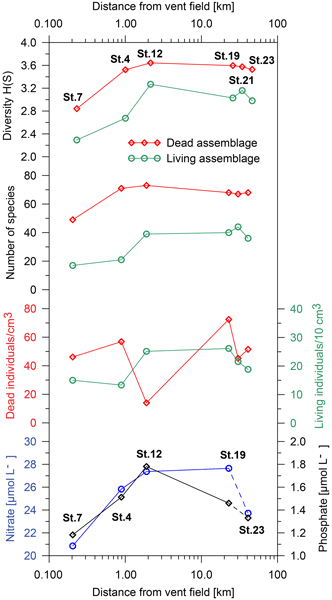
The biodiversity and abundance of benthic foraminifera tend to increase with distance within a transect from the Rainbow hydrothermal vent field. Miliolids dominate closer to the vents and may be better adapted to the potentially hydrothermal conditions than hyaline and agglutinated species. The reason for this remains unclear, but there are indications that elevated trace-metal concentrations in the porewater and intrusion of acidic hydrothermal fluids could have an influence on the foraminifera.
Giulia Lodi, Julia Cooke, Rebecca A. Pickering, Lucie Cassarino, Mike Murray-Hudson, Keotshephile Mosimane, and Daniel J. Conley
EGUsphere, https://doi.org/10.5194/egusphere-2024-225, https://doi.org/10.5194/egusphere-2024-225, 2024
Preprint archived
Short summary
Short summary
Papyrus, Cyperus papyrus, is abundant in the Okavango Delta. We explored nutrient and Silicon (Si) isotopes distribution in papyrus to learn more about how this species affects nutrient cycles which are still moderately understood in Botswana. We found large amounts of Si in roots, rhizomes, stems and umbels. We showed that this plant takes up lighter Si isotopes and deposits lighter isotopes first, starting in the roots, leading to an enrichment in heavy isotopes along the transpiration stream.
Cited articles
Abelmann, A., Gersonde, R., Knorr, G., Zhang, X., Chapligin, B., Maier, E., Esper, O., Friedrichsen, H., Lohmann, G., Meyer, H., and Tiedemann, R.: The seasonal sea-ice zone in the glacial Southern Ocean as a carbon sink, Nat. Commun., 6, 8136, https://doi.org/10.1038/ncomms9136, 2015.
Abramson, J., Adler, J., Dunger, J., Evans, R., Green, T., Pritzel, A., Ronneberger, O., Willmore, L., Ballard, A. J., Bambrick, J., Bodenstein, S. W., Evans, D. A., Hung, C.-C., O'Neill, M., Reiman, D., Tunyasuvunakool, K., Wu, Z., Žemgulytė, A., Arvaniti, E., Beattie, C., Bertolli, O., Bridgland, A., Cherepanov, A., Congreve, M., Cowen-Rivers, A. I., Cowie, A., Figurnov, M., Fuchs, F. B., Gladman, H., Jain, R., Khan, Y. A., Low, C. M. R., Perlin, K., Potapenko, A., Savy, P., Singh, S., Stecula, A., Thillaisundaram, A., Tong, C., Yakneen, S., Zhong, E. D., Zielinski, M., Žídek, A., Bapst, V., Kohli, P., Jaderberg, M., Hassabis, D., and Jumper, J. M.: Accurate structure prediction of biomolecular interactions with AlphaFold 3, Nature, 630, 493–500, https://doi.org/10.1038/s41586-024-07487-w, 2024.
Ács, É., Földi, A., Vad, C. F., Trábert, Z., Kiss, K. T., Duleba, M., Borics, G., Grigorszky, I., and Botta-Dukát, Z.: Trait-based community assembly of epiphytic diatoms in saline astatic ponds: a test of the stress-dominance hypothesis, Sci. Rep., 9, 15749, https://doi.org/10.1038/s41598-019-52304-4, 2019.
Adl, S.: Rhizoa, Protistol, Elsevier, ISBN 97803239529961, 2024.
Aguilera, A., Lundin, D., Charalampous, E., Churakova, Y., Tellgren-Roth, C., Śliwińska-Wilczewska, S., Conley, D. J., Farnelid, H., and Pinhassi, J.: The evaluation of biogenic silica in brackish and freshwater strains reveals links between phylogeny and silica accumulation in picocyanobacteria, Appl. Environ. Microbiol., 91, https://doi.org/10.1128/aem.02527-24, 2025.
Alexandre, A., Meunier, J.-D., Colin, F., and Koud, J.-M.: Plant impact on the biogeochemical cycle of silicon and related weathering processes, Geochim. Cosmochim. Acta, 61, 677–682, https://doi.org/10.1016/s0016-7037(97)00001-x, 1997.
Alfredsson, H., Hugelius, G., Clymans, W., Stadmark, J., Kuhry, P., and Conley, D. J.: Amorphous silica pools in permafrost soils of the Central Canadian Arctic and the potential impact of climate change, Biogeochemistry, 124, 441–459, https://doi.org/10.1007/s10533-015-0108-1, 2015.
Aller, R. C. and Wehrmann, L. M.: Sedimentary diagenesis, depositional environments, and benthic fluxes, in: Treatise on Geochemistry, vol. 4, edited by: Anbar, A. and Weis, D., Elsevier, 573–629, https://doi.org/10.1016/b978-0-323-99762-1.00095-4, 2025.
Alley, K., Patacca, K., Pike, J., Dunbar, R., and Leventer, A.: Iceberg Alley, East Antarctic Margin: Continuously laminated diatomaceous sediments from the late Holocene, Mar. Micropaleontol., 140, 56–68, https://doi.org/10.1016/j.marmicro.2017.12.002, 2018.
Anderson, O. R.: Protozoa, Radiolarians, in: Encyclopedia of Ocean Sciences, edited by: Steele, J. H., Thorpe, S. A., and Turekian, K. K., Academic Press, Oxford, 2315–2320, https://doi.org/10.1006/rwos.2001.0193, 2001.
Aparicio, M., Le Bihan, A., Jeandel, C., Fabre, S., Almar, R., and Mingo, I. M.: Contribution of sandy beaches to the global marine silicon cycle, Nat. Geosci., 18, 154–159, https://doi.org/10.1038/s41561-024-01628-6, 2025.
Armbrust, E. V.: The life of diatoms in the world's oceans, Nature, 459, 185–192, https://doi.org/10.1038/nature08057, 2009.
Arrigo, K. R.: Sea ice as a habitat for primary producers, in: Sea Ice, edited by: Thomas, D. N., Wiley, 352–369, https://doi.org/10.1002/9781118778371.ch14, 2017.
Assmy, P., Henjes, J., Smetacek, V., and Montresor, M.: Auxospore formation by the silica-sinking, oceanic diatom Fragilariopsis kerguelensis (Bacillariophyceae), J. Phycol., 42, 1002–1006, https://doi.org/10.1111/j.1529-8817.2006.00260.x, 2006.
Azam, F., Fenchel, T., Field, J. G., Gray, J. S., Meyer-Reil, L. A., and Thingstad, F.: The Ecological Role of Water-Column Microbes in the Sea, Mar. Ecol. Prog. Ser., 10, 257–263, https://doi.org/10.3354/meps010257, 1983.
Baines, S. B., Twining, B. S., Brzezinski, M. A., Krause, J. W., Vogt, S., Assael, D., and McDaniel, H.: Significant silicon accumulation by marine picocyanobacteria, Nat. Geosci., 5, 886–891, https://doi.org/10.1038/ngeo1641, 2012.
Bárcena, M. A., Cacho, I., Abrantes, F., Sierro, F. J., Grimalt, J. O., and Flores, J. A.: Paleoproductivity variations related to climatic conditions in the Alboran Sea (western Mediterranean) during the last glacial–interglacial transition: the diatom record, Palaeogeogr. Palaeoclimatol. Palaeoecol., 167, 337–357, https://doi.org/10.1016/S0031-0182(00)00246-7, 2001.
Baronas, J. J., Hammond, D. E., Berelson, W. M., McManus, J., and Severmann, S.: Germanium–silicon fractionation in a river-influenced continental margin: The Northern Gulf of Mexico, Geochim. Cosmochim. Acta, 178, 124–142, https://doi.org/10.1016/j.gca.2016.01.028, 2016.
Baronas, J. J., Torres, M. A., West, A. J., Rouxel, O., Georg, B., Bouchez, J., Gaillardet, J., and Hammond, D. E.: Ge and Si isotope signatures in rivers: A quantitative multi-proxy approach, Earth Planet. Sci. Lett., 503, 194–215, https://doi.org/10.1016/j.epsl.2018.09.022, 2018.
Baronas, J. J., Hammond, D. E., Rouxel, O. J., and Monteverde, D. R.: A First Look at Dissolved Ge Isotopes in Marine Sediments, Front. Earth Sci., 7, https://doi.org/10.3389/feart.2019.00162, 2019.
Baronas, J. J., West, A. J., Burton, K. W., Hammond, D. E., Opfergelt, S., Pogge Von Strandmann, P. A. E., James, R. H., and Rouxel, O. J.: Ge and Si Isotope Behavior During Intense Tropical Weathering and Ecosystem Cycling, Glob. Biogeochem. Cycles, 34, https://doi.org/10.1029/2019gb006522, 2020.
Baronas, J. J., Hammond, D. E., Bennett, M. M., Rouxel, O., Pitcher, L. H., and Smith, L. C.: Ge/Si and Ge Isotope Fractionation During Glacial and Non-glacial Weathering: Field and Experimental Data From West Greenland, Front. Earth Sci., 9, https://doi.org/10.3389/feart.2021.551900, 2021.
Barrio-Hernandez, I., Yeo, J., Jänes, J., Mirdita, M., Gilchrist, C. L. M., Wein, T., Varadi, M., Velankar, S., Beltrao, P., and Steinegger, M.: Clustering predicted structures at the scale of the known protein universe, Nature, 622, 637–645, https://doi.org/10.1038/s41586-023-06510-w, 2023.
Barron, J. A., Bukry, D. B., and Gersonde, R.: Diatom and silicoflagellate biostratigraphy for the late Eocene: ODP 1090 (sub-Antarctic Atlantic), in: Diatom research over time and space Morphology, taxonomy, ecology and distribution of diatoms – from fossil to recent, marine to freshwater, established species and genera to new ones, edited by: Kociolek, J., Kulikovskiy, M., Witkowski, J., and Harwood, D., Nova Hedwigia, Stuttgart, 1–32, ISBN-13 978-3-443-51065-7, 2014.
Battershill, C. and Bergquist, P.: The influence of storms on asexual reproduction, recruitment, and survivorship of sponges., in: New perspectives in sponge biology, edited by: Rutzler, K., Smithsonian Institution Press, Washington, DC, 397–403, ISBN 0874747848, 9780874747843, 1990.
Beazley, L. I., Kenchington, E. L., Murillo, F. J., and Sacau, M. D. M.: Deep-sea sponge grounds enhance diversity and abundance of epibenthic megafauna in the Northwest Atlantic, ICES J. Mar. Sci., 70, 1471–1490, https://doi.org/10.1093/icesjms/fst124, 2013.
Behrenfeld, M. J., Halsey, K. H., Boss, E., Karp-Boss, L., Milligan, A. J., and Peers, G.: Thoughts on the evolution and ecological niche of diatoms, Ecol. Monogr., 91, https://doi.org/10.1002/ecm.1457, 2021.
Bell, J. J.: The functional roles of marine sponges, Estuar. Coast. Shelf Sci., 79, 341–353, https://doi.org/10.1016/j.ecss.2008.05.002, 2008.
Bell, J. J., Strano, F., Broadribb, M., Wood, G., Harris, B., Resende, A. C., Novak, E., and Micaroni, V.: Chapter Two – Sponge functional roles in a changing world, in: Advances in Marine Biology, vol. 95, edited by: Sheppard, C., Academic Press, 27–89, https://doi.org/10.1016/bs.amb.2023.07.002, 2023.
Biard, T. and Ohman, M. D.: Vertical niche definition of test-bearing protists (Rhizaria) into the twilight zone revealed by in situ imaging, Limnol. Oceanogr., 65, 2583–2602, https://doi.org/10.1002/lno.11472, 2020.
Biard, T., Stemmann, L., Picheral, M., Mayot, N., Vandromme, P., Hauss, H., Gorsky, G., Guidi, L., Kiko, R., and Not, F.: In situ imaging reveals the biomass of giant protists in the global ocean, Nature, 532, 504–507, https://doi.org/10.1038/nature17652, 2016.
Biard, T., Krause, J. W., Stukel, M. R., and Ohman, M. D.: The Significance of Giant Phaeodarians (Rhizaria) to Biogenic Silica Export in the California Current Ecosystem, Glob. Biogeochem. Cycles, 32, 987–1004, https://doi.org/10.1029/2018GB005877, 2018.
Biller, S. J., Berube, P. M., Lindell, D., and Chisholm, S. W.: Prochlorococcus: the structure and function of collective diversity, Nat. Rev. Microbiol., 13, 13–27, https://doi.org/10.1038/nrmicro3378, 2015.
Booth, B. C. and Marchant, H. J.: Parmales, a New Order of Marine Chrysophytes, with Descriptions of Three New Genera and Seven New Species, J. Phycol., 23, 245–260, https://doi.org/10.1111/j.1529-8817.1987.tb04132.x, 1987.
Bowler, C., De Martino, A., and Falciatore, A.: Diatom cell division in an environmental context, Curr. Opin. Plant Biol., 13, 623–630, https://doi.org/10.1016/j.pbi.2010.09.014, 2010.
Bryłka, K., Alverson, A. J., Pickering, R. A., Richoz, S., and Conley, D. J.: Uncertainties surrounding the oldest fossil record of diatoms, Sci. Rep., 13, https://doi.org/10.1038/s41598-023-35078-8, 2023.
Bryłka, K., Ashworth, M. P., Alverson, A. J., and Conley, D. J.: The Cretaceous Diatom Database: A tool for investigating early diatom evolution, J. Phycol., 60, 1090–1104, https://doi.org/10.1111/jpy.13499, 2024.
Brzezinski, M., Olson, R., and Chisholm, S.: Silicon availability and cell-cycle progression in marine diatoms, Mar. Ecol. Prog. Ser., 67, 83–96, https://doi.org/10.3354/meps067083, 1990.
Brzezinski, M. A.: the Si:C:N ratio of marine diatoms: interspecific variability and the effect of some environmental variables, J. Phycol., 21, 347–357, https://doi.org/10.1111/j.0022-3646.1985.00347.x, 1985.
Brzezinski, M. A., Krause, J. W., Baines, S. B., Collier, J. L., Ohnemus, D. C., and Twining, B. S.: Patterns and regulation of silicon accumulation in Synechococcus spp., J. Phycol., 53, 746–761, https://doi.org/10.1111/jpy.12545, 2017.
Buitenhuis, E. T., Li, W. K. W., Vaulot, D., Lomas, M. W., Landry, M. R., Partensky, F., Karl, D. M., Ulloa, O., Campbell, L., Jacquet, S., Lantoine, F., Chavez, F., Macias, D., Gosselin, M., and McManus, G. B.: Picophytoplankton biomass distribution in the global ocean, Earth Syst. Sci. Data, 4, 37–46, https://doi.org/10.5194/essd-4-37-2012, 2012.
Burki, F. and Keeling, P. J.: Rhizaria, Curr. Biol., 24, R103–R107, https://doi.org/10.1016/j.cub.2013.12.025, 2014.
Busch, K., Slaby, B. M., Bach, W., Boetius, A., Clefsen, I., Colaço, A., Creemers, M., Cristobo, J., Federwisch, L., Franke, A., Gavriilidou, A., Hethke, A., Kenchington, E., Mienis, F., Mills, S., Riesgo, A., Ríos, P., Roberts, E. M., Sipkema, D., Pita, L., Schupp, P. J., Xavier, J., Rapp, H. T., and Hentschel, U.: Biodiversity, environmental drivers, and sustainability of the global deep-sea sponge microbiome, Nat. Commun., 13, https://doi.org/10.1038/s41467-022-32684-4, 2022.
Cahoon, L. B.: The role of benthic microalgae in neritic ecosystems, in: Oceanography and Marine Biology, vol. 37, CRC Press, 40, https://doi.org/10.1201/9781482298550, 1999.
Calvert, S. E.: Silica Balance in the Ocean and Diagenesis, Nature, 219, 919–920, https://doi.org/10.1038/219919a0, 1968.
Cardinal, D., Alleman, L. Y., Dehairs, F., Savoye, N., Trull, T. W., and André, L.: Relevance of silicon isotopes to Si-nutrient utilization and Si-source assessment in Antarctic waters, Glob. Biogeochem. Cycles, 19, 2004GB002364, https://doi.org/10.1029/2004GB002364, 2005.
Carvajal-Landinez, F. M., Helenes, J., and Murcia, L.-A. G.: Quantitative biostratigraphy and paleoecology of Neogene tropical dinoflagellate cysts, J. South Am. Earth Sci., 134, 104776, https://doi.org/10.1016/j.jsames.2023.104776, 2024.
Cassarino, L., Hendry, K. R., Henley, S. F., MacDonald, E., Arndt, S., Freitas, F. S., Pike, J., and Firing, Y. L.: Sedimentary Nutrient Supply in Productive Hot Spots off the West Antarctic Peninsula Revealed by Silicon Isotopes, Glob. Biogeochem. Cycles, 34, https://doi.org/10.1029/2019gb006486, 2020.
Cassarino, L., Curnow, P., and Hendry, K. R.: A biomimetic peptide has no effect on the isotopic fractionation during in vitro silica precipitation, Sci. Rep., 11, 9698, https://doi.org/10.1038/s41598-021-88881-6, 2021.
Chadwick, M., Allen, C. S., Sime, L. C., Crosta, X., and Hillenbrand, C.-D.: Reconstructing Antarctic winter sea-ice extent during Marine Isotope Stage 5e, Clim. Past, 18, 129–146, https://doi.org/10.5194/cp-18-129-2022, 2022.
Chang, F. H. and Gall, M.: Autecology, pigment composition and toxicology of Dictyocha octonaria (Dictyochophyceae, Ochrophyta) from Wellington Harbor, New Zealand, Phycol. Res., 64, 65–71, https://doi.org/10.1111/pre.12122, 2016.
Chang, F. H., McVeagh, M., Gall, M., and Smith, P.: Chattonella globosa is a member of Dictyochophyceae: reassignment to Vicicitus gen. nov., based on molecular phylogeny, pigment composition, morphology and life history, Phycologia, 51, 403–420, https://doi.org/10.2216/10-104.1, 2012.
Chang, F. H., Sutherland, J., and Bradford-Grieve, J.: Taxonomic revision of Dictyochales (Dictyochophyceae) based on morphological, ultrastructural, biochemical and molecular data, Phycol. Res., 65, 235–247, https://doi.org/10.1111/pre.12181, 2017a.
Chang, S., Feng, Q., Clausen, S., and Zhang, L.: Sponge spicules from the lower Cambrian in the Yanjiahe Formation, South China: The earliest biomineralizing sponge record, Palaeogeogr. Palaeoclimatol. Palaeoecol., 474, 36–44, https://doi.org/10.1016/j.palaeo.2016.06.032, 2017b.
Chang, S., Zhang, L., Clausen, S., Bottjer, D. J., and Feng, Q.: The Ediacaran-Cambrian rise of siliceous sponges and development of modern oceanic ecosystems, Precambrian Res., 333, 105438, https://doi.org/10.1016/j.precamres.2019.105438, 2019.
Chen, C., Feng, Q., Algeo, T. J., Zhang, L., Chang, S., and Li, M.: New sponge spicules from the Ediacaran-Cambrian transition in deep-water facies of South China, Palaeogeogr. Palaeoclimatol. Palaeoecol., 627, 111714, https://doi.org/10.1016/j.palaeo.2023.111714, 2023.
Chepurnov, V. A., Mann, D. G., Vyverman, W., Sabbe, K., and Danielidis, D. B.: Sexual Reproduction, mating system, and protoplast dynamics of Seminavis (Bacillariophyceae), J. Phycol., 38, 1004–1019, https://doi.org/10.1046/j.1529-8817.2002.t01-1-01233.x, 2002.
Cho, H.-M., Kim, G., Kwon, E. Y., Moosdorf, N., Garcia-Orellana, J., and Santos, I. R.: Radium tracing nutrient inputs through submarine groundwater discharge in the global ocean, Sci. Rep., 8, 2439, https://doi.org/10.1038/s41598-018-20806-2, 2018.
Chong, L. S., Berelson, W. M., McManus, J., Hammond, D. E., Rollins, N. E., and Yager, P. L.: Carbon and biogenic silica export influenced by the Amazon River Plume: Patterns of remineralization in deep-sea sediments, Deep Sea Res. Part Oceanogr. Res. Pap., 85, 124–137, https://doi.org/10.1016/j.dsr.2013.12.007, 2014.
Chu, J., Maldonado, M., Yahel, G., and Leys, S.: Glass sponge reefs as a silicon sink, Mar. Ecol. Prog. Ser., 441, 1–14, https://doi.org/10.3354/meps09381, 2011.
Churakova, Y., Aguilera, A., Charalampous, E., Conley, D. J., Lundin, D., Pinhassi, J., and Farnelid, H.: Biogenic silica accumulation in picoeukaryotes: Novel players in the marine silica cycle, Environ. Microbiol. Rep., 15, 282–290, https://doi.org/10.1111/1758-2229.13144, 2023.
Civel-Mazens, M., Cortese, G., Crosta, X., Lawler, K. A., Lowe, V., Ikehara, M., and Itaki, T.: New Southern Ocean transfer function for subsurface temperature prediction using radiolarian assemblages, Mar. Micropaleontol., 178, 102198, https://doi.org/10.1016/j.marmicro.2022.102198, 2023.
Civel-Mazens, M., Crosta, X., Cortese, G., Lowe, V., Itaki, T., Ikehara, M., and Kohfeld, K.: Subantarctic jet migrations regulate vertical mixing in the Southern Indian, Earth Planet. Sci. Lett., 642, 118877, https://doi.org/10.1016/j.epsl.2024.118877, 2024.
Closset, I., McNair, H. M., Brzezinski, M. A., Krause, J. W., Thamatrakoln, K., and Jones, J. L.: Diatom response to alterations in upwelling and nutrient dynamics associated with climate forcing in the California Current System, Limnol. Oceanogr., 66, 1578–1593, https://doi.org/10.1002/lno.11705, 2021.
Closset, I., Brzezinski, M. A., Cardinal, D., Dapoigny, A., Jones, J. L., and Robinson, R. S.: A silicon isotopic perspective on the contribution of diagenesis to the sedimentary silicon budget in the Southern Ocean, Geochim. Cosmochim. Acta, 327, 298–313, https://doi.org/10.1016/j.gca.2022.04.010, 2022.
Conley, D. J.: Terrestrial ecosystems and the global biogeochemical silica cycle, Glob. Biogeochem. Cycles, 16, https://doi.org/10.1029/2002gb001894, 2002.
Conley, D. J. and Carey, J. C.: Silica cycling over geologic time, Nat. Geosci., 8, 431–432, https://doi.org/10.1038/ngeo2454, 2015.
Conley, D. J., Frings, P. J., Fontorbe, G., Clymans, W., Stadmark, J., Hendry, K. R., Marron, A. O., and De La Rocha, C. L.: Biosilicification Drives a Decline of Dissolved Si in the Oceans through Geologic Time, Front. Mar. Sci., 4, 397, https://doi.org/10.3389/fmars.2017.00397, 2017.
Cooke, J. and Leishman, M. R.: Consistent alleviation of abiotic stress with silicon addition: a meta-analysis, Funct. Ecol., 30, 1340–1357, https://doi.org/10.1111/1365-2435.12713, 2016.
Cornelis, J. and Delvaux, B.: Soil processes drive the biological silicon feedback loop, Funct. Ecol., 30, 1298–1310, https://doi.org/10.1111/1365-2435.12704, 2016.
Crosta, X. and Koç, N.: Diatoms: From Micropaleontology to Isotope Geochemistry, in: Developments in Marine Geology, vol. 1, edited by: Hillaire-Marcel, C. and De Vernal, A., Elsevier, 327–369, https://doi.org/10.1016/S1572-5480(07)01013-5, 2007.
Crosta, X. and Shemesh, A.: Reconciling down core anticorrelation of diatom carbon and nitrogen isotopic ratios from the Southern Ocean, Paleoceanography, 17, https://doi.org/10.1029/2000PA000565, 2002.
Crosta, X., Etourneau, J., Orme, L. C., Dalaiden, Q., Campagne, P., Swingedouw, D., Goosse, H., Massé, G., Miettinen, A., McKay, R. M., Dunbar, R. B., Escutia, C., and Ikehara, M.: Multi-decadal trends in Antarctic sea-ice extent driven by ENSO–SAM over the last 2,000 years, Nat. Geosci., 14, 156–160, https://doi.org/10.1038/s41561-021-00697-1, 2021.
Cumming, B. F., Wilson, S. E., and Smol, J. P.: Paleolimnological potential of chrysophyte cysts and scales and of sponge spicules as indicators of lake salinity, Int. J. Salt Lake Res., 2, 87–92, https://doi.org/10.1007/BF02905055, 1993.
Currie, H. A. and Perry, C. C.: Silica in Plants: Biological, Biochemical and Chemical Studies, Ann. Bot., 100, 1383–1389, https://doi.org/10.1093/aob/mcm247, 2007.
Decelle, J., Veronesi, G., LeKieffre, C., Gallet, B., Chevalier, F., Stryhanyuk, H., Marro, S., Ravanel, S., Tucoulou, R., Schieber, N., Finazzi, G., Schwab, Y., and Musat, N.: Subcellular architecture and metabolic connection in the planktonic photosymbiosis between Collodaria (radiolarians) and their microalgae, Environ. Microbiol., 23, 6569–6586, https://doi.org/10.1111/1462-2920.15766, 2021.
De Freitas Oliveira, M. R., da Costa, C., and Benedito, E.: Trends and gaps in scientific production on freshwater sponges, Oecologia Aust., 24, 61–75, https://doi.org/10.4257/oeco.2020.2401.05, 2020.
De Goeij, J. M., Van Oevelen, D., Vermeij, M. J. A., Osinga, R., Middelburg, J. J., De Goeij, A. F. P. M., and Admiraal, W.: Surviving in a Marine Desert: The Sponge Loop Retains Resources Within Coral Reefs, Science, 342, 108–110, https://doi.org/10.1126/science.1241981, 2013.
De La Rocha, C. L., Brzezinski, M. A., and DeNiro, M. J.: Fractionation of silicon isotopes by marine diatoms during biogenic silica formation, Geochim. Cosmochim. Acta, 61, 5051–5056, https://doi.org/10.1016/S0016-7037(97)00300-1, 1997.
De La Rocha, C. L., Brzezinski, M. A., DeNiro, M. J., and Shemesh, A.: Silicon-isotope composition of diatoms as an indicator of past oceanic change, Nature, 395, 680–683, https://doi.org/10.1038/27174, 1998.
Demarest, M. S., Brzezinski, M. A., and Beucher, C. P.: Fractionation of silicon isotopes during biogenic silica dissolution, Geochim. Cosmochim. Acta, 73, 5572–5583, https://doi.org/10.1016/j.gca.2009.06.019, 2009.
DeMaster, D. J.: The supply and accumulation of silica in the marine environment, Geochim. Cosmochim. Acta, 45, 1715–1732, https://doi.org/10.1016/0016-7037(81)90006-5, 1981.
DeMaster, D. J.: The Diagenesis of Biogenic Silica: Chemical Transformations Occurring in the Water Column, Seabed, and Crust, Treatise Geochem., 7, 407, https://doi.org/10.1016/B0-08-043751-6/07095-X, 2003.
DeMaster, D. J.: The Global Marine Silica Budget: Sources and Sinks, in: Encyclopedia of Ocean Sciences, vol. 1, edited by: Cochran, J. K., Bokuniewicz, H. J., and Yager, P. L., Elsevier, 473–483, https://doi.org/10.1016/b978-0-12-409548-9.10799-7, 2019.
Deshmukh, R., Sonah, H., and Belanger, R. R.: New evidence defining the evolutionary path of aquaporins regulating silicon uptake in land plants, J. Exp. Bot., 71, 6775–6788, https://doi.org/10.1093/jxb/eraa342, 2020.
de Tombeur, F., Turner, B. L., Laliberté, E., Lambers, H., Mahy, G., Faucon, M.-P., Zemunik, G., and Cornelis, J.-T.: Plants sustain the terrestrial silicon cycle during ecosystem retrogression, Science, 369, 1245–1248, https://doi.org/10.1126/science.abc0393, 2020.
de Tombeur, F., Pélissier, R., Shihan, A., Rahajaharilaza, K., Fort, F., Mahaut, L., Lemoine, T., Thorne, S. J., Hartley, S. E., Luquet, D., Fabre, D., Lambers, H., Morel, J.-B., Ballini, E., and Violle, C.: Growth–defence trade-off in rice: fast-growing and acquisitive genotypes have lower expression of genes involved in immunity, J. Exp. Bot., 74, 3094–3103, https://doi.org/10.1093/jxb/erad071, 2023a.
de Tombeur, F., Raven, J. A., Toussaint, A., Lambers, H., Cooke, J., Hartley, S. E., Johnson, S. N., Coq, S., Katz, O., Schaller, J., and Violle, C.: Why do plants silicify?, Trends Ecol. Evol., 38, 275–288, https://doi.org/10.1016/j.tree.2022.11.002, 2023b.
de Tombeur, F., Plouzeau, L., Shaw, J., Hodson, M. J., Ranathunge, K., Kotula, J., Hayes, P. E., Tremblay, M., Coq, S., Stein, M., Nakamura, R., Wright, I. J., Lambers, H., Violle, C., and Clode, P. L.: Anatomical and Trait Analyses Reveal a Silicon-Carbon Trade-Off in the Epidermis of Sedges, Plant Cell Environ., 48, 2396–2410, https://doi.org/10.1111/pce.15307, 2025.
De Tommasi, E., Gielis, J., and Rogato, A.: Diatom Frustule Morphogenesis and Function: a Multidisciplinary Survey, Mar. Genomics, 35, 1–18, https://doi.org/10.1016/j.margen.2017.07.001, 2017.
de Voogd, N., Alvarez, B., Boury-Esnault, N., Cárdenas, P., Díaz, M.-C., Dohrmann, M., Downey, R., Goodwin, C., Hajdu, E., Hooper, J., Kelly, M., Klautau, M., Lim, S.-C., Manconi, R., Morrow, C., Pinheiro, U., Pisera, A., Ríos, P., Rützler, K., Schönberg, C., Turner, T., Vacelet, J., van Soest, R., and Xavier, J.: World Porifera Database, https://doi.org/10.14284/359, 2025.
De Wever, P., Dumitrica, P., Caulet, J. P., Nigrini, C., and Caridroit, M.: Radiolarians in the Sedimentary Record, Gordan and Breach Science Publishers, https://doi.org/10.1201/9781482283181, 2001.
Doering, K., Erdem, Z., Ehlert, C., Fleury, S., Frank, M., and Schneider, R.: Changes in diatom productivity and upwelling intensity off Peru since the Last Glacial Maximum: Response to basin-scale atmospheric and oceanic forcing, Paleoceanography, 31, 1453–1473, https://doi.org/10.1002/2016PA002936, 2016.
Doering, K., Ehlert, C., Pahnke, K., Frank, M., Schneider, R., and Grasse, P.: Silicon Isotope Signatures of Radiolaria Reveal Taxon-Specific Differences in Isotope Fractionation, Front. Mar. Sci., 8, https://doi.org/10.3389/fmars.2021.666896, 2021.
Dumitrica, P.: Double skeletons of silicoflagellates: Their reciprocal position and taxonomical and paleobiological values, Rev. Micropaléontologie, 57, 57–74, https://doi.org/10.1016/j.revmic.2014.04.001, 2014.
Durak, G. M., Taylor, A. R., Walker, C. E., Probert, I., De Vargas, C., Audic, S., Schroeder, D., Brownlee, C., and Wheeler, G. L.: A role for diatom-like silicon transporters in calcifying coccolithophores, Nat. Commun., 7, 10543, https://doi.org/10.1038/ncomms10543, 2016.
Durbin, E. G.: Studies on the autecology of the marine diatom Thalassiosira nordenskioeldiiII. II. The influence of cell size on growth rate, and carbon, nitrogen, chlorophyll a and silica content, J. Phycol., 13, 150–155, https://doi.org/10.1111/j.1529-8817.1977.tb02904.x, 1977.
Durkin, C. A., Koester, J. A., Bender, S. J., and Armbrust, E. V.: The evolution of silicon transporters in diatoms, J. Phycol., 52, 716–731, https://doi.org/10.1111/jpy.12441, 2016.
Eckford-Soper, L. and Daugbjerg, N.: The ichthyotoxic genus Pseudochattonella (Dictyochophyceae): Distribution, toxicity, enumeration, ecological impact, succession and life history – A review, Harmful Algae, 58, 51–58, https://doi.org/10.1016/j.hal.2016.08.002, 2016.
Egan, K. E., Rickaby, R. E. M., Leng, M. J., Hendry, K. R., Hermoso, M., Sloane, H. J., Bostock, H., and Halliday, A. N.: Diatom silicon isotopes as a proxy for silicic acid utilisation: A Southern Ocean core top calibration, Geochim. Cosmochim. Acta, 96, 174–192, https://doi.org/10.1016/j.gca.2012.08.002, 2012.
Ehlert, C., Doering, K., Wallmann, K., Scholz, F., Sommer, S., Grasse, P., Geilert, S., and Frank, M.: Stable silicon isotope signatures of marine pore waters – Biogenic opal dissolution versus authigenic clay mineral formation, Geochim. Cosmochim. Acta, 191, 102–117, https://doi.org/10.1016/j.gca.2016.07.022, 2016.
Ehrenberg, C. G.: Ueber das Massenverhältniss der jetzt lebenden Kiesel-Infusorien und über ein neues Infusorien-Conglomerat als Polirschiefer von Jastraba in Ungarn, Ann. Phys., 117, 555–558, https://doi.org/10.1002/andp.18371170712, 1837.
Ehrlich, H., Deutzmann, R., Brunner, E., Cappellini, E., Koon, H., Solazzo, C., Yang, Y., Ashford, D., Thomas-Oates, J., Lubeck, M., Baessmann, C., Langrock, T., Hoffmann, R., Wörheide, G., Reitner, J., Simon, P., Tsurkan, M., Ereskovsky, A. V., Kurek, D., Bazhenov, V. V., Hunoldt, S., Mertig, M., Vyalikh, D. V., Molodtsov, S. L., Kummer, K., Worch, H., Smetacek, V., and Collins, M. J.: Mineralization of the metre-long biosilica structures of glass sponges is templated on hydroxylated collagen, Nat. Chem., 2, 1084–1088, https://doi.org/10.1038/nchem.899, 2010.
Eicken, H.: From the Microscopic, to the Macroscopic, to the Regional Scale: Growth, Microstructure and Properties of Sea Ice, in: Sea Ice: An Introduction to its Physics, Chemistry, Biology and Geology, edited by: Thomas, D. N. and Dieckmann, G. S., Wiley, 22–81, https://doi.org/10.1002/9780470757161.ch2, 2003.
Esenkulova, S., Sutherland, B. J. G., Tabata, A., Haigh, N., Pearce, C. M., and Miller, K. M.: Comparing metabarcoding and morphological approaches to identify phytoplankton taxa associated with harmful algal blooms, Facets, 5, 784–811, https://doi.org/10.1139/facets-2020-0025, 2020.
Fabre, S., Jeandel, C., Zambardi, T., Roustan, M., and Almar, R.: An Overlooked Silica Source of the Modern Oceans: Are Sandy Beaches the Key?, Front. Earth Sci., 7, https://doi.org/10.3389/feart.2019.00231, 2019.
Falkowski, P. G., Katz, M. E., Knoll, A. H., Quigg, A., Raven, J. A., Schofield, O., and Taylor, F. J. R.: The Evolution of Modern Eukaryotic Phytoplankton, Science, 305, 354–360, https://doi.org/10.1126/science.1095964, 2004.
Falkowski, P. G., Fenchel, T., and Delong, E. F.: The Microbial Engines That Drive Earth's Biogeochemical Cycles, Science, 320, 1034–1039, https://doi.org/10.1126/science.1153213, 2008.
Farooq, M. A. and Dietz, K.-J.: Silicon as Versatile Player in Plant and Human Biology: Overlooked and Poorly Understood, Front. Plant Sci., 6, https://doi.org/10.3389/fpls.2015.00994, 2015.
Faure, E., Not, F., Benoiston, A.-S., Labadie, K., Bittner, L., and Ayata, S.-D.: Mixotrophic protists display contrasted biogeographies in the global ocean, ISME J., 13, 1072–1083, https://doi.org/10.1038/s41396-018-0340-5, 2019.
Ferguson, A. and Davis, A.: Heart of glass: spicule armament and physical defense in temperate reef sponges, Mar. Ecol. Prog. Ser., 372, 77–86, https://doi.org/10.3354/meps07680, 2008.
Fernandez, N. M., Bouchez, J., Derry, L. A., Chorover, J., Gaillardet, J., Giesbrecht, I., Fries, D., and Druhan, J. L.: Resiliency of Silica Export Signatures When Low Order Streams Are Subject to Storm Events, J. Geophys. Res.-Biogeo., 127, https://doi.org/10.1029/2021jg006660, 2022.
Field, C. B., Behrenfeld, M. J., Randerson, J. T., and Falkowski, P.: Primary Production of the Biosphere: Integrating Terrestrial and Oceanic Components, Science, 281, 237–240, https://doi.org/10.1126/science.281.5374.237, 1998.
Flombaum, P., Wang, W.-L., Primeau, F. W., and Martiny, A. C.: Global picophytoplankton niche partitioning predicts overall positive response to ocean warming, Nat. Geosci., 13, 116–120, https://doi.org/10.1038/s41561-019-0524-2, 2020.
Flynn, K. J. and Martin-Jézéquel, V.: Modelling Si-N-limited growth of diatoms, J. Plankton Res., 22, 447–472, https://doi.org/10.1093/plankt/22.3.447, 2000.
Folkers, M. and Rombouts, T.: Sponges Revealed: A Synthesis of Their Overlooked Ecological Functions Within Aquatic Ecosystems, in: YOUMARES 9 – The Oceans: Our Research, Our Future, edited by: Jungblut, S., Liebich, V., and Bode-Dalby, M., Springer International Publishing, Cham, 181–193, https://doi.org/10.1007/978-3-030-20389-4_9, 2020.
Fontorbe, G., Frings, P. J., De La Rocha, C. L., Hendry, K. R., and Conley, D. J.: A silicon depleted North Atlantic since the Palaeogene: Evidence from sponge and radiolarian silicon isotopes, Earth Planet. Sci. Lett., 453, 67–77, https://doi.org/10.1016/j.epsl.2016.08.006, 2016.
Fontorbe, G., Frings, P. J., De La Rocha, C. L., Hendry, K. R., Carstensen, J., and Conley, D. J.: Enrichment of dissolved silica in the deep equatorial Pacific during the Eocene-Oligocene, Paleoceanography, 32, 848–863, https://doi.org/10.1002/2017PA003090, 2017.
Fortey, R. A. and Holdsworth, B. K.: The oldest known well-preserved Radiolaria, Boll. Della Soc. Paleontol. Ital., 10, 35–41, 1971.
Frings, P. J., Clymans, W., Fontorbe, G., De La Rocha, C. L., and Conley, D. J.: The continental Si cycle and its impact on the ocean Si isotope budget, Chem. Geol., 425, 12–36, https://doi.org/10.1016/j.chemgeo.2016.01.020, 2016.
Frings, P. J., Schubring, F., Oelze, M., and Von Blanckenburg, F.: Quantifying biotic and abiotic Si fluxes in the Critical Zone with Ge/Si ratios along a gradient of erosion rates, Am. J. Sci., 321, 1204–1245, https://doi.org/10.2475/08.2021.03, 2021.
Frings, P. J., Panizzo, V. N., Sutton, J. N., and Ehlert, C.: Diatom silicon isotope ratios in Quaternary research: Where do we stand?, Quat. Sci. Rev., 344, 108966, https://doi.org/10.1016/j.quascirev.2024.108966, 2024.
Fripiat, F., Cardinal, D., Tison, J.-L., Worby, A., and André, L.: Diatom-induced silicon isotopic fractionation in Antarctic sea ice, J. Geophys. Res.-Biogeo., 112, https://doi.org/10.1029/2006JG000244, 2007.
Fripiat, F., Tison, J.-L., André, L., Notz, D., and Delille, B.: Biogenic silica recycling in sea ice inferred from Si-isotopes: constraints from Arctic winter first-year sea ice, Biogeochemistry, 119, 25–33, https://doi.org/10.1007/s10533-013-9911-8, 2014.
Fuhrman, J. A.: Marine viruses and their biogeochemical and ecological effects, Nature, 399, 541–548, https://doi.org/10.1038/21119, 1999.
Gaino, E., Scoccia, F., Piersanti, S., Rebora, M., Bellucci, L. G., and Ludovisi, A.: Spicule records of Ephydatia fluviatilis as a proxy for hydrological and environmental changes in the shallow Lake Trasimeno (Umbria, Italy), Hydrobiologia, 679, 139–153, https://doi.org/10.1007/s10750-011-0861-7, 2012.
Geilert, S., Grasse, P., Doering, K., Wallmann, K., Ehlert, C., Scholz, F., Frank, M., Schmidt, M., and Hensen, C.: Impact of ambient conditions on the Si isotope fractionation in marine pore fluids during early diagenesis, Biogeosciences, 17, 1745–1763, https://doi.org/10.5194/bg-17-1745-2020, 2020.
Geilert, S., Frick, D. A., Garbe-Schönberg, D., Scholz, F., Sommer, S., Grasse, P., Vogt, C., and Dale, A. W.: Coastal El Niño triggers rapid marine silicate alteration on the seafloor, Nat. Commun., 14, https://doi.org/10.1038/s41467-023-37186-5, 2023.
Gentil, J., Hempel, F., Moog, D., Zauner, S., and Maier, U. G.: Review: origin of complex algae by secondary endosymbiosis: a journey through time, J. Soil Sci. Plant Nutr., 254, 1835–1843, https://doi.org/10.1007/s00709-017-1098-8, 2017.
Gerea, M., Saad, J., Izaguirre, I., Queimaliños, C., Gasol, J., and Unrein, F.: Presence, abundance and bacterivory of the mixotrophic algae Pseudopedinella (Dictyochophyceae) in freshwater environments, Aquat. Microb. Ecol., 76, 219–232, https://doi.org/10.3354/ame01780, 2016.
Ghobara, M. M., Ghobara, M. M., Mazumder, N., Vinayak, V., Reissig, L., Gebeshuber, I. C., Tiffany, M. A., Gordon, R., and Gordon, R.: On Light and Diatoms: A Photonics and Photobiology Review, in: Diatoms: Fundamentals and Applications, John Wiley & Sons, Ltd, 129–189, https://doi.org/10.1002/9781119370741.ch7, 2019.
Giesbrecht, K. E. and Varela, D. E.: Summertime Biogenic Silica Production and Silicon Limitation in the Pacific Arctic Region From 2006 to 2016, Glob. Biogeochem. Cycles, 35, e2020GB006629, https://doi.org/10.1029/2020GB006629, 2021.
Görlich, S., Pawolski, D., Zlotnikov, I., and Kröger, N.: Control of biosilica morphology and mechanical performance by the conserved diatom gene Silicanin-1, Commun. Biol., 2, https://doi.org/10.1038/s42003-019-0436-0, 2019.
Gouretski, V. V. and Koltermann, K. P.: WOCE - Global Hydrographic Climatology: A Technical Report, Bundesamt für Seeschifffahrt und Hydrographie (BSH), Hamburg & Rostock, https://doi.org/10.57802/azf1-r757, 2004.
Gouvêa, L., Fragkopoulou, E., B. Araújo, M., Serrão, E. A., and Assis, J.: Seagrass Biodiversity Under the Latest-Generation Scenarios of Projected Climate Change, J. Biogeogr., 52, 172–185, https://doi.org/10.1111/jbi.15021, 2024.
Grasse, P., Closset, I., Jones, J. L., Geilert, S., and Brzezinski, M. A.: Controls on Dissolved Silicon Isotopes Along the U.S. GEOTRACES Eastern Pacific Zonal Transect (GP16), Glob. Biogeochem. Cycles, 34, e2020GB006538, https://doi.org/10.1029/2020GB006538, 2020.
Grenne, T. and Slack, J. F.: Paleozoic and Mesozoic silica-rich seawater: Evidence from hematitic chert (jasper) deposits, Geology, 31, 319, https://doi.org/10.1130/0091-7613(2003)031<0319:PAMSRS>2.0.CO;2, 2003.
Gutierrez-Rodriguez, A., Stukel, M. R., Lopes dos Santos, A., Biard, T., Scharek, R., Vaulot, D., Landry, M. R., and Not, F.: High contribution of Rhizaria (Radiolaria) to vertical export in the California Current Ecosystem revealed by DNA metabarcoding, ISME J., 13, 964–976, https://doi.org/10.1038/s41396-018-0322-7, 2019.
Haeckel, E.: Report on the Radiolaria collected by H.M.S. Challenger during the years 1873–1876, Zoology, 18, 1–1803, 1887.
Halbach, L., Vihtakari, M., Duarte, P., Everett, A., Granskog, M. A., Hop, H., Kauko, H. M., Kristiansen, S., Myhre, P. I., Pavlov, A. K., Pramanik, A., Tatarek, A., Torsvik, T., Wiktor, J. M., Wold, A., Wulff, A., Steen, H., and Assmy, P.: Tidewater Glaciers and Bedrock Characteristics Control the Phytoplankton Growth Environment in a Fjord in the Arctic, Front. Mar. Sci., 6, https://doi.org/10.3389/fmars.2019.00254, 2019.
Hamm, C. E., Merkel, R., Springer, O., Jurkojc, P., Maier, C., Prechtel, K., and Smetacek, V.: Architecture and material properties of diatom shells provide effective mechanical protection, Nature, 421, 841–843, https://doi.org/10.1038/nature01416, 2003.
Harper, H. E. and Knoll, A. H.: Silica, diatoms, and Cenozoic radiolarian evolution, Geology, 3, 175, https://doi.org/10.1130/0091-7613(1975)3<175:SDACRE>2.0.CO;2, 1975.
Harrison, F. W.: Sponges (Porifera: Spongillidae), in: Pollution Ecology of Freshwater Invertebrates, edited by: Hart, C. W. and Fuller, S. L. H., Academic Press New York, New York, 29–66, ISBN 0-12-328450-3, 1974.
Hartley, S. E. and DeGabriel, J. L.: The ecology of herbivore-induced silicon defences in grasses, Funct. Ecol., 30, 1311–1322, https://doi.org/10.1111/1365-2435.12706, 2016.
Hatton, J. E., Hendry, K. R., Hawkings, J. R., Wadham, J. L., Kohler, T. J., Stibal, M., Beaton, A. D., Bagshaw, E. A., and Telling, J.: Investigation of subglacial weathering under the Greenland Ice Sheet using silicon isotopes, Geochim. Cosmochim. Acta, 247, 191–206, https://doi.org/10.1016/j.gca.2018.12.033, 2019a.
Hatton, J. E., Hendry, K. R., Hawkings, J. R., Wadham, J. L., Opfergelt, S., Kohler, T. J., Yde, J. C., Stibal, M., and Žárský, J. D.: Silicon isotopes in Arctic and sub-Arctic glacial meltwaters: the role of subglacial weathering in the silicon cycle, Proc. R. Soc. Math. Phys. Eng. Sci., 475, 20190098, https://doi.org/10.1098/rspa.2019.0098, 2019b.
Hatton, J. E., Hendry, K. R., Hawkings, J. R., Wadham, J. L., Benning, L. G., Blukis, R., Roddatis, V., Ng, H. C., and Wang, T.: Physical weathering by glaciers enhances silicon mobilisation and isotopic fractionation, Geochem. Perspect. Lett., 7–12, https://doi.org/10.7185/geochemlet.2126, 2021.
Hatton, J. E., Ng, H. C., Meire, L., Woodward, E. M. S., Leng, M. J., Coath, C. D., Stuart-Lee, A., Wang, T., Annett, A. L., and Hendry, K. R.: Silicon Isotopes Highlight the Role of Glaciated Fjords in Modifying Coastal Waters, J. Geophys. Res.-Biogeo., 128, https://doi.org/10.1029/2022jg007242, 2023.
Hawkings, J. R., Wadham, J. L., Benning, L. G., Hendry, K. R., Tranter, M., Tedstone, A., Nienow, P., and Raiswell, R.: Ice sheets as a missing source of silica to the polar oceans, Nat. Commun., 8, https://doi.org/10.1038/ncomms14198, 2017.
Hawkings, J. R., Hatton, J. E., Hendry, K. R., De Souza, G. F., Wadham, J. L., Ivanovic, R., Kohler, T. J., Stibal, M., Beaton, A., Lamarche-Gagnon, G., Tedstone, A., Hain, M. P., Bagshaw, E., Pike, J., and Tranter, M.: The silicon cycle impacted by past ice sheets, Nat. Commun., 9, https://doi.org/10.1038/s41467-018-05689-1, 2018.
Hendry, K. R. and Robinson, L. F.: The relationship between silicon isotope fractionation in sponges and silicic acid concentration: Modern and core-top studies of biogenic opal, Geochim. Cosmochim. Acta, 81, 1–12, https://doi.org/10.1016/j.gca.2011.12.010, 2012.
Hendry, K. R., Georg, R. B., Rickaby, R. E. M., Robinson, L. F., and Halliday, A. N.: Deep ocean nutrients during the Last Glacial Maximum deduced from sponge silicon isotopic compositions, Earth Planet. Sci. Lett., 292, 290–300, https://doi.org/10.1016/j.epsl.2010.02.005, 2010.
Hendry, K. R., Swann, G. E. A., Leng, M. J., Sloane, H. J., Goodwin, C., Berman, J., and Maldonado, M.: Technical Note: Silica stable isotopes and silicification in a carnivorous sponge Asbestopluma sp., Biogeosciences, 12, 3489–3498, https://doi.org/10.5194/bg-12-3489-2015, 2015.
Hendry, K. R., Marron, A. O., Vincent, F., Conley, D. J., Gehlen, M., Ibarbalz, F. M., Quéguiner, B., and Bowler, C.: Competition between Silicifiers and Non-silicifiers in the Past and Present Ocean and Its Evolutionary Impacts, Front. Mar. Sci., 5, 22, https://doi.org/10.3389/fmars.2018.00022, 2018.
Hendry, K. R., Sales De Freitas, F., Arndt, S., Beaton, A., Friberg, L., Hatton, J. E., Hawkings, J. R., Jones, R. L., Krause, J. W., Meire, L., Ng, H. C., Pryer, H., Tingey, S., Van De Velde, S. J., Wadham, J., Wang, T., and Woodward, E. M. S.: Insights into silicon cycling from ice sheet to coastal ocean from isotope geochemistry, Commun. Earth Environ., 6, https://doi.org/10.1038/s43247-025-02264-7, 2025.
Heneghan, R. F., Holloway-Brown, J., Gasol, J. M., Herndl, G. J., Morán, X. A. G., and Galbraith, E. D.: The global distribution and climate resilience of marine heterotrophic prokaryotes, Nat. Commun., 15, https://doi.org/10.1038/s41467-024-50635-z, 2024.
Henriksen, P., Knipschildt, F., Moestrup, Ø., and Thomsen, H. A.: Autecology, life history and toxicology of the silicoflagellate Dictyocha speculum (Silicoflagellata, Dictyochophyceae), Phycologia, 32, 29–39, https://doi.org/10.2216/i0031-8884-32-1-29.1, 1993.
Herman, P. M. J., Hemminga, M. A., Nienhuis, P. H., Verschuure, J. M., and Wessel, E. G. J.: Wax and wane of eelgrass Zostera marina and water column silicon levels, Mar. Ecol. Prog. Ser., 144, 303–307, https://doi.org/10.3354/meps144303, 1996.
Hernández-Almeida, I., Cortese, G., Yu, P. -S., Chen, M. -T., and Kucera, M.: Environmental determinants of radiolarian assemblages in the western Pacific since the last deglaciation, Paleoceanography, 32, 830–847, https://doi.org/10.1002/2017PA003159, 2017.
Hernández-Becerril, D. U. and Bravo-Sierra, E.: Planktonic Silicoflagellates (Dictyochophyceae) from the Mexican Pacific Ocean, Bot. Mar., 44, https://doi.org/10.1515/bot.2001.050, 2001.
Hervé, V., Derr, J., Douady, S., Quinet, M., Moisan, L., and Lopez, P. J.: Multiparametric Analyses Reveal the pH-Dependence of Silicon Biomineralization in Diatoms, PLOS ONE, 7, e46722, https://doi.org/10.1371/journal.pone.0046722, 2012.
Hiebert, T. C., Thompson, A. W., and Sutherland, K. R.: Diverse microbial prey in the guts of gelatinous grazers revealed by microscopy, Mar. Biol., 172, https://doi.org/10.1007/s00227-025-04615-6, 2025.
Hildebrand, M. and Lerch, S. J. L.: Diatom silica biomineralization: Parallel development of approaches and understanding, Semin. Cell Dev. Biol., 46, 27–35, https://doi.org/10.1016/j.semcdb.2015.06.007, 2015.
Hildebrand, M., Volcani, B. E., Gassmann, W., and Schroeder, J. I.: A gene family of silicon transporters, Nature, 385, 688–689, https://doi.org/10.1038/385688b0, 1997.
Hildebrand, M., Lerch, S. J. L., and Shrestha, R. P.: Understanding Diatom Cell Wall Silicification–Moving Forward, Front. Mar. Sci., 5, https://doi.org/10.3389/fmars.2018.00125, 2018.
Hirota, R., Hata, Y., Ikeda, T., Ishida, T., and Kuroda, A.: The Silicon Layer Supports Acid Resistance of Bacillus cereus Spores, J. Bacteriol., 192, 111–116, https://doi.org/10.1128/jb.00954-09, 2010.
Hobbie, J. E., Daley, R. J., and Jasper, S.: Use of nuclepore filters for counting bacteria by fluorescence microscopy, Appl. Environ. Microbiol., 33, 1225–1228, https://doi.org/10.1128/aem.33.5.1225-1228.1977, 1977.
Hodell, D. A., Kanfoush, S. L., Shemesh, A., Crosta, X., Charles, C. D., and Guilderson, T. P.: Abrupt Cooling of Antarctic Surface Waters and Sea Ice Expansion in the South Atlantic Sector of the Southern Ocean at 5000 cal yr B.P., Quat. Res., 56, 191–198, https://doi.org/10.1006/qres.2001.2252, 2001.
Hodson, M. J., White, P. J., Mead, A., and Broadley, M. R.: Phylogenetic Variation in the Silicon Composition of Plants, Ann. Bot., 96, 1027–1046, https://doi.org/10.1093/aob/mci255, 2005.
Hong, W.-L., Sun, X., Torres, M. E., Huang, T.-H., and Pickering, R. A.: The role of silicate alteration in regulating marine carbon cycling, Chem. Geol., 684, 122769, https://doi.org/10.1016/j.chemgeo.2025.122769, 2025.
Hooper, J. N. A. and Van Soest, R. W. M.: Systema Porifera. A Guide to the Classification of Sponges, in: Systema Porifera, Springer US, Boston, MA, 1–7, https://doi.org/10.1007/978-1-4615-0747-5_1, 2002.
Hopwood, M. J., Carroll, D., Dunse, T., Hodson, A., Holding, J. M., Iriarte, J. L., Ribeiro, S., Achterberg, E. P., Cantoni, C., Carlson, D. F., Chierici, M., Clarke, J. S., Cozzi, S., Fransson, A., Juul-Pedersen, T., Winding, M. H. S., and Meire, L.: Review article: How does glacier discharge affect marine biogeochemistry and primary production in the Arctic?, The Cryosphere, 14, 1347–1383, https://doi.org/10.5194/tc-14-1347-2020, 2020.
Hopwood, M. J., Carroll, D., Gu, Y., Huang, X., Krause, J., Cozzi, S., Cantoni, C., Gastelu Barcena, M. F., Carroll, S., and Körtzinger, A.: A Close Look at Dissolved Silica Dynamics in Disko Bay, West Greenland, Glob. Biogeochem. Cycles, 39, https://doi.org/10.1029/2023gb008080, 2025.
Hou, Y., Baronas, J., Kemeny, P., Bouchez, J., Geirsdóttir, Á., Miller, G., and Torres, M.: Glacially enhanced silicate weathering revealed by Holocene lake records, Earth ArXiv [preprint], https://doi.org/10.31223/X5RM73, 8 February 2025.
Ignatiades, L.: The Relationship of the Seasonality of Silicoflagellates to Certain Environmental Factors, Bot. Mar., 13, https://doi.org/10.1515/botm.1970.13.1.44, 1970.
Iler, R. K.: The chemistry of silica, Solubility, Polymerization, Colloid Surf. Prop. Biochem., 866, ISBN 978-0-471-02404-0, 1979.
Inagaki, F., Motomura, Y., and Ogata, S.: Microbial silica deposition in geothermal hot waters, Appl. Microbiol. Biotechnol., 60, 605–611, https://doi.org/10.1007/s00253-002-1100-y, 2003.
Isson, T. T. and Planavsky, N. J.: Reverse weathering as a long-term stabilizer of marine pH and planetary climate, Nature, 560, 471–475, https://doi.org/10.1038/s41586-018-0408-4, 2018.
Iwai, M., Motoyama, I., Lin, W., Takashima, R., Yamada, Y., and Eguchi, N.: Diatom and Radiolarian Biostratigraphy in the Vicinity of the 2011 Tohoku Earthquake Source Fault in IODP Hole 343-C0019E of JFAST, Isl. Arc, 34, e70009, https://doi.org/10.1111/iar.70009, 2025.
Jeong, Y. and Lee, J.: Comparative analysis of organelle genomes provides conflicting evidence between morphological similarity and phylogenetic relationship in diatoms, Front. Mar. Sci., 10, https://doi.org/10.3389/fmars.2023.1283893, 2024.
Jewson, D. H.: Size reduction, reproductive strategy and the life cycle of a centric diatom, Philos. Trans. R. Soc. Lond., 336, 191–213, https://doi.org/10.1098/rstb.1992.0056, 1997.
Jin, X., Gruber, N., Dunne, J. P., Sarmiento, J. L., and Armstrong, R. A.: Diagnosing the contribution of phytoplankton functional groups to the production and export of particulate organic carbon, CaCO3, and opal from global nutrient and alkalinity distributions, Glob. Biogeochem. Cycles, 20, https://doi.org/10.1029/2005gb002532, 2006.
Jochem, F. and Babenerd, B.: Naked Dictyocha speculum – a new type of phytoplankton bloom in the Western Baltic, Mar. Biol., 103, 373–379, https://doi.org/10.1007/bf00397272, 1989.
Johnson, S. N., Waterman, J. M., Hartley, S. E., Cooke, J., Ryalls, J. M. W., Lagisz, M., and Nakagawa, S.: Plant Silicon Defences Suppress Herbivore Performance, but Mode of Feeding Is Key, Ecol. Lett., 27, e14519, https://doi.org/10.1111/ele.14519, 2024.
Jordan, R. and McCartney, K.: Stephanocha nom. nov., a replacement name for the illegitimate silicoflagellate genus Distephanus Stöhr., Phytotaxa, 201, 177–187, 2015.
Jumper, J., Evans, R., Pritzel, A., Green, T., Figurnov, M., Ronneberger, O., Tunyasuvunakool, K., Bates, R., Žídek, A., Potapenko, A., Bridgland, A., Meyer, C., Kohl, S. A. A., Ballard, A. J., Cowie, A., Romera-Paredes, B., Nikolov, S., Jain, R., Adler, J., Back, T., Petersen, S., Reiman, D., Clancy, E., Zielinski, M., Steinegger, M., Pacholska, M., Berghammer, T., Bodenstein, S., Silver, D., Vinyals, O., Senior, A. W., Kavukcuoglu, K., Kohli, P., and Hassabis, D.: Highly accurate protein structure prediction with AlphaFold, Nature, 596, 583–589, https://doi.org/10.1038/s41586-021-03819-2, 2021.
Jurkowska, A. and Świerczewska-Gładysz, E.: The evolution of the marine Si cycle in the Archean-Palaeozoic – an overlooked Si source?, Earth-Sci. Rev., 248, 104629, https://doi.org/10.1016/j.earscirev.2023.104629, 2024.
Kemp, A. E. S., Pearce, R. B., Grigorov, I., Rance, J., Lange, C. B., Quilty, P., and Salter, I.: Production of giant marine diatoms and their export at oceanic frontal zones: Implications for Si and C flux from stratified oceans, Glob. Biogeochem. Cycles, 20, 2006GB002698, https://doi.org/10.1029/2006GB002698, 2006.
Kidder, D. L. and Tomescu, I.: Biogenic chert and the Ordovician silica cycle, Palaeogeogr. Palaeoclimatol. Palaeoecol., 458, 29–38, https://doi.org/10.1016/j.palaeo.2015.10.013, 2016.
Kim, H. H., Laufkötter, C., Lovato, T., Doney, S. C., and Ducklow, H. W.: Projected 21st-century changes in marine heterotrophic bacteria under climate change, Front. Microbiol., 14, https://doi.org/10.3389/fmicb.2023.1049579, 2023.
Klitgaard, A. B.: The fauna associated with outer shelf and upper slope sponges (Porifera, Demospongiae) at the Faroe Islands, northeastern Atlantic, Sarsia, 80, 1–22, https://doi.org/10.1080/00364827.1995.10413574, 1995.
Knight, M. J., Senior, L., Nancolas, B., Ratcliffe, S., and Curnow, P.: Direct evidence of the molecular basis for biological silicon transport, Nat. Commun., 7, 11926, https://doi.org/10.1038/ncomms11926, 2016.
Knight, M. J., Hardy, B. J., Wheeler, G. L., and Curnow, P.: Computational modelling of diatom silicic acid transporters predicts a conserved fold with implications for their function and evolution, Biochim. Biophys. Acta BBA-Biomembr., 1865, 184056, https://doi.org/10.1016/j.bbamem.2022.184056, 2023.
Koltun, V. M.: Spicule analysis and its application in geology: Izvestiya Akademii Nauk SSR, Seriya Geol., 4, 73–77, 1960.
Kotzsch, A., Gröger, P., Pawolski, D., Bomans, P. H. H., Sommerdijk, N. A. J. M., Schlierf, M., and Kröger, N.: Silicanin-1 is a conserved diatom membrane protein involved in silica biomineralization, BMC Biol., 15, https://doi.org/10.1186/s12915-017-0400-8, 2017.
Krause, J. W., Nelson, D. M., and Brzezinski, M. A.: Biogenic silica production and the diatom contribution to primary production and nitrate uptake in the eastern equatorial Pacific Ocean, Deep Sea Res. Part II Top. Stud. Oceanogr., 58, 434–448, https://doi.org/10.1016/j.dsr2.2010.08.010, 2011.
Krause, J. W., Brzezinski, M. A., Baines, S. B., Collier, J. L., Twining, B. S., and Ohnemus, D. C.: Picoplankton contribution to biogenic silica stocks and production rates in the Sargasso Sea, Glob. Biogeochem. Cycles, 31, 762–774, https://doi.org/10.1002/2017gb005619, 2017.
Krause, J. W., Schulz, I. K., Rowe, K. A., Dobbins, W., Winding, M. H. S., Sejr, M. K., Duarte, C. M., and Agustí, S.: Silicic acid limitation drives bloom termination and potential carbon sequestration in an Arctic bloom, Sci. Rep., 9, 8149, https://doi.org/10.1038/s41598-019-44587-4, 2019.
Kristiansen, S., Farbrot, T., and Naustvoll, L.-J.: Production of biogenic silica by spring diatoms, Limnol. Oceanogr., 45, 472–478, https://doi.org/10.4319/lo.2000.45.2.0472, 2000.
Kröger, N., Deutzmann, R., and Sumper, M.: Polycationic Peptides from Diatom Biosilica That Direct Silica Nanosphere Formation, Science, 286, 1129–1132, https://doi.org/10.1126/science.286.5442.1129, 1999.
Kröger, N., Lorenz, S., Brunner, E., and Sumper, M.: Self-Assembly of Highly Phosphorylated Silaffins and Their Function in Biosilica Morphogenesis, Science, 298, 584–586, https://doi.org/10.1126/science.1076221, 2002.
Kuerten, S., Parolin, M., Assine, M. L., and McGlue, M. M.: Sponge spicules indicate Holocene environmental changes on the Nabileque River floodplain, southern Pantanal, Brazil, J. Paleolimnol., 49, 171–183, https://doi.org/10.1007/s10933-012-9652-z, 2013.
Kumar, S., Milstein, Y., Brami, Y., Elbaum, M., and Elbaum, R.: Mechanism of silica deposition in sorghum silica cells, New Phytol., 213, 791–798, https://doi.org/10.1111/nph.14173, 2017a.
Kumar, S., Soukup, M., and Elbaum, R.: Silicification in Grasses: Variation between Different Cell Types, Front. Plant Sci., 8, https://doi.org/10.3389/fpls.2017.00438, 2017b.
Kumar, S., Rechav, K., Kaplan-Ashiri, I., and Gal, A.: Imaging and quantifying homeostatic levels of intracellular silicon in diatoms, Sci. Adv., 6, eaaz7554, https://doi.org/10.1126/sciadv.aaz7554, 2020a.
Kumar, S., Adiram-Filiba, N., Blum, S., Sanchez-Lopez, J. A., Tzfadia, O., Omid, A., Volpin, H., Heifetz, Y., Goobes, G., and Elbaum, R.: Siliplant1 protein precipitates silica in sorghum silica cells, J. Exp. Bot., 71, 6830–6843, https://doi.org/10.1093/jxb/eraa258, 2020b.
Kumar, S., Natalio, F., and Elbaum, R.: Protein-driven biomineralization: Comparing silica formation in grass silica cells to other biomineralization processes, J. Struct. Biol., 213, 107665, https://doi.org/10.1016/j.jsb.2020.107665, 2021.
Kuwata, A., Yamada, K., Ichinomiya, M., Yoshikawa, S., Tragin, M., Vaulot, D., and Lopes dos Santos, A.: Bolidophyceae, a Sister Picoplanktonic Group of Diatoms – A Review, Front. Mar. Sci., 5, https://doi.org/10.3389/fmars.2018.00370, 2018.
Laget, M., Drago, L., Panaïotis, T., Kiko, R., Stemmann, L., Rogge, A., Llopis-Monferrer, N., Leynaert, A., Irisson, J.-O., and Biard, T.: Global census of the significance of giant mesopelagic protists to the marine carbon and silicon cycles, Nat. Commun., 15, 3341, https://doi.org/10.1038/s41467-024-47651-4, 2024.
Lalonde, S. V., Konhauser, K. O., Reysenbach, A.-L., and Ferris, F. G.: The experimental silicification of Aquificales and their role in hot spring sinter formation, Geobiology, 3, 41–52, https://doi.org/10.1111/j.1472-4669.2005.00042.x, 2005.
Lampitt, R. S., Briggs, N., Cael, B. B., Espinola, B., Hélaouët, P., Henson, S. A., Norrbin, F., Pebody, C. A., and Smeed, D.: Deep ocean particle flux in the Northeast Atlantic over the past 30 years: carbon sequestration is controlled by ecosystem structure in the upper ocean, Front. Earth Sci., 11, https://doi.org/10.3389/feart.2023.1176196, 2023.
Laruelle, G. G., Roubeix, V., Sferratore, A., Brodherr, B., Ciuffa, D., Conley, D. J., Dürr, H. H., Garnier, J., Lancelot, C., Le Thi Phuong, Q., Meunier, J. -D., Meybeck, M., Michalopoulos, P., Moriceau, B., Ní Longphuirt, S., Loucaides, S., Papush, L., Presti, M., Ragueneau, O., Regnier, P., Saccone, L., Slomp, C. P., Spiteri, C., and Van Cappellen, P.: Anthropogenic perturbations of the silicon cycle at the global scale: Key role of the land-ocean transition, Glob. Biogeochem. Cycles, 23, 1–17, https://doi.org/10.1029/2008GB003267, 2009.
Läuchli, C., Gaviria-Lugo, N., Bernhardt, A., Wittmann, H., Sachse, D., Mohtadi, M., Lückge, A., and Frings, P. J.: Constraints on the Role of Marine Authigenic Clay Formation in Determining Seawater Lithium Isotope Composition, Geochem. Geophys. Geosystems, 26, e2024GC012099, https://doi.org/10.1029/2024GC012099, 2025.
Leblanc, K. and Hutchins, D. A.: New applications of a biogenic silica deposition fluorophore in the study of oceanic diatoms, Limnol. Oceanogr. Methods, 3, 462–476, https://doi.org/10.4319/lom.2005.3.462, 2005.
Le Quéré, C., Harrison, S. P., Prentice, I. C., Buitenhuis, E. T., Aumont, O., Bopp, L., Claustre, H., Cotrim Da Cunha, L., Geider, R., Giraud, X., Klaas, C., Kohfeld, K. E., Legendre, L., Manizza, M., Platt, T., Rivkin, R. B., Sathyendranath, S., Uitz, J., Watson, A. J., and Wolf-Gladrow, D.: Ecosystem dynamics based on plankton functional types for global ocean biogeochemistry models, Glob. Change Biol., 11, 2016–2040, https://doi.org/10.1111/j.1365-2486.2005.1004.x, 2005.
Leventer, A., Dunbar, R. B., and DeMaster, D. J.: Diatom Evidence for Late Holocene Climatic Events in Granite Harbor, Antarctica, Paleoceanography, 8, 373–386, https://doi.org/10.1029/93PA00561, 1993.
Leventer, A., Domack, E., Dunbar, R., Pike, J., Stickley, C., Maddison, E., Brachfeld, S., Manley, P., and McClennen, C.: Marine sediment record from the East Antarctic margin reveals dynamics of ice sheet recession, GSA Today, 16, 4, https://doi.org/10.1130/GSAT01612A.1, 2006.
Leys, S. P. and Lauzon, N. R. J.: Hexactinellid sponge ecology: growth rates and seasonality in deep water sponges, J. Exp. Mar. Biol. Ecol., 230, 111–129, https://doi.org/10.1016/S0022-0981(98)00088-4, 1998.
Li, J., Zhang, K., Ke, Z., Liu, J., Tan, Y., Chen, Z., and Liu, H.: Composition and genetic diversity of picoeukaryotes in the northeastern South China Sea during the Luzon winter bloom, Reg. Stud. Mar. Sci., 57, 102752, https://doi.org/10.1016/j.rsma.2022.102752, 2023.
Liang, Y., Hua, H., Zhu, Y.-G., Zhang, J., Cheng, C., and Römheld, V.: Importance of plant species and external silicon concentration to active silicon uptake and transport, New Phytol., 172, 63–72, https://doi.org/10.1111/j.1469-8137.2006.01797.x, 2006.
Likhoshway, Ye. V., Masyukova, Yu. A., Sherbakova, T. A., Petrova, D. P., and Grachev, M. A.: Detection of the gene responsible for silicic acid transport in chrysophycean algae, Dokl. Biol. Sci., 408, 256–260, https://doi.org/10.1134/S001249660603015X, 2006.
Litchman, E.: Trait-Based Diatom Ecology, in: The Molecular Life of Diatoms, edited by: Falciatore, A. and Mock, T., Springer International Publishing, Cham, 3–27, https://doi.org/10.1007/978-3-030-92499-7_1, 2022.
Livage, J.: Bioinspired nanostructured materials, Comptes Rendus Chim., 21, 969–973, https://doi.org/10.1016/j.crci.2018.08.001, 2018.
Llopis Monferrer, N., Boltovskoy, D., Tréguer, P., Sandin, M. M., Not, F., and Leynaert, A.: Estimating Biogenic Silica Production of Rhizaria in the Global Ocean, Glob. Biogeochem. Cycles, 34, https://doi.org/10.1029/2019gb006286, 2020.
Llopis Monferrer, N., Romac, S., Laget, M., Nakamura, Y., Biard, T., and Sandin, M. M.: Is the Gelatinous Matrix of Nassellaria (Radiolaria) a Strategy for Coping With Oligotrophy?, Environ. Microbiol., 27, e70098, https://doi.org/10.1111/1462-2920.70098, 2025.
Lohman, K. E.: The ubiquitous diatom–a brief survey of the present state of knowledge, Am. J. Sci., 258, 180–191, 1960.
López-Acosta, M., Leynaert, A., and Maldonado, M.: Silicon consumption in two shallow-water sponges with contrasting biological features: Si consumption by sponges, Limnol. Oceanogr., 61, 2139–2150, https://doi.org/10.1002/lno.10359, 2016.
López-Acosta, M., Leynaert, A., Grall, J., and Maldonado, M.: Silicon consumption kinetics by marine sponges: An assessment of their role at the ecosystem level, Limnol. Oceanogr., 63, 2508–2522, https://doi.org/10.1002/lno.10956, 2018.
López-Acosta, M., Maldonado, M., Grall, J., Ehrhold, A., Sitjà, C., Galobart, C., Pérez, F. F., and Leynaert, A.: Sponge contribution to the silicon cycle of a diatom-rich shallow bay, Limnol. Oceanogr., 67, 2431–2447, https://doi.org/10.1002/lno.12211, 2022.
Loucaides, S., Michalopoulos, P., Presti, M., Koning, E., Behrends, T., and Van Cappellen, P.: Seawater-mediated interactions between diatomaceous silica and terrigenous sediments: Results from long-term incubation experiments, Chem. Geol., 270, 68–79, https://doi.org/10.1016/j.chemgeo.2009.11.006, 2010.
Łukowiak, M.: Fossil and modern sponge fauna of southern Australia and adjacent regions compared: interpretation, evolutionary and biogeographic significance of the late Eocene “soft” sponges, Contrib. Zool., 85, 13–35, https://doi.org/10.1163/18759866-08501002, 2016.
Luo, M., Li, W., Geilert, S., Dale, A. W., Song, Z., and Chen, D.: Active Silica Diagenesis in the Deepest Hadal Trench Sediments, Geophys. Res. Lett., 49, e2022GL099365, https://doi.org/10.1029/2022GL099365, 2022.
Luo, M., Zheng, M., Wallmann, K., Dale, A. W., Strasser, M., Torres, M. E., Koelling, M., Riedinger, N., März, C., Rasbury, T., Bao, R., Itaki, T., Ikehara, K., Johnson, J. E., Bellanova, P., Nakamura, Y., Yu, M., Xie, J., and Chen, D.: Rapid burial and intense degradation of organic matter drive active silicate weathering in the subsurface sediments of the ocean's deepest realm, Geology, 53, 636–641, https://doi.org/10.1130/G53131.1, 2025.
Maavara, T., Dürr, H. H., and Van Cappellen, P.: Worldwide retention of nutrient silicon by river damming: From sparse data set to global estimate, Glob. Biogeochem. Cycles, 28, 842–855, https://doi.org/10.1002/2014gb004875, 2014.
Mackenzie, F. T. and Garrels, R. M.: Chemical mass balance between rivers and oceans, Am. J. Sci., 264, 507–525, https://doi.org/10.2475/ajs.264.7.507, 1966.
Mackie, G. O. and Singla, C. L.: Studies on hexactinellid sponges. I. Histology of Rhabdocalyptus dawsoni (Lambe, 1873), Philos. Trans. R. Soc. Lond. B Biol. Sci., 301, 365–400, https://doi.org/10.1098/rstb.1983.0028, 1997.
Maddison, E. J., Pike, J., Leventer, A., Dunbar, R., Brachfeld, S., Domack, E. W., Manley, P., and McClennen, C.: Post-glacial seasonal diatom record of the Mertz Glacier Polynya, East Antarctica, Mar. Micropaleontol., 60, 66–88, https://doi.org/10.1016/j.marmicro.2006.03.001, 2006.
Maldonado, M. and Abdul Wahab, M. A.: Phylum Porifera, in: Atlas of Marine Invertebrate Larvae, edited by: Boyle, M. J., Young, C. M., and Sewell, M. A., Elsevier Science & Technology, Chantilly, 626, https://doi.org/10.1016/C2018-0-00366-7, 2025.
Maldonado, M. and Hendry, K. R.: Revisiting the silicon isotopic signal of sponge skeletons and its implications, Limnol. Oceanogr., lno.70138, https://doi.org/10.1002/lno.70138, 2025.
Maldonado, M. and Riesgo, A.: Reproduction in Porifera: a synoptic overview, Treballs de la Societat Catalana de Biologia, 24–49, https://doi.org/10.2436/20.1501.02.56, 2008.
Maldonado, M., Navarro, L., Grasa, A., Gonzalez, A., and Vaquerizo, I.: Silicon uptake by sponges: a twist to understanding nutrient cycling on continental margins, Sci. Rep., 1, https://doi.org/10.1038/srep00030, 2011.
Maldonado, M., Ribes, M., and Van Duyl, F. C.: Nutrient Fluxes Through Sponges: biology, budgets, and ecological implications, Adv. Mar. Biol., 62, 113–182, https://doi.org/10.1016/b978-0-12-394283-8.00003-5, 2012.
Maldonado, M., Aguilar, R., Bannister, R. J., Bell, J. J., Conway, K. W., Dayton, P. K., Díaz, C., Gutt, J., Kelly, M., Kenchington, E. L. R., Leys, S. P., Pomponi, S. A., Rapp, H. T., Rützler, K., Tendal, O. S., Vacelet, J., and Young, C. M.: Sponge Grounds as Key Marine Habitats: A Synthetic Review of Types, Structure, Functional Roles, and Conservation Concerns, in: Marine Animal Forests: The Ecology of Benthic Biodiversity Hotspots, vol. 1, edited by: Rossi, S., Bramanti, L., Gori, A., and Orejas Saco del Valle, C., Springer International Publishing, Cham, 145–184, https://doi.org/10.1007/978-3-319-17001-5_24-1, 2017.
Maldonado, M., López-Acosta, M., Sitjà, C., García-Puig, M., Galobart, C., Ercilla, G., and Leynaert, A.: Sponge skeletons as an important sink of silicon in the global oceans, Nat. Geosci., 12, 815–822, https://doi.org/10.1038/s41561-019-0430-7, 2019.
Maldonado, M., López-Acosta, M., Beazley, L., Kenchington, E., Koutsouveli, V., and Riesgo, A.: Cooperation between passive and active silicon transporters clarifies the ecophysiology and evolution of biosilicification in sponges, Sci. Adv., 6, eaba9322, https://doi.org/10.1126/sciadv.aba9322, 2020.
Maldonado, M., Beazley, L., López-Acosta, M., Kenchington, E., Casault, B., Hanz, U., and Mienis, F.: Massive silicon utilization facilitated by a benthic-pelagic coupled feedback sustains deep-sea sponge aggregations, Limnol. Oceanogr., 66, 366–391, https://doi.org/10.1002/lno.11610, 2021.
Maldonado, M., López-Acosta, M., Abalde, S., Martos, I., Ehrlich, H., and Leynaert, A.: On the dissolution of sponge silica: Assessing variability and biogeochemical implications, Front. Mar. Sci., 9, https://doi.org/10.3389/fmars.2022.1005068, 2022.
Malinverno, E.: Extant morphotypes of Distephanus speculum (Silicoflagellata) from the Australian sector of the Southern Ocean: Morphology, morphometry and biogeography, Mar. Micropaleontol., 77, 154–174, https://doi.org/10.1016/j.marmicro.2010.09.002, 2010.
Maliva, R. G., Knoll, A. H., and Siever, R.: Secular Change in Chert Distribution: A Reflection of Evolving Biological Participation in the Silica Cycle, PALAIOS, 4, 519, https://doi.org/10.2307/3514743, 1989.
Maliva, R. G., Knoll, A. H., and Simonson, B. M.: Secular change in the Precambrian silica cycle: Insights from chert petrology, Geol. Soc. Am. Bull., 117, 835–845, https://doi.org/10.1130/b25555.1, 2005.
Maniscalco, M. A., Brzezinski, M. A., Lampe, R. H., Cohen, N. R., McNair, H. M., Ellis, K. A., Brown, M., Till, C. P., Twining, B. S., Bruland, K. W., Marchetti, A., and Thamatrakoln, K.: Diminished carbon and nitrate assimilation drive changes in diatom elemental stoichiometry independent of silicification in an iron-limited assemblage, ISME Commun., 2, 57, https://doi.org/10.1038/s43705-022-00136-1, 2022.
Mann, D. G. and Vanormelingen, P.: An Inordinate Fondness? The Number, Distributions, and Origins of Diatom Species, J. Eukaryot. Microbiol., 60, 414–420, https://doi.org/10.1111/jeu.12047, 2013.
Marron, A., Cassarino, L., Hatton, J., Curnow, P., and Hendry, K. R.: Technical note: The silicon isotopic composition of choanoflagellates: implications for a mechanistic understanding of isotopic fractionation during biosilicification, Biogeosciences, 16, 4805–4813, https://doi.org/10.5194/bg-16-4805-2019, 2019.
Marron, A. O., Alston, M. J., Heavens, D., Akam, M., Caccamo, M., Holland, P. W. H., and Walker, G.: A family of diatom-like silicon transporters in the siliceous loricate choanoflagellates, Proc. R. Soc. B Biol. Sci., 280, 20122543, https://doi.org/10.1098/rspb.2012.2543, 2013.
Marron, A. O., Ratcliffe, S., Wheeler, G. L., Goldstein, R. E., King, N., Not, F., De Vargas, C., and Richter, D. J.: The Evolution of Silicon Transport in Eukaryotes, Mol. Biol. Evol., 33, 3226–3248, https://doi.org/10.1093/molbev/msw209, 2016.
Martin-Jézéquel, V., Hildebrand, M., and Brzezinski, M. A.: Silicon metabolism in diatoms: implications for growth, J. Phycol., 36, 821–840, https://doi.org/10.1046/j.1529-8817.2000.00019.x, 2000.
Massey, F. P., Ennos, A. R., and Hartley, S. E.: Silica in grasses as a defence against insect herbivores: contrasting effects on folivores and a phloem feeder, J. Anim. Ecol., 75, 595–603, https://doi.org/10.1111/j.1365-2656.2006.01082.x, 2006.
Mavromatis, V., Rinder, T., Prokushkin, A. S., Pokrovsky, O. S., Korets, M. A., Chmeleff, J., and Oelkers, E. H.: The effect of permafrost, vegetation, and lithology on Mg and Si isotope composition of the Yenisey River and its tributaries at the end of the spring flood, Geochim. Cosmochim. Acta, 191, 32–46, https://doi.org/10.1016/j.gca.2016.07.003, 2016.
Mayzel, B., Aram, L., Varsano, N., Wolf, S. G., and Gal, A.: Structural evidence for extracellular silica formation by diatoms, Nat. Commun., 12, https://doi.org/10.1038/s41467-021-24944-6, 2021.
McCartney, K., Churchill, S., and Woestendiek, L.: Silicoflagellates and Ebridians from Leg 138, Eastern Equatorial Pacific, Proc. Ocean Drill. Program, https://doi.org/10.2973/odp.proc.sr.138.108.1995, 1995.
McCartney, K., Witkowski, J., Jordan, R. W., Daugbjerg, N., Malinverno, E., Van Wezel, R., Kano, H., Abe, K., Scott, F., Schweizer, M., Young, J. R., Hallegraeff, G. M., and Shiozawa, A.: Fine structure of silicoflagellate double skeletons, Mar. Micropaleontol., 113, 10–19, https://doi.org/10.1016/j.marmicro.2014.08.006, 2014.
McCartney, K., Witkowski, J., and Szaruga, A.: Palaeocene–early Eocene southern subtropical to subpolar silicoflagellate biostratigraphy, Acta Geol. Pol., 68, 219–248, 2018.
McCartney, K., Witkowski, J., Jordan, R. W., Abe, K., Januszkiewicz, A., Wróbel, R., Bąk, M., and Soeding, E.: Silicoflagellate evolution through the Cenozoic, Mar. Micropaleontol., 172, 102108, https://doi.org/10.1016/j.marmicro.2022.102108, 2022.
McCutchin, C. A., Edgar, K. J., Chen, C.-L., and Dove, P. M.: Silica–Biomacromolecule Interactions: Toward a Mechanistic Understanding of Silicification, Biomacromolecules, 26, 43–84, https://doi.org/10.1021/acs.biomac.4c00674, 2025.
McGrath, E. C., Woods, L., Jompa, J., Haris, A., and Bell, J. J.: Growth and longevity in giant barrel sponges: Redwoods of the reef or Pines in the Indo-Pacific?, Sci. Rep., 8, https://doi.org/10.1038/s41598-018-33294-1, 2018.
McKenzie, L., Nordlund, L. M., Jones, B. L., Cullen-Unsworth, L. C., Roelfsema, C. M., and Unsworth, R.: The global distribution of seagrass meadows, Environ. Res. Lett., 15, 074041, https://doi.org/10.1088/1748-9326/ab7d06, 2020.
McManus, J., Hammond, D. E., Berelson, W. M., Kilgore, T. E., Demaster, D. J., Ragueneau, O. G., and Collier, R. W.: Early diagenesis of biogenic opal: Dissolution rates, kinetics, and paleoceanographic implications, Deep Sea Res. Part II Top. Stud. Oceanogr., 42, 871–903, https://doi.org/10.1016/0967-0645(95)00035-o, 1995.
McMurray, S. E., Blum, J. E., and Pawlik, J. R.: Redwood of the reef: growth and age of the giant barrel sponge Xestospongia muta in the Florida Keys, Mar. Biol., 155, 159–171, https://doi.org/10.1007/s00227-008-1014-z, 2008.
McNair, H. M., Brzezinski, M. A., and Krause, J. W.: Quantifying diatom silicification with the fluorescent dye, PDMPO, Limnol. Oceanogr. Methods, 13, 587–599, https://doi.org/10.1002/lom3.10049, 2015.
McNair, H. M., Brzezinski, M. A., and Krause, J. W.: Diatom populations in an upwelling environment decrease silica content to avoid growth limitation, Environ. Microbiol., 20, 4184–4193, https://doi.org/10.1111/1462-2920.14431, 2018.
Meire, L., Meire, P., Struyf, E., Krawczyk, D. W., Arendt, K. E., Yde, J. C., Juul Pedersen, T., Hopwood, M. J., Rysgaard, S., and Meysman, F. J. R.: High export of dissolved silica from the Greenland Ice Sheet, Geophys. Res. Lett., 43, 9173–9182, https://doi.org/10.1002/2016gl070191, 2016.
Meister, P., Alexandre, A., Bailey, H., Barker, P., Biskaborn, B. K., Broadman, E., Cartier, R., Chapligin, B., Couapel, M., Dean, J. R., Diekmann, B., Harding, P., Henderson, A. C. G., Hernandez, A., Herzschuh, U., Kostrova, S. S., Lacey, J., Leng, M. J., Lücke, A., Mackay, A. W., Magyari, E. K., Narancic, B., Porchier, C., Rosqvist, G., Shemesh, A., Sonzogni, C., Swann, G. E. A., Sylvestre, F., and Meyer, H.: A global compilation of diatom silica oxygen isotope records from lake sediment – trends and implications for climate reconstruction, Clim. Past, 20, 363–392, https://doi.org/10.5194/cp-20-363-2024, 2024.
Michalopoulos, P. and Aller, R. C.: Rapid Clay Mineral Formation in Amazon Delta Sediments: Reverse Weathering and Oceanic Elemental Cycles, Science, 270, 614–617, https://doi.org/10.1126/science.270.5236.614, 1995.
Michalopoulos, P. and Aller, R. C.: Early diagenesis of biogenic silica in the Amazon delta: alteration, authigenic clay formation, and storage, Geochim. Cosmochim. Acta, 68, 1061–1085, https://doi.org/10.1016/j.gca.2003.07.018, 2004.
Michalopoulos, P., Aller, R. C., and Reeder, R. J.: Conversion of diatoms to clays during early diagenesis in tropical, continental shelf muds, Geology, 28, 1095–1098, https://doi.org/10.1130/0091-7613(2000)28<1095:CODTCD>2.0.CO;2, 2000.
Mirdita, M., Schütze, K., Moriwaki, Y., Heo, L., Ovchinnikov, S., and Steinegger, M.: ColabFold: making protein folding accessible to all, Nat. Methods, 19, 679–682, https://doi.org/10.1038/s41592-022-01488-1, 2022.
Mitani-Ueno, N., Yamaji, N., Huang, S., Yoshioka, Y., Miyaji, T., and Ma, J. F.: A silicon transporter gene required for healthy growth of rice on land, Nat. Commun., 14, 6522, https://doi.org/10.1038/s41467-023-42180-y, 2023.
Moestrup, Ø. and Thomsen, H. A.: Dictyocha speculum (Silicoflagellata, Dictyochophyceae), Studies on armoured and unarmoured stages, Biol. Skr. Det K. Dan. Vidensk. Selsk., 37, 1–57, 1990.
Molina-Cruz, A.: Holocene palaeo-oceanography of the northern Iceland Sea, indicated by Radiolaria and sponge spicules, J. Quat. Sci., 6, 303–312, https://doi.org/10.1002/jqs.3390060405, 1991.
Morais, L., Fairchild, T. R., Lahr, D. J. G., Rudnitzki, I. D., Schopf, J. W., Garcia, A. K., Kudryavtsev, A. B., and Romero, G. R.: Carbonaceous and siliceous Neoproterozoic vase-shaped microfossils (Urucum Formation, Brazil) and the question of early protistan biomineralization, J. Paleontol., 91, 393–406, https://doi.org/10.1017/jpa.2017.16, 2017.
Morozov, A. A. and Galachyants, Y. P.: Diatom genes originating from red and green algae: Implications for the secondary endosymbiosis models, Mar. Genomics, 45, 72–78, https://doi.org/10.1016/j.margen.2019.02.003, 2019.
Mouget, J.-L., Gastineau, R., Davidovich, O., Gaudin, P., and Davidovich, N. A.: Light is a key factor in triggering sexual reproduction in the pennate diatom Haslea ostrearia: Light induction of sexual reproduction in diatoms, FEMS Microbiol. Ecol., 69, 194–201, https://doi.org/10.1111/j.1574-6941.2009.00700.x, 2009.
Müller, W. E. G., Boreiko, A., Wang, X., Belikov, S. I., Wiens, M., Grebenjuk, V. A., Schloßmacher, U., and Schröder, H. C.: Silicateins, the major biosilica forming enzymes present in demosponges: Protein analysis and phylogenetic relationship, Gene, 395, 62–71, https://doi.org/10.1016/j.gene.2007.02.014, 2007.
Müller, W. E. G., Mugnaioli, E., Schröder, H. C., Schloßmacher, U., Giovine, M., Kolb, U., and Wang, X.: Hierarchical composition of the axial filament from spicules of the siliceous sponge Suberites domuncula: from biosilica-synthesizing nanofibrils to structure- and morphology-guiding triangular stems, Cell Tissue Res., 351, 49–58, https://doi.org/10.1007/s00441-012-1519-0, 2013.
Murray, D. and Schrader, H.: Distribution of silicoflagellates in plankton and core top samples from the Gulf of California, Mar. Micropaleontol., 7, 517–539, https://doi.org/10.1016/0377-8398(83)90013-0, 1983.
Naidoo-Bagwell, A. A., Monteiro, F. M., Hendry, K. R., Burgan, S., Wilson, J. D., Ward, B. A., Ridgwell, A., and Conley, D. J.: A diatom extension to the cGEnIE Earth system model – EcoGEnIE 1.1, Geosci. Model Dev., 17, 1729–1748, https://doi.org/10.5194/gmd-17-1729-2024, 2024.
Nakagawa, Y., Endo, Y., and Taki, K.: Contributions of heterotrophic and autotrophic prey to the diet of euphausiid, Euphausia pacifica in the coastal waters off northeastern Japan, Polar Biosci., 15, 52–65, https://doi.org/10.15094/00006183, 2002.
Nakamura, Y., Tuji, A., Kimoto, K., Yamaguchi, A., Hori, R. S., and Suzuki, N.: Ecology, Morphology, Phylogeny and Taxonomic Revision of Giant Radiolarians, Orodaria ord. nov. (Radiolaria; Rhizaria; SAR), Protist, 172, 125808, https://doi.org/10.1016/j.protis.2021.125808, 2021.
Nakov, T., Beaulieu, J. M., and Alverson, A. J.: Accelerated diversification is related to life history and locomotion in a hyperdiverse lineage of microbial eukaryotes (Diatoms, Bacillariophyta), New Phytol., 219, 462–473, https://doi.org/10.1111/nph.15137, 2018.
Nantke, C. K. M., Frings, P. J., Stadmark, J., Czymzik, M., and Conley, D. J.: Correction to: Si cycling in transition zones: a study of Si isotopes and biogenic silica accumulation in the Chesapeake Bay through the Holocene, Biogeochemistry, 146, p. 171, https://doi.org/10.1007/s10533-019-00618-w, 2019.
Naumova, E. Yu., Zaidykov, I. Yu., Tauson, V. L., and Likhoshway, Y. V.: Features of the Fine Structure and SI Content of the Mandibular Gnathobase of Four Freshwater Species of Epischura (Copepoda: Calanoida), J. Crustac. Biol., 35, 741–746, https://doi.org/10.1163/1937240X-00002385, 2015.
Nawaz, M. A., Azeem, F., Zakharenko, A. M., Lin, X., Atif, R. M., Baloch, F. S., Chan, T.-F., Chung, G., Ham, J., Sun, S., and Golokhvast, K. S.: In-silico Exploration of Channel Type and Efflux Silicon Transporters and Silicification Proteins in 80 Sequenced Viridiplantae Genomes, Plants, 9, 1612, https://doi.org/10.3390/plants9111612, 2020.
Nelson, D. M. and Goering, J. J.: A stable isotope tracer method to measure silicic acid uptake by marine phytoplankton, Anal. Biochem., 78, 139–147, https://doi.org/10.1016/0003-2697(77)90017-3, 1977.
Nelson, D. M., Tréguer, P., Brzezinski, M. A., Leynaert, A., and Quéguiner, B.: Production and dissolution of biogenic silica in the ocean: Revised global estimates, comparison with regional data and relationship to biogenic sedimentation, Glob. Biogeochem. Cycles, 9, 359–372, https://doi.org/10.1029/95gb01070, 1995.
Neuweiler, F., Larmagnat, S., Molson, J., and Fortin-Morin, F.: Sponge Spicules, Silicification, and Sequence Stratigraphy, J. Sediment. Res., 84, 1107–1119, https://doi.org/10.2110/jsr.2014.86, 2014.
Ng, H. C., Cassarino, L., Pickering, R. A., Woodward, E. M. S., Hammond, S. J., and Hendry, K. R.: Sediment efflux of silicon on the Greenland margin and implications for the marine silicon cycle, Earth Planet. Sci. Lett., 529, 115877, https://doi.org/10.1016/j.epsl.2019.115877, 2020.
Ng, H. C., Hawkings, J. R., Bertrand, S., Summers, B. A., Sieber, M., Conway, T. M., Freitas, F. S., Ward, J. P. J., Pryer, H. V., Wadham, J. L., Arndt, S., and Hendry, K. R.: Benthic Dissolved Silicon and Iron Cycling at Glaciated Patagonian Fjord Heads, Glob. Biogeochem. Cycles, 36, https://doi.org/10.1029/2022gb007493, 2022.
Ng, H. C., Hendry, K. R., Ward, R., Woodward, E. M. S., Leng, M. J., Pickering, R. A., and Krause, J. W.: Detrital Input Sustains Diatom Production off a Glaciated Arctic Coast, Geophys. Res. Lett., 51, e2024GL108324, https://doi.org/10.1029/2024GL108324, 2024.
Nikolaev, S. I., Berney, C., Fahrni, J. F., Bolivar, I., Polet, S., Mylnikov, A. P., Aleshin, V. V., Petrov, N. B., and Pawlowski, J.: The twilight of Heliozoa and rise of Rhizaria, an emerging supergroup of amoeboid eukaryotes, Proc. Natl. Acad. Sci., 101, 8066–8071, https://doi.org/10.1073/pnas.0308602101, 2004.
Ogane, K., Tuji, A., Suzuki, N., Kurihara, T., and Matsuoka, A.: First application of PDMPO to examine silicification in polycystine Radiolaria, Plankton Benthos Res., 4, 89–94, https://doi.org/10.3800/pbr.4.89, 2009.
Ohnemus, D. C., Rauschenberg, S., Krause, J. W., Brzezinski, M. A., Collier, J. L., Geraci-Yee, S., Baines, S. B., and Twining, B. S.: Silicon content of individual cells of Synechococcus from the North Atlantic Ocean, Mar. Chem., 187, 16–24, https://doi.org/10.1016/j.marchem.2016.10.003, 2016.
Oksman, M., Juggins, S., Miettinen, A., Witkowski, A., and Weckström, K.: The biogeography and ecology of common diatom species in the northern North Atlantic, and their implications for paleoceanographic reconstructions, Mar. Micropaleontol., 148, 1–28, https://doi.org/10.1016/j.marmicro.2019.02.002, 2019.
Olofsson, M., Robertson, E. K., Edler, L., Arneborg, L., Whitehouse, M. J., and Ploug, H.: Nitrate and ammonium fluxes to diatoms and dinoflagellates at a single cell level in mixed field communities in the sea, Sci. Rep., 9, 1424, https://doi.org/10.1038/s41598-018-38059-4, 2019.
Onodera, J., Watanabe, E., Nishino, S., and Harada, N.: Distribution and vertical fluxes of silicoflagellates, ebridians, and the endoskeletal dinoflagellate Actiniscus in the western Arctic Ocean, Polar Biol., 39, 327–341, https://doi.org/10.1007/s00300-015-1784-y, 2016.
Opfergelt, S., Gaspard, F., Hirst, C., Monin, L., Juhls, B., Morgenstern, A., Angelopoulos, M., and Overduin, P. P.: Frazil ice changes winter biogeochemical processes in the Lena River, Commun. Earth Environ., 5, https://doi.org/10.1038/s43247-024-01884-9, 2024.
Otero-Ferrer, J. L., Cermeño, P., Bode, A., Fernández-Castro, B., Gasol, J. M., Morán, X. A. G., Marañon, E., Moreira-Coello, V., Varela, M. M., Villamaña, M., and Mouriño-Carballido, B.: Factors controlling the community structure of picoplankton in contrasting marine environments, Biogeosciences, 15, 6199–6220, https://doi.org/10.5194/bg-15-6199-2018, 2018.
Ou, Q., Xu, H., Zhang, Z., Ma, J., and Pan, K.: Effects of ambient silicic acid concentration on the physiology of marine cyanobacterial Synechococcus, Mar. Environ. Res., 209, 107220, https://doi.org/10.1016/j.marenvres.2025.107220, 2025.
Painting, S. J., Lucas, M. I., Peterson, W. T., Brown, P. C., Hutchings, L., and Mitchell-Innes, B. A.: Dynamics of bacterioplankton, phytoplankton and mesozooplankton communities during the development of an upwelling plume in the southern Benguela, Mar. Ecol. Prog. Ser., 100, 35–53, 1993.
Pančić, M., Torres, R. R., Almeda, R., and Kiørboe, T.: Silicified cell walls as a defensive trait in diatoms, Proc. R. Soc. B Biol. Sci., 286, 20190184, https://doi.org/10.1098/rspb.2019.0184, 2019.
Passmore, A. J., Jarman, S. N., Swadling, K. M., Kawaguchi, S., McMinn, A., and Nicol, S.: DNA as a Dietary Biomarker in Antarctic Krill, Euphausia superba, Mar. Biotechnol., 8, 686–696, https://doi.org/10.1007/s10126-005-6088-8, 2006.
Pasternak, A. F. and Schnack-Schiel, S. B.: Seasonal feeding patterns of the dominant Antarctic copepods Calanus propinquus and Calanoides acutus in the Weddell Sea, Polar Biol., 24, 771–784, https://doi.org/10.1007/s003000100283, 2001.
Perry, E. C. and Lefticariu, L.: Formation and Geochemistry of Precambrian Cherts, in: Treatise on Geochemistry, Elsevier, 1–21, https://doi.org/10.1016/B0-08-043751-6/07138-3, 2007.
Petrucciani, A., Chaerle, P., and Norici, A.: Diatoms Versus Copepods: Could Frustule Traits Have a Role in Avoiding Predation?, Front. Mar. Sci., 8, https://doi.org/10.3389/fmars.2021.804960, 2022a.
Petrucciani, A., Knoll, A. H., and Norici, A.: Si decline and diatom evolution: Insights from physiological experiments, Front. Mar. Sci., 9, 924452, https://doi.org/10.3389/fmars.2022.924452, 2022b.
Petrucciani, A., Moretti, P., Ortore, M. G., and Norici, A.: Integrative effects of morphology, silicification, and light on diatom vertical movements, Front. Plant Sci., 14, https://doi.org/10.3389/fpls.2023.1143998, 2023.
Phoenix, V. R., Adams, D. G., and Konhauser, K. O.: Cyanobacterial viability during hydrothermal biomineralisation, Chem. Geol., 169, 329–338, https://doi.org/10.1016/S0009-2541(00)00212-6, 2000.
Pike, J. and Kemp, A. E. S.: Early Holocene decadal-scale ocean variability recorded in Gulf of California laminated sediments, Paleoceanography, 12, 227–238, https://doi.org/10.1029/96PA03132, 1997.
Pisera, A. and Sáez, A.: Paleoenvironmental significance of a new species of freshwater sponge from the Late Miocene Quillagua Formation (N Chile), J. South Am. Earth Sci., 15, 847–852, https://doi.org/10.1016/S0895-9811(03)00012-9, 2003.
Pokrovsky, O. S., Reynolds, B. C., Prokushkin, A. S., Schott, J., and Viers, J.: Silicon isotope variations in Central Siberian rivers during basalt weathering in permafrost-dominated larch forests, Chem. Geol., 355, 103–116, https://doi.org/10.1016/j.chemgeo.2013.07.016, 2013.
Pondaven, P., Gallinari, M., Chollet, S., Bucciarelli, E., Sarthou, G., Schultes, S., and Jean, F.: Grazing-induced Changes in Cell Wall Silicification in a Marine Diatom, Protist, 158, 21–28, https://doi.org/10.1016/j.protis.2006.09.002, 2007.
Porter, S. M. and Knoll, A. H.: Testate amoebae in the Neoproterozoic Era: evidence from vase-shaped microfossils in the Chuar Group, Grand Canyon, Paleobiology, 26, 360–385, https://doi.org/10.1666/0094-8373(2000)026%253C0360:taitne%253E2.0.co;2, 2000.
Presti, M. and Michalopoulos, P.: Estimating the contribution of the authigenic mineral component to the long-term reactive silica accumulation on the western shelf of the Mississippi River Delta, Cont. Shelf Res., 28, 823–838, https://doi.org/10.1016/j.csr.2007.12.015, 2008.
Preston, C. M., Durkin, C. A., and Yamahara, K. M.: DNA metabarcoding reveals organisms contributing to particulate matter flux to abyssal depths in the North East Pacific ocean, Deep Sea Res. Part II Top. Stud. Oceanogr., 173, 104708, https://doi.org/10.1016/j.dsr2.2019.104708, 2020.
Pryer, H. V., Hawkings, J. R., Wadham, J. L., Robinson, L. F., Hendry, K. R., Hatton, J. E., Kellerman, A. M., Bertrand, S., Gill-Olivas, B., Marshall, M. G., Brooker, R. A., Daneri, G., and Häussermann, V.: The Influence of Glacial Cover on Riverine Silicon and Iron Exports in Chilean Patagonia, Glob. Biogeochem. Cycles, 34, https://doi.org/10.1029/2020gb006611, 2020.
Ragueneau, O., Schultes, S., Bidle, K., Claquin, P., and Moriceau, B.: Si and C interactions in the world ocean: Importance of ecological processes and implications for the role of diatoms in the biological pump, Glob. Biogeochem. Cycles, 20, https://doi.org/10.1029/2006GB002688, 2006.
Rahman, S., Aller, R. C., and Cochran, J. K.: The Missing Silica Sink: Revisiting the Marine Sedimentary Si Cycle Using Cosmogenic 32Si, Glob. Biogeochem. Cycles, 31, 1559–1578, https://doi.org/10.1002/2017gb005746, 2017.
Rahman, S., Tamborski, J. J., Charette, M. A., and Cochran, J. K.: Dissolved silica in the subterranean estuary and the impact of submarine groundwater discharge on the global marine silica budget, Mar. Chem., 208, 29–42, https://doi.org/10.1016/j.marchem.2018.11.006, 2019.
Ran, L., Wiesner, M. G., Liang, Y., Liang, W., Zhang, L., Yang, Z., Li, H., and Chen, J.: Differential dissolution of biogenic silica significantly affects the utility of sediment diatoms as paleoceanographic proxies, Limnol. Oceanogr., 69, 467–481, https://doi.org/10.1002/lno.12492, 2024.
Ran, X., Wu, W., Song, Z., Wang, H., Chen, H., Yao, Q., Xin, M., Liu, P., and Yu, Z.: Decadal change in dissolved silicate concentration and flux in the Changjiang (Yangtze) River, Sci. Total Environ., 839, 156266, https://doi.org/10.1016/j.scitotenv.2022.156266, 2022.
Ratcliffe, S., Meyer, E. M., Walker, C. E., Knight, M., McNair, H. M., Matson, P. G., Iglesias-Rodriguez, D., Brzezinski, M., Langer, G., Sadekov, A., Greaves, M., Brownlee, C., Curnow, P., Taylor, A. R., and Wheeler, G. L.: Characterization of the molecular mechanisms of silicon uptake in coccolithophores, Env. Microbiol, 25, 315–330, https://doi.org/10.1111/1462-2920.16280, 2023a.
Ratcliffe, S., Meyer, E. M., Walker, C. E., Knight, M., McNair, H. M., Matson, P. G., Iglesias-Rodriguez, D., Brzezinski, M., Langer, G., Sadekov, A., Greaves, M., Brownlee, C., Curnow, P., Taylor, A. R., and Wheeler, G. L.: Characterization of the molecular mechanisms of silicon uptake in coccolithophores, Environ. Microbiol., 25, 315–330, https://doi.org/10.1111/1462-2920.16280, 2023b.
Raven, J.: Blue carbon: past, present and future, with emphasis on macroalgae, Biol. Lett., 14, 20180336, https://doi.org/10.1098/rsbl.2018.0336, 2018.
Ray, N., Al-Haj, A., Maguire, T., Henning, M., and Fulweiler, R.: Coastal silicon cycling amplified by oyster aquaculture, Mar. Ecol. Prog. Ser., 673, 29–41, https://doi.org/10.3354/meps13803, 2021.
Riesgo, A., Maldonado, M., López-Legentil, S., and Giribet, G.: A Proposal for the Evolution of Cathepsin and Silicatein in Sponges, J. Mol. Evol., 80, 278–291, https://doi.org/10.1007/s00239-015-9682-z, 2015.
Rigual-Hernández, A. S., Trull, T. W., Bray, S. G., and Armand, L. K.: The fate of diatom valves in the Subantarctic and Polar Frontal Zones of the Southern Ocean: Sediment trap versus surface sediment assemblages, Palaeogeogr. Palaeoclimatol. Palaeoecol., 457, 129–143, https://doi.org/10.1016/j.palaeo.2016.06.004, 2016.
Rizos, I., Frada, M. J., Bittner, L., and Not, F.: Life cycle strategies in free-living unicellular eukaryotes: Diversity, evolution, and current molecular tools to unravel the private life of microorganisms, J. Eukaryot. Microbiol., 71, e13052, https://doi.org/10.1111/jeu.13052, 2024.
Robinson, R. S., Moore, T. C., Erhardt, A. M., and Scher, H. D.: Evidence for changes in subsurface circulation in the late Eocene equatorial Pacific from radiolarian-bound nitrogen isotope values, Paleoceanography, 30, 912–922, https://doi.org/10.1002/2015PA002777, 2015.
Robinson, R. S., Jones, C. A., Kelly, R. P., Love, A., Closset, I., Rafter, P. A., and Brzezinski, M.: A Test of the Diatom-Bound Paleoproxy: Tracing the Isotopic Composition of Nutrient-Nitrogen Into Southern Ocean Particles and Sediments, Glob. Biogeochem. Cycles, 34, e2019GB006508, https://doi.org/10.1029/2019GB006508, 2020.
Rohde, S. and Schupp, P. J.: Allocation of chemical and structural defenses in the sponge Melophlus sarasinorum, J. Exp. Mar. Biol. Ecol., 399, 76–83, https://doi.org/10.1016/j.jembe.2011.01.012, 2011.
Rong, B., Zhang, L., Liu, Z., Bai, W., Gu, W., Wei, X., Hou, W., and Ge, C.: Role of phytoliths in carbon stabilization of Zostera marina L. plants: One unreported mechanism of carbon sequestration in eelgrass beds, Estuar. Coast. Shelf Sci., 301, 108751, https://doi.org/10.1016/j.ecss.2024.108751, 2024.
Roseby, Z. A., Smith, J. A., Hillenbrand, C.-D., Allen, C. S., Leventer, A., Hogan, K., Cartigny, M. J. B., Rosenheim, B. E., Kuhn, G., and Larter, R. D.: History of Anvers-Hugo Trough, western Antarctic Peninsula shelf, since the Last Glacial Maximum. Part II: Palaeo-productivity and palaeoceanographic changes during the Last Glacial Transition, Quat. Sci. Rev., 294, 107503, https://doi.org/10.1016/j.quascirev.2022.107503, 2022.
Roth, J., Gallinari, M., Schoelynck, J., Hernán, G., Máñez-Crespo, J., Ricart, A. M., and López-Acosta, M.: Chemical determination of silica in seagrass leaves reveals two operational silica pools in Zostera marina, Biogeochemistry, 168, https://doi.org/10.1007/s10533-024-01189-1, 2025.
Round, F. E., Crawford, R. M., and Mann, D. G.: Diatoms: Biology and Morphology of the Genera, Cambridge University Press, 768 pp., https://doi.org/10.1017/S0025315400059245, 1990.
Ryderheim, F., Grønning, J., and Kiørboe, T.: Thicker shells reduce copepod grazing on diatoms, Limnol. Oceanogr. Lett., 7, 435–442, https://doi.org/10.1002/lol2.10243, 2022.
Sancetta, C.: Seasonal occurrence of silicoflagellate morphologies in different environments of the eastern Pacific Ocean, Mar. Micropaleontol., 16, 285–291, https://doi.org/10.1016/0377-8398(90)90007-9, 1990.
Santos, I. R., Chen, X., Lecher, A. L., Sawyer, A. H., Moosdorf, N., Rodellas, V., Tamborski, J., Cho, H.-M., Dimova, N., Sugimoto, R., Bonaglia, S., Li, H., Hajati, M.-C., and Li, L.: Submarine groundwater discharge impacts on coastal nutrient biogeochemistry, Nat. Rev. Earth Environ., 2, 307–323, https://doi.org/10.1038/s43017-021-00152-0, 2021.
Schiller, J.: Die planktonischen Vegetationen des Adriatischen Meeres, Arch. Protistenkd., 53, 59–123, 1925.
Schneider-Mor, A., Yam, R., Bianchi, C., Kunz-Pirrung, M., Gersonde, R., and Shemesh, A.: Diatom stable isotopes, sea ice presence and sea surface temperature records of the past 640 ka in the Atlantic sector of the Southern Ocean, Geophys. Res. Lett., 32, 2005GL022543, https://doi.org/10.1029/2005GL022543, 2005.
Schoelynck, J. and Struyf, E.: Silicon in aquatic vegetation, Funct. Ecol., 30, 1323–1330, https://doi.org/10.1111/1365-2435.12614, 2016.
Schoelynck, J., Bal, K., Puijalon, S., Meire, P., and Struyf, E.: Hydrodynamically mediated macrophyte silica dynamics, Plant Biol., 14, 997–1005, https://doi.org/10.1111/j.1438-8677.2012.00583.x, 2012.
Schröder, H.-C., Perović-Ottstadt, S., Rothenberger, M., Wiens, M., Schwertner, H., Batel, R., Korzhev, M., Müller, I. M., and Müller, W. E. G.: Silica transport in the demosponge Suberites domuncula: fluorescence emission analysis using the PDMPO probe and cloning of a potential transporter, Biochem. J., 381, 665–673, https://doi.org/10.1042/BJ20040463, 2004.
Schröder, H. C., Brandt, D., Schloßmacher, U., Wang, X., Tahir, M. N., Tremel, W., Belikov, S. I., and Müller, W. E. G.: Enzymatic production of biosilica glass using enzymes from sponges: basic aspects and application in nanobiotechnology (material sciences and medicine), Naturwissenschaften, 94, 339–359, https://doi.org/10.1007/s00114-006-0192-0, 2007.
Sekiguchi, H., Moriya, M., Nakayama, T., and Inouye, I.: Vestigial Chloroplasts in Heterotrophic Stramenopiles Pteridomonas danica and Ciliophrys infusionum (Dictyochophyceae), Protist, 153, 157–167, https://doi.org/10.1078/1434-4610-00094, 2002.
Sheath, R. and Wehr, J.: Freshwater Algae of North America, Elsevier, https://doi.org/10.1016/b978-0-12-741550-5.x5000-4, 2003.
Shemesh, A., Rietti-Shati, M., Rioual, P., Battarbee, R., De Beaulieu, J., Reille, M., Andrieu, V., and Svobodova, H.: An oxygen isotope record of lacustrine opal from a European Maar indicates climatic stability during the Last Interglacial, Geophys. Res. Lett., 28, 2305–2308, https://doi.org/10.1029/2000GL012720, 2001.
Shimizu, K., Cha, J., Stucky, G. D., and Morse, D. E.: Silicatein α: Cathepsin L-like protein in sponge biosilica, Proc. Natl. Acad. Sci., 95, 6234–6238, https://doi.org/10.1073/pnas.95.11.6234, 1998.
Shimizu, K., Amo, Y. D., Brzezinski, M. A., Stucky, G. D., and Morse, D. E.: A novel fluorescent silica tracer for biological silicification studies, Chem. Biol., 8, 1051–1060, https://doi.org/10.1016/S1074-5521(01)00072-2, 2001.
Shimizu, K., Amano, T., Bari, Md. R., Weaver, J. C., Arima, J., and Mori, N.: Glassin, a histidine-rich protein from the siliceous skeletal system of the marine sponge Euplectella, directs silica polycondensation, Proc. Natl. Acad. Sci., 112, 11449–11454, https://doi.org/10.1073/pnas.1506968112, 2015.
Shimizu, K., Nishi, M., Sakate, Y., Kawanami, H., Bito, T., Arima, J., Leria, L., and Maldonado, M.: Silica-associated proteins from hexactinellid sponges support an alternative evolutionary scenario for biomineralization in Porifera, Nat. Commun., 15, https://doi.org/10.1038/s41467-023-44226-7, 2024.
Shrestha, R. P., Tesson, B., Norden-Krichmar, T., Federowicz, S., Hildebrand, M., and Allen, A. E.: Whole transcriptome analysis of the silicon response of the diatom Thalassiosira pseudonana, BMC Genomics, 13, https://doi.org/10.1186/1471-2164-13-499, 2012.
Sieradzki, E. T., Ignacio-Espinoza, J. C., Needham, D. M., Fichot, E. B., and Fuhrman, J. A.: Dynamic marine viral infections and major contribution to photosynthetic processes shown by spatiotemporal picoplankton metatranscriptomes, Nat. Commun., 10, 1169, https://doi.org/10.1038/s41467-019-09106-z, 2019.
Siever, R.: Silica in the oceans: biological-geochemical interplay, in: Scientists on Gaia, edited by: Schneider, S. H. and Boston, P. J., MIT Press, Cambridge, 287–295, ISBN 0262691604, 1991.
Siever, R.: The silica cycle in the Precambrian, Geochim. Cosmochim. Acta, 56, 3265–3272, https://doi.org/10.1016/0016-7037(92)90303-z, 1992.
Silva, P. C.: Algae. A Taxonomic Survey. Fasc. 1, Phycologia, 21, 192–194, https://doi.org/10.2216/i0031-8884-21-2-192.1, 1982.
Sim-Smith, C., Ellwood, M., and Kelly, M.: Sponges as Proxies for Past Climate Change Events, in: Climate Change, Ocean Acidification and Sponges: Impacts Across Multiple Levels of Organization, edited by: Carballo, J. L. and Bell, J. J., Springer International Publishing, Cham, 49–78, https://doi.org/10.1007/978-3-319-59008-0_3, 2017.
Sperling, E. A., Robinson, J. M., Pisani, D., and Peterson, K. J.: Where's the glass? Biomarkers, molecular clocks, and microRNAs suggest a 200-Myr missing Precambrian fossil record of siliceous sponge spicules, Geobiology, 8, 24–36, https://doi.org/10.1111/j.1472-4669.2009.00225.x, 2010.
Struyf, E. and Conley, D. J.: Emerging understanding of the ecosystem silica filter, Biogeochemistry, 107, 9–18, https://doi.org/10.1007/s10533-011-9590-2, 2012.
Struyf, E., Smis, A., Van Damme, S., Meire, P., and Conley, D. J.: The Global Biogeochemical Silicon Cycle, Silicon, 1, 207–213, https://doi.org/10.1007/s12633-010-9035-x, 2009.
Strydom, S., McCallum, R., Lafratta, A., Webster, C. L., O'Dea, C. M., Said, N. E., Dunham, N., Inostroza, K., Salinas, C., Billinghurst, S., Phelps, C. M., Campbell, C., Gorham, C., Bernasconi, R., Frouws, A. M., Werner, A., Vitelli, F., Puigcorbé, V., D'Cruz, A., McMahon, K. M., Robinson, J., Huggett, M. J., McNamara, S., Hyndes, G. A., and Serrano, O.: Global dataset on seagrass meadow structure, biomass and production, Earth Syst. Sci. Data, 15, 511–519, https://doi.org/10.5194/essd-15-511-2023, 2023.
Stukel, M. R., Biard, T., Krause, J., and Ohman, M. D.: Large Phaeodaria in the twilight zone: Their role in the carbon cycle, Limnol. Oceanogr., 63, 2579–2594, https://doi.org/10.1002/lno.10961, 2018.
Su, Y., Lundholm, N., and Ellegaard, M.: The effect of different light regimes on diatom frustule silicon concentration, Algal Res., 29, 36–40, https://doi.org/10.1016/j.algal.2017.11.014, 2018.
Sun, X., Mörth, C.-M., Porcelli, D., Kutscher, L., Hirst, C., Murphy, M. J., Maximov, T., Petrov, R. E., Humborg, C., Schmitt, M., and Andersson, P. S.: Stable silicon isotopic compositions of the Lena River and its tributaries: Implications for silicon delivery to the Arctic Ocean, Geochim. Cosmochim. Acta, 241, 120–133, https://doi.org/10.1016/j.gca.2018.08.044, 2018.
Sutton, J. N., Varela, D. E., Brzezinski, M. A., and Beucher, C. P.: Species-dependent silicon isotope fractionation by marine diatoms, Geochim. Cosmochim. Acta, 104, 300–309, https://doi.org/10.1016/j.gca.2012.10.057, 2013.
Suzuki, N. and Not, F.: Biology and Ecology of Radiolaria, in: Marine Protists: Diversity and Dynamics, edited by: Ohtsuka, S., Suzaki, T., Horiguchi, T., Suzuki, N., and Not, F., Springer Japan, Tokyo, 179–222, https://doi.org/10.1007/978-4-431-55130-0_8, 2015.
Swann, G. E. A., Leng, M. J., Juschus, O., Melles, M., Brigham-Grette, J., and Sloane, H. J.: A combined oxygen and silicon diatom isotope record of Late Quaternary change in Lake El'gygytgyn, North East Siberia, Quat. Sci. Rev., 29, 774–786, https://doi.org/10.1016/j.quascirev.2009.11.024, 2010.
Taguchi, S. and Laws, E. A.: Application of a single-cell isolation technique to studies of carbon assimilation by the subtropical silicoflagellate Dictyocha perlae vis, Mar. Ecol. Prog. Ser., 23, 251–255, 1985a.
Taguchi, S. and Laws, E. A.: Application of a single-cell isolation technique to studies of carbon assimilation by the subtropical silicoflagellate Dictyocha perlaevis, Mar. Ecol. Prog. Ser., 23, 251–255, 1985b.
Takahashi, K.: Radiolaria: Sinking population, standing stock, and production rate, Mar. Micropaleontol., 8, 171–181, https://doi.org/10.1016/0377-8398(83)90022-1, 1983.
Takahashi, K.: Silicoflagellates as productivity indicators: Evidence from long temporal and spatial flux variability responding to hydrography in the northeastern Pacific, Glob. Biogeochem. Cycles, 3, 43–61, https://doi.org/10.1029/gb003i001p00043, 1989.
Takahashi, K., Onodera, J., and Katsuki, K.: Significant populations of seven-sided Distephanus (Silicoflagellata) in the sea-ice covered environment of the central Arctic Ocean, summer 2004, Micropaleontology, 55, 313–325, 2009.
Tesson, B., Lerch, S. J. L., and Hildebrand, M.: Characterization of a New Protein Family Associated With the Silica Deposition Vesicle Membrane Enables Genetic Manipulation of Diatom Silica, Sci. Rep., 7, https://doi.org/10.1038/s41598-017-13613-8, 2017.
Thamatrakoln, K. and Hildebrand, M.: Silicon Uptake in Diatoms Revisited: A Model for Saturable and Nonsaturable Uptake Kinetics and the Role of Silicon Transporters, Plant Physiol., 146, 1397–1407, https://doi.org/10.1104/pp.107.107094, 2008.
Thamatrakoln, K., Alverson, A. J., and Hildebrand, M.: Comparative sequence analysis of diatom silicon transporters: toward a mechanistic model of silicon transport, J. Phycol., 42, 822–834, https://doi.org/10.1111/j.1529-8817.2006.00233.x, 2006.
Torricella, F., Melis, R., Malinverno, E., Fontolan, G., Bussi, M., Capotondi, L., Del Carlo, P., Di Roberto, A., Geniram, A., Kuhn, G., Khim, B.-K., Morigi, C., Scateni, B., and Colizza, E.: Environmental and Oceanographic Conditions at the Continental Margin of the Central Basin, Northwestern Ross Sea (Antarctica) Since the Last Glacial Maximum, Geosciences, 11, 155, https://doi.org/10.3390/geosciences11040155, 2021.
Torricella, F., Gamboa Sojo, V. M., Gariboldi, K., Douss, N., Musco, M. E., Caricchi, C., Lucchi, R. G., Carbonara, K., and Morigi, C.: Multiproxy investigation of the last 2,000 years BP marine paleoenvironmental record along the western Spitsbergen margin, Arct. Antarct. Alp. Res., 54, 562–583, https://doi.org/10.1080/15230430.2022.2123859, 2022.
Torricella, F., Morigi, C., Gamboa-Sojo, V., Carbonara, K., Bronzo, L., and Lucchi, R. G.: Paleoceanographic changes along the western Spitsbergen margin, evidence from planktic microfossil during the last 10 kyr BP, Palaeogeogr. Palaeoclimatol. Palaeoecol., 670, 112940, https://doi.org/10.1016/j.palaeo.2025.112940, 2025.
Tréguer, P., Nelson, D. M., Van Bennekom, A. J., DeMaster, D. J., Leynaert, A., and Quéguiner, B.: The Silica Balance in the World Ocean: A Reestimate, Science, 268, 375–379, https://doi.org/10.1126/science.268.5209.375, 1995.
Tréguer, P., Bowler, C., Moriceau, B., Dutkiewicz, S., Gehlen, M., Aumont, O., Bittner, L., Dugdale, R., Finkel, Z., Iudicone, D., Jahn, O., Guidi, L., Lasbleiz, M., Leblanc, K., Levy, M., and Pondaven, P.: Influence of diatom diversity on the ocean biological carbon pump, Nat. Geosci., 11, 27–37, https://doi.org/10.1038/s41561-017-0028-x, 2018.
Tréguer, P. J.: The Southern Ocean silica cycle, Comptes Rendus Géoscience, 346, 279–286, https://doi.org/10.1016/j.crte.2014.07.003, 2014.
Tréguer, P. J. and De La Rocha, C. L.: The World Ocean Silica Cycle, Annu. Rev. Mar. Sci., 5, 477–501, https://doi.org/10.1146/annurev-marine-121211-172346, 2013.
Tréguer, P. J., Sutton, J. N., Brzezinski, M., Charette, M. A., Devries, T., Dutkiewicz, S., Ehlert, C., Hawkings, J., Leynaert, A., Liu, S. M., Llopis Monferrer, N., López-Acosta, M., Maldonado, M., Rahman, S., Ran, L., and Rouxel, O.: Reviews and syntheses: The biogeochemical cycle of silicon in the modern ocean, Biogeosciences, 18, 1269–1289, https://doi.org/10.5194/bg-18-1269-2021, 2021.
Trower, E. J., Strauss, J. V., Sperling, E. A., and Fischer, W. W.: Isotopic analyses of Ordovician–Silurian siliceous skeletons indicate silica-depleted Paleozoic oceans, Geobiology, 19, 460–472, https://doi.org/10.1111/gbi.12449, 2021.
Van Cappellen, P. and Qiu, L.: Biogenic silica dissolution in sediments of the Southern Ocean. I. Solubility, Deep Sea Res. Part II Top. Stud. Oceanogr., 44, 1109–1128, https://doi.org/10.1016/s0967-0645(96)00113-0, 1997.
Van Cappellen, P., Dixit, S., and Van Beusekom, J.: Biogenic silica dissolution in the oceans: Reconciling experimental and field-based dissolution rates, Glob. Biogeochem. Cycles, 16, https://doi.org/10.1029/2001gb001431, 2002.
Van Soest, R. W. M., Boury-Esnault, N., Vacelet, J., Dohrmann, M., Erpenbeck, D., De Voogd, N. J., Santodomingo, N., Vanhoorne, B., Kelly, M., and Hooper, J. N. A.: Global Diversity of Sponges (Porifera), PLoS ONE, 7, e35105, https://doi.org/10.1371/journal.pone.0035105, 2012.
Van Valkenburg, S. D. and Norris, R. E.: The Growth and Morphology of the Silicoflagellate Dictyocha Fibula Ehrenberg in Culture, J. Phycol., 6, 48–54, https://doi.org/10.1111/j.1529-8817.1970.tb02356.x, 1970.
Varela, D. E., Pride, C. J., and Brzezinski, M. A.: Biological fractionation of silicon isotopes in Southern Ocean surface waters, Glob. Biogeochem. Cycles, 18, https://doi.org/10.1029/2003GB002140, 2004.
Vaulot, D., Eikrem, W., Viprey, M., and Moreau, H.: The diversity of small eukaryotic phytoplankton (≤3 µm) in marine ecosystems, FEMS Microbiol. Rev., 32, 795–820, https://doi.org/10.1111/j.1574-6976.2008.00121.x, 2008.
Visintini, N., Martiny, A. C., and Flombaum, P.: Prochlorococcus, Synechococcus, and picoeukaryotic phytoplankton abundances in the global ocean, Limnol. Oceanogr. Lett., 6, 207–215, https://doi.org/10.1002/lol2.10188, 2021.
Vonk, J. A., Smulders, F. O. H., Christianen, M. J. A., and Govers, L. L.: Seagrass leaf element content: A global overview, Mar. Pollut. Bull., 134, 123–133, https://doi.org/10.1016/j.marpolbul.2017.09.066, 2018.
Vrieling, E. G., Sun, Q., Tian, M., Kooyman, P. J., Gieskes, W. W. C., Van Santen, R. A., and Sommerdijk, N. A. J. M.: Salinity-dependent diatom biosilicification implies an important role of external ionic strength, Proc. Natl. Acad. Sci., 104, 10441–10446, https://doi.org/10.1073/pnas.0608980104, 2007.
Wallmann, K., Geilert, S., and Scholz, F.: Chemical Alteration of Riverine Particles in Seawater and Marine Sediments: Effects on Seawater Composition and Atmospheric CO2, Am. J. Sci., 323, https://doi.org/10.2475/001c.87455, 2023.
Wang, Q. and Danilov, S.: A Synthesis of the Upper Arctic Ocean Circulation During 2000–2019: Understanding the Roles of Wind Forcing and Sea Ice Decline, Front. Mar. Sci., 9, https://doi.org/10.3389/fmars.2022.863204, 2022.
Wang, X., Schloßmacher, U., Wiens, M., Batel, R., Schröder, H. C., and Müller, W. E. G.: Silicateins, silicatein interactors and cellular interplay in sponge skeletogenesis: formation of glass fiber-like spicules, FEBS J., 279, 1721–1736, https://doi.org/10.1111/j.1742-4658.2012.08533.x, 2012.
Ward, J. P. J., Hendry, K. R., Arndt, S., Faust, J. C., Freitas, F. S., Henley, S. F., Krause, J. W., März, C., Tessin, A. C., and Airs, R. L.: Benthic silicon cycling in the Arctic Barents Sea: a reaction–transport model study, Biogeosciences, 19, 3445–3467, https://doi.org/10.5194/bg-19-3445-2022, 2022.
Wei, Y., Qu, K., Cui, Z., and Sun, J.: Picocyanobacteria – A non-negligible group for the export of biomineral silica to ocean depth, J. Environ. Manage., 342, 118313, https://doi.org/10.1016/j.jenvman.2023.118313, 2023.
Wenzl, S., Hett, R., Richthammer, P., and Sumper, M.: Silacidins: Highly Acidic Phosphopeptides from Diatom Shells Assist in Silica Precipitation In Vitro, Angew. Chem. Int. Ed., 47, 1729–1732, https://doi.org/10.1002/anie.200704994, 2008.
Wetzel, F., de Souza, G. F., and Reynolds, B. C.: What controls silicon isotope fractionation during dissolution of diatom opal?, Geochim. Cosmochim. Acta, 131, 128–137, https://doi.org/10.1016/j.gca.2014.01.028, 2014.
Wild, B., Gerrits, R., and Bonneville, S.: The contribution of living organisms to rock weathering in the critical zone, Npj Mater. Degrad., 6, https://doi.org/10.1038/s41529-022-00312-7, 2022.
Wille, M., Sutton, J., Ellwood, M. J., Sambridge, M., Maher, W., Eggins, S., and Kelly, M.: Silicon isotopic fractionation in marine sponges: A new model for understanding silicon isotopic variations in sponges, Earth Planet. Sci. Lett., 292, 281–289, https://doi.org/10.1016/j.epsl.2010.01.036, 2010.
Williams, O. L., Kurtz, A. C., Eagle, M. J., Kroeger, K. D., Tamborski, J. J., and Carey, J. C.: Mechanisms and magnitude of dissolved silica release from a New England salt marsh, Biogeochemistry, 161, 251–271, https://doi.org/10.1007/s10533-022-00976-y, 2022.
Wörheide, G., Dohrmann, M., Erpenbeck, D., Larroux, C., Maldonado, M., Voigt, O., Borchiellini, C., and Lavrov, D. V.: Deep Phylogeny and Evolution of Sponges (Phylum Porifera), Adv. Mar. Biol., 1–78, https://doi.org/10.1016/B978-0-12-387787-1.00007-6, 2012.
Wu, X., Yang, S., Wallmann, K., Scholz, F., Dou, Y., Guo, J., and Xu, X.: Strong potassium uptake in surface sediments of the Changjiang River Estuary and the East China Sea: Implications for authigenic processes and the marine potassium budget, Earth Planet. Sci. Lett., 657, 119292, https://doi.org/10.1016/j.epsl.2025.119292, 2025.
Xu, H., Shi, Z., Zhang, X., Pang, M., Pan, K., and Liu, H.: Diatom frustules with different silica contents affect copepod grazing due to differences in the nanoscale mechanical properties, Limnol. Oceanogr., 66, 3408–3420, https://doi.org/10.1002/lno.11887, 2021.
Yacano, M. R., Foster, S. Q., Ray, N. E., Oczkowski, A., Raven, J. A., and Fulweiler, R. W.: Marine macroalgae are an overlooked sink of silicon in coastal systems, New Phytol., 233, 2330–2336, https://doi.org/10.1111/nph.17889, 2021.
Yager, J. A., West, A. J., Trower, E. J., Fischer, W. W., Ritterbush, K., Rosas, S., Bottjer, D. J., Celestian, A. J., Berelson, W. M., and Corsetti, F. A.: Evidence for Low Dissolved Silica in mid-Mesozoic Oceans, Am. J. Sci., 325, https://doi.org/10.2475/001c.122691, 2025.
Yamada, K., Yoshikawa, S., Ichinomiya, M., Kuwata, A., Kamiya, M., and Ohki, K.: Effects of Silicon-Limitation on Growth and Morphology of Triparma laevis NIES-2565 (Parmales, Heterokontophyta), PLOS ONE, 9, e103289, https://doi.org/10.1371/journal.pone.0103289, 2014.
Zexer, N., Kumar, S., and Elbaum, R.: Silica deposition in plants: scaffolding the mineralization, Ann. Bot., 131, 897–908, https://doi.org/10.1093/aob/mcad056, 2023.
Zhang, L., Wang, R., Chen, M., Liu, J., Zeng, L., Xiang, R., and Zhang, Q.: Biogenic silica in surface sediments of the South China Sea: Controlling factors and paleoenvironmental implications, Deep Sea Res. Part II Top. Stud. Oceanogr., 122, 142–152, https://doi.org/10.1016/j.dsr2.2015.11.008, 2015.
Zhang, L., Suzuki, N., Nakamura, Y., and Tuji, A.: Modern shallow water radiolarians with photosynthetic microbiota in the western North Pacific, Mar. Micropaleontol., 139, 1–27, https://doi.org/10.1016/j.marmicro.2017.10.007, 2018.
Zhang, Z., Cao, Z., Grasse, P., Dai, M., Gao, L., Kuhnert, H., Gledhill, M., Chiessi, C. M., Doering, K., and Frank, M.: Dissolved silicon isotope dynamics in large river estuaries, Geochim. Cosmochim. Acta, 273, 367–382, https://doi.org/10.1016/j.gca.2020.01.028, 2020a.
Zhang, Z., Sun, X., Dai, M., Cao, Z., Fontorbe, G., and Conley, D. J.: Impact of human disturbance on the biogeochemical silicon cycle in a coastal sea revealed by silicon isotopes, Limnol. Oceanogr., 65, 515–528, https://doi.org/10.1002/lno.11320, 2020b.
Zhu, D., Liu, S. M., Leynaert, A., Tréguer, P., Ren, J., Schoelynck, J., Ma, Y., and Sutton, J. N.: Muddy sediments are an important potential source of silicon in coastal and continental margin zones, Mar. Chem., 258, 104350, https://doi.org/10.1016/j.marchem.2024.104350, 2024.
Zhu, T., Zhao, S., Xu, B., Liu, D., Cardenas, M. B., Yu, H., Zhang, Y., Chen, X., Xiao, K., Yi, L., Cho, H.-M., Liu, S., Zhang, Z., Lian, E., Burnett, W. C., Chen, G., Yu, Z., and Santos, I. R.: Large scale submarine groundwater discharge dominates nutrient inputs to China's coast, Nat. Commun., 16, 2932, https://doi.org/10.1038/s41467-025-58103-y, 2025.
Ziegler, K., Chadwick, O. A., Brzezinski, M. A., and Kelly, E. F.: Natural variations of δ30Si ratios during progressive basalt weathering, Hawaiian Islands, Geochim. Cosmochim. Acta, 69, 4597–4610, https://doi.org/10.1016/j.gca.2005.05.008, 2005.
Editorial statement
This paper in the Ocean Science Jubilee Special Issue is a multidisciplinary review of silicon in the ocean (and in fact also in the earth system). It presents "everything you ever wanted to know about silicates but were afraid to ask". In addition to its scientific excellence and thoroughness as a review, it is also noteworthy for being entirely conceived and written by a group of early career researchers who decided to work together on this topic. We commend their initiative!
This paper in the Ocean Science Jubilee Special Issue is a multidisciplinary review of silicon...
Short summary
This review explores how various forms of marine life, from picoplankton to giant sponges, transform and control silicon to form silica-based structures, and how this process shapes the ocean silicon cycle. It also highlights the overlooked role of dynamic boundary zones where land, seafloor and ice meet seawater, and explains how combining biology and geochemistry can improve paleoceanographic proxies, biogeochemical models, and predictions of climate-driven changes in ocean productivity.
This review explores how various forms of marine life, from picoplankton to giant sponges,...


Special issue